Introduction
The history of late Ottoman Haifa was fundamentally shaped by the construction of a branch of the Hejaz Railway connecting Haifa and northern Palestine with the main line between Damascus and the holy city of Medina.Footnote 1 From the late eighteenth century, Haifa's urban space and social dynamics underwent a number of changes due to shifts in regional trade, the impact of new technologies and the effects of migration, all resulting in attempts by Istanbul to assert its authority in the city. The structures of the Hejaz Railway were crucial in promoting Ottoman rule and identity, particularly considering that the Haifa branch had originally been a British-run concession. Moreover, despite being a nominally Ottoman project and a demonstration of Ottoman technological successes, there was a significant amount of influence and direct input of German technology and aesthetics in the Hejaz Railway in general, and in Haifa in particular. In many ways, these various issues are all represented in a monument erected in 1903 commemorating the start of Ottoman-funded construction on the Haifa branch. Referred to by the Ottomans as the Sütūn-u ʿĀlī, this ‘Exalted Column’ was briefly described in Klaus Kreiser's article on Ottoman and Egyptian public monuments, yet it deserves more detailed attention as a significant example of the architectural legitimation of the Ottoman empire in a specific political and social context.Footnote 2 When examined together with the other imperial structures in Haifa and the wider changes taking place in the city, this monument attests to the importance the late Ottoman state placed on emphasizing imperial authority in a city undergoing structural and institutional changes, largely due to foreign rather than Ottoman investment.
For much of its history under Ottoman rule, Haifa was overshadowed by its more commercially and politically significant neighbour some 25 kilometres to the north, the ancient port city of Acre.Footnote 3 Haifa was merely a ḳażā (a judicial sub-district) in the sancāḳ (district) of Acre, subject to the vilāyet (province) of Sidon (until 1867), then Syria (until 1887) and finally Beirut. Before the mid-nineteenth century, Haifa lacked a developed port and overland connections beyond its immediate hinterland. However, increased maritime traffic to the Levantine ports from the 1830s, with the advent of steamships, and the gradual silting of Acre's port in the same period, led to increased European interest in Haifa as a commercial and political base in Ottoman Palestine.Footnote 4 The development of urban space in Haifa by European settlers, notably German Templers and later Zionist groups, was particularly troubling for an Ottoman state seeking to centralize and consolidate its rule in the provinces. However, this migration and infrastructural development saw Haifa overtake Acre as a port and urban centre by the first decade of the twentieth century.Footnote 5
One of the pivotal moments in the history of Haifa was the arrival of the railway connecting the city with Dara’a. The initial construction from 1890 was financed and overseen by a British company, but after construction stalled the Ottoman government took over in order to connect the branch with its Hejaz Railway. This was one of a number of infrastructural projects undertaken by the Ottoman state aimed at asserting imperial control in the city in order to challenge foreign-financed development. As well as introducing new institutions such as schools and post offices, the Ottoman government also constructed monuments emphasizing Haifa's connection with the rest of the empire and with Sultan Abdülhamid II (1876–1909) in particular.
This article will examine the use of monumental architecture in Haifa, focusing on the changing economic and social context that led the Ottoman government to erect a unique monument in the Sütūn-u ʿĀlī. Using archival sources, newspapers, photographic and cartographic evidence, it is clear that the Sütūn-u ʿĀlī was, from the perspective of the Ottoman state, a necessary addition to the urban landscape. Its iconography represents a number of elements of the political ideology propagated by the Hamidian regime and its mere existence demonstrates its use as a means of stamping Ottoman authority on a city changing, in a number of ways, outside of Ottoman control.
Railway architecture and the aesthetic of power
To begin with, it is necessary to contextualize the Sütūn-u ʿĀlī as an expression of imperial authority within the wider use of railways and their buildings as symbols of state power. It is arguable that the Hejaz Railway was in itself a monument to the Ottoman state under Abdülhamid II. It was an altogether different enterprise from its Anatolian and Mesopotamian counterparts, railways whose function was overtly commercial and strategic and which had been financed largely by British, French or German capital. Although still commercially and strategically significant, especially given the centralizing policies of the Hamidian government, the Hejaz Railway had the fundamental purpose of facilitating Muslims in performing the Hajj, thus solidifying the state's religious legitimacy. Moreover, although construction was directed by the German engineer Heinrich Meissner, the railway was financed in part by the Ottoman state, and in part by donations made by pilgrims and Muslim congregations in the Ottoman empire and beyond.Footnote 6
The use of a railway to facilitate the Hajj was not necessarily greeted with enthusiasm in the provinces. As with the construction of the Hejaz telegraph line, there was religious, political and economic opposition to the railway. There exists a fascinating pamphlet from around 1880 written by a low-ranking religious official denouncing steamships, steam mills, the telegraph and other innovations.Footnote 7 ‘God, who is exalted’, the author claimed, ‘has created this kind of thing through the hands of the unbelievers [i.e. the Europeans] in order to lead astray, and deceive, the sinners and the shameless.’Footnote 8 The author's critique of steamships could easily be applied to the railway, that on the one hand this new technology was a favour from God as it permitted a swift and safe journey, but was a punishment on the other as ‘one can attain what one wants without effort’.Footnote 9 As part of the purpose of the Hajj was effort and sacrifice, the railway could be seen as making things a little too easy; a train ride, however long and bumpy, was far more convenient and comfortable than the same journey on foot or on camel. Linked to this, opposition was not just religious in nature, but economic. Local Bedouin were set to lose significant revenue from leasing their camels to pilgrims, and the railway, as with the telegraph, would intersect their lands.Footnote 10 Although Ottoman propaganda extolled the benefits of technological innovation for local populations and all imperial subjects, there was significant dissatisfaction among local actors towards the railway.Footnote 11 This opposition was persistent; one document from the Ottoman archives in 1899 details the measures being taken to prevent attacks on the Hauran–Damascus line, yet another document 10 years later showed that attacks continued to occur, now on the Hejaz Railway's infrastructure.Footnote 12
Despite opposition to the railway's construction, it was largely heralded as a success for the state's extension of power into the provinces, and it was a project of great significance for a regime seeking to assert a unifying Islamic identity at a time of changing political, economic, social and technological realities. Faced by a number of domestic and external threats, the Ottoman state under Abdülhamid II turned to a homogenizing Islamic discourse that emphasized the sultan's role as caliph as a means to consolidate and expand Ottoman authority over its provinces, and to challenge the European powers under whose rule millions of Muslims lived. Consequently, the Ottoman state undertook a number of major development projects in extending the state's reach through the construction of roads, railways and ports, the establishment of state schools throughout the empire and the homogenization of religious discourse at home and abroad. The Hejaz Railway was one project among many, yet its significance was as a tool of legitimizing the sultan by combining Islamic piety and modern technology. Infrastructural development as pious patronage formed part of the discourse of the Ottoman state, so that the official yearbook (sālnāme) of the province of Beirut declared on the completion of the Hejaz Railway in 1908 that ‘If there are any great and useful developments in religion, science and construction in the Well-Protected Imperial Domains, the sole promoter of all of them is the guardian of the true religion, the pious and distinguished caliph.’Footnote 13 This railway was therefore a demonstration of the sultan's credentials as both a reforming monarch and as a pious Islamic ruler, and provides a clear example of the late Ottoman state attempting to reconcile modernity with its own distinctive identity.
In this respect, the station buildings acted as monuments to the achievement of railway's construction and to its imperial patron. In the Ottoman empire, and indeed across the world, certain stations were created as monuments to the might and technological skill of the polity that produced them. Haydarpaşa in Istanbul (1909), Moskovsky in St Petersburg (1851), the old Shimbashi station in Tokyo (1872) and St Pancras in London (1868) are but a few examples of railway architecture intended to harmonize idealized historical and cultural expressions and motifs with a distinctly European aesthetic of technological and societal modernity.
Colonial powers like the British used stations to achieve this same end in an imperial context, notably in India with the Victoria (now Chhatrapati Shivaji) Terminus in Mumbai (1888) and Kolkata's Howrah Terminus (1905, remarkably similar to Shimbashi station). As well as this monumental architecture, imperial rule in Bengal and Punjab, as in Syria and Hejaz, was physically imposed on the urban and rural landscape through railways and their infrastructure, greatly changing the interactive experience between central government and provincial subjects.Footnote 14 Railway stations, as Ian Kerr has argued in the case of India, were built to signify a variety of political discourses, some perhaps more subtle than those conveyed by monumental architecture.Footnote 15 As well as consolidating an imperial presence in central urban centres, India's railway building project linked those centres with more distant towns and villages, and this formed a crucial part of an imperial civilizing mission aimed at the provincial population, comparable to Ottoman elite attitudes towards the Arab provinces that Ussama Makdisi has termed ‘Ottoman Orientalism’.Footnote 16
Whilst demonstrating imperial power and societal progress, railways also conveyed the arrival of ‘modernity’ in a specific political context, and the case of Japan provides a good point of comparison. In Japan, as in the Ottoman empire, the railway became a physical expression of a modernizing and reformist state agenda. Railways were a signifier of these non-European states employing and adapting European technology, with all the political, economic and social connotations of centralization, industrialization and homogenization that such innovations carried with them. For ‘Eastern’ powers asserting themselves in increasingly European-dominated political and commercial systems, railways and their associated structures were, to use the phrase of Michael Dylan Foster, ‘a metonym for modernity’.Footnote 17
The Hejaz Railway and Haifa's new monuments
The termini of the Hejaz Railway were grand structures intended to project such a discourse of imperial power and modernity. The intermediary stations on the line emphasized homogeneity, sharing the same German-influenced utilitarian design constructed from local materials.Footnote 18 However, the Damascus terminus was constructed with an imposing and distinctly European palatial façade adorned with arched windows reminiscent of ‘classical’ Islamic structures like the Umayyad Mosque. The interior was beautifully decorated in an ‘oriental’ fashion, which Kathleen Kuiper described as ‘a sort of Eastern Art Nouveau’.Footnote 19 That at Medina was similarly grand, with tall, wide arches in the style of a caravanserai.
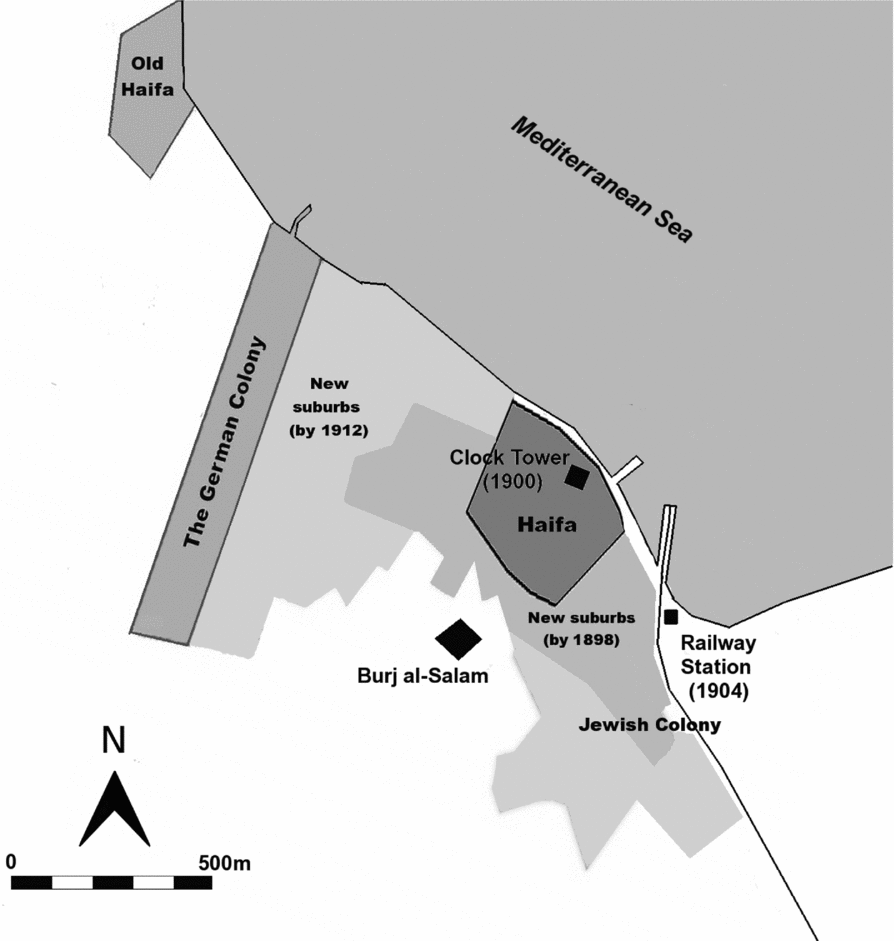
Haifa received a station befitting its status as a branch terminus, and this building was one of several that profoundly changed the city throughout the nineteenth century. The settlement at Haifa originally had been situated on the western tip of the Bay, now the suburb of Bat Galim. That original city was largely destroyed when the location of the town was moved by Zahir al-’Umar, the notable who controlled much of Galilee in the mid-eighteenth century. He constructed a walled city in what is now called the Lower City or Downtown (Ha-ʿIr ha-Taḥtit/Al-Baladah al-Taḥtī), above which a castle (the burj al-salām) was established (see Figure 1).
Late Ottoman Haifa Sources: Information from K. Baedeker (ed.), Palestine and Syria: Handbook for Travellers (Leipzig and London, 1876), 348; K. Baedeker (ed.), Palestine and Syria: Handbook for Travellers, 2nd edn (Leipzig and London, 1894), 229; K. Baedeker (ed.), Palestine and Syria: Handbook for Travellers, 3rd edn (Leipzig and London, 1898), 265; K. Baedeker (ed.), Palestine and Syria, with the Chief Routes through Mesopotamia and Babylonia: Handbook for Travellers, 4th edn (Leipzig and London, 1906), 225; K. Baedeker (ed.), Palestine and Syria, with Routes through Mesopotamia and Babylonia and the Island of Cyprus: Handbook for Travellers, 5th edn (Leipzig and London, 1912), 229; The National Archives, Kew, MPH 1/223, ‘A map of Palestine from surveys conducted for the Committee of the Palestine Exploration Fund’, 1890–94; Hebrew University of Jerusalem, Historic Cities Digitization Project: ‘Plan of Haifa’ from F. Palmer, ‘Report on the provision of harbour facilities for Palestine’ (London, 1923), http://historic-cities.huji.ac.il.

Due to improving commercial links, Haifa began to expand and develop from the mid-nineteenth century, with Ottoman and foreign Christian suburbs to the west of the walled city, and Ottoman Muslim and Jewish, and later Zionist, settlement to the east. Amid this changing urban landscape, and with Muslims accounting for less than half of the city's population, the imperial government sought to build monumental structures that would emphasize the city's links with Islam and empire, the first being a clock tower built in the walled city, the second the Hejaz Railway station constructed in the new neighbourhoods to the east and the third the Exalted Column commemorating that railway, situated next to the station.
Haifa was not alone in receiving infrastructural attention from the Ottoman state in this period. Damascus gained railway links to its wider province and beyond, a tramway system and electric street lighting by 1907, and a pipeline to provide drinking water by 1909.Footnote 20 Ottoman sultans and elites had provided amenities in provincial cities in Syria and Palestine dating back to the sixteenth century, but the central state by no means held a monopoly on the endowment of the pious foundations (waqf) that provided fountains, soup-kitchens, mosques and schools in provincial centres before the nineteenth century. Local elites, keen to gain influence and to establish and solidify patronage networks, but also to demonstrate their credentials as pious Muslims, were the primary benefactors in cities such as Damascus.Footnote 21 In Palestine in particular, major religious and social welfare structures like the Great Mosque of Jaffa, built by the local governor in 1812, and Acre's Khān al-ʿUmdān, a caravanserai and market place built by the dominant local notable in Palestine, Ahmad al-Jazzar, in 1784.Footnote 22 As Vincent Lemire demonstrated in his study of the use of water in Jerusalem, these public monuments were not simply political instruments, but carried with them complex layers of religious, economic, technological and social meaning.Footnote 23 This legacy helps to explain why the Ottoman state under Abdülhamd II invested so much into building monumental structures that represented the state and its aims, whilst at the same time providing services and opportunities to the local population.Footnote 24 Given the city's relative neglect by previous sultans, the structures erected in Haifa in this later period of Ottoman rule provide good examples of this wider construction project.
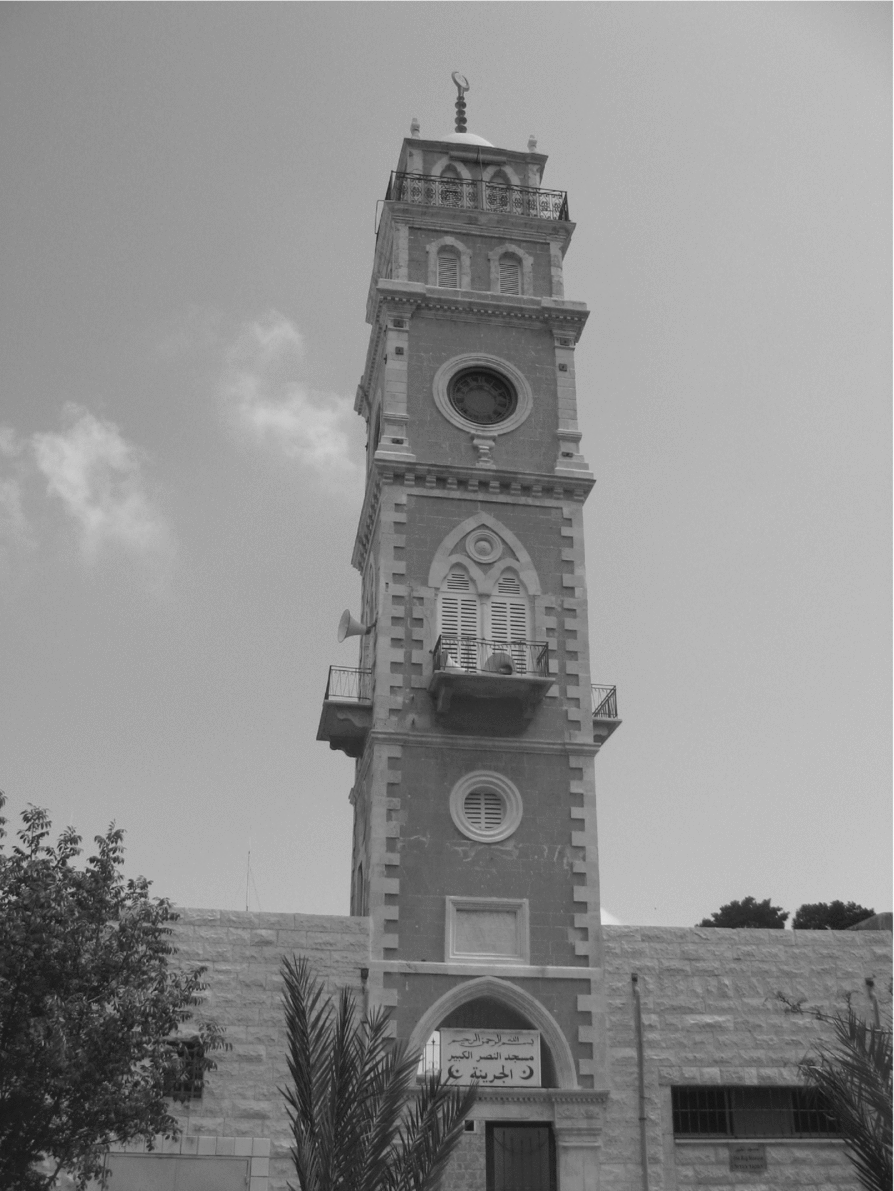
The first monument to be considered is the clock tower constructed at the Jarīnah Mosque (see Figure 3 below). This large mosque was built inside the walled city in 1774 to commemorate the re-establishment of Ottoman rule after the death of al-’Umar, but as a religious site it was unremarkable. Haifa contained no Islamic shrines (maqām) unlike, for instance, Acre, which possessed both a grand mosque holding a hair of the Prophet's beard (al-Anwār Mosque), and a shrine of the prophet Salih; even the nearby village of Jabaʿa had a maqām to a certain Shaykh Amir.Footnote 25 What made the Jarīnah Mosque notable was not a religious structure, but the monumental clock tower that was constructed in 1899, one of many being built across the Ottoman empire to commemorate the Silver Jubilee of Adbülhamid II in 1900.
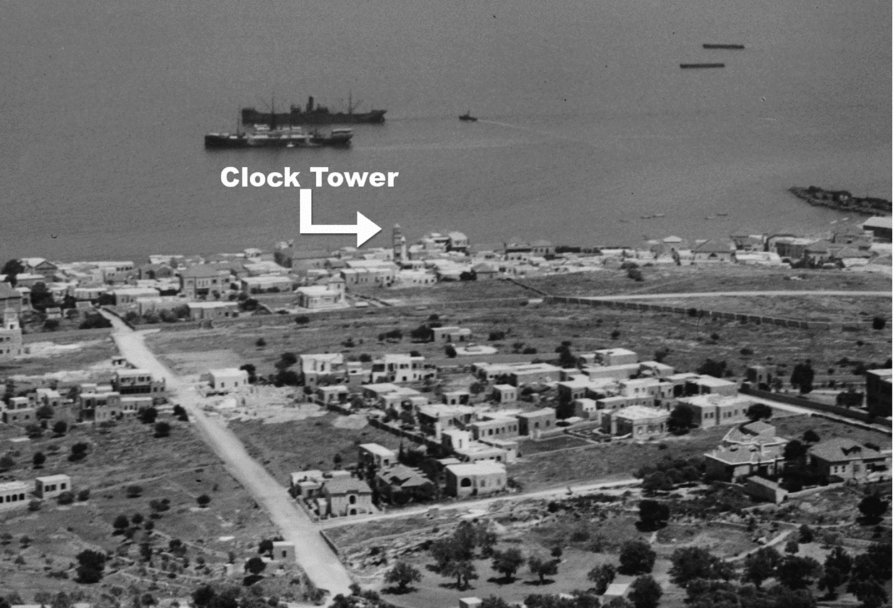
The clock tower and walled city viewed from Mount Carmel, early twentieth century Source: Detail from ‘Haifa and bay, showing place of anchorage’, unknown photographer, c. 1900 – c. 1920, from the G. Eric and Edith Matson Photograph Collection digitized by the Library of Congress, LC-DIG-matpc-05575, downloaded from www.loc.gov.
The Hamidian clock tower at the Jarīnah Mosque, 2013 Source: Photograph by the author, 12 Apr. 2013.
It is important to note that despite the construction of clock towers, private timekeeping must have remained centred on prayer times.Footnote 26 For the majority of Ottoman subjects, the dissemination of European time must have had a limited impact, except in creating some temporal confusion; by the end of the nineteenth century, an Ottoman subject would have to negotiate two timekeeping and three calendar systems. These monumental clock towers in the empire's urban centres, therefore, had far more of a symbolic role of imposing order and uniformity across a vast political and varied demographic space. Describing the communal celebration of Abdülhamid II's Silver Jubilee in 1900, which often centred on these new clock towers, Jens Hanssen argued that ‘simultaneity of symbolic action would thus bring about the imagining of a common community on a common geography in a common time frame’.Footnote 27 Rather than changing how people measured time, these clock towers created a physical and temporal space replicated with local variations in over 100 urban centres, and thus the clock tower as an imperial structure was an attempt to provide a tangible link between those cities and their denizens.
In this way, the Jarīnah Mosque, lacking any sort of religious stature, acquired an imperial significance. The clock tower became the tallest structure in Haifa at that time, and its domination over the walled city and surrounding areas can be seen in Figure 2, a view of the cityscape from the early twentieth century. Moreover, the deliberate positioning of a monument to the sultan and modernity over the entrance to the city's main mosque was a powerful statement of Ottoman state ideology, combining Islam with progress and homogenization in the name of the Ottoman monarch. However, whilst this was an imperial monument, the financing of its construction was almost certainly the responsibility of the municipality. It is unclear how exactly Haifa's clock tower was financed, but in the provincial capital Beirut the governor requested permission from the central government to build a tower from municipal funds.Footnote 28 The Russian Jewish newspaper Ha-Melits (The Advocate) reported on the inauguration of the Jaffa clock tower in 1900 that the Jews there ‘shared in the expenses of building the tower, in honour of the sultan’.Footnote 29 If the municipalities of Beirut and Jaffa used municipal and private funds to fund their clock towers, it is reasonable to assume that the Haifa municipality did the same. In this sense, there is continuity with earlier practices of local elites providing urban monuments and facilities for the city.
Although five other cities in Palestine constructed clock towers for the Silver Jubilee, none saw such an explicit combining of imperial and religious space. In Acre, the clock tower was placed over the Khān al-ʿUmdān, in Jaffa and Nablus it stood alone as part of a public square, in Safed it formed part of the Ottoman government building and in Jerusalem it was built over the Jaffa Gate. That in Haifa – similar in design to that in the provincial capital, Beirut – was the only one that was part of a mosque complex in Palestine. There are examples of clock towers in and around mosque complexes elsewhere in the Ottoman empire, notably that in the courtyard of the Yıldız Hamidiye Mosque in Istanbul, yet there was clearly a deliberate choice made in Haifa to make the clock tower a part of the mosque itself.Footnote 30 Despite this, the clock tower bears no invocation to God (unlike the Exalted Column, as will be seen), with only a brief dedication and the declaration, ‘long live our Sultan Abdülhamid’.Footnote 31 It therefore cemented the relationship between Islam and the state in a city lacking in earlier imperial patronage or Islamic credentials.
The buildings associated with the railway provide a clearer insight into the relationship between the Ottoman state and Haifa in this period. The Haifa railway project had originally been run by a British company that purchased construction rights as a concession from the Ottoman government in 1890, but so little progress was made that the Ottoman state bought back the concession in 1901 and, with the assistance and expertise of German engineers, completed work in 1905.Footnote 32 One can get a sense of the earlier frustration of the notables of Haifa and the region from the speeches made at the delayed inauguration of construction in 1892. Esad Tevfiḳ Efendi, the governor of Acre, issued a clear reproach to the British contractors:
The country has been waiting for your works, in expectation of the sign of your efforts; and news of you had varied on account of the length of time that passed, causing uneasiness in our minds, for the people prefer the completion of the work, though some had become weak in hope; but I wish you good fortune, victory, and good progress.Footnote 33
Other speeches at that event also made clear the ideological link between technological and moral progress, most notably in the speech of Ghattas Efendi, a Christian, thanking Abdülhamid for permitting the railway's construction in Haifa:
Too long the seeds of progress have been amongst us in a state of inertness, longing for a hand to raise them from this long apathy and bring them to light. Whenever we compared the past with the present, we asked ourselves if we were really the descendants of our ancestors. The past brought us but regrets; the present found us in the same inertness; and our future appeared as nothing but a series of vain illusions, when at last a shining star appeared on our horizon, which dissipated the darkness of this dark night, and revived the little life we still possessed, opening before us an era of moral and physical progress, to which our ancestors themselves have never attained.Footnote 34
Evidently, to the elite denizens of Haifa, Christian as well as Muslim, this project was more than simply one of physical connection, but linked to a wider understanding of the role of new technologies in strengthening communal identity.
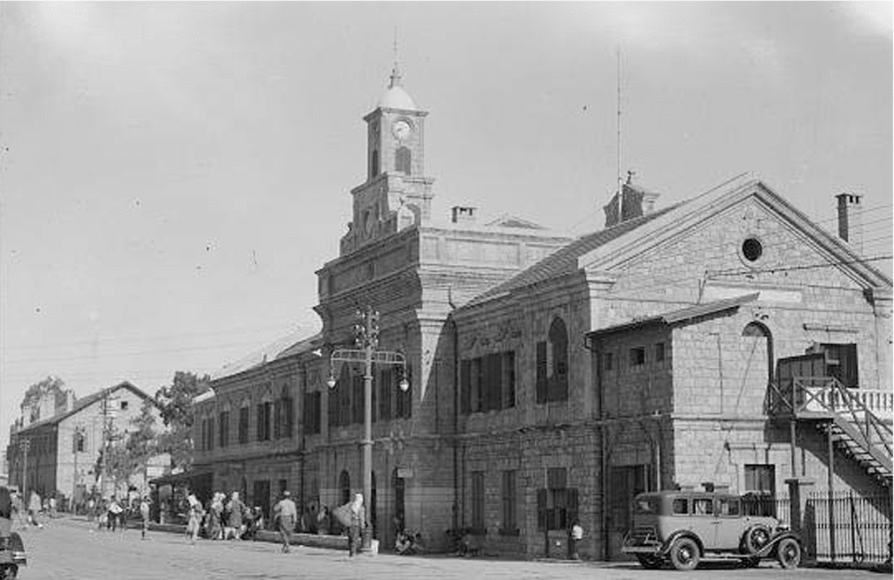
The buildings associated with the Hejaz Railway station, therefore, became monuments to Ottoman imperial authority, ideology and patronage, as well as to the linking of an expanding town with the wider world. Such ideas were embodied in the second major monumental structure, the station building (see Figure 4). This had its own domed clock tower, which rose up from among the new developments to the east of the walled city for whose expansion it was to be a catalyst. The design of the station itself, which Zeynep Çelik described as ‘baroque-flavoured’, was in many ways an elaborated and extended version of the common style of station on the Hejaz Railway, with the flourishes associated with the main termini at Damascus and Medina.Footnote 35 The addition of the tall clock tower tipped with an Ottoman crescent symbolized Haifa's integration with the rest of the empire, the crescent representing the sultan's authority and Islam, and the clock a demonstration of modernity and homogeneity.
Haifa station in the 1920s Source: ‘Haifa R.R. Station’, unknown photographer, c. 1920 – c. 1933, from the G. Eric and Edith Matson Photograph Collection digitized by the Library of Congress, LC-DIG-matpc-15372, downloaded from www.loc.gov.
The third monument was the Sütūn-u ʿĀlī, the Exalted Column to the sultan and his railway, which predated the construction of the station. Unlike even the most ornate of stations or clock towers, this new monument provided no practical use. No similar railway monument was erected in Damascus or Medina, and the only comparable monument was the column in Damascus celebrating the construction of the Hejaz telegraph network. The structure itself was neither tall enough to form a towering presence over the city of Haifa as the clock tower did, nor was it grand enough to provide a physical demonstration of Hamidian progress, as the station did. Indeed, as it was built prior to substantial urban development in the area east of the walled city, the station and its surroundings came to overshadow the Sütūn-u ʿĀlī. However, an analysis of this monument says much about the history of late Ottoman Haifa.
The Exalted Column in context
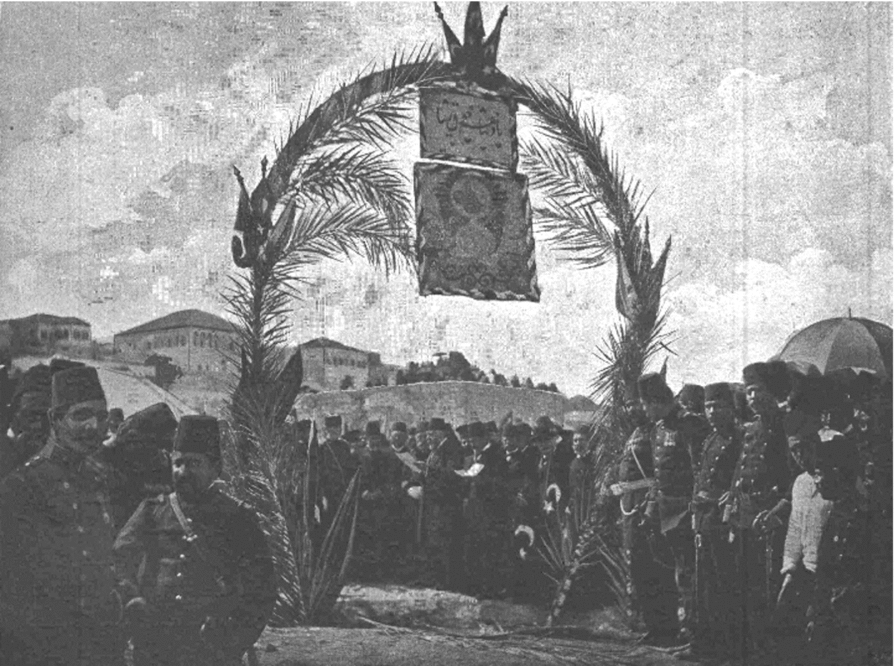
Before analysing the Sütūn-u ʿĀlī, it is important to attempt to establish why this monument might have been erected and in this form. Other stations had received temporary monuments for celebratory events, such as a triumphal arch over the railway tracks in Dara’a, featured in the newspaper Servet-i Fünūn.Footnote 36 A simple frame with foliage and flags, this also featured a display of weaponry in the style of the Ottoman coat of arms; this monument marked the official opening of the station, which had been timed to coincide with the celebrations for the anniversary of the sultan's accession.Footnote 37 A similar but smaller structure was erected in Haifa in April 1903, also depicted in Servet-i Fünūn.Footnote 38 This arch, called the ‘glorifying column’ (sütūn-u mefḫaret, see Figure 5), was decorated with palm fronds, Ottoman flags and two hangings, the top one proclaiming ‘long live the sultan’ and the other displaying Abdülhamid's emblem (the ṭuġrāʾ). The caption of a subsequent image of the arch notes that it was celebrating the Haifa branch reaching the sea. Given the date, the state of the railway and the attendance of important guests, it is highly likely that these images show part of a series of ceremonies celebrating Ottoman control of the railway that included the dedication of the Sütūn-u ʿĀlī.Footnote 39
The ‘glorifying column’, 1903 Source: Servet-i Fünūn, 1 Mayıs 1319 (14 May 1903), front page.
The Dara’a and Haifa temporary monuments were part of a wider trend of erecting arches decorated with foliage and flags on certain special occasions over railways in Europe, North America and beyond, from the inauguration of railways in Mexico, to the opening of a bridge in Wazirabad by the prince of Wales in 1876, to the funerary rail journey of Abraham Lincoln in 1865.Footnote 40 Similarly, permanent monuments to railways did exist in other contexts, such as the column crowned with a double-headed eagle on one of the platforms at Vladivostok station marking the end of the Trans-Siberian Railway.Footnote 41 The inspiration for the Exalted Column almost certainly came from Germany, whose engineers were so prominent in the construction work on the Hejaz Railway. One particular example is the monument commemorating the first steam railway in Germany, the Ludwig-Eisenbahndenkmal (Ludwig Railway Monument) in Nuremberg, completed in 1890, which contained a number of features that also can be found on the Sütūn-u ʿĀlī. As well as bearing an inscription commemorating the patronage of Bavaria's king Ludwig I (1825–48), the monument contains the emblem of the railway, a bronze relief depicting one of the early trains steaming ahead, and a sculpture of Heracles atop a winged wheel.
It has been conjectured that the Sütūn-u ʿĀlī was the work of the Italian architect, Raimondo d’Aronco, who designed the striking monument to the Damascus–Medina telegraph line.Footnote 42 Despite the lack of evidence to explicitly link d’Aronco to the Sütūn-u ʿĀlī, it could well be part of his portfolio. However, given the German influence found on the rest of the Hejaz Railway, and particularly given the presence of a German settlement in Haifa, it seems feasible to draw a link between the aesthetic of the Eisenbahndenkmal and the Sütūn-u ʿĀlī. Indeed, in an article on German involvement in Ottoman railways written in 1913, the prominent German technological journal Die Welt der Technik (The World of Technology) claimed that ‘the station and the railway monument in Haifa, the current starting point of the Hejaz Railway, are of German origin’.Footnote 43
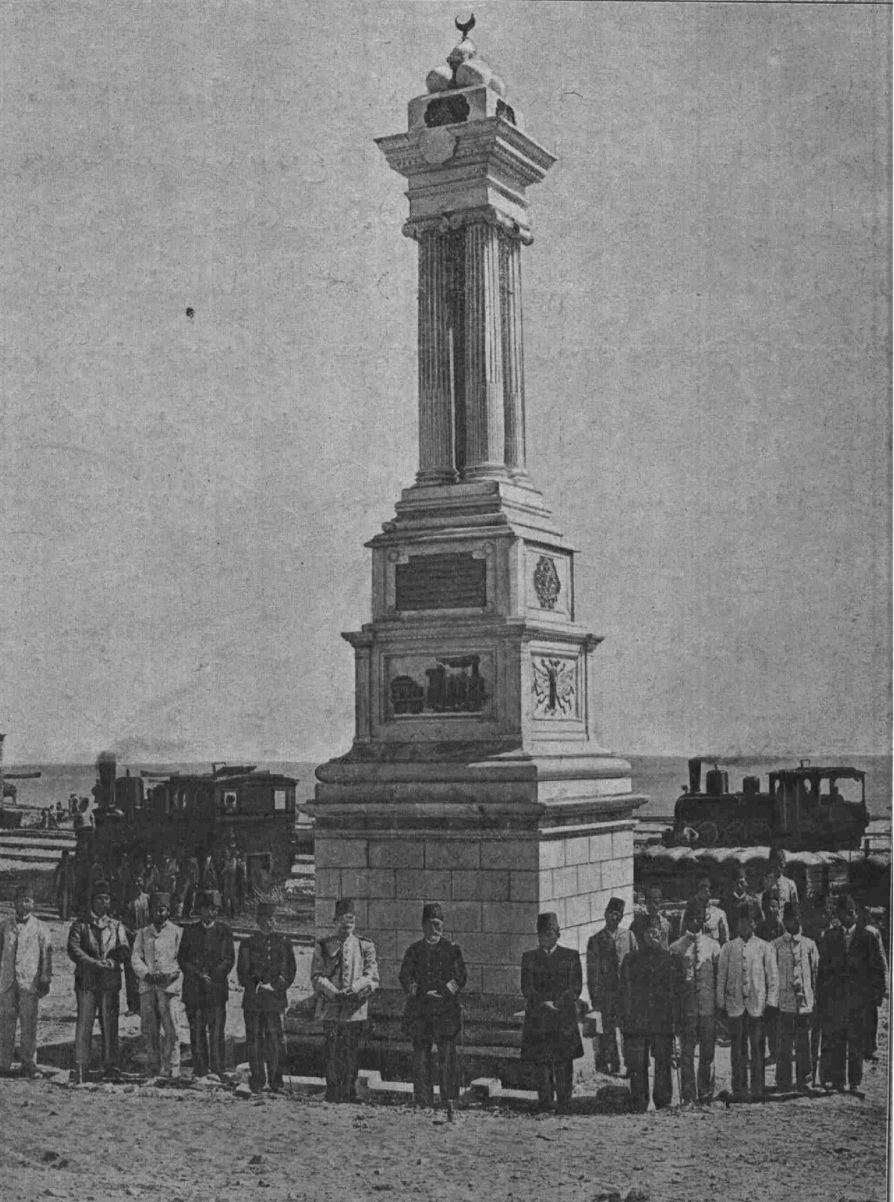
Easier to establish, yet frequently misunderstood, is the purpose of the Sütūn-u ʿĀlī. Figure 6 shows the column at an official event, which has erroneously been given as depicting the official opening of the Haifa branch on 15 October 1905.Footnote 44 Part of this is due to the reproduction of this photograph in later publications, such as commemorative editions of the Ottoman newspaper Servet-i Fünūn in 1905 and the Sālnāme-i Vilāyet-i Beyrūt in 1908 on the completion of the entire Hejaz Railway.Footnote 45 Yet there are a number of clues indicating that it actually depicts the dedication of the monument on 11 April 1903, of which the temporary ‘glorifying column’ noted above was most likely part.
The dedication of the Sütūn-u ʿĀlī, 11 April 1903 Source: Servet-i Fünūn, 2 Teşrin-i evvel 1321 (15 Jan. 1905), front page.
The caption of the photograph in Servet-i Fünūn labels it as ‘Erecting the Exalted Column at the commencement of the Haifa branch of the Exalted Railway.’Footnote 46 This is likely the event described in the Palestine-based Hebrew-language newspaper Ḥavatselet (Lilly) in May 1903: ‘The news from Haifa is that the governor of the province of Beirut, together with many government officials, came to that city to visit the Haifa–Damascus railway now being built with the finances of the benevolent government, and so far work has been completed in laying twenty-five kilometres on the ground.’Footnote 47 Similarly, a report of the American consul in Beirut noted that, following the arrival of German engineers in Haifa on 5 April, on 11 April ‘the vali [governor] of the province of Beirut unveiled a monument in commemoration of the beginning of operations’.Footnote 48 That this photograph documents the commencement of construction, rather than its completion, can be further seen in the lack of development around the column, with none of the paved roads or adjoining buildings that were present at the inauguration of the line in 1905.Footnote 49
Furthermore, the Sütūn-u ʿĀlī bears two inscriptions on the upper level of the pedestal explaining its purpose. On the south-west side facing the road the inscription was written in Arabic, and that facing north-east inside the station was written in Ottoman Turkish. The different inscriptions have so far not been analysed, nor full translations provided of both.Footnote 50 Placing the inscription in both languages demonstrates that there was a desire to emphasize the link with the central government, whilst keeping the monument accessible to the Arabic-speaking residents of Haifa. Photographic evidence shows that the inscription panel (as with other decorations on the column) would have been painted to contrast with the whiteness of the stone to ensure maximum visibility. The Arabic-language inscription, using religious language to emphasize the railway's role in facilitating pilgrimage and prayer, reads in full:
In the name of God, the merciful and the compassionate: praise be to God alone and prayer and peace upon his final Prophet. Our lord and our master, the Commander of the Faithful and the Caliph of the Master of Prophets, Sultan of the two lands and Ruler of the two seas, the Sultan son of the Sultan, the conquering Sultan Abdülhamid Khan son of the conquering Sultan Abdülmecid Khan – may God extend his reign and prolong his life and his days – has ordered that a railway be established from Syrian Damascus to facilitate the pilgrimage of the nation of Muhammad (peace be upon him) to the House of God and to press their foreheads at the garden of the Messenger of God (peace be upon him). Then he gave his pious order – may God fully perpetuate his reign – that the railway be extended from the city of Haifa to join the Hejaz Railway for the pilgrimage of every Muslim to the House of God and to journey to the garden of the Messenger of God to pray to the Almighty that he support his great Caliphate and that he raise up his worthy workers in his sublime hand. Inaugurated in the year 1319 AH [1901/02].Footnote 51
Interestingly, the Ottoman Turkish text contains a somewhat different dedication, focusing more on the sultan's role in commanding the railway to be built:
In the name of God, the merciful and the compassionate: praise be to God alone and prayer and peace upon his final Prophet. Our lord, His Majesty the Commander of the Faithful and Caliph on Earth, Sultan of the two lands and Ruler of the two seas, the Sultan son of the Sultan, the conquering Sultan Abdülhamid Khan son of the conquering Sultan Abdülmecid Khan, desiring to strengthen the prayers of the Muslim pilgrims fulfilling the obligation of hajj and visiting the sweet-smelling garden of the Prophet, the magnificent threshold of the caliphate has undertaken a benevolent work in issuing the order and imperial command for constructing [the railway] from the noble city of Damascus to honoured Mecca. [This] memorial commemorates the magnificent imperial decree of the great order from the caliph stretching forth his hand that the Haifa railway become a branch line of the Hamidian Hejaz Railway. Year 1319 AH [1901/02].Footnote 52
All of this evidence places the monument at the beginning of Ottoman work on the Haifa branch, rather than at the end.
Thus, one can see the Sütūn-u ʿĀlī, erected very soon after the concession was purchased by the Ottoman state from the British company, as an important symbol of progress in a number of ways. It demonstrated progress in a literal sense, in that the British company had achieved little construction in over a decade of holding the concession. Yet it also represented progress in a more symbolic sense. Official Ottoman state ideology linked technological development with Abdülhamid's role as the sole religious and moral authority, and that the notables of Haifa embraced this narrative is clear from the speech of Ghattas Efendi. This background largely explains why Haifa received the Sütūn-u ʿĀlī, and not Medina or Damascus. The failed British attempt to construct the line had the potential to damage Haifa's development as a city. However, the failure of the foreigners was a great propaganda opportunity for the Ottoman government. The Sütūn-u ʿĀlī is in this sense a victory column, yet a closer examination of its imagery reveals much about the limitations of the Ottoman presence in Haifa.
The significance of the imagery on the Sütūn-u ʿĀlī
The Sütūn-u ʿĀlī combined imperial imagery with that of technology and progress in the specific context of Haifa. The monument presents three main symbols: the emblem of the Hejaz Railway; the Ottoman coat of arms; and a locomotive. These can be seen to represent technology, Ottoman authority and accessibility of the imperial discourse, all within the context of foreign settlement and development in Haifa.
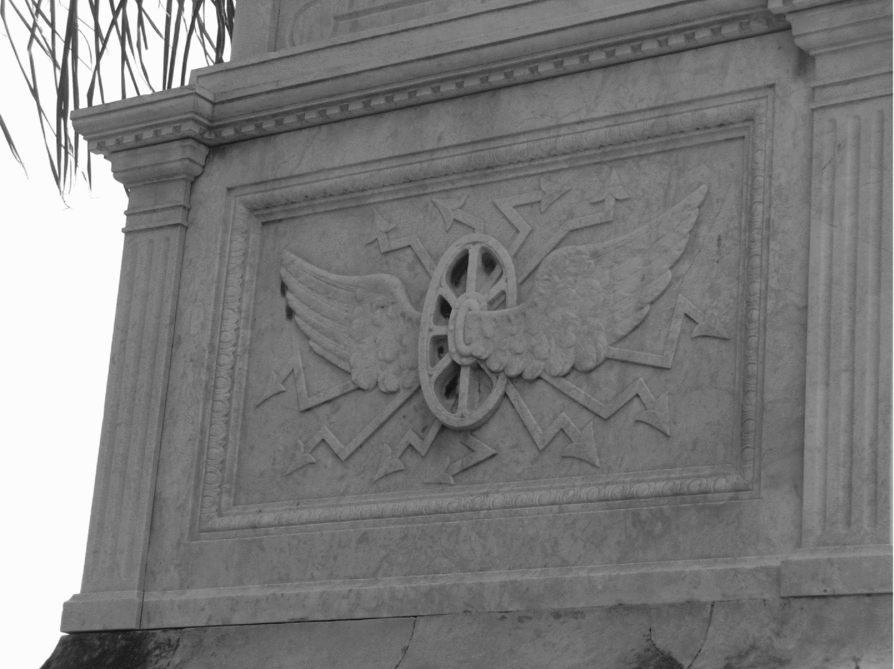
The first of these symbols is the emblem of the Hejaz Railway, a winged wheel surrounded by bolts of lightning, which was placed on the lower tier of the pedestal on the north-west and south-east faces (Figure 7). The winged wheel had been adopted by a number of European railway companies, notably German ones, and this symbol placed the Hejaz Railway and Haifa within that iconographic context. Notably, the Eisenbahndenkmal in Nuremberg was topped with this symbol, further demonstrative of both the German influence on the Hejaz Railway project and of the Ottoman desire to be seen to be part of a European technological modernity.
The winged wheel on the north-west face of the pedestal Source: Photograph by the author, 12 Apr. 2013.
The railway was not the only technological or infrastructural development to reach Haifa by the turn of the twentieth century. The 1880s and 1890s had seen an intensive programme of connective construction, led by Sadık Pasha, the ḳāʾimaḳām (regional governor) of Haifa between 1879/80 and 1889, and subsequently the mutaṣarrıf (district governor) of Acre.Footnote 53 In his speech praising the Ottoman government and berating the British contractors, Esad Tevfik had heaped praise upon Sadık Pasha for the improvements he had brought to the region, particularly mentioning the construction of a number of bridges, including one over the river Maḳtaʿ (today the Ḳishon) situated to the north of Haifa, and another over the river Naʿmīn (Naʿaman) south of Acre.Footnote 54 These two bridges were part of a major project to improve Haifa's road links with the surrounding region, and were completed by early 1892, prior to inauguration of the railway.Footnote 55 So proud was Sadık Pasha of this particular achievement, that he sent photographs of the bridges to be presented to the sultan.Footnote 56
However, as with many other such projects, the Ottomans had external assistance. One notable foreigner involved in developing infrastructure in the region was the German-American engineer, Gottlieb Schumacher, a resident of the German Colony in Haifa who had surveyed and mapped the Galilee region.Footnote 57 Schumacher was appointed as a district engineer for Acre in 1886, responsible for roads and bridges. Undoubtedly, he was the responsible for the bridges over the Maḳtaʿ and Naʿmīn rivers, and he made his mark on Haifa through the construction of a jetty in the German colony that was built in 1898 in preparation for the visit of Kaiser Wilhelm II of Germany (1888–1918).Footnote 58
Many of the other technological and infrastructural developments in Haifa came with the establishment of a colony of German Templers in 1868, the first Templer colony in Palestine.Footnote 59 Until 1898, Haifa's telegraph office, post office and sole steamer connection were run by the Austrian Lloyd Shipping Company (Österreichischer Lloyd) with the main aim of serving the German Colony. The only banks available were those of private individuals, such as A. Dück & Co. of the German Colony, or of foreign institutions like the London-based Bank of Syria.Footnote 60 Carriages to other towns were provided by the German Catholic Hospice and the German-run Hotel Carmel. Therefore, with many services provided by foreigners at the turn of the twentieth century, the Sütūn-u ʿĀlī can be seen as a statement of Ottoman efforts to play a more prominent role in the city. Indeed, the arrival of the railway saw the development of new Ottoman postal services including new post offices, as well as the establishment of banks and new steamer connections.
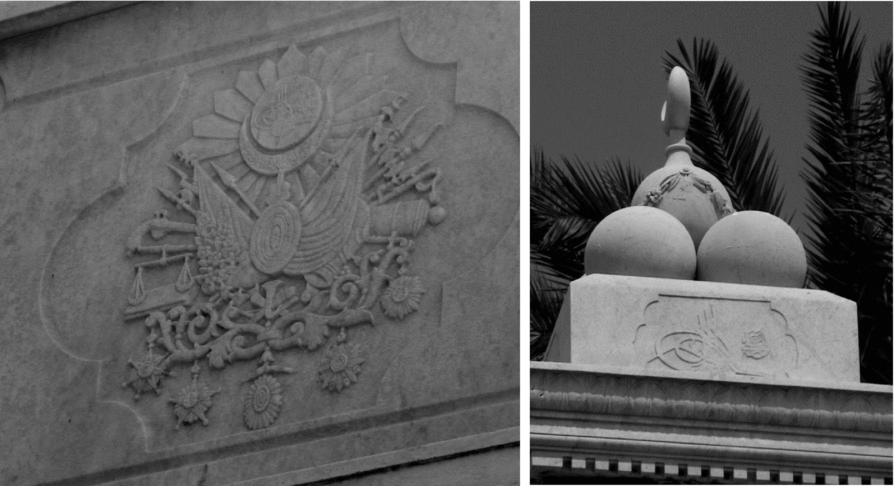
If the winged wheels were symbols of Ottoman technological development, then the second main image, the Ottoman coat of arms situated directly above them, was a clear sign of Ottoman authority in Haifa (Figure 8). From its introduction during the reign of Mahmud II (1808–39), these arms became an omnipresent symbol of the Ottoman state, adorning public buildings such as barracks, schools and hospitals, and featured on official documents, proclamations and newspapers. It was also used on temporary monuments, as in the cases discussed above. The arms were prominently displayed on the façades of major new Ottoman buildings in Palestine, such as the municipal hospital in Jerusalem. In Haifa, however, it seems to have been absent; the emblem was not placed on the clock tower, which did include an Ottoman/Islamic star and crescent above its gateway. It is possible that the Sütūn-u ʿĀlī might have provided the first architectural depiction of this symbol in Haifa.
The Ottoman arms on the north-west face of the pedestal (l) and the ṭuġrāʾ of Abdülhamid II beneath the cannonballs and crescent (r). Source: Photograph by the author, 12 Apr. 2013.
The emblem itself combined a variety of images that synthesized the past with the present, depicting the flags of the Ottoman sultanate and the Islamic caliphate, together with a mixture of old and new weapons, flowers of prosperity, the scales of justice over two books representing the two sources of Ottoman law (the Qur’an and European legal codes) and the various medals and orders of the Ottoman state. It was an emphatic display of old Islamic and Turkic traditions meeting and blending with the modern and European ideas and trappings adopted by the late Ottoman state.Footnote 61
In addition, above a representation of an Ottoman crown and sitting in an Islamic crescent was a disc containing the ṭuġrāʾ, a calligraphic seal of the sultan's name. This personal symbol of the monarch, which could be found on stamps, coins and other public displays of sultanic authority, was also placed at the top of the Sütūn-u ʿĀlī, just below a cluster of cannonballs that supported an Islamic crescent (see Figure 8). Through the display of the Ottoman arms and the sultanic ṭuġrāʾ, the Sütūn-u ʿĀlī was identified as an imperial monument that emphasized Haifa's links to a wider political and spiritual entity. This was something that was particularly important for the government in Istanbul given the increasing foreign influence in the city that threatened Ottoman authority in the city.
A major concern for the Ottoman government was the sale of land to foreigners. Although there had been few problems concerning the German Colony, Germany being an Ottoman ally, there was more suspicion over the settlement of foreign Jews, who largely came from the lands of the Ottoman arch-enemy, Russia. Despite attempts to stop foreign Jews from settling in Palestine, it is clear from a large number of documents in the Ottoman archives that such prohibitions were consistently ignored by local officials, and from the 1880s there was a growing Jewish colony to the east of the walled city.Footnote 62 The Ottoman government was particularly wary of individual agents such as Michel Erlanger, who represented the Jewish philanthropist Edmond de Rothschild and the Zionist Alliance Israélite Universelle (AIU).Footnote 63 As further evidence of the failure to halt foreign Jewish immigration, a report from early 1900 found that 22,000 dunams (5,436 acres) of land for 130 households had been purchased in the Haifa district by groups like the AIU.Footnote 64 It was therefore important that the Ottoman state placed a clear symbol of imperial rule over Haifa, and the Sütūn-u ʿĀlī, situated in the new eastern neighbourhoods inhabited by Ottoman Muslims and Jews as well as foreign Jewish immigrants, clearly played a role in this.
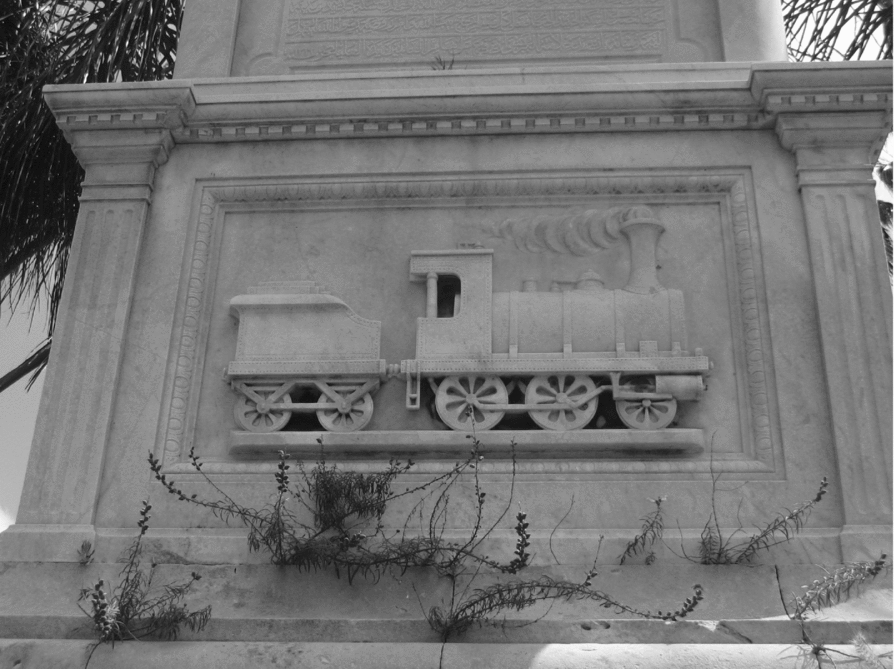
The final image on the Exalted Column depicted a locomotive steaming ahead, placed on the south-west and north-east faces of the pedestal (Figure 9). This image may provide further evidence of a German link with the Exalted Column, as the Nuremberg Eisenbahndenkmal featured a bronze relief of a train, and the 2–4–0 model locomotive depicted on the Sütūn-u ʿĀlī had been favoured by the Bavarian railways.Footnote 65 However, I contend that the reason for depicting this locomotive, aside from its aesthetic value, was that it served as a pictographic inscription for the benefit of the majority of the population who would have been illiterate and therefore unable to read the monument's inscriptions that were placed above it.Footnote 66
Education was a central part of the reforms and ideology of the government of Abdülhamid II, aimed at strengthening centre–provincial relations. As well as offering an education, they were intended to provide young Ottomans with feelings of loyalty towards the state.Footnote 67 According to the yearbook of the Ottoman Ministry of Public Education of 1319 (1901/02), an ibtidāʾī (elementary school) had opened in Haifa in 1874 and a rüşdiye (middle school) in 1877, both built in the eastern neighbourhoods.Footnote 68 Between 1882 and 1891, the Ottoman state established 19 ibtidāʾī schools in villages throughout the Haifa ḳażā.Footnote 69 However, attendance was low, the Haifa rüşdiye having just 15 boys, below the provincial average of 23 boys.Footnote 70 The nearest Ottoman ʿidādī (high school) at that time was in Acre, with 105 Muslim and 5 non-Muslim students learning mathematics, bookkeeping, algebra, geometry, history, geography, Arabic, Turkish, Persian, calligraphy, morality and religious sciences.Footnote 71 However, the separate non-Muslim schools in Haifa had far higher intakes, notably the Jewish ʿidādī with 150 boys, a large number even when compared with the Ottoman ʿidādī in the provincial capital Beirut (212 Muslims and 12 non-Muslims).Footnote 72
The locomotive on the south-west face of the pedestal Source: Photograph by the author, 12 Apr. 2013.
Despite the great effort to expand educational institutions in this and other regions, as with other forms of infrastructural development, the Ottomans had to contend with European institutions. The yearbook listed five foreign schools in Haifa: two German rüşdiyes with 30 boys and 25 girls, a German ʿidādī with 55 boys and 120 girls; a French ʿidādī with 150 boys; and a French priests’ school with an unrecorded number of students.Footnote 73 Clearly, the European schools were significantly ahead in terms of student intake. Even so, given that Haifa had a population of about 13,300 in 1900, school attendance was low, although more markedly in the Ottoman schools.Footnote 74 Even if more children received lessons in basic literacy through religious instruction, the text of the Arabic inscription on the Sütūn-u ʿĀlī surely must have been beyond the comprehension of many of Haifa's inhabitants. Given that the depictions of the locomotive are positioned directly beneath the two inscriptions, this would seem to indicate that it had a pictographic function, describing the monument in conjunction with the other symbols to those who could not read.
There is one final aspect of the Sütūn-u ʿĀlī's design that places the monument in a wider geopolitical context. As discussed above, German architectural and political influence was strong in the Hejaz Railway project (among others), and in the Ottoman empire in general in this period. One can see the overall design of the column, therefore, as something of a statement on the nature of this relationship. On the bottom level on the pedestal is the steam engine and the winged wheel, both appropriated for use by the Hejaz Railway, but quite clearly of German origin. The Ottoman layer above, consisting of the imperial coat of arms and the inscriptions, in a sense rests upon these symbols of German technological expertise. Whether this was the intention of the column's designer cannot be known, but the design of the column certainly gives these images greater prominence of positioning and size than those other symbols of the Ottoman state.
In sum, the imagery of technological progress and imperial authority found on the Sütūn-u ʿĀlī, together with its written and pictographic inscriptions, demonstrates the importance the Ottoman state placed in conveying its discourse. The choice of symbols also reflected the various problems and pressures the Ottomans faced in early twentieth-century Haifa. The city had been let down by the foreign contractors, had been neglected by earlier imperial administrations and had witnessed waves of foreign immigration with the establishment of the German and Jewish colonies in the west and east that had built their own infrastructure and institutions. The Sütūn-u ʿĀlī was not simply a monument to the joining of Haifa to the Hejaz Railway, although the religious and imperial message in that regard was quite explicit. Rather, it also was a monument to the development of an Ottoman state presence in Haifa.
Conclusion
Today, the main Ottoman monuments in Haifa no longer dominate the cityscape as they once did. The great clock tower is overshadowed by the neighbouring Beyt ha-Mifraś (Sail Tower), a 137m-high government building that sits at the heart of the old walled city. The Hejaz Railway station bears a new inscription in the form of a commemorative plaque noting that a bomb planted by the Jewish paramilitary group Irgun Tsvaʾi Leʾumi destroyed the central and eastern wing including the grand façade with its clock tower on 20 September 1946. The Exalted Column still stands next to the station, its paintwork gone, generally ignored, yet still a striking piece of architecture on one of the main roads through Downtown Haifa.
The Sütūn-u ʿĀlī provides a number of insights into the history of the Hejaz Railway, of Haifa at the turn of the twentieth century and of the projection of Ottoman state ideology in the provinces. Whilst part of an architectural movement in the Ottoman empire and in the wider world that used railways and their buildings to demonstrate the state's power and technological sophistication, the Sütūn-u ʿĀlī also had a specific local message. As the only permanent monument to the Hejaz Railway, the column could have been placed in the regional centre of Damascus, or in the holy city of Medina. Yet it was erected in Haifa, where much of the city's urban development had been undertaken by foreigners, notably those of the German Colony. It was unveiled at a time of increasing foreign immigration and the continuing influence of foreign schools, but also in the immediate aftermath of the Ottoman government rescuing the faltering Haifa railway project from the incapable hands of the British consortium. The column projects its message of progress, piety and imperial benevolence in a number of ways to be as accessible as possible, from two different inscriptions in two different languages, to the variety of symbols and images. The Sütūn-u ʿĀlī therefore provided a visual and epigraphic representation of the ideology of the Hamidian Ottoman state in combining modernity with Islam, but also served as a promise of imperial patronage for a city whose development was occurring largely outside of Ottoman control.