Introduction
Research on resilience has increased substantially over the past two decadesReference Haskett, Nears, Ward and McPherson1 and is now also receiving increasing interest from those involved with policy and practice in relation to its potential impact on health, well-being and quality of life. This interest is due to a move away from ‘deficit’ models of illness and psychopathology, as resilience theory focuses on understanding healthy development despite risk, and on strengths rather than weaknesses.Reference Fergus and Zimmerman2
Unfortunately the complexities of defining what appears to be the relatively simple concept of resilience are widely recognized, especially within the behavioural sciences.Reference Haskett, Nears, Ward and McPherson1, Reference Luthar, Cicchetti and Becker3–Reference Masten5 This creates considerable challenges when developing an operational definition of resilience; definitional variation leads to inconsistencies relating to the nature of potential risk and protective processes, and in the estimates of prevalence.Reference Haskett, Nears, Ward and McPherson1, Reference Luthar, Cicchetti and Becker3 A review of resilience research reporting prevalence data noted that the proportions found to be resilient varied from 25 to 84%.Reference Vanderbilt-Adriance and Shaw6
This has strong implications for improving knowledge about the factors that contribute to the development, maintenance or reduction of resilience and how resilience might be promoted to improve health and well-being. It is noted that many of the debates around the definition of resilience could be addressed by better science, including ‘rigorous attention to sharpening concepts’.Reference Masten5 In order to inform future research more clarity is required. This should be derived from a thorough methodological assessment to ensure it is underpinned by a robust scientific approach.
Limitations of current research on the concept of resilience
A number of discussion papers have contributed substantially to the study of resilience and their value to the advancement of knowledge on the topic is immense.Reference Fergus and Zimmerman2, Reference Luthar, Cicchetti and Becker3, Reference Masten5, Reference Bonnano7–Reference Luthar and Cicchetti10 However, in most cases these critiques have been mainly embedded within the discipline of developmental psychology and derived from studies of children and adolescents. Their content is rich and extremely informative, but it has not been developed from a clear methodological approach; for example, methods for obtaining the papers discussed are not presented.
Previous work has examined the concept of resilience within a recognized analytical framework: concept analysis.Reference Dyer and McGuinness11, Reference Gillespie, Chaboyer, Wallis and Grimbeek12 Concept analysis is a method of conceptual knowledge representation and data analysis that is routinely applied to clarify meanings and develop operational definitions, through considering evidence from multiple disciplines.Reference Walker and Avant13 The application of this recognized methodological framework enables a more objective approach to concept clarification and addresses differences in application within diverse scientific disciplines.
Unfortunately there are a number of methodological limitations with both of these previous concept analyses of resilience.Reference Dyer and McGuinness11, Reference Gillespie, Chaboyer, Wallis and Grimbeek12 In the analysis presented by Dyer and McGuinessReference Dyer and McGuinness11 the aims of the analysis are not clear, which is a first step of concept analysis.Reference Walker and Avant13 The search strategies for the literature reviews are not provided, nor is a rationale for which data should be included or excluded in the analysis. This presents a key drawback regarding the extent of the coverage of the research literature, as without a thorough, systematic approach it is quite possible that key omissions were made. This is particularly evident in both papers. For example, Gillespie et al.Reference Gillespie, Chaboyer, Wallis and Grimbeek12 state that self efficacy, hope and coping are the defining attributes of resilience. Dyer and McGuinessReference Dyer and McGuinness11 state that a sense of self, determination and pro-social attitude are the defining attributes. Whilst these constructs may be implicated in resilience, it is not clear why these specific ones were chosen whilst other, equally possible constructs (e.g. self esteem, competence) were excluded. Neither of the papers synthesize the literature to provide an operational definition of resilience.
As highlighted previously, the method of concept analysis can be poorly applied. Beckwith et al.Reference Beckwith, Dickinson and Kendall14 note that various concept analysis frameworks have been applied uncritically, and may not contain sufficient scientific rigour to add to theoretical development. PaleyReference Paley15 also notes that, within concept analysis, there is often a lack of clarity regarding the specification of how the defining attributes of the concept under question are identified. This has implications for identifying what might be viewed as a model case of resilience, or identifying other concepts that may be related to resilience, or indeed have been used in research to demonstrate resilience, but on closer inspection may not actually share all of the defining attributes.
Research objective
To address the need for concept clarification and improve the methodological approach in achieving this outcome, the aim of this paper is to present a review of the literature within a concept analysis framework. This will enable a more robust, theoretically informed measurement framework for future research on resilience. This paper synthesizes methodological approaches and draws on a range of disciplinary perspectives to address the question: ‘how can resilience be best defined in order to inform research, policy and practice?’
Specifically, the analysis will:
(i) clarify the meaning of the concept of resilience from a multi-disciplinary perspective;
(ii) develop an operational definition that is meaningful across different disciplines and stakeholders, and can be universally understood and applied across research, policy and practice;
(iii) highlight implications for future research.
To determine the definition of resilience, this paper draws on three approaches: concept analysis, literature review using systematic principles, and stakeholder consultation. Full details of the methods can be downloaded from: http://resilience.bangor.ac.uk/Work%20Programme%20Methodology.pdf
Resilience – identifying uses of the concept
Dictionary definitions
Resilience originates from the Latin ‘resilire’ (to leap back). General dictionary definitions note that the noun ‘resilience’ is a derivative of the adjective ‘resilient,’ which has two uses:
(i) 1. able to recoil or spring back into shape after bending, stretching, or being compressed; 2. (of a person) able to withstand or recover quickly from difficult conditions.16
(ii) 1. (of a person) recovering easily and quickly from misfortune or illness; 2. (of an object) capable of regaining its original shape or position after bending or stretching.17
Resilience is also defined in discipline-specific dictionaries as:
(i) the rate at which a system regains structure and function following a stress or perturbation;18
(ii) the personal quality of a person exposed to high risk factors that often lead to delinquent behaviour, but they do not do so;19
(iii) a measure of a body's resistance to deformation. Resilience is usually defined as the work required to deform an elastic body to its elastic limit divided by the volume of the body.20
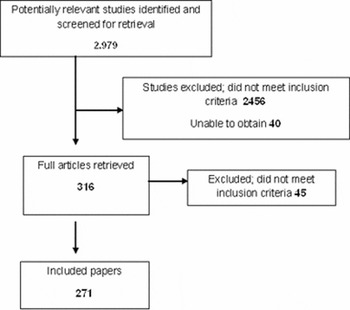
The academic search yielded a large amount of potential papers, which were primarily routed in the disciplines of psychology and the social sciences. The disciplines of education, health and medicine feature to a lesser extent. Figure 1 summarizes the process of the review.
Flow diagram of review process

Common within many of the papers was the recognition of the difficulties in defining resilience. Many authors went to commendable lengths to justify their description of the concept, drawing on theory and other research to inform their choice. In many instances authors did not present their own definition of resilience, but discussed the definitions and applications of other key researchers in the field of resilience research. Due to the volume of papers identified and to avoid repetition, a representative overview is presented. This was ascertained through examining the authors’ definition, and the supporting citations. These reflect the uses of the concept within different disciplines.
Developmental psychology
Underpinning the rationale for many researchers is the early work from developmental psychology on stress-resistant children by Garmezey,Reference Garmezy and Stevenson21 who set the scene for subsequent research to explore how protective factors might function. Masten et al.Reference Masten, Best and Garmezy22 defined resilience as the process of, capacity for, or outcome of successful adaptation despite challenging or threatening circumstances. Observations from longitudinal research spanning four decades describe resilience as an innate self-righting mechanism.Reference Werner and Smith23 More recently resilience has been defined as good outcomes in spite of serious threats to adaptation or development.Reference Masten24
Context – the life course
In many instances the risk or adversity is not an isolated event that the person is able to actively change. For example, a common adversity in studies of resilient children and adolescents is poverty and deprivation. From a life course perspective poverty and deprivation can persist. However, as adults develop there are a number of other adverse occurrences that create irreversible losses, such as bereavement of friends and relatives, unemployment, divorce and ill-health.
In relation to the study of older age, Staudinger et al.Reference Staudinger, Marsiske and Baltes25 propose that the management of loss should also be considered. Adaptation to situations such as chronic illness may be at a lower level of functioning, but should still be considered resilience, given the context of the adversity.Reference Greve, Staudiner, Cohen and Cicchetti26 In his research of adult trauma and bereavement, BonnanoReference Bonnano7, Reference Bonanno27 recognizes this distinction in the experience of adversity and notes that adult adversities are more likely to be isolated, but are potentially highly disruptive. He defines adult resilience as an individual's capacity to resist maladaptation in the face of risky experiences and to maintain a stable equilibrium. From a longitudinal perspective, resilience has been defined as the ability to ‘bounce back’ from adversity and go on with life.Reference Netuveli, Wiggins, Montgomery, Hildon and Blane28 Within a lifespan development framework, the examination of the ability to bounce back from earlier dysfunction can highlight adaptation and turning points at all stages of the life course.Reference Goldstein32 This reflects the notion of ‘steeling effects’, an important aspect of Rutter's workReference Rutter30 in relation to the life course, where effective negation of risk exposure earlier in life facilitates a resilient response later.
Environmental perspectives on resilience
As with the dictionary definitions, there are definitions used within specific academic disciplines. From the ecological perspective comes the idea of social resilience, the ability of groups or communities to cope with external stresses and disturbances as a result of social, political and environmental change.Reference Adger31 In the face of an environmental disaster, social–ecological resilience is defined as how far a particular relationship between social processes (e.g. informal networks within civil society and the private sector) and ecological dynamics can be disturbed without dramatic loss of complexity of both, rather than the speed at which the status quo can be restored after disturbance.Reference Goldstein32 In the context of school and education, resilience is the ability to thrive academically despite adverse circumstances.Reference Kitano and Lewis33, Reference Sutherland34
Biology and psychiatry
From the field of psychiatry, overcoming stress or adversity is how RutterReference Kitano and Lewis33 views resilience, with a focus on relative resistance to psychosocial risk experiences. He notes that the identification of resilience requires examining a range of possible psychological outcomes, not just a focus on an unusually positive one or on super-normal functioning. The limited number of papers that looked at the neuroscience/biological contributors to resilience define it as competent functioning despite adversity, but emphasize it is a ‘dynamic process that is influenced by neural and psychological self-organisation, as well as transactions between the ecological context and the developing organism’.Reference Curtis and Cicchetti8 Nigg et al.Reference Nigg, Nikolas, Friderici, Park and Zucker35 also highlight that the avoidance of psychopathology is critical to resilience. From a genetics perspective, resilience can be viewed as the degree to which the person at genetic risk for maladaptation and psychopathology are not affected.Reference Luthar, Cicchetti and Becker3
Personal characteristics
Others suggest that resilience represents personal qualities that enable the individual to thrive in the face of adversity,Reference Connor and Davidson36 or that resilience is a relatively stable personality traitReference Kirkwood, Bond, May, McKeith and The37 characterized by the ability to overcome, steer through and bounce back from adversity.Reference Ong, Bergeman, Bisconti and Wallace38 Alternatively it may be viewed as a personality factor that protects against life adversities and negative emotions by resourceful adaptation, flexibility and inventiveness.Reference Roth and von Collani39 From the policy perspective, in ‘Equally Well’, a report from the Ministerial Task Force in Health Inequalities,40 resilience is also viewed as an individual attribute and is defined as a personal strength/vulnerability that can influence socio-economic inequalities in health. The focus of resilience as a personal attribute has generally been addressed more within the adult literature than with children.Reference Luthar and Brown9 Also, the examination of resilience by assessment of personality characteristics is a point of debate in the literature and warrants discussion. The main point of contention is that psychological resilience is viewed by some as a fixed, stable personality traitReference Kirkwood, Bond, May, McKeith and The37, Reference Silk, Vanderbilt-Adriance, Shaw, Forbes, Whalen, Ryan and Dahl41 and that resilience is not, and cannot be, an observed trait.Reference Rutter42 Others exercise caution against referring to any representations of resilience as a stable personality trait/characteristic, as this implies that a person who does not have this attribute is somehow a failure.Reference Luthar, Cicchetti and Becker3
Resilience as a process
As resilience research has developed, so has the focus of study, away from identifying some of the key factors associated with resilience, to understanding the mechanisms by which they might operate. In this context, resilience refers to a dynamic process encompassing positive adaptation within the context of significant adversity.Reference Luthar, Cicchetti and Becker3 Resilience has been described as processes and patterns of positive adaptation in development, during or following threats to adaptation.Reference Masten, Burt, Coatsworth, Cohen and Cicchetti43 Hjemdal et al.Reference Hjemdal, Friborg, Stiles, Rosenvinge and Martinussen44 define resilience as the protective factors, processes and mechanisms that contribute to a good outcome despite experiences with stressors that carry significant risks for mental ill health. Policy from the World Health Organisation views resilience as something that embraces positive adaptation, with protective factors and assets that moderate risk factors and therefore reduce the impact of risk on outcomes.Reference Friedli45 The American Psychological Association46 defines resilience as the process of adapting well in the face of adversity, trauma, tragedy, threats, or even significant sources of stress – such as family and relationship problems, serious health problems, or workplace and financial stressors. It means ‘bouncing back’ from difficult experiences.
Diversity in the operation of resilience
In a review of the literature, MastenReference Bonnano7 suggests that the concept of resilience has been described as (1) developing well in the context of high cumulative risk for developmental problems (beating the odds, better than predicted development); (2) functioning well under currently adverse conditions (stress-resistance/coping); (3) recovery to normal functioning after catastrophic adversity or severe deprivation (bouncing back, normalization). As well as examining resilience, research in the UK by Bartley and colleagues also includes capability, referring to the ability to react and adapt positively when things go wrong.Reference Bartley, Schoon, Mitchell, Blane, Ziglio and Morgan47 They use a multi-dimensional definition of resilience, which refers to the process of withstanding negative effects of risk exposure, demonstrating positive adjustment in the face of trauma or adversity and beating the odds associated with risks, focusing on socio-economic disadvantage and poverty.
Stakeholder perspectives
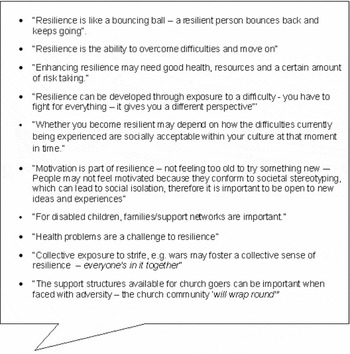
In order to extend scientific definitions and reflect a wider perspective from service users and providers, stakeholders were asked in consultation workshops to consider how they would define resilience. Their responses reflected experiences from their own lives, which they felt might enhance or be detrimental to resilience. Considering that the stakeholder group was not familiar with the academic research on resilience, their ‘reality driven’ perspectives generally reflect those posed by science and dictionaries (see Figure 2). The stakeholders felt that the term ‘bouncing back’ was meaningful and gave an implicit understanding of the concept and what it represents.
Examples of stakeholder comments

Determining the defining attributes of resilience
The overview of uses of resilience so far highlights some diversity but many similarities in how it has been defined across a range of areas, confirming the complexity that underlies the concept. All the identified uses of the concept are considered beneficial for the further stages of the analysis. How resilience is defined reflects how it might be measured and so assessment is intricately tied up with issues of definition. Through the next steps of the analysis, an in-depth exploration of the antecedents, defining attributes and consequences will assist with concept clarification; whether resilience is best viewed within a dynamic, multi-dimensional model or as a unitary construct.
This step requires identification of the attributes most frequently associated with the concept. This phase has important implications for measurement as, alongside the identification of the antecedents and consequences, it can provide a useful basis for developing measures and evaluating existing ones.Reference Paley15 The definitions highlight a number of factors that could be considered defining attributes of resilience (e.g. adversity, resistance, adaptation). However, to understand resilience it is also important to understand what underlies these attributes and the subsequent outcomes.
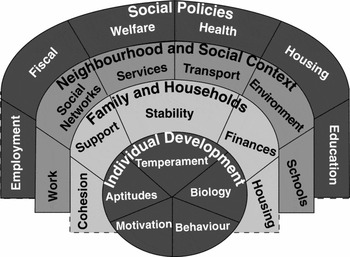
In order for resilience to be achieved, a consensus within research is for the role of protective factors, also referred to as ‘assets’, ‘resources’ or ‘strengths’.Reference Gillespie, Chaboyer, Wallis and Grimbeek12, Reference Werner and Smith23, Reference Kitano and Lewis33, Reference Richardson51–Reference Werner56 These are recognized as crucial in achieving resilience and, through their dynamic interplay, enable the ability to respond positively to risks and alter or reduce the effects of adversity. In other words, they facilitate the competence/capability that enables resistance to adversity and underlies the process of adaptation.Reference Olsson, Bond, Burns, Vella-Brodrick and Sawyer54 Competence is the capacity or motivation for, or process of effective adaptationReference Masten, Burt, Coatsworth, Cohen and Cicchetti43 and enables adaptive use of resources within and outside the person. It is based on the beliefs of perceived effectiveness in adaptation and arises from interactions with the environment. Experiences that enable successful adaptation can inspire further confidence to overcome future challenges and set-backs. Competence has been identified as an essential component of the resilience experience.Reference Fergus and Zimmerman2 The protective factors have commonly been identified across three levels of functioning: (1) individual (e.g. psychological, neurobiological), (2) social (e.g. family cohesion, parental support) and (3) community/society (e.g. support systems generated through social and political capital, institutional and economic factors).Reference Garmezy55, Reference Werner56 Some researchersReference Fergus and Zimmerman2, Reference Sacker and Schoon57 distinguish the individual level protective factors as assets, whereas resources are viewed as external to the individual. Assets might include factors such as competence and efficacy; resources encompass the contextual or environmental influences, such as family support and community services. Figure 3 presents an example of the multiple layers at which health promoting factors might occur. A full discussion of protective factors is beyond the scope of this paper (for more detailed reviews see Charney,Reference Charney58 Curtis & Cicchetti,Reference Curtis and Cicchetti8 Luthar,Reference Luthar, Cohen and Cicchetti29 Mowbray et al.,Reference Punamäki, Qouta, El Sarraj and Montgomery52 MastenReference Masten5 and Vanderbilt-Adriance & ShawReference Vanderbilt-Adriance and Shaw6).
Example of the layers of resources and assets that facilitate resilience (from A. Sacker, personal communication, September 2009; adapted from Dahlgren & Whitehead, 1991, with permission)

Antecedents
Antecedents are the events that must happen prior to the occurrence of the concept.Reference Walker and Avant13 Within resilience research, a necessary requirement is the experience of a risk or adversity that carries a significant threat for the development of a negative outcome. The context of the adversity could be biological, psychological, economic or social, and cover areas such as stress,Reference Freeman, Kimbrell, Booe, Myers, Cardwell, Lindquist, Hart and Komoroski59 diagnosis of Alzheimer's disease,Reference Braudy-Harris48 the impact of poverty and economic disadvantage,Reference Buckner, Mezzacappa and Beardslee60 refugee children,Reference Daud, af Klinteberg and Rydelius61 children in care,Reference Flynn, Ghazal, Legault, Vandermeulen and Petrick62 caring,Reference Horton and Wallander63 ill-health in older age,Reference Windle, Woods and Markland64 and bereavement.Reference Mancini and Bonanno65 Within neurobiological approaches, from a developmental perspective, resilience has been identified from studying why childhood adversity leads to maladjustment in some children but not others.Reference Curtis and Cicchetti66 Others have explored why some individuals exposed to trauma develop post-traumatic stress disorder (PTSD) while others do not.Reference Hoge, Austin and Pollack67 Neighbourhood deprivation has been found to contribute to depression is some individuals, but not others.Reference Silk, Vanderbilt-Adriance, Shaw, Forbes, Whalen, Ryan and Dahl41
A key point is that it is misleading to use the term resilience if a stressor, under normal circumstances with a majority of people, would not ordinarily pressure adaptation and lead to negative outcomes.Reference Roisman68 Vanderbilt-Adriance & ShawReference Vanderbilt-Adriance and Shaw6 also caution that not all risks are equivalent in severity; some may be acute and others chronic and persistent. Thus any findings for the occurrence of resilience can only be considered within the context of that specific adversity.
Consequences
Consequences are the end-points that occur as a result of the antecedents and attributes of resilience. Having considered the previously outlined definitions within resilience research, the required outcomes of resilience should reflect the maintenance of normal development or functioning (mental or physical health), or better than expected development or functioning, given exposure to the adversity under question. This might not necessarily be an exceptionally positive outcome. Within a life span developmental perspective, the resilience process is often referred to as positive adaptation or adjustment.Reference Fergus and Zimmerman2, Reference Luthar, Cicchetti and Becker3, Reference Rutter30
It is worth noting that some of the conceptual difficulties around resilience are determined by the criteria researchers use to assess how the outcome is a ‘good’ one and reflects adaptation. Within child and adolescent research, the achievement of salient developmental tasks in the face of adversity, such as learning to read and write, attending and behaving properly at school, are viewed as positive outcomes.Reference Masten24
The nature of the risk/adversity could be used to guide the strength of resilience, for example for severe to catastrophic events, the maintenance of near-average functioning is adequate.Reference Masten, Hubbard, Gest, Tellegen, Garmezy and Ramirez69 Also within the context of severe adversity, a return to normal functioning or ‘recovery’ may be sufficient.Reference Masten24 It is also important to consider the meaning of the adversity to the individual, as it may amplify or attenuate subjective distress,Reference Yehuda and Flory70 which suggests that in an ideal research design, both subjective and objective outcome measures be incorporated.
Other research with older adults defines a resilient outcome as flourishing despite adversity.Reference Hildon, Smith, Netuveli and Blane71 However, within a resilience framework, superior functioning is not the expected outcome. The term ‘flourishing’ tends to be placed more in the realms of positive psychology, where the focus is on good outcomes for all individuals, not just those who experience significant difficulties.Reference Luthar, Cohen and Cicchetti29 RutterReference Rutter30 also cautions that the study of resilience should examine a range of possible [psychological] outcomes, rather than focus on an unusually positive one, or on super-normal functioning. If too narrow a range of outcomes are considered, or reliance is placed on one data source, or if there is measurement at only one point in time, resilience may be artefactual.
Similarly, within the disciplines of prevention of substance abuse and psychopathology, the absence or avoidance of psychopathology, or low levels of symptoms, are viewed as a good outcome.Reference Luthar, Cohen and Cicchetti29, Reference Waller, Okamoto, Hankerson, Hibbeler, Hibbeler and McIntyre72 This approach has been criticised by Olsson et al.,Reference Olsson, Bond, Burns, Vella-Brodrick and Sawyer54 who note that considerable adolescent research has demonstrated that young people functioning well under high stress often show higher levels of emotional distress compared with their low-stress peers, and so resilience may not be the absence of distress and measuring such outcomes may be misleading. Indeed, the presence of distress AND the maintenance of competence may be one of the strongest forms of resilience. The key point is that there is no necessary expectation that protection from stress and adversity should lead to positive experiences.Reference Rutter30
Defining empirical referents
According to Walker & AvantReference Walker and Avant13 empirical referents are ‘classes or categories of actual phenomena that by their existence or presence demonstrate the occurrence of the concept itself’. This aspect of concept analysis is concerned with how resilience would be measured. There are three key features emerging from the analysis that demonstrate the experience of resilience: the encounter with adversity, the ability to resist and adapt to the adversity, and the avoidance of a negative outcome. A simple assessment of resilience then needs to consider: (a) what is the risk or adversity?, (b) which assets/resources might offset the effect of the risk?, and (c) is the outcome better than could be expected (comparing with a group of individuals not at risk, or comparing on the presence or absence of the assets/resources)? Researchers have utilized two main approaches to the study of resilience that address these three key features, described by MastenReference Masten24 as variable focused and person focused approaches.
Variable focused approaches
These use multi-variate statistics to examine the relationships between adversity, outcome and the protective factors/assets. Within the variable focused approach are three models – compensatory, protective and challenge – which explain how the protective factors can alter the effects of adversity on outcome.
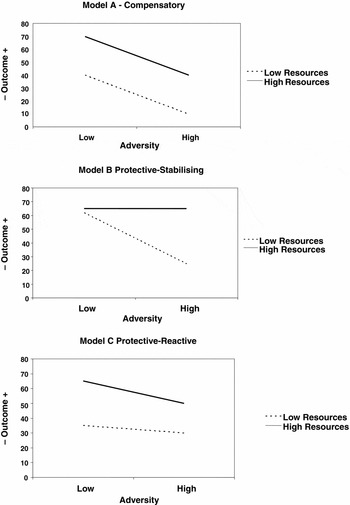
The compensatory model reflects the independent contribution of risks or resources to the outcome and involves examining their direct (main) effects. Resources with direct effects can be beneficial at both high- and low-risk conditions (see Figure 4A). This main effects approach is commonly examined through multiple regression procedures or structural equation modelling.
Models of resilience

The protective model describes how the presence of resources will influence the direction and/or strength of the risk, usually depicted as moderating or reducing the effects of the risk under question on a negative outcome. Conversely, it could moderate the effects in a positive direction. This type of model is commonly tested through the inclusion of an interaction term between the risk and protective factor in multiple regression. The effects of the interactions in protection models can also demonstrate the operation of different processes. LutharReference Luthar73 proposes a more detailed range of operational criteria to describe these interactive processes. ‘Protective-stabilizing’ describes stability despite increasing risk when the protective factor is present (see Figure 4B). ‘Protective reactive’ describes how the protective factor might present an advantage, but this is less so when the risks are higher (see Figure 4C). This is an important approach for explaining resilience in later life in the face of chronic illness. Windle et al.Reference Windle, Woods and Markland64 found evidence for both of these two models across different age cohorts. In those aged 60–69 years, higher levels of psychological resilience gave stability in well-being despite increases in ill health (protective stabilizing). For those aged 70–79 and 80–90 years, psychological resilience provided an advantage, but slightly less so when ill health was higher (protective reactive).
The challenge model describes a curvilinear relationship between a risk factor and outcome. Here exposure to low levels and high levels of risk are associated with negative outcomes, but moderate levels are associated with better outcomes. In these models, the risk and protective factors examined are the same variable, the distinguishing feature being the level of exposure. This model assumes that moderate levels of risk can be important for learning how to overcome challenges. This approach is commonly examined with polynomial terms in multiple regression.Reference Fergus and Zimmerman2 When examined longitudinally, it enables an examination of whether the experience of overcoming adversity strengthens people's resistance to later risks and challenges. To illustrate, SchoonReference Schoon75 found that at age 5, children with good reading ability but who experienced family economic disadvantage were similar to others with good reading ability but whose family had no economic problems. However, by the age of 16, the economically disadvantaged children had declined dramatically and were doing worse in exams than economically privileged children who had poor reading skills at age 5. This suggests that despite the advantage of educational resilience earlier in life, it was not able protect against the persistent effects of economic disadvantage.
Person focused approach
This aims to identify comparative groups of individuals from within similar high levels of adversity who show patterns of good or poor adaptation, simultaneously assessed by multiple criteria, so as to identify the factors that might lead to risk or be assets.Reference Masten24 This approach is often used to classify the proportion who may be determined resilient. For example, in examining the characteristics of youths living in poverty, Buckner et al.Reference Buckner, Mezzacappa and Beardslee60 operationalize resilience as the presence of competences, adaptive functioning and lack of significant mental health problems. Through this categorization, 29% were classed as resilient and the authors were able to distinguish differences between groups. The non-resilient experienced more negative life events, chronic strains and abuse, whereas the resilient has greater self-regulatory skills and self esteem and received more active parental monitoring.
In the context of ‘bouncing back’, using data from the British Household Panel Survey, resilience was suggested for those people who had increasing scores on a mental status measure (GHQ-12) after exposure to adversity (functional limitation, bereavement or marital separation, poverty), but returned to its pre-exposure level after 1 year.Reference Netuveli, Wiggins, Montgomery, Hildon and Blane28
Resilience measurement scales
Other researchers have developed resilience measurement scales, some of which have been examined in a review of instruments appropriate for the study of resilience in adolescentsReference Ahern, Kiehl, Sole and Byers76 and all age groups.Reference Windle, Bennett and Noyes77 Notably, the majority of self report scales are based primarily on individual, psychological resilience and require more validation work.
Identifying model case
This is an example of the use of the concept that demonstrates all the defining characteristics. The following illustrate examples of resilience research that encompass the necessary antecedents, the defining attributes and the consequences.
Lin and colleaguesReference Lin, Sandler, Ayers, Wolchik and Luecken78 investigated variables at multiple levels (the environment, the family and the individual child) that differentiate children who manifest clinically significant levels of mental health problems from those children who do not, after experiencing the death of a primary care giver. Bereaved children were classified into one of two subgroups (resilient or affected) based on their scores on measures of mental health problems. Those who scored below the clinical cut-off level on every measure of mental health were considered resilient. Children who scored above the clinical cut-off level on any measure were considered affected. The analyses found that differences between the bereaved resilient versus bereaved affected status was related to family and child variables. Higher levels of caregiver warmth and discipline and lower levels of caregiver mental health problems were family-level variables that significantly differentiated resilient children from affected children. Bereaved children's perceptions of less threat in response to negative events and greater personal efficacy in coping with stress were child-level variables that differentiated resilient from affected status.
Schoon et al.Reference Schoon, Parsons and Sacker79 examined the influence of socioeconomic adversity on school adjustment during adolescence (age 16) and long-term consequences of school adjustment for the transition from school to work (age 33), whilst considering factors (parental and individual resources, teacher expectations) that might buffer such adversity. They found that overall, socioeconomic adversity was a significant risk factor for educational failure and that it influences consequent adjustment in work and health related outcomes at the age of 33, as assessed by qualifications, socio-economic status (SES) and self reports of general health and mental status. In examining the protective factors at age 16, the negative effects of economic adversity on exam score was halved through including parental involvement and aspirations, own educational motivation and aspirations, teacher expectations and behaviour. Interactions amongst the protective factors and socioeconomic adversity were negative and demonstrated that any protective effects were found more amongst those at lower risk. For this group the important predictors of exam performance were own educational motivation and teacher expectations and also behaviour adjustment, own job aspirations and parental involvement with the school. For those experiencing socioeconomic adversity, the most important factor predicting exam performance was teacher expectations, followed by own educational motivation and own job aspirations, parental aspirations and parental involvement with the school, respectively.
Identifying additional cases
It is recommended that other concepts be examined in order to address possible overlap, and more importantly to clarify the true nature of the concept in question.Reference Walker and Avant13 A number of concepts (addressed below) are often substituted for describing resilience; they may contain some aspects of resilience, or a component of resilience, but are not true examples.
Borderline case
A borderline case very closely resembles the concept in question, and could often be mistaken for it. Further distinguishing features are that a borderline case should also differ substantially in one of the defining characteristics.Reference Walker and Avant13 A closely related concept is the Sense of Coherence (SOC). This is a core component of the theory of the origins of health – salutogenesis.Reference Antonovsky80 Both resilience and salutogenesis are developed from observations of how people manage difficult situations and display positive adaptation and stay well. Both theories incorporate protective factors, known as generalized resistance resources in salutogenesis. However, where these two approaches may differ relates to the operation of the constructs. In salutogenesis, the generalized resistance resources lead to life experiences that promote a strong SOC and this sense of coherence is the key focus. In contrast, resilience would subsume SOC as one of the defining attributes, but not the only one. Thus SOC could be considered part of the process leading to a resilient outcome, but not the only aspect. Resilience research would ideally focus on measuring and analysing multiple levels of function and their interactions. SOC may be one of these levels, but a resilience framework would place an emphasis on an actual examination of SOC across other levels or resilience, in relation to adversity.
Although both theories have focused on health outcomes, resilience can also be applied to wider outcomes. For example, Sacker and SchoonReference Sacker and Schoon57 looked at educational resilience, examining the role of educational and personal assets and family resources in supporting young people from socially disadvantaged family backgrounds to stay on in school beyond the mandatory school leaving age. Another distinction is that Antonovsky postulated that SOC was mainly formed in the first three decades of life. Resilience theory acknowledges the dynamic nature of assets and resources, thus nothing is fixed.
Nevertheless, salutogenesis is intricately tied in with resilience, and it has been suggested that a historical lack of multi-disciplinary integration has meant that theoretical perspectives on salutogenesis (from the discipline of medical sociology) and resilience (largely from the disciplines of psychiatry and developmental psychology) have perhaps not been synthesized to the extent that they should have.Reference Almedom81
Related case
These are related to the concept being studied, but do not contain all of the defining attributes.Reference Walker and Avant13 KobasaReference Kobasa82 introduced the concept of hardiness, which has been defined as a stable personality resource that consists of three psychological attributes: commitment, challenge, and control. Commitment refers to an ability to turn events into something meaningful and important; control refers to the belief that, with effort, individuals can influence the course of events around them, and challenge refers to a belief that fulfilment in life results from the growth and wisdom gained from difficult or challenging experiences.Reference Maddi and Khoshaba83 Like resilience, hardiness has been used in the study of its associations with lower levels of psychopathology in the face of stress. However, the defining point which distinguishes hardiness from resilience is that it is a stable personality trait whereas resilience is viewed as something dynamic that will change across the lifespan. Moreover, hardiness measures are designed to detect stability.
Ego-resiliencyReference Block and Kremen84 has been used on occasion by researchers to measure resilience. It is proposed as an enduring psychological construct that characterizes human adaptability. It is a developmental process of impulse control, where the individual learns to regulate behaviour so as to turn events into pleasant experiences and not into adverse consequences. It is assumed that ego-resilience renders a pre-disposition to resist anxiety and to engage positively with the world.
Whilst it shares a number of similarities with the attributes and consequences of the resilience concept under question in this paper, in contrast to resilience, ego-resiliency does not depend on risk or adversity. Rather it is part of the process of dealing with general, day-to-day change. Also ego-resiliency is a personality trait, whereas resilience is a far broader phenomenon. As with the sense of coherence, ego-resiliency may be one of the protective factors implicated in a resilient outcome, but it would be incorrect to use this as an indicator of resilience per se.
Contrary case
A contrary case is a clear example of something that is not resilience. The high functioning of individuals under conditions of no/low risk or adversity is not considered resilience. The model of successful ageingReference Rowe and Kahn85 is an example of a contrary case. In order to meet the criteria for successful ageing, there must be a low probability of disease and disease-related disability, including the absence of risk factors for disease, high cognitive and physical functional capacity and active engagement with life.Reference Rowe and Kahn85 A resilience framework would acknowledge the possibility that ill-health and functional incapacity might be present, but that their potentially negative influence would not necessarily lead to a poor outcome. Importantly, people are not invulnerable, but resilient.
Discussion
The analysis identifies three necessary requirements for resilience: the need for a significant adversity/risk, the presence of assets or resources to offset the effects of the adversity, and positive adaptation or the avoidance of a negative outcome. Based on this analysis, the following definition encompasses all of the key characteristics:
Resilience is the process of effectively negotiating, adapting to, or managing significant sources of stress or trauma. Assets and resources within the individual, their life and environment facilitate this capacity for adaptation and ‘bouncing back’ in the face of adversity. Across the life course, the experience of resilience will vary.
This analysis has taken a novel approach to clarifying the nature of resilience, drawing on three approaches that cover both academic and stakeholder perspectives – systematic review, concept analysis and consultation workshops. This process has enabled the identification of important areas that might have otherwise been overlooked if just using one approach, enabling a deeper understanding of what is meant by resilience. Consultation with stakeholders provided a valuable contribution to the academic work. Their perspectives on resilience as a multi-level construct, encompassing the individual and the wider environment has helped to ensure that the final definition is one that has the potential for wider application, and could be universally applied and understood in ‘real world’ settings.
The robust methodological approach in this paper improves on that of the previous concept analyses of resilience.Reference Dyer and McGuinness11, Reference Gillespie, Chaboyer, Wallis and Grimbeek12 In contrast to the previous two papers, the systematic framework in this paper provides a replicable search strategy and transparent inclusion and exclusion criteria, thereby minimizing the possibility of selection bias. The process of systematically identifying resilience literature over the past 20 years enabled earlier theoretical formulations of the concept to be synthesized with more recent developments. This also ensured that early landmark papers on resilience were incorporated. Diverse uses of the concept were identified through exploring resilience within different disciplines.
This paper utilized actual examples from the research literature to illustrate examples of actual cases and related cases of resilience. This contrasts with the methods of other researchers using concept analysis,Reference Dyer and McGuinness11, Reference Haas86, Reference Xyrichis and Ream87 who restricted their illustrations of the defining attributes of the concepts under question by using hypothetical scenarios. Whilst this may have served as a useful method of clarification, the lack of engagement with actual, theoretically derived examples does not assist with clarifying any scientific overlap.
Analysing and synthesizing this large volume of research has enabled the key characteristics of resilience to be thoroughly examined. This methodical approach demonstrates that resilience is the product of a dynamic process that first requires exposure to a significant threat or adversity. Protective resources or assets are the defining attributes of resilience. Examining the interplay between resources and risk is an important aspect of resilience research and can highlight mechanisms underlying vulnerability or adaptation.Reference Masten5, Reference Luthar, Cohen and Cicchetti29, Reference Masten and Curtis88 It is important to understand how such factors interact with or mediate adversity and risk to increase or decrease the opportunity for resilience.
Within a lifespan developmental framework, the dynamic nature of resilience indicates it is not fixed, but will fluctuate over time, as new vulnerabilities and strengths arise from changing life circumstancesReference Luthar, Cohen and Cicchetti29 (p. 741). Research from children and adolescents suggests that the protection from risk is also influenced by earlier experiences, and that across the lifespan different factors may play a distinct role from earlier.Reference Rutter30, Reference Rutter, Shonkoff and Meisels89 It is suggested that the mental health impact of adversity in later life is mediated by psychological resources and social factors inherited from earlier years.Reference Rogers and Pilgrim90 Certain factors might predispose to other experiences that actually mediate the risk. Poverty is a risk for psychopathology in children, but this may be more due to the effects of poverty on impaired family functioning and family relationships.Reference Rutter30 Understanding the process of resilience, through the consideration of its defining attributes, can enable examination of how a resilient response at one point in life may help facilitate further resilience in later life, identifying both its stability and changes.
The life course approach considers the developmental pathways of the concept. It is then clear that a requirement for understanding the process of resilience is the acknowledgement of its complexity; resilience operates across multiple levels, which interact with each other. These levels reflect the human ecology framework, also described as Ecological Systems Theory.Reference Bronfenbrenner, Husen and Postlethwaite91 Although mainly used for understanding child development, this theory has been receiving considerable attention in the gerontology literature and is cited in the resilience literature. This framework aims to understand people in the environments in which they live, and to evaluate their interactions with these environments. People do not exist in isolation but interact with, and are influenced by, their physical, social and environmental contexts. Thus the functioning of the defining attributes of resilience can be further explained within this theoretical framework.
Implications for further research
It is also noteworthy that a large proportion of resilience research is routed within the discipline of developmental psychology, and has mainly been developed with children and adolescents. There is a consensus from child and adolescent research as to what the most important factors may be,Reference Masten5 especially for the role of relationships.Reference Luthar, Cohen and Cicchetti29 However, the salience of these factors may vary across the life span. Far less is known about the process of resilience in adulthoodReference Bonnano7, Reference Campbell-Sills, Cohan and Stein92 and even less has followed individuals over their life time to ascertain the value of protective factors as people age. Most research with adults into trauma and loss has only included treatment-seeking populationsReference Bonnano7. A key question is whether the factors that lead to adult resilience follow a similar profile to those found for children and adolescents, and whether they function in a cumulative and interactive mannerReference Bonnano7.
Neuroscience/biological approaches to resilience are notably missing from resilience research.Reference Luthar and Brown9 To date, most of the biological contribution to the area is derived from the effects of early care-giving environment. A major contribution to resilience research could be made through more multi-disciplinary studies that examine the dynamics of resilience across the lifespan, its role in healthy ageing and managing loss, such as changes in cognitive functioning. As the methods for measuring and analysing multiple levels of functioning and their interactions improves,Reference Masten5 the dynamics underlying resilience should be a key focus for future research.
The theoretical basis for resilience clearly acknowledges that protective factors operate across a number of levels. In order for interventions to be most effective, theory would imply that interventions need to consider the dynamic interplay across these different levels, and not just focus on developing individual strengths. Little research has looked at the mechanisms by which adversities, protective resources, or interventions work.Reference Sandler93 Research on children has examined diverse sources of resilience, whereas research on adults has focused more on personal attributes, such as personality characteristics. Less attention has been paid to the extent to which these attributes are influenced by other factors.Reference Luthar and Brown9 This has important implications for what might be considered the target for the development of interventions. Will strengthening individual, psychological resilience achieve better results than if the focus was on improving the resources available in the immediate environment (e.g. social support), or within the wider environmental context (e.g. support through health and social services?), and how might one level interact with another?
Another point is that positive adaptation may not occur across all spheres of life. A review notes that although some high-risk children show positive outcomes in one domain, in 10 out of 13 studies examined this did not generalize to other domains.Reference Vanderbilt-Adriance and Shaw6 Luthar et al.Reference Luthar, Cicchetti and Becker3 suggest that at-risk children who are resilient in specific domains (e.g. high academic grades), should show positive performance on conceptually related measures, such as classroom behaviour. Thus resilience may be best measured in its related context. It has been suggested that more precision could be gained by using terms to describe the nature of the resilience experience being studied,Reference Luthar, Cicchetti and Becker3 e.g. psychological resilience,Reference Windle, Markland and Woods74 educational resilienceReference Sacker and Schoon57, Reference Waller, Okamoto, Miles and Hurdle94 or cognitive resilience.Reference Glymour, Weuve, Fay, Glass and Berkman95 From their review of the literature, Vanderbilt-Adriance & ShawReference Vanderbilt-Adriance and Shaw6 conclude that the lack of consistency in positive outcomes over the life course and across domains suggest that ‘global resilience’ is rare and recommend researchers are more specific about relating the concept of resilience to the relevant domain outcome.
Conclusion
This theoretical exploration of the concept of resilience highlights how interlaced with normal, everyday life resilience is, reflecting its multi-disciplinary roots. It would suggest that for many, providing the right resources are available, exposure to risks and adversity may not result in a poor outcome. In relation to intervention, the context in which people live could be altered, the services and treatment received could be improved and individual assets could be enhanced so as to enable a better chance for health and well-being, even when faced with substantial risk and adversity. Importantly, the complex interplay between these layers should be recognized and the underlying processes explored. For those experiencing persisting, chronic adversities, psychopathology could be averted providing that the individual is able to draw on a range of resources within themselves and their immediate environment, and that the wider environment is also supportive. The suggestion by RichardsonReference Richardson51 that resilience may be the driving force that controls the universe may be a little overstated, but the capacity for ‘ordinary magic’Reference Masten24 and the opportunity for positive adaptation should be an option for everyone.
Conflicts of interest
The author has no conflicts of interest to declare.
This paper has been developed as part of the work of the Resilience and Healthy Ageing Network, funded through the UK Lifelong Health and Wellbeing Cross-Council Programme. The LLHW Funding Partners are: Biotechnology and Biological Sciences Research Council, Engineering and Physical Sciences Research Council, Economic and Social Research Council, Medical Research Council, Chief Scientist Office of the Scottish Government Health Directorates, National Institute for Health Research/The Department of Health, The Health and Social Care Research & Development of the Public Health Agency (Northern Ireland), and Wales Office of Research and Development for Health and Social Care, Welsh Assembly Government.
The author would like to thank the network members for their inspiring discussions on the topic: Dr Cherie McCraken (Liverpool University), Professors Jane Noyes and Jo-Rycroft Malone (Bangor University) for their helpful comments on the paper, and Jenny Perry, Eryl Roberts and Marta Ceisla (Bangor University) for their assistance with abstract screening and identification of papers.