Introduction
The association between the quality of the interparental or marital relationship and child emotional and behavioral adjustment is a robust one. High levels of interparental conflict and low levels of marital satisfaction have both been consistently associated with increased behavior problems in children (Cummings & Davies, Reference Cummings and Davies1994, Reference Cummings and Davies2002; Rhoades et al. Reference Rhoades, Leve, Harold, Neiderhiser, Shaw and Reiss2011). Available work has indicated that this association is probably bidirectional in nature (Harold & Conger, Reference Harold and Conger1997; Davies et al. Reference Davies, Harold, Goeke-Morey and Cummings2002; Grych et al. Reference Grych, Harold and Miles2003; Schulz et al. Reference Schulz, Cowan and Cowan2006; Harden et al. Reference Harden, Turkheimer, Emery, D'Onofrio, Slutske, Heath and Martin2007). Namely, longitudinal and intervention studies have suggested that this association is at least partially causal in origin (Harold & Conger, Reference Harold and Conger1997; Davies et al. Reference Davies, Harold, Goeke-Morey and Cummings2002; Grych et al. Reference Grych, Harold and Miles2003; Schulz et al. Reference Schulz, Cowan and Cowan2006), such that child behavior problems tend to improve following either (1) improvements in the interparental relationship in response to intervention or (2) the dissolution of high-conflict marriages (Amato & Booth, Reference Amato and Booth1996; Morrison & Coiro, Reference Morrison and Coiro1999; Booth & Amato, Reference Booth and Amato2001; Schulz et al. Reference Schulz, Cowan and Cowan2006). On the other hand, genetically informed studies (Harden et al. Reference Harden, Turkheimer, Emery, D'Onofrio, Slutske, Heath and Martin2007) have indicated that the association partially reflects genetic influences on child antisocial behavior, results that are more in keeping with a child-driven effect.
Importantly, however, available work has yet to consider the possible role of the gene–environment interaction (G × E). G × E is typically defined as differential responsiveness to environmental risk as a function of genotype (Plomin et al. Reference Plomin, DeFries and Loehlin1977), and in this case would manifest as differential responsiveness to interparental conflict as a function of one's predisposition towards antisocial behavior. Although, to our knowledge, no studies have examined this possibility with regard to interparental conflict and youth conduct problems (for a study of child anger, however, see Rhoades et al. Reference Rhoades, Leve, Harold, Neiderhiser, Shaw and Reiss2011), studies of other environmental moderators have unambiguously supported a role for G × E in antisocial/externalizing behaviors (Kim-Cohen et al. Reference Kim-Cohen, Caspi, Taylor, Williams, Newcombe, Craig and Moffitt2006; Feinberg et al. Reference Feinberg, Button, Neiderhiser, Hetherington and Reiss2007; Hicks et al. Reference Hicks, South, DiRago, Iacono and McGue2009; Burt & Klump, Reference Burt and Klump2013a , Reference Burt and Klump2014a ,Reference Burt and Klump b ). As one example, Feinberg et al. (Reference Feinberg, Button, Neiderhiser, Hetherington and Reiss2007) examined whether parental negativity and warmth moderated genetic and environmental influences on adolescent behavior problems, and found that genetic influences were potentiated in the face of either negative parenting or low warmth. Consistent with these sorts of results, G × E is now widely thought to constitute a fundamental mechanism through which genes and environments influence human behavior and mental health (Rutter et al. Reference Rutter, Moffitt and Caspi2006).
The aim of the current study was thus to examine whether and how positive and negative aspects of the interparental relationship moderated the etiology of child antisocial behavior. To ensure the robustness of our results, we examined multiple measures and informant reports of the interparental relationship, including mother/wife and father/husband reports, observer ratings of videotaped interparental interactions and the perceptions of the twin children, and did so in a large sample of child twin families. Given the comprehensive nature of these analyses, we expected the results to provide clear evidence for or against G × E in the association between the interparental relationship and child antisocial behavior.
Method
Participants
Participants were drawn from the Twin Study of Behavioral and Emotional Development in Children (TBED-C), a study within the population-based Michigan State University Twin Registry (MSUTR) (Klump & Burt, Reference Klump and Burt2006; Burt & Klump, Reference Burt and Klump2013b ). Given our specific focus on the quality of the interparental relationship (rather than on the effects of divorce or separation), we restricted our primary analyses to families in which the twins’ primary caregivers were currently married/cohabitating (n = 720 families or 1440 twins and their parent/s). The TBED-C includes both a population-based sample (n = 500 families of which 440 were ‘intact’ or had currently married/cohabitating parents) and an independent ongoing sample for which inclusion criteria also specified that participating twin families lived in moderately to severely disadvantaged neighborhoods (current n = 380 families of which 280 were ‘intact’).
To be eligible for participation in the TBED-C, neither twin could have a cognitive or physical condition (as assessed through parental screen), such as a significant developmental delay, that would preclude completion of the assessment. Children provided informed assent whereas parents provided informed consent for themselves and their children. The twins ranged in age from 6 to 10 years (mean = 8.11, s.d. = 1.41; although a few twins had turned 11 by the time they participated) and were 48% female. Although all families in this sample were ‘intact’, a portion of the fathers/stepfathers did not participate at all (n = 80 families) or completed only a portion of the study (n = 61 families). In these cases, no spousal interaction video was obtained.
The Department of Vital Records in the Michigan Department of Community Health identified twins in our age range either directly from birth records or through the Michigan Twins Project, a large-scale, population-based registry of twins in lower Michigan who were themselves recruited through birth records. The Michigan Bureau of Integration, Information, and Planning Services database was used to locate family addresses within 120 miles of East Lansing, MI through parent drivers’ license information. Pre-made recruitment packets were then mailed to parents on our behalf by the Michigan Department of Community Health. A reply postcard was included for parents to indicate their interest in participating. Interested families were contacted directly by project staff. Parents who did not respond to the first mailing were sent additional mailings approximately 1 month apart until either a reply was received or up to four letters had been mailed.
This recruitment strategy yielded overall response rates of 62% for the population-based sample and 57% for the at-risk sample, which are similar to or better than those of other twin registries that use anonymous recruitment mailings (Baker et al. Reference Baker, Barton and Raine2002; Hay et al. Reference Hay, McStephen, Levy and Pearsall-Jones2002). Families participating in the population-based sample endorsed ethnic group memberships at rates comparable to area inhabitants (e.g. Caucasian: 86.4% and 85.5%, African American: 5.4% and 6.3% for the participating families and the local census respectively). The at-risk sample was significantly more racially diverse (15% African American, 75% Caucasian) than the population-based sample, although this difference was eliminated here by our focus on intact families only (5.4% African American, 85.7% Caucasian). Moreover, both samples were representative of the families recruited for that particular study (as assessed by a brief questionnaire screen administered to 80% of non-participating families). Participating twins were not experiencing higher levels of conduct problems, emotional symptoms or hyperactivity than were non-participating twins (Cohen's d effect sizes ranged from −0.08 to 0.01 in the population-based sample and from 0.01 to 0.09 in the at-risk sample; all n.s.). Participating families also did not differ from non-participating families in paternal felony convictions (d = −0.01 and 0.13 for the population-based and at-risk samples respectively), rate of single parent homes (d = 0.10 and −0.01 for the population-based and at-risk samples respectively), paternal years of education (both d ⩽ 0.12) or maternal and paternal alcohol problems (d ranged from 0.03 to 0.05 in both samples). However, participating mothers in both samples reported slightly more years of education (d = 0.17 and 0.26, both p < 0.05) than non-participating mothers. Maternal felony convictions also differed across participating and non-participating families but only in the population-based sample (d = −0.20, p < 0.05, at-risk sample d = 0.02, n.s.).
Zygosity was established using physical similarity questionnaires administered to the twins’ primary caregiver (Peeters et al. Reference Peeters, Van Gestel, Vlietinck, Derom and Derom1998). On average, the physical similarity questionnaires used by the MSUTR have accuracy rates of at least 95%. The current study included 315 monozygotic (MZ) twin pairs and 405 dizygotic (DZ) twin pairs.
Measures
Child antisocial behavior
Mothers and fathers completed the Child Behavior Checklist (CBCL; Achenbach & Rescorla, Reference Achenbach and Rescorla2001) separately for each twin. The twins individually completed the Semistructured Clinical Interview for Children and Adolescents (SCICA; McConaughy & Achenbach, Reference McConaughy and Achenbach2001). The DSM-oriented Conduct Problems (CP) scale comprises 17 CBCL items and 19 SCICA items viewed as ‘very consistent’ with the DSM-IV diagnostic category of Conduct Disorder (e.g. stealing, fighting, setting fires, cruelty to animals). Internal consistency reliabilities for the CBCL CP scales were adequate (α = 0.80 and 0.76 for mother and father informant reports respectively). Approximately 10% of the SCICA interviews were videotaped to obtain inter-rater reliability. The intraclass correlation for CP across all raters was 0.88.
Maternal, paternal and child informant reports of CP were available for 99.8, 95.3 and 99.9% of twins respectively. The various informant reports were correlated 0.29 to 0.49 (all p < 0.01), consistent with the moderate cross-informant correlations seen in other studies (Achenbach et al. Reference Achenbach, McConaughy and Howell1987). CP data were averaged across informants to create a CP composite. At least two informant reports were available for all twins. The use of this combined informant approach is thought to allow for a more complete assessment of twin symptomatology compared with the use of any one informant alone (Achenbach et al. Reference Achenbach, McConaughy and Howell1987). CP data were log-transformed prior to analysis to adjust for positive skew (skews before and after transformation were 2.37 and 0.53 respectively).
Quality of the interparental relationship
The Dyadic Adjustment Scale (DAS; Spanier, Reference Spanier1976) was used to assess mother/wife and father/husband ratings of their relationship. Each member of the couple was asked to complete the questionnaire. The DAS measures four dimensions of marital adjustment (satisfaction, consensus, cohesion and affective expression), along with an overall measure of marital adjustment (the sum of the four dimensions). All five scales were examined here, separately for husbands and wives. The DAS demonstrated good internal consistency reliabilities across both informants for the individual scales (α = 0.70–0.86) and the overall scale (α = 0.94–0.95).
We also examined observer ratings of a 10-min videotaped interaction between spouses. Each parental dyad was asked to discuss and attempt to resolve recent conflicts in their relationship. Trained raters then coded the videos using the Brief Romantic Relationship Interaction Coding Scheme (BRRICS; Humbad et al. Reference Humbad, Donnellan, Klump and Burt2011). The BRRICS was designed to assess various aspects of romantic relationships, including specific components of the dyadic interaction. The latter included positive reciprocity (i.e. overall positivity and warmth in the couple; smiling, laughing and joking with each other), demand–withdraw pattern (i.e. a pattern in which one partner ‘nags’ the other partner, who then withdraws from the interaction), negative reciprocity (i.e. hostility, harsh tone, frowning and/or criticism towards each other) and overall satisfaction (i.e. observer perceptions of the extent to which the couple is satisfied and happy with their marriage). The inter-rater reliabilities ranged from 0.87 to 0.97 for the four scales.
We also examined twin perceptions of conflict in the interparental relationship, as assessed with the Children's Perception of Interparental Conflict Scale (CPIC; Grych et al. Reference Grych, Seid and Fincham1992; Nigg et al. Reference Nigg, Nikolas, Miller, Burt, Klump and von Eye2009). For the current study, we focused specifically on the Conflict Properties Scale (n = 11 items, α = 0.77), which assesses the frequency and intensity of interparental conflict as observed by the child (e.g. ‘My parents get really mad when they argue’). The other three scales on the CPIC (Threat, Self-Blame and Triangulation/Stability) were not examined because they assess the child's emotional and/or cognitive appraisals of interparental conflict (e.g. ‘I am to blame when my parents argue’) rather than their observations (Nikolas et al. Reference Nikolas, Friderici, Jernigan, Waldman and Nigg2010, Reference Nikolas, Klump and Burt2013).
Analyses
Twin studies leverage the difference in the proportion of genes shared between MZ twins (who share 100% of their genes) and DZ twins (who share an average of 50% of their segregating genes) to estimate the relative contributions of additive genetic (A), shared environmental (i.e. factors that make twins similar to each other regardless of the degree of their genetic relationship; C) and non-shared environmental effects (i.e. factors that make twins different from each other, including measurement error; E) to the variance within observed behaviors or characteristics (phenotypes). More information on twin studies is provided elsewhere (Neale & Cardon, Reference Neale and Cardon1992).
We evaluated whether the quality of the interparental relationship might moderate the etiology of CP using the original ‘univariate G × E’ model (Purcell, Reference Purcell2002) or the ‘extended univariate G × E’ model (van der Sluis et al. Reference van der Sluis, Posthuma and Dolan2012), as appropriate. The Purcell model is more powerful statistically but is prone to false positives when twins are not perfectly correlated on the moderator variable (van der Sluis et al. Reference van der Sluis, Posthuma and Dolan2012). We thus made use of the Purcell model when examining moderation by the family-level measures of the interparental relationship (i.e. those that did not vary across twins; mother and father reports of the DAS and observer ratings of the interparental relationship) and used the van der Sluis et al. model when examining moderation by individual twin perceptions of the interparental relationship. To circumvent possible G × E correlational confounds (in which genetic effects overlap across the moderator and the outcome), the moderator values are entered in a means model of CP separately across twins and zygosity. Moderation is then modeled on the residual CP variance (i.e. that which does not overlap with the moderators). The first and least restrictive of these models allows for linear and non-linear moderation. We then fitted a series of more restrictive moderator models, constraining the linear and non-linear moderators to be zero and evaluating the reduction in model fit.
Each moderator was floored at zero and then divided by its highest value prior to analysis so that it ranged from 0 to 1. The only exception to this treatment of the moderator was for demand–withdraw, as this variable was assessed dichotomously (no = 0, yes = 1). As it is generally recommended that unstandardized or absolute ACE estimates be presented (Purcell, Reference Purcell2002), we standardized our log-transformed CP score to have a mean of zero and a standard deviation of one to facilitate interpretation of the unstandardized values.
Mx, a structural-equation modeling program (Neale et al. Reference Neale, Boker, Xie and Maes2003), was used to fit models to the transformed raw data using full information maximum likelihood techniques. When fitting models to raw data, variances, covariances and means are first freely estimated. Model fit for the biometric G × E models was then evaluated using four information theoretic indices that balance overall fit (using minus twice the log-likelihood) with model parsimony: the Akaike information criterion (AIC; Akaike, Reference Akaike1987), the Bayesian information criterion (BIC; Raftery, Reference Raftery1995), the sample-size adjusted BIC (SABIC; Sclove, Reference Sclove1987) and the deviance information criterion (DIC; Spiegelhalter et al. Reference Spiegelhalter, Best, Carlin and Van Der Linde2002). The lowest or most negative AIC, BIC, SABIC and DIC values among a series of nested models are considered best. Because fit indices do not always agree (they place different values on parsimony, among other things), we reasoned that the best-fitting model should yield lower or more negative values for at least three of the four fit indices (Hicks et al. Reference Hicks, South, DiRago, Iacono and McGue2009; Burt & Klump, Reference Burt and Klump2013a , Reference Burt and Klump2014a ).
Results
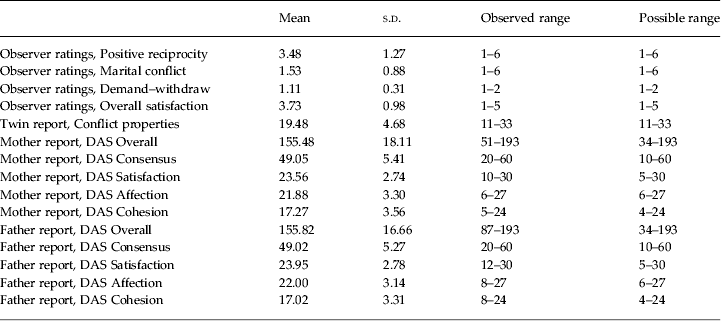
Descriptive statistics for the various measures of the interparental relationship are presented in Table 1. The quality of the interparental relationship varied across the sample, indicating that range restriction in the moderator is unlikely to influence our results. This is especially the case for child reports, observer ratings and, to a lesser extent, mother/wife reports of the marital relationship, in that the full range of possible values was present for most of these variables. Father/husband reports of the marital relationship showed slightly less variability.
Descriptive statistics for the various measures of the interparental relationship

DAS, Dyadic Adjustment Scale; s.d., standard deviation.
With the exception of twin reports of conflict properties, observer-rated marital conflict and observer-rated demand–withdraw, high scores index higher levels of relationship quality.
The prevalence of child CP in these data was consistent with population averages: 13.8% of the twins evidenced marginally to clinically significant levels of CP by either mother or father report (using the clinical cut-points described in the CBCL manual). Such results indicate that range restriction in the outcome is also unlikely to influence our results. As expected, mean levels of child CP varied across sex (Cohen's d = 0.47, p < 0.001), such that boys demonstrated higher rates of CP than girls. CP also demonstrated a small negative association with age (r = −0.13, p < 0.001). Sex and age were thus regressed out of the log-transformed CP data prior to the G × E analyses (McGue & Bouchard, Reference McGue and Bouchard1984).
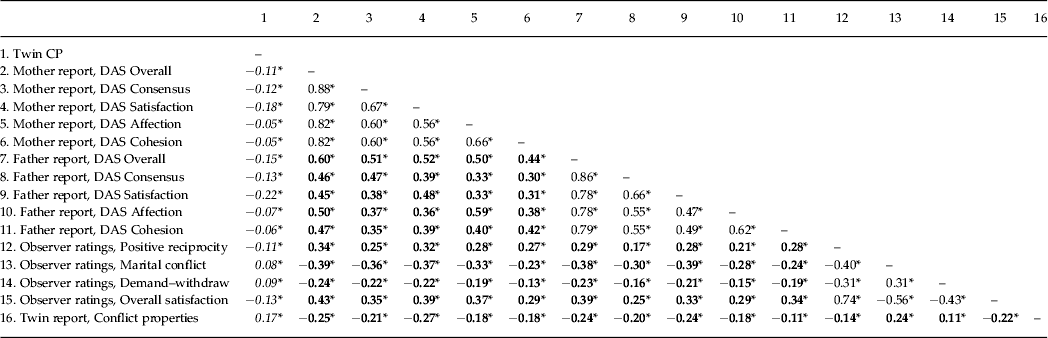
Phenotypic correlations between child CP and the interparental relationship are presented in Table 2. All associations were in the expected direction (e.g. marital conflict was positively associated with CP whereas marital satisfaction was negatively correlated with CP) but were typically only modest in magnitude. Associations across the various informants/measures of the interparental relationship are also presented in Table 2. The strongest cross-informant associations were seen between mother and father reports of their relationship (both of which were obtained using the DAS), with correlations in the range 0.4–0.6. Associations with twin reports and observer ratings were small to moderate in magnitude (typically in the range 0.2–0.4), results that are very much in keeping with the cross-informant/measure associations seen in other studies (Achenbach et al. Reference Achenbach, McConaughy and Howell1987). Indeed, the overall pattern of correlations indicated that all informants were providing ‘valid’ reports of the quality of the interparental relationship.
Correlations

CP, Child conduct problems; DAS, Dyadic Adjustment Scale.
Zero-order associations among the variables are presented. Associations between CP and the measures/informants of the interparental relationship are presented in italics. Associations across the various measures/informants of the interparental relationship are presented in bold.
* Correlation is significantly greater than zero at p ⩽ 0.05.
Univariate analyses
Prior to model-fitting analyses, we examined the etiology of CP independently of the interparental relationship. MZ and DZ intraclass correlations were 0.59 and 0.39 respectively, indicating the presence of genetic, shared and non-shared environmental influences. The model-fitting results further indicated that genetic (44%) and non-shared environmental (40%) influences made significant contributions to CP (both p < 0.05). Shared environmental influences accounted for 16% of the variance but did not reach statistical significance.
G × E analyses
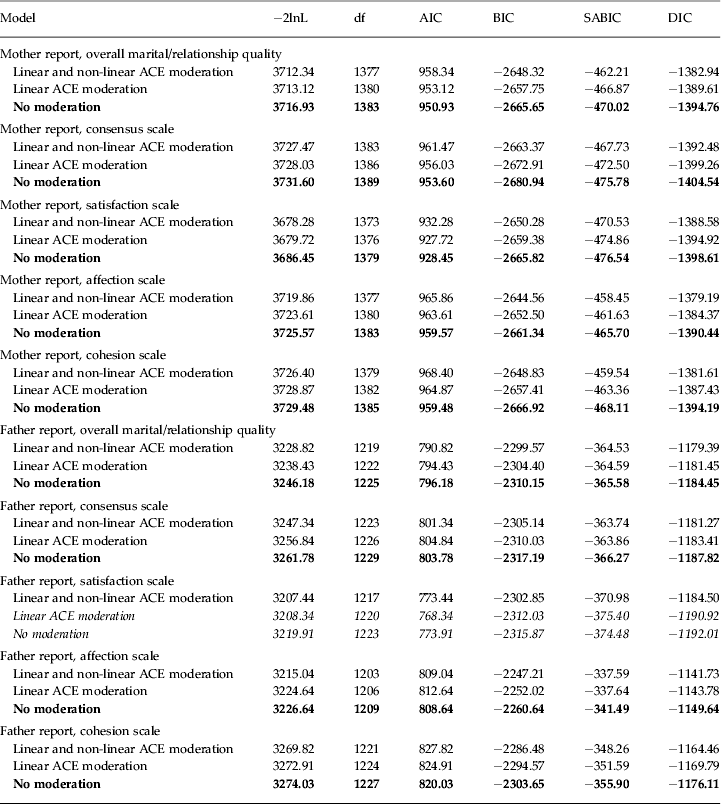
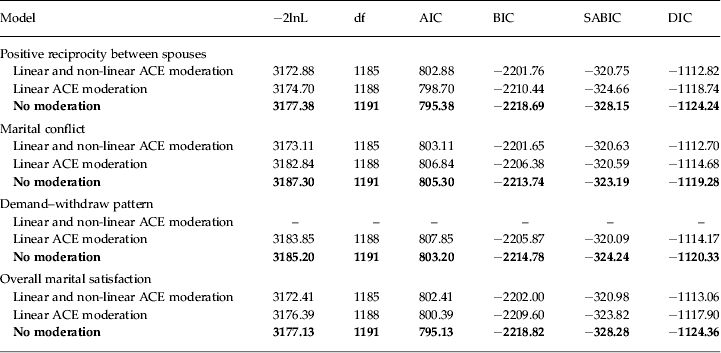
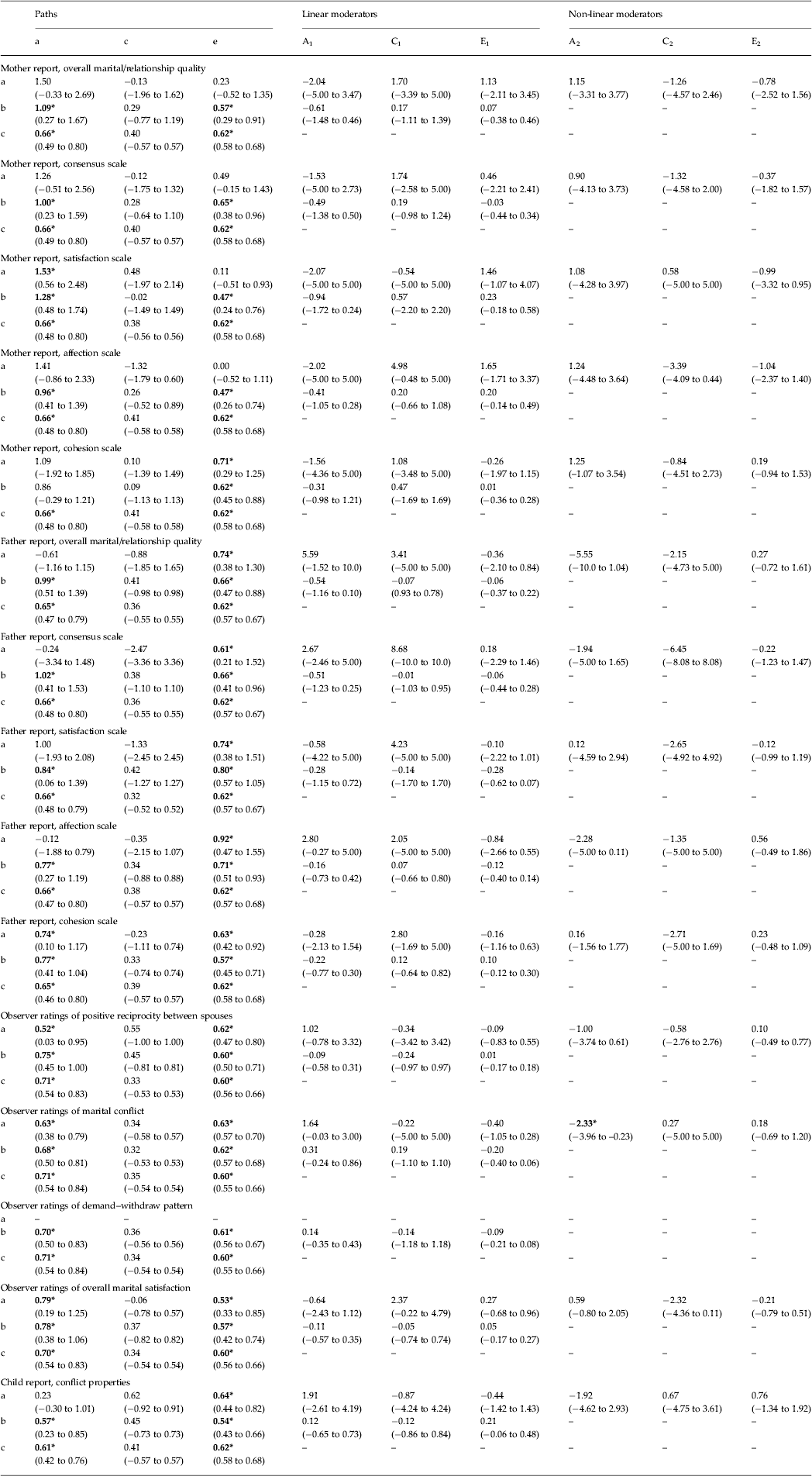
We next fitted the G × E models to the data. Fit indices for moderation by mother/wife and father/husband reports of their marital relationship are presented in Table 3, and those for moderation by observer ratings and child reports are presented in Tables 4 and 5 respectively. Parameter estimates for all models are presented in Table 6. There was no evidence that the etiology of CP was moderated by mother/wife reports of the quality of the interparental relationship. For all five measures of relationship quality, fit indices pointed squarely towards the no-moderation model as the best-fitting model. Moreover, none of the moderator estimates were significantly greater than zero. Examination of observer ratings of interparental interactions (Table 4) and twin reports of observed interparental conflict (Table 5) were fully consistent with those of mother/wife reports. The no-moderation model was selected as the best-fitting model in all five analyses. None of the moderator estimates in these models were significantly greater than zero (Table 6), with the exception of the non-linear genetic parameter for observer-rated marital conflict. As noted, however, the no-moderation model provided the better fit to these data overall, according to three of the four fit indices.
Fit indices for etiologic moderation by mother and father reports of the quality of their relationship, as assessed by the Dyadic Adjustment Scale (DAS)

AIC, Akaike information criterion; BIC, Bayesian information criterion; SABIC, sample size-adjusted BIC; DIC, deviance information criterion; df, degrees of freedom.
The best-fitting model for a given set of analyses is highlighted in bold font, and is indicated by the lowest AIC, BIC, SABIC and DIC values for at least three of the four fit indices. Models that provide the best fit to the data according to two of the four fit indices are indicated with italic.
Fit indices for etiologic moderation by observer ratings of spousal interactions

AIC, Akaike information criterion; BIC, Bayesian information criterion; SABIC, sample size-adjusted BIC; DIC, deviance information criterion; df, degrees of freedom.
The best-fitting model for a given set of analyses is highlighted in bond font, and is indicated by the lowest AIC, BIC, SABIC and DIC values for at least three of the four fit indices.
Fit indices for etiologic moderation by twin reports of interparental conflict

AIC, Akaike information criterion; BIC, Bayesian information criterion; SABIC, sample size-adjusted BIC; DIC, deviance information criterion; df, degrees of freedom.
The best-fitting model for a given set of analyses is highlighted in bond font, and is indicated by the lowest AIC, BIC, SABIC and DIC values for at least three of the four fit indices.
Unstandardized path and moderator parameter estimates for all models

A, C and E (upper and lower case) respectively represent genetic, shared and non-shared environmental parameters on DSM-oriented Conduct Problems (CP). Models a, b and c represent the non-linear, linear and no-moderation models respectively from Tables 3, 4 and 5. The 95% confidence intervals were bounded to −5.0 and 5.0, except in those few cases in which the estimate itself was greater than 5.0, to assist with model convergence. Because the non-shared environmental paths and moderators are combined to compute the non-shared environmental variance at each moderator value, the constituent components of that variance estimate need not be significantly greater than zero for the non-shared environmental variance estimate to be greater than zero (as would be expected). Bold font and an asterisk indicate that the estimate is significant at p < 0.05.
The results were slightly more ambiguous for father/husband reports of marital quality (see Table 3). There was little to no evidence of etiologic moderation by father/husband reports of consensus, affection, cohesion or overall quality. For father/husband reports of satisfaction, however, only two of the fit indices pointed towards the no-moderation model. The other two indicated the presence of possible linear moderation. Examination of the linear moderator estimates, however, indicated that none of the moderators were individually significant (see Table 6), arguing against this possibility. Indeed, only the non-shared environmental moderator even approached significance (p = 0.12).
Confirmatory analyses
As indicated previously, our analyses were restricted to children living in families with married/cohabitating parents so as to directly examine the moderating role of interparental relationship quality (rather than the important but nevertheless separable experience of marriage dissolution). Importantly, however, it is not uncommon for divorced/non-cohabitating parents to continue to interact, particularly around the parenting of their children. To evaluate whether the exclusion of such families influenced our results, we repeated our G × E analyses after including 72 families with divorced, separated or ambiguously-partnered parents (total n = 792 families). These confirmatory analyses were restricted to mother, father and twin reports of relationship quality (observer-rating analyses were not repeated, as parents were not asked to complete this task if they were divorced). Of note, the observed ranges of all moderators in this augmented sample were identical to those reported in Table 1, offering additional evidence that range restriction in the moderator did not influence our findings. Our G × E conclusions were similarly unchanged. Fit indices uniformly pointed towards the no-moderation model for all mother and twin reports of the interparental relationship (results available upon request). For father reports, three of the five tests pointed to the no-moderation model (for father-reported satisfaction and overall quality, the fit was ambiguous, with two fit indices pointing towards the no-moderation model and two pointing towards the linear moderation model). Such results clearly suggest that the exclusion of these families does not account for our null results.
Discussion
The aim of the current study was to evaluate whether and how the quality of the interparental relationship might moderate the etiology of child CP. Our results reveal little to no evidence of etiologic moderation, results that persisted across multiple informant reports of the interparental relationship (i.e. mother/wife report, father/husband report, observer ratings of videotaped spousal interactions and child perceptions of the frequency and severity of their parents’ conflict), and also across cohabitating and non-cohabitating parents. These findings collectively argue against interparental relationship quality as an etiologic moderator of child CP.
The strength of this conclusion is augmented by our examination of a large and ethnically diverse sample of twins. This sample was adequately powered to detect both linear and non-linear G × E (see simulation studies in Purcell, Reference Purcell2002). Moreover, because our sample included twins ‘at risk’ for child CP (based on their residence in a disadvantaged neighborhood), our null results cannot be attributed to the relatively low base rate of child CP in population-based samples. Our extensive phenotyping of both CP and interparental conflict further bolsters our confidence in our results, particularly because the multi-informant operationalization of child CP used here has yielded clear evidence of moderation by the parent–child relationship (Burt et al. Reference Burt, Klahr, Neale and Klump2013; Burt & Klump, Reference Burt and Klump2014a ). These strengths are somewhat offset, however, by the cross-sectional nature of our data. Namely, the current results are specific to middle childhood and should not be applied to other developmental periods (i.e. adolescence). This is particularly the case given the known roles of development in the etiology (Lyons et al. Reference Lyons, True, Eisne, Goldberg, Meyer, Faraone, Eaves and Tsuang1995; Miles & Carey, Reference Miles and Carey1997; van Beijsterveldt et al. Reference van Beijsterveldt, Bartels, Hudziak and Boomsma2003; Bergen et al. Reference Bergen, Gardner and Kendler2007) and phenotypic expression (Tremblay, Reference Tremblay2010; Burt, Reference Burt2012) of youth CP, along with the possible role of development in G × E processes (Burt, Reference Burt2011). Similarly, our results are specific to child CP and do not extend to other forms of childhood psychopathology. Our results are also specific to moderation by the interparental relationship and do not extend to separation or divorce per se. Future work should explore etiologic moderation by parental divorce/separation.
One final limitation concerns the few analyses for which fit indices/parameter estimates did not uniformly agree on the best-fitting model. Namely, the no-moderation model provided the best fit to the data according to all four fit indices for 10 of the 15 potential moderator variables. For four additional moderator variables, three of the four fit indices pointed towards the no-moderation model. In one of these models (that for observer ratings of marital conflict), the non-linear genetic moderator estimate was significantly greater than zero. Although this may represent legitimate moderation, it is worth noting that this finding was not replicated when evaluating twin reports of conflict properties. Moreover, we estimated 129 moderator values across the 15 moderators. We would thus expect roughly six of these to emerge as significant at p < 0.05, simply by chance.
Building on the above, three of the four fit indices pointed towards the no- moderation model for mother-reported satisfaction. Although this level of agreement (i.e. three of four fit indices) is interpreted as supportive of the no-moderation model (see; Hicks et al. Reference Hicks, South, DiRago, Iacono and McGue2009), and none of the linear moderators for mother-reported satisfaction were significantly greater than zero, these results are of interest given the uncertain model fit for father-reported marital satisfaction. As shown in Table 6, however, the non-shared environmental moderator for mother-reported satisfaction was positively signed instead of negatively signed as it was for father-reported satisfaction, a crucial difference (particularly because the E paths for both father-reported and mother-reported satisfaction were positively signed). In other words, our results indicate that although non-shared environmental influences on CP decrease (non-significantly) with father-reported satisfaction, they increase (non-significantly) with mother-reported satisfaction. It is not clear what to make of such contradictory findings, particularly given that they were not replicated using observer ratings of satisfaction, for which all four fit indices pointed towards no moderation. We would thus argue that the weight of the evidence still points distinctly away from a role for G × E in the association between the interparental relationship and child CP.
Despite these limitations, the current study does have important implications for future research. Our results clearly suggest that the etiology of child CP is not significantly moderated by the quality of the interparental relationship. Across multiple measures of the interparental relationship, as completed by four different informants, the no-moderation model provided the best fit to the data. These null findings are striking, for two reasons. First, although marital quality may not moderate the etiology of child CP, child CP is nevertheless associated with the quality of the interparental relationship. Although it would be beyond the scope of the current study to clarify the origins of this association, future work should seek to do just this. For instance, marital quality may influence child CP through an environmental main effect, in which the quality of the interparental relationship causally shapes child behavior. Alternately, their association may be a function of a passive gene–environment correlation in which those with a genetic predisposition towards CP are more likely to have lower quality romantic relationships and to pass on genetic of risk for CP to their children. Finally, they may be associated through overlapping genetic influences. Genetic overlap would be likely to reflect an evocative gene–environment correlational process, whereby the difficulties associated with parenting a child who has high levels of CP take a toll on the interparental relationship. Future work should distinguish between these very different possibilities.
Second, and perhaps more importantly, conflict, warmth and control in the parent–child relationship have all been shown to moderate the etiology of child CP (Burt et al. Reference Burt, Klahr, Neale and Klump2013; Burt & Klump, Reference Burt and Klump2014a ). The notable absence of this same etiologic moderation by the interparental relationship accordingly argues against the notion that every environmental pathogen exacerbates genetic influences on psychopathology (the diathesis–stress model of G × E), or that every protective environment suppresses genetic influences. Instead, the presence and form of etiologic moderation (diathesis–stress versus other types of G × E; Pennington et al. Reference Pennington, McGrath, Rosenberg, Barnard, Smith, Willcutt, Friend, DeFries and Olson2009) seem likely to vary according to the phenotype and environmental experience(s) under study (Burt, Reference Burt2011), and perhaps also to developmental stage (Burt et al. Reference Burt, Klahr, Neale and Klump2013). Although this point may seem obvious, a broad reading of the literature reveals that diathesis–stress G × E is often implicitly, and sometimes even explicitly, assumed to contribute broadly to risk factor–psychopathology associations (see, for example, Hicks et al. Reference Hicks, South, DiRago, Iacono and McGue2009). Future research should thus seek not only to delineate the specific environmental experiences that serve as etiologic moderators of CP but also to clarify how this gene–environment interplay might change over the course of development.
Acknowledgments
This project was supported by R01-MH081813 from the National Institute of Mental Health (NIMH) and R01-HD066040 from the Eunice Kennedy Shriver National Institute for Child Health and Human Development (NICHD). The content is solely the responsibility of the authors and does not necessarily represent the official views of the NIMH, the NICHD or the National Institutes of Health. We thank all participants for making this work possible.
Declaration of Interest
None.