Introduction
An estimated 30 million people in the U.S. have a penicillin allergy label (PAL), yet fewer than 5% have true, clinically significant immunologically-mediated hypersensitivity reaction. Reference Shenoy, Macy, Rowe and Blumenthal1 Inaccurate PALs are linked to antimicrobial resistance, Clostridioides difficile infection, surgical site infections, and increased healthcare costs. Reference Krah, Jones, Lake and Hersh2 Penicillin allergy delabeling (PAD) is therefore endorsed as a stewardship strategy to optimize antibiotic prescribing. Reference Shenoy, Macy, Rowe and Blumenthal1,Reference Staicu, Vyles and Shenoy3 However, limited allergist access, lack of standardized protocols, and workforce constraints prevent widespread implementation of PAD. Reference Staicu, Vyles and Shenoy3–Reference Samarakoon, Accarino, Wurcel, Jaggers, Judd and Blumenthal6 Emerging data suggest that multidisciplinary approaches, including non-allergist involvement and electronic health record (EHR) tools, may expand PAD. Reference Chow, McDanel, Turner and Copaescu5,Reference Powell, Elkhalifa, Guyer, Garcez, Sandoe and Zhou7 To better characterize current PAD practices, we surveyed the Society for Healthcare Epidemiology of America research network (SRN) institutions in the U.S., a consortium of hospitals collaborating on multicenter projects in healthcare epidemiology, regarding their PAD protocols, resource availability, barriers to implementation, and collection of outcomes data.
Methods
We conducted a structured electronic survey of U.S. SRN member institutions (n = 96). The survey was open from April 22, 2025, to June 19, 2025. Participation was voluntary, and there were no exclusion criteria. Study data were collected and managed using Research Electronic Data Capture (REDCap) tools hosted at Tufts University.
The survey consisted of 15 questions based on conditional logic. A complete version of the survey is included in the Supplemental Materials. The survey collected data on risk stratification approaches for PALs, delabeling practices, outcomes tracking, barriers, institutional characteristics, and access to allergy specialists. We used descriptive analyses to summarize responses. The Institutional Review Board of Tufts Medical Center determined this study was non-human subjects research.
Results
Institutional characteristics and specialty service availability (supplemental Table 1)
Thirty-four SRN institutions participated (35.4%), predominantly primary academic medical centers (n = 21) or academic-affiliated hospitals (n = 10). Of these, 44.1% cared for both adult and pediatric populations, and 64.7% had 201–500 inpatient beds. Access to inpatient allergists varied; 21 institutions reported in-person consultation availability, 2 relied on telemedicine or e-consults, and 10 lacked access to allergy consultation altogether. All institutions had active antimicrobial stewardship programs (ASPs).
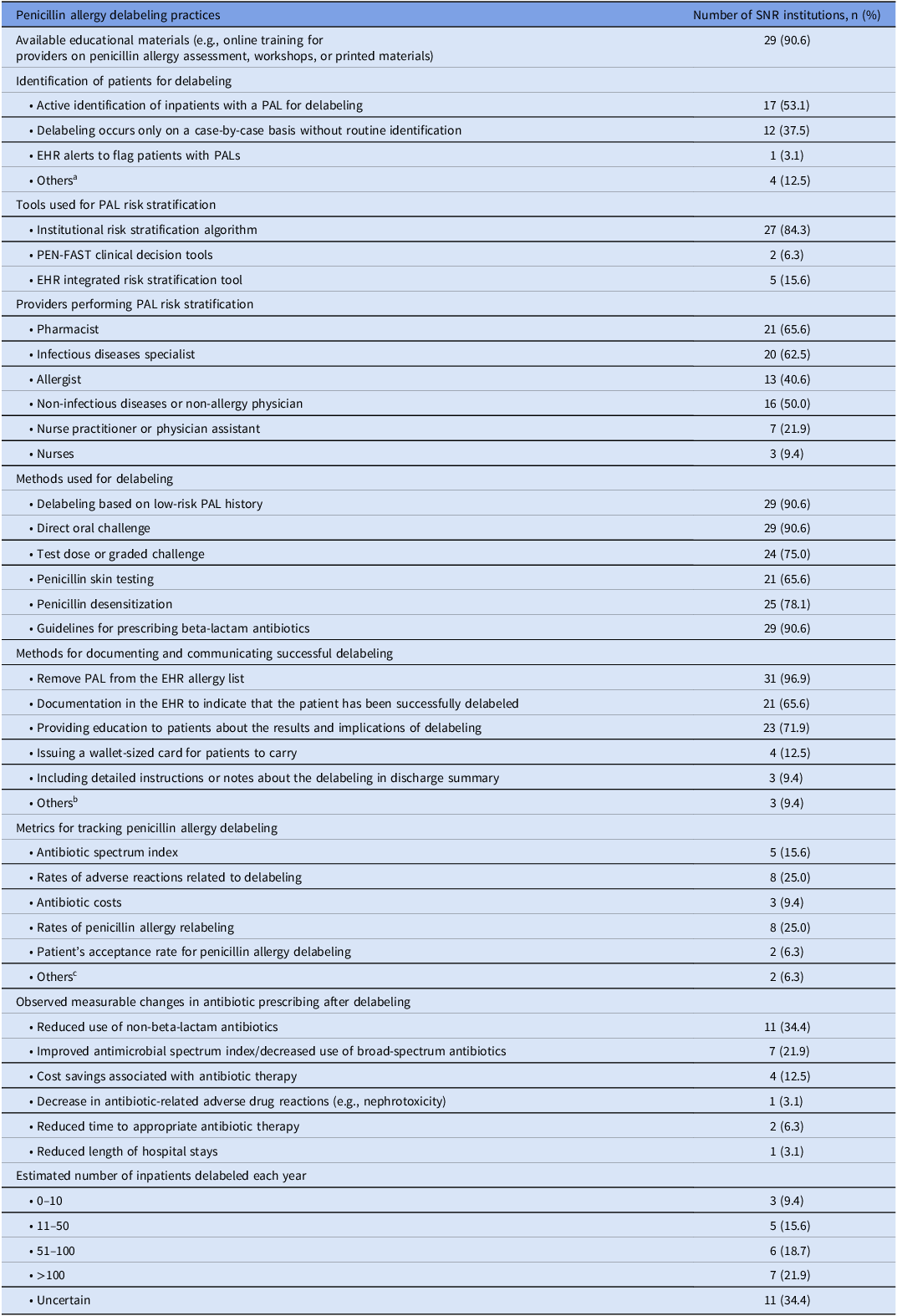
Penicillin allergy delabeling practices among a cohort of 32 SRN institutions

EHR, electronic medical record; PAL, penicillin allergy label; SRN, the Society of Healthcare Epidemiology of America Research Network
a Identification of patients with a PAL through quality improvement projects or research (4)
b Notification to other providers (1), best practice alert to prevent PAL relabeling (2)
c Antimicrobial susceptibility (1), rates of pre-operative antibiotic use in surgical patients with PALs (1)
Penicillin allergy delabeling practices (Table 1)
Among 32 institutions reporting delabeling activities, 29 (90.6%) provided educational materials and tools for healthcare providers. Risk stratification was primarily performed using institutional algorithms (84.3%), with limited use of EHR-integrated tools (15.6%) or the PEN-FAST clinical decision-making tool (6.3%). Pharmacists (65.6%) and infectious diseases (ID) specialists (62.5%) most frequently performed risk stratification, followed by non-ID or non-allergist physicians (50.0%), allergists (40.6%), and advanced practice providers (21.9%). The most common PAD method was delabeling based on low-risk PAL history (90.6%). Access to pharmacologic challenges included direct oral challenge (90.6%), test dose or graded challenge (75.0%), penicillin skin testing (65.6%), and desensitization (78.1%).
Nearly all institutions removed PALs from the EHR allergy list following successful delabeling (96.9%). Additionally, most institutions provided patients with education on the rationale and implications of delabeling and documented successful delabeling in the EHR; a smaller number issued wallet-sized cards and included PAD details in discharge summaries.
Outcome tracking and observed impacts (Table 1)
Only 13 institutions tracked delabeling outcomes. Metrics varied, including rates of adverse reactions related to delabeling (n = 8), rates of relabeling (n = 8), and antibiotic spectrum index (n = 5). Among the institutions with reporting outcomes, reduction in non-beta-lactam antibiotic use (n = 11), improvements in antimicrobial spectrum index in those who were delabeled (n = 7), and cost savings (n = 4) were most common. The estimated inpatient delabeling volume varied widely, with 11 institutions uncertain how many patients are delabeled in a given year.
Penicillin allergy delabeling by location (supplemental Table 2)
Delabeling was most common in inpatient settings, with far lower use in the emergency departments (EDs) and primary care offices.
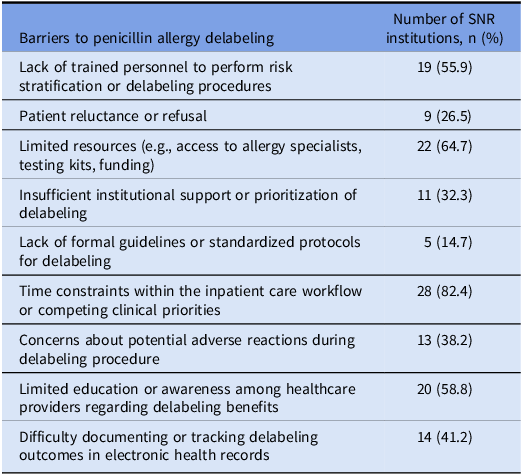
Barriers to penicillin allergy delabeling among a cohort of 34 SRN institutions

SRN, the society of healthcare epidemiology of America research network.
Barriers to penicillin allergy delabeling (Table 2)
Time constraints (82.4%), lack of education or awareness among healthcare providers regarding the benefits of delabeling (58.8%), limited trained healthcare personnel (55.9%), and lack of resources (64.7%) were the most frequently reported barriers. Additional challenges included insufficient institutional support, patient reluctance or refusal, and concerns for potential adverse reactions during the delabeling process. Difficulty tracking delabeling outcomes in the EHR was reported by 41.2% of institutions.
Discussion
This survey highlights heterogeneity in PAD practices across U.S. SRN institutions, underscoring both progress and persistent gaps. Although all respondent institutions reported having an ASP, delabeling activities and their implementation varied considerably. While the majority of institutions offered educational materials and tools, access to inpatient allergist consultation remained inconsistent, and delabeling was often led by non-allergist clinicians such as pharmacists and ID specialists. This pattern mirrors national data showing wide disparities in penicillin allergy evaluation resources and infrastructure. Reference Staicu, Vyles and Shenoy3,Reference Mancini, Fu and Zhang4 These findings also emphasize that while clinical guidelines support delabeling efforts, operationalization is constrained by institutional capacity. Reference Staicu, Vyles and Shenoy3,Reference Samarakoon, Accarino, Wurcel, Jaggers, Judd and Blumenthal6 Expanding structured PAD workflow to non-allergist and non-ID providers during routine patient care rounds may help bridge these capacity gaps.
Fewer than half the institutions tracked delabeling outcomes, and only one-third reported the number of patients successfully delabeled. Lack of systematic outcome measurements represents missed opportunities to quantify impact and guide quality improvement. Literature shows that delabeling improves antibiotic selection, reduces broad-spectrum antibiotic use, lowers costs, and minimizes adverse events. Reference Krah, Jones, Lake and Hersh2,Reference Dong, Zembles, Nimmer, Brousseau and Vyles8–Reference Staub, Nelson and Byrge10 Without outcome tracking, institutions cannot demonstrate these benefits or refine processes. Standardizing outcome metrics, such as delabeling rates, relabeling rates, rates of adverse reactions, and antimicrobial spectrum indices, should be a future priority. Reference Dong, Zembles, Nimmer, Brousseau and Vyles8,Reference Staub, Nelson and Byrge10
Time constraints and lack of trained healthcare personnel remain pervasive barriers, consistent with previous studies highlighting workforce limitations as a key impediment to delabeling scalability. Reference Staicu, Vyles and Shenoy3–Reference Chow, McDanel, Turner and Copaescu5 Non-allergist-led delabeling programs, including pharmacist- or ID specialist-driven programs, have shown the potential to fill this gap. Reference Staicu, Vyles and Shenoy3,Reference Chow, McDanel, Turner and Copaescu5 Incorporating delabeling into existing ASPs, supported by algorithm-driven risk assessment, could facilitate more efficient and sustainable models of care. Reference Chow, McDanel, Turner and Copaescu5,Reference Samarakoon, Accarino, Wurcel, Jaggers, Judd and Blumenthal6
Despite increasing evidence that EHR-integrated tools can improve allergy documentation, facilitate risk stratification, and support point-of-care delabeling, adoption remains limited. Reference Samarakoon, Accarino, Wurcel, Jaggers, Judd and Blumenthal6,Reference Powell, Elkhalifa, Guyer, Garcez, Sandoe and Zhou7 Enhanced EHR decision support, including automated alerts for eligible patients or integrated risk assessment algorithms, could address barriers related to time constraints and shortages of trained personnel. Reference Samarakoon, Accarino, Wurcel, Jaggers, Judd and Blumenthal6,Reference Powell, Elkhalifa, Guyer, Garcez, Sandoe and Zhou7 However, EHR tool deployment requires system-level investment, leadership buy-in, and alignment among stakeholders.
PAD was infrequently performed in EDs and primary care offices, despite growing evidence that delabeling in these settings is safe, feasible, and may prevent downstream consequences of inaccurate PALs. Reference Staicu, Vyles and Shenoy3,Reference Chow, McDanel, Turner and Copaescu5,Reference Dong, Zembles, Nimmer, Brousseau and Vyles8 Expanding delabeling programs beyond inpatient settings is critical to reaching the large population of patients who have inaccurate PALs and reducing inappropriate antibiotic use across the continuum of care. Reference Staicu, Vyles and Shenoy3,Reference Chow, McDanel, Turner and Copaescu5,Reference Samarakoon, Accarino, Wurcel, Jaggers, Judd and Blumenthal6
This study has several limitations. First, our survey relied on self-reported data from a convenience sample of SRN institutions, which may be subject to reporting bias. Second, our survey had a relatively small sample size. However, the response rate was consistent with previously published SRN surveys and reflects typical engagement levels for this type of work. Third, although the SRN includes diverse institutions, the sample was predominantly academic medical centers, which may limit generalizability to non-academic or community settings. Lastly, definitions of delabeling, risk stratification, and outcome metrics may vary across institutions, and survey responses may also be subject to interpretation variability. Nonetheless, this study provides important insights into current delabeling practices and barriers across a range of healthcare settings.
Conclusions
This survey demonstrates variability in penicillin allergy delabeling practices across SRN institutions in the U.S. and underscores persistent barriers related to resources, time, and workforce limitations. Minimal use of EHR tools and limited outcome tracking hinder broader implementation and evaluation efforts. Future interventions should prioritize standardizing delabeling processes, integrating EHR-based tools, expanding non-allergist-led programs, and addressing gaps in ED and primary care settings. Optimizing delabeling across diverse healthcare environments is essential to maximizing its benefits for patient safety, antimicrobial stewardship, and resource utilization.
Supplementary material
To view supplementary material for this article, please visit https://doi.org/10.1017/ice.2025.10320.
Acknowledgments
None.
Financial support
This work was supported by the National Center for Advancing Translational Sciences, National Institutes of Health (NIH), Award Number 1K12TR004384 (K.S.F.). The content is solely the responsibility of the authors and does not necessarily represent the official views of the NIH.
Competing interests
All authors have no conflict of interest relevant to this article.