Crucial transformations of power relations and sociopolitical organization emerged across Early Formative Mesoamerica. Rank societies developed in areas formerly characterized by small autonomous villages. Autonomy both within and between villages eroded as defined leadership roles materialized within larger villages; regional site hierarchies, elite culture, and aspects of ideology appear in the archaeological record. The largest and most complex of these societies developed on the Gulf Coast of Mexico, the Olmecs. The emergence of more sociopolitically complex societies during the Early Formative period across Mesoamerica correlates with transformations in exchange and interaction, on both local and interregional levels. Beginning by 1150 b.c. (uncal), select sites across Mesoamerica display distinctive ceramic vessels that share a common symbolism and iconography. Unlike earlier shared styles, such as the preceding “red-on-buff” ceramics that occur throughout much of the highlands of Mexico (Winter Reference Winter and Hirth1984, Reference Winter and Clark1994), the ceramic vessels display a consistent and complex iconography that often contrasts with local pottery traditions, occurring on certain types of ceramics or with specific vessel forms. These ceramics, often referred to as “Olmec-style” or “Olmec pottery,” exhibit symbols that may represent iconic elements of developing religious beliefs and cosmology. While fundamental principles of this emergent religion and cosmology existed in Mesoamerica prior to 1150 b.c., Olmec monumental art and portable objects synthesized and abstracted these concepts on durable material. Interaction with the Gulf Coast Olmecs, and local understandings of the Olmec style, remain deeply contested topics and are the subjects of this paper.
The nature of these widespread symbols and the implications in terms of interaction represented by the use of this common iconography during the so-called San Lorenzo (or Early) horizon, from 1150–850 b.c., remain poorly understood. Entwined in elucidating the nature of the San Lorenzo horizon across Mesoamerica are two major issues: the comparative sociopolitical complexity between contemporaneous Early Formative period Mesoamerican societies and what materials if any were actually exchanged as part of this interaction. Understanding the nature of San Lorenzo horizon interaction impacts both larger issues of interregional interaction as well as the rise of societies more complex than the early (circa 1400 b.c.) Mokaya chiefdoms of Soconusco (Clark and Pye Reference Clark, Pye, Clark and Pye2000).
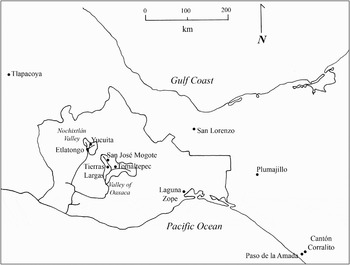
To explore these issues, I focus on three contemporaneous societies: the Olmecs of San Lorenzo, Veracruz; the Mixtecs of the Nochixtlán Valley; and the Zapotecs of the Valley of Oaxaca—the latter two groups both in the modern Mexican state of Oaxaca (Figure 1). In terms of the Olmecs, I focus on San Lorenzo; but recent research—such as that reported by Pool et al. (Reference Pool2010) on the Early Formative period at Tres Zapotes—suggests that several contemporaneous Early Formative Olmec polities existed within Olman (“the land of the Olmecs” of eastern Veracruz and western Tabasco), each potentially engaging in different networks of interaction within and outside of the Gulf Coast. In addition to comparative political organization, I explore the Olmec-style ceramics each region produced, what materials may have moved between these regions, and the differing impacts of interregional interaction on early ranked societies. I also examine epistemology and methodology and how classifications have been used and abused in previous comparisons of pottery between Oaxaca and the Gulf Coast. I discuss material from three contemporaneous ceramic phases during the San Lorenzo horizon: the San Lorenzo phase, the San José phase in the Valley of Oaxaca, and the Cruz B phase in the Nochixtlán Valley.
Location of the Valleys of Oaxaca and Nochixtlán in Early Formative period Mesoamerica, with sites indicated that are mentioned in the text.

As a caveat, I note the term “Olmec style”—initially developed based on objects in museum collections before the exploration of the archaeological Olmec culture—has often been applied uncritically to many artifact categories that may have nothing to do with the Gulf Coast Olmecs (Blomster Reference Blomster2002; Grove Reference Grove, Benson and de la Fuente1996). A more robust definition of the Olmec style must be applied to specific artifact types in order to determine if any connection existed in conception or execution with the material culture of the Gulf Coast Olmec. By applying a definition of Olmec style based on Gulf Coast materials to one such object category—so-called “hollow baby” figurines—it was possible to purge the literature of many figurines that bore no resemblance to the Olmec style, which clarifies where and in what frequencies these objects actually occur (Blomster Reference Blomster1998b, Reference Blomster2002). Furthermore, Olmec style objects should not be assumed to have been produced on the Gulf Coast, but rather may be regional variants of this style. Such assertions should be supported by compositional data, which has recently been applied to San Lorenzo horizon ceramics (see below).
COMPARATIVE SOCIOPOLITICAL ORGANIZATION IN EARLY FORMATIVE MESOAMERICA
By 1150 b.c., rank societies or chiefdoms appeared in Oaxaca, with major centers, San José Mogote in the Valley of Oaxaca and Etlatongo in the Nochixtlán Valley, positioned atop two-tier site hierarchies in their respective valleys. An additional important Oaxacan Early Formative period center with Olmec-style materials is located near the Pacific Coast of the Isthmus of Tehuantepec—the site of Laguna Zope (Zeitlin and Zeitlin Reference Zeitlin and Zeitlin1993). In the Etla branch of the Valley of Oaxaca, where most small villages (such as Tierras Largas) covered only 2 to 5 ha, the village of San José Mogote had a 20-ha core area of public structures and higher status houses that contrasted slightly with the majority of houses in terms of quality of construction and plaster, as well as the presence of an outbuilding or ramada. Inclusion of outlying barrios would extend San José Mogote's size to 60 to 70 ha but this maximum extent does not represent continuous occupation (Marcus and Flannery Reference Marcus and Flannery1996:106). In addition to slight differences in house construction, higher-status individuals at San José Mogote are associated archaeologically with better access to deer meat, magnetite mirrors, imported ceramics, marine shell, and jade. Higher-status individuals may also have organized some craft production, such as magnetite mirrors, with one group of families controlling mirror-polishing (Marcus and Flannery Reference Marcus and Flannery1996:103; Winter Reference Winter and Clark1994).
In the Nochixtlán Valley, Etlatongo's own core area grew to approximately 26 ha during the Cruz B phase, with some evidence of outlying barrios that could extend the size of the site similar to that of San José Mogote and its barrios (see above); in both cases, however, I prefer the figure for the main village, not adding outlying settlements not necessarily connected with the main sites. No primary evidence of a substantial pre-Cruz B occupation has been recovered (Blomster Reference Blomster1998a, Reference Blomster2004; Zárate Morán Reference Zárate Morán1987); however, scattered earlier materials suggest the presence of a small hamlet at this location prior to the Cruz B phase. Excavations through both test units and larger horizontal exposures at Etlatongo revealed that some higher status individuals lived in houses on small platforms (generally less than half a meter), made up of redeposited middens and fill, elevating them above surrounding houses; at least one such house may have had decorated interior plaster. Such individuals also had access to large storage facilities, more exotic and imported goods and displayed relatively large items of ritual paraphernalia (Blomster Reference Blomster1998b, Reference Blomster2004). One area of probable public space has also been defined in the southern portion of the site, a mound elevated by depositing construction fill, in one case with a disproportionately large amount of figurine fragments.
The location of San Lorenzo, on an artificially modified salt dome above the surrounding floodplain, allowed control of river transportation networks. Before 1150 b.c., San Lorenzo was similar to what the Oaxacan chiefdoms would become during the San Lorenzo horizon, a roughly 20-ha site atop a two-tier settlement hierarchy (Symonds et al. Reference Symonds, Cyphers and Lunagómez2002:56). By 1150 b.c., San Lorenzo grew to nearly 700 ha, dwarfing all contemporaneous settlements in Mesoamerica (Cyphers and Di Castro Reference Cyphers, Di Castro, Fash and Luján2009:23). The San Lorenzo Tenochtitlan Archaeological Project (SLTAP) has documented at least a three-tier “central place” hierarchy dominated by San Lorenzo, which housed 40% of the region's population (see Symonds et al. Reference Symonds, Cyphers and Lunagómez2002: 124, 126); the hierarchy would be four-tier if smaller villages and hamlets which would have had no administrative functions are included. In other parts of Mesoamerica, such a settlement hierarchy would generally be consistent with state-level political organization, as clear control and administration over the San Lorenzo hinterland are indicated (Clark Reference Clark, Scarborough and Clark2007). San Lorenzo's builders organized internal urban space to delimit zones of public space as well as residential areas, with a massive ramp connecting San Lorenzo to a dock associated with one of the rivers that surrounded the site (Cyphers Reference Cyphers, Stark and Arnold1997). In terms of social organization, San Lorenzo elites controlled a basalt workshop and lived in what the SLTAP (Cyphers Reference Cyphers, Stark and Arnold1997) refers to as the “Red Palace,” estimated to cover some 400 m2.
Recent data from Olman and Oaxaca indicate substantial differences in sociopolitical organization. The ability of Olmec leaders to commission the first monumental art in Mesoamerica in the form of multiton portraiture (the famous colossal heads) and “altars” or thrones attests to a magnitude of power greater than anywhere else in contemporaneous Mesoamerica. Throughout Early Formative Oaxaca, status differences clearly lay along a continuum, without the displays of personal power and regional settlement integration noted for San Lorenzo. SLTAP archaeologists have referred to San Lorenzo as the center of an incipient state (Symonds Reference Symonds, Clark and Pye2000), while John Clark (Reference Clark, Scarborough and Clark2007:42) refers to San Lorenzo as Mesoamerica's first and only pristine state, based on both its four-tier regional settlement pattern and evidence of foreign hegemony at Cantón Corralito in the Mazatan region, both of which are indicators of the state at the later Valley of Oaxaca Zapotec center of Monte Albán. The political classification of San Lorenzo reveals the limitations in underlying epistemologies, as it invokes problematic neoevolutionary stages and typologies (see Yoffee Reference Yoffee2005), with the result being for some scholars the flawed assertion that if the San Lorenzo Olmec can be placed into the same general “chiefdom” category as other contemporaneous societies, even as a more “complex” chiefdom, it could not have had an impact on them (Flannery and Marcus Reference Flannery and Marcus2000). Current evidence indicates that whatever classification scheme we deploy, the San Lorenzo Olmec were sociopolitically more complexly organized than their contemporaneous Early Formative neighbors throughout Mesoamerica.
WHAT MATERIALS EXHIBIT OLMEC STYLE IN EARLY FORMATIVE PERIOD MESOAMERICA?
Gulf Coast Olmec art includes naturalistic images often combined with iconography that abstracted important concepts of Olmec religion and cosmology (Coe Reference Coe, Wauchope and Willey1965; de la Fuente Reference de la Fuente and Townsend1992). In terms of objects that show Olmec style and iconography, in Oaxaca these are confined to ceramic objects—pottery vessels and figurines. The consistency in representation and the particular use of images in the Olmec style at select sites throughout Mesoamerica suggests the presence of a symbolic code that reinforced social and cosmological structures, beliefs, and values—a not uncommon feature of pottery decoration (Rice Reference Rice1987:251). Although some researchers (Grove Reference Grove, Lowe and Pye2007:222) seize on the apparent absence of monumental art in regions such as Oaxaca as evidence for a lack of Gulf Coast influence, such an observation ignores the sociopolitical context of Oaxacan ranked societies and the complex and nuanced nature of San Lorenzo horizon interregional relationships, which do not signify Olmec political or economic domination in Oaxaca. As opposed to the sociopolitically more complex Olmec center of San Lorenzo, monumental stone sculpture was simply not a feature of early Oaxacan ranked societies. Indeed, multi-ton portraits of rulers, such as the Olmec colossal heads of San Lorenzo, are not artifacts normally associated with ranked societies. Although a fired clay paw, approximately life-size and part of a larger sculpture, was found at Etlatongo (Blomster Reference Blomster2004:Figure 8.2), both the paw, and slightly later bas-relief sculptures from San José Mogote (Monuments 1 and 2; see Marcus and Flannery Reference Marcus and Flannery1996:Figure114), all reflect supernatural imagery—not portraits of leaders. With some possible examples in the Mazatan region (see Clark and Pye Reference Clark, Pye, Clark and Pye2000), monumental art does not appear outside of Olman until the following La Venta horizon. Instead, Olmec-style imagery appeared on portable objects, which could be easily imported and locally imitated.
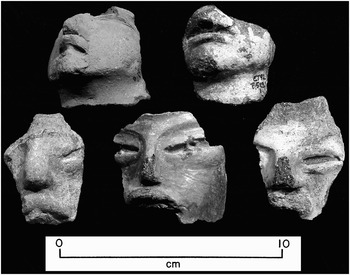
Generally in Oaxaca there are both objects that exhibit the Olmec style as defined for Gulf Coast monuments and ceramics and others that only approximate this style; the distinction between these two is important and may be supported by compositional data. While I focus here on ceramic vessels, solid Olmec-style figurines have been found in both the Valley of Oaxaca and the Nochixtlán Valley. In addition to solid figurines, so-called “hollow baby” figurines (what I have referred to as Group 1) exhibit the Olmec style, while Group 2 hollow figurines are local reinterpretations (Blomster Reference Blomster2002). While none of the published hollow examples from the Valley of Oaxaca (Marcus Reference Marcus1998) correspond with a robust definition of Olmec-style, Group 1 figurines—both fragmentary and nearly intact—have been found at Etlatongo, although they are outnumbered by Group 2 figurines (Figure 2). While Flannery and Marcus (Reference Flannery and Marcus1994:386) claim that hollow babies are a central Mexican phenomenon rather than associated with Olman, they are incorrect, as their interpretation is based on counting the many looted hollow figurines—some of them in Olmec style, some of them not (thus the importance of carefully defining Olmec style)—reportedly from sites such as Tlatilco, Tlapacoya-Zohapilco, and Las Bocas (Blomster Reference Blomster2002). Their model is also flawed by being overly focused on intact objects, ignoring the archetypal Olmec-style examples of hollow baby head fragments excavated at San Lorenzo (Coe and Diehl Reference Coe and Diehl1980:267). In terms of the origins of the Olmec style applied to the human form, solid figurines in this style first appeared at San Lorenzo before the time of the San Lorenzo horizon, during the Chicharras phase (Coe and Diehl Reference Coe and Diehl1980:263).
Hollow figurine face fragments recovered during excavations at Etlatongo. The top two are Olmec-style, or Group 1, while the bottom three are Group 2—local reinterpretations of Group 1.

San Lorenzo Pottery
Some ceramic types associated with the San Lorenzo horizon actually first appear in the earlier Chicharras phase (1250–1150 b.c.) at San Lorenzo, including several of the white paste ceramics, such as Xochiltepec White, as well as white-slipped ceramics, such as La Mina White, with its distinctive orange to red paste (Coe and Diehl Reference Coe and Diehl1980:150–159). Two types of differentially fired black-on-white pottery also appear in the Chicharras phase. Iconographic elements that may represent earth and sky, such as volutes and fine incising similar to decoration on later Limón Incised pottery, occur in the Bajió phase (1350–1250 b.c.) on ceramic vessels, before their appearance on monumental art (Di Castro and Cyphers Reference Di Castro and Cyphers2006:52).
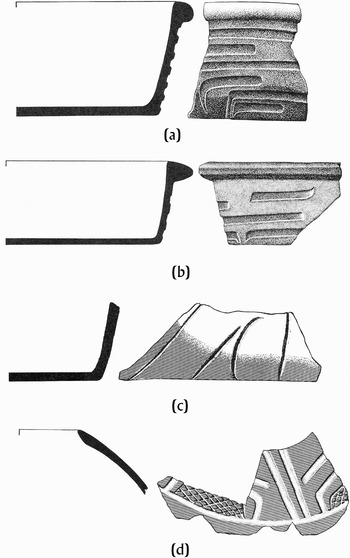
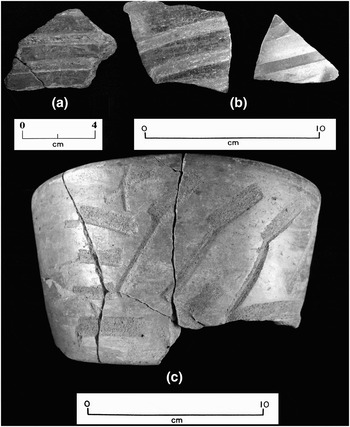
The sculptural nature of Olmec-style art is fully expressed in San Lorenzo phase pottery, in which one of the important types, Calzadas Carved (Fig. 3a, b), features excised designs and symbols, some of which appear on monumental Olmec art, such as Loma del Zapote Monument 2 (Cyphers Reference Cyphers2004:235–237). Di Castro and Cyphers (Reference Di Castro and Cyphers2006:34–35) have recently defined four basic designs and associated compositions at San Lorenzo, the first three of which consist of symmetrical designs, elements of which may be combined for the fourth (asymmetrical compositions of fantastic creatures). Individual motifs on Calzadas Carved pottery, which may combine excision and incision, include: starburst, “jaguar-dragon-paw-wing,” crossed bands/St. Andrew's cross, cross-hachure, brackets and upside down U-shaped lines, some of which combine to form a profile view of a creature with flaming eyebrows (Coe and Diehl Reference Coe and Diehl1980:162–171). These designs appear mostly to represent a creature often referred to as a “fire-serpent” or dragon rather than the cleft-headed “were-jaguar” so prevalent on monumental architecture (Stark Reference Stark, Scarborough and Clark2007:53), although these may be profile and frontal views of the same creature, as shown on a pot from central Mexico (Blomster Reference Blomster2004; Winter Reference Winter and Clark1994). Potters executed the majority of Calzadas Carved designs on the exterior of bowls, where they are oriented either horizontally or vertically, although a small amount are oriented diagonally.
Pottery types defined at San Lorenzo: (a) and (b) Calzadas Carved, (c) Limón Incised, and (d) Conejo Orange-on-White. Sherds not at same scale. Redrawn from Coe and Diehl Reference Coe and Diehl1980:Figures 138g, i; 144i; 150e.

In addition to Calzadas Carved, Xochiltepec White and La Mina White pottery, the San Lorenzo phase includes other types found elsewhere in Mesoamerica: Limón Incised (Figure 3c), which has a variety of incised designs, but are often curvilinear and diagonal lines combined with opposed volutes, curved brackets, and/or other motifs (Coe and Diehl Reference Coe and Diehl1980:171), and Conejo Orange-on-White (Figure 3d), essentially the same paste as Xochiltepec White but with an orange slip on the surface through which decorations may be incised and/or excised (Coe and Diehl Reference Coe and Diehl1980:179). While a variety of designs can be included under Limón Incised, I use this term here solely for curvilinear and diagonal lines that may be associated with opposed volutes or curved arches/brackets. Both Calzadas Carved and Xochiltepec White have been identified as evidence of Olmec-style artifacts at sites throughout Mesoamerica, Limón Incised and Conejo Orange-on-White, however, are extremely rare and restricted in their distribution.
Pottery in the Valley of Oaxaca and the Nochixtlán Valley
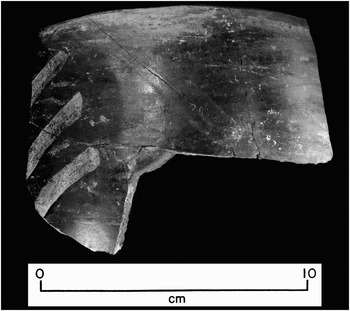
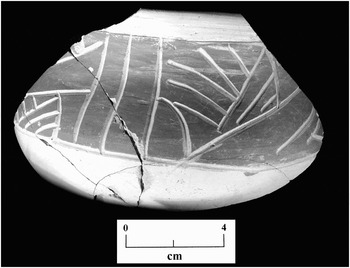
Pottery forms and types increased around 1150 b.c. in the Valley of Oaxaca, with red, white, yellow, and pink slip colors appearing (Flannery and Marcus Reference Flannery and Marcus1994; Winter Reference Winter and Clark1994). Black-on-white pottery, white or white-slipped vessels with contrasting zones of black, through fire-clouding and/or reduction, occur as well—at least 100 years after such pottery was produced during the Chicharras phase at San Lorenzo. Gray ware pottery vessels, sometimes fired in a reducing atmosphere or smudged, and occasionally slipped, also make their first appearance, as do vessels made of white paste, visually similar to Xochiltepec White. Flat-based conical and cylindrical bowls become frequent and are the most common setting for both local and Olmec-style designs. Some San José phase motifs appear to be purely local Valley of Oaxaca designs and include large shapes with hachure, nested triangles (usually with only two lines; see Flannery and Marcus Reference Flannery and Marcus1994:Figure 12.15), zoned designs, and paired jabs. Olmec-style designs usually are expressed as free-standing abstractions of a composite zoomorphic being(s) and include elements such as flame eyebrows, U-shapes/brackets (that may represent gums), the St. Andrew's cross, music brackets, cleft-related elements, and other excised bands, organized in various configurations (Flannery and Marcus Reference Flannery and Marcus1994:135–149). Designs are oriented diagonally or horizontally and usually placed on the outside of bowls (Figure 4) but may also be found on the interior.
Delfina Gray bowl, with diagonal “fire-serpent” carved design (filled with red pigment) found at San José Mogote but imported, as shown through INAA, from San Lorenzo (MURR sample SLN287). See drawing in Flannery and Marcus Reference Flannery and Marcus1994:Figure 146b.

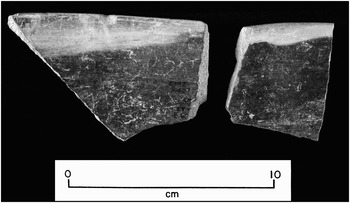
Similar changes and expansion in the ceramic assemblage occur as well in the Cruz B phase of the Nochixtlán Valley (Blomster Reference Blomster2004). The vast majority of pottery consists of a coarse brown paste. Unrestricted vessels are almost invariably slipped with colors, sometimes modified by firing—including white, red, brown, orange, gray, and black. As with the Valley of Oaxaca and Gulf Coast, differential firing is used to achieve contrasting zones of white/yellow and gray/black. A finer brown paste (“café fino”) is used almost exclusively for bowls that feature an orange slip burnished to achieve a waxy surface; while rarely decorated, some examples have a starburst design on the interior base, which is one element that distinguishes Etlatongo vessels from contemporaneous Valley of Oaxaca pots. Gray ware vessels, some of which were fired in a reducing atmosphere, also first appear during the Cruz B phase and may be differentially fired to produce a white band on the vessel's rim (Figure 5).
Differentially fired gray ware pottery from Etlatongo with white interior rims.

Along with local decorations, a small amount of vessels at Etlatongo exhibit Olmec-style designs, where they appear on gray ware vessels and coarse café pots, only rarely occurring on café fino pots (see Figure 6). Olmec-style designs, expressed in both symmetrical and free-standing asymmetrical compositions, include crossed bands/St. Andrew's crosses, U-shapes and brackets, piano keys, L-shaped excised and incised lines, wavy “flame” lines, starbursts, and other designs that could be elements of “paws” or “flame eyebrows” both similar to and different from examples in the Gulf Coast and Valley of Oaxaca. At Etlatongo, designs are usually excised or incised on the exterior of cylindrical (and occasionally conical) bowls. Only rarely do designs appear on the interior of conical bowls; interior placement appears to be more common in the Valley of Oaxaca. Olmec-style motifs appear on these vessel either horizontally or diagonally placed (Figure 6); vertical orientations appear confined to large motifs and cover less of the surface of the pot, not the typical composite design of Calzadas Carved that wraps around much of the vessel.
Examples of Olmec-style exterior carved designs from Etlatongo: (a) horizontal design on a red-slipped bowl; (b) diagonal designs on gray ware bowls; (c) combination of diagonal and horizontal elements on a gray ware cylindrical bowl, shown by INAA (MURR sample BLM003) as a San Lorenzo import.

A fundamental difference between Olmec-style pottery in the Nochixtlán Valley and in the Valley of Oaxaca is the appearance at Etlatongo of crossed bands, arranged symmetrically in horizontal bands, similar to the first composition defined for San Lorenzo by Di Castro and Cyphers (Reference Di Castro and Cyphers2006:34); while an “X” or crossed bands is Motif 7 in the Valley of Oaxaca, a symmetrical composition solely of crossed bands has not been illustrated for the Valley of Oaxaca, except for some “cross-hatching” on a spouted tray from San José Mogote (Flannery and Marcus Reference Flannery and Marcus1994:Figure 12.71). Valley of Oaxaca pottery may exhibit large, bounded areas of hachure, often identified with the “were-jaguar” or “earth” designs, that appear to be virtually absent at Etlatongo. Bounded hachure appears to be a Valley of Oaxaca innovation, incorporated both into local expressions of Olmec-style compositions and purely local designs. Indeed, the presence of such a design on one cylindrical bowl fragment at Etlatongo is suggestive of a Valley of Oaxaca origin, although INAA on this sherd was not conclusive (Blomster Reference Blomster2009). In terms of the problematic dichotomy between fire-serpent and were-jaguar concepts discussed below for the Valley of Oaxaca, it does appear that the majority of Olmec-style designs at Etlatongo fall within the fire-serpent/dragon category; were-jaguar imagery, usually incised, appears on café fino vessels, which are rarely a medium for Olmec symbols.
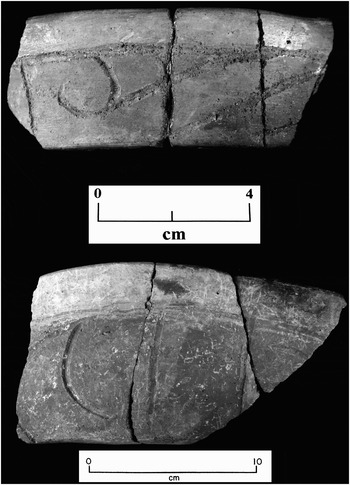
In addition to other potentially Olmec-related types of pottery (Xochiltepec White and La Mina White) found in the Valley of Oaxaca, two types of pottery defined at San Lorenzo are present at Etlatongo but virtually absent in the Valley of Oaxaca: Conejo Orange-on-White (Figure 7) and Limón Incised (Figure 8). Indeed, despite the larger Valley of Oaxaca sample, only one definitive example of what I define as Limón Incised (see above) has been published, included with a burial at Tomaltepec (Whalen Reference Whalen1981:130); perhaps this Limón Incised cylinder came from the Nochixtlán Valley, where chemical sourcing shows potters produced local versions, as this type does not appear to have been produced in the Valley of Oaxaca.
Conejo Orange-on-White vessel, excavated at Etlatongo but sourced through INAA (MURR sample BLM011) as a San Lorenzo import.

Two examples of Limón Incised vessels excavated at Etlatongo; INAA shows the top pot was made at Etlatongo (MURR sample SLN266).

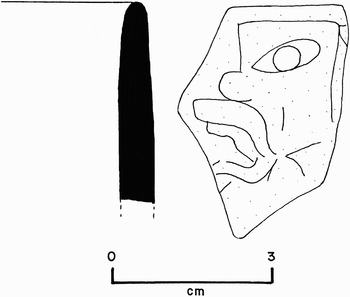
Discovered by Marcus Winter in a recent salvage project at Etlatongo, a small rim sherd from a cylindrical bowl exhibits a fully-realized Olmec-style profile incised on the vessel's exterior (see Figure 9). The sherd comes from a café fino bowl, with an orange/red slip distinctive of this ware. While the archaeological context does not provide an exact chronological placement, the clay and surface treatment of this ware are distinctly Cruz B. At some point, perhaps after the vessel was no longer used, the eye was gouged out and much of the slip removed, perhaps similar to the ritualized destruction of some examples of Olmec paraphernalia elsewhere in Mesoamerica. Naturalistic images such as this are virtually unknown in any part of Oaxaca; more elaborately incised profiles designs are associated with Tlapacoya-Zohapilco, with one example from that site sourced by INAA as a central Mexican product.
An Olmec-style profile face on the exterior of a café fino cylindrical bowl, excavated at Etlatongo; stippling indicates red slip. Drawn by Juan Cruz Pascual.

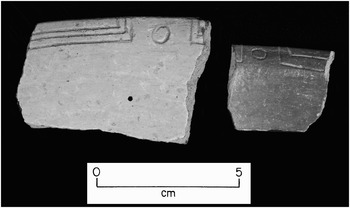
Unlike the Valley of Oaxaca, double-line break designs do not occur until after the Cruz B phase, and do not feature the abstract cleft-headed elements as do the slightly earlier examples in the Valley of Oaxaca (Figure 10). Indeed, many of the more abstract and geometric double-line breaks from the Valley of Oaxaca probably come from post-850 b.c. contexts. The placement of this double-line/extended bracket below the interior rim of conical bowls is fundamentally different from the Olmec-style inverted U's/brackets placed on the exterior of cylindrical bowls.
Double-line breaks—with incised circles—on the rims of white-slipped conical bowls, from post-Cruz B contexts at Etlatongo.

STYLE AND INTERACTION: EPISTEMOLOGY AND METHODOLOGY IN CERAMIC COMPARISONS
The appearance of pottery that features Olmec-style designs at sites in both the Gulf Coast and various regions of Oaxaca presents numerous epistemological and interpretive challenges. The movement of Olmec-style pots, with decorative motifs invoking abstract religious beliefs and cosmology, implies “the dissemination of these ideas” (Clark Reference Clark, Scarborough and Clark2007:31). Are these actual Gulf Coast imports in Oaxaca, or are all Olmec-style vessels the result of local Zapotec and Mixtec production?
Different epistemologies lie behind the models that have been proposed for this interaction, ranging from systems theory to agency perspectives. An outgrowth of processual archaeology, systems theory has become a core element of the neoevolutionary paradigm that focuses on how culture (viewed as a system of intercommunicating networks) adapts humans to the local environment, both natural and social (Binford Reference Binford1962). Despite the focus on open systems detailed in James Miller's Living Systems (Reference Miller1978), which epitomizes the organic analogy utilized by its proponents, systems theory rejects significant external contributions to the developmental trajectory of a given society (Flannery Reference Flannery and Leone1972). Outright conquest and incorporation of a region, however, are invoked by systems theory explanations for the later Zapotec Monte Albán state's spread through domination and control of adjacent regions (Marcus and Flannery Reference Marcus and Flannery1996). Essentially a functionalist paradigm, many examples of systems theory focus on how different feedback mechanisms maintained an ancient system in a state of equilibrium or homeostasis. In terms of explaining change, although ostensibly concerned with internal processes (such as demographic increases), “deviation amplifying” positive feedback often was introduced externally through random change, such as the genetic mutation in wild grass that provoked systematic changes leading to the development of agriculture in Mesoamerica (Flannery Reference Flannery and Leone1972).
Agency perspectives (Bourdieu Reference Bourdieu1977; Giddens Reference Giddens1984; Ortner Reference Ortner1984), in contrast, explore social identities and negotiations of status and power. Material culture is central to such a perspective, as it may reproduce, promote, and/or challenge agency while actual social negotiations produce political relations. Such a perspective views agents as socially embedded and imperfect, engaged in an interactive and recursive relationship between structures that both constrain and enable them. Much debate exists among scholars surrounding motivations and the amount of intentionality of agents (see Dobres and Robb Reference Dobres, Robb, Dobres and Robb2000), but the goal is not to recreate the lives of specific past individuals. Another possibility considers culture as existing between ideological (expressed/possessed by a particular social group) and hegemonic (shared and naturalized conventions) poles, where individual behavior positions itself somewhere between these two poles (Comaroff and Comaroff Reference Comaroff and Comaroff1991:21-24)
While specific applications of these models to the Early Formative Oaxaca data will be detailed below, neoevolutionary perspectives have been central in developing models that categorize Oaxacan societies and the San Lorenzo Olmecs as chiefdoms (see above) and minimize direct contact or impact between these regions (Flannery Reference Flannery and Benson1968; Flannery and Marcus Reference Flannery and Marcus1994). A corollary of such a neoevolutionist interpretation is that Valley of Oaxaca potters produced more Olmec-style vessels than Olmec potters at San Lorenzo, a view largely based on the supposed greater repertoire of Olmec symbols and designs at Valley of Oaxaca sites (Flannery and Marcus Reference Flannery and Marcus2000). Furthermore, because some of these Olmec-style symbols appear on distinctive Oaxacan gray ware pottery, it has been claimed that such pots produced in the Valley of Oaxaca were exported to the Gulf Coast Olmec and other regions of Early Formative Mesoamerica, such as Tlapacoya-Zohapilco; Flannery and Marcus (Reference Flannery and Marcus1994, Reference Flannery and Marcus2000) state highland regions exhibit earlier and more frequent examples of Olmec-style symbols than the Gulf Coast region. In addition to assessing the earliest appearances of elements of this style, I challenge the supposed greater variety and frequency of Olmec-style symbols in the Valley of Oaxaca, critiquing three factors: definition of Olmec-style pottery, classification and comparison of sherds from different sites, and identification of opposed Zapotec forces.
First Appearance of the Olmec Style on Pottery
While it is possible that earlier examples of Olmec-style motifs appeared on perishable materials, pottery provides a more permanent medium to observe where this iconography first manifested across Mesoamerica. Appearing as a well-defined and consistent suite of symbols, Clark (Reference Clark, Scarborough and Clark2007:31) notes that “a long evolution in other media appears unlikely.” As noted above for San Lorenzo, incised symbols appear more than one hundred years earlier than the San Lorenzo horizon; volutes and fine incision appear around 1350 b.c. while inverted U's ascend in popularity beginning around 1250 b.c. in the Chicharras phase (Di Castro and Cyphers Reference Di Castro and Cyphers2006:51). In both the Valley of Oaxaca and the Nochixtlán Valley, Olmec-style iconography does not appear prior to the phases (San José and Cruz B) contemporaneous with the San Lorenzo phase. Di Castro and Cyphers (Reference Di Castro and Cyphers2006:47–48) have reanalyzed Christine Niederberger's (Reference Niederberger1976, Reference Niederberger1987) Zohapilco excavations, which have been cited by Kent Flannery and Joyce Marcus (Reference Flannery and Marcus2000) as showing the “priority” of the highlands in many Olmec motifs; Di Castro and Cyphers determine that some of the relevant stratigraphy is problematic, with one stratum cited as producing pre-San Lorenzo horizon (Nevada phase) materials actually part of one larger deposit, Strata 9–12, with a later (Ayotla phase) date. Finally, in the well-documented pre-San Lorenzo horizon ceramic inventories of different Mazatan sites, such as Paso de la Amada, Olmec-style designs are not present (Clark Reference Clark, Scarborough and Clark2007; Lesure Reference Lesure, Clark and Pye2000), although identical incised geometric designs are present at both San Lorenzo and Cantón Corralito prior to the San Lorenzo horizon (Blomster and Cheetham Reference Blomster and Cheetham2008). Olmec-style figurines also appear earlier in the Gulf Coast (see above). Thus, the San Lorenzo Olmecs expressed many aspects of this style in ceramics prior to other regions.
Zapotec “Olmec-style” Designs, Frequencies, and Forces in Oaxaca
For sherds in Oaxaca to be considered Olmec style, the designs should minimally be excised; if incised, the design must comprise a composition more complex than a single straight line, with possible shapes and elements noted above. When applying such standards to what Flannery and Marcus (Reference Flannery and Marcus1994) include as Olmec style (or “pan-Mesoamerican;” see below) in Early Formative pottery from the Valley of Oaxaca, it becomes evident that Flannery and Marcus have been overly inclusive.
Flannery and Marcus (Reference Flannery and Marcus2000) support the supposed priority of Oaxaca in the creation of Olmec-style symbols by claiming a greater frequency and variety of them in the Valley of Oaxaca, where they refer to them as pan-Mesoamerican symbols, which they define as excised or incised, and “include depictions of what may be supernatural beings, great natural forces, or cosmological beliefs” (Reference Flannery and Marcus1994:136)—essentially the basic definition of Olmec style. Flannery and Marcus have never distinguished Olmec-style symbols as discrete from how they conceive pan-Mesoamerican designs, invariably referring to typical Olmec symbols—the St. Andrew's cross, for example—when discussing them. Indeed, Flannery and Marcus (Reference Flannery and Marcus1994:140) note that in their typology Motifs 15 through 18 are probably specific to Oaxaca and do not include them as “pan-Mesoamerican.” To avoid confusion, I continue to use the term Olmec style, while noting Flannery and Marcus' (Reference Flannery and Marcus1994, Reference Flannery and Marcus2000) preference for the term “pan-Mesoamerican.”
A basic problem is how Flannery and Marcus define and count these designs, many of which appear to be distinguished by very minor variations. I explore this problem through the range of free-standing motifs that characterize Olmec-style pottery in the Valley of Oaxaca. Pyne (Reference Pyne1976:272–274) defines 18 free-standing motifs, 14 of which she considers examples of Olmec iconography. Pyne (Reference Pyne1976:273) and Flannery and Marcus (Reference Flannery and Marcus1994:140–145) classify seven of these motifs (1–7) as representing the fire-serpent (which Flannery and Marcus interpret as Zapotec lightning/sky) and seven (Motifs 8–14) as images of the were-jaguar (or earthquake/earth). Various techniques are deployed to increase the variety and quantities of such motifs in Oaxaca. When they illustrate a sample of Pyne's first 14 motifs, Flannery and Marcus (Reference Flannery and Marcus1994:Figures 12.5–12.13) include designs that do not appear outside of Oaxaca and should not be considered Olmec style—doing so inflates the variations of these motifs and the actual number of Olmec-style sherds in the Valley of Oaxaca. Flannery and Marcus (Reference Flannery and Marcus1994) organize Pyne's Olmec-style motifs to include numerous variants, many of which consist of thin, often straight, incised lines. I suggest such designs do not meet a rigorous definition of Olmec style and should not be included in their quantities of Olmec symbols in Oaxaca. For example, the often thin and straight incised lines, sometime combined with hachure, that comprise Motifs 4, 5, 6, 12, and 14 have no visual relationship to Olmec-style designs and iconography. Furthermore, motifs that are primarily incised lines, or variants of double-line breaks, may fall late in or after the San José phase (see above). Unless hachure is combined with cleft shapes, it is not Olmec style; I exclude from the rubric of Olmec style all vessels with simple incised lines or vertical bands of hachure; several sherds with such designs were included in the Valley of Oaxaca samples in the sourcing study reported below and appear to be local Oaxaca products.
Excluding many motifs considered by Flannery and Marcus as Olmec-style renders their assertion of the larger repertoire of these symbols in the Valley of Oaxaca problematic at best. It also exposes one of several problems in their ceramic totals; when Flannery and Marcus (Reference Flannery and Marcus1994:Table 16.1, 2000:Table 2) present frequencies of Olmec-style pottery from the Valley of Oaxaca, they do not specify which motifs or variants are included. Thus, it is not possible to simply go through their totals and recalculate more accurate frequencies of Olmec-style materials from their excavations, unless all excised sherds are assumed to be Olmec style (see Stark Reference Stark, Scarborough and Clark2007 and below). The quantities of sherds that Flannery and Marcus cite as exhibiting such iconography, and types of designs in Oaxaca, are vastly overstated.
Equally problematic is Flannery and Marcus' (Reference Flannery and Marcus2000:24) assertion that their Valley of Oaxaca excavations yielded more types of pottery with Olmec designs than at San Lorenzo. Several distortions occur with their comparisons between ceramic assemblages from the Gulf Coast and Valley of Oaxaca. Archaeologists create etic pottery types based on specific requirements and features of their assemblage (Spaulding Reference Spaulding1953). Flannery and Marcus (Reference Flannery and Marcus2000:25) express their “surprise” that the San Lorenzo ceramic typology created by Coe and Diehl (Reference Coe and Diehl1980) includes only one pottery type with Olmec symbols, Calzadas Carved (the San Lorenzo typology is being revised by the SLTAP; see Di Castro and Cyphers Reference Di Castro and Cyphers2006). Compared to only one pottery type at San Lorenzo with Olmec motifs, Flannery and Marcus (Reference Flannery and Marcus2000:25) emphasize their four types of pottery from the Valley of Oaxaca with such motifs (Leandro Gray, San José Black-and-White, Atoyac Yellow-White, and Delfina Fine Gray); they associate the higher number of types with Olmec-style designs in Oaxaca with Zapotec potters' greater involvement in their creation. Their comparison is fundamentally flawed, as Flannery and Marcus (Reference Flannery and Marcus2000) overlook the different classification criteria. Because the pottery excavated by Coe and Diehl (Reference Coe and Diehl1980) at San Lorenzo suffered extensive erosion, preservation of surface color and slip varied and therefore does not play a significant role in their classification. Conversely, surface color plays a primary role in Flannery and Marcus' (Reference Flannery and Marcus1994) classification of the well-preserved Valley of Oaxaca pottery as is evident in the names of the types that exhibit supposed Olmec designs. Since Coe and Diehl were not able to make distinctions in slip color a consistent factor in their classification, they generally did not assign excised sherds to different types; Calzadas Carved includes only pottery decorated by excised lines, sometimes in combination with incised decorations. Flannery and Marcus' comparison of ceramic types reveals nothing significant about production of Olmec pottery in these two regions but simply highlights differences in methodologies. Differences in these etic ceramic types cannot be interpreted to assign greater Oaxacan priority in the creation of Olmec-style designs, contra Flannery and Marcus (Reference Flannery and Marcus2000).
Nor is Flannery and Marcus' comparison accurate, as there are other types of contemporaneous pottery at San Lorenzo that exhibit incised and some excised Olmec-style designs, such as examples on the following four types: Limón Incised; Conejo Orange-on-White (Figure 3d; Coe and Diehl Reference Coe and Diehl1980:Figure 150); an Olmec-style face carved on a specimen of Yagua Orange (Coe and Diehl Reference Coe and Diehl1980:Figure 158b); and several possibilities—not definitive due to preservation and size of the sherds—of carved designs on Tatagapa Red (Coe and Diehl Reference Coe and Diehl1980:Figures 159o, p). While Coe and Diehl's (Reference Coe and Diehl1980:Figure 146) sample of Xochiltepec White consists of restricted vessels without plastic decoration, one San Lorenzo sample of this type in the MURR database (SLN519) is an incised hemispherical bowl, and a decorated example excavated in the Valley of Oaxaca (but sourced as originating at San Lorenzo) is also in the MURR database (see below). Due, however, to the erosion of surface color on San Lorenzo pottery, incised Xochiltepec White vessels (which are extremely rare) may actually be Conejo Orange-on-White without any remaining traces of slip; thus, Xochiltepec White clearly is not a significant type for the dissemination of Olmec-style designs. While the number of etic Olmec-style pottery types is an artifact of different methodologies, Flannery and Marcus, however, fail to consider fully the range of decorated types at San Lorenzo.
The ceramic comparison between the Gulf Coast and Valley of Oaxaca becomes even more problematic when sherd frequencies are examined. Flannery and Marcus (Reference Flannery and Marcus2000:22–25) note that only 4% of Level F's sherds at San Lorenzo are Calzadas Carved; they compare this frequency with Leandro Gray sherds from San José Mogote as a type, noting this type comprises 23% of all middle San José phase sherds. Their comparison is invalid and misleading, as not all Leandro Gray sherds have Olmec-style designs and cannot be compared as a type with one that is comprised completely of Olmec-style sherds. In fact, only 12% of Leandro Gray sherds from a midden at San José Mogote are decorated at all (Flannery and Marcus Reference Flannery and Marcus2000:Table 2); how many of these have Olmec-style motifs remains unclear. Only 2% of another type with occasional Olmec symbols, Atoyac Yellow White, is decorated; Flannery and Marcus' (Reference Flannery and Marcus2000) focus on the high frequency of this type overall at San José Mogote is irrelevant. Thus, by comparing “Olmec-style” pottery from the Valley of Oaxaca by types, the vast majority of which do not exhibit Olmec-style designs, with those from San Lorenzo, Flannery and Marcus further create the illusion of a higher frequency of Olmec-style designs in Oaxaca, a tactic also recently identified by Stark (Reference Stark, Scarborough and Clark2007:51), who, using only excised designs at San José Mogote, recalculates Olmec-style frequencies as between 1% and 4%.
Flannery and Marcus employ the same strategies in their presentation of Niederberger's Zohapilco data, where they use quantities of all sherds, both decorated and undecorated, from the types Tortuga Pulido, Volcán Pulido, Atoyac Gris Fino, Valle Borde Blanco, Pilli Blanco, and Paloma Negativo to generate inflated frequencies (between 27% and 29%) of Olmec-style motifs, which Flannery and Marcus (Reference Flannery and Marcus2000:19) proclaim as the highest frequencies of Olmec-style designs in Mesoamerica (see also Di Castro and Cyphers Reference Di Castro and Cyphers2006:50–51). Niederberger (Reference Niederberger1976:159–164) recalculated the frequencies of Olmec-style motifs as only 0.5% to 2.0%, while Stark (Reference Stark, Scarborough and Clark2007:Table 3.1) estimates 0.4% to 1.7% and Di Castro and Cyphers (Reference Di Castro and Cyphers2006:51), only 1.15%, significantly less than frequencies for Olmec-style sherds at San Lorenzo, calculated by David Cheetham (Reference Cheetham2010) as 6.4% for Calzadas Carved, 8.8% for Limón Incised (based on rim sherds from Coe and Diehl's project). Flannery and Marcus (Reference Flannery and Marcus2000:19) also erroneously promote the appearance of supposed Olmec-style designs on six types at Zohapilco (compared, once again, to only one decorated type at San Lorenzo) as significant.
Returning to the Valley of Oaxaca, Flannery and Marcus have also attempted to emphasize an important Zapotec role in the creation of Olmec symbols by linking the two basic forces represented by Pyne's Motifs 1–7 (fire-serpent) and 8–14 (were-jaguar) with distinct Zapotec expression of natural forces, sky/lightning and earth/earthquake, respectively (see above). In addition to ill-advisedly conflating 14 such disparate motifs as representing two opposed “forces” (a ceramic vessel from central Mexico often used to illustrate these “forces” shows front and profile views of the same dragon-like entity), identifying these symbols with Zapotec forces known through Spanish ethnohistoric documents 2,500 years later remains especially problematic. Flannery and Marcus (Reference Flannery and Marcus2000:13) speculate that this “ancient dichotomy” existed long before the Gulf Coast Olmec; no supporting material evidence, however, has ever been offered. Furthermore, no clear connection has ever been developed between these Olmec-style symbols and later Zapotec belief and iconography. One potential link has been cited by Marcus (Reference Marcus, Sharer and Grove1989:196), who connects the Early Formative Zapotec “earth/earthquake” iconography with the earthquake glyph from later Zapotec writing, which Marcus and Flannery (Reference Marcus and Flannery1996:130) believe first appeared on a stone slab (Monument 3) from San José Mogote, the dating of which remains debated (see Cahn and Winter Reference Cahn and Winter1993). Urcid (Reference Urcid1992:157) demonstrates that the supposed earthquake sign (Glyph E in the system established by Alfonso Caso) on Monument 3 is Glyph L—not related to earthquake. Thus, Olmec symbols do not correspond to early Zapotec iconography. While the visual distinction between fire-serpent and were-jaguar imagery obviously reflects important conceptual categories, they may not form a neat dichotomy between two opposing forces.
There has been an inaccurate impression that the Valley of Oaxaca had both more types and higher frequencies of Olmec-style pottery, signaling greater involvement in their creation (as Zapotec expressions of natural forces) and dissemination; utilization of such flawed data by other scholars leads to inherently problematic conclusions (see Stark Reference Stark, Scarborough and Clark2007). Flannery and Marcus' category of “pan-Mesoamerican” designs includes clearly local as well as Olmec style designs, inflating their frequencies in Oaxaca. In addition to artificially stacked comparisons, there is an underlying problem that simply having more varieties of designs (as defined by archaeologists) correlates with the designs' origins.
Missing from comparisons of the Gulf Coast and Valley of Oaxaca ceramic assemblages has been another major Olmec-style decorated ceramic type—Limón Incised—as it has not been documented by Flannery's important excavations at San José Mogote. Additionally, while Marcus (Reference Marcus, Sharer and Grove1989:194) asserts that the Valley of Oaxaca Zapotecs were more involved in the creation and production of pottery with “pan-Mesoamerican” symbols than the Mixtecs, the Etlatongo excavations encountered numerous examples of both Limón Incised pottery and Conejo Orange-on-White (virtually absent in the Valley of Oaxaca), as well as all of the basic types found in the Valley of Oaxaca. The supposed priority of the Zapotecs in the creation of Olmec-style gray ware and other pottery can no longer be accepted, even within the boundaries of modern Oaxaca state. Indeed, the centrality of San José Mogote in Early Formative sociopolitical complexity and interregional interaction may largely be an artifact of its earlier excavation; Etlatongo is as large as nuclear San José Mogote, and its inhabitants were probably more intensively involved in utilizing, importing, and producing a whole spectrum of Olmec-style objects.
MOVEMENT OF OLMEC-STYLE POTTERY IN EARLY FORMATIVE MESOAMERICA
Throughout the debate on the significance of Olmec-style pottery throughout Early Formative Mesoamerica, scholars lacked robust compositional or petrographic data. While it had long been suspected that Xochiltepec White may have been a Gulf Coast export (Pires-Ferreira Reference Pires-Ferreira1975:82), its origin remained undocumented. Similarly, fine gray ware pots, including those with Olmec-style designs, have long been asserted to be a Valley of Oaxaca export but without significant support based on analyses of raw materials (Flannery and Marcus Reference Flannery and Marcus1994, Reference Flannery and Marcus2000).
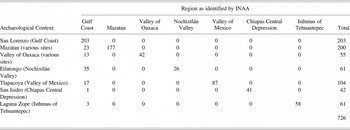
In order to more objectively determine the origin of Olmec pottery, researchers have collaborated on a program of chemical characterization. Over 1,000 archaeological pottery and modern clay samples from the Gulf Coast, Oaxaca state, Chiapas, and central Mexico were subjected to Instrumental Neutron Activation Analysis (INAA) at the University of Missouri Research Reactor (MURR). Samples were selected to include local pottery as well as possible imports. Details on methodology and statistical techniques, which focused on Mahalanobis distances and multivariate analyses for compositional pattern recognition, have been previously published (Blomster et al. Reference Blomster, Neff and Glascock2005; Neff et al. Reference Neff, Blomster, Glascock, Bishop, Blackman, Coe, Cowgill, Cyphers, Diehl, Houston, Joyce, Lipo and Winter2006). An effort was made to include the eight supposed Oaxaca imports (as identified visually by Pyne but never illustrated by Flannery and Marcus) from the San Lorenzo collection, curated at the Peabody Museum of Natural History, Yale University (Blomster Reference Blomster1998a, Reference Blomster2004). Between this INAA project and one directed by David Cheetham (Reference Cheetham2010; Cheetham et al. Reference Cheetham, Gonzáles, Behl, Coe, Diehl and Neff2009), those sherds have all been subjected to INAA. Through INAA, it was possible to determine the compositional group and region of origin for 726 (updating previously published results) samples of pottery (see Table 1).
Regional Assignments for San Lorenzo Horizon Pottery

Note: Updated from Blomster et al. Reference Blomster, Neff and Glascock2005 (Table 1)
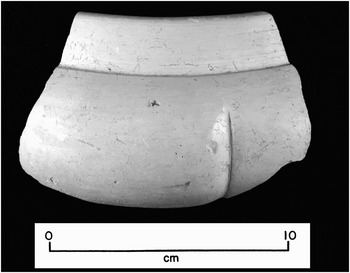
The results demonstrate a clear pattern of San Lorenzo production and dissemination of Olmec pottery, producing both fine, white-paste pottery and decorated Olmec-style pottery. The San Lorenzo Olmecs exported several types of pots to regional centers across Mesoamerica, with not all regions exhibiting the full array of pottery types available during this time period. Some pottery types, such as Xochiltepec White (Figure 11) and Conejo Orange-on-White (Figure 7), appear to be produced solely by the Olmecs. Examples of Xochiltepec White vessels, while often in the shape of vegetal effigies, rarely exhibit plastic decoration (see above), while examples of Conejo Orange-on-White from both San Lorenzo and Etlatongo manifest elaborate designs. Also, one Xochiltepec White example found at San José Mogote, imported from San Lorenzo (SLN206 in the MURR database), has a complex incised design, and Flannery and Marcus (Reference Flannery and Marcus1994:258) note other Valley of Oaxaca examples have excised “pan-Mesoamerican” motifs. In Oaxaca, other relatively undecorated types imported to Etlatongo and San José Mogote resemble La Mina White (BLM032) and differentially fired Perdida Black-and-White (BLM031, SLN213) defined at San Lorenzo (Coe and Diehl Reference Coe and Diehl1980) and identical to so-called Coatepec White-rimmed Black, as defined in the Tehuacán Valley and the Valley of Oaxaca. In terms of decorated pots, a small portion of the non-white paste Olmec-style vessels recovered from excavations at Etlatongo and Valley of Oaxaca sites were imported from San Lorenzo.
Xochiltepec White pottery excavated at Etlatongo but identified through INAA (MURR sample BLM001) as a Gulf Coast import.

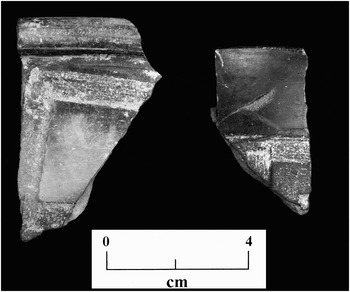
Throughout Early Formative period Mesoamerica, chiefly centers imported pots decorated with Olmec-style iconography, while potters in each region produced vastly more local emulations, imitations, and variants with much regional diversity in types of designs and frequency of both imported Olmec-style pots and local creations (see Blomster et al. Reference Blomster, Neff and Glascock2005). For pottery with Olmec-style symbols from sites in Oaxaca, the INAA results are especially interesting. So-called gray ware pottery with Calzadas Carved designs, asserted as solely a Valley of Oaxaca product (Flannery and Marcus Reference Flannery and Marcus1994, Reference Flannery and Marcus2000), was actually manufactured at both San Lorenzo and in several regions of Oaxaca. Examples of Olmec-style iconography imported from San Lorenzo but found in the Valleys of Oaxaca and Nochixtlán invariably appear on the exterior of Delfina Fine Gray cylinders. This type, along with Leandro Gray, have been referred to as important wares “widely exported” from the Valley of Oaxaca to the rest of Mesoamerica (Flannery and Marcus Reference Flannery and Marcus1994:157, 259); the INAA performed at MURR directly contradicts the idea of a substantial amount of Oaxacan gray wares with Olmec-style designs exchanged throughout Mesoamerica, especially arriving at San Lorenzo. At San José Mogote, one large fragment of a Delfina Fine Gray cylindrical vessel has diagonal “fire serpent” excisions filled with red pigment (see Figure 4). INAA demonstrates that this specimen was an import from San Lorenzo (Sample SLN287). While a small percentage of sherds classified as Delfina Gray may be San Lorenzo imports, sherds classified as the thicker Leandro Gray appear to be limited in production and distribution to the Valley of Oaxaca.
At Etlatongo, fine gray ware pots with Olmec-style iconography were encountered virtually identical to examples of Delfina Fine Gray from San José Mogote (see Figure 12). INAA reveals, however, that such vessels at Etlatongo were not made in the adjacent Valley of Oaxaca, Calzadas Carved gray wares at Etlatongo appear to be either Gulf Coast imports or local Etlatongo products. Indeed, both gray wares illustrated in Figure 12, from San José Mogote and Etlatongo, originated at San Lorenzo. Local versions of Olmec-style iconography at Etlatongo most frequently adorn coarse café paste vessels, as they do in the Valley of Oaxaca. While Oaxacan-made versions of decorated Delfina Fine Gray and Leandro Gray vessels do not appear to have been exported in the current INAA sample, it would be interesting to determine if some examples, perhaps without Olmec-style designs but undecorated or with purely local motifs, did move between regions; one possible example from the Valley of Oaxaca has been identified at Etlatongo (Blomster Reference Blomster2009; see above). At both Etlatongo and San José Mogote, potters created local imitations of Olmec-style pottery in a variety of clay recipes and forms, using both slips and design configurations unique to each region. From the limited INAA sample, it appears that a greater frequency of gray ware pots with Olmec-style symbols were imported at Etlatongo compared with San José Mogote, which supports the greater range of types or styles of Olmec vessels (see above) found at Etlatongo, and further contradicts the idea that the Early Formative Mixtecs were less involved in interregional interaction than their Zapotec contemporaries (Marcus Reference Marcus, Sharer and Grove1989:194). While in most Early Formative period contexts at Etlatongo, Olmec-style pots, both imported and local, represent 5% or less of the assemblage, in three contexts that contributed sherds to the MURR study, they constitute between 10% and 22% (Blomster and Cheetham Reference Blomster and Cheetham2008). In terms of the fire-serpent and were-jaguar categories used by many scholars to characterize abstract Olmec-style designs on pottery, Etlatongo is also more similar to San Lorenzo with its focus on fire-serpent/dragon imagery, while both designs are more evenly represented at San José Mogote. I note, however, that many of the so-called were-jaguar or “earth” motifs in the Valley of Oaxaca appear to be primarily local, and may have little to do with the Olmec style.
Examples of carved gray ware pottery, both sourced through INAA as San Lorenzo products. The one on the right was excavated at Etlatongo (MURR sample BLM028); the one on the left was found at San José Mogote (MURR sample BLM066).

The INAA data have several implications for both macro- and micro-scale interaction in Early Formative Mesoamerica. None of the Calzadas Carved examples in the San Lorenzo sample analyzed at MURR were made in Oaxaca; however the presence of one or two Oaxaca-made vessels at San Lorenzo would not contradict the pattern generated by the INAA data. A recent attempt through petrographic analysis to suggest that a handful of sherds at San Lorenzo were made in Oaxaca failed to overturn the results of the MURR study because of the assumption that only Oaxaca clays would contain volcanic materials (Stoltman et al. Reference Stoltman, Marcus, Flannery, Burton and Moyle2005). This assertion is fundamentally incorrect as shown by petrographic analyses of clays and pots made in the San Lorenzo vicinity (Guevara Reference Guevara2004; Neff et al. Reference Neff, Blomster, Glascock, Bishop, Blackman, Coe, Cowgill, Cyphers, Diehl, Houston, Joyce, Lipo and Winter2006). In addition, the Stoltman/Flannery study limits non-plastic inclusions in San Lorenzo pottery to calcareous sand and quartzite (Stoltman et al. Reference Stoltman, Marcus, Flannery, Burton and Moyle2005:11213). A recent study using petrography and x-ray diffraction has contradicted this assertion as well, revealing the complex mineralogy of San Lorenzo pottery (Cheetham et al. Reference Cheetham, Gonzáles, Behl, Coe, Diehl and Neff2009).
Thus, the San Lorenzo Olmecs had priority in the production and dissemination of both Olmec-style decorated pottery and white paste pottery. Societies in neighboring regions, such as the Nochixtlán Valley and the Valley of Oaxaca, made their own imitations of this pottery but generally did not exchange it with each other or with the Olmecs. Undecorated pottery or pots with local motifs may have been exchanged between regions such as the Nochixtlán Valley and the Valley of Oaxaca (Blomster Reference Blomster2009). While the Olmecs may not have created all of the motifs exhibited even on Gulf Coast pottery, they played a fundamental role in synthesizing them into a coherent package, iconography dramatically different from that displayed stylistically in ceramic objects prior to the San Lorenzo horizon beyond the Gulf Coast.
EPISTEMOLOGY AND MODELS OF EARLY FORMATIVE INTERACTION
The chiefly centers of San José Mogote and Etlatongo imported Olmec pottery, both white paste and with Olmec-style iconography, from San Lorenzo rather than from each other. This pattern attests to the high value that was placed on Gulf Coast-produced pottery and suggests that models that have downplayed the nature and origin of the iconography of Olmec pottery must be reevaluated. The differences in the assemblages of Olmec-style material between the Valley of Oaxaca and the Nochixtlán Valley indicate the great variety in the nature of interregional interaction across Mesoamerica. Models must consider the agency of all players in this interaction.
An important 1968 paper by Flannery set the tone for much of the past forty years of interpretation. In the so-called emulation model, Flannery argues against symbols appearing in Oaxaca with significant Olmec-based meaning, focusing on local developmental patterns and use of Olmec symbols by Zapotec leaders. Flannery's (Reference Flannery and Benson1968) emulation model derives from systems theory (see above) and relies primarily on scattered ethnographic analogies from northwestern North America and Burma, not from Mesoamerica. As a neoevolutionary model, the focus is on local developments, minimizing any foreign contact or impact from the more complexly organized Olmecs. While this model displays a welcome emphasis on the strategizing of local Zapotec leaders, the agency of the Olmec and the impact of their symbols remain undeveloped. Nearly thirty years later, in the face of what Flannery and Marcus (Reference Flannery and Marcus1994) considered as mounting evidence for similar sociopolitical organization of the Olmecs and Early Formative Zapotecs, they transformed the emulation model into a peer polity model, which focuses on change emerging from the interaction of societies, roughly comparable politically, that quickly spread any innovations through the network of participating societies (Renfrew Reference Renfrew, Renfrew and Cherry1986:6). In Flannery and Marcus' (Reference Flannery and Marcus1994, Reference Flannery and Marcus2000) most recent scenario, the Olmecs were simply one of many contemporaneous Mesoamerican chiefdoms exchanging pottery without any priority in the creation and dissemination of Olmec-style symbols. Flannery and Marcus argue that a pan-Mesoamerican style (what has been referred to here as Olmec style), like other features of Early Formative Mesoamerican period societies, arose out of competitive interaction among chiefdoms as part of an “adaptive autonomy” that speeds up evolution.
Even before the INAA results, the idea that such a consistent abstract iconography from across Mesoamerica could be the result of sporadic interaction between largely independent societies had been challenged (Blomster Reference Blomster1998a; Stark Reference Stark, Clark and Pye2000). Clearly the vast disparity between contemporaneous societies on the Gulf Coast and Oaxaca contradicts the first criterion in applying a peer polity model, the presence of polities of comparable size (Renfrew Reference Renfrew, Renfrew and Wagstaff1982). Understanding San Lorenzo horizon interaction has not been advanced by evolutionary models that provide coarse socio-political typologies and reject significant impact between distant groups. Agency perspectives (see above) focus on negotiations of status and power and seem more amenable to an interaction that may have focused heavily on religion and its correlates in societal ideology. With interregional interaction, agency must be explored from multiple perspectives for the different parties involved, focusing on the constant contestation of power and relationships. Such a perspective also escapes the narrow formalism of neoevolutionary economic perspectives and its focus on Western capitalist ideas and decisions, allowing for different forms of interaction within and between societies that go beyond reciprocal exchange (Polyani Reference Polyani, Polyani, Arensberg and Pearson1957).
Recognizing that not all Early Formative societies were at the same level of sociopolitical complexity and that relationships between contemporaneous societies may have taken many forms allows for different models that may more accurately reflect relationships between societies such as the Olmecs, Zapotecs, and Mixtecs. In relationships between societies of different levels of complexity, one society in the relationship may be considered a superordinate center. Defined in both preindustrial states and noncentralized societies, Helms (Reference Helms1993) suggests that a superordinate center represents an earthly approximation of a divine, cosmological model. Helms' (Reference Helms1993:96) model emphasizes acquisition of goods, which she defines as a one-sided activity very separate from concepts such as exchange and reciprocity, and focuses attention on negotiations among social actors at different levels in the societies involved. The relationship of a superordinate center (which may characterize San Lorenzo) and outside regions will depend on distance and the interest of the participants in this interaction. Thus, there will be much variety in these interactions based on the character and organization of outlying societies as well as the motivations of all agents. While the impoverished neoevolutionary typology categorizes non-Gulf Coast Early Formative period ranked societies as chiefdoms, much variety existed in the internal organization and integration of factions within such societies,which impacted external relationships. Debates on understanding Uruk interaction in the Near East suggest the range of models, from world systems to distance parity, that may apply across different regions manifesting a similar phenomenon (Algaze Reference Algaze1993; Stein Reference Stein and Cusick1998). What these disparate models recognize is the mutual impact of interacting societies. While interaction may be asymmetrical or the societies involved may be at different levels of sociopolitical complexity, participants have agency on different levels that often provoke dynamic and unexpected short- and long-term results among the interacting parties.
I integrate the concept of a superordinate center with that of a regional cult with the superordinate center as the religious and cosmological focus or even origin of the cult. Religious cults are known for later Mesoamerica, such as the Quetzalcoatl cult of the Epiclassic and Postclassic periods (Ringle et al. Reference Ringle, Negrón and Bey1998). Regional cults spread across ethnic, political, and linguistic boundaries as they promote transcultural rituals and play important roles in both generating new interaction patterns as well as providing an ideological basis for transformations in participating cultures (Werbner Reference Werbner and Werbner1977). While cults are expansive religions, they are not necessarily spread through force, and they exhibit diverse manifestations due to considerable agency on the part of participating societies. For example, the Chavín horizon in Peru, which manifested its underlying principles in various media that appear over a dispersed geographic area, has been characterized as a regional cult, with varying impacts on societies in contact with it (Burger Reference Burger1992).
Olmec interregional interactions may have intertwined the spread of a regional cult with acquisition and/or exchange of exotic goods desired at San Lorenzo, such as magnetite mirrors from the Valley of Oaxaca (Pires-Ferreira Reference Pires-Ferreira1975) and ilmenite cubes acquired from central Chiapas, probably from an outpost established at their manufacturing point at Plumajillo (Agrinier Reference Agrinier1989). Superordinate centers, such as San Lorenzo, have an obligation to extend the spread of cosmic order across regions, generally by elites from such centers presenting skillfully crafted items to leaders of distant groups, while acquiring exotic foreign items from such groups and reinforcing their status (Helms Reference Helms1993:179–180). It is worth noting that the San Lorenzo Olmecs interacted only with already ranked societies; transfers of exotics between regional leaders also sealed alliances. Rather than Olmec-style pots, other foreign objects of value arrived at San Lorenzo and may have served as distant symbols supporting and legitimizing their religion and cosmology.
From a Oaxacan perspective, emerging leaders obtained Olmec ceramics, both pottery vessels and figurines, and made local emulations of them. The relationship between the original and the imitations was dynamic, and differentiating between local and imported Olmec-style pottery from excavations will more fully reveal their distributions at sites such as Etlatongo. While utilization and conscious emulation of the largely alien Olmec imagery enhanced the prestige of local Oaxacan elites, the model I propose goes beyond simple emulation, recognizing that significant nonlocal meanings were embedded in these abstract Olmec-style symbols, so similar across regions. From Oaxacan perspectives, elements of Olmec iconography and cosmology were accepted and incorporated into local beliefs and represented their connection to a larger cosmic order as seen by the consistent adherence to Olmec iconographic features in the pottery. Helms' (Reference Helms1993:205) focus on acquisition also applies, as obtaining Olmec vessels and symbols may have transpired outside of traditional exchange relationships, and involved active negotiations among social agents and political factions; such interactions do not imply exploitation or long-term cultural assimilation. This model acknowledges that local potters actively contributed some symbols to Oaxacan versions of Olmec iconography on vessels made in villages such as Etlatongo and San José Mogote, but the available data do not suggest that these contributions informed representations outside of their respective regions. Local imitations of Olmec-style pottery by the ranked societies they encountered do not appear to have been desired or acquired by the San Lorenzo Olmecs and were generally not imported to the Gulf Coast.
This model also acknowledges multiple interactions and different exchanges occurring and allows for many objects that moved across Mesoamerica unrelated to Olmec interaction. Within a region, leaders at chiefly centers such as Etlatongo and San José Mogote may have distributed some San Lorenzo-made Olmec pots to supporters in the smaller villages within their realm. Indeed, of the 13 Valley of Oaxaca sherds that visually appeared to be Xochiltepec White, INAA demonstrated that the only four actually imported from the Gulf Coast were all found at the chiefly center of San José Mogote. None was found at the small villages or hamlets of Tierras Largas, Huitzo, and Abasolo. A similar pattern extends to the few Olmec-style decorated pots demonstrated through INAA to have been San Lorenzo imports. If Olmec-style designs were largely confined to Delfina Fine Gray pots, then this pattern corresponds with Flannery and Marcus' (Reference Winter and Clark1994:263) observation that this fine gray ware comes primarily from San José Mogote, while it is extremely scarce at small hamlets such as Tierras Largas and Abasolo (although two small Delfina Fine Gray rim sherds, not exhibiting decoration, in the MURR sample imported from San Lorenzo were found at Tierras Largas). The imports, infused with the inalienable qualities of their distant origin, largely remained at the chiefly center that acquired them.
The San Lorenzo Olmecs and their interactions with other Early Formative societies must be understood in the context of these contemporaneous societies. Rather than focusing on which neoevolutionary typology best characterizes the San Lorenzo Olmecs, they must be understood in comparison to their contemporaries across Mesoamerica. Comparing the “Red Palace” at San Lorenzo with millennium-later Zapotec palaces at Monte Albán (Flannery and Marcus Reference Flannery and Marcus2000:6) reveals little about the sociopolitical organization of the Olmecs. Multiple lines of evidence demonstrate that the San Lorenzo Olmecs were more sociopolitically complex than their contemporaries (see Clark Reference Clark, Scarborough and Clark2007). Olmec interaction neither created Zapotec or Mixtec civilization nor transformed ancient Oaxacans as has been convincingly argued for Olmec contact with the Mokaya people of Soconusco's Mazatan region (Clark and Pye Reference Clark, Pye, Clark and Pye2000) with an Olmec enclave at Cantón Corralito and a fundamental transformation in many features of the ceramic assemblage resulting from this contact (Cheetham Reference Cheetham2006, Reference Cheetham2010). While the impact of Olmec symbols and cosmology varied throughout Mesoamerica and was negotiated on a local level, Karl Taube (Reference Taube2004) has tracked features of Olmec religion and cosmology that resonated in later societies through iconographic elements in depictions of supernatural entities. Understanding Olmec interaction in Oaxaca does not supersede an interest in local sequences (contra Grove Reference Grove, Lowe and Pye2007) but rather is vital to understanding the nature of early ranked societies in the Valleys of Nochixtlán and Oaxaca as well as comparative Early Formative sociopolitical organization. The relationships between the Olmecs, Zapotecs, and Mixtecs represent a complex episode of “interaction and entanglement” (Dietler Reference Dietler and Cusick1998:298) that added a distinct patina to early iconography and imagery in the Valleys of Oaxaca and Nochixtlán and provided additional elements to locally emerging religion, cosmology, and ideology.
RESUMEN
La interacción entre la costa del Golfo olmeca y varias regiones de Mesoamérica durante el formativo temprano continua a debate y es pobremente entendida. En Oaxaca, los modelos han sido dominados por la epistemología neoevolutiva. La interacción entre el valle de Oaxaca y San Lorenzo ha estado caracterizada por la emulación o por modelos de primus inter pares, con comparaciones obstaculizadas por comparaciones inadecuadas entre las tipologías de arqueólogos. Las comparaciones entre los sitios del valle de Oaxaca, el valle de Nochixtlán y la costa del Golfo demuestran que San Lorenzo estuvo en un diferente nivel de complejidad sociopolítica que sus contemporáneos. Observando la evidencia material de la interacción, resúmenes publicados de la cerámica estilo olmeca del valle de Oaxaca son reanalizados para establecer afirmaciones de que sitios tales como San José Mogote tuvieron ejemplos mas frecuentes de diseños olmecas, datos recientes de San Lorenzo refutan esta interpretación. Con el objeto de determinar el movimiento de la cerámica del Formativo Temprano, el análisis de activación neutrónica demuestra la cerámica olmeca de la Costa del Golfo exportada a los mixtecos y zapotecos en Oaxaca, mientras que recibieron unas cuantas—Si es que acaso algunas—vasijas en reciprocidad, sugiriendo que nuevos modelos y perspectivas teóricas deberían de ser aplicadas para entender las relaciones entre las jefaturas de Oaxaca y el naciente estado olmeca en San Lorenzo. Una perspectiva de agencia explora lo que los grupos mixtecos, zapotecos, olmecas pudieron haber tomado de estas interacciones y relaciones, y reconoce tanto el entendimiento local como de la Costa del Golfo de lo “olmeca.” Tales relaciones podrían ser caracterizadas más por la adquisición entre regiones, con San Lorenzo como centro rector.
ACKNOWLEDGMENTS
The Etlatongo research was made possible by permits and support from the Consejo de Arqueología and both national and state-level branches of INAH, while funding came primarily from a Fulbright (IIE) Fellowship; I thank all past and current directors and members of the various agencies that have been so helpful, as well as the many field assistants from Etlatongo. I also wish to thank several scholars who have graciously provided feedback on this paper and/or have provided me with additional data, both published and unpublished: David Cheetham, Alexander Dent, Richard Diehl, Arthur Joyce, Christopher Pool, Marcus Winter, and an anonymous reviewer. Olaf Jaime-Riverón kindly assisted with the Spanish summary. I would also like to thank the other contributors to our Society for American Archaeology symposium in San Juan, and especially our discussants John Clark, David Grove, and Barbara Stark for their stimulating comments. Any errors remain my own.