INTRODUCTION
Imagine a room where twenty-five busy young people replete with headphones sit at desks, removed from each other by side-blinder walls, receiving instruction, not in person, but by video. Occasional contact with adult classroom monitors occurs for the purposes of having work checked off, obtaining additional work in the face of work finished or mistakes made, and ultimately, upon completion of a day’s work, qualifying for a bus ticket to go home. This is not a scene from a call center; it is an example of a typical school day for a Black teenage girl attending an alternative charter high school in Detroit, Michigan.
The practical realities of school reform in Detroit do not appear to conform with theoretical images of what enlarging school choice was expected to provide. The clustering of under-resourced and “low-performing” schools in poor, urban areas, largely serving students of color, has been well-described elsewhere (Darling-Hammond Reference Darling-Hammond2004). Attempts by policy makers and philanthropic investors to provide greater school choice to families in these “failing” school districts has been documented (Carpenter and Kafer, Reference Carpenter and Kafer2012; Goenner Reference Goenner2011), as have the heroics of parents who try to exercise that “choice” (Cooper Reference Cooper2005, Reference Cooper2009; Pattillo Reference Pattillo2015; Rhodes and DeLuca, Reference Rhodes, DeLuca, Lareau and Goyette2014). The charade of parent choice and empowerment that school choice is alleged to represent was exposed by Mary Pattillo (Reference Pattillo2015), who found that barriers erected by schools themselves left poor and working-class Black parents feeling that the power of choice remained intact with schools and not with them. Yet, parents are not the only agents doing the work of school choice. Caught in the maelstrom of policy debates about school reform, and entrenched cultural and political narratives about taking personal responsibility for investing in one’s human capital, are the poor to middle-class students of color who accept this ideology and take up the challenge every day by staying in school and making the most of their “choices.”
Concerns about the school-to-prison pipeline and high drop-out rates have focused most qualitative research on Black students in under-resourced schools and on the experience of boys (Ferguson Reference Ferguson2001; Noguera Reference Noguera2009; Rios Reference Rios2011). At the same time, the voices of the female foot soldiers toward the American dream, who also contend with school instability, and more frequently than not stay in school have rarely been heard. Footnote 1 To address this gap, we chronicle the educational experiences of Black adolescent girls in a region of the nation rapidly transitioning under a spate of school reforms.Footnote 2 We asked girls of poor, working class, and lower-middle class backgrounds in the metro-Detroit region, attending charter, magnet, and traditional neighborhood schools, about their high school tenure, daily school routines, and adaptive experiences when faced with school adversities.
From interview data we present the accounts of twenty-six Black female high school students making the best of challenging educational situations in the metro-Detroit region. Through their own words and actions, we present evidence that they sought to invest in their human capital and valued high school experiences they believed important to forging their path to college. However, embedded within their narratives were unique challenges rooted in resource deprived neighborhoods and families, and the ever-changing school landscape that complicated this pursuit for girls across a range of class backgrounds. We argue that the interactive effects of school closures, emergency management takeover, and the charter school explosion are implicated in facilitating the disconnection of girls from the very activities they—and society—believe they should be succeeding at: education and structured opportunities for developing their human and social capital.
BACKGROUND
Evidence Base on School Reforms Implemented in Black Communities
For Black parents, a longstanding priority has been a move away from deficit-based narratives that admonish Black children for educational lags, and a move toward equity-centered reforms that address unequal investment in neighborhood schools (Anderson Reference Anderson2016; Bell Reference Bell2007). Yet, the policy approach taken has largely involved holding “failed” neighborhood schools accountable via closure, state takeover, and expanding the “choice” of school options beyond the defined attendance boundaries.
School Closures
School closures and redistricting of students disproportionately occurs in predominantly Black communities (Anderson Reference Anderson2015). Official statements on school closures frequently cite the need to address underutilization and competition by charters, as well as failing academic status (Pew 2011). Incongruent to narratives of failure, however, are student and parent accounts that describe their schools as community anchors (Deeds and Pattillo, Reference Deeds and Pattillo2015; Ewing Reference Ewing2018). While academic performance is valued by Black students and parents, so too is network stability, safety, and convenience. Qualitative data on school closures in Newark, Chicago, and Atlanta found that those faced with a closure expressed anxiety over the loss of longstanding connections, depicted by many as the “splitting up of family” (Deeds and Pattillo, Reference Deeds and Pattillo2015; Dill et al., Reference Dill, Morrison and Dunn2016; Gordon et al., Reference Gordon, Torre, Cowhy, Moore, Sartain and Knight2018) and emotional grief for the institution and all that it represents, including a place of care, citizenship, and historical continuity (Ewing Reference Ewing2018). Disregard for these alternative evaluative criteria, however, leave finances and test scores to dictate closure status (Deeds and Pattillo, Reference Deeds and Pattillo2015; Ewing Reference Ewing2018).
The claim that closures and redistricting of students will improve academics for Black students, however, is unsubstantiated. Some studies find that externally imposed closures negatively impact test scores and graduation rates of displaced students (Bross et al., Reference Bross, Harrris and Liu2016; Kirshner et al., Reference Kirshner, Gaertner and Pozzoboni2010). In several cases, a decline in student test scores was observed during the closure announcement year, and recovery occurred thereafter to produce a null effect (de la Torre and Gwynee, Reference de la Torre and Gwynne2009; Ozek et al., 2012; Sherrod and Dawkins-Law, Reference Sherrod and Dawkins-Law2013). Positive effects have been found, although these gains were concentrated among students who ended up at higher-performing schools (Bross et al., Reference Bross, Harrris and Liu2016; Brummet Reference Brummet2014; Carlson and Lavertu, Reference Carlson and Lavertu2015; CREDO 2017; de la Torre and Gwynee, Reference de la Torre and Gwynne2009; Engberg et al., Reference Engberg, Gill, Zamarro and Zimmer2012; Kemple Reference Kemple2016). Unfortunately, evidence suggests that a majority of students affected by closures do not end up in schools that are better than their origin school due to the lack of higher performing local options (CREDO 2017). Moreover, studies in receiving schools have found that redistricted students felt stigmatized as “dumb” and “failures” in their new schools, potentially introducing a negative effect that extends beyond academic performance (Dill et al., Reference Dill, Morrison and Dunn2016; Gordon et al., Reference Gordon, Torre, Cowhy, Moore, Sartain and Knight2018; Green Reference Green2017; Kirshner et al., Reference Kirshner, Gaertner and Pozzoboni2010).
Takeover of Schools and Districts
Federal and state education policy has shifted the takeover of schools from an action formerly reserved for alleged fiscal mismanagement to a consequence districts could face if they do not meet minimal expectations on standardized test scores (Wong and Shen, Reference Wong and Shen2003). Takeover entities have included governor appointment of a consultant or management firm, the state board of education, or mayoral control (Oluwole and Green, Reference Oluwole and Green2009). Black school districts are more likely to experience state takeover and unilateral removal of the elected school board (Morel Reference Morel2018). In the case of Louisiana, Michigan, and Tennessee, recovery school districts were formed that also allowed for charter conversion and the hiring and firing of staff. The post-Katrina New Orleans recovery school district transformed nearly all of the district’s schools into charters. Studies document substantial achievement gains in the district (Harris and Larsen, Reference Harris and Larsen2016; Holly et al., Reference Holly, Field, Kim and Hassel2015), however, test scores remained below national standards and White students gained more than their Black counterparts (Harris and Larsen, Reference Harris and Larsen2016). In Michigan’s state-run turnaround district for low-performing schools, 78% of students showed no improvement or lost ground on state assessments (Pedroni Reference Pedroni2014). Findings from Tennessee suggest that district-based reform and mayoral takeover have the potential to be more effective than state-takeover (Nelson and Grace, 2016). Reform packages of interconnected policies, however, have made it difficult to discern what elements are affecting student outcomes (Welsh Reference Welsh2019) and the overreliance on test scores leaves many unanswered questions on the full impact.
School Choice and Charters
Charters are the fastest growing area of school choice, overwhelmingly located in urban communities of color (NAPCS 2017). Backed by education entrepreneurs and elected officials endorsing market theory, school choice was lauded as the lifeline Black families needed to emancipate their children from under-performing neighborhood schools. Evidence from lottery and observational studies suggests, on average, no meaningful difference in test scores between charter and traditional public schools, though variability exists by locale, charter school operator, and race group (Betts and Tang, Reference Betts and Tang2014; Chabrier et al., Reference Chabrier, Cohodes and Oreopoulos2016; CREDO 2009, 2013; Furgeson et al., Reference Furgeson, Gill, Haimson, Killewald, McCullough, Nichols-Barrer, The, Verbitsky-Savitz, Bowen, Demerrit, Hill and Lake2012; Gleason Reference Gleason, Clark, Tuttle, Dwoyer and Silverberg2010). When positive effects are observed, often they are concentrated among economically disadvantaged and racial-ethnic minority students attending charters in urban areas. For example, the Center for Research on Education Outcomes (CREDO 2013) found that poor Black students in charters gained twenty-nine additional days of learning in reading and thirty-six days in math over their counterparts in traditional public schools.
Although academic performance is marginally better for poor Black students in charters than for peers in traditional public schools, these gains are slight in comparison to the racial learning gap. The same CREDO report found that poor Black students attending charter schools have 151 fewer days of learning in reading and math relative to White students in traditional public schools (CREDO 2013). Additionally, students of all races, including Whites, are more likely to be in a racially isolated school than their peers in non-charters, indicating that the charter school movement, in actuality, may exacerbate segregation of opportunity (Frankenberg et al., Reference Frankenberg, Siegel-Hawley and Wang2010). Also, charters independently adopt their own policies, and many have come under fire for zero tolerance policies that invoke suspensions leveraged more heavily against Black students (Losen et al., Reference Losen, Keith, Hodson and Martinez2016). Altogether, these concerns prompted the NAACP and the Black Lives Matter Movement to launch a call for a moratorium and reevaluation of charters as a model to address racial disparities in education (The Movement for Black Lives 2017; Vasquez Heilig Reference Vasquez Heilig2016).
Black Students’ School Experiences: Chronicled from the Male Perspective
Given Black youth’s greater propensity to interface with experimentation in school reforms, education scholars have called for the voices of Black youth to be centered in education research. A burgeoning literature is especially focused on the expert testimonies of Black males who are viewed as most “at risk” (Howard Reference Howard2013; Rowley et al., Reference Rowley, Ross, Lozada, Williams, Gale, Kurtz-Costes, Liben and Bigler2014; Schott Foundation for Public Education 2010). Across school types, but especially in “no excuse” charters, Black boys have described feeling ignored in instruction, yet hyper-surveilled and singled-out for misbehavior (Caton Reference Caton2012; Marsh and Noguera, Reference Marsh and Noguera2018). Some evidence suggests that boys feeling devalued in school lowers their academic engagement (Osborne Reference Osborne1997; Taylor and Graham, Reference Taylor and Graham2007). Other literature finds some males adopt high-effort coping dispositions (the tendency to work harder in the face of obstacles) with the stated goal of proving teachers wrong about their academic potential (Caton Reference Caton2012; Harper and Davis, Reference Harper and Davis2012). In addition, Black males have characterized adults who demonstrate authentic concern for their sociocultural realities in and outside of school as instrumental to their academic engagement (Duncan-Andrade Reference Duncan-Andrade2010; Fergus and Noguera, Reference Fergus and Noguera2010; Toldson Reference Toldson2008). Based on this research, instructional strategies are being tailored to be culturally responsive to Black males, taking a special focus on social-emotional programming (Fergus and Noguera, Reference Fergus and Noguera2010).
While empirical research is expanding to capture diversity in Black boys’ experiences and coping responses, the experiences of Black girls remain underrepresented. As Lori D. Patton and colleagues (2016) explain, a “mythologized discourse” signals that Black girls must be all right in schools, precisely because their test scores and graduation rates are better than their male counterparts (p. 194). In consequence, less scholarship has explicitly asked to hear from Black girls on their school experiences. What little we do know comes mostly from research on disciplinary sanctions that found Black girls too receive various forms of punishment at higher rates than their White counterparts; although the overall punishment rates are lower than rates for Black boys, the racial gap is wider for girls (Blake et al., Reference Blake, Butler, Lewis and Darensbourg2011; Losen and Skiba, Reference Losen and Skiba2010). Classroom observations found that Black girls are evaluated against White middle-class definitions of femininity and penalized for physical appearances and behaviors incongruent with these standards. Mature attire, gum chewing, or any show of assertiveness were found to invoke labels such as “precocious,” “ghetto,” “defiant,” and “loud” (Morris Reference Morris2007; Morris Reference Morris2016; Wun Reference Wun2016). Exclusionary punishments (i.e., office referrals, detentions, and suspensions) were employed to regulate Black girls, frequently justified on the basis of these pejorative labels (Blake et al., Reference Blake, Butler, Lewis and Darensbourg2011). Importantly, two studies on the social integration of Black students in school desegregation programs found that White peers projected racially stereotyped labels onto the bussed Black students, yet, only the gender performances of Black girls were used against them to justify exclusion from social cliques (Holland Reference Holland2012; Ispa-Landa Reference Ispa-Landa2013). These glimpses of Black girls’ experiences with racialized labeling and exclusion points to the understudied importance of race and gender in schools for Black girls, and the potential implications not only for academics, but also for experience with stress and promoting overall wellbeing.
In summary, the takeover and closures of underperforming schools and expansion of choice options have demonstrated limited promise in alleviating the educational woes of Black youth. Important ethnographic studies have peered inside classrooms to document the continuation of adverse interactions with teachers and school authorities, particularly within choice (charter and inter-district) settings. Through this research, tailored interventions have been developed to minimize adverse interactions and stressors, and address the socio-emotional wellbeing of students, particularly Black boys. Research on Black youth in schools that has prioritized the voices of Black males renders the experiences and insights of Black girls invisible and leaves us with an incomplete understanding of inequality in schools for Black youth (Chavous and Cogburn, Reference Chavous and Cogburn2007). We must do more to capture the perspective of Black girls, especially in contexts where school closures and choice are hyper-prevalent and girls and their families are making tough decisions about where they will fare best. Our goal was to fill this gap by moving beyond Black girls’ experiences with disciplinary sanctions to more broadly interrogate their schooling experiences.
Tamara T. Butler (Reference Butler2018) refers to “Black Girl Cartography” as the mapping of connections between Black girl oppressions and their geopolitical and sociocultural locations. By naming spaces where Black girls are excluded and by whom, she suggests that we are able to identify the laws, policies, and practices responsible for creating spaces that compound inequities. We exercise these principles by first discussing why the Detroit-metro context is an important research site to pose questions on the effects of school reform on Black girls. We then utilize this backdrop to pose questions that reveal how place and policy influence their school experiences, such as: What have been their experiences with closures and takeovers? What factors (both external and internal) influence where girls enroll in high school, given a “choice” of varied school structures (e.g., neighborhood, magnet, charter, and out of district)? How do the girls make use of their school spaces during and after classroom hours? How do they describe their relationships with teachers and peers? And how do they contend with instability introduced through changes in their school landscape?
STUDY SETTING
Once a thriving industrial mecca, Detroit boasted a population of 1.8 million in 1950 and the largest Black middle-class in the United States. White flight coupled with the auto-industry’s relocation of central city factories to outlying suburban areas left a city core of Black residents, many entrenched in low-paying jobs or out of work (Farley et al., Reference Farley, Danziger and Holzer2000). Badly weakened by depopulation and disinvestment, the city tax base was destroyed and, in turn, the quality of public schools and services suffered, prompting a subsequent outflow of middle-income Blacks to the inner-ring suburbs (Frey Reference Frey2015; Mirel Reference Mirel1999).
Michigan’s experimentation with market-based school reform policies in the 1990s was billed as a way to force improvements in educational quality by breaking up the “public education monopoly” through competition, “empowering parents” by honoring their freedom to choose, and reducing inequities by tearing down “the Berlin Wall of separation that has held kids hostage to one school district” (Engler Reference Engler1993, pp. 4–8). Michigan’s State School Aid Act now allows students in participating school choice districts, which include Detroit, to transfer between public schools in the same local district or to public schools in contiguous districts with per-pupil funding reallocated to the receiving school (Michigan Department of Education 2015).
In another wave of reforms, the governance of Detroit Public Schools (DPS) shifted away from local control as the state suspended powers of the DPS elected school board and appointed an emergency financial manager to run the district.Footnote 3 Caps on the number of charters were also relaxed, and a charter school boom coincided with the steady closure of Detroit neighborhood schools (Dickson Reference Dickson2011). From 2000–2015, 195 DPS closed while more than 100 charters opened (Grover and van der Velde, Reference Grover and Velde2016). Footnote 4 In another blow, DPS lost an additional twelve schools (six high schools) in 2012 to the Education Achievement Authority (EAA), a governing body formed by the Governor to take over the city’s lowest-performing schools (Michigan Department of Education 2011).
In the spring of 2016, DPS teachers began to stage sickouts to protest crumbling infrastructure, overcrowded classrooms, and security of pensions (DeVito 2016). Following the close of data collection, state lawmakers approved a $617 million rescue package returning the district to local governance and EAA back to the district (Zaniewski Reference Zaniewski2016). Widespread dissatisfaction with the plan has been voiced over the amount of bailout funds and removal of language to regulate the addition of charters (Henderson Reference Henderson2016).
This constellation of school reforms resulted in the reshuffling of students across the entire metro-Detroit area. In 1999, 80% of Detroit students attended DPS. By 2012 that figure dropped to 47% and the remainder of students were concentrated in out-of-district schools (20%), charters (23%), and the EAA (8%) (Kang Reference Kang2015). This context of high racial and economic segregation, combined with the sequential layering of school reform policies implemented in under-resourced school districts, is important to the study of ways in which Black adolescent girls navigate rapid shifts in their educational landscape, and the active efforts they employ to carry on in pursuit of future aspirations.
METHODS
This study draws from qualitative in-depth interviews collected from twenty-six Black adolescent girls, fifteen to eighteen years of age, enrolled in public high schools in the Detroit-metro area between May 2014 and January 2016. The first author, who identifies as a Black woman of biracial descent (Black/White) and middle-class background, conducted the interviews. The overarching goal of the larger project was to capture how the social structures in which Black adolescent girls are located influence their daily routines, as well as their perceptions about their daily demands and experiences with stress. Naturally, schools and the larger choice environment was a central focus when entering the field and this paper draws upon data gleaned from interview questions on high school tenure, education experiences, and adaptions employed when faced with school adversities.
Through posted flyers, neighborhood contacts, and snowball sampling, we recruited girls of poor to lower-middle class status who attended: 1) traditional neighborhood public schools and public charter schools in the city center, 2) public magnet schools that admit students based on an application and eighth grade examination scores, and 3) neighborhood public schools and public charter schools in the middle-class, inner-ring suburbs. The larger project focus on structural determinants of stress dictated a sampling frame that included variation in class status and neighborhood context. Ultimately, this sampling strategy was useful to the study of school reform policy and girls’ school experiences, as proponents of school choice have argued that students with fewer resources benefit from the decoupling of residential location from schooling choice. By including girls in the sample from varied class background and school choice scenarios, we were able to more fully interrogate this claim, especially as we made comparisons to girls who reside in the inner-ring suburbs, who are often presumed to have more resources and less need to compromise in enacting their ideal school preferences.
Interviews were semi-structured and lasted between ninety and 120 minutes. Respondents were asked about their a) enrollment history and school mobility, b) relationships with teachers and peers, c) extracurricular environment and participation, d) school adversities and stress more broadly, and e) adaptive strategies employed when faced with school adversities. As a sign of gratitude and respect for their time and participation, participants were remunerated for the in-depth interview. Interviews were audiotaped, transcribed, and subsequently coded using NVIVO research software. Analysis began with the first author open-coding text line-by-line (Strauss and Corbin, Reference Strauss and Corbin1998). Comparisons were then made across cases, looking for similarities and variation in order to establish broader categories, and revision of initial codes into subcategories. From this stage, we engaged in focused coding and particular themes of interest that cut across cases were elaborated on by writing code memos (Charmaz Reference Charmaz2006).
PARTICIPANTS
Table 1 provides each participant’s residential setting and high school type. For those who had attended multiple high schools, information is offered on both the current (denoted with an asterisk*) and previously attended schools. A total of eighteen girls resided within the city boundaries and were spread across school type—39% in charters, 33% in traditional public schools, and 28% in magnets. Eight girls were in the suburban contrast, and a majority of them (75%) attended suburban schools.
Sample characteristics

A number of girls had experienced a high school transition—nine girls had attended more than one high school, and some shuffled among multiple schools. Aniyah was on her fourth high school; Lexi, Chivonn, and Jayla each were on their third; and Elyse, Imani, Laila, Jordan, and Shonice had made the switch between two. Three girls directly experienced a high school closing, and two of these three subsequently experienced emergency management takeovers of another high school, where the school was swapped out from under the student (forcing her to have completely new teachers and administrators). Another girl experienced emergency management takeover, but no closure. Three additional girls were bracing for a planned closure and merger of their current schools, and three other girls were contemplating a school transition in the near future.
OVERVIEW OF FINDINGS
Despite variation in their high school contexts, common across the sample was a belief that education is tied to social mobility and might lead to improved economic and psychosocial wellbeing. As such, girls from across the class spectrum, attending traditional public, charter, and magnet schools, were making efforts to employ a range of strategic coping mechanisms to carry on with their educational pursuits when confronted with adverse educational situations.
A sweep of school instabilities was described in their narratives—some attested to the loss of ties that occur for students caught in the churn that school closures and takeovers exert on the school landscape. Others highlighted the burden that students experience when accessing school choice, such as longer commutes and loss of sleep due to greater physical distance between home and school, as well as relinquishing school-based extracurricular activities. Some of these instabilities forced girls to lose significant amounts of time and energy when attempting to carry on with their educational pursuits. Coping strategies included restructuring of daily time (e.g., sleep patterns), uptake of self-directed learning, and staying insular and engaging only with people and spaces perceived as safe. Using select quotes we provide evidence for each of these points in our analysis.
Belief in Education as Economic Survival: Stress Now Equals Relief Later
Girls spoke of career aspirations in health care, crime investigation and law, engineering, playwriting, music therapy, and animation. Internalization of the American creed—those who work hard and play by the rules will be rewarded with success—was evident when asked about their relationship to school and future plans. In their words, “you’ve got to find a job you can count on” that “makes you independent,” where “you don’t have to ask anyone for anything” and can be free from the hardships they have witnessed their families contend with daily. College is the golden ticket they say will get them there. For example, Shonice, a senior who attended a public school in her inner-ring middle-class neighborhood shared:
You have to go to college. You have to do your homework so you can have good grades so you can get accepted. Interviewer: You believe that you have to go to college? I think so…either it’s vocational , or it’s military, or it’s college. Eventually, you’ll need something past what those other two can give you.
Even among the four girls (Aniyah, Lexi, Makayla, and Sydney) who did not explicitly mention grades, and instead spoke on the importance of “finishing school,” community college or military service as a path to college was on their radar. In addition to grades, resisting distractions and maintaining a clean school record was also a priority, often described as “staying out of the drama.” Celeste conveyed this sentiment when she offered, “…staying out of trouble will get you places. When you have so much behind your record, some colleges won’t accept you.”
Belief in education as economic survival meant that girls viewed school performance as being high-stakes which, in turn, had implications for daily stress. When asked about how she prioritized her time, Lexi emphatically answered, “School. I really want to graduate this year with my class. It has been stressful. I just want to go to college and get my life started.” Justice commented on putting in the work to maintain grades, “I stress myself out a lot about grades. [Mom] is finding out about these scholarships and she’s like, ‘You’re going to get the Bill Gates Scholarship!’ It’s just a lot of pressure.” Imani shared that after taking the ACT, she slept for the whole day because “Tests irritate me. I worry I’m not going to pass.” The emotions described during these evaluative experiences—stress, worry, exhaustion—provide glimpses into how much they clearly care about their schooling performance. This information serves as contextual aid in understanding how the girls navigated their schooling, including selection of a high school and instabilities encountered along the way that could threaten plans for graduation, college, and future mobility.
“Choosing” a High School
Many girls described their parents’ desires for a college prep curriculum and a safe environment as dictating their current school enrollment. Imani lived in the city, but explained that she and her mother opted for a public school in the suburbs:
My mom thought it would be a better education, because it gets you ready for college. Interviewer: Did you consider the schools near you? No! My mom graduated from [neighborhood school], but I never thought about it because it’s not the best. It’s the violence. Stuff is always happening there. And [other nearby school]—they’re not stable. Private is too much money, so I picked the best public that was advanced, but not too advanced that I don’t understand and fail.
Several other girls were accepted into magnet schools and opted to remain in the city for school. For example, Kendra’s father wanted her to attend an all-girls college-prep school in the suburbs, but after shadowing students there for a day, she decided “this is not for me” because “the girls were different” (predominantly White, middle class). Kendra completed the competitive application process for a city magnet and enrolled there instead, believing the school offered both academic rigor and a place where she felt like she would fit in.
Charters, another choice option, were attended by seven city resident girls. Daphne, for instance, attended a high school that was a part of the charter system she first entered in elementary school, sought out by her mother for their “smaller class size.” In contrast, Lexi and Aniyah entered charters midway through high school, after cycling through a school closure and experiencing instability in their newly assigned schools. Lexi explained, “I couldn’t take the [EAA’s] strict rules.” This contrast illustrates how the arrival to a charter varied in the sample. Another subset of girls residing in the city remained in neighborhood public schools and spoke of ease with their school “being down the street” where they were with “people they knew.” Chivonn, for instance, exited her magnet and returned to a neighborhood school at her family’s request, to “watch after” her younger, male cousin as he entered high school. In Kierra’s case, she based her decision on a familiar coach:
I cheered for a [rec league] my whole life. The coach knew me since I was like four. She became the new cheer coach at [neighborhood school], so I went there. (Later in conversation) At practice, I’m bonding with other females and the coach—we’re coming together to do something we love.
Different from the city, a majority of the girls in the suburbs were in traditional neighborhood schools, described in language that signaled it was the default—“the place where everybody goes.” Amina was the one exception who traveled from the suburbs into the city to attend a magnet school that her mom felt was “more challenging” than the neighborhood middle school she entered upon her move to the suburbs. School mobility was present in the suburban subgroup, although the source of mobility primarily stemmed from residential moves. For example, Jordan, Shonice, Jayla, and Amina previously lived in the city and relocated during middle or high school. Upon moving, Jordan and Shonice settled into their neighborhood schools. Jayla opted for an online charter her first year but planned a return to a neighborhood public school because “she missed being around people.”
In summary, we find prioritization of academic rigor and safety in the school selection process. However, we also find girls discussing an array of other factors enmeshed in their decisions about school choice, such as a sense of belonging, relief from unsparing rules, continuity in adult relationships (i.e., the coach), as well as management of familial demands, more explicitly raised among girls who resided within the city boundaries, findings akin to that described in the literature (Deeds and Pattillo, 2014; Ewing Reference Ewing2018).
In principle, the closing of under-performing schools and expansion of choice should facilitate access to academic rigor, as well as these other features, many of which prior research has shown matter for academic achievement and socio-emotional wellbeing. In reality, however, we find that the very reforms advanced to deliver quality educational experiences are implicated in hindering the learning environment, as well as causing instability in many of the features that mattered to the girls. In the next sections, we present data on the instabilities introduced via school closures and choice through the voices of the girls. We pair this with details on the extra work and high-effort coping required to carry on, with the most salient involving: 1) self-direction and compromise, 2) restructuring of daily time (commutes/sleep), 3) relinquishment of school ties, and 4) relinquishment of extracurricular activities.
Lengths Taken by Girls to Make the Best of Challenging Educational Situations
Self-Direction and Compromise: Adaptive Response to Teacher Vacancies
Over the course of our study, national and local news sources began to chronicle struggles with teacher shortages in Detroit and neighboring districts. Reports confirmed the severity of shortages, as well as speculated that the causes involved retirements and attrition related to pay freezes, emergency management, and competition introduced via charters (Cwiek Reference Cwiek2018; Zaniewski Reference Zaniewski2015). We rely upon these external data to draw linkages between the spate of school reform policies (expansion of choice and emergency management) and teacher shortages. The data we offer here adds insight into how these policies were felt by girls in the day-to-day learning environment.
Teacher vacancies were commonly mentioned across the sample and prevalent even in suburban districts and magnet schools, often considered the “safe-havens” for quality academics. D’aja, a sophomore at a city magnet school, sharply recounted the moment she felt behind in her ninth grade science class:
He [science teacher] said to me, “Oh, you should have known that!” I’m like, “I didn’t have a science teacher!” and he says, “that sounds like a personal problem.” All my friends could tell you, we didn’t have a science teacher from seventh to eighth grade.
This incident stuck in D’aja’s mind because she felt embarrassed for not knowing the “basics,” and reported frequently turning to online self-help tools to fill in the gaps. The teacher shortage D’aja referenced was not atypical. Many girls attested to “just sitting there”—Makayla for months in her health class, and Ciara in ninth grade Spanish. Ciara ultimately gave up plans to carry forward the Spanish she began in middle school:
We was sitting there [Spanish class] for a month or two, honestly. We was just sitting there on our phones. Interviewer: Was there a teacher in the room? It was a sub. Interviewer: What would the sub do? She would be on her computer and we’d just be on our phones. I’m like after a while this is crazy—I want to do some work [prompting a switch to French].
D’aja and Ciara both possessed some degree of advantage—D’aja attended a selective, college-prep magnet school and Ciara attended a middle-class suburban high school. Yet, as the above quotes indicate, they too were contending with challenging educational situations, brought on by school reforms that have affected the retainment of teachers. Importantly, the losses incurred and adaptations made in these two examples—confidence in self-abilities, time in playing catch-up, and compromising choice of electives—are just a sliver of the losses, trade-offs, and high-effort coping mechanisms required of girls.
Long Commutes and Restructured Sleep: Trade Offs When Accessing Choice
Stretching across 139 square miles, the city of Detroit is expansive and loosely networked by an under-resourced public transportation system (Cowen et al., Reference Cowen, Edwards, Sattin-Bajaj and Cosby2018). Detroiters are also saddled with the most expensive automobile insurance rates in the country, estimated at an annual premium of $5,414 (The Zebra 2018). In part, these rates are responsible for the significant share of city residents (25%) living in households without a vehicle (U.S. Census Bureau 2016). At the time of data collection, the DPS student transportation policy issued city bus passes for high school students who lived more than two miles from their neighborhood school and met low-income criteria; choice options, including districts accepting nonresident students and charters, were not required to provide transportation. Challenges presented by the physical and economic landscape, coupled with a pronounced choice environment and gaps in transportation provisions, made for difficult travel to and from school in the city. This was especially true for girls attempting to access more distal school choice options, as well as for those living in areas where school closures were more prevalent.
Choosing not to attend either of the two high schools physically located nearest to home, because she was “looking for the best public education” meant that Imani endured an arduous morning routine to get to her school in the suburbs. Imani woke at 5:00 am, left the house by 6:00, and arrived at 7:00 to wait for an 8:00 am start time. The hour-long wait was necessary, as her mom shuttled other family members to work and this drop-off arrangement was the only way to accommodate everyone’s schedule. For Amina, whose commute went in the opposite direction from the inner-ring suburbs to a city magnet school, the drive took approximately twenty minutes by expressway. A carpool was established between Amina’s mother and a neighbor in order to juggle work and school transport duties.
Morning routines were also highly coordinated for those moving within the city. Like most charters, Daphne’s did not provide transportation and her mother worked early hours, so Daphne took the city bus. To quell safety issues, the following routine was worked out with Daphne’s father, who lived in another part of town that her mother felt was safer for walking and logistically more feasible for Daphne (one bus, instead of two): wake at 4:30 am, get dropped off at dad’s by 5:10 am, catch the bus at 7:30 for an 8:00 am start. In the afternoons, she took the city bus home to her mother’s house and repeated this morning routine all over again. Safety was a concern raised by many as a reason to minimize taking the bus altogether. Raven, for instance, expressed:
No, I never took [the bus]. It’s not really safe, especially as it gets darker earlier now. I have to walk a lot [from the stop]. Instead, I wait until my parents come get me.
All but two of the girls resided in a household with a car, and thus many girls regularly secured rides with extended family or friends (62% of sample) to avoid safety concerns and time inconvenience. Yet, as was illustrated through Imani, Amina, and Daphne, a multitude of family members often relied upon a single household car, and/or the time demands (e.g., work, caretaking) of others required extraordinary efforts to coordinate schedules. Accordingly, four girls regularly relied upon the city bus to get to and from school; and three others periodically took the city bus. Navigating the bus system required ample patience and strategic planning, as explained by D’aja:
I hate full buses, they pass you by. Interviewer: What time do you usually arrive at the stop? At 6:50 am. Detroit buses, if they come on time, it’s usually the early 6:55. It’s about 10 minutes with the stops. I walk in the door and I wait till 7:45. I’m usually the earliest person—me and twenty other kids. You’re waiting almost 45 minutes? Some teachers won’t even be there. The security guards be on the same bus as me. What time does the next bus come if you don’t make the 6:55? 7:15, but that’s full, so I’d have to wait for the 7:30.
The lines to clear security at the school entrance took upwards of ten minutes, risking a tardy if she took the 7:30 am bus. Instead, she toughed out the earlier wake time and forty-five minutes of dead time. Lexi too had to be strategic in her morning commute. She took the crosstown bus to her charter, which required walking several blocks from home, roughly a thirty-minute bus ride, and another eight-city-block walk from the stop to school. She shared, “The bus is out of control! It come whenever it want to.” Given its inconsistency, Lexi coordinated with her boyfriend by text to determine when she should begin walking to her stop. He lived several stops ahead and would alert her on the timing. On the way home, the bus ride could go in excess of an hour and a half in the afternoons if they didn’t leave school before others in the area let out for the day.
A report conducted by Joshua Cowen and colleagues (2018) analyzed drive times for Detroit students and concluded that ninth graders lived, on average, 5.5 miles and 11.5 drive minutes from their elected school. Albeit a small sample, following roughly the same methodology (Google maps platform) with our data, we find similar averages of 5.3 miles and ten minutes by car (range was .6 to 10.5 miles and two to twenty minutes by car). Drive distance was shortest for the few girls attending their nearest neighborhood school (one to three minutes), followed by suburban residents (roughly three to four minutes); girls accessing magnets, charters, or other forms of choice ranged between five to ten minutes. However, in the recounted morning routines, a direct commute from home to school was rarely a simple point A to B drop. For girls in the city center, more often than not, stops were made to accommodate the schedules of the overall family unit, lengthening commute and wait times. Additionally, sometimes the bus was the primary source of transportation. If we rely upon the experiential knowledge of girls, who factored in walk times, wait times, and their first-hand experiences with inconsistencies in service, their reported commutes averaged closer to thirty minutes each way, significantly longer than the average drive time in the Urban Institute report (Cowen et al., Reference Cowen, Edwards, Sattin-Bajaj and Cosby2018).
The morning schedules of Imani, Amina, and Daphne confirm the intricate routines devised by girls and their families to piece together better educational options (Pattillo Reference Pattillo2015). Many of the girls woke early and reported being tired by afternoon and frequent day napping after school, sometimes for hours until dinner time. Yet, these three examples are more representative of those advantaged enough to have cars and parental time that allows for exploring school options. In the case of Lexi, the extra work she was putting in was more reflective of the inconvenience tied to living in an area of the city with high school closures—a point we explore further in the next section.
Isolation and Increased Regimentation: Consequences of Forced Choice
Other features of school reform—emergency management takeover and closures—are raised in this section as important in explaining the multitude of school transitions that were more common among girls living in some of the economically hardest hit areas of the city. For Lexi, Aniyah, and Chivonn, their first school transition occurred when the state-appointed emergency manager selected their high school for termination, citing low academic performance and decreasing enrollment numbers. Chivonn entered a DPS magnet school. Lexi and Aniyah entered other DPS schools and reported adversities at their second high school, prompting a third switch. Hereafter, we detail their transitions after their school closures. Woven throughout their accounts are descriptions of restrained movements based upon where they feel safe, adverse interactions with peers (in particular, other girls) as well as school authority, and signs of resignation.
Aniyah’s conflict at her second school escalated to a physical altercation and resulted in her expulsion from the school. At this stage, Aniyah was shuffled to school number three, one the State deemed as failing, and at the direction of the emergency manager, was taken over and subsumed under the EAA. Once this happened, the school staff and rules changed, transportation services were cut back, an extended school day and year was instituted, and in her words, “they (the staff) just wanted too much.” Aniyah expressed frustration with conflicting demands imposed by staff (advisory group and regular classwork), disorganization in scheduling of these demands, and friction with staff and peers. These factors were enough to prompt yet another move, this time to an alternative charter school for “at risk” students.
Other girls, not directly affected by the EAA, often shared “everybody’s running away,” an indicator that Aniyah’s reaction was not uncommon. Lexi too expressed frustration with the enforcement of school rules after entering her second high school, which was also subsumed under EAA. She experienced an accumulation of tardies, “I’d be late and they’d lock me out [of the classroom].” After several rounds of this routine and resultant suspensions, she decided “I’m not learning nothing being out of school, so I might as well switch to another school,” and on her third transition she landed at an alternative charter school, across town. Attending another school on her side of town did not feel like an option. The multiple closures and state takeovers herded many affected students under one roof at one of the only remaining neighborhood schools in the area, resulting in a setting that she felt was primed for conflict:
It’s like they got their own gangs, so at [school name redacted], it’s a lot of fighting and stuff every day because kids from [closed school A], [closed school B], and [EAA takeover] go. That’s three different gangs, plus the gangs that was inside of the old school building, that’s all at one school now. And they be fighting every day. That school is dangerous.
Kierra, a student at the very neighborhood school Lexi described, confirmed Lexi’s account without prompts and without the two girls knowing one another:
We were over capacity when school first started. It was just so many kids. The teachers didn’t have no type of control. It was no type of learning really going on because they couldn’t get the classroom under control.
Aniyah and Lexi’s learning environment was forcibly altered, beginning with the closure, and subsequently through transitions to neighboring schools also under State scrutiny. They described entering into what they felt were stricter environments, and a loss of classroom time via disciplinary actions. Felicia, another student who experienced emergency management takeover, echoed sentiments that conveyed a tightening-up in rules, “A whole new group came and took over. It’s my last year and I had to adjust to a whole new staff. They’re different from the original high school [tone of disdain]. They are very, very, very strict.” Importantly, we also saw how Kierra’s learning environment was transformed via overcrowding and ill-conceived plans for addressing tensions between formerly divided groups, all coalescing to similarly impose on her learning time.
Intermingled in these stories on school closures and takeovers was friction with teachers and peers, and the use of disciplinary action that effectively resulted in the loss of class time. We argue that the girls’ narratives suggest that school closures and takeovers are key in fracturing relationships (peer to peer, teacher to student), and that loss of familiarity primed conflict and a forfeiture of protections for students caught in the volatility. Aniyah described being new at school, and feeling “out of place”:
When I got there, I got tried. See, if you go to a new school, don’t nobody know you. That’s what happened to me. They thought I was weak-minded, so every other day I was getting into it with somebody. I told him [security guard] and he wouldn’t do nothing…See, he was one of the ones where if he’s faced with a student that’s been going there longer, he’ll take their side.
Reflecting upon the closure and her initial transition, Aniyah’s narrative captures the precariousness felt by girls entering new spaces, and the work they do to mentally armor themselves in order to hold their own when tested or “tried” by new peers in a setting where they feel detached from adult protections. Savvy beyond her years, Chivonn eloquently summed up the protections of strong teacher-student ties that she worked to establish after transitioning into her school after the initial closure:
I have to have a relationship with my teachers because that kind of helps in the long run. If you miss something and you need to go back and do it, they might let you. But they might not give everybody that chance. If they know you, they know that you’re not the type of person that doesn’t do your work and they know something has to be going on with you. That’s half the reason I’ve never been suspended. I got close to the main people so if anybody ever tried to give me trouble, they’d be like, “No, I know her. She’s not like that.”
In returning to Lexi and her description of the alternative charter environment, we learn how pass offs to different schools and coarse interactions along the way have also steered her towards regimented learning. She described just how scant the opportunities for social interaction are after cycling through to this last school option, but rationalized it as better, because this way she stays out of trouble. Each student sits at a desk with sidewalls, a computer, and headphones:
We don’t even use textbooks. The teacher talks to us via video. We have two teachers that sit in our classroom, but they’re not really the teachers that teach us. If we fail on a quiz, we ask them for a retake or we would ask them for a check. Interviewer: So, on the video, are they live? Are you able to interact with them? Mm-mm [no]. [Later on] You have to do three quizzes a day to get a bus ticket, to get to go home and then they give you a bus ticket to get back, so you have to do three quizzes a day.
Noticeably absent from this description is dialogue between the classroom teacher and students that builds reasoning and critical thinking skills. Instead, the classroom teacher is more akin to a monitor. Headphones and side-blinder walls on the desks are there to discourage social interaction among students. Furthermore, transportation to and from school is conditioned upon test-taking, setting up a situation that incentivizes teaching to the test, diminishing the likelihood of long-term comprehension. Traveling across town to keep her head down and her interactions minimal is the lesson that Lexi learned in order to survive instability introduced via reforms.
Considerable evidence has been presented to suggest that school closures and takeovers are catalysts to girls losing enormous amounts of learning time. They are investing time in sorting through the next best options when told their current school is no longer a choice, or suddenly changes from what they knew it to be. When the closest neighborhood school shutters or changes governing hands, girls are forced to expend even more time in long commutes on a disjointed public transportation system or engage in intricate coordination with family. Time and energy is taken to learn new buildings, new faces (both peers and teachers), and new rules. Moreover, girls located in the receiving schools are also impacted by the domino effect that occurs when one school closes and the immediate neighboring school is subjected to added pressures. Underfunded and overworked teachers are tasked with the impossible job of managing familiar and new faces in an overcrowded environment, primed for conflict. In consequence, everything tightens up, and little slack is given to students who face difficulties getting to and from more distant schools. The erosion of teacher-student bonds fosters a harsher learning environment, increasing the likelihood of experiencing a suspension or expulsion that further revokes class attendance.
Collateral Damage: Extracurricular Activities and Feelings of Belonging
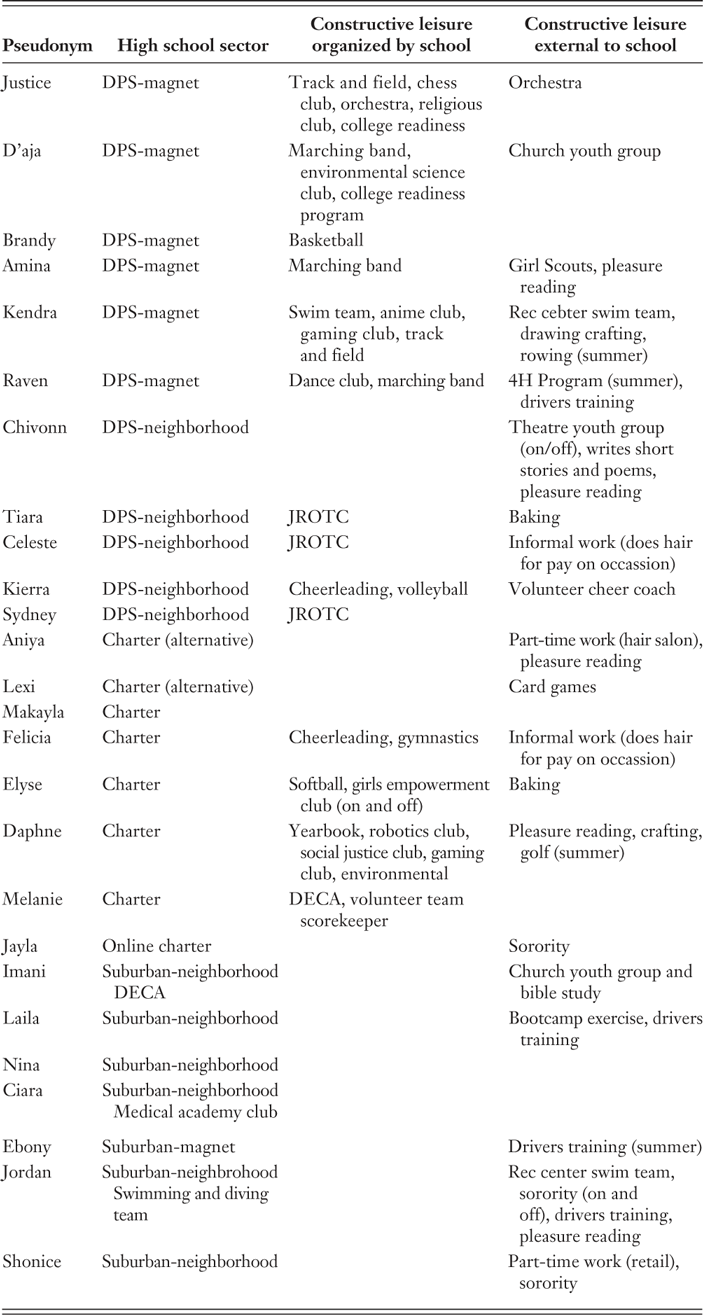
Participation in extracurricular activities was recorded for each participant to more fully capture the impact of schools on daily life (see Table 2). Column one provides school-based extracurricular participation and column two captures activities detached from schools. Most girls that reported school-based participation were engaged in one to two activities. Four girls—Justice, D’aja, Kendra, and Daphne—stood apart, carrying a slightly higher number and greater diversity in types of activity. On both ends of the class spectrum, especially among girls attending charters and suburban neighborhood schools, there were reports of no school-based extracurricular participation.
Engagement in constructive leisure attached to and external to schools

DPS = Detroit Public School.
Magnet = examination and application-based schools that offer a specialized curricula.
Inquiry on the availability of extracurricular sports and clubs revealed clear differences: lists rattled off by students in magnet schools presented as more of a smorgasbord, whereas charters offered few options. Additionally, magnet schools seemingly offered greater diversity in activities. The first author also catalogued, in retrospect, the sports and clubs advertised on school websites and confirmed this finding. DPS-magnet schools in the city advertised around eleven sporting options for girls (including cheer and dance) and upwards of sixteen clubs (one school exceeded thirty) that included the arts, culture, media, technology, career focus, competition (e.g., chess, robotics) and social justice initiatives. DPS neighborhood schools advertised roughly six to seven sporting options and seven clubs. Suburban schools also advertised six to seven sports, but a greater range of clubs (eleven to thirteen). The range of activities among charters spanned from alternative charters that advertised zero extracurricular activities, most others offering around seven sports and four clubs, and the one exception (Daphne’s) offering eighteen clubs.
For girls in neighborhood schools and charters, the core club options were robotics, JROTC, or DECA, formerly known as Distributive Education Clubs of America. The mission of clubs like JROTC and DECA is less about college readiness, and more so about molding particular character attributes and etiquette for the working world, particularly among urban students of color.Footnote 5 The U.S. JROTC guidepost, “To Motivate Young People to be Better Citizens,” for example, is implemented through a curriculum that instills “the value of citizenship, service to the United States, and personal responsibility and sense of accomplishment” (U.S Army Junior ROTC). Of a similar nature, DECA focuses on building vocational skills such as “human relations and employability skills” in career areas such as hospitality, sales, and service (Michigan DECA). While personal responsibility and teamwork are important life-skills, they are weighted differently from skills purported as essential for college-readiness, such as study skills, innovative or critical thinking, and assertiveness that will aid in networking and taking advantage of campus resources. As such, we argue that these club options are perhaps not as ideal of a match for girls who have stated goals of attending college.
In interviews, we also asked girls to “design” their ideal school. An expansion in extracurricular activities was widely reported in girls’ dream schools, particularly among charter and neighborhood school attendees: “A pool. And, I’d have a cheerleading and dance team” (Melanie, city charter); “We’d use the pool [exists, but drained]. Also, I’d have tennis” (Sydney, neighborhood city school); “I’d have dance and debate. And majorette” (Imani, neighborhood suburban school); “I would like some performing arts, like band, orchestra, dance, drama, or theater” (Elyse, city charter school). Lexi was one of several who made no mention of sports, clubs, or for that matter, any organized activity. Only after probes did we learn that she used to be a cheerleader, but that came to an end during the state takeover at her second high school:
I was on the cheerleading team, but then EAA happened and I didn’t have no way home. They stopped buying us the bus cards. Everybody has to ride the cheese bus if you want a way home. Interviewer: Cheese bus [laughter]…You mean the yellowish-orange buses? Yep! So they used to provide the bus pass, for like City busses? Yeah, the D dot busses, and it will last until 9:00 pm and that’s where if you had practice, you can go and still get on the D dot busses. With the cheese bus, it will only come after school, so you’d have to walk or somebody come pick you up. I didn’t have that [mother doesn’t have a car].
Policy changes instituted via state takeover and chartering once again emerged as limiting factors that disconnected girls from opportunities to build human and social capital, to exercise and relieve stress accumulated in the day. Lexi and many others solely reported constructive activities carrying low or no costs (e.g., reading/writing for pleasure, baking, playing cards).
Teens like Imani that commuted to suburban school districts far from their home often turned to neighborhood cornerstones to get what they lost in the physical and social distance between home and school. Imani shared: “I go to church Tuesdays, Sundays, Saturdays if they have events. It’s literally walking distance from my house. Everything is walking distance except for my school.” For Shonice, the move to the suburbs also challenged feelings of belonging. This uneasiness kept her from pursuing basketball, a sport she used to play. She too returned to what was familiar:
Interviewer: Do you participate in any after-school activities? No, I just wasn’t comfortable. It was too many new faces. I do the sorority, because some of the people that was in there, I knew from [my old] school and one girl goes to my grandma’s church. It was kind of easier to interact with people.
In comparing girls across neighborhoods and school types, we learn that choice offers access to alternative academic options, but at a cost. A loss of extracurricular involvement happens via the absence of school-based options (e.g., in charters) or via inadequate provision of transportation; and, even for girls located in better resourced schools, interracial peer interactions may hinder their ability to fully reap the benefits of those resources.
DISCUSSION
Drawn from in-depth interviews with Black adolescent girls navigating the metro-Detroit area school landscape, we presented data on adverse school experiences and the high-effort coping girls employed to continue their schooling. Centering Black adolescent girls in this analysis is a unique contribution to the study of race and school reform policies, as girls are too often positioned in the background as a comparative group for research on Black boys or absent from analyses altogether. Restricting interviews to Black girls does limit our ability to say what aspects of the experiences described are because the interviewees are girls. However, we argue that our approach offers a more in-depth analysis of Black girls positioned at different locations physically and economically, aiding our ability to discuss how school reform interacts with these other factors to influence daily life.
For many girls positioned outside of middle-class neighborhoods and selective magnet schools, “voluntary” uptake of school choice was enacted by those that had just enough access (in terms of time and transportation) to make it possible to go in search of quality options. In other cases, uptake of school choice was forced on those caught in the churn created by State-imposed closures and takeovers. Despite variations in how they got to where they were in this school ecosystem, common across their narratives were descriptions of compromises, losses, and trade-offs made in order to carry on with the education they believed to be essential to gaining a chance at college and the American dream.
Concessions that were described illuminate the interactive effects of school reform policies on the entire regional network of schools and Black girls’ educational experiences. Teacher vacancies even affected middle-class students attending suburban schools and magnet students, resulting in girls self-directing their learning or giving up their preferred elective in order to obtain some form of classroom content. In contrast, school closures and takeovers, dictated by the State, created an exceedingly turbulent churn for students concentrated in some of the economically hardest hit areas of the city. For the girls entangled in this whirl, the loss of ties to peers and teachers wreaked havoc on their educational experiences and were central to creating even greater school instability. Practical realities robbed girls of time as they figured out their next move, trekked further to new buildings, and adapted to new peers, teachers, and school rules. Familiarity was lost between teachers and students and, we argue, in turn, the slack that might be granted in rules and regulation of behavior was lost as well. Interfacing with inflexible school policies meant continued interruptions of their learning time via classroom lock-outs, suspensions, and expulsions.
Having resources that made it possible to seek refuge in a charter or neighboring suburban school did not fully protect against loss or grant immunity from stressful school experiences. With “choice” came early morning wake times in the dark, lengthy treks to and from school, and restructured sleep patterns. Safety during travel featured as a prominent consideration when accessing school choice options, a finding not discussed in great detail in extant research on Black males and schools. Girls in charter or suburban schools, too, had to allot time to adapt to new teachers, peers, school structure, and policies as well as, potentially, accepting the loss of extracurricular activities because they were not offered (charters) or because getting to and from practice and games became logistically impossible. In essence, these girls were trading one set of stressors for another.
Survival strategies varied across situations, yet common among them was the tendency to engage with others only in those spaces perceived as safe. To be clear, safety was sought not only from violence, but also from social evaluations made by teachers and peers that carried the potential to influence academics and social integration. Several girls sought “less strict” environments, landing in schools that required minimal interaction. Others went out of their way to make themselves known to teachers and school administrators so they would know “what they’re about” and not risk misrecognition and disciplinary action. Upon attending a new school or encountering an altogether new neighborhood and school setting, many remained insular and skeptical of sports and clubs that required engagement with unfamiliar faces, another finding perhaps uniquely experienced by Black girls (Holland Reference Holland2012; Ispa-Landa Reference Ispa-Landa2013).
The data presented here affirm that measures of social integration and health need to be considered in conjunction with academic outcomes when measuring the effects of school reform policies. Early wake times and restructured sleep patterns, a lack of cognitive and physical stimulation through a loss of school-based extracurriculars or teacher shortages, increased social isolation and blows to one’s sense of belonging, are all known to be associated with declines in health. These, along with the high-effort coping strategies enacted to carry on under these circumstances, are real considerations for the ways in which school reform policies may be implicated in triggering stress-response systems for Black adolescent girls, that may intensify or accumulate with continued social and economic marginalization, resulting in chronic health detriments by early adulthood (Geronimus Reference Geronimus1992; Geronimus et al., Reference Geronimus, Hicken, Keene and Bound2006).
School policy evaluations have almost exclusively relied upon analysis of test scores and graduation rates. We urge researchers and policy makers to incorporate other measures that can tell us not only if achievement improves (or falters) under these reforms, but also if students are paying a toll in health. Given the array of concessions made across this sample, this question is relevant not only for school choice policy, but also for other reforms that prompt rapid transitions in the educational landscape and student displacement or relocation.
Lastly, all students do not contend with these instabilities in their high school tenure (Anderson Reference Anderson2015; Morel Reference Morel2018). In Michigan, districts with higher concentrations of low-income Black students have experienced more intense charter school competition and subsequent fiscal stress (Arsen and Ni, Reference Arsen and Ni2012). Also, majority Black districts are the only school districts in the state to experience emergency management and takeover, despite fifty-five majority White districts also being deemed financially distressed (Bosman and Davey, Reference Bosman and Davey2016; McGuire and Lenhard, Reference McGuire and Lenhard2015). To put it simply, Black students across Michigan, and particularly in the metro-Detroit area, are contending with school reform policies others have been spared, and the data in this paper suggest that these very policies are actually implicated in exacerbating school instability for Black adolescent girls.
Following the close of data collection, DPS was returned to local governance and the EAA takeover schools were folded back into the district, raising hopes for a district turnaround under new leadership. Yet, it is important to acknowledge that the instability introduced into the educational landscape from emergency management, in particular, has led to a generation of Black youth, including Black girls, who did not experience better schools. Additionally, the threat of school closures still looms and the pronounced choice environment remains intact. Our findings suggest if any gaps are to be closed between Whites and Blacks in the Detroit-metro area (and elsewhere), policymakers must acknowledge research findings, such as our own, that show advantages for those students that have proximal access to high quality neighborhood schools simply cannot be replicated in a choice environment. Choice will never really be able to level the playing field. School reforms should work to maintain local governance, listening to the students (and parents) who have demonstrated in this paper and elsewhere, the premium they place on education and their needs in order to succeed. A large part of this is minimizing churn by improving quality schooling options within the neighborhoods where students live, and when closures are absolutely necessary, providing programmatic supports (Geronimus et al. Reference Geronimus, James, Destin, Graham, Hatzenbuehler, Murphy, Pearson, Omari and Thompson2016) to ease those transitions.
ACKNOWLEDGMENTS
Our deepest gratitude to the teen girls in the Detroit-metro area who shared their lives and school experiences to make this study possible. This research was supported in part by an NICHD training grant to the Population Studies Center at the University of Michigan (T32HD008339) and a Marshall Weinberg Dissertation Fellowship Award. The first author also gratefully acknowledges writing time supported by an NICHD training grant (T32HD049302) to the University of Wisconsin-Madison School of Medicine and Public Health. This work was conducted while Dr. Evans was a doctoral student at the University of Michigan School of Public Health and pre-doctoral trainee at the University of Michigan Population Studies Center. The content is solely the responsibility of the authors and does not necessarily represent the official views of the National Institutes of Health.