Introduction
Multilateral negotiations are complex and strenuous bargaining processes, in which chairs are necessary to ensure their smooth and effective conduct. Chairs may be third parties with no direct stake at the negotiations or one of the negotiating parties elected or appointed to the office. Chairs feature at all levels of political decision-making, be they local, national or international, exercising in the first place procedural control over the negotiations. According to the exact nature and institutional structure of the multilateral context and the demands of the negotiation contours, the functions of the Chair may extend to encompass agenda management, brokerage services, and external representation. Hence, the role of the Chair becomes critical in delineating the negotiation space and affecting the negotiation direction and outcome per se.
The first accounts of this institution were incorporated in broader treatises of multilateral negotiations, the Chair being considered a feature of the negotiation structure.Footnote 1 Acknowledging the significant potential of the Chair, a distinct literature has emerged more recently, which deals explicitly with the Chair in various international institutional settings – United Nations (UN), European Union (EU), and World Trade Organization (WTO) – both analytically and empirically.Footnote 2 In most of these accounts, Chairs perform their functions in a neutral and impartial way by assumption. However, Chairs may pursue own preferences in the conduct of their assigned tasks. Like policy and business entrepreneurs, they invest their personal or country-of-origin resources, pushing forward and advocating specific proposals in the hope of a future return.Footnote 3 Future return that exceeds the cost of taking up any entrepreneurial activity is a sine qua non condition for the emergence of the Chair as policy entrepreneur.
In this article, we examine the parameters that determine the successful outcome of the Chair's entrepreneurial activities. Emphasis is laid on structural institutional and not personality-specific parameters (that is, leadership potential, communication and inter-personal skills, expertise of Chair), although the latter may also significantly affect the scope of Chair's actions. We focus primarily on the institutional dimension of the Chair and not the personality in office, not least because personality-specific attributes require a more interdisciplinary research.Footnote 4 Drawing on delegation theory and rational choice institutionalism, we conceptualise Chairs as agents set in place by the negotiating principals to address collective action problems inherent in decentralised bargaining.Footnote 5 As a result of their functionalist raison d'être and agentic nature, Chairs play a specific role in the negotiations attributed to them by the negotiating parties, capitalising on the given resources of the office within particular limits set by the principals.
According to this analysis, we cluster the identified parameters that affect the Chair's entrepreneurial activities in three groups of organisational attributes, comprising the Chair's mandate, available resources and (formal) constraints, in particular decision-making rules. The scope of the mandate outlines the Chair's role and delimits the Chair's intervention capacity in and control over the negotiation process, identifying explicitly or implicitly the assigned tasks and the Chair's intervention repertoire. The resources on which the Chair capitalises to perform his/her role comprise undisclosed information to which the Chair has privileged access and the Chair's political capital. They derive from inherent informational asymmetries as well as the Chair's legitimacy, authority, and political support. Finally, the negotiating parties set to limit potential Chair's over-assertiveness. Such constraints to Chair's entrepreneurship emanate from the decision-making rules (majoritarian vs. unanimity) and the control mechanisms set in place by the constituent principals (appointment, administrative and oversight procedures).
Our analytical framework applies to both domestic and international institutional settings of multilateral negotiations. In this article, we draw our empirical evidence from the UN setting, which is the most significant international forum of institutionalised multilateral negotiations. We use a combination of primary and secondary sources for the analysis of four case-studies. Primary sources comprise interviews with high-ranking officials, available verbatim records, and official UN documents. Inevitably, interviews, especially on very important and salient issues, raise concerns about the validity and potential bias of the information provided. However, despite such concerns, the provided information cannot be disregarded, especially in negotiations held in the past or behind closed doors. Wherever possible, we have tried to cross-validate the information provided; still, caution is required.
The four case-studies comprise the negotiations for the Security Council (SC) reform (the Rajali Plan, 1997–1998), the Russian succession to the Soviet SC permanent seat in 1992, the deliberations of Committee I in the UN Law of the Sea Conference (UNCLOS, 1973–1977), and the American and Soviet co-Chairing of the ‘Eighteen Nation Disarmament Committee’ (ENDC, 1962–1968). The case studies have a long time span and come across the whole UN institutional spectrum (Security Council, General Assembly and ad hoc Working Groups, Conferences and Committees under the UN auspices, etc.). They have three common characteristics: first, they all feature a distinctive entrepreneurial role of the Chair, albeit differently exhibited and with varying success, which helps study the impact of the identified conditioning parameters. Second, the Chairs' entrepreneurial activities take place in the most constraining environment in terms of decision-making rules, with unanimity or consensus being the rule in all four institutional settings examined.Footnote 6 The case studies have been chosen on the underlying assumption that if Chairs successfully manage to realise their entrepreneurial potential when every single negotiating partner may bloc their initiatives, then in settings with a looser (majoritarian) decision-making rule this parameter will be of even less significance. Third, Chairs are not third parties at the negotiations; they are constituent components of the negotiating structure, elected or appointed to the office. Still, they exhibit different levels of engagement in the bargaining process with different stakes.
In the next section, we elaborate on our analytical framework; we then present the empirical evidence from the UN setting and discuss the main findings.
Parameters conditioning Chair's entrepreneurship: an analytical typology
Policy entrepreneurs are actors who help propel dynamic policy change in their respective political environment, be it local, national or international. With their actions, they create or exploit new opportunities to push forward their ideas or policy options, thus having transformative effects on politics, policies, or institutions. Three general attributes of policy entrepreneurs have been identified in the relevant literature: first, policy entrepreneurs shape the terms of political debate, (re)framing issues, defining problems, and influencing policy agendas. Second, they constitute a source of innovation in terms of a new policy or policy direction, a new agency, or new forms of collective action. Third, they somehow manage to consolidate innovation into lasting change.Footnote 7
In most early research done, policy entrepreneurship has been treated as a chance occurrence, relying heavily on biographical accounts and personality-related features.Footnote 8 More systematic studies have examined the conditions that increase the likelihood of an emerging entrepreneur in any given organisational milieu and the structural institutional characteristics that facilitate or frustrate entrepreneurial activities.Footnote 9 Very much like business entrepreneurs, policy entrepreneurs invest their resources, pushing forward and advocating specific proposals in the hope of a future return. Such return may take the form of policy outcomes they favour, satisfaction from participation, or even personal aggrandisement in the form of increased reputation and/or better career prospects.Footnote 10 Policy entrepreneurs have admittedly a complicated utility function, which underlies their involvement in the negotiation process, comprising not only material benefits but also related to policy success and own status.Footnote 11
At the same time, policy entrepreneurs face entry barriers in any given policy arena. The permeability of such barriers, which are most often – but not exclusively – institutionalised, dictates the amount of resources the entrepreneurial interloper has to invest in order to advocate his/her policy ideas. Low entry barriers may encourage policy entrepreneurs; however, if they are too low they may actually discourage entrepreneurial activities since any return may well be rapidly competed away by future newcomers. High entry barriers may provide more entrepreneurship incentives securing a temporary policy monopoly but again very high barriers will have an adverse effect. Therefore, the relationship between entry barriers and entrepreneurship is curvilinear with policy entrepreneurs least likely to emerge when entry barriers are very high or low.Footnote 12 Thus, the main condition for the emergence of a policy entrepreneur is a positive cost-benefit analysis, in which potential returns exceed existing entry barriers embedded in the status quo.Footnote 13 Still, of course, the emergence of a policy entrepreneur should not be conflated with the success of his/her campaign.
Chairs resemble policy and business entrepreneurs in that they may invest their personal or country-of-origin resources advocating specific bargaining proposals in the hope of a future return. To start with, Chairs are agents, having emerged as a governance form in multilateral negotiations to resolve or mitigate collective action problems that arise in decentralised bargaining. These problems revolve around agenda-, negotiation-, and representation-failure, creating a demand for an institutional response to avoid cyclical agenda instability, partial only exploitation of the existing negotiation ‘contract zone’, and problematic collective representation of the negotiating parties vis-à-vis third parties. To address these problems, the negotiating parties-principals assign to the chairmanship institution the functions of agenda management, brokerage, and representation. The supply on behalf of the Chair of such services is based on first, his/her privileged access to information unavailable to the negotiating parties or too costly to acquire and second, his/her asymmetrical control over the negotiation process.Footnote 14
In the mind of the negotiating parties, such supply of solutions assumes a Chair without an own agenda, seeking centrist bargaining outcomes. However, agents may be motivated to exercise their functions in pursuit of the envisaged future return. The Chair's actions can either have a distributional effect directing negotiations to an own preferred outcome along the Pareto optimal frontier or induce a sub-optimal solution, which better reflects the Chair's own preferences.Footnote 15 Chair's preferences are not limited to material self-benefits associated with a particular negotiating output. They can be also related with a personal normative drive to ‘reach a solution’, increased political status, and/or better career prospects, very much like any other policy entrepreneur discussed above. These two preference components are not always converging, in which cases Chairs may sacrifice own material self-benefits to achieve a negotiating breakthrough. In any case, the Chair's scope of action may affect both the process and outcome of negotiations.
To control and curtail the Chair's potential impact, the negotiating parties build two kinds of safety valves in the institutional environment in which the Chair operates: decision-making rules and control mechanisms in the form of appointment, administrative and oversight procedures.Footnote 16 The more demanding the decision rule for a given set of preferences of the negotiating parties, the smaller the existing contract zone and subsequently the manoeuvrability of the Chairs. The exact nature and strictness of the control mechanisms set in place depend on the purpose of delegationFootnote 17 and the institutional design of the chairmanship. For example, a rotational format undermines the ex ante control of the principals exercised through the appointment process and cancels out any re-appointment incentive. Elected officers from one of the negotiating parties or the appointment of a supranational official enhance the principals' control over the Chair, with a lesser potential impact on the distributional dimension of the negotiated outcome and greater negotiation efficiency.Footnote 18
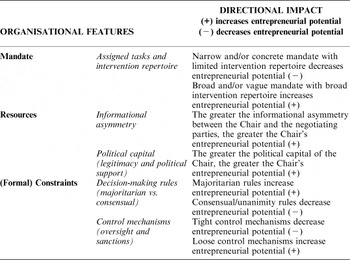
Bringing together the two literature strands on policy entrepreneurs and the chairmanship institution, the emergence of entrepreneurial Chairs in multilateral negotiations depends on a cost-benefit analysis, in which the (material or non-material) return for the Chair is case-specific and the cost depends on three kinds of organisational features, related with the Chair's agentic nature. These features comprise the mandate, available resources and (formal) constraints (see Table 1). The mandate encapsulates the process control the Chair enjoys over the negotiation process, outlining the tasks of the Chair and the available means to perform them. Both the tasks and the means may be explicitly (that is, stated in the mandate or procedural rules) or implicitly (that is, the Chair may consider that he/she has such authority and act in such a way by custom or established practice) assigned to the Chair. The intervention repertoire of the Chair may comprise drafting agreement texts, ruling over disputed items in the course of the negotiations, issuing official public statements on behalf of the principals, etc. A broad or vague mandate with a wide intervention repertoire raises the potential of Chair's assertiveness and reinforces his/her entrepreneurship potential. In contrast, a narrow and/or detailed mandate curtails the Chair's capacity to perform the assigned functions in pursuit of the envisaged return.
Parameters conditioning chair's entrepreneurial potential

In terms of resources, the more resources are available to the Chair, the greater becomes the Chair's entrepreneurship potential. We distinguish between two kinds of resources, information-related and political capital. As discussed above, the Chair has privileged and asymmetrical access to information. Through existing bureaucratic mechanisms (for example, Secretariats) and appropriate procedural arrangements (for example, confidential bilateral meetings), the Chair gets undisclosed information about the utility functions of the negotiating principals, which can be instrumentally used for the exact demarcation of the existing contract zone.Footnote 19 The greater the informational asymmetry between the Chair and the negotiating parties, the more advantageous is the Chair's position to pursue the envisaged return of his/her entrepreneurial activities.
Besides information-related resources, the Chair's entrepreneurship potential is also positively associated with his/her political capital, which depends on the Chair's legitimacy and political support.Footnote 20 In general, legitimacy of an institution refers to the normative belief of political actors that their adopted behaviour should be in conformity with the institution's prescriptions.Footnote 21 As a result, high levels of legitimacy strengthen the political influence of an institution, improve its access to positions of authority, enhance its governance functions and eventually extend its period of rule.Footnote 22 The legitimisation of the chairmanship institution derives from the approval and assent of the negotiating parties to the Chair's activities. Otherwise, the Chair loses credibility and can perform none of the assigned functions effectively. In such case, the incumbent Chair may be replaced or more radically, the negotiating parties may envisage a change at the institutional format of the chairmanship office (for example, by appointing a supranational official instead of one of the negotiating parties).
If negotiating partners perceive the Chair's interventions legitimate, the Chair's entrepreneurial potential rises. In contrast, Chair initiatives perceived as illegitimate by one or more of the negotiating parties curtail the Chair's entrepreneurship potential. Such loss of legitimacy may derive from a Chair's distributional bias in previous negotiation rounds that has alienated negotiation partners, attempts to expand the mandate or bypass principals' control, and/or changes in the bargaining structure that result in the Chair's status degradation. The institutional format and mode of Chair selection further affect the Chair's legitimacy. A consensual decision for the Chair appointment or an election with an overwhelming majority may increase the Chair's legitimacy and subsequently his/her entrepreneurship potential.
Political support refers to the implicit or explicit political back up Chairs may enjoy either within or outside the group of negotiating parties. Such back up may take the form of additional contributions to the Chair's resources, exerting pressure to or influencing negotiating partners to accept a specific bargaining outcome, deter challenges of the Chair's authority, and ensure his/her institutional viability. The more solid the political support of the Chair, the higher his/her entrepreneurship potential. Such political support may derive from two different sources: first, the Chair may capitalise on the country's participation in a certain group or coalition of states (for example, Non-Aligned Movement in the UN) and their combined status and numerical strength. Second, political support may be also ‘earned’ as a result of converging Chair's preferences with the positions of other powerful actors involved in the negotiating process. Radical Chair preferences away from the negotiating centre lead to his/her marginalisation. The former reflects broader patterns of alliance; the latter is on a more ad hoc basis and reflects more case-specific negotiation dynamics.Footnote 23
Formal institutional constraints derive from the decision-making rules (majoritarian vs. unanimity/consensual rule) and the control mechanisms set in place by negotiating parties to control for the Chair's over-assertiveness, as discussed above. In general, extensive constraints curtail Chair's entrepreneurship potential. Majoritarian decision-making rules constitute a more conducive environment for an entrepreneurial Chair to master the necessary support through the appropriate redistribution of agreement benefits, although the prevalence of an implicit consensus norm may curtail the Chair's entrepreneurial activities. In more demanding decision-making settings, which require special majorities or even unanimity, the negotiating parties can more easily control Chair's entrepreneurial ventures. Increased efficiency of control mechanisms may discourage the Chair, but their function depends on the existing decision-making rules as well as the institutional format of the office. For example, decision-making rules on the appointment or impeachment of a Chair are critical for the (s)election of the appropriate candidate or the dethronement of the current one. The re-appointment option constitutes an additional incentive to the incumbent to behave according to the assigned mandate and be more cautious in his/her entrepreneurial ventures. In contrast, where no such option is available or in rotational formats where chairing has an expiry date, lame duck Chairs may be more frequent, increasing the likelihood of emergence of a more adventurous policy entrepreneur.
Chairing and policy entrepreneurship in the UN
The January 1992 Security Council summit: the role of the British Presidency
The monthly rotating format of the SC Presidency means that it is attached to the member-state and not to the country representative as an individual. Thus, the President has a ‘double-hatted’ position in the Council, acting as both presiding officer and country representative.Footnote 24 The SC expansion from eleven to fifteen members in 1965 and later on the end of the Cold War broadened the scope of SC activities, requiring the Chair to assume increased managerial responsibilities. In general, the formal tasks of the SC President as stipulated in the Rules of Procedure revolve mainly around procedural arrangements,Footnote 25 offering however to the President considerable interventionist latitude as long as the presidential rulings on the contested procedural issues are acceptable to the SC majority.Footnote 26 Of particular importance is the capacity of the Chair to set the agenda of the SC meetings along with the Secretary General (Rules 7 and 20) and call for a (formal or informal) SC meeting (Rules 1–3). However, in practice and except from emergency situations, the Chair convenes a meeting only if there is a consensus among the permanent members.Footnote 27 Besides agenda-management, the Chair has also assumed, throughout the years, increasing brokerage responsibilities due to the growing complexity in the SC decision-making environment. The brokerage function of the Chair is severely constrained by a norm of consensus, despite the fact that formally the SC can take decisions without resorting to unanimity.Footnote 28
The rise of the SC international status over the years has gone along a proliferation of voices considering the SC unrepresentative and calling for reform to better reflect the geographical representation of UN membership and the newly emerging, post-1989, world order. Unsurprisingly, the permanent five opposed any such call to broaden or alter SC permanent membership. The dissolution of the Soviet Union in 1991 brought forward uncertainty about its successor in the UN structures and most importantly its SC permanent seat. The transition from Soviet to Russian UN membership was swift although not unopposed.Footnote 29 However, the Russian claim to the Soviet SC permanent seat was much more sensitive politically than UN membership because it threatened to open the Pandora's Box of SC reform, a perspective far from welcome by the permanent five and especially UK and France.Footnote 30
The British Presidency, in office during January 1992, held private consultations with the other permanent SC members to ensure their common approach to the issue.Footnote 31 Following these meetings, which solidified the bloc of the SC permanent members, the British Presidency orchestrated the transition from the Soviet to the Russian SC seat in two steps. The first step entailed convening for the first time in SC history an extraordinary summit at the highest level of Head of States or Government scheduled for 31 January 1992. Although the summit agenda would seemingly revolve around the SC role in the post-Cold War era, in reality it aimed to confirm resolutely Russia as the rightful successor of the Soviet Union.Footnote 32 The summit was deliberately called at the highest political level (Head of States or Government) and not at the level of state representatives (for example, Ambassadors). Besides political reasons of maximising legitimisation of the Russian SC permanent membership, the British Presidency wanted to ensure that no SC member would raise credential objections with regard to the Russian representatives that might have jeopardised the real purpose of the summit.Footnote 33 The second step entailed an official Presidency statement, raising the hidden agenda issue at the most convenient time during the debate on the official agenda item. In that respect, speaking as SC representative in the welcome address, the President officially committed the SC to accept Russia as the successor to the Soviet seat. The Presidential actions created a political and diplomatic fait accompli, causing discontent among the most ardent revisionist countries and main contenders for a permanent SC seat. Still, their reactions remained covert for different reasons.Footnote 34
The future of the Soviet SC permanent seat was a highly salient issue to the British Presidency, which preferred its swift conclusion so as to avoid any discussion about the SC reform. In pursuit of that goal, the UK made instrumental use of the Presidential office. The British act to convene a SC summit at the highest political level constituted an institutional novelty, skilfully expanding the intervention repertoire of the SC Presidency. By its formal welcome statement on behalf of the SC, the Presidency shaped the UN substantive political agenda on SC reform. The Presidency acted in agreement with the other permanent SC members, relying on their acquiescence to overcome any opposition. Such agreement was critical, considering the veto power at their disposal, which could annul the Presidency's entrepreneurial venture. Their combined political power and influence increased the Presidency's political capital and ensured that reactions remained low voiced. Thus, despite the constraints imposed by the demanding decision-making rule, the Presidential entrepreneurship bore fruits mainly due to the political support offered by the ‘big beasts in the SC jungle’.
The open-ended working group on SC reform: the Rajali Initiative (1997)
The January 1992 SC summit deferred the issue of SC reform but did not eliminate it from the UN agenda. In response to ever intensifying calls, the UN General Assembly (UNGA) established an Open-Ended Working Group (OEWG) to reflect on the issue.Footnote 35 The OEWG was open to all UN members that wished to participate and operated on a consensus basis. From its birth in 1993 until 1997, much discussion took place in it but with little actual impact.
Chairing UNGA or a UN Working Group entails only procedural control over the deliberations without any formal brokerage requirements (UNGA Rule of Procedure 35). Nevertheless, in 1997, the then UNGA and OEWG President, Ambassador Ismael Rajali of Malaysia, sought a more active role in pursuit of an agreement along the lines of the Malaysian government.Footnote 36 The President pushed forward a framework proposal with focal points around which bargaining could eventually converge. Following extensive consultation with most OEWG members,Footnote 37 he outlined in March 1997 before the OEWG a three-stage reform plan.Footnote 38 The ‘Rajali plan’ was novel in that the first two stages would be put to vote in accordance with Article 18, which deals with ‘important questions’ and requires a two-thirds majority of members present and voting, and not Article 108 of the Charter, which refers to Charter amendments and needs a two-thirds majority of all UNGA member states. By circumventing the more constraining Article 108 of the UN Charter in the first two and most crucial stages, in which the member states would agree on the SC reform formula and select the five new permanent members, the SC reform would become more feasible.Footnote 39
The stage-by-stage approach and the outlined procedure were endorsed by the permanent SC members, which saw in it an opportunity to safeguard their unique veto privilege. It was also embraced by a group of European states as well as other aspiring permanent members like Germany, Japan, Brazil and India, expected to emerge as primary candidates for the new permanent SC posts.Footnote 40 However, the Non Aligned Movement (NAM) heavily criticised the plan, seen as a procedural shortcut to bring in the SC from the back door the most powerful contenders.Footnote 41 Thus, the overwhelming majority of NAM countries chose not to associate themselves with it, although most of them had individually aspired to similar reform proposals in previous rounds of deliberation. This decision reflected NAM's heterogeneity and intention to safeguard the unity of the movement. The Rajali plan envisaged the elevation of a few developing countries to permanent membership, thus bringing discord and disarray among the NAM ranks about the appropriate candidates. Hence, the NAM countries collectively considered that the Rajali initiative put the viability of the Movement under severe strain and should be therefore rejected for the sake of NAM's cohesion.Footnote 42
Several NAM countries launched a severe attack against the OEWG President and his interference in the negotiations. Presenting the plan in his capacity as OEWG Chairman suggested that it constituted the negotiating middle ground and enjoyed the implicit or explicit acquiescence of the OEWG members, which was clearly not the case at least as far as NAM was concerned. Since the Chairman had not been formally delegated any extraordinary brokerage power, the Ambassador of Malaysia was criticised for having abused the Presidential office to produce this document, which undermined and jeopardised the further evolution of OEWG negotiations.Footnote 43
The Rajali entrepreneurial initiative aimed to break the negotiation deadlock over the SC reform, counting on a large scale information base and the political support of the permanent SC five and some of the most interested and influential revisionist countries (Germany, Japan, India etc.). In the course of the deliberations, the Chair exceeded the narrow mandate and the limited intervention repertoire of the office. However, given NAM's negative disposition, the consensual decision-making mode led to the shelving of the Rajali plan, with the Chair being ultimately de-legitimised and accused of overshooting his official and authorised mandate.
Chairing Committee I of UNCLOS III (1976–1977)
The Third UN Conference on the Law of the Sea (UNCLOS III) consisted mainly of three committees, of which Committee I focused on seabed resources (minerals, etc.) beyond national jurisdiction. Decisions at all levels were to be taken by consensus and formal authority was accorded to the Committees Chairs in preparing informal negotiating texts for the issues falling within the competence of their respective committees.Footnote 44 Each Chair had to prepare negotiating texts closing the gap among negotiating parties and further introduce any modifications or revisions. Thus, Chairs were explicitly expected ‘to act as neutral drafters as well as selectors, prompters and legitimising agents of compromises worked out by groups of delegates’.Footnote 45
In contrast to Committees II and III, little progress had been made in Committee I between 1973–1976. The exploitation of seabed mineral resources touched upon important economic interests of two distinct groups, namely the advanced industrial countries, led by the US, and the ‘Group of 77’, which included over 100 developing, landlocked or self-locked, states. Having articulated in the UN their demands for a New International Economic Order (NIEO) that would close the economic gap between developed and developing states, the Group of 77 associated UNCLOS III negotiations with NIEO under the drive of its most militant members.Footnote 46 Despite their diametrically opposing positions, the two main contending groups made efforts towards a compromise. Thus, expectations arose that an agreement was feasible during the May–July 1977 session, especially after the ‘Evensen group’ that met informally in smaller numbers produced a composite text for most of the substantive issues.Footnote 47 Both sides accepted the text as the basis for further negotiations, giving the impression of an imminent settlement of all outstanding issues.Footnote 48
However, the 1977 session of Committee I took a different turn. The Committee Chair, Ambassador Paul Engo of Cameroon, let the session end after eight weeks of negotiations without producing a consolidated text. The text he circulated after the conclusion of the session deviated considerably from what seemed to be an emerging consensus. By altering core provisions of the ‘Evensen group’ text, the Chair's text undermined the progress achieved in the previous years and jeopardised the future of the whole Conference since key states, like the US, expressed doubts about the continuation of negotiations.Footnote 49 The text was rejected and the Chair received heavy criticism for introducing his own changes in the draft text, rendering it unacceptable to several negotiating partners. Considering the significant repercussions of such individual initiatives, UNCLOS participants altered subsequently the Conference's rules of procedure with a view to limiting Chair's power, putting restrictions to their exclusive right to draft negotiating texts.Footnote 50 From that point onwards, modifications or text revisions would be the collective responsibility of a team comprising several Conference officials.Footnote 51
The Chair's urge to overturn the emerging compromise in the Committee I negotiations was dictated by ideological considerations related to the North-South division and Cameroon's role in the Group of 77 and NAM. The two groups had an overlapping (though not identical) membership and were interacting in the articulation of their agendas as regards the NIEO establishment.Footnote 52 This was especially manifested in the first stage of UNCLOS III negotiations (1973–1976), during which the two groups had attempted to use the NIEO as a bargaining ploy to prise maximum economic concessions from the developed states. Cameroon lined up with the drive of the most intransigent members of the Group of 77, which became increasingly marginalised in the course of negotiations. The submitted text was a last minute attempt to polarise negotiations and revitalise the hard core stance of the Group of 77.
In this case, the Chair's return would not derive from the breaking of the existing negotiating deadlock but instead from the sabotage of the unfavourable to the Chair emerging agreement. Thus, rather than the engineering aspect of entrepreneurship in multilateral negotiations,Footnote 53 it highlights the destructive potential of Presidential entrepreneurship. The most important asset in the Chair's disposal was the exclusive authority to draft the agreement text, on which he based his entrepreneurship venture. However, the consensual decision-making rule ensured that the opposing negotiating parties did not lose control of the bargaining process and enabled them to marginalise the Chair. This highly contested and unsuccessful entrepreneurial initiative led to the tightening of the Chairs' mandate in UNCLOS III negotiations and the curtailment of their intervention repertoire.
Co-chairing disarmament negotiations in the ‘Eighteen Nation Disarmament Committee’ (ENDC) (1962–1968)
In 1962, the US and the USSR took disarmament and arms control negotiations outside the UN purview in a newly established negotiating body, the ENDC.Footnote 54 The UN General Assembly welcomed the new negotiating body under the assumption that the Assembly would remain the principal negotiation agenda setter, through resolutions mirroring the will of the whole UN membership. In that respect, and despite the ENDC formal autonomy from the UN, the UNGA considered the ENDC more as a dependent agent set in place to facilitate negotiations rather than an autonomous institutional body/structure.
In its first meeting, the ENDC adopted by consensus a synoptic procedural arrangement, conferring on the two superpowers privileged procedural control through the establishment of a permanent co-chairing office.Footnote 55 Co-Chairing ensured the cooperative cohabitation of the two major powers at the head of the negotiating body and authorised them to make decisions on the structure of the negotiation process (sequence and frequency of the meetings, etc.) as well as to table draft agreement texts. Co-Chairing aimed to provide an ex ante control mechanism, mutually constraining to both co-Chairs given the confrontational nature of the US-USSR relationship. Furthermore, the unanimity decision-making rule on all issues, procedural and substantive, was an additional constraint in the performance of the co-Chairs' functions. Still, by virtue of their position and the assigned procedural powers, the two co-Chairs managed to set the agenda and direct negotiations at will.Footnote 56
In terms of agenda setting, the co-Chairs managed to shift the ENDC agenda focus from disarmament to arms control, despite UNGA's calls to the opposite direction.Footnote 57 Given the ENDC unanimity decision-making rule, the easiness with which the two co-Chairs took control over the agenda in the period 1962–1968 is noteworthy. This owed much to the attitude of the non-aligned ENDC members, reflecting the still moderate NAM stance in the UN.Footnote 58 At the time, the dominant view within the NAM ranks was that the realisation of the Movement's potential to influence international politics was conditional upon exhibiting a flexible attitude and convincing the two blocks about the Movement's impartiality.Footnote 59 In that respect, the non-aligned states were prepared to associate themselves with any disarmament initiative taken by the two Chairs or their respective camps. Their moderate attitude added a great deal of flexibility in ENDC deliberations and facilitated the co-Chairs in shaping the ENDC's agenda, enabling a discretionary selection of arms control measures for negotiation.Footnote 60
The agenda setting power of the ENDC co-Chairs declined from the beginning of 1970s onwards, owing much to NAM's radicalisation in world affairs. In that respect, NAM members sought to upgrade UNGA's role in the disarmament negotiations, reinstating the General Assembly as the real agenda-setter for ENDC. They called more consistently for specific nuclear disarmament measures, a concrete disarmament programme and a comprehensive test-ban treaty. The negative response made increasingly clear that the real agenda-setting role remained still in the hands of the co-Chairs. The two major powers turned a deaf ear to UNGA's demands to deal with broader issues of disarmament.Footnote 61 This attitude led NAM to attack the two major powers for misusing the office for their political interestsFootnote 62 and demand its abolishment in order to lessen the stranglehold of the two superpowers. The co-Chairing arrangement was finally replaced by a rotating Chair in 1978, bringing about the complete subjection of the negotiating body to the UN General Assembly.
Besides agenda setting, the ENDC co-Chairing office also carried out a very significant brokerage role, especially evidenced during the Non-Proliferation Treaty (NPT) negotiations (1965–1968). The issue of non-proliferation of nuclear weapons was very important for both co-Chairs and their allies, seeking the consolidation of the existing at the time nuclear status quo. At the initial stage of negotiations, each co-Chair presented a draft treaty, heavily reflecting own preferences, in the objective to probe the true preferences of the non-aligned, Non-Nuclear Weapon States (NNWS). The non-aligned states heavily criticised the submitted draft treaties but they had no common position as to what could render the Treaty balanced.Footnote 63 Such variance revealed the heterogeneity of the non-aligned states and undermined their negotiating power. In order to adopt a common bargaining position in the ongoing NPT negotiations the non-aligned states called for a NNWS Conference to meet no later than 1968.
Realising the need to conclude NPT negotiations prior to the Conference, the co-Chairs submitted an interim ENDC report to UNGA. Based on this intentionally over-optimistic report, they sponsored a UNGA draft resolution, specifying a concrete timetable for the conclusion of NPT negotiations.Footnote 64 By virtue of this resolution, UNGA requested the ENDC to submit by 15 March 1968 a NPT draft treaty. In that respect, a very tight deadline was set and ENDC members were called to focus, conveniently for the co-Chairs, on the prohibition of nuclear weapons horizontal proliferation, and not to strive for their own versions of Treaty perfection. On the basis of their discretionary power to present draft treaties on a ‘take it or leave it’ basis, the co-Chairs submitted to the ENDC in the following months treaty versions in advanced stage without engaging in actual negotiations with NNWS.Footnote 65 Only at the final stage, did the co-Chairs submit an improved draft treaty, still heavily reflecting their own interests but also containing some concessions to the NNWS. This draft, tabled shortly before due time, laid the political burden of negotiation failure on the NNWS. Although the draft Treaty remained far from what the NNWS envisaged, they did not reject it, leading to its adoption subsequently by an overwhelming UNGA majority.
Despite the constraining decision-making rule, the ENDC negotiations were highly influenced by the entrepreneurial activities of the two co-chairmen with regard to both the agenda setting and the bargaining outcome. The co-Chairs managed to shift the agenda away from UNGA's mandate, capitalising on the conducive environment. The positive disposition of the non-aligned countries and their unwillingness to obstruct ENDC negotiations provided a passive kind of political support to the co-Chairs entrepreneurship. In the NPT negotiations, the co-Chairs used instrumentally their procedural control over the bargaining process and their drafting monopoly to achieve an outcome that reflected their preferences.
Assessing the parameters conditioning Chair's entrepreneurship
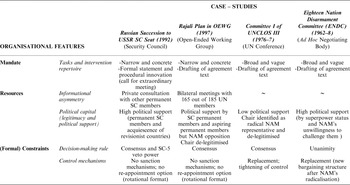
Table 2 provides an overview of the four case studies, in which Chairs engaged in entrepreneurial activities with varying outcomes. The British SC Presidency successfully shaped the SC political agenda, avoiding the spill-over of the Soviet SC seat issue to a broader discussion on SC reform. The OEWG Chairman unsuccessfully attempted to make a breakthrough in OEWG deliberations, expanding his role and uploading national preferences. The Chairman of the Committee I of UNCLOS III submitted a draft agreement text that reflected his country's own preferences, impeding rather than enhancing negotiation progress; his initiative was turned down. The two ENDC co-Chairmen (US and USSR) successfully managed to shape the negotiation agenda around arms control instead of disarmament and direct NPT negotiations towards their desired outcome.
Chairs as policy entrepreneurs in UN multilateral negotiations

The case studies provide different insights on the significance of the identified parameters on the Chair's entrepreneurship potential. Narrow and concrete mandates do not necessarily hinder Chair's entrepreneurship (for example, SC Presidency, OEWG), but they can be used to rally support against and block Chair's initiatives (like in the OEWG case). In terms of intervention repertoire, Chairs draft agreement texts (for example, ENDC co-Chairing, Committee I of UNCLOS III, OEWG), issue public statements on behalf of the principals or engage in some procedural innovation (for example, the British SC Presidency). In all cases (except from the Rajali plan), Chairs enjoy the monopoly over the use of these means, which raises their entrepreneurship capacity but does not necessarily guarantee success.
In theory, informational resources constitute the most important Chair asset; nonetheless, informational asymmetries do not feature high in our case studies and therefore we cannot conclusively prove or disprove their role in the analysis of the Chairs' entrepreneurship. Two reasons may account for this lack of documentation: first, most of this information exchange is informal in nature and second, most of the negotiations take place behind closed doors. Subsequently, it is difficult to identify and assess the exact magnitude of informational asymmetries and the deriving advantage of the Chair. Still, sporadic references (for example, UK contacts with the other SC permanent members prior to the 1992 summit and Rajali's formal and informal contacts with OEWG members) do hint that this is more a methodological shortcoming rather than substantial issue that does not refute the significance of informational asymmetries and their instrumental use by the Chair.
The political capital of the Chair is more easily accounted for and emerges as a very critical parameter for the realisation of the Chair's entrepreneurship potential. In the UNCLOS III case, the identification of the Chair with the more intransigent negotiating parties undermined the centrist, middle-of-the-road character of the chairmanship office and led to his marginalisation. Political support (by the other permanent members in the case of the British SC Presidency and by their respective camps to the two superpowers in the ENDC case) or lack of it (by NAM countries in the OEWG case and most participants in the UNCLOS III case) determine to a large extent the outcome of the Chair's entrepreneurial activities. As the UNCLOS III case suggests, mastering such political support is not only an issue of country blocs and alliances but can be also affected by the Chairs' embraced and promoted positions. Radicalism in relation to the positions held by the negotiating parties undermines the Chair's entrepreneurial potential.
Decision-making rules also emerge as an important parameter for the realisation of the Chair's entrepreneurship potential. The requirement for unanimity or consensus constitutes a safety valve for the negotiating parties against any unwanted Chair entrepreneurial endeavours (for example, in OEWG and UNCLOS III). However, the effect and significance of this parameter should be seen, according to our understanding, in conjunction with the Chair's political capital. In terms of control mechanisms, ex post control action is envisaged in most cases, either in the form of Chair replacement (for example, in the ENDC but at a much later stage and only once the bargaining structure changed) or modification/ tightening of the Chair's mandate to curtail monopoly of action (for example, in UNCLOS III). However, this does not suggest that the activities of the Chairs were not under continuous scrutiny even if reactions did not always or formally surface (see, for example, the covert reactions in the SC and OEWG). Still, the rotational format in two out of four cases (that is, SC British Presidency and OEWG) meant that the negotiating principals had few sticks and carrots – sanction mechanisms and/or reappointment option – to control the entrepreneurial activities of the Chairs.
Conclusion
Which structural features of the negotiating contours affect the entrepreneurial potential of the Chair in multilateral negotiations? Which parameters determine the successful outcome of the Chair's entrepreneurial activities? Based on delegation theory and earlier treatises of the chairmanship institution, we have identified three groups of organisational attributes, associated with the Chair's mandate, resources and formal constraints. We have examined these features by looking at four significant cases of multilateral negotiations in the UN setting where the Chair actively intervened in the course of the negotiations. Thus, the main analytical contribution of the article is the identification of the parameters conditioning Chair's entrepreneurship potential in multilateral negotiations. Additionally, by drawing empirical evidence from the UN setting, we contribute to the better understanding of diplomatic negotiations at the international level on issues of high salience and complexity.
Our analytical typology suggests the features of the ideal-type environment for an entrepreneurial Chair: a broad and vague mandate with monopolistic intervention repertoire at the Chair's disposal, high levels of informational asymmetries and political capital, less constraining decision-making rules, and loose control mechanisms. The four case studies have additionally highlighted two important points: first, not all parameters are relevant to all institutional settings or cases; a parameter may have an overwhelming effect on Chair's entrepreneurship in a particular setting whereas in a different one the same parameter may bear no influence at all. Second, the identified parameters are interrelated; they constitute a coherent set and the effect of one parameter is filtered through the others.
Entrepreneurship potential should not be however conflated with entrepreneurial success. The Chair's mandate mostly conditions the scope and modality of Chair's interventions in the bargaining process whereas resources and constraints mostly relate to the output of the Chair's interventions and the realisation of his/her entrepreneurship potential. Entrepreneurship based on broad mandates with extensive intervention repertoire even when topped up with a great amount of resources may still fail due to restrictive decision-making rules (that is, consensus or unanimity). Thus, decision-making rules condition the outcome of Chair's entrepreneurship rather than the process, although they may cast their shadow over the negotiations (that is, in a majoritarian or consensus-based environment, the Chair may invoke an implicit or explicit threat to call for a vote to bring in line the more recalcitrant negotiating parties).
Entrepreneurial action based on an abundance of resources, especially political capital, which ensures the acquiescence of the negotiating parties, may overcome the constraints of decision-making rules or narrow and concrete mandates. In other words, resources, in particular political capital, emerge as a ‘necessary’ and sometimes even ‘sufficient’ condition for the Chair to have an impact on the negotiation process. If the Chair masters the ‘appropriate’ support, he/she may expand the mandate through institutional innovations without being challenged and overcome existing constraints set through restrictive decision-making rules or control mechanisms. None of the other parameters seems capable to expand so drastically the entrepreneurial potential of the Chair.
These insights are not relevant only to international and highly institutionalised bargaining fora, as was the case with the negotiations discussed in this article that were institutionally embedded in the UN setting. The identified parameters condition Presidential activities at any given negotiating environment featuring the chairmanship institution. They apply to a large variety of institutional and political settings, ranging from departmental meetings in enterprises or academic institutions to local and municipal councils to high-level and high-profile international diplomatic initiatives. The chairpersonship office is a political institution of each own with its distinct constituent features that delineate its scope of action and its autonomy potential. Acknowledging the potential impact of the Chair's initiatives on the bargaining structure and outcome, we need to pay a closer look to the parameters that underlie Chair's entrepreneurship. These parameters create a more (or less) conducive environment for an assertive Chair to invest his/her resources in pursuit of some perceived benefit and determine to a large extent the likelihood of realising his/her entrepreneurship potential. Future research should focus on the refinement and enrichment of the typology and its empirical corroboration in different institutional and political settings at domestic and international level. Furthermore, it should explore further the interplay among these parameters in particular considering more dynamic perspectives of multilateral negotiations.