1. Introduction
The degree to which language interacts with non-linguistic representations is a recurrent topic in the cognitive sciences. This relationship has primarily been investigated under the assumption that non-linguistic representations form the basis for language comprehension (e.g., within the framework of ‘embodied’ cognition: Barsalou, Reference Barsalou2008; Talmy, Reference Talmy2000; Tversky & Lee, Reference Tversky, Lee, Freksa, Habel and Wender1998; Wallentin, Weed, Østergaard, Mouridsen, & Roepstorff, Reference Wallentin, Weed, Østergaard, Mouridsen and Roepstorff2008). However, a growing interest involves the degree to which language also influences non-linguistic processes (Coventry, Griffiths, & Hamilton, Reference Coventry, Griffiths and Hamilton2014; Gudde, Coventry, & Engelhardt, Reference Gudde, Coventry and Engelhardt2016; Levinson, Reference Levinson2003; Tylén, Weed, Wallentin, Roepstorff, & Frith, Reference Tylén, Weed, Wallentin, Roepstorff and Frith2010).
Chatterjee and co-workers (Chatterjee, Southwood, & Basilico, Reference Chatterjee, Southwood and Basilico1999) found that English speakers have a tendency to imagine the content of simple active sentences as evolving from left to right. Participants are faster at picture–sentence matching if images have left-to-right implied motion and if the agent is depicted on the left. Initially, this was interpreted as a reflection of brain lateralization (Chatterjee, Reference Chatterjee2001). Cross-cultural studies, however, found that the left-to-right bias reverses in cultures with right-to-left orthography, and thus probably reflects adaptation to reading direction (Fuhrman & Boroditsky, Reference Fuhrman and Boroditsky2010; Maass & Russo, Reference Maass and Russo2003; Román, El Fathi, & Santiago, Reference Román, El Fathi and Santiago2013). A subsequent study demonstrated an interaction between writing direction and age, underlining the developmental origin of the bias (Dobel, Diesendruck, & Bölte, Reference Dobel, Diesendruck and Bölte2007).
In order to further study the effects of agency, Maass & Russo (2003) and Dobel et al. (Reference Dobel, Diesendruck and Bölte2007) asked participants to make drawings of sentences such as “He gives a ball to her”, where the described action (i.e., movement of the ball) went from subject (he) of the sentence to the object of the prepositional phrase (her), and contrasted them to drawings of sentences such as “He gets a ball from her”, where the action went from the object of the prepositional phrase to subject. For speakers of languages with left-to-right reading it was found that adult participants placed agents to the left more often in their drawings, and even more so if the agent was mentioned before the recipient.
While it has been shown that the left-to-right bias tags on to a simple word-order effect where the first mentioned word is placed to the left in imagination, and to agent–patient relationships, where agents are placed to the left of recipients, it remains to be studied if the left-to-right bias can also be linked to grammatical categories. Syntax is often thought to represent the core of language, working independently of semantic and imaginary processes (Avrutin, Reference Avrutin, Grodzinsky and Amunts2006; Chomsky, Reference Chomsky2002). If this is the case, we should not expect to see any effect of grammatical category in the left-to-right bias effect. If, on the other hand, grammatical category plays a role in organizing imagery, we should expect to see a leftward bias for the grammatical subject.
According to such an alternative view, syntactic roles could play a role in attentional control during comprehension and thereby affect imagination, independently of other semantic effects (e.g., agency) with which it is often correlated in speech and writing (Laanemets, Reference Laanemets2013; Thomsen & Kristensen, Reference Thomsen and Kristensen2015).
In some areas of linguistics, attention is vaguely defined as “the focus of consciousness” (Chafe, Reference Chafe1994, pp. 26–30; Croft & Cruse, Reference Croft and Cruse2004, p. 46). Linguistic attention is based on an extensive system that assigns different degrees of salience to the parts of an expression. The hearer allocates her attention in a particular way over the material of these domains. Linguistic attention is thought to function as a gradient, not as a dichotomous all-or-none phenomenon (Talmy, Reference Talmy, Geeraerts and Cuyckens2007).
Order of mention is known to play a role in the construction of discourse. The first mentioned element in a sentence may be said to instantiate the ‘topic’ or ‘theme’ (e.g., Halliday & Matthiessen, Reference Halliday and Matthiessen2004, p. 59). The grammatical subject, on the other hand, following Givón, “tends to code the most important, recurrent, continuous topic” (Givón, Reference Givón1984, p. 138, emphasis added). The grammatical subject may, in other words, often tell us what is important over a longer discourse span (see also Frazier, Reference Frazier1999, for a discussion of sentence and discourse topic). In reading research, a similar phenomenon has been described as a backward-looking center of attention during reading, usually the grammatical subject of the sentence, linking up with previous discourse, and one or more forward-looking centers of attention, which often gain prominence by a sentence-initial position (Gordon, Grosz, & Gilliom, Reference Gordon, Grosz and Gilliom1993).
The different attractors of attention within a sentence may also yield what Talmy has termed ‘nested’ attention (Talmy, Reference Talmy, Maienborn, von Heusinger and Portner2011). According to him, the use of, for example, passive voice in a sentence (e.g., “She is kissed by him”) first directs the attention towards the agent (the kisser) and then towards the recipient of the kiss. This redirection, according to Talmy, leaves intact the foregrounding of the agent’s intentional role. He therefore argues that the attention on the agent in a passive sentence is embedded within a more dominant attention on the recipient.
The order and the strength of allocation of attention due to these different anchors within a passive or active sentence has not been studied. In prototypical subject-initial utterances in languages such as English and Danish, sentence topic, agency, and grammatical subject are usually collapsed and the focus of attention is therefore anchored at the beginning of the sentence. But the idea is nevertheless that a single sentence has multiple elements that can be foregrounded in attention, and that it may, in certain situations, be beneficial to use utterances that divide attention in order to make a temporary detour from the obvious or recurrent topic. By having more than one way of steering attention towards its elements (e.g., using order of mention or grammar), language allows for this type of divided anchoring. Another example of such divided attentional focus enabled by syntactic manipulation is contrast, e.g., “Elvis likes all the members of the Beatles, except Ringo. Him, he dislikes.” Here, the second sentence is in theory ambiguous (is Elvis he or him?), but is disambiguated by the fact that Elvis is the recurrent topic (and thus the grammatical subject), and Ringo is singled out to become the current by being placed first. Placing the object first brings about the divided focus. This division is likely to take place also in the absence of a context. It is a general finding across research on attention that unexpected events attract attention (Fritz, Elhilali, David, & Shamma, Reference Fritz, Elhilali, David and Shamma2007; Parmentier, Turner, & Perez, Reference Parmentier, Turner and Perez2014). The same is arguably the case for non-prototypical linguistic utterances (Delong, Troyer, & Kutas, Reference Delong, Troyer and Kutas2014; Kristensen & Wallentin, Reference Kristensen, Wallentin and Willems2015; Kuperberg & Jaeger, Reference Kuperberg and Jaeger2015). In the absence of a context, however, the listener is forced to come up with an interpretation for the unusual division based on episodic memory or world-knowledge, which may be a cognitively demanding task. Recent findings from both behavioral (Kristensen, Engberg-Pedersen, & Poulsen, Reference Kristensen, Engberg-Pedersen and Poulsen2014a) and neuroimaging experiments (Kristensen, Engberg-Pedersen, & Wallentin, Reference Kristensen, Engberg-Pedersen and Wallentin2014b) show how syntactic processing costs are context specific. Neuroimaging studies have previously found that object-initial sentences yield more activation in primary language regions of the brain, such as Broca’s area in the left inferior frontal gyrus (Ben-Shachar, Palti, & Grodzinsky, Reference Ben-Shachar, Palti and Grodzinsky2004; Kristensen, Engberg-Pedersen, Nielsen, & Wallentin, Reference Kristensen, Engberg-Pedersen, Nielsen and Wallentin2013; Makuuchi, Grodzinsky, Amunts, Santi, & Friederici, Reference Makuuchi, Grodzinsky, Amunts, Santi and Friederici2013; Thompson, den Ouden, Bonakdarpour, Garibaldi, & Parrish, Reference Thompson, den Ouden, Bonakdarpour, Garibaldi and Parrish2010). However, it has also been shown that if object-initial sentences are produced within a supporting context, as in the example above, then Broca’s area activity diminishes (Kristensen et al., Reference Kristensen, Engberg-Pedersen and Wallentin2014b) and comprehension improves (Kristensen et al., Reference Kristensen, Engberg-Pedersen and Poulsen2014a), suggesting that Broca’s area activity may not reflect syntactic processes per se, but rather differences in attentional load and predictability (Kristensen & Wallentin, Reference Kristensen, Wallentin and Willems2015).
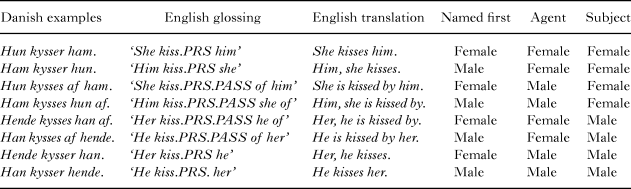
Danish is well suited as a language to study the effect of grammatical categories on attention and imagery as it allows both subject–verb–object (SVO) and object–verb–subject (OVS) word order. Danish is a V2 language (similar to German and Swedish), meaning that the finite verb occurs in the second position of the clause, while both subject and object can occur in the first position (Kristensen, Reference Kristensen2013; Kristensen & Wallentin, Reference Kristensen, Wallentin and Willems2015), and thus become a focus of attention (see Table 1 for examples).
Example sentences

notes: PRS: present tense; PASS: passive voice.
If the suggested functional role for grammatical categories is correct, we should expect to see that the grammatical subject will be given prominence in imagery, e.g., when making drawings of sentence content, regardless of its position in the sentence, due to its function as recurrent topic. If so, we should expect to see an influence of syntactic roles on the formation of such drawings. Prominence in this case would mean a position towards the left in the drawing, as this is where objects of importance are most often placed in Danish written sentences.
In our experiment, we thus aimed at studying the lateralization effect in drawings as a function of attentional allocation provided at different levels of linguistic abstraction. The first named entity is usually both the grammatical subject and the agent, but by counterbalancing the order of these elements in different stimulus sentences, we were able to study their effects independently (see Table 1 for examples). We hypothesized that, due to their default position in the beginning of sentences in Danish (and towards the left during reading), they would each individually contribute to the lateralization effect.
2. Materials and methods
2.1. participants
The experiment was conducted in a Danish secondary school (Stenhus Gymnasium). One-hundred-sixty-seven students (85/81/1 male/female/not reported; 19/146/2 left-handed/right-handed/ambidextrous; median age: 18 years; range: 15–22) participated. Data from two additional participants were excluded due to them not producing any comprehensible drawings. All participants were native Danish speakers. Bilingualism was registered and knowledge of a language with right-to-left reading direction (6 participants) was included as a model covariate.
The experiment took place during class hours. No sensitive data were collected. Prior to the experiment, participants were informed about general aspects of the experiment, including that there would be no correct or incorrect answers and that participation was anonymous. After the experiment, classes were given a thorough debriefing on the project.
2.2. stimuli and materials
The experimental sentences were constructed using eight Danish transitive verbs: slå ‘hit’, sparke ‘kick’, kysse ‘kiss’, trække ‘pull’, forfølge ‘follow’, skubbe ‘push’, udpege ‘point out’, skyde ‘shoot’. Verbs were clearly imageable, involved a simple agent–patient relationship with an action unfolding by default in the horizontal plane. Sentences were created for each verb by combining them with pronouns describing a male and a female character. Similar to English, Danish has case-marked personal pronouns: han ‘he’, hun ‘she’, ham ‘him’, hende ‘her’. Danish also allows both SVO and OVS word order (Kristensen, Reference Kristensen2013; Kristensen & Wallentin, Reference Kristensen, Wallentin and Willems2015). By including active and passive sentence forms, we constructed 2 × 2 × 2 sentences for each verb as illustrated in Table 1.
A total of 8 × 8 sentences were made. These were divided into eight stimulus sets, using each verb and sentence construction only once per set in a counterbalanced order. Each participant was only subjected to one set of eight sentences.
Prior to the experiment, participants were each given a set of papers. The front page asked the participants to fill out information about gender, handedness, grade, and potential bilingualism. It further contained a frame accompanied by a written pretest sentence for illustration of the experimental procedure. The test materials consisted of eight numbered frames (17 cm × 10.7 cm), without written sentences. The frames were supplied in order to standardize the size of the drawings. The frames were numbered in order for students to know which box to use for which sentence. The presence of the number also eliminated potential ambiguities with respect to paper orientation.
2.3. procedure
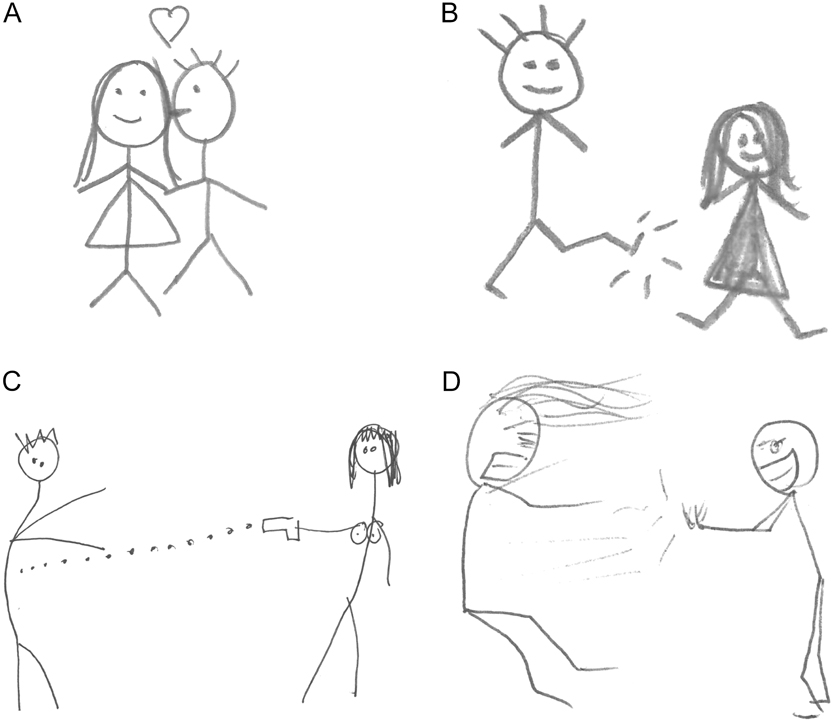
The experiment lasted approximately 15 minutes. It was carried out in eight different classes; each class was tested on a different set of sentences. Students were first told to fill out the front page. Subsequently, the procedure of the test was explained and participants were instructed not to care about the aesthetic qualities of their drawings, but simply to draw stick figures when illustrating the sentences (see Figure 1). The participants were free to use their preferred writing tool, and they were allowed to erase. A pre-test-sentence was used to give the participants a sense of the task. The pre-test sentence was both read aloud to the participants and written on the page, and after drawing this, the participants were allowed to ask questions. They were subsequently informed that during the experiment no questions would be allowed, and that the motivation for the experiment would be revealed afterwards. All test sentences were read aloud twice with neutral prosody, i.e., without adding stress to any particular words. Drawing began immediately after the second sentence presentation. Participants were given 60 s. to finish each drawing. If any communication between the participants emerged during the experiment, this was immediately stopped by the experimenter.
Participants were asked to draw stick figures illustrating the content of sentences read aloud to them, e.g.: A: “She is kissed by him” [MA]; B: “He kicks her” [MF, MA, MS]; C: “Her, he is being shot by” [MS]; D: “Him, she is being pushed by” [MF, MA]. Drawings were coded for whether the male character was to the left in the drawing. Independent variables were MF: the male character was mentioned before the female; MA: the male character was the agent performing the action; MS: the male character was the grammatical subject of the sentence.

2.4. coding and analysis
We used a binary coding for the dependent variable: [1] if the male character was depicted to the left of the female in the drawings; [0] if the female character was drawn to the left of the male. A total of 1,336 drawings were coded. Two independent coders, blinded to the stimuli and experimental hypotheses, judged if the male character was located to the left. Initial agreement was 97.6%. Disagreements were solved by discussion. One drawing was discarded due to it not containing any human characters, leaving 1,335 drawings for analysis.
Data were submitted to a linear mixed-effects logistic regression analysis using the glmer() function (Bates, Mächler, Bolker, & Walker, Reference Bates, Mächler, Bolker and Walker2015) in R, incorporating a maximum likelihood model fit (Laplace Approximation). Both data and script for analyses are available as supplementary material (available at https://dx.org/10.1017/langcog.2017.19).
An initial analysis looked at the effect of verb type and found no significant effects (|z| < 0.8, p >.4). Three main factors were included as fixed effects in a simple model based on our hypotheses: MF: effect of naming male character first/last; MA: effect of male character being agent/recipient; and MS: effect of male character being grammatical subject/object. Participants and stimulus sets were treated as random effects. An additional more complex model included two-way and three-way interactions between MF, MA, and MS, plus three additional covariates: handedness, participant gender, and language bias (reported knowledge of languages with right-to-left reading systems). In order to make model comparison possible, one participant who had not revealed his/her gender and the two ambidextrous participants were excluded (i.e., n = 1311). No significant effects of interactions, handedness, participant gender, or language bias were observed (p > .05). A model comparison between the simple and the complex model found that the complex model did not represent a significant improvement (χ2(7) = 4.27, p > .5). More complex models, including interactions between handedness, gender, and linguistic effects were also tried, but they failed to converge. We thus report the main effects from the simple model, using the full dataset (n = 1335).
3. Results
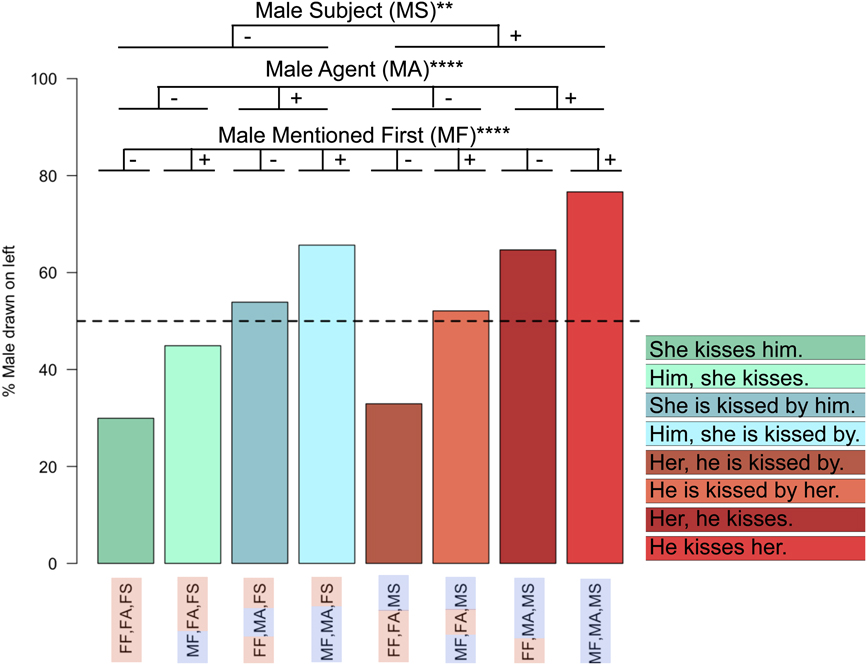
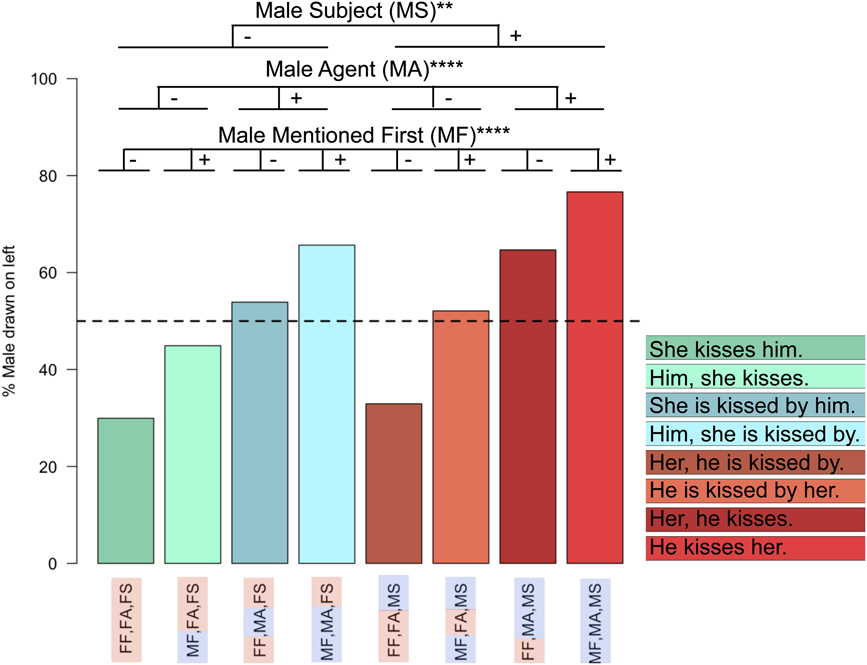
Overall, 52.5% of the drawings had the male character on the left. A chi-squared test revealed that this distribution was not significant (χ2(1) = 3.46, p = .06). Distribution across dependent variables can be seen from Table 2 and Figure 2. Placement of the characters in the drawing was significantly affected by naming male character first (z = 5.5, p < .00005), by male character being the agent (z = 9.2, p < .00005), and by male character being grammatical subject (z = 3.1, p < .005).
Descriptive statistics

Percentage drawings with the male character on the left for each sentence type. Chance level = 50%. FF/MF: Female/Male named First, FA/MA: Female/Male Agent; FS/MS: Female/Male sentence Subject. Example sentences are translations of the original Danish sentences (see Table 1). ** p < .005, **** p < .00005.
4. Discussion
We replicate previous findings showing how the first mentioned item in a sentence and also the agent of the sentence tend to be depicted to the left in a drawing. The novel finding is that participants were also inclined to place the grammatical subject of a sentence to the left in their drawing, independently of whether the described sentence subject was named first or was the agent in the described event. This result indicates that grammatical roles are also functional roles, e.g., transferring information about attentional prominence.
It is important to understand that, for each drawing, the participant can only choose between two options (male left / female left). The statistical effects reported are marginal effects, meaning that they reflect variance explained by each independent variable, independent of the other independent variables. Shared variance is disregarded. The effects that are observed in the present data thus arise from the situations where the three independent variables (first mentioned, agent, subject) split linguistically, and thus force the participant to choose which one to follow and depict on the left. The effect of subject/object category therefore reflects trials where participants choose to override the other factors and place the grammatical subject on the left side anyway.
Being named first, being the agent in an agent/patient relationship, and being the grammatical subject in a sentence are statistically correlated in Danish: SVO sentences are 1.5–4 times as frequent as OVS sentences (Thomsen & Kristensen, Reference Thomsen and Kristensen2015), and verbs in the passive mood only have a frequency of 5–7% of the total number of finite verbs in both written and spoken Danish (Laanemets, Reference Laanemets2013). This distribution of sentence types fits with an intuition that the use of divided attentional focus evoked by disentangling linguistic prominence markers should be the exception rather than the rule. This is illustrated by the fact that, although both subject and object can occur in the first position in Danish, in discourse, object-first sentences are only licensed if the object is ‘topic-worthy’ (Kristensen, Reference Kristensen2013), i.e., if it is somehow singled out in the preceding discourse, such as in the contrast example presented in the ‘Introduction’.
Connecting linguistic structure to attention is consistent with findings from sentence production experiments (Gleitman, January, Nappa, & Trueswell, Reference Gleitman, January, Nappa and Trueswell2007; Myachykov, Ellis, Cangelosi, & Fischer, Reference Myachykov, Ellis, Cangelosi and Fischer2013; Myachykov & Garrod, Reference Myachykov, Garrod, Ramm and Fabricius-Hansen2008; Myachykov, Garrod, & Scheepers, Reference Myachykov, Garrod and Scheepers2012; Myachykov & Tomlin, Reference Myachykov and Tomlin2008; Myachykov, Tomlin, & Posner, Reference Myachykov, Tomlin and Posner2005; Tomlin, Reference Tomlin, Downing and Noonan1995). Tomlin (Reference Tomlin, Downing and Noonan1995) found that participants often mention a given element in a description of a scene first, if their attention is directed towards it. If an arrow is pointed towards a dark fish as it is being eaten by a lighter fish, English speakers will tend to describe the scene with a passive construction (“the dark fish is being eaten by the light fish”), whereas they will use an active construction if an arrow points their attention to the light fish (“the light fish eats the dark fish”). Similar studies have been conducted with Russian and Finnish speakers (Myachykov & Garrod, Reference Myachykov, Garrod, Ramm and Fabricius-Hansen2008; Myachykov & Tomlin, Reference Myachykov and Tomlin2008). Russian has extensive case marking and relatively free word order, even though SVO sentences are preferred. Here, when participants were directed to the agent in the event, they almost invariably described the scenario using an agent-first, subject-first construction. However, when they were directed to the patient of the event, around two-thirds stuck to an agent-first, subject-first construction, but around one-third described the event using a patient-first, object-first construction or a patient-first, subject-first (passive) construction. These findings are consistent with the present in suggesting that the agent-first effect is the strongest force in sentence construction, but that attentional cueing can elicit weaker forces urging other construction types. Response times from the Russian study also indicated that participants were slower at describing the scenes when directed towards the patient, suggesting interference from divided attention with a subsequent reconfiguration of the content of imagery during subsequent sentence construction.
Our findings are also compatible with sentence recall studies showing that the agent/subject/first-mentioned item is recalled better than the patient/object/last-mentioned item (Clark, Reference Clark1966). Probe recognition studies have also shown that probe words are responded to considerably more rapidly when they are the names of the first- as opposed to the second-mentioned participants in a target sentence. This advantage is independent of whether the first named item was the agent of the sentence or not (Gernsbacher & Hargreaves, Reference Gernsbacher and Hargreaves1988; Gernsbacher, Hargreaves, & Beeman, Reference Gernsbacher, Hargreaves and Beeman1989).
We take our results to indicate that leftward positioning in the drawings point to the expected order of elements in a sentence in Danish. This indicates that the default expectation is a sentence with the active part and the grammatical subject both named first, but that the effect of agency is much stronger than the effect of grammatical subject. These findings add to the increasing number of studies that demonstrate the effects of reading/writing habits on other aspects of non-linguistic cognition, such as the processing of near/far space (Braine, Schauble, Kugelmass, & Winter, Reference Braine, Schauble, Kugelmass and Winter1993; Vaid, Rhodes, Tosun, & Eslami, Reference Vaid, Rhodes, Tosun and Eslami2011), on aesthetic preference (Chokron & De Agostini, Reference Chokron and De Agostini2000; Maass et al., Reference Maass, Pagani and Berta2007), and in the perception of violence (Maass et al., Reference Maass, Pagani and Berta2007), also when it applies to calling a foul in a soccer game (Kranjec, Lehet, Bromberger, & Chatterjee, Reference Kranjec, Lehet, Bromberger and Chatterjee2010).
One of the limitations of the current experiment is that we cannot evaluate the temporal dynamics of the underlying comprehension and production process. The current experiment evokes imagery in an overt and slow fashion by asking participants to produce elaborate depictions of their understanding of the sentences. This raises the question of whether the observed effect would also be expected to exist in tasks without the overt task of producing images. We hypothesize that it does. Previous research has shown that imagery is a fast and automatic part of language comprehension (Zwaan & Pecher, Reference Zwaan and Pecher2012; Zwaan, Stanfield, & Yaxley, Reference Zwaan, Stanfield and Yaxley2002). Lateralization effects related to reading direction have also been found in simple stimulus/response tasks (Fuhrman & Boroditsky, Reference Fuhrman and Boroditsky2010). Furthermore, the generation of the output of interest, i.e., gender lateralization in the drawings, was something that occurred without any instruction or attention directed towards it. We are thus confident that the observed effects reflect non-conscious effects and are not due to inferred demand characteristics (Orne, Reference Orne, Rosenthal and Rosnow1969). Future experiments may provide more detailed measurements in time on a smaller sample.
Sentence topic and adaptation to reading direction may, of course, not be the only determinants of how drawings are produced. Biomechanical constraints, such as handedness, probably also play a role. Previous research has found that right-handers tend to draw from left to right when asked to draw with their right hand but from right to left when drawing with their left hand (Braswell & Rosengren, Reference Braswell and Rosengren2002). If so, this would indicate that our participants who were predominantly right-handers would draw the left element before the right element in their drawing, again suggesting that the effects we observe have to do with what is brought to the forefront of attention. But it also highlights the possibility that left-handers would behave differently. We did not see any effects of handedness in our initial analysis, but this may be due to the relatively small number of left-handers (19) in our sample. A larger number of participants may be necessary in order to study potential interactions between handedness and linguistic factors on produced drawings, and a more detailed study may reveal if right-handed participants actually construct their drawings in a left-to-right fashion.
Reading direction is not the only left-to-right convention in Western culture. Theatre and film also have had similar conventions. The stage-right (left as seen from the audience’s perspective) is traditionally considered stronger than the stage-left (Dean & Carra, Reference Dean and Carra1989, p. 63) In the commedia-dell-arte tradition, the hero enters the stage from the left as seen from the audience’s perspective (stage-right), while the villain enters from the right. This convention dates back to the medieval mystery plays, where heaven was positioned on the spectators’ left and hell on the right. Similar conventions can also be observed in film. One study exists that suggests that right-to-left movement on film is deemed more negatively than left-to-right movement (Egizii, Denny, Neuendord, Skalski, & Campbell, Reference Egizii, Denny, Neuendord, Skalski and Campbell2012). Camera movement in classic Hollywood films have also been found to predominantly be left-to-right (O’Leary, Reference O’Leary2003). However, this effect seems to have disappeared in newer films (Salt, Reference Salt2005) and is therefore probably not responsible for the effects observed in this experiment. Furthermore, the standard assumption is that these conventions originate in reading direction (e.g., Dean & Carra, Reference Dean and Carra1989, p. 63), and thus may be considered different aspects of the same general tendency.
Taken together, our findings show that three different types of linguistic profiling independently provide a tendency for Danish speakers to imagine them in a left-to-right manner corresponding to the reading direction: (1) we replicate the earlier finding that the first-mentioned object is imagined as placed to the left of the second-named object; (2) we also replicate a finding that the active part of a sentence is displayed to the left; and last, (3) we show for the first time that the grammatical subject is placed to the left of the grammatical object, independently of whether it is mentioned first or is the agent of the action, suggesting stronger links between syntax, attention, and imagery than hitherto imagined. Further studies are needed to show how these effects play out in languages in which the alignment of agency, grammatical subject, and first mentioning is not the default.
Supplementary materials
For supplementary materials for this paper, please visit <http://dx.org/10.1017/langcog.2017.19>.