


After the third-wave democratization in the 1980s and 1990s, several Asian countries pursued the decentralization of political and fiscal systems as a reform strategy to promote democratic, equal, and efficient governance. Following the democratic regime transition in 1987, South Korea (hereafter, Korea) held its first local election in 1995, and in the early 2000s a significant portion of fiscal authority was handed over to local governments. Similarly, after the fall of Suharto in 1998, Indonesia launched the “big bang decentralization reforms of 2001 and 2005,” which transferred significant funds and authorities to local governments (OECD 2019, 126). Thailand restarted its decentralization process, which had begun after the establishment of the first democratic constitution in 1997 but paused after the military-led coups in 2014, and, in 2020, expanded direct local elections to chief executives and legislatures in all local governments. Other Asian neighbors, such as the Philippines, Taiwan, and Vietnam, have also transferred significant amounts of social services and administrative work to local governments (Panao Reference Panao2020; Shair-Rosenfield Reference Shair-Rosenfield2016; Ichimura and Bahl Reference Ichimura and Bahl2016). Despite the governance of the popularly elected local officials, however, most of these Asian countries have not improved; rather, economic and social welfare disparities have worsened across regions (Herath Reference Herath2009; Sumarto et al. Reference Sumarto, Vothkneht, Wijaya and Hill2014; OECD 2019). How has decentralization in Asian young democracies affected regional disparity in social services and benefits?
Studies with a normative view expect that decentralization would promote democratization and equity by precipitating political participation and providing opportunities for marginalized groups to voice their political demands (Swanson and Ki Reference Swanson and Ki2020). Central governments would transfer more financial resources to their less affluent sub-national regions for interregional fiscal balance (Boadway and Shah Reference Boadway and Shah2009). Directly elected sub-national governments would have strong incentives to respond to localized demands, which would lead to better governance (Osborne Reference Osborne1993). Under the flexibility of decentralization, local governments can design and implement programs that best fit the particular needs of local residents. Decentralization is thus deemed to be an effective way to provide public services to local citizens (Ebel and Vaillancourt Reference Ebel, Vaillancourt, Freire and Stern2001). Many developing countries adopt decentralization as a way to develop more responsive, efficient, and economically productive administration (Bird Reference Bird1993).
However, local governments in most developing countries, including Korea, are still financially and politically controlled by the central government. Although governors and mayors in local governments are directly elected by their local residents and granted spending authority, local financing is still substantively dependent on transfers from the central government, which can be called “partial fiscal decentralization” (Brueckner Reference Brueckner2009, 24). Under partial decentralization, local governments have very limited access to their own revenues. Although they have some local taxes such as property taxes and user charges, they still have constrained autonomy in setting the tax rates. The central government transfers a significant portion of local revenues, through which it influences spending choices and maintains leverage over local governments. For example, Shah (Reference Shah2004) finds that 42 percent of sub-national revenue (local and provincial) in developing countries came from central transfers. Likewise, cases have been witnessed in Indonesia (Gonschorek, Schulze, and Sjahrir Reference Gonschorek, Schulze and Sjahrir2018) and the Philippines (Panao Reference Panao2020). In fact, several studies on Asian young democracies reveal that the fiscal distribution at both central and local levels is often politically manipulated (Wongpredee and Sudhipongpracha Reference Wongpredee and Sudhipongpracha2014; Gonschorek, Schulze, and Sjahrir Reference Gonschorek, Schulze and Sjahrir2018).
Although there are such discrepancies between the normative goals and actual outcomes of decentralization, few studies on Asian democracies examine how the political incentives of the central and local governments are interconnected for the fiscal resources for, and the allocation of, local social expenditures. Particularly, the partisan interests of those governments in decentralized social spending have not received much attention, although a long history of work shows that partisanship matters in social policy (Kwon Reference Kwon2009; Aspalter Reference Aspalter2006; Selway Reference Selway2011). After decentralization, local incumbents in most Asian countries gained substantial fiscal leverage, but they have also maintained partisan affiliation during local elections and throughout their terms in office. Local politicians struggle to receive nominations from major political parties to gain financial support and a political network for their elections, while political parties at the center try to plant co-partisans in local governments for their future elections and governance. Likewise, decentralization in Asian democracies introduces additional complexities into the equation, as well as new calls for testing the partisan proposition using within-country data.
This article contributes to the current literature by systematically examining how partisan considerations of the central and local government shaped the distribution of social spending (especially on social security and welfare, along with public education) across regions in Korea from 2002 to 2015. We argue that partisan considerations, specified as partisan alignment and partisan ideology, significantly influenced the allocation of resources from the central government to its regional governments, and from these regional governments to their respective local constituents. First, the residing president and incumbent party have a strong incentive to transfer more resources to the regions that their co-partisans govern (i.e., the case of partisan alignment) in order to earn credit from their residents and secure their future elections. Second, the additional subsidy transfers from the central government lessen local budget constraints and help the regional governments retain greater fiscal abilities to provide social services and programs. Third, the chief executives of regional governments (i.e., governors or mayors) would have strong incentives to follow partisan policies in the allocation of social expenditures to their local residents. That is, progressive (or left-leaning) governors or mayors would spend more on social programs and services than would their conservative (or right-leaning) counterparts.
The analysis of the Korean case adds considerably to our understanding of the political economy of local social expenditures for two reasons. First, Korea is one of the third-wave Asian democracies that have decentralized their political systems in the last three decades. The transfer scheme of central subsidies and local social expenditures in Korea is suited to testing our theoretical arguments because they are allocated at the discretion of the central and local governments. Since its democratic transition in 1987, Korea has significantly decentralized its political and financial system to promote grassroots (participatory) democracy and equivalent economic development across regions. Local councils were first elected in 1991, and the heads of local governments at both municipal and regional levels were elected in 1995. The Kim Dae-jung government (1998–2003) revised the Local Autonomy Act to expand the autonomy of local governments over administration and budget. The Roh Moo-hyun government (2003–2008) revised the Local Subsidy Act to increase local subsidy taxes from 15 to 19.24 percent of national taxes and transferred the majority of social services to local governments. The Lee Myung-bak government (2008–2013) passed the Special Act on the Promotion of Decentralization in 2008 to improve the transparency and reliability of finance in local governments. While taxing and spending authority in Korea has been incrementally transferred to local governments over time, the central government still has substantive discretion over local finance. The Korean case is also well suited for empirical analyses because of its relatively reliable data and considerable socioeconomic and partisan variations across regions and time.
Second, Korea has historically strong regionalism along with geographically unequal economic prosperity (Ahn Reference Ahn, Minami, Kim and Falkus1999). Under highly regionalist politics, political parties have often appealed to voters with regionalist propaganda rather than distinct partisan programs, and voters have cast votes based on their regional origins rather than their class interests. We believe that these features are not unique to Korea but, rather, characterize many Asian countries that have regionally associated economic inequality and political conflicts for different reasons. In this sense, our study of Korea provides an idea of what the distribution of social services and benefits in partial fiscal decentralization would look like under the strong influence of regionalism.
This article is organized into six parts. In the first section, we discuss the existing studies on fiscal transfers of the central government and the social distribution of local governments in a decentralized system. The second section proposes our theoretical argument. We discuss how partisan alignment between the central and regional governments in a partial fiscal decentralization system impacts the distribution of national subsidies, which provides significant fiscal room for local social spending. We also propose how the partisan preferences of regional chief executives affect local social expenditures. In the third section, we present the Korean case as qualitative evidence for our theoretical argument. In the fourth and fifth sections, we present our data, models, and empirical results. In the final section, we conclude with a discussion of the policy implications.
Determinants of Local Social Spending in a Decentralized System
Local governments are likely to spend more on social services and programs if they have sufficient fiscal resources and/or strong political determination to prioritize social policies. In this sense, the current literature related to decentralized social expenditures can largely be divided into two categories: studies on (1) the central government's fiscal transfers to local governments and (2) the local government's social expenditures on residents.
The first strand of studies focuses on factors constituting the direction and amount of the central transfer to local governments. Some studies assess a normative prediction that the central government would transfer larger grants to local governments with a lower fiscal capacity and/or poorer socioeconomic status (e.g., Boadway and Shah Reference Boadway and Shah2009). That is, the amount of a central transfer would depend on the financial needs of the local government. However, most recent studies hold the view that central transfers are still subject to the central incumbent's electoral and partisan interests. Yet there are significant debates over the most effective ways to gain such interests. According to the swing voter theory, the central government transfers more subsidies to regions with a higher level of electoral competition (Lindbeck and Weibull Reference Lindbeck and Weibull1987). The marginal effect of fiscal investment is much higher in these regions because voters with weak electoral preferences (i.e., swing voters) can easily be persuaded to change their voting decisions as compared to core voters who strongly oppose (or support) the incumbent. On the other hand, the core voter theory predicts that the central government will transfer more subsidies to regions with a higher level of electoral support to reward its core voters (Cox and McCubbins Reference Cox and McCubbins1986). Others argue that the central incumbent reaps more electoral benefits by investing in politically aligned local incumbents (Arulampalam et al. Reference Arulampalam, Dasgupta, Dhillon and Dutta2009; Brollo and Nannicini Reference Brollo and Nannicini2012). Because the voters cannot clarify whether local public projects are developed by the central or local government, the central incumbent could collect a large portion of the electoral credits when they fund a politically aligned region.
The second strand of studies pays more attention to how local governments allocate available financial resources to local residents. Some studies with a normative view expect that directly elected local politicians are accountable for a large share of the electorates and, thus, provide broad-based social services (Fossati Reference Fossati2016; Panao Reference Panao2020). Therefore, local governments would try to expand social services as they become more financially affluent. However, several studies rebut this view, arguing that decentralization does not necessarily promote local political participation and contestation, nor does it always increase the policy accountability of local incumbents (Kitschelt and Wilkinson Reference Kitschelt and Wilkinson2007; Driscoll Reference Driscoll2018). According to these studies, a local politician is held accountable for local constituency demands and spends more on social programs only when s/he confronted electoral competition in the previous election and feels threatened by the prospect of losing his/her office in the next election. Still, others argue that local executives and legislatures do not necessarily prioritize broader social services and programs (Sole-Olle Reference Sole-Olle2006; González Reference González2017). Instead, they will employ their partisan policies, which can target their major constituents in the regions. That is, incumbents affiliated with left-leaning political parties are expected to pursue more generous social welfare policies to appeal to lower-income voters, while those affiliated with right-leaning parties employ business-friendly projects to appeal to upper-income voters.
The problems with the current literature are twofold. First, the two strands of literature that are critical to explaining decentralized social expenditures are mostly disconnected from each other. Indeed, this is because there are two types of fiscal decentralization: (1) a more decentralized system, in which local governments have considerable taxing and spending power, central resources are allocated mostly based on a formula, and local governments, thus, are fiscally and politically independent from the control of the center, and (2) a more centralized system, in which most local revenues depend on central transfers and, thus, the central government and its executives have more discretion over local finance. The studies of the former system (e.g., the United States) focus more on local politics for the study of local expenditures, while those on the latter system focus on the central government's political interests. Most decentralized systems have varying central government authority and control over resource flows between these two systems. Also, many developing countries, including Korea, have “partial fiscal decentralization,” where spending authority is devolved to the sub-national governments, but financing authority remains under the discretion of the central government (Shah Reference Shah2004; Brueckner Reference Brueckner2009). In such a system, the disjuncture of the literature can be problematic, because the central transfers are important to determining the fiscal scope of the local executive's social policy, and the local incumbent does not always prioritize social welfare projects even under a similar fiscal ability.
Second, extant studies have paid less attention to the partisan incentives of central and local governments in Asian young democracies. In particular, most of them view the political parties in these countries as being weakly organized and having unstable linkages to voters (Hsiao, Cheng, and Achen Reference Hsiao, Cheng, Achen, Achen and Wang2017; Hagopian Reference Hagopian, Boix and Stokes2009). However, recent studies find that the policy preferences of the governing party are an important determinant of national-level social policies and policy outcomes in Asian countries (e.g., Kwon Reference Kwon2009; Aspalter Reference Aspalter2006; Selway Reference Selway2011). After decentralization, local incumbents in most Asian countries (e.g., Indonesia, Korea, Malaysia, Pakistan, Taiwan, Thailand, and the Philippines) gained substantial authority over local budgets but are still affiliated with political parties at the center (Panao Reference Panao2020; Shair-Rosenfield Reference Shair-Rosenfield2016; Ichimura and Bahl Reference Ichimura and Bahl2016). Yet, existing empirical studies on the topic remain limited to the national level, and the few studies on the local level are constrained to specific regions and/or short periods (see Kim and Lee Reference Kim and Lee2018, and Appendix 8 for the existing studies on Korea). To improve the current discussion handling two types of decentralization, it is thus crucial to study how the partisan interests of the central and local governments are interconnected in order to shape social expenditures and conduct comprehensive cross-regional and cross-time analyses covering various central and local governments within a decentralized country.
Partisan Interests of the Central and Local Governments in Partial Fiscal Decentralization
In the partially decentralized fiscal system, both central and local governments derive social policy decisions and outcomes cooperatively at sometimes and contentiously at other times. We argue that partisan interest is one of the major political incentives for both governments in the system. First, the central government has strong incentives to transfer its resources to regions with chief executives from the incumbent party. Even when the popularly elected local officials have a significant portion of administrative authority, the central governments in many Asian countries still collect a significant portion of local tax revenues. Although they set up rules to formulate the equal distribution of central funds, these rules are often politicized in the process of establishment or distribution (Boadway and Shah Reference Boadway and Shah2009; Wongpredee and Sudhipongpracha Reference Wongpredee and Sudhipongpracha2014). Therefore, the central incumbent often has the leverage to control the fund transfers for his/her political interests. Electoral support from local projects, which are funded by the central transfers, is shared by the central incumbent and the local executive (Gonschorek, Schulze, and Sjahrir Reference Gonschorek, Schulze and Sjahrir2018). Therefore, the residing president can garner the most credits for his/her next election from the fund transfers to his/her co-partisans in local governments.
The central incumbent also transfers more funds to his/her co-partisans to enhance their electoral chances. The size of national subsidies earned during incumbency increases the probability of reelection in local governments (Costa-i-Font, Rodriguez-Oreggia, and Lunapla Reference Costa-i-Font, Rodriguez-Oreggia and Lunapla2003). The central incumbent would try to make his/her co-partisan reap such electoral benefits and take local offices. Because voters often evaluate the incumbent party through local elections, the latter are frequently considered “the interim assessment of the incumbent central government” (Kang Reference Kang2015, 50). Winning many seats in local elections can be considered voters’ re-expression of confidence in the central incumbent, and it helps the central government gain legitimacy to further its ongoing or proposed policies. Governors or mayors in local governments are also important cooperators for future national elections because they have substantial power to mobilize voters and local resources. In addition, local officials have incentives to align with the center and help the central party, as that will secure more fiscal resources and thus increase their probability of an electoral victory in the future.
Second, because most local governments in the partially decentralized fiscal system have limited tax resources and tax capacities, the additional financial resources obtained from the center provide them with the fiscal ability to enlarge social expenditures. According to Wagner's Law, if a state becomes financially and economically affluent, it will have more popular demand for, and fiscal room to increase, social expenditures (Wagner Reference Wagner1883). Correspondingly, local governments that obtain more fiscal resources will spend more on social services and programs, which are generally popular among local residents. Yet, local residents would not necessarily support the expansion of social services and programs if they had to take on additional tax burdens. In that sense, large subsidy transfers from the central government make it easier to implement expansionary social spending than do locally raised tax revenues.
Thus, our first and second hypotheses are as follows:
H1: Under partial fiscal decentralization, the central government transfers more subsidies to local governments with governors or mayors with the same party affiliation.
H2: Under partial fiscal decentralization, local governments with larger subsidies spend more on social services and programs.
Third, the partisan affiliation of chief executives in local government is significantly associated with the distribution of social services and programs in the regions. Locally elected governors or mayors are not mere implementers of central governments’ policies but, rather, are important policymakers for local programs and services. In particular, governors (or mayors) in regional governments apply for national subsidy transfers from the central government on behalf of sub-regional districts and budgetary power and have policy discretion to allocate such regional resources locally (Park Reference Park2017; OECD 2019). Because local budgets are frequently obscured and difficult to categorize into the purpose of the funds, it is often hard for the central government to understand the needs of local governments and audit the misuse of funds (Malik Reference Malik2019). Thus, local incumbents often have the leverage to manage available fiscal resources for their political interests.
However, the political survival of local politicians depends on the partisan supporters in the regions and on receiving a major party's nomination for the next election. Local politicians in most Asian countries seek party nominations, which can provide them with stronger voter networks and financial assistance for election as well as opportunities to become important figures in national politics (Manikas and Thornton Reference Manikas and Thornton2003; Unger and Mahakanjana Reference Unger and Mahakanjana2016). In fact, several local politicians in Asia became the presidential candidates of major political parties after they were renowned as governors or mayors of regional governments. For example, in Taiwan, President Chen Shui Bian from the Democratic Progressive Party (DPP) won the 2000 presidential election after serving as mayor of the City of Taipei from 1994 to 1998. In Korea, President Lee Myung-bak (2008–2013) became a presidential candidate for Hanara-dang or the Grand National Party (GNP) by earning a political reputation as the mayor of the Special City of Seoul (2002–2006).
Party leaders at the center have control over the party nominations for local elections and use this as an opportunity to discipline their local partisans. For example, in the Taiwanese local executive elections of 2005 and 2009, national parties used primary elections and party nominations to consolidate their local party unity and evade rebel candidates (Fell, Sullivan, and Sapir Reference Fell, Sullivan and Sapir2013). In the Philippines, the national party leadership had veto power over the key elected candidates such as governors and city mayors (Manikas and Thornton Reference Manikas and Thornton2003). Most local politicians in Asian countries thus strive to obtain nominations from the locally popular political parties in local elections and maintain a close relationship with the central parties during their terms. For example, local politicians in Indonesia have faced stiff competition for party nominations, called pilkada, since they were allowed to have partisan affiliation in the 2005 local election.
The political parties’ policy stances on social welfare should, thus, significantly affect local politicians’ preferences for social welfare policies and services. As Asian countries achieved democratic and economic development, there have been more public demands for, and partisan debates over, social welfare expansion. Although partisan policies in Asian democracies have not developed as distinctly as those in Western democracies, voters still perceive their differences increasingly over time. For example, the Democratic Progressive Party (DPP) in Taiwan is often considered a center-left political party because it has adopted more progressive social welfare and education policies than the conservative Kuomintang (KMT). The populist Thai Rak Thai party in Thailand, which launched the flagship policy of the 30-baht healthcare scheme ($1 for healthcare), is deemed a pro-welfare/populist party as compared to the conservative Democrat Party (e.g., Selway Reference Selway2011). Thus, governors or mayors who are members of pro-welfare political parties are more likely to prioritize social policies and programs than other local policies such as developmental projects. Our third hypothesis is summarized as follows.
H3: Local governments affiliated with a progressive (or left-leaning) political party spend more on social services and benefits than do those affiliated with a conservative (or right-leaning) political party.
Partisan Interests, Subsidy Transfers, and Local Social Spending in Korea
As public demands for social welfare have grown in the 2000s, serious partisan debates have taken place over redistributive policies in Korea. Distinct stances on social welfare have been taken by the two major political parties; Saejeongchi minju yeonhap or the New Politics Alliance for Democracy (NAPD) has supported “universal social welfare,” which provides social benefits to all Korean citizens regardless of income level, whereas Saenuri-dang or the New Frontier Party (NFP) has opposed it and maintained “selective social welfare,” which provides benefits only for the neediest.Footnote 1 The NFP and NPAD are thereby considered conservative and progressive parties, respectively, on the Korean political spectrum, although they can be categorized as rightist and centrist along with the traditional left–right ideological spectrum (Wang Reference Wang, Kitschelt and Wang2012). Most of the heads of local governments and members of local councils in Korea run as candidates of the two parties in local elections but are also strongly affiliated with them throughout their terms (Kim and Roh Reference Kim and Roh2014; Yu and Kim Reference Yu and Kim2015). Therefore, local politicians’ preferences for social services and benefits have been strongly affected by political parties’ policy stances on redistribution.
However, local partisan representation in Korea has also been closely connected to regionalist partisan support. In particular, there has been strong regional bloc voting in the southwest regions (South/North Jeolla Provinces and the city of Gwangju) supporting the NPAD, and in the southeast regions (South/North Gyeongsang Provinces and the cities of Daegu, Busan, and Ulsan) supporting the NFP. The electoral success of local politicians in the regions has been strongly associated with regionalist sentiments rather than their policy directions (Heo and Stockton Reference Heo and Stockton2005). Thus, local governments and councils in these two regions have been occupied predominantly by the NPAD or NFP. Decentralization in Korea has been promoted based on the expectation that it will lessen regional inequality and alleviate such regionalist conflicts to some extent.
Under the decentralization process, most pronounced are the transfers of social services and programs to local governments. Significant portions of social expenditures have been transferred to local governments over time. In 2015, local social security and welfare (SSW) and education expenditures in Korea reached 6.3 percent of the GDP, which is almost 58 percent of total national SSW and education expenditures (OECD Statistics).Footnote 2 The share of social expenditures in the budgets of local governments has also expanded over time. As of 2018, local SSW and education spending accounted for roughly 37 percent of total local government budgets (Database of Local Finance Integrated Open System). However, there have been significant differences in the levels of, and changes in, regional social expenditures in Korea (see Appendix 3 for the regional data).
The central government in Korea has transferred significant amounts of subsidies to local governments to balance the regional disparity. The subsidy transfers can be classified into three categories: (1) Local Shared Tax (LST), (2) National Treasury Subsidies (NTS), and (3) Local Education Subsidies (LES). These subsidies are provided to help local governments facing fiscal shortfalls and to promote balanced regional development. LST is distributed to local governments to supplement revenue shortages and equalize the financial inequality between regional governments. LST is financed by 19.24 percent of internal tax revenues based on the financial status of local governments as specified by the Local Subsidy Act, and no limitations are imposed on local governments’ use of this money. NTS is intended to support specific local businesses or programs and is financed by the central government's general or special account budgets based on the Enforcement Decree of the Subsidy Management Act. LES is directly transferred to the Ministry of Education in each city or province based on the Local Education Subsidy Act. According to the National Assembly Budget Office (2020), subsidies transferred from the central government in 2019 to higher-tier local governments with a weak revenue base account for roughly 36.3 percent of yearly total central government spending.
The distributions of subsidy transfers in Korea—particularly LST and NTS—are often susceptible to political influences. NTS is significantly subject to political influence, as the law does not specify its financial resources. To receive NTS, a local government must submit an application, which is reviewed by the central government, including the Ministry of Interior and Safety and the Ministry of Economy and Finance, and budgeted annually in the National Assembly. NTS also requires matching funds from the local governments, the sizes of which are often arbitrarily determined by the central government. The selection of NTS and the amount of assistance for it are typically determined subjectively, as it is often difficult to decide whether NTS should be used to assist the local business/program and the extent to which NTS should do this (Kim Reference Kim2000). Therefore, many local politicians in Korea systematically lobby for NTS in the central government and National Assembly during the yearly review of the budget (Jeon Reference Jeon2012). While the financial sources of LST are specified by the Local Subsidy Act, special local subsidy transfers are still subject to political decisions (Huh and Kim Reference Huh and Kim2017). On the other hand, LES is less affected by political influence because it is governed directly by bureaucratic formulae based on the number of teachers, schools, classrooms, and students registered in the National Education Information System.
The residing president and his/her governing party in Korea have substantial power over the subsidy transfers, and they try to assist their co-partisans in regional governments. A good example is the City of Incheon, which, from 2010 to 2014, was governed by centrist mayor Song Young-Gil (DP), who was then replaced by a rightist mayor, Yoo Jeong-bok (NFP: 2014–2018), in 2014. During this entire period, the central government was controlled predominantly by rightist presidents: the Lee Myoung-bak government (GNP: 2008–2013) and the Park Geun-hye government (NFP: 2013–2017). Immediately after Yoo Jeong-bok (NFP) succeeded Song Young-gil (DP) as mayor, in 2014, the central government transferred an additional subsidy of ₩98,533 (roughly $83) per capita to Incheon.Footnote 3 Likewise, the allocation of national subsidies in Korea has not necessarily served the policy objective of facilitating even socio-economic development. LST is included as general local revenues, which means that local governments can use it according to their needs (Yoon Reference Yoon2007; Jeon Reference Jeon2012). Although NTS is funded for specific purposes, local governments also often use NTS to relieve their financial burdens for other local businesses (Kim Reference Kim2000). The additional funds from the central government provide some fiscal room for regional governments to spend on social services and programs.
Despite the fiscal constraints, governors or mayors in Korea have often made deliberate changes to local social policies along with their partisan policies (Yu and Kim Reference Yu and Kim2015; Dixon and Hakim Reference Dixon and Hakim2009; Jeong Reference Jeong2011). The recent partisan debates over the provision of the free school meal service are a good example of our theoretical argument. In fact, the partisan debates over a “universal” versus “selective” welfare state began in the 2010 local election. The centrist party, the DP (the former NPAD), campaigned based on the partisan policies of “universal welfare” and promised to provide free lunch, free education, and free healthcare, plus half college tuition. On the other hand, the rightist party, the GNP (the former NFP), campaigned for free lunch service for underprivileged students (e.g., low-income students).
After the election, serious partisan debates took place over the free school meal system in the City of Seoul. The former mayor of Seoul, Oh Se-hoon, from the ruling conservative party, the GNP, proposed providing free meal services to 30 percent of impoverished children. However, the centrist opposition party, the DP, proposed and passed a bill through the city parliament to provide free meal services to every child in Seoul. According to the bill, the free school meal service would start in elementary school but eventually expand to middle school. Mayor Oh said that the bill was a populist policy and called for a referendum (the Seoul Free Lunch Referendum) to stop it. He lost the referendum on August 24, 2011, and had to resign due to the political fallout. In the by-election of 2011, Park Won-soon from the DP was elected as the new mayor of Seoul. Immediately afterward, he approved the bylaw for the free lunch program and a 16.7 percent increase in the budget for SSW spending. Throughout his eight years of city governance, SSW spending in Seoul continuously increased, reaching almost 35 percent of the city's entire budget in 2019 (Seo Reference Seo2019). Since then, the free lunch program has spread nationwide, though the program's provision still significantly varies according to the political leadership of regional governments (Yu and Kim Reference Yu and Kim2015).
Empirical Analysis of the Impact of Partisan Alignment on National Subsidy Transfers
Data
In this section, we examine the first hypothesis: whether the central government transfers more national subsidies to a local government with the same partisan alignment. The regional governments include eight provinces (Gangwon, Gyeonggi, North/South Chungcheong, North/South Jeolla, and North/South Gyeongsang) and seven metropolitan cities (Seoul Special City, Busan, Daegu, Incheon, Gwangju, Daejeon, and Ulsan).Footnote 4 Regional-level data were retrieved from the Local Finance Open System, which is a division of the Ministry of Government Administration and Home Affairs (MOGAHA). The data analysis includes 15 regional governments from 2002 to 2015.
Subsidies
The dependent variable is per capita subsidies transferred from the central government to a regional government (SUBSIDYPC). SUBSIDYPC is measured by the sum of Local Shared Tax (LST) and National Treasury Subsidies (NTS) in millions of Korean won (₩) per year, weighted by the total population of the region. We exclude Local Education Subsidies (LES), which is mostly insulated from political influences. See Appendix 3 for the data across regions and time.
Partisan Alignment
Our key independent variable is the ideological coalition between the incumbent president and the regional chief executive (ALIGNMENT).Footnote 5 We anticipate that the central government will transfer more subsidies to a regional government if the two entities share partisan preferences. ALIGNMENT is a dummy variable, coded as 1 if the regional chief executive (governor or mayor) is a member of the party to which the president belongs (i.e., the governing party) and 0 otherwise. The presidential elections in Korea were held every five years (2002, 2007, and 2012), and our empirical analysis covers the central governments of three presidents: Roh Moo-hyun (MDP/OP: 2003–2008), Lee Myung-bak (GNP: 2008–2013), and Park Geun-hye (NFP: 2013–2017). Information about the partisan affiliation of regional executives was gathered from the National Election Committee (NEC) and the websites of regional governments. Local elections in Korea were held every four years (1998, 2002, 2006, 2010, and 2014), and most regions experienced partisanship changes in their governors or mayors from 2002 to 2015. See Appendix 2 for detailed information.
Controls
To further isolate the effect of partisan alignment on subsidy transfers, we include a list of control variables. First, if the central government is concerned about equitable redistributions among national citizens, it will transfer resources away from regions with sufficient revenues and direct more resources toward regions with scarce revenues (Boadway and Shah Reference Boadway and Shah2009). The level of regional revenue (REVENUEPC) is measured by the total regional revenue, excluding subsidies, weighted by the total regional population.
Second, the central government is likely to transfer more subsidies to impoverished regions to promote balanced development across those regions. However, the central government may actually transfer more resources to more productive regions to promote innovation (Duranton and Venables Reference Duranton and Venables2018; Kwon Reference Kwon2005). The level of regional development is measured by regional gross domestic products per capita (RGDPPC).
Third, as discussed earlier, the central government may transfer more or fewer subsidies to a region based on the region's level of support (core voter theory) or electoral competition (swing voter theory) during the presidential election. The level of regional support for the sitting president is measured by the percentage of votes for the president in each region in the previous presidential election (PREVOTE). The level of electoral competition in a region is measured by the absolute vote share difference between two leading candidates (PRESCOMP): the top vote-getter and second-most vote-getter in each region. Each of the three presidents in our analysis was unexceptionally one of the top two candidates in any region. PRESCOMP can range from 1 (a complete victory or defeat) to 0 (a tie). As the president gets more votes in a region, the electoral competition in that region decreases. Thus, PRESVOTE and PRESCOMP are positively correlated with each other (corr. = 0.38, p < 0.01). To account for that, we test the effects separately in the model.
Fourth, regions with more farm households and larger populations are likely to demand assistance from the central government and, thus, receive more subsidies. However, densely populated areas are mostly metropolitan cities with greater numbers of taxable residents. Thus, the central government may allocate resources to less populated regions with fewer taxable residents (Kwon Reference Kwon2005). Therefore, we control for the natural logarithm of the number of farm households (LOGFARMHOUSE) and the total population of a region (LOGPOP). Finally, regional dummies are included to capture region-specific characteristics such as regional-bloc voting. See Appendix 3 for variable sources and summary statistics.
Model and Method
To predict the impact of partisan alignment on the national subsidy transfers to a regional government, we use the Arellano-Bond generalized method of moment (GMM) estimators with robust standard errors. Following Anderson and Hsiao (Reference Anderson and Hsiao1982), we also use the second lag of the dependent variable (SUBSIDYPC t−2) as an instrument. The GMM estimator is appropriate for our empirical study because we can avoid endogeneity problems, unobserved regional-specific characteristics, and heteroskedasticity problems (Arellano and Bond Reference Arellano and Bond1991). In particular, we can estimate both the short- and long-term effects of a variable of interest. The short-term effect can estimate the temporary change in regional subsidies generated by the partisan alignment, while the long-term effect can capture the overall effects when this change is perpetuated in an infinite future.Footnote 6 See Appendices 3–6 for an in-depth discussion of the data, method, empirical results, and robustness tests.
The empirical model can be expressed with the following regression equation:
 $$\eqalign{& SUBSIDYPC_{i, t} = \phi\; SUBSIDYPC_{i, t-1} + \beta ALIGNMENT_{i, t} \cr & \quad\quad\quad\quad\quad\quad + \gamma _kZ_{i, k, \;t-1} + \alpha _i + \varepsilon _{i, t}}$$
where SUBSIDYPC refers to per-capita subsidies from the central government to region i in year t and ideological alignment (ALIGNMENT) refers to the dummy variable for the same party affiliation between the central government and a regional government. According to our hypothesis, the coefficient estimate of ALIGNMENT should be positive and statistically significant. α and ε denote regional dummy variables (for unit-specific fixed effects) and errors. Z is a vector of k control variables that affect the distribution of the subsidies.
Empirical Findings
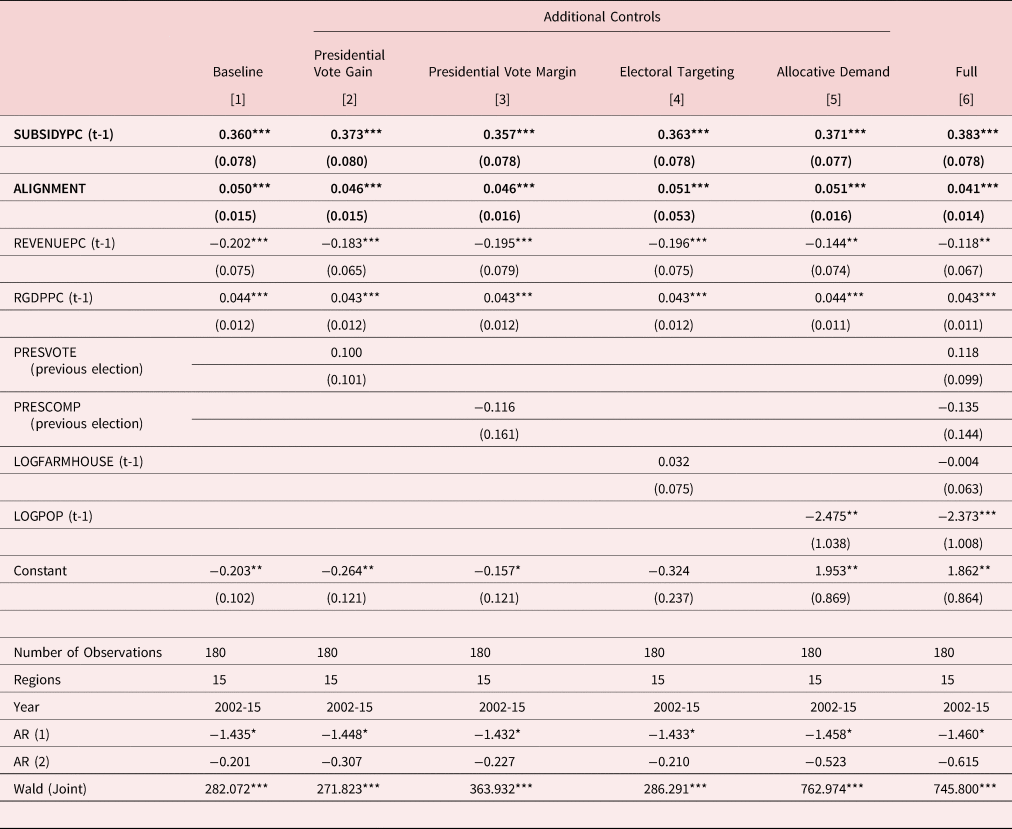
Table 1 reports the effects of party alignment on changes in the total subsidy transfers from the central government to regional governments. We test the results with various model specifications (Models [1]–[6]). Model [1] is a baseline model that controls for the financial and economic conditions of local governments: REVENUEPC and RGDPPC. Model [2] and Model [3] add variables regarding electoral politics: PREVOTE and PRESCOMP, respectively. Model [4] and Model [5] add variables regarding demographic conditions: LOGFARMHOUSE and LOGPOP, respectively. Model [6] is the full model, which includes all the related control variables. In all models, the lagged dependent variable (SUBSIDYPC t−1) is positively and strongly associated with the dependent variable (SUBSIDYPC t), suggesting that subsidy transfers are path-dependent.
Dynamic Panel Analysis for National Subsidies to Local Governments

Note: Dependent variable: Δ total subsidies (sum of the NTS and the LST) per capita (in million won); Dynamic GMM estimates are obtained from the “xtabond” command in Stata; Robust standard errors are reported inside parentheses; One-tailed significance tests at *** p ≤ 0.01, **p ≤ 0.05, *p ≤ 0.1.
The empirical results in all the models consistently and strongly confirm our argument about subsidy transfers (Hypothesis 1). Partisan alignment between the central government and a regional government is strongly and positively associated with subsidy transfers to that region. These estimated effects are also substantively meaningful. According to the results in the full model (Model [6]), when a regional executive's partisan affiliation changes from an opposition party to a governing party, subsidy transfers in the short-term increase by roughly ₩41,000 ($35) per capita, which is nearly 80 percent of the average annual growth in subsidy transfers per capita (SUBSIDYPC) to a region (₩57,677). The partisan alignment also has a significant long-run effect on the level of subsidies in a region. According to the results in Model [6], the presence of a mayor/governor affiliated with the governing party induces a long-run increase in SUBSIDYPC by ₩67,033 ($57) per capita. This value is equivalent to 7.3 percent of the annual average level of regional subsidy transfers per capita (₩921,071 or $780). By awarding more resources to supporting regions, the central government in Korea seems to maintain its power over regional governments.
Figure 1 depicts the short-term effects of partisan alignment on subsidy transfers by regional governments. The marginal effect is calculated as a percentage of the average annual change in subsidy transfers in each region (2002–2015). The figure shows that the substantive effect of partisan alignment significantly varies across regions with different rates of annual SUBSIDYPC growth, ranging from 232 percent in Gangwon Province to 40 percent in North and South Jeolla Provinces. Interestingly, the substantive effect of partisan alignment is the largest in electorally competitive regions such as Gangwon Province, Seoul, and Gyeonggi Province (except for Ulsan and South Gyeongsang Province). The results suggest that the substantive effects of partisan alignment are relatively larger in electorally competitive regions than in the regional bases of two political parties. The central incumbent seems to secure his/her votes in the competitive regions by sending signals that voting for his/her party is beneficial to them.
The Marginal Effects of Partisan Alignment on Changes in Subsidy Transfer
Note: Each percentage point represents the relative size of the first-differenced GMM estimate of the partisan alignment effect captured in Model [6] to the region-specific average annual change in per capita subsidy transfers. The dotted line for the scale of 100 percent serves as the baseline comparison, which is the same as the region-specific average change.

The empirical results also reveal that SUBSIDYPC is determined by other economic and demographic conditions. Subsidy transfers are shown to be higher in regions where local revenues (REVENUEPC) and population (LOGPOP) are lower, but regional GDP (RGDPPC) is higher (see Appendix 5 for the effects of control variables).
Empirical Analysis of the Impact of National Subsidies and Partisan Ideology on Regional Social Expenditures
DATA
This section examines the second and third hypotheses: how significantly the national subsidies and partisan ideology of regional chief executives affect expenditures on social security and welfare (SSW) and education. We retrieved regional SSW spending data from the Ministry of Government Administration and Home Affairs (MOGAHA) and regional education spending data from the Ministry of Education's (MOE) Local Educational Financial Statistics. Until 2007, the regional social spending data in Korea were categorized by policy areas (e.g., basic livelihood support, marginal class support, childcare, housing, etc.), although national social spending data were categorized by policy function (i.e., SSW and education). To accommodate the difference, the Ministry of Public Administration and Security revised the accounting categories of local government data into policy functions starting in 2008. Thus, regional SSW data are available only from 2008 to 2015. However, the MOE has published the annual dataset for local education financing since 2004. Thus, regional education spending data are available for a longer period (2004–2015).
Social Spending
Our dependent variable, SPENDINGPC, represents the regional government's expenditures on SSW and education, each as per capita spending (SSWPC and EDUPC, respectively).Footnote 7 SSWPC includes basic livelihood support, childcare, veterans’ affairs, housing, and general affairs. EDUPC includes teacher salaries, educational facility support, and free lunch and preschool programs.
Partisan Ideology
One of our major independent variables is the regional chief executive's centrist partisan ideology (CENTRIST), which is coded as 1 if the governor or mayor is a member of a centrist party and 0 if otherwise. Most regional governments from 2004 to 2015 experienced an ideological change in chief executives, except for Busan, Daegu, and North Gyeongsang (with only rightist heads) and Gwangju and South/North Jeolla (with only centrist heads). Holding the other factors constant, we expect that the centrist executive spends more on SSW and education than does his/her rightist counterpart.
Subsidies
The other main independent variable is per capita subsidies transferred from the central government to a regional government (SUBSIDYPC), which is consistent with the data analysis in the previous section. If a regional government gets more subsidies from the central government, it is likely to spend more on social security and welfare (SSWPC) and education (EDUPC).
Controls
We control for the other variables that can affect social spending in local governments. First, we include regional revenues (REVENUEPC) and regional GDP (RGDPPC) to control for the financial and economic conditions of local governments. More affluent regions are more likely to spend on social programs (Wagner Reference Wagner1883). Yet, regions with larger revenues can attract more low-income earners from the other regions, which can deplete a source of funding for the needy and slacken the growth of welfare spending in the region (Peterson Reference Peterson1981). Policymakers in affluent regions may also prioritize development projects rather than social welfare for local expenditures (Musgrave Reference Musgrave1969).
Second, regional social expenditures can be associated with electoral politics in regions: vote share in local elections (LOCALVOTE) and competitiveness in local elections (LOCALCOMP). A regional chief executive with more votes may spend more on social programs to reward supporters in the form of social services. On the other hand, regional executives who experienced significant competition in the previous election may spend more on social programs to entice their residents and secure those residents’ votes in the next election. LOCALVOTE is measured by a share of the votes for the regional chief executives in each region in the previous local election. LOCALCOMP is measured by the absolute vote share difference between two leading candidates: the top vote-getter (i.e., the elected chief executive) and the second-most vote-getter in each region. LOCALCOMP can range from 1 (a complete victory or defeat) to 0 (a tie), with the smaller value indicating more electoral competition in the region. Because LOCALVOTE and LOCALCOMP are highly and significantly correlated (corr. = 0.92, p < 0.01), we include them separately in the models.
Finally, regional social expenditures can also automatically change with regional economic and demographic conditions such as unemployment rate, dependency ratio, and regional population. The demand for social security and welfare (SSW) expenditures would be higher in a region with more unemployed residents and an unworkable (young or aged) population. Education spending can also increase with a larger school-age population in a region. Unemployment (UNEMP) is measured by the number of unemployed laborers as a percentage of the total workable local labor force (aged from 15 to 64) in a region. Dependency ratios (DEPENDENCY) are measured by the number of local residents aged below 15 or above 65 as a ratio of the total population in a region. The data on the number of individuals in the education-aged population (e.g., primary, secondary, or tertiary education) are not available at the regional level. As such, we include DEPENDENCY for SSWPC but logged population (LOGPOP) for EDUPC.
Model and Method
Consistent with the data analysis in the previous section, we use the Arellano-Bond dynamic GMM estimators with robust standard errors to estimate the determinants of regional social expenditures. We also adopt the first difference regression technique, using the second lag of the dependent variable (SPENDINGPC t−2) as an instrument. The empirical model is the following:
 $$\eqalign{& SPENDINGPC_{i, t} = \varphi\; SPENDINGPC_{i, t-1} + \psi _1CENTRIST_{i, t} + \psi _2SUBSIDYPC_{i, t-1} \cr & \quad\quad\quad\quad\quad\quad\quad+\omega _kZ_{i, k, t-1} + \alpha _i + \varepsilon _{i, t}}$$
where all subscripts and parameter estimators are defined in the same manner as those in the subsidy model (eq.1). SPENDINGPC represents SSWPC and EDUPC. Regional governments are expected to spend more on SSW and education if they have centrist chief executives and/or if additional financial resources are available to them from national subsidies.
Empirical Findings
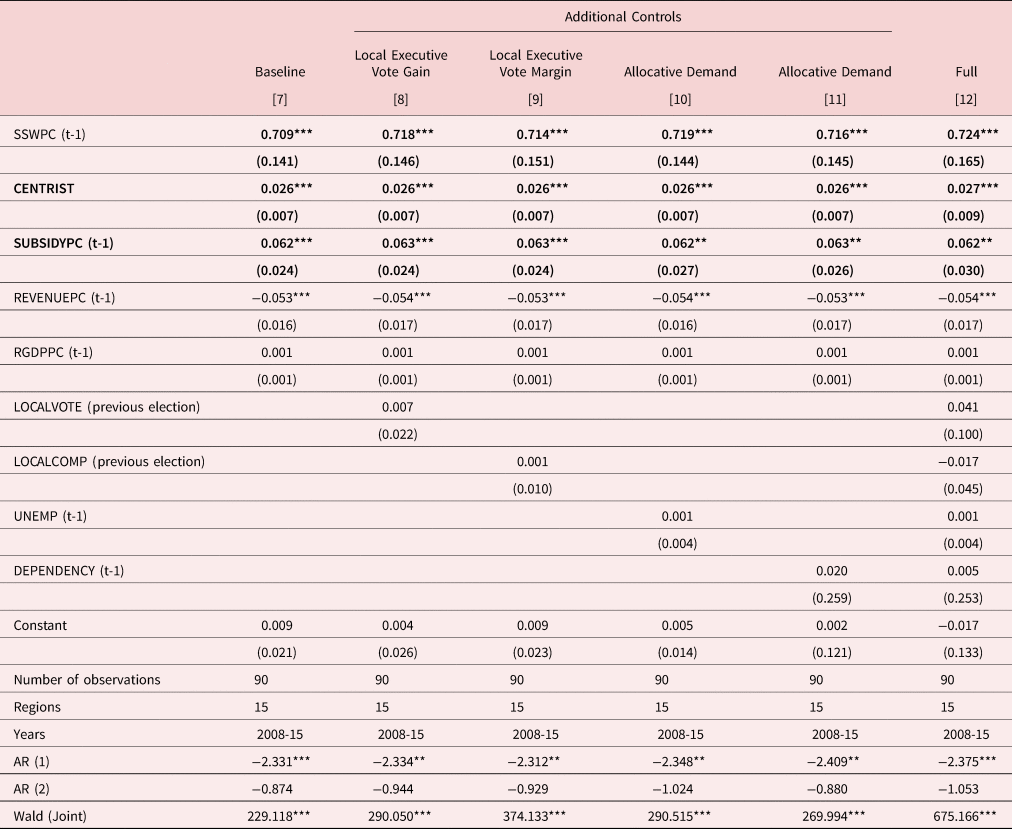
Table 2 reports the empirical results for SSWPC. Model [7] controls for the financial and economic conditions of regional governments: REVENUEPC and RGDPPC. Models [8]–[11] control for LOCALVOTE, LOCALCOMP, UNEMP, or DEPENDENCY. Model [12] includes all the control variables. In all models, lagged dependent variables have statistically significant coefficients, suggesting that SSWPC is path-dependent.
Results for Social Security and Welfare Spending

Notes: Dependent variable: Δ SSWPC (in million won); Dynamic GMM estimates are obtained from the “xtabond” command in Stata; Robust standard errors are reported inside parentheses; One-tailed significance tests at *** p ≤ 0.01, **p ≤ 0.05, *p ≤ 0.1.
The empirical results in the table strongly and consistently support our argument. First, centrist chief executives are strongly and positively associated with SSWPC (Hypothesis 3). According to the results in Model [12], when a centrist executive replaces a non-centrist chief executive in a region, SSWPC is expected to grow by an additional ₩27,393 ($23), which is nearly four times more than the average growth of SSWPC (₩7,227 or $6). In the long term, a region with a centrist chief executive is expected to increase SSWPC by ₩99,377 ($84), which is nearly 64 percent of the average level of SSWPC (₩154,780 or $131). Despite the financial constraint, political leaders in regional governments seem to govern based on their partisan programs and to target their major constituents through local government social expenditures.
Second, SUBSIDYPC is also positively and significantly associated with SSWPC (Hypothesis 2). According to the results in Model [12], if subsidy transfers to a region grow by an additional ₩164,498 ($139) per capita (one standard deviation), SSWPC is expected to grow spontaneously by ₩10,266 ($9), which is 142 percent of the average growth of SSWPC. When the level of subsidy transfers in a region increases by ₩570,724 ($484) per capita (one standard deviation), the estimated level of SSWPC as a long-run effect predicts an additional ₩129,219 ($109). The results suggest that the additional revenue resources provide regional governments with the fiscal room necessary to distribute more social benefits to their constituents. On the other hand, regional revenues are negatively and significantly associated with SSWPC, suggesting that a region with larger locally raised revenues actually expands its social welfare spending at a slower pace as compared to the others (see Appendix 3).
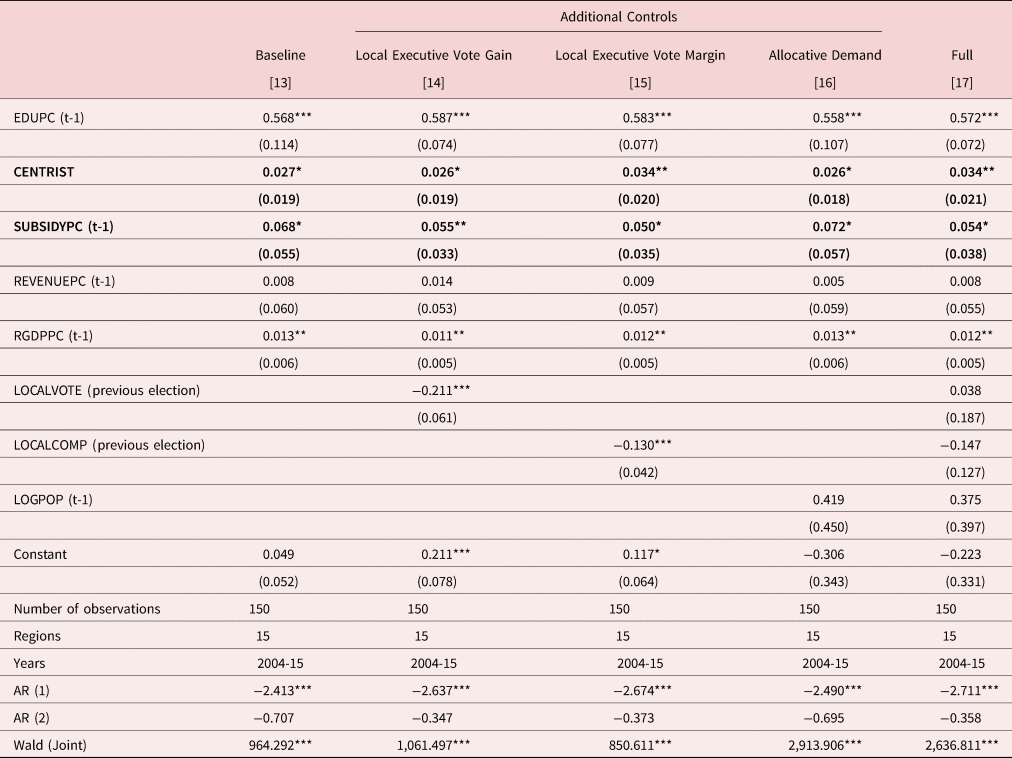
Table 3 reports the empirical results for regional education spending ([13]–[17]). As expected, EDUPC in a given year is significantly and positively associated with spending in the previous year. The empirical results also correspond to our theoretical expectations. The regional chief executive's partisan ideology is strongly associated with EDUPC (Hypothesis 3). According to the results in Model [17], if a governor or mayor changes from a non-centrist to a centrist, s/he is expected to increase EDUPC by ₩34,383 ($29), which is about 75 percent of the average growth of EDUPC (₩46,568 or $39). The long-term governance of a centrist chief executive in a region is expected to increase the level of EDUPC by ₩80,247 ($68). National subsidy transfers to a region are also significantly associated with greater education spending. According to the results in Model [17], if the central government increases SUBSIDYPC to a region by an additional ₩164,498 ($139) (one standard deviation), the regional government is expected to yield an additional growth in EDUPC of ₩8,806 ($7), which is 19 percent of the average growth of EDUPC. In the long term, if the level of subsidy transfers to a region incrementally expands by ₩570,724 ($484) per capita (one standard deviation), the level of EDUPC is expected to increase by ₩71,306 ($60). Conversely, regional economic development (RGDPPC) is consistently and negatively associated with education spending. The result suggests that economically affluent regions tend to allocate fewer resources to education than do those in poor regions (see Appendix 3).
Results for Education Spending

Notes: Dependent variable: Δ EDUPC (in million won); Dynamic GMM estimates are obtained from the “xtabond” command in Stata; Robust standard errors are reported inside parentheses; One-tailed significance tests at *** p ≤ 0.01, **p ≤ 0.05, *p ≤ 0.1.
The overall effects of partisan alignment and ideology can make substantive differences in regional SSW and education spending. For example, counting the population in 2015, if the governor of Gyeonggi Province is progressive and affiliated with the incumbent party, s/he would spend more on SSW and education than would the unaligned rightist counterpart by ₩2,518,956 million ($2,133 million), which would be almost 75 percent of the total expenditures in the province (₩3,367,713 million) (see Appendix 5 for calibration). The real data also reflect such regional disparity. As of 2015, the sum of regional SSWPC and EDUPC ranged from ₩1,081,328 ($916) in Gyeonggi Province to ₩2,035,692 ($1,725) in South Jeolla Province. Hypothetically, if the central government equally distributed them per population, any residents in Korea would have received the benefits of ₩1,281,574 ($1,086). The magnitudes of the regional difference would increase with the expansion of social welfare provisions.
Conclusion and Implications
The findings in this article strongly support our theoretical arguments but also provide important policy implications for decentralized distribution in Korea and other Asian countries that have partially decentralized. First, the partisan interests of the central government on subsidy transfers can increase tensions between the center and regional governments controlled by opposition parties. According to our findings, the central government in Korea run by Saenuri-dang or the New Frontier Party (NFP) transferred more subsidies to the southeast region (which predominantly supported the party) to secure its regional support in future elections. Similarly, the central government run by Saejeongchi minju yeonhap or the New Politics Alliance for Democracy (NPAD) transferred more subsidies to the southwest region. Transferring more subsidies to supporting regions can increase pork-barrel politics and consolidate regionalism. It can also destabilize the distribution of local social expenditures, which will fluctuate with changes in the central government and incumbent local governments.
Second, decentralized social spending can result in an unequal distribution of social services and benefits across and within regions. The strong impact of partisan policies on regional social expenditures could be understood as a more “democratic” and “efficient” policy response to the demands of local residents. However, when partisan motives dominate the process of decentralized distribution, the expansion of social expenditures can have a limited equalizing role, forsaking some local residents’ needs. That is, those with lower incomes in regions with politically conservative leaders would receive disproportionally less social security and welfare (SSW) and education benefits than would those in regions with more progressive political leaders. At the extreme, a leftist central government can generate even larger regional inequality over social benefits because leftist chief executives of regional governments would get more funds from the center and have stronger partisan initiatives for social policy expansion than would their politically unaligned rightist counterparts.
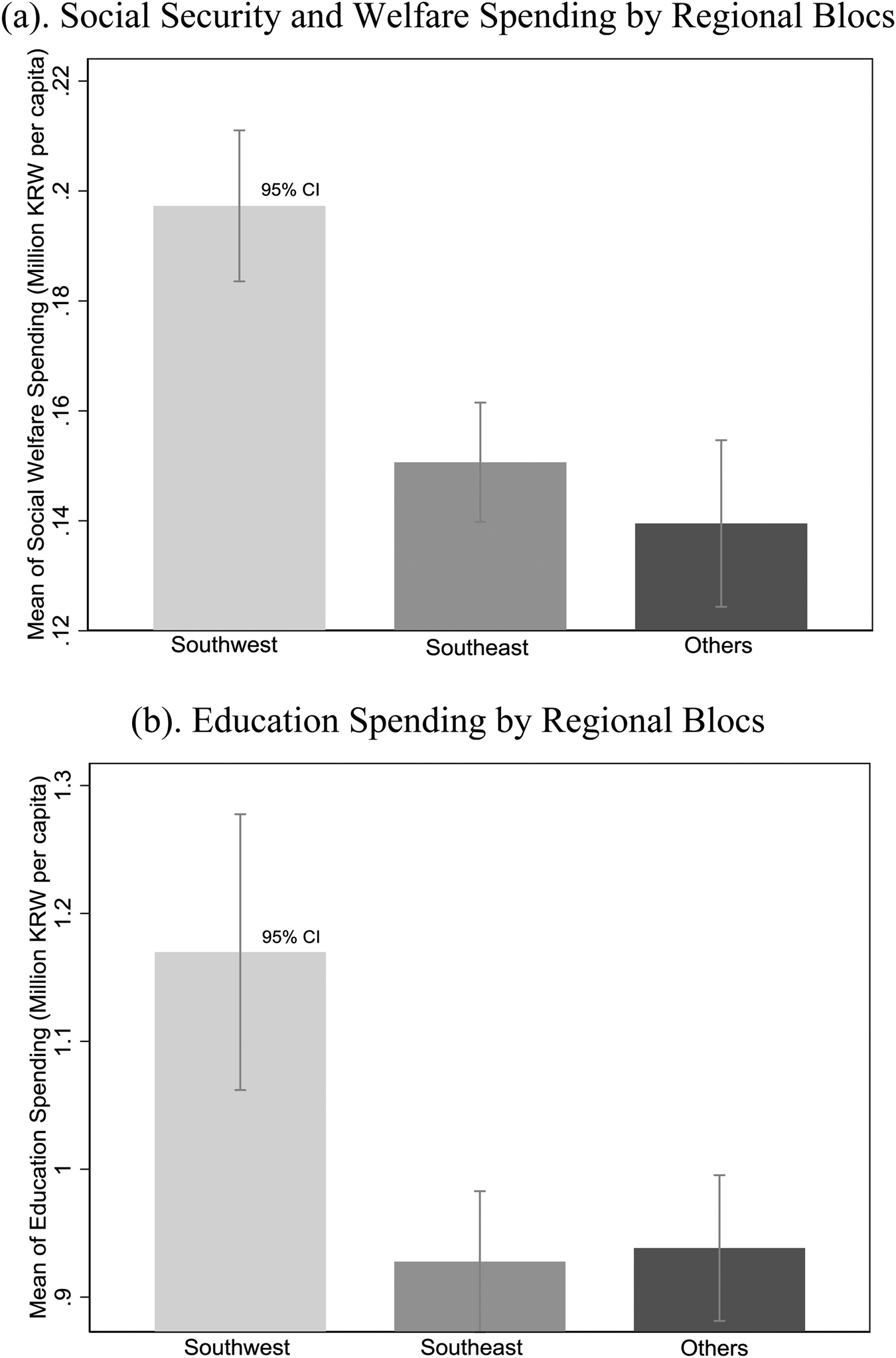
The strong partisan influences can further worsen regional conflicts if regional partisan support is strongly correlated with non-policy-driven regional cleavages. Figure 2 shows the average SSW and education expenditures per capita in southwest regions, southeast regions, and the rest of Korea. The figure reveals that southwest regions, whose regional governments are dominated by the centrist NPAD, in fact, have significantly high levels of SSW and education expenditures per capita as compared to southeast regions, which are governed mainly by the conservative NFP. If part of the motivation for decentralization is to reduce regional conflicts, it would be crucial to identify ways to formulate the central and local redistribution of fiscal resources that can moderate regional inequality. Thus, the process of decentralization, particularly for social welfare services and programs, should be carefully undertaken to constrain external political influences. When regionalism prevails, regional governments should be directed to focus more on effective administration to target local residents in most need, though regional governments’ ability to change important social services and benefits should be limited (e.g., through the use of required public hearings and voting).
Social Welfare and Education Per Capita Spending by Regional Blocs: Southeast, Southwest, and the Other Regions.

The findings of this article have important implications for decentralizing democracies in Asia and other developing countries. Many of them have similar features of decentralization as compared to Korea, where popularly elected local officials have some taxing and spending power, but local budgets and expenses are still under the direct and indirect discretion of the central authority (Gonschorek, Schulze, and Sjahrir Reference Gonschorek, Schulze and Sjahrir2018, Panao Reference Panao2020). Our findings suggest that the partial fiscal decentralization in Korea has politicized local revenues and expenditures, which has resulted in regionally unequal distribution of social spending. Likewise, when partisan interests prevail in regional politics, decentralized distribution can result in unintended political and economic consequences, especially under partial fiscal decentralization. Yet, transferring more of the fiscal authorities to local governments has also created several problems such as corruption and the abuse of public office (Alfada Reference Alfada2019; Fisman and Gatti Reference Fisman and Gatti2002). There are no definite recommendations about the decentralization model that fits each country. Therefore, the ideal features of decentralization should be carefully designed based on the institutional and socio-economic circumstances of a nation. Most decentralizing developing countries are still struggling to find ways to promote the responsiveness and efficiency of local governance while minimizing the abuse of power of national and local authorities. When partial fiscal decentralization exists, we underscore the notion that the political incentives of both the central and local governments should garner more theoretical and empirical attention.
Acknowledgement
This project is funded by Korea Inequality Research Lab and Korean Studies Promotion Service. The authors thank Cheol-sung Lee, Christopher Hwang, Jaejin Yang, Jonathan Rodden, Jongsung You, Lisa Piergallini, Youngtae Shin, and Young Jun Choi. The authors also thank Stephan Haggard and five anonymous reviewers for helpful comments on this and previous drafts.
Sources of support
Korean Studies Promotion Service (#: AKS-2018-LAB-1250002)
Conflicts of Interest
The authors declare none.
Supplementary Material
The supplementary material for this article can be found at https://doi.org/10.1017/jea.2021.33.
Eunyoung Ha is Research Fellow of the Institute for Welfare State Research at Yonsei University. Her research interests include globalization, political and economic inequality, social welfare policies, and political polarization. She mainly studies the public demands and policy constraints under the integrated world market. Her work has been published in the Journal of Politics, Comparative Political Studies, Political Research Quarterly, and World Development.
Dong Wook Lee is Assistant Professor of Political Science at Adelphi University. His research interests include partisan politics, redistributive government spending, regionalism, and the political geography of inequality. His work has been published in the Journal of Politics, Political Analysis, and International Interactions, among others.