On March 19, 1973, at 9:00 a.m. on New York City’s WNBC-TV, Governor Nelson Rockefeller and Reverend Oberia D. Dempsey appeared on Barbara Walter’s fledgling talk show, “Not for Women Only.” Rockefeller and the Harlem pastor defended the governor’s harsh new drug-control legislation and debated its opponents.Footnote 1 After the episode aired, Rockefeller and Dempsey took the show on the road, decrying the social consequences of drug addiction and promoting very punitive solutions. Eventually, the legislature passed and the governor signed the drug laws into law.Footnote 2 Over thirty years later, the New York State legislature drastically reformed the measures, repealing their most draconian components.Footnote 3 But the damage had been done.
The drug laws facilitated the mass imprisonment of people of color in New York State. In 1970, 8.6 percent of the state’s prison population was incarcerated for drug law violations. By 2000, that number had risen to 31.2 percent. Clear racial disparities exist: Latinos are twenty-six times more likely than whites to go to prison for a drug-related crime and African Americans are thirty-four times more likely. From 1930 until 2000, the white proportion of the state’s prison population declined by 3.7 percent, while the African American proportion increased by 260 percent.Footnote 4 Nonetheless, the explanations for mass incarceration in New York State and throughout the United States reference only parts of this story. “Not for Women Only” disappeared from television, but Barbara Walters became an icon. The fate of prisoners and ex-prisoners captured the attention of legal scholars, social scientists, historians, and activists.Footnote 5 Rockefeller and his Republican contemporaries assumed a notorious position within the historiography of mass incarceration. Dempsey, however, was forgotten. And he is not alone.
The dominant history of mass incarceration, because of its inordinate focus on white racism, obscures the role that African Americans like Reverend Dempsey played in the expansion of the modern carceral state. Michelle Alexander, for example, likens mass incarceration to Jim Crow and situates the contemporary criminal justice system within a teleological history of the American racial order.Footnote 6 According to her, the carceral state signifies a racial project determined to resist civil rights and restore the old racial order. Despite powerfully delineating the ways in which the modern prison system perpetuates racial inequality, the new Jim Crow thesis does not offer a comprehensive political theory of its origins. It does not consider black agency.
Marie Gottschalk offers a useful corrective. First, she criticizes the narrow temporal scope of most “‘law and order’ scholarship” and suggests that tracing penal policies over time (before and after the 1960s) would yield greater insight into what changed in the politics of crime to spur mass imprisonment.Footnote 7 Second, Gottschalk’s second innovation is her focus on social movements. Specifically, she examines how the mobilization of victims’ rights groups, the social construction of “criminals” and “victims,” and evolving governmental capacities accelerated the astonishing growth of the carceral state after the 1960s.Footnote 8 Despite these virtues, Gottschalk ignores black victims’ groups: a glaring omission since African Americans are both more likely to be imprisoned than whites and more likely to be victims of violent crime.Footnote 9
Given their experiences, it is possible that black victims organized an anticrime social movement. In fact, the mid-twentieth-century economic, social, and political transformation of black communities made such a movement a serious potentiality. Urban deindustrialization and the suburbanization of work produced a “black underclass.” The expansion of equal rights improved the life chances of working- and middle-class African Americans and empowered them.Footnote 10 Lingering residential segregation placed the black poor and working- and middle-class African Americans in conflict.Footnote 11 Urban decline concentrated and exacerbated social problems and cultivated new “criminals.” It created new “victims”: working- and middle-class blacks.Footnote 12 Accordingly, it is quite plausible that these new “victims” employed their newly found political power to police the urban black poor—and assisted the construction of the modern carceral state in the process.
Of course, this would not be an entirely new story.Footnote 13 The migration of black southerners to northern cities during the early twentieth century evoked similar responses from the urban black middle class.Footnote 14 Evelyn Brooks Higginbotham’s conceptualization of the “politics of responsibility” supplies a theoretical foundation for these regulatory processes. “The politics of respectability,” she maintains, “emphasized reform of individual behavior and attitudes both as a goal in itself and as a strategy for reform of the entire structural system of American race relations.”Footnote 15 In her study of the women’s movement in the black Baptist church, Higginbotham demonstrates how white supremacy, class status, and Victorian morality shaped their activism: “The Baptist women spoke as if ever-cognizant of the gaze of white America, which in panoptic fashion focused perpetually upon each and every black person and recorded his or her transgressions in an overall accounting of black inferiority.” Because of this racialized environment, “there could be no laxity as far as sexual conduct, cleanliness, temperance, hard work, and politeness were concerned. There could be no transgression of society’s norms. From the public spaces of trains and streets to the private spaces of their individual homes, the behavior of blacks was perceived as ever visible to the white gaze.”Footnote 16 In this context, class and racial politics were inextricably tethered. Middle-class African Americans drew upon traditional, class-based norms to regulate the lives of the urban black poor and advance a broader political agenda to improve their own racial and economic position.
Its explanatory grasp of turn-of-the-century black politics notwithstanding, this formulation of the “politics of respectability” might be too static and, as a result, might be incapable of explaining the content of middle-class African American political claims in different historical and socioeconomic contexts. While race and class always matter, how they specifically shape the life chances of African Americans and how they operate within black political discourse might vary over time and across space.Footnote 17 Social shifts might disentangle middle-class black regulation of the urban black poor from a broader political project aimed at reforming American race relations. African American middle-class attempts to police the lives of the urban black poor might not respond to the “white gaze.” Instead, such actions might be rooted in an ideological commitment to traditional values and bourgeois norms. They might originate in perceived material threats.
My central argument is that the “politics of respectability” evolves. Specifically, I claim that civil rights victories and persistent racial and economic inequality created a systematically different context for urban middle-class black politics in the postwar era. These social and political shifts created fertile grounds for black penal populism: a grassroots political movement that “speaks to the way in which criminals and prisoners are thought to have been [favored] at the expense of crime victims in particular and the law-abiding public in general.” Penal populism emphasizes the protection of the “well-being and security of law-abiding ‘ordinary people’” and the punishment “of those whose crimes jeopardize this.”Footnote 18 As middle-class African Americans witnessed major social and political achievements, the “politics of respectability” increasingly lost its fear of the “white gaze.” As middle-class African Americans experienced greater insecurity, they, instead of blaming the structural economic and racial origins of urban decline, drew upon their class-based values—“the politics of respectability”—to define offenders as threats to “law-abiding” “citizens.” Furthermore, they mobilized indigenous civic resources to support policies that policed the urban black poor—not to reform the American racial order but to ensure public safety and guard their own material, class-based interests.
In order to adjudicate between these contending theories, this article studies the Reverend Oberia D. Dempsey. Paul Pierson, like Gottschalk, reminds us that taking “snapshots” of major policy events can cause analysts to miss “prior and later events and processes,” particularly structural forces, “at considerable cost.”Footnote 19 He writes: “In many contexts, however, a long, slow erosion of the status quo may be a crucial factor in generating policy change. What may seem like a relatively rapid process of reform is in fact only the final stage of a process that has in fact been under way for an extended period.”Footnote 20 Other studies have provided penetrating “snapshots” of drug policy development in New York State, identifying the role ideas, institutions, and elite interests played in the enactment of specific laws or offering general depictions of the cultural context of those legislative moments.Footnote 21 Yet these analyses frequently miss a crucial piece of this policy history: the long, slow emergence of black penal populism. By writing Dempsey’s biography, I am able to fill an important gap. I am able to adopt a long time frame and assess what changed in African American life in the 1950s and 1960s to precipitate black penal populism and reshape the context of crime policy development.
At first glance, Dempsey might seem like an unlikely anchor for this policy history. You will not find Oberia D. Dempsey mentioned in major studies of black politics in New York City. He receives only passing mention in the biography of J. Raymond Jones, Harlem’s political godfather.Footnote 22 Dempsey’s name does not even appear in any of the three major biographies of Adam Clayton Powell Jr., who Dempsey served so dutifully for several years and whose church, Harlem’s famous Abyssinian Baptist Church, launched Dempsey’s career.Footnote 23 Additionally, there are very few materials on Dempsey in the archives of the Abyssinian Baptist Church.Footnote 24 The most sustained discussion of him and his civic work appears in Charles V. Hamilton’s The Black Preacher in America.Footnote 25 Even then, his profile is relatively cursory and does not sufficiently situate his work within the broader politics of the time. Nonetheless, as I studied drug policy development in New York State during the 1960s and the 1970s, Reverend Dempsey continued to appear in newspaper reports and government documents, and it eventually became apparent that this history was missing a crucial voice—a voice that was heard loudly at the time but silenced in recent narratives.
To return voice to Dempsey and the people of Harlem and trace the modulating tenor of their anticrime pleas, I have reviewed a multiplicity of sources. I started studying Dempsey by following his coverage in African American newspapers, particularly the Amsterdam News, and magazines, specifically Ebony and Jet, from the 1940s until his death. I also consulted the papers of the local branch of the National Association for the Advancement of Colored People (NAACP) for mentions of Dempsey and for discussions of crime issues in general. The goal was not only to document his activism over time but also to view it within the context of the black community he served. This strategy had another purpose. In my study of drug policy, I found that mainstream newspapers, such as the New York Times and the Washington Post, and the secondary literature frequently looked to national civil rights leaders or black militants for the “black perspective” on urban problems. At the very least, they gave short shrift to the views and activism of “ordinary people.” So, if a penal populist movement emerged in Harlem during the 1960s and 1970s, I would only find it by reviewing the rags that knew the community best and studying the organizations that served it most. Next, I shifted my focus to potential targets of black penal populism: legislative bodies and white politicians. I perused the transcripts of federal and state hearings and the archives of white officials to isolate the claims Dempsey and working- and middle-class African Americans made on government and the rationales underpinning those positions. Finally, I reviewed available surveys of African Americans in Harlem and in cities throughout the nation to ascertain the breadth and depth of black penal populism. In the end, this mélange of materials reveals that Dempsey was neither a small-time pastor of a random storefront church nor a puppet of Nelson Rockefeller. Instead, these sources indicate that Reverend Oberia D. Dempsey was a central figure in postwar black politics in New York City and a pivotal leader in an understudied yet consequential class-based, grassroots, anticrime social movement.
From Birth to Civil Rights
The third of Sidney Dempsey, a Baptist minister, and Lizzie Dempsey’s seven children, Oberia David Dempsey, was born on May 11, 1915 in Paris, Texas. At the age of twelve, Sidney Dempsey demanded that his son quit school and work full-time on the farm. When the twelve-year-old refused, his father beat him badly. Determined to escape agricultural work, the younger Dempsey ran away in the middle of the night. He eventually settled in Muskogee, Oklahoma, but life in Muskogee was not easy. From the age of twelve until eighteen, he lived by himself in a boxcar next to a creek in the black part of town. Dempsey attended school, as he wished, but African Americans in Muskogee shunned him because he was poor. His classmates nicknamed him “raggedy boy.”Footnote 26
Dempsey finished high school at the segregated Manual Training School in Muskogee. Then, in 1940, he enlisted in the Army, spending the next several years in Europe as a technical sergeant in a field artillery unit.Footnote 27 After an honorable discharge, he and his family moved to Bedford-Stuyvesant in Brooklyn. Like many African Americans during the “Second Great Migration,”Footnote 28 Dempsey longed for a life beyond the fields of the rural South and invested in the promise of the North. In fact, he picked New York because he heard some sailors say that “the streets of New York are paved with gold.”Footnote 29 In the city, he worked in a mattress and spring factory and, for seven years, took night classes at Brooklyn College, where he eventually earned a degree in political science and business administration.Footnote 30 As he described it, “I went to Brooklyn College for a number of years and started my education. It was interrupted, but I continued to study whenever I had the chance.”Footnote 31
Similar to many black veterans of World War II, Dempsey spent his time providing for his family and volunteering in the church, the community, and in the broader struggle for equal rights.Footnote 32 Eventually he was called to the ministry and combined his civic mindedness with his religious zeal. In 1953, Dempsey joined Mt. Lebanon Baptist Church, one of Brooklyn’s largest congregations, as assistant pastor. At the church, he worked under Reverend Dr. C. L. Franklin, an influential local black pastor who, as chairman of the National Baptist Convention’s Social Action Commission, was well integrated within a national network of black leaders and deeply involved in the national civil rights movement.Footnote 33 Dempsey also became an active member of the NAACP. In 1952, he led the Brooklyn branch’s membership campaign and set a new membership record.Footnote 34 Because of his youth ministry and his work for the NAACP, he was ranked fifth in the Amsterdam News’s “10 Leading Brooklynites” in 1952.Footnote 35
Dempsey once described himself as an “outside preacher.” He said: “Rather than the old line of spiritual minister who does nothing but preach and conduct prayer meetings, and who stays inside, I’m an outside preacher. My work is social action.”Footnote 36 Dempsey, like Progressive do-gooders in the late nineteenth and early twentieth centuries, ventured outside his church in search of vice and in defense of virtue.Footnote 37 In 1954, he along with multiple groups, including the Adventurers Motion Picture Club of Brooklyn, various Sunday school groups, and Parents Teachers Associations, initiated a campaign against juvenile delinquency.Footnote 38 They held a “mass meeting” at Bethany Baptist Church to discuss the issue and went door to door handing out circulars. The purpose of this drive was to “stress the importance of [returning] to the old home training, for if youths are not disciplined in the home they will rebel against discipline on the outside of the home.”Footnote 39
In late 1955, Dempsey received a significant promotion of sorts. He joined the ministerial staff of Harlem’s historic Abyssinian Baptist Church, helmed by the legendary and mercurial Adam Clayton Powell Jr.Footnote 40 Not only was the “Mighty Abyssinian” one of the largest Protestant congregations in the nation by the 1940s and the religious home for the city’s black Brahmins, but it was also an organizational center for civil rights activism in New York and an important node in the national civil rights network. As pastor of the Abyssinian Baptist Church, Powell aggressively deployed these assets in pursuit of racial equality and his own personal goals, including becoming New York State’s first African American member of Congress.Footnote 41 Dempsey assisted Powell. He frequently served as a substitute for the enigmatic Powell at social and civic events and worked on the representative’s political campaigns.Footnote 42
In 1957, Dempsey received another promotion. Powell appointed him director of the religious education department of the church. After receiving the new post, Dempsey announced a three-point program for the church’s community center: “(1) An all out drive against juvenile delinquency in the community; (2) To make young people aware of their civic and personal responsibilities; (3) To launch a [fund-raising] campaign to raise $10,000 for the Adam Clayton Powell, Sr. Center in order to provide additional facilities and services for the youngsters of the community.”Footnote 43 The community center serviced around three hundred youth and offered a variety of activities, including “basketball, calisthenics, volley ball, ping pong, [nok-hockey], weightlifting, boxing, wrestling, billiards, arts and crafts, sewing, charm and dance classes, debating, [drama], newspaper, music, scouting, socials, coed counseling (job opportunities), and a movie-TV school.”Footnote 44
To be clear, Dempsey was not at the forefront of black efforts to eliminate juvenile delinquency. Starting in the Great Depression, many black civic organizations spent a great deal of resources and effort tackling the issue. In 1942, the Subcommittee on Crime and Delinquency of the interracial City-Wide Citizens’ Committee on Harlem, co-chaired by Powell and Algernon D. Black, released a report on the community’s growing delinquency problem.Footnote 45 While drawing attention to the character flaws of young criminals and calling for the cooperation of “self-respecting and law abiding” citizens,Footnote 46 the report also emphasized the racial roots of youth crime. The introduction read: “A Negro boy may become a burglar because his mother is working every afternoon and evening and must leave him neglected; and the mother may be compelled to work because some white employers discriminate against the boy’s father by refusing to employ Negroes.” It added: “The slum, a broken family, the great increase of migration from certain sections of the South, insufficient educational opportunities, and the lack of vocational training—all these and a hundred other factors may aid in the creation of a Negro criminal.”Footnote 47 Indicative of the force of the “white gaze,” the report also took great pains to note that juvenile delinquency was not unique to the African American community. It stressed: “The same factors which create criminals among white people operate with more deadly effect among Negro people because the poverty, crowding and [underprivilege] of the Negro community are more pronounced.”Footnote 48
Harlem was not alone. African American communities across the United States witnessed a dramatic increase in black juvenile delinquency, and the “politics of respectability” defined their response. In 1942, the Cooperating Council of Agencies Serving Negro Youth of Philadelphia published “What Makes Johnny Bad?”Footnote 49 The pamphlet’s conclusion asked, “What can we do about it?” The answer: “More and better jobs must be provided for Negroes, readjustment of the Negro in the school system must be made, extension of health and recreational facilities for Negroes must be brought about.”Footnote 50 Then it underscored the broader racial origins of youth crime: “These things can hardly be accomplished, however, until the city as a whole comes to see the problem of juvenile delinquency among Negroes as only one aspect of a much larger problem—the problem of the total relationship of the Negro group to the white.” Situating black juvenile delinquency within the broader “race problem,” the pamphlet continued: “It is difficult to see how there will be any real solution to the situation so long as the Negro is regarded by the great mass of white people as something foreign, different, separate, strange, inferior. . . . Policies of separation and segregation, no matter how subtly practiced or brilliantly rationalized, can never provide solutions to the problem.”Footnote 51
By the time Dempsey decided to attack juvenile delinquency, many African American activists had begun to perceive this problem differently. Signs of racial progress prompted black reformers to minimize structural causes. In 1955, during his testimony at a hearing on narcotics trafficking and addiction, Powell emphasized individual behavior rather than racial inequality. When one congressman asked the Harlem Representative to explain rising addiction among young African Americans, Powell replied, “I don’t know, I will tell you frankly, because sociologists say it is due to the slums; it is due to that, but Negro people in New York City are much better off now than they were when I first started going to Congress, for instance.” He highlighted black progress: “We have broken through nearly every roadblock; we are working everywhere; we are making equal wages. There are more slum-clearance projects built, being built, and money appropriated to be built, in my congressional district than any other congressional district in the United States of America.”Footnote 52 The usually boastful Powell did not exaggerate. “Black New Yorkers,” Martha Biondi observes, “changed the social, political, and cultural landscape of New York City.”Footnote 53 She elaborates: “They fought for better jobs, moved into new neighborhoods, formed their own banks, demanded equal social services and political representation, protested police abuse, and paved the way for their children to attend college.”Footnote 54 These achievements spawned hope while youth crime bred consternation and umbrage.
The racial optimism and traditional morality expressed in Powell’s testimony permeated Dempsey’s antidelinquency campaigns. In 1958, he planned a youth crusade for Christ. Because “far too many” were “going astray,” the program pursued the following objectives: “(1) The young people will mobilize one hundred and fifty voices to sing in a youth choir each evening, including various churches of the city; (2) An immediate door to door canvas of the Harlem community will be launched in a few days in an effort to invite all young people and adults to attend the crusade; (3) Young people and adults of all faiths, races, and creeds will be invited to attend, plus civic, social, and political leaders. An invitation to accept Christ will be extended each evening also.”Footnote 55 Toward the end of 1959, the reverend participated in a panel discussion on violence and crime in Harlem. The question: “Should church activity include crusades to eliminate ugly conduct and crime?” The entire panel agreed that the church needed to tackle these challenges. One panelist, Fred Samuel, a lawyer and civic leader, vehemently insisted that the church should confront this “evil” and that “a never-ending crusade against hoodlumism and profanity should be started immediately.”Footnote 56 Continuing with this theme, Dempsey later moderated a panel discussion at Macedonia Baptist Church, “The Breakdown of Family Life in Our Society.”Footnote 57
Dempsey was not alone. Across the country, the coincidence of urban decline and black progress transfigured the “politics of respectability.” In 1961, the Chicago Defender published “Here’s How Delinquency Can be Curbed.” The article updated ideas found in “What Makes Johnny Bad?” In truth, “Here’s How Delinquency Can be Curbed” contradicted previous arguments. The piece stated: “Children not only reflect the morality, but the entire character of their parents. A home in which adults have a healthy and outspoken respect for the law is rarely a home in which juvenile offenders live.” It noted: “Traditionally, crowded slum neighborhoods of large cities produce three times as many youthful offenders as do other areas. However, it isn’t poverty which causes delinquency. Many fine people come from impoverished homes.”Footnote 58 Unlike previous African American assessments of youth crime, this one highlighted respectability and minimized poverty and race. By the beginning of the 1960s, racial progress had forced many working- and middle-class African Americans to reassess the structural origins of antisocial behavior. Their improving fortunes, the mounting threat of youth crime, and traditional morality inspired a new argument: one that impugned the character of the urban black poor.
In 1961, Dempsey left the mighty Abyssinian to open his own church, the Upper Park Avenue Baptist Church.Footnote 59 He departed the church as one of Harlem’s leading civic leaders. In 1959, the reverend was even elected “Mayor of Harlem,” receiving 24,702 out of the 71,202 ballots cast. These were stunning achievements for a man who fled Paris, Texas, alone at twelve and lived in a boxcar for years in Muskogee, Oklahoma. This World War II veteran witnessed and was part of seminal events in postwar African American history: the “Second Great Migration,” urban decline, and the black rights movement. More than anything, he led and was part of a broader transformation in postwar African American politics. Dempsey’s early civic and political activities signified the comingling of two strands of black politics: the “politics of respectability” and the politics of race. Dempsey’s early activism indicates that the politics of race can certainly operate without the “politics of respectability”—without “Biblical teachings, the philosophy of racial self-help, Victorian ideology, and the democratic principles of the Constitution of the United States.”Footnote 60 And his civic efforts suggest that the “politics of respectability” can exist independently of the politics of race—without a critique of “the entire system of American race relations” or without concern for the “panoptic” design of white supremacy.
Dempsey’s political and civic work during the 1950s evinced a progressive, reformist sensibility disconnected, at times, from racial solidarity. Embracing the philosophy of self-help, Dempsey believed that civic engagement and strong black religious, civic, and political institutions were not only good in and of themselves but also were good for the community—understood in racial terms. Over time, his activism on behalf of Harlem’s poor began to betray a strong do-gooder spirit and a good-government progressivism lacking racial moorings. Unlike “What Makes Johnny Bad?” and other early attempts by African American civic leaders to confront juvenile delinquency, the Harlem pastor’s youth work and his campaigns against juvenile delinquency, crime, and drug addiction increasingly suggested a “politics of respectability” completely divorced from the politics of race, as they were guided by a belief that certain behaviors were morally right or wrong in and of themselves—not for their consequences for “the entire structural system of American race relations.” Dempsey’s next major crusade would again appropriate the “politics of respectability” but abjure racial thinking and allegiances.
From Civil Rights to Black Penal Populism
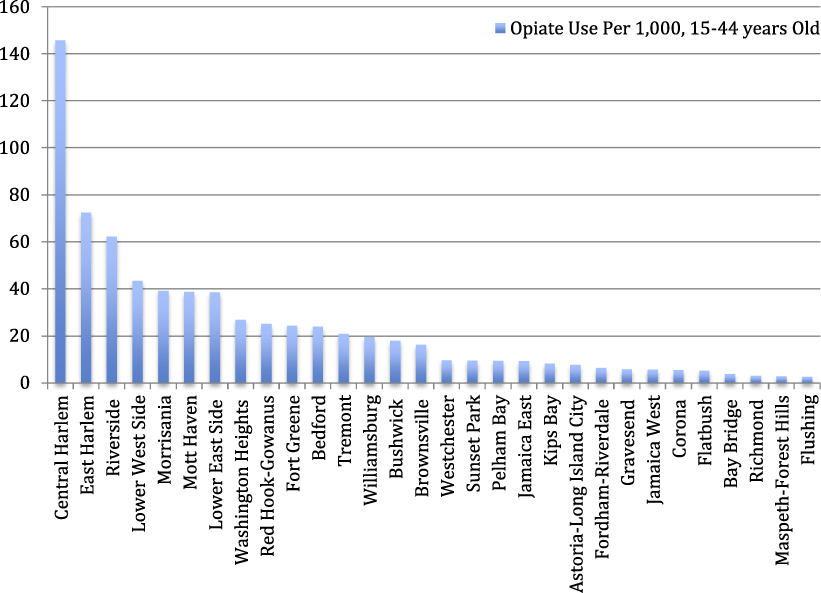
Racial and economic forces eventually sapped Harlem of its optimism. Economic dislocation and racial segregation compounded the struggling community’s social problems. They created a “dark ghetto.”Footnote 61 Harlem’s juvenile delinquency rate was more than double the rate in the city. Not only did it hover well above the city average from 1953 to 1962, but it also climbed dramatically over that period. Moreover, juvenile delinquency was not spread evenly across the community. All of Harlem’s individual health areas witnessed, during the early 1960s, extremely high rates of juvenile delinquency—double or nearly double the city average. Additionally, the number of drug users in Central Harlem spiked in 1959. By 1961, the number of drug users in Central Harlem was almost eight times the city average. While Central Harlem’s share of the city’s total number of habitual users fell to around 23 percent, it still remained extremely high for one neighborhood.Footnote 62 As Figure 1 depicts, these trends had not changed by the end of the 1960s. Offering a neighborhood-level view of opiate addiction in New York City in 1969, Figure 1 confirms the concentration of drug addiction within minority neighborhoods. It underscores the tragic uniqueness of Harlem’s narcotics problem.
Opiate use per 1,000, 15–44 years old.
Source: Mary Koval, Opiate Use in New York City (New York, 1969), 19.

These shifts reoriented the activities of Reverend Dempsey and reshaped the political claims of working- and middle-class African Americans. As drug addiction and related crimes increased, Dempsey and other working- and middle-class Harlem residents and activists began to view addicts as threats to their life chances and lifestyles. Unlike his activism during the 1950s, this Harlem pastor did not mobilize to protect delinquents from themselves. He and others did not view individual reform as just good itself. Instead, he picketed and preached to protect the “citizens” of Harlem from vagrants and the violent. “I declare,” Dempsey proclaimed in 1970, “a citizens war on drugs.” He added, “We will take the battle to the streets. We will employ any shock action necessary to draw attention to this city’s desperate drug problem.”Footnote 63 The signs draping Dempsey’s Upper Park Avenue Black Church bluntly depicted the shift from civil rights to penal populism: “We are going to return Harlem back into the hands of Decent People. dope addicts are violating the civil rights of blacks and whites. this must be stopped now!”
After securing important local civil rights advances during the 1940s and 1950s, the next rights movement in Harlem would not seek to protect blacks against discrimination but guard “decent people” from the urban black poor. Furthermore, “citizenship” became the new discursive frame for the “politics of respectability” and a key rhetorical device for Harlem’s penal populist movement. A letter to the Amsterdam News praising Dempsey elucidates the conceptual contours of this new discursive paradigm. The author noted that Dempsey “sacrifices his time” to protect “citizens” from “criminals” and “dope addicts.”Footnote 64 “Citizenship,” then, separated the responsible from the irresponsible, the victims from the culprits, the dignity of working- and middle-class African Americans from the turpitudes of the irredeemable urban black poor.
Applying skills and resources he developed over the years, Dempsey mobilized aggressively against Harlem’s drug problem. Dempsey held conferences and press conferences.Footnote 65 He led petition drives, and presented these petitions, frequently signed by thousands, to public officials at all levels of government.Footnote 66 In the fall of 1962, Dempsey led a seven-week, “anti-dope drive.” Toward the end of the drive, thirty civic leaders signed a four-point plan: “1. Urge President Kennedy to push Congress to provide funds for the construction of a hospital in the New York area to treat, cure, and rehabilitate addicts. 2. Also urge the President to mobilize all law-enforcement agencies to unleash their collective fangs on dope pushers and smugglers. 3. Urge Gov. Rockefeller to also push a similar crack down. 4. [Urge] Mayor Wagner and Police Commissioner Michael Murphy to turn loose the city’s police, including the transit and housing lawmen, on criminals and narcotics dealers.”Footnote 67 He issued reports.Footnote 68 He wrote letters to editors, and, in 1968, he occasionally authored a column in the Amsterdam News under the tag line, “Dope Battle ‘Lost;’ The War Is Still On.” One piece ended by imploring readers to “join the war on dope now.”Footnote 69
Dempsey planned multiple campaigns to involve the community, publicize Harlem’s drug problem, and lobby public officials.Footnote 70 At one event in 1962, members of a variety of block associations, church groups, and fraternal organizations along with 250 Children marched for two hours and held a rally to protest Harlem’s crime problems. Accompanied by two drum-and-bugle corps, the marchers carried banners and placards that read, “Children, Narcotics Mean Death”; “Why Should Harlem Be Destroyed By Narcotics Peddlers?”; and “Narcotics: Parents, Warn Your Children.”Footnote 71 Women from citizen groups handed out literature to bystanders as Dempsey warned a crowd of two hundred that “narcotics gangsters would like to make inroads on the one million youngsters who will soon be out of school” and urged them to cooperate with law enforcement. In 1963, he organized a series of “street-corner-meetings” at Lenox Avenue and 144th Street, one of many “cesspools in Harlem for narcotics trafficking and crime in general.”Footnote 72 At another corner, the reverend and several hundred people picketed for two hours.Footnote 73 In 1963, Dempsey also escorted high-ranking police officials and reporters to eight apartment buildings believed to have been the site of drug trafficking.Footnote 74
And Dempsey was not alone. Harlem’s worsening drug problem spurred others into action. In 1962, local Democratic leader Mark Southall circulated a petition addressed to the governor and the legislature. The petition began by stating that residents had been “surrounded by the disastrous toll and effects of drug addiction, as well as the free and easy use of dope and narcotics” and were “desirous of eliminating and eradicating the use of dope and narcotics and the illegal traffic of drugs in our City, and the elimination of all the undesirable effects accompanying the same.” The document also displayed Harlem’s burgeoning penal populist impulses. The signatories resolved that “the State laws against the illegal sale and distribution of dope, drugs and narcotics be effectively tightened and the punishment for violation thereof be made more stringent and severe.” Interestingly, this petition like Dempsey’s early ones did not attribute Harlem’s drug problem to the broader racial and economic forces that turned Harlem into a “dark ghetto.” It did not ask the governor and the legislature for civil rights legislation or economic programs. Also like Dempsey’s early petitions, this one expressed some compassion for drug addicts. Signatories resolved that “free clinics be set up within the State for the alleviation and care of those unfortunate persons who have acquired the terrible habit [of] addiction [to] dope and narcotics.”Footnote 75
This empathy, however, did not last. Those “unfortunate persons,” instead of racism and poverty, soon became a threat and an object of resentment. In 1965, Dempsey stated: “Problem number one in this city is crime and narcotics addiction.”Footnote 76 Addicts were the eye of the storm: “The most sordid crimes including all forms of robbery and even murder are being committed by addicts in all sections of New York City in their quest for funds for fixes.”Footnote 77 Although he did not oppose the “demonstrations of the Negro civil rights leaders,” the reverend insisted that solving the “narcotics problem would go a long way in solving our social and economic problems as an ethnic group.”Footnote 78 In 1969, he wrote, “Unfortunately, with all of the good and meaningful intentions of welfare in our city, eighty five per cent of the youthful addicts being registered at our center for treatment, or rehabilitation, comes from families who are receiving welfare assistance from the City.” He continued, “Thousands of welfare checks are stolen by addicts every month, and thousands of addicts on welfare, are using their welfare checks to purchase dope.”Footnote 79 In 1969, Dempsey filed a petition with U.S. Attorney Robert M. Morgenthau. The petition begged the Justice Department to intervene. It read: “We demand freedom to come and go without fear of being assaulted, mugged, brutalized by the drug crazed dope addicts.”Footnote 80
Many working- and middle-class African Americans, like Dempsey, blamed community problems on individual behaviors and attitudes rather than on a deficit of rights or a scarcity of social programs. In 1970, Roy Wilkins, executive director of the NAACP, wrote, “The top problem in Harlem and in other parts of New York City is not housing. It is not discrimination in employment or public education. Nor is it hospital care or crime or the relations with the police. It is the traffic and the toll in narcotics.” He explained, “The individuals and groups in the ghetto who are screaming for black control in black areas can test their sincerity on the drug problem. They do not need new ordinances or laws. They do not need a grant from a foundation or a hand-out from the public treasury. They need to declare an action war (not a word war) on the drug pushers in their neighborhoods and especially those around their schools.”Footnote 81 Truth be told, Wilkins’s position on black-on-black crime varied over time. At some moments, he cited individual responsibility. At others, he referenced structural problems. Sometimes his “politics of respectability” bespoke a fear of the “white gaze.” Sometimes they indicated resentment toward the urban black poor.
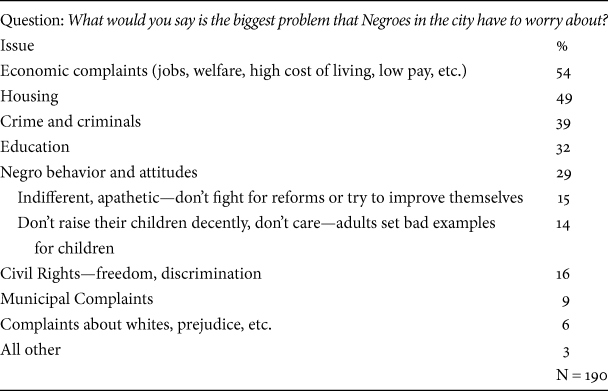
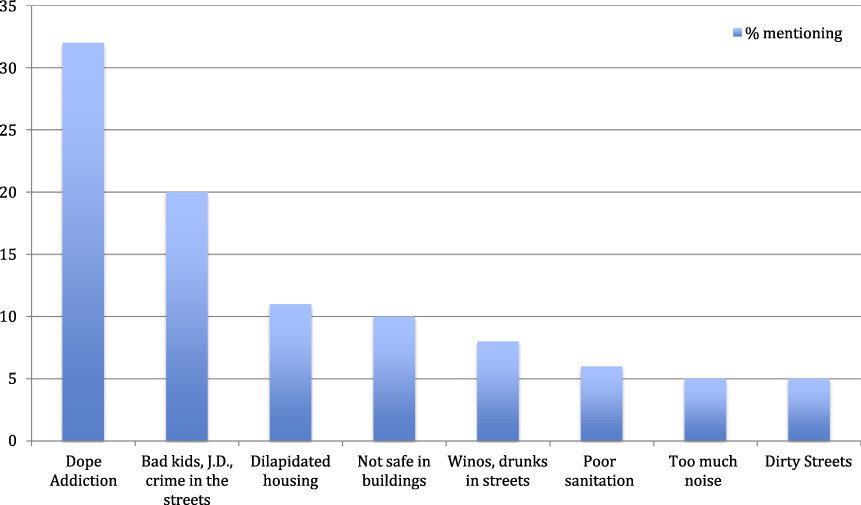
Nonetheless, Wilkins’s statement in 1970 captured the dominant sentiment in Harlem. Black attitudes reflected these new social realities and grievances. In a 1964 New York Times poll of blacks in the city, 39 percent of respondents listed crime and criminals as their top concern, while only 16 percent listed civil rights and 6 percent listed white prejudice (see Table 1).Footnote 82 Moreover, a sizable proportion listed “Negro behavior and attitudes,” including the view that blacks are not trying to improve themselves and raising their children “decently.” A Kraft poll of Harlem residents conducted in 1966 yielded similar results.Footnote 83 African Americans listed “dope addiction” and “bad kids” as the biggest problems facing their block (see Figure 2). The other major problems also reflected safety and quality-of-life concerns: building security, “winos,” noise, and dirty streets. A sixty-six-year-old black woman in Harlem said: “Hoodlums in the [street] and the people breaking into your apartment. I just bought a new radio in November, and they stole that. I am not a young lady, to go out and buy more. But the biggest problem is to go out for a walk. You don’t know when your apartment is going to be robbed.”Footnote 84 She added: “And the dope addicts. And the wine heads. They sit down all over the stoop. If you want to go out, you have to squeeze out, if you want to come in, you have to squeeze in.” Another older woman complained: “Everything is wrong up here. These niggers is crazy. Them damn dope addicts and muggers snatching your pocketbook. I see [teenagers] selling dope on the street.”Footnote 85 Illuminating the class content of these opinions, one respondent complained: “[Harlem is too crowded] because welfare dependents are breeding too fast. These welfare dependents should also be placed in a neighborhood by themselves instead of in projects with decent working class men and women. They build slums wherever they go.”Footnote 86
African American Social and Political Concerns in New York City in 1964

Source: “Attitude of Negroes on Key Questions,” New York Times, 27 July 1964, 19.
* Respondents were allowed to list more than one problem.
“Problems on my block” (1966).
Source: John F. Kraft, Inc., The Report of a Survey of Attitudes of Harlem Residents Toward Housing, Rehabilitation, and Urban Renewal (New York, 1966), 34, National Association for the Advancement of Colored People records, 1842–1999, Box 4:A34, Harlem, New York, 1966–67, Library of Congress, Washington, D.C.
These views were not unusual. The Kraft Harlem survey was part of a larger series of opinion polls. Alarmed by the Watts riot in 1965, the Senate Subcommittee on Executive Reorganization commissioned surveys of African Americans in Watts, Harlem, Chicago, and Baltimore.Footnote 87 As the Chicago Defender reported, the interviews exposed the views of the “average Negro”: “instead of being concerned about police brutality, he wants much more police protection”; “cares little for civil rights laws”; “rejects school integration. He wants schools that can teach basic discipline, manners and personal hygiene”; “loathes welfare programs. He sees current welfare programs as causing degeneration and forcing families to separate.”Footnote 88 The “fear of near anarchy” frequently manifested itself as resentment toward teenagers. A respondent in the Watts survey listed teenagers as “the biggest single problem facing other Negroes in this area”: “kids acting the fool, get in serious trouble; nothing to do, no place to go; parents don’t control (out drinking themselves).”Footnote 89 Another one cited “community hoodlums.” One respondent called them “rowdies” and offered some solutions: “draft teenagers; more park and recreation for kids; parental supervision.”Footnote 90 The subjects in Lee Rainwater’s classic study of life in a Chicago housing project voiced similar grievances. They described the following problems as “very serious and very frequent”: “holding somebody up and robbing them”; “being a wino or an alcoholic”; “stealing from somebody”; “teenagers yelling curse words at adults”; “breaking windows”; “drinking a lot and fooling around on the streets”; “teenagers getting in fights”; “boys and girls having sexual relations with a lot of different boys or girls.”Footnote 91
While urban blacks carried a general concern for social disorder, they harbored a specific fear of drugs and crime. In polls taken throughout the country during 1960s and 1970s, urban African Americans listed drugs and crime as their top concerns.Footnote 92 In the late 1960s, fear gripped the city of Baltimore: in 1969, 58 percent of whites and 68 percent of blacks supported increasing the number of police. Furthermore, drugs were at the center of black Baltimore’s crime concerns. While 13 percent of blacks cited poverty and 19 percent cited unemployment as causes of soaring crime rates, 34 percent named drugs.Footnote 93 A 1972 survey of D.C.-area residents, including a sample of inner-city residents living in Shaw, Stanton Park, Trinidad, and Ivy City, indicated the inner-city residents were more likely than suburban residents and residents in other parts of the capital to list crime as the “most serious” issue facing the nation. Nearly 40 percent of inner-city residents reported that the police were “not tough enough,” while 29.4 percent of respondents in the rest of the city and 33.7 percent of suburban respondents reported that police were “not tough enough.”Footnote 94
In cities across the country, working- and middle-class African Americans’ interest in racial prejudice and civil rights declined as their concern for crime increased. By the mid-1960s, they found themselves enveloped by a web of social ills, of which drugs and crime were by far the worse, and they drew upon notions of respectability to understand and frame the problems they faced. They condemned the urban poor. According to them, the poor spurned middle-class morality: Christian values, individual responsibility, and self-discipline. Many working- and middle-class African Americans believed the poor willfully engaged in reckless behavior that compromised their personal safety and quality of life. Given the nature of these risks, punishment became their preferred remedy. They favored removal.
Dempsey’s citizens’ war on drugs embodied these sentiments. The reverend believed that social conditions in Harlem necessitated the regulation of the poor. He argued that “since there is no known cure for addicts it is recommended that all known addicts be picked up off the streets and carried through a thorough rehabilitation program.” He also believed that “all known addicts with or without criminal records must be registered.”Footnote 95 Dempsey’s 1965 petition to Mayor John Lindsay adds programmatic detail to these goals: “1. Declare all habitual narcotics users to be sick people in need of medical assistance. 2. Empower the city and state to construct a huge facility to house and treat them. 3. Set up rehabilitative centers to train cured addicts in employable skills and help re-integrate them into society. 4. Call for a voters referendum in 1966 to possibly enable the city to do the last two of the above.”Footnote 96 These goals illuminate both the punitive and participatory impulses of the reverend’s activism. In terms of the latter, his proposed referendum affirmed his long-standing faith in and promotion of civic engagement. In regards to the former, his rehabilitation proposal made receipt of social services contingent upon their temporary segregation.
A few years later, Dempsey’s rationale became explicit and his prescriptions drastic. He demanded: “Erect health camps, or citizens conservation camps, throughout the country, far away from cities, and take every known addict and thug off the streets. Place them in these camps for a period of ten years, or more, and provide the proper help, to help the unfortunates [help] themselves.”Footnote 97 The Harlem pastor also believed that regulating “junkies” and punishing “pushers” required a greater police presence and expanded police power. He felt that “all law-enforcement agencies” needed to “unleash their collective fangs on dope pushers and smugglers.Footnote 98 In fact, he ridiculed a revision in the New York State penal code that restricted police officers’ use of lethal force. He charged that the code shackled police and prevented “them from fighting criminal elements.” “It is,” he averred, “giving hoodlums encouragement.”Footnote 99
Working- and middle-class class residents occasionally proposed racial explanations for police neglect. Every so often, they compared the police presence in Harlem to other neighborhoods and attributed greater policing in white communities to racial and economic privilege. At the same time, they never argued that police neglect caused the problems they were facing. Interestingly, residents and activists occasionally deployed a racial narrative for police activity as a rhetorical device to draw attention to the insecurity of working- and middle-class “citizens” and to justify the hyper-policing of the poor. In 1966, the Citizens Care Committee—an umbrella group of parents organizations, block associations, and church groups from the area between 110th and 124th Streets from Fifth Avenue to Morningside Drive—met with officials from the police department and the mayor’s office to castigate them for the withdrawal of foot patrolmen from Harlem and their replacement with police officers in radio cars. Mrs. LaCretia Lamb, executive chairman of the committee, remarked that police cars were “alright for Madison and Park and that area where everyone’s got doormen. . . . But up here we don’t have it. That cop on the street is an asset. We’re proud to have this cop. He stands for something, for law and order.”Footnote 100
In early 1966, a series of store burglaries along 135th and 145th Streets prompted an emergency community meeting. Ninety people along with police officers, politicians, religious leaders, and activists, including Dempsey, jammed into a hot, small conference room at the Bowery Savings Bank on 145th Street to discuss the security crisis in Harlem. Mark Southall, now a state assemblyman, read a prepared statement: “A mugging took place in broad daylight while people watched from their windows, doorsteps and the sidewalk completely unconcerned. No one reported it to the police. Merchants on 135th and 145th Streets are compelled to hire private guards to protect themselves from criminals. These are acts of Negroes victimizing, assaulting and raping other Negroes.”Footnote 101 “This is an emergency situation,” Southall insisted. He added, “All the well-intentioned discussions of the deprivations and poverty existing in Harlem cannot condone the actions of these petty thieves, punks, and gangsters.”Footnote 102 “It is time,” he pressed, “we face the reality that from these very same conditions of Harlem have come many of our finest leaders, lawyers, judges, doctors, teachers, performers, businessmen.” Then he specified the risks these “punks” and “petty thieves” posed to the citizens of Harlem: “These are vicious, cruel, Negro thugs outraging other Negroes and blocking the path to opportunities for other Negroes and commerce in our community.”Footnote 103 Southall updated the “politics of respectability,” revising it for the social milieu of mid-1960s Harlem. He assailed the individual characters of “punks” and “petty thieves,” contrasting their moral excesses to the moral restraint of Harlem’s “finest.” Moreover, fear of the “white gaze” did not motivate his desire to discipline and punish. “Negro thugs,” according to Southall, imperiled the life chances of Harlem’s “finest.” That is to say, they jeopardized the material interests—not the racial position—of working- and middle-class African Americans.
Roy Innis, national chairman of the Congress of Racial Equality (CORE), supplied a different analysis. He described the problem as social and economic in origin and criticized the police for acting like an “occupation army” in Harlem. This, however, was the minority view. Assemblyman Percy Sutton thundered, “There is no civil rights action involved.” He added, “Black criminals are preying on black merchants. We need effective law enforcement.”Footnote 104 Southall agreed: “It is important that there be complete understanding and trust between this community and the police. We do not wish our neighborhood to be known as a crime area, nor do we feel that Negro criminals be given sympathetic treatment because they are Negroes.” He continued: “We urge maximum punishment for every criminal apprehended and convicted until this crime wave has been completely terminated.”Footnote 105 Many attendees, despite the NYPD’s clear history of corruption and brutality, did not fear their encounters with the police. Because of their day-to-day encounters with “black criminals,” they desperately desired more policing. Although Innis viewed the drug and crime problems through a racial lens, others did not agree with his diagnosis: police were not the problem; “hoodlums,” “junkies,” and “pushers” were.
No document powerfully captured the ideological contours of Harlem’s penal populist movement more than the 1969 “Report of the Anti-Crime Committee of the New York Branch NAACP.” Speaking to the community’s disquiet and indignation, the report began and ended by proclaiming: “The reign of criminal terror in Harlem must be stopped now.” It described a dire situation: “The lives and property of the people are in constant danger by day and by night. . . . The old, the weak, and the handicapped are the special prey of marauding hoodlums. The economic, civic, religious, and social life of the community is being strangled. Thousands are so grateful for having reached home without being ‘mugged’ and found their homes not yet burglarized, that they dare not ‘tempt fate’ by venturing out at night unless it is absolutely necessary.” Given this desperate situation, the report advocated extremely punitive measures. It suggested setting the mandatory minimum sentence of drug dealing at ten years and proposed the imposition of mandatory life sentences for individuals convicted of selling marijuana to minors and other illegal narcotics to anyone. In regards to first-degree murder, the report stated: “If capital punishment is not to be restored, we demand the passage of a law forbidding the release of [first-degree] murderers until at least [thirty years] have been spent behind bars. In regard to muggings, the report demanded that “the minimum penalty for ‘mugging’ be five years in prison, with no time off for good [behavior] and no eligibility for parole during that period.” It added: “This penalty should be meted out to first offenders as well as to others.”Footnote 106
The explanations the NAACP’s anticrime committee for Harlem’s crime problem and the justifications it supplied for their punitive proposals illuminate the ways in which middle-class African American politics—the “politics of respectability”—had evolved from the 1950s to the 1960s and early 1970s. The committee gave lip service to the racial and economic origins of the community’s crime problem: “We recognize that such social evils as white racism, unemployment, family breakdown, inadequate education and substandard housing must be successfully attacked if there is to be a long-term solution.” Then it stated: “But the reign of criminal terror must be stopped now. For the decent people of Harlem, this issue is as crucial as any other. This is quite literally a matter of life and death.” Because of this fear, none of the committee’s proposals attacked “white racism” or “unemployment.” Instead, it asked government agencies to attack individuals—“hoodlums” and “vagrants.” Despite an abstract appreciation for the effects of racism and unemployment, the local NAACP drew attention to individual behavior and attributes.
The report’s discussion of policing is particularly telling. Like Reverend Dempsey and others, the report pleaded for aggressive policing: “We are in full agreement with those who state that there should be a substantial increase in the number of policemen on the beat. We are also in full agreement with those who believe that more effective use should be made of the police strength already available.” Similar to its discussion of the origins of Harlem’s crime problem, the report engaged in a bit hand-waving in its discussion of the historical conflicts between African Americans and the police department: “We shall continue to fight police brutality through litigation, exposure and public protest.” Then the report stated: “But we favor the use of whatever force is necessary to stop a crime or to apprehend a criminal.” None of the reports recommendations included protests or litigation against the NYPD. Rather, its proposals justified the erection of a police state in Harlem.
Worsening conditions spurred more grassroots advocacy. In early February 1970, a group of mothers informed Reverend Wyatt Tee Walker, a former assistant of Dr. Martin Luther King and an aide to Governor Rockefeller on urban issues,Footnote 107 that drugs were being sold at Teen City, a popular teen hangout spot.Footnote 108 As Walker, pastor of Harlem’s Canaan Baptist Church, began to organize against Teen City and its owner, Edward Hamm, a fifteen-year-old girl died of a drug overdose in Hamm’s apartment.Footnote 109 For six consecutive Sundays, parishioners at Canaan Baptist Church picketed Teen City, which stood only a few doors down from the church.Footnote 110 One Sunday, Walker, flanked by Representative Charles Rangel and Charles Kenyatta, stood on a white Ford Mustang parked in front of Teen City and, with the help of a bullhorn, preached a sermon decrying Harlem’s drug problem. He shouted, “We are trying to save our children.” He encouraged his two hundred parishioners and onlookers to “let us know the minute you find out the name of a pusher.” He added, “We’ve been living dangerously for a long time and we’re not afraid to name names. . . . I am convinced God is concerned about the narcotics peddlers on 116th Street.”Footnote 111 The following Sunday three hundred people picketed the business. The next Sunday nearly four hundred people tied up traffic protesting outside Teen City. Teen City closed in early May, after which Walker and the Manhattan Division of the Council of Churches announced plans to open a Community Narcotics Information and Counseling Service.Footnote 112
A spate of teen drug overdoses angered and activated African American women across the city. Black women had always been deeply involved in grassroots, antidrug campaigns. Indeed, they were central to each of Dempsey’s campaigns. But, by 1970, black women were so frustrated that they formed their own organization, Mothers Against Drugs (MAD). Explicating the impetus for the group, Ebony reported: “The women are angry. And they are representative of a new mood in New York’s black communities. In Harlem, Bedford-Stuyvesant, Brownsville, and South Bronx, a black backlash is surfacing—a backlash against the heavy drug traffic in their communities and against all who benefit from it.”Footnote 113 A mother of an eighteen-year-old girl who died of an overdose repeated “Kill the pushers” when asked what should be done.Footnote 114
In 1970, Reverend Dempsey coordinated a “March on Washington” to draw attention to the nation’s drug crisis. A dense and diverse collection of civic, religious, and political organizations supported the march, including MAD, the Baptist Ministers Conference of Greater New York, the Martin Luther King Democratic club (Charlie Rangel’s political club), the Better Government Democrat Organization (Waldaba Stewart’s political club), the Parents Foundation Against Drug Abuse of New Jersey, the United Parent Teachers Association, the United Federation of Teachers Union, New Haven’s Narcotics Addiction Research and Opportunities, Inc., the New York Branch of the NAACP, the Epsilon Sigma Chapter of the Phi Beta Sigma Fraternity, and the National Afro-American Labor Council.Footnote 115 The groups hoped the demonstration would pressure national political leaders to fight the international drug trade and enact severe penalties for pushers. Before the rally, Reverend Dempsey and others met with Robert J. Brown, special assistant to President Nixon, at the White House to discuss their proposals. At the rally, Dempsey asked the crowd of approximately 650 people,Footnote 116 “Where will it end?” He added, “First marijuana, then speed balls, heroin, coke and in no time we will be back in the lawless days. We must stop now. It’s our moral obligation.”Footnote 117 “This is the beginning of a national movement,” he announced.Footnote 118 Still, the estimated 650 people in attendance was a far cry from the 15,000 predicted by the organizers. In response, Jet chided the black community for not joining the movement: “With dope use in black communities a serious problem, blacks failed to respond to the minister’s project. [Reverend] Dempsey, the country’s leading exponent of drug reforms, has been fighting the cause for more than 20 years.”Footnote 119
Given this activist record, it is not surprising that Reverend Dempsey vigorously supported the draconian Rockefeller drug laws. In late January 1973, the Harlem pastor testified on behalf of the program during legislative hearings. He stated: “It’s time to start thinking about the people who are victims of . . . crimes by addicts, time to start protecting ourselves, time to worry about our children before they are reached by the dope pusher, time to stop listening to bleeding hearts.”Footnote 120 A month later, Dempsey appeared on WCBS to debate the merits of the law with Gordon Chase, the health services administrator for New York City. Chase opposed the bill, explaining, “I think the program that the Governor is talking about is not only excessively tough. It’s cruel. It’s cruel and it’s unjust.” Chase added: “I think the Governor’s proposal in essence is throwing in the towel and acting hysterically. He’s simply saying, my gosh, we can’t do anything despite a lot of indicators that indicate we are making some progress. Let’s throw everybody in prison.” Turning attention back to “victims,” Dempsey responded: “I take a different point of view from Mr. Chase because first of all, in this case the emphasis is just being placed upon the addicted person but I’ve got to think in terms of the eighteen million people in New York State who are unaddicted. I’ve got to think in terms of the millions of young people in the state who are trying to make it. I’ve got to think in terms of the fact that right now we are overburdened as a direct result of drug addiction and we are overtaxed trying to pay for drug addiction.”Footnote 121
And he was not alone. Other African American activists came to the defense of the Rockefeller drug laws. On January 22, 1973, Reverend Dempsey and four other community leaders joined the governor at a press conference in Albany to praise his plan. The group included Glester Hinds, founder of the People’s Civic Welfare Association in Harlem, Dr. George W. McMurray, pastor of the Mother African Zion Church, Reverend Earl B. Moore, pastor of St. Paul Baptist Church in Harlem, and Dr. Robert W. Baird, a white physician and founder of the Haven Clinic for addicts in Harlem.Footnote 122 Their statements captured the punitiveness of Harlem’s penal populism. Hinds remarked, “I don’t think the Governor went far enough.” He believed that capital punishment should have been included in the legislation “because these murderers need to be gotten rid of completely.”Footnote 123
Similarly, the religious leaders expressed little sympathy for “pushers.” Reverend Moore, who was active in the Southern Christian Leadership Conference and was the New York coordinator for the Poor People’s Campaign in 1968, argued that because of weak laws “the addicts reign and the non-addicts have become slaves and can barely exist.” Footnote 124 Explaining his support for the governor’s proposals, Dr. George W. McMurray remarked, “As a [minister], someone says, ‘McMurray, you are being a little too harsh.’” In response to this charge, McMurray insisted that if the pusher is left on the street “out of sympathy, he’s going to kill you, he’s going to kill me. Then he’s going to kill himself.”Footnote 125 Then he said: “Where someone says, ‘What you going to do with the poor little boy who is 21 years of age? You mean you’re going to send him up for life?’ Yes, if this is his choice, then let him go for life.”Footnote 126 Dr. McMurray suggested that spending life in prison could help “pushers” become “productive citizens.” “There are many things to do in prison,” he quipped.Footnote 127
And there were others. Several African Americans took to the airwaves or put pen to paper to defend Rockefeller’s plan, including Eulace Peacock, the track star and rival of Jesse Owens, and Robert Royal, director of the Civil Service Division of the Local 144 of the AFL-CIO. Vincent Baker, the author of the NAACP’s 1969 crime report and founder and president of Citizens Mobilization Against Crime, gave an “eloquent rebuttal” on CBS to CBS’s editorial on the drug laws. Simeon Booker, a WINS news commentator, penned an editorial that described Rockefeller’s proposals as the work of a great “humanitarian.” Dr. Beny Primm, executive director of the Addiction Research and Training Corporation in Bedford-Stuyvesant, appeared on two television panels defending the laws.Footnote 128 Benjamin Watkins, the current “Mayor of Harlem,” said the “harshest” treatment was necessary to “remove this contagion from our community.”Footnote 129
These views were not just the opinions of African American elites. They were popularly rooted. An aide told Rockefeller that Clarence Jones, the editor and publisher of the Amsterdam News, said that “a poll of about 200 Harlem residents, conducted by the Amsterdam News staff, brought a dominate reaction in favor of your Narcotics program.” In a 1973 New York Times survey of New Yorkers, respondents across all racial groups listed crime and drugs as top concerns with slightly higher proportions of blacks mentioning these issues.Footnote 130 Additionally, 63 percent of whites expressed feeling safe in their own neighborhoods, while only 32 percent of blacks reported feeling safe. Other responses revealed that African Americans in New York City rejected rehabilitation and supported punitive solutions. A little over 50 percent of black respondents opposed the placement of methadone clinics in their neighborhood. Two-thirds of black respondents—more than whites—supported life sentences without parole for drug dealers, and three in five believed that certain crimes warranted the death penalty.Footnote 131
There are, however, compelling alternative explanations for African American support for the drug laws and punitive policies in general. Charles Hamilton and others have noted the ways in which white political leaders have offered resources and positions to black activists to incorporate them on terms favorable to the white power structure.Footnote 132 And this might be a plausible explanation for the anticrime politics of Reverend Dempsey and others. Rockefeller certainly aggressively courted many African American activists and political elites. In 1965, Rockefeller, at the urging of Jackie Robinson, met with an “ad hoc committee to discuss the problems of Negro community.” The group included: Bill Booth, State NAACP chairman; Reverend Sandy Ray, the minister from Corner Stone Baptist Church; Al Duckett, an aide to Martin Luther King; and Reverend George Lawrence, from Antioch Baptist Church. The purpose of the meeting was to hear the grievances of the local black community and to identify potential names for state positions.Footnote 133 In 1966, Rockefeller asked a veritable “who’s who” in the black community to join his Committee on Urban Affairs, including Reverend Dempsey, A. Philip Randolph, Reverend Bill Jones and Reverend George Lawrence, from the Bethany Baptist Church, Reverend Sandy Ray, Mrs. Anna Hedgeman, Dr. Kenneth B. Clark, and James R. Lawson.Footnote 134
Reverend Dempsey also benefited from public funds. Dempsey’s House of Hope, a rehabilitation referral service operating out of the second floor of his Upper Park Avenue Baptist Church, received support from state agencies.Footnote 135 Additionally, Dempsey was made a special consultant to the East Harlem and Central Harlem Education Center of the New York State Addiction Control Commission.Footnote 136 After the governor signed his drug proposal into law, Dempsey was paid to help with the advertising campaign. An aide sent the governor a memo that read: “Reverend Dempsey is ready to go to work full time with a sound truck trying to reach the street addicts and to get them off the streets and into treatment.”Footnote 137 Later that year, Dempsey was appointed a special consultant to the New York State Drug Abuse Commission.Footnote 138
While these financial entanglements warrant scrutiny and perhaps suspicion, reducing Dempsey’s activism and ideology to white resources and influence disregards the potential for black agency and ignores the independence of the black public sphere. Indeed, the reverend’s acquisition of local and state resources is a testament to his independent, entrepreneurial spirit and zeal rather than de facto evidence of powerlessness or quiescence. Dempsey aggressively pursued all available funds in order to accomplish his own goals. For example, after the 1964 Harlem riot, he sent a very brief memo to the City Council president. The first paragraph stated: “In addition to other factors, narcotics [are] contributing to unrest in Harlem also.” The second paragraph simply said: “We need your personal donation and some help from the [Anti-Poverty] Committee which you lead.”Footnote 139 The Harlem pastor saw in the riot an opportunity to pursue his own agenda and to lay claim to any resources deployed to deal with the causes of the riot. He also never missed an opportunity to solicit a personal donation.
Similarly, while the shifting ideological terrain of Republican Party politics deserves attention, it would be a huge mistake to depict Dempsey and others as unwitting co-conspirators in white racial reaction. In her cultural study of the Rockefeller drug laws, Julilly Kohler-Hausmann argues that white backlash to civil rights caused white program administrators and politicians to position black and Puerto Rican “addicts as ‘anti-citizens,’ the opposite of right-bearing citizens. In terms of the dominant medical metaphor of addiction, pusher/addicts moved from being considered diseased to being cast as the disease.” She explains: “Politicians constructed them as outside of citizenship, holding addict/pushers responsible not only for their own condition, but also for many of the problems plaguing society, such as crime, deteriorating urban infrastructure, and mass social and economic insecurity.”Footnote 140 This assessment is partly correct. The conceptual foundation of the drug laws defined addicts as “anti-citizens,” victims of their own iniquity and causes of all manner of social problems. Yet white program administrators and white politicians in New York did not invent this framing: it was constructed in Harlem by Reverend Dempsey and others. “Snapshots” of this policy moment and inattention to the local black public sphere can cause one to miss the long, slow development of black penal populism. Without engaging the black public sphere, one can easily miss the petitions signed by thousands, the marches and rallies, the letters to editors, the reports and studies, and the hearings, town halls, and emergency meetings. White patrons did not subsidize the picket signs and parades. This civic engagement was paid for with the time and resources, sweat and tears, of working and middle-class Harlemites.Footnote 141
Despite the dominant portrayal produced by “snapshots,” Rockefeller was no pioneer of punishment. Instead, he was a Johnny-come-lately to the penal populist movement that emerged on the streets of Harlem. As residents and activists began to organize against “junkies” and “pushers,” Rockefeller, pressured by white policy experts and bureaucrats in New York, enacted policies that treated addiction as a sickness rather than a crime.Footnote 142 Moreover, these policy experts and bureaucrats continued to embrace this framing throughout the 1960s and the 1970s.Footnote 143 Simultaneously, Harlem residents and activists, exploiting the civic infrastructure that was so crucial to local and national civil rights victories, continued to mobilize on behalf of a frame that considered “addicts” threats to “decent citizens.”Footnote 144
And the people of Harlem were not alone. The disappearance of work, the persistence of racial segregation, and growing social disorganization fostered greater insecurity in many urban African American communities.Footnote 145 Working- and middle-class African American in these cities drew upon the moral content of indigenous class categories to define threats to public safety—“thugs,” “pushers,” and “junkies”—as “anti-citizens” and tapped indigenous organizational resources to mobilize against them. In 1974, Roy Wood, National Black Network radio commentator, urged a united effort in combating crime: “I think when the criminal element of our communities becomes so bad and brazen that Black people are no longer safe on the streets . . . it is time to rally decent, self-respecting Black people together for nationwide action against Black on Black crime.”Footnote 146 The month before, the New York Times reported that “a dramatic shift is occurring, and blacks in greater numbers are involving themselves in the war on crime.” Overstating the novelty of this movement, the paper assayed that “the new involvement by blacks is only a beginning, a spontaneous movement as yet unorganized from above.”Footnote 147 This “spontaneous” penal populist movement had already been in progress well before 1974; increasing crime rates and urban decay simply expanded the movement’s size and deepened its fervor.
By 1976, penal populist movements were bubbling up from below in urban black communities across the country. Charlayne Hunter reported: “The heightened concern about what one black official called ‘black-on-black genocide’ has led to community efforts in such cities as New York, Philadelphia, New Orleans, Memphis, Buffalo, Washington and Chicago.”Footnote 148 In Chicago and Washington, D.C., Jesse Jackson organized an anticrime campaign with the slogan “get off dope, get on hope.”Footnote 149 The program sought to enlist parents and children in the fight against disciplinary problems in schools. Jackson, the president of the civil rights organization Operation Push, avowed: “We must get tough on crime.” He insisted: “Handguns ought to leave. Dope pushers must be dealt with severely and the streets must be made safe for normal citizens.”Footnote 150 There were others. Chicago’s Woodlawn Organization also joined the mounting citizens’ war against drugs and crime. Justifying his organization’s anticrime efforts, Joe Gardner, an official at the Chicago’s Woodlawn Organization, explained that it became involved “because the complaint that it was not safe to walk the street . . . had dominated every community meeting we’ve had since 1971.”Footnote 151
In Los Angeles, Reverend Claude Evans took up the charge. In 1969, Evans and members of the Truth Baptist Church in Watts distributed more than ten thousand stickers that read: “Another Family Against Crime.”Footnote 152 Explaining the effort, he said, “[The stickers] show the community is fed up with crime and is willing to give whatever help is needed to help police fight crime.”Footnote 153 As crime increased, Evans persevered. In 1974, Evans, with the backing of a council of black churches in Watts and other African American neighborhoods, planned an anticrime rally at the Los Angeles Memorial Coliseum. The purpose of the event was to promote “citizen” “involvement in combating crime and terrorism on the city’s streets.”Footnote 154
Several scholars have illuminated the manifold ways the “Second Great Migration,” deindustrialization, and the black rights movement incited racial resentment between blacks and whites, but they, by ignoring crime within black communities, have overlooked the ways in which the “urban crisis” instigated class conflict within African American neighborhoods.Footnote 155 They found white backlash yet missed “black-lash.”Footnote 156 Urban decline and civil rights victories placed post-1960s middle-class African American activism in a systematically different social, economic, and political context. Consequently, the grassroots, anticrime politics that emerged in Harlem and other cities only slightly resembled the old “politics of respectability.” It featured its “righteous discontent” but lacked its racial consciousness. Whereas African American reformers once held that racism made Johnny bad, community groups in black neighborhoods across the country were now convinced that Johnny was simply bad. Faced with the decay and insecurity of the “urban crisis,” Reverend Dempsey and others drew upon indigenous middle-class values to define “victim” and “criminal,” to distinguish between “decent citizens” and the urban black poor, and to justify the removal of the latter.
Conclusion
On Saturday, October 2, 1982, the Reverend Oberia D. Dempsey died of a pulmonary embolism at Harlem Hospital.Footnote 157 His obituary in the Amsterdam News began: “Harlem and the city have lost the man called the Crime Fighter because of his relentless and fearless one-man crusade against drug addiction and its destruction of the lives of children and adults in the community.”Footnote 158 The obituary also stated that Dempsey “risked his life for the sake of his crusading work,” and, because of his activism, “he obtained a gun permit and was armed even in the pulpit as a life protective measure.”Footnote 159 The Amsterdam News heralded him as an unyielding activist who devoted his life and sacrificed his own safety for the sake of his community. This veteran of World War II died a general in the popularly rooted citizens war on drugs.
Dempsey returned to the “mighty Abyssinian” for one last time. His funeral, officiated by Reverend Calvin O. Butts III and attended by hundreds of Harlemites, took place at the iconic church.Footnote 160 The Old Testament reading came from the 27th Psalm and alluded to the material and moral conflict at the root of black penal populism. It begins:
The Lord is my light and my salvation; whom shall I fear? The Lord is the strength of my life; of whom shall I be afraid? When the wicked, even mine enemies and my foes, came upon me to eat up my flesh, they stumbled and fell. Though an host should encamp against me, my heart shall not fear: though war should rise against me, in this will I be confident.Footnote 161
The inclusion of the 27th Psalm also intimated Dempsey’s religious devotion and his bravery. The program’s second hymn captured his individual sacrifice:
Must Jesus bear the cross alone
And all the world go free? No, there’s a cross for everyone
And there’s a cross for me.
The song’s refrain, “No, not alone,”Footnote 162 also spoke to the participatory sensibilities and populist orientation of his citizens war on drugs. Dempsey, like many civil rights leaders, was eulogized as someone who courageously bore a cross for his community and encouraged others to take it as well.Footnote 163 Yet, unlike an earlier generation of black rights activists, his sacrifice did not include braving the violence of Jim Crow. The “wicked” and his “enemies” were within the black community, not without. Dempsey did not bear a cross for everyone—just for “decent citizens.” And he was not alone.
This up-from-the-rural-South narrative of a man once called “raggedy boy” reveals much about postwar middle-class black politics. Civil rights achievements, economic change, and racial segregation altered the life chances and interests of middle-class African Americans and the urban black poor and changed their relationship to each other. After the 1960s, the immediate and tangible consequences of drugs and crime more so than the “white gaze” or the increasingly abstract implications of racial inequality altered the lives of working- and middle-class black families: their “day-to-day encounters with whites” mattered less than their day-to-day contact with “junkies,” “pushers,” “winos,” and “hoodlums.”Footnote 164 Empowered by new rights and fresh citizenship, working- and middle-class African Americans in Harlem used “citizenship” as a discursive frame and exploited the networks and resources they used achieve civil rights victories to mobilize against these new threats.
Reverend Oberia Dempsey’s story suggests that scholars have overestimated the extent to which the key institutions of black civil society that emerged after Reconstruction sustained a sense of “linked-fate” among African Americans.Footnote 165 Extending the temporal scope of the analysis reveals that these institutions did not always operate as incubators for racial solidarity. Instead, they remained repositories for middle-class norms. Tapping their traditional morality, black reformers mobilized against new foes. Employing all the pomp and circumstance, prayers and passion, of previous civil rights activism, Dempsey and many others took to the streets to agitate and entreat. With banners and bands, picket signs and bullhorns, leaders and members of block associations, churches, women’s groups, fraternal organizations, and Democratic clubs demanded more police, shamed addicts, called out pushers, and harangued white and black political leaders for their perceived unresponsiveness to the problems of drugs and crimes in minority neighborhoods. Dempsey believed that older addicts were victims of their own will and wickedness. For him, the urban black poor became a cross to bear. The poor he considered redeemable received his attention and assistance—his compassion. But when he deemed them a threat and too much to bear, he turned to police and prisons for salvation. And, no, he was not alone.