Introduction
While the provision of alternative care (including foster care and residential care) has a long history in South Africa, research on such care is limited and research on aging out of care (referred to here as care-leaving) is particularly limited, with a history going back only 5 years. Prior to this, only a small handful of publications on care-leaving had been produced and these extend back no further than 2003 (Van Breda & Dickens, Reference van Breda, Dickens, Mendes and Snow2016). Furthermore, most studies are small and qualitative. Consequently, our understanding of the South African care-leaving journey, including factors influencing the experience of care, outcomes of young people who have left care and factors that influence life after care, is limited.
Recent research on care-leaving outcomes among a group of South African care-leavers suggests that, in comparison with their peers in the general population of South Africa and in comparison with care-leaving outcomes elsewhere in the world, this group of care-leavers may be doing relatively well (Dickens, Reference Dickens2017). Dickens' study raises some significant questions about how we interpret care-leaving outcomes in relation to other groups of young people and how we define what constitutes a “successful” outcome.
For example, Dickens’ (Reference Dickens2017) found that 35% of the care-leavers in her study were NEET (not in employment, education or training) one year out of care. Most would probably regard this as a negative outcome. However, compared with the 30% national NEET rate among 15–24 year old South African youth (StatsSA, 2017), the NEET rate of these care-leavers is only slightly higher. Consequently, we might consider this care-leaver NEET rate to be a contextually average or “normal” rate. But if we compare this with the rates in England, where 19–21 year old care-leavers’ NEET rate (40%) is three times higher than the general population of 19–21 year olds (13%) (Department for Education, 2017), Dickens’ statistics look decidedly positive. Does this imply that the in-care and care-leaving programmes of her organisation are effective, while England's are ineffective?
Understanding care-leaving outcomes, teasing out the pathways that lead to these outcomes and judging the “success” of care programmes are thus major conceptual and empirical challenges. In this article, I aim to explore some aspects of the complex relationships between a selection of care factors (viz. the demographics of youth in care, the life challenges they faced coming into care and their care history) and a selection of one year care-leaving outcomes (including accommodation, employment, NEET, health and relationships), drawn from a limited case study, viz. a longitudinal study of care-leaving in a residential care setting in South Africa. Through this exploration, I hope to sound a note of caution about simplistic interpretations of care-leaving outcome data.
Review of the Literature
There has been considerable focus in the international literature on care-leaving outcomes. A large Australian study of people who left care between 1930 and 1989 (Fernandez et al., Reference Fernandez, Lee, Blunden, McNamara, Kovacs and Cornefert2016), for example, found generally negative outcomes, including lower levels of wellbeing (particularly among younger women), high unemployment, low income and low home ownership. Studies like this appear to confirm the long-term negative impacts of being placed in care, particularly at a time in history when the quality of care was poor and with high rates of institutionalised abuse.
Even studies conducted more recently, in the era of the Convention on the Rights of the Child (United Nations, 1989), show care-leavers to have generally poorer outcomes than their peers who do not have a care history, in a range of domains (Mendes, Johnson, & Moslehuddin, Reference Mendes, Johnson and Moslehuddin2011; Stein, Reference Stein2012), including employment (Okpych & Courtney, Reference Okpych and Courtney2014; Stewart, Kum, Barth, & Duncan, Reference Stewart, Kum, Barth and Duncan2014), education (Courtney & Hook, Reference Courtney and Hook2017) and crime (Mendes & Moslehuddin, Reference Mendes and Moslehuddin2009).
Dixon (Reference Dixon2008), for example, examined the health and wellbeing outcomes of English care-leavers. She reports that children with health concerns (e.g., disability or mental health issues) are overrepresented among the population of children in care, and that a high percentage of young people leave care with emotional, mental health and learning challenges. It is, however, unclear if these are new challenges or a continuation of challenges that these children brought into care; and, if the latter, it is also unclear if these challenges are greater or less than they were when entering care. What Dixon's study does illuminate, however, is the interaction between these health and wellbeing challenges and other care-leaving outcomes, such as accommodation and employment. Dixon (Reference Dixon2008, p. 212) notes:
‘The interplay between health and life outcomes is not straightforward. It may be that a young person's predisposition to health difficulties can affect their ability to cope with the transition from care to independent living. Conversely, trying to cope with adverse experiences after care, such as poor housing or isolation, can affect a young person's health and in turn damage their coping strategies’.
Mendes and Snow (Reference Mendes, Snow, Mendes and Snow2016) point out the complex causes of these disappointing care-leaving outcomes: First, children typically come into care from ‘highly chaotic and disadvantaged families characterised by poverty, relationship breakdown, substance abuse, violence, disability and mental illness’ (p. xxxiii). Consequently, these children enter care with a range of psychosocial difficulties, placing them on a path towards later suboptimal outcomes. Second, care placements are often less than ideal (e.g., neglect, lack of suitable specialised services and placement breakdowns), which can undermine the development of looked-after children. Third, care-leavers have few well-functioning family and community resources to draw on when aging out of care and, in many countries, are able to access only very limited social assistance (Van Breda & Dickens, Reference van Breda, Dickens, Mendes and Snow2016). Thus, those who are ‘least likely to be developmentally ready for independence at 18 years of age, are expected to almost instantaneously transform into self-sufficient adults without any safety net’ (Mendes & Snow, Reference Mendes, Snow, Mendes and Snow2016, p. xxxiv).
These causal factors (Mendes & Snow, Reference Mendes, Snow, Mendes and Snow2016) do not operate in isolation of each other. For example, the family environment may contribute to a child's disruptive behaviour, but a child's disruptive behaviour may destabilise a family and precipitate or exacerbate dysfunctional family dynamics. The more disorganised the behaviour of a child in out-of-home care, the more likely the placement is to breakdown, resulting in more frequent placement changes, leading to further behavioural disturbance. These dynamics operate in a circular rather than linear fashion (Becvar & Becvar, Reference Becvar and Becvar2018), making it hard, if not impossible, to pin down the cause of the challenges faced by a young person leaving care.
McSherry and Fargas Malet (Reference McSherry and Fargas Malet2017) have recently challenged simplistic and linear claims of causation in response to a previous article (Ainsworth & Hansen, Reference Ainsworth and Hansen2014, p. 87), which argued that the poor outcomes of care-leavers constituted evidence that family foster care was ineffective and potentially harmful, and that children would be better off remaining in the ‘less-than-optimal parental care from which the children were removed’. In making their case, McSherry and Fargas Malet (Reference McSherry and Fargas Malet2017, p. 218) point out that ‘the root cause of the poor [care-leaving outcomes] is the early experience, not the care system itself.’ In so doing, they problematise the interpretation of research findings on the outcomes of care-leavers, and suggest a more nuanced, thoughtful engagement with research data.
Methodology
This article draws on data from the Growth Beyond the Town study, which is a mixed-methods, rolling longitudinal cohort study being conducted at Girls and Boys Town South Africa (GBT) (Van Breda & Dickens, Reference van Breda and Dickens2017). This is the only longitudinal study of care-leaving in Africa and the largest study of care-leaving outcomes in South Africa. Youth are recruited into the study shortly before they age out of care, at which time they participate in a qualitative interview and complete the Youth Ecological Resilience Scale (van Breda, Reference van Breda2017). Their social worker also completes a biographical questionnaire concerning the young person's care history. Every year thereafter, participants are interviewed using an unstructured narrative interview, a structured outcome interview and a self-administered outcome scale. The study has been running for several years and is now collecting 5 year outcome data from the first cohort of care-leavers, while continuing to enrol new care-leavers into the study. This article draws on a selection of this data, viz. some of the care data provided by social workers and quantitative outcome data provided by youth at one year out of care.
Young people aged 16 years or older who were preparing to age out of GBT's care from 2012 to 2015 were invited to participate in the study through workshops run by GBT staff and an information brochure. All 69 young people who met these criteria and participated in the workshops agreed to participate in the study and completed the baseline assessment. Informed consent was obtained from both the youth and their parents or guardians. A year later, they were contacted and invited to participate in the follow-up interview. Fifty-two participants participated in the 1-year outcome interview (75% retention). The other 17 participants dropped out due to being lost to follow-up (n = 10), being readmitted into care (n = 3), choosing to withdraw from the research (n = 3) and death (n = 1). No demographic differences (age, gender, disability, care facility, home province or race) were found between the 52 care-leavers who completed the 1 year interview and the 17 who did not.
This sample is not representative of the broader population of care-leavers in South African. It is not the study's intention to generalise results from this group of GBT care-leavers to other care-leavers in the country. It is also impossible to identify differences between this group and young people in the care of other organisations, since there is no national database of children in care and no comparable studies of care-leaving in other organisations in South Africa.
The baseline data used in this study is drawn from a questionnaire completed by each young person's social worker prior to the youth leaving GBT's care. For the purposes of this article, these data include demographic, pre-care and in-care variables. Demographic variables are gender (male and female) and population group (viz. South Africa's still-used race groups: African, Coloured, Indian and White). Pre-care variables refer to the young person's situation prior to coming into care, and here constitute their “referral issues”. These are the life challenges or problems with which GBT care staff report children came into care, and that are the focus of their individualised development plan (a treatment plan). These are thus not necessarily the reason the children were found by the Children's Court to be in need of care and protection and placed in GBT.
In-care variables quantify certain important information about the young person's journey through the care system. These include the age of moving in and out of this system, and the length of time spent in it. Other in-care variables refer to aspects of the residential care programme, one of which (the peer group system (PGS)) is specific to GBT's programme. The PGS is a form of peer governance in which children in GBT's programme progress up a hierarchy of citizenship, achieving greater degrees of genuine responsibility, first for self and then for self and others, in order to take care of the GBT community. When youth are admitted they start out as “Aspirant Citizens” (level 7) needing to demonstrate personal responsibility and then some level of responsibility for others, in order to move through levels 6 and 5 and then to achieve “Citizenship” within the community (level 4). Some youth discover they have good leadership skills and develop further to become part of the “Council” and/or “Mayor” of the campus (levels 3, 2 and 1). There is also a level 8, called “Protection”, which is the lowest level on the PGS, reserved for those who have engaged in problematic or dangerous behaviour, like drugs, crime, assault or being AWOL. Here youth are seen to need additional protection from their behaviour getting them further into trouble and potential removal from the home. The PGS is one of the hallmarks of the GBT programme and is thought to be key in youth development.
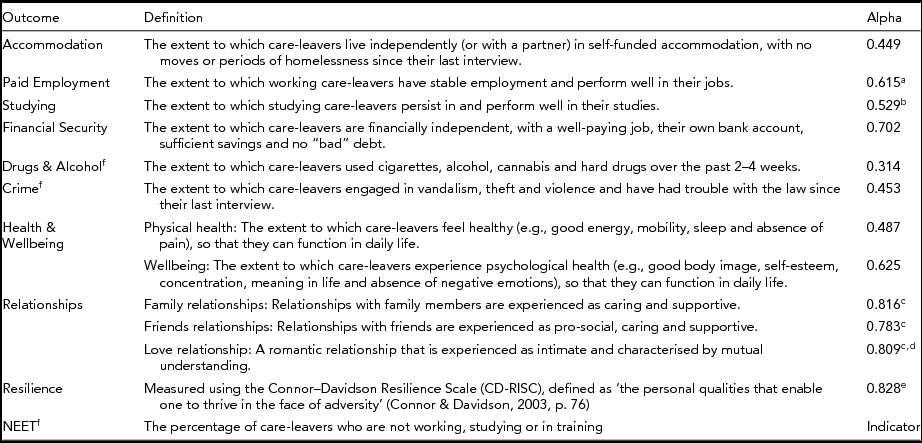
The outcome interview generated a substantial amount of data from which a set of outcome measures were constructed. A selection of these are utilised in this article. Table 1 names and defines these measures, all of which (except NEET) were continuous variables scored on a 0–100 range. Table 1 also presents Cronbach's coefficient alpha for the continuous variables, based primarily on the data from the 52 participants in this study. Reliability varies from .314 to .828. Most of the outcome measures are not psychological constructs, but rather checklists of often diverse behaviours or experiences, resulting in low internal consistency in several measures. For example, accommodation includes aspects of independence (e.g., paying for their accommodation), stability (few moves over the past year) and not being homeless. These are all salient aspects of the kind of accommodation we hope care-leavers will achieve as they become young adults, but one may not expect them to all tightly cohere, hence the reliability coefficient drops short of the preferred standard of .60 for group research (Hudson, Reference Hudson1982). Content validity was enhanced by designing these measures in relation to measurements of outcomes in other care-leaving studies.
Definitions of outcomes.

a n = 23 for this validation because only 23 participants were employed at 1 year.
b n = 16 for this validation because only 16 participants were studying or in training at 1 year.
c These measures are drawn from the YERS, and the alpha coefficients are drawn from the original validation with n = 575 (van Breda, Reference van Breda2017).
d n = 319 for this validation because only 319 participants were in a love relationship at the time of the YERS validation.
e The CD-RISC was re-validated with the sample of 575 youth used to validate the YERS (van Breda, Reference van Breda2017).
f These variables are negatively worded, thus high scores indicate negative outcomes.
Data were analysed in SPSS v24 using nonparametric bivariate statistics because of the small sample size. Such statistics have limitations that multivariate statistics do not have, but are necessitated by the limited quantity of data available for analysis. Spearman's rho correlation was used to examine association between pairs of continuous variables, Mann-Whitney U was used to test differences in continuous variables across dichotomous categories, Kruskal–Wallis chi-square was used to test differences in continuous variables across multiple categories, and Pearson's chi-square was used to test association between pairs of categorical variables (Pett, Reference Pett2016). Because of the exploratory nature of this study, significance was set at a more generous p < .10, though this increases the risk of Type I errors.
To protect the ethics of participants, written informed consent was negotiated with the youth at each interview, with parental/guardian consent required for youth under age 18. Interviews included a narrative qualitative interview to allow opportunity for rapport-building and for the youth to debrief. This was an expression of a relational ethics of care (Ellis, Reference Ellis, Goodson, Antikainen, Sikes and Andrews2016), which focuses on engaging fully with the whole person and not merely extracting data from them, but also co-creating an interested and caring space for dialogue and reflection. Participants frequently reported that the interviews were a unique opportunity for them to step back from life to reflect on their living. Ethical approval for the study was provided by the Faculty of Humanities Academic Research Ethics Committee of the University of Johannesburg on 20 September 2012.
Results
The sample was predominantly male (49 of 52 participants) due to GBT having only recently taken girls into their programme. The majority of participants were African (n = 27), 11 White, nine Coloured and five Indian. All but one of the participants were South African citizens, and all but two came from the three provinces where GBT sites are located (Gauteng, Western Cape and KwaZulu-Natal). Participants ranged in age from 16 to 21 at the time of leaving care, with the majority (n = 45) aged 17–19. None of the participants was disabled. Participants were in GBT's care for 2–6 years, with a mean of 4.3 years.
Demographic Variables
Because of the small sample of women in the study (only three out of 52 participants), gender comparisons were not performed. The role of population group in shaping this sample's care-leaving outcomes one year after leaving the care of GBT was examined. Race categories were unevenly spread, compared with the South African population. Though the order of frequency of race categories in the sample matches that of the population, African participants are underrepresented (52% of the sample compared with 79% of the population), while the other three race groups are overrepresented.
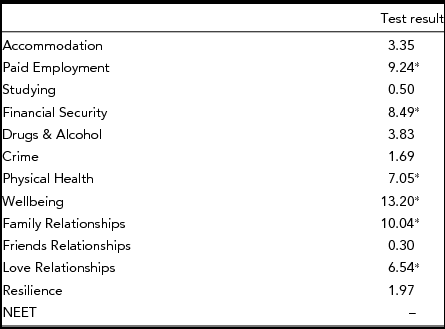
Table 2 presents the results of the demographic analyses. For the comparisons of population group with all outcomes except NEET, the Kruskal–Wallis test was used and the chi square scores are reported. The NEET comparisons were performed using the chi-square test, however, the results could not be reported because in both cases at least one cell had an expected count of less than five.
Contribution of population group to care-leaving outcomes.

* p < .10
The results presented in Table 2 suggest that population group appears to influence six outcomes – the largest number of significant results for any variable in this study. Post hoc tests were used to determine between which combinations of population groups the differences were located:
1. Paid Employment: Coloured (M = 90.9) and African (M = 84.3) working care-leavers had significantly better levels of work performance than White (M = 49.4) care-leavers who were working. (This is not a reflection on how many participants were employed, but rather on the job performance of those who were working.)
2. Financial Security: White (M = 67.3) care-leavers had greater financial security than African (M = 51.0) care-leavers.
3. Physical Health: Indian (M = 89.3) care-leavers had better levels of physical health than both White (M = 73.4) and African (M = 77.2) care-leavers.
4. Wellbeing: Both Indian (M = 89.2) and Coloured (M = 82.9) care-leavers had significantly higher levels of wellbeing than African (M = 71.1) and White (M = 67.0) care-leavers.
5. Family Relationships: Indian (M = 94.0) care-leavers had more caring and supportive relationships with their family than African (M = 58.9) care-leavers.
6. Love Relationships: White (M = 98.8) care-leavers had significantly more intimate and mutually understanding relationships with a romantic partner than African (M = 79.6) care-leavers.
Pre-care Variables
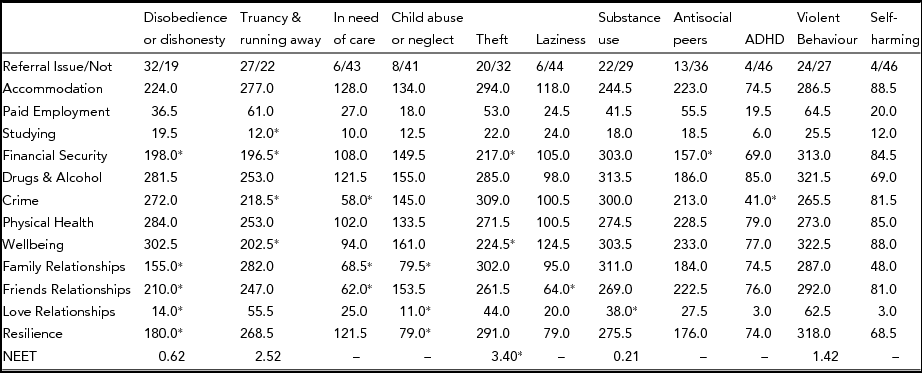
The primary data available regarding the lives of study participants before coming into care are their referral issues. Table 3 depicts the contribution of referral issues to care-leaving outcomes at one year. The first row of Table 3 provides the frequency of study participants who were reported by their social worker to have each referral issue, followed by the frequency who were not reported to have that referral issue. Only referral issues that were reported for at least four participants are included in the table. Other than for the comparisons with NEET, all other comparisons were made using the Mann–Whitney test and the U scores are reported. The NEET comparisons were performed using the chi-square test and Pearson's chi-square result is reported. The NEET tests could not all be reported because in some cases at least one cell had an expected count of less than five. The referral issues have been sequenced in order of frequency of significant results.
Contribution of referral issues to care-leaving outcomes.

* p < .10
The referral issues that participants faced at the time of coming into care, which was on average 5 years prior to the 1-year outcome interview, appear to exert a notable influence on care-leaving outcomes a year out of care. This is particularly evident in the youth's Financial Security (where there are four significant correlations), as well as Crime, Family Relationships, Friends Relationships and Love Relationships (each of which has three significant correlations).
The results can be described as follows:
1. Disobedience or dishonesty: This referral issue refers to lying, manipulation and/or not following rules. Care-leavers who had this referral issue when they came into GBT reported better Financial Security (M = 60.8 vs. M = 49.8), more satisfying relationships with Family (M = 78.9 vs. M = 52.9), Friends (M = 76.4 vs. M = 65.8) and Lovers (M = 93.5 vs. M = 74.5), and higher levels of Resilience (M = 79.8 vs. M = 71.7) a year out of care than those who did not have this referral issue.
2. Truancy and running away: This refers to truancy from school and running away from the family home or leaving the home without permission. Care-leavers who had this referral issue, compared with those without this issue, reported poorer Study habits (M = 67.9 vs. M = 86.5), less Financial Security (M = 52.3 vs. M = 62.6), lower levels of engagement in Crime (M = 4.5 vs. M = 6.0), and poorer Wellbeing (M = 71.0 vs. M = 79.5).
3. In need of care: This means that the child was orphaned or abandoned or their previous placement (e.g., in foster care) broke down. Care-leavers who had this referral issue reported higher levels of Crime (M = 7.9 vs. M = 4.8) and less satisfying Relationships with Family (M = 50.0 vs. M = 72.7) and Friends (M = 52.1 vs. M = 74.9) a year after leaving care.
4. Child abuse or neglect: This refers to children who experienced neglect or abuse (physical, sexual, etc.). Care-leavers with a pre-care history of abuse or neglect reported, a year after leaving care, less positive relationships with both Family (M = 48.1 vs. M = 74.1) and Lovers (M = 68.8 vs. M = 88.3), and lower levels of Resilience (M = 67.8 vs. M = 78.4) than those without a history of abuse or neglect.
5. Theft: Care-leavers who had stolen or shoplifted prior to coming into care, reported less Financial Security (M = 51.5 vs. M = 59.5), less psychological wellbeing (M = 69.6 vs. M = 76.8) and higher rates of being NEET (50% vs. 33%) a year after leaving care than those without a history of theft.
6. Laziness: Care-leavers who were reported to be “lazy” at the time of admission into care were found to have better relationships with Friends (M = 84.7 vs. M = 70.5) a year after leaving care than those who were not reported to be “lazy”.
7. Substance use: Care-leavers who had been using or abusing alcohol and/or other substances prior to coming into care reported having a more satisfying love relationship (M = 95.0 vs. M = 79.5) a year after leaving care.
8. Antisocial peers: This refers to children succumbing to peer pressure or being involved in a gang prior to coming into GBT's care. Those who had referral issues with antisocial peers reported less financial security (M = 49.0 vs. M = 59.8) a year after leaving care than those without a history of antisocial peers.
9. ADHD: Care-leavers who had issues with Attention Deficit and Hyperactivity Disorder when they came into care later reported higher levels of engagement in Crime (M = 15.8 vs. M = 4.1), than those without ADHD.
In-care Variables
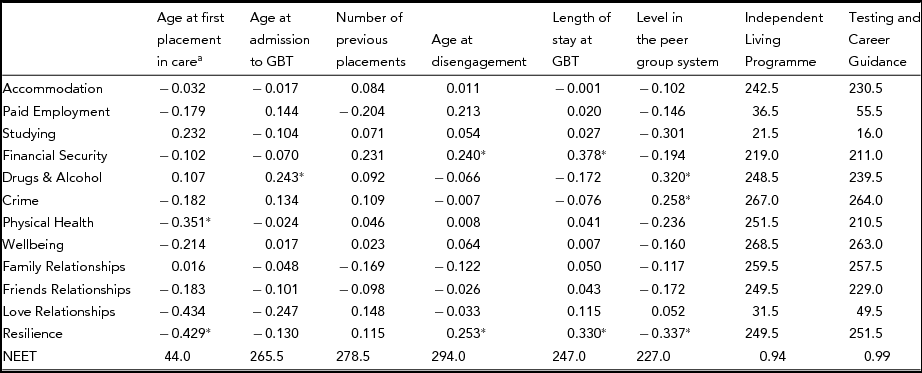
Table 4 presents the results of the analyses of the associations between in-care variables and 1-year outcomes. The NEET comparisons were conducted using Pearson's chi-square test, the comparisons of outcomes with the variables in the two right-hand columns were done with the Mann–Whitney U test, while the remaining tests were conducted using Spearman's rank order correlation for pairs of continuous variables.
Contribution of in-care variables to 1-year outcomes.

a Data are available for only 24 of the 52 participants due to an administrative error in the early rounds of data gathering. * p < .10
Fewer numbers of significant findings emerge in these analyses than the previous table, with Resilience having the highest number (four) of associations with in-care variables. The following emerges from an inspection of Table 4:
• Age at first placement in care: The younger the child was on coming into the care system the first time, the better their physical health and the higher their Resilience a year after leaving the care system.
• Age at admission to GBT: The younger the child was on coming into GBT's care, the lower their use of drugs and alcohol.
• Age at disengagement: The older the young person was when they left GBT's care (age at disengagement ranged from 16 to 21), the more Financial Security and Resilience they reported 1 year after leaving care.
• Length of stay at GBT: The longer the young person stayed in the care of GBT (length ranged from 2 to 6 years), the more Financial Security and Resilience they reported 1 year after leaving care.
• Level in the PGS: The higher the youth progressed up the PGS, the less likely they were, a year out of care, to be engaged in Crime and Drugs & Alcohol and the more Resilient they were.
It is noteworthy that participation in the Independent Living Programme (36 care-leavers participated in the programme, while 16 did not, even though this is a standard part of GBT's programme) and the Education Testing and Career Guidance Programme (33 participated and 16 did not) had no bearing on any of the 1-year care-leaving outcomes. In addition, the number of placements, often regarded as a predictor of worse outcomes, was not associated with care-leaving outcomes in this study (though half the participants had none and a further quarter had only one placement prior to coming to GBT).
Limitations
This study has several limitations. It is based on a small sample from a single organisation. The single organisation means results cannot be generalised to other care-leavers in South Africa, though this was not the intention of this study. The small sample size, however, weakens the statistics reported in this study, particularly increasing the risk of Type I errors in relation to the many statistical tests conducted. Almost all participants are male, thus it is not clear to what extent these findings may be generalised to female care-leavers. Thus, all results should be interpreted tentatively.
Discussion
The results suggest that demographic, pre-care and in-care variables all contribute to the 1-year outcomes of a sample of South African care-leavers. However, the direction of some of these contributions is unanticipated, and interpretations of the significant results are equivocal. The purpose of this article is to foreground the complexities in interpreting longitudinal outcome data on leaving care. This discussion, therefore, is not intended to draw definitive conclusions about factors contributing to care-leaving outcomes in South Africa or even in GBT. Rather, this discussion is intended to show the competing conclusions that can be drawn from data, thereby illustrating the complexities of attempting to reach such definitive conclusions. This complexity is accentuated in a developing country, such as South Africa, where research resources are limited, studies are generally small, and the limitations of administrative data make comparisons with other groups of care-leavers or the population in general difficult or impossible.
Population Group
Population group appears to be an important contributor to several care-leaving outcomes, with more significant findings than any other variable. South Africa's history of institutionalised racism, in which White people (constituting a small percentage of the population) were systematically advantaged over Coloured, Indian and particularly African people, has had immense impacts. Although the country is now 24 years post-apartheid, and although all the participants in this study were born after the 1994 transition to a non-racial democracy, the decades of racism continue to exert an influence on society, as is evidenced in the marked disparities in low- and semi-skilled employment and educational attainment of African and Coloured people compared with Indian and particularly White people (StatsSA, 2017). It could thus be expected that population group will overwhelmingly shape the life opportunities of young people leaving care.
This expectation, however, needs critical consideration. We know very little about the profile of young people coming into the care system in South Africa due to dismal administrative data (Loffell, Reference Loffell, Dawes, Bray and Van der Merwe2007). However, it is possible that White children coming into care are disproportionately drawn from the lower socioeconomic strata of the white population, while African children, for example, may be drawn from a wider socioeconomic group. These possible differences, combined with various other differences (e.g., family accommodation and community safety), may influence care factors, such as age of entry into care, duration in care and quality of care. All these differences could then influence care-leaving outcomes, complicating direct associations between population group and outcomes. Such interactions between race, care factors and outcomes have been reported in studies in the USA, for example (Dworsky et al., Reference Dworsky, White, O'Brien, Pecora, Courtney, Kessler and Hwang2010).
Nevertheless, the surface expectation that African and Coloured care-leavers would do significantly worse than Indian and particularly White care-leavers was not clearly borne out by the data from this study. African participants appear to be among the lowest scoring groups for five care-leaving outcomes, but highest on one, suggesting that of the four population groups, they are the most vulnerable for negative care-leaving outcomes, as expected. White participants, while scoring highest on two outcomes, score lowest on three, suggesting that they are a group with notable vulnerability for negative outcomes. By contrast, Indian participants scored highest on three of the six outcomes, and not lowest on any, while Coloured participants score highest on two and not lowest on any, suggesting that these two groups experience moderately good outcomes.
Results for African and Indian participants appear to conform to expectations, but White participants’ poor scores and Coloured participants’ positive scores are unexpected. White care-leavers’ higher financial security scores are expected, but their poor work performance, health and wellbeing are not; while Coloured participants’ positive work performance and wellbeing are similarly unanticipated.
This suggests a complex interaction between racial inequality in society and opportunities within the care system. On the one hand, the role of structural factors such as race appears to be at work in these data and should always be considered when considering the outcomes of care-leavers. On the other hand, these factors are not inexorable, and in various ways, both positive and negative, care-leavers appear not to conform to demographic trends. Perhaps the coloured participants feel mobilised by the new opportunities available to them post-apartheid and, together with motivation from GBT staff, seek to capitalise on these opportunities through performing well at work, which contributes to increased wellbeing. Perhaps the White participants retain a sense of racial entitlement that is no longer supported by the labour market, resulting in underperformance at work and lower levels of health and wellbeing. Further research would be needed to ascertain the reasons for such results.
Referral Issues
Participants’ referral issues are salient, because these point to the influence that pre-care life challenges and behavioural problems may exert on life after care. In the absence of intervention, one might expect that earlier problems may continue into early adulthood, but that intervention (in the form of a residential treatment programme, such as GBT) may serve to reduce the severity of these problems and their influence on the young person's later outcomes.
This study generates data that suggests that pre-care life problems do continue to exert an influence on participants’ outcomes several years later, after leaving care. In particular, in this sample, a history of being found in need of care due to child abuse and neglect, truanting, theft, antisocial peers or ADHD appears to negatively influence financial security, criminal activity or family relationships (all of which had two or more significant statistical results). A pre-care history of vulnerability thus appears to increase the chances of negative post-care outcomes, despite going through a residential treatment programme. One might conclude, therefore, that GBT's programme is ineffective.
However, these findings are not ubiquitous. A pre-care history of disobedience, laziness and substance abuse seems to contribute to better outcomes a year after leaving care, not worse. And while truancy has several negative outcomes, it is also related to lower levels of later criminal activity. Relationships with friends and lovers seem particularly positively impacted by such histories, but also criminal activity and financial security, which are negatively impacted by some histories but positively impacted by others. The relationship between life challenges and later outcomes is thus not unequivocal, suggesting there are other complex processes at play. This finding begs yet further questions.
It is also noteworthy that a referral issue of substance use does not correlate with drugs and alcohol a year after leaving care, and that the referral issues theft, antisocial peers and violent behaviour do not correlate with the outcome Crime. Of all the possible correlations presented in Table 3, these were the most anticipated, since later behaviour is typically predicted by earlier behaviour, making these findings especially surprising and noteworthy. Perhaps young people coming into care with such obvious and externalising behavioural problems get more focused intervention from care staff than those with environmental or internalising problems, resulting in better outcomes. If so, this suggests that GBT's residential care programme does work for those with serious behavioural problems. But again, further data would be needed to test this hypothesis.
Progress through Care
The in-care factor of timing is prominent in the results. Specifically, earlier entry into the care system, later exit from the system and longer time spent in the system appear to have positive benefits a year after aging out of the system, particularly in relationship to financial security and resilience, but also physical health and use of drugs and alcohol. While there is a strong voice against residential care (Tregeagle, Reference Tregeagle2017; Williamson & Greenberg, Reference Williamson and Greenberg2010) and even foster care (Ainsworth & Hansen, Reference Ainsworth and Hansen2014), these findings are in line with the results of many other studies that argue that early entry and a long stay in care are beneficial to vulnerable children. In particular, this may support the finding of McSherry, Fargas Malet, and Weatherall (Reference McSherry, Fargas Malet and Weatherall2016) that placement longevity, rather than placement type, may be the key factor in facilitating positive care-leaving outcomes.
These results surely do not support removing children from their families at an early age and placing them in long-term care. But, when children are in need of care and families are unable to provide them with the requisite care, long-term placements appear better than later or short-term placements.
However, this study involved only young people who had stayed in care until they were ready to age out of care. Not included are those who left care at a younger age, typically to be reunified with their families. We do not have data on the adult outcomes of children who were reunified with their families at an earlier age and thus cannot draw strong conclusions that staying in care longer causes improved outcomes. Indeed, the complexities of designing a study able to do this are formidable.
Programme Components
It is noteworthy that receipt of either of two standard interventions, viz. an independent living programme and testing and career guidance, appears to have made no contribution to care-leaving outcomes. This is counter-intuitive since these programmes are designed to promote better psychosocial functioning after leaving care. The lack of results is thus disappointing, but not entirely unexpected as various studies have had similar results (Batista-Calderbank, Reference Batista-Calderbank2011; Yelick, Reference Yelick2017). It may be that the format of such programmes is problematic – a time-limited and structured programme of independent living skills may not translate well into the realities of living independently after having been in care. Apparently, positive care-leaving requires something other than what most children's homes are offering. Alternatively, more time between the care experience and outcome data collection may be required, as some research suggests that the value of the care experience emerges only after several years (Mmusi & Van Breda, Reference Mmusi and van Breda2017).
The programme component that did generate significant results was GBT's PGS, where those who achieved higher levels in the system showed greater resilience and, importantly, lower levels of drugs, alcohol and crime a year after leaving care. It is tempting to interpret this as evidence that the PGS is a successful programme, particularly as GBT highly esteems their PGS. GBT would argue that movement up the PGS creates opportunities for taking on authentic responsibility and learning leadership skills in real-world situations, thus improving their chances of positive care-leaving outcomes.
However, it is possible that the level achieved in the PGS is a result of children's interpersonal skills and emotional maturity (among other characteristics), more than a contributor to their development. Thus, it is possible that children who possess the resilience and competencies to avoid substances and crime are the ones who will be recognised by care staff and promoted up the PGS, probably contributing to further strengthening of these attributes. The causal relationship between PGS and positive outcomes is thus unclear.
Conclusions
The results of the analysis of data generated from a residential care programme in South Africa suggest that the relationships between a range of demographic, pre-care and in-care variables and a set of 1-year independent living outcome variables are neither consistent with expectations nor easily interpreted. Methodological limitations of anything less than the largest and most sophisticated studies also undermine the capacity of studies to draw rigorous conclusions. This is surely a challenge globally, where we see that there are very few longitudinal studies on care-leaving beyond one year post-care follow-up (van Breda, Reference van Breda2018). It is a particular challenge in developing countries, where research resources are exceptionally limited.
These findings serve to raise the awareness of the producers and consumers of research that research on care-leaving outcomes is fraught with methodological and conceptual imprecision. This is because of the complex mix of factors (including demographic, pre-care and in-care factors) that can impact on the journey of a child from the family, through the care system and into young adulthood. This journey occurs in the real world, filled with messiness and complexity, most of which cannot be measured or controlled in research, which is necessarily reductionist. The results of such research, therefore, whether positive or negative, should be interpreted and utilised with caution and humility.