For voters with bounded rationality to emulate the formation of policy preferences under full information, party cues provide effective heuristics (Mondak, Reference Mondak1993; Lupia, Reference Lupia1994; Lupia and McCubbins, Reference Lupia and McCubbins1998; Schaffner and Streb, Reference Schaffner and Streb2002; Levendusky, Reference Levendusky2010; Bullock, Reference Bullock2011). Although rationally ignorant voters generally do not possess detailed knowledge about political issues, they are able to form policy preferences consistent with their own interests, so long as they learn the position of their supported party from pieces of information: party cues. Although the effect of party cues appears to be robust, it should be noted that most of the empirical evidence is centered on the US, which has a stable two-party system, whereas the effect has not been thoroughly investigated in non-US countries with multiparty and/or unstable party systems. The lopsided accumulation of evidence in the US raises a concern about the generalizability of the finding, especially when the characteristics of modern US politics such as political polarization work to magnify the effect of party cues (Levendusky, Reference Levendusky2010; Brader et al., Reference Brader, Tucker and Duell2013). In sum, it could be argued that the effect of party cues has been subjected to lenient empirical scrutiny in the US.
The present study aims to test the generalizability of the effect of party cues by focusing on Japan, where the party system and people's party identifications have been destabilized since the 1990s. As empirical findings are valid only when they are replicated using various political institutions and contexts (McDermott, Reference McDermott, Druckman, Green, Kuklinski and Lupia2011), it is crucially important to investigate the effect of party cues in countries outside the US. Furthermore, in light of the fact that the media system in Japan is more stable and ideologically polarized than its party system, we also test whether newspaper names (press cues, hereafter) serve as substitutes for party cues.
Our survey experiment demonstrates that the effects of party and press cues in Japan are muted, and therefore these two types of cues do not serve as effective shortcuts in forming policy preferences. These results indicate that issue voting based on cognitive heuristics is difficult under an unstable multiparty system where party identification is weak. Therefore, the extant literature on party cues that presupposes the US-style party system cannot be generalized easily to other political contexts.
Cue-based formation of policy preferences
The traditional issue voting model is based on the premise that voters have enough knowledge to autonomously form their policy preferences (Brody and Page, Reference Brody and Page1972; Nie et al., Reference Nie, Verba and Petrocik1976), and democratic theories regard issue voting as an indispensable mechanism to keep legislators responsive to voters’ preferences (e.g., Dahl, Reference Dahl1971; Gilens, Reference Gilens and Berinsky2012). However, it is not easy for voters to collect and understand policy information in complex modern societies. Ordinary voters generally do not possess substantial political knowledge (Delli Carpini and Keeter, Reference Delli Carpini and Keeter1996) and lack constrained policy preferences (Converse, Reference Converse and Apter1964), and therefore they are seldom able to form exogenous ‘bedrock preferences’ to which political elites are supposed to respond (Druckman, Reference Druckman2014). One realistic solution to this discrepancy between the theory and reality is cognitive shortcuts. Since the 1970s, studies employing findings from cognitive psychology have consistently documented that even less knowledgeable voters can effectively form policy preferences on complex issues because peripheral cues allow them to heuristically bypass deep information processing.
Cues are the pieces of information that enable inferences without detailed knowledge and effortful cognitive processing (Eagly and Chaiken, Reference Eagly and Chaiken1993; Rucker and Petty, Reference Rucker and Petty2006). In the political context, cues take a variety of forms, such as interest groups’ endorsements and candidates’ likability, but the cues most readily available and reliable to voters are party cues (Downs, Reference Downs1957). In the US, where the majority of voters identify themselves as either Democrat or Republican, people effectively form policy preferences on complicated issues using their own party identification and party cues (Zaller, Reference Zaller1992; Green et al., Reference Green, Palmquist and Schickler2002; Cohen, Reference Cohen2003; Kam, Reference Kam2005; Bullock, Reference Bullock2011; Sniderman and Stiglitz, Reference Sniderman and Stiglitz2012). As an illustration, Kam (Reference Kam2005) tested the effect of party cues on policy preferences by manipulating a party's issue position in a newspaper article on food irradiation. The results indicated that party identifiers more strongly approved food irradiation when they read that their own party supported it, suggesting that party identifiers utilize party cues to form policy preferences that are consistent with their party's position. In sum, party cues enable voters with limited policy information to form ‘as-if rational’ policy preferences.
Moderating factors of party cueing
More recent studies have unraveled the heterogeneous effects of party cues. Among the factors that moderate the effects of party cues, issue salience and the clarity of parties’ ideological positions are the most important from a cross-national perspective.
Voters utilize party cues in order to compensate for their lack of information (Lupia and McCubbins, Reference Lupia and McCubbins1998), and therefore the effect of party cues is expected to be large when the salience of the issue is low and thus it is relatively difficult to learn about the issue (Merolla et al., Reference Merolla, Stephenson and Zechmeister2008). Using federalism as a low-salience issue and abortion as a high-salience issue, Arceneaux (Reference Arceneaux2008) experimentally tested whether voters punish candidates who defect from the issue positions of their party. The results demonstrated that voters punished the candidates by lowering their approval when the issue salience was high, but voters did not punish the candidates and simply followed the issue positions of their supported party's candidates when the issue salience was low. That is, when issue salience is high (e.g. abortion), voters do not simply rely on party cues to form policy preferences because they possess a relatively large body of knowledge as well as having entrenched opinions, whereas they rely more on party cues when the issue salience is low and thus they do not know much about that issue (e.g. federalism).
The other known moderator of party cueing is the clarity of parties’ ideological positions. The clearer the parties’ ideological positions, the more confident voters can be about what values and interests underpin the endorsement of a policy by a given party, leading to a larger effect of party cues on policy preferences (e.g. Skitka and Robideau, Reference Skitka and Robideau1997; Merolla et al., Reference Merolla, Stephenson and Zechmeister2008; Goren et al., Reference Goren, Federico and Caul Kittilson2009; Levendusky, Reference Levendusky2010; Brader et al., Reference Brader, Tucker and Duell2013). Conversely, when the ideological positions of parties are not clear and their issue positions are not distinctively differentiated in the eyes of voters, it is difficult to perceive the difference between parties even when party cues are available. In this situation, the effect of party cues would be limited.
The literature on moderating factors of party cueing indicates that the effect of party cues is expected to be larger in the US than in other political contexts because the ideological positions of the Democratic and Republican parties have been remarkably polarized since the 1970s (Abramowitz, Reference Abramowitz2010). Under a polarized two-party system, it is in many cases evident that if party D supports position X then the other party R opposes position X, whereas this is not the case in countries with less polarized and/or multiparty systems because the notion of an ‘out-group’ is not always clear. The prominent ideological polarization in the US makes party cueing even more effective, but is arguably anomalous from a global perspective. Standard classifications of party systems, such as those described by Sartori (Reference Satrori2005), argue that a two-party system presupposes a centripetal society where the ideological distance between the two parties tends to be small. That is, as predicted by the economic model of Downs (Reference Downs1957), the ideological positions of two major parties are expected to converge to that of the median voters to maximize their vote shares, resulting in less distinctive policies (Lijphart, Reference Lijphart1999). The polarized two-party system in the US does not fit this typology. Therefore, although the effect of party cueing has been consistently demonstrated in the US, we nevertheless need to be cautious in extrapolating the US-centered findings to other political contexts.
Party cueing in non-US contexts
The effect of party cues in countries other than the US has not been fully examined. Among the few studies, Merolla et al. (Reference Merolla, Stephenson and Zechmeister2008) tested the effect of party cues on policy preferences in Canada by conducting an experiment that compared the responses to a series of questions with and without party cues. The results indicated that aside from the New Democratic Party, a minor party with a distinctive ideological position, the party cues of the two major parties (i.e. the Liberal and Conservative parties) had hardly any effect on the policy preferences of each party's supporters, suggesting that party cues do not serve as effective shortcuts in forming policy preferences when major parties avoid taking ideologically distinctive positions.
The importance of parties’ ideological distinctiveness is also corroborated by Brader et al. (Reference Brader, Tucker and Duell2013). With survey experiments targeting Poland and Hungary as new democratic countries and the UK as a country with a long history of democracy, Brader et al. (Reference Brader, Tucker and Duell2013) tested the moderating roles of the longevity, incumbency, and ideological distinctiveness of parties in party cueing. The experiments demonstrated that ideological distinctiveness has the most consistent effect as a moderating factor of party cueing. The importance of parties’ ideological distinctiveness implies that the effect of party cues would be mitigated even in countries with a long history of democracy when the ideological differences of parties are not clearly perceived.
By contrast, Samuels and Zucco (Reference Samuels and Zucco2014) demonstrated that party cues in Brazil are as effective as those in the US. Based on social identity theory, Samuels and Zucco (Reference Samuels and Zucco2014) hypothesized that, when party cues are available, approval for a policy would increase when the respondent's supported party endorses it (i.e. ingroup cueing), whereas disapproval would increase when their opposing party endorses it (i.e. outgroup cueing). Supporting these hypotheses, Samuels and Zucco's (Reference Samuels and Zucco2014) experiments indicated that, even in Brazil, where more than 50% of the elected officials are independents, policy preferences consistent with the respondent's own partisanship were strengthened when party cues were available in the survey vignettes. Samuels and Zucco's (Reference Samuels and Zucco2014) findings illustrated that party cues are effective even under a multiparty system where partisanship is weak, supporting the generalizability of the US-centered findings.
To test the generalizability of party cueing, it is crucial to test it in further non-US contexts, especially when the extant knowledge has been derived in settings that favor the finding of party cue effects. Samuels and Zucco (Reference Samuels and Zucco2014) is one of the few studies to do this, but the party system in Brazil is rooted in the cleavage of economic inequality (Hunter and Power, Reference Hunter and Power2007) and therefore the ideological positions of major parties are relatively distinct (Power and Zucco, Reference Power and Zucco2009). By focusing on Japan, where the party system is unstable and people's party identifications are weak, the present study aims to test the generalizability of party cueing in a setting that is distinctively different from the US.
Ideological indistinctiveness of Japanese parties
During the Cold War, ‘the 1955 system’ shaped the ideological landscape in Japan, which was marked by competition between the conservative Liberal Democratic Party (LDP) and the progressive Social Democratic Party of Japan (SDPJ). However, when these long-term rivals formed a coalition government in 1994 after a massive party realignment triggered by political reform in the early 1990s, the ideological structure of Japanese politics became blurred (Kabashima and Takenaka, Reference Kabashima and Takenaka1996). The ideological position of the Democratic Party of Japan (DPJ), which won government in 2009, was more liberal than that of the LDP, but many of the DPJ members in the Diet were originally elected from the LDP, and thus the ideological distinction between the DPJ and the LDP was much less clear than that between the LDP and the SDPJ under the 1955 system. Meanwhile, there have been constant realignments among minor parties, making the party system fluid. As a result, there is no major liberal party competing with the conservative LDP, and the ideological constellation of Japanese parties has become even more ambiguous.
In fact, Kabashima and Takenaka (Reference Kabashima and Takenaka2012) demonstrated that the correlation between the ideology of Japanese voters and that of their supported party ranks lowest among the ten countries studied, including the US and the UK. Corroborating this finding, Endo and Jou (Reference Endo and Jou2014) showed that the younger generation in Japan tends to perceive the Japanese Communist Party as ‘conservative’ and the neo-liberal Japan Restoration Party as ‘progressive’, suggesting that the traditional conservative–progressive ideological dimension is losing its meaning at least among the youth. These results attest to the ambiguity of Japanese parties’ ideological positions. In light of the moderating role of parties’ ideological distinctiveness, party cues in Japan are less likely to function as effective shortcuts in shaping policy preferences. Conversely, if party cues are effective even in Japan, then we must conclude that the generalizability of party cueing is quite high.
Press cues as substitutes for party cues
If party cueing is less likely in Japan, is there any substitute for party cues? We explore the possibility that press cues act as substitutes for party cues because the media system in Japan is more stable than the party system, and the ideological stances of major newspapers are distinctive and widely shared.
In contrast to the ambiguity of the ideological constellation of Japanese parties, the media system in Japan is stable partly because of prominent cross-ownership, whereby each TV network is associated with a national newspaper company (Akhavan-Majid, Reference Akhavan-Majid1990; Fujitake, Reference Fujitake2005). Specifically, the Yomiuri Shimbun and Asahi Shimbun, which boast the two largest circulations in the world, date back to the nineteenth century and have long held leading positions in the media system as the two major national newspapers in Japan.
More importantly, the liberal tone of Asahi Shimbun and conservative tone of Yomiuri Shimbun are well established and widely acknowledged by the public (Akuto, Reference Akuto, Pharr and Krauss1996). Unlike the ambiguous ideological positions of political parties, the contrasting ideological stances of the two major newspapers in Japan have continued coloring the coverage of recent issues such as security, nuclear energy, and international diplomacy in East Asia. The ideological distinctiveness and consistency of the two newspapers potentially make the press cues equivalent to party cues as heuristics for policy preference formation.
In fact, media outlets’ brand recognition and their general ideological slants have been demonstrated to be influential in the US (Baum and Gussin, Reference Baum and Gussin2008; Iyengar and Hahn, Reference Iyengar and Hahn2009; Stroud, Reference Stroud2008), where both the party system and the media system are polarized. As an illustration, Baum and Gussin (Reference Baum and Gussin2008) experimentally manipulated the apparent media source of identical news coverage of the 2004 presidential election. Their results showed that when CNN's logo was attached to the news, the participants perceived the news as more favorable to Kelly than to Bush, whereas they perceived the news as more favorable to Bush than to Kelly when the logo of FOX News was attached. They also found that this effect was stronger among those who were knowledgeable about the ideological slants of these media outlets. These findings strongly suggest that press cues function as an information shortcut and that citizens can heuristically interpret the news by utilizing their recognition of media brands and their associated ideological leanings.
Drawing on these findings, we expect that ideologically distinctive press cues in Japan work as substitutes for party cues and that the readers of each newspaper can use the cues to form policy preferences that are consistent with the ideological slant of the newspaper to which they subscribe. In particular, recent observations suggest that the editorial tone of Asahi Shimbun is becoming more liberal, while that of Yomiuri Shimbun is becoming more conservative, resulting in increasing polarization (e.g. Tokuyama, Reference Tokuyama2014). We expect that the ideological polarization of the media system in Japan would increase the effectiveness of press cues.
Method
To maximize the comparability of our study with previous studies, we follow the experimental design of Samuels and Zucco (Reference Samuels and Zucco2014). In essence, the participants are presented with brief vignettes in which the presence of party or press cues is manipulated. After reading the vignettes, the participants’ policy preferences are measured. Thus, we can evaluate the prevalence of the heuristic formation of policy preferences using cues. In order to probe into the moderating effect of issue salience, we use two issues with high and low salience, respectively. As the competing arguments on highly salient issues tend to be well understood by the public (Zaller, Reference Zaller1992), cue-based preference formation is less likely to occur (Kam, Reference Kam2005; Merolla et al., Reference Merolla, Stephenson and Zechmeister2008). Therefore, we expect that the effect of cues will be magnified when the issue salience is low.
Pilot survey
We first conducted a pilot survey using the Japanese online panel of Nikkei Research, aiming to identify the issues to be included in the experiment. The online panel of Nikkei Research consists of self-selected potential respondents who are recruited from a variety of offline and online outlets. Although the panel is not representative of Japanese voters, it has established a good reputation for data quality.
Targeting individuals aged from 20 to 69 years, we solicited 5,000 survey responses and received 635 completed responses (45% of respondents were female; mean age of 43.35 years, SD = 14.14). Six possible policy issues were selected from the latest Diet Record: (a) the second postponement of a higher consumption tax rate, (b) authorizing the use of the right to collective self-defense, (c) amendment of a temporary staffing services law, (d) introduction of a basic income, (e) introduction of assistant child-care providers, and (f) decreasing the fee for child day care. For each of the six policy issues, we presented brief pros and cons of the policy and measured the respondents’ own preferences (with one four-point scale ranging from ‘Agree’ to ‘Disagree’) and certainty of preferences (with one nine-point scale). See the Supplementary Materials for the exact wordings of the items.
We prioritized the selection of policy issues with evenly split responses (i.e. 50% of the respondents agreed and 50% disagreed). The share of the majority response, regardless of whether it was for or against each policy issue, was as follows: collective self-defense rights (52%), temporary staffing services law (55%), basic income (63%), consumption tax (66%), fee for child day care (69%), and assistant child-care providers (73%). Furthermore, to select one high-salience and one low-salience issue, we calculated the mean value of preference certainty for each policy issue (range: 0–1). The basic assumption is that the more salient the issue is, the higher the preference certainty should be because the news coverage of high-salience issues tends to be large and arguments concerning the issues are more likely to be known by the public. The preference certainty was 0.69 for the consumption tax, 0.66 for collective self-defense rights, 0.62 for the basic income, 0.61 for the fee for child day care, 0.60 for assistant child-care providers, and 0.59 for the temporary staffing services law, respectively. Based on the distribution of preferences and the levels of certainty, we selected authorizing the use of the right to collective self-defense as the high-salience issue and the amendment of the temporary staffing services law as the low-salience issue.
Experimental design
The participants recruited from the panel of Nikkei Research were Japanese aged from 20 to 69 years who had not participated in the pilot survey. We used the Instructional Manipulation Check (IMC) (Oppenheimer et al., Reference Oppenheimer, Meyvis and Davidenko2009) at the beginning of the experiment to screen those who did not pay due attention to the material because participants needed to read brief vignettes in the subsequent sections (see the Supplementary Materials for the details of the IMC). We solicited survey responses from 44,000 people, of which 2,589 met the demographic conditions (i.e. nationality and age) and passed the IMC. Although the response rate is admittedly low, this is not anomalous in the online recruitment of participants. For instance, when participants are recruited through Amazon Mechanical Turk, the number of potential participants who are exposed to the recruitment message is far greater than that of those who actually participate in the study. The low response rate in our study is analogous to this situation. We were only able to send email invitations to potential participants, but we do not know whether they actually read them.
Among the 2,589 potential participants, we randomly sampled 2,000 participants, who then navigated to the experiment and responded to the pretreatment survey on policy preferences. In addition to the respondents’ pretreatment policy preferences and certainty on the two issues selected in the pilot survey (i.e. lagged dependent variables), their political interest, approval of the Cabinet, party identification, ideology, mass media exposure, and political knowledge were also measured in the pretreatment survey (see the Supplementary Materials for the details of covariate measurement). After responding to the pretreatment survey, the participants were presented with the experimental vignettes.
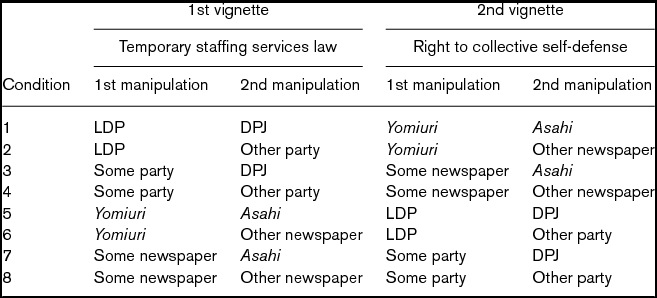
The 2,000 participants were assigned to one of the eight conditions presented in Table 1 in a completely random manner. The order of the two issues was fixed so that the issue of amending the temporary staffing services law was always first. The rationales behind this decision were, firstly, the expectation that the effect of cueing would be larger for the low-salience issue and, secondly, the concern that the response to the first vignette might work as an anchor, with the respondents using it to adjust their response to the second vignette. In short, we fixed the order of issues in order to obtain fresh responses to the cue for the low-salience issue. The order of party and press cues was counterbalanced.
Experimental conditions

After presenting the vignettes, each participant's own preference (with one four-point scale ranging from ‘Agree’ to ‘Disagree’) and preference certainty (with one nine-point scale) were measured as dependent variables. The participants were then fully debriefed and thanked. Among the 2,000 participants, 1,204 completed the experiment (response rate = 60.2%).
Vignettes
Following Samuels and Zucco (Reference Samuels and Zucco2014), we manipulated the presence of party and press cues in the vignettes. As an illustration, the vignette for the temporary staffing services law with party cues read as follows:
-
Politicians from different parties support different positions in the debates about the amendment of the temporary staffing services law.
-
[Some party][LDP] claims the temporary staffing services law should be amended to satisfy the diversifying needs of career enhancement and work style. [Other party][DPJ] claims the temporary staffing services law should not be amended to avoid the increase and entrenchment of temporary workers with unstable employment. With which of these positions do you agree more?
Orthogonal manipulation of the mention of the LDP as a party supporting the amendment and the mention of the DPJ as a party opposing the amendment yielded four experimental conditions. Likewise, the vignette on the right to collective self-defense with press cues read as follows:
-
In their editorial columns, different newspapers support different positions in the debates about authorizing the limited use of the right to collective self-defense by reinterpreting the constitution.
-
[Some press][Yomiuri Shimbun] claims the limited use of the right to collective self-defense should be authorized to strengthen the Japan–US Security Arrangements. [Other press][Asahi Shimbun] claims the limited use of the right to collective self-defense should not be authorized to avoid embroilment in international conflicts. With which of these positions do you agree more?
Analysis
Covariate balance
The covariate balance among those who completed the experiment is presented in Tables A1 and A2 in the online Supplementary Material Appendix. No serious imbalance was observed in any covariate.
Effect of party cues
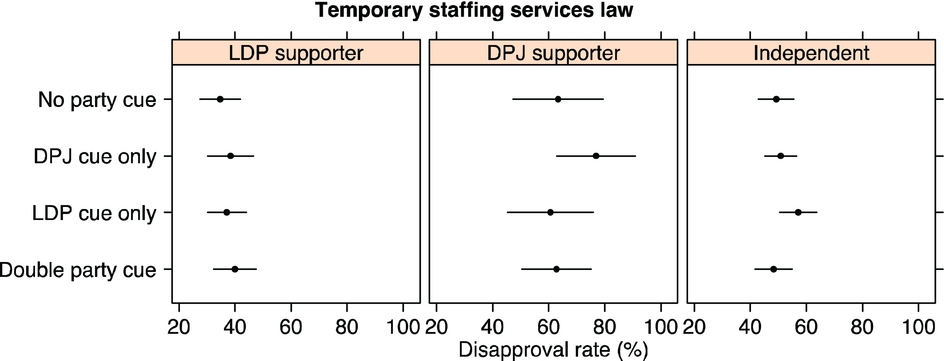
First, to test the effect of party cues for the low-salience issue, we estimated an ordinary least-squares regression predicting post-treatment policy preferences on the temporary staffing services law with the treatment, the respondent's party identification, and their interaction term as independent variables (see Table A3 in the Supplementary Materials for the estimated model). Based on the estimated model, the point estimates and their 95% confidence intervals were plotted for each combination of the treatment and party identification (Figure 1). The treatment effect is presented as the difference in the point estimates between the treatment conditions and the control condition (i.e. with no party cue). Those who identified with minor parties other than the LDP and DPJ were excluded from the analysis because some minor parties are ideologically proximate to either the LDP or DPJ, and therefore merging them with independents would bias the ideological distribution of the category.
Treatment effects of party cues on policy preferences with 95% CIs (low-salience issue)

On average, the LDP supporters approved the amendment of the temporary staffing services law more than the DPJ supporters did. The policy preferences of independents fell between them. It is noteworthy that these differences in policy preferences were also observed in control conditions in which no party cues were provided. The description of the pros and cons of the low-salience issue possibly provided policy information that enabled the participants to form policy preferences without relying on party cues. We return to this possibility in the discussion. The comparisons between the conditions with at least one party cue and with no party cue indicate that party cues hardly had any effect on policy preferences among the LDP supporters and independents. Although the DPJ supporters’ opposition to the amendment of the temporary staffing services law became slightly stronger when they were provided with a DPJ cue, this effect was not statistically distinguishable from the no party cue condition because the estimate was imprecise (i.e. a wide confidence interval) due to the limited number of DPJ identifiers.
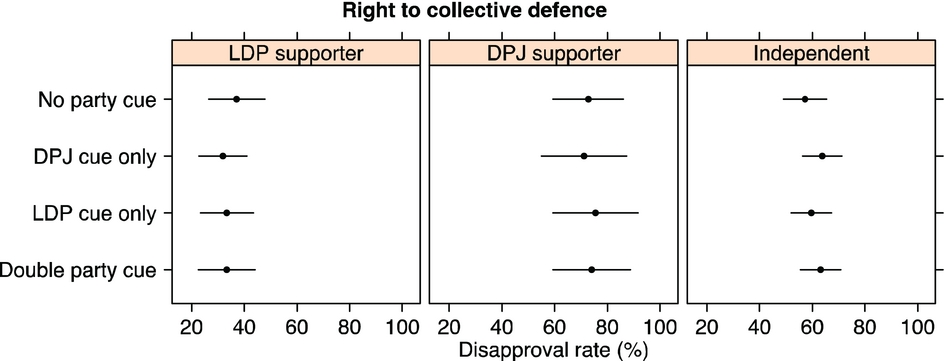
Next, to test the effect of party cues for the high-salience issue, we estimated an ordinary least-squares regression predicting post-treatment policy preferences on the right to collective self-defense using the treatment, the respondent's party identification, and their interaction term as independent variables (see Table A3 in the Supplementary Materials for the estimated model). Based on the estimated model, the point estimates and their 95% confidence intervals were plotted for each combination of the treatment and party identification (Figure 2).
Treatment effects of party cues on policy preferences with 95% CIs (high-salience issue)

On average, the LDP supporters approved the limited use of the right to collective self-defense more than the DPJ supporters did. Again, the policy preferences of independents fell between them, but were closer to those of the DPJ supporters. As expected, party identifiers yielded statistically distinguishable policy preferences for the issue with high salience even when respondents were not provided with party cues. More importantly, the comparisons between the conditions with at least one party cue and with no party cue showed no statistically distinguishable differences in means, suggesting that respondents’ policy preferences were not influenced by party cues. That is, the effect of party cues was muted for the high-salience issue.
In summary, the effect of party cues is muted regardless of the salience of policy issues, which does not replicate the findings of Samuels and Zucco (Reference Samuels and Zucco2014), who found significant effects of party cues in Brazil. It is especially noteworthy that party cues are ineffective even for the low-salience issue.
Effect of press cues
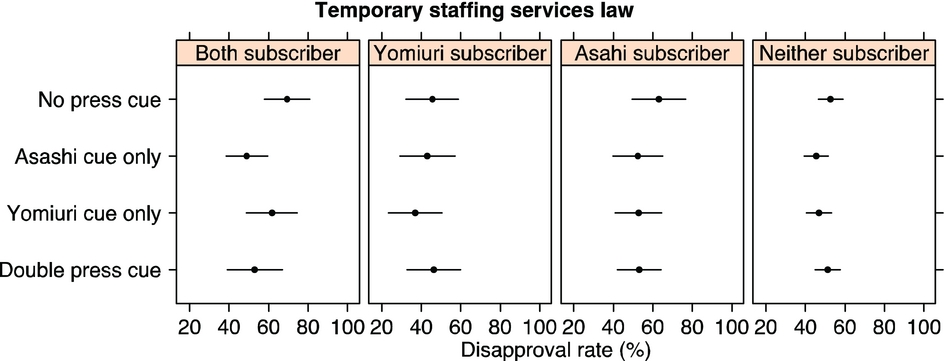
To test the effect of press cues for the low-salience issue, we estimated an ordinary least-squares regression predicting post-treatment policy preference on the temporary staffing services law with the treatment, the respondent's regular newspaper subscription, and their interaction term as independent variables (see Table A4 in the Supplementary Materials for the estimated model). Based on the estimated model, the point estimates and their 95% confidence intervals were plotted for each combination of the treatment and newspaper subscription (Figure 3). Regarding newspaper subscription, the participants were categorized into four groups: (a) those who subscribed to both Yomiuri and Asahi Shimbun (14%), (b) those who subscribed to only Yomiuri Shimbun (14%), (c) those who subscribed to only Asahi Shimbun (15%), and (d) those who did not subscribe to either Yomiuri or Asahi Shimbun (57%).Footnote 1
Treatment effects of press cues on policy preferences with 95% CIs (low-salience issue)

On average, Yomiuri subscribers approved the amendment of the temporary staffing services law more than Asahi subscribers did, which is consistent with the observation that Yomiuri Shimbun is conservative whereas Asahi Shimbun is liberal. The policy preferences of those who subscribed to neither Yomiuri nor Asahi Shimbun fell between those of Yomiuri and Asahi subscribers, and the preferences of those who subscribed to both newspapers were closer to those of Asahi subscribers. Significant differences in means between the conditions with at least one press cue and with no press cue were not found, and therefore the press cues were not effective in forming policy preferences for the low-salience issue.
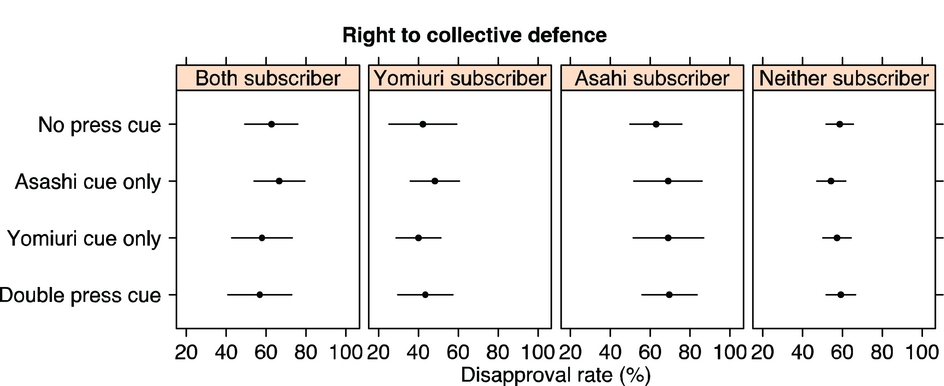
Likewise, to test the effect of press cues for the high-salience issue, we estimated an ordinary least-squares regression predicting post-treatment policy preferences on the right to collective self-defense using the treatment, the respondent's regular newspaper subscription, and their interaction term as independent variables (see Table A4 in the Supplementary Materials for the estimated model). Based on the estimated model, the point estimates and their 95% confidence intervals were plotted for each combination of the treatment and newspaper subscription (Figure 4).
Treatment effects of press cues on policy preferences with 95% CIs (high-salience issue)

Consistent with Figure 3, Yomiuri subscribers approved the limited use of the right to collective self-defense more than Asahi subscribers did. The policy preferences of those who did not subscribe to either Yomiuri or Asahi Shimbun and those who subscribed to both newspapers fell between those of Yomiuri and Asahi subscribers. As evident in Figure 4, no statistically significant differences in means between the conditions with at least one press cue and with no press cue were observed, suggesting that press cues are ineffective in forming policy preferences for high-salience issues, as was previously suggested for low-salience issues.
Discussion
The effect of party cues has been consistently demonstrated in empirical studies in the US and it is becoming one of the bedrock factors in explaining political psychology and behavior. Despite the ample evidence in the US-based studies, the generalizability of party cueing has not been examined in non-US contexts. To fill this gap, the present study investigated the effect of party cues as well as that of press cues by fielding a survey experiment in Japan, where the ideological positions of parties have become increasingly vague. The results were consistent: the role of party and press cues in forming policy preferences in Japan is severely limited. In short, party and press cues do not affect the formation of policy preferences.
We did not replicate the finding of Samuels and Zucco (Reference Samuels and Zucco2014), despite the fact that we followed their experimental design, and it is important to report these results. The scientific literature suffers publication bias when only positive results that reach arbitrarily set statistical significance levels are reported (Greenwald, Reference Greenwald1975; Coursol and Wagner, Reference Coursol and Wagner1986), which distorts our understanding of political phenomena. When statistically significant results are more likely to be published than statistically insignificant results, holding research quality fixed, the likelihood that published results reflect type I errors rather than true population parameters is increased, biasing estimated effect sizes upward (Franco et al., Reference Franco, Malhotra and Simonovits2014).
Next, we consider the possible reasons why the effect of party cues was muted, after which we discuss the implications of our findings for issue voting in Japan. We first explore the methodological issues that might have worked against detecting a significant effect. Satisficing is a serious threat to survey experiments such as the one in the present study because the participants are treated by reading the vignettes (Krosnick, Reference Krosnick1991; Maniaci and Rogge, Reference Maniaci and Rogge2014). A serious threat of satisficing also exists in Japan. Miura and Kobayashi (Reference Miura and Kobayashi2015a, Reference Miura and Kobayashi2015b, Reference Miura and Kobayashi2016) demonstrated that satisficing on the online panels of Japanese survey firms is rampant and that it distorts the results of online experiments. To address this issue, the IMC was employed in this study to exclude satisficers who do not pay due attention to vignettes. However, it is also known that the level of motivation and need for cognition is relatively high among those who pass the IMC (Oppenheimer et al., Reference Oppenheimer, Meyvis and Davidenko2009). Therefore, these participants who do not engage in satisficing could have been more likely to have deliberated upon the arguments about the policy issues and formed their preferences without relying on cues. In other words, the use of the IMC as a screener could have biased the composition of the sample in favor of those who processed the policy information through the central route rather than those who utilized cues through the peripheral route, leading to the null results.
Secondly, related to the first issue, it is possible that the description in the vignettes other than the cues could have provided the policy information necessary for the central route of processing. To maximize the comparability with Samuels and Zucco (Reference Samuels and Zucco2014), the vignettes in this study presented brief descriptions about the pros and cons of the issues. These pieces of policy information, however, might have enabled the formation of policy preferences independent of the cues even when the issue salience was low. The policy information should be particularly useful for the highly motivated participants who pass the screener, making it easier for them to form preferences without relying on cues. As Bullock (Reference Bullock2011) demonstrates, people do not rely exclusively on party cues, but rather form policy preferences by weighing both party cues and policy information. Therefore, the policy information included in the vignettes could have reduced the relative usefulness of the cues. This interpretation is consistent with the finding that the control groups without any cues could nevertheless express policy preferences in line with those of their supported parties.
Thirdly, the present study could have suffered from low power because the number of party identifiers in the sample was limited. As illustrated in Figure 1, when given the DPJ cue, the DPJ supporters became more opposed to the amendment of the temporary staffing services law, which indicates the effect of a party cue. However, this effect does not reach a statistically significant level because of the limited number of DPJ supporters. Likewise, in the analyses of press cues, those who subscribed only to Yomiuri Shimbun (n = 174) or to Asahi Shimbun (n = 168) were randomly assigned to eight conditions, which could have undermined the statistical power of the regression. Post hoc power analyses to explore this possibility demonstrated that the minimum detectable effect size (Cohen's f) of the interaction effect ranges from 0.16 to 0.17 (alpha = 0.05, power = 0.8), meaning that our design can detect small to medium effect sizes (see Cohen, Reference Cohen1992, and Faul et al., Reference Faul, Erdfelder, Lang and Buchner2007, for the post hoc power analyses). Therefore, our null results indicate that either the cueing is muted or the effect size of cueing is so small that an extremely large sample is needed to detect it. Future studies are encouraged to use larger samples, although it is difficult to recruit a large number of party identifiers or newspaper subscribers in Japan due to weak partisanship and declining newspaper subscriptions.
Last but not least, the selection of issues could have nullified the effect of the cues. Issues in this study were selected based on two criteria: distribution of attitudes toward the issue (i.e. whether opinions are evenly divided or not) and the level of uncertainty. The 50/50 criterion was employed because party cues’ information value would be diminished if there was a consensus among political parties and/or the public. Although this reasoning is in line with findings that party cues become more effective when parties, and perhaps also party identifiers, take polarized positions on an issue (Cohen, Reference Cohen2003; Druckman et al., Reference Druckman, Peterson and Slothuus2013), people's attitudes may alternatively have been relatively entrenched on divisive issues and less subject to cueing. Such controversial issues tend to be covered by media more frequently, providing greater opportunities for the public to become informed about them and hence reducing their need to rely on heuristics such as press cues (Neuman et al., Reference Neuman, Just and Crigler1992). On the other hand, although the level of uncertainty was significantly higher for the issue of the temporary service staffing law than for the issue of the right to collective defense (t(634) = 7.09, p < .001), the absolute difference was not particularly large (0.66 vs. 0.59). Therefore, there could have been far less salient issues for which party and press cues might be more effective. Alternative criteria for issue selection, such as using the proportion of ‘don't know’ responses to survey items probing participants’ attitudes about an issue, should be explored in future studies.
All these potential causes need to be carefully examined before concluding that party and press cueing are missing in Japan. Furthermore, there might be alternative cues that Japanese voters rely on heavily. In that sense, the current findings are still tentative. However, if the missing effect of cues is not a methodological artifact, the results of the current study have a remarkable implication for issue voting in Japan. Specifically, they imply that it is difficult for Japanese voters to utilize party and press cues in forming policy preferences because of the ideological indistinctiveness of Japanese politics. Using Japan Election Study data, Hirano (Reference Hirano2015) demonstrated that, across a variety of issues, more than 30% of the responses were coded as ‘Don't know’ or ‘No answer’ when respondents were prompted to estimate the issue positions of major political parties, with the only exception being the LDP's position on fiscal policy (26%). Furthermore, 20% to 30% of party identifiers were not able to indicate their supported party's issue positions. A similar finding is reported in Imai (Reference Imai2008). These findings indicate that a significant number of Japanese voters do not accurately recognize their supported parties’ issue positions, and their knowledge about other parties’ positions is even more limited. If Japanese voters do not know the issue positions of parties and if they do not or cannot utilize party and press cues, issue voting is doubly difficult for them. Although the present study did not include the measurement of participants’ knowledge of the parties’ issue positions, it would be fruitful for future studies to investigate the moderating role of knowledge in the process of party cueing.
With that said, it is important to know the limitations of party cueing. Cue taking does not always lead to correct political decision making (Kinder, Reference Kinder1998), because the minimal knowledge required to utilize cues is in many cases inaccurate. Moreover, the power of party cues dominates that of persuasive and rational arguments when the party system is polarized (Cohen, Reference Cohen2003; Druckman et al., Reference Druckman, Peterson and Slothuus2013). Therefore, although cue taking helps to form policy preferences, it does not always enhance the quality of public opinion (Druckman, Reference Druckman2014). In light of this backlash effect of cueing, the null effect of cues in Japan may reflect positive aspects of the ideological indistinctiveness of the Japanese parties, in the sense that the voters cannot blindly follow the positions of their parties. However, political cues still have great potential to provide an effective means of forming policy preferences when issues are too complex for an inattentive public. The missing effect of cues in Japan suggests that the robust effect of party cues in the US may not be straightforwardly generalizable to other political contexts. The nature of effective cues may depend on the nature of the party system, and therefore it is important to test the effectiveness of cues in cross-national contexts.
About the authors
Tetsuro Kobayashi is an associate professor of Department of Media and Communication, City University of Hong Kong. His research focuses on political communication and psychology in East Asian countries.
Tomoya Yokoyama is an assistant professor of Department of Communication and Media Studies, Rikkyo University. His research focuses on political communication and political behavior.
Supplementary material
To view supplementary material for this article, please visit https://doi.org/10.1017/S1468109917000226