A complete atrioventricular canal defect, also known as a complete atrioventricular septal defect, is an endocardial cushion defect that produces a common atrioventricular valve as well as both atrial and ventricular septal defects. This cardiac malformation leads to a left-to-right shunt, pulmonary overcirculation, and, if untreated, pulmonary hypertension and congestive heart failure. Reference Calabrò and Limongelli1,Reference Craig2 Surgical repair is typically performed between 3 and 6 months of age or when heart failure symptoms become apparent. Reference St Louis, Jodhka and Jacobs3
Traditionally, patients with complete atrioventricular canal defects have been managed medically with diuretics, afterload reduction, and supplemental enteral nutrition and oxygen in an attempt to reach general age and weight thresholds prior to repair, largely due to technical concerns about the fragility of the atrioventricular valve tissue in younger and smaller patients. Reference Reddy, McElhinney, Brook, Parry and Hanley4 Pulmonary artery banding has been used as a bridge to definitive repair in patients initially deemed poor surgical candidates. Reference Devlin, Jegatheeswaran and McCrindle5 However, delaying corrective surgery can result in pre-operative morbidity as well as more challenging post-surgical convalescence as a result of respiratory infections, failure to thrive, damage to valve tissue from thickening and distortion, and development of pulmonary vascular disease. Reference Reddy, McElhinney, Brook, Parry and Hanley4
There is currently no clear consensus in the literature regarding which preoperative factors best predict surgical outcomes following complete atrioventricular canal repair. Previous studies have correlated preoperative pulmonary hypertension, extended cardiopulmonary bypass time, low weight at surgery, and age less than 2.5 months at surgery with poor surgical outcomes, yet these correlations have not been consistent amongst studies. Reference St Louis, Jodhka and Jacobs3,Reference Dawary, Alshamdin, Alkhalaf, Alkhamis and Khouqeer6–Reference Kogon, Butler and McConnell8 Additionally, in the current era, event rates for mortality, re-operation, and significant post-operative atrioventricular valve regurgitation are low, making these low yield study end points. As a result, we aimed to study postoperative length of stay as a global indicator of postoperative complication burden, ease of recovery, and costs following complete atrioventricular canal repair. While several studies have employed descriptive statistics to study factors affecting outcomes of complete atrioventricular canal repair, few studies have performed advanced statistical analysis with a granular set of variables to correlate preoperative factors with surgical outcomes of complete atrioventricular canal repair. This study attempts to investigate the association of various risk factors, including age and weight at surgery, markers of failure to thrive, and pulmonary vascular disease, with postoperative length of stay following complete atrioventricular canal repair.
Patients and methods
Data source
Our institutional Society of Thoracic Surgeons Congenital Heart Surgery Database was used in this study. The Society of Thoracic Surgeons Congenital Heart Surgery Database contains multi-institutional preoperative, intraoperative, and outcomes data on patients undergoing congenital heart surgery from 1998 onward. In this study, only data from our institution were collected. Additional clinical data were gathered from the electronic medical record. This analysis was approved by the Duke University Institutional Review Board, and the need for patient consent was waived given the retrospective study design.
Study design
Data from the Society of Thoracic Surgeons Congenital Heart Surgery Database as well as the electronic medical record were retrospectively reviewed and statistical analysis was performed.
Patient population
The study population included infants who underwent primary complete atrioventricular canal repair between 2001 and 2020. Concomitant procedures were excluded aside from patent ductus arteriosus ligation and pulmonary artery band takedown. Of the 156 complete atrioventricular canal patients identified from our Society of Thoracic Surgeons Congenital Heart Surgery Database data, 6 were excluded. There was one duplicate patient, two major age outliers (repairs at 6-10 years old), two reoperations for residual atrioventricular septal defect and/or ventricular septal defect (no data from index procedure collected), and one reoperation for residual atrioventricular septal defect and ventricular septal defect that was also a major age outlier (repair at 34 years old). The final cohort consisted of 150 primary complete atrioventricular canal repairs.
Data collection
Preoperative patient characteristics included age at surgery, weight at surgery, sex, prematurity, race, diagnosis of chromosomal abnormality, presence of non-cardiac anatomic abnormality, degree of preoperative atrioventricular valve regurgitation, presence of patent ductus arteriosus with bidirectional flow, preoperative pulmonary artery banding, preoperative supplemental oxygen requirement, preoperative supplemental enteral nutrition requirement, preoperative use of any heart failure medications, preoperative use of sildenafil, hospital admissions prior to surgery for cardiopulmonary illness, hospitalisation at time of surgery, and year of operation.
Intraoperative patient characteristics included type of repair (one- or two-patch), cardiopulmonary bypass time, cross clamp time, and whether a patent foramen ovale was retained.
The primary outcome was postoperative length of stay. Secondary outcomes included length of postoperative mechanical ventilation, need for reintubation, length of postoperative inotrope use, need for inotropes re-initiation, postoperative cardiac arrest, need for extracorporeal membrane oxygenation postoperatively, reoperation within one year, readmission within one year for cardiopulmonary illness, degree of atrioventricular valve regurgitation at discharge, presence of residual ventricular septal defect at discharge, degree of atrioventricular valve regurgitation at one year, presence of residual ventricular septal defect at one year, and survival at one year. Given the study focus on post-operative convalescence and short-term technical outcomes, the follow-up period was truncated at 1 year for survivors, yielding a median follow-up time of 11.7 months (interquartile range 7.8–12.0 months).
Statistical analysis
Descriptive statistics were computed for preoperative, intraoperative, and postoperative variables. Shapiro–Wilk test was used to determine normality. Linear regression was used to determine patient characteristics and pre-operative variables significantly associated with continuous outcomes. Associations with survival at one year and severe regurgitation free-survival at one year were determined using Cox proportional hazards analysis. Statistical comparisons between short and long postoperative length of stay groups were performed by two-tailed Wilcoxon rank sum test for continuous variables and Pearson’s chi-square test or Fisher’s exact test for discrete variables. Bootstrap aggregation, or sampling with replacement (n = 500 resamples), was used to guide variable selection for multivariable linear regression. For model creation, postoperative length of stay was treated as a continuous variable. Statistical significance was defined as p < 0.05 for the final model and all comparisons. All statistical analyses were performed using SAS version 9.4 (SAS Institutes, Cary, NC).
Results
Preoperative factors
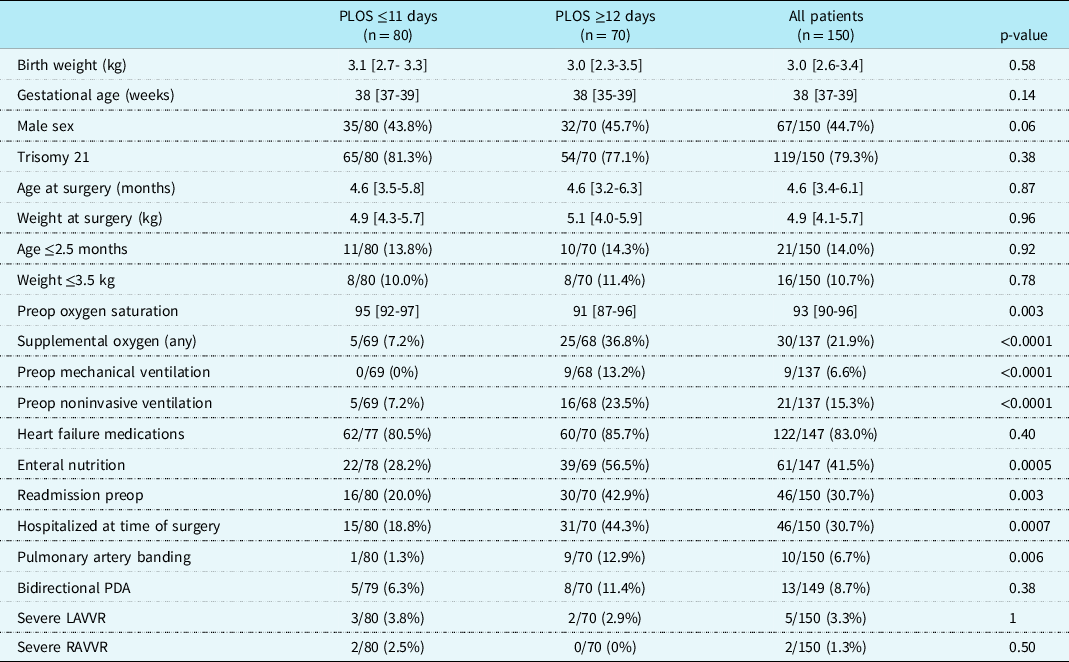
From 2001 to 2020, 150 infants underwent isolated complete atrioventricular canal repair at our institution. Median age and weight at surgery were 4.6 months old (interquartile range 3.4–6.1) and 4.9 kilograms (interquartile range 4.1–5.7), respectively. Of this cohort, 45% were male, 60% were white, 23% were premature, 79% had a diagnosis of trisomy 21, and 8% had a non-cardiac anatomic abnormality. Median oxygen saturation on the day of surgery was 93% (interquartile range 90–96%). At the time of surgery, 1% had severe right atrioventricular valve regurgitation, 3% had severe left atrioventricular valve regurgitation, 9% had a patent ductus arteriosus with bidirectional flow, 22% required preoperative supplemental oxygen, 83% required heart failure medication, 42% required enteral nutritional supplementation, and 7% had undergone prior pulmonary artery banding. Thirty-one percent had been admitted prior to surgery for cardiopulmonary illness and 31% were hospitalised at the time of surgery (Table 1).
Preoperative variables stratified by PLOS

Values expressed as median [interquartile range] or number (percent). LAVVR = left atrioventricular valve regurgitation; PDA = patent ductus arteriosus; RAVVR = right atrioventricular valve regurgitation.
Operative variables
Seventy-one percent of patients underwent two-patch repair, while 29% underwent one-patch repair (Australian or “modified” 1-patch technique). Median cardiopulmonary bypass time was 141 minutes (interquartile range 116–190). Median cross clamp time was 100 minutes (IQR 84–131). A patent foramen ovale was left in 9% of cases (Table 2).
Intraoperative variables stratified by median PLOS

Values expressed as median [interquartile range] or number (percent). PFO = patent foramen ovale.
Postoperative outcomes
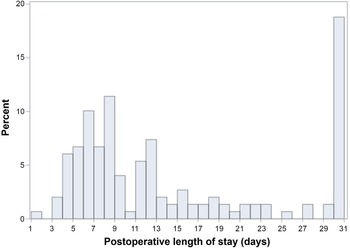
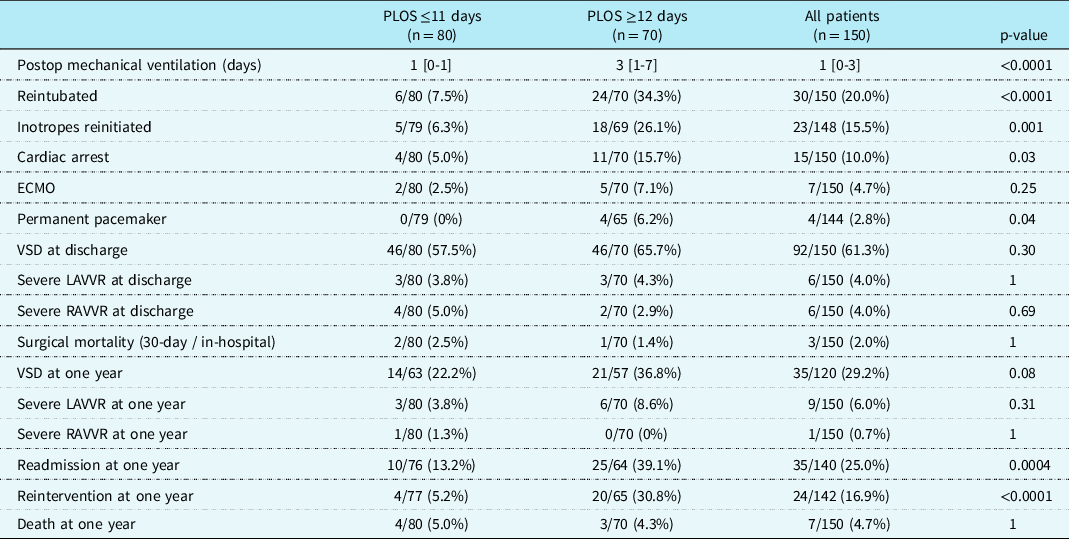
Median postoperative length of stay was 11.0 days (interquartile range 6.8–22.0) (Fig 1). Median length of mechanical ventilation was 1 day (interquartile range 0–3) and 20% required reintubation during the postoperative period. Median length of inotrope use was 2 days (interquartile range 1–4) and 16% required inotrope re-initiation. In the postoperative period, 5% required extracorporeal membrane oxygenation and 10% experienced cardiac arrest. At discharge, 4% had severe left atrioventricular valve regurgitation, 4% had severe right atrioventricular valve regurgitation, and 61% had a residual ventricular septal defect. Mortality within 30 days or prior to hospital discharge was 2%. At one year, 6% had severe left atrioventricular valve regurgitation, 0.7% had severe right atrioventricular valve regurgitation, and 29% had a residual ventricular septal defect. Twenty-five percent of patients required readmission and 17% required reintervention within one year of surgery (n = 7 mitral valve repair/replace, n = 4 permanent pacemaker, n = 4 residual ventricular septal defect closure, n = 1 subaortic stenosis repair, n = 8 other). Ninety-five percent of patients were alive one year after complete atrioventricular canal repair (Table 3).
Distribution of postoperative length of stay in days.

Postoperative variables stratified by median PLOS

Values expressed as median [interquartile range] or number (percent). ECMO = extracorporeal membrane oxygenation; LAVVR = left atrioventricular valve regurgitation; RAVVR = right atrioventricular valve regurgitation; VSD = ventricular septal defect.
Linear regression analyses performed to identify associations with postoperative length of stay did not yield any significant results for candidate covariates sex, prematurity, race, non-cardiac anomaly, chromosomal abnormality, weight on day surgery (and its non-linear transformations), age at surgery (and its non-linear transformations), use of sildenafil or heart failure medications preoperatively, need for enteral nutritional supplementation preoperatively, degree of preoperative right or left atrioventricular valve regurgitation, presence of patent ductus arteriosus with bidirectional flow, hospitalisation at time of surgery, readmission preoperatively for cardiopulmonary illness, or year of operation. Univariate analysis using age and weight at surgery as variables and postoperative mechanical ventilation, survival at one year, and severe regurgitation-free survival at one year as outcomes similarly failed to yield statistically significant results.
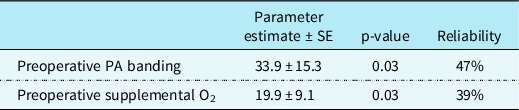
Linear regression performed using bootstrap aggregation did identify significant associations between prior pulmonary artery banding and preoperative supplemental oxygen requirement with postoperative length of stay (Table 4). Postoperative length of stay was 33.9 days longer for patients who underwent pulmonary artery banding preoperatively than for those who did not (p = 0.03). Postoperative length of stay was 19.9 days longer for patients who required preoperative supplemental oxygen than for those who did not.
Multivariable regression with bootstrap aggregation showing association between preoperative pulmonary artery banding and preoperative supplemental oxygen on PLOS

PA = pulmonary artery, SE = standard error.
When patients who underwent previous pulmonary artery banding were excluded from the data set, the only variable associated with increased postoperative length of stay was use of preoperative enteral nutrition, with a parameter estimate of 18.9 (p = 0.01). This indicates that patients who required enteral nutrition preoperatively had a postoperative length of stay 18.9 days longer than who did not.
Comment
Traditionally, age and weight have been the primary determinants dictating timing of complete atrioventricular canal repair. However, in our single-institution analysis, prior pulmonary artery banding, preoperative supplemental oxygen requirement, and preoperative enteral nutrition supplementation were associated with increased postoperative length of stay after complete atrioventricular canal repair, whereas age and weight were not. These findings suggest that operation prior to the onset of pulmonary involvement or severe heart failure symptoms may be more important than reaching pre-specified age or weight thresholds.
In an analysis of a large multicentre cohort consisting of patients in the Society of Thoracic Surgeons Congenital Heart Surgery Database, St. Louis and colleagues found that age less than 2.5 months and weight less than 3.5 kg at the time of surgery were associated with higher mortality, longer postoperative length of stay, and increased frequency of major complications. Reference St Louis, Jodhka and Jacobs3 Several other studies have specifically evaluated whether age at surgery plays a role in outcomes. Cui and colleagues found that both mortality and significant mitral regurgitation were higher in infants who underwent repair prior to 3 months of age. Reference Cui, Zhuang and Chen9 In contrast, Stellin and colleagues showed that age at surgery of greater than 3 months increased risk of hospital mortality with an odds ratio of 4.8. Reference Stellin, Vida and Milanesi10 Several other experienced centres have identified no difference in outcomes between patients who underwent operation before or after 3 months of age. Reference Reddy, McElhinney, Brook, Parry and Hanley4,Reference Singh, Warren, Reece, Ellman, Peeler and Kron11,Reference Ramgren, Nozohoor, Zindovic, Gustafsson, Hakacova and Sjögren12 There is similar variability in the literature regarding the significance of weight at time of surgery. A study by Prifti and colleagues showed an association between weight less than 5 kg at time of repair and a higher rate of late reoperation for left atrioventricular valve regurgitation. Reference Prifti, Bonacchi and Bernabei13 To the same effect, Kogon’s study found a significantly higher presence of complications with decreasing weight. Reference Kogon, Butler and McConnell8 However, other experienced centres have reported excellent results with complete atrioventricular canal repair at weight below 3.5 kg. Reference Reddy, McElhinney, Brook, Parry and Hanley4,Reference Kobayashi, Takahashi and Ando7,Reference Goutallier, Buratto and Schulz14 When compared to the aforementioned Society of Thoracic Surgeons study, the proportion of patients in our series younger than 2.5 months of age or weighing less than 3.5 kg at the time of surgery (14.0% and 10.7%, respectively) were higher than national numbers (11.8% and 6.3%, respectively). Reference St Louis, Jodhka and Jacobs3 Despite this, in our analysis, age and weight were not associated with worse outcomes, including postoperative length of stay, postoperative mechanical ventilation, severe regurgitation-free survival, or survival. This could be a result of our modest sample size, but results are similar to other single institution reports from experienced centres where satisfactory outcomes were achieved in smaller and younger patients.
Based on the results of our study, it appears the extent of pulmonary disease preoperatively plays the largest role in predicting the ease of postoperative recovery. In patients with complete atrioventricular canal defects, left to right intracardiac shunting results in increased circulation in the pulmonary vasculature, leading to pulmonary hypertension and/or congestive heart failure. In our analysis, we found that preoperative supplemental oxygen and enteral nutrition were associated with increased postoperative length of stay, suggesting that patients with symptoms of heart failure or pulmonary vascular disease at the time of repair have prolonged post-operative recovery, likely as a result of increased post-operative complications, prolonged mechanical ventilation, management of pulmonary hypertension, or slower rate of general convalescence. Ideally, complete atrioventricular canal repair should be performed prior to the onset of severe heart failure symptoms, whenever possible, to improve outcomes in these patients.
In addition to preoperative supplemental oxygen and enteral nutrition, we found that prior pulmonary artery banding was associated with increased postoperative length of stay. Along with preoperative supplemental oxygen requirement, need for pulmonary artery banding serves as a marker of the extent of pulmonary disease or as a marker of a child who is considered unfit for cardiopulmonary bypass or extensive intracardiac repair as a result of age, size, or comorbid conditions. The goal of pulmonary artery banding is to reduce blood flow to the pulmonary vasculature in patients who are symptomatic but require further medical optimisation prior to definitive repair, both to reduce heart failure symptoms and prevent irreversible pulmonary vascular changes. However, a recent study by Buratto and colleagues concluded that in children younger than three months of age, complete atrioventricular canal repair is associated with better survival than pulmonary artery banding. Importantly, there was no difference in left atrioventricular valve reoperation rates in this study. Reference Buratto, Hu and Lui15 Our analysis supports the growing literature that suggests pulmonary artery band placement may be inferior to early primary repair, in part due to an association with prolonged postoperative length of stay after staged complete atrioventricular canal repair. However, it should be noted that our study does not provide a head-to-head comparison of primary versus staged repair in matched patients and these conclusions are somewhat speculative.
Our results suggest delaying complete atrioventricular canal repair can lead to increased postoperative length of stay in some patients. These outcomes have significant implications in terms of cost of care, patient health, and emotional burden to the family. Each additional postoperative day spent on a ventilator can cost upwards of $3,539. Reference Edwards, Rivanis, Kun, Caughey and Keens16 Similar costs are associated with days spent on a ventilator preoperatively, which in some cases may have been avoided by earlier surgical intervention. Furthermore, a longer ICU stay puts the patient at physical risk for numerous complications across multiple organ systems. Specifically, atelectasis, acute respiratory distress syndrome, pulmonary oedema, and pneumonia are established complications of prolonged mechanical ventilation. Reference Phongjitsiri, Coss-Bu and Kennedy17 Finally, excessively long postoperative length of stay and mechanical ventilation days are emotionally taxing on families. Early surgical repair may reduce postoperative length of stay and by extension costs as well as patient and family suffering.
The timing of complete atrioventricular canal repair often depends on the preferences of paediatric cardiologists and cardiac surgeons at the treating institution. Our study is consistent with many prior reports which show that repair before the onset of severe heart failure and failure to thrive yields better outcomes. However, the age and weight at which the operating surgeon is comfortable performing a definitive repair are likely surgeon specific. Based on our institutional data, we currently aim to perform elective complete atrioventricular canal repair shortly after reaching a weight of 4.5 kg and 3 months of age, with the goal being to perform repair as soon as the operating surgeon believes a good technical result can be achieved, and prior to the onset of severe heart failure symptoms requiring hospitalisation. For infants who develop severe heart failure symptoms or failure to thrive before this age, we recommend inpatient hospitalisation for one week of supplemental enteral nutrition prior to repair in order to achieve nutritional optimisation and a positive nitrogen balance. For infants at the extremes of age and weight, specifically younger than 2.5 months of age or weighing less than 3.5 kg, we occasionally resort to pulmonary artery banding when other comorbidities are present, but generally as a last resort.
Limitations
Our study represents a single-institution retrospective study with several limitations, including unmeasured confounders related to patient selection, low event rates, and small sample size. In addition, the 19-year study period introduces the possibility of era effect, given many changes in medical and surgical management likely occurred over this time period. We did not include correlations with cardiac catheterisation due to limited catheterisation data, but this could be helpful in confirming our hypothesis that supplemental oxygen requirement and low oxygen saturation preoperatively are effective markers of pulmonary disease. Lung biopsy, although invasive, would be another useful way of identifying cellular and molecular alterations to the intima and media of vessels. Correlating either the pulmonary pressures and vascular resistance at time of surgery gained from catheterisation data or the extent of intimal and medial changes of pulmonary vasculature at time of surgery with outcomes of complete atrioventricular canal repair would potentially allow for more detailed investigations into underlying disease mechanisms. Additionally, multicentre, prospective studies would be informative for gathering more data about the optimal conditions for complete atrioventricular canal defect repair.
Conclusion
Our single-institution analysis shows that previous pulmonary artery banding, preoperative use of supplemental oxygen, and preoperative enteral nutrition were associated with increased postoperative length of stay after complete atrioventricular canal repair, whereas age and weight were not. These findings suggest operation prior to the onset of pulmonary involvement, heart failure symptomatology, or failure to thrive may be more important than reaching age or weight thresholds. We believe these data support efforts to pursue early complete atrioventricular canal repair in many patients, while also recognising that it is important to remain within the comfort zone of the treating team given the complexity of the surgical repair and patient management.
Acknowledgements
None.
Financial Support
This research received no specific grant from any funding agency, commercial or not-for-profit sectors.
Conflicts of interest
None.