INTRODUCTION
Since the second half of 2015, Europe has faced a substantial increase in the number of asylum seekers in need of international protectionFootnote 1 (United Nations High Commissioner for Refugees 2016). In that year, 39,064 requests for asylum were registered in Belgium, almost double the number of the year before. The European Union is in the process of establishing a Common European Asylum System (CEAS) by taking legislative measures in order to harmonize the standards for asylum (European Commission 2019). An example of such a measure is the European Asylum Procedures Directive of which article 22 requires all member states to provide applicants with legal assistance in the form of information, representation, and counselling (European Parliament & Council of the EU 2013). Legal support is viewed as the keystone to protection of asylum seekers and, therefore, the EU considers access to legal/procedural information a prerequisite to ensure a fair asylum procedure (EU Agency for Fundamental Rights 2014). The directive emphasises that the legal support should be adjusted to the asylum seeker's individual needs. Providing applicants with accessible and comprehensible legal information is largely a matter of language and how it is used. Moreover, given that encounters with asylum seekers are almost by definition multilingual in nature, the asylum seekers’ (socio)linguistic needs are closely intertwined with the provision and organisation of language support (Inghilleri & Maryns Reference Inghilleri, Maryns, Baker and Saldanha2019). The current protection directives, however, do not elucidate how to address discursive challenges and (socio)linguistic needs. It is up to the service providers themselves to accommodate information provisions to the needs of individual asylum seekers, although they do not receive any training in these aspects.
Also in the academic literature, the crucial role of language in legal support remains underexposed. To date, language research in the field of asylum law has mainly focused on language use within the asylum procedure itself, as this process heavily relies on the production of oral accounts and the textual reproduction of these accounts in reports and decisions (Barsky Reference Barsky1994; Pöllabauer Reference Pöllabauer2004; Maryns Reference Maryns2006; Tipton Reference Tipton2008; Blommaert Reference Blommaert2010). The discursive challenges that characterise lawyer-asylum seeker encounters (usually in the form of legal consultations) remain to be explored further. That this is a field worthy of further inquiry is suggested by the existing literature, which indicates that successful communication between immigration lawyers and their clients is crucial for the outcome of legal consultations and, accordingly, for the eventual asylum decision (Hambly Reference Hambly, Gill and Good2019; Smith-Khan Reference Smith-Khan2020b). Smith-Khan (Reference Smith-Khan2020a) and Reynolds (Reference Reynolds2020) do not only acknowledge the important role of the immigration lawyer, but also explicitly advocate for further research in this underexplored research domain. During legal consultations, spoken interaction is key as the lawyer and the asylum seeker discuss the case, the possible steps to take, and the eventual outcomes. These consultations involve careful consideration and negotiation of the asylum seeker's narrative and identity. In particular, the credibility of the asylum narrative can be considered a vulnerable aspect of the asylum seeker's identity (Bohmer & Shuman Reference Bohmer and Shuman2007; Smith-Khan Reference Smith-Khan2020a). The literature shows that government-imposed criteria about what kind of narrative indexes a credible refugee identity are often not within reach of asylum seekers (Vogl Reference Vogl2013; Reynolds Reference Reynolds2020) and that producing a credible account that meets institutional criteria of acceptability is a difficult task for which asylum seekers need guidance and support (Smith-Khan Reference Smith-Khan2020a,Reference Smith-Khanb).
In the Belgian context, immigration lawyers offer this support through legal assistance at different stages in the procedure: they are present at the asylum hearing with the immigration official and if their client has to testify for the asylum appeal court. However, as their role during these interviews is limited by law (cf. Legal assistance in the Belgian asylum procedure), their support is particularly important during preparatory consultations where they prepare their clients for the interview. Immigration lawyers provide assistance by means of strategies that aim to reorient the asylum seeker's experiential narrative into an institutionally acceptable one. This reorientation process implies complex management activities: it involves a re-ordering of facts by which the asylum seeker's experiences are subjected to rigorous scrutiny. This aspect of scrutiny, however, may affect the relationship of trust, where lawyers are walking a thin line between their role as advocate (who understands, supports, and sympathises with his/her client) and their role as legal professional (who adopts the critical interrogative and gatekeeping role of the asylum agencies). An additional challenge, resulting from the fact that applicants are required to present their claim in person, is that lawyers can only offer backstage assistance to their client's future narrative performance during the upcoming asylum hearing, a performance that has to meet institutional requirements of credible narration. Moreover, immigration lawyers operate in linguistically diverse contexts that require specific multilingual strategies to facilitate communication (Reynolds Reference Reynolds2020): while in some asylum consultations, more than one language is used (usually with the assistance of a professional or ad hoc interpreter), other consultations involve different varieties of the same language (often when a lingua franca is employed) or even a combination of different strategies.
This article aims to gain a better understanding of the above-mentioned challenges that characterise legal consultations with applicants for international protection. We use linguistic-ethnographic methods to unravel the complex interactional dynamics, and, in order to allow for a deeply contextualized analysis of the interactional process, we adopt a case study approach and focus on a consultation between an Afghan asylum seeker, his confidant, and his lawyer. The main purpose of the consultation is to prepare the asylum seeker for testifying at the asylum hearing for the Belgian asylum authorities. In view of this objective, the consultation implies two levels of interactional management: (i) management of the locally situated interaction between the lawyer and the asylum seeker, and (ii) the interlocutors’ projections of the management of the translocally situated interaction between the immigration official and the asylum seeker during the upcoming asylum hearing, in which the latter will be expected to tell his story and motivate his claim.
This article examines the interactional strategies used during the consultation in order to analyse how lawyers prepare their clients for the asylum hearing. We address questions about how the lawyer facilitates the narrative performance of his client and how he assists the asylum seeker in (re)shaping the refugee narrative in accordance with institutionally accepted forms of narration. The data demonstrate that in a context where credibility is at stake, implementation of these strategies is already challenging in itself. What proves even more challenging, however, is the framing and contextualisation of the strategies and objectives pursued. Limited meta-reflection on the expectations, responsibilities, and envisaged outcomes of the consultation causes confusion throughout the consultation, which further exacerbates the asylum seeker's vulnerability.
THE LEGAL PROFESSION: A COMPROMISE BETWEEN CARE AND JUSTICE
The task of professional lawyers consists of representing their clients in the best possible way. Johnson (Reference Johnson1999:206) conceptualises the traditional view of a lawyer as somebody who ‘zealously represents his clients within the bounds of the law’. Similarly, Arguedas (Reference Arguedas1996:8) argues that clients can expect that their lawyers ‘will find and use every advantage within the law’ to defend their case. Both descriptions tie in with the dominant view on the professional responsibilities of lawyers, in which representation of the client is seen as a problem-solving activity taking place within the boundaries of an objective, universal, and abstract set of rights (Zwier & Hamric Reference Zwier and Hamric1996). Barkai & Fine (Reference Barkai and Fine1982:505), as well as Westaby & Jones (Reference Westaby and Jones2018), critique this problem-solving orientation and warn against viewing law as a set of legal problems to be ‘solved like a puzzle’, ignoring the emotional dimension inevitably inherent to legal cases. Building on this idea, Zwier & Hamric (Reference Zwier and Hamric1996:383–87) propose a ‘care perspective’ to complement the common ‘justice perspective’ of lawyers. Such a care perspective values the act of listening and prioritizes the establishment of a good connection between lawyer and client (Cochran, DiPippa, & Peters Reference Cochran, DiPippa and Peters2011).
When focusing on the Flemish context, institutional texts about professional conduct similarly expose the dual professional responsibility of lawyers, viz. a counselling responsibility that is situated at the level of legal guidance, next to a more traditional problem-solving responsibility at the level of legal expertise and settlement. Article 226 of the ‘Code of ethics’ from the Flemish bar association (Orde van de Vlaamse Balies Reference Orde van de2019) juxtaposes the lawyer's duty to defend the client and his/her obligation to function as a counsellor. In a similar vein, the website of the bar association to which the lawyers who contributed to this study are related, highlights the dual nature of the lawyer's job by emphasising that lawyers have a counselling responsibility next to their problem-solving role. Both Flemish institutional texts reflect a representation model that combines care and justice. Legal representation contains two phases: a ‘learning phase’, which comprises the gathering of information, followed by a ‘doing phase’, which involves the actual ‘problem-solving’ activity (Zwier & Hamric Reference Zwier and Hamric1996; Cochran et al. Reference Cochran, DiPippa and Peters2011). The fact that the ‘doing phase’ is preceded by a ‘learning phase’ is not surprising, as facts function as building blocks of legal cases (Barkai & Fine Reference Barkai and Fine1982; Zwier & Hamric Reference Zwier and Hamric1996). Therefore, the more information a lawyer gathers, the better s/he can represent the client. It is in this process of information gathering that the counsellor-like quality of the lawyer is important, as ‘rapport’ between client and lawyer will positively affect the process of obtaining information (Cochran et al. Reference Cochran, DiPippa and Peters2011). Rapport is particularly crucial in consultations with asylum seekers, because they form a vulnerable population group often characterised by distrust. Newcomers who arrive in Belgium without knowledge of the language or culture might experience a lot of tension as they encounter a complex legal maze. Problems of trustworthiness are common here, especially because people who seek international protection, having fled persecution in their own country, often struggle with a distrust of authorities (Katzmann Reference Katzmann2008). This highlights the importance as well as the complexity of the rapport building between lawyer and client, in particular, and of the care perspective in general.
The representation model sketched here states that, when most information has been gathered, the care perspective, which is characterised by the acts of listening, building trust, and gathering information, partly makes room for a justice perspective (Zwier & Hamric Reference Zwier and Hamric1996). In this phase, the learning mode shifts towards the doing mode, and the lawyer takes over from the client and starts functioning as a spokesperson. This is where the habitus of the legal practitioner, the knowledge of the legal language, and the experience unavailable to lay people come in (Kamler & Maclean Reference Kamler and Maclean1996). The representation model with its two phases captures the job of most lawyers but is not completely applicable to the case of lawyers working in the asylum context. We explore the specific nature of the job of the immigration lawyer in more detail in the next section, by laying out the Belgian asylum procedure and the role of the lawyer in this context.
LEGAL ASSISTANCE IN THE BELGIAN ASYLUM PROCEDURE
In compliance with the European directives (cf. Introduction), Belgian law safeguards the right to legal assistance throughout the procedure. Article 90 of the Belgian Aliens’ Act (1980)Footnote 2 provides the right to legal counsel for all applicants in the asylum procedure. Moreover, the Reception Act (2007)Footnote 3 states that access to efficient legal aid should be guaranteed. Belgian legal assistance is organised in two stages: first- and second-line assistance. Both stages are completely free for asylum seekers without (or with very limited) income. The Federal Department of Justice pays legal representatives, via different judicial bodies, to provide legal advice to asylum seekers (Judicial Support Act 1998).Footnote 4 Local commissions for legal assistance organise the first-line assistance, which provides initial legal advice to people in need. When questions become more complicated, the help seeker is referred to specialised, second-line assistance. This type of assistance is organised by the Bureau of Second Line Assistance: they appoint a pro bono lawyer who counsels the asylum seeker during the procedure. It should be noted that the status of pro bono lawyers, and therefore the right to (free) legal assistance, is under great pressure, due to budget cuts and the current political situation in Belgium (Asylum Information Database 2019). The lawyer in our case study provides second-line assistance and works on a pro bono basis.
The Belgian asylum procedure has three government authorities responsible for the determination of refugee status: (a) Dienst Vreemdelingenzaken (DVZ or Immigration Department), which is responsible for the registration of asylum requests and for determining which EU member state is responsible for the application according to the Dublin regulation; (b) Commissariaat-Generaal voor Vluchtelingen en Staatlozen (CGVS or Office of the General Commissioner for Refugees and Stateless Persons), which is the central asylum authority that makes independent decisions on asylum applications and (c) Raad Voor Vreemdelingenbetwistingen (RvV or Council for Alien Law Litigation), which is the judiciary body in charge of appeals against negative asylum decisions made by CGVS.
Throughout the procedure, interviews between asylum applicants and officers about the applicant's motivation for seeking international protection occupy a central place in the assessment of the case. The role of the immigration lawyer during these interviews, however, can be described as liminal. This makes the asylum setting unique compared to other legal procedures, where the litigant's story is heard indirectly through the voice of a legal representative. In the asylum process, however, applicants must tell their story in order to be granted protection. The following explanation by Zagor (Reference Zagor, Jenkins, Nolan and Rubenstein2014:10) is illuminating here.
Under most rights regimes, there is little if any societal or legal imperative to tell one's story of human rights violations. … the survivor's voice is more often heard indirectly and informally than courtesy of an official process. By contrast, the refugee has long been in a situation where protection depends upon the telling of one's story. Whether she wants to or not, a refugee must speak.
The Belgian asylum authorities require applicants to account for themselves during the registration interview at DVZ (Royal Decree 1981)Footnote 5 as well as during the second interview at CGVS (Aliens’ Act 1980; see n. 2). During the registration interview, the presence of a lawyer is even prohibited. As pro bono lawyers are often only appointed after the registration of the application, many asylum seekers do not yet have a lawyer at this point. The first interview is exploratory and limited in time and scope: basic information about identity, about motives for fleeing, and the travel route is elicited by means of preformulated questions. During the second interview, which implies an extensive testimony and a thorough examination of the claim, the asylum seeker is allowed to be accompanied by his lawyer but the lawyer is constrained from intervening during the interview (Royal Decree 2013).Footnote 6 Nevertheless, the lawyer is allowed to consult with his client during the mandatory fifteen-minute break and to formulate some additional notes for the written record at the end of the interview (Royal Decree 2013). While the lawyer is physically co-present, s/he is only marginally involved in the interview event. Although immigration lawyers can help take care of administrative matters, draft written documents, and file appeals to fight negative decisions, it is striking how the asylum seeker's voice is foregrounded during this critical phase of the procedure. The closest the Belgian immigration lawyers come to defending/representing their client is by preparing from backstage the story that the client will be performing frontstage (Goffman Reference Goffman1959). In this way, an intermediate phase pops up between what Zwier & Hamric (Reference Zwier and Hamric1996) defined as the listening and the doing phase.
Similarly, in the US, although the American judicial context is different to the Belgian one, the immigration lawyer can be perceived to take on an assisting role instead of functioning as a spokesperson. Suzuki (Reference Suzuki2006) frames the task of the immigration lawyer as merely assisting the client's telling. Although immigration lawyers are not allowed to speak for their client, nor to ‘coach’ them in the sense of putting words in their mouth, they are able to counsel their client in developing ‘a detailed and consistent narrative from the sensory elements of memory’ (Suzuki Reference Suzuki2006:273). Ardalan (Reference Ardalan2014) similarly argues that immigration lawyers and clients can benefit from working together to create a chronologically logical story and to gather concrete evidence. Moreover, she emphasises the importance of presenting that eventual claim in a manner that is compelling to Western authorities. Lawyers tend to use specialised legal lexis, but it comes as no surprise that lay people's testimonies do not exhibit similar language practices of the law (Kamler & Maclean Reference Kamler and Maclean1996). Because of the importance of presenting the testimony in a compelling way (Ardalan Reference Ardalan2014), the lawyer facilitates the asylum seeker in translating his experiential narrative into a more formal, legal one (Bohmer & Shuman Reference Bohmer and Shuman2007; Hambly Reference Hambly, Gill and Good2019; Smith-Khan Reference Smith-Khan2020b). This translation is of an intra-lingual nature, as verbal signs are interpreted into other signs of the same language (Jakobson Reference Jakobson and Brower1959). Since a process of rewording is taking place, the lawyer's intervention does not affect the authenticity of the account. In this view, no argument can be made about the fabrication of stories (Boccaccini Reference Boccaccini2002). The asylum seeker is also encouraged to prepare and rehearse the version of the narrative developed with the assistance of the lawyer. This brings home the performative nature of the testimony (Zagor Reference Zagor, Jenkins, Nolan and Rubenstein2014) and highlights how the contributions of the lawyer are rendered invisible. This erasure of the lawyer's active input is ‘necessary’, as the legitimacy of the government's credibility assessment is dependent on the asylum seeker being the only one responsible for his refugee narrative (Smith-Khan Reference Smith-Khan2020a).
METHODOLOGY AND RESEARCH CONTEXT
This article is based on a data set of sixty-two lawyer-asylum seeker consultations collected in the autumn of 2018. The topic of all consultations can be situated within the field of migration law, with most consultations addressing requests for international protection. Lawyer-client consultations, as well as most other interactions in the field of asylum and migration, are of a sensitive and private nature and often difficult to negotiate access to (Eades Reference Eades2010; Smith-Khan Reference Smith-Khan2020a); this corpus of authentic, empirical data consequently offers unique insights. The data were gathered from five lawyers connected to the same Belgian law firm. The multilingual aspect almost inherent to migration law consultations is demonstrated by the multitude of languages in our corpus, either as a lingua franca, such as English/French, or in interpreter-mediated conversations, including Arabic, Farsi, and Tigrinya. The mediated consultations in the data set mostly feature professional interpreters but in a couple of cases ad hoc interpreting (through a family member/friend) takes place as well.
In our aim to use a methodology that provides us with ‘maximum information’, we combine different qualitative methods, including observation and recording of consultations (Cunningham Reference Cunningham1991). Following the ethnographic tradition, we feel strongly about physically being in the field during the moments of interaction. In this way, we can state that this article accounts for data that were collected and analysed ‘first hand’ by linguistic-ethnographic methods (Marcus & Fischer Reference Marcus and Fischer1999; Rampton, Tusting, Maybin, Barwell, Creese, & Lyra Reference Rampton, Tusting, Maybin, Barwell, Creese and Vally2004). As making video recordings was perceived as too intrusive for the already stressful setting and the vulnerable participant population, we sought and were granted permission to audio record the encounters. The advantage of the recorded interactional data lies in the fact that they make a fine-grained linguistic analysis possible, as transcriptions can be systematically analysed. The combined forces of the empirical field notes, on the one hand, and the linguistic analysis, on the other, result in more nuanced understandings: while the ethnographic approach opens up linguistics, the linguistic perspective ties the observational insights down (Rampton et al. Reference Rampton, Tusting, Maybin, Barwell, Creese and Vally2004; Tusting Reference Tusting2019). The micro-analysis of the everyday experience of asylum seekers and lawyers will be used as a lens to examine macro-social issues as institutional discourse practices and ideologies and to gain a better understanding of the interactional management during lawyer-asylum seeker consultations.
This article provides an in-depth case study of a consultation that clearly demonstrates the tendencies of intra-lingual translation and co-construction that are tangible in our whole corpus. The participation framework of this consultation consists of the lawyer (male, from the Flemish part of Belgium), the asylum seeker (male, from Afghanistan), and an independent individual, who functions as his confidantFootnote 7 and consultant throughout the consultation (female, from the Flemish part of Belgium). When the asylum seeker arrived in Belgium, he was considered a minor and placed in the care of a guardian. However, on the basis of an age determination procedure, the government estimated that he was twenty-three years old. His guardian, the woman we refer to as his ‘confidant’ as she cannot be considered his legal guardian any more, nevertheless offers the boy shelter and assists him throughout his legal procedure. She is not connected to the government or to an NGO and does not receive any money; she is driven by what the lawyer calls ‘humanitarian motives’. In addition to the asylum seeker, the lawyer, and the confidant, one of the researchers was present as well. All ratified participants sat around a small round table. The researcher positioned herself out of their direct view, in a corner of the room.
The consultation was conducted in Dutch, although the asylum seeker's first languages are Dari and Farsi.Footnote 8 The client's language repertoire also contains some English, as do the repertoires of the lawyer and the confidant, who are both Flemish-speaking. During his previous consultation, however, the asylum seeker was assisted by an interpreter. There is an interesting parallel here with Reynolds’ (Reference Reynolds2020) study, which looks into migration advice encounters about family reunification. In her article, she analyses two meetings with the same client of which only one contains an interpreter. The choice for the in/exclusion of an interpreter in those meetings was motivated by the communicative goals of the encounter: the objectives of the first meeting were more complex and delicate, whereas the second meeting focused on practicalities. Although the consultation discussed in our article definitely deals with a challenging topic, no interpreter was involved. Given that the client's Dutch had improved since his first consultation, the asylum seeker and his confidant decided that he would no longer need an interpreter. This dynamic is not unique to this particular consultation, it rather constitutes a recurring element in our corpus. Also in other empirical studies investigating institutional settings, the choice not to use an interpreter is often motivated by practical considerations and by language ideologies that conceptualise direct communication as more effective (Okrainec, Miller, Holcroft, Boivin, & Greenaway Reference Okrainec, Miller, Holcroft, Boivin and Greenaway2014). Reynolds’ (Reference Reynolds2020) reflections about the link between the communicative activity type and the choice for a particular discursive practice hold, however, with regard to the hearing with the authorities, the communicate event that is anticipated and prepared for in our case study. For this purpose, the lawyer did request an interpreter—something that he motivated by emphasising the importance of the encounter, by saying that ‘every letter counts’, and by adding that the client's Dutch is great, but that he probably still speaks his mother tongue better.
As no interpreter is involved, the consultation takes place in an interactional ‘space of multilingualism’ (Blommaert, Collins, & Slembrouck Reference Blommaert, Collins and Slembrouck2005), in which an ‘ideology of linguistic inclusion’ (Reynolds Reference Reynolds2020:6) is at work. The participants are open to communicative flexibility: all kinds of communicative resources are welcomed (Dutch, English, written documents) in order to reach mutual understanding and facilitate successful communication (Reynolds Reference Reynolds2020). Nevertheless, as the data analysis demonstrates, the participants inevitably face linguistic and interactional challenges.
The asylum seeker has lived in Belgium since 2015. Since his arrival, he has submitted two asylum applications. His first request for asylum was rejected because the CGVS suspected that he did not tell the truth about his travel trajectory. In following advice of friends from the Afghan community,Footnote 9 the asylum seeker did not disclose the fact that he stayed in a particular city. The asylum seeker then received a negative decision. The lawyer, made aware of the withheld information, decided not to appeal the negative decision, but instead start a second, independent application for asylum. Unlike other jurisdictions, the Belgian government can grant asylum applicants a so-called ‘subsequent application’, if they can provide new, persuasive elements (here: a place of residence), and if they can explain why they lied in their previous interview (here: because of rumours, misinformation, and fear, see n. 9). The authorities declared the ‘subsequent application’ of the asylum seeker to be admissible, and consequently, the date for a new interview at CGVS was set. The analysed consultation has the objective of preparing the asylum seeker for this second CGVS interview. Any reference made to the asylum seeker's familiarity with the set-up of the interview refers to the CGVS interview conducted during his first application.
MANAGING NARRATIVES, MANAGING IDENTITIES
The data analysis in this section focuses on (i) the reorientation of the asylum narrative from an authentic-experiential towards a more objectified formal-institutional account, (ii) the participants’ positioning work that indexes this reorientation process, and (iii) their fluctuating alignment of local- interactional and translocal-gatekeeping perspectives. In what follows, we provide three data excerpts, each followed by a micro-analysis that points out linguistic patterns as well as critical sections and rich points (Copland & Creese Reference Copland and Creese2015). The data are presented in a chronological way, and the line-by-line analysis—which includes a translation of the original Dutch turns into English—provides the reader with insight into the sequential structure of the consultation. All proper names have been replaced by pseudonyms in order to guarantee anonymity. We also refrain from using specific place names or dates for the same purpose.
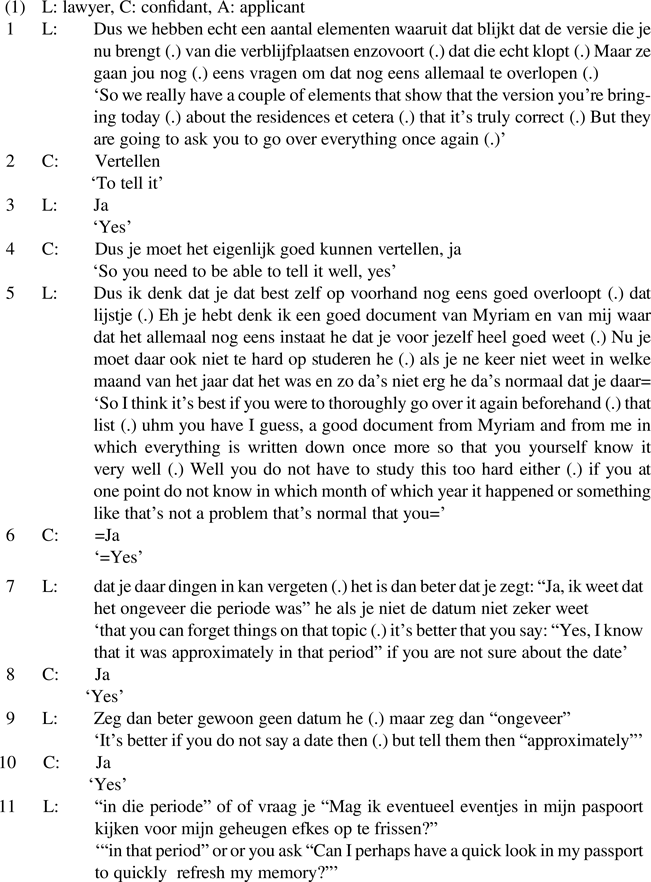
Excerpt (1) can be situated at the beginning of the consultation. After having discussed the possibilities for material support with the applicant (A) and the confidant (C), the lawyer (L) briefly explains how the asylum interview will proceed. He also formulates advice on how to prepare adequately for the interview.Footnote 10

Excerpt (1) deals with the key element in the asylum application, viz. the truth about the asylum seeker's residential trajectory. The applicant has to produce a truthful and credible account of his whereabouts from the moment he left his home in Afghanistan until his arrival in Belgium. Nevertheless, however truthful his account may be, the performance of this truth and the assessment of this performance as a ‘credibly voiced’ testimony by the asylum authorities raises multiple challenges (McKinnon Reference McKinnon2009:216). The performance of credibility is marked by a series of tensions: (a) between monitoring and gatekeeping perspectives, (b) between written text and oral performance, (c) between backstage and frontstage voices, and (d) between experiential and factual modes of narration. Micro-analysis of excerpt (1) demonstrates how these tensions are also reflected in the way the lawyer prepares his client for the hearing.
In turn 1, the lawyer starts by making a distinction between ‘we’ (the lawyer and the confidant who provide assistance) and ‘they’ (the asylum authorities who decide on the case). This ‘us-versus-them’ way of positioning serves different purposes simultaneously: it enables the lawyer to establish a relationship of trust with his client, while making clear that his client should not expect to receive the same trust from the asylum authorities. Whereas the lawyer/confidant are convinced of the veracity of the facts about the applicant's residence (“we truly have a number of elements”, “that (this version) is really correct”), the authorities are expected to adopt a more interrogatory role (“they will ask you once more…”). This tension between supportive-monitoring and gatekeeping perspectives lies at the basis of the lawyer's advisory discourse throughout the consultation. Still, it is not clear to what extent this distinction in perspectives is picked up by the applicant. After all, no explicit reference to the asylum authorities is made here. Later on in the consultation, it becomes clear that the lawyer's positioning work is confusing the applicant. The presence of the confidant does not alleviate this confusion, but rather seems to exacerbate the ambiguity about interactional relationships.
Another possible source of confusion for the applicant is the tension between written text and oral performance. At several points, the lawyer makes reference to a written account of the applicant's spatial trajectory, which is referred to as “that list” and “a good document” (turn 5). This record was produced in an earlier consultation by the lawyer on the basis of corroborating evidence, and in close collaboration with the applicant and his confidant. This document, which entails a timeline of the applicant's whereabouts, has a twofold function. First, the lawyer provides this list, accompanied by other written documents such as the applicant's passport, to the authorities as part of the application. By providing written evidence, the lawyer exerts direct control over part of the application; this impact can be considered prominent because research has shown that the asylum procedure highly values written evidence (Maryns Reference Maryns2006). Second, the applicant is supposed to study the ‘list’, as the overview document can help provide structure to the applicant's narrative of escape, like a script the applicant can rely on when preparing for the interview. In this regard, the ‘list’ entails an opportunity as well as a risk. On the one hand, the document helps the applicant prepare a plausible account, but on the other, the applicant should take into account that the government can check his oral testimony against the written list that the lawyer provided as evidence. In order to be deemed credible, the applicant's story has to be ‘internally consistent’, because, although the lawyer was prominently involved in preparing this written evidence, the asylum procedure considers the applicant as the sole author of the text. No matter how accurate this script may be, the credibility of the facts has to be orally performed during the asylum interview and this performance lies solely in the hands of the applicant. While the lawyer and the confidant can provide backstage support in the form of drafting a script or staging an asylum interview and anticipating the possible pitfalls, ultimately it is up to the applicant to represent his own case frontstage, preferably in a way that is ‘coherent, plausible, not contradicting generally known facts’ and therefore ‘on balance, capable of being believed’ (United Nations High Commissioner for Refugees 1998:3,’; Maryns Reference Maryns2006; Smith-Khan Reference Smith-Khan2017). The data suggest that the experiential story the applicant might be prone to tell, if he does not ‘study’ the list, does not meet these criteria. The lawyer, in other words, seems to attach greater value and credibility to the list, a written document composed to help the applicant structure his narrative, than to the applicant's oral testimony. In this way, the lawyer can be seen to stimulate the applicant to produce and perform an autobiography that matches the official record of dates and events (Hall & Rossmanith Reference Hall and Rossmanith2016).
In addition to giving advice, the lawyer's backstage support also involves anticipating a hypothetical interview scenario where he instructs the applicant on how to speak during the interview. At a meta-linguistic level, it is interesting to see how the lawyer offers ready-made formulations (turns 7 and 9: “It's better that you say/if you do not say”). The lawyer's direct speech in these turns animates the hypothetical voice of the applicant during the asylum interview (Goffman Reference Goffman1981; Maryns Reference Maryns, Heffer, Rock and Conley2013).
The transformation of the experiential testimony into an institutionally valid narrative is clear in this excerpt. However, using the term narrative can be confusing. After all, the applicant's narrative is clearly shaped in the direction of what is institutionally accepted: spoken testimony consistent with/supported by hard evidence. This probably also explains why the lawyer uses the verb overlopen (‘going over’, ‘browsing’, or ‘scrolling’ through the script, in turns 1 and 5). The confidant, aware of the linguistically challenging character of the term, takes it upon herself to clarify overlopen (turn 2) by providing the applicant with the more common word vertellen (‘to tell’, ‘to narrate’). However, overlopen and vertellen cannot be considered synonyms. On the contrary, the use of vertellen in this context goes against the lawyer's purpose of familiarising the applicant with the institutionally expected way of ‘going through’ the facts, dates, and places. The lawyer first confirms the confidant's intervention turn 3 probably as a face-saving strategy, but then resumes emphasising the importance of the script (turn 5). In this respect, one could argue that the presence of the confidant causes confusion about the interactional goals of the asylum hearing. Strikingly, it is exactly this tension between the suggestion of narrative choice, of an opportunity to tell their ‘story’, and the underlying expectation of a factual reconstruction of the events in the form of a report (Trinch Reference Trinch2001) or a legal case (Zagor Reference Zagor, Jenkins, Nolan and Rubenstein2014) that often causes confusion during asylum interviews. Asylum seekers are invited to ‘tell their story’ but are ultimately assessed on ‘textualist’ criteria of consistency and detail (Maryns Reference Maryns2006). To be deemed credible, applicants are expected to function as the sole author of their own refugee narrative (Smith-Khan Reference Smith-Khan2020a), yet the authorities require them to formulate their claims in a manner that is almost unattainable without the help of legal professionals.
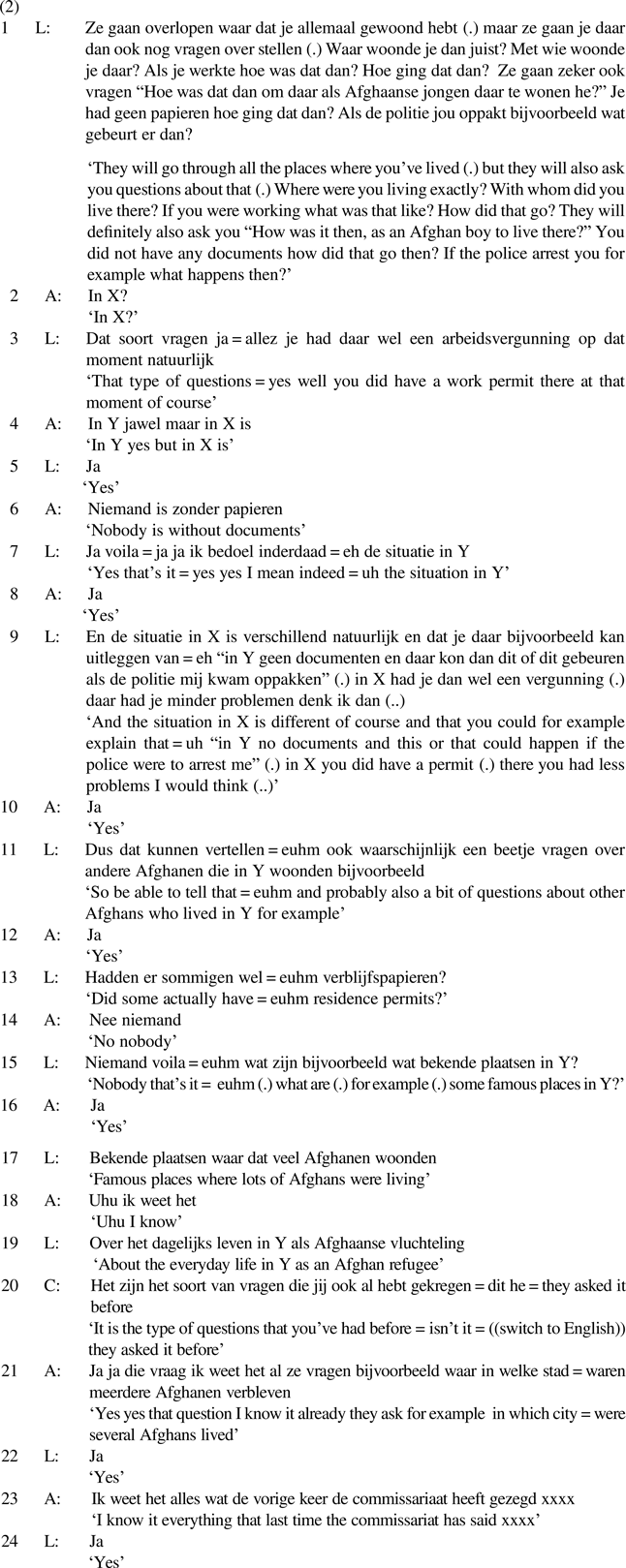
Excerpt (2) occurs a few minutes later in the consultation. The lawyer continues to focus on the applicant's migration history, which involved a constant movement between Afghanistan and three other non-European countries and eventually his arrival in Europe (X stands for ‘a city in non-EU country 1’; Y for ‘non-EU country 2’). The lawyer's perspective on the matter has slightly changed: whereas in excerpt (1), he was advising the applicant on how to structure his account on the basis of a script that could help meet institutional criteria, the lawyer switches to the perspective of the asylum authorities in excerpt (2), where he anticipates the type of questions the applicant can expect during the upcoming hearing.

At this stage in the consultation, the lawyer switches to the perspective of the asylum authorities. He adopts a particular strategy by which he anticipates the kind of probing questions that are typically used in asylum interviews, thereby preparing his client for a detailed scrutiny of his account. These questions are not meant to be answered directly by the applicant but serve as a demonstration of what the asylum seeker is likely to be subjected to during his upcoming interview at the CGVS. The lawyer repeatedly uses ‘for example’ (bijvoorbeeld in Dutch) to frame these questions as ‘sample questions’. When supplying these potential questions, a shift in footing takes place: the lawyer is now speaking on behalf of the authorities. In Goffmanian terms, the lawyer can still be considered the animator and the author of his own words but the asylum authorities now function as the principal of the expressed sentiments (Goffman Reference Goffman1981). The lawyer repeatedly emphasises that they (meaning the authorities) will ask these questions but the applicant does not seem to pick up on the intended attribution of the lawyer's words. The fact that the positioning work of the lawyer appears to confuse the applicant speaks from turn 2, in which the applicant tries to provide an answer to the lawyer's questions. This suggests that the applicant regards the questions as part of an interrogation by his lawyer (locally), rather than as a rhetorical illustration of the upcoming asylum hearing (translocally). To some extent, the lawyer goes along with the applicant's line of reasoning (turns 3 and 9), which probably confuses the applicant even more. In turn 7, the lawyer uses the I pronoun and in this way it becomes unclear whether the lawyer is still speaking on behalf of the authorities or whether he can now be considered the principal of his own words. But then again, he switches to a more ‘generic’ perspective, by which he anticipates potential questions about the Afghan community in Y (turns 11 and 15) and even potential answers. Still, the applicant keeps supplying concrete answers to what are in fact rhetorical questions (turns 13 and 14). Interestingly in turn 15, the lawyer switches to a different type of questioning that is no longer related to the personal situation of the applicant. This question about ‘popular places in your country of residence’ is instantly reminiscent of the ‘knowledge questions’ used in asylum hearings (Maryns Reference Maryns2006; Kagan Reference Kagan2010), that is, questions that test knowledge of country-related facts as part of the assessment of an applicant's credibility. At this point, the applicant, helped by his confidant, can make the link with his previous interview at the CGVS, and this helps him to better frame the lawyer's questions—he even adopts the use of ‘for example’ in turn 21.
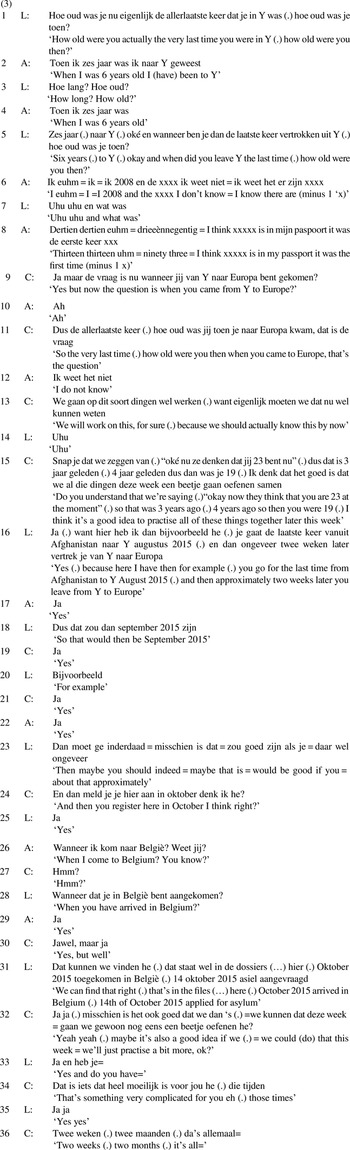
Now that the lawyer has demonstrated the kind of probing questions the asylum seeker can expect in his upcoming asylum interview, he switches to yet another type of questioning in excerpt (3). These questions are no longer framed as sample questions and, in contrast to the previous questions, the lawyer now clearly expects answers.

A seemingly straightforward question for the lawyer—how old were you the very last time you were in Y? (turn 1)—causes confusion for the applicant. This is partly due to the way the question is phrased in Dutch. In particular, the lawyer's use of the ‘empty’ verb ‘to be’ (“the last time you were in”) causes confusion here: while the lawyer uses this time indication as a way of saying ‘just before you left Y’ (simple past of ‘to be’ in the sense of ‘leaving’), it is interpreted by the applicant as ‘when I have been to Y’ (present perfect of ‘to be’ in the sense of ‘arriving’). The lawyer's additional questions (“how long? how old?”) leave too much meaning implicit for the applicant to answer (“how long have you been there/how old were you when you left?”). The lawyer then rephrases his question in a more direct way (“the last time you left Y, how old were you then?”). As the applicant still cannot answer, the confidant takes over with yet another reformulation: “how old were you when you came to Europe?” (turns 9–11). All of this rewording and clarification leads to a situation in which the applicant is faced with a barrage of questions in a way that resembles the interrogatory style of the asylum authorities. His answers are fragmented and his increasing uncertainty is also supported by his nonverbal behaviour: he seems visibly nervous, a behaviour he did not expose earlier on in the consultation, when he was briefed about the procedure.
This shows how a shift in footing towards the perspective of the authorities poses a threat to the relationship between lawyer and client. The shift seems to undermine the rapport that the lawyer so carefully built up during the ‘listening phase’ of information gathering. This dynamic might be informed by different factors. First, the applicant might feel threatened because of the direct interrogation style, reminiscent of the gatekeeping behaviour of the actual asylum officials. Second, it is also plausible that the applicant feels uncomfortable, because the relationship of trust and cooperation urges him to satisfy the lawyer's questions, something he is unable to do. Another element that probably informs the applicant's behaviour is the delicate question about age: the applicant considered himself seventeen years old when he arrived in Belgium. Since the age determination procedure, the government believes him to be twenty-three instead. Although such age determinations are anything but irrefutable (United Nations High Commissioner for Refugees 2015), this anomaly might also be explained by the fact that chronological details are highly valued cultural elements in Western societies, but something which Afghan individuals typically do not attach importance to (Smith-Khan Reference Smith-Khan2017). In turns 34–36, the confidant reflects on the way in which the applicant has difficulties to meet the institutional criteria about chronology, as he experiences time in a way that Western adjudicators might conceptualise as blurry (or even suspicious). Regardless of what the applicant's ‘true age’ is, questions like the ones formulated in the excerpt above, require him to (re)calculate his age, starting from the ‘legally agreed-upon fact’ of twenty-three being his current age (Hall & Rossmanith Reference Hall and Rossmanith2016:39).
Although it certainly impacts the established rapport, this shift to a more interrogatory style can be considered a necessary step in preparing the applicant for his interview. The fact that the applicant is not able to answer questions about his own migration history sets the alarm bells ringing: it becomes clear now that the applicant cannot survive the scrutiny and strict requirements set by the asylum agencies. The confidant is committed to take the necessary steps to remedy the situation, by gathering information and clarifying details as part of the ‘learning phase’ and by reflecting on the process of deciphering/memorizing the timeline as a shared challenge. What follows is an interesting negotiation about what counts as institutionally established information and what needs to be filled in by the applicant. The confidant tries to explain what kind of reasoning is required at this stage: an effective reconstruction of the applicant's migration trajectory must be based on the ‘given facts’ as established by the authorities, viz. the age of the applicant (with reference to the age assessment test) and the day he registered his application in Belgium. These elements must serve as reference points in the reconstruction of his personal timeline. The rigidity of this administrative reality—the institutional record as a framework for the applicant's personal experiences—is in sharp contrast with the applicant's uncertainty about structuring his trajectory as well as with the advice the lawyer formulated in excerpt (1) about how the asylum seeker should only provide the level of specificity that he can actually remember. Excerpt (3) highlights how ‘remembering’ does not refer to recalling what actually happened, as much as it refers to reproducing memorised, highly specific facts. It is only through guidance of the lawyer (with the help of the confidant), that the applicant is able to construct a consistent, coherent, and factual story.
The confidant's remark that this is a difficult exercise for the applicant and therefore one that requires practice (turn 15) brings home the performative aspect of the testimony. Yet, the way in which the confidant and the lawyer immediately start calculating dates on behalf of the applicant demonstrates how the immediate required action is more about researching and identifying the facts that he will need to recite. It is striking that also at this stage, the lawyer's contribution is not so much about the correctness of the facts (reflected in his use of ‘for example’ and his use of the conditional “that would be September 2015”) but rather about demonstrating the kind of reasoning needed to ensure a credible reconstruction of his client's trajectory. The way the applicant addresses the lawyer in turn 26, however, suggests that they have different expectations of the consultation: the applicant puts the reconstruction of his case entirely in the hands of his lawyer and his confidant, who have the knowledge to deal with the asylum authorities. The lawyer, by contrast, espouses an ideology of ‘shared responsibility’ (Felstiner & Sarat Reference Felstiner and Sarat1992:1471) and sees it as his task to offer support at a meta-level, by instructing his client on how to perform an acceptable asylum account, while leaving the actual implementation of his advice—filling in the details of the case (the what)—in the hands of the applicant (and his confidant). After all, given that the lawyer will not be entitled to take up the role of spokesperson in the upcoming asylum interview, the applicant himself should be capable of presenting the elements of his application in a testimony that is supported by factual evidence. This approach also safeguards the authenticity of the testimony, as the lawyer does not preformulate the narrative (the what).
COMPETING VOICES AND AMBIVALENCE ABOUT ROLES AND RESPONSIBILITIES
Throughout the consultation, the lawyer has a strategic approach to managing the asylum seeker's narrative. This approach is founded on the lawyer's past experiences with asylum institutions and government officials (Hambly Reference Hambly, Gill and Good2019). Informed by ‘superior knowledge of the institution's procedures and expectations’ (Smith-Khan Reference Smith-Khan2020b:3), the lawyer fosters a strong idea of what a successful refugee testimony looks like. As is clear from the analysis, a particular language ideology is being articulated which rates a detailed, chronological, and consistent account as more credible than an experiential, fragmentary story (Maryns Reference Maryns2006; Zagor Reference Zagor, Jenkins, Nolan and Rubenstein2014). The lawyer also acts on the knowledge that, regardless of how truthful the asylum account might be, there is a performative dimension at stake as well; in order to receive a positive decision, the testimony has to be voiced credibly and authentically. The lawyer's language ideology goes hand in hand with a professional ideology that envisions his task as offering backstage assistance to the asylum seeker's upcoming front stage performance.
As a consequence, the discursive moves of the lawyer are goal-oriented and deliberative (Hayes & Houston Reference Hayes and Houston2006), and aim to reorient the asylum narrative without preformulating any of its building blocks. The co-construction of the asylum narrative that takes place during the legal consultation is motivated by the ideologies described above. The lawyer's positioning work, that is, the way in which he shifts his footing and, alternately, aligns with the client's and the authorities’ perspective, is meant to create rapport, on the one hand, and familiarise the client with the institutional expectations of the gatekeeping system on the other. Similarly, the lawyer's dependence on written documents and factual elements is rooted in his language beliefs as well. In other words, the practice of the lawyer and the ways in which he facilitates the client's upcoming frontstage performance, are informed by ideologies of what counts as plausible and credible evidence in the asylum determination procedure.
The lawyer's beliefs, ideologies, and discursive practices reflect the role and the responsibilities he is taking on. As discussed in the data analysis, the lawyer's discursive moves evoke a tension between supportive-monitoring and gatekeeping perspectives. In giving advice, the lawyer can be seen to align with the perspective of the asylum seeker. These ‘linguistic acts of advocacy’ (Trinch Reference Trinch2001:480–81), however, are followed by shifts in footing, as the lawyer interferes in the asylum seeker's narrative performance to make it comply with institutional, narrative expectations (Vogl Reference Vogl2013) and thereby aligns with the gatekeeping role of the authorities. The data analysis made clear that this balance between both roles is delicate. The enactment of the gatekeeping role can be seen to threaten the rapport between lawyer and client. It is no surprise that the lawyer's ‘repackaging’ of the asylum seeker's story communicates a power imbalance as well as a dissatisfaction with the client's authentic narrative products (Trinch Reference Trinch2001). The data show how the lawyer's role ambiguity seems to confuse and upset the asylum seeker. One could argue that, although a preoccupation with authenticity is a valid concern, there is still a lot of scope for the lawyer to inform his client about his strategic approach to the consultation, without having to put words into his mouth. The lawyer can, for example, explain that a narrative reorientation has to take place, without literally spelling out what the client's reoriented narrative should look like. The division of responsibility similarly remains unclear to the asylum seeker. Whereas the lawyer aims to co-construct the asylum narrative together with the client and his confidant, the client himself seems to perceive this less as a shared responsibility. It becomes apparent from the way they prepare for the asylum hearing that the asylum seeker and the lawyer foster competing ideologies of what constitutes credible performance in the procedure. Throughout the consultation, the participants seem to pursue separate and at some points even competing avenues.
It is illuminating to look at this dynamic from a Habermasian point of view, analysing the legal consultation in terms of two distinct voices: the voice of system (the legal world, with its gatekeeping procedures, for which the lawyer speaks) and the voice of lifeworldFootnote 11 (‘the social world of the client beset with urgent emotional demands’; Felstiner & Sarat Reference Felstiner and Sarat1992:1454; Habermas Reference Habermas1996; see also Mishler Reference Mishler1984 as the terminology was first applied to doctor-patient consultations). The negotiation between lawyer and asylum seeker in the data demonstrates how the voice of system is colonizing the voice of lifeworld (Hayes & Houston Reference Hayes and Houston2006). The voice of law is privileged as ‘lawyer-client interaction always occurs in the space of law’ (Felstiner & Sarat Reference Felstiner and Sarat1992:1457). In other words, the lawyer's mystification of the motives behind the conversational direction strengthens his position of dominance, whereas it leaves the client powerless and confused (Bogoch Reference Bogoch1994).
It could be argued that this tension between different avenues or voices can in the first place be attributed to the linguistic diversity that characterises the consultation. It became apparent from the consultation how the use of a lingua franca (as used in Firth Reference Firth1996) interferes with the lawyer's attempts at thorough communication and qualitative legal support. This raises questions about the way in which the idea of using an interpreter in the given context was easily dismissed. In situations like these, where alternative multilingual solutions are used instead of professional language support, more meta-communicative effort may be required to sufficiently explicate intended meanings and interactional purposes. Following Reynolds (Reference Reynolds2020), we believe that legal practice would benefit from lawyers being mindful of how understanding has to be negotiated at different levels of meaning, taking into account the participants’ heterogeneous linguistic resources but also considering procedural, specialist knowledge, and interactional routines. This call for meta-communication is not only necessary to enhance mutual understanding of what is being said, but also to invoke adequate context about the finality of the consultation. In other words, transparency about what is being communicated and whether it is understood is closely interrelated with transparency about the interactional goals of the institutional encounter. The lawyer and the asylum seeker in the data could be seen to fulfil complementary roles, but it was not made sufficiently explicit how exactly these different roles and responsibilities were allocated. Arguably, more meta-communicative reflection could result in a better alignment of the lawyer's voice of system and the asylum seeker's voice of lifeworld (Hayes & Houston Reference Hayes and Houston2006), which may benefit lawyer-client rapport as well as the quality of legal assistance. Drawing on Heydon & Lai's work (Reference Heydon and Lai2013), which investigates interpreting practice in the context of police interviews, we argue that, whether with or without an interpreter, clarifying the goals of the interaction by giving instructions and ‘verbalising strategies’ might help empower lay participants, without interfering with the overall objective of presenting an ‘authentic’ story during the asylum hearing. We therefore argue that enhancing the quality of legal consultations where multiple discursive challenges are faced, requires increased meta-communicative awareness among lawyers to elucidate institutional knowledge that is not necessarily shared by their clients.
CONCLUDING REMARKS
Based on linguistic-ethnographic data collected at a law firm in the Flemish part of Belgium, this article has analysed the dynamics of interactional management and narrative co-construction in lawyer-asylum seeker interaction. As Belgian law does not allow lawyers to function as spokesperson for their clients in asylum interviews, asylum seekers have to speak for themselves during the asylum hearing. This provision affects the nature of the job of immigration lawyers as it pushes them into a backstage role. In what follows, we present three conclusions that emanated from the data analysis. These concluding remarks touch upon the constructed nature of credibility, the prominent role that language plays during legal consultations, and the importance of equal access to legal assistance.
First, analysing lawyers’ contributions to asylum claim preparation demonstrates how credibility assessments aiming to measure asylum seekers’ truthfulness based on ‘their’ accounts are disingenuous and unfair because of the co-constructed and contextually constrained and dictated nature of the narratives. The authorities treat refugee narratives as if they are produced in isolation and solely controlled by the asylum seeker (as described in Smith-Khan Reference Smith-Khan2020a), but our empirical data show how this assumption is incorrect and how narratives are inevitably shaped by the institutional structure in which they come into being. Asylum seekers are repeatedly instructed to tell the truth, but their authentic story is often not acceptable for the asylum authorities. In many cases, the asylum seeker's truth, anchored in lived experiences, cannot stand as a credible account in the legal-institutional context. Therefore, asylum seekers are dependent on the support of others in the construction of their refugee identity. Since most of the lawyers’ contribution happens backstage, the extent of their influence can be characterised as underappreciated, unacknowledged, or in some cases even invisible.
Second, data analysis highlights how much the lawyer's counselling work depends on language. The impact of language in social service encounters with migrants is apparent in multilingual consultations where either an interpreter or a lingua franca are being used. Yet, as the data clearly demonstrate, the significance of language and communication for legal professionals goes well beyond the multilingual dimension and also includes other discursive strategies. As the discussion section has shown, the lawyer's discursive practices are informed by his ideologies, but at the same time also influence the roles and the responsibilities he takes on. The combination of unresolved misunderstandings due to multilingual challenges and the confusion sparked by role ambiguity, incites us to emphasise how the negotiation of understanding takes place at various levels of meaning (Reynolds Reference Reynolds2020) and to highlight the need for meta-communication (in the form of verbalising the purpose of the interaction) in legal counselling settings that deal with asylum.
Finally, the data also demonstrate how crucial the role of legal assistance is in the construction of an asylum narrative that meets the government-imposed criteria. An issue of concern that emerges from this observation is the inequality of access to legal assistance. As explained earlier, the Belgian state guarantees the right to a pro bono lawyer for applicants without sufficient resources. The lawyers who contributed to our research project all work for law firms that specialise in migration law and offer optimal legal assistance on a pro bono basis to a select number of applicants. However, pro bono lawyers are currently under high pressure due to budget cuts and this inevitably affects the quality of legal support (Asylum Information Database 2019). Consequently, as the asylum seeker's chance of success depends heavily on the legal adviser to whom s/he is assigned, such measures scaling back pro bono support affect assistance to the most vulnerable. This development also widens the gap between applicants who do and who do not have access to quality legal support.
To conclude, this article has foregrounded how crucial it is for an asylum seeker to have adequate legal support during the asylum procedure. This kind of guidance starts from a firm awareness of the fact that the government-imposed criteria about what kind of narrative indexes the refugee identity, are not within reach of clients. It also acknowledges that bridging this gap involves a linguistically challenging co-construction and reorientation process in which the lawyer ends up managing the asylum seeker's narrative and identity construction.