The link between financial development and economic growth has been a matter of great interest to many economists and economic historians. While it is widely agreed that a correlation between the two variables exists, there is no general consensus on the direction of the causal mechanism. Those who believe that financial development leads to economic growth argue that financial markets and institutions help firms to overcome problems of moral hazard and adverse selection, therefore making external finance cheaper and allowing the reallocation of capital to the best investment opportunities.Footnote 2 However, when these institutions and markets are not fully developed, other mechanisms may do the job: individuals, households or other enterprises can substitute specialist financial intermediaries. Informal credit can be the best option to solve information and enforcement problems in some circumstances and environments, especially where borrowers have no collateral or when the legal system is inadequate. A special case of this is trade credit, namely the credit provided by suppliers to firms. Although there is a level of disagreement over whether trade credit is a form of informal credit, it is generally agreed that the two share certain common elements.Footnote 3
This article centres on a historical case of trade credit: the credit supplied by cotton manufacturers to their customers in nineteenth-century Spain. Since the beginning of the twentieth century, several Spanish authors have studied how different nineteenth-century Catalan cotton manufacturers commercialised their goods, contrasting this process with British manufacturing. While the British could rely on a strong commercial sector, the Catalans had to build commercial structures on their own and to invest time and resources in marketing their goods.Footnote 4 Some differences also existed concerning the financial aspects of selling. All British sales were backed by a bill of exchange so that whatever the term of payment was, manufacturers could transfer this credit to a banker who would discount the bill. Thus it can be seen that banks financed the working capital involved in the selling process. In contrast to the British system, Spanish manufacturers' clients would not accept such an endorsed compromise of payment and, as a consequence, manufacturers could not transfer their credit to the banks. Therefore, all the credit clients received was given by manufacturers themselves, with no help from the financial system.
The high level of commercial and financial involvement of manufacturers has been viewed by most authors as an encumbrance, as something that made manufacturers' business more difficult and less profitable. In this article we concentrate on the financial aspects of the problem. If we analyse the case of the Catalan cotton manufacturers from the perspective of trade credit literature, the situation is less dramatic and less exceptional.
Trade credit exists nowadays in both developed and developing countries. Several theories have been advanced to explain why firms borrow from their suppliers rather than from financial intermediaries.Footnote 5 One set of theories can be brought together under the heading of the ‘industrial organisation explanation’.Footnote 6 Trade credit can offer implicit quality guarantees, since the delay in payment gives customers time to inspect the merchandise.Footnote 7 It may reduce the transaction costs of paying bills.Footnote 8 Trade credit can also be a way of avoiding monopoly rents in a very uncompetitive banking sector,Footnote 9 or of providing external finance to new firms in an excessively competitive one in which banks cannot establish long-term relationships with them.Footnote 10 It can also be a way of allowing price discrimination when it is forbidden by law.Footnote 11
Probably, however, a second set of theories gives a better reflection of the case of the Catalan cotton manufacturers: those that can be classified under the heading of the ‘financing advantage explanation’.Footnote 12 Asymmetric information is a key element in finance. As lenders know less about borrowers' ability to pay than the borrowers, there is credit rationing: profitable business opportunities may not become effective because of the lack of external finance. In this context, suppliers may know their customers better than banks because of their direct dealings with them.Footnote 13 For example, monitoring of credit quality can be a by-product of selling if a manufacturer's salesmen visit a customer's premises regularly,Footnote 14 and the size and timing of a buyer's orders or his inability to take advantage of early payment discounts can give a real picture of the firm's financial soundness.Footnote 15 In short, suppliers may obtain information from borrowers at a lower cost than banks. Moreover, they can also enforce payments better because they can threaten to cut off future suppliesFootnote 16 and, if they manufacture durable goods, they can repossess their collateral more easily than financial intermediaries.Footnote 17 This links in with relational contracting: if the supplier and the customer belong to a network, both obtaining information and applying sanctions are easier.Footnote 18
To sum up, if a firm is not able to borrow from a bank because of the adverse-selection problem, its supplier may well be the perfect substitute. The supplier knows the firm and is interested in making the sale. This is important for small firms in developing countries where formal institutions for supporting a market economy have not been fully developed.Footnote 19 Of course, it was also important in the past. Trade credit can be seen as the second-best solution when financial development fails to keep pace with economic growth. Thus, even accepting that financial development leads to economic growth, its absence does not hinder it, because firms find substitutes for poorly developed institutions.Footnote 20 Trade credit in nineteenth-century Spain may well be an example of this.
Section I below seeks to verify the extent to which the commercial commitment of the Catalan cotton industry also entailed financial involvement. That is, it aims to establish how important trade credit was. The next two sections assess the credit practices of the cotton manufacturers. More specifically, in Section II we examine how the construction of a commercial network provided a particularly effective information structure for supporting this lending function, and in Section III we analyse the extent to which the Catalan cotton manufacturers acted as efficient financial middlemen for Catalan industry and the Spanish market. Section IV concludes.
I
The aim of this section is to quantify the amount of credit cotton manufacturers gave their customers. To do this we draw on the records of four cotton manufacturers – La España Industrial, La Rambla, Sedó and Viladomiu – and three cotton textile merchants – Herrero, Fortea and Masaveu – and court and legal records. La España Industrial was the largest cotton firm in Spain, with 1,790 workers, 934 power-looms and 41,748 spindles in 1861. It was located in Sants, next to Barcelona. La Rambla was smaller, with 400 workers, but still it was the eleventh Catalan cotton firm by capital – six times greater than the average. It was sited in Vilanova, a seaside village 45 km south of Barcelona. Still in 1861, Sedó was the twenty-fourth firm by capital, with 180 workers, and Viladomiu was much smaller, with a capital close to the average and 35 workers. Both of them were river mills in the countryside.Footnote 21 On the other hand, Herrero was a textile merchant in Santiago and Oviedo with a capital over 4 million reales (about the size of the eighth-largest Catalan cotton firm) in the same year.Footnote 22 Fortea was located in Zaragoza and Masaveu in Oviedo, with a capital five and six times smaller than Herrero.Footnote 23
The first step is to know how much credit was backed by transferable documents – bills of exchange and promissory notes. This kind of credit, even though it was trade credit, could easily be transferred through discounting to the banking system, thus becoming formal credit. As stated in the introduction, British cotton goods trade in the nineteenth century worked on these terms so, at the end of the day, the accepting houses – commercial banks – financed the working capital involved in the sales. However, Spanish historiography has stated that this mechanism was almost non-existent in Catalan cotton commercialisation in nineteenth-century Spain. We will test this assertion by examining the business records.
Lluís Castañeda maintains that, for the period 1817-83, bills of exchange were not credit instruments, but a way of transferring money from distant places. In Barcelona, the great majority of bills of exchange issued against other Spanish cities were short-term bills (payable in eight days), and the participation of Catalan manufacturers in longer-term bills (40, 60, 90, 120 days…) was very limited.Footnote 24 Moreover, Xavier Cuadras-Morató and Joan R. Rosés have shown that in Catalonia bills of exchange were used as money due to the shortage of coins and banknotes, not as credit instruments.Footnote 25 Our analysis of the commercial letters of several firms confirms this view: they were usually payable within a very short period (for example, eight days) in Barcelona and sent by clients when they had exhausted the agreed trade credit.Footnote 26 So they did not constitute credit, but appeared at the maturity date.
In addition to this qualitative evidence, we perform a quantitative analysis of one cotton firm, La España Industrial. The source is the firm's record of credit documents, which includes all the bills of exchange and promissory notes received by the firm each year. We will take three benchmarks: 1857, 1870 and 1880.Footnote 27 Because we are interested in their credit function, we examine only the bills of exchange and promissory notes which, when they reached La España Industrial, had a remaining lifespan before maturity of more than 15 days. Bills payable within this period are not considered to have any credit function. From this source analysis we can establish how much credit the cotton firm had backed by transmissible documents in these three years and what share of this credit was finally financed by the banking system. Moreover, we can compare these figures with the ‘current account’ credit – unendorsed trade credit – the firm gave its clients during the same years.
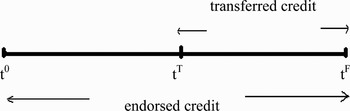
We calculate the total amount of endorsed credit in the following way. For each document – bill of exchange or promissory note – we are interested in three particular points in time: the moment it reached La España Industrial (t0), its maturity date (tF) and when (if this is the case) La España Industrial transferred it to someone else (tT) before its maturity date (see Figure 1).
Endorsed and transferred credit

We agree that
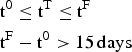
If vi is the value of the document (in reales), then the amount of credit backed by the document is (tFi − t0i) vi (in reales x days), and the amount of credit really transferred to the bank is (tFi − tTi) vi . In short, every time the cotton firm received a bill of exchange or a promissory note with a remaining life of longer than 15 days, this was an amount of trade credit supplied by the firm to its customer but with a special characteristic: as it was embodied in a transferable document, the cotton firm could transfer this credit to a bank. The firm could wait until the maturity date and cash the document itself, but if it waited several days and then discounted the document in a bank, this trade credit would be transformed into formal credit, though only for the days remaining until its maturity date (multiplied by its value).
Therefore, the total amount of endorsed trade credit supplied by the firm is ∑i(tFi − t0i) vi and the total amount of endorsed trade credit really transferred to the banking system is ∑i(tFi − tTi) vi, since
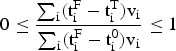
This figure is useful because it can be compared with the total amount of ‘current account’ credit, or unendorsed trade credit. We obtain this second figure from the clients' debit at the end of the year. Although there were certain seasonal variations in sales and payments, December was a ‘normal’ month, so the clients' debit at the end of the year was close to the yearly average. Then it is safe to assume that clients, on average, owed this money for 365 days a year. Therefore, multiplying this average debt by 365, we obtain the total amount of unendorsed trade credit, also expressed in reales per days, and we can then make comparisons with the endorsed trade credit figure.
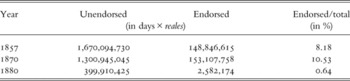
This estimation shows us that endorsed credit was a very tiny part – 8.18 per cent in 1857, 10.53 in 1870 and 0.64 in 1880 − of the total trade credit La España Industrial gave to its clients (see Table 1). The bulk was current account credit, that is, without any transferable document backing it. Given that in 1857, 68.51 per cent of formal credit was effectively transferred, it can be seen that only 5.61 per cent of all credit was financed by someone else and 2.27 per cent in 1870.Footnote 28
La España Industrial: endorsed and unendorsed credit

Sources: ANC; FEI, ‘Copy book of several credit documents’ and ledgers and inventories of La España Industrial (14.7).
The analysis of La España Industrial for 1857, 1870 and 1880 confirms the traditional view: endorsed credit played a very small role in commercial relations between manufacturers and merchants. The huge part of the credit given by manufacturers to their clients could not be transmitted to a third actor and, therefore, bankers were not able to finance, through discounting, this credit. However, manufacturers had another way of obtaining external funds to finance working capital. They could issue their own promissory notes, promising a future payment to a banker, a supplier, or a merchant, who was lending money to them. For example, in 1857, 1870 and 1880 La España Industrial received an amount of endorsed credit very close to 25 per cent of the total credit the company gave to its clients.Footnote 29 Although sales operations were not backed by banks, credit could be obtained when firms offered collateral guarantees.
In Barcelona a credit market had formed in which those offering and those seeking capital came together. Using financial tools such as debitorios (a form of debit note), promissory notes and also current account credit from their suppliers, the companies had access to the capital they required in order to undertake their business activity. Promissory notes were the main tool of merchants and manufacturers for financing circulating capital. The founding of the Bank of Barcelona in 1844 strengthened their use in the wholesale market: in 1860, at least 56.6 per cent of credit sales in the Barcelona stock exchange were endorsed by this type of document.Footnote 30 In this market, raw cotton was one of the main products being traded and, as we know, it was the main raw material in the manufacture of cotton fabrics. Therefore, the fact that it was sold on credit meant it was a source of finance for the cotton textile firms, and the fact that a major part of these credit payments were formalised as promissory notes allowed the banks to finance, indirectly, the circulating capital of these firms.Footnote 31
In short, our research confirms the traditional view as regards the relative unimportance of the formal credit system between cotton manufacturers and their customers. However, it also indicates that manufacturers had various alternative mechanisms available to finance their circulating capital by using current liabilities, often through endorsed credits that could be transferred to the banking system.
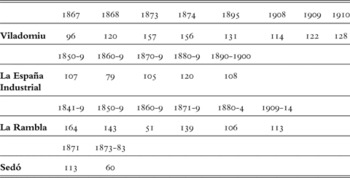
Having verified that, in the main, the credit offered by manufacturers to their customers was not endorsed by transferable commercial paper, we now seek to quantify this credit, in terms of the number of days, on average, the manufacturers allowed their customers before demanding payment. Table 2 provides a summary of the accumulated empirical evidence. For various cotton firms during the period 1850–1913, the average length of credit terms was, in many cases, greater than a hundred days.Footnote 32
Cotton manufacturers' unendorsed credit: average term of payment (in days)
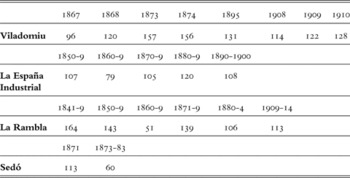
Sources: AHCVG; FLR, ledgers of La Rambla. ANC; FEI, FV and FS, ledgers and inventories of La España Industrial, Viladomiu y Sedó.
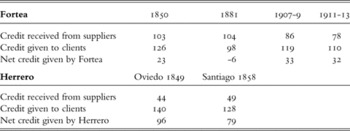
While it is true that the commercial vocation of the manufacturers led them to offer credit terms to their customers, and that these were in the main informal agreements, we should stress that they were not the only ones to finance the circulating capital of the sales process. The wholesalers and the commission houses were also often net creditors. Drawing on the books of two provincial wholesalers, we can calculate the time that elapsed before payment was made to their suppliers as well as the time that elapsed before they demanded payment from their customers, what Pat Hudson has called their ‘credit matrix’.Footnote 33 In Table 3 we can see their net credit position in various years.Footnote 34 While Fortea of Zaragoza did not give much more credit to its customers than that which it received from its suppliers, and in 1881 it even had a net debit position, Herrero played an important role as a net credit provider.
Textile merchants' credit matrix (in days)

Sources: ABH, ledgers of Herrero. BUZ; FF, ledgers of Fortea (1850, 1881, 1930) and balance sheets (1907-9 and 1911-13).
In short, the manufacturers were not the only ones to be granting credit. Every link in the chain of distribution that the fabrics passed through on their way to the consumer was a potential creditor. As we have seen, the situations could be highly varied. Contrary to the views of some historians, there were merchants who played the role of financial ‘cushion’,Footnote 35 while others, effectively, allowed this financial weight to fall exclusively on the manufacturers.
Whatever the case, we can conclude that, in the distribution and sale of Catalan cotton fabrics, current account credit was an essential element in the relationship between the economic agents that participated in this activity. In fact, we can speak of a true credit market in which manufacturers, commission houses, wholesalers and retailers all intervened. Below we shall examine just how this market operated.
II
Previous historical studies have suggested that Catalan manufacturers acted as ‘bankers’ to their customers. It was, they claim, a role that the manufacturers adopted very much against their will and which had detrimental economic effects. However, an analysis of the records consulted presents a less negative view of the manufacturers' financial activity. In fact, their case conforms quite well to the ‘financing advantage’ explanation of trade credit. In all probability the Catalan cotton manufacturers combined their credit functions with their business activity and performed the three main activities of a bank – screening, monitoring and enforcing contracts – in a very professional way. If they played the role of creditors in the period between 1850 and 1913, this behaviour appears to have been wholly justified. Although the origin of the unendorsed credit of the manufacturers lay in the refusal of their customers to accept firm commitments to pay, it is difficult to imagine that so many manufacturers, for such a length of time, were able to tolerate conditions that were systematically prejudicial to their interests, particularly if we consider that Barcelona was an important financial market place that brought together a critical mass of manufacturers, merchants, bankers and savers to constitute a fluid credit market. In fact, we have already seen that the manufacturers had access to bank credit through the issue of their own promissory notes. They were well known in the market and had sufficient guarantees to obtain outside finance without the need to discount their customers' promises to pay.
As we analyse the various company records, and court and legal documents, the image that emerges is that of a number of manufacturers that have taken on the task of producing fabrics and selling them, as well as the functions of classifying their customers according to their solvency, of minimising the risks of their credit sales and developing sufficient market power as to guarantee the deferred payment of their bills. All the indications are that, in the circumstances, the cotton manufacturers were best placed to act as bankers to their commercial customers. Trade credit in Spanish textile trade can thus be explained by the financing advantage theory.
Before seeking to demonstrate with empirical evidence the veracity of this hypothesis, we shall see how this type of explanation is not new in economic history. Since lending money to others is subject to the problem of asymmetric information, the first task of the banker is to obtain information about the projects in which this money will be invested and the solvency of those that wish to undertake them.Footnote 36 This activity, as well as the subsequent monitoring of the debtor and enforcement of payments, requires the establishment of a network of information and control. In this sense, various studies in economic history conducted in the frame of ‘New Institutional Economics’ identify that, in certain circumstances, and especially in economies that are in the first stage of capitalist development, the best-placed agents for offering credit to certain individuals or firms are not necessarily the bankers, that is, the specialist financial intermediaries, but other agents engaged in a different principal economic activity.
A good example of trade credit is described in the studies undertaken by Simon Ville and Grant Fleming, in which they explain how the pastoral agents, firms dedicated to the supply of animals, materials, technical and commercial support to Australian and New Zealand farmers during the second half of the nineteenth century, were also best placed for providing them with loans. Although the banks could lend money directly to the farmers, they preferred to do so through the pastoral agents, as they did not have much information about the farms, which were small and highly dispersed productive units, and regarding which, therefore, it was costly to obtain information. By contrast, the pastoral agents, thanks to the fact that they had established a good network in the territory and maintained commercial relations with the farmers, knew them much better and were able to evaluate perfectly the risk associated with each credit. Thus, the banks lent money to the pastoral agents and they, in turn, lent it to the farmers. As the agents were better informed, they were in the best position to act as bankers.Footnote 37 In short, when obtaining information is costly, those who are able to put this information to more than one use can profit more efffectively from this information network.
Another example of this is provided by the work of Aidan Hollis and Arthur Sweetman in which they show that, in the case of Ireland in the mid nineteenth century, the banks were not always the ones equipped to lend money. Here, a number of what were almost charitable credit societies managed to make a profit by lending money to poor Irish families, in a regime that was very similar to today's ‘micro-credit’ systems. The secret of the success of these societies lay in the fact that they were deeply rooted in the local communities, and so, with an intimate knowledge of their customers, they were able to assess their risks correctly. In addition, as the community was interested in the continuity of these institutions, there was considerable social pressure brought to bear to ensure the credits were repaid, so that the percentage of unpaid debts was very low.Footnote 38
As we have seen, one of the main tasks of the banker is ensuring that borrowers return the money they lend. When the environment in which they operate is complex and this activity is very expensive, it is logical that institutions emerge that reduce the transaction costs and ensure that the credit market functions. As Jeremy Baskes explains, this was the case of rural, colonial Mexico in the eighteenth century where, through the operation of the repartimiento it was the magistrates that were responsible for financing the breeding and gathering of the cochineal insect, as they were the only ones that dared to pay the small farmers in the Oxaca region up front for this product: ‘The repartimiento was operated by magistrates vested with judicial power, which they could use to facilitate the enforcement of contracts. These powers enabled officials to collect their own debts at reasonable cost.’Footnote 39
In short, charitable organisations, merchants and even magistrates were more efficient providers of credit to groups of the population in given settings. For similar motives, the Catalan cotton manufacturers might have been the best bankers for their customers in nineteenth-century Spain.
As mentioned at the outset to this discussion, the literature has stressed the high degree of involvement of the Catalan textile manufacturers in the commercialisation of their products. This dated back to the eighteenth century and was one of the factors in the absolute dominance of Catalan textiles in Spain in the nineteenth and twentieth centuries. Based on a thorough study of the records of a number of firms, both industrial and commercial, as well as court and legal records, I have been able to confirm this commercial involvement in the case of the cotton industry and to explain the forms it adopted and how these changed over the nineteenth century.Footnote 40 Before the opening up of the early railway network in the mid 1860s, the cotton manufacturers used various mechanisms to ensure their presence in trading channels: they set up their own stores in a number of big Spanish cities, they participated as limited liability partnerships in trading companies, they allowed textile merchants to participate in the capital of their industrial firms, and they signed preferential supply contracts with certain trading companies, among other practices. All these mechanisms, however, were incomplete ways of integrating their commercial function, since they did not allow the manufacturers to reach the whole Spanish market directly and, at the same time, they obliged them to distribute the products of other manufacturers so as to be able to bear the costs of their own commercial structures.
All this was to change with the building of the railway network in the mid 1860s. Thanks to the railways, the cotton firms were able to send their commercial travellers all over Spain; with two or three travellers, an agent based in Madrid and one more in another major city, a firm was able to establish its own commercial structure and to cover the whole of the national market. During the last third of the nineteenth century all the large and medium-sized Catalan cotton firms adopted this new system, though this did not stop the fact that a large part of their production continued to be channelled through independent merchants.
What we wish to stress here is that while operating these commercial structures - both those adopted prior to the railways and the system of commercial travellers and fixed agents that ended up winning the day – credit practices were to play an important role. The manufacturers had various reasons for wishing to be present in the channels of distribution of their products: they believed that by ridding themselves of intermediaries they would strengthen their sales at the expense of those of their competitors and they were keen to obtain feedback from the consumers so as to adapt production rapidly to their tastes. Another major reason was that in this way they could be better informed about their customers' solvency. The fact that most of their sales were made on credit made it even more necessary to have their own employees in the various regional markets, in short to be able to count on a network of information in the field.
This is quite apparent in the correspondence maintained by the firms. For example, when the cotton firm Muntadas Hermanos set up their own store in Madrid in 1841, and used this as a base for creating a portfolio of customers in the central zone of Castilla, they were initially highly reticent about offering credit terms to new customers that were quite unknown to them. Andrés Ramires, a retailer in Villarubia, asked to buy goods on credit from them. As they did not know him, the Muntadas were only prepared to sell to him for cash.Footnote 41 Ramires insisted and the Muntadas offered him, by letter, a three-month credit of 10,000 reales if he could give them the name of someone they knew who could act as guarantor.Footnote 42 The two names that Ramires gave were unknown to the Muntadas, and so it was not possible to give him credit terms: ‘once you know people, guarantors are superfluous; but as we have the misfortune to be new in this market and not to have any business relations in La Mancha, we do not wish to scatter our business interests haphazardly’.Footnote 43 Direct knowledge of the customer or, failing that, the guarantee of a third party were conditions sine qua non for giving credit. Only recently established in Madrid, the Muntadas Hermanos knew few customers whom they could trust and, therefore, to whom they could offer credit. It was precisely with the idea of changing this situation that they decided to establish their new base of operations in this territory. Proof of this is the fact that by 1843 their store had already opened accounts with 160 customers in the area of the Meseta. The commercial network, with the information that it could provide, allowed them to give credit. Moreover, this network was even more necessary, given the demands of the customers for credit.
That the manufacturers' commercial structures fulfilled the typical functions of the banks becomes quite evident when we analyse the correspondence between the manufacturers and their commercial travellers and agents in the last third of the nineteenth century. A significant part of the work of these men in the field was that of screening, monitoring and enforcing contracts. They were responsible for classifying all potential customers as either ‘good’ or ‘bad’, in other words, between those that were worthy of buying on credit and those that could only make cash purchases. To do so they observed and identified which other manufacturers and merchants trusted them, what assets they possessed, which partners – and with what amount of patrimony – were backing the business, whether they honoured their promises and, in general, what their reputation was in the local area. For example, Eusebio Casajús, a traveller for La Rambla in Zaragoza, wrote in 1895: ‘You might well receive a visit these days from a young lad, Mr. José M. Alonso, established a short time ago in ready-made clothes; you can quote him shop prices; they have given us good references.’Footnote 44
These controls did not only involve discriminating between solvent and more doubtful customers, but it also involved monitoring the situation over time. Having someone in the field was a valuable tool for identifying any possible problems with present customers. In case of doubt, the travellers went as far as to examine the accounting books of the customers. This was the case with the commercial traveller working for La España Industrial, Andrés G. y Gallardo, who in 1880 wrote the following about Brieva Arévalo y Cia: ‘This company is fully trustworthy, and nothing can possibly happen to it, I see all its operations and I examine its books when I wish; we should therefore meet their orders …’Footnote 45
The work of the commercial travellers and fixed agents also helped ensure all customer payments were made. Not only did they bring pressure to bear to guarantee payment of all outstanding debts, but also, when a customer defaulted, they represented the company at the meeting of creditors or intervened to renegotiate the debt.
In short, the establishment of the commercial network by the cotton manufacturers had financial implications. Part of the information gathered via this network referred to the solvency of customers and, in this sense, it served a similar function to the networks established by banks today. This facet to their operations was already present in the various attempts made at integrating their commercial function before the advent of the railways, although it was not until the introduction of the system of commercial travellers in the 1870s that the mechanism was perfected. If knowing consumer tastes was important for the manufacturers, it was just as important, or even more so, to have good information about the customers, and here what interested them most was their financial solvency. From the moment in which they began selling through a current account, from the time that credit was to play a key role in the relations with the customer, the commercial and banking functions became inextricably tied together. In this way, the structure designed to ensure that more of their product reached more customers also served to gather information about their customers' solvency. Just as the manufacturers had decided to become merchants of their products, by giving credit they also became bankers. Like the pastoral agents in Australasia in the nineteenth century, they were the best placed to give credit to their customers, since they had at their disposal a network of information which the bankers did not have.
III
In the first section we have seen that the record archives confirm what the historical literature has long claimed: manufacturers supplied their customers using credit sales, and that this on the whole was an informal system, being unendorsed by commercial paper. In the second section we have seen that among the main tasks of the employees that formed the commercial structure of the cotton firms was that of analysing the solvency of their customers, a task more typical of the banks. It seems more than apparent that in nineteenth-century Spain, selling fabrics meant selling on credit and that this conditioned the activity of the manufacturers, who dedicated themselves conscientiously to their tasks as ‘bankers’. We have seen similar historical examples, demonstrating that the credit system in Spain's textile trade was by no means unique and, in terms of the picture painted by the literature, much less dramatic. The Catalan cotton manufacturers did indeed operate as bankers, but they were by no means unwilling bankers.
An analysis of how this credit market worked should support this claim. We shall analyse the implications of the fact that most of this credit system was informal. As also pointed out in the historiography, this led to a certain laxity in honouring payment obligations. The fact that there were neither bills of exchange nor promissory notes that specified this obligation to pay within a fixed term made it easier for debtors not to honour their promises. Legally it was more difficult to make debtors pay on demand; or rather it was more costly for the creditors to recoup their money through the courts. Therefore, when a manufacturer agreed to credit sales under these conditions, he was giving a certain advantage to his customer and assuming a greater risk than if the credit had been endorsed by commercial paper. To manage this risk – or to reduce it – the manufacturers invested in information, that is, they paid their employees in the field to undertake the same tasks as those conducted by the banks.
A detailed analysis of the modus operandi of credit sales reveals that the manufacturers' risk management was highly professional. First, as we have seen, they screened their new customers on the basis of information gathered by their own commercial travellers. Furthermore, in the case of customers with whom they had already dealt, they established the maximum sums with which they could be credited, depending on the financial strength of each company. In general, they fixed the dates on which payment became due. This might vary between two and four months. Some firms applied the same length of credit terms to all their customers, while others divided them according to the credit terms offered. Above all, however, the system was characterised by its flexibility. If a customer had problems of liquidity, they could delay payment, and the degree of concern caused to the manufacturer would be linked to the firm's previous credit history and the reports it received from its travellers. So manufacturers assessed the financial strength of a firm by examining its accounts as well as considering its payment track record. They behaved like professional bankers. They had to calculate in each instance whether the situation called for flexibility, and hence the customer could be trusted, or whether the alarm bells should be sounded and there was a need to be more exacting. In order to manage this risk correctly, each company needed to operate its own information structure in the field.
That there was a trade-off between flexibility and the perception of risk can be seen when we analyse the use made of formal credit. As discussed above, this system constituted a small part of the credit regime offered by manufacturers to their customers and, yet, it is interesting to ask why in fact at times it was used. The answer is clear: manufacturers insisted upon documentation of the credit when they perceived a greater risk. And this occurred primarily in two circumstances: when the customer was new and when a regular customer started to delay on its payments. An example of this first circumstance is endorsed in 1857 when 70 per cent of the value of promissory notes that passed through the hands of La España Industrial was attributable to new customers. The company protected these purchases with transferable credit documents.Footnote 46 A good example of the second circumstance is provided by La Igualadina Algodonera, which in October 1866 sold two batches of grey clothing with payment falling due after 90 days to Juan Ribas y Cia. ‘Neither of these two bills had been honoured by the date they fell due and so the company granted Juan Ribas y Cia an extension with the signing of a promissory note, to the value of 32,921 reales being the sum of the two aforementioned bills.’Footnote 47
In this latter case, as well as reinforcing the liability for the debt on detecting that the probability of failing to honour the obligation had increased, the manufacturer extended the credit to a customer with liquidity difficulties without undermining its own, since it could discount the promissory note in a bank and obtain the full amount of the bills.
In short, if, when the risk increased, the manufacturers resorted to formal credit agreements, this meant that they were usually prepared to accept informal credit because they knew that the risk they ran was small. The existence of a commercial structure that served the purpose of evaluating financial risks and the presence of a long-term relationship with the customers, which served as a disincentive to opportunist behaviour on their part, allowed the manufacturers to be flexible with their customers without at the same time harming their own interests.Footnote 48
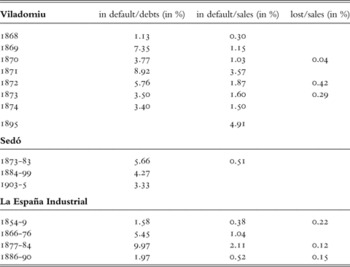
How efficient were the manufacturers in their tasks of risk management? To answer this question we analysed the clients' default indices of three manufacturers. In the first column of Table 4 we can see the percentage of customers' debts that were considered uncertain or difficult to enforce. Note that the average values were, generally, between 1 and 6 per cent, with the exception of the period 1877-84 at La España Industrial, when values reached almost 10 per cent.
Clients' default indices of cotton firms

Sources: ANC; FV, FS and FEI, ledgers of Viladomiu, Sedó and La España Industrial.
Clients' default ratio in the Spanish banking system (in %)

Source: Boletín del Banco de España, November 2000.
To evaluate these data, that is, to determine whether the default indices were high or low, we need to compare them with the ratios published elsewhere, for example, with the default ratio of Spanish banks in the second half of the twentieth century. If we examine the data in Table 5, where the default ratio is defined as ‘uncertain and delayed credits as a share of the total of credits in non-credit resident sectors’,Footnote 49 we can see that the values are lower than those in Table 4, but that they do not differ greatly.
If we also look at the third column in Table 4, which includes those sums that were considered as having been definitively lost, the values are very modest, never reaching 0.5 per cent of the value of annual sales. This means that the cotton firms were highly skilled in renegotiating their customers' debts, that they were prepared to defer payments and to forego a part of the principal so as to minimise their losses. In the company archives and in those of the courts, there are numerous examples of initiatives of this type. In 1880, the commercial representative of La España Industrial in Sevilla, Andrés G. y Gallardo, was responsible for his company's interests in his customers' default, Martínez Aceña y Santacruz. After investigating the true financial state of the company, he recommended a friendly settlement to the La España Industrial cotton companyFootnote 50 and acted as their representative on the board of receivers, which decided to allow a period of four years for the firm to pay off its debts using six-monthly payments, endorsed by promissory notes.Footnote 51
Thus, all the indications are that the manufacturers acted in a much more professional way as bankers than Spanish historiography has previously suggested. Here, an important question is whether their financial involvement had a negative effect on the profitability of the cotton firms. The literature indicates that the impossibility of transferring customer debts to the banking system would have forced them to have large sums of money immobilised in the sales process. This greater circulating capital used per unit sold would have affected their profitability. However, we have seen in the first section that the manufacturers, due to the place they occupied in the Catalan business circle, had easy access to the capital market. They could receive credit from banks, from their suppliers, or from any merchant or saver that was prepared to lend them money for a period of time. In short, given that they were well-known companies, with partners that were well connected in the Catalan business community, they were able to obtain financing at a rate of interest that oscillated between 5 and 7 per cent.
If the cotton manufacturers were well known and respected by Catalan entrepreneurs, bankers and savers and, at the same time, they had at their disposal a network of information that allowed them to gauge adequately the risks of offering credit to wholesalers and retailers in the Spanish market, were they not in an ideal position to become the best financial intermediaries between a prosperous Catalan industry and a backward agrarian Spain? Was it not logical then that they should take advantage of this situation to act as arbitrators between cautious savers that trusted them and provincial shopkeepers with problems of liquidity but whom they knew to perfection?Footnote 52 The key lies in knowing whether the manufacturers earned money as financial intermediaries, in other words, whether in one way or another they fixed a higher rate of interest for their customers than that which they paid to their creditors.
An analysis of commercial correspondence shows the existence of discounts for early payment. It is logical to conclude that the price paid by those that required all the time extended to them by the manufacturer included this financial reward. The implicit interest rate, therefore, would be the difference between the price paid by a customer paying ‘late’ and the price paid by one making an ‘early’ payment. For example, we know that in 1860 and in 1865 La España Industrial operated a discount policy for early payment, and established an implicit annual rate of interest of between 6 and 12 per cent,Footnote 53 as did Jaumandreu, another cotton firm.Footnote 54 Sedó operated the same policy in 1871, with an interest rate of between 12 and 24 per cent.Footnote 55 Masaveu, a textile merchant established in Oviedo, paid their invoice before the due date in 1865 so as to benefit from a discount equivalent to an annual interest of 6 per centFootnote 56 and Fortea, the Zaragoza merchant, charged an annual interest of 30 per cent on credit to his customers in 1881.Footnote 57 Although these discounts for early payment are not always seen, in the cases in which they are explicit, they involved interest rates that were at times equal to, and nearly always greater than, those paid by the cotton companies. In other words, there is evidence that suggests that the manufacturers charged for their financial services.
In short, in nineteenth-century Spain, Catalan cotton manufacturers supplied trade credit to their customers because they had a financing advantage over banks. Their direct access to structures of commercialisation within the Spanish market allowed them to manage their credit risk as if they were professional bankers and with high levels of efficiency. All the indications are that, in one way or another, they charged for this service. When all is said and done, if someone wishing to sell fabrics in nineteenth-century Spain had to resign themselves to offering informal credit to the provincial shopkeepers, the latter would not find more flexible or more understanding lenders than the cotton manufacturers and leading textile merchants, since no one knew them like they did.
IV
Financial development helps economic growth but its absence probably does not abort it. As Joan Robinson said, ‘where enterprise leads, finance follows’.Footnote 58 When financial institutions are not fully developed, firms find other mechanisms for overcoming the asymmetric information problems associated with lending. The informal credit literature shows many examples of this: in the past, in developing countries today, and even in developed ones. Trade credit in nineteenth-century Spain is a good example. In an environment where the information structures of the banks were not sufficiently developed, cotton manufacturers supplied credit to their customers in an efficient manner. The manufacturers acted, therefore, as their customers' bankers, but it would be wrong to say they were their unwilling bankers. The commercial network they built up allowed them to undertake this function (basically, keeping informed about their customers and bringing pressure to bear on the purchasers of their fabrics) better than anybody. They enjoyed a financing advantage. Having their own information network together with the long-term relationships they had built up with wholesalers and retailers were the two key factors in minimising the risks of credit sales.
In the textile trade, a veritable credit market was in operation, a market with recognised criteria for selecting customers, with in-built mechanisms to compensate for greater risks – the use of endorsed credit – and also, in most instances, with implicit rates of interest being applied. The textile manufacturers, along with the merchants, were in the best position to lend money to their customers, simply because they were the ones that knew them best and because, given their place within the Catalan business network, they had easy access to financial resources. In fact, the absence of bills of exchange and promissory notes that endorsed their customers' debts did not impede the manufacturers from turning to the banking system to finance their circulating capital. Bankers, as well as merchants and investors in general, were prepared to give liquidity to the cotton firms, which would have enjoyed an established reputation and whose active partners would have been fully integrated in the Catalan business circle.Footnote 59
Thus, in nineteenth-century Spain, the prevailing circumstances led cotton manufacturers to operate simultaneously as both manufacturers and bankers.