1 Introduction
This paper examines Brazilian Portuguese primary stress in non-verbs, and proposes a probabilistic analysis based on weight gradience in the language.Footnote 1 Portuguese stress is restricted to the final three syllables of the word (the ‘trisyllabic window’), although only final and penultimate stress are typically analysed as regular and productive (Hermans & Wetzels Reference Hermans and Leo Wetzels2012). Previous research has proposed that weight-sensitivity in the language is restricted to the word-final syllable, i.e. that stress is influenced by the weight of the final syllable, but not the weight of syllables located earlier in the word (Bisol Reference Bisol1992). Additionally, weight-sensitivity is seen to be categorical and binary (a syllable is either heavy or light, according to the shape of its rhyme).
Primary stress placement in Portuguese non-verbs can largely be explained by weight, in terms of the following generalisations (Bisol Reference Bisol1992): stress is final if the word-final syllable is heavy – where ‘heavy’ is defined as containing a diphthong, a nasal vowel or a coda consonant, as in (1a) (Portuguese has no long vowels). If the word-final syllable is light, stress falls on the penultimate syllable (1b). Taken together, these are the regular stress patterns in the language, which are found in 72% of the lexicon (Houaiss et al. Reference Houaiss, de Salles Villar and Manoel de Mello Franco2001). Phonetically, stress in Portuguese is highly correlated with duration (Major Reference Major1985).
-
(1)


There are, however, three types of irregular stress patterns in the language: final stress when the word-final syllable is light (2a), penultimate stress when the word-final syllable is heavy (b) and antepenultimate stress (c).
-
(2)

Researchers have employed different mechanisms in order to accommodate the cases in (2) (e.g. Bisol Reference Bisol1992, Lee Reference Lee2007). For example, (b) and (c) have been accounted for by segmental and syllabic extrametricality respectively (to be discussed in §2). The pattern in (a) has been explained by incorporating a catalectic consonant, e.g. café [kaμˈfεμCμ]. Even though the catalectic consonant is only phonetically realised in derived forms (e.g. cafet-eira [kafeˈtejPa] ‘coffee maker’), it bears its own mora (Hyman Reference Hyman1985), and stressed light word-final syllables are thus underlyingly heavy in such analyses.
Cases such as (2a) have motivated some researchers to propose that the location of stress is governed by morphological factors – as an alternative to catalexis. In particular, the presence or absence of theme vowels has been argued to play an important role in determining where stress falls: most non-verbs in Portuguese are composed of a stem and a theme vowel (tv), as in (3a), but words such as (3b) are exceptions to this pattern, in that no theme vowel is present. If it is posited that regular stress in Portuguese falls on the stem-final vowel, such forms are no longer irregular.
-
(3)

Existing accounts thus largely explain the location of regular stress in most of the lexicon in terms of a single phonological factor, syllable weight, with exceptions generally accounted for by mechanisms not directly involving weight. When we examine the lexicon of the language more closely, however, the relationship between weight and stress becomes less clear than is traditionally assumed. As will be shown in §3, weight seems to affect stress in all syllables in the stress domain, including the irregular cases in (2), though to different degrees. For instance, antepenultimate stress is almost always found in words that contain light penultimate and final syllables. If penultimate syllables are not sensitive to weight, this is an unexpected correlation. Furthermore, onsets seem to affect stress location in the lexicon, as we shall see in §3, which indicates that weight computation in Portuguese may not be restricted to the rhyme.
A more accurate measure of how weight is computed in Portuguese is naturally important for a more comprehensive understanding of how stress and weight interact in the language. In this paper, I present a probabilistic analysis that accounts for the vast majority of cases that fall into the patterns in (1) and (2). I propose that weight in Portuguese has a gradient effect on stress, which is positionally and quantitatively determined (for positional weight, see Gordon Reference Gordon2004 and Ryan Reference Ryan2014). In other words, the weight effects of a given syllable depend on the position of the syllable within the word, as well as on the number of segments present in the syllable. As we will see, weight effects in Portuguese go beyond ‘heavy’ and ‘light’ syllables.
The analysis in this paper is developed by addressing the three questions in (4).
-
(4)

(4a) examines whether weight does in fact only play a role word-finally in Portuguese. In the lexicon investigated here, the weight of all three syllables in the stress domain seems to have some influence. Statistical models to be presented in §4 indicate that weight-sensitivity weakens gradiently as we move away from the right edge of the word. The observation that final, penultimate and antepenultimate stress are sensitive to weight shows that antepenultimate stress is not as idiosyncratic as might be thought, contra standard views of Portuguese.
Question (4b) refers to whether weight is categorical, as assumed in standard views. I show that weight is in fact gradient: how much each syllable is affected varies considerably, but the effects are statistically significant. Weight-sensitivity depends on the position of a given syllable within the word, and, crucially, its effect on stress weakens monotonically as we move away from the right edge of the word.
Previous research in Brazilian Portuguese has been based on the assumption that onsets do not influence stress – following the traditional view that weight is a property of the rhyme (Chomsky & Halle Reference Chomsky and Halle1968, Liberman & Prince Reference Liberman and Prince1977, Halle & Vergnaud Reference Halle and Vergnaud1987, Halle & Kenstowicz Reference Halle and Kenstowicz1991, Hayes Reference Hayes1995, among many others). Question (4c) investigates whether this assumption is appropriate for Portuguese, and, if not, how onsets might affect stress in the lexicon. Onsets do show statistically significant effects in Portuguese (§4), but not in the way we would expect from more recent studies, which have shown that onsets have a positive effect on stress in other languages (Gordon Reference Gordon2005, Topintzi Reference Topintzi2010, Ryan Reference Ryan2014).
This paper is organised as follows: in §2, I discuss Portuguese stress in detail, and revisit analyses proposed to account for both the regular and irregular patterns found in the language. In §3, I analyse weight and stress in a comprehensive lexicon in order to answer the questions in (4). In §4, I model the patterns in the lexicon using binomial logistic regressions. Crucially, given their probabilistic nature, the predictions of the models presented here are more consistent with the actual lexical patterns than are previous analyses, which assumed categoricity. Finally, §5 summarises the findings of the paper, and discusses directions for future work.
2 Stress in Portuguese
In this section, I discuss stress in Portuguese non-verbs, and examine both morphological (§2.1) and phonological approaches (§2.2) previously proposed to account for irregular patterns in the language. I argue that there is no compelling argument for morphological influence on non-verb stress, and therefore the analysis presented in this paper is solely based on phonological factors.
Stress in many Indo-European languages is restricted to the final three syllables of the word.Footnote 2 This is the case in Romance languages such as Italian, Portuguese, Catalan and Spanish – a trait inherited from Latin. Unlike Latin, however, stressed word-final syllables are relatively common in modern Romance languages, including Portuguese (Roca Reference Roca and van der Hulst1999). Stress in German, English and Dutch monomorphemic words also falls within a trisyllabic window (Domahs et al. Reference Domahs, Plag and Carroll2014).
Many studies on stress in Portuguese (e.g. Câmara Jr Reference Câmara1970, Major Reference Major1985, Bisol Reference Bisol1992, Collischonn Reference Collischonn1994, Lee Reference Lee1994, Araújo Reference Araújo2007, Wetzels Reference Wetzels2007) agree that primary stress in the language is relatively predictable in non-verbs with final or penultimate stress. On the other hand, antepenultimate stress is regarded as idiosyncratic (i.e. unpredictable), and represents less than 15% of all non-verbs in the Houaiss dictionary (Houaiss et al. Reference Houaiss, de Salles Villar and Manoel de Mello Franco2001), the most comprehensive dictionary of Portuguese. Words with antepenultimate stress have always existed in Portuguese, and although their stress profile is not regular in the language, there is no evidence suggesting that such forms are completely avoided (Araújo et al. Reference Araújo, Guimarães-Filho, Oliveira and Viaro2007: 58) – though in some north-eastern varieties ‘this pattern has completely vanished … in non-verbs’ (Wetzels Reference Wetzels2007: 29). Finally, antepenultimate stress is sometimes ‘repaired’ via syncope and resyllabification – as long as the resulting form obeys the phonotactic patterns in the language (see Amaral Reference Amaral2000): fósforo [ˈfɔsfɾƱ]. This type of repair is found in most dialects of Brazilian Portuguese.
Antepenultimate stress is therefore phonologically more peripheral in the language when compared to final and penultimate stress, which are more common and much more productive (around 18% and 68% respectively in the Houaiss lexicon). As a result, it is normally assumed that a new word in the language is not likely to have antepenultimate stress (Hermans & Wetzels Reference Hermans and Leo Wetzels2012). Rather, new words tend to have either final or penultimate stress, aside from some borrowings. The words penalty [ˈpena1ʧi] and performance [peɾˈfɔɾmãnsi], for example, are present in Portuguese dictionaries with the original stressed syllable, even though this results in stress on the antepenultimate syllable in both cases (once the final cluster in performance is repaired). This preservation of the source language's stressed syllable is respected in the spoken language as well, despite following a disfavoured pattern in Portuguese.
Across the entire Portuguese lexicon (Houaiss et al. Reference Houaiss, de Salles Villar and Manoel de Mello Franco2001), primary stress has both morphological and phonological components: whereas stress in verbs is lexically defined by mood, tense, person and number morphemes (see Wetzels Reference Wetzels2007 for a review), stress in non-verbs is heavily influenced by weight (cf. Mateus & d'Andrade Reference Mateus and d'Andrade2000). The morphological aspect of stress in verbs is undisputed, but some researchers have suggested that morphological factors also play a role in stress in non-verbs (Lee Reference Lee2007, Pereira Reference Pereira2007, among others). These researchers assume that stress in non-verbs is sensitive to both morphological and phonological factors.
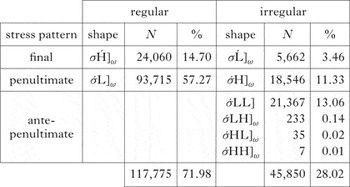
Table I summarises the stress patterns in non-verbs. As mentioned earlier, heavy syllables (H) may have a nasal vowel, a coda consonant and/or a complex nucleus: pagã [paˈgã] ‘pagan’, valor [vaˈ1oɾ] ‘value’, funil [fuˈniw] ‘funnel’. Light syllables (L) are open, and contain only one segment in the nucleus: abacaxi [abakaˈʃi] ‘pineapple’.
Stress patterns in the Houaiss dictionary for non-verbs with more than one syllable (N=163,625).

Note that very few words have antepenultimate stress and a heavy penultimate or final syllable (also noted in Wetzels Reference Wetzels2007 for a subset of cases, discussed in §2.2) – this situation is similar to what we find in Dutch (van Oostendorp Reference Oostendorp2012). Almost all these cases consist of borrowings, such as performance [peɾˈfɔɾmãnsi] and propolis [ˈpɾɔpƱ1is] ‘propolis’. Some of these words undergo syncope in spoken Brazilian Portuguese: óculos [ˈɔkƱ1Ʊs] → [ˈɔk1Ʊs] ‘glasses’.
2.1 Morphological approaches to Portuguese stress in non-verbs
In this section, I review the arguments for morphological influence in non-verb stress, and argue that there is no unambiguous evidence for such an influence. Previous research has proposed that morphology plays an important role in Portuguese stress, in that theme vowels are never stressed. I show that, whether or not theme vowels have an active role in the synchronic grammar of Portuguese non-verbs, there is no convincing evidence to suggest that such vowels actually influence stress: effects often attributed to theme vowels can be accounted for by phonological factors alone.
Morphological influence on Portuguese non-verb stress has been proposed by Mateus (Reference Mateus1983), Lee (Reference Lee1995, Reference Lee2007) and Pereira (Reference Pereira2007). These analyses assume that the stress domain in Portuguese non-verbs is the stem – that is, number, gender and theme vowels are not visible to stress, and therefore these morphemes are never stressed in Portuguese. As a result, irregular final stress in Table I is accounted for as in (5): in a word like jacaré, for example, stress falls on the stem-final vowel (/ε/) (this approach entails that all words with irregular final stress are monomorphemic).Footnote 3 A word like boca, on the other hand, has a theme vowel (/a/), and therefore stress falls on /o/, the only vowel in the stem.
-
(5)

The main argument for this proposal comes from derived forms. If we add a suffix to both words above, the theme vowel is typically deleted, whereas the stem-final vowel cannot be. In (6), the diminutive suffix -inho [-ĨɲƱ] is attached to pato and sofá. In (6a), the theme vowel is deleted, yielding patinho; in (6b), since the word-final vowel is part of the stem, an epenthetic consonant (/z/) is inserted to avoid hiatus (Bachrach & Wagner Reference Bachrach and Wagner2007).
-
(6)
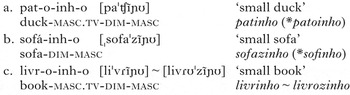
However, example (6c) shows that the situation is not as straightforward as implied by (a) and (b). Whereas /1ivr-o/ should pattern exactly like /pat-o/, both forms are in fact found, indicating the optionality of tv-deletion. Such cases are less common, but not rare, and seem to be more acceptable with certain lexical items than others (de Freitas & Barbosa Reference Freitas and Barbosa2013).
A stem-based analysis of stress seems to be more comprehensive than a purely phonological analysis, in that it accounts for more patterns: σĹ]ε words are no longer irregular, as they are in phonological approaches – rather, they simply lack a theme vowel. However, the assumptions of such an analysis are problematic. The argument in question is circular: a vowel is stressed because it is not thematic, and is not thematic because it is stressed. Note that there is nothing in the pair presented in (6a, b) that motivates the presence or absence of a theme vowel in present-day Portuguese – except for the location of stress. In addition, the three nominal theme vowels, /a e o/, also appear stem-finally in words like sofá ‘sofa’, dendê ‘palm oil’ and metrô ‘metro’, which have word-final stress. Thus stress placement is the only way to determine whether a given vowel is (or is not) thematic.
A purely phonological alternative to theme vowels follows from the observation that, cross-linguistically, prominent segments are more likely to be preserved (Harris Reference Harris, van Oostendorp, Ewen, Hume and Rice2011). In Portuguese, stressed vowels are never deleted in monomorphemic or derived forms. Consequently, a word like sofá could not possibly lose its stressed vowel in any derived form. Theme vowels, on the other hand, are not stressed, which explains why they may be deleted.
There are other phonological processes in Brazilian Portuguese that are often said to be associated with theme vowels, such as vowel raising and external sandhi. Theme vowels may raise in the language, whereas stem-final vowels cannot: mergulh-o [meɾˈguʎo] → [meɾˈguʎƱ] ‘dive (n)’, but robô [xoˈbo], *[xoˈbu] ‘robot’. Likewise, external sandhi is only allowed in words with a theme vowel: camisa usada [kaˈmizɐ uˈzada] → [kaˈmizuˈzadɐ] ‘used shirt’, but jacaré amarelo [Zakaˈɾε amaˈɾε1Ʊ], *[Zakaˈɾamaˈɾε1Ʊ] ‘yellow alligator’. Like vowel deletion in derived forms (6a, c), both vowel raising and sandhi can be accounted for without additional mechanisms: stressed vowels are protected, and therefore they cannot raise, be deleted in derivations or undergo external sandhi.
The question, therefore, is whether stressed vowels are maintained because they are more prominent or because they are part of the stem. Given the facts, it is not possible to tell these two alternatives apart. The same question can be posed for other Romance languages, where the problem also arises. In fact, Roca (Reference Roca and van der Hulst1999: 673) proposes an extrametricality rule for all Romance languages to capture the observation that theme vowels are ‘invisible’ to stress.
-
(7)

Roca prefaces the rule as follows: ‘in the absence of evidence to the contrary, however, it is indeed reasonable to assume that final stressless vowels are desinential’ (1999: 672). What motivates (7) is exactly the fact that theme vowels, unlike stressed stem-final vowels, seem to be frequently deleted in Romance languages.
Whether or not theme vowels exist in present-day Portuguese is beyond the scope of this paper, but their alleged relevance to stress clearly bears on the questions examined here. In this section, however, I have argued that there is no solid evidence that such vowels have a role in Portuguese stress. This paper is therefore based only on phonological factors, to be discussed in the next section.
2.2 Phonological approaches to Portuguese stress in non-verbs
Even if we assumed that morphological factors did impact stress in Portuguese, we would still need to consider phonological factors, which heavily influence stress in the language. In this section, I examine such factors in more detail, focusing on weight and how it affects the stress patterns found in the language. I briefly review previous analyses of stress in Portuguese, which employ different mechanisms to account for stress irregularities. Finally, I provide independent evidence for weight effects in Portuguese.
Previous analyses of Portuguese stress all make reference to syllabic constituency. In view of this, I first describe syllable shape in the language. In Brazilian Portuguese, the onset position can contain only two segments, as shown in (8). Onset clusters consist of stop + liquid or labial fricative + liquid sequences. A word such as macabro ‘macabre’ can only be syllabified as [ma.ˈka.bɾo], not *[ma.ˈkab.ɾo]). In other words, stop + liquid clusters in Portuguese are not ambiguous vis-à-vis their syllabification (Cristófaro-Silva Reference Cristófaro-Silva2005). Finally, rhymes in Portuguese normally contain up to four segments.
-
(8)
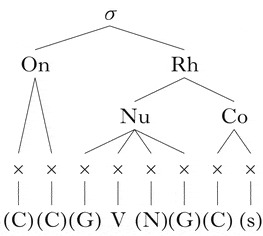
Very few words (borrowings, proper names etc.) violate these syllabic restrictions; some are listed in Houaiss et al. (Reference Houaiss, de Salles Villar and Manoel de Mello Franco2001). Such cases are phonotactically adapted in spoken Brazilian Portuguese, mostly via epenthesis (e.g. the borrowing skate is produced as [isˈkejʧi]). Recent borrowings are not the only words that are repaired: well-established words also undergo epenthesis and resyllabification if they violate the syllabic template in Portuguese: advogado ‘lawyer’ and obstetra ‘obstetrician’, for example, are normally produced in Brazilian Portuguese as [a.ʤi.vo.ˈga.dƱ, a.de.vo.ˈga.dƱ] and [o.bis.ˈtε.tɾɐ] respectively.
The syllabification algorithm in Portuguese is straightforward and unambiguous, given the restricted number (and quality) of segments in complex onsets and codas (see Thomas Reference Thomas1974 for a comprehensive description and Neto et al. Reference Neto, Willian Rocha and Sousa2015 for a computational implementation). A nonce word such as pantridocra, for example, is unambiguously syllabified as /pan.tɾi.do.kɾa/, regardless of stress. How such a word is actually produced will vary considerably between Brazilian and European Portuguese (Mateus & d'Andrade Reference Mateus and d'Andrade1998). Consider the word devedor ‘debtor’, syllabified as /de.ve.ˈdoɾ/. In colloquial European Portuguese, where vowels are frequently deleted, such a word is often produced as [ˈdvdor]. This type of reduction never happens in Brazilian Portuguese (as we have seen, certain coda–onset sequences often undergo epenthesis).
In (8), onglides and offglides are treated identically: both contain two ú- slots. On a categorical view, this entails that both rising and falling diphthongs are heavy. This contrasts with standard approaches to stress in Portuguese, which treat rising diphthongs as light (Bisol Reference Bisol2013). The present paper, however, does not distinguish rising and falling diphthongs. One reason is empirical. As Harris (Reference Harris1983: 11) shows for Spanish, rising diphthongs seem to contribute to weight in some positions in the word. Antepenultimate stress in Spanish (e.g. teléfono ‘telephone’) is blocked when another syllable in the stress domain is heavy. As a result, a word such as *teléfosno or *teléfoino is not found in Spanish. Interestingly, words such as *teléfiono ([te.ˈ1e.fjo.no]) do not occur either. All these generalisations, critically the last one, also hold for Portuguese. This indicates that, like coda consonants, both types of diphthongs affect weight to some degree, a fact which is consistent with the representation in (8). Even though the overall findings of the present paper do not hinge on the particular choice of onglide treatment, I return to this discussion in §4.1.3, where I provide another reason for not differentiating onglides and offglides in the probabilistic approach proposed in this paper.
(8) implies that the nucleus of a syllable in Portuguese can contain one to four segments, as in gato ‘cat’, gaita ‘harmonica’, guaipeca ‘mongrel’, bastião ‘bastion’. This, however, depends on how one treats nasality in words such as fã ‘fan’, in particular nasal diphthongs (patrão ‘boss’) and triphthongs (bastião). I assume the standard approach to nasality in Portuguese, according to which the nucleus of a word such as fã is underlyingly bisegmental /faN/ (see Battisti Reference Battisti1997 for a review). Since nasality is realised on the vowel, then, if the same assumption is extended to diphthongs and triphthongs, syllable nuclei in Portuguese may contain up to four segments (e.g. bastião /bas.tjaNw/). Assuming this standard representation, minimal pairs such as mão ‘hand’ and mau ‘bad’ are quantitatively distinct: the former contains three nuclear segments, while the latter contains two nuclear segments.Footnote 4
Traditionally, only the presence of rhyme segments has been seen as relevant for weight – onsets are thus disregarded in the computation of weight (e.g. Halle & Vergnaud Reference Halle and Vergnaud1980, Hyman Reference Hyman1985, Hayes Reference Hayes1989). Portuguese is an example of a language that has been analysed in this way: as mentioned earlier, a heavy syllable contains a diphthong, a nasal vowel or a coda consonant; onset structure is irrelevant. However, some studies have shown that onsets also have an impact on stress in various languages, suggesting at least some contribution to the calculation of weight (Davis Reference Davis1988, Gordon Reference Gordon2005, Topintzi Reference Topintzi2010, Ryan Reference Ryan2011, Reference Ryan2014).
To my knowledge, no researcher has proposed a role for onsets in Portuguese stress. However, in south-eastern varieties of Brazilian Portuguese, onset clusters are often simplified in unstressed syllables (Harris Reference Harris1997): prato [ˈpɾatƱ] ‘plate’ + -inho [ĩɲƱ] → [paˈʧĩɲƱ] ‘small plate’. In other words, complex onsets are preferred in more prominent positions. This simplification is relatively common in some spoken varieties: words such as próprio [ˈpɾɔpɾjƱ] ‘proper’ are sometimes produced as [ˈpɾɔpjƱ]. In addition, onset metathesis is observed in words such as obstetra [ob(i)sˈtεtɾɐ] → [ob(i)sˈtɾεtɐ] ‘obstetrician’. Despite the apparent correlation between onset clusters and stressed syllables in such processes, Cristófaro-Silva (Reference Cristófaro-Silva2005) argues that cluster reduction is not in fact phonologically conditioned. She shows that cluster simplification may occur in both stressed and unstressed syllables, which suggests that word-level prominence is not the underlying cause for the process in question.
The proposal that onset-cluster simplification is not related to stress does not necessarily mean that onsets do not affect stress. Since no study has directly examined the impact of onsets on Portuguese stress, all previous weight-based analyses focus on rhymes (e.g. Bisol Reference Bisol1992, Reference Bisol2013, Lee Reference Lee1994, Wetzels Reference Wetzels2007), given the assumptions of standard moraic theory (Hyman Reference Hyman1985, Hayes Reference Hayes1989). On such a view, CV.CV.CV words (e.g. macaco ‘monkey’) and CV.CCV.CV words (e.g. catraca ‘turnstile’) are both predicted to bear penultimate stress, as they have exactly the same moraic representation: σM.σM.σM]W. As onsets are outside the rhyme, these constituents are not moraic, and are therefore not predicted to affect stress likelihood. However, in §3 I show that the onset patterns found in the Portuguese lexicon diverge from these predictions.
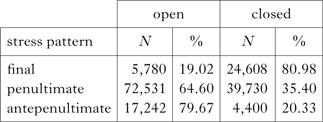
As mentioned in §2, previous studies of Portuguese stress only consider weight in word-final rhymes (e.g. Bisol Reference Bisol1992, Collischonn Reference Collischonn and Bisol1996, Araújo Reference Araújo, Guimarães-Filho, Oliveira and Viaro2007). The standard claim that only word-final syllables are weight-sensitive is based primarily on the observation that antepenultimate, penultimate and final syllables behave very differently from one another with respect to syllable shape (open vs. closed) and stress, as can be seen in Table II.
Stressed syllable profiles by stress pattern in the Houaiss dictionary (N=164,291).

If Portuguese is in fact only weight-sensitive word-finally, its weight profile could be classified as combined. Combined systems have distinct weight computations for different positions or circumstances. 42 of the 500 languages in the WALS database have a combined weight system, including Spanish and Romansch, both closely related to Portuguese (Goedemans & van der Hulst Reference Goedemans, van der Hulst, Dryer and Haspelmath2013).
Wetzels (Reference Wetzels2007), however, argues that weight may also play a role word-internally, given the behaviour of palatal consonants in Brazilian Portuguese.Footnote 5 Although consonantal quality does not have an evident effect on stress in the language, [ɲ] and [ʎ] are exceptions. These consonants are never found in final onsets in words with antepenultimate stress (3.8% of the lexicon contain such onsets). Wetzels (Reference Wetzels2007: 25) analyses such consonants as geminates, which therefore occupy both onset and (preceding) coda slots: baralho → [ba.ˈɾaʎ.ʎo], *[ˈba.ɾaʎ.ʎo] ‘deck of cards’. This analysis is consistent with the fact that very few words with antepenultimate stress have a heavy penultimate syllable: in both cases, weight in the penultimate syllable would block antepenultimate stress.
Standard views on stress in Portuguese non-verbs tend to rely on more frequent or robust patterns in the lexicon, such as the distribution of open vs. closed syllables across stress locations. Table II, for instance, provides a clear positive correlation between final closed syllables and final stress: 80.98% of all words with final stress have a closed word-final syllable. On the other hand, antepenultimate closed syllables and antepenultimate stress show a negative correlation, as only 20.33% of words in that category have a closed antepenultimate syllable. A similar pattern is found for penultimate stress, given that only 35.4% of stressed penultimate syllables are heavy. These facts have provided the motivation for most phonological analyses of Portuguese stress. Such analyses typically conclude that weight-sensitivity is only present word-finally.
What Table II does not show is whether or not the unstressed syllables in a given word are closed or open. In other words, what do the penultimate syllables of words with final stress look like? This is an important gap in traditional analyses of weight in Brazilian Portuguese. If penultimate syllables are not weight-sensitive, then having heavy or light syllables in that position should not affect the probability of antepenultimate stress for a given word. However, we have just seen that the weight profile of penultimate syllables does affect how likely antepenultimate stress is. §3 explores this and other patterns in detail.
Thus far, we have seen that weight clearly has an impact on the distribution of stress patterns in Portuguese. However, stress is not the only context where weight plays a role in the language: it also influences mid-vowel contrasts when stress is held constant on the penultimate syllable. This is known as spondaic lowering, and was first formalised by Wetzels (Reference Wetzels1992). Spondaic lowering neutralises the mid-vowel contrast in the stressed syllables of non-verbs with penultimate stress. Crucially, it is conditioned by weight – more specifically by the weight of the word-final syllable, as in (9), a fact which is consistent with the claim that weight effects in the language are restricted to this position. Therefore, the relevance of weight to Portuguese goes beyond stress.
-
(9)
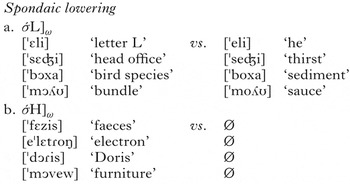
Given the positional bias of weight effects discussed above, Bisol (Reference Bisol1992) proposes that Brazilian Portuguese builds moraic and syllabic trochees (the former applying only word-finally). Thus, papel [paˈpεw] ‘paper’ is parsed as [pa(ˈpεμwμ)] and sapato [saˈpatƱ] ‘shoe’ as [sa(ˈpaσtƱσ)]. Let us now briefly look at how the moraic approach deals with irregularities in stress, and at the issues which arise.Footnote 6
Previous approaches to stress in Portuguese are categorical; that is, a set of rules or constraints generates only predictable patterns. As a result, ‘exceptions’ are explained with mechanisms such as catalexis (§1) and extrametricality: Bisol (Reference Bisol1992), d'Andrade (Reference d'Andrade1994) and Massini-Cagliari (Reference Massini-Cagliari1999) employ exceptional syllable extrametricality to account for antepenultimate stress, in which case final syllables are skipped, and a syllabic trochee is built from the right edge of the word: (ˈσσ)⟨σ⟩. Likewise, words with penultimate stress and a heavy final syllable (σ́H]ε) are explained with segment extrametricality, which makes the (heavy) final syllable light: ˈCV.CV⟨C⟩.
In sum, we have seen that both stress and spondaic lowering provide strong evidence for the role of weight in Portuguese. To investigate in detail how weight affects stress in the language, I explore in §3 the patterns found in the Portuguese lexicon. We will see that the weight effects on stress are considerably more intricate than previously thought.
3 Data
This section probes the Portuguese lexicon in an attempt to answer the three questions posed in (4) in §1. These questions are clearly connected, since (4a) examines where weight-sensitivity is found and (b) examines how it affects stress. Likewise, question (c) also affects the answer to question (b).
The data examined in this paper is based on the most comprehensive lexicon available in the Portuguese language: the Houaiss dictionary (Houaiss et al. Reference Houaiss, de Salles Villar and Manoel de Mello Franco2001). The Houaiss lexicon contains 442,000 entries, of which 164,291 are non-verbs, including monosyllables. Even though the lexicon contains nearly all words in the language, it lacks the necessary components needed for a thorough phonological analysis, e.g. syllabification, stress location, segmental information, etc. As a result, the list of words present in Houaiss et al. (Reference Houaiss, de Salles Villar and Manoel de Mello Franco2001) was used as a starting point for the elaboration of a stress lexicon in Portuguese (see below). The final lexicon (the Portuguese Stress Lexicon) is freely available (Garcia Reference Garcia2014), and contains over fifty analysable variables, which range from syllabification, stress location, weight and segmental profiles to neighbourhood density and bigram probabilities.
Given its large size, the Houaiss lexicon also includes many words that are rarely used in spoken Portuguese. Some words are borrowings whose phonotactic patterns do not match those found in the language – e.g. German words such as Schnitzel and Bretschneidera (the sequences [ʃn] and [ʧn] are not allowed in Portuguese, and undergo [i]-epenthesis). Words with more than two onset segments or two coda segments, as well as words that violate the phonotactic patterns in the language were excluded from the Portuguese Stress Lexicon (5.6%), as were monosyllables (0.4%).
No constraints were imposed on word length (aside from a lower bound of two syllables). The median number of syllables in the whole lexicon is four, but spoken Portuguese contains very few words with more than five syllables. If we examine the FrePOP database of spontaneous speech (Frota et al. Reference Frota, Vigário, Martins and Cruz2010), for example, more than 90% of the 188,269 words listed contain fewer than four syllables. A separate analysis was therefore implemented, where only words with fewer than six syllables were considered. The results of this analysis did not differ significantly from the results presented in this paper. The more comprehensive analysis was therefore preferred, where no length constraints were imposed.
One further adaptation was necessary: approximately 0.12% of the words in the lexicon have antepenultimate stress and word-final hiatus, which is always resolved through diphthongisation in Portuguese: ˈCV.CV.V → ˈCV.CGV. For example, terráqueo /te.ˈxa.ke.o/ ‘earthling’ is realised as [te.ˈxa.kjƱ]. Diphthongisation is not categorical when the second V in a VV sequence is stressed: piada [pi.ˈa.da] ~ [ˈpja.da] ‘joke’. This directly affects stress, since the diphthongisation yields penultimate stress in a word such as terráqueo. As a result, these data could potentially bias the analysis.Footnote 7 Words such as terráqueo were therefore removed from the data. Finally, words with more than one coda segment in any syllable in the stress domain (N = 1216) were removed, given that the vast majority of such words are either borrowings or contain a prefix such as trans-. The final version of the Portuguese Stress Lexicon contains 154,610 entries.
Grapheme–phoneme conversion was carried out by various scripts and regular expression substitutions. Some cases, however, were ambiguous. For example, the grapheme <x> can be realised as [s] (máximo ‘maximum’), [z] (exato ‘exact’), [k.s] (oxigênio ‘oxygen’) and [ʃ] (coxa ‘thigh’) – note that in all four examples <x> is in intervocalic position. As well as the qualitative difference, this grapheme is particularly important because one of its phonemic realisations involves a different syllabic configuration ([k.s]), i.e. a quantitative difference. All 2399 words containing this type of mismatch, as well as other grapheme–phoneme idiosyncrasies, were manually checked and corrected.
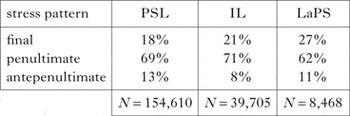
Among the rare words in the lexicon, many are technical terms, which often have antepenultimate stress. This could mean that the lexicon used here is not representative of everyday Portuguese stress patterns. Although the analysis in this paper is concerned with the lexicon per se, it would be desirable for the distribution of stress patterns in the Portuguese Stress Lexicon (PSL) not to deviate greatly from what speakers would normally experience in their language use. To verify this, two additional word-lists were examined, both of which contain only the most frequent words in the language: Invoke Limited (IL; Dave Reference Dave2012) and LaPS (Laboratório de Processamento de Sinais; Klautau Reference Klautau2013), from the Federal University of Pará – unlike the Houaiss dictionary, IL and LaPS are based solely on Brazilian Portuguese. In all three word-lists, the proportions of each pattern are relatively similar across all non-verbs considered. More importantly, the order penultimate > final > antepenultimate is observed in all three corpora, as shown in Table III.
Portuguese word-lists (IL and LaPS are based on Brazilian Portuguese).

3.1 Weight-sensitivity: the Portuguese lexicon
In this section, I examine how weight-sensitivity affects stress placement in the Portuguese Stress Lexicon. Firstly, I show that segmental quality does not have a clear correlation with stress. Secondly, I explore how the size of each syllabic constituent may affect stress: both subtle and robust effects are found in all three syllabic positions: onset, nucleus and coda. In §4, I present statistical models that capture these trends.
3.1.1 Segmental quality and stress
The stress patterns in the lexicon described above were analysed in terms of the number of segments as well as consonantal quality in all three possible syllable positions: final, penultimate and antepenultimate. Consonantal quality in codas or onsets does not seem to affect stress likelihood in a consistent way. Even though correlations do exist, their effects are not systematic. For example, [ɲ], which is only possible in onset position, is significantly correlated with penultimate stress when in penultimate position (p<0.0001), but negatively correlated with final stress when in final position (p<0.0001). On the other hand, (onset) [k] is negatively correlated both with final stress in final position (p<0.0001) and with penultimate stress in penultimate position (p<0.0001). Different trends are found for other consonants, and no systematic pattern is observed – the same can be said for vowel quality.
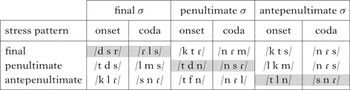
When we observe the distribution of the most frequent consonants in onset and coda position, we also see no consistent pattern, as shown in Table IV. In fact, the distribution of such consonants is as unsystematic as their correlation with stress, mentioned above. For example, it could be the case that more sonorous onset segments appear more frequently in stressed syllables (the shaded cells in Table IV). In other words, stressed positions could be more frequently occupied by more sonorous segments. This is simply not the case when we look at consonantal distributions or consonantal correlations with stress.
Most frequent onset and coda segments by stress pattern.

3.1.2 Onset-size effects
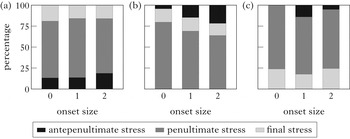
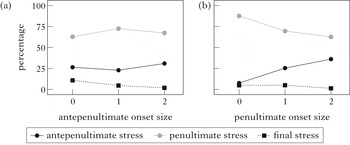
Let us now explore the data by examining the impact of onset size on stress. Onsets may be absent (0), as in árvore ‘tree’, singleton (1), as in cólica ‘spasm’, or complex (2), as in prático ‘practical’ – all three words have antepenultimate stress in this particular case, and are represented by the bars at the foot of Fig. 1a. The primary focus of the exploratory data analysis that follows is to show how properties of a given syllable affect stress on that syllable, as opposed to stress on the other two syllables in the stress domain. The plots in Fig. 1 show the percentage of words with a given stress pattern according to the onset size in each syllable.
Onset-size effects by syllable and stress pattern: (a) antepenultimate syllables, (b) penultimate syllables, (c) final syllables.

Figure 1 suggests that onsets are positively correlated with stress in the antepenultimate and final syllables. The number of words with antepenultimate stress does not seem to be affected by a difference between 0 and 1 in the antepenultimate onset size. Rather, the difference in the antepenultimate syllable plot in Fig. 1a lies between {0, 1} and 2 segments. For both antepenultimate and final syllables (Figs. 1a, c), there are no clear onset effects on stress.
We can see in Fig. 1b that onset size is negatively correlated with stress in penultimate syllables. In other words, as we increase the number of onset segments in the penultimate syllable, we observe a decrease in the number of words with penultimate stress. Interestingly, it is the number of words with antepenultimate stress that increases as a function of penultimate onset size. As we will see below, these effects become clearer once we control for coda size. The importance of these effects will be examined in §4.
3.1.3 Nucleus-size effects
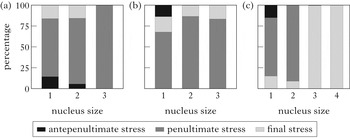
Nuclei and codas are expected to have stronger effects on stress than onsets. In Fig. 2, we can see that words with penultimate and final stress are affected by penultimate and final nucleus size respectively. Longer nuclei seem to have a strong effect on stress, which is consistent with typological weight distinctions, where complex nuclei are heavier than V nuclei. For example, words such as bastião [basˈtjãŵ] always bear final stress. In these cases, the final nucleus is coded as [jaNw], and contains four segments, which means that, as mentioned in §2.2, nasality is counted as a segment.
Nucleus-size effects by syllable and stress pattern: (a) antepenultimate syllables, (b) penultimate syllables, (c) final syllables.

Note that the effect of nuclei on stress is visible not only word-finally, but also in the penultimate syllable, contrary to what we would expect if weight-sensitivity were constrained to the right edge of the word in Portuguese (according to the traditional view discussed in §2). Interestingly, the size of antepenultimate nuclei seems to have a negative effect on antepenultimate stress, which is clearly unexpected.
3.1.4 Coda-size effects
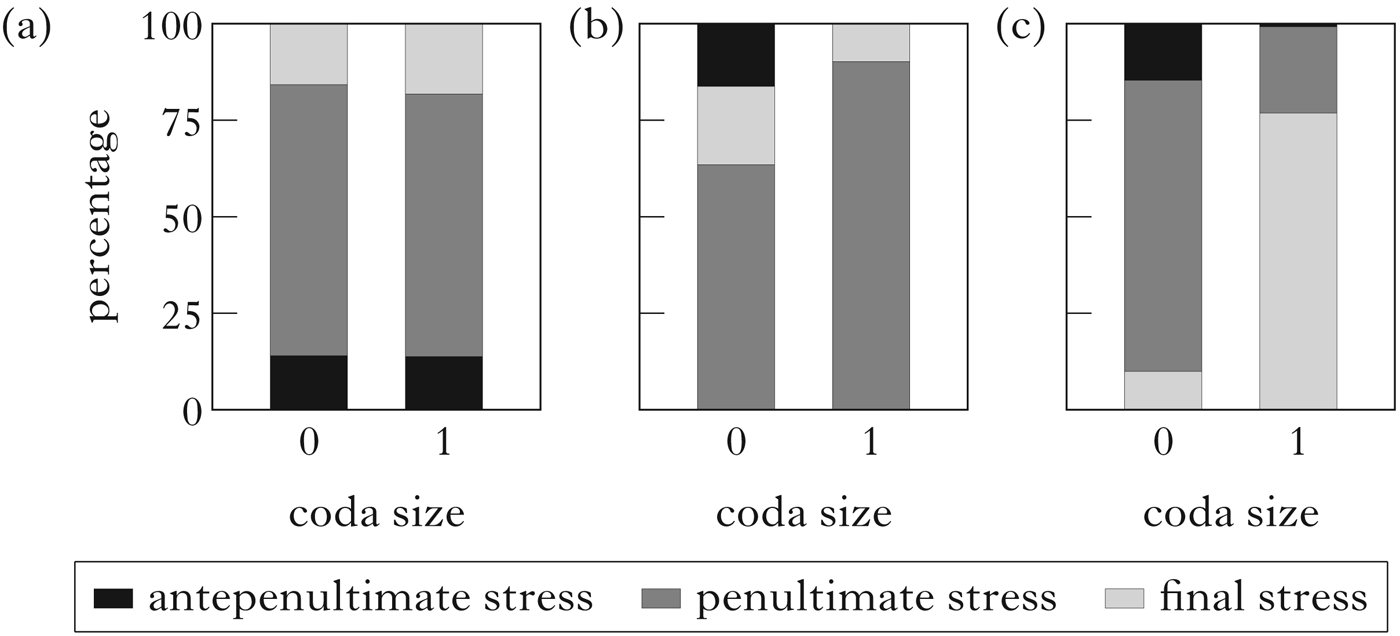
Let us now examine the effect of coda size on stress placement. Figure 3c shows a very strong effect of the presence of a final coda on stress placement, consistent with standard approaches to stress in Portuguese discussed in §2: final stress is far more frequent when the final syllable has a coda. Penultimate codas also show a positive effect on penultimate stress. Antepenultimate syllables, however, suggest a null effect, given that the presence of a coda segment does not seem to affect antepenultimate stress. Recall, however, that in almost all words with antepenultimate stress, only the antepenultimate syllable can be heavy (see Table I). In other words, though the antepenultimate rhyme may not affect the likelihood of antepenultimate stress, the presence of penultimate and final codas is expected to have a very strong (negative) effect on antepenultimate stress.
Coda-size effects by syllable and stress pattern: (a) antepenultimate syllables, (b) penultimate syllables, (c) final syllables.

The trends observed above suggest that the effect of syllable weight is gradient, not categorical: coda effects are overall stronger than nucleus effects, which is unexpected, but both seem to have a substantial impact on stress. One of the possible reasons for the weaker effect of nuclei may be the fact that rising diphthongs are traditionally considered to be light in Portuguese, but such cases count as complex nuclei in Fig. 2 (see §2.2; I return to this in §4.1.3). The extent to which weight influences stress also depends on which syllable one examines: final stress is more strongly affected by nuclei and codas than penultimate stress. In other words, weight effects seem to vary considerably across (and within) syllables, and are not only found word-finally. Onsets also show some effect on stress, though the trends observed here indicate that these segments may be negatively correlated with stress in a given syllable. These trends are statistically analysed in §4 below.
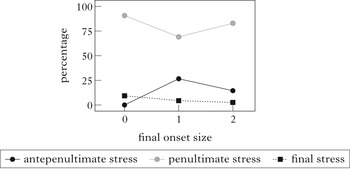
Given the trisyllabic window in which stress falls in Portuguese, we can verify the onset–stress relation in the two final syllables. Considering the coda effects in Fig. 3, σLL]ε words will most likely have penultimate stress regardless of onset size, as the absence of a final coda will definitely affect stress on that syllable. Nevertheless, the degree to which stress is affected could vary with the number of onset segments. Let us therefore examine whether final onset size affects penultimate/final stress.
Figure 4 suggests that larger final onset sizes (specifically the difference between 1 and 2) are more highly correlated with penultimate stress than final stress. It should be noted that singleton onsets are much more frequent in the Portuguese Stress Lexicon than complex onsets: 84.3% vs. 4.7% in words with final stress, 89.1% vs. 2.1% in words with penultimate stress and 81% vs. 10.2% in words with antepenultimate stress. These data refer to stressed syllables, but unstressed syllables also have more singleton than complex onsets – the frequency of onset clusters in Portuguese, like other Romance languages, is relatively low.
Stress patterns by final onset size in LLL words.

The trend in Fig. 4 is problematic, given that onsets of a given syllable are not expected to negatively impact stress on that syllable (see, for example, Ryan Reference Ryan2014). If this particular trend is statistically credible, however, the data would be consistent with a different theory of weight computation, namely interval theory (Steriade Reference Steriade2012).Footnote 8 Unlike syllables, intervals are rhythmic units that extend from a given vowel up to (but not including) the following vowel (i.e. a V-to-(V) interval). Since all intervals begin with a vowel, it follows that the string CCVCCVC is parsed into intervals as ⟨CC⟩VCC.VC (word-initial consonants are treated as extrametrical in this theory). The longer an interval, the heavier it is – and, as a result, the more likely it is to attract stress.
The crucial parsing difference between syllables and intervals lies with onset segments: an onset which would be parsed into a syllable i would be parsed into an interval i®1. However, a coda and its preceding nucleus, which belong to the same syllable, also belong to the same interval. It follows that more onset segments in the final syllable result in a longer (and therefore heavier) penultimate interval – all else being equal. Consequently, the negative onset effects observed in Fig. 4 would be predicted by interval theory, even though the negative effect of antepenultimate nucleus size in Fig. 2 would still be unexpected.Footnote 9
Penultimate and antepenultimate syllables are locations where coda effects are less apparent (standard analyses assume there is no such effect in these positions, as discussed in §2). Figure 5 presents the proportion of such words for different onset sizes in the penultimate syllable. In syllable theory, increases in onset size in the penultimate syllable should increase the amount of material in that constituent, positively affecting its duration, which should in turn affect the likelihood of penultimate stress (assuming that onsets play a role in stress assignment). Interval theory, on the other hand, predicts an increase in the likelihood of antepenultimate stress.
Stress patterns by (a) antepenultimate and (b) penultimate onset size in LLL words.

We see in Fig. 5b that the likelihood of antepenultimate stress increases when the penultimate syllable contains onset segments. Figures 4 and 5 show a clear pattern, which is consistent with interval theory. Antepenultimate onset size (Fig. 5a), on the other hand, presents a less clear pattern (recall that antepenultimate onsets are assumed to be extrametrical, so no particular pattern is expected): the presence of onset clusters in this syllable seems to favour antepenultimate stress when compared to singleton onsets, but not when compared to onsetless syllables. The high degree of unpredictability of antepenultimate syllables (relative to penultimate and final syllables) might be one of the reasons behind the unexpected patterns that we find. The onset effects observed in Fig. 5 are also unexpected, given work by Kelly (Reference Kelly2004) and Ryan (Reference Ryan2011), for example, who show a positive effect of onset size on stress – however, these studies focus on word-initial onsets.Footnote 10 As we will see in §4, antepenultimate syllables show a pattern that is not accounted for in either syllable or interval theory.
4 Statistical analysis
In the previous section, we saw that the patterns in the Portuguese Stress Lexicon show gradient weight effects with respect to stress location. In this section, I test whether the correlations in the data are supported (i.e. are significant), using statistical models that predict the location of stress based on the different syllabic constituents in the stress domain. In §4.1, I describe each of the statistical models proposed, analyse the results and examine how they relate to the main questions in this paper, formulated in (4) above. In §5, these models are compared to previous approaches, which serve as the baseline for the present analysis. Even though some of the patterns observed support interval theory, the statistical models proposed in this paper are based on syllables, as the representational assumptions encoded in the predictors of syllable-based models are, by definition, a superset of those encoded by interval-based predictors, given the structural differences between the two theories. In other words, we can evaluate intervals by considering syllable-based results, but not vice versa (the reader can easily make direct comparisons between the two theories by examining the effect sizes of onsets in the models provided).
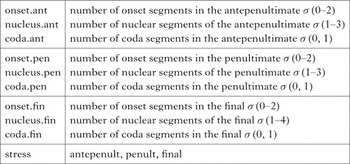
The factors examined in §3 are listed in Table V. The number of predictors in the statistical models proposed in this paper is proportional to the size of the stress domain (3 syllables ú 3 constituents per syllable = 9 predictors). Antepenultimate constituents were coded as n/a in disyllabic words.
Predictor and predicted variables.

The analysis presented in this section employs two binomial logistic regressions to model the Portuguese lexicon. Given that the stress patterns found in the language involve more than two levels, a multinomial logistic regression could be employed. However, goodness of fit and diagnostics become more intricate in such a model; i.e. it is less straightforward to assess the model's accuracy and interpret the meaning of coefficients, for instance, since outcomes are interpreted in relation to a reference level. Furthermore, the literature on multinomial models applied to linguistic data is much scarcer than that on binomial models.
A more parsimonious alternative would be to model the data using ordinal regression (see Agresti Reference Agresti2010), also known as the cumulative link model. In this case, the stress domain in the data would need to be treated as a three-point scale, where final (1) and antepenultimate (3) positions demarcate the end-points of the domain: 3>2>1]ε. This scale mirrors the stress domain, in terms of ordering as well as end-points (i.e. stress cannot be later than final nor earlier than antepenultimate). A single ordinal regression for the stress domain in Portuguese can be understood as equivalent to two (binomial) logistic regressions. Another advantage of ordinal regressions is that predictors in such models tend to have lower standard errors when compared to equivalent binomial regressions (Christensen Reference Christensen2013: 6).
Despite the advantages of ordinal regressions, their interpretation is also less trivial (much like multinomial regressions). Because a single coefficient is generated, its interpretation depends on multiple thresholds, which act as intercepts along the scale assumed. More importantly, it is not clear that the stress domain should be treated as a scale. In other words, it is not intuitive why penultimate stress should be at a higher (or lower) point in the scale than final stress.
A third option is to analyse the data using logistic regressions (glm() in R; R Core Team 2016). As mentioned above, this is the option employed in this paper. Because standard logistic models involve binary (i.e. binomial) predicted variables, two such models are necessary to accommodate the stress domain in Portuguese. As a result, interpreting the effect of individual predictors is more straightforward, and no scale needs to be assumed (cf. ordinal regressions). In fact, all three options just described were compared, and the results did not differ substantially with regard to the central focus of the present study, i.e. weight gradience and its effect on stress.
In the analysis proposed in this paper, two statistical models will be used: one model (AntPenFin) will predict antepenultimate vs. penultimate/final stress, and another model (PenFin) will predict penultimate vs. final stress (‘stress’ in Table V). This division is aligned with traditional analyses, which classify antepenultimate stress as irregular, and penultimate/final stress as (mostly) regular (§2).
Logistic Regressions predict the log-odds of y = 1/0 based on a set of predictors. In this case, y = antepenultimate vs. {penultimate, final} in one model and y = penultimate vs. final in another model. The fitted model is given in (10), where Pr(y i = 1) denotes the probability that stress y = 1; β0 represents the intercept, which can only be interpreted when all other variables are set to zero (this is not meaningful for the purposes of the present analysis); (β1…n) represents the regression coefficients for each predictor; and Xi stands for the values of the ith data point (i.e. the segmental count at each syllabic constituent).
-
(10)

For example, assume we have a CVCCVCV word such as martelo ‘hammer’, which is syllabified as CVC.CV.CV. In the AntPenFin model, we would predict the probability of antepenultimate stress (vs. penultimate/final stress) based on the segmental count in each syllable in the stress domain, as in (11). In this case, we are interested in how much each predictor in the set {β1…9} affects such a probability.
-
(11)

As we will see, both models capture weight gradience in Portuguese. Furthermore, given the probabilistic nature of the approach proposed in this paper, the models are more accurate than previous categorical analyses in predicting the weight–stress patterns present in the lexicon. In §4.1, I present the models and examine their results and predictions. In §5, I contrast these predictions with the actual patterns in the lexicon, and discuss how the present analysis differs from previous approaches.
4.1 Models of stress
4.1.1 The AntPenFin model
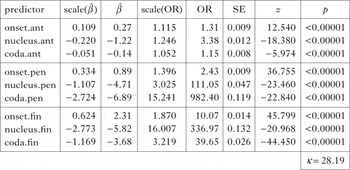
In this model, stress (antepenultimate or penultimate/final) is predicted based on syllabic constituents in all positions in the stress domain. The AntPenFin model is presented in Table VI, where we can see that all nine predictors have a highly significant effect on stress (p < 0.00001), which confirms that weight effects are not limited to word-final syllables. In addition, we can see that effect sizes weaken as we move away from the right edge of the word. All coefficient values in Table VI have been centred and scaled, and are therefore directly comparable to one another (each β̂ unit corresponds to one standard deviation of a given predictor). The results indicate key trends. First, we find divergent weight effects between rhymes and onsets across all three predictor positions in question. For example, whereas both the nucleus size and the coda size in the antepenultimate syllable negatively affect the likelihood of antepenultimate stress, the size of antepenultimate onsets positively affects antepenultimate stress.
Scaled (and unscaled) coeffcient values for the AntPenFin model (β̂>0 ⇒higher likelihood of antepenultimate stress), with associated odds ratio (OR=e|β̂|), standard errors, Wald z-values and significances.

The onset effects we observe in Table VI are consistent with the data trends discussed in §3.1.1, i.e. increasing the penultimate onset size increases the likelihood of antepenultimate stress. It is also possible to see that onset effects (in absolute terms) weaken as we move away from the right edge of the word – the same is true for nucleus effects. If we combine the penultimate onset effect with the antepenultimate rhyme effect discussed above, we can conclude that a word shape such as CV.CCV.CV would likely be the optimal candidate for antepenultimate stress (multiple onset clusters in the same word are uncommon in Portuguese).
Unsurprisingly, both penultimate and final rhymes negatively affect antepenultimate stress. In other words, LLL is the ideal weight profile for this particular stress pattern. Interestingly, the effect size of nuclei and codas is different when penultimate and final syllables are compared: in final position, nuclei have a stronger effect than codas, while in penultimate position codas have a stronger effect. In fact, the presence of a word-final coda reduces the odds of antepenultimate stress by a factor of nearly 3.2, whereas the presence of a penultimate coda reduces the odds of antepenultimate stress by a factor of 15.2 (see §4.1.2 for a discussion of nucleus–coda effects). These observed differences in effect size also capture a particular lexical pattern in the language, namely that σ́HL is less common than σ́LH (Table I).
One important characteristic of an optimal dataset is that the predictors involved are orthogonal, i.e. uncorrelated – although this is rare in practice, predictors should ideally be as uncorrelated as possible. The more non-orthogonal predictors are, the more difficult it becomes to explain exactly which predictors are responsible for a given effect – this is a phenomenon known as collinearity (Belsley et al. Reference Belsley, Kuh and Welsch1980), represented by k. A model with k{6 has no collinearity, k ≈15 indicates moderate collinearity and k}30 points to high collinearity (Baayen Reference Baayen2008: 182). The predictors included in the model in Table VI have medium-high collinearity (k =28.19).
The syllabic shapes found in Portuguese explain why collinearity between onsets, nuclei and codas is not low: although both heavy nuclei and codas are allowed, GVC/VGC syllables are rare in the language – i.e. syllabic predictors are not completely orthogonal. Furthermore, words with coda segments in multiple syllables are uncommon in the Portuguese lexicon. A Spearman r2 test reveals that the most collinear pair of predictors in the AntPenFin model is onset.pen and coda.ant (r2 = 0.15, p < 0.00001). Higher collinearity does not affect the model's coefficients; rather, it increases standard errors, which in turn lower the significance of a given effect (Baayen Reference Baayen2008). However, all the effects in question are highly significant (p < 0.00001), and therefore even relatively high collinearity should not pose problems for the analysis.
4.1.2 The PenFin model
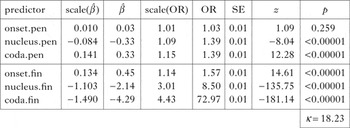
The PenFin model in Table VII shows that only penultimate onsets have no significant effect on penultimate (vs. final) stress – all other predictors are highly significant (p < 0.00001). Let us begin by examining the three predictors in the final syllable (positive β̂ values indicate a higher likelihood of penultimate stress). First and foremost, we can see that most of the trends discussed in §3.1.1 are also confirmed in this model. For example, final onsets do have a positive effect on penultimate stress. In fact, adding an onset segment to the final syllable increases the odds of penultimate stress by a factor of 1.14 (note that this effect is inconsistent with the typical representational assumptions of syllable theory, as mentioned in §3.1). We also see that both nucleus.fin (β̂ = —1.103, p < 0.00001) and coda.fin (β̂ = …1.490, p < 0.00001) have negative effects on penultimate stress, which is expected, given that this is known to be a very robust aspect of Portuguese stress (§2).
Scaled (and unscaled) coefficient values for the PenFin model.

Surprisingly, nucleus.fin has a weaker effect than coda.fin – a pattern also found for penultimate syllables in the AntPenFin model discussed above. This contradicts the strong typological tendency for VV to be heavier than VC (Gordon Reference Gordon, Goldsmith, Riggle and Yu2011). Recall that Portuguese has no long vowels, and, importantly, not all complex nuclei in the language are assumed to affect stress, as rising diphthongs are traditionally treated as light. The model presented in Table VII makes no distinction between rising and falling diphthongs (as discussed in §2.2), since nucleus.fin and nucleus.pen simply count the number of segments (ú-slots in (8)) in the domain (this is further motivated in §4.1.3). This could explain why the effect of final nuclei in this model is smaller than that of final codas. To check whether this was the case, alternative models were run where only falling diphthongs were considered to be heavy. In the alternative PenFin model, nucleus.fin (β̂ = 1.00) still has a smaller effect size than coda.fin (β̂ = 1.39), and nucleus.pen (β̂ = 0.08) still has a smaller effect size than coda.pen (β̂ = —0.17). The same pattern is found in the alternative AntPenFin model.
Let us now examine the results of nucleus.pen and coda.pen. First, nucleus.pen shows a negative effect on penultimate stress, which is unexpected. This could again be connected to the distinction between rising and falling diphthongs discussed above: if most diphthongs in nucleus.pen happen to be rising diphthongs, this pattern could be explained. However, that is not the case. In fact, if we only examine words with a complex penultimate nucleus, 52% of such words contain the falling diphthong [ej], almost all of them with penultimate stress.
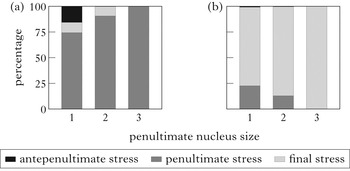
One potential reason behind the negative effect of nucleus.pen is another variable in the model: coda.fin. These two variables are negatively correlated, and removing coda.fin makes the effect of nucleus.pen turn positive – which is what we would expect given the trends in Fig. 2. The interaction between these two variables, however, is not captured in Fig. 2, since nuclei are plotted independently. If we inspect these two variables in Fig. 6, we can clearly see that penultimate diphthongs have different effects, depending on whether the word-final syllable contains a coda consonant (C#) or not (V#). In particular, for word-final syllables with a coda consonant, the more segments a word has in its penultimate nucleus, the less likely penultimate stress becomes (as shown by the lowest bars in Fig. 6). For example, words such as fácil ‘easy’ are more frequent in the Portuguese lexicon than words such as lêucon [ˈlew.koN] ‘leucon’ (23.2% vs. 12.4%).Footnote 11 In other words, if we only look at disyllables that contain no penultimate coda but which do contain a word-final coda (N = 1871), those with a monophthong in penultimate position are twice as likely to bear penultimate stress as those with a diphthong in penultimate position.
Penultimate nucleus size by word-final profile: (a) V#; (b) C#.

Because this paper assumes that theoretical premises should guide the statistical analysis, the model presented in Table VII does not include the interaction in question. A syllabic representation does not predict that nuclei and codas in different syllables should interact. In other words, there is no principled reason to believe these two variables should affect each other (see §4.1.3 for a discussion) – in fact, other interactions could also exist in the language. The objective of the present analysis is not to build the best statistical model, which could include a number of unprincipled interactions. Rather, the objective is to build a theoretically principled model that is able to best capture weight gradience in Portuguese.
Let us now turn to coda.pen, which had a significant effect in the PenFin model. The positive coefficient value of this predictor (β̂ = 0.141) indicates that adding a coda segment to the penultimate syllable increases the odds of penultimate stress by a factor of 1.15. This is naturally a much smaller effect than, for example, coda.fin, but it is highly significant. The effect sizes listed in Table VII clearly show a gradient effect, whereby predictors in the final syllable have a greater absolute effect than predictors in the penultimate syllable.
In Table VII, onset.pen had no significant effect on stress. A relevant question is whether this null effect is also found if we model only disyllabic words. In fact, if we restrict the PenFin model to disyllables (N = 11,475), we find that onset.pen has a positive effect on penultimate stress (β̂ = 0.16, p < 0.00001).
4.1.3 Model assessment
The models above have both expected and unexpected results. In the PenFin model, for example, the effects of nucleus.pen and onset.fin go against what a syllabic representation would predict. On the other hand, the expected strong effect of final nuclei and codas possibly explains why previous analyses of Portuguese stress have constrained weight effects to the right edge of the word: such analyses have concentrated on word-final syllables only, most likely because of the considerably different coefficient values between final and penultimate syllables (β̂coda.fin/β̂coda.pen ≈ 10 in the PenFin model). Therefore, although the structure of earlier syllables does affect stress placement, these effects are small compared to the structure of the final syllable, and may not be noticed unless a large enough subset of the Portuguese lexicon is examined.
In §2.2, we saw that, contrary to most analyses of Portuguese stress, rising diphthongs may not always pattern as light (following Harris Reference Harris1983). In particular, given that both ˈCV.CVG.CV and ˈCV.CGV.CV words are unattested in the language, it is not clear that a categorical weight difference can be determined for onglides vs. offglides. This is one of the reasons why the models above do not differentiate rising and falling diphthongs. A second reason, discussed below, is conceptual.
Should a model that only includes quantitative predictors be sensitive to the difference between rising and falling diphthongs? Should this distinction be ‘visible’ to the model? The richness of a model has to do with the types of theoretical and representational assumptions it should encode. We are interested in a model that predicts stress on the basis of quantitative information. One of the main objectives of the model is to determine how weight affects stress. Such a model should be as unbiased as possible. By differentiating rising and falling diphthongs, we would be adding information to the model that goes beyond a neutral segmental count – in fact, this would inform the model of a specific weight effect in the language (an effect which should be unknown a priori). In other words, we would be telling the model that a specific sequence of segments is light, even though the purpose of the model is to inform us about weight effects.
The two models presented and discussed above show that the weight patterns in the Portuguese lexicon are much more intricate than one would expect – and far from categorical. Firstly, such effects go in two directions. Whereas in the PenFin model penultimate stress becomes less likely when final syllables are heavy, in the AntPenFin model antepenultimate stress becomes less likely when antepenultimate syllables are heavy. In fact, we also see positive and negative weight effects in the penultimate rhyme (the PenFin model), where nucleus.pen and coda.pen have opposite effects on penultimate stress.
One could argue that some of these facts may be related to the footing patterns in Portuguese. The language is traditionally classified as trochaic (see Bisol Reference Bisol2000 for a review), and therefore (ĹL) and (H´) feet should be preferred (Hayes Reference Hayes1995). In addition, recall that previous analyses have argued that the final syllable is extrametrical in words with antepenultimate stress (Bisol Reference Bisol1992 and many others). If we now combine these two facts, we can partially explain why both nucleus.ant and coda.ant are negatively correlated with antepenultimate stress: given that ĹL trochees are preferred to H´L trochees, (ĹL)⟨σ⟩ is better than (H´L)⟨σ⟩, and therefore should be more likely.Footnote 12 A third footing option, namely (H´)L⟨σ⟩, is preferred to (H´L)⟨σ⟩. However, this leaves a syllable unparsed in the middle of the stress domain, which not only contradicts traditional foot-based analyses of Portuguese, but is also highly marked. This approach thus assumes that light antepenultimate syllables are more stress-attracting for footing reasons, not because of weight per se.
Not all facts are accounted for by extrametricality and footing patterns, however. For example, while the negative effect of nucleus.pen would be explained, the positive effect of coda.pen would not. Furthermore, the onset effects found in both models would require an additional explanation, as one would not expect such effects in a standard foot-based analysis. Indeed, there does not seem to be a theoretically unified way of accounting for all the effects found in the syllable models under discussion.
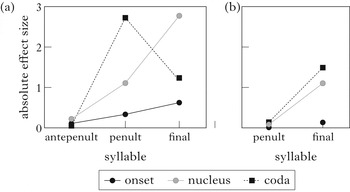
Let us now turn to the main focus of the present analysis, namely weight gradience. The absolute coefficient values in the AntPenFin and PenFin models argue for a clear gradient notion of weight-sensitivity in Portuguese. Contrary to what previous analyses assume, the models discussed above show that weight is not a categorical phenomenon in the language. In Fig. 7, the absolute effect size of each predictor (i.e. syllable constituent) is plotted for each of the two models. The panels provide a more evident gradient trend: predictors in the final syllable have a stronger effect on stress when compared to predictors in the penultimate syllable (PenFin model), which in turn have stronger effects on stress than predictors in the antepenultimate syllable (AntPenFin model).
Absolute effect sizes in the syllable models: (a) the AntPenFin model; (b) the PenFin model.

As can be seen in Fig. 7, the effects of predictors in the penultimate syllable are relative to the statistical model. In other words, the absolute difference between penultimate and final predictors is smaller than that of penultimate and antepenultimate predictors. This trend indicates that the antepenultimate syllable is the least weight-sensitive position in the stress domain in Portuguese. In addition to the weight gradience across syllables, we also observe gradual effects within syllables: coda > nucleus > onset for final syllables in the PenFin model and penultimate syllables in the AntPenFin model, but nucleus > coda > onset for final syllables in the AntPenFin model. For antepenultimate syllables, the absolute effect sizes indicate a different trend, namely nucleus > onset > coda. Although this trend is highly significant, it is surprising, and difficult to interpret; it is not clear how such a pattern could be accommodated by any representational assumptions regarding rhythmic units.
5 Discussion
In this section, I summarise and discuss the main results presented in this paper. §5.1 evaluates the accuracy of the probabilistic analysis I propose, and §5.2 briefly explores the implications of the approach adopted here for the grammar of Portuguese.
The models discussed in §4 clearly answer the questions in (4). First, weight-sensitivity is found in all positions in the stress domain, not only word-finally. Second, weight effects are gradient, not categorical. These two facts are evident in both statistical models discussed above. Third, onsets do contribute to weight in the Portuguese lexicon. However, the latter effect manifests itself in an unexpected way, given that in penultimate and final syllables onset size is negatively correlated with stress.
Both models examined in this paper clearly show that the relationship between stress and weight in Portuguese is far more intricate than previously assumed. Inconsistencies and surprising effects are not only limited to onsets: (i) penultimate codas have a stronger effect than penultimate nuclei; (ii) final codas have a stronger effect than final nuclei in predicting penultimate stress (PenFin model); (iii) heavy antepenultimate rhymes disfavour antepenultimate stress.
The most important characteristic of the present approach is its probabilistic nature. A categorical approach cannot predict that a certain irregular pattern exists (e.g. ĹLL), given that it deviates from traditional generalisations about the language (σσH´, else σσ́L). The present proposal, however, predicts that all licit stress patterns are possible (including so-called irregular cases), and that some are more likely than others. Crucially, and perhaps most importantly, it is no longer the case that all irregular forms are equally unlikely, an implication of standard analyses. As we will see below, the probabilistic nature of the present approach results in a more accurate characterisation of stress in the Portuguese lexicon.
5.1 Accuracy
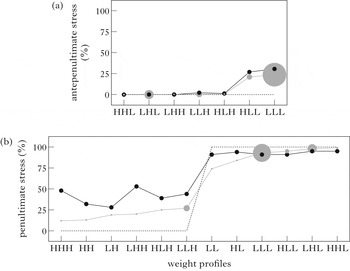
In this section, I briefly compare the predictions of the present approach with those of traditional categorical analyses. First, let us examine the predictions of the AntPenFin model in Fig. 8a, which plots the proportion (or probability) of words with antepenultimate stress (vs. penultimate or final stress) across sets of words that mirror the different weight profiles (i.e. sequences of light and heavy syllables) in the language. The dotted line represents the predicted probability of antepenultimate stress based on traditional (categorical) approaches (i.e. 0%, since antepenultimate stress is considered to be irregular). Actual lexical proportions are represented by grey circles (where the size of the circle corresponds to lexical representativeness). These proportions are based on the set of words being modelled in each case: AntPenFin: N = 143,135; PenFin: N = 134,599. Finally, black circles represent the mean predicted probability of antepenultimate stress based on the present approach.
The accuracy of (a) the AntPenFin model and (b) the PenFin model. Mean predicted probabilities of (a) antepenultimate (vs. penultimate/final) stress and (b) penultimate (vs. final) stress by weight profile (black circles), as well as actual lexical frequencies (grey circles) are plotted. The size of the grey circles indicates the lexical proportions of (a) antepenultimate and (b) penultimate stress. Dotted lines indicate predicted stress based on a standard categorical analysis.

As we can see in Fig. 8a, in some cases (e.g. HHH, HHL, LHL), categorical predictions accurately match the actual lexical proportions. Note that a clear mismatch is observed for HLL and LLL words. These cases, however, are accurately approximated by the predicted proportions in Fig. 8a. In other words, given a new LLL word, the present analysis predicts that there is roughly a 25% probability that such a word will be assigned antepenultimate stress, and a 75% probability that stress will be either penultimate or final. Traditional approaches, on the other hand, would not predict antepenultimate stress in this (or any other) case.
Assuming that a word is not assigned antepenultimate stress, we now need to consider penultimate vs. final stress, which account for the vast majority of words in the lexicon (Table I). Fig. 8b plots the percentage (or probability) of words with penultimate stress (vs. final stress) across the different weight profiles in the language. Recall that traditional approaches predict final stress for all words with a heavy final syllable (σσH´) and penultimate stress elsewhere (σσ́L). Clearly, these predictions deviate considerably from the actual lexical proportions of penultimate stress.
Like Fig. 8a, Fig. 8b shows that probabilistic predictions are substantially more accurate than a categorical approach. Even though we observe a clear distinction between σσH and σσL words, a gradient effect within each group is also visible. For example, H´L words are more frequent than ĹL words – and this difference is mirrored in the models’ mean predicted probabilities.
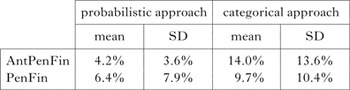
Whereas Fig. 8 provides a means to visually compare the present proposal to traditional analyses of Portuguese stress, Table VIII presents a numerical comparison, namely the weighted mean deviation of predicted probabilities from actual lexical percentages. The mean deviation takes into account the representativeness in the plots of each weight profile in the lexicon. Not only is the weighted mean deviation lower in the probabilistic approach presented here, the weighted standard deviations are also lower when compared to a categorical approach, a fact which mirrors the trends in Fig. 8.
Weighted mean deviation of mean predicted probabilities from actual lexical proportions: probabilistic vs. categorical approaches.

5.2 A probabilistic grammar
Thus far, we have investigated the stress patterns in the Portuguese lexicon by employing different statistical models. Little has been said, however, about what these patterns mean for the grammar of Portuguese speakers. If the lexical patterns explored in this paper are psychologically real, important questions are (i) how such patterns could be implemented in a phonological grammar and (ii) how the lexicon and grammar interact. I will not construct such a grammar here, given that at present we do not know how closely speakers’ grammars mirror the lexical patterns modelled in this paper, but I will sketch what such a grammar (henceforth G) might look like.
A first step towards modelling G would be to determine whether the patterns presented in this paper reflect what is in the minds of speakers. If that is the case, G could be modelled within probabilistic versions of Optimality Theory (Prince & Smolensky Reference Prince and Smolensky1993) where constraints are weighted (Pater Reference Pater2009), such as maxent grammar (Hayes & Wilson Reference Hayes and Wilson2008) or noisy harmonic grammar (Boersma & Pater Reference Boersma, Pater, McCarthy and Pater2016). A maxent grammar would make particular sense, given that constraints correspond to different predictors (Goldwater &Johnson Reference Goldwater, Johnson, Spenador, Eriksson and Dahl2003).
To map the present analysis into a maxent grammar, the predictors discussed above would be equivalent to markedness constraints that enforce weight–stress mappings based on the lexical patterns observed in the language. For example, a positional constraint WSP n (the Weight-to-Stress Principle; Prince Reference Prince1990) would penalise an unstressed syllable in position n according to the number of segments present in σ n , where n represents the possible positions in the stress domain.
The lexical distributions of stress determine how G will assign stress probabilistically to a novel word, as in Fig. 9. Once an output is selected (probabilistically), stress will remain lexically marked on the word, which correctly ensures that stress in existing words does not vary.Footnote 13 Finally, this novel word will now be part of the lexicon (3 in Fig. 9).Footnote 14 Therefore, only words without stress information (i.e. novel words) will be assigned stress probabilistically. This type of distinction between existing and novel words draws on Zuraw (Reference Zuraw2000: 48), who employs ‘listedness’ as a means to differentiate the two types of words with respect to the application of nasal substitution in Tagalog.
Relationship between lexicon and grammar (G) assumed in the present analysis. Lexical patterns generate constraint weights (1). Stress in new words is assigned based on probabilities (2). Once stressed, a new word enters the lexicon (3).

In the probabilistic approach presented here, patterns are no longer treated as regular or irregular, but rather as more or less likely. For example, in a new word such as setamira, penultimate stress is most likely, but final (and antepenultimate) stress is also possible for a word of this shape. If the (less likely) candidate with final stress is chosen by the grammar, it will enter the lexicon as setamirá. Other constraints in G will ensure that (i) illicit stress patterns are not generated, e.g. pre-antepenultimate stress, and (ii) stress does not shift once it has been assigned (i.e. stress is required to be faithfully realised in the output).
Because stress is lexically marked in the present approach, speakers need to learn a word with its particular stress position. In categorical analyses, only irregular cases are lexically marked, since regular cases are derived based on the generalisations already discussed. The latter approach entails that speakers would memorise only the additional mechanisms responsible for irregular stress (e.g. extrametricality). Crucially, the present approach provides an explanation as to how lexical stress is assigned to all words (probabilistically, based on the stress patterns already present in the lexicon). In other words, particular groups of words (e.g. words with antepenultimate stress) do not require a different explanation.
The probabilistic approach presented here is based solely on the quantitative aspect of weight, which means segmental quality is not part of the model employed in the analysis. Likewise, metrical representation is not included in the model, as the objective is to evaluate the accuracy of a model based solely on weight. Naturally, the absence of such a representation does not imply that a metrical component plays no role in the grammar of Portuguese. For example, even if feet do not play a direct role in primary stress assignment per se, they could still be responsible for restricting the stress domain to the final three syllables in a word and in assigning secondary stress.
In addition to WSP, discussed above, other constraints in G will play an important role if speakers’ grammars in fact encode all the lexical patterns found in this paper. For example, suppose that the specific effect where antepenultimate rhymes negatively impact antepenultimate stress is indeed generalised to novel words by speakers. This effect would not be captured by a constraint such as WSP, given that constraints in a maxent framework cannot have negative weights. Instead, positionally defined constraints against marked structures (e.g. *Complex) could indirectly capture the observation that antepenultimate syllables are more likely to bear stress if their rhymes are minimally complex.
In sum, at present we do not know how speakers’ grammars and the lexical patterns modelled in this paper compare. Previous work has shown that statistically significant trends in the lexicon are not necessarily generalised by speakers (Albright & Hayes Reference Albright, Hayes, Fanselow, Féry, Vogel and Schlesewsky2006, Hayes et al. Reference Hayes, Zuraw, Siptár and Londe2009, Becker et al. Reference Becker, Ketrez and Nevins2011). For example, the negative effects observed in antepenultimate syllables mentioned above may not be reflected in the minds of speakers and therefore encoded in the grammar. Likewise, the negative onset effects found for penultimate and final syllables may be restricted to the lexicon, and may not be generalised to novel forms by native speakers. Crucially, the model presented here formalises the lexicon as a hypothetical baseline, which is a necessary step if we wish to examine whether the lexicon mirrors speakers’ grammars. Future work is needed to investigate how the grammar and lexicon compare with respect to the probabilistic assumptions made in this paper.
6 Conclusion
This paper has examined the role of weight in stress assignment in Portuguese. I have proposed a probabilistic model that focuses on weight as the only predictor of stress location. The objective of such a model was to show that weight effects are gradient, not categorical as assumed in previous literature (Bisol Reference Bisol1992, Lee Reference Lee1994, Reference Lee2007, Mateus & d'Andrade Reference Mateus and d'Andrade2000, Wetzels Reference Wetzels2007). Likewise, these effects are shown to be more intricate than traditional approaches assume, given that some effects are negatively correlated with stress (e.g. antepenultimate nuclei; penultimate and final onsets).
Assuming that the lexicon does indeed reflect the grammar, the probabilistic grammar implied in this paper considers that stress is assigned based on a probability distribution derived from the patterns present in the lexicon. Once assigned, stress remains lexically marked. This approach is substantially different from traditional analyses. First, a formal distinction between regular and irregular patterns no longer exists; rather, a given stress location is more or less likely. Likewise, weight is not categorically defined (e.g. heavy or light). Instead, a weight continuum is assumed, whereby the notion of weight-sensitivity is understood as inherently gradient (cf. Albright & Hayes Reference Albright, Hayes, Fanselow, Féry, Vogel and Schlesewsky2006, Ryan Reference Ryan2011).
Unlike previous approaches, the probabilistic analysis proposed in this paper predicts that speakers could in principle assign antepenultimate stress to a new LLL word, for instance. In contrast, categorical studies predict that so-called irregular cases are not generalisable. Future research is needed to test these predictions, and whether the weight effects in the Portuguese lexicon are reflected in speakers’ grammars. This will also provide a means to compare to what extent the subtleties found in the Portuguese lexicon are in fact captured (and generalised) by speakers. As the relationship between the Portuguese lexicon and speakers’ grammars becomes clearer, the probabilistic approach to weight assumed here can be further developed, and its impact on other aspects of the grammar can be evaluated.