INTRODUCTION
Attention-deficit/hyperactivity disorder (ADHD), which affects up to 8% of the school-aged population (Froehlich et al., Reference Froehlich, Lanphear, Epstein, Barbaresi, Katusic and Kahn2007), is characterized by the presence of developmentally inappropriate levels of impulsivity, hyperactivity, and inattentiveness (American Psychological Association, 2013). Approximately 25% to 40% of individuals with ADHD have a Reading Disorder (RD) (Willcutt & Pennington, Reference Willcutt and Pennington2000). Regardless of RD status, individuals with ADHD have difficulty identifying written words (McGrath et al., Reference McGrath, Pennington, Shanahan, Santerre-Lemmon, Barnard, Willcutt and Olson2011; Willcutt et al., Reference Willcutt, Betjemann, McGrath, Chhabildas, Olson, DeFries and Pennington2010), demonstrate slower, less accurate sight word reading and non-word decoding (Ghelani, Sidhu, Jain, & Tannock, Reference Ghelani, Sidhu, Jain and Tannock2004; Jacobson et al., Reference Jacobson, Ryan, Martin, Ewen, Mostofsky, Denckla and Mahone2011; Willcutt, Pennington, Olson, & DeFries, Reference Willcutt, Pennington, Olson and DeFries2007), and have difficulty constructing meaning from text (Brock & Knapp, Reference Brock and Knapp1996; Gregg et al., Reference Gregg, Coleman, Stennett, Davis, Nielsen, Knight and Hoy2002; Miller et al., Reference Miller, Keenan, Betjemann, Willcutt, Pennington and Olson2013; Samuelsson, Lundberg, & Herkner, Reference Samuelsson, Lundberg and Herkner2004).
Neuropsychological Functions Implicated in RD & ADHD
Although RD is primarily characterized by difficulties with phonological awareness, phonological decoding, orthographic decoding, and/or rapid serial naming (Sheikhi, Martin, Hay, & Piek, Reference Sheikhi, Martin, Hay and Piek2013), there is also evidence for the contribution of neuropsychological functions to word reading and fluency including verbal working memory, set shifting, planning, and response inhibition in RD (Willcutt, Pennington, Olson, Chhabildas, & Hulslander, Reference Willcutt, Pennington, Olson, Chhabildas and Hulslander2005). Hence, some have argued that problems in word reading, reading fluency, and reading comprehension in ADHD are possibly related to ADHD-related deficits in neuropsychological functioning including deficits in response inhibition, vigilance, working memory, and planning (Brock & Knapp, Reference Brock and Knapp1996; Jacobson, Ryan, Denckla, Mostofsky, & Mahone, Reference Jacobson, Ryan, Denckla, Mostofsky and Mahone2013; Jacobson et al., Reference Jacobson, Ryan, Martin, Ewen, Mostofsky, Denckla and Mahone2011; Pennington, Reference Pennington2006; Pham, Reference Pham2013; Savage, Cornish, Manly, & Hollis, Reference Savage, Cornish, Manly and Hollis2006; Willcutt et al., Reference Willcutt, Betjemann, McGrath, Chhabildas, Olson, DeFries and Pennington2010; Willcutt, Doyle, Nigg, Faraone, & Pennington, Reference Willcutt, Doyle, Nigg, Faraone and Pennington2005). In fact, participants with ADHD only, RD only, and with ADHD + RD all have been shown to demonstrate significant deficits in set-shifting, response inhibition, and processing speed (Marzocchi et al., Reference Marzocchi, Oosterlaan, Zuddas, Cavolina, Geurts, Redigolo and Sergeant2008; Willcutt, Pennington, et al., Reference Willcutt, Pennington, Olson, Chhabildas and Hulslander2005), the latter of which has been proposed as a common cognitive correlate for ADHD and RD (Jacobson et al., Reference Jacobson, Ryan, Denckla, Mostofsky and Mahone2013; McGrath et al., Reference McGrath, Pennington, Shanahan, Santerre-Lemmon, Barnard, Willcutt and Olson2011; Willcutt et al., Reference Willcutt, Betjemann, McGrath, Chhabildas, Olson, DeFries and Pennington2010; Willcutt, Pennington, et al., Reference Willcutt, Pennington, Olson, Chhabildas and Hulslander2005). Thus, it may be that shared cognitive deficits are responsible, in part, for the high rates of comorbidity between ADHD and RD. Many researchers argue that inhibition is the primary neuropsychological function that precedes and allows development of other executive functions (Barkley, Reference Barkley1997; Carlson & Moses, Reference Carlson and Moses2001) which makes it a natural target of investigation. Furthermore, response inhibition and processing speed challenges are often associated with word reading problems in individuals with ADHD and individuals with RD (Jacobson et al., Reference Jacobson, Ryan, Martin, Ewen, Mostofsky, Denckla and Mahone2011; McGrath et al., Reference McGrath, Pennington, Shanahan, Santerre-Lemmon, Barnard, Willcutt and Olson2011; Willcutt et al., Reference Willcutt, Betjemann, McGrath, Chhabildas, Olson, DeFries and Pennington2010; Willcutt, Pennington, et al., Reference Willcutt, Pennington, Olson, Chhabildas and Hulslander2005).
Stop Signal Task
One of the most frequently used measures of response inhibition is the stop signal task (SST). The SST was designed to assess the ability to cancel an ongoing speeded motor response (Lipszyc & Schachar, Reference Lipszyc and Schachar2010). The task is based on the race model, which purports that whether or not a particular response will be inhibited depends on the outcome of a race between two independent processes: the go process and the stop process (Logan, Cowan, & Davis, Reference Logan, Cowan and Davis1984). While stop signal reaction time (SSRT) provides an estimate of the latency of the inhibitory process (i.e., response inhibition), mean reaction time (MRT) and the within-subject reaction time standard deviation (SDRT) can also be obtained (Epstein et al., Reference Epstein, Langberg, Rosen, Graham, Narad, Antonini and Altaye2011). MRT and SDRT reflect the latency and the variability in the latency of the go process, respectively. MRT is also a measure of processing speed in that it captures the ability to search quickly for and respond to specific targets. It should also be noted that although SSRT is typically presumed to capture response inhibition, others have suggested that it reflects an underlying deficit of attention or cognitive processing (Alderson, Rapport, & Kofler, Reference Alderson, Rapport and Kofler2007; Lijffijt, Kenemans, Verbaten, & van Engeland, 2005). Similarly, SDRT could also reflect sustained attention (Lijffijt et al., Reference Lijffijt, Kenemans, Verbaten and van Engeland2005; Manly et al., Reference Manly, Owen, McAvinue, Datta, Lewis, Scott and Robertson2003) or non-optimal activation state (Kuntsi, Oosterlaan, & Stevenson, Reference Kuntsi, Oosterlaan and Stevenson2001). Regardless, these three outcomes are thought to have distinct developmental courses and unique patterns of neural activity (Lipszyc & Schachar, Reference Lipszyc and Schachar2010).
A meta-analysis of studies using the SST in various diagnostic groups reported that individuals with ADHD only, RD only, and comorbid ADHD + RD, demonstrate significant deficits in all three SST outcomes, especially SSRT and SDRT, with the most impairment evident in the ADHD + RD group (Lipszyc & Schachar, Reference Lipszyc and Schachar2010). However, this meta-analysis did not disaggregate RD into word reading, reading fluency, and/or reading comprehension skills, and the majority of children with RD were characterized as having word reading difficulties. Although successful reading involves each of these component constructs amongst others, it is possible that neuropsychological deficits may differentially impact each of these domains. For example, neuropsychological functions may be more strongly linked to reading comprehension than word reading or fluency, since reading comprehension is more complex than basic phonological decoding and word identification and involves higher order cognitive processing (Sesma, Mahone, Levine, Eason, & Cutting, Reference Sesma, Mahone, Levine, Eason and Cutting2009). Furthermore, word reading, reading fluency, and reading comprehension, while overlapping, may involve distinct cognitive processes (Christopher et al., Reference Christopher, Miyake, Keenan, Pennington, DeFries, Wadsworth and Olson2012; Kim, Wagner, & Lopez, Reference Kim, Wagner and Lopez2012; Nation, Cocksey, Taylor, & Bishop, Reference Nation, Cocksey, Taylor and Bishop2010; Snowling & Hulme, Reference Snowling and Hulme2012) that are not accounted for by word decoding or comprehension respectively (Miller et al., Reference Miller, Keenan, Betjemann, Willcutt, Pennington and Olson2013; Sesma et al., Reference Sesma, Mahone, Levine, Eason and Cutting2009). There is also evidence that individuals with ADHD have deficits in reading comprehension and/or reading fluency even in the absence of word reading difficulties (Ghelani et al., Reference Ghelani, Sidhu, Jain and Tannock2004; Jacobson et al., Reference Jacobson, Ryan, Martin, Ewen, Mostofsky, Denckla and Mahone2011; Li et al., Reference Li, Cutting, Ryan, Zilioli, Denckla and Mahone2009; Miller et al., Reference Miller, Keenan, Betjemann, Willcutt, Pennington and Olson2013; Willcutt et al., Reference Willcutt, Pennington, Olson and DeFries2007). Thus, investigating the potential relation of neuropsychological functioning measured by the SST (i.e., response inhibition, reaction time variability, and latency or processing speed) to components of reading in poor readers with ADHD is warranted. Although initial research suggests an association between these cognitive skills and reading ability, their respective predictive powers for the specific component skills of reading (word reading, reading fluency, reading comprehension) remain understudied (Christopher et al., Reference Christopher, Miyake, Keenan, Pennington, DeFries, Wadsworth and Olson2012).
Possible Association of Reading Constructs with Neuropsychological Functions Measured by the SST
Word reading skills (both timed and untimed) may be affected by inhibition challenges in that efficient retrieval of the phonological codes for letters and letter units, for example, may be affected by the ability to suppress irrelevant codes and quickly search and retrieve the relevant response (Altemeier, Abbott, & Berninger, Reference Altemeier, Abbott and Berninger2008). Furthermore, inefficient inhibitory mechanisms may contribute to poorer reading comprehension in that reading involves selecting relevant information to build a coherent representation of the meaning of the text. Thus, the reader must ignore irrelevant information within text passages as irrelevant information may damage the maintenance of relevant information thereby negatively impacting reading comprehension from text (Borella, Carretti, & Pelegrina, Reference Borella, Carretti and Pelegrina2010).
Reaction time variability (i.e., SDRT) is purported to demonstrate the efficiency with which limited attentional resources are allocated in the face of demands for effortful cognitive control (Li et al., Reference Li, Cutting, Ryan, Zilioli, Denckla and Mahone2009). Successful word reading requires accessing stored representations of words quickly and efficiently. Thus, processing speed and/or SDRT should predict how efficiently and accurately one is able to do this. Slow processing speed may decrease the efficiency of reading, impacting reading fluency, since fluent reading depends on the automatic recognition of words. This may also affect reading comprehension since the diversion of attention to word reading may leave fewer cognitive resources available for processing the meaning of the text (LaBerge & Samuels, Reference LaBerge and Samuels1974; Samuels, Reference Samuels2012). Furthermore, slower processing speed may increase the demand placed upon working memory during reading comprehension, potentially overburdening the reader's ability to retain the content long enough to comprehend its meaning (Jacobson et al., Reference Jacobson, Ryan, Martin, Ewen, Mostofsky, Denckla and Mahone2011).
Current Study
In the current study, we investigated the relation between response inhibition (SSRT), processing speed (MRT), and reaction time variability (SDRT), as measured with the SST, and reading in children with ADHD who are poor readers (i.e., ≤25th percentile on word reading tasks). We included measures of word reading, reading fluency (i.e., word reading efficiency), and reading comprehension. We hypothesized that response inhibition, processing speed, and reaction time variability would be related to word reading, fluency, and reading comprehension skills. Specifically, we hypothesized a negative association between the SST variables and word reading, reading fluency, and reading comprehension, such that poorer performance on the SST would be associated with poorer reading performance in all domains.
METHOD
The study was approved by the University Institutional Review Boards at two implementation sites, Cincinnati Children's Hospital Medical Center and the University of Texas Houston Health Science Center, and the research was completed in accordance with the Helsinki Declaration. Children were recruited from local schools, the community, and outpatient clinics. Informed parental consent and participant assent were obtained from all participants before initiating any procedures.
Participants
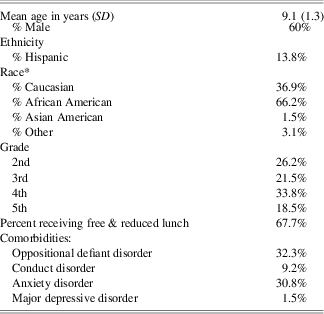
Baseline data from an ongoing multi-site clinical trial investigating interventions for children with attention and reading challenges were used. All children (n = 65) were in grades 2 through 5 and met DSM-IV diagnostic criteria for ADHD (Combined or Predominantly Inattentive type) based on the Diagnostic Interview Schedule for Children, 4.0 (DISC) (Shaffer, Fisher, Lucas, Dulcan, & Schwab-Stone, 2000) conducted with parents. In addition, all children were rated as “often” or “very often” on at least four inattention symptoms on the Swanson Nolan and Pelham (SNAP-IV) ADHD rating scale by their teacher. Poor reading was defined in the primary study as a standard score of 90 or lower (i.e., ≤25th percentile) on the Woodcock Johnson-III (WJ-III) Letter-Word Identification subtest, Word Attack subtest, or the Basic Reading Skills score. All children had a Full Scale IQ score >70 on the Kaufman Brief Intelligence Test for Children – Second Edition (KBIT-2) (Kaufman & Kaufman, Reference Kaufman and Kaufman2004). Demographic characteristics of the sample are included in Table 1.
Demographic characteristics (n = 65)

Note. *Totals > 100% as some parents selected more than one racial category; SD = standard deviation
Measures
Woodcock Johnson Tests of Achievement – Third Edition (WJ-III) (Woodcock, McGrew, & Mather, Reference Woodcock, McGrew and Mather2001)
The WJ-III Letter-Word Identification (naming letters and reading words aloud from a list) and Word Attack (reading nonsense words aloud to test phonetic word attack skills) subtests, comprising the Basic Reading Skills score, were used to determine eligibility for the study. These two subtests have good reliability (>.8) and validity (Woodcock et al., Reference Woodcock, McGrew and Mather2001).
Kaufman Brief Intelligence Test – Second Edition (Kaufman & Kaufman, Reference Kaufman and Kaufman2004)
The KBIT-2 is a brief individually administered screening measure that provides an estimate of a child's verbal and nonverbal intellectual abilities that are associated with academic success. The Verbal IQ score provides an estimate of a child's receptive vocabulary and range of general information about the world, as well as verbal comprehension, reasoning, and vocabulary knowledge; the Nonverbal IQ score provides an estimate of a child's visual spatial processing and relational reasoning; and the IQ Composite score provides an estimate of a child's overall intellectual functioning in terms of skills necessary to succeed at school. The measure has good reliability and validity and correlates well with more comprehensive tests of intelligence (e.g., Wechsler Intelligence Scale for Children) (Kaufman & Kaufman, Reference Kaufman and Kaufman2004).
The Diagnostic Interview Schedule for Children – Parent Version 4.0 (DISC) (Shaffer et al., Reference Shaffer, Fisher, Lucas, Dulcan and Schwab-Stone2000)
The DISC is a structured diagnostic interview instrument designed for use in epidemiological and clinical studies by lay interviewers. It contains algorithms to generate diagnoses, based on rules similar to those published in the DSM-IV (American Psychiatric Association, 2000). Overall, the DISC has good test–retest reliability (kappa = .82), interrater reliability (kappa = .7), and good convergent validity with behavior rating scales (Hersen & Turner, Reference Hersen and Turner2003).
Swanson, Nolan, and Pelham (SNAP-IV) DSM-IV ADHD Rating Scale (Swanson, Reference Swanson1992)
Raters evaluate how well each DSM-IV ADHD symptom describe a child on a four-point Likert scale (0 = Not at all, 1 = Just a little, 2 = Quite a bit, 3 = Very much). The measure shows adequate internal consistency (.94) and test–retest reliability (Bussing et al., Reference Bussing, Fernandez, Harwood, Wei Hou, Garvan, Eyberg and Swanson2008; Gau et al., Reference Gau, Shang, Liu, Lin, Swanson, Liu and Tu2008). Teachers completed the nine inattention items at screening. Parents completed the full 18-item scale at baseline. For the analyses, an inattention average was generated for the nine inattention symptoms, and a hyperactive/impulsive average was generated for the nine hyperactive/impulsive symptoms as rated by parents.
Stop-Signal Test (Logan & Cowan, Reference Logan and Cowan1984)
A fixation cross was presented in the center of a computer screen for 500 ms followed by a 500 ms presentation of a target stimulus (an airplane) facing to either the left or right. Participants were provided with a response pad and asked to press the button that corresponded to the direction the target stimulus was facing. However, an auditory “stop signal” (1000 Hz tone) was presented on 25% of trials within each block that required participants to inhibit their response to the visual stimulus (stop trials). The delay between presentation of the target stimulus and the tone began at 250 ms and varied according to the participant's performance (mean stop signal delay 230.5 ± 225.5). Successful inhibition resulted in increases of 50 ms and unsuccessful inhibition resulted in decreases of 50 ms so that the rate of inhibition was controlled to approximate 50% (mean % inhibition 40.7 ± 16.6). Following three practice blocks of 20 trials each (one block without stop-signal, two with stop-signal), participants completed 178 trials. The task took 10 min to complete. MRT, SDRT, and SSRT (computed by subtracting the mean delay time from the mean go-signal reaction time) were computed for correct trials. Accuracy and probability of inhibition on the SST was examined to determine whether the individual had generally complied with the requirements of the task. Consistent with other research (Schachar, Mota, Logan, Tannock, & Klim, Reference Schachar, Mota, Logan, Tannock and Klim2000), unacceptable performance was characterized by (1) inhibiting on all or none of the stop-signal trials and/or (2) fewer than 66% correct responses to the go task. Seven participants were excluded based on these criteria resulting in a final dataset from 65 participants for analyses; those excluded did not differ significantly from the remaining sample on demographic characteristics (age, IQ, gender, ethnicity, ADHD severity) nor on the reading dependent variables. Percent accuracy for the final sample on the SST ranged from 68 to 99 (mean 85.4 ± 9.69).
Wechsler Individual Achievement Test, 3rd Edition (WIAT) (Wechsler, Reference Wechsler2009)
The WIAT Word Reading subtest is an untimed measure that requires the participant to read a list of words. The WIAT Pseudoword Decoding provides an untimed measure of the ability to read pronounceable pseudowords, an indicator of context-free phonological decoding. Together these two subtests generate a Basic Reading Composite score which was used in the current study to indicate word reading. The WIAT Reading Comprehension subtest is individually administered, and items are presented in sets according to the grade level of the participant. Participants read sentences and longer passages aloud or silently and then answer a set of comprehension questions about each passage. We opted to use a standardized measure of reading comprehension since studies have shown that the type of reading comprehension measure used (e.g., standardized or not, passage dependent or independent, open-ended or close-ended questions, grade level, length of test, etc.) can influence findings (Miller et al., Reference Miller, Keenan, Betjemann, Willcutt, Pennington and Olson2013; Nation & Snowling, Reference Nation and Snowling1997). The passages on the WIAT Reading Comprehension subtest are accompanied by both literal and inferential questions distributed within and across item sets that do not uniformly increase in difficulty. This design enables a student to demonstrate reading comprehension skills on passages at a lower readability level and controls for potentially confounding weaknesses in word identification and vocabulary knowledge (Breaux, Reference Breaux2008). The WIAT provides standardized scores based on national norms derived from a representative sample of children in the United States. Each subtest used in the current study has adequate split-half, test–retest, or inter-rater reliability (Wechsler, Reference Wechsler2009). The criterion and discriminant validity of each subtest is supported by correlations with other standardized achievement tests, as well as significant associations with grades and other measures of academic performance.
Test of Word Reading Efficiency (TOWRE) (Torgesen, Wagner, & Rashotte, Reference Torgesen, Wagner and Rashotte1999)
The TOWRE Sight Word Efficiency subtest requires the child to read as many words as possible in 45 s, providing a measure of reading speed along with a measure of word reading accuracy. The TOWRE Phonemic Decoding Efficiency subtest provides a timed measure of the ability to read pronounceable pseudowords, a measure of timed phonological decoding. Together these two subtests generate a Word Reading Efficiency Composite score which was used in the current study as a measure of reading fluency. The TOWRE provides standardized scores based on national norms derived from a representative sample of children in the United States. Each subtest used in the current study has adequate split-half, test–retest, or inter-rater reliability (Torgesen et al., Reference Torgesen, Wagner and Rashotte1999). The criterion and discriminant validity of each subtest is supported by correlations with other standardized achievement tests, as well as significant associations with grades and other measures of academic performance.
Design and Procedure
Families participated in a screening evaluation which included a phone screen with the parent, the teacher completing the SNAP-IV rating scale inattention items and the child being administered the WJ-III and KBIT-2. Eligible families, that is, children with a Full Scale IQ > 70 and reading skills ≤25th percentile, then completed an evaluation that included the parent interview (i.e., DISC) and a battery of child assessments assessing neuropsychological functioning (i.e., SST) and reading ability (i.e., WIAT and TOWRE). Children were un-medicated for their ADHD at the time of their evaluation.
Statistical Analysis
There were no missing data for any predictor or response variable for any of the (N = 65) participants. Pearson's bivariate correlations were calculated to examine relations between the dependent variables. Mplus version 7.11 (Muthén & Muthén, Reference Muthén and Muthén1998–2012) was used for the statistical analyses which were conducted using 500 bootstrap samples to obtain empirical rather than sample-estimated (based on N = 65) standard errors.
Predicting Word Reading, Fluency, & Comprehension from Stop Signal Variables
Because the dependent variables (reading performance measures) were highly inter-correlated (r's > .5), we chose to estimate the relationships among the three SST predictor variables and the three reading performance variables in one multivariate (i.e., three correlated reading performance dependent variables) multiple (i.e., three SST predictor variables) regression model. Specifically, MRT, SDRT, and SSRT were entered as predictors and WIAT Basic Reading Composite, TOWRE Word Reading Efficiency Composite, and WIAT Reading Comprehension were the dependent variables. This analysis simultaneously estimates the prediction of each of the three dependent variables from the three independent variables, taking into account the inter-correlations among both the independent variables and dependent variables; thus nine total regression paths (three independent variables predicting each of three dependent variables) were estimated.
Predicting Fluency and Comprehension from Stop Signal Variables, Controlling for Word Reading
To test whether SST performance predicts reading performance after controlling for individual differences in word reading, two additional multiple regressions were conducted, one for fluency and one for reading comprehension. In these regressions, dependent variables were limited to TOWRE Word Reading Efficiency Composite and WIAT Reading Comprehension. Also, SST performance predictor variables were limited to those that were significant in the initial analyses. Finally, the WIAT Basic Reading Composite was added as a covariate to control for word reading.
Controlling for the Influence of ADHD Symptoms, IQ, and Comorbidity
Additional analyses were completed to test whether the relation between the SST variables and reading performance could be explained by differences in severity of ADHD symptoms, IQ, comorbid anxiety, comorbid oppositional defiant disorder, and comorbid conduct disorder. For each of the psychiatric comorbidities, we used dichotomous variables with 1 indicating presence of the disorder, and 0 indicating the absence of the disorder. Each of the initial models was re-run with (1) parent-rated inattention and hyperactivity symptom averages on the SNAP-IV, (2) IQ, and (3) presence/absence of comorbid anxiety, oppositional defiant disorder, and/or conduct disorder included as covariates.
RESULTS
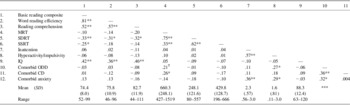
Results of the correlations showed that SDRT was significantly negatively correlated with the WIAT Basic Reading Composite, TOWRE Word Reading Efficiency Score, and WIAT Reading Comprehension subtests (Table 2). SSRT was significantly negatively correlated with WIAT Basic Reading Composite but not with TOWRE Word Reading Efficiency Score or WIAT Reading Comprehension. IQ was significantly positively correlated with all three reading variables, but the ADHD symptom domains and the various psychiatric comorbidities did not significantly correlate with any of the reading variables.
Correlations between dependent variables

Note. MRT = mean reaction time, SDRT = reaction time standard deviation, SSRT = stop signal reaction time, IQ = Intelligence Quotient, ODD = Oppositional Defiant disorder, CD = Conduct disorder.
Tp < .10, *p < .05, **p < .01. ***See Table 1 for rates of comorbidities.
Predicting Word Reading, Fluency, & Comprehension from Stop Signal Variables
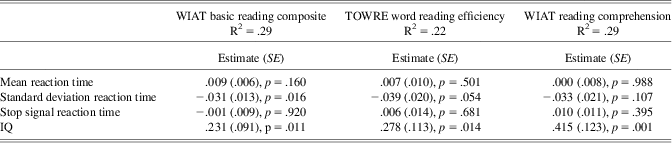
Results of the multivariate multiple regression analysis indicated that SDRT predicted all three reading variables (WIAT Basic Reading Composite, TOWRE Word Reading Efficiency and WIAT Reading Comprehension) (Table 3). MRT and SSRT did not significantly predict any reading variable.
Predicting word reading, fluency, and comprehension from stop signal variables

Note. SE = standard error, WIAT = Wide Range Achievement Test, Third Edition, TOWRE = Test of Word Reading Efficiency; R2 is for the total model.
Predicting Fluency and Comprehension from Standard Deviation Reaction Time, Controlling for Word Reading
Results of the multiple regression analyses predicting TOWRE Word Reading Efficiency and WIAT Reading Comprehension from SDRT, while controlling for WIAT Basic Reading Composite, revealed that SDRT did not account for a significant proportion of variance in either reading fluency or reading comprehension over and above the variance accounted for by word reading (Table 4).
Predicting fluency and comprehension from SST predictors, controlling for reading

Note. SE = standard error; R2 is for the total model.
Controlling for the Influence of ADHD Symptoms, IQ, and Comorbidity
ADHD symptoms and psychiatric comorbidity were not significant predictors in either of the models. Hence, the pattern of results presented above did not change substantively when these variables were added as covariates. Although IQ was correlated with the reading measures, when IQ was added to the models, the pattern of the results was quite similar to that presented above, with the exception that SDRT no longer significantly predicted reading comprehension (Table 5).
Predicting word reading, fluency, and comprehension from stop signal variables, including IQ

Note. SE = standard error, WIAT = Wide Range Achievement Test, Third Edition, TOWRE = Test of Word Reading Efficiency; R2 is for the total model.
DISCUSSION
The specific association between neuropsychological functioning and reading skills has not been fully explored in children with ADHD and with reading challenges. Since research shows that children with ADHD have deficits in reading comprehension and/or reading fluency even in the absence of word reading difficulties, the etiology of reading difficulties in children with ADHD may relate to a pattern of differential relationships between various neuropsychological functions and the specific components of reading. The current study investigated the relation between various neuropsychological outcomes (i.e., response inhibition, reaction time variability, and processing speed) and word reading, reading fluency, and reading comprehension in children with ADHD who are poor readers.
The primary findings were that reaction time variability (i.e., SDRT) is associated with weaknesses in word reading, fluency, and reading comprehension. Furthermore, these associations were unique to SDRT since regression results indicated that overall response speed (i.e., MRT) and response inhibition (i.e., SSRT) did not relate to any of the reading measures. However, after accounting for word reading, the relation between SDRT and reading fluency and reading comprehension did not remain significant suggesting that SDRT exerted its effects on reading fluency and reading comprehension through its effect on word reading/decoding. These results demonstrate that not only does SDRT relate to ADHD (Jacobson et al., Reference Jacobson, Ryan, Denckla, Mostofsky and Mahone2013; Tamm et al., Reference Tamm, Narad, Antonini, O'Brien, Hawk and Epstein2012) and to RD (Borella, Chicherio, Re, Sensini, & Cornoldi, Reference Borella, Chicherio, Re, Sensini and Cornoldi2011; Lipszyc & Schachar, Reference Lipszyc and Schachar2010), but SDRT also relates to deficits in reading decoding, fluency, and comprehension among children with ADHD with reading difficulties.
Reaction time variability may reflect impairments in information processing and, more specifically, failure to maintain executive control (Bellgrove, Hester, & Garavan, Reference Bellgrove, Hester and Garavan2004; Tamm et al., Reference Tamm, Narad, Antonini, O'Brien, Hawk and Epstein2012). Furthermore, dyslexic readers have been shown to read more slowly and variably than non-dyslexic readers, and to demonstrate greater random trial-to-trial variability compared with average readers (Wijnants, Hasselman, Cox, Bosman, & Van Orden, Reference Wijnants, Hasselman, Cox, Bosman and Van Orden2012). One study in normal readers with ADHD showed that response variability in rapid naming of numbers and letters strongly predicted reading comprehension, but not reading fluency, in children with ADHD, which was interpreted to suggest that response variability may be an important component of response preparation within executive control that can be garnered from decomposing rapid naming responses to the item level (Li et al., Reference Li, Cutting, Ryan, Zilioli, Denckla and Mahone2009). However, the measure of response variability was not based on reaction time but rather consisted of the degree of variation in pauses and articulations on the rapid naming test. Other research with similar reaction time measures as those used in the current study has shown a relationship between reaction time variability and reading fluency, but not word reading, using the same oral non-contextual reading fluency task (i.e., TOWRE) (Jacobson et al., Reference Jacobson, Ryan, Denckla, Mostofsky and Mahone2013). The lack of an effect on word reading in this latter study may be due to the fact that the task used in that study was a simple motor reaction time task with much lower demand on cognitive processing than the SST. Nonetheless, taken together with our findings, it appears that reaction time variability, regardless of how it is defined, is related to reading.
Contrary to our initial prediction, our measure of response inhibition (i.e., SSRT) was not significantly associated with word reading, reading fluency, or reading comprehension in the regression analyses. It is possible that the restriction of our sample to children with ADHD may have resulted in a restricted range of SSRT performance, limiting its capacity to predict reading performance. However, the current results are also consistent with at least some studies in a mixed literature on the relation between response inhibition and reading. For example, one other study of impaired and non-impaired readers, some of whom also had ADHD, also did not demonstrate an association between SSRT and reading comprehension (Christopher et al., Reference Christopher, Miyake, Keenan, Pennington, DeFries, Wadsworth and Olson2012). In contrast, response inhibition deficits have been linked with reading comprehension difficulties in some studies of non-ADHD individuals (Borella et al., Reference Borella, Carretti and Pelegrina2010; Locascio, Mahone, Eason, & Cutting, Reference Locascio, Mahone, Eason and Cutting2010; Savage et al., Reference Savage, Cornish, Manly and Hollis2006), but none used the same measure of response inhibition included in the current study. Overall, these results suggest that response inhibition may play a more marginal role in reading compared to SDRT.
We also did not show an association between processing speed (i.e., MRT) and the reading variables when all SST variables were included in the models. This is consistent with other research using a simpler motor reaction time task that also showed that general reaction time was not associated with word reading or reading fluency; however, no measure of reading comprehension was included in that study (Jacobson et al., Reference Jacobson, Ryan, Denckla, Mostofsky and Mahone2013). Of interest, Christopher et al. (Reference Christopher, Miyake, Keenan, Pennington, DeFries, Wadsworth and Olson2012) did show a marginal association between processing speed and reading comprehension. In contrast to the simple forced-choice response required on the go trials of the SST, the tasks used to assess processing speed in that study included more complex tasks that required the subject to scan and match letters and pictures as rapidly as possible. Therefore, it is plausible that the construct of processing speed measured in their study may be quite different from reaction time to go stimuli in the SST used in the current study.
Study limitations include the lack of a control group without ADHD or reading problems. In addition, we did not select the sample based on deficits in reading comprehension or reading fluency, but instead selected the sample for word reading difficulties. This may have restricted the range for word reading and decreased our ability to detect associations between some SST performance measures and word reading. Similarly, our fluency measure assessed speeded reading of single words, but did not assess fluent reading of connected text. Furthermore, neuropsychological testing was limited to the SST and we did not have other measures of processing speed nor other cognitive constructs that may be important for reading comprehension such as working memory. Relatedly, the pace of the SST was determined by the computer, and response variability may be quite different for self-paced tasks (e.g., Rapid Automatized Naming). Also, the definition of poor reading in this study included children who were reading in the lower end of the average range (i.e., WJ-III scores 85 to 90) and may have had deficits in only one of the two related domains assessed (untimed word reading or phonemic decoding). This limitation may affect generalizability to children with more impaired reading. However, this definition of poor reading has frequently been used in the literature (Cirino, Fuchs, Elias, Powell, & Schumacher, Reference Cirino, Fuchs, Elias, Powell and Schumacher2013; Denton, Reference Denton2012; Fuchs, Compton, Fuchs, Bryant, & Davis, Reference Fuchs, Compton, Fuchs, Bryant and Davis2008; Moody et al., Reference Moody, Holzer, Roman, Paulsen, Freeman, Haynes and James2000; Protopapas, Sideridis, Mouzaki, & Simos, Reference Protopapas, Sideridis, Mouzaki and Simos2011; Swanson, Reference Swanson1999). Generalizability may also be somewhat limited by overrepresentation of African American children, children with low socioeconomic status (i.e., 67.7% of the sample received free or reduced lunch), and individuals of below-average IQ in the study sample. However, this sample is quite representative of the schools in cities from which participants with ADHD and reading challenges were recruited.
Our results add to a growing body of evidence suggesting a role for reaction time variability (i.e., SDRT) as a contributing factor to reading difficulties and a more general marker of psychopathology (Lipszyc & Schachar, Reference Lipszyc and Schachar2010; Tamm et al., Reference Tamm, Narad, Antonini, O'Brien, Hawk and Epstein2012). Further study of this question, perhaps using ex-Gaussian analyses to more precisely estimate the impact of SDRT on reading, as well as research focusing on developing treatments to mitigate reaction time variability, appear warranted.
Acknowledgments
This work was supported by the National Institutes of Health (grant number R01 HD060617). There are no conflicts of interest for any of the contributing authors. We appreciate the significant contributions of the research assistants, Abigail Webb, Ana Bartels, and Anita Najhawan. We are also grateful to the families who participated in the study.