





Introduction
In a small village at the foot of the snow-capped mountains, the groom’s family courtyard is alive with the energy of a Lisu wedding (Figure 1). Strings of bright red pennants, lanterns, and costumes contrast with the village’s earthy hillsides and tiled rooves, and with Yunnan’s characteristically vivid blue skies. The three-day celebration spills beyond the courtyard into every corner of the village. A temporary outdoor kitchen is close at hand, pots bubbling appetisingly over open flames. The voices of the walapa (matchmakers) and musicians weave through the air; younger guests move in a circle dance to the rhythm of the maniu (mouth organ); elders cluster under the eaves, exchanging stories.
A wedding in Haba Luo village, Hutiaoxia township, 2020. Photo by Keyi Liu.

Figure 1. Long description
A daytime scene at Haba Luo village. Around 60 villagers are celebrating a wedding. At the front, a dozen, mostly in colourful red costumes, are holding hands and dancing in a line. Onlookers observe from each side. Behind them is a large tiled roof under several rows of bright red pennants and red lanterns. In the background we see mountain peaks and a blur sky with white clouds.
This is one of seven (p. 10 describes the Louhai wedding as my first) I attended in Yunnan during 2020–2021. My initial aim was to follow the entire process from start to finish, experiencing each ritual and event firsthand. Yet, I quickly found myself swept into the action itself. My Lisu friends pulled me into songs and dances, urging me to join feast after feast, repeatedly insisting that “if you want to understand our weddings, you have to play with us together.” Over time, I attended six more Lisu weddings and came to understand each event not as a fixed ritual structure but as a multi-day, cross-contextual, and largely improvisational sequence of co-present performance modes.
Two observations emerged from this experience. First, no two of the weddings I attended were alike. While they drew on a shared general framework, each was created and sustained by its walapa, musicians, and the way the community infused its own style into those shared traditional formats in real time. The “typical Lisu wedding” projected by earlier scholarly accounts and continuing in the most recent literature (Yu Reference Yu2018; Qia Reference Qia2025) existed nowhere in the minds of those organising the weddings around me. Instead, those responsible for each celebration reinvented traditional components through spontaneous creativity, which may itself be just as traditional as the components themselves.
That this dimension has remained largely outside the analytical frame of existing scholarship is unlikely to be an accident. Chinese-language ethnomusicological research on minority weddings in Southwest China has inherited the assumptions of the 1950s minority identification project (see further, Mullaney Reference Mullaney2011:3-6,52-66), within which weddings appear as representative ritual texts to be transcribed, translated, and ordered into sequence. The improvisation and recombination I encountered are precisely what this frame, in its pursuit of “cultural averages” (Nettl Reference Nettl1983:9; Stock Reference Stock1998:51) and authentic representative forms cannot register. Yet the limits of existing scholarship are not only a matter of disciplinary inheritance. They are also, I suspect, a matter of how the researcher is positioned to observe in the first place, which brings me to the second observation. To attend a Lisu wedding is thus not to attend one performance, but to move among several, each operating by its own logic. And each, accordingly, makes different demands on those present. These are not casual variations in fieldwork mood. They are structural features of the event itself. The participant–observer continuum I came to see, is not calibrated to register such structural shifts. If this is true for Lisu weddings, then it is also true for ethnographic writing, and this article is thus also a plea for, and case study in, an emergent and experiential style of ethnography that has so far been little explored in such settings.
Background
The Lisu people
The Lisu are a trans-border ethnic group originating from the Qinghai-Tibetan plateau, with a history of extensive migration primarily across Southeast Asia, including China, Myanmar, Thailand, and Northern India (Figure 2; see further, Bradley Reference Bradley, Thurgood, Randy and LaPolla2016; Hou and Zhang Reference Hou and Zhang2009). There are roughly 700,000 Lisu in China, mostly living in mountainous regions where each differently located Lisu grouping has developed its own sense of history and cultural practices. For example, Nujiang, the largest Lisu settlement, which has been most widely investigated by scholars and journalists seeking to learn more about Lisu culture, is close in proximity to Myanmar, and has been strongly missionised, with many Lisu converting to Christianity before 1949 (Arrington Reference Arrington2015:141).
Map of Lisu distribution (each colour represents the primary regions of Lisu population distribution in different countries), 2022. Base map courtesy of Bai Si, redrawn by Keyi Liu.

Figure 2. Long description
This figure is a map of mainland East and Southeast Asia showing the distribution of Lisu populations across four countries. As set out in the legend at the upper left, solid lines mark international borders and dashed lines mark province or state boundaries; the colour key at the lower right links each shaded area to one country. Four shaded areas indicate the primary regions in which Lisu people live. The largest, in light blue, forms a broad horizontal band across southwest China, principally in Yunnan. A vertical purple band extends south from the Chinese border through northern and eastern Myanmar. A smaller orange area sits at the southern end of this band, in northern Thailand. A small beige area lies to the west, in northeast India near the eastern Himalaya. Together the four areas form a single, roughly continuous cluster concentrated in the mountainous highlands where the borders of China, Myanmar, Thailand, and India converge.
As this observation suggests, the Lisu are very much part of the fabric of the modern world, sharing contemporary experiences and challenges with other Indigenous and majority Han Chinese communities around them. For instance, recent initiatives like the Chinese government’s Poverty Alleviation Campaign have significantly impacted the Lisu people in areas such as education, housing, transportation, and livelihood.Footnote 1
Lisu music and weddings
Notwithstanding either the rise of regional cultural variations or the impacts of the modern state, singing, dancing, and playing musical instruments remain at the heart of many Lisu people’s lives, allowing them to find enjoyment in social interactions and express their emotions and feelings towards the environment and one another. My interactions with Lisu consultants revealed that their understanding of music is holistic and intricately intertwined with their cultural and societal fabric. In this viewpoint, music extends beyond the confines of sound and melody. It intimately connects Lisu subjects to the natural environment, everyday life (including activities like hunting, herding, and gathering), social interactions, and spiritual beliefs. Apart from being an art form, Lisu music also serves as a non-written language, a vehicle for historical transmission, an educational tool, a conduit for rituals, and a means of resolving disputes.
Research on Lisu music and weddings within China has developed in two main phases. The first, foundational phase was driven by the documentary imperative of the 1980s–1990s minority cultural protection projects. Zhao (Reference Zhao1989, Reference Zhao1997) and Zhang (Reference Zhang2006), and other scholars, drawing on extensive fieldwork in Nujiang, the largest and most missionised Lisu settlement to established a classification of Lisu vocal genres: mugua (木刮, narrative songs), youyi (优叶, courtship songs), and baishi (摆时, communal dance songs). This classification organised songs by social function and performance context and aimed to produce a comprehensive inventory of the Lisu vocal repertoire that could serve both scholarly and cultural-preservation purposes. It has since been widely adopted in subsequent Chinese-language scholarship and codified in state cultural-policy documents, including the 2006 inscription of Lisu folk songs on the first national list of intangible cultural heritage.
Yet the framework’s pursuit of comprehensive, regionally portable typology, a defining feature of the broader 1980s–1990s music classification project (Jones Reference Stephen2003:312,316) has obscured significant local variation. My fieldwork in Weixi and Lijiang revealed that the mugua/youyi/baishi typology does not map straightforwardly onto local usage in these regions. Singers in the communities I worked with employ regionally specific category terms, organise their repertoire along different axes, and at times resist the assumption that genre labels developed in Nujiang are universally applicable to Lisu music elsewhere. This is not a refutation of the foundational classification work but a recognition of what a classification organised around generalisable types necessarily abstracts away: the regional, situational, and improvisatory dimensions of Lisu musical practice as it lives in particular communities.
A second phase of Chinese-language scholarship, emerging primarily after 2015, has begun to address dimensions that the foundational typological work bracketed. More recent studies have examined the ritual sounds within Lisu weddings and their cultural meanings (Yu Reference Yu2018), notational practices in Lisu wedding music (Chen Reference Chen2024), and sociological dimensions including wedding consumption and folk religious practices (He Reference He2022; Li Reference Li2022; Wang Reference Wang2022). Regional compilations of Lisu folk songs and dances (Lijiang Lisu Studies Association 2012; Weixi Lisu Ethnic Development Research Association 2012) constitute a valuable but largely unanalysed archive. Anglophone scholarship on Lisu music has addressed some contexts, including musical practices among Lisu communities in northern Thailand (Durrenberger Reference Durrenberger1975; Larsen Reference Larsen1984) and the Christian-mediated transformation of Lisu hymnody in Nujiang (Arrington Reference Arrington2015, Reference Arrington2020; Diao Reference Diao2015).
This body of work has advanced our knowledge of Lisu musical forms and ritual structures. Yet two dimensions remain largely unexamined. First, existing scholarship tends to treat wedding music as classifiable text, transcribing melodies, translating lyrics, and categorising song types, rather than analysing how music and dance function as real-time social processes within the unfolding dynamics of a multi-day event. Second, the interplay between structurally different kinds of musical and dance activity occurring across distinct social spaces within a single wedding has received no sustained attention. These are the gaps the present study addresses.
In addressing these gaps, this article does not propose to displace the careful work of typology and notation that has shaped scholarship in this field. It proposes, rather, to bring into view what categorial inventories alone cannot register: the dynamism, the cross-contextual movement, the situated improvisation, and the multi-day temporal architecture that the Lisu wedding makes its principal medium.
Fieldwork, theory, language, and documentation
The ethnographic findings presented in this article are drawn from fieldwork I conducted in Yunnan between 2020 and 2021. Most of this fieldwork took place in the mountainous Lisu communities of Lijiang Prefecture and Weixi Lisu Autonomous County, two regions in which Lisu traditional musical practice remains comparatively unaffected by Christian missionary influences, and where the Lisu population lives at higher elevations along routes often inaccessible by public transport and absent from standard maps. Within 2 weeks of arriving in Lijiang in late September 2020, recognising that access to such villages required forms of local infrastructure that no academic position could supply, I joined the Lijiang Lisu Culture Research AssociationFootnote 2 as a volunteer, supporting its documentation of Lisu cultural transmission across various villages while pursuing my own research questions.
The seven Lisu weddings I attended through this network included three in traditional style, two combining traditional and modern elements, and two in a primarily modern Han Chinese style.Footnote 3 To provide a cohesive narrative, I take the Louhai wedding, held in November 2020 and the most comprehensive one, as the article’s primary narrative thread, using the others as supplementary examples to demonstrate the embodiment of music and dance in different stages of the wedding ceremonies. Informed consent was obtained from the host families in each case, both in advance and on the day, and revisited at each ceremonial stage where documentation might intrude on intimate or sacred elements of the rite.
Most of my fieldwork conversations were conducted in Mandarin, which is now widely spoken in the Lisu communities where I worked.Footnote 4 Interview quotations in this article are presented in English, translated from the Mandarin in which most of my interlocutors spoke. The song lyrics quoted in this article are translations of meaning rather than literal word-for-word transcriptions. After a song was performed, I asked the singer or a nearby bilingual participant to render the general meaning in Mandarin, which I then translated into English and checked with local consultants where possible. The translations should accordingly be read as interpretive renderings of lyric meaning. For Lisu terms, I follow the convention now standard within Lisu communities themselves: Pinyin-based transliteration, italicised on first appearance.Footnote 5
The fieldwork data cited in this article derive from audio and video recordings, photographs, and field notes made during my fieldwork, with the informed consent of participants in each setting. My documentation drew on the full range of media Stock (Reference Stock, Clarke and Cook2004) recommends: audio and video recordings preserved sung text and melodic detail; photographs captured spatial arrangements and gestural exchanges; written notes recorded conversation, my own questions, and the running commentary offered by my hosts. The transcribed dialogues and sung lyrics quoted throughout this article are drawn from these recordings; passages presented as personal conversation are reconstructed from notes taken in the moment or shortly afterwards. Transcriptions and translations into English are my own.
Matchmaking
Lisu wedding music starts the very moment matchmaking begins. There is an old Lisu saying, “there is no marriage without walapa.” The closest English equivalent to walapa is “matchmaker,” but the role is broader than the ordinary English sense of someone who introduces a potential marriage partner. Traditionally, each family invited its own walapa to represent their interests. Before the wedding, the walapa meet the parents to formally propose and discuss the wedding, the proposing family visiting the family whose daughter (or, more rarely, son) they wish to wed. In some communities, the role is held by a nipaFootnote 6 , a ritual specialist who acts as an intermediary between the human world and the spiritual realm; in others, it is held by an elder, a senior male relative, or a brother. The choice depends on the specific knowledge required, particularly the knowledge of ancient sung lyrics and tunes that the antiphonal proposal exchange demands. Even in the Sinicised and Westernised Lisu weddings I attended, where the couple’s match resulted from free love rather than family negotiation, someone still occupies the walapa role across the wedding’s ceremonial moments.
In one of the weddings I attended, Li Jinsong, a well-known nipa in Yongsheng County, took on the role of walapa. The bride was the daughter of He Wenqin (a member of the Lijiang Lisu Culture Research Association), who wanted to follow traditional Lisu wedding rituals fully. Unusually, this was a case of the bride’s family proposing to the groom’s family; Li explained that the procedures were the same with only the roles of the groom and bride being reversed:
Today, I have three main tasks. The first is to deliver the gifts we’ve prepared and explain our purpose to the man’s family. If the man’s family agrees to the marriage, the presents we’ve brought will be accepted. The second is to discuss with them matters related to the ceremony. The third is to work out an auspicious date for the wedding. (Li Jinsong, personal interview, 6 January 2021)
On the day of the matchmaking, we were received in a guest room centred around a warm firepit at the groom’s home (Figure 3). The bride’s and groom’s families exchanged a few polite words before transitioning seamlessly into a musical dialogue. Both Li Jinsong and the groom’s walapa were good at singing, performing a variety of traditional songs imbued with ancient words and rich allusions for nearly 3 hours. The groom’s walapa opened by introducing the groom’s character through a series of metaphorical praises:
Bride’s family (right) and groom’s family (left) participate in song-based matchmaking (walapa Li Jinsong: third from the right; the groom’s walapa, first on the left), 2021. Photo by Keyi Liu.

Figure 3. Long description
This photograph was taken inside a traditional Lisu log house. A wooden shelf along the back wall holds an assortment of dark ceramic pots and vessels. In the middle of the floor, a small wood fire burns in an open hearth, and a low table in front of it is set with bowls of fruit, nuts, and snacks. The two families sit facing each other across the fire. The groom’s family is on the left: three men on low seats, with the groom’s walapa at the far left in a light embroidered vest over a white shirt. The bride’s family is on the right, and their walapa, Li Jinsong, is third from the right. Paper cups, fruit, and orange peel lie scattered on the earthen floor. The two walapa are leading the song-based matchmaking that has brought the families together.
Our young man doesn’t talk much,
but he’s honest and steady, like a mountain cliff.
He can carry heavy loads up the hill,
and work hard in the fields to grow crops.
He’s not sweet with words, and he’s quiet,
but his hands are rough from work, and his feet are always moving.
He gets up with the sunrise,
and doesn’t rest until the stars are out.
In response, the bride’s walapa, Li Jinsong, sang to highlight the bride’s admirable qualities and her family background to persuade the groom’s family to accept the proposal:
Her family has no evil ways,
her family is honest.
Her family is harmonious,
and everyone has a good temperament.
They have many mountains and forests,
it takes three days to circle the mountains,
they can gather plenty of firewood.
They have numerous cows and horses,
they are strong and well-suited for ploughing fields,
they can plod three hills in a single day.
Several features of this exchange repay attention. The two sung parts are constructed in parallel: identical metaphorical framework (mountains, work, harmony, and plenty), an identical melodic frame and a parallel deployment of formulaic phrasing. When I spoke to some of the younger generation family members, many admitted they could no longer fully grasp the lyrics, especially some ancient and poetic words. Li Jinsong explained later that this exchange used to last a full day or more, sometimes several days, when both walapa were strong singers and the agricultural slack season permitted. The exchange was not openly competitive, but walapa “often tried to outlast and outwit each other with clever metaphors, long story songs, and well-timed humour.” Contemporary practice preserves the singing as a symbolic ritual in much shorter form, given the realities of a faster-paced life and the diminishing number of proficient walapa.
Researching this component of the wedding, I remained primarily an observer, watching alongside other family members and guests as the exchange unfolded. Unlike them, however, I actively asked questions afterwards, and my hosts expected me to. They expected me to ask questions, potentially even naive ones. They expected to be able to guide my observations. They took my active engagement as confirmation of my depth of interest, and therefore of the unique distinctiveness and value of their cultural traditions in the context of a minority population. This expectation might be emphasised by referring to my stance as one of “guided observation,” with local consultants directing my attention to matters that they knew to be significant or representative and actively offering their own commentaries on what we were looking at and listening to.
The day before the wedding, or “Helping day”
In November 2020, after some 6 weeks of working alongside the Lisu singer Ashicai at the Lijiang Lisu Culture Research Association, he invited me to my first Lisu wedding. It was held in Louhai, a village at roughly 3,000 metres elevation, set deep in a mountain range about 5 hours’ drive from Lijiang. The groom, Shi Yanxiong, was Ashicai’s apprentice and, with Cai Yuping, the co-founder of the band Longma Group. We arrived at 2 p.m. on 29 November. The courtyard was already crowded, alive with conversation, toasting, and the sounds of attendants serving and clearing tables. Approximately 10 tables were set up throughout the courtyard for guests to have lunch, each table seating about eight people. Red ribbons and balloons hung overhead, revealing a scene rich in wedding atmosphere and happiness (Figure 4).
Wedding banquet in Louhai Village, Guanghua Township, Yongsheng County, 29 November 2020. Photo by Keyi Liu.

Figure 4. Long description
A crowded Lisu wedding banquet held in a village courtyard. Overhead, the branches of a tree are hung with round red and pink balloons and strings of red triangular bunting, marking the festive occasion. Many tables fill the courtyard, and guests of all ages crowd around them; some sit eating while others stand and talk in groups.
Cai Yuping shows me around after lunch. According to him, the first day of the wedding is locally called simply “the first day,” but some scholars refer to it as Xiangbangri (helping day). On this day, villagers from the same village come to the groom’s or bride’s house to assist with preparing the wedding feasts. A large open-air, improvised kitchen at the rear of the courtyard holds a dozen large pots in which are stewing. Some villagers are cleaning dishes, washing vegetables, and cutting vegetables; others are lugging firewood, lighting fires, and cooking. Once each set of guests completes their meal, the tables are swiftly cleared and reset for the next group of diners. Consequently, there are four to five seatings to ensure that all guests are served. Although the entire scene appears somewhat chaotic at first glance, a closer examination reveals that everything is arranged sensibly and in an orderly manner. A middle-aged man in the courtyard is skilfully orchestrating everyone’s movements. Cai Yuping introduces me: this is Uncle Shi, the groom’s uncle and also the walapa for this wedding. As walapa, Uncle Shi is clearly the busiest, most hardworking person at the event. Not only did he oversee the intricacy of the traditional Lisu wedding ceremony itself, but the groom’s parents have also entrusted him with the direction of all significant matters. Even the groom has to follow Uncle Shi’s guidance throughout the 3-day celebration.
During dinner, Cai mentions that the guests in the courtyard today are mostly locals from Louhai, particularly those who have come to help that day. This is the day before the official wedding, he explains, and it is all about getting ready for the following big day. The process of a traditional Lisu wedding requires a great deal of time, planning, and complex etiquette, so many locals voluntarily gathered at the groom’s house early in the morning to assist with the family’s preparations. To express their gratitude, the groom’s family invited Ashicai to perform, livening up the celebration and thanking everyone for attending and supporting the wedding.
Feasting and dancing
As dusk falls, the lights in the courtyard come on one by one. The young women change into Lisu costumes (Figure 5a). The groom’s sister warmly invites me into her room and generously lends me her own traditional attire. With her assistance, I manage to dress fully in the Lisu costume, which consists of about six pieces, including a decorated hat. When I return to the courtyard, Ashicai and another musician started to play the maniuFootnote 7 (Figure 5b). The guests have already joined hands, the circle has formed and it has begun to move. Members of the groom’s family wave me in: “If you want to understand our weddings, you have to join the dance!” Then, two people take me by the hands, and I am inside the circle before I have time to think.
(a) and (b) Dancing at the wedding to maniu music, Louhai, 29 November 2020. Photo by Keyi Liu.

Ashicai is from Yulong County, where the maniu tunes and dance steps are different from those preferred here, except for some famous Lisu dance tunes that are widely distributed. He explained earlier that two maniu players are usually invited to a wedding because playing the maniu requires a high level of lung capacity, and it is challenging to play and dance at the same time for a long duration. The two need to take turns to keep the music unbroken. I expect, at first, that Ashicai’s unfamiliar tunes and steps may give the Louhai villagers pause. When moving alongside the villagers as we watch and follow Ashicai’s steps, most of the villagers quickly grasp the new pattern, and even children adapt faster than I do.
The circle dance has a flexibility I came to recognise as structural. Participants join and leave at any time without disrupting the overall flow. When tired, I link the hands of the people to my left and right, who continue dancing as I step aside to rest. To rejoin, I approach the edge of the circle, wait for the right moment, catch the eyes of two people to signal my desired re-entry point, hoping they would release their hands to take mine. Of course, this requires some attentiveness. If I unwittingly signal my desire to join between a young couple, they might give me a look that says, “Hey, we don’t need a third wheel here!” The flexibility extends a structural commitment to inclusion: the dance is a vessel that can accommodate any number of dancers, at any time, at any skill level.
A few days later, in casual conversation, Ashicai mentions that if you encounter someone you find attractive, you can try to join the circle beside that person. After holding their hand, you can use the index finger of the hand holding theirs to gently tap their palm. If they are not interested in you, they may politely walk away when the next circle dance begins, but if they are interested, the two of you can go to the mountains for some private time after the dance (Ashicai, personal conversation, 3 December 2020). Listening to him, I suddenly realise that during the dancing at Louhai, a young man had repeatedly tapped my palm for some time. At the time, I was unaware of the hidden meaning behind his gesture, and neither tapped back nor walked away at the next break. We danced hand-in-hand for some time, myself ignorant of his signal and him probably confused as to why I gave no response.Footnote 8
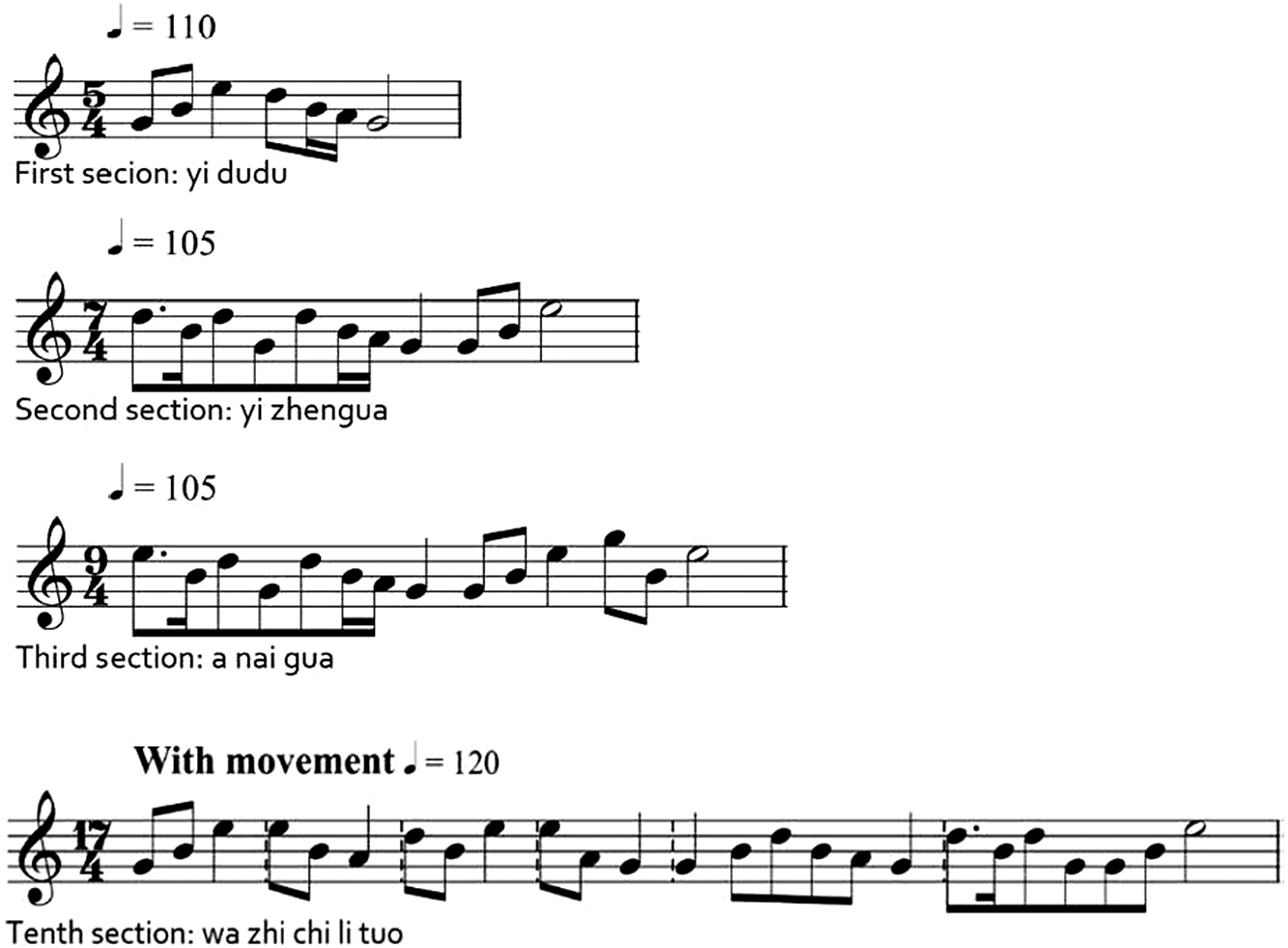
Part of my obliviousness to my would-be suitor may have arisen from the demands of the dance steps. The difficulty of a Lisu wedding dance is not constant. As the evening unfolds, each successive maniu tune carries its own metric unit and its own corresponding sequence of footwork, and both the metric unit and the footwork sequence grow progressively longer and more intricate from one tune to the next. Figure 6 shows four selected tunes from this progression, Sections 1, 2, 3, and 10, to illustrate the expansion. Section 1 sets a five-beat cycle (5/4); Section 2 extends this to seven beats (7/4); Section 3, to nine (9/4). By Section 10, the unit has lengthened to 17 beats (17/4), with the footwork within each cycle having grown correspondingly elaborate (see the full transcription of all 12 sections in Liu Reference Liu2023:117–119).
Staff transcription of melodic patterns from contrasting sections 1–3 and 10 of a wedding dance.

Figure 6. Long description
A staff-notation transcription comparing four contrasting sections of a Lisu wedding dance, transcribed by Keyi Liu. Each section is shown as a single treble-clef melodic line, labelled with its name and tempo. The first section, "yi dudu," is in 5/4 time at quarter note = 110. The second, "yi zhengua," is in 7/4 at quarter note = 105. The third, "a nai gua," is also at quarter note = 105 but in 9/4. The tenth section, "wa zhi chi li tuo," at quarter note = 120 and is in a much longer 17/4 metre, its single line subdivided by dashed barlines into several short groups. Read together, the four lines show how the metre expands from section to section, from five beats to seven, nine, and finally seventeen per bar, while all four sections share a similar stepwise melodic shape that returns to the same sustained final note. The transcription is used to illustrate the rhythmic and metric contrast between sections of the dance rather than to give a note-by-note score.
For the first four or five maniu tunes, I could follow by imitating the player’s steps through two or three rotations of the circle. From that point on, the steps grew harder for me. But for most of those around me, this growing difficulty was what made the dance engaging; accomplished dancers value the more elaborate footwork and the more irregular metric units of the later tunes more than the simpler patterns of the earlier ones. As Cai Yuping said: The footwork of electronic dance music is rather basic. The maniu can play more complex and varied tunes, and it is more enjoyable to dance to. (Cai Yuping, personal conversation, Louhai Village, 29 November 2020). Cai Yuping’s observation helps to explain why the live maniu has not, in this region, been displaced by amplified electronic dance music, a displacement that has unfolded with some force in other Yunnan minority contexts, where traditional ceremonial music at weddings and festivals have been progressively replaced by recorded popular forms (Rees Reference Rees2000:134-136). The maniu player, in turn, watches how many participants can keep up with the steps and flexibly adjusts the difficulty of what he plays accordingly.
But how does a maniu player hold so many complex tunes in mind, and know which to reach for in the moment? At another wedding some months later, in Lahezhu Village, I asked Li Zizhong. His reply was telling:
We play according to our steps. If we didn’t dance, we would not know how to play the music. If you don’t play according to the pattern of the footsteps, you won’t follow the light and heavy notes of the steps, and you’re definitely playing it wrong. Then, everyone’s footsteps will follow you in a mess. So, when you learn to dance, you will naturally be able to play. (Li Zizhong, personal interview, Laoyashu, Lahezhu Village, 15 April 2021)
Therefore, mastering the dance steps themselves is not only a prerequisite for participation in a full Lisu dance but is also essential for the accompanying instrumentalists (and for any would-be transcriber/analyst). The role of the feet in the dance reminds me of the role of percussion in an ensemble. What Li Zizhong describes, and what Hill, Saenghong, and Grim-Feinberg (Reference Hill, Saenghong and Grim-Feinberg2011:146–149) found at Lahu dance events nearby, is that the music is not the prior layer that the feet follow. The relation runs both ways, and it runs continuously. The dancing musician makes the musical decisions; the dancers follow without missing a beat; the musician’s next phrase is determined by what their feet have just done, and their feet’s next pattern is held in place by his next phrase. Variation and improvisation move within this mutual constraint: the maniu player can reorganise his materials in novel ways, but the cadence must remain compatible with the sequence of phrases and pauses the dancers hear as a given. Improvisation here is not invention; it is the recombination of inherited material within a framework that the feet themselves uphold.
As I step out of the circle to take a break, the groom’s younger sister tells me, “We can dance for whole night without getting tired, and we usually dance like this every night for the three days of the wedding” (personal communication, Louhai Village, 29 November 2020). It is almost midnight when I finally follow Yuping’s sister-in-law home to bed, aware that I will have to get up early the next day for welcoming the bride ritual. The dance continues as we leave. In my dreams, it seemed that I was still dancing to the distant sounds of the maniu.
This phase of the wedding saw me move from observer and questioner to participant. In the latter stages, I learnt no longer through observation of others supplemented by the exegeses provided by local hosts but through my own bodily engagement and experience. This was in close accord with the learning style recommended by many Lisu who played a role in helping me study their dance and music, and I was repeatedly told that I needed to immerse myself in the environment and context, learning through experience. For example, observing the movements and calls of animals and attempting to imitate them would help me understand what they conceived of as natural laws within the mountains. This process resonates with Titon’s (Reference Titon, Gregory and Cooley2008) “knowing fieldwork,” and with what Kisliuk (Reference Kisliuk, Gregory and Cooley2008) describes as the moment when “our very being merges with the field through our bodies and voices,” and only later builds up a theoretical framework either for ourselves or for use in explanation to others (Rice Reference Timothy1994:82-86, Reference Rice, Gregory and Cooley2008).
The position here requires further attention because it is the one I heard most often from Lisu consultants: “If you want to understand our weddings, you have to play with us.” The phrase was not simply a gesture of hospitality. It named a local condition of understanding. Existing terms such as participation or observation do not quite capture this mode of entry. Play creates a shared frame in which gestures, jokes, musical patterns, and forms of address acquire meanings that are not always available from the side. This is why Bateson’s account of playfulness as a generator of novel combinations and creative discovery, and more recent discussions of playful participation as a way of generating knowledge are useful here (Bateson Reference Bateson2015; Sjöberg Reference Sjöberg2018).
Nevertheless, it was also clear that participation also has some limits: I noticed the young man’s gentle finger taps but failed to understand that they carried an invitation; I struggled to keep up as dance patterns became increasingly complex and, moreover, lacked the high-altitude stamina of my Lisu age-mates that allowed them to dance almost until dawn. My participatory experiences were thus not entirely equivalent to those of an accustomed adult Lisu participant.
But this falling-short does not mean such knowledge remained out of reach; it points instead to how this kind of knowledge operates. The understanding transmitted through participatory learning is not homogeneous. Part of it is kinaesthetic, settling into the body through repeated practice (Hahn Reference Hahn2007); the dance steps whose increasing intricacy I struggled to follow belong to this layer. Another part is symbolic and metaphorical: its meanings are not self-evident but embedded in a local system of public signs that must be learned and decoded before they become legible (Geertz Reference Clifford1973:5-14). Lisu society is, in Hall’s (Reference Hall1976:91) sense, a high-context culture, where much of what is meant is carried not in explicit speech but in gestures, indirection, conventionalised cues, and shared tacit understandings. The finger-tap belongs to this second layer. The action itself is neutral; it carries courtship meaning only because, within the Lisu sign system, it has been conventionalised as such a signal. That meaning opened to me only later, when Ashicai explained the convention in casual conversation. This kind of knowledge cannot be explained on the spot or acquired through observation alone; it comes only from sustained participation, allowing the context, slowly, to work its way in. In high-context cultures, the most consequential decoding often arrives by indirect routes: through a passing remark, through a conversation one did not realise needed to be continued. What I could not read at the moment of participation became readable later, through the indirect channels by which such cultures transmit their most important meanings.
Welcoming the bride day
The second day is the central part of the wedding, with several stages, among them an ancestral worship ceremony, a procession to collect the bride, the return journey, the naming of the new couple, and the wedding banquet. Each of these stages carries music of a different kind. At 7 o’clock that morning, the groom’s entourage is made up mostly of middle-aged and older guests, with young people conspicuously absent. “They were drinking and dancing until five,” Yuping’s brother chuckles. “It would be a miracle if they could get up now.”
Ancestor worship
The first ceremony of the day is the ancestral rite. The groom’s family’s walapa Uncle Shi and deputy walapa clasp their hands in fists and kneel in the main room of the groom’s residence, facing the southern wall directly opposite the entrance. The groom and his best man follow them into the same posture. The four then turn to bow towards the bare eastern wall and finally make their way outdoors to bow in the direction of the nearby mountain. I do not interrupt to ask what each direction means. After the ceremony is complete, Uncle Shi explains:
Typically, the first time we [face the southern wall and] pay homage is to the ancestors of the groom’s family by burning incense. The second time, [when we bow toward the eastern wall,] we pay respect to the direct senior relatives of the groom. [At this point in the ritual,] if the parents have passed away, we pay respect to them. If the parents are still alive, we pay respect to their parents, which is the previous generation [that is, the groom’s grandparents]. The final step we take outside is to pray for the blessings of the mountain deities and bodhisattvas to ensure the smooth success of this marriage. These traditions have been passed down from generation to generation. (Uncle Shi, personal conversation, 30 November 2020)
As they kneel and pay their respects, a local maniu musician, Gu Xuezhong, plays a tune off to the side. The tune is called “Respecting the Mountain God.” For a mountain people, the tune is an expression of gratitude and praise for these grand hills that provide for Lisu livelihoods. Ashicai adds that his hometown also has a tune by the same name, but the melody varies across different communities, depending on who is playing it.
This rite signifies the connection between the marrying couple and their ancestors, as well as seeking their blessings for the groom to receive the bride. The walapa, the groom, and their families pay their respects to the spirits of their forebears, expressing gratitude for the wisdom and guidance passed down through generations. The previous night, I had participated actively in the dancing, learning something about the Lisu community through experiencing the ways they enjoy the complex play of music, movement, and sociability. This morning, by contrast, I stood solemnly alongside the rest of the entourage, witnessing the simple yet evocative rite. Witnessing is also a form of participation and relational fellowship (Stock Reference Stock2018:100––101), but it remains highly distinct in character from the fast-paced physical intimacies of dance.
Setting out for the bride’s home
The procession then sets out to welcome the bride, bearing gifts prepared the previous day. One walapa walks at the head of the entourage, the other at the tail. Our destination is Guanghua Village, about 3 km away. In fact, the bride is not a resident of Guanghua Village; her home is in Honghe, over 300 km distant. Due to this significant distance, she and her parents had been staying at the groom’s house in advance of the wedding, but they had spent the previous night at another relative’s home in Guanghua so that the groom’s family could “collect” them properly the following morning. In contrast, two simpler weddings I attended featured brides from neighbouring villages where the groom departed the previous afternoon to meet the bride, stayed overnight at her residence, and then returned with her the following morning.
Our journey is replete with excitement. Folk songs fill the air, the tune of the maniu known as the “Wedding Procession Tune” resounds, and firecrackers pop, their echoes announcing the joyous event to the entire village. The lyrics use a wealth of metaphors to suggest that the groom and bride are a perfect match made in heaven.
Sun and moon pair with mountains and rivers,
fish and shrimp belong in the river.
In the forest, the beasts pair,
with the birds pairing in the trees.
Grass pairs with insects,
Insects pair with butterflies.
The clear breeze pairs with the bright moon,
Flowers and grass pair with trees.
Without a dowry, a wedding cannot be,
Without a walapa, a pairing cannot be.
… …
The music in this stretch of the wedding moves with us. It is neither a fixed performance addressed to an audience nor a ritual addressed to spirits. It is the sound of an entourage in motion, marking out the route through the village and the hills and onto another household’s threshold. Together with the firecrackers and the singing voices, it produces what local hosts and guests alike would describe as renao (热闹), a sociality of festive heat, noise, and conviviality that is itself a recognised mode of social value and a marker of the event’s success (Chau Reference Chau2008:486).
When we arrive at the bride’s house, we are led into a sparsely furnished room. Pine leaves are scattered across the floor, and a temporary altar has been set up at the centre. Cai Yuping later explains that the room’s plainness is both customary and practical as it leaves space for incense burning, ritual worship, and the separate seating of the two families. (Cai Yuping, personal communication, 30 November 2020). Within this cleared ritual space, an antiphonal exchange begins, through which the groom’s party formally requests permission to take the bride away. This exchange treats the bride’s departure as a ritual negotiation conducted through song, metaphor, humility, and wine offering. Walapa Uncle Shi picks up a bowl of wine in each hand and sings what is called the “Picking up the Bride Song”:
Pork does not even make a sound when you put it in the pan and fry it.
When you put a piece of pork in your mouth it does not even have any oil. Please excuse me.Footnote 9
In response, the bride’s brother then takes two bowls of wine, singing:
Our girl cannot embroider.
Your lapels are wide and long.
Please teach her slowly and treat her well in the future.Footnote 10
……
After singing, they sprinkle the wine onto the altar. Yuping later tells me that, as a younger Lisu man, he does not fully understand all of the metaphors embedded in these wedding songs. Some meanings become clear only after consulting Uncle Shi, whose knowledge of ritual language and wedding procedure gives him a particular authority in this setting. Uncle Shi, in turn, appears to welcome such questions, whether from younger Lisu participants or from an outsider such as myself. This phase of the wedding suggests a further reflection on fieldwork stance. As a guest from outside the community, I am able and even encouraged to ask questions that a local Lisu researcher would very likely not need to ask (or that would be considered silly to ask): my apparently omnivorous outsider curiosity allows my hosts to show off their cultural expertise and, in this case, supports the families’ decision to hold a traditional-format wedding.Footnote 11 Rather, as my participation above did not entirely match that of community insiders, so too my observations at each step remain somewhat distinct from those of the others around me in the groom’s entourage, a thought that suggests observation too has its blind spots.
Naming the new couple
We walk back to Louhai. As the procession approaches the groom’s house, Ashicai begins to play the Welcoming the Bride tune. We enter the courtyard hand-in-hand and begin a circle dance to the music. The procession dances counterclockwise for six full laps, indicating that good fortune has arrived.Footnote 12 Then, the walapa starts to work on the new names he will give to the newlyweds. A room is set up with all the necessary items for the ceremony, which will be hosted by the walapa Shi and the bride’s uncle. The bride’s brother and walapa Shi pick up a bowl of wine and sing the Naming the New Couple song:
Grandparents,
uncles, aunts and uncles,
brothers and sisters, (2x)
nephews and nieces,
grandsons and granddaughters,
now we all wish that the new names of the bride and groom will be Youyi Ma and Youyi Pa.
We wish them good fortune, prosperity and happiness!
The song runs for several minutes, and only a small part of the final verse is given here. As shown in Figure 7, while singing, they pour wine from their bowls into the fire once during every section, and their work is not considered complete until they have done this three times. This symbolises the blessing that the bride and groom will receive. The new name will, according to Uncle Shi, be carried into the couple’s children’s names, meaning in this case that this couple’s first child would very likely be named Shi Youyi.
Bride’s brother (left) and walapa Uncle Shi (centre) pour wine in the name-giving ceremony, 30 November 2020. Photo by Keyi Liu.

As this shows, Lisu people are named twice in their lives, first at birth and second at marriage or engagement. The rules of naming have changed over the years, and many Lisu people today cannot clearly explain them; in some cases, such as in Wadi, Nujiang River, they have even been lost (Lu Reference Lu2013:41). Reflecting on this tradition, the walapa Shi says to me, “Although we Lisu have our own language, we do not have our own script. Very few young people know these seemingly simple songs anymore. I wonder if this couple’s children will still experience such scenes when they get married.” This rite concludes the escorting home of the bride, and the walapa’s job is essentially done. Later, during the feast, it is customary for the groom’s family to show their gratitude to the walapa with gifts and toasts, drinking as much as possible as a sign of respect. But since the walapa this time was the groom’s uncle, it felt more like a family affair, and the formality was relaxed.
Three spaces at the wedding feast
Since this wedding is occurring in the winter, darkness falls early, and the evening banquet begins well before nightfall. By around four in the afternoon, food has been laid out simultaneously in three separate spaces, each occupied by different types of guests. The courtyard is for guests from the village and for those who have travelled from other villages, including myself. The living room is set aside for the female relatives of the bride and groom. The main room of the house is reserved for the men of the two families’ relatives. The same evening, the same wedding, the same meal, and yet these three spaces are not simply three locations within a single event. As I came to see across the course of the night, each generates a qualitatively different form of music and sociality, and each calls forth a different kind of presence from me as the outsider permitted to move between them.
The courtyard: Songs that move between the tables
In the courtyard, the meal is busy and continuous. Once one round of guests finishes, the tables are cleared and reset for the next. Musicians invited by the groom’s family, including Ashicai, perform in this space, enhancing the festive atmosphere of the banquet (Figure 8). They move between the tables as they sing, exchanging lines with one guest, accepting a toast from another, drawing a third into a verse and waiting for her to take it up. This pattern of singer-circulation amid the dining tables is widespread in ethnic-minority China.
Ashicai (middle) sings in the courtyard during the wedding banquet. 30 November 2020. Photo by Keyi Liu.

Figure 8. Long description
Ashicai stands at the center of the frame wearing a black vest with colorful embroidery and holding a blue and yellow microphone. In the foreground, several guests are seated at low tables eating from white bowls with chopsticks. The background is densely packed with dozens of wedding guests, many wearing traditional colorful headwear and patterned clothing. Overhead, a canopy of green leaves is decorated with numerous round red and pink balloons. The scene is set in a sunlit courtyard between white-walled buildings.
What looks at first like the casual circulation of singers among tables is, in these cases as in the courtyard at Louhai, a recognised social form: an interactional architecture in which songs, as Gibbs (Reference Gibbs2019:5) has put it for the closely cognate banquet folk-singing of rural, “act as public conversations people can join in on” performed not as the delivery of a fixed programme to a seated audience, but as a continuously negotiated exchange in which guests sing along, are sung to, and are sometimes invited to take up a line themselves.
The living room: A sung farewell among women
As the celebrations continue in the courtyard, the groom’s sister leads me to the living room, where the bride and groom’s female relatives are about to begin their meal. Sixteen people sit in a wide circle on a pine-leaf strewn floor. By now, I have learnt that pine leaves symbolise pleasure and good fortune (Figure 9). The food is spread in the centre. Once most of the meal has been eaten, the room fills with laughter, and then with song. The bride’s mother begins:
Female relatives of the bride and groom sit in a large circle on a pine-leaf-covered floor, preparing to share their banquet meal. 30 November 2020. Photo by Keyi Liu.

Figure 9. Long description
At the center of the scene, a rectangular patch of green pine needles covers the tiled floor. Scattered across these needles are stacks of white ceramic bowls, bundles of red chopsticks, and small red rectangular packages. Around this, about twelve women and children are seated on low stools or the floor, forming a wide circle. The women wear a variety of clothing, including traditional embroidered garments in vibrant red and pink, as well as modern jackets and hats. The room is a plain interior with white walls and bright daylight entering from the right. The women, female relatives of the bride and groom, are gathered to share the banquet meal.
Bride’s mother: My adored little daughter,
My darling child,
I’m so hesitant to marry you off,
I don’t want to send you away.
……
The family must be harmonious,
Be loving to your husband.
Be kind to your family,
Be friendly to your neighbours.
Ask your mother-in-law where to go,
Tell your husband where you are going.Footnote 13
Bride’s sister-in-law: My little sister and I are like a pair of bamboo chopsticks,
My sister and I are like a pair of Jew’s Harps.
At night we are friends looking for vegetables,
In the morning, we are partners in fetching water.
Since I came into this family,
When I entered this house.
Though my mother-in-law teaches me,
I depend on my little sister for many things.
Although my father-in-law teaches me,
I depend on my little sister for many things.
You help me with my livestock at night,
You help me feeding the chicks in the morning.
From now on, I’ll be the only one looking for vegetables.
From now on, I’ll be the only one to fetch water.
These are songs of farewell, but they do more than say goodbye. The mother’s lines name a reluctance while also offering instruction: how to behave with the husband’s family, how to negotiate the mother-in-law’s authority, and how to maintain harmony in the new household. The sister-in-law’s lines trace the everyday companionship that the bride’s departure will end, and the empty place she will leave in the daily tasks of the natal home. There are no fixed rules about the length or content of such songs. A singer who is close to the bride, or particularly skilled at expressing herself, will be moving and tearful; a singer with a grievance might use the occasion to register it (Groom’s sister, personal conversation, 1 December 2020). The force of these songs lies in their inward address. Like the women’s wedding singing Sugarman analyses as a form of meta communication rather than ordinary speech, directed less towards an outside audience than towards those gathered within the gendered space of the rite (Sugarman Reference Sugarman1997:221–222). The room does not face outward. The songs are sung to the bride, about the bride, and among the women who have raised and lived alongside her.
My position in this room is correspondingly particular. I am invited by the groom’s sister, who knows of my interest in songs and makes space for me among the women. As the songs unfold, she explains their words and implications, not as a neutral translator but as a participant in the event: a younger sister pleased that her brother has married a woman she regards warmly. Her explanations suggest that my listening matters to her. She wants me not only to hear the songs, but also to understand the affection, pride, and sense of good fortune that gather around this bride. I am not one of the women to whom these are primarily addressed, yet I am also not simply an external observer. My presence is neither detached documentation nor full participation. It is a permitted and welcomed form of witnessing, mediated by the groom’s sister’s invitation and explanations. Through her, I am allowed to approach the songs’ meanings; through me, perhaps, this moment is also acknowledged as something worth being heard, remembered, and carried beyond the room. Witnessing here, is not a diminished form of observation, but an ethical mode of presence grounded in relation rather than extraction (Oliver Reference Oliver2001:7,15-17; see also Appert Reference Appert2017 on how gendered access to domestic and ritual spaces shapes the ethnographic field).
The main room: A duel of antiphonal song
The third space is the main room for the house, where it is reserved for the men of the bride and groom’s families (Figure 10). Cai Yuping has already explained my work to them, and they have agreed that I could document the singing here as well. By the time I arrive, they have mostly finished eating and removed the dishes, and the pine-covered floor has been cleared in preparation to begin singing. They allow me to stand at the doorway. This room is larger, more crowded, and more formal in atmosphere. The female relatives take turns singing to the bride; here, male elders representing each family engage in an antiphonal exchange with one another. Sometimes, representative singers from each side sing alone; sometimes, each group chooses a leader, with the others singing along to support him. According to them, they plan to sing until midnight, which is several hours of song, but also a simplified intention in comparison to the older custom of singing for three consecutive days and nights. The melodies are simple and repetitive, the units typically only two to four lines long, a format that leaves substantial room for singers to improvise lyrics suited to the moment and to plan their contributions to the unfolding exchange.
Male relatives from both the bride’s and groom’s families gather in the main room and are singing, 30 November 2020. Photo by Keyi Liu.

The content moves through a recognised sequence: the origin of the world, the appearance of the first Lisu people, the hardships of raising a child, recollections of the bride and groom’s growing-up years, the walapa’s introduction, the parents’ assent, the preparations, the ceremony, and the blessings now wished upon the couple. This space’s songs are with lots of poetic figures, archaic terms, and metaphors, which is why each side selects its most knowledgeable elder as lead singer. Here is a selection about the hardships of raising children:
Groom’s representative: Take care of your baby so that he does not cry at night,
Take care of your baby so that she doesn’t get cold in the morning.
Carry him to the village to pray for blessings,
To the village to show off.
Carry him until he is three months old,
He grows to four months…
Bride’s representative: Teach her to do needlework at night,
Teach her to do productive work in the morning.
People are born to work,
We are born to live.Footnote 14
This is a sung duel in the strict sense, not adversarial, but representative. Each singer speaks not as an individual but as the voice of a family, and the antiphonal exchange itself is the form in which the two families negotiate, before the gathered company, what each has cherished and what each will give over. The threshold song at the bride’s doorway earlier in the day had operated by a similar logic, a sung negotiation between families, but here the form is sustained over hours rather than minutes, addressed not to a specific action but to the broader fact of the alliance now being concluded.
My position here is also a threshold position, but in a different sense than the one I had taken at the bride’s doorway. I am not being barred from entry; I am being granted what entry the room’s structure allows. Standing at the doorway, I can hear the singing, observe the exchanges, and write down lines that Cai Yuping translates for me afterwards. I cannot sit among the singers, and the songs are not directed to me. The doorway is not a compromise the room has made to my outsider status; it is what the space is structured to make available to a researcher who is also a young woman from outside the family.
Amid these simultaneous activities, the bride and groom are incredibly busy, weaving between the different spaces. They offer toasts table-by-table in the courtyard; the bride joins the women in the second room to share food and songs, while the groom spends time with the men in the third room, paying respects to elders and taking part in the antiphonal singing. This careful rotation, the couple told me, is a way to honour all the guests who have come to celebrate their wedding; overlooking even one person would be considered disrespectful.
Dance time again!
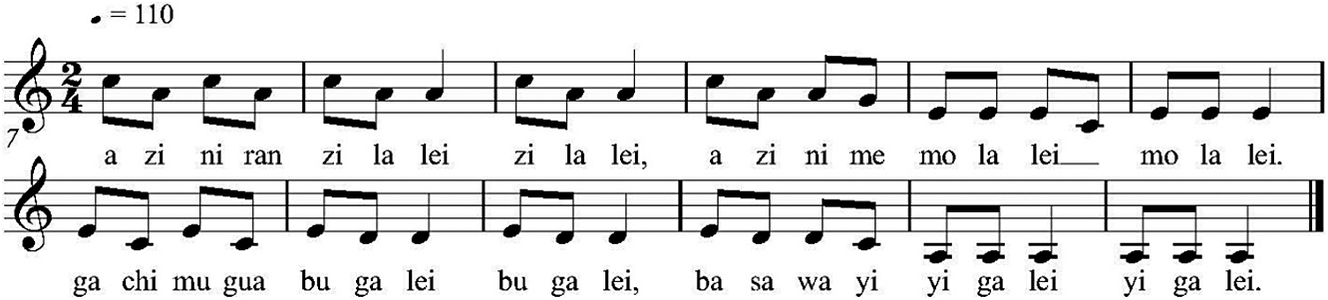
Back in the courtyard, the banquet has ended and the tables have been cleared to the side. As on the previous night, guests form a circle and dance to the rhythm of the maniu. The difference is that many of those joining the dance this evening are visitors from outside the village, and the maniu tunes and accompanying steps are noticeably simpler than those performed the night before. We arrive just as the maniu musician Gu Xuezhong takes a break, and a sound system is used to play dance music and songs, starting with the instrumental track of Ashicai’s “Zi La Lei” in 2/4 metre, while Ashicai himself holds the microphone and sings along (Figure 11).Footnote 15 After this performance, the audience breaks into playful calls, urging the groom Shi Yanxiong and Cai Yuping to sing. Yielding to this spirited encouragement, the pair perform a song they had written and composed themselves, “Meeting at Louhai Lisu Village” in 4/4 (Figure 12).
Transcription of “Zi La Lei.” Transcribed by Keyi Liu.

Figure 11. Long description
A staff-notation transcription of the Lisu song "Zi La Lei". The melody is written on a single treble-clef line in 2/4 metre, laid out in two systems of six bars each. It moves stepwise within a narrow range of only a few neighbouring pitches, built from short repeating rhythmic figures of paired eighth notes. The phrases are largely parallel in shape, and each settles back onto the same low final note, giving the song a simple, strophic character. Romanized Lisu syllables are set beneath the staff, one syllable to a note, and the piece closes with a double barline.
Groom Shi Yanxiong and Cai Yuping performing at the wedding, 30 November 2020. Photo by Keyi Liu.

The second day of the wedding led me through a further range of stances in my observation and participation. Among these, I want to emphasise the role I took alongside other guests as a witness to rites that offered solemn thanks to familial ancestors and to the natural environment. Bearing witness involves more than simply observing or recording an event; it involves establishing a connection around the sharing of subjectivities, not objectification or alienation. It is a fundamentally ethical mode of engagement (see further, Oliver Reference Oliver2001). My point here is that witnessing may look like observation or the “guided observation” I proposed above, but it is actually essentially participatory. Attending respectfully to the performance of these rites meant recognising this as a moment where I should not attempt to learn through joining the good-humoured sociality of dance and where I should hold back on the questions my hosts were elsewhere so ready to entertain. Holding back in both these ways allowed me to tune into the strength and seriousness of my Lisu hosts’ underlying spirituality as it emerged among the broader ethos of joy and play that characterised so much of the wedding.
Note also the differences in role and experience brought out as I tracked across the three spaces of the evening. I could join the dance in the courtyard, learning the steps and increasing my stamina through personal experience, exhilaration and the encouragement of those around me. I could sit quietly alongside the women of the principal families, reflecting (as a single, urban, Han girl) on how marriage transforms relationships for rural, Lisu women, and how they each commemorate that transformation in a personal song gifted to the bride. Or I could become an observer privileged to hover at the threshold as the men collaborated and competed in antiphonal songs, serious in tone, replete with the inherited wisdom of the ages. How I chose to allocate my attention to these spaces and their performative movements and sounds across the evening drew me into frameworks of: physically challenging learning and warm fellowship; the inevitable back-and-forth of imagination, commemoration, and personal reflection; and hushed focus as I hovered on the edge of archaic Lisu lyrics and song exchange not normally shared with women. Given such nuanced and layered engagements, participant observation seems too shallow a term for all this. Instead, moving fluidly between active participation, reflective witnessing, and respectful observation seemed to allow me deeper insights into the rich social and cultural dynamics of the Lisu wedding, while also prompting further reflections on the complexities and ethical responsibilities inherent in ethnographic engagement.
Coda: Back to the bride’s home day
On the third day of the wedding, it is customary for the groom to accompany his bride back to her family home. He pays his respects to his in-laws and shows his gratitude for their raising of his wife. During this visit, the groom’s family brings gifts such as fruits, pastries, or liquor to the bride’s family. The couple will spend time with the bride’s family, catching up and enjoying a meal together. After the visit, the couple will return to the groom’s family home, marking the end of the wedding ceremony and the beginning of their new life together. The visit does not involve a musical or dance component.
This day also marks the moment when wedding guests return to their own homes. Xu Ligang has returned to drive Ashicai and me back to Lijiang city. Though the festivities had only lasted a few days, when the lively and sensory-rich atmosphere suddenly returned to calmness, I could not help but feel a sense of loss. It seemed Ashicai shared this mood, saying, “in the past, communication was limited; males were typically bold enough to invite the girl of their dreams to dance and sing with them when they encountered her during festivals or wedding banquets. If you do not take the opportunity, you will not know when you will see each other again and may, therefore, miss the chance of a lifetime.” At that moment, Xu Ligang joked, “Liu, look, Ashicai must be thinking about a girl he met once and still thinks about.” Ashicai did not offer any more details. With eyes aged yet still holding a rare innocence and sincerity, he gazed quietly into the distance beyond the car window as he began to sing:
My sweetheart.
My sweetheart.
I consider myself fortunate to have met you in my life.
Your flower-like face has left an indelible mark on my heart.
However, I have no idea when we will meet again.
Conclusions
In this paper, I have shared a new portrait of the types and roles of music and dance performance in a traditional-style Lisu wedding. Rather than trying to “average out” melodies or dance steps in the hope of identifying which elements best represent “authentic” Lisu tradition, I emphasise the flexibility and immediacy of Lisu musical practices. Each wedding song, dance, or ritual was created and continually adapted by the walapa, musicians, and participants in real time, shaped by the specific contexts, interactions, and individuals involved. Across the three days, the music opened a circle dance into longer and more elaborate metric units, moved through several processional, conversational, contestive, and naming-conferring forms, and ran simultaneously across three differently constituted spaces of the wedding feast. What emerges across these registers is that dynamism, multi-day duration, cross-contextual movement, and improvisatory texture are not deviations from some prior “authentic” repertoire, but the constitutive conditions of the form itself. In doing so, I highlight the many different ways that performance action and interaction take form across the wedding, and the situations and individuals that shape what I regard as a locally grounded commitment to liveness and hence to diversity and fluid variation.
I have also reflected on the qualitative research method commonly labelled participant observation that has been a mainstay of ethnomusicological and ethnochoreological study. My intention was to expose my own numerous shifts of role and stance during the research in question. We commonly talk about participant observation as if it is one method, albeit a composite one; scholars sometimes invert this formulation to write instead of a potentially more engaged, and collaborative approach to knowledge creation, “observant participation” (see, for example, Seim Reference Seim2024, which also offers a significant literature review in this area).
Across these weddings, my field position cannot be described adequately as a simple movement between observation and participation. At different moments, I was invited to dance, expected to ask questions, permitted to witness gendered and family-specific singing, and required to remain respectfully at the edge of ritual action. Conquergood’s (Reference Conquergood and Bial2004) notion of co-performative witnessing is useful here not as a replacement term for all these positions, but as a reminder that ethnographic knowledge is produced through accountable co-presence: through being bodily, temporally, and ethically implicated in events as they unfold. Throughout this article, I therefore treat observer, guided observer, witness, observant participant, and playful participant not as steps along a single continuum, but as differently situated forms of presence made available by particular musical, ritual, and social spaces.
As I noted in the discussion of the circle dance, the phrase “play with us” carries several layers at once: a polite welcoming, a local sense of what makes an event succeed, a semantic field in Lisu wider than English play, and a familiar pattern by which a number of Southwest Chinese minority communities draw outsiders in. “Play” is both a mode of social participation and a criterion for evaluating its quality. It asks “whether you have joined in with others, whether you have put yourself fully into it, and whether it has been done well—that is, whether the occasion has really come alive” (Zhao Jie, personal conversation, 5 April 2021).
Yet my participation was evidently not entirely comparable with that of others around me—I lacked practice in the more expanded patterns of dance steps and so could not get them efficiently into my head, and I lacked the stamina to dance into the small hours. Elsewhere, participation meant remaining passive, as when it comprised the solemn act of witnessing key rites in an ethically engaged posture, rather than more simply observing them as a remarkable or exotic spectacle. Even my reliance on observation also had some points of distinction from that which a local Lisu scholar might have undertaken. My hosts expected me to ask many questions, potentially even naïve ones. They expected to be able to guide my observations. They took my active engagement as a confirmation of my depth of interest, and, therefore, of the distinctiveness and value of their cultural traditions in the context of a minority population in a much larger nation. The data I could gather and the local testimony that accompanied these observations would thus have differed from those elicited by a Lisu scholar, potentially leading to distinctions in analysis as well.
My aim here is not to “solve” this problem by proposing some new arrangement of research methods. It is more modestly to bring out into the open the seemingly inevitable contingencies of the several ways I undertook ethnographic work on Lisu wedding music and dance, and to illuminate how these contingencies themselves enrich our understanding of ethnographic methods and the cultural dynamics they aim to represent. Finally, this contingency is not a matter for lament; it is an acknowledgement of the essentially manifold toolkit that ethnographers bring to their fieldwork and the need to recognise the potential underlying our inevitable shifts of posture as we learn to see, hear, witness, play, and feel.
Acknowledgements
This research has received funding from the European Research Council (ERC) under the European Union’s Horizon 2020 research and innovation programme (Grant agreement No. 101039864). The views and opinions expressed are, however, those of the author(s) only and do not necessarily reflect those of the European Union or the European Research Council.






 Open access

