Introduction
Mild cognitive impairment (MCI) is a condition that refers to cognitive impairment in subjects without dementia. It has various causes, including Alzheimer's disease (AD) (Visser et al. Reference Visser, Kester, Jolles and Verhey2006). It is important to identify MCI subjects with prodromal AD, because if disease-modifying drugs for AD become available, these are likely be most effective in the early stage of the disease. Possible predictors for AD are affective symptoms, such as depression, anxiety and apathy (Ownby et al. Reference Ownby, Crocco, Acevedo, John and Loewenstein2006). These symptoms are common in subjects with MCI (Apostolova & Cummings, Reference Apostolova and Cummings2007), but it is uncertain whether they can predict AD in this population (Steffens et al. Reference Steffens, Otey, Alexopoulos, Butters, Cuthbert, Ganguli, Geda, Hendrie, Krishnan, Kumar, Lopez, Lyketsos, Mast, Morris, Norton, Peavy, Petersen, Reynolds, Salloway, Welsh-Bohmer and Yesavage2006). Depressive symptoms were associated with an increased risk of developing AD in some studies (Modrego & Ferrandez, Reference Modrego and Ferrandez2004; Gabryelewicz et al. Reference Gabryelewicz, Styczynska, Luczywek, Barczak, Pfeffer, Androsiuk, Chodakowska-Zebrowska, Wasiak, Peplonska and Barcikowska2007), and with a decreased risk in others (Rozzini et al. Reference Rozzini, Chilovi, Trabucchi and Padovani2005; Liu et al. Reference Liu, Wang, Wang, Lin, Hong, Liu and Tsai2007), while most studies did not find a relationship between depression and AD at all (Tierney et al. Reference Tierney, Boyle, Lam and Szalai1999; Visser et al. Reference Visser, Verhey, Ponds, Cruts, Van Broeckhoven and Jolles2000a, Reference Visser, Verhey, Ponds, Kester and Jollesb; Copeland et al. Reference Copeland, Daly, Hines, Mastromauro, Zaitchik, Gunther and Albert2003; Korf et al. Reference Korf, Wahlund, Visser and Scheltens2004; Robert et al. Reference Robert, Berr, Volteau, Bertogliati, Benoit, Sarazin, Legrain and Dubois2006; Wang et al. Reference Wang, Lirng, Lin, Chang and Liu2006; Feldman et al. Reference Feldman, Ferris, Winblad, Sfikas, Mancione, He, Tekin, Burns, Cummings, del Ser, Inzitari, Orgogozo, Sauer, Scheltens, Scarpini, Herrmann, Farlow, Potkin, Charles, Fox and Lane2007; Palmer et al. Reference Palmer, Berger, Monastero, Winblad, Backman and Fratiglioni2007; Teng et al. Reference Teng, Lu and Cummings2007; Panza et al. Reference Panza, Capurso, D'Introno, Colacicco, Zenzola, Menga, Pistoia, Santamato, Scafato, Gandin, Capurso and Solfrizzi2008). Similarly, discrepant results have been reported regarding the predictive accuracy of apathy and anxiety for AD (Robert et al. Reference Robert, Berr, Volteau, Bertogliati, Benoit, Sarazin, Legrain and Dubois2006; Feldman et al. Reference Feldman, Ferris, Winblad, Sfikas, Mancione, He, Tekin, Burns, Cummings, del Ser, Inzitari, Orgogozo, Sauer, Scheltens, Scarpini, Herrmann, Farlow, Potkin, Charles, Fox and Lane2007; Liu et al. Reference Liu, Wang, Wang, Lin, Hong, Liu and Tsai2007; Palmer et al. Reference Palmer, Berger, Monastero, Winblad, Backman and Fratiglioni2007; Teng et al. Reference Teng, Lu and Cummings2007).
These contradictory findings suggest that the relationship between affective symptoms and AD is modified by other factors which varied between studies, but these factors have not yet been identified. Statistically non-significant findings may be explained by a small sample size or a brief follow-up period. The aim of the present study was to investigate the predictive accuracy of affective symptoms for AD in a large clinical cohort of subjects with MCI over a 10-year follow-up period. In addition, we examined whether age, the presence of amnestic MCI or the length of the follow-up period modified the relationship between affective symptoms and AD. We hypothesized that the association between affective symptoms and AD would be strongest in elderly subjects or in subjects with amnestic MCI, as these subjects are more likely to develop AD (Visser et al. Reference Visser, Kester, Jolles and Verhey2006; Visser & Verhey, Reference Visser and Verhey2007). We examined whether the length of the follow-up period was a potential effect modifier, because previous studies suggested that the predictive accuracy of depression for dementia might increase or decrease with the length of follow-up period (Green et al. Reference Green, Cupples, Kurz, Auerbach, Go, Sadovnick, Duara, Kukull, Chui, Edeki, Griffith, Friedland, Bachman and Farrer2003; Ownby et al. Reference Ownby, Crocco, Acevedo, John and Loewenstein2006). Besides depression, anxiety and apathy, we also investigated sleeping problems as a predictor for AD. Sleeping problems are common in affective disorders and previous studies found that these problems may be predictive for cognitive decline or dementia (Jelicic et al. Reference Jelicic, Bosma, Ponds, Van Boxtel, Houx and Jolles2002).
Method
Subjects
Subjects were selected from an ongoing longitudinal study of non-demented subjects who had been referred to the Maastricht Memory Clinic. The memory clinic is an out-patient clinic of the Maastricht University hospital (Verhey et al. Reference Verhey, Jolles, Ponds, Rozendaal, Plugge, de Vet, Vreeling and van der Lugt1993). The design of this study has been described in detail elsewhere (Verhey et al. Reference Verhey, Jolles, Ponds, Rozendaal, Plugge, de Vet, Vreeling and van der Lugt1993; Visser et al. Reference Visser, Kester, Jolles and Verhey2006). Consecutive patients were included at the time of the first visit to the memory clinic. Subjects included had to be 40 years or older and to have MCI, which was defined as a score of 2 or 3 on the Global Deterioration Scale (GDS; Reisberg et al. Reference Reisberg, Ferris, de Leon and Crook1982). This broad definition of MCI is consistent with that of other studies (Tierney et al. Reference Tierney, Szalai, Snow, Fisher, Nores, Nadon, Dunn and St George-Hyslop1996; Feldman & Jacova, Reference Feldman and Jacova2005; Tabert et al. Reference Tabert, Manly, Liu, Pelton, Rosenblum, Jacobs, Zamora, Goodkind, Bell, Stern and Devanand2006). This definition was used because subjects with AD in the predementia stage often do not meet the more strict criteria of MCI, such as the criteria for amnestic MCI (Geslani et al. Reference Geslani, Tierney, Herrmann and Szalai2005; Storandt et al. Reference Storandt, Grant, Miller and Morris2006; Dickerson et al. Reference Dickerson, Sperling, Hyman, Albert and Blacker2007; Visser & Verhey, Reference Visser and Verhey2007). Exclusion criteria were: the existence of dementia at baseline, and an apparent cause for the cognitive impairment, such as cerebrovascular disorders, brain trauma, endocrine disorders, or psychiatric disorders other than mild affective disorders at baseline (Visser et al. Reference Visser, Verhey, Ponds, Cruts, Van Broeckhoven and Jolles2000a).
For the present study we selected subjects older than 55 years, who had been eligible for at least one follow-up assessment (n=263). Subjects included in this study were referred to the memory clinic by general practitioners (72%), neurologists (4%), psychiatrists (13%) or others (11%). The study was approved by the medical ethics committee at the Maastricht University hospital. After the study had been explained to them, all the subjects gave their written informed consent.
Clinical assessment at baseline and follow-up
At baseline, all subjects underwent a standardized assessment, which included: a detailed history of the subject; a psychiatric, neurological, and physical examination; the Mini Mental State Examination (MMSE; Folstein et al. Reference Folstein, Folstein and McHugh1975); the GDS (Reisberg et al. Reference Reisberg, Ferris, de Leon and Crook1982); the 17-item version of the Hamilton Depression Rating Scale (HAMD; Hamilton, Reference Hamilton1960); the Blessed Dementia Rating Scale (BDS; Blessed et al. Reference Blessed, Tomlinson and Roth1968); and appropriate laboratory tests; a neuropsychological assessment including tests for measuring learning and memory, working memory, fluency, intelligence, speed of information processing and executive functioning; and a computerized tomography (CT) or magnetic resonance imaging (MRI) as described elsewhere (Verhey et al. Reference Verhey, Jolles, Ponds, Rozendaal, Plugge, de Vet, Vreeling and van der Lugt1993).
At 2, 5 and 10 years after baseline, subjects were invited to participate in a follow-up assessment. Because subjects were continuously enrolled, not all subjects had been in the study long enough to undergo a follow-up assessment after 5 or 10 years. At the time of our analyses, 263 subjects were eligible for the 2-year follow-up, 232 for the 5-year follow-up, and 133 for the 10-year follow-up. The follow-up assessment included a standardized questionnaire about medical history and cognitive complaints, the MMSE, GDS, BDS, HAMD, and a neuropsychological assessment comparable with the baseline assessment. Subjects who refused to come for the follow-up assessment were interviewed by telephone, using a standardized questionnaire about medical history and cognitive complaints, and the Telephone Interview for Cognitive Status (Brandt et al. Reference Brandt, Spencer and Folstein1988). In this way a diagnosis was made in 14 subjects.
Amnestic MCI was defined as a score of 1.5 standard deviations below the mean of a reference population on the delayed recall measure of the Auditory Verbal Learning Test (AVLT), after correction for age, sex and education (Petersen et al. Reference Petersen, Smith, Waring, Ivnik, Tangalos and Kokmen1999; Van der Elst et al. Reference Van der Elst, van Boxtel, van Breukelen and Jolles2005). The amnestic MCI criteria also require intact activities of daily living. This was operationalized as the absence of dementia and a score below 4 on the GDS, which was part of the inclusion criteria of the study, in accordance with previous studies (Geslani et al. Reference Geslani, Tierney, Herrmann and Szalai2005).
The diagnosis of dementia and AD was made according to the Diagnostic and Statistical Manual of Mental Disorders, 4th edition (DSM-IV) criteria and National Institute of Neurological and Communicative Disorders and Stroke (NINCDS) and the Alzheimer's Disease and Related Disorders Association (ADRDA) criteria (NINCDS-ADRDA; McKhann et al. Reference McKhann, Drachman, Folstein, Katzman, Price and Stadlan1984; APA, 1994). The diagnosis of frontotemporal dementia was made according to the Neary criteria (Neary et al. Reference Neary, Snowden, Gustafson, Passant, Stuss, Black, Freedman, Kertesz, Robert, Albert, Boone, Miller, Cummings and Benson1998). Vascular dementia was diagnosed according to the National Institute of Neurological Disorders and Stroke (NINDS) and the Association Internationale pour la Recherche et l'Enseignement en Neurosciences (AIREN) criteria (NINDS-AIREN; Román et al. Reference Román, Tatemichi, Erkinjuntti, Cummings, Masdeu, Garcia, Amaducci, Orgogozo, Brun and Hofman1993). The diagnoses of dementia and AD were made independently both by a neuropsychiatrist and a neuropsychologist. Both were blinded to the baseline results. Consensus about the diagnoses was reached for all subjects.
Affective symptoms
In the present study we made use of the subscales from the HAMD (Hamilton, Reference Hamilton1960) for anxiety (items 9, 10, 11, 15 and 17), depression (items 1, 2, 3, 7 and 8), sleeping problems (items 4, 5 and 6) (Shafer, Reference Shafer2006) and apathy (items 7, 8 and 13) (Li et al. Reference Li, Meyer and Thornby2001).
Statistical analyses
Statistical analyses were performed using spss (version 11 for Mac OS X; SPSS Inc., USA). We dichotomized all affective symptom scores. Symptoms were considered to be clinically present if at least one item included in a subscale was either 1 or higher for items scored on a three-point scale, or was ⩾2 for items scored on a five-point scale. Group differences were analysed using an independent t test or χ2 test. Predictive accuracy was analysed using a discrete-time survival analysis model and implemented using logistic regression and an appropriately adjusted dataset (Hosmer & Lemeshow, Reference Hosmer and Lemeshow1999). The outcome group included all subjects with AD at follow-up. The reference group included subjects without dementia or with non-AD dementia at follow-up. Analyses were performed with and without adjustment for age, sex and education. The difference in odds ratio (OR) for AD between subjects diagnosed with AD at the 2-year, 5-year and 10-year follow-up was tested using the discrete-time survival analysis model (Hosmer & Lemeshow, Reference Hosmer and Lemeshow1999). We also investigated interactions of affective symptoms with amnestic MCI, and with age (younger or older than 70 years). In order to investigate whether findings were influenced by the inclusion of subjects with non-AD-type dementia in the reference group, we repeated the analyses after the exclusion of subjects with non-AD-type dementia.
Results
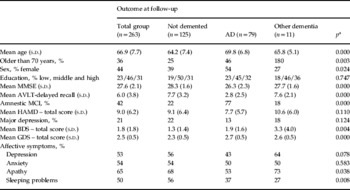
At baseline, 263 MCI subjects were included in the study. Their baseline characteristics are listed in Table 1. Symptoms of depression, anxiety and sleeping problems were present in about 50% of the subjects, and symptoms of apathy in about 70% (Table 1).
Baseline comparisons of the converters and non-converters

AD, Alzheimer's disease; s.d., standard deviation; MMSE, Mini Mental State Examination; AVLT, Auditory Verbal Learning Test; MCI, mild cognitive impairment; HAMD, Hamilton Depression Rating Scale; BDS, Blessed Dementia Rating Scale; GDS, Global Deterioration Scale.
a Not demented v. AD.
Outcome at follow-up
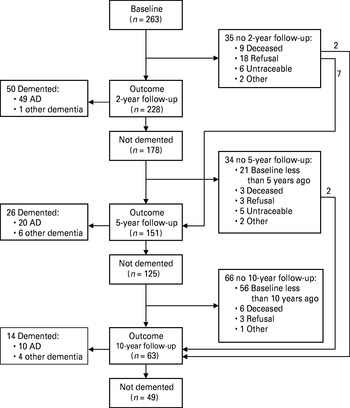
At least one follow-up was available for 228 subjects (87%). The number of subjects at each follow-up and the reason for the absence of a follow-up are shown in Fig. 1. Subjects without outcome at a follow-up for which they had been eligible were similar to subjects with outcome with regard to age, sex, education, MMSE score, score on the delayed recall test, HAMD score, BDS score, proportion of subjects with amnestic MCI and GDS score.
Flowchart of the follow-up. AD, Alzheimer's disease.

At follow-up, 79 subjects had developed AD and 11 subjects had developed other types of dementia, namely vascular dementia (n=6), frontotemporal dementia (n=1), Parkinson's dementia (n=3) and primary progressive aphasia (n=1) (see Fig. 1). The annualized conversion rate to AD was highest for the first years of follow-up and decreased with longer follow-up intervals (11% for the first 2 years, 4.2% for years 3–5, and 3.0% for years 6–10). The average follow-up length was 5.4 years. The baseline characteristics according to outcome are listed in Table 1. Subjects who converted to AD were about 5 years older at baseline, were more often female, had lower MMSE and AVLT delayed recall scores, more often had amnestic MCI, and had higher BDS and GDS scores compared with the subjects who did not develop AD (Table 1).
Predictors for AD
Univariate analyses showed that the presence of sleeping problems [OR 0.43, 95% confidence interval (CI) 0.26–0.71, p=0.001] and symptoms of apathy (OR 0.58, 95% CI 0.35–0.96, p=0.034) were associated with a decreased risk for AD. Depressive symptoms (OR 0.62, 95% CI 0.38–1.03, p=0.065) showed a trend in the same direction.
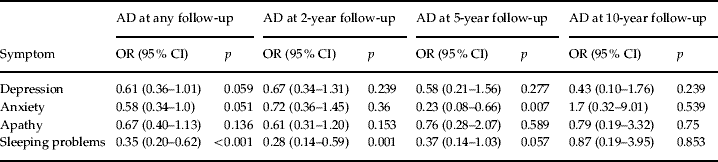
After adjustment for age, sex and education, sleeping problems were associated with a lower risk for AD (OR 0.35, 95% CI 0.20–0.62, p<0.001) (Table 2). Symptoms of depression (OR 0.61, 95% CI 0.36–1.01, p=0.059) and anxiety (OR 0.58, 95% CI 0.34–1.0, p=0.051) showed a trend in the same direction (Table 2). After the exclusion of subjects who developed a non-AD-type dementia, results remained essentially the same. Also impairment on individual sleeping items was associated with a lower risk of developing AD (sleep initiation: OR 0.30, 95% CI 0.15–0.59, p<0.001; sleep continuation: OR 0.28, 95% CI 0.14–0.58, p=0.001; early awakening: OR 0.35, 95% CI 0.17–0.70, p=0.003).
ORs of affective symptoms for ADFootnote a

OR, Odds ratio; AD, Alzheimer's disease; CI, confidence interval.
a All data are corrected for age, education and sex.
Effect of amnestic MCI and age
The presence of amnestic MCI modified the relationship between depressive symptoms and the risk for AD (p=0.017). Depression was associated with a lower risk for AD in subjects without amnestic MCI (OR 0.34, 95% CI 0.13–0.93, p=0.036), but not in subjects with amnestic MCI (OR 1.1, 95% CI 0.50–2.3, p=0.85). Age did not modify the risk for AD for any symptom.
Effect of length of follow-up period
We noted some differences in predictive accuracy related to time of follow-up (Table 2), but these differences were small. Only with regard to anxiety was the risk of developing AD statistically significantly different (p=0.046) in the case of subjects diagnosed with AD at the 5-year follow-up (OR 0.23, 95% CI 0.08–0.66, p=0.007) and subjects newly diagnosed with AD at the 10-year follow-up (OR 1.7, 95% CI 0.32–9.01, p=0.539).
Discussion
The major finding of this clinical, long-term follow-up study is that sleeping problems were associated with a decreased risk for AD. In addition, symptoms of depression and anxiety also showed a trend in this direction. The predictive accuracy of depression was dependent on the presence of amnestic MCI and that of anxiety on the length of follow-up period.
Previous studies on the predictive accuracy of affective symptoms for AD in subjects with MCI mainly focused on depressive symptoms. The outcomes of our study are consistent with some of these studies (Rozzini et al. Reference Rozzini, Chilovi, Trabucchi and Padovani2005; Liu et al. Reference Liu, Wang, Wang, Lin, Hong, Liu and Tsai2007), but in disagreement with others (Modrego & Ferrandez, Reference Modrego and Ferrandez2004; Gabryelewicz et al. Reference Gabryelewicz, Styczynska, Luczywek, Barczak, Pfeffer, Androsiuk, Chodakowska-Zebrowska, Wasiak, Peplonska and Barcikowska2007). We found that depressive symptoms were only associated with a reduced risk in subjects without amnestic MCI. This corroborates our earlier finding that in the absence of moderately severe memory impairment, depression is more likely to be associated with primary depression than with prodromal AD (Visser et al. Reference Visser, Verhey, Ponds, Kester and Jolles2000b). It is also in line with the observation that depressed subjects without a plasma biomarker profile suggestive of AD have better memory performances than depressed subjects with such a profile (Sun et al. Reference Sun, Steffens, Au, Folstein, Summergrad, Yee, Rosenberg, Mwamburi and Qiu2008). We did not find that the predictive accuracy of depressive symptoms for AD was dependent on follow-up length, although population-based studies did show that the risk of developing AD for those with depressive symptoms either increased or decreased with follow-up length (Green et al. Reference Green, Cupples, Kurz, Auerbach, Go, Sadovnick, Duara, Kukull, Chui, Edeki, Griffith, Friedland, Bachman and Farrer2003; Ownby et al. Reference Ownby, Crocco, Acevedo, John and Loewenstein2006).
Anxiety was found to be associated with a decreased risk for AD in two other studies as well (Robert et al. Reference Robert, Berr, Volteau, Bertogliati, Benoit, Sarazin, Legrain and Dubois2006; Liu et al. Reference Liu, Wang, Wang, Lin, Hong, Liu and Tsai2007); but a population-based study reached the opposite conclusion (Palmer et al. Reference Palmer, Berger, Monastero, Winblad, Backman and Fratiglioni2007). These conflicting findings may be explained by a difference in setting. Our findings suggested that anxiety is associated with a decreased risk in the short term and an increased risk in the long term. This may indicate that the predictive accuracy of anxiety for AD is dependent on the length of follow-up period.
Unlike our study, previous studies reported that apathy was associated with an increased risk for AD, although this reached statistical significance in only one study (Robert et al. Reference Robert, Berr, Volteau, Bertogliati, Benoit, Sarazin, Legrain and Dubois2006; Feldman et al. Reference Feldman, Ferris, Winblad, Sfikas, Mancione, He, Tekin, Burns, Cummings, del Ser, Inzitari, Orgogozo, Sauer, Scheltens, Scarpini, Herrmann, Farlow, Potkin, Charles, Fox and Lane2007; Teng et al. Reference Teng, Lu and Cummings2007). These conflicting findings may have resulted from different ways of assessing these symptoms, as we used a subscale from the HAMD, while other studies used the informant-based Neuropsychiatric Inventory (Cummings et al. Reference Cummings, Mega, Gray, Rosenberg-Thompson, Carusi and Gornbein1994).
Sleeping problems have not been investigated before as predictors for AD in subjects with MCI. While it is well known that sleep disturbances occur in mild and moderate phases of AD, the present data show that they are not associated with an increased risk of developing AD in subjects with MCI, but, on the contrary, with a decreased risk. This effect was seen for all aspects of sleeping problems (sleep initiation, sleep continuation and early awakening). In contrast to our findings, a previous study conducted on the general population showed that sleeping problems were associated with cognitive decline (Jelicic et al. Reference Jelicic, Bosma, Ponds, Van Boxtel, Houx and Jolles2002). However, other studies did not find this association (Foley et al. Reference Foley, Monjan, Masaki, Ross, Havlik, White and Launer2001; Tworoger et al. Reference Tworoger, Lee, Schernhammer and Grodstein2006).
Age did not modify the relationship between affective symptoms and AD, although we expected that affective symptoms would be associated with an increased risk for AD in elderly subjects. It is possible that the age range in our study was not large enough to detect such an interaction.
A number of factors that have not been investigated in the present study may explain the conflicting results between studies. First of all, as we already mentioned above, predictive accuracy may depend on whether the study is conducted in a community or in a clinical setting. For example, in a memory clinic setting affective symptoms are always related to a memory problem, which is not the case in a community setting. Moreover, subjects seen in a clinical setting have gone through a referral process. In our study, subjects had been referred by a general practitioner or another specialist and this may have led to an enrichment of the sample by subjects with primary depression, which would explain the high prevalence of depressive symptoms and the decreased risk of affective symptoms for AD. Second, predictive accuracy may depend on the type of rating scale used. Like most of the other studies, we used a clinician-based rating scale for affective symptoms. Using a self-rating scale for depression and anxiety (Arrindell & Ettema, Reference Arrindell and Ettema1981, Reference Arrindell and Ettema2003) would have yielded similar results (data not shown). Also if we had used a diagnosis of major depression as predictor, we would have obtained similar results (OR 0.58, 95% CI 0.29–1.2, p=0.13). Third, the variability between the studies may be explained by differences in the presence of vascular disorders or vascular risk factors, because these factors may modify the relationship between depression and cognitive impairment (Alexopoulos, Reference Alexopoulos2006). Fourth, the variability may have resulted from an interaction between age, MCI type, the length of the follow-up period, setting, vascular risk factors and diagnostic instruments. Finally, it is also possible that the conflicting findings reflect random variation.
The annual conversion ratio of 11% for the first 2 years is comparable with the mean annual conversion rate of 10.2% found in a meta-analysis (Bruscoli & Lovestone, Reference Bruscoli and Lovestone2004). The annual conversion ratio in our study declined with the length of follow-up period, as described before (Visser et al. Reference Visser, Kester, Jolles and Verhey2006).
Few subjects developed non-AD types of dementia, which is in line with other clinical MCI studies (Geslani et al. Reference Geslani, Tierney, Herrmann and Szalai2005). After exclusion of subjects with non-AD types of dementia, results remained similar, which indicates that the inclusion of subjects with a non-AD-type dementia in the reference group did not affect the results.
The strengths of the present study were: the large sample size; the long follow-up period of up to 10 years; the high follow-up rate; and the broad inclusion criteria for MCI in which mild depressive symptomatology was not excluded at baseline, in accordance with current recommendations (Steffens et al. Reference Steffens, Otey, Alexopoulos, Butters, Cuthbert, Ganguli, Geda, Hendrie, Krishnan, Kumar, Lopez, Lyketsos, Mast, Morris, Norton, Peavy, Petersen, Reynolds, Salloway, Welsh-Bohmer and Yesavage2006). The limitations of the study were: the relatively small number of subjects with a 10-year follow-up, and the lack of pathological confirmation of the clinical diagnosis. In addition, a few diagnoses were based on a telephone interview, which is less reliable than a clinical and neuropsychological assessment. However, post hoc analyses in which these subjects were excluded remained essentially the same (data not shown), indicating that this did not introduce a major bias.
There have been several hypotheses regarding the relationship between depression, MCI and AD (Steffens et al. Reference Steffens, Otey, Alexopoulos, Butters, Cuthbert, Ganguli, Geda, Hendrie, Krishnan, Kumar, Lopez, Lyketsos, Mast, Morris, Norton, Peavy, Petersen, Reynolds, Salloway, Welsh-Bohmer and Yesavage2006; Wilson et al. Reference Wilson, Arnold, Beck, Bienias and Bennett2008). One hypothesis proposes that depressive symptoms contribute to the development of AD. A second hypothesis suggests that depressive symptoms may be an early manifestation of AD. A third hypothesis states that cognitive impairment results from a primary depressive disorder. Our data support the last hypothesis, as we found that affective symptoms were generally associated with a decreased risk for AD.
The present study indicates that affective symptoms in subjects with MCI are not predictive for prodromal AD. Given the high prevalence of affective symptoms in prodromal AD (37–53%), however, the presence of these symptoms certainly does not exclude the possibility of prodromal AD. Therefore, the presence of mild affective symptoms should not be an exclusion criterion for studies that aim to select these subjects, as has been the case in previous MCI trials (Visser et al. Reference Visser, Scheltens and Verhey2005). It might be the case that in specific samples affective symptoms are indeed associated with an increased risk for AD, and that apart from the type of MCI other factors that characterize such samples remain to be identified. Because affective symptoms are common in subjects with MCI, services for subjects with cognitive complaints should pay attention to this symptomatology, and should have psychiatric expertise available to diagnose and treat these symptoms.
Acknowledgements
The authors thank Nico Rozendaal for his help in the data management. The study was partly funded by the ‘Hersenstichting Nederland’ (Dutch Brain Foundation).
Declaration of Interest
None