Second language acquisition (SLA) as a discipline has not had a long history and, as any new discipline, has seen growing pains over the years. This research timeline traces the development of the increased and more sophisticated use of statistics in SLA research and the increasing demands for rigor in their use.Footnote 1 Use of statistical procedures has been increasing in the SLA literature, but the tools themselves have not developed from within the field; rather the increased use stems from greater statistical sophistication on the part of users. In other words, SLA is not an innovator but an increasingly knowledgeable borrower and adapter of statistical procedures.
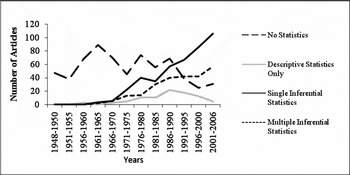
The beginnings of probability and statistics go back approximately 350 years. The early focus was on probability for gambling purposes and has generally been traced back to letters written in the 18th century (Bayes Reference Bayes1763). The field of SLA clearly does not go as far back as the origin of statistics, but we mention early statistical developments to show that statistical techniques were already well established at the time of early SLA research. In looking at statistical use beginning with the early publications of SLA journals, we conducted a survey (based on Gass, in press) of three journals (with different inaugural dates), all devoted exclusively to research in SLA (Language Learning, Studies in Second Language Acquisition, and Second Language Research), with regard to the use of statistical techniques over time. A graph, based on 1,411 articles surveyed, is given in Figure 1. As can be seen, the number of articles using both single and multiple inferential statistics has increased whereas articles with no statistical procedures has declined. The number of articles with only descriptive statistics has generally been low over the years.
Statistical use in SLA: 1948–2006.

Because statistics is a tool and not the object of research, this timeline takes a slightly different approach than others in this series. Our selection of the literature is based on developing signs that the field is promoting the use of statistical procedures. We take the increasing appearance of publications (books, editorial comments, and articles) that focus more and more on how statistics are used or can be used and interpreted in SLA as an indication that the field considers the accurate and appropriate use of statistics important. While publications do not always build upon previous works, as we have seen in other research timelines in this series, what we see over time is a greater use of statistics and emphasis on the need for rigorous statistical analyses. Over the years many, although not all, journals in our field have introduced strict guidelines for the reporting of quantitative and qualitative outcomes as part of their information for contributors and, indeed, many of our selections are editorial comments, discussions, and/or articles referring to the need for such guidelines. Editorial comments send a message to readers and authors alike of the need to be rigorous in the consideration of appropriate statistical usage. Finally, there is an increasing number of books dealing with statistics and research design aimed at applied linguists and SLA researchers. In some sense, many of the books do not differ in scope, but their presence on the market responds to a perceived need for work on statistical usage as it applies to the field of SLA. In addition, many earlier works are out of print (sometimes due to the demise of a particular publishing company). Furthermore, as a consequence of the increased focus on statistics in L2 research, individual publishing companies appear to want their own version of statistical coverage; market-driven increase, in and of itself, suggests a greater concern with research rigor.

*We are grateful to an anonymous reviewer for pointing out that the journals that require submissions to conform to APA guidelines are by the very nature of the requirement demanding sophistication in the analysis and presentation of statistical data.
Shawn Loewen is Assistant Professor in the Second Language Studies program at Michigan State University. He specializes in L2 acquisition and L2 classroom interaction. His recent research has investigated the occurrence and effectiveness of incidental focus on form in meaning-focused L2 classrooms; his work has appeared in Language Learning, Studies in Second Language Acquisition and The Modern Language Journal. He teaches classes on SLA and research methodologies, specializing in quantitative analysis, and serves on the advisory board of Language Teaching Research and Innovation in Language Learning and Teaching.
Susan Gass is University Distinguished Professor in the Department of Linguistics & Germanic, Slavic, Asian and African Languages at Michigan State University. She serves as Director of the English Language Center, Director of the Second Language Studies Program, Co-Director of the Center for Language Education and Research, and Director of the Arabic Flagship Program. She conducts research in L2 acquisition and has published widely in books and journals. She is co-author (with Alison Mackey) of Second language research: Methodology and design (Lawrence Erlbaum, 2005), (with Alison Mackey) Data elicitation for second and foreign language research (Lawrence Erlbaum, 2007), and (with Larry Selinker) Second language acquisition (Routledge, 2008). She has served as President of the International Association of Applied Linguistics (AILA) (2002–2008) and President of the American Association for Applied Linguistics (1987–1988), is the Associate Editor of Studies in Second Language Acquisition, and is the recipient of numerous awards.