Around 20 June 1797 the Philadelphian merchant George Latimer visited the insurance brokerage of Isaac Wharton and David Lewis to insure goods he was shipping to Hispaniola (Haiti) on the snow Boston. A policy was drawn up specifying the details of the risk and the premium rate was tentatively agreed at 15 percent, reflecting the danger of capture by French privateers then active in the Caribbean. The brokers then offered the policy to their underwriters.
A few days later, William and Samuel Keith insured twelve hogsheads of claret that they were shipping on the same vessel for $480, likewise paying a premium of 15 percent. Footnote 1 However, instead of going to a broker, the Keiths obtained their insurance from the Insurance Company of North America (INA), a joint stock marine insurance corporation.
At this time, France and Britain were at war. Therefore, as was usual, the insured in all cases warranted that the vessel carried the documents required to establish that the goods were American (neutral) property under U.S. law. Nevertheless, the Boston was captured on 25 July by the French privateer Fine, and carried into Jean-Rabel, where she was condemned by a prize court for intending to trade with the English.Footnote 2 This was unfortunate, but not unusual. During the late 1790s hundreds of American merchant vessels suffered similar fates.Footnote 3
Brokerages for individual underwriting had been operating in Philadelphia since the 1740s, but the first American marine insurance corporation had been formed only in 1792. Then in the late 1790s, during the pivotal period when private underwriters and newly formed corporations existed side by side, Philadelphia's marine insurance industry was buffeted by a massive exogenous shock, the “Quasi-War” between America and France. This article uses archival data from a private underwriter and a marine insurance corporation to study how the Quasi-War affected the institutional structure of Philadelphia's marine insurance industry.
THE FORMATION OF AMERICAN MARINE INSURANCE CORPORATIONS
While the basic contractual form of marine insurance policies was quite standardized by the eighteenth century, the exact details of particular policies varied considerably. Goods and vessels were usually insured in separate policies. Some policies covered simple one-way trips, but others covered more complicated voyages to multiple ports. The insured risks varied from “sea risk” dangers of wind and weather to broader coverage including the possibility of enemy capture. Policies sometimes allowed some flexibility as to route and cargo, including specified adjustments to the premium in various contingencies. It was also common for the parties to add idiosyncratic clauses and conditions to the policy reflecting the nature of the proposed voyage and the information available at the time of contracting.
Before 1792 transactions were generally organized by brokers who gathered “names” for each policy. By limiting their exposure on any single risk and spreading their underwriting judiciously across a variety of voyages, the private underwriters—many of them merchants themselves—attempted to make a profit while minimizing the likelihood of heavy losses. Although this system enabled merchants to share risk, it had some drawbacks. In addition to the transactions costs of finding a new set of underwriters for each policy, the security of the policy depended on the financial security of the individual underwriters.
A natural way to try to overcome some of these difficulties was to form insurance partnerships or other associations. Britain's Bubble Act of 1720 had made the formation of marine insurance partnerships or corporations illegal in the American colonies, but independence freed Americans from this constraint. The first American joint stock marine insurance corporation, the Insurance Company of North America (INA) was formed in Philadelphia in 1792, and obtained a charter from the state legislature in 1794. Many more marine insurance corporations were formed in Philadelphia and other U.S. cities over the following decade, part of a set of institutional innovations that Richard Sylla has called the “U.S. Financial Revolution.”Footnote 4
What were the advantages of corporations compared to the existing system of private underwriting? The most frequently cited advantage associated with the corporate form is the limitation of stockholders' liability to the value of their stock. Limited liability facilitates the delegation of control of capital by large numbers of investors to those with the specialist managerial skills needed to employ the capital productively.Footnote 5 In particular, a key advantage of limited liability corporations in comparison with joint liability partnerships is the protection they afford to shareholders with “deep pockets” in case the firm should become insolvent. This is crucial if shares are to be freely transferable. Without limited liability, both creditors and other shareholders would need to monitor each shareholder's solvency in order to protect their own position, and in particular, they would want to ensure that shares were not transferred to asset-poor individuals.Footnote 6
However, joint liability partnerships had never been observed in British or American marine insurance. Instead, the most salient organizational alternative was private individual underwriting, either through stable syndicates or more usually through ad hoc syndicates organized by brokers on a policy-by-policy basis. In either case, there was no joint liability. Each private underwriter was liable only for the amount he had underwritten or for his share of the syndicate, so the “deep pockets” problem did not arise.
Furthermore, while some of the early American marine insurance corporations obtained charters with clear limited liability provisions, others did not, and many of the charters were more ambiguous or avoided the question. The charter granted to the INA in April 1794 was silent on the question of limited liability, but its founders were keen to limit their liability if possible, and they attempted to do so by changing the wording of the policy.Footnote 7 Subsequent charters in Pennsylvania and New York were similarly silent on the question. In December 1803, the Articles of Association of the Phoenix Insurance Co. made clear the founders' intention that “the members of this association shall not be liable to any loss, damage, or responsibility, in their persons, or property, other than the property which they have respectively invested in the capital and funds of the company.”Footnote 8 Although the charter they obtained two months later adopted most of the provisions of their Articles of Association verbatim, the section on limited liability was conspicuously omitted.Footnote 9 It was not until 1810 that Pennsylvania granted a charter with a clear statement of limited liability.Footnote 10
Massachusetts, Connecticut, Rhode Island, and Washington DC all chartered marine insurance corporations with limited liability.Footnote 11 In contrast, Maryland explicitly rejected limited liability. The charter of the Maryland Insurance Company, passed on 24 Dec 1795, stipulated:
That if at any time the funds of the corporation should not be competent to pay and satisfy the just demands of the assured, that nothing herein contained shall be construed to discharge the stockholders from being liable for their respective proportions of said losses, according to the number of shares they may hold therein, but no stockholder shall be liable for more than his own proportion of losses as aforesaid, or to answer for the failure or deficiency of others.Footnote 12
Since the security of the policy therefore depended upon the solvency of the members, the charter also stipulated that any transfers of shares had to be approved by the directors. An unincorporated association formed in Baltimore in 1799 and two further corporations chartered in January 1805 adopted similar rules.Footnote 13 The Maryland corporations were therefore essentially similar to large stable syndicates of private underwriters. The difference was mainly in their size, the ease with which shares could be transferred, and the raising of a capital fund as an initial bulwark against losses.
In summary, while it appears that the corporations' founders were in general keen to limit their liability if possible, it seems unlikely that limited liability was their primary objective. In all cases, either by the charters, or by clauses inserted in the policies, wealthy shareholders were insulated from joint liability in the event that other shareholders proved insolvent. But this cannot be viewed as the key motive for incorporation, since there had been no joint liability under the existing system of private underwriting either. This accords with Edwin Perkins' view that from a de jure standpoint, “the historical evidence regarding whether stockholders in the late eighteenth and early nineteenth century had limited or unlimited personal liability for a firm's potential losses is inconclusive.” However, they probably enjoyed de facto limited liability, which later became formalized as the American common law developed in the early nineteenth century. Given this ambiguity, he argues that in the early republic “we may safely conclude that the prospect of limited liability does not appear to have been among the inducements attracting investors to place their funds in the shares of commercial banks and other corporate ventures.”Footnote 14
If not limited liability, what were the advantages of the corporate form? In support of their petition for a charter, the INA's founders argued that whereas individual underwriters frequently failed, a corporation would improve the security of the policy by holding a capital fund large enough to cover all but a catastrophic run of bad luck.Footnote 15 The security of the policy was of paramount concern for merchants, so this gave the corporations an important advantage on the demand side. In addition, if a loss occurred, the insured would find it easier to recover from a corporation than from many private underwriters individually.
Equally important, however, the corporations had an advantage in the supply of insurance services because of their sheer scale. As Eugene Fama and Michael Jensen note, stock companies enable risk to be spread across many residual claimants who individually choose the extent to which they bear risk and who can diversify their holdings.Footnote 16 Thus, the INA's founders argued that a corporation could draw on a larger stock of capital than could be accessed through the existing system of private underwriters, whereas under the existing system, “for want of a sufficient number of underwriters of responsibility” large sums of money were “drained from the country” as many American merchants continued to obtain insurance abroad, principally in London. From this perspective, the key advantage of the corporate form was to facilitate the organization of enormous yet flexible underwriting syndicates, which vastly reduced the transactions costs of spreading risk among a large number of people and obviated the need to find a new group of underwriters for each policy. In particular, the corporate form expanded the pool of available capital for underwriting by enabling wealthy individuals who were not merchants or were not physically located in Philadelphia to act as underwriters by entrusting their underwriting decisions to experts.Footnote 17 At the same time it gave these investors the flexibility to withdraw their capital by selling their shares.Footnote 18
Opponents of the petition argued that these advantages could equally be provided by an unincorporated company, and the founders of the INA indicated that they were willing to proceed without a corporate charter if necessary.Footnote 19 Nevertheless, they vigorously sought a charter in the face of considerable opposition. Competition among states probably eased their path. When their initial petition for a charter ran into opposition, they briefly threatened to seek a charter in Delaware.Footnote 20
Given their important advantages in financial security and risk-spreading, it may appear that corporations were simply a superior organizational form to the preexisting institutions of private underwriting. But the story is not so simple. In Britain, Lloyd's of London had developed into a sophisticated marine insurance marketplace based on private underwriting, and successive waves of entry by corporations in the nineteenth century failed to dislodge Lloyd's from its dominant position or to drive Britain's private underwriters out of business.Footnote 21 So, what disadvantages, if any, did the corporations have relative to private underwriting?
The key disadvantage of the corporate form identified by Fama and Jensen is that agency problems, arising from the separation between control by decision makers within the firm and the owners who bear the residual risk, create a need for costly internal governance structures. Even with such mechanisms in place, the agency problems are unlikely to be completely overcome.Footnote 22 Timothy Guinnane, Ron Harris, Naomi Lamoreaux, and Jean-Laurent Rosenthal argue that such agency problems make the corporate form inferior to other organizational forms for many kinds of business activity.Footnote 23 For example, Eric Hilt has shown that because of internal agency problems, corporations performed significantly worse than unincorporated partnerships at managing complex whaling voyages in the 1830s.Footnote 24
The private underwriters, in contrast, faced no such internal agency problems because they underwrote on their own account. The risk-bearers and decision makers were the same people. This also gave them another important advantage, the leeway to be flexible. Because of the inherent uncertainties of eighteenth century trade, it was common, and often unavoidable, for vessels to deviate from their planned voyages and thereby technically void the policy. As a result, marine insurance contracts were necessarily incomplete and it was important for merchants to be able to trust the underwriter to act in good faith. In 1806 a broker informed a correspondent that:
The insurance on the Orestes, as you desired, was wholly effected by incorporated Companies, and you need never consider an apology necessary for giving them the preference when you wish it done…(but) I can assure you, in regard to solvency, there are not perhaps two [private underwriters] who write that I would hesitate in laying an India risk of my own before: And many persons in this City are giving a preference to Individual Underwriters, from experience that they may meet with a greater spirit of accommodation from them, in case of Loss, than they can always expect from the Directors of an Office, who must consult the Interest of the Stockholders, and may not conceive it consistent with their Duty to be liberal.Footnote 25
The private underwriters may also have had an advantage in overcoming agency problems between the underwriter and the insured. While the system of private underwriting was based on direct, hard-nosed market transactions, it also relied on repeated interaction, reputation, and trust among merchants who were deeply knowledgeable about their business, and who dealt with each other in long-lived, multifaceted business, social and religious relationships. Thus, underwriting on each other's voyages became part of the complex web of trusting personal interactions that characterized the eighteenth century business world.Footnote 26
Finally, as Oliver Westall notes, the optimal choice of organizational structure in insurance depends in part on the ability to transmit and process information about risks.Footnote 27 In the course of their business as merchants involved in trade, the private underwriters constantly gathered information about the goods, vessels, captains, and routes on which they underwrote and the people with whom they dealt. Embedded within their business and social networks, they were well placed to obtain and process the information necessary to evaluate risks and to overcome moral hazard and adverse selection problems.Footnote 28
THE QUASI-WAR WITH FRANCE
In the eighteenth century, it was common during wartime for belligerent nations to commission private vessels to prey on enemy commerce. Privateering provided a free, straightforward, and incentive-compatible way for the state to increase its naval strength and harass the enemy. It should not be confused with piracy. At least in theory, privateers were subject to strict rules governing the treatment of both enemy and neutral vessels. If the captured vessels or goods were legally condemned in prize courts, they became property of the captor. If, on the other hand, the privateers were unable to show that the vessel or goods were legitimate captures (“good prize”), they were released, sometimes with payment of compensation. In practice, however, nations differed over the conditions governing the neutrality of vessels and cargoes, and inevitably, because a lot of money was at stake, the system was sometimes abused.
The corporations founded in the United States in the 1790s came into being at a turbulent time. Britain and France were at war. Although the United States remained officially neutral (until 1812), it almost went to war on several occasions. In 1794 the British captured hundreds of American vessels trading with French colonies in the West Indies, and war for a time seemed imminent, but it was averted by the signing of Jay's Treaty in November of that year. The treaty put an end to British captures, but to obtain peace the Americans made several concessions that were unfavorable to France. France retaliated by issuing a series of increasingly restrictive decrees governing the neutrality of American vessels. During the next few years, hundreds of American merchantmen were captured by French privateers for alleged violations of these decrees.Footnote 29 By 1798 the situation in the West Indies was described by a Frenchman as, “A system of piracy almost general, sustained by a commercial tribunal which condemns without reserve and without exception neutral and allied ships on the most frivolous pretexts.”Footnote 30
The United States government responded to these attacks by building a navy that began to patrol sea routes and capture French privateers. However, the United States did not declare war on France. Its navy was authorized to attack vessels that posed a threat to American shipping, but not to attack unarmed French merchant vessels or to attack the French on land. Because war constantly threatened to erupt during this period, but was never officially declared or fully engaged, the conflict “placed the Adams administration and the American people in a state of almost perpetual crisis.”Footnote 31 It is therefore referred to as a “Quasi-War.” Following Napoleon Bonaparte's coup d'état in 1799, it became clear that the new French government wanted peace, and the Quasi-War was brought to an end by a peace agreement (the Mortefontaine Convention) signed in September 1800.
EFFECTS OF THE QUASI-WAR
War created both problems and opportunities for merchants and underwriters. For merchants, the interruption of regular channels of commerce could make wartime trade highly profitable. Yet, rapidly changing political and military circumstances and the slow speed of communication meant that unskillful or unlucky merchants could easily find themselves facing ruin. For underwriters, high premium rates meant that wartime underwriting could be highly profitable if carried out judiciously, but it could prove disastrous if an unexpected political or military development caused a string of losses.
The Quasi-War caused substantial fluctuations in insurance rates as rumors of war and reports of privateering activity waxed and waned. The secretary of one of the corporations remarked in 1797, “Circumstances varying as they do, We are obliged to vary premiums very often.”Footnote 32 There was some trepidation about French intentions as early as October of 1795, when the INA board sent a deputation to the Secretary of State to “inform him that a Report prevails that the French cruisers have orders to Capture all vessels bound to British ports and request him to apply to the French minister to know whether this is so or not.”Footnote 33 French captures began early in 1796. By late 1796 American newspapers carried lists of captured vessels and the usual rate of premium on a one-way voyage to the West Indies was 5 to 6 percent, already well above the usual peacetime rate of 2½ to 3 percent. By early 1797 it had risen to 10 to 15 percent, and 25 percent and more was paid in 1798, when New York merchant David Gelston lamented:
It is said England has issued orders to take all Neutral Vessels bound to any French, Dutch, or Spanish ports either in Europe or America—the French declare against all English ports the United States against all French ports—where is a Vessel to be sent?Footnote 34
By 1799 the successful actions of the U.S. Navy had begun to bring premiums down, and they declined further in 1800/01 as the number of French privateers diminished and the two countries moved toward peace.
This article uses two manuscript sources to study the Quasi-War's effects on premium rates and the institutional structure of the marine insurance industry. The first is a record of 1,068 policies insured by a private underwriter through Wharton & Lewis's brokerage, easily the most established insurance brokerage in Philadelphia at the time, between April 1795 and March 1801.Footnote 35 The amounts recorded do not reflect the total sums insured on these vessels, and some voyages that were insured through Wharton & Lewis's office do not appear in this record, so the record appears to reflect the underwriting of a single substantial underwriter or possibly some kind of syndicate.Footnote 36 Therefore, the Wharton & Lewis register of policies is an incomplete, but substantial record of the most important locus of private underwriting activity in Philadelphia during this period. In what follows, it is also assumed to be a representative record, both in terms of the premiums charged and the overall number of policies underwritten.Footnote 37
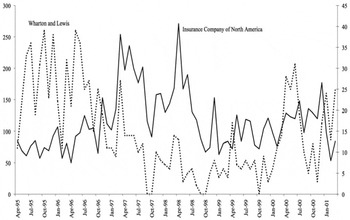
NUMBER OF POLICIES UNDERWRITTEN EACH MONTH BY THE PRIVATE UNDERWRITER THROUGH WHARTON AND LEWIS (RIGHT SCALE) AND BY THE INSURANCE COMPANY OF NORTH AMERICA (LEFT SCALE), APRIL 1795–MARCH 1801

These data are compared with records of policies insured during the same period by the Insurance Company of North America (INA), one of the two corporations active in the market.Footnote 38 Note that one INA blotter, covering the period from April 1798–March 1799, is missing, so there is a gap in the INA data covering this period.
Figure 1 shows how the volume of business done by the private underwriter and the corporation was affected by the Quasi-War. Of course, there were perhaps 50 private underwriters and two corporations active in the market, so it is not possible to gauge market share precisely. However, the Quasi-War clearly coincided with a striking shift of the marine insurance business out of the hands of private underwriters and into those of the corporations beginning in 1796, at around the time that French captures began, and lasting until the threat receded around 1800. The private underwriter insured a total of 286 voyages in 1796, which collapsed to only 69 in 1798 before recovering somewhat to 186 in 1800 as the danger diminished. The number of vessels entering Philadelphia from foreign ports, which may be taken as a rough barometer of the size of the market, also fell somewhat during the war, from 817 in 1796 to 487 in 1798, and 565 in 1800.Footnote 39 The number of policies insured by the INA, however, actually increased from 1148 in 1796 to 1547 in 1798, and was 1459 in 1800.Footnote 40
EXPLAINING THE QUASI-WAR'S EFFECTS
It seems clear that the corporations were far more successful than private underwriters in taking advantage of the tremendous opportunities presented by the Quasi-War. Why?
First, the security of a privately underwritten policy was always a concern for merchants. Even in peacetime, those seeking insurance spared no effort to find “good men” to cover their risks, and those who insured on behalf of correspondents in other ports constantly reassured them that the names on their policies were “safe.” However, in wartime it became even more difficult than usual to form reliable judgments about the solvency of other merchants, because of the increased danger of losses from both trade and underwriting. The Quasi-War, like earlier wars, coincided with numerous failures. In April 1797 it was reported that:
The underwriters that are substantial will not take a risk to the West Indies and back under 33½ to 40 percent against all risks. I say substantial because many of our underwriters' circumstances are such [that they are experiencing financial difficulties].Footnote 41
In May 1799 the Oliver brothers, merchants in Baltimore, warned that “[t]he Times are so critical that there is but little security in any foreign expedition and we don't feel anxious to engage in them.” Others were less cautious however, leading to numerous bankruptcies in Baltimore in 1799–1800, and the Olivers believed that “Philad[elphia] will soon be in the same situation.”Footnote 42 Thus, one merchant advised a correspondent that although the private underwriters might be slightly cheaper, he should insure with a corporation because “It being of a long duration before the Voyage is completed, Deaths and other accidents may (and does too often) happen to Individuals.”Footnote 43
In contrast, as their founders had anticipated, the corporations were widely perceived as financially secure. The INA's capital, unlike that of a private underwriter, was dedicated solely to the payment of insurance losses, and was large enough to cover all but a catastrophic run of bad luck.Footnote 44 Moreover, its charter stipulated that its funds were to be invested in relatively safe investments such as government debt and the stocks of public corporations, such as banks, canal and turnpike companies, as well as a small amount of real estate sufficient to house the company's offices. It was specifically forbidden to trade in goods or to engage in banking.
Accordingly, as the financial security of private underwriters became more suspect, merchants seeking reliable insurance naturally gravitated to the corporations. In September 1799, for example, Daniel Coxe insured $8,000 worth of goods with the INA, noting in the policy that a portion of the goods insured, “having been underwrote in New York by Bankrupts, is to be considered as not having been underwrote there.”Footnote 45
The upshot is that, while the war naturally drove up the actuarially fair rates of premium on all voyages, it also caused an additional relative increase in demand for insurance by corporations and a decrease in the demand for private underwriting services because of the corporations' greater perceived financial security.
Given the relative decline in the demand for private underwriting, the private underwriters would have needed to lower their premiums relative to those of the corporations to maintain their market share. However, they could not afford to compete too aggressively on price, as several factors conspired to encourage a fall in the supply of private underwriting services during the war.
First, war changed the nature of the risks insured against in a way that undermined the value of merchants' human capital for assessing risks. In peacetime, the private underwriters' familiarity with captains, cargoes, vessels and routes made them good judges of the risks they insured. But war reduced the relative value of this idiosyncratic knowledge about individual risks, overwhelming it with systemic risks that affected all vessels relatively more equally, such as the risk of an unexpected increase in privateering activity.
Furthermore, although wartime premiums presented private underwriters with opportunities for high expected returns if they underwrote judiciously, it also became harder for them to diversify their risks. An unexpected political or military development, such as a change of policy regarding neutral rights leading to the capture of a large number of merchantmen, might impact a merchant-underwriter's trade income and at the same time cause multiple underwriting claims against him. Thus, as a mechanism used to spread risk among the community of merchants, the system of private underwriting was better suited to insuring against idiosyncratic peacetime hazards that would affect some merchants but not others, such as accidents at sea, than to dealing with systematic wartime dangers which could strike many merchants simultaneously. In the first case, the lucky could compensate the unlucky; but if all were unlucky together, the risk-sharing function of insurance would fail.
A final reason for merchants to be cautious in their wartime underwriting was that in an age when virtually all trade was conducted on credit, it was crucial to safeguard a reputation for financial prudence. A merchant who was seen to be underwriting at excessively low premium rates would not only earn reduced underwriting profits, but might also risk damaging his perceived creditworthiness within the merchant community, which could be calamitous.
Thus, to preserve both their capital and their good name, the private underwriters had ample cause for caution. For most of them, after all, underwriting was a sideline to their main business as merchants, and if it became too risky, they could shift their attention to other activities.
Of course, the corporations also faced increased risks during wartime, but because their stockholders could diversify their assets in other ways, corporations could spread risk more widely and could therefore afford to be less risk-averse than individual underwriters. The implication, then, is that the war temporarily gave corporations an advantage on the supply side. both kinds of underwriters would naturally increase premiums during wartime to compensate for the heightened risks, but private underwriters' caution would be reflected in an additional leftward shift of the supply curve for private underwriting services during wartime.
To evaluate these arguments, it is instructive to compare the premiums charged during the Quasi-War by the INA and the private underwriter on one-way and round-trip voyages between the United States and 13 major categories of destination: Asia,Footnote 46 Cuba,Footnote 47 Hispaniola,Footnote 48 Jamaica,Footnote 49 France,Footnote 50 Northern Europe,Footnote 51 Southern Europe,Footnote 52 the Mediterranean,Footnote 53 the United Kingdom and Ireland,Footnote 54 the Spanish Main,Footnote 55 Martinique and Guadeloupe, other ports in the Lesser Antilles,Footnote 56 and New Orleans.Footnote 57 The premiums are estimated as

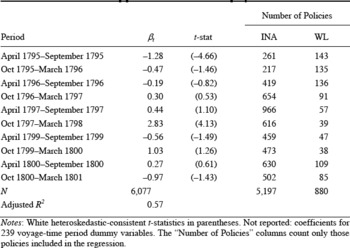
where pirt is the rate of premium on policy i, travelling on route r in time period t, the αrt are fixed effects for voyages on each of the 26 routes r (one-way and return voyages are treated separately) during each of the ten six-month time periods between 1 April 1795–31 March 1798 and 1 April 1799–31 March 1801 (making 260 voyage-year combinations in all, 21 of which were omitted due to a lack of data).Footnote 58 WLirt is a dummy variable which identifies whether policy i was underwritten by the private underwriter; and εirt is an error term. The coefficient of interest is βt, the estimated additional premium charged by (or paid to) a private underwriter in period t.
ESTIMATED PREMIUM DIFFERENCES BETWEEN PRIVATE AND CORPORATE UNDERWRITERS

Notes:
White heteroskedastic-consistent t-statistics in parentheses. Not reported: coefficients for 239 voyage-time period dummy variables. The “Number of Policies” columns count only those policies included in the regression.
Table 1 reports the results of this regression. The key finding is that controlling for route, in the summer of 1795 the private underwriter was charging, on average, 1.28 percent less than the corporation, but by the winter of 1797/98, at the height of the Quasi-War, he was charging 2.83 percent more. The differences are both statistically significant and large enough to substantially affect merchants' incentives, so it is not surprising that the table also shows that the relative volume of business shifted dramatically in favor of the corporation.
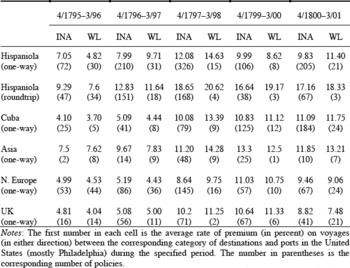
Table 2 illustrates this pattern by comparing the average premiums charged by the private underwriter and the corporation and the volume of business they underwrote on major routes.
The increase in the relative premiums charged by private underwriters and the fall in the volume of business are consistent with the interpretation that the Quasi-War caused a fall in the supply of private underwriting services. As a result, the private underwriters' share of the market collapsed and their premiums increased even further than the corporations' premiums did during the war. The fall in the volume of private underwriting was likely exacerbated by an additional fall in demand for private underwriting as merchants sought the perceived security of policies issued by the corporations. The resulting increase in relative demand for corporate underwriting explains the tremendous growth in the INA's volume of business during the Quasi-War.
AVERAGE PREMIUM RATES AND VOLUME OF BUSINESS ON MAJOR ROUTES

Notes:
The first number in each cell is the average rate of premium (in percent) on voyages (in either direction) between the corresponding category of destinations and ports in the United States (mostly Philadelphia) during the specified period. The number in parentheses is the corresponding number of policies.
A caveat is in order here: this comparison of premium rates relies on an implicit assumption that the types of voyages insured by the corporation and the private underwriter do not differ systematically in terms of the hidden characteristics of the captain, vessel, and crew—that is, that there is no unobserved selection bias. This assumption is potentially problematic. One might hypothesize, for example, that merchants may have tried to insure the “best” risks privately among themselves, leaving the “worst” risks to the corporations. Conversely, it could be that merchants tended to insure with private underwriters only if they were turned down by the corporations, so that private underwriters got a disproportionate share of the “worst” risks.
We are also assuming that there are no systematic differences in the contractual details of the risks. The INA record reveals a rich variety of policy conditions. A typical entry, for example, reads in part:
at & from Norfolk to Cape Nichola Mole & at & from thence to Port au Prince, with a convoy, if not, to proceed from the Mole to Jeremie, or a French port in the Bite of Leogane or any other port in the Island of Hispaniola & at & from thence back to Norfolk on the Schooner Nelly, James Brown master, Goods, Drs 2500 @ 15pCt whereof if no Loss happens three percent is to be returned if she does not go into the Bite of Leogane or to more than one Port besides Cape Nichola Mole.Footnote 59
Many of the INA policies contained idiosyncratic conditions of this sort. For example, many policies gave the vessel liberty to touch and trade at particular ports, with returns of premium if those ports were not visited. Others granted returns of premium if the vessel sailed in convoy or before or after a certain date. Most policies included a warranty that the goods insured were American property, but some did not. Some of these were declared to be carrying false papers in an effort to pass as neutral. Premiums were considerably higher on vessels declared to be carrying contraband, a profitable but hazardous business. If it was uncertain on which vessel goods would be shipped, they might be covered (for a slightly higher premium) on “any good American vessel.” Voyages to Hamburg or Amsterdam usually specified a return of premium if the vessel went “north about” to avoid the English Channel. An important source of variation arose from the fact that insurance might be purchased at any time from before a vessel sailed to when it was expected to arrive. Some vessels were even insured when they were already considered overdue, and naturally these paid a higher premium, which might also be affected by rumors about storms, enemy activity, and so on.
Unfortunately, the Wharton & Lewis record does not specify all the policy conditions, and therefore the possibility of either adverse selection in the choice of insurer or of systematic unobserved differences in the policy conditions adopted by the private and corporate underwriters cannot be entirely ruled out. Note, however, that the qualitative argument remains valid unless any such selection biases changed significantly during the course of the war.
Three other developments are worthy of mention. First, the success of the two pioneering corporations in Philadelphia led within a few years to similar incorporations in other American states. Increased competition from other corporations, particularly in New York and Maryland, may help to account for the leveling off in the INA's volume of business seen in Figure 1 despite a growth in the volume of trade after the end of the Quasi-War.Footnote 60
Second, as a result of both the increased capacity of the American marine insurance industry and the intermittent political problems and uncertainties between the United States and Britain, the volume of American business insured in London fell sharply. One American merchant in London argued that the increased security afforded by corporations in America had led to a sharp decrease in the amount of insurance done in London by American merchants, so by 1810, “nineteen twentieths” of his consignments from America were insured in America.Footnote 61 In particular, American underwriters generally had better and more recent information about the important West Indian routes, and this advantage became particularly important in wartime, when premiums could fluctuate rapidly.Footnote 62
Finally, yellow fever outbreaks clearly disrupted the private underwriting networks, as seen in Figure 1. In September–October 1797, the WL record contains only a single entry: the ship Sickness, captain Disease, on a voyage from Earth to Heaven with a cargo of 1,500 souls, a reference to the outbreak of Yellow Fever during which many Philadelphia residents left the city. During the yellow fever outbreaks in 1797 and 1798, both the INA offices and Wharton & Lewis's office were temporarily moved.Footnote 63 However, while the secretary of the corporation continued to issue policies during these outbreaks, the private brokers would have found it difficult to fill policies if most of their underwriters had fled to the countryside.
CONCLUSION
Both organizational forms—corporate and private underwriting—had advantages and disadvantages. Private underwriting was a long-established and flexible market-based mechanism for sharing risk among a community of merchants. The corporate form increased the security of the policy and expanded the pool of available capital beyond the merchant community, but it may have suffered disadvantages in dealing with asymmetric information and agency problems. Indeed, many of the shareholders and directors of the INA also continued both to purchase insurance and to underwrite privately.Footnote 64 However, the Quasi-War with France arrived at a critical juncture for American marine insurance, highlighting the advantages of the corporate form by casting doubt on the security of the privately underwritten policy and making it harder for private underwriters to diversify their risks.
Although Britain and France were briefly at peace in 1802/03, it must have been clear at the end of the Quasi-War that a period of considerable uncertainty lay ahead. Peace with France and Jefferson's election in 1800 created renewed tensions with Britain, which were later manifested in the Embargo Act of 1807 and ultimately the War of 1812. In 1800 the INA complained that:
The late Captures made by the British Ships are truly alarming and none more so that those made by the Halifax Squadron, as we cannot discern the principles or pretences on which some of them are made, & of course know not by what precautions to guard against them. They seem to imply some new rule of conduct of which we are uninformed, either of late adoption, or by new construction of former regulations.Footnote 65
Although Wharton and Lewis's brokerage had survived the Quasi-War, in 1803 they reconstituted their business as a corporation, the Phoenix Insurance Company, which obtained a charter in February 1804 with Wharton as its first president and Lewis as vice president.Footnote 66 Other brokers carried on for a time, but within a decade of the end of the Quasi-War, private underwriting in Philadelphia was effectively extinct.Footnote 67 Thus, by bringing the advantages of the corporate form into sharp focus, it appears that the Quasi-War helped to bring about a transition from private to corporate underwriting in the American marine insurance industry.