Implications
The presence of non-starch polysaccharides (NSP) in wheat exerts antinutritional effects in pigs, increasing digesta viscosity and reducing nutrient digestibility through encapsulation which results in poor feed efficiency and growth. The addition of NSP-degrading enzymes such as xylanase to wheat-based diets can help to reduce these effects. However, the addition of xylanase as high as 32 000 BXU/kg to wheat-barley cereal-based diets formulated to meet or exceed the nutrient requirements of grower pigs had no effect on growth performance or nutrient utilisation. This suggests that the addition of xylanase to good quality wheat-based grower pig diets has no beneficial effects.
Introduction
Exogenous enzymes are used in livestock diets in order to maximise utilisation of nutrients and improve feed efficiency. The presence of non-starch polysaccharides (NSP) in wheat (predominately arabinoxylans) have been shown to have antinutritional effects in pigs (Yin et al., Reference Yin, McEvoy, Schulze, Hennig, Souffrant and McCracken2000; Nortey et al., Reference Nortey, Patience, Simmins, Trottier and Zijlstra2007). Non-starch polysaccharides increase digesta viscosity and reduce nutrient digestibility through encapsulation (Kim et al., Reference Kim, Simmins, Mullan and Pluske2005). The incorporation of NSP-degrading enzymes can help to alleviate the negative effects of NSP. Xylanase, an NSP-degrading enzyme, works by removing the nutrient encapsulating effects of the cell wall in feed by the breakdown of long-chain arabinoxylans, releasing nutrients for digestion by the animal and by reducing digesta viscosity (Masey O’Neill et al., Reference Masey O’Neill, Smith and Bedford2014b). An additional mechanism has been suggested as the addition of xylanase to maize–soya bean-based broiler diets consistently increased serum peptide YY (Singh et al., Reference Singh, O’Neill, Ghosh, Bedford and Haldar2012) suggesting a neuro-hormonal mechanism through the production of the satiety-related gut hormone peptide YY. Peptide YY slows down gastric emptying increasing gastric digestion of nutrients (Allen et al., Reference Allen, Fitzpatrick, Yeats, Darcy, Adrian and Bloom1984) with a consequential increase in feed efficiency. Arabinoxylo-oligosaccharides, produced from enzymatic hydrolysis of arabinoxylans, are non-digestible oligosaccharides with prebiotic activity that can be fermented by intestinal microbiota (Grootaert et al., Reference Grootaert, Van den Abbeele, Marzorati, Broekaert, Courtin, Delcour, Verstraete and Van de Wiele2009; Neyrinck et al., Reference Neyrinck, Van Hee, Piront, De Backer, Toussaint, Cani and Delzenne2012), resulting in an increase in volatile fatty acid (VFA) production, predominately acetate, propionate and butyrate (Goodlad et al., Reference Goodlad, Lenton, Ghatei, Adrian, Bloom and Wright1987). Cuche et al. (Reference Cuche, Cuber and Malbert2000) found that ileal VFA infusion increased peptide YY concentrations in pigs suggesting the production of VFAs stimulates the release of the gut hormone peptide YY from entero-endocrine cells.
The use of xylanase in pig diets has been extensively studied; however, inconsistent results have been reported. Passos et al. (Reference Passos, Park, Ferket, von Heimendahl and Kim2015) found that xylanase supplementation from 0 to 1400 LXU/kg enhanced ileal digestibility of NDF, dry matter (DM), organic matter (OM) and energy when fed to grower pigs. Woyengo et al. (Reference Woyengo, Sands, Guenter and Nyachoti2008) found that xylanase supplementation had no effect on grower pig performance; however, they did find that xylanase supplementation at 4000 XU/kg increased amino acid ileal digestibility and Ca digestibility. Olukosi et al. (Reference Olukosi, Sands and Adeola2007) found no effect of xylanase supplementation on performance or nutrient digestibility when added to a wheat–barley–soya bean meal-based diet for grower pigs. The inconsistent results reported may result from differences in the level of xylanase used. Inconsistent results along with limited information on the role of a xylanase enzyme on VFA production in grower pigs and the activity of peptide YY suggests there is a need for further investigation.
The current study was designed to test the hypotheses that hydrolysis of NSPs by xylanase creates shorter chain oligosaccharides altering caecal fermentation. Changes in caecal fermentation will alter VFA production which in turn will affect peptide YY secretion. The objectives of this study were: (1) to identify the optimum inclusion level of xylanase (Econase XT) in grower pig diets by measuring the effect of increasing enzyme levels on growth performance, the concentration of VFA and peptide YY concentration in portal and peripheral blood of grower pigs and (2) to increase our understanding of the interrelationships between xylanase inclusion, VFA production and peptide YY secretion in grower pigs.
Material and methods
Animals
This experiment was carried out at the University of Leeds, Spen farm. This experiment received ethical approval from the University of Leeds Animal Welfare and Ethical Review Committee. A total of 512 grower pigs ((Large White×Landrace)×MAXGRO) were allocated to pens on the basis of litter of origin, sex and live weight (32 reps of four treatments with four pigs per pen). Pigs were allocated to trial at 7 weeks of age (14.2±0.31 kg) and remained on trial until 12 weeks of age (~41.5±3.31 kg). Pigs were housed in fully slatted grower accommodation throughout the trial with 16 pens per room. Each pen measured 135×155 cm. Heating and ventilation were controlled to maintain temperature at ~22°C (Dicam System). Pigs had free access to feed and water.
Experimental design
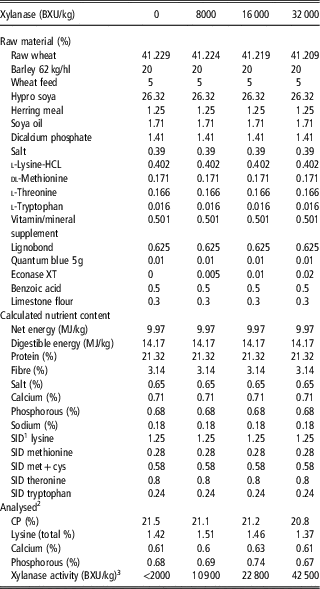
The experiment was a dose response design with four inclusion levels of xylanase (0, 8000, 16 000 or 32 000 BXU/kg). The xylanase was a β 1-4, endo-xylanase (Econase® XT; AB Vista, Marlborough, Wiltshire, UK) and its main function is to breakdown the fibre fraction from cereals, mainly arabinoxylan (European Food Safety Authority, 2008). Diets were a cereal-based wheat, barley mix formulated to meet or exceed the nutrient requirements of grower pigs (BSAS, 2003) and contained 500 FTU Quantum Blue per kg diet (AB Vista). The diet composition is shown in Table 1. Titanium dioxide was added in all diets at 5 g/kg as an indigestible marker to determine apparent total-tract digestibility of nutrients. Feed was analysed for CP, lysine, crude fibre, fat, ash, phosphorus and calcium (Sciantec Analytical Services Ltd., Stockbridge Technology Centre, Cawood, North Yorkshire, UK). Diets were also analysed for xylanase activity by ELISA method using Quantiplate Kits for Econase XT (Enzyme Services & Consultancy, Innovation & Technology Centre, Ystrad Mynach, UK).
Ingredient composition and nutrient content of experimental diets fed throughout the trial

Diets included 5 g/kg of TiO2.
Vitamins and minerals included to meet recommendations BSAS (2003).
1 Standardised ileal digestible.
2 Analysis performed by Sciantec Analytical Services Ltd. Stockbridge Technology Centre,UK.
3 Analysis performed by Enzyme Services & Consultancy.
Measurements
Pigs were individually weighed at the start of the trial (7 weeks of age) and at 10 and 12 weeks of age. Average daily intake, average daily gain (ADG) and feed conversion ratio (FCR) were recorded on a pen basis. Mean pen health scores were taken each morning throughout the experiment on a scale of 1 to 4 (1=no signs of poor health, 4=serious signs of poor health) as described by Taylor et al. (Reference Taylor, Jagger, Toplis, Wellock and Miller2013). Scores were assessed by the same trained individuals. A record was kept of any veterinary interventions and any mortality.
Pen faecal samples (250 to 300 g) were collected on the second last day of the trial. Samples from two pens of the same treatment were pooled to give 16 replicates per treatment and stored at −20°C for subsequent analysis. All feed and pooled faecal samples underwent wet ash sample preparation (method 975.03 AOAC 2012) for analysis of TiO2 (Short et al., Reference Short, Gorton, Wiseman and Boorman1996). Digestibility values for DM, organic matter (OM) and crude fibre (CF) were calculated using TiO2 as a marker. Briefly, each sample was oven dried at 102°C for 24 h. Samples were then ashed in a muffle furnace for 16 h at 550°C. Ashed samples were then digested in 7.4 M H2SO4. This solution was filtered and used for TiO2 determination. Crude fibre was determined using the Foss fibre Cap 2021 Fibre Analysis System (Foss Analytical, Hilleroed, Denmark).
At the end of the trial 16 pigs per treatment were euthanised by schedule 1 procedures. Pigs were stunned using captive-bolt and then exsanguinated in accordance with the Animals (Scientific Procedures) Act 1986. Pigs were selected by randomly choosing 16 of the 32 replicates. Within each replicate, one pig from each pen was selected based on performance. The performance of the sampled pig was as close to the mean for that treatment replicate as possible. Immediately following death, blood samples were collected from both portal and peripheral circulations into heparinised tubes. The blood was centrifuged at 2000×g, 4°C for 15 min. Plasma was removed and stored at −20°C before analysis. The gastrointestinal tract was removed and the pH of the distal ileum and caecum digesta were measured (HI-99163 Handheld Meat pH Meter; Hanna Instruments, Bedfordshire, UK).
Plasma samples were analysed for peptide YY concentration using a commercial ELISA kit (Pig Peptide YY (PYY) ELISA kit (CSB-EL019128PI)). The assay has high sensitivity for the detection of pig PYY with no significant cross-reactivity or interference between pig PYY and analogues. The intra-assay CV was <15% and the inter-assay CV was <15%. Plasma samples were also analysed for VFA concentrations (acetate, propionate, butyrate) using gas chromatography (Varian 3400; Varian Ltd., Yarnton, Oxford, UK). Helium was used as carrier gas. Caproic acid was used as the internal standard. The sample was deproteinised using ultrafiltration (Amicon 0.5 ml 10 K; MerckMillipore, Darmstadt, Germany). Samples were spun at 14 000×g for 20 min. Phosphoric acid was then added to the ultrafiltrate. This ultrafiltrate was directly injected into the system.
Statistical analysis of results
Mean pen data for live weight, feed intake, daily gain, FCR and pH were analysed by ANOVA using the GLM procedure SPSS, version 22 (IBM SPSS Statistics for Windows, Version 20.0; IBM Corp, Armonk, NY, USA). All data were tested for normality of residuals and outliers. Orthogonal polynomial contrasts were applied to test for linear and quadratic responses to the inclusion of xylanase (SPSS, version 22). Responses were considered significant when P⩽0.05, and trends were noted when P⩽0.10. The number of pigs treated with antibiotics were analysed by the non-parametric Kruskal–Wallis one-way ANOVA. Any pigs removed from the trial due to ill health were weighed before removal. An ANOVA was run to compare treatment effects on portal and peripheral levels of peptide YY and total VFA, whereas a Repeated-Measures ANOVA was performed to compare portal and peripheral concentrations. Peptide YY data were not normally distributed and were log transformed in order to normalise the data for analysis. Total VFA data were not normally distributed and were transformed using square root transformation in order to normalise the data for analysis. Post analysis, any data which had been transformed was then reverse transformed before presentation in the results. Composition of VFA (%) in portal and peripheral blood were analysed by the non-parametric Kruskal–Wallis one-way ANOVA. The individual pig was the experimental unit for blood analysis.
Results
General observations and health.
The results of the dietary chemical analysis confirmed that analysed values were similar to the calculated values (Table 1). There was no difference between treatments for health score or in the numbers of pigs that were treated with antibiotics. Growth performance of pigs was considered normal throughout the trial with an ADG of 781±50.7 g/day. Two pigs were removed from the trial (8000 BXU/kg) due to ill health. All remaining individual pig data was included for statistical analysis.
Growth performance and digestibility
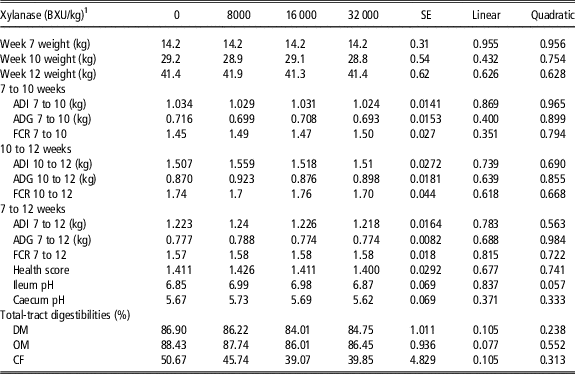
At the start of the experiment there was no difference in live weight between any of the dietary treatments. Performance data are shown in Table 2. The addition of xylanase to the diet had no effect on performance over the 35 days. The addition of xylanase had no effect on DM, OM or CF total-tract digestibility.
Effects of increasing concentrations of xylanase on live weight, average daily gain, average daily intake, feed conversion ratio and pH of the ileum and caecum

ADFI=average daily feed intake; ADG=average daily gain; FCR=feed conversion ratio; DM=dry matter; OM=organic matter; CF=crude fibre.
1 BXU=xylanase units, n=32.
pH of the gastrointestinal tract and blood analysis
Supplementation of xylanase to the diet tended to have a quadratic effect on ileal pH with higher pH values recorded for pigs fed a diet supplemented with 8000 and 16 000 BXU/kg xylanase (P<0.10). pH levels returned to control levels when supplemented with 32 000 BXU/kg xylanase. Xylanase had no effect on caecal pH.
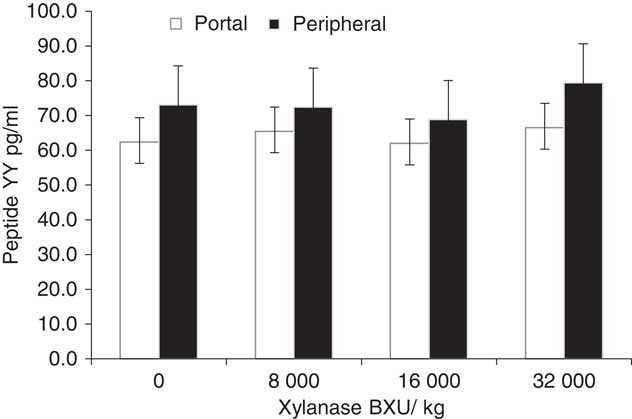
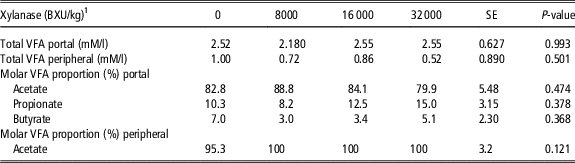
Xylanase had no effect on peptide YY levels in the portal (P=0.967) or the peripheral (P=0.846) blood (Figure 1). There was no significant difference in peptide YY concentrations between portal and peripheral blood (P=0.355). Total VFA concentration was higher in portal compared with peripheral blood (P<0.05; Table 3). In terms of the distribution of individual VFA in portal blood, acetate was present at the highest level (2.24±0.216 mM/l), followed by propionate (0.494±0.0891 mM/l) and then butyrate (0.175±0.0345 mM/l). In contrast to this, the composition of individual VFA in peripheral blood was predominately acetate. Xylanase had no effect on total VFA concentration.
Peptide YY concentrations in portal and peripheral plasma of grower pigs fed either 0, 8000, 16 000 or 32 000 BXU/kg xylanase at day 35 (n=16).

Volatile fatty acid (VFA) concentrations in portal and peripheral plasma of weaner-grower pigs fed four levels of xylanase (day 35)

1 BXU=xylanase units, n=16.
Discussion
Supplementing wheat–barley-based diets with xylanase had no effect on growth performance or nutrient digestibility of grower pigs over a 35-day trial period; however, pig performance across all treatments was good which may suggest that diet quality was sufficient or that there were no antinutritional effects from NSPs and thus there were no beneficial effects from adding xylanase. Yin et al. (Reference Yin, McEvoy, Schulze, Hennig, Souffrant and McCracken2000) found that xylanase addition (5000 U/kg) to grower pigs fed wheat based or wheat byproduct-based diets improved nutrient digestibility. However, they observed the greatest improvement in digestibility in pigs fed diets containing wheat plus bran which had a higher fibre and NSP content compared with wheat alone. Nortey et al. (Reference Nortey, Patience, Simmins, Trottier and Zijlstra2007) also found that the addition of xylanase (4375 U/kg) to grower pigs improved nutrient digestibility; however, pigs were fed diets containing wheat millrun which again had a higher concentration of NSP in comparison with wheat. Dry matter digestibility of the control pigs in the current study was 86%. In the study by Yin et al. (Reference Yin, McEvoy, Schulze, Hennig, Souffrant and McCracken2000), DM digestibility for pigs fed the wheat-based diet was 89% whereas DM digestibility for pigs fed the wheat plus bran diet was 75.8%. Nortey et al. (Reference Nortey, Patience, Simmins, Trottier and Zijlstra2007) found that millrun inclusion reduced total-tract DM digestibility in pigs from 86.7% (wheat control diet) to 74.2% (millrun diet). The addition of xylanase improved DM digestibility in the millrun diets (80.1%) but digestibility remained lower than that of the wheat control diet. Studies have shown an inverse relationship between control performance and exogenous enzyme response and thus the better the performance of the control animals, the poorer the response to exogenous enzymes (Rosen, Reference Rosen2006 and Reference Rosen2010). The age of the pig may also influence the pigs’ response to xylanase. Olukosi et al. (Reference Olukosi, Sands and Adeola2007) found that NSP-degrading enzymes increased nutrient digestibility when fed to weaner pigs; however, NSP-degrading enzymes did not affect nutrient digestibility when fed to grower pigs. They suggested that this was due to an increase in the gut microbial population of grower pigs resulting in microbes capable of breaking down NSP.
In the current study xylanase tended to increase ileal pH values for pigs fed a diet supplemented with 8000 and 16 000 BXU/kg xylanase. The higher ileal pH levels observed at 8000 and 16 000 xylanase BXU/kg are difficult to explain. In contrast Sheng et al. (Reference Sheng, Yang, Zhao, Wang and Wang2013) found that xylanase increased microflora proliferation and fermentation when fed to broiler chicks resulting in a reduction in ileal digesta pH. An increase in caecal fermentation has been shown to stimulate the release of peptide YY from enterocyte cells (Keenan et al., Reference Keenan, Martin, Raggio, McCutcheon, Brown, Birkett, Newman, Skaf, Hegsted, Tulley, Blair and Zhou2012). As peptide YY slows both gastric emptying and transit time it has been proposed that the release of peptide YY increases gastric digestion of nutrients. Masey O’Neill et al. (Reference Masey O’Neill, Singh and Cowieson2014a) investigated the effects of xylanase supplementation (16 000 and 32 000 BXU/kg) to wheat and corn-based broiler diets on broiler performance, nutrient digestibility and caecal VFA content. They found that xylanase supplementation improved FCR irrespective of cereal or enzyme dose and improved nutrient digestibility. They also found that caecal VFA content was higher when broiler diets were supplemented with xylanase. Yin et al. (Reference Yin, McEvoy, Schulze, Hennig, Souffrant and McCracken2000) found a numerical increase in apparent ileal VFA production with the addition of xylanase to grower pig diets, increasing VFA production by 38% when added to wheat plus bran-based diets which had a high fibre and NSP content. This is in contrast to the current study where the addition of xylanase to wheat-based diets did not affect VFA concentrations in plasma. Volatile fatty acids were measured in portal blood in order to obtain information on the end products of fermentation in the gastrointestinal tract. The fact that xylanase had no effect on VFA concentrations suggests that the fermentation of fibre was already optimised in the control diet and therefore the addition of xylanase could not enhance this process. Alternatively it may be that the cereals in this experiment were resistant to xylanase attack. The higher levels of VFAs observed in the portal blood compared with peripheral blood was expected as the portal blood reflects the production of VFAs in the gastrointestinal tract and not consumed by colonocytes before uptake by the liver and peripheral tissues (Hooda et al., Reference Hooda, Matte, Vasanthan and Zijlstra2010; den Besten et al., Reference den Besten, van Eunen, Groen, Venema, Reijngoud and Bakker2013).
The current study also found no effect of xylanase on plasma peptide YY levels which is not surprising as VFA concentrations were not affected. Singh et al. (Reference Singh, O’Neill, Ghosh, Bedford and Haldar2012) observed an increase in serum levels of peptide YY when broilers were fed a maize soya bean meal-based diet under ad libitum conditions when diets were supplemented with xylanase (16 000 µ/kg Econase XT). However in the same experiment xylanase addition reduced total caecal VFA concentration. The increase in peptide YY was more pronounced for the broilers fed an energy deficient diet, thus the production of peptide YY may have been the result of the energy limiting diets in order to increase nutrient digestion.
In conclusion, the addition of xylanase had no effect on grower pig performance, nutrient digestibility, VFA concentration or peptide YY concentration when fed up to 32 000 BXU/kg over a 35-day period. The lack of response in the current study may suggest that NSP levels were low and diet quality was sufficient and as a result the addition of xylanase had no beneficial effects.
Acknowledgements
None.
Declaration of interest
There are no conflict of interests.
Ethics statement
This experiment received ethical approval from the University of Leeds Animal Welfare and Ethical Review Committee.
Software and data repository resources
Data is not deposited in an official repository.