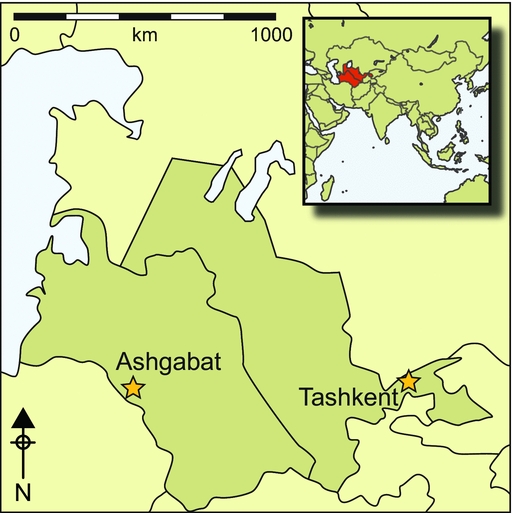
Introduction
Since the 1950s, many Iron Age settlements have been excavated in southern Central Asia. It is, however, only recently that debate has emerged concerning their subsistence economies. The consensus prior to this has been that Iron Age people lived in sedentary communities with economies based on agriculture and herding, as opposed to the nomadic and semi-nomadic populations of northern Central Asia. This assumption was based on discoveries of irrigation canals, grain silos and the remains of domestic herbivores; no critical analysis of this evidence was proposed within a broader framework that integrated socio-economic context with environmental potential.
Recent archaeological analysis of the material culture of southern Central Asia, however, reveals significant geographic variations (Lhuillier Reference Lhuillier2013, in press). The aim of this paper is to examine whether these variations were mirrored in the associated subsistence economies. The focus is on their correlation with settlement type and material culture, keeping in mind the environmental constraints present in this region. An important variable lies at the heart of this discussion: cultural choice vs the availability of resources, and, more particularly, what was accessible in the immediate environment. Additionally, we will examine:
-
• Evidence for development throughout the Iron Age to determine interaction and influence between the subsistence economies and changes in the material culture and political upheaval.
-
• Evidence for development since the end of the Bronze Age.
In Central Asia, the transition from the Bronze Age to the Iron Age towards the middle of the second millennium BC is characterised by major shifts in material culture and ideology. Several lines of evidence, however, indicate partial continuity in environmental exploitation and in the use of extant irrigation networks (Francfort & Lecomte Reference Francfort and Lecomte2002). Examples include the continued occupation of oases or settlements (e.g. Marushchenko Reference Marushchenko1959; Cattani Reference Cattani, Kosarev, Kozhin and Dubova2004; Sverchkov & Boroffka Reference Sverchkov and Boroffka2006; Vinogradova et al. Reference Vinogradova, Ranov and Filomonova2008; Bendezu-Sarmiento & Lhuillier Reference Bendezu-Sarmiento, Lhuillier and Mamedov2011; Lhuillier et al. Reference Lhuillier, Bendezu-Sarmiento, Lecomte, Rapin and Bendezu-Sarmiento2013). While no regional change in environmental and climatic conditions has yet been recorded, the lack of comparative faunal assemblage studies precludes reliable conclusions concerning the economic structure of contemporaneous Central Asian societies.
This article will consider new archaeozoological data from two Turkmen sites, and will re-examine published data from Iron Age sites in Uzbekistan and Turkmenistan, in order to provide new insights on animal exploitation in this region.
Extant data and their limitations
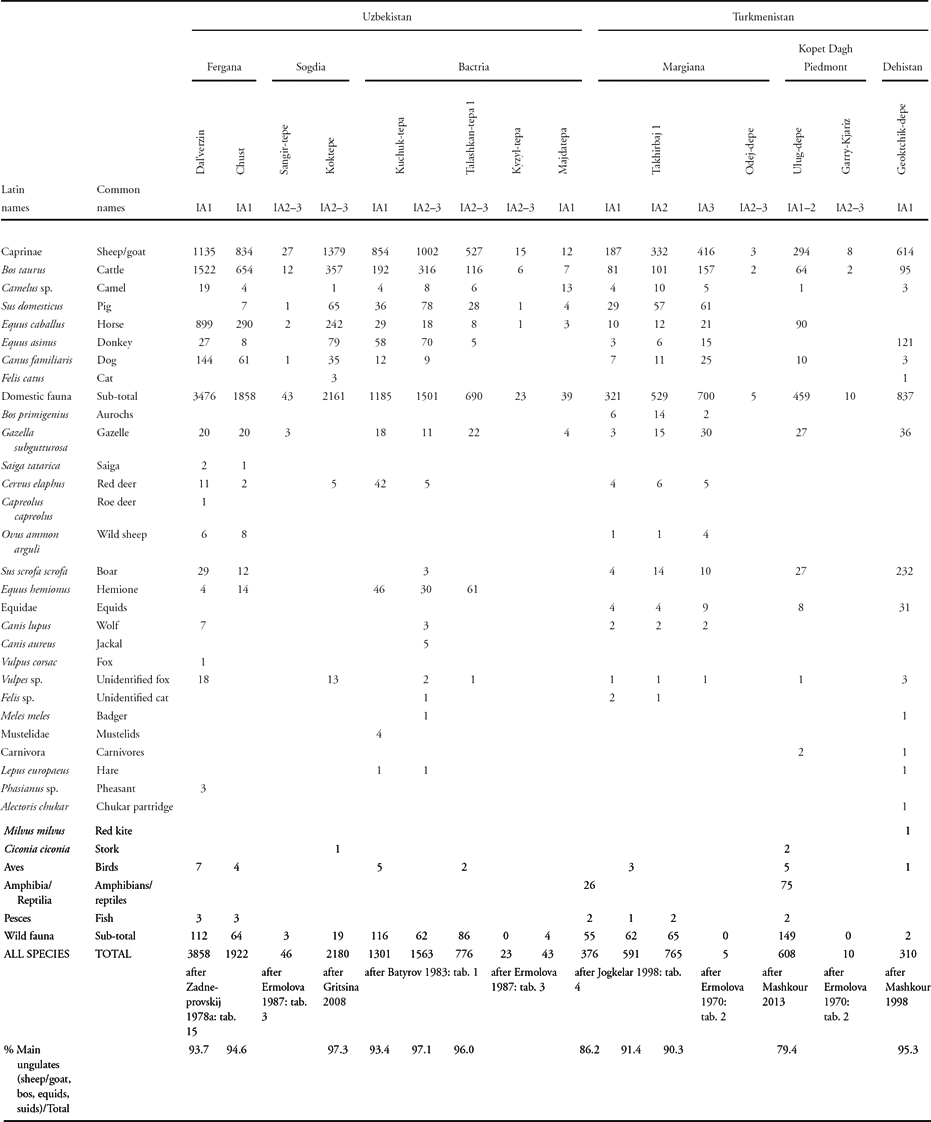
Reassessment of extant data from pioneering Soviet-led research in the 1960s–1980s is essential, as they provide broad geographic and chronological overviews of southern Central Asia, particularly in terms of subsistence economy variability. Table 1 summarises the available Iron Age faunal spectra for this region. Although the quantity of regional studies is insufficient, they are valuable in providing general information on subsistence economies, even if methodological issues remain poorly developed. This discrepancy particularly affects the distinction between wild and domestic herbivores (such as equids and suids). This present study is, therefore, limited by these issues. Subsequently, the faunal spectra often refer to large taxonomic groups. Previous research also lacks information concerning taphonomy, demography and anthropogenic evidence—all useful indicators of animal husbandry practices. Finally, it is impossible to correlate these data with any existing archaeobotanical studies (see Tengberg Reference Tengberg and Bendezu-Sarmiento2013 for a synthesis). The situation is, however, changing thanks to recent or yet unpublished research, such as at Kyzyl-tepa (Wu et al. Reference Wu, Miller and Crabtree2015) and Majdatepa in Uzbekistan, and Topak Kala depe in Turkmenistan (N. Boroffka and M. Wagner pers. comm.).
Faunal spectra of the Iron Ages sites of southern Central Asia.

Although these issues limit a fully integrated approach to studying agropastoralism, faunal remains analysis can help to correlate information on ancient material culture with diverse economic systems and communal lifeways.
Chronology and cultural context
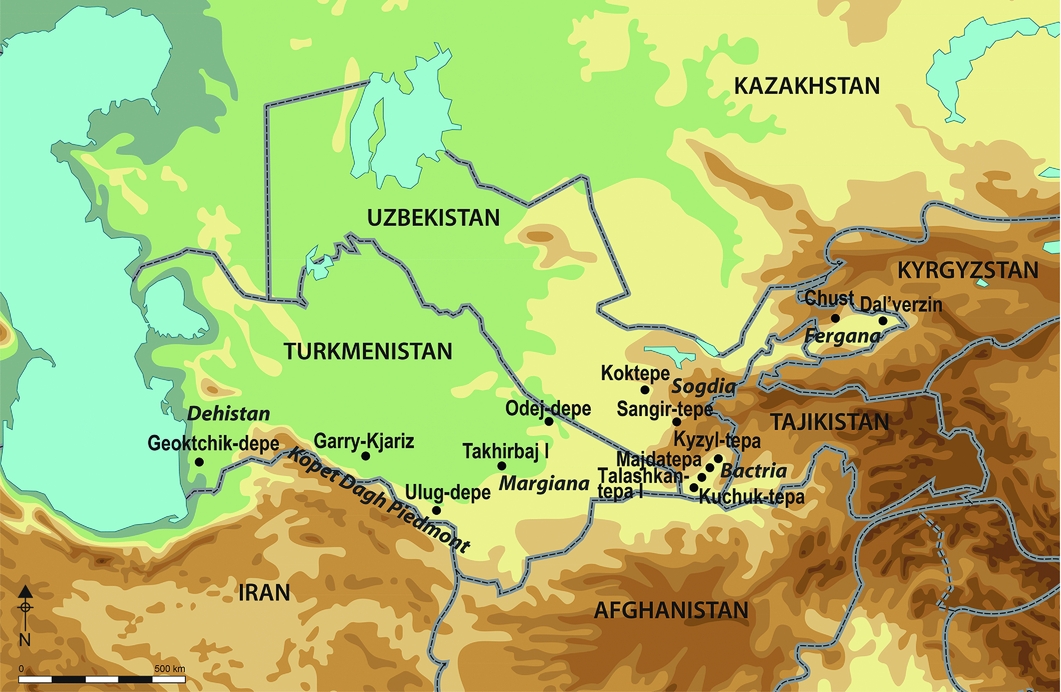
In southern Central Asia (Figure 1), the Early Iron Age (Iron Age 1, c. 1500–1400 BC; Figure 2) is characterised by a patchwork of regionally and locally varied cultures known as ‘Handmade Painted Ware’ cultures (or Yaz I), which spread throughout Uzbekistan, Turkmenistan, south-eastern Tajikistan, eastern Kyrgyzstan, northern Afghanistan and north-eastern Iran (Lhuillier Reference Lhuillier2013). Following the highly developed Bronze Age Oxus civilisation (Luneau Reference Luneau2014), these are characterised by disrupted contact with neighbouring cultures, and by a shift in material culture and funerary practices (e.g. the disappearance of iconography, the use of merely utilitarian objects and replacement of burial by excarnation).
Distribution and location of Iron Age sites with archaeozoological material in southern Central Asia.

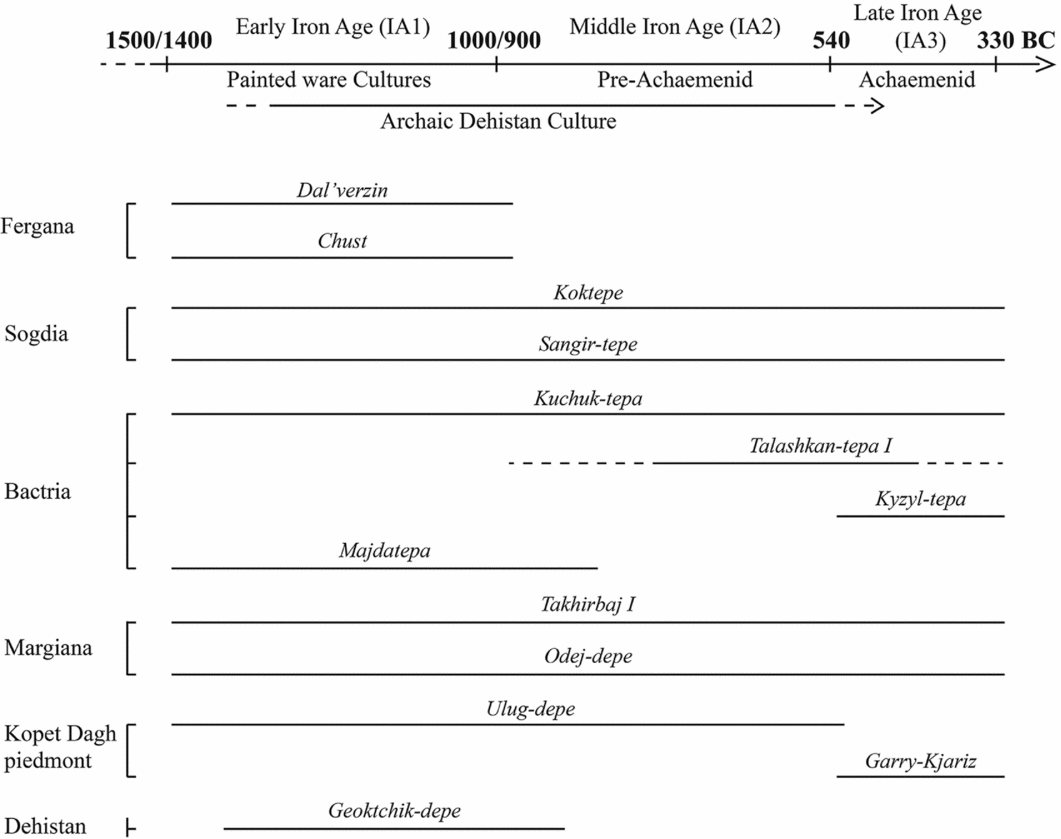
Chronology of the Iron Age sites included in this study.

In parallel, around the thirteenth century BC and until the sixth/fifth centuries BC, the ‘Archaic Dehistan’ culture was established in western Turkmenistan (Lecomte Reference Lecomte2005). Settlements developed around a complex network of canals, essential in that arid region. Material assemblages differ from those of Yaz I cultures; graves are also absent.
The Middle Iron Age (Iron Age 2, pre-Achaemenid or Yaz II) occupied the period between the end of the early Iron Age (c. 1000 BC) and the conquest of Central Asia by the Achaemenids. This was a flourishing period, characterised by the development of large settlements. While regional funerary practices remained identical, a new pottery type, which became standardised throughout southern Central Asia, was developed.
After 560 BC, southern Central Asia became part of the Achaemenid Empire—a period known as the Late Iron Age (Iron Age 3, Achaemenid period or Yaz III). Persian and Greek sources report that Central Asian territories were divided into satrapies (provinces), as in other parts of the empire under Achaemenid rule. Settlements and their associated material culture show continuity, which makes it very difficult to distinguish this period from the previous one.
Environmental settings
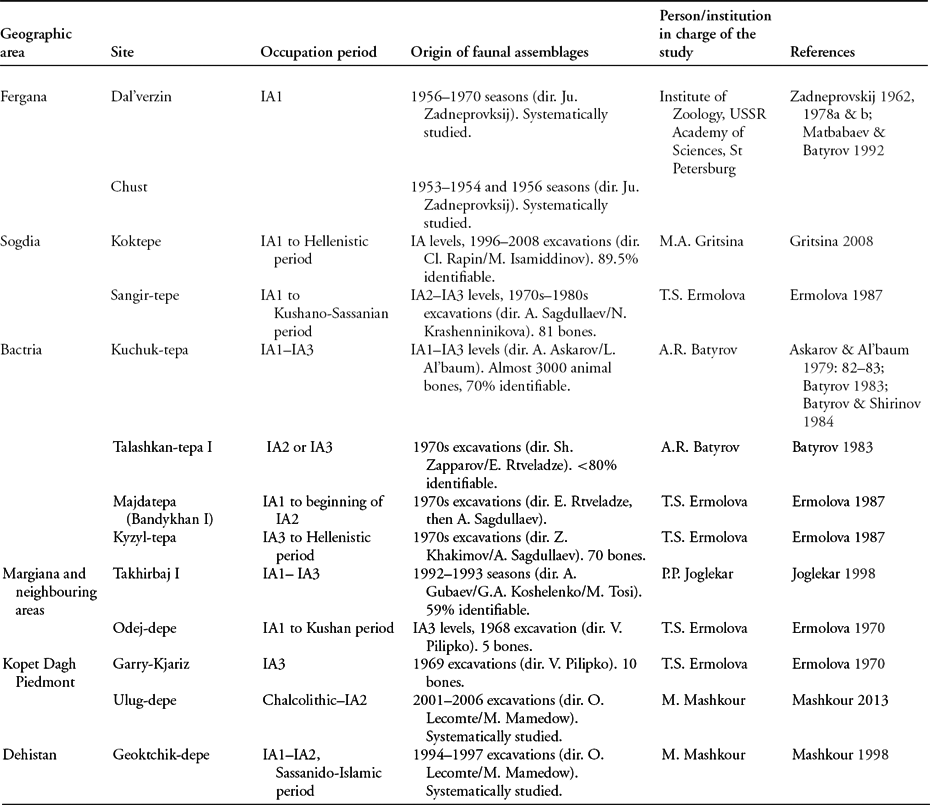
For a micro-regional analysis of these disparate data, we grouped the sites into six main geographic components (Figure 1 & Table 2): Fergana Valley, Sogdia and Bactria in Uzbekistan; Margiana, Kopet Dagh Piedmont and Dehistan in Turkmenistan (Early to Late Iron Age; Figure 2).
List of the sites under study.

Fergana Valley
Located in eastern Uzbekistan and Tajikistan and western Kyrgyzstan, the Fergana Valley is bordered by the high, mountainous foothills of the Tien Shan. The valley is well irrigated by the Syr-darya and its tributaries, along which the sites are grouped into oases. During Iron Age 1, the valley was occupied by the Chust culture (Zadneprovskij Reference Zadneprovskij1962), represented here by two Uzbek sites, Chust and Dal'verzin.
Sogdia
Northern Sogdia is located in the Zeravshan River basin, from the mountainous area in northern Tajikistan to the Bukhara oasis and the Kyzyl-Kum Desert. During the Iron Age, represented here by the site at Koktepe, sites were mainly grouped around the modern Uzbek town of Samarkand. The area around Sharh-i Sabz in Uzbekistan corresponds to southern Sogdia. Separated from Bactria by the Bajsun Tau Mountains, it is represented here by the Sangir-tepe site, and was culturally linked to northern Sogdia during the Iron Age. The Zeravshan and Kashka-darya Rivers, and small mountain rivers, created a fertile environment of alluvial plains.
Bactria
Bactria corresponds to the basin of the Amu-darya and its tributaries, covering modern southern Uzbekistan and Tajikistan and northern Afghanistan, where it is bordered by the Hindu-Kush Mountains. Northern Bactrian faunal remains studied here come from four southern Uzbek sites: Kuchuk-tepa, Talashkan-tepa I, Majdatepa and Kyzyl-tepa. Northern Bactria corresponds to the area between the Hissar, Bajsun-Tau and Babatag Mountains to the north, west and east, and the Amu-darya to the south.
Margiana and neighbouring areas
Margiana corresponds to the endoreic delta of the Murghab River, at the eastern fringe of the Kara Kum Desert and to the north of the Kopet Dagh Mountains. In this continental desert area, seasonal floods of the Murghab propagated abundant vegetation. The location of ancient settlements was thus determined by the movements of the delta fan (Salvatori Reference Salvatori, Salvatori and Tosi2008). One site, Takhirbaj I, is located in Margiana itself, while the second site, Odej-depe, is located on the left Amu-darya bank, close to the modern city of Turkmenabad.
Kopet Dagh Piedmont
The eastern Kopet Dagh Piedmont in Turkmenistan is culturally linked to the Margiana yet is geographically distinct. Thanks to numerous small mountain rivers, it is a well-watered area with semi-steppe vegetation. Settlements such as Garry-Kjariz and Ulug-depe are located on their alluvial fans.
Dehistan
Farther west, Geoktchik-depe belongs to the ‘Archaic Dehistan culture’. It is located 80km to the east of the Caspian Sea on the Misrian Plain, a semi-arid alluvial plain in the south of the Kara-Kum Desert. Settlement here was impossible without irrigation, despite the presence of the Atrek River.
Animal exploitation and regional diversity
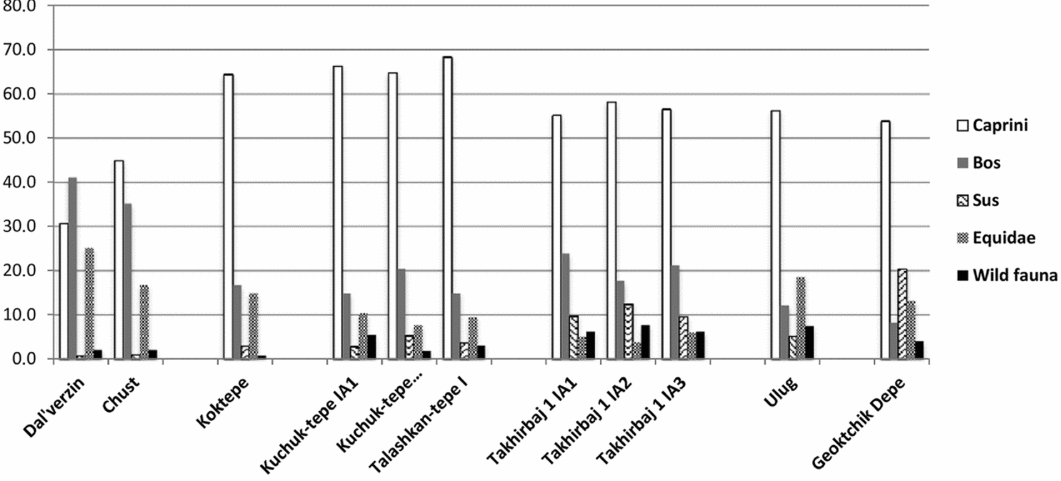
The Iron Age faunal spectra indicate that the bulk of the remains (almost 90 per cent of the total bone assemblage) represent small and large ungulates, sheep/goat, cattle, equids and suids (Figure 3). Wild species are also important contributors at some sites.
Distribution of main ungulates and wild species in the Iron Ages sites of southern Central Asia.

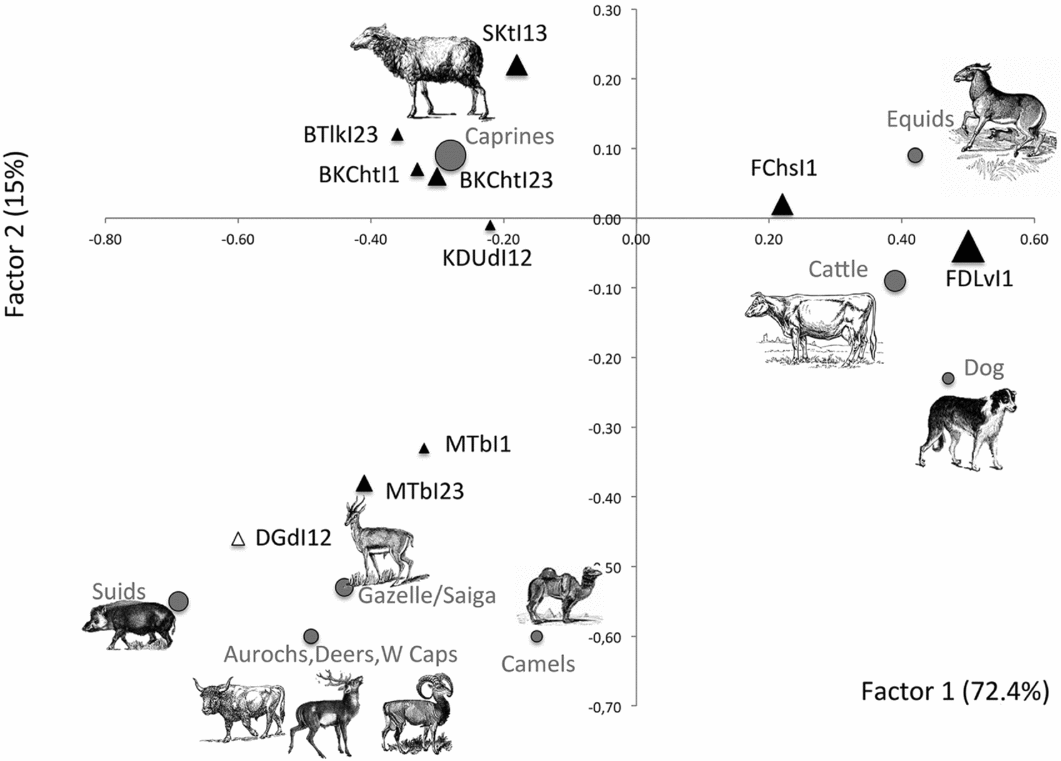
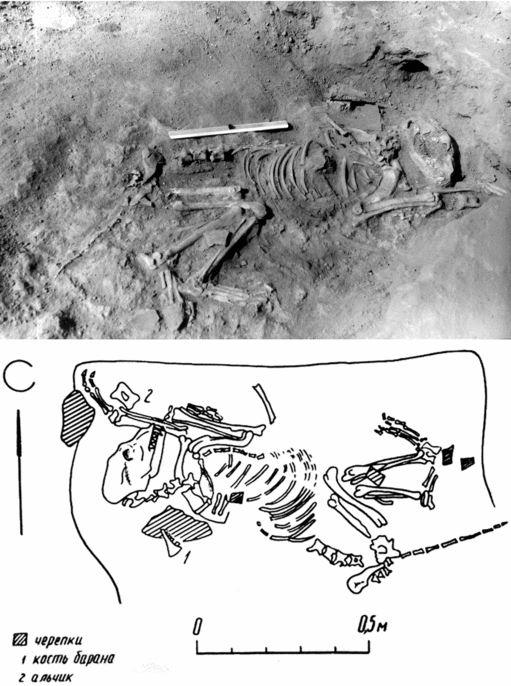
The general taxonomic frequency and diversity presented in Table 1 suggests that, although sheep/goat and cattle herding predominated, hunting was an activity of obvious importance. Wild animals, when present, reflect various ecological settings around the sites. Gazelles/saigas, hemiones and some birds, such as the chukar partridge, were hunted in steppe and arid areas. Red and roe deer, boar, weasels and pheasants were found in more sheltered areas, and wild sheep in piedmont regions. Finally, most wild canids and hares are ubiquitous species and were present in numerous habitats. Hunting wild animals such as carnivores may represent needs beyond subsistence (e.g. the exploitation of fur). The presence of red deer antler provides a further possible example of non-subsistence hunting, as no other skeletal elements are reported. Antlers were recorded at Kuchuk-tepa (Askarov & Al'baum Reference Askarov and Al'baum1979: fig. 26), Chust (Matbabaev & Batyrov Reference Matbabaev and Batyrov1992: 18–19) and Dzharkutan (Mashkour pers. comm.), where they were used in tool manufacture. It is often possible to identify them as shed antlers, which were collected and then possibly exchanged through a trade network. Although fish remains are present in sites near rivers or the sea, this does not seem to be a major food source. Poor recovery techniques—in particular the absence of sieving—should, however, be considered as a potential bias in the faunal spectra (cf. Payne Reference Payne and Higgs1972), in the case of old excavations. An attempt for synthesising these tendencies was tested with a correspondence analysis based upon taxonomic frequencies for each site. Poor recovery techniques disproportionately affect the frequency of small animal elements. The authors decided, therefore, to use only ungulate bones, which suffer less from loss at the recovery stage (see Figure 4 & online supplementary material, although Geoktchik-depe was included in the illustrative category due to the inclusion of three complete suid skeletons; Mashkour Reference Mashkour, Buitenhuis, Bartosiewicz and Choyke1998: tab. 1). The first two axes of the analysis contribute to 87 per cent of the total variability, and the projection of the point cloud is well structured. Three well-distinguished groups are visible and seem to match the geographic distribution of the sites: the Fergana sites cluster together, as do the Bactrian and Sogdian sites, and finally the Margian and Dehistan sites. The Fergana cluster is defined mostly by high proportions of cattle, equids and dog. It is notable that two horse burials were recovered from Dal'verzin, one of which was associated with human and sheep/goat skulls. A dog burial was also excavated here (Zadneprovskij 1978a: 84, 88) (Figure 5). The Bactrian and Sogdian sites are characterised by a more caprine-oriented economy, while cattle and equids contribute the remaining components. The Kopet Dagh Piedmont, represented by Ulug-depe, has an intermediate position, with equids being more important than cattle. The Margian sites are also caprine-oriented but show a more diversified economy, with a greater contribution of wild ungulates. Here, suids seem to be a more important subsistence component. Dehistan is represented only by one site, Geoktchik-depe. Due to the high contribution of suids, it lies opposite the Fergana sites in the correspondence analysis, with similar characteristics to Margian sites.
Correspondence analysis characterising southern Central Asian Iron Age faunal assemblages. FDlvI1: Dal'verzin; FChsI1: Chust; SKtI13: Koktepe; BKChtI1: Kuchuk-tepa; BKChtI23: Kuchuk-tepa; BTlkI23: Talashkan-tepa I; MTbI1: Takhirbaj; MTbI23: Takhirbaj I; KDUdI12: Ulug-depe; DGdI12: Geoktchik-depe; F: Fergana; S: Sogdia; B: Bactria; M: Margiana; D: Dehistan; I: Iron Age, numbers 1, 2 and 3 for the Iron Age periods.

Dog burial from Dal'verzin (Zadneprovskij 1976).

Iron Age economies
One aim of this research was to observe variation in southern Central Asian Iron Age settlement patterns, and their possible relationship to subsistence economy type. Regional variation can be observed among contemporaneous material cultures during the Iron Age 1 (Lhuillier Reference Lhuillier2013) as is seen during the Iron Ages 2–3 (Lhuillier in press). Although the general consensus on the agropastoral character of these cultures is not questioned here, the authors suggest that this assumption should be nuanced on a case-by-case basis, according to a more or less important component of agriculture or pastoralism.
In the study region, stone and metal tools related to the agricultural practice, such as sickles, grindstones, mortars and pestles, were found. The economic influence of farming cannot be assessed, due to a lack of archaeobotanical research. Cereals are often mentioned in the literature, but are seldom precisely determined. Identified cereals include cultivated wheat (Triticum), barley (Hordeum vulgare) and millet (Panicum).
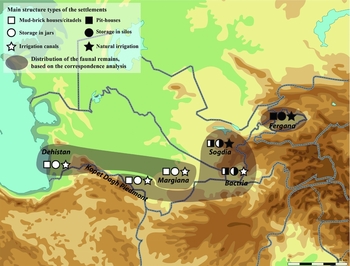
When this information is considered alongside faunal and material evidence, some regional variability appears. Pit-houses and storage silos found at some sites, such as Chust and Dal'verzin in Fergana and Koktepe in Sogdia (Figure 6), could be associated with a semi-nomadic way of life. This interpretation would suppose seasonal mobility, with cultivation of crops during periods of settlement, the latter of which was possible due to natural irrigation of the agricultural lands. Conversely, the construction of mud-brick houses and citadels, and the presence of storage jars observed in Bactria, Margiana, the Kopet Dagh Piedmont and Dehistan may suggest more sedentary populations. Here, the presence of canal networks and irrigation systems supports a focus on agriculture-based economies.
Schematic distribution of the main types of settlements, and schematic correlation with the distribution of the faunal remains during the Early Iron Age.

To determine if there is a correlation between the archaeozoological data and a local cultural and/or political evolution, both should be considered in a broader chronological framework. The territory occupied by the Yaz I cultures during the Iron Age 1 extends to some areas of the steppe's fringes that were previously occupied by Andronovo-related cultures, usually with small settlements (around 1–2ha), in a process that may evidence extensive exploitation of the environment by dispersed small groups of people. During the Iron Age 2, the settled area contracted in its northern part, its core becoming more similar to the Oxus civilisation. Contemporaneous urban sites (e.g. Ulug-depe) emerged, with clear evidence of centralised storage management. Apart from at a few sites, settlement patterns remained the same during the Iron Age 3, with no apparent effect of the Achaemenid conquest. It seems, however, that these cultural changes were not paralleled in the subsistence economies. In the four sites where faunal remains were analysed for Iron Age 1 and Iron Ages 2–3 (Kuchuk-tepa, Takhirbaj I, Ulug-depe and Geoktchik-depe), no evolution in subsistence strategy can be identified (Table 1). The limited faunal data suggest that Iron Age economies were not affected by material and/or political transformations, such as the Achaemenid conquest.
Discussion
Subsistence economies and food procurement are influenced by two main factors: the availability of natural resources and the socio-economic settings with their cultural biases.
The study region, located in modern Turkmenistan and Uzbekistan, is a semi-arid area, although regional variations exist due to multiple factors, such as topography and the vicinity of aquatic resources, deserts and vegetated areas. Modern environmental data for this region, supplied by the Global Network of Isotopes in Precipitation, indicate that the study region receives less than 60mm of summer precipitation—ranking among the lowest in northern Asia. Pastoralism, including a mobile element, is the best-adapted socio-economic system for these conditions. A recent study of a broad northern Eurasian region demonstrates how environment determines pastoral economies (Bendrey Reference Bendrey2011). In our study, the authors focus on a more restricted and homogeneous geographic, cultural and chronological entity to examine whether any structural relationships exist between settlement type and animal exploitation.
A reliable source of environmental evidence is the presence of wild animals (Table 1) and a consideration of the ecological niches in which they belong. This provides an indication of the ecological variation around many of the settlements, especially those with larger faunal assemblages. As for domesticates, the intensive reliance on sheep and goats at most sites indicates herding management preoccupied with the year-round need for pasture. The available archaeobotanical data indicates the presence of irrigated agriculture from the Chalcolithic onwards, in the Kopet Dagh Piedmont, in Margiana and in northern Bactria (e.g. Miller Reference Miller1999). There is further evidence for irrigated agriculture at Sarazm in Tadjik Sogdia during the third millennium BC—an area that received greater than average rainfall (Spengler & Willcox Reference Spengler and Willcox2013). In the study region, all settlements had crop-storage technology and evidence of cereal culture and/or consumption. This confirms arable agriculture as part of their economic activity. Prehistoric Central Asian steppe populations have often been labelled as mobile pastoralists, but ethnographic studies and, increasingly, archaeological data show that these categorisations are no longer reliable (Salzman 2004; Frachetti 2008; Spengler & Willcox Reference Spengler and Willcox2013; Spengler et al. Reference Spengler, Frachetti and Fritz2013). All of the various sources of information now highlight the importance of pastoral economies drawing on diverse resources. This ability, and economic flexibility, in an undoubtedly constraining environment, has favoured subsistence economies ranging from sedentism to nomadism (and a wide range of intermediate options), allowing mobility between various ecotones to optimise both land use and settlement. It is also important to consider the physiology of herded animals. Sheep and goats can easily adapt to hot, dry environments, whereas cattle, the second most important animal in the faunal spectra of southern Central Asia, are more sensitive to drought conditions (Temple Reference Temple and Nestel1984), and are thus considered a proxy for sedentism. Both sheep/goat and cattle may, however, be part of a pattern of mobility.
Ethnographic evidence from various parts of Eurasia and Africa provides a reliable corpus of knowledge concerning diverse animal-management strategies in constrained environments. Cattle mobility in Africa is, for instance, a response to drought and a lack of pasture land (Buntt Reference Buntt2007). There is geochemical evidence for the seasonal movement of cattle in prehistoric Europe (Bentley & Knipper Reference Bentley and Knipper2005) and on the Arabian Peninsula (McCorriston et al. Reference McCorriston, Harrower, Martin and Oches2012; Henton et al. Reference Henton, McCorriston, Martin and Oches2013). This evidence undermines previous theories concerning the systematic relationship between sedentism, cattle breeding and in extenso agricultural activities (Kohl Reference Kohl2007). Pigs are another species that are used as an indicator of sedentism, as animals can move only short distances. Suids are present in almost all of the sites of the study region, yet distinction between wild and domestic forms remains a problem (e.g. Evin et al. Reference Evin, Cucchi, Cardini, Strand Vidarsdottir, Larson and Dobney2013 and references therein). Although analysis of the extant literature cannot solve this question, wild and domestic types can be attributed for two sites (Ulug-depe and Geoktchik-depe) in the present study. Finally, equids should be examined, as they represent one of the main contributors to the faunal assemblages examined here. Often associated with nomadic cultures (Anthony Reference Anthony1986), horses had been domesticated for over a millennium. They played an important role in the Bronze Age societies of Central Asia. Besides their symbolic role in the funerary context (Dubova Reference Dubova2008), horses were used for food and labour (Outram et al. Reference Outram, Stear, Bendrey, Olsen, Kasparov, Zaibert, Thorpe and Evershed2009). As with the suids, the problem of taxonomic distinction is a major limitation when relying on extant literature. In Geoktchik-depe, the identified equids were horses and donkeys; in Ulug-depe there were hemiones, horses and probably donkeys. Regardless, the presence of equids does not provide sufficient support for or against mobile pastoral nomadism—as was debated by Frachetti and Benecke (Reference Frachetti and Benecke2009).
The challenge remains, however, to determine an end point for oasis-area southern Central Asian sheep/goat and cattle pastoralism as an expression of herding or cultivation practices. This question needs to be addressed through the integration of archaeobotanic research and statistically consistent faunal assemblage analysis.
Conclusion
Review of the limited extant literature and recent faunal studies from Iron Age sites in Turkmenistan and Uzbekistan indicates that animal exploitation was based on sheep/goat and cattle herding, as well as equids and suids, and some wild animals. It remains difficult to interpret these archaeozoological remains in terms of mobility, even though some elements suggest that the degree and nature of said mobility probably varied in the different regions studied here. In particular, limited precipitation and the grazing needs of animals inevitably led to increased herd mobility. Evidence for the exploitation of various ecotones, which may have acted as buffer zones, may be suggestive of complex articulation between agro-pastoralism and territorial management. The limited data gathered here and the lack of contemporaneous archaeobotanical data preclude a full understanding of these multi-resource-based economies. The evidence does, however, suggest the necessity for reconsidering the socio-economic structure of the Iron Age societies.
Observed regional specificities could be linked to local cultural choices, and/or to local environment exploitation only. Indeed, our study found no evidence that material and cultural change (notably at the end of the Bronze Age or of the Iron Age 1 period), or that political upheavals (notably the Achaemenid conquest at the beginning of the Iron Age 3) found any reflection in subsistence economies. Currently, no decline or collapse of agropastoral systems can be seen across the different regions considered in this study. Similarly, the regional variants among subsistence economies (as far as it can be observed from the faunal remains), do not exactly overlap with the regional variants based on the material culture (Figures 4 & 6). During protohistory, Margiana was culturally closely linked to Bactria, and Sogdia to the Fergana Valley; the subsistence economies seem, however, to have evolved independently in these areas, and animal exploitation is more deeply linked to the regional variants observed in the settlement pattern. This is demonstrated in Figure 6, and possibly reflects a local adaptation to the environment. These facts evidence the high stability of subsistence economies among the protohistoric populations of southern Central Asia, thereby increasing our chronological knowledge of these societies by highlighting a longue durée socio-economic pattern that seems to have resisted material and political transformations. Future research using our approach will complement this knowledge.
Acknowledgements
We express our deep gratitude to the directors of the expeditions, whose material was studied here: Olivier Lecomte (CNRS), Julio Bendezu-Sarmiento (CNRS, DAFA) and Mohammed Mamedow (Memorials Protection and Restoration Department of the Ministry of Culture of Turkmenistan). We also would like to thank the two anonymous reviewers, whose comments greatly helped to improve this article.
Supplementary material
To view supplementary material for this article, please visit http://doi.org/10.15184/aqy.2017.62