Introduction
Nematode members of the genus Tylenchorhynchus Cobb, 1913, known under the common name ‘stunt nematodes’, are one of the largest groups of plant-parasitic nematodes, which are migratory ectoparasites of the roots of many plants, including various agricultural crops and native plants (Siddiqi, Reference Siddiqi2000; Handoo et al., Reference Handoo, Palomares-Rius, Cantalapiedra-Navarrete, Liébanas, Subbotin and Castillo2014). Bitylenchus Filipjev, 1934 was proposed as a subgenus of the genus Tylenchus Bastian, 1865 by Filipjev (Reference Filipjev1934), with Tylenchus (Bitylenchus) dubius (Bütschli, 1873) Filipjev, 1934 as its type species; however, it was synonymized with Tylenchorhynchus by Filipjev (Reference Filipjev1936). Some nematologists (Fortuner & Luc, Reference Fortuner and Luc1987; Handoo, Reference Handoo2000; Geraert, Reference Geraert2011) considered Bitylenchus as a synonym of Tylenchorhynchus, but others recognized both as valid genera (Gomez-Barcina et al., Reference Gomez-Barcina, Siddiqi and Castillo1992; Siddiqi, Reference Siddiqi2000; Andrássy, Reference Andrássy, Csuzdi and Mahunka2007; Handoo et al., Reference Handoo, Palomares-Rius, Cantalapiedra-Navarrete, Liébanas, Subbotin and Castillo2014; Ghaderi et al., Reference Ghaderi, Karegar, Niknam and Subbotin2014). The genus Bitylenchus was differentiated from Tylenchorhynchus in having areolated outer bands of lateral fields, a large post-anal intestinal sac containing intestinal granules and fasciculi, relatively more thickened cuticle at the female tail tip and gubernaculum lacking a crest (Gomez-Barcina et al., Reference Gomez-Barcina, Siddiqi and Castillo1992). The genus Sauertylenchus Sher, 1974 is also similar to Bitylenchus, except for the difference in the structure of the lip region, which has an offset labial disc and the first labial annulus divided into six sectors and a relatively longer stylet (Sher, Reference Sher1974; Siddiqi, Reference Siddiqi1986, Reference Siddiqi2000; Gomez-Barcina et al., Reference Gomez-Barcina, Siddiqi and Castillo1992).
Siddiqi (Reference Siddiqi2000) listed 105 valid species under Tylenchorhynchus, 29 valid species under Bitylenchus and a further five species under Sauertylenchus. Geraert (Reference Geraert2011) considered 133 species under Tylenchorhynchus (the genus Bitylenchus was considered as its synonym) and only one species under the genus Sauertylenchus (Sauertylenchus labiodiscus Sher, 1974). Subsequently, Tylenchorhynchus bambusi Singh, Lal, Rathour & Ganguly, 2010; Bitylenchus hispaniensis Handoo, Palomares-Rius, Cantalapiedra-Navarrete, Liébanas, Subbotin & Castillo, 2014; Bitylenchus capsicumi Akhter & Zarina, 2014; Tylenchorhynchus mediterraneus Handoo, Palomares-Rius, Cantalapiedra-Navarrete, Liébanas, Subbotin & Castillo, 2014; and Tylenchorhynchus iranensis Azimi, Mahdikhani-Moghadam, Rouhani & Rajabi Memari, 2016 were described from India, Spain, Pakistan, Spain, and Iran, respectively. Sturhan (Reference Sturhan2014) transferred Paratrophurus striatus Castillo, Siddiqi & Gomez-Barcina, 1989 to the genus Tylenchorhynchus and named it Tylenchorhynchus casigo (Castillo, Siddiqi & Gomez-Barcina, 1989) Sturhan, 2014.
Recently, Handoo et al. (Reference Handoo, Palomares-Rius, Cantalapiedra-Navarrete, Liébanas, Subbotin and Castillo2014) studied relationships between the genera Bitylenchus and Tylenchorhynchus using integrative taxonomy. In this sense, the use of integrative taxonomy combined with the phylogenetic test of alternative hypotheses confirmed the separation of these two genera, rejecting Fortuner & Luc's (Reference Fortuner and Luc1987) conceptual view of Tylenchorhynchus as a large genus. Because of the few and difficult characters to study in this group of nematodes, the use of molecular markers for species identification in the genus is of high importance. The use of nuclear ribosomal RNA (rRNA) genes (D2–D3 expansion segments of the large ribosomal subunit (28S), internal transcribed spacer (ITS) and partial small ribosomal subunit (18S)) have been proven useful in the latest phylogenetic studies of this group of nematodes (Handoo et al., Reference Handoo, Palomares-Rius, Cantalapiedra-Navarrete, Liébanas, Subbotin and Castillo2014; Azizi et al., Reference Azizi, Eskandari, Karegar, Ghaderi, van den Elsen, Holterman and Helder2016; Gharakhani et al., Reference Gharakhani, Pourjam and Pedram2019; Hosseinvand et al., Reference Hosseinvand, Eskandari and Ghaderi2019a, Reference Hosseinvand, Eskandari and Ghaderi2020).
The taxonomic position of certain genera incorporated into the large genus Tylenchorhynchus, particularly Bitylenchus and Sauertylenchus, is still controversial, despite several phylogenetic and morphological studies. Sufficient morphological information is not available on several known species, which makes their identification a challenging task. So far, several identification keys have been given for species included in these genera, mostly under Tylenchorhynchus sensu lato (s.l.) (Allen, Reference Allen1955; Brzeski, Reference Brzeski1998; Brzeski & Dolinski, Reference Brzeski and Dolinski1998; Handoo, Reference Handoo2000; Geraert, Reference Geraert2011). In the present study, we provided a revised and new updated key for species included in the genera Bitylenchus, Sauertylenchus and Tylenchorhynchus. Moreover, we described a new species from Bitylenchus and provided additional morphological and molecular information on four other known species – namely, Bitylenchus parvus (Allen, 1955) Jairajpuri, 1982; Sauertylenchus maximus (Allen, 1955) Siddiqi, 2000; Tylenchorhynchus agri Ferris, 1963; and Tylenchorhynchus graciliformis Siddiqi & Siddiqui, 1983.
Materials and methods
Taxonomic review of Bitylenchus, Sauertylenchus and Tylenchorhynchus
The original and several relevant published descriptions of the species included in the genera Bitylenchus, Sauertylenchus and Tylenchorhynchus were studied in detail. Based on obtained information from these descriptions, as well as those given in the monograph by Geraert (Reference Geraert2011), we provided an updated and revised identification key for all known species in these genera. For practical reasons, we prefer to include all species in a single key due to close morphological affinity of the genera, and problems arise when assigning a correct taxon for a given population. Besides the characters implemented in the key by Geraert (Reference Geraert2011), we used new additional characters, such as the number of tail annuli, areolation of the lateral field and the shape of gubernaculum, for obtaining a better resolution to separate closely related species. The taxonomic position of the valid species and their synonyms are mainly based on Siddiqi (Reference Siddiqi2000).
Sampling and morphological identification
Soil samples were collected from the rhizosphere of different wild plants in Khuzestan and Zanjan provinces of Iran. Nematodes were extracted by the tray method (Whitehead & Hemming, Reference Upadhyay, Swarup and Sethi1965), then killed and fixed by hot FPG (4:1:1, formaldehyde:propionic acid:glycerol) and processed to anhydrous glycerol (De Grisse, Reference De Grisse1969). The nematodes were transferred to a drop of glycerol and a surrounding ring of paraffin wax on permanent slides, and studied using a light microscope, equipped with a Dino-eye microscope eye-piece camera in conjunction with its Dino Capture version 2.0 software (https://www.dinolite.us/dinocapture). Drawings were made through a drawing tube attached to a light microscope. Specimens were identified at species level using the available identification keys (Geraert, Reference Geraert2011).
Molecular characterization
For molecular analyses, and in order to avoid mistakes in case of mixed populations in the same sample, two specimens from each sample were temporarily mounted in a drop of 1 M sodium chloride containing glass beads (to avoid nematode crushing/damaging) to ensure confirming specimens with the unidentified populations. All necessary morphological and morphometric data (pictures and measurements) of the studies specimens in temporary slides were recorded using the aforementioned camera-equipped microscope. This was followed by DNA extraction from single individuals, as described by Subbotin et al. (Reference Sturhan2000). The D2–D3 region was amplified using the D2A (5′-ACAAGTACCGTGAGGGAAAGTTG-3′) and D3B (5′-TCGGAAGGAACCAGCTACTA-3′) primers (Nunn, Reference Nunn1992). Finally, the 18S rRNA was amplified using primers 988F (5′-CTCAAAGATTAAGCCATGC-3′), 1912R (5′-TTTACGGTCAGAACTAGGG-3′), 1813F (5′-CTGCGTGAGAGGTGAAAT-3′) and 2646R (5′-GCTACCTTGTTACGACTTTT-3′) (Holterman et al., Reference Holterman, van der Wurff, van den Elsen, van Megen, Bongers, Holovachov, Bakker and Helder2006).
All polymerase chain reaction (PCR) assays were carried out according to the conditions described by Archidona-Yuste et al. (Reference Archidona-Yuste, Navas-Cortés, Cantalapiedra-Navarrete, Palomares-Rius and Castillo2016). Then, the amplified PCR products were purified using ExoSAP-IT (Affimetrix, USB products (Cleveland, OH, USA)) and used for direct sequencing on a DNA multicapillary sequencer (Model 3130XL genetic analyser; Applied Biosystems, Foster City, CA, USA) using the BigDye Terminator Sequencing Kit V.3.1 (Applied Biosystems, Foster City, CA, USA), at the Stab Vida sequencing facilities (Caparica, Portugal). The newly obtained sequences were submitted to the GenBank database under the accession numbers indicated on the phylogenetic trees.
Phylogenetic analyses
The D2–D3 segments of 28S rRNA and 18S rRNA sequences of different genera of Telotylenchinae Siddiqi, 1960 were obtained from GenBank and used for phylogenetic reconstruction. Outgroup taxa for each dataset were chosen following previously published studies (Handoo et al., Reference Handoo, Palomares-Rius, Cantalapiedra-Navarrete, Liébanas, Subbotin and Castillo2014; Azizi et al., Reference Azizi, Eskandari, Karegar, Ghaderi, van den Elsen, Holterman and Helder2016; Hosseinvand et al., Reference Hosseinvand, Eskandari and Ghaderi2019a). The D2–D3 region alignment consisted of 54 sequences as ingroups and two sequences of Psilenchus hilarulus de Man, 1921 (KP313831) and Coslenchus paramaritus Hosseinvand, Eskandari & Ghaderi, 2019b (MK542004) as outgroups. The 18S rRNA alignment consisted of 30 sequences as ingroups and Geocenamus quadrifer (Andrássy, 1954) Brzeski, 1991 (AY993997) and P. hilarulus (KX798728) as outgroups. The newly obtained sequences were edited and aligned with other relevant sequences available in GenBank using the Muscle alignment tool implemented in MEGA7 program (Kumar et al., Reference Kumar, Stecher and Tamura2016). The ambiguously aligned parts and divergent regions were removed from the alignments using the online version of Gblocks 0.91b (Castresana, Reference Castresana2000; http://molevol.cmima.csic.es/castresana/Gblocks_server.html). The best-fit model of nucleotide substitution used for the phylogenetic analysis was statistically selected using jModelTest 2.1.10 (Darriba et al., Reference Darriba, Taboada, Doallo and Posada2012) with the Akaike Information Criterion (AIC). Phylogenetic trees were generated with the Bayesian inference method using MrBayes 3.2.6 (Huelsenbeck & Ronquist, Reference Huelsenbeck and Ronquist2001; Ronquist et al., Reference Ronquist, Teslenko and van der Mark2012). The best-fit model, the base frequency, the proportion of invariable sites and the gamma distribution shape parameters and substitution rates in the AIC were then used in MrBayes for the phylogenetic analyses. The general time-reversible model with invariable sites and a gamma-shaped distribution (GTR+I+ G) for the D2–D3 segments of 28S rRNA and 18S rRNA genes was run with four chains for 2 × 10⁶ generations. A combined analysis of the two genes was not undertaken due to some sequences not being available for all species. The topologies were used to generate a 50% majority-rule consensus tree. Posterior probabilities (PPs) are given on appropriate clades. Trees from all analyses were visualized and saved using FigTree software V.1.4.3 (http://tree.bio.ed.ac.uk/software/figtree/; Rambaut, Reference Rambaut2016) and edited with Adobe® Acrobat® XI Pro 11.0.1.
Results
Key to species of Bitylenchus, Sauertylenchus and Tylenchorhynchus
All known species of these three genera are treated in a single identification key here (see Discussion for justification). For practical reasons, we separate this complex nematode group into several morphotype groups, based on the main diagnostic characters (mainly the number of lip region annuli and presence/absence of post-rectal sac) used for species delineation in these genera.
Group 1. Lip region without annuli, smooth; post-rectal sac absent or very slightly overlapping rectum (presented in the original description of Tylenchorhynchus amgi but not drawn)
Group 2. The number of transverse annuli on lip region (excluding labial disc) usually two or three, rarely four; post-rectal sac absent or very slightly overlapping rectum
Group 3. The number of transverse annuli on lip region (excluding labial disc) usually two or three, rarely four; post-rectal sac present
Group 4. The number of transverse annuli on lip region (excluding labial disc) usually four or five, rarely six; post-rectal sac absent or very slightly overlapping rectum
Group 5. The number of transverse annuli on lip region (excluding labial disc) usually four or five, rarely six; post-rectal sac present
Group 6. The number of transverse annuli on lip region (excluding labial disc) mostly 6–10, fine; post-rectal sac absent or very slightly overlapping rectum
Group 7. The number of transverse annuli on lip region (excluding labial disc) mostly 6–10, fine; post-rectal sac present
Dichotomous keys for species identification in proposed morphospecies groups
Group 1.
1 Average of stylet length below 15 μm………Tylenchorhynchus cynodoni Kumar, 1981
– Average of stylet length 17–22 μm………2
– Average of stylet length 23 μm………Tylenchorhynchus robustus Thorne & Malek, 1968 (lip region described as having no visible transverse annuli; however, this species may have 6–10 mostly fine annuli, and belongs to the group 6)
2 Average value of c′ ratio 2 to 3.5………3
– Average value of c′ ratio nearly 4 or more………6
3 Average of cuticular annuli on the ventral side of tail below 30………4
– Average of cuticular annuli on the ventral side of tail more than 40………Tylenchorhynchus sudanensis (Decker, Yassin & El-Amin, 1975) Castillo, Siddiqi & Gomez-Barcina, 1989
4 Lip region distinctly offset; tail sub-cylindrical………Tylenchorhynchus oryzae Kaul & Waliullah, 1995
– Lip region continuous to slightly offset; tail cylindrical………5
5 Lip region hemispherical, basal bulb saccate; stylet knobs posteriorly or laterally directed……… ………Tylenchorhynchus parasudanensis (Elbadri, Moon, Lee & Choo, 2010) Geraert, 2011
– Lip region conoid truncate, basal bulb pyriform; stylet knobs anteriorly directed………Tylenchorhynchus tuberosus Zarina & Maqbool, 1994
6 Cuticular annuli on the ventral side of tail below 25 on average………7
– Cuticular annuli on the ventral side of tail more than 35 on average………8
7 Stylet with anteriorly directed basal knobs; cuticular annuli 1.0–1.2 μm apart………T. amgi Kumar, 1981
– Stylet with posteriorly directed basal knobs; cuticular annuli 1.5–2.4 μm apart……… ………Tylenchorhynchus leviterminalis Siddiqi, Mukherjee & Dasgupta, 1982
8 Lip region hemispherical, slightly offset, tail cylindrical, very slightly arcuate ventrally………Tylenchorhynchus ooti Siddiqi, 2008
– Lip region conoid-truncate, continuous, tail cylindrical to sub-clavate with characteristic shallow depression on its dorsal side………Tylenchorhynchus microcephalus Siddiqi & Patel, 1990
Group 2.
1 Average of stylet length below 18 μm………2
– Average of stylet length 18–22 μm………17
– Average of stylet length more than 23 μm………28
2 Cuticular annuli on the ventral side of tail more than 25 on average………3
– Cuticular annuli on the ventral side of tail below 25 on average………5
3 Average of body length more than 800 μm………Tylenchorhynchus handooi Khan, 2004
– Average of body length less than 700 μm………4
4 c′ = 2.7–3.2; stylet 16–17 μm………Tylenchorhynchus karnalensis Saha, Singh, Lal & ………Kaushal, 2002
– c′ = 4; stylet 14–16 μm………Tylenchorhynchus delhiensis Chawla, Bhamburkar, Khan & Prasad, 1968
5 Lip region distinctly offset………6
– Lip region continuous or slightly offset………7
6 Basal bulb saccate and offset from intestine; cuticular annuli 1.6–1.8 μm wide at mid-body; tail slightly ventrally curved; c = 17–24………Tylenchorhynchus microconus Siddiqi, Mukherjee & Dasgupta, 1982
– Basal bulb pyriform with slight overlapping, cuticular annuli 2.7 μm wide at mid-body; tail straight; c = 14–17………Tylenchorhynchus aspericutis Knobloch, 1975
7 Tail cylindrical………8
– Tail conical to sub-cylindrical………9
8 Lateral field marked by peculiar oblique striae………Tylenchorhynchus gossypii Nasira & Maqbool, 1996
– Lateral field not marked by such striae………Tylenchorhynchus lucknowensis Singh & Jain, 1983
9 Average of stylet length below 14 μm………Tylenchorhynchus tritici Golden, Maqbool & Handoo, 1987
– Average of stylet length more than 14 μm………10
10 c′ = 3.9………Tylenchorhynchus elamini Elbadri, Moon, Lee & Choo, 2010
– c′ = 2.0–3.5………11 (including eight similar species)
11 Average of body length less than 600 μm………12
– Average of body length more than 600 μm………16
12 Stylet knobs anteriorly directed………13
– Stylet knobs posteriorly directed………14
13 Lip region with two transverse annuli; c′ = 2.3–2.8; average of stylet length more than 17 μm……… ………Tylenchorhynchus varicaudatus Singh, 1971
– Lip region with 3–4 transverse annuli; c′ = 3.0–3.4; average of stylet length less than 17 μm……… ………Tylenchorhynchus qasimii Ramzan, Handoo & Fayyaz, 2008
14 Tail annuli 20–24………Tylenchorhynchus iarius Saha, Gaur & Lal, 1998
– Tail annuli 11–20………15
15 c′ = 2.3–2.9………Tylenchorhynchus rudis Siddiqi, 2008
– c′ = 3.2………Tylenchorhynchus haki Fotedar & Mahajan, 1971
16 Tail annuli 13–16; cuticular annuli about 3 μm wide at mid-body; spicules with distinct terminal notch……… ………Tylenchorhynchus mashhoodi Siddiqi & Basir, 1959
– Tail annuli 17–21; cuticular annuli 2.6 μm wide at mid-body; spicules without terminal notch……… ………Tylenchorhynchus bohrrensis Gupta & Uma, 1980
– Tail annuli 23; cuticular annuli about 2.2 μm wide at mid-body; spicules without terminal notch……… ………Tylenchorhynchus elegans Siddiqi, 1961
17 Tail annuli more than 25 on average………18
– Tail annuli less than 25 on average………21
18 Tail clavate; c′ = 4; tail with distinct hyaline near 10 μm thick………Tylenchorhynchus clavicaudatus Seinhorst, 1963
– Tail conical to sub-cylindrical; c′ below 3.5; tail without distinct hyaline………19
19 Lip region distinctly offset………Tylenchorhynchus sanwali Kumar, 1982
– Labial region continuous to slightly offset………20
20 Tail conical to almost funnel-shaped with narrow terminus………Tylenchorhynchus paratriversus Brzeski, 1992
– Tail regularly conical with hemispherical terminus……… ………Tylenchorhynchus thermophilus Golden, Baldwin & Mundo-Ocampo, 1995
21 Tail clavate………22
– Tail conical to sub-cylindrical………23 (two similar species)
22 Pharynx 115–160 μm; spicules 19–23 μm; tail hyaline 7–13 μm thick………Tylenchorhynchus crassicaudatus Williams, 1960
– Pharynx 105–120 μm; spicules 21–26 μm; tail hyaline 5–8 μm thick………Tylenchorhynchus kegasawai Minagawa, 1995
23 Tail terminus striated; longitudinal striae present on anterior end………Tylenchorhynchus claytoni Steiner, 1937
– Tail terminus smooth; longitudinal striae absent………24
24 Male not found, even in populations with very high number of females……… ………Tylenchorhynchus annulatus (Cassidy, 1930) Golden, 1971
– Males usually present………25
25 Lip framework refractive; stylet knobs concave, 5 μm across………Tylenchorhynchus ancorastyletus Ivanova, 1983
– Lip framework non-refractive; stylet knobs usually not concave, 4 μm or less………26
26 c′ = 2.0; stylet 19–23 μm; stylet knobs posteriorly directed………Tylenchorhynchus mexicanus Knobloch & Laughlin, 1973
– c′ = 2.7–3.0; stylet 17–20 μm; stylet knobs laterally or anteriorly directed………27 (three similar species)
27 Lip region annuli three; body length 620–710 μm; spicules 20–22 μm………Tylenchorhynchus badliensis Saha & Khan, 1982
– Lip region annuli two; body length 570–630 μm; spicules 23–24 μm………Tylenchorhynchus coffeae Siddiqi & Basir, 1959
– Lip region annuli two; body length 580–660 μm; spicules 24–26 μm………Tylenchorhynchus musae Kumar, 1981
28 Body length 700–800 μm; tail hyaline very thick (12–16 μm); spicules 21–25 μm………Tylenchorhynchus clavus Khan, 1990
– Body length 800–1000 μm; tail hyaline normal (below 8 μm thick); spicules 28–33 μm……… ………Tylenchorhynchus silvaticus Ferris, 1963
Group 3.
1 Average of stylet length less than 18 μm; spicules 24–28 μm……… ………Tylenchorhynchus microcephaloides (Zarina, Siddiqi & Shahina, 2004) Geraert, 2011
– Average of stylet length between 18 and 22 μm; spicules shorter than 25 μm………2
– Average of stylet length more than 24 μm; spicules shorter than 25 μm………Tylenchorhynchus botrys Siddiqi, 1985
2 Cuticular annuli on the ventral side of tail below 25 on average; tail terminus smooth (except in Tylenchorhynchus kashmirensis) ………3
– Cuticular annuli on the ventral side of tail 25–35 on average; tail terminus striated……… ………Bitylenchus equatorialis Talavera & Siddiqi, 1995
– Cuticular annuli on the ventral side of tail more than 35 on average; tail terminus smooth……… ………T. neoclavicaudatus Mathur, Sanwal & Lal, 1979
3 Lip region distinctly offset; tail terminus striated………Tylenchorhynchus kashmirensis Mahajan, 1974
– Lip region continuous or slightly offset; tail terminus smooth………4
4 Tail cylindrical to clavate………5 (two similar species)
– Tail conical to sub-cylindrical………6
5 Tail cylindrical to slightly clavate………Tylenchorhynchus nudus Allen, 1955
– Tail distinctly clavate………Tylenchorhynchus bambusi Singh, Lal, Rathour & Ganguly, 2010
6 c′ = 2.8–4.1; post-rectal sac filling less than 20% of tail length………Tylenchorhynchus alami Shaw & Khan, 1996
– c′ = 2.1–2.6; post-rectal sac filling about 45–70% of tail length………7
7 Spicules 21–25 μm; stylet knobs with concave anterior surfaces………Tylenchorhynchus agri Ferris, 1963
– Spicules 18 μm; stylet knobs rounded………Tylenchorhynchus ewingi Hopper, 1959
Group 4.
1 Average of stylet length below 18 μm………2 (some species have a stylet near to 18 μm; comparison with those bearing 18–22 μm stylet is recommended)
– Average of stylet length 18–22 μm………15
– Average of stylet length more than 22 μm………28
2 Cuticular annuli on the ventral side of tail below 30 on average………3
– Cuticular annuli on the ventral side of tail more than 30 on average………11
3 Lip region distinctly offset………4
– Lip region continuous or slightly offset………5
4 Tail terminus smooth; spicules 24–26 μm………Tylenchorhynchus variannulatus Siddiqi, 2008
– Tail terminus striated; spicules 14 μm………Tylenchorhynchus leucaenus Azmi, 1991
– Tail terminus striated; male unknown………Tylenchorhynchus crotoni Pathak & Siddiqui, 1997
5 Body ventrally contracted behind vulva………Tylenchorhynchus contractus Loof, 1964
– Body not contracted behind vulva………6
6 Tail with broadly rounded terminus; lateral field strongly areolated; gubernaculum hammer-shaped……… ………Tylenchorhynchus aerolatus Tobar Jiménez, 1970
– Tail with narrower terminus; lateral field not strongly areolated; gubernaculum simple………7
7 Spermatheca non-functional; males absent or very rare………Tylenchorhynchus clarus Allen, 1955 (Tylenchorhynchus variannus Mavlyanov, 1978 is a possible synonym)
– Spermatheca functional; males usually present………8
8 Stylet length 11–13 μm………Tylenchorhynchus nordiensis Khan & Nanjappa, 1974
– Stylet length 15–19 μm………9 (three similar species; also, they should be compared with Tylenchorhynchus zeae and Tylenchorhynchus chirchikensis, which have only slightly longer stylet)
9 Tail terminus flattened………Tylenchorhynchus shivanandi Shaw & Khan, 1992
– Tail terminus hemispherical………10
10 Spicules 18–21 μm………Tylenchorhynchus brassicae Siddiqi, 1961
– Spicules 21–26 μm………Tylenchorhynchus spinaceai Singh, 1976
11 Tail terminus striated………Tylenchorhynchus mangiferae Luqman & Khan, 1986
– Tail terminus smooth………12
12 Cuticle on either side of vulva irregular………Bitylenchus usmanensis (Khurma & Mahajan, 1988) Siddiqi, 2000
– Cuticle near vulva normal………13
13 Lip region hemispherical; vulva with lateral membrane………Tylenchorhynchus fatimae Khan, Saeed & Akhter, 2004
– Lip region sunken and dome-shaped; vulva without lateral membrane………14
14 Lip region with 5–6 transverse annuli; lateral field areolated………Bitylenchus quaidi (Golden, Maqbool & Handoo, 1987) Siddiqi, 2000
– Lip region with four transverse annuli; lateral field apparently not areolated………Tylenchorhynchus minutus Karapetjan, 1979
15 Cuticular annuli on the ventral side of tail below 25 on average………16
– Cuticular annuli on the ventral side of tail between 25 and 35 on average………25
– Cuticular annuli on the ventral side of tail more than 35 on average………27
16 Tail cylindrical to clavate………17
– Tail conical to sub-cylindrical………19
17 Body length 730–830 μm; c′ = 3.0–3.8………Tylenchorhynchus idahoensis Siddiqi, 2008
– Body length 570–710 μm; c′ = 2.5–3.0………18
18 Tail clavate; tail annuli about 15………Tylenchorhynchus dactylurus Das, 1960
– Tail cylindrical; tail annuli 8–10………Tylenchorhynchus georgiensis Eliashvili, 1971
19 Lip region distinctly offset………20
– Lip region continuous or slightly offset………22
20 Tail with very narrow terminus………Tylenchorhynchus aduncus de Guiran, 1967
– Tail terminus not so narrow………21
21 Body length 460–660 μm; tail terminus striated………Tylenchorhynchus ismaili Azmi & Ahmad, 1991
– Body length 670–830 μm; tail terminus smooth………Tylenchorhynchus graciliformis Siddiqi & Siddiqui, 1983
22 Tail with very narrow terminus………Tylenchorhynchus paulettae Bloemers & Wanless, 1998
– Tail terminus not so narrow………23
23 Tail terminus striated; spicules 26–29 μm………Tylenchorhynchus irregularis Wu, 1969
– Tail terminus smooth; spicules less than 25 μm………24 (three similar species)
24 Body length 530–640 μm………Tylenchorhynchus zeae Sethi & Swarup, 1968
– Body length 620–700 μm………Tylenchorhynchus chirchikensis Mavlyanov, 1978
– Body length 700–780 μm………Tylenchorhynchus projectus Khan, 1990
25 Body length 520–590 μm; lip region with five annuli; stylet knobs rounded………Tylenchorhynchus ebriensis Seinhorst, 1963
– Body length 600–760 μm; lip region with four annuli; stylet knobs with concave anterior end………26
26 Tail terminus narrow, striated………Tylenchorhynchus eremicolus Allen, 1955
– Tail terminus hemispherical, smooth………Tylenchorhynchus digitatus Das, 1960
27 Tail with finger-shaped outgrowth; c′ = 2.2………Tylenchorhynchus erevanicus Karapetjan, 1979
– Tail with distinct hyaline (9–12 μm); c′ = 5………Tylenchorhynchus areoterminalis Siddiqi, 2008
– Tail normal; c′ = 2.8………Tylenchorhynchus hordei Khan, 1972
28 Tail with elongated-conical with narrow terminus; tail annuli more than 30……… ………Tylenchorhynchus antarctictus Wouts & Sher, 1981
– Tail bifurcated; tail annuli 26–27………Tylenchorhynchus bicaudatus Khakimov, 1973
– Tail suddenly constricted ventrally before middle, distal part hook-shaped with a bursa-like structure formed by lateral fields; tail annuli less than 25………Tylenchorhynchus bursifer Loof, 1960
– Tail conical; tail annuli 15–22………Tylenchorhynchus cylindricus Cobb, 1913
– Tail almost cylindrical; tail annuli near 25………Sauertylenchus velatus (Sauer & Annells, 1981) Siddiqi, 2000
– Tail almost cylindrical; tail annuli 14–15……… ………Tylenchorhynchus tarjani Andrássy, 1969
Group 5.
1 Average of stylet length below 18 μm………2
– Average of stylet length more than 18 μm………7
2 Tail annuli more than 40………Tylenchorhynchus paracanalis Khan, 1991
– Tail annuli less than 40………3
3 Average of stylet length below 15 μm; vulva without distinct epiptygma………4
– Average of stylet length more than 15 μm; vulva without epiptygma………Bitylenchus capsicumi Akhter & Zarina, 2014
– Average of stylet length more than 15 μm; vulva with distinct epiptygma………Bitylenchus queirozi (Monteiro & Lordello, 1976) Jairajpuri, 1982
4 Cuticle posterior to vulva with irregular ondulations……… ………Bitylenchus ventrosignatus (Tobar Jiménez, 1969) Jairajpuri, 1982
– Cuticle posterior to vulva normal………5
5 Tail terminus smooth………Tylenchorhynchus subcylindricus Singh & Jain, 1983
– Tail terminus striated………6
6 Tail conical with narrow terminus; spicules 20–23 μm………Bitylenchus swarupi (Singh & Khera, 1978) Jairajpuri, 1982
– Tail almost cylindrical with hemispherical terminus; spicules 23–26 μm………Bitylenchus cuticaudatus (Ray & Das, 1983) Siddiqi, 1986
7 Tail annuli less than 25………Tylenchorhynchus kamlae Shaw & Khan, 1996
– Tail annuli 25–35………8
– Tail annuli 35–45………Bitylenchus bryobius (Sturhan, 1966) Jairajpuri, 1982
8 Body length 480–800 μm; spicules 18–26 μm………9
– Body length 830–1300 μm; spicules 33–35 μm……… ………Sauertylenchus pratensis (Gomez-Barcina, Siddiqi & Castillo, 1992) Siddiqi, 2000
9 Lip region usually with four transverse annuli………Bitylenchus colombianus Siddiqi, 1985
– Lip region with five or six transverse annuli………10 (two similar species)
10 Stylet length 16–20 μm……… ………Bitylenchus iphilus Minagawa, 1995
– Stylet length 19–21 μm………Bitylenchus malinus (Lin, 1992) n. comb.
Group 6.
1 Average of stylet length below 17 μm………2 (two similar species)
– Average of stylet length 18–22 μm………3
– Average of stylet length more than 22 μm………6
2 Body length 580–700 μm; stylet 16–17 μm………Tylenchorhynchus latus Allen, 1955
– Body length 710–730 μm; stylet 14–16 μm………Tylenchorhynchus persicus Sultan, Singh & Sakhuja, 1991
3 Tail annuli less than 20………Tylenchorhynchus shimizui Talavera, Watanabe & Mizukubo, 2002
– Tail annuli 20–35………4
– Tail annuli more than 35………5
4 Lip region continuous; c′ = 1.7–2.3; spicules 29–34 μm………Tylenchorhynchus casigo (Castillo, Siddiqi & Gomez-Barcina, 1989) Sturhan, 2014
– Lip region offset; c′ = 3.4–5.0; spicules 20–22 μm………Tylenchorhynchus teres (Khan & Darekar, 1979) Siddiqi, 1986
5 Lip region distinctly offset; body length 800–1200 μm; tail regularly sub-cylindrical……… ………Tylenchorhynchus mediterraneus Handoo, Palomares-Rius, Cantalapiedra-Navarrete, Liébanas, Subbotin & Castillo, 2014
– Lip region continuous; body length 750 μm; tail contracted behind anus………Tylenchorhynchus manubriatus Litvinova, 1946
6 Tail annuli 16–30; vulva with protruding double epiptygma………Tylenchorhynchus siccus Nobbs, 1990
– Tail annuli more than 30; epiptygma absent………7
7 Tail conical ending to a very narrow terminus; stylet 23–26 μm………Tylenchorhynchus tenuicauda Wouts & Sher, 1981
– Tail cylindrical ending to a hemispherical terminus; stylet 26–31 μm………Tylenchorhynchus kegenicus Litvinova, 1946
Group 7.
1 Average of stylet length 10–11 μm………Bitylenchus depressus Jairajpuri, 1982
– Average of stylet length 12–15 μm………2
– Average of stylet length 15–19 μm………6
– Average of stylet length 19–22 μm………10
– Average of stylet length 22–30 μm………13
– Average of stylet length 35–40 μm………Sauertylenchus labiodiscus Sher, 1974
2 Cuticle near vulva irregular………3
– Cuticle near vulva normal………4
3 Longitudinal striae present on anterior end (pharyngeal region); spicules 23–27 μm……… ………Bitylenchus brevilineatus (Williams, 1960) Jairajpuri, 1982
– Longitudinal striae absent; spicules 21–23 μm………Bitylenchus goffarti (Sturhan, 1966) Jairajpuri, 1982
4 Lip region continuous………Bitylenchus mediocris Talavera & Siddiqi, 1995
– Lip region offset………5
5 Lateral field not areolated; lip region with 6–7 transverse annuli; spermatheca with spheroid sperm……… ………Bitylenchus vulgaris (Upadhyay, Swarup & Sethi, 1972) Jairajpuri, 1982
– Lateral field areolated; lip region with 7–9 transverse annuli; spermatheca lacking sperm……… ………Bitylenchus singularis Siddiqi & Sharma, 1994
6 Lip region offset………7
– Lip region continuous………9
7 Lip region with 5–7 transverse annuli; epiptygma present; intestinal fasciculi absent; tail sub-cylindrical, abruptly narrowing near terminus………Bitylenchus parvulus n. sp.
– Lip region with 6–10 transverse annuli; epiptygma absent; intestinal fasciculi present; tail sub-cylindrical to cylindrical, with normal hemispherical terminus………8
8 c′ = 2.2–3.7; spermatheca filled with sperm, males common………Bitylenchus dubius (Bütschli, 1873) Filipjev, 1934
– c′ = 3.1–4.4; spermatheca empty, males absent………Bitylenchus tobari (Sauer & Annells, 1981) Siddiqi, 1986
9 Gubernaculum with crest, distinctly curved proximally……… ………Tylenchorhynchus iranensis Azimi, Mahdikhani-Moghadam, Rouhani & Rajabi Memari, 2016
– Gubernaculum lacking crest, simple……… ………Bitylenchus parvus (Allen, 1955) Jairajpuri, 1982 (three other species, Bitylenchus teeni (Hashim, 1984) Siddiqi, 1986, Bitylenchus huesingi (Paetzold, 1958) Jairajpuri, 1982 and Bitylenchus hispaniensis Handoo, Palomares-Rius, Cantalapiedra-Navarrete, Liébanas, Subbotin & Castillo, 2014 are very similar)
10 Tail annuli less than 30; c′ below 2………Bitylenchus kidwaii (Rashid & Heyns, 1990) Siddiqi, 2000
– Tail annuli more than 30; c′ more than 2………11
11 Post-rectal sac covers one-third of tail length at maximum………Bitylenchus serranus Gomez-Barcina, Siddiqi & Castillo, 1992
– Post-rectal sac covers almost the total tail length………12
12 Stylet knobs anteriorly directed; c′ = 2.7; stylet knobs anteriorly directed………Bitylenchus canalis (Thorne & Malek, 1968) Jairajpuri, 1982
– Stylet knobs posteriorly directed; c′ = 3–4; stylet knobs posteriorly directed……… ………Bitylenchus natalensis (Kleynhans, 1984) Siddiqi, 1986
13 Labial region distinctly offset; average of stylet length 25 μm; vulva with epiptygma……… ………Sauertylenchus pamiricus (Ivanova, 1989) n. comb.
– Labial region slightly offset; average of stylet length below 25 μm; vulva without epiptygma………14
14 Tail terminus annuli finer than other tail annuli………Sauertylenchus maximus (Allen, 1955) Siddiqi, 2000
– Tail terminus annuli as wide as other tail annuli………Sauertylenchus ibericus (Mahajan & Nombela, 1987) Siddiqi, 2000
Descriptions and observations of Iranian populations
A total of 81 individuals, including 62 female and 19 male specimens belonging to seven species, were used for morphological analyses. Description of the new species and some species are given, and observations are made for other species.
Bitylenchus parvulus n. sp.
ZooBank (zoobank.org) identifier: urn:lsid:zoobank.org:pub: 9089459F-7E88-4039-80EB-F0B65B600CFC.
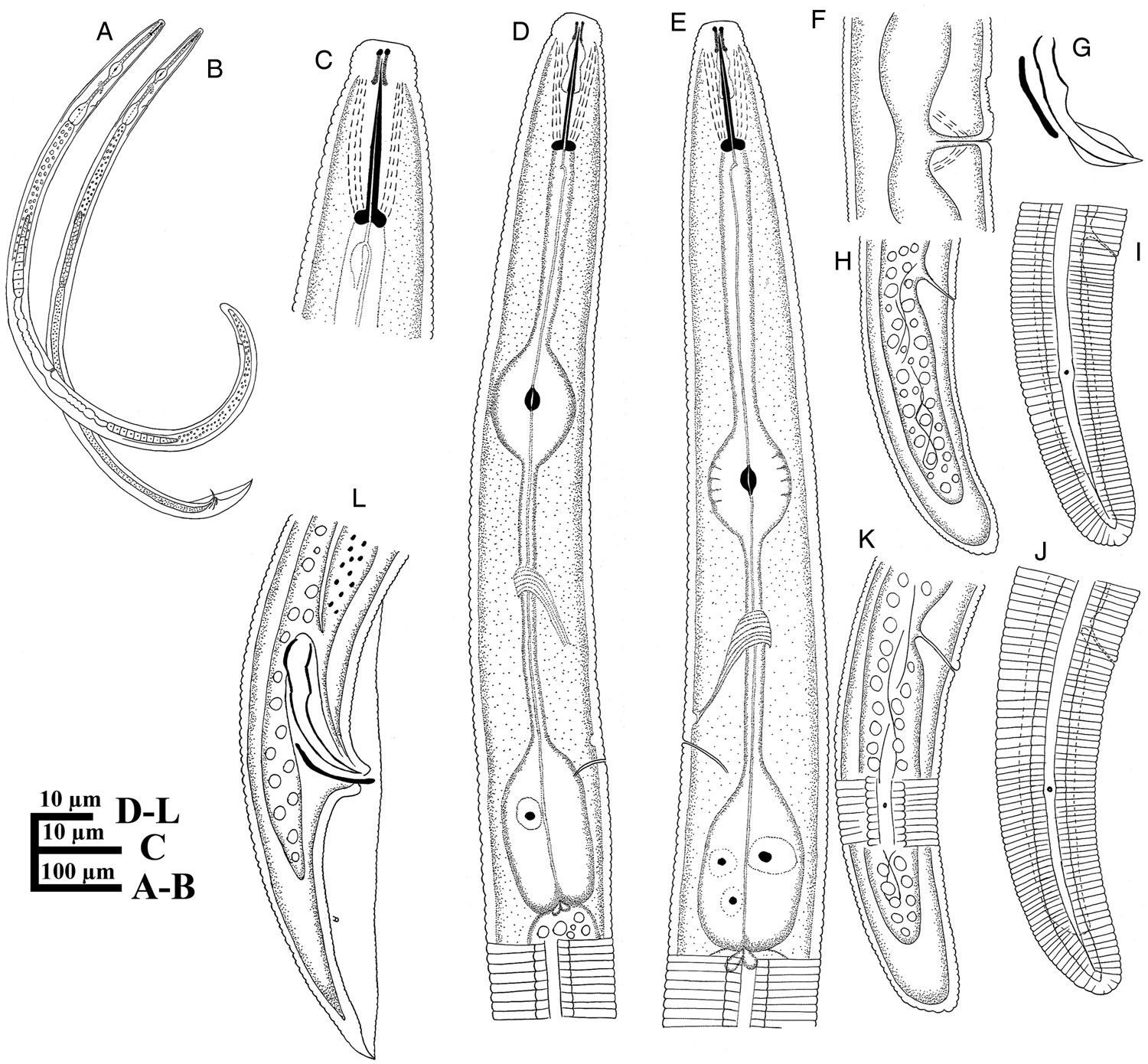
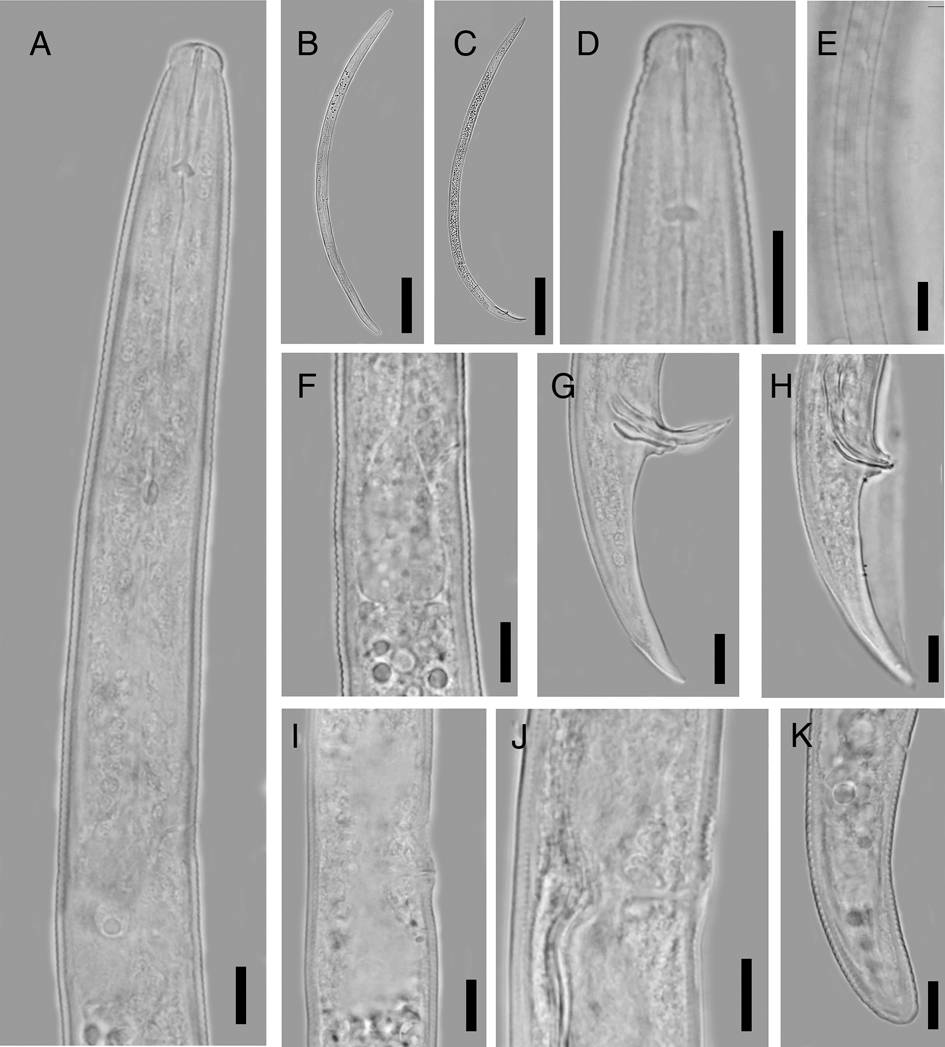
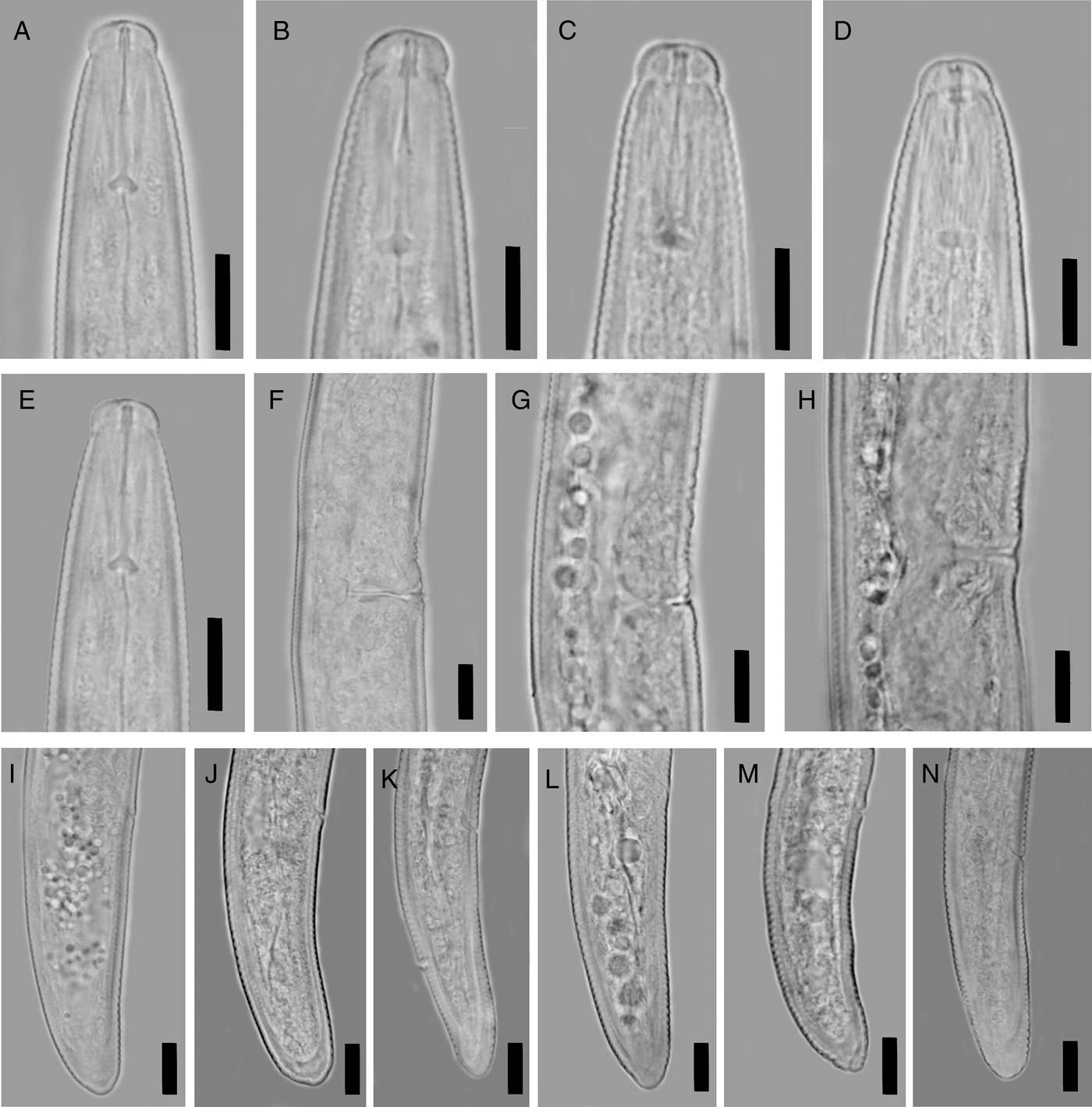
(figs 1–3)
Bitylenchus parvulus n. sp. Female (A, C, E, F, H–K) and male (B, D, G, L). (A, B) Entire body; (C) anterior end; (D, E) anterior end and pharyngeal region; (F) reproductive system; (G) spicules and gubernaculum; (H–L) posterior end.

Bitylenchus parvulus n. sp. Female (A, B, D, E, F, I–K) and male (C, G, H). (A) Anterior end and pharyngeal region; (B, C) entire body; (D) anterior end; (E) lateral field; (F) pharyngeal basal bulb; (G, H, K) posterior end; (I, J) vulva region. Scale bars: (B, C) 100 μm; (A, D–K) 10 μm.

Bitylenchus parvulus n. sp. Female. (A–E) Anterior end; (F–H) vulva region; (I–N) posterior end. Scale-bars: 10 μm.

Measurements
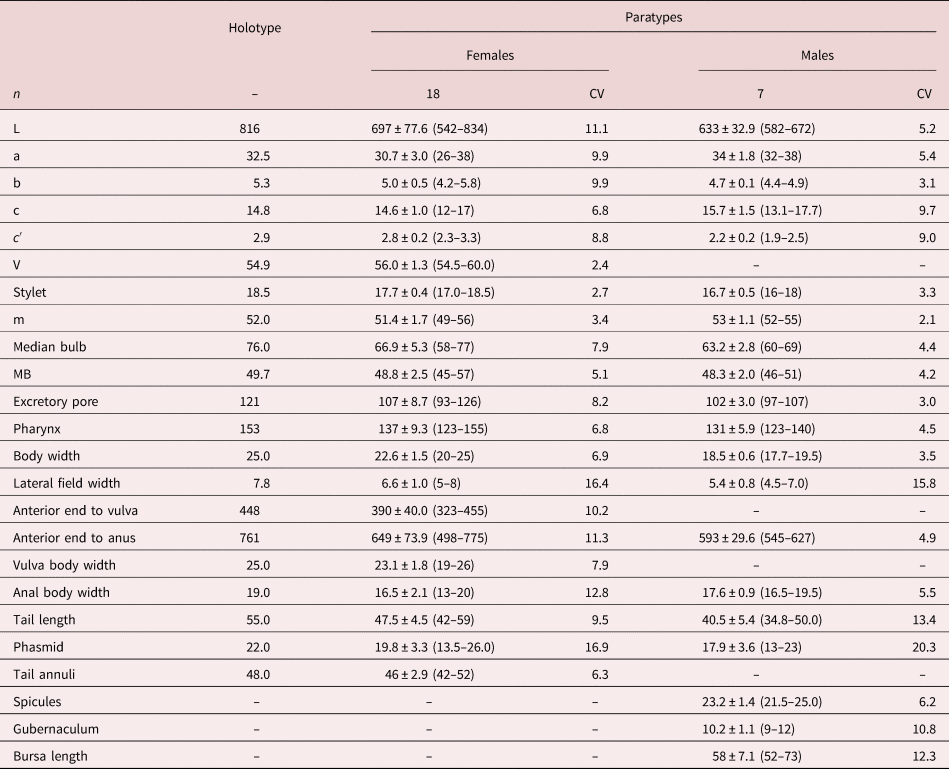
The morphometrics of B. parvulus n. sp. are presented in table 1.
Morphometric characters of Bitylenchus parvulus n. sp. recovered from Iran. All measurements are in μm, and in the form: mean ± standard deviation (range) and coefficient of variation (CV).

Description
Female. Medium-sized, ventrally arcuate to J-shaped after heat fixation. Lateral field with four incisures, outer bands areolated, 29 (21–37)% of the corresponding body diameter. Cuticle annuli delicate, 1.0 (0.5–1.5) μm wide at mid-body. Cuticle just anterior to vulva with irregular undulations (wrinkling) at its ventral side. Labial framework slightly sclerotized; lip region slightly offset from body contour by a distinct depression, with five to seven annuli, 3.6 (3.0–4.0) μm high and 7.4 (6.5–8.5) μm wide. Amphidial apertures indistinct. Stylet well-developed, conus 9.1 (8.5–9.5) μm, about one half of stylet length, stylet knobs rounded, slightly sloping backward, 3.7 (3.0–4.5) μm in width. Dorsal pharyngeal gland orifice (DGO) 2.8 (2.0–3.5) μm from stylet knobs. Procorpus cylindrical, as long as isthmus, median bulb well developed, ovate, with distinct valve, 17.5 (15.0–19.5) μm long and 11.6 (10.0–13.5) μm wide, occupying 48 (57–66)% of the corresponding body diameter. Nerve ring at anterior half of isthmus, 91 (80–101) μm from anterior end. Excretory pore position varies from posterior end of isthmus to anterior end of basal bulb. Hemizonid 5–6 annuli anterior to excretory pore, 109 (96–119) μm from anterior end. Basal bulb pocket-shaped, offset from intestine, 27 (22–34) μm in length and 13.5 (10.0–15.5) μm in width. Cardia small. Intestine generally without distinct fasciculi. Post-rectal sac occupies almost entire tail cavity. Reproductive system didelphic–amphidelphic, gonads straight, oocytes arranged in single row, spermatheca non-offset, usually without sperm, uterus long, vagina perpendicular to the body axis, 8.7 (7.5–10.5) μm long, occupying 24 (22–26)% of the vulval body width. Vulva near mid-body, as a transverse slit, with small epiptygma. Phasmids at 42 (31–50)% of tail length. Tail sub-cylindrical, often dorsally convex, usually narrowing abruptly near terminus giving a bluntly digitate appearance to its striated terminus.
Male. Body ventrally curved to J-shaped. Cuticle annuli 0.8 (0.5–1.0) μm at mid-body. Lateral field occupying 29 (26–37)% of body width, not areolated. Labial framework not sclerotized. Labial region slightly offset from body with five to six annuli, 6.8 (6.5–7.5) μm wide and 3.5 (3.0–4.5) μm high. Stylet knobs well developed, slightly sloping backward, 3.4 (3.0–3.5) μm in width. Median bulb oval, 10.0 (9.0–11.0) μm × 14.5 (13.5–16.5) μm. Basal bulb pyriform, 11.4 (10.5–12.0) μm × 21.5 (18.0–26.5) μm. Testis single, 430 (417–460) μm long, occupying 65.5 (63.0–68.0)% of total body length. Spicules curved ventrally, with velum and pointed tip. Gubernaculum simple, crescent-shaped, about one-third of spicules length. Bursa elongated, 58 (51–62) μm long. Tail conical, ending to a pointed terminus.
Taxonomic summary
Type locality. The new species was recovered from the rhizosphere of milk vetch (Astragalus sp.) in Sendan mountain, Zanjan province, north-western Iran (49°07′13″N, 36°42′41″E).
Type material. Holotype, 16 paratype females and six paratype males were deposited in the nematode collection of the Department of Plant Protection, College of Agriculture, Shiraz University, Shiraz, Iran; and two paratype females and one paratype male at the USDA Nematode Collection (B. parvulus T-7480p).
Etymology. The species epithet refers to the proximity of the new species with the other known species, B. parvus.
Diagnosis and relationships. The new species is characterized by lip region with five to seven annuli, stylet 17.7 (17.0–18.5) μm long, sub-cylindrical tail with digitate terminus, cuticle just anterior to vulva wrinkled and post-rectal sac occupied whole of tail cavity.
Regarding general characters, lip region annuli, tail shape and post-rectal sac, B. parvulus n. sp. is similar to a group of some closely related species – namely, Bitylenchus dubius; Bitylenchus tobari (Sauer & Annells, 1981) Siddiqi, 1986; B. hispaniensis; Bitylenchus huesingi (Paetzold, 1958) Jairajpuri, 1982; B. parvus; Bitylenchus serranus Gomez-Barcina, Siddiqi & Castillo, 1992 and Bitylenchus teeni (Hashim, 1984) Siddiqi, 1986. The new species differs from B. dubius and B. tobari in the number of lip region annuli (5–7 vs. 6–9 and 8–10, respectively), epiptygma (present vs. absent), fasciculi (absent vs. present), unique shape of tail terminus (suddenly narrowing near terminus giving a bluntly digitate shape to tail terminus vs. normal hemispherical tail terminus) and cuticle anterior to the vulva wrinkled (vs. usually normal). It can be further distinguished from B. tobari by difference in c′ ratio (2.8 (2.3–3.3) vs. 3.8 (3.1–4.4)) and reproduction behaviour (spermatheca filled with sperm and males are common vs. spermatheca empty and males absent).
From B. parvus, B. serranus and B. teeni, it differs by having a distinctly offset lip region (vs. continuous or slightly offset) and female tail shape (digitate vs. not digitate). It can be further distinguished from B. hispaniensis and B. parvus by presence of a distinct epiptygma (vs. absence) and absence of intestinal fasciculi (vs. presence), from B. huesingi by stylet knobs shape (sloping backward vs. rounded), from B. serranus by slightly shorter stylet (17.7 (17.0–18.5) vs. 19.0–22.0 μm), slightly posterior position of vulva (V = 56.0 (54.5–60.0) vs. 49–54%) and slightly shorter spicules (23.2 (21.5–25.0) vs. 26–31 μm) and from B. teeni by absence of intestinal fasciculi (vs. presence).
Iranian population of B. parvus (Allen, 1955) Jairajpuri, 1982
(fig. 4)
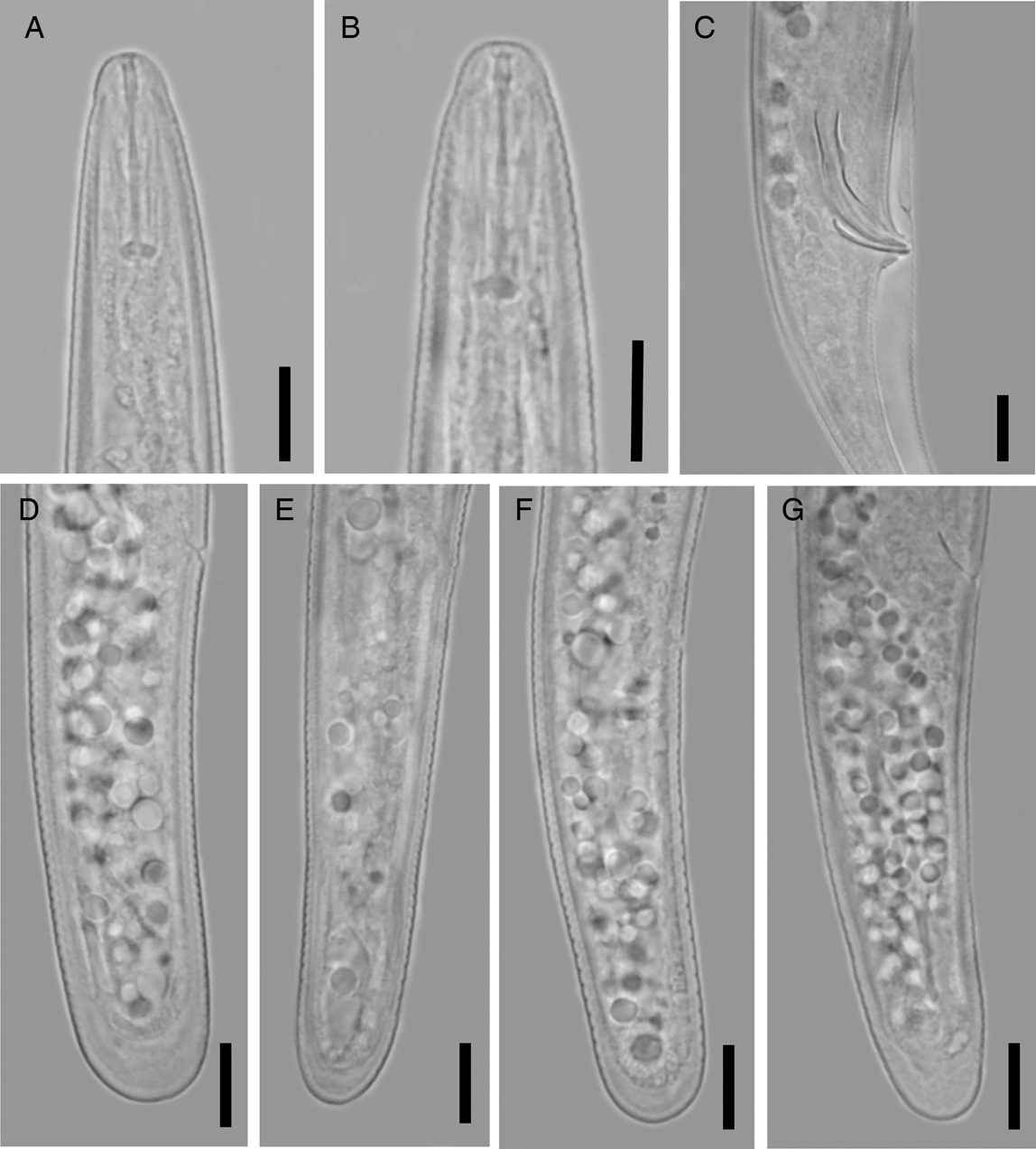
Bitylenchus parvus. Female (A, D–G) and male (B, C). (A, B) Anterior end; (C–G) posterior end. Scale bars: 10 μm.

Measurements
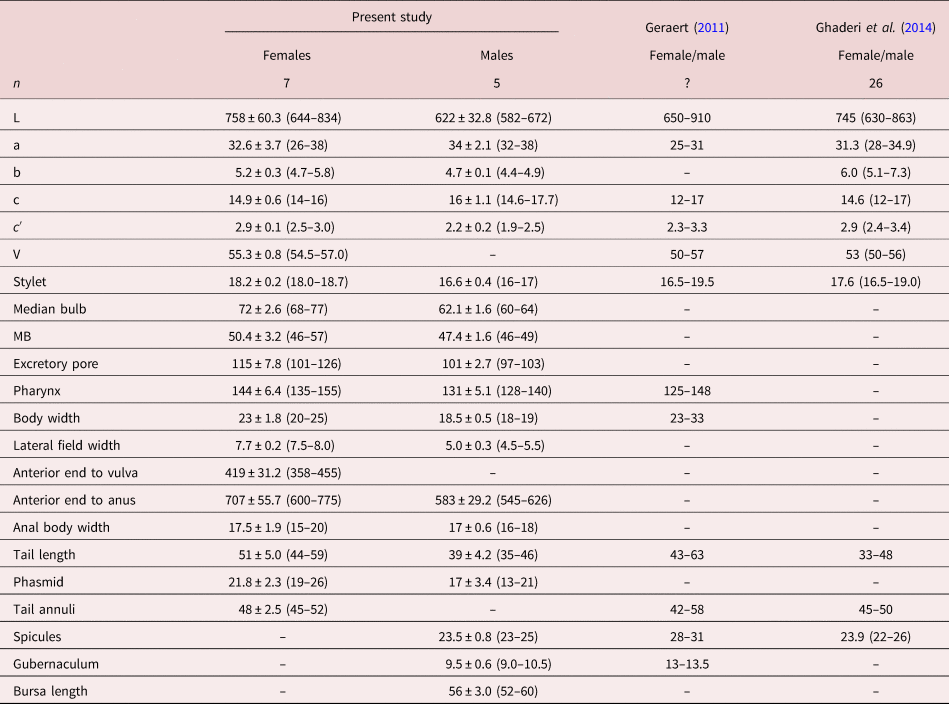
The morphometrics of B. parvus are presented in table 2.
Morphometric characters of Bitylenchus parvus recovered from Iran.

All measurements are in μm, and in the form: mean ± standard deviation (range).
This population was found around the rhizosphere of rice (Oryza sativa L.) in Dezful, Khuzestan province, south-western Iran (32°27′87″N, 48°46′11″E). The morphological and morphometric characters of the Iranian population of B. parvus fit well with other populations recorded in literature (Allen, Reference Allen1955; Geraert, Reference Geraert2011; Ghaderi et al., Reference Ghaderi, Karegar, Niknam and Subbotin2014), except that the tail terminus is usually smooth.
Iranian population of S. maximus (Allen, 1955) Siddiqi, 2000
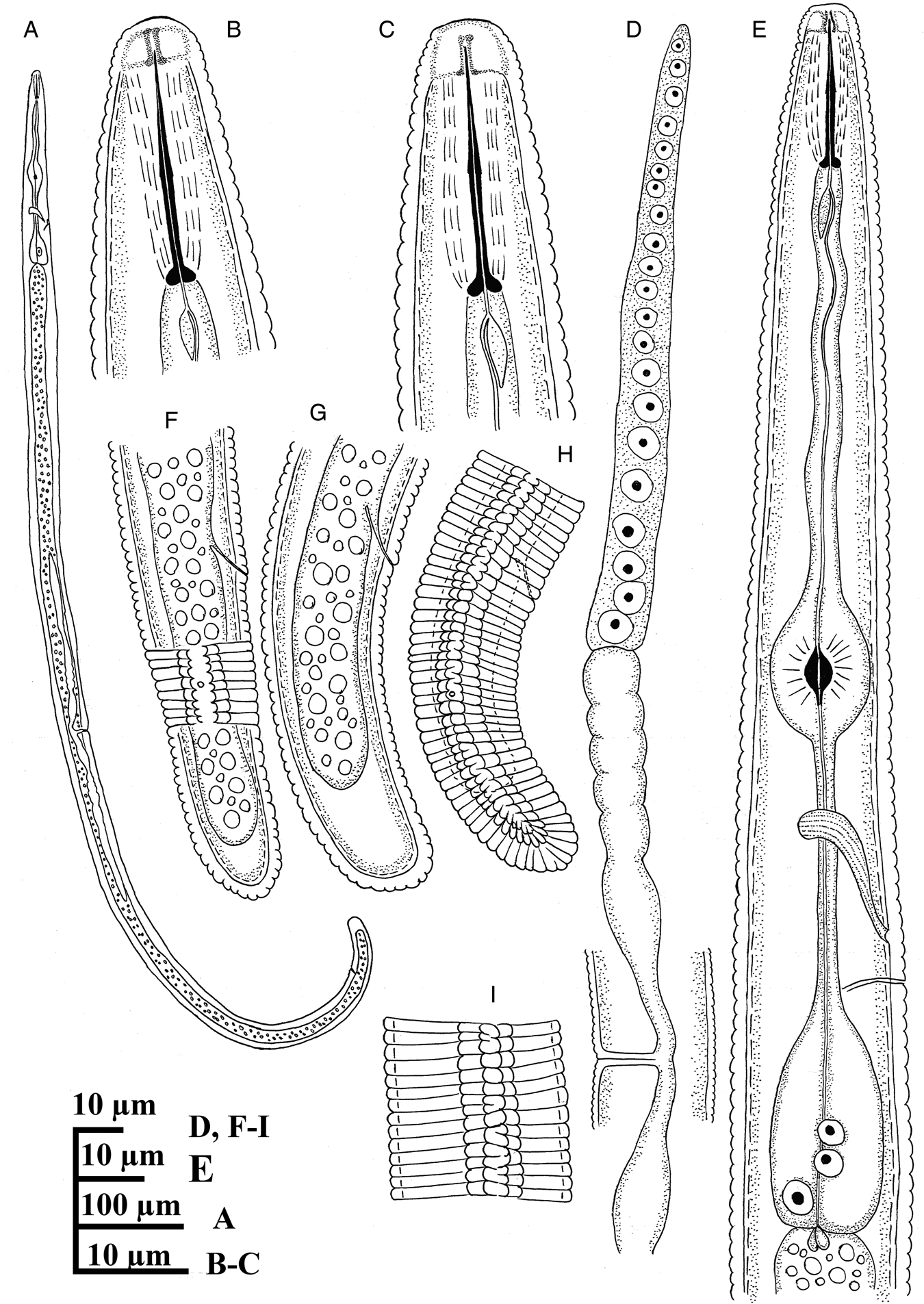
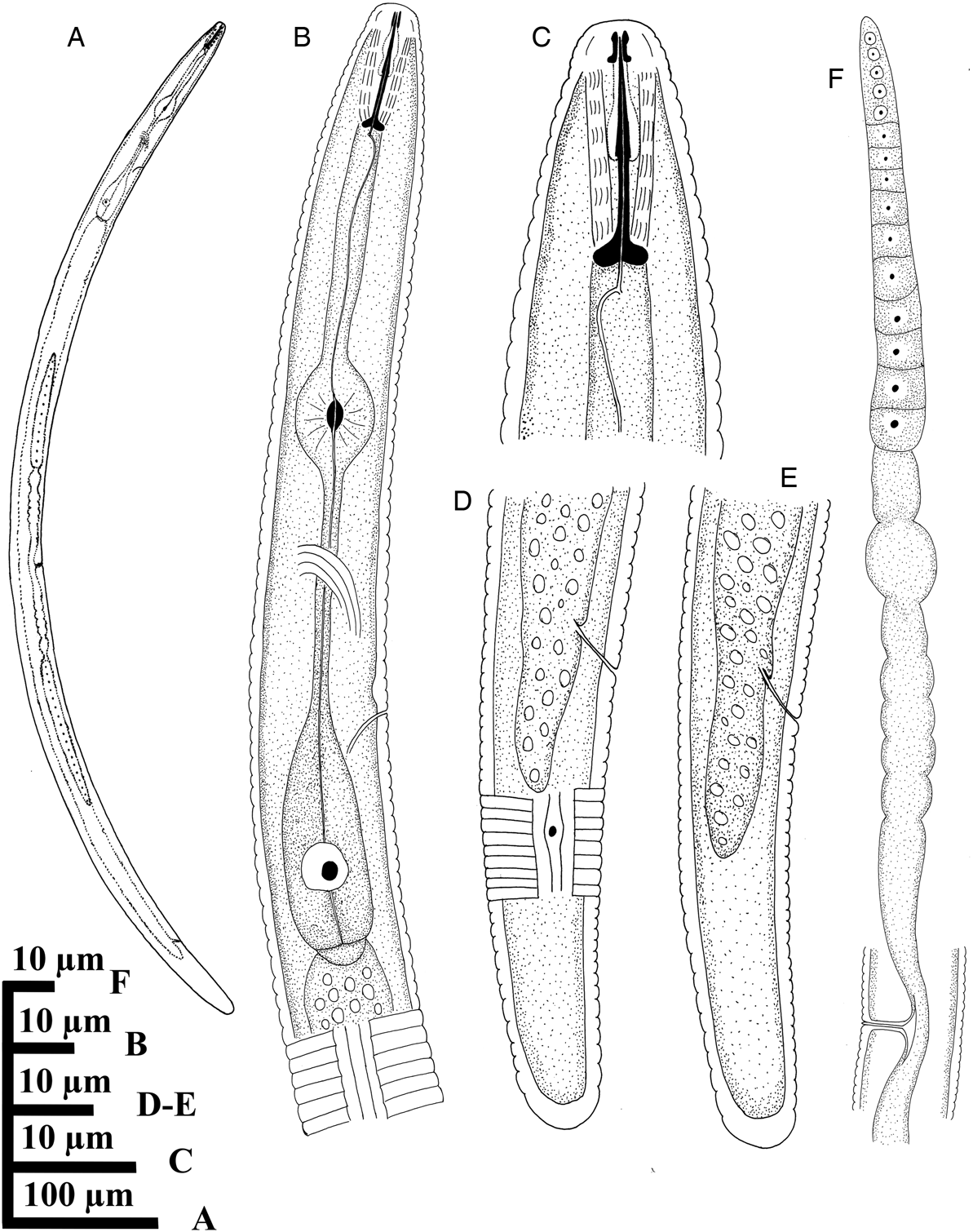
Sauertylenchus maximus. Female. (A) Entire body; (B, C) anterior end; (D) reproductive system; (E) anterior end and pharyngeal region; (F–H) posterior end; (I) lateral field.

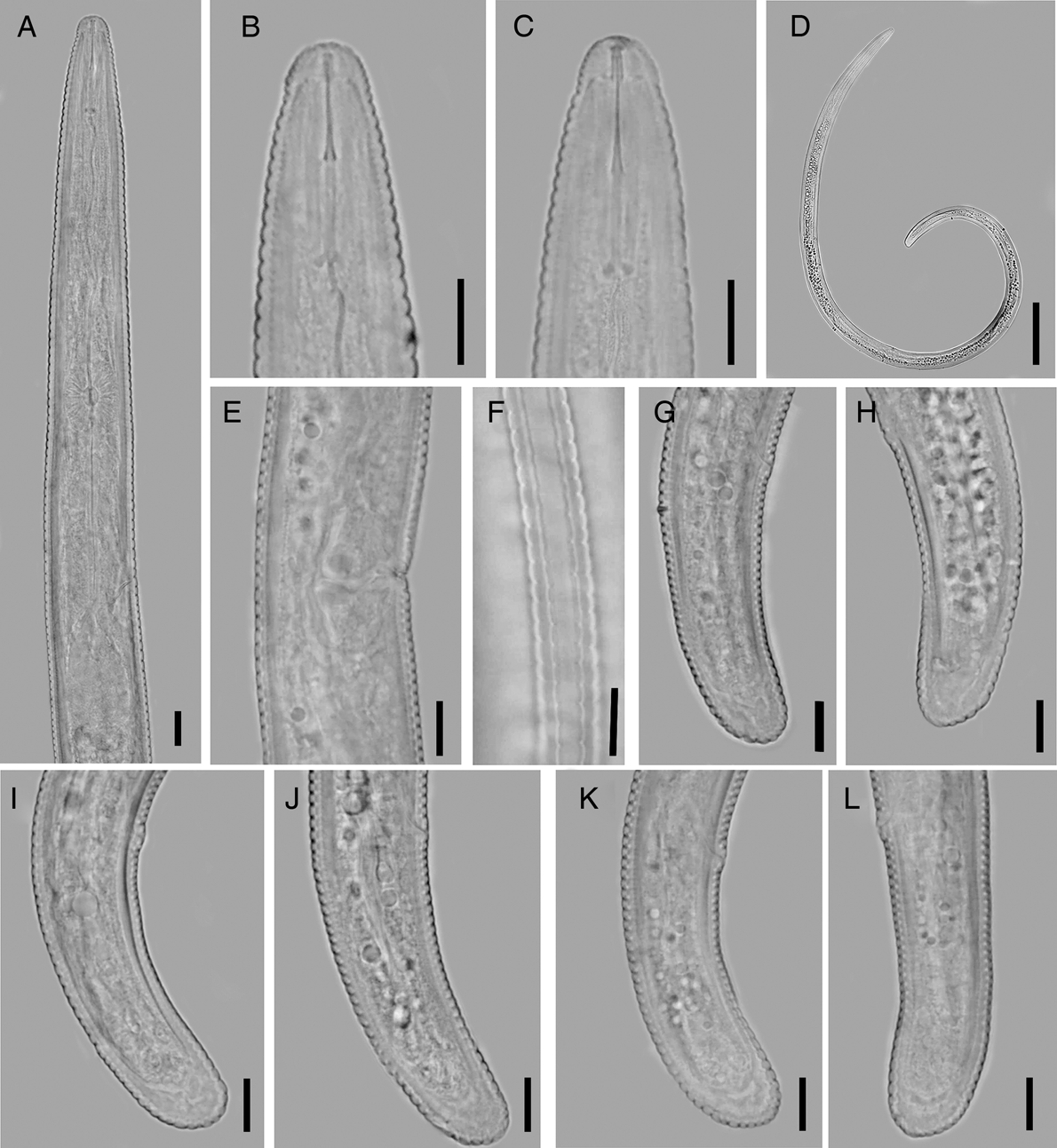
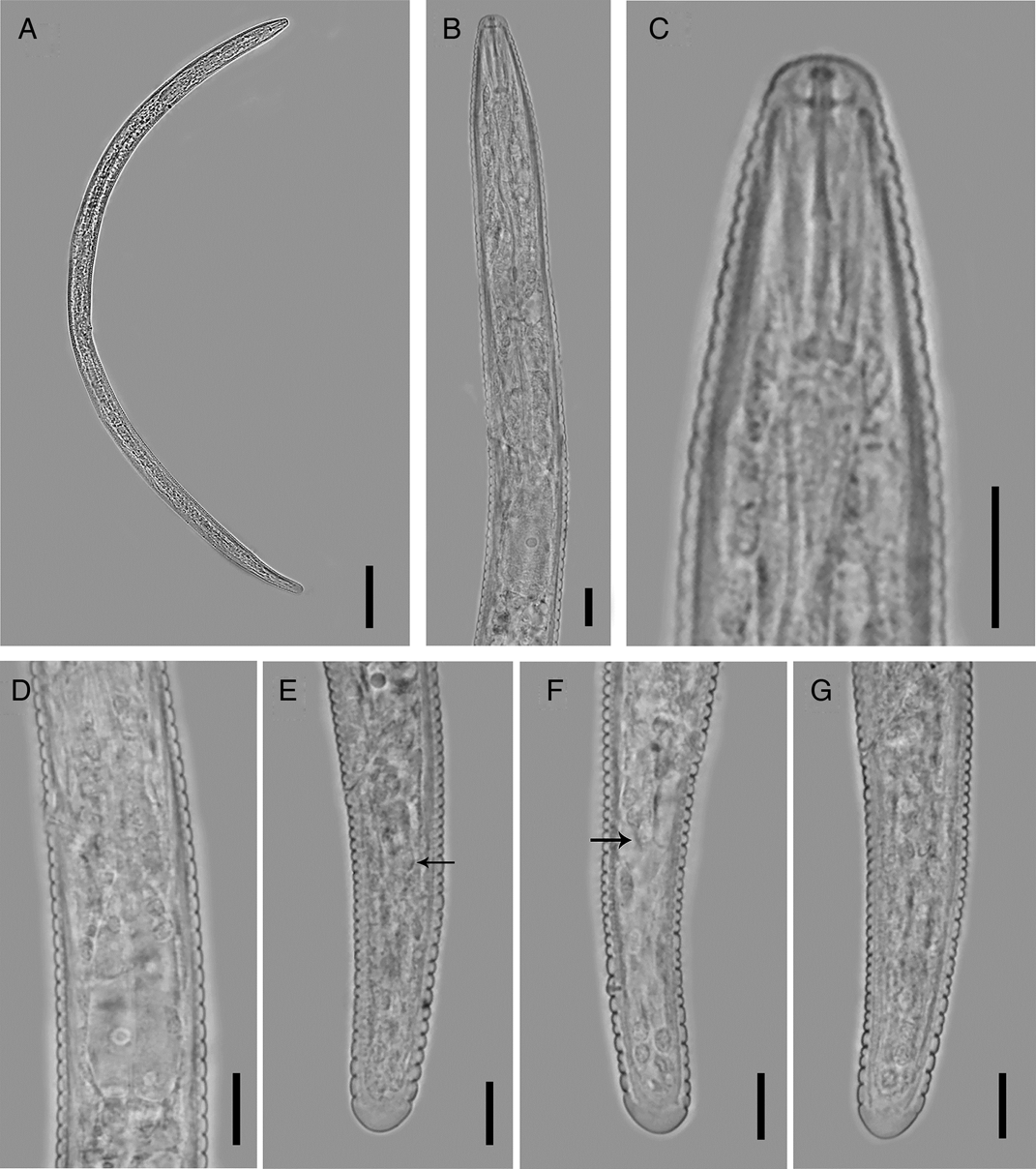
Sauertylenchus maximus. Female. (A) Anterior body and pharyngeal region; (B, C) anterior end; (D) entire body; (E) vulva region; (F) lateral field; (G–L) posterior end. Scale bars: 10 μm.

Measurements
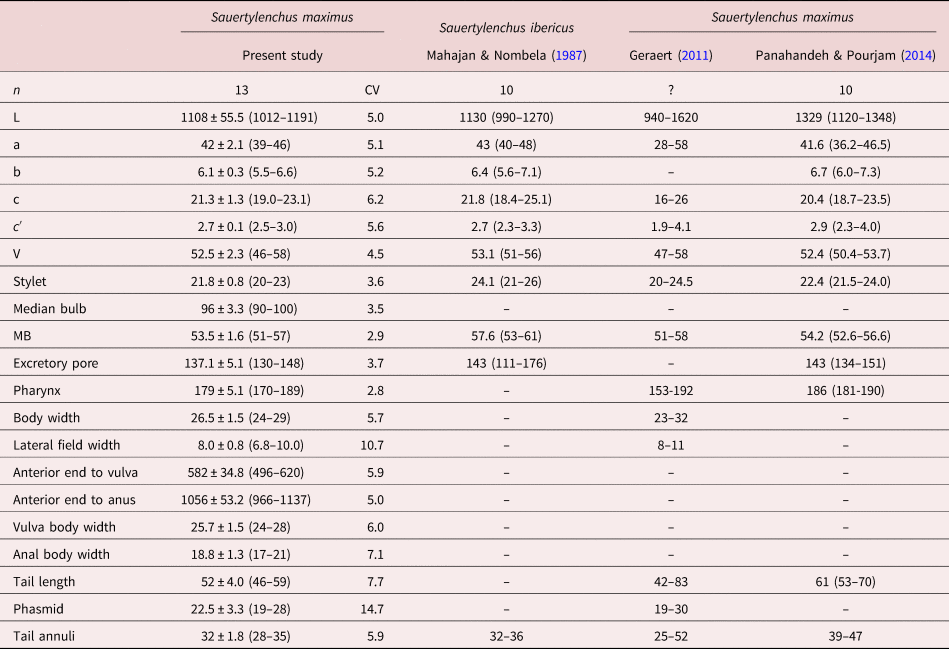
The morphometrics of S. maximus are presented in table 3.
Morphometric characters of the females of Sauertylenchus maximus recovered from Iran and its comparison with original description and other populations of S. maximus and Sauertylenchus ibericus.

All measurements are in μm, and in the form: mean ± standard deviation (range) and coefficient of variation (CV).
Description
Female. Body ventrally curved to C-shaped, about 1 mm in length. Lateral field with four incisures, about one-fourth to one-third or 30.0 (25.5–35.5)% of body diameter, with areolation at entire body. Body annuli deep, 2.2 (2.0–2.5) μm wide at pharynx, 1.7 (1.5–2.0) μm wide at mid-body. Lip region high, non-offset or offset by a slight depression, with 6–8 distinct annuli, 8.4 (8.0–9.0) μm wide and 4.3 (4.0–5.0) high. Stylet slender, conus 11.5 (11.0–12.0) μm, occupying 53 (51–56)% of total stylet length, knobs sloping backward, 2.9 (2.5–3.0) μm wide. DGO 2.2 (1.5–3.0) μm posterior to stylet knobs. Procorpus cylindrical, about as long as isthmus. Median bulb well developed, with distinct refractive valve, 14 (13–15) μm wide and 21.0 (19.0–23.5) μm long, occupying 66 (60–70)% of body diameter. Nerve ring at middle of isthmus, 118 (111–125) μm from anterior end. Excretory pore at level with anterior end of basal bulb. Hemizonid 3–8 annuli anterior to excretory pore, or 133 (127–143) μm from anterior end. Basal bulb pyriform and offset, 14.7 (13.5–16.0) μm wide and 30 (28–36) μm long. Cardia small. Post-rectal sac occupies entire tail cavity. Ovaries paired, vulva a transverse slit, without epiptygma, spermatheca indistinct, uterus short, vagina perpendicular to the body axis, 12 (9–16) μm or 47 (35–57)% of vulval body diameter. Phasmids at 43 (37–52)% of tail length. Tail cylindrical, curved ventrally ending to a rounded striated terminus.
Male. Not found.
Locality. This population was recovered from the rhizosphere of milk vetch (Astragalus sp.) in Sendan mountain, Zanjan province, north-western Iran (36°42′31″N, 49°07′23″E).
Remarks
Sauertylenchus maximus is very similar to Bitylenchus canalis (Thorne & Malek, 1968) Jairajpuri, 1982, B. serranus and S. ibericus (Mahajan & Nombela, 1987) Siddiqi, 2000. It differs from B. canalis by lip region morphology (rounded vs. truncated), stylet knobs shape (sloping posteriorly vs. anteriorly) and the number of tail annuli (25–52 vs. 66). It differs from B. serranus by annuli characters in tail tip (as wide as other tail annuli vs. wider) and post-rectal sac length (occupied almost whole of tail cavity vs. short post-rectal sac, 10–19 μm long). The present population fits well with S. maximus but differs by annuli on tail terminus as same as other tail annuli (vs. finer than other tail annuli). Mahajan & Nombela (Reference Mahajan and Nombela1987) differentiated S. ibericus from S. maximus in having an offset lip region and lacking areolation in the caudal region. However, lip region is illustrated as slightly offset similar to that observed for S. maximus. Therefore, areolation of the lateral field on tail region and the width of tail terminus annuli remain as the only diagnostic characters between S. maximus and S. ibericus. The present population shows areolation of the lateral field on tail region (similar to S. maximus), but tail terminus annuli are generally as wide as other tail annuli (similar to S. ibericus). As the present population of S. maximus has an offset labial disc distinctly separable from lip region annuli, and the first cephalic annuli divided into six sectors, we prefer to follow Siddiqi (Reference Siddiqi2000) for maintaining this species in Sauertylenchus, not in Bitylenchus.
Iranian population of T. agri Ferris, 1963
Tylenchorhynchus agri. Female. (A) entire body; (B) anterior end and pharyngeal region; (C) anterior end; (D, E) posterior end; (F) reproductive system.

Tylenchorhynchus agri. Female. (A) Entire body; (B) anterior end and pharyngeal region; (C) anterior end; (D) pharyngeal basal bulb; (E–G) posterior end (arrow points to post-rectal sac). Scale bars: (A) 100 μm; (B–G) 10 μm.

Measurements
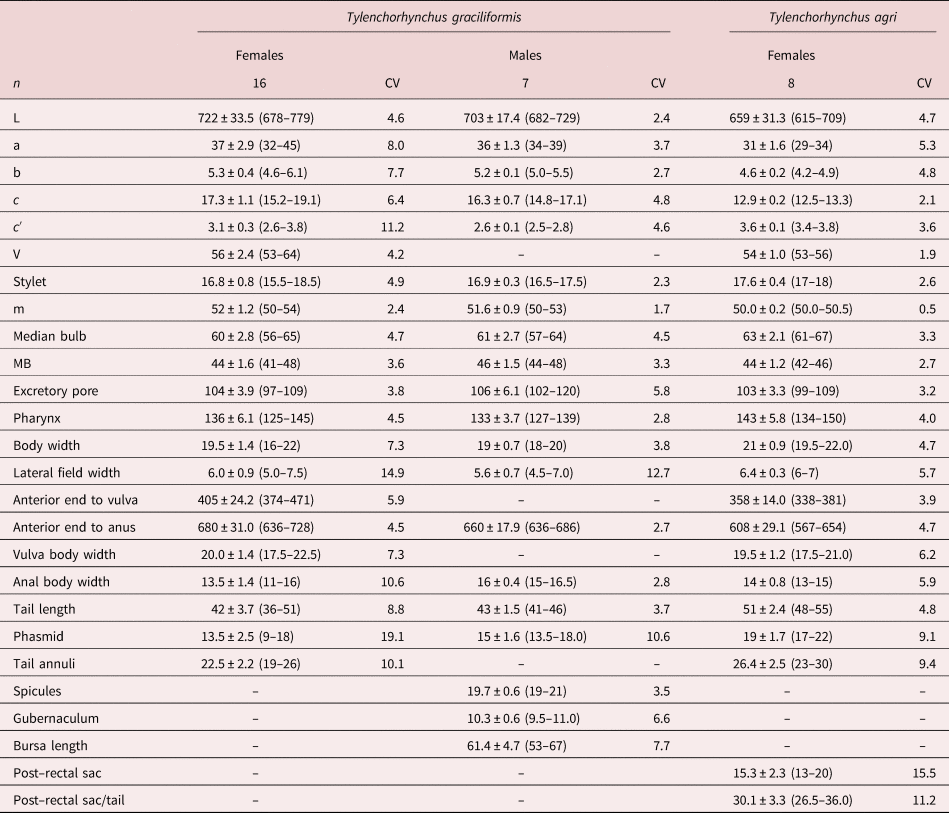
The morphometrics of T. agri are presented in table 4.
Morphometric characters of Tylenchorhynchus graciliformis and Tylenchorhynchus agri recovered from Iran.

All measurements are in μm, and in the form: mean ± standard deviation (range) and coefficient of variation (CV).
Description
Female. Body slightly ventrally curved to C-shaped after heat fixation. Lateral field occupies 30 (28–33)% of the corresponding body diameter. Body annuli delicate, 2.2 (2.0–2.5) μm wide at pharynx, and 1.7 (1.5–2.0) μm at mid-body. Labial region slightly offset, bearing four to five annuli, 7.5 (7.4–7.7) μm wide and 3.4 (3.5–4.0) μm high. Stylet conus 8.8 (8.5–9.0) μm, 53 (50–56)% of total stylet length, knobs rounded, 3.9 (3.5–4.5) μm wide. DGO 2.4 (2.0–2.7) μm posterior to stylet knobs. Procorpus cylindrical, about as long as isthmus. Median bulb ovate with distinct valve, 11 (10–12) μm wide, 16.5 (16–17) μm long, occupying 61 (55–70)% of the corresponding body diameter. Isthmus slender. Basal bulb pyriform to slightly elongate, offset from intestine, 12 (11–14) μm wide and 32 (29–36) μm long. Cardia hemispherical. Nerve ring at anterior half of isthmus, at 85 (83–89) μm from anterior end. Excretory pore at anterior part of basal bulb. Hemizonid one to two annuli anterior to excretory pore, at 99 (96–106) μm from anterior end. A small post-rectal sac occupying 30 (26–36)% of tail cavity. Ovaries paired and straight, spermatheca rounded and non-offset, without sperm. Uterus short, vagina perpendicular to the body axis, 7.5 (7.0–8.0) μm, occupying 38 (34–43)% of the vulval body width, vulva with small epiptygma. Phasmids located at 37 (23–30)% of tail length. Tail sub-cylindrical ending to a smooth terminus.
Male. Not found.
Locality. This population was recovered from the rhizosphere of desert poplar (Populus euphratica Oliv.) in Dezful region, Khuzestan province, south-western Iran (32°11′36″N, 48°42″67″E).
Remarks
Tylenchorhynchus agri is similar to Tylenchorhynchus alami Shaw & Khan, 1996; Tylenchorhynchus claytoni Steiner, 1937; Tylenchorhynchus crassicaudatus Williams, 1960; Tylenchorhynchus ewingi Hopper, 1959; Tylenchorhynchus haki Fotedar & Mahajan, 1971; and Tylenchorhynchus mexicanus Knobloch & Laughlin, 1973. It is different from T. alami by lip region morphology (slightly offset vs. continuous), tail shape and length (sub-cylindrical, 32–39 μm long vs. conoid, 48 μm long), spicules length (21–25 vs. 17–18 μm) and post-rectal sac (filling 30% vs. less than 20% of tail length). From T. claytoni, it can be distinguished by longitudinal striae (absent vs. present) and post-rectal sac (present vs. absent). It differs from T. crassicaudatus by tail length (32–39 vs. 38–63 μm) and post-rectal sac (present vs. absent), from T. ewingi by annuli of lip region (4–5 vs. 3 annuli), spicules (21–25 vs. 18 μm) and stylet knobs shape (with concave anterior surfaces vs. rounded), from T. haki by slightly longer stylet (17–23 vs. 16–18 μm) and tail characters (sub-cylindrical, 32–39 μm long vs. conoid, 27 μm long) and from T. mexicanus by lip region characters (slightly offset vs. distinctly offset), tail shape (sub-cylindrical vs. conoid) and post-rectal sac (present vs. absent).
Iranian population of T. graciliformis Siddiqi & Siddiqui, 1983
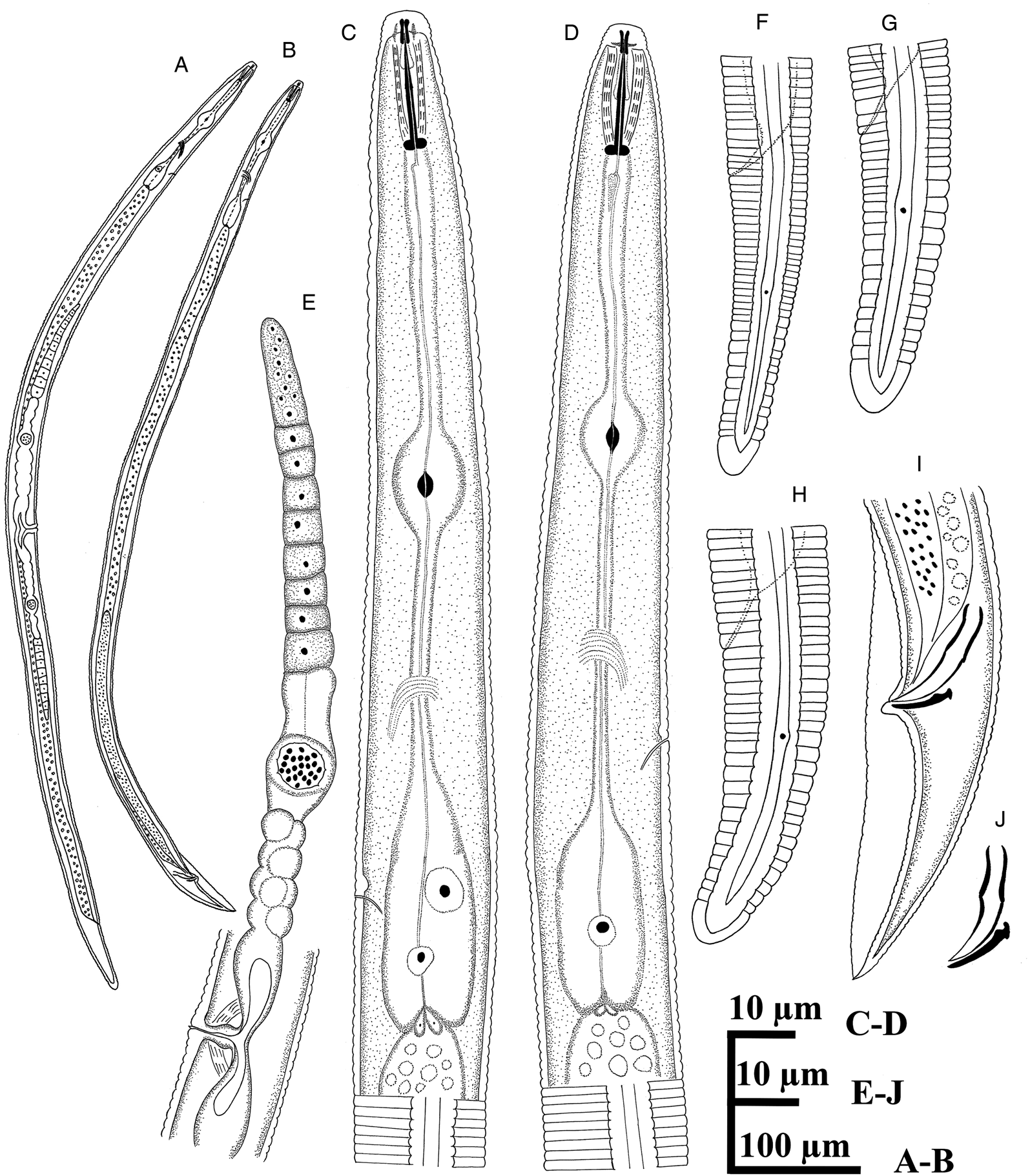
Tylenchorhynchus graciliformis. Female (A, C, E, F–H) and male (B, D, I, J). (A, B) Entire body; (C, D) anterior end and pharyngeal region; (E) reproductive system; (F–I) posterior end; (J) spicules and gubernaculum.

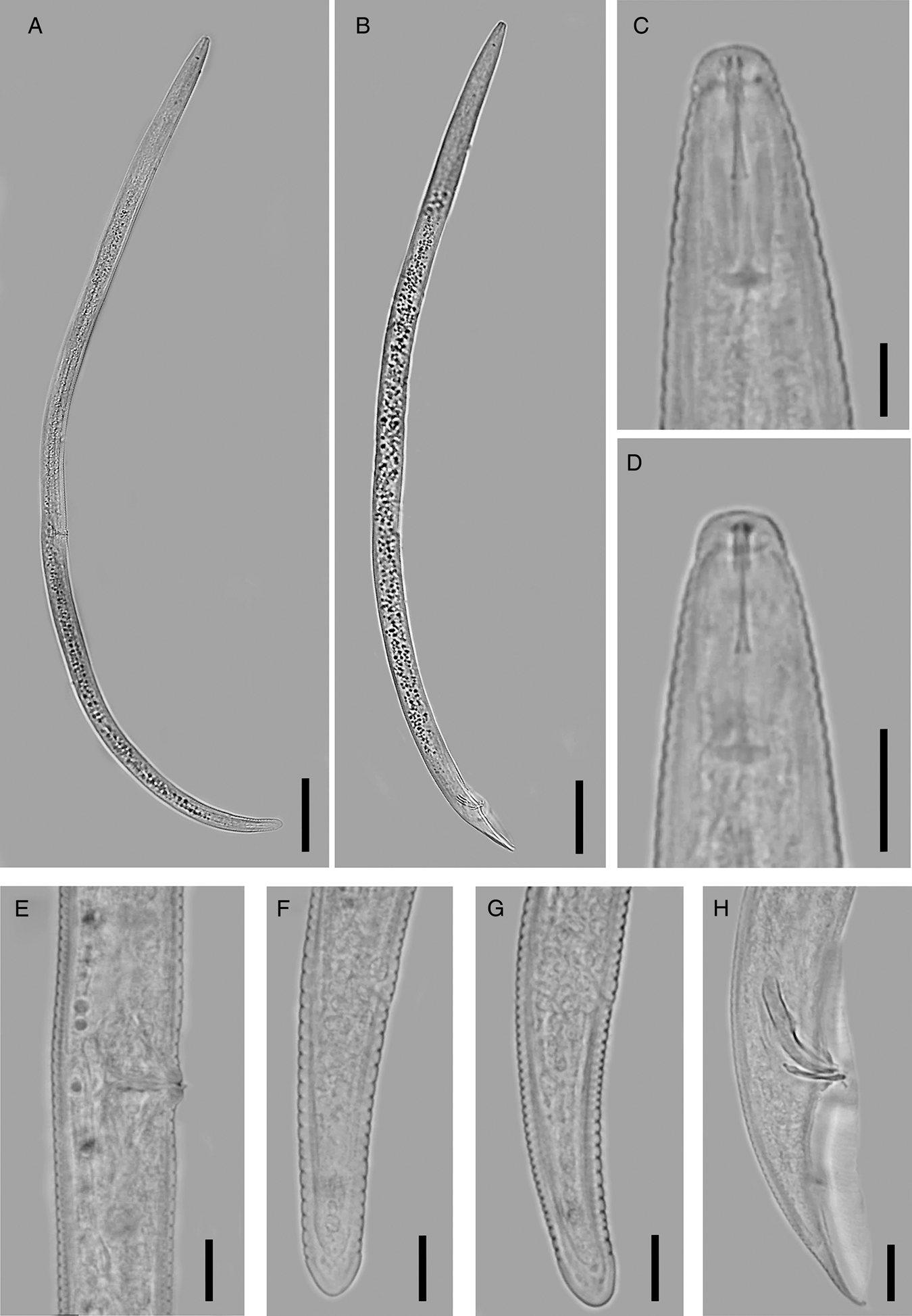
Tylenchorhynchus graciliformis. Female (A, D–J) and male (B, C, H). (A, B) Entire body; (C, D) anterior end; (E) vulva region; (F–H) posterior end. Scale bars: (A, B) 100 μm; (C–H) 10 μm.

Measurements
The morphometrics of T. graciliformis are presented in table 4.
Description
Female. Body ventrally curved to C-shape. Lateral field occupied one-fourth to one-third of body width, outer bands crenate, 32 (23–39)% of body width in diameter. Body annuli delicate, 1.9 (1.0–2.3) μm at pharynx and 1.7 (1.5–1.9) μm at mid-body. Lip region slightly offset bearing usually five, rarely six, annuli, 6.8 (6.5–7.5) μm wide and 3.2 (3.0–4.0) μm high. Stylet delicate, conus 8.7 (8.0–9.5) μm, 52 (50–54)% of total stylet length, knobs laterally directed, 4.1 (3.5–4.5) μm wide. DGO 2.2 (1.5–3.0) μm posterior to stylet knobs. Procorpus cylindrical, about as long as isthmus. Median bulb ovate with distinct valve, 10.7 (10.0–11.0) μm wide, 16.8 (15.5–18.0) long, occupying 64 (59–69)% of body width in diameter. Isthmus slender. Basal bulb elongate–saccate, offset from intestine to slightly overlapping anterior end of intestine, 12.3 (11.0–14.0) μm wide, 31 (27–38) μm long. Cardia hemispherical. Nerve ring at middle of isthmus, 86 (76–93) μm from anterior end. Excretory pore at anterior part of basal bulb. Hemizonid one to three annuli anterior to excretory pore, 104 (97–109) μm from anterior end. Deirids indistinct. Post-rectal sac absent. Reproductive system didelphic–amphidelphic, gonads straight, spermatheca rounded and non-offset, filled with spheroid sperm, 2–3 μm in diameter. Uterus short, vagina perpendicular to body axis, 9.0 (7.5–12.0) μm, occupying 44 (35–53)% of vulval body diameter. Vulva prominent, equipped with small epiptygma. Phasmids located at 32 (23–40)% of tail. Tail sub-cylindrical, bearing 22 (18–26) cuticular annuli on its ventral side, ending to a smooth terminus.
Male. General characters similar to those of female. Body ventrally curved to J-shaped. Body annuli 1.6 (1.5–2.0) μm wide at mid-body. Lateral field with four incisures, 29 (23–36)% of body width. Lip region bearing four to five annuli, 6.1 (6.0–6.5) μm wide and 2.9 (2.5–3.0) μm high. Stylet comparable with that of female, conus 51 (50–52)% of total stylet length; knobs sloping backward. DGO 1.9 (1.5–2.0) μm posterior to stylet knobs. Median bulb 10.0 (9.5–11.0) μm wide and 13.5 (12.0–15.0) μm long. Basal bulb elongate–saccate, slightly shorter than female, 11.4 (10.0–13.0) μm wide and 28 (25–30) μm in length. Nerve ring located at 87 (80–93) μm from anterior end. Deirids indistinct. Spicules tylenchoid. Gubernaculum with crest. Bursa extending to end of tail, 61 (53–67) μm in length.
Locality. The present population of T. graciliformis was recovered from the rhizosphere of tamarisk (Tamarix sp.) in the Dezful region, Khuzestan province, south-western Iran (32°16′66″N, 48°47′56″E).
Remarks
All morphological and morphometric characteristics of the present population fit well with those of the original population of T. graciliformis, differing only in the lip region demarcation; in the present population, lip region is generally slightly offset from the rest of body (drawn and illustrated as distinctly offset in the original description). Tylenchorhynchus graciliformis is similar to Tylenchorhynchus aduncus de Guiran, 1967; Tylenchorhynchus brassicae Siddiqi, 1961; T. clarus Allen, 1955; Tylenchorhynchus contractus Loof, 1964; Tylenchorhynchus aerolatus Tobar Jiménez, 1970; Tylenchorhynchus striatus Allen, 1955; and Tylenchorhynchus ismaili Azmi & Ahmad, 1991. It differs from T. aduncus by tail shape (sub-cylindrical vs. conical), shape of stylet knobs (laterally directed vs. posteriorly directed), spermatheca shape (spherical vs. ovoid), spicules length (19–21 vs. 22–25 μm) and shape of gubernaculum (with a simple crest vs. characteristic hammer-shaped). It can be distinguished from T. aerolatus by absence of areolation in lateral field (vs. having regular areolation), the shape of gubernaculum (with simple crest vs. hammer-shaped) and body length (678–780 vs. 540–700 μm). It differs from T. brassicae by annuli of lip region (5–6 vs. 4 annuli), stylet length (17–19 vs. 16–17 μm) and tail characters (sub-cylindrical, 36–51 μm vs. conical, 23–40 μm in length). The present population can be differentiated from T. clarus by lip region morphology (offset vs. non offset), number of tail annuli (16–20 vs. 7–20), presence of males and spermatheca filled with sperm (vs. absence of males and empty spermatheca), from T. contractus and T. striatus by lip region characters (offset vs. non offset) and from T. ismaili by body size (678–780 vs. 460–660 μm) and tail terminus striation (smooth vs. striated).
Molecular characterization of Tylenchorhynchus, Bitylenchus and Sauertylenchus species from Iran
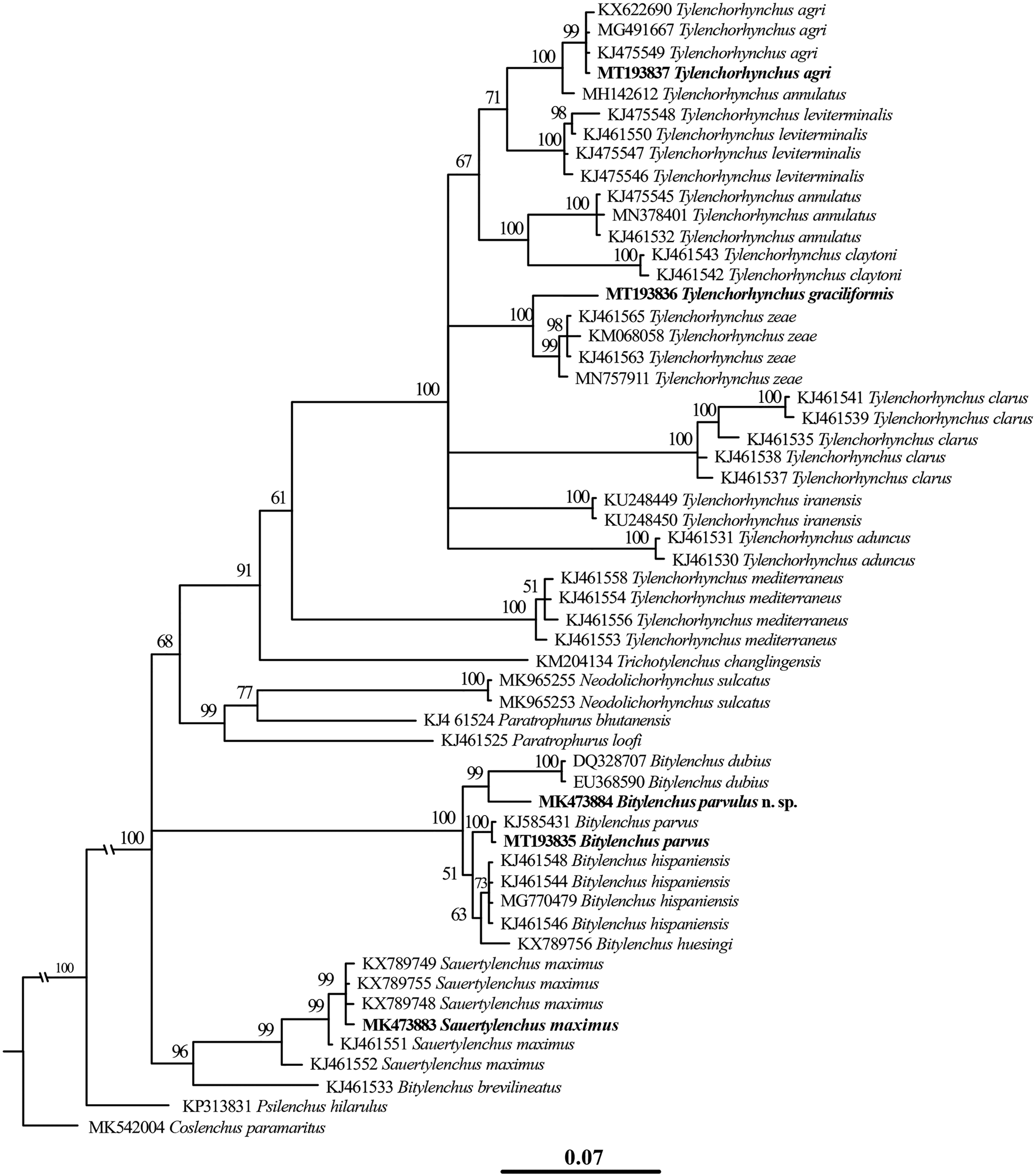
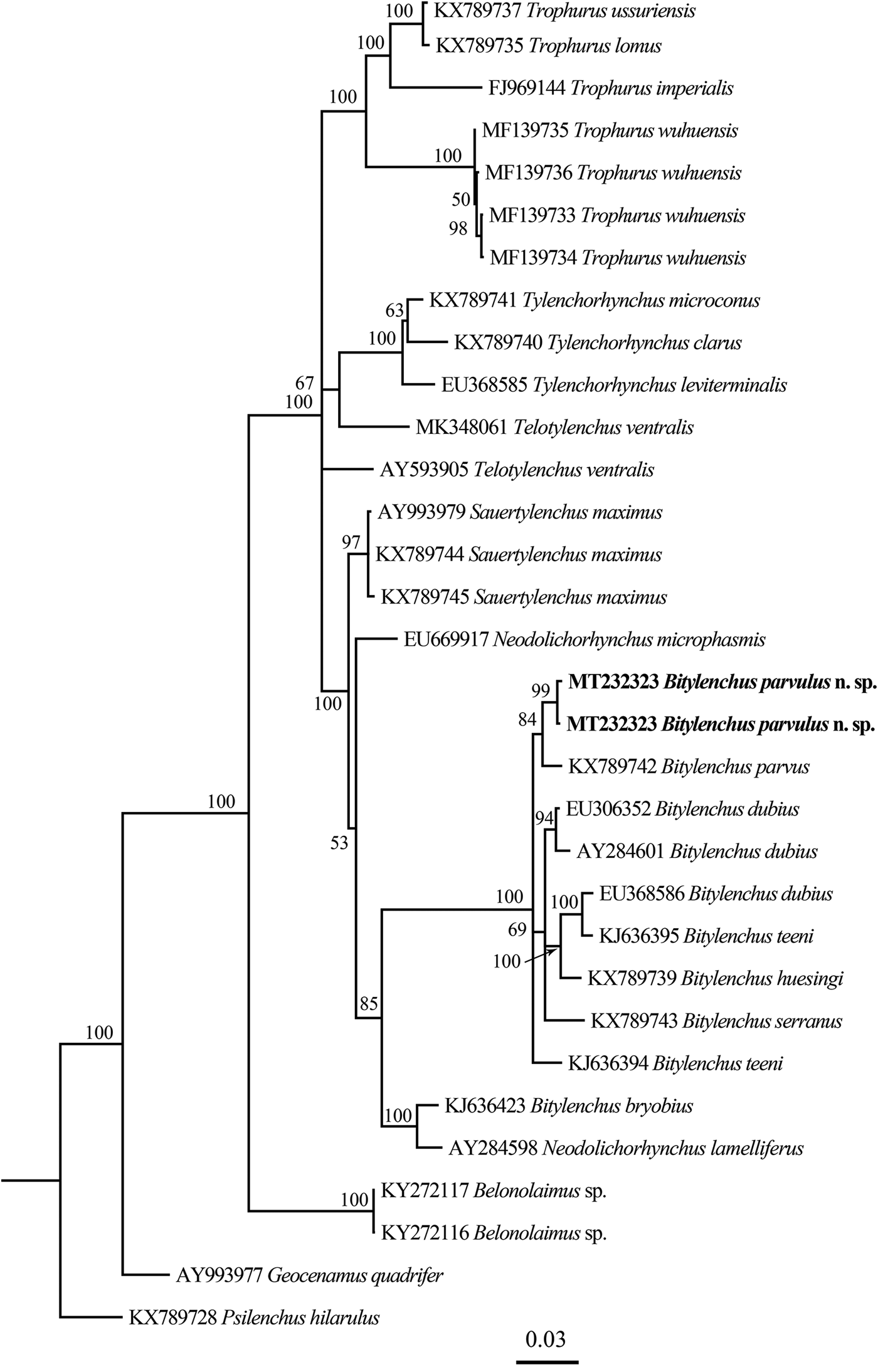
The amplification of D2–D3 expansion segments of 28S and partial 18S rRNA genes yielded single fragments of 669 and 1695 bp, respectively, after discarding primer sequences. D2–D3 for B. parvulus n. sp. (MK473884) differed from the closest related species, B. parvus (KJ585431), by 14 different nucleotides and zero indels (98% similarity); from B. hispaniensis (KJ461548, KJ461544, KJ461547 and MG770479) by 13–15 different nucleotides and one indel (98% similarity); from B. huesingi (KX789756) by18 different nucleotides and one indel (97% similarity); and from B. dubius (DQ328707 and EU368590) by 20 different nucleotides and zero indels (97% similarity). Two sequences for B. parvulus n. sp. (MT232322, MT232323) differing in three nucleotides (99.8% similar) were obtained for the 18S rRNA marker. These sequences closely matched with several species, such as B. parvus (KX789742) and B. teeni (KJ636394), by 19 and 21 different nucleotides, and one and three indels (99% similarity), respectively. D2–D3 from the Iranian population of B. parvus (MT193835) was identical to B. parvus (KJ585431) from Fars province, Iran. D2–D3 from the Iranian population of S. maximus (MK473883) closely matched with several populations of S. maximus (KX789749, KX789755 and KX789748), differing by 1–2 bp and zero indels (99% similarity). Finally, D2–D3 from the Iranian populations of T. agri and T. graciliformis (MT193837 and MT193836) showed that these isolates had the highest similarity (100% and 97.2%) with T. agri and Tylenchorhynchus zeae, respectively.
Phylogenetic relationships of studied species
The phylogenetic relationships within Bitylenchus, Sauertylenchus, Tylenchorhynchus and representatives of other genera of the subfamily Telotylenchinae from the analysis of the partial 28S rRNA and 18S rRNA gene sequences are presented in figs 11 and 12, respectively. The phylogenetic analysis of the 28S rRNA separated the genus Bitylenchus and Sauertylenchus in different clades, with the exception of Bitylenchus brevilineatus (Williams, 1960) Jairajpuri, 1982 (KJ461533). The D2–D3 sequences of B. parvulus n. sp. clustered well (PP = 99) with two sequences of B. dubius (DQ328707 and EU368590). Bitylenchus parvulus n. sp. formed a well-supported clade (PP = 100) with B. parvus (KJ585431 and MT193835), B. huesingi (KX789756) and four sequences of B. hispaniensis (KJ461548, KJ461544, KJ461547 and MG770479). Our isolate of S. maximus (MK473883) formed a well-supported clade (PP = 99) with populations of S. maximus (KX789749, KX789755 and KX789748) deposited in GenBank. The Iranian isolate of B. parvus (MT193835) clustered well (PP = 100) with B. parvus (KJ585431). The Iranian isolate of T. agri (MT193837) formed a clade (PP = 99) with three isolates of T. agri (KX622690, MG491667 and KJ475549). The Iranian isolate of T. graciliformis (MT193837) formed a clade (PP = 100) with four isolates of T. zeae Sethi & Swarup, 1968 (MN757911, KJ461563, KJ461565 and KM068058).
Phylogenetic relationships among Bitylenchus, Sauertylenchus and Tylenchorhynchus species with representatives of other Telotylenchinae genera. Bayesian 50% majority rule consensus tree as inferred from D2–D3 expansion segments of 28S rRNA sequence alignment under the general time-reversible model of sequence evolution, with correction for invariable sites and a gamma-shaped distribution (GTR + I + G). Newly obtained sequences in this study are shown in bold. Scale bar = expected changes per site.

Phylogenetic relationships among Bitylenchus, Sauertylenchus and Tylenchorhynchus species with representatives of other Telotylenchinae genera. Bayesian 50% majority rule consensus tree as inferred from the partial 18S rRNA gene sequence alignment under the general time-reversible model of sequence evolution, with correction for invariable sites and a gamma-shaped distribution (GTR + I + G). Newly obtained sequences in this study are shown in bold. Scale bar = expected changes per site.

The 18S rRNA phylogeny showed that B. parvulus n. sp. (MT226922 and MT226923) formed a moderately supported clade (PP = 84) with B. parvus (KX789742) and a high-supported clade (PP = 100) with other species of the genus Bitylenchus, as B. dubius (EU306352, AY284601 and EU306352), B. teeni (KJ636395 and KJ636394), B. huesingi (KX789739) and B. serranus (KX789743).
Discussion
In the present study, we provided a key for identification of all the known species treated in the three closely related genera Bitylenchus, Sauertylenchus and Tylenchorhynchus. A new species, B. parvulus n. sp., was described and illustrated during this study, morphological and additional molecular data were obtained for some previously described species (T. agri, B. parvus and S. maximus) and new molecular and morphological data were presented for T. graciliformis.
Some morphological (Gomez-Barcina et al., Reference Gomez-Barcina, Siddiqi and Castillo1992; Siddiqi, Reference Siddiqi2000) and molecular data (Ghaderi et al., Reference Ghaderi, Karegar, Niknam and Subbotin2014; Handoo et al., Reference Handoo, Palomares-Rius, Cantalapiedra-Navarrete, Liébanas, Subbotin and Castillo2014; present study) support that Bitylenchus and Sauertylenchus are separable genera from Tylenchorhynchus. However, the validity of the genus Sauertylenchus still needs to be tested with more studies, particularly by inclusion of the type species of this genus (Handoo et al., Reference Handoo, Palomares-Rius, Cantalapiedra-Navarrete, Liébanas, Subbotin and Castillo2014).
Although Bitylenchus, Sauertylenchus and Tylenchorhynchus are treated as the three separated valid genera in literature, there is no adequate information on the important diagnostic characters such as lateral field areolation, lip region structure, post-rectal sac presence or the shape of gubernaculum on many of the described species in the literature. Moreover, there is no agreement on the taxonomic position of certain species – for instance, S. maximus in Siddiqi (Reference Siddiqi2000) has been considered as B. maximus in Andrássy (Reference Andrássy, Csuzdi and Mahunka2007) or T. maximus in Geraert (Reference Geraert2011). Which is why the identification of species in Tylenchorhynchus, Bitylenchus and Sauertylenchus remains a challenging task, and certain species from one genus may come close to certain species from the other. Considering these problems in the identification of species, all known species of these three genera are treated in a single identification key here.
The following studies have tried to provide identification keys or diagnostic compendiums for identification of species in the genus Tylenchorhynchus: Ganguly et al. (Reference Ganguly, Lal and Rathour2013) – checklist of 158 species and compendium for 60 Indian species; Geraert (Reference Geraert2011) – key for 133 species including Bitylenchus species; Andrássy (Reference Andrássy, Csuzdi and Mahunka2007) – key for 16 European species; Handoo (Reference Handoo2000) – key and compendium for 111 species; Brzeski & Dolinski (Reference Brzeski and Dolinski1998) – compendium for 177 species of Tylenchorhynchus s.l.; Brzeski (Reference Brzeski1998) – key for nine European species and compendium for 160 species of Tylenchorhynchus s.l.; Hooper (Reference Hooper1978) – key and compendium for 55 species; Tarjan (Reference Tarjan1973) – key and compendium for 46 species; Tarjan (Reference Talavera, Watanabe and Mizukubo1964) – key and diagnostic compendium for 88 species of Tylenchorhynchus s.l.; Thorne & Malek (Reference Tarjan1968) – key for nine species; and Allen (Reference Allen1955) – key for 34 species of Tylenchorhynchus s.l. For the genus Bitylenchus, only two keys are provided separately: Jairajpuri (Reference Jairajpuri1982) and Andrássy (Reference Andrássy, Csuzdi and Mahunka2007).
According to D2–D3 of 28S, and partial 18S rRNA genes phylogeny, we accept the hypothesis of Bitylenchus, Sauertylenchus and Tylenchorhynchus as valid genera and reject the ‘large-genus idea’ advocated by Fortuner & Luc (Reference Fortuner and Luc1987). Similar results were obtained in some recently published molecular phylogenies (Ghaderi et al., Reference Ghaderi, Karegar, Niknam and Subbotin2014; Handoo et al., Reference Handoo, Palomares-Rius, Cantalapiedra-Navarrete, Liébanas, Subbotin and Castillo2014; Azimi et al., Reference Azimi, Mahdikhani-Moghadam, Rouhani and Rajabi Memari2016). Diagnosis and identification of Bitylenchus, Sauertylenchus and Tylenchorhynchus species based solely on morphometric features is quite problematic, because there is a continuous range in values of morphological–morphometric data within populations of the same species, as well as amongst species (Handoo et al., Reference Handoo, Palomares-Rius, Cantalapiedra-Navarrete, Liébanas, Subbotin and Castillo2014). As a result, it is important to include molecular markers in the description of topotypes from already described and new species, as it has been suggested by other authors (Gutiérrez-Gutiérrez et al., Reference Gutiérrez-Gutiérrez, Palomares-Rius, Cantalapiedra-Navarrete, Landa, Esmenjaud and Castillo2010, Zamora Araya et al., Reference Wu2016), and the probability of cryptic speciation in plant-parasitic nematodes (Palomares-Rius et al., Reference Palomares-Rius, Cantalapiedra-Navarrete and Castillo2014; Gharakhani et al., Reference Gharakhani, Pourjam and Pedram2019).
Bitylenchus parvulus n. sp. is molecularly closely related to B. dubius and B. parvus, and in both phylogenetic trees (D2–D3 expansion segments of 28S rRNA and partial 18S rRNA) formed a monophyletic position as valid species inside the genus Bitylenchus. This species, moreover, could be separated from these closely related species in regard to morphological and morphometric characteristics. The validity of Bitylenchus as a separated genus from Tylenchorhynchus has been already discussed in Handoo et al. (Reference Handoo, Palomares-Rius, Cantalapiedra-Navarrete, Liébanas, Subbotin and Castillo2014) and the addition of more representatives of this genus, as B. parvulus n. sp., reinforce this idea.
Morphological characters of the Iranian isolate of T. agri (MT193837) were similar to type species, and in the D2–D3 tree formed a clade with three isolates of T. agri (KX622690, MG491667 and KJ475549). Tylenchorhynchus agri formed a sister clade with T. annulatus in the 28S rRNA tree. Additionally, these species could be separated morphologically because T. annulatus (MH142612) differs by the number of lip region annuli and absence of post-rectal sac from T. agri. Our isolate of T. graciliformis formed a clade with T. zeae, which could be also separated morphologically by slightly shorter stylet length and the number of tail annuli.
Tylenchorhynchus iranensis (KU248449 and KU248450) was transferred to the genus Bitylenchus by Ghaderi & Karegar (Reference Ghaderi, Karegar, Ghaderi, Kashi and Karegar2018). The authors noticed that this species is not different from B. parvus, B. teeni and B. huesingi, but according to the shape of gubernaculum, having a distinct crest in the relevant description (Azimi et al., Reference Azimi, Mahdikhani-Moghadam, Rouhani and Rajabi Memari2016) and its phylogenetic position within Tylenchorhynchus species in the 28S rRNA tree, it could be considered as a valid species in the genus Tylenchorhynchus and not in Bitylenchus.
Sauertylenchus ibericus is very close to S. maximus and differs only by tail terminus annuli (as wide as vs. smaller than other tail annuli). The S. maximus (MK473883) isolate from Iran has the annuli of tail terminus as wide as the other tail annuli (seldom smaller than tail annuli). This sequence is identical to and formed a clade with S. maximus. As no stable diagnostic character can be observed and sequences of S. maximus and S. ibericus are identical, synonymy of these two species is proposed here, being S. maximus the valid species and S. ibericus a junior synonym. However, the study of topotypes of both species may clarify the exact taxonomic status of them.
Conclusions
1. In this paper, we provide an identification key to all known species treated in the closely related genera Bitylenchus, Sauertylenchus and Tylenchorhynchus.
2. We confirm Siddiqi's classification for transferring S. maximus to the genus Sauertylenchus as representatives of this species formed a separate clade from Bitylenchus species.
3. We describe a new species – namely, B. parvulus n. sp. – and characterize four known species (B. parvus, S. maximus, T. agri and T. graciliformis) by morphological and molecular characters; two of them (T. agri and T. graciliformis) were new records from Iran.
4. We propose the synonymization of S. ibericus with S. maximus.
Acknowledgements
The authors thank the anonymous reviewers and editor of this manuscript for their valuable suggestions to improve the paper. J.E.P.R. acknowledges the Spanish Ministry of Economy and Competitiveness for the ‘Ramon y Cajal’ Fellowship RYC-2017-22228.
Financial support
This research received no specific grant from any funding agency in the public, commercial, or not-for-profit sectors.
Conflicts of interest
None.
Ethical standards
No specific permits were required for the indicated fieldwork studies. The soil samples were obtained in public areas, forests and other natural areas, and do not involve any endangered or protected species in Iran, nor are the sites protected in any way.