1. Introduction
Imagine it is 1995, and someone proposes to construct an encyclopedia on the Internet that is free for everyone to read, has very weak filters, few editors, no peer review, and is open to expert and uncertified amateur alike to publish articles anonymously on whatever they wanted, from the Frisch elasticity of labor supply, to the Loch Ness Monster, to a list of animals with fraudulent diplomas.Footnote 1 It would have barely passed the giggle test.
Economists would worry about the ‘public good’ aspects about original articles (Arrow, Reference Arrow and Groves1962; Besen, Reference Besen and Raskind1991; Nordhaus, Reference Nordhaus1969). The encyclopedia would be one large collective action problem, where the benefits of reading the encyclopedia (for free) are widely dispersed among anonymous readers and the costs of putting in the (uncompensated) time and effort of researching and writing articles is concentrated on individual writers (Olson, Reference Olson1965). Expressive works like original encyclopedia articles feature high fixed costs of production and low marginal costs of distribution and use. Producing an expressive work requires significant effort and investment of time, research, experimentation, and capital to produce an expressive work, but as expressive works are non-rival in consumption – that is, one person's reading of an article does not prevent others from reading the article simultaneously, especially if it is online – the original producer must worry about ‘free riders’. If enough users are able to consume the work without paying (via copying, sharing, or otherwise consuming without payment), then the original author is unable to recoup her capital costs. With an expected negative return, she would have little incentive to produce in the first place. Copyright laws are intended to prevent this from happening by coercively encouraging free riders to purchase the good rather than suffer legal sanctions. In practice, such laws establish a trade-off between generating the incentive to produce original works by legally prohibiting free riders from unauthorized uses and subsequently reducing access to existing works as a result of the copyright holder's veto power (Landes and Posner, Reference Landes and Posner2003).
Furthermore, anyone would recognize that without strong, centralized control, abuse is likely, if not guaranteed, to be flagrant. Users would pass rumor and fancy as fact, and the careful, dispassionate analysis of scholarly experts would be buried by the demagogues, the quacks, and the mob. Not to mention, without a central manager, negative network externalities are likely to emerge, where different users would create their own works according to different standards and levels of quality, reducing consistency, and potentially interoperability with other works or systems.
Perhaps, as a response to these perfectly rational and legitimate fears, Jimmy Wales launched Nupedia, ‘the open content encyclopedia’, online in March of 2000.Footnote 2 While Nupedia was written by volunteers, and ultimately licensed as free content to readers, the content was reviewed by expert editors prior to official publication, and the site expected that contributors would have Ph.Ds in their respective fields. Under editor-in-chief Larry Sanger, Nupedia implemented a seven-step peer review process that gradually filtered out low-quality articles. In its first year, Nupedia approved publication of just 21 articles.
As a response to Nupedia's slow productivity, in early 2001, Wales and Sanger founded Wikipedia as an alternative to further open up the flow of articles. In contrast to the centralized management of Nupedia, Wikipedia utilized a new, more open-ended and decentralized web application known as the ‘wiki’. This system allows multiple users to edit a single article without it having a pre-defined structure or owner, archives each change, and allows for users to discuss and reverse changes. In its first month alone, Wikipedia published 200 articles, and reached 18,000 in its first year.
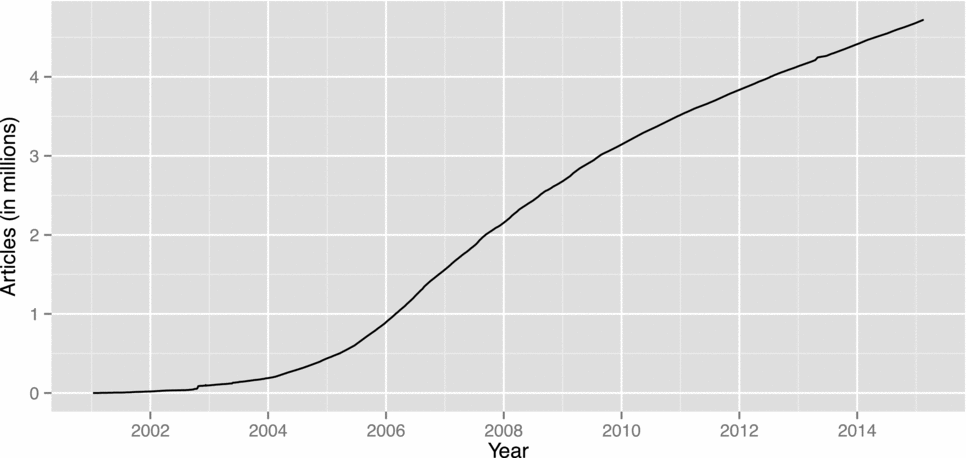
As of this writing, Wikipedia is the seventh most visited website in the world.Footnote 3 By its own count, it has 39,321,483 articles in 292 languages (5,126,463 of them in English, the largest Wikipedia) and 61,515,369 users making 2,165,910,765 edits.Footnote 4 The leading encyclopedia in the English-speaking world, the famed Encyclopaedia Britannica, on the other hand, had at its final printing (in 2010), 40,000 articles, and about 120,000 online. Figure 1 shows stunning success, compiled from Wikipedia's own statistics.Footnote 5
Number of articles on Wikipedia since its creation.

The success of Wikipedia and other projects that feature mass-collaboration, open-source, and free software-everything from Linux to R to Mozilla FirefoxFootnote 6 – have led to a dearth of popular books by scholars, entrepreneurs, and pundits making bold claims about a ‘new economics’ of the internet age (see e.g. Anderson Reference Anderson2008, Reference Anderson2009, Reference Anderson2012; Benkler, Reference Benkler2006; Downes, Reference Downes2009; Kelly, Reference Kelly1999; Raymond, Reference Raymond1999; Shirky, Reference Shirky2008; Tapscott and Williams, Reference Tapscott and Williams2007). In any event, the rise of Wikipedia stands as an example of clever construction of the rules over a creative space that enable expression without resorting to the traditional use of copyright. In fact, what is most interesting about Wikipedia is that it actually exploits copyright law in the opposite way than the law was intended. Rather than using copyright's legal right to exclude others’ ability to consume content to incentivize its original creation, Wikipedia inverts this logic by making all content available for free and compels uses and derivative of that content, to remain free and non-excludable. Wikipedia's use of the ‘copyleft’ licenses, under modern copyright law, include stipulations that all content cannot be closed off by any person.Footnote 7
As such, Wikipedia not only stands as a counterexample to the incentive-based logic of intellectual property rights, but a carefully constructed entrepreneurial workaround to the existing system of expressive works production. While in some sense, Wikipedia appears to be a simple case of market entrepreneurship, with the non-profit Wikimedia Foundation simply selling a zero-price encyclopedia, it also exhibits entrepreneurship over ‘the rules’ or the institutional arrangements governing how common resources are provided. There is a growing literature on such ‘higher-tiered’ or ‘institutional’ entrepreneurship, illustrating the importance of examining the choice of devising alternative rules or governance structures, as well as the consequences of strategic choices made under a given set of rules (Buchanan and Tullock, Reference Buchanan and Tullock1962). All human beings seek ways to maximize their own well-being, and depending on the institutions within a society, such an entrepreneurial drive can manifest itself in productive entrepreneurship on the market, unproductive lobbying for political favors, or through violent activities that outright destroy wealth (Baumol, Reference Baumol1990). Entrepreneurs can furthermore act to change the actual institutions or governance structures in order to create a more profitable environment to operate within (Schotter, Reference Schotter1981), by means of establishing new categories of property rights (Alchian, Reference Alchian1965; Demsetz, Reference Demsetz1969), creating property-protecting technologies in an area lacking state capacity (Leeson and Boettke Reference Leeson and Boettke2009; Li et al., Reference Li, Feng and Jiang2006), or by changing political rules to reach more favorable political outcomes (Martin and Thomas, Reference Martin and Thomas2013). The traditional economic concern with free riding is, as Wagner (Reference Wagner2013) astutely observes, not caused by something inherent in the ontology of the good itself, but is ‘an artifact of a particular set of institutional assumptions’. Indeed, even Hardin's (Reference Hardin1968) original tragedy of the commons example results only under a particular set of flawed institutions (Cole et al., Reference Cole, Epstein and McGinnis2014: 353). Thus, understanding how to craft institutions and governance structures properly to avoid such problems is of prime importance.
Wikipedia has succeeded by creating an effective governance structure over a common pool resource – free encyclopedia articles. This paper, following Hess and Ostrom (Reference Hess, Ostrom, Hess and Ostrom2007b) and Dourado and Tabarrok (Reference Dourado and Tabarrok2015), draws upon the institutional analysis of Ostrom (Reference Ostrom1990) and other scholars collectively known as the ‘Bloomington School’ to understand how proper design of rules leads communities to manage common pool resources effectively. The Bloomington approach elucidates a ‘test’ of eight key design principles for successful and long-enduring institutions, which I use to examine the factors which have given rise to Wikipedia's success, as well as exploring some of the challenges that Wikipedia qua governance structure for online social interaction, grapples with. I conclude that Wikipedia's success can be attributed to its sufficiently meeting the Bloomington Schools’ eight key criteria, and that it illustrates the potential for other entrepreneurial solutions at the institutional level to better ‘promote the Progress of Science and useful Arts’ (United States Constitution, Article I, Section8).
2. Expressions and the commons
Many scholars have productively suggested that we can best view culture, expression, and knowledge as a commons (Benkler, Reference Benkler2002; Dourado and Tabarrok, Reference Dourado and Tabarrok2015; Frischmann et al., Reference Frischmann, Madison and Strandburg2014; Hess and Ostrom, Reference Hess, Ostrom, Hess and Ostrom2007b; Schweik and English, Reference Schweik and English2012).Footnote 8 Economists typically define a common resource as one that is rivalrous but non-excludable – that is, while each user of a resource crowds out others’ uses, none have any ability to prevent others’ use. Hardin (Reference Hardin1968) famously describes the ‘tragedy’ of the commons whereby, due to the inability to exclude others, each person faces an individual incentive to over-exploit the resource before everyone else does. This ultimately ends up depleting the resource, with common examples being overgrazed pastures, over-fished waters, and polluted environments. The classic solution proffered to correct this problem is to establish property rights over the resource, granting users the ability exclude others use (Alchian, Reference Alchian1965; Demsetz, Reference Demsetz1964, Reference Demsetz1969, Reference Demsetz1970).
On the other hand, recent research in economic development and property rights has highlighted another potential risk of improperly prescribed property rights by governments. If rules are poorly designed, or they are forced into an alien institutional framework like Procrustes’ bed (Boettke et al., Reference Boettke, Coyne and Leeson2004), then what results is the symmetrically opposite ‘tragedy of the anti-commons’, (Buchanan and Yoon Reference Buchanan and Yoon2000; Heller, Reference Heller1997, Reference Heller2008). In such a situation, multiple users possess rights to exclude others from using a resource, requiring any would-be user to secure the blessing of every potential veto-holder. The tragic result is that the valuable resource lies dormant, mummified in bureaucratic red tape, and holdout problems.
Rather than a strict binary public-vs-private or propertized-vs-non-propertized distinction that dictates success or failure, the Bloomington School has shown that there is a wide variety of institutional forms that can govern a commons (Ostrom, Reference Ostrom2010). Rather than a guaranteed tragedy, the commons present an opportunity, provided the affected group can establish an effective governance structure over the resource.
In terms of culture, Hess and Ostrom (Reference Hess, Ostrom, Hess and Ostrom2007b: 3) apply a rather wide interpretation of a commons, defining it merely as ‘a resource shared by a group of people that is subject to social dilemmas’. This definition allows us to view expressive works as a commons, as these goods are shared by every member of society who values expression, and further by all who benefit from the fruits of culture and innovation.
Rather than traditional fears of overuse in resource commons, the knowledge commons can be, in fact, additive, or, in the words of Dourado and Tabarrok (Reference Dourado and Tabarrok2015), ‘super-Lockean’ as, contingent upon it being relatively accessible, the more people draw from it and share, the more value they add to society (cf. Hess and Ostrom, Reference Hess, Ostrom, Hess and Ostrom2007a: 5). Knowledge and expressive works, being non-rivalrous, can add more than ‘enough and as good left’ when used, since consuming, replicating, and constructing derivate works more widely distributes the original. Furthermore, the production of new works requires use of older works as inputs. As Ridley (Reference Ridley2011: 7) memorably relates, ‘ideas have sex with each other’, that is, they are combinatorial, and it is only through the exchange of ideas, rather than a single orphan idea from a lone genius, that great technologies are born. The camera pill, for instance, was born out of a conversation between a gastroenterologist and a guided missile designer (ibid: 270). Thus, the creation of new expressive works requires access to the commons of prior works in order to build upon, making the main challenge one of preventing an anti-commons from forming, and enabling new expressions to build off of old ones. As Isaac Newton famously said, ‘if I have seen further it is by standing on the shoulders of giants’.
A large volume of research by the Bloomington school collects examples of common resources that have successfully discovered governance structures that avoid tragedy (see e.g. McGinnis, Reference McGinnis1999). Their lengthy studies have culminated in constructing a grammar of institutions, the Institutional Analysis and Development (IAD) framework (Hess and Ostrom, Reference Hess, Ostrom, Hess and Ostrom2007a). Ostrom (Reference Ostrom1990: 90), Hess and Ostrom (Reference Hess, Ostrom, Hess and Ostrom2007b: 7), and Wilson et al. (Reference Wilson, Ostrom and Cox2013: S22) summarize eight ‘design principles’ for institutions to successfully manage common pool resources. Dourado and Tabarrok (Reference Dourado and Tabarrok2015) call these ‘the eightfold path to success’. Long-enduring institutions that successfully manage common pool resources have the following features:
-
(1) Clearly defined boundaries for group membership and for the shared resource;
-
(2) Proportional equivalence between benefits/costs and the contributions/transgressions of members;
-
(3) Collective-choice arrangements to allow members to establish rules and make decisions for the group;
-
(4) Monitoring of member behavior through detectable norm-abidement to prevent free-riding;
-
(5) Graduated sanctions for transgressors ranging from informal gossip to expulsion;
-
(6) Conflict-resolution mechanisms that are viewed as efficient and fair;
-
(7) Recognition of rights of group members to self-organize internally;
-
(8) Polycentric relations between the group and other social orders to maintain optimal size and autonomy.
In the next section, I investigate the success of Wikipedia by applying each of these principles to the rules, norms, and history of Wikipedia.
3. Institutional entrepreneurship: the case of wikipedia
Wikipedia, the free encyclopedia stands as an understudied testament to the consequences of crafting the right rules to facilitate expression without resort to traditional models of copyright. While many serious scholars are beginning to liberally refer others to Wikipedia articles as good primers for intellectual topics, scholarship on Wikipedia itself is widely dispersed and idiosyncratic. Among economists, Wikipedia itself is often relegated as a curious example used briefly in the service of some larger point, whether for modeling contribution spillovers (Aaltonen and Seiler, Reference Aaltonen and Seiler2014), estimating the relationship between group size and contributions (Zhang and Zhu, Reference Zhang and Zhu2011), expanding the theory of the firm (Frey et al., Reference Frey, Luthi and Osterloh2011), examining club competition and individual recognition (Polborn, Reference Polborn2007), applying network theory (Ransbotham et al., Reference Ransbotham, Kane and Lurie2012), or discussing the role of user generated content in the rise of the Web 2.0 (Kaletka and Pelka, Reference Kaletka and Pelka2011).Footnote 9 Others have primarily focused on assessing whether Wikipedia is factually accurate and unbiased relative to other encyclopedias. Giles (Reference Giles2005) found that, on average, the difference in the accuracy of 42 science articles on Wikipedia and their counterparts in the prestigious Encyclopaedia Britannica ‘was not particularly great’. Greenstein and Zhu (Reference Greenstein and Zhu2012) found that on net, Wikipedia remains neutral, interestingly not because of the revision mechanism within individual controversial articles, but because for every biased article on an issue, there appear an equal amount of articles with the opposite bias on that issue. However, Hasty et al. (Reference Hasty, Garvalosa, Barbato, Valdes, Powers, Hernandez, John, Suciu, Qureshi, Popa-Radu, Jose, Drexler, Patankar, Paz, King, Garber, Valladares and Somji2014: 371) caution that ‘[m]ost Wikipedia articles for the 10 costliest [medical] conditions in the United States contain errors compared with standard peer-reviewed sources’. Only a handful of economists or legal scholars have, in passing, mentioned Wikipedia's impact on intellectual property rights (Benkler, Reference Benkler2006; Boldrin and Levine, Reference Boldrin and Levine2008; Dourado and Tabarrok, Reference Dourado and Tabarrok2015; Frey et al., Reference Frey, Luthi and Osterloh2011; Polborn, Reference Polborn2007; Shirky, Reference Shirky2008; Tapscott and Williams, Reference Tapscott and Williams2007).
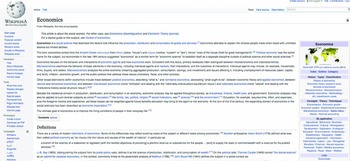
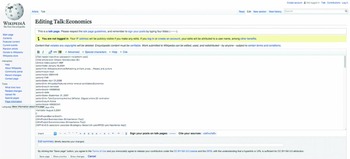
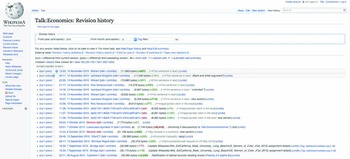
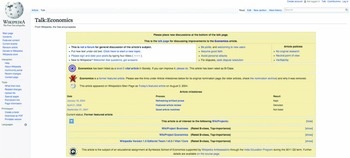
The three main components that define Wikipedia are its use of the ‘wiki’, its self-conscious efforts to be an encyclopedia, and the licensing strategy for its content (Benkler, Reference Benkler2006: 70–71). A wiki, named after the Hawaiian word for ‘quick’, is a web application created by Ward Cunningham that allows multiple users to collaborate on a document. The wiki neither structures the organization of the document, nor allocates ownership rights to any individual or entity. Any user with access can write, modify, and delete portions of the document anonymously (though typically they must register under a username or pseudonym). Each document is bundled with a ‘talk’ page, where users can discuss the actions and edits of other users. All actions and changes to the document by users are publicly recorded and archived, allowing any user monitoring changes to quickly revert the document to previous states if necessary (for instance, to reverse blatant vandalism). Figures 2–5 demonstrate the features of the wiki application via the article on economicsFootnote 10 on the English Wikipedia.
Screenshot of main article page for example article on ‘Economics’ as of November 1, 2015. Note the ‘Talk’, ‘Edit’, and ‘View History’ options on the top menu bar.

Screenshot of edit page for example ‘Economics’ article. Any user (note I am not even logged in) can edit the article page using simple Markdown language.

Screenshot of history page for example ‘Economics’ article. Any user can observe the edits by all users by username and IP address, as well as reverse them.

Screenshot of talk page for example ‘Economics’ article. Editors discuss the changes everyone is making to the article page. Note that this screenshot simply covers some of the table of contents for a long talk page.

The second key feature of Wikipedia is the deliberate effort by participants with a unifying collective goal: to disseminate knowledge. This generates a community of interested members, which enables co-production by users to generate the content of the encyclopedia articles.
Finally, all text on Wikipedia, by virtue of being ‘fixed in a tangible medium of expression’ (17 USC §102) is automatically copyrighted under U.S. law (and the Berne Convention internationally). However, wiki software does not establish a sole owner that can control the work, ‘no editor owns an article and any contributions can and will be mercilessly edited and redistributed’.Footnote 11 Furthermore, Wikipedia employs a compulsory license, the Creative Commons Attribution – ShareAlike 3.0 Unported License (CC BY-SA).Footnote 12 This license itself is a private entrepreneurial creation by the founders of Creative Commons, a non-profit organization that provides licenses that promote greater access and distribution of copyrighted works. The CC-BY-SA license permits users to share and adapt the work without requesting permission, even for commercial purposes, so long as they attribute credit to the source and document any changes. Furthermore, derivative works based on the original must also employ the same license conditions as the original. This ensures that all Wikipedia articles remain open to satisfy the goal of becoming a freely accessible public encyclopedia, and its content can never be closed off into an anti-commons by users or copyright holders.
Wikipedia is governed by its members adherence to the ‘five pillars’ that normalize articles and interactions on the site:Footnote 13
-
(1) Wikipedia is an encyclopedia;
-
(2) Wikipedia is written from a neutral point of view;
-
(3) Wikipedia is free content that anyone can use, edit, and distribute;
-
(4) Editors should treat each other with respect and civility;
-
(5) Wikipedia has no firm rules.
I now turn to examining how Wikipedia's success in terms of how it (intentionally or otherwise) implements all eight of the Bloomington School's principles for successful institutions.
Defined boundaries
The definition and purpose of Wikipedia is made quite clear by its first pillar – it is a voluntary encyclopedia open to all to use and edit. In further defining the purpose of building an open online encyclopedia, Wikipedia has a made a clear list of what it is not meant to be.Footnote 14 Wikipedia is not, for instance, a dictionary, a place to publish original research, a soapbox, a newspaper, a manual, or a technical journal.
Wikipedia exhibits perhaps one of the clearest possible examples of coproduction. Coproduction allows consumers or end-users of a commons to input skills or information into the production of public goods (Aligica and Tarko, Reference Aligica and Tarko2013). For many public goods, such as Wikipedia articles, the input of consumers is essential ‘if there [is] to be any production at all’ (Parks et al., Reference Parks, Baker, Kiser and Oakerson1981: 1001–1002). This is highlighted precisely by the fact that Wikipedia deliberately refers to all users who use Wikipedia as editors – a title that outside of Wikipedia connotes gate-keeping authority. Indeed, without this key element of blurring the line between consumer and producer, Wikipedia would have gone the way of Nupedia long ago, and languished in the shadow of authoritative expert encyclopedias like the Britannica.
Wikipedia is also a shared resource that is potentially available to any user to consume. Any person who visits the website is automatically a user of Wikipedia, and catalogued according to their computer's IP address. They can consume Wikipedia's content anonymously and can also edit any article in principle. At its original inception, Wikipedia was truly anarchic in that anyone could create and edit articles without any formal registration requirement. However, over time, Wikipedia instituted a policy requiring users to register a username (usually pseudonymous) in order to create new articles, edit certain articles, and acquire other privileges.Footnote 15 Wikipedia has also instituted further exceptions to truly open editing, as in cases of suspected vandalism, as described below.
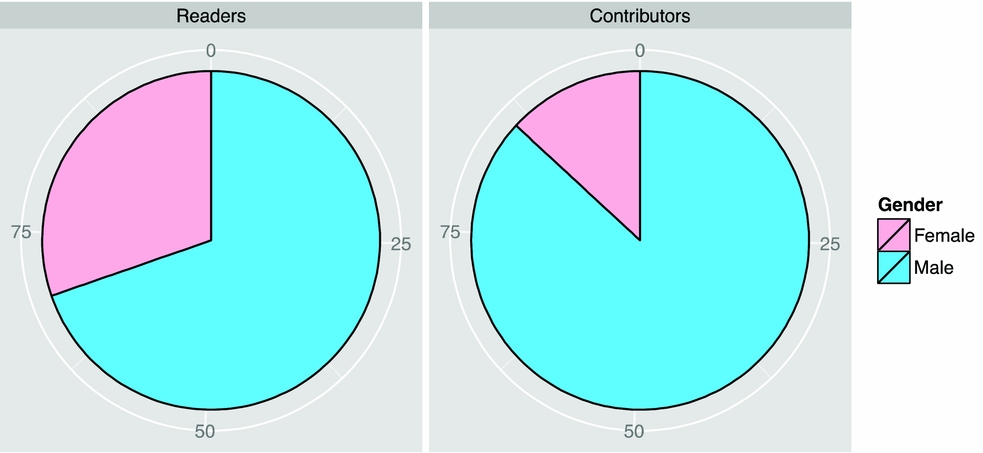
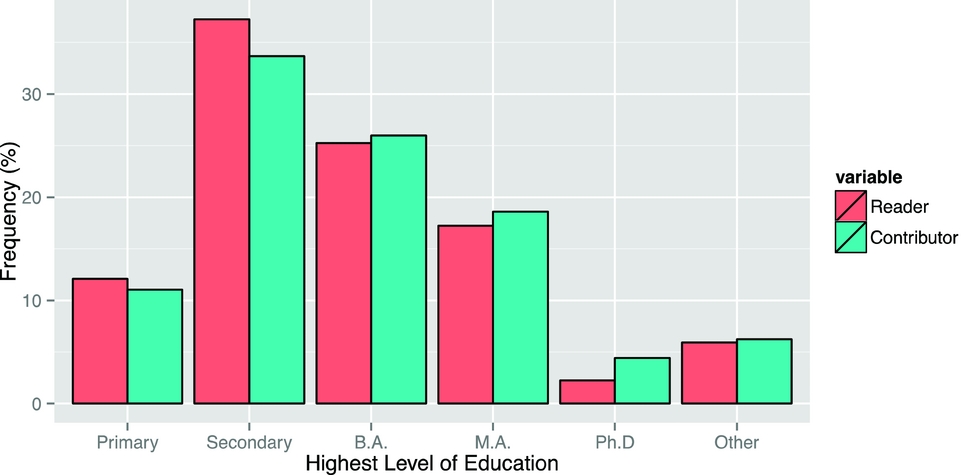
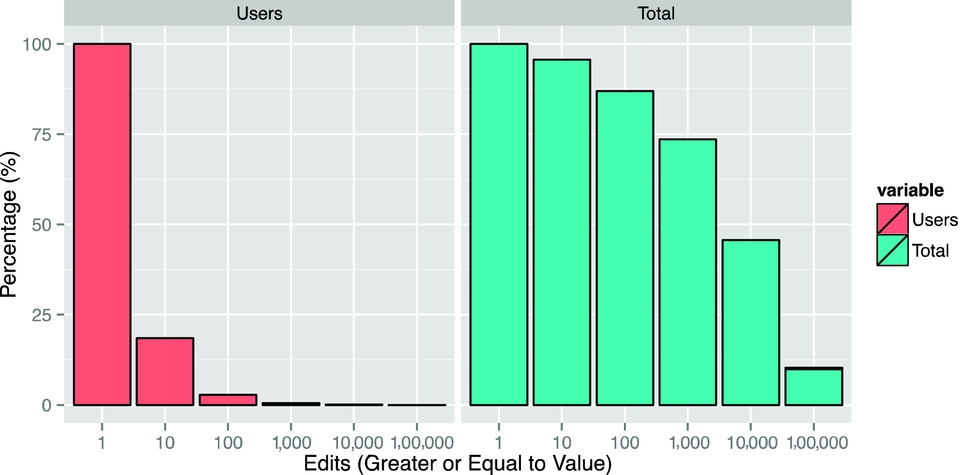
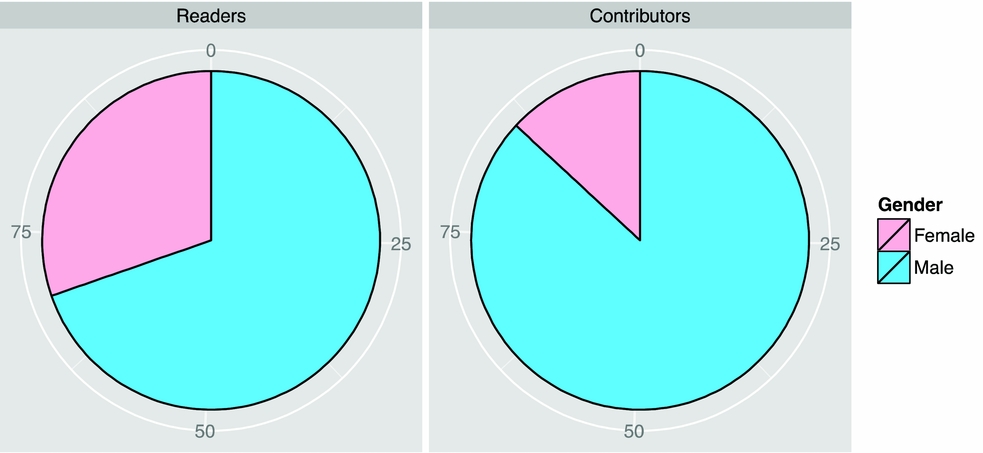
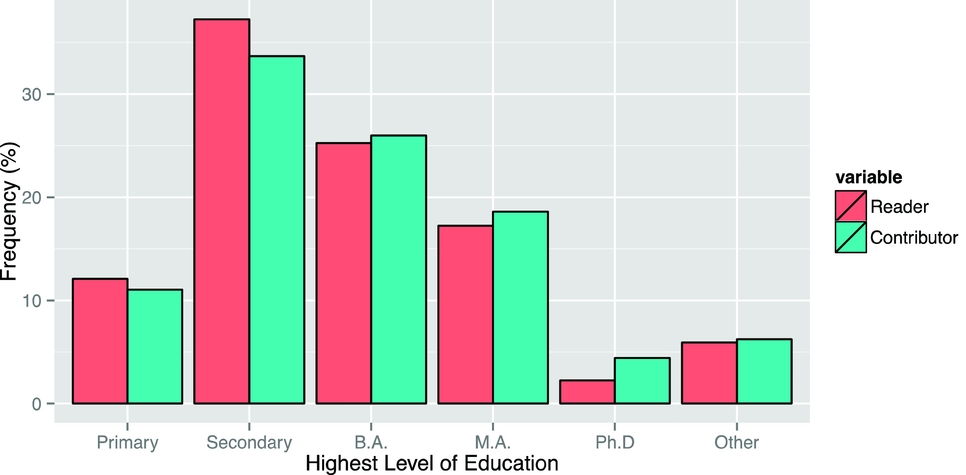
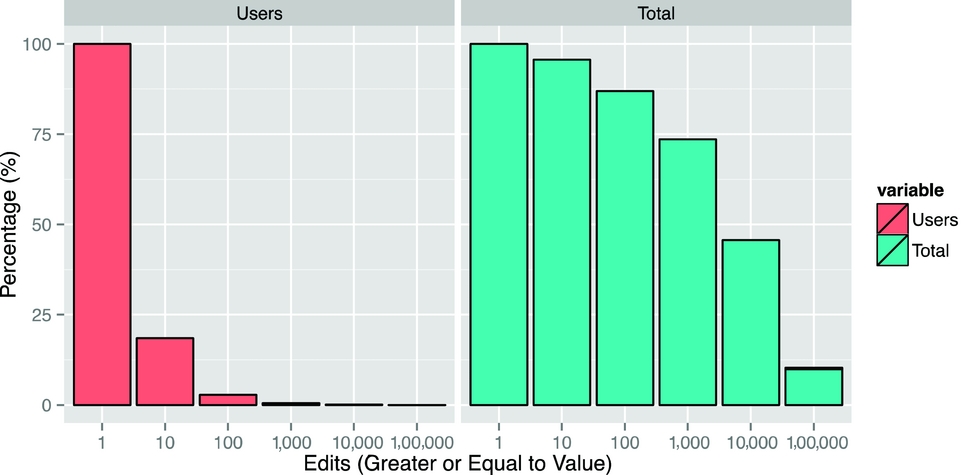
A 2010 voluntary survey of 170,000 Wikipedians across 231 countries and in 21 languages provides some demographic information about who uses and contributes to Wikipedia (Glott et al., Reference Glott, Schmidt and Ghosh2010). Most users (about 65%) identify themselves as only a reader, 23% report themselves as occasional contributors, and a small minority (7%) call themselves regular contributors (ibid.: 5). Readers are on average 25 years old, with about half of respondents younger than 22 years (ibid.: 7). Readers tend to be slightly younger (on average 25 years old) than contributors (on average 26 years old). There is also a disproportionate percentage of male readers (69%) and contributors (86%) relative to female readers (30%) and contributors (13%), as depicted in Figure 6. Furthermore, contributors tend to be slightly better educated than readers, with most users having at least a high school or Bachelor's level of education, reflective of the dominance of younger age groups, as shown in Figure 7. Additionally, while users report a variety of unique reasons they choose to contribute, most indicate desires to spread knowledge or fix errors, while very few contribute for the purpose of earning money, furthering a career, or, even to gain reputation within the Wikipedia community (ibid.; 9). For those who do not contribute, the most common reasons reported are unfamiliarity with the process, lack of time, uneasiness about editing others work, not feeling sufficiently qualified or knowledgeable to contribute, and satisfaction with passively reading rather than actively contributing (ibid.: 10). Those users that do contribute edits tend to make only a handful of them, with a very small proportion of users making many edits, as shown by Figure 8. The left panel shows the proportions of users who contribute a certain number of edits and the right panel shows the proportion of total edits made by those users who contribute a certain number of edits.Footnote 16
Breakdown of Wikipedians by gender, compiled from Glott et al. (Reference Glott, Schmidt and Ghosh2010: 7).
Breakdown of Wikipedians by highest level of education attained, compiled from Glott et al. (Reference Glott, Schmidt and Ghosh2010: 7).
Distribution of article edits by registered Wikipedia users.
Stemming from Wikipedia's intentional collective goal of being an encyclopedia, Wikipedians use several mechanisms to exclude users who run contrary to this goal. Primarily, users who deliberately and systematically try to edit Wikipedia articles for reasons other than good faith efforts to disseminate accurate information (i.e. spreading lies, rumors, political biases, edits-for-hire, etc.), will have their IP address or username banned – which will allow them to read but no longer edit articles. This process is described in more detail in the next section.
Proportional costs and benefits
Proportional equivalence between costs and benefits ensures that certain subsets of the group are not bearing disproportionate costs or benefits, which would threaten the internal stability of the group and its shared resource.
As Hume (Reference Hume1740: Book III, Part II, Section V) famously described,
Men being naturally selfish, or endowed only with a confined generosity, they are not easily induced to perform any action for the interest of strangers, except with a view to some reciprocal advantage, which they had no hope of obtaining but by such a performance.
People thus reserve their benevolence for those closest to them, and can often foster cooperation with others in the broader commercial society according to anonymous arms-length exchanges in markets according to prices (Hayek, Reference Hayek1973).
Wikipedians do not get paid. Even the Wikimedia Foundation, which owns the physical infrastructure behind Wikipedia and oversees its operation, is a non-profit organization financed by donations. Thus, there is little financial incentive to contribute edits. Scholars have long observed that in many cases of expressive works, such as writing a book, authors do not necessarily require financial motive to produce such a public good (see e.g. Johnson, Reference Johnson2012; Landes and Posner, Reference Landes and Posner2003: 41–50). Wikipedia's structure seems to have tapped the right ingredients to captivate Hume's ‘confined generosity’ to motivate individuals to contribute in the public interest.Footnote 17 Primarily, this is because Wikipedia is both modular and additive.Footnote 18 An article on Wikipedia is an independent good, and is capable of being effectively produced by one person or one million. Furthermore, each individual edit by any given user contributes to the social product (provided the edit is not intentionally malicious), and an individual edit can take as little or as much time as a reader has time (and passion) for. This could range from spending 30 seconds to correct a misspelled word, to many hours spent creating a new article that the user is passionate about. Researchers studying free and open source software have long noted that modularity is a key component of successful non-proprietary software (Benkler, Reference Benkler2002; Raymond, Reference Raymond1999). Thus, the ease, modularity, and additive nature of editing Wikipedia helps channel users’ ‘confined generosity’ to edit for the social good out of their own personal desires without requiring financial incentives (which would be necessary if making contributions were of a larger and individually costlier scale).Footnote 19
The main currency within Wikipedia's community is reputation and social standing for a small subset of passionate and active users. Building a reputation, conceived as investing in social capital, can allow an editor to engage in a lot of activities in which other users can not. First, she can expect a higher likelihood of her edits to be approved rather than removed. Additionally, she can ‘run’ for higher office as a bureaucrat or an administrator. This, however, can only account for a small fraction of a percent of all registered users (not even counting unregistered readers). As self-reported by users in the survey by the reasons given for contribution levels in Glott et al. (Reference Glott, Schmidt and Ghosh2010) above, few users chose to contribute out of a desire for reputation within the Wikipedia community. Hence, any potential gains to reputation are only valuable to those who wish to be very active, visible, and well-ranked among the Wikipedia community – precisely those interested in admin powers. Most users feel satisfied with simply reading or small individual contributions toward editing articles, rather than seeking to forge ongoing relationships with a close-knit community (which one can participate in only by actively posting and discussing on talk pages).
Wikipedia has a small degree of hierarchy that naturally emerges from within the community, in the form of functionally defined roles of administrators (admins) and bureaucrats. Admins are users that are granted greater control over articles and other user abilities, such as the power to block and unblock user accounts and IP addresses from editing articles, protect and unprotect pages from editing entirely, delete and undelete articles, and rename articles.Footnote 20 At Wikipedia's inception, every user was granted admin powers, but over time, as a protection against vandalism, these powers have been trusted to only a small number of dedicated users. Wikipedia does not have any formal rule for qualifying a user for admin powers, every user can apply to become an admin, but the community holds a discussion about each application and if there is a clear positive consensus after 7 days, that user is approved. Thus, only members who are deeply involved in the community and make frequent contributions are likely to be rewarded with adminship. Jimmy Wales argues that the administrator is merely a technical role played by regular community users and is reserved for editing emergencies, rather than any inherent authority or hierarchical superiority. The role, like the rest of Wikipedia, is purely voluntary and uncompensated. The English Wikipedia currently has 1,463 administrators.Footnote 21
Bureaucrats are users simply invested with the power to add and remove administrator powers to a user to enact a community consensus.Footnote 22 The process of becoming a bureaucrat is similar to that of requesting adminship, though a higher degree of community consensus is required for this role. There are currently 33 bureaucrats on the English Wikipedia.
Collective-choice arrangements
All successful groups need some sort of decision-making procedure to create and modify rules that affect all members of the group in furtherance of the group's ends. The main way Wikipedia's ends are achieved is through informal community consensus on article content and user activities.Footnote 23 As there are few formal rules that govern the editing process (mostly reserved for resolving crises), most rule-making is emergent and norm-based, contingent on the overall goal of creating an open encyclopedia.
Following the trade-off between internal decision-making costs and external costs identified by Buchanan and Tullock (Reference Buchanan and Tullock1962), Wikipedia features quite low internal decision-making costs and high external costs.Footnote 24 As typified by Wikipedia's first pillar, Wikipedia's collective goal of being a genuine high-quality encyclopedia places hard constraints on articles and editors: edits that are commonly viewed as detracting from this goal are fiercely resisted and will be removed by nearly anyone. Thus, external costs are rather high. Despite this, internal decision-making costs are quite low, since the number of people interested in any given page is quite small (certainly this group size varies across article subjects from ‘Tholeiitic magma series’ to ‘Capitalism’). Additionally, Wikipedia is able to achieve its goal of a neutral point of view by including all perspectives that heterogeneous users are willing to contribute into an article. Often, any controversial article (‘Capitalism’, for instance) will feature a ‘Criticism’ section where users of different opinions can choose to express their dissent through opposing arguments. As a result, with relatively high external costs and low decision costs, the Calculus of Consent model predicts that the optimal decision-making rule is to require agreement among a very large proportion of the deciding group. Wikipedia confirms this prediction, as it is a foundational feature of Wikipedia that major decisions are made ‘by consensus’.
Wikipedia delineates several tiers of a normative structure to govern user interactions: policies, guidelines, and essays.Footnote 25 Policies ‘have wide acceptance among editors and describe standards that all users should normally follow’. Guidelines are ‘sets of best practices that are supported by consensus’, that users are encouraged to follow, but common sense is mostly needed. Essays are merely opinions of a single user or group of users about an issue that has not reached community consensus. Users can post essays that they do not wish others to edit on their own personal user page.
Even at a higher, constitutional level, to change overall policy, Wikipedia does not employ any sort of formal voting system. Wikipedians can propose and discuss changes to overall Wikipedia policy or guidelines on relevant talk pages. ‘Village pump’ pages exist as a forum for members to provide notice and discussion of proposals for major rule changes.Footnote 26
Monitoring
The success of any group effort strongly depends upon the ability of members to cheaply monitor defection and behavior harmful to the collective goals of the enterprise. One might reasonably imagine that Wikipedia faces a gargantuan collective action problem in monitoring the accuracy of millions of articles that are subject to hostile edits by anonymous readers at all hours of the day. However, several technical components of the wiki software mitigate this problem, as well as the different incentives of individual users and groups.
Monitoring is still critical for Wikipedia, despite the fact that neither its product nor its members’ contributions are denominated in measurable dollar terms.Footnote 27 In meeting their collective goal of being a genuine encyclopedia, Wikipedians must still monitor the quality of each other's articles. Fortunately, the wiki platform enables the site to distribute monitoring capacities across its members with relevant knowledge and interests.
As part of the software, each article has a talk page, where users can comment on changes by other users, as well as view an archive of all changes made by every user according to their username or IP address (if unregistered). Users can also add a particular article to their ‘watchlist’, where they will automatically be notified of any change to the article's content, and of conversations occurring on the article's associated talk page. Edits to an article that are malicious can easily be detected and reversed with the click of a button, reverting the article to its state before the particular edit. Figures 6–8 again illustrate this with an example.
One might ordinarily expect a strong collective action problem to arise between a single committed vandal and a large group of people benefitting from a common resource such as a Wikipedia article. With many ‘free riding’ readers of any given article, it might be a potential challenge for users to police and combat malicious changes. However, the design of the wiki software flips the logic of collective action problems on its head, giving users an effective means to quickly reverse vandalism through their watchlists of articles they have an interest in, with this ability increasing with the number of readers.
Though all users have editing power, there are no editors that are tasked with overseeing the entire set of articles. Typically, any given contributor is interested only in a particular set of topics that they have expertise, interest, or passions in. Should a malicious user attempt to vandalize and intentionally edit an article for the purpose of mockery, irrationality, or prejudice, these edits can be quickly discovered by interested users. The larger the audience of interested readers on generic, popular, or controversial topics (e.g. capitalism, Star Wars, or current events), the more eyes policing and the less likely a vandalistic edit can seep through the cracks. More technical, idiosyncratic, and less trafficked articles face a higher likelihood of vandalistic edits persisting for a significant period of time. Furthermore, users that repeatedly vandalize articles are identified by their username or IP address, which can be suspended or permanently banned by admins (see Sections 3.5 and 3.6).
A second type of monitoring dilemma exists between ordinary users and admins. Ordinary users must have some recourse over admins that have gone rogue or are otherwise abusing their admin powers, such as improperly banning users or excessively locking articles. Admins are monitored by other users who are interested in respective articles that are being abused, including other admins. Admins suspected of continual abuse of their powers can be removed by Jimmy Wales or the arbitration committee (ArbCom) (see below).
Graduated sanctions
In order to ensure compliance with community norms, any group must have punishments to deter unsocial behavior. Punishments for violations further must be scaled gradually, to ensure they do not further incentivize worse behavior (e.g. minor infractions should not be met with immediate expulsion, or else there is no relative cost difference between committing a minor or a major infraction).
Wikipedia has three main sanctions against individual violators: communal shaming, temporary bans, and permanent bans. Individual users that vandalize articles or otherwise violate Wikipedia's policies are first often met with discussion on the article's talk page. A user's malicious edits will typically be reversed by another user and documented on the talk page. For continual vandalism by a particular user, identified either by their username or IP address, admins can block the username/IP address from editing temporarily, or for severe cases, permanently. Wikipedia publicly posts all active sanctions in place against violators.Footnote 28
Conflict resolution mechanisms
Any group must have mechanisms to resolve disputes between individual members that are effective at resolving conflict, and are viewed by all participants as impartial and decisive. In general, with respect to its mission of creating an open source encyclopedia, Wikipedia strives to minimize potential conflict over the content of articles by mandating a ‘neutral point of view’.Footnote 29 Rather than aiming for consensus on a single point of view and subsuming all content to it, Wikipedia encourages a diversity of opinion. To productively channel the passions of competing factions of opinion, Wikipedia articles often feature sections that include the various arguments for different opinions.
Predictably, the main type of conflicts on Wikipedia are disagreements over the content of an article. This can range from honest disagreements between varying perspectives on an issue (e.g. liberal and conservative users editing a policy-relevant article) to deliberate ‘trolling’ and malicious vandalism. To the extent that different opinions are not productively expressed in designated ‘criticism’ sections of an article, users attempt to resolve it in the talk page discussion. As noted above, when this is insufficient, it falls to admins to mete out punishment to recalcitrant users.
As both monitoring and control over content are distributed across many users, conflicts over article content can easily trigger an ‘edit war’, where multiple users each repeatedly edit articles in their favor and reverse all dissident edits.Footnote 30 This includes cases where an individual editor repeatedly restores her preferred version of the article after it has been removed by other editors. Wikipedia normally encourages editors to come to a consensus on the talk page and essentially ‘talk-it-out’. When disagreements boil over to outright edit wars, Wikipedia invokes a bright line ‘three-revert rule’ (3RR) which declares that no editor may perform three reversions of others’ edits on an article in a 24 hour period.Footnote 31 Editors who frequently violate the 3RR rule are subject to the graduated sanctions listed above.
Additionally, for articles on topics, persons, or events that systematically provoke controversy (the reader can certainly imagine some), articles can be placed under ‘protection’.Footnote 32 While any user can call for an article's protection in its associated talk page, it is up to an admin to change the protection settings for an article. Protection constitutes a range of measures, ranging from preventing any changes by unregistered users without admin approval to full protection where only admins can edit articles.
Wikipedia's ‘court of last resort’, at least on the English Wikipedia, is the ArbCom.Footnote 33 The committee is comprised of 12 users appointed by Jimmy Wales after advisory elections by the community, and to date has decided over 370 cases of user conduct. The committee's decisions are binding on Wikipedia members, and their punishments have ranged from warnings to bans. Hoffman and Mehra (Reference Hoffman and Mehra2010) document that the ArbCom largely stays true to its ideal by choosing to review primarily behavioral disputes between user conduct, rather than the content of articles under controversy.
Wales in particular has quite a lot of de jure control over Wikipedia. As he appoints the ArbCom members, although constrained by selecting those members that have been approved by community consensus, he could potentially wield the ArbCom's power to ban any users that post content he disagrees with. However, use of the ArbCom has been relatively limited (although not without its critics).
Wales appears to act as a benevolent despot, although he has rejected commentators’ use of this term to describe him, and instead chooses to compare himself to the Queen of England, a constitutional monarch with no real power.Footnote 34 If we can assume, based on his statements and actions, that Wales’ objective is to maximize the spread of information,Footnote 35 then the literature on rational dictatorship implies that he will select the optimal amount of interference with production (see e.g. Congleton, Reference Congleton2011; Olson, Reference Olson1993; Tullock, Reference Tullock2005; Wintrobe, Reference Wintrobe1990). Wales, however, is not in the strict sense a residual claimant to the financial success of Wikipedia, as Wikipedia is a non-profit organization that produces no revenue-generating assets.Footnote 36 Thus, he would likely choose to engage in minimal intervention into the production of Wikipedia articles – only enough to ensure basic order and prevention of severe vandalism that would jeopardize information creation and spread. Furthermore, to ensure that this is a credible commitment on his part, Wales empowers the ArbCom to veto his actions and have members of the ArbCom selected by popular vote, similar to the evolution of the constitutional King and Council models in Congleton (Reference Congleton2011). This ensures that editors are convinced that Wales will credibly restrain his authority and will all continue to produce articles, increasing the likelihood of achieving Wikipedia's mission, and satisfying Wales’ preference for disseminating information (not to mention, presumably filling donation coffers).
Recognition of self-organization rights
All successful groups must have the authority to conduct their own affairs and their members’ autonomy respected. As stated in the fifth pillar, Wikipedia does not have firm rules, but instead has mere ‘policies and guidelines. . .not carved in stone’. Contingent on respecting the basic rules of common sense and human decency, with wanton exceptions listed above, the openness of Wikipedia achieves respect for individual autonomy in spades, with its categorical tongue-in-cheek ‘rule’ to ‘ignore all rules’.Footnote 37
As noted above, the English Wikipedia's ArbCom has only decided 370 cases of user conduct, despite the existence of millions of articles, tens of millions of users, and almost two billion edits. This suggests that Wales and the Wikimedia Foundation do indeed respect users’ rights to self-organize in practice, not just in theory or PR statements.
Polycentric external relations
For those groups that interact with other groups and with the social order at large, the given group must have mechanisms that coordinate activity productively across different groups such that the size of various groups is proportional to the size of the collective problem faced. Wikipedia is an Internet website that produces content available to all with an internet connection across the world. As the raison d'etre of Wikipedia is producing expressive content in the form of original encyclopedia articles, Wikipedia must interact with other media outlets and original works under national and international copyright laws. Since all original expressive works require inputs from previous existing works, Wikipedia users and article content must not run afoul of existing expressive works or their copyright holders.
Creators often view copyright as the sine qua non of creative work, since having a copyright on a work stands as evidence of expressing something of value.Footnote 38 On Wikipedia, however, this is far from the case. While there are no rights to exclude consumers of Wikipedia articles, and there are no monetary exchanges evidencing value, Wikipedians are creating value in the form of zero-price encyclopedia articles. Within the Wikipedia community, some of these contributions are recognized and allow particularly prominent editors to rise to the ranks of administrators and bureaucrats. Perhaps, due to the modularity of any marginal Wikipedia edit, users can create value and contribute to the Wikipedia project on their own time solely due to their Humean ‘confined generosity’, and their desire to further the expansion of knowledge. Were they asked, or ordered – as in an employment relationship – to write substantial portions of encyclopedia articles, it seems more likely that contributors would feel the stronger burden of their opportunity cost, and require greater financial incentive.
In any event, Wikipedia does however make use of other media and expressions created outside its website, which are governed by the law of copyright. Wikipedia policy requires users seek permission prior to posting any copyrighted work (text, image, video, or sound recording) within a Wikipedia article.Footnote 39 Wikipedia strongly encourages its users to use works that are in the public domain, works that can be plausibly used under copyright's ‘fair use’ doctrine, works that users themselves have ownership over and authorize for use on Wikipedia, or copyrighted works that are licensed for free use (such as works under Creative Commons licenses). The license also mandates that authors of content on Wikipedia must adhere to Wikipedia's license, preventing them from closing down the article or seeking royalties from use in an article. Owners of existing works that are posted on Wikipedia without consent have recourse to a special request to take down a Wikipedia article for copyright infringement.
Finally, as mentioned above, Wikipedia content is protected by the Creative Commons CC-BY-SA license. Articles that are produced on Wikipedia are freely accessible to anyone to use, distribute, and modify, so long as they give attribution to Wikipedia and all modifications follow these conditions as well.
4. Implications
The language of ‘intellectual property rights’, makes it seem natural to extend the logic of property rights to the ethereal realm of non-rivalrous ideas and expressions. The common parlance entices many economists, conditioned by the association of ‘property rights, good; no property rights, bad’, to support intellectual property rights. Economists have long recognized the critical role that property rights have played in both the successes and failures of attempts to cultivate economic growth. Resources that have yet to be ‘propertized’ remain in the commons, subject to the tragedy of the commons, dooming the resource to overuse and depletion.
Many critics of intellectual property rights have indeed argued strongly that the term is a misappropriation of a legal concept for a political benefit of a particular industry (Kinsella, Reference Kinsella2008; Lessig Reference Lessig2004). The rhetoric of property rights can often be a facade for political action used for private gain (Stigler, Reference Stigler1971). Whether for taxi medallion auctions, defense contract procurement, or tradeable pollution permits, the language of property rights and markets may merely consecrate that which is to be perceived as wise political program, when in fact it is a rent-seeking victory by some interest group. Said ‘rights’, in this view, appear to be merely enforceable claims to perpetuate obsolete business models by vetoing innovation, akin to horse-and-buggy producers having the ‘property right’ to prohibit the automobile from being manufactured. As Landes and Posner (Reference Landes and Posner2003: 23) remind us, ‘[a] fundamental principle of American law is that competition is not a tort’. Critics prefer the term intellectual privilege, both analytically and normatively, to describe the actual dynamic at work (Bell, Reference Bell2014).
Extensive research by the Bloomington School, however, allows us to both sidestep this contentious debate, as well as use new analytical tools for examining the diversity of solutions to the age old problem of fostering innovation and expression. If a governance structure is improperly designed, or imposed from on-high without regard to local conditions and historical context, then indeed the tragedy of the commons – where weak rules under-exclude, or the symmetric tragedy of the anti-commons, where strong rules over-exclude – would ensue. Therefore, the key to understanding prosperity, innovation, and the role of property rights is not to ask the simple binary question ‘do (or should) property rights exist for X?’ – or exist at some theoretical optimum – but how those rights fit within an existing framework of institutions that promote or stifle cooperation, exchange, and production (Boettke et al., Reference Boettke, Coyne and Leeson2004; Buchanan, Reference Buchanan1964). In doing so, scholars in this tradition have sought to study many cases of both market and institutional entrepreneurs and communities designing ‘good’ rules of interaction that promote cooperation, exchange, and proper stewardship over common resources (see e.g. Dourado and Tabarrok, Reference Dourado and Tabarrok2015; Frischmann et al., Reference Frischmann, Madison and Strandburg2014; McGinnis, Reference McGinnis1999). Clever design of governance structures to manage a commons presents an opportunity, not necessarily a pre-ordained tragedy.
In general, copyright laws have both made it more difficult for entrepreneurs to navigate markets due to higher transactions costs of negotiating rights, as well as distorting the channels of activity by major creative firms and entrepreneurs (Safner, Reference Safner2016). Despite this, while plenty of incumbent firms continue to cling to business models rapidly being made obsolete by new technology and turn instead to political and legal processes to maintain rents through ‘lobbynomics’ (Hargreaves, Reference Hargreaves2011), others have discovered new enterprising ways of circumnavigating the increasing risk of an anti-commons. Some have embraced new technologies emerging in the market such as streaming (e.g. Netflix and Spotify) or bundled greater services and convenience to their products (e.g. iTunes and Amazon).
The more radical response has come from entrepreneurs attempting to create new organization and institutional spaces by designing rules that make traditional models of distribution or legal protection unnecessary. It is this ‘higher-tiered’ form of institutional entrepreneurship that this paper has attempted to highlight through the case of Wikipedia. Scholars of innovation and culture have understudied this type of creative solution to such a complex puzzle. Despite the fact that Wikipedia still resides within a legal system of copyright, its content is not created with the intent to exclude others from use, quite the contrary. Wikipedia should stand out like a sore thumb to the modern read as one of the quintessential examples of institutional and cultural success in the knowledge economy of the rising 21st century. It is a resource that is used by millions at a money-price of zero, and yet creates – admittedly unquantifiable, but surely significant-value in spreading knowledge to both expert and hobbyist alike. While Wikipedia may not rebut the logic of preventing free riders via intellectual property rights such as copyright, it illustrates that alternative governance structures can, under certain conditions, provide public goods and manage common resources by other means.
Hence, we must broaden our theoretical frameworks of how expressive goods are produced to account for greater institutional diversity and continue to search for alternative governance structures. Economic models with closed-form solutions, such as optimizing the trade-off between incentive and access while holding a society's institutional form constant (or worse, abstracting from it entirely) may prevent us from better understanding cultural expression. Such models may miss the diverse forest for the trees by ignoring the variety of culture-enhancing institutions. Instead, we must take a broader, comparative institutional approach to studying efficiency and effectiveness in the provision of expressive works. The Bloomington School's theory and methodology provides a great step forward to locate other case studies in order to uncover the true breadth of institutional variety and creative potential.
Acknowledgements
I would like to thank Alex Tabarrok, Vlad Tarko, Mike Madison, Geoffrey Hodgson, Elana Reman, and two anonymous reviewers for useful comments. I am also grateful to the Earhart Foundation for financial assistance. The usual disclaimer applies.