Introduction
Cholecystokinin (CCK) is one of three main gastrointestinal hormones exerting several biological actions. Contractile effects on the gallbladder and inhibition of gastric emptying are among its physiological influences (Liddle, Reference Liddle1994). It is also believed that CCK plays a major role in gastrointestinal peristalsis (Dockray, Reference Dockray1994; Walsh, Reference Walsh1994). Several extensive studies have been performed in order to explain its precise role in the gastrointestinal motility (Yonekura et al., Reference Yonekura, Kitade, Furukawa, Takahashi, Katsumata, Katoh and Obara2002; Adelson et al., Reference Adelson, Million, Kanamoto, Palanca and Tache2004; Varga et al., Reference Varga, Balint, Burghardt and D’Amato2004) as the whole problem is not easy to assess. These difficulties are due to the existence of multiple molecular forms of CCK, possible hormonal or neural effects and interactions, the different effects in various segments of the gastrointestinal tract, biphasic responses, unresolved problems with the localization of CCK receptor subtypes and CCK release, the complexity of gastrointestinal motor functions, and species differences (Liddle, Reference Liddle1994; Li et al., Reference Li, Zhu and Owyang1999; Wang et al., Reference Wang, Prpic, Green, Reeve and Liddle2002). In ruminants, these questions are even less known than in monogastric species. CCK-immunoreactive cells are present in ruminant small-bowel mucosa (Calingasan et al., Reference Calingasan, Kitamura, Yamada, Oomori and Yamashita1984). In sheep tissues, as in other species, the cholecystokinin-octapeptide (CCK-OP) is present and seems to be one of the major forms (Liddle, Reference Liddle1994; Varga et al., Reference Varga, Balint, Burghardt and D’Amato2004). CCK decreases antral peristalsis and contracts the pyloric sphincter (Ruckebusch, Reference Ruckebusch1988). CCK and its amphibian analogue, cerulein, stimulate small-intestinal motor activity and participate in the induction of a fed-like pattern (Cottrell and Gregory, Reference Cottrell and Gregory1991). Therefore, either the natural CCK form (CCK-OP) or its amphibian analogue (cerulein) was used for comparison of their actions and potencies in sheep and for further validation of the applied experimental model.
The minute rhythm (MR) is one of the most important motility patterns and appears mostly in the upper small intestine. In the duodenum, it comprises, most frequently, a single spike burst migrating aborally with a relatively high speed at about 1-min intervals (Fleckenstein et al., Reference Fleckenstein, Bueno, Fioramonti and Ruckebusch1982). In the jejunum and ileum, the number of MR-related spike bursts might be increased. It can be assumed that it is responsible for chyme propulsion. The MR can be observed during either interdigestive or digestive states (Wilmer et al., Reference Wilmer, Van Cutsem, Andrioli, Tack, Coremans and Janssens1998; Romański, Reference Romański2002). During the former state, MR arrives mostly during phase 2 of the principal interdigestive pattern called the migrating myoelectric (motor) complex (MMC). Three or four phases of the MMC pattern can be distinguished (Code and Marlett, Reference Code and Marlett1975). Phase 1 of the MMC is characterized by lack or very sparse spike bursts or phasic contractions. During the irregular phase 2 of the MMC, the intensity of these events gradually increases, becoming maximal and most regular during phase 3. Phase 4 of the MMC, not always observed, resembles phase 2 of the MMC and arrives just before phase 1 of the next MMC cycle. Phase 2 of the MMC is usually the longest, and thus Dent et al. (Reference Dent, Dodds, Sekiguchi, Hogan and Arndorfer1983) proposed its subdivision into phases 2a and 2b. The evident increase in spike burst incidence during phase 2 of the MMC was suggested to be considered as the border between phases 2a and 2b of the MMC in sheep (Romański, Reference Romański2007).
Although this pattern was already described, also in sheep (Fleckenstein et al., Reference Fleckenstein, Bueno, Fioramonti and Ruckebusch1982; Wilmer et al., Reference Wilmer, Van Cutsem, Andrioli, Tack, Coremans and Janssens1998; Romański, Reference Romański2002), no report has been published concerning the effect of CCK on the MR in any animal species. Thus the physiological role of CCK in the control of MR is virtually unknown. Its characteristics and evoking mechanisms also have not been sufficiently ascertained. The mediatory effect of CCK upon the small-intestinal MR was assumed possible since the cholinergic system may control the arrival of the MR and modulate CCK action on gastrointestinal and gallbladder motility (Liddle, Reference Liddle1994; Walsh, Reference Walsh1994; Romański, Reference Romański2002). On the other hand, feeding, which may stimulate CCK release from the gut, affects the MR pattern (Romański, Reference Romański2002), which implies the role of gastrointestinal hormones (including CCK) regulating this pattern. Thus the influence of three doses of CCK-OP and cerulein upon the gastrointestinal MR pattern was studied in fasted and non-fasted sheep during various phases of the small-intestinal MMC in order to determine the role of CCK in the control of MR within the ovine small bowel.
Material and methods
Surgical preparation of animals
Six Polish Merino adult rams weighing 40 to 44 kg each were used. The animals were fasted 24 h before surgery (the sterile technique). Then, a 10 to 12 cm right lateral incision was performed under general and local anesthesia. Seven bipolar platinum electrodes were attached, these being on the serosal side to the antrum (one electrode, 4 cm proximally to the pyloric ring), the duodenal bulb (one electrode, 10 cm distally to the pyloric antral electrode), the duodenum (main duodenal electrode, 50 cm distally to the bulbar electrode), the jejunum (two electrodes, 200 and 300 cm distally to the duodenal electrode) and the ileum (two electrodes, 110 and 10 cm proximally to the ileo-cecal sphincter, respectively). In four of these sheep, two additional mid-duodenal electrodes, spaced 15 and 30 cm distally to the bulbar electrode, were sutured and the strain gauge force transducer was attached near the main duodenal electrode. Tissue reactivity in response to the insertion of the electrodes was previously checked during 3 months and no inflammatory reactions were observed in histological preparations of tissue surrounding the electrodes (Romański and Kuryszko, Reference Romański and Kuryszko1995). In the present study, the same electrode type and technique of implantation was used. The marked electrode and transducer wires were exteriorized to the upper right lateral region, fixed over the skin and soldered to the plug. Just after surgery and during the next day, 5 ml of 50% Biovetalgin (Biowet, Drwalew, Poland) was injected intramuscularly. At least 10 days for postsurgical recovery until the onset of the experimental period was allowed. During this period, drinking water was not limited and rations of fodder were gradually increased 3 to 5 days after the operation until complete recovery, including normal appetite. The skin sutures were removed 9 to 10 days following the surgery. Then the animals were fed with complete standard rations of fodder, i.e. 1 kg of good-quality hay and a standard grain mixture (4 to 5 g/kg of body weight (BW)) per animal daily. All feed offered to them was consumed. A similar procedure was applied previously (Romański, Reference Romański2005a).
Myoelectrical and motor recordings
The experiments were performed in 48-h fasted and non-fasted animals, which were fed the day before the experiment. Drinking water was restricted only during the recording session. The myoelectric and motor recordings were continued in all the animals throughout the experiments using an adapted multichannel electroencephalograph (Reega Duplex TR XVI, Alvar, Montreuil, Paris, France). Experiments lasted 3 to 4.5 h each. During the control recording, normal MMC and MR patterns were visually identified in the small intestine, while the duodenum served as a reference point. Both these patterns were determined according to criteria published elsewhere. The MMC was considered as a four-part cycle (Code and Marlett, Reference Code and Marlett1975) and its phases were subdivided as described by Dent et al. (Reference Dent, Dodds, Sekiguchi, Hogan and Arndorfer1983); more precise criteria were proposed later (Romański, Reference Romański2007). The MR was determined as the rhythmically arriving episodes of usually 1 to 4 spike bursts in the duodeno-jejunum and exhibiting a frequency range of 0.3 to 1.8 cpm (Romański, Reference Romański2002). The duodenal motor recordings reflected the duodenal myoelectric recordings (the spike bursts).
Drug administration
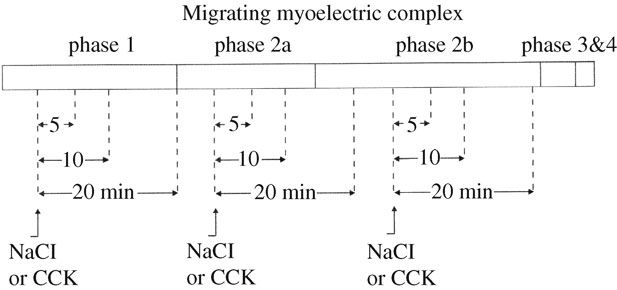
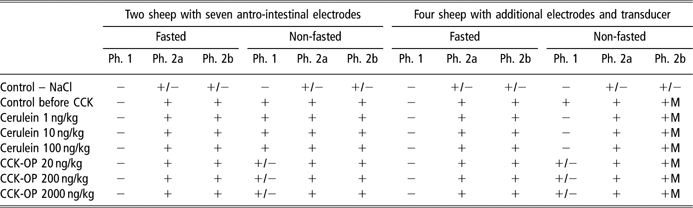
Initially, at least two normal consecutive phases 3 of the MMC were recorded and then 0.15 M NaCl (additional control experiments, n = 24, Figure 1, Table 1) at the rate of 5 ml was administered intravenously (i.v.) during 30 s in the course of phases 1, 2a or 2b of the MMC through the indwelling jugular polyethylene catheter introduced before the experiment. This slow i.v. injection given in a separate experiment was initiated very carefully using plastic syringes and within the first 5 s its rate was gradually increased to the maximum, while 5 s before its termination its rate was gradually lowered. Two CCK peptides were used. CCK-OP (Sincalide, Squibb Institute, Princeton, NJ, USA) was given at the doses 20, 200 and 2000 ng/kg of BW and cerulein (Takus, Farmitalia Carlo Erba, Milan, Italy) was administered at the doses 1, 10 and 100 ng/kg of BW. Each dose of either CCK peptide was randomly given in a manner similar to saline administration. CCK peptides were injected during phases 1, 2a and 2b of the MMC and saline was injected during phases 2a and 2b MMC of the previous MMC cycle, i.e. at least 50 min before CCK administration. Two consecutive experiments with CCK administration were performed within intervals of at least 1, 2 or 3 days depending on low, moderate or high CCK dose, respectively. A total of 148 double experiments, including control recording without saline injection and CCK administration, were performed (Table 1).
Experimental schedule. After control recording, NaCl (0.15 M NaCl) or CCK peptides (cerulein or CCK-OP, each in three different doses) were given intravenously during 30 s in the course of individual phases of duodenal MMC in fasted or non-fasted sheep. NaCl or CCK peptides were administered during phase 1 of the MMC 2 to 5 min after phase 1 onset, during phase 2a of the MMC 2 to 5 min after phase 2a onset and during phase 2b of the MMC 5 to 10 min after phase 2b onset. MR incidence was calculated at 5, 10 or 20 min intervals before and after CCK peptide administration.

List of experiments performed in fasted and non-fasted sheep

Ph. = migrating myoelectric complex phases; CCK-OP = cholecystokinin-octapeptide; + = experiments performed and presented in ‘Results’ section; +/− = experiments not shown; − = experiment not performed; M = mechanical recordings analyzed.
Calculations and statistical analysis
The MMC cycles were visually identified in myoelectric recordings in the duodenum and the number of MR patterns during the various phases of the MMC cycle was calculated within 5, 10 and 20 min before and after CCK administration in all the experimental groups (Figure 1). In a given MR pattern, the number of spike bursts was also determined. The data were expressed as means ± s.d. or in %. Statistical analysis was performed with the use of ANOVA I and the Student’s t-test for paired values (Snedecor and Cochran, Reference Snedecor and Cochran1971). P = 0.05 was considered as the border of statistical significance.
Results
The duodenal mechanical recordings (data not shown) obtained from the strain gauge force transducer followed the duodenal myoelectric recordings obtained from the adjacent electrode and further confirmed the presence of MR in this region.
Injection of saline during phase 2a or 2b of the MMC in fasted and non-fasted sheep did not affect the MR pattern and small-intestinal motility (data not shown).
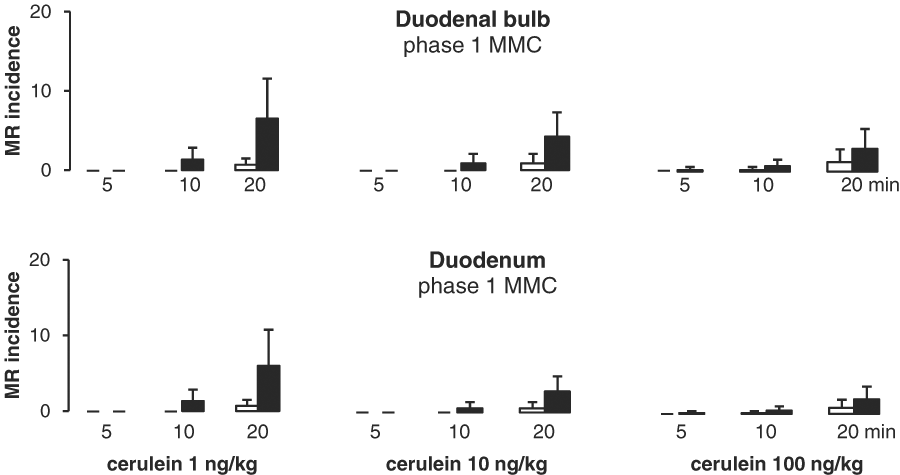
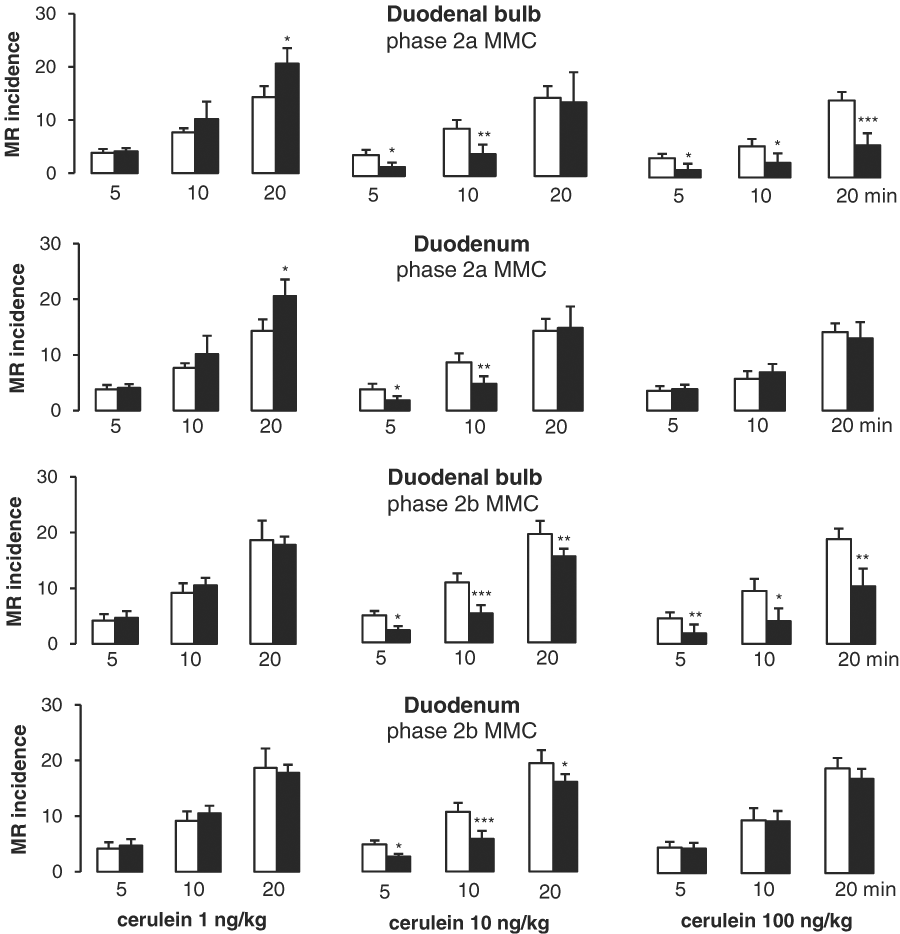
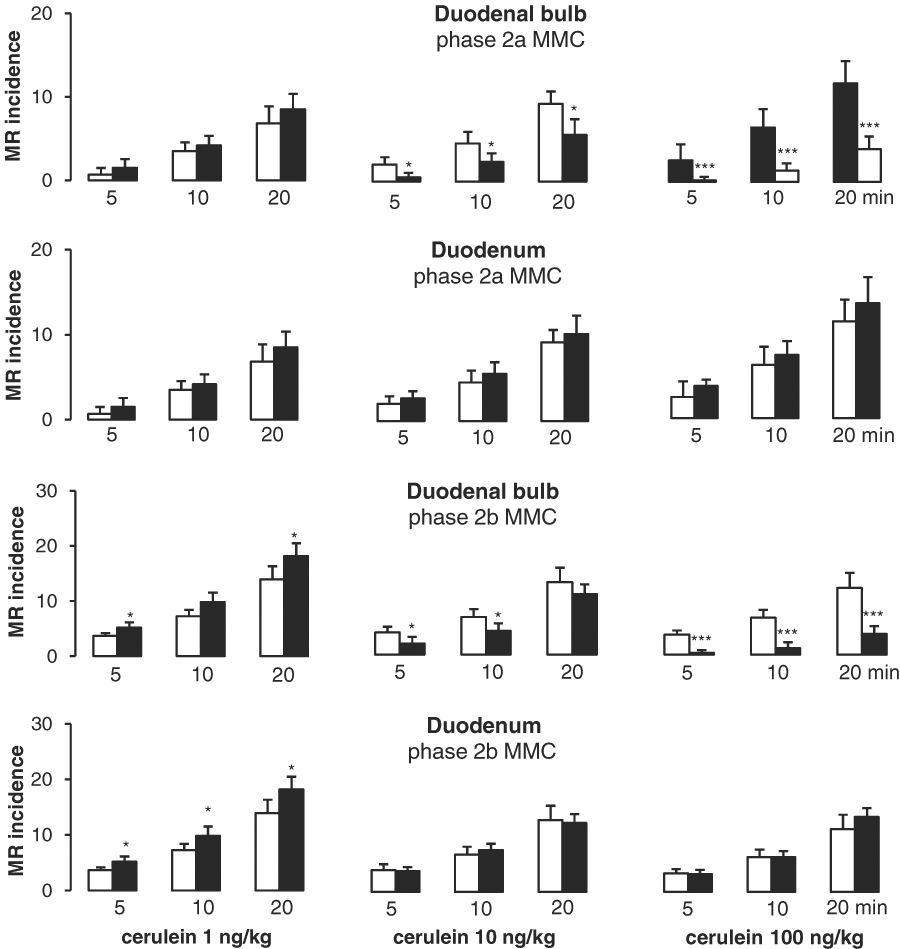
Cerulein administration during phase 1 of the MMC in non-fasted sheep did not exert a significant effect on MR appearance in the duodenal bulb and duodenum (Figure 2). In fasted animals, the results were very similar (data not shown). Injection of cerulein during phase 2a or 2b of the MMC at the two higher doses produced significant inhibition of MR incidence in the duodenal bulb in non-fasted sheep (Figures 3–5). When the hormone was given during the more active MMC phases in fasted sheep, the effect was roughly similar to that in non-fasted sheep, although some differences were observed (Figure 6). The effect of cerulein on the arrival of the MR in the duodenal bulb was often stronger than that in the duodenum (especially in fasted animals) and the character of the hormonal action in the distal small intestine appeared to be dependent on the MMC phase (Figures 4 and 5). However, during the control periods the incidence of MR in non-fasted sheep during phases 2a and 2b of the MMC did not differ significantly (0.8 ± 0.4 v. 0.9 ± 0.4 MR cycles per minute, respectively, n = 6). After both higher doses of CCK peptides, more regular series of 2 to 11 spike bursts at frequencies of 0.8 to 1.4 series per minute after cerulein and 0.6 to 1.2 series per minute after CCK-OP were denoted, and these series were unerringly qualified as duodenal MR.
The effects of cerulein administered at doses 1, 10 and 100 ng/kg BW during phase 1 of the MMC in non-fasted sheep on MR incidence in the duodenal bulb and duodenum. Bars (mean values) organized in pairs with indicated s.d. The left bar of each pair (white) represents the control value (before CCK peptide administration) and the right bar (black) is the value after CCK peptide. Other explanations as in the legend to Figure 1.

The effects of cerulein administered at doses 1, 10 and 100 ng/kg during phases 2a and 2b of the MMC in non-fasted sheep on MR incidence in the duodenal bulb and duodenum. Statistical significance v. relevant control value: *P < 0.05, **P < 0.01, ***P < 0.001. Other explanations as in the legend to Figure 2.

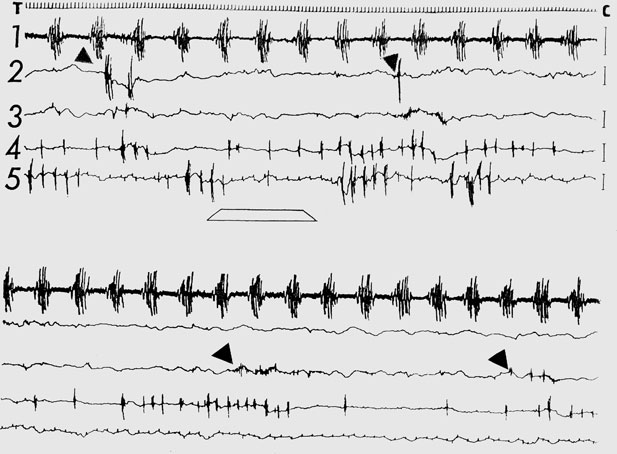
Consecutive recording fragments of the myoelectrical activity of ovine antrum and small intestine before and after cerulein (100 ng/kg) administration during phase 2a of the MMC observed in the duodenum of non-fasted sheep. T = time in seconds. Electrode localization: 1 = abomasal antrum, 2 = duodenal bulb, 3 = duodenum, 4 and 5 = jejunum, 6 and 7 = ileum. C = calibration 100 μV. ▴ = the MR pattern (the arrow sloping right down).

Consecutive recording fragments of the myoelectrical activity before and after cerulein (100 ng/kg) administration during phase 2b of the MMC observed in the duodenum of non-fasted sheep. Other explanations as in the legend to Figure 4.

The effects of three doses of cerulein administered during phases 2a and 2b of the MMC in fasted sheep on MR incidence in the duodenal bulb and duodenum. Other explanations as in the legend to Figure 3.

Various types of MR regarding the number of spike bursts in one MR pattern were observed in the duodeno-jejunum. In non-fasted sheep, during phase 2b of the MMC of the control periods, 69.4% of the single spike burst forming MR, 24.1% of the double MR patterns, 3.0% of the triple MR patterns, 1.9% of the quadriple MR patterns and 1.9% of MR patterns containing more than four spike bursts each were observed in the duodenal bulb (n MR = 108 in six sheep). In the duodenum, these values were 53.7%, 22.2%, 12.0%, 4.0% and 7.4%, respectively (n MR = 111 in six sheep).
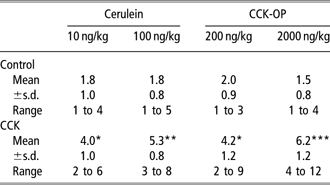
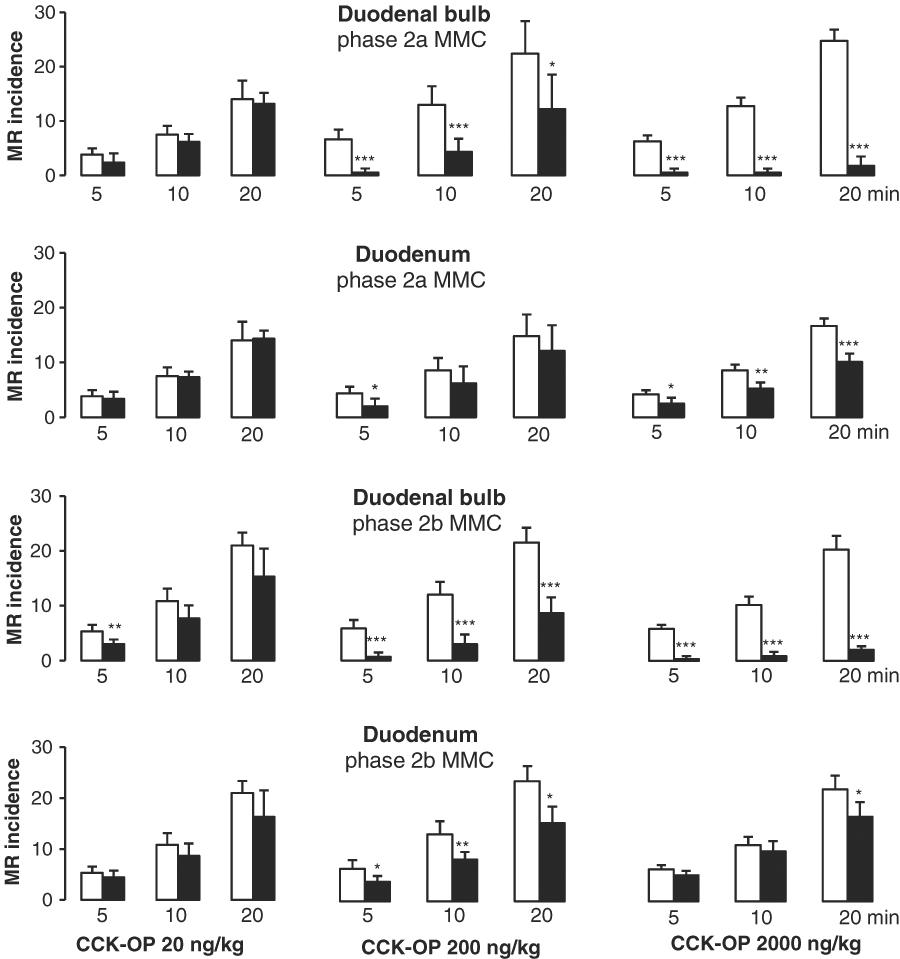
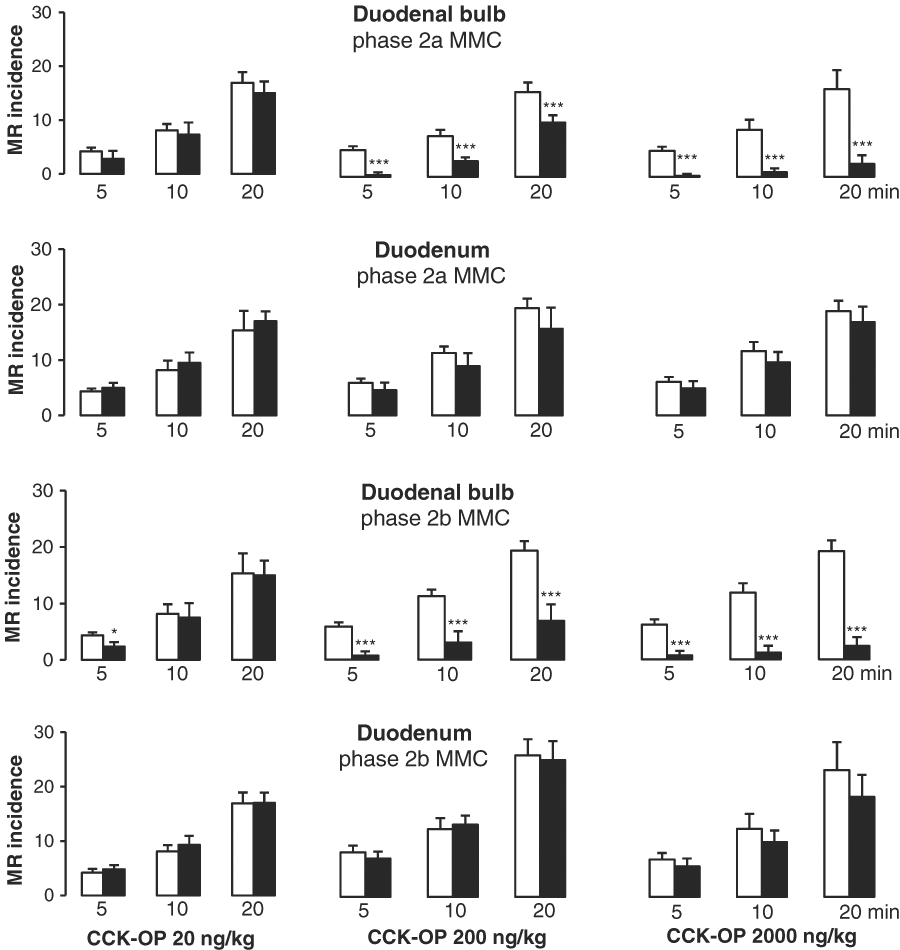
Administration of cerulein and CCK-OP at both higher doses increased the number of spike bursts in one MR pattern within the duodenum (Table 2, Figure 4). Injection of CCK-OP usually exerted a more pronounced effect than injection of cerulein. CCK-OP applied at all three doses in the course of phase 1 of the MMC in fasted and non-fasted sheep did not evoke meaningful effect on the small-intestinal MR pattern (data not shown). These results were similar to those after cerulein administered during the same MMC phase. The smallest dose of CCK-OP exerted significant changes in MR incidence (Figures 7–9) but the smallest dose of cerulein was even more effective. This effect was contrary to the response to moderate dose of the hormone. All three doses of CCK-OP exerted much stronger effects in the duodenal bulb compared with those in the duodenum (Figures 7 and 8). In fasted animals, the effect of CCK-OP administered during phase 2a of the MMC was similar to the effect of CCK-OP given during phase 2b of the MMC (Figures 3, 7 and 8). The effect of cerulein on mid-duodenal activity was similar to its effect upon the distal duodenum (the data from the mid-duodenum are omitted).
Number of spike bursts in 1 min rhythm pattern in the duodenum of non-fasted sheep before (control) and after cerulein (10 and 100 ng/kg) and CCK-OP (200 and 2000 ng/kg) administration during phase 2b of the migrating myoelectric complex

CCK-OP = cholecystokinin-octapeptide.
n = 6.
Statistical significance: *P < 0.05, **P < 0.01, ***P < 0.001 v. the relevant control value.
The effects of three doses of CCK-OP administered during duodenal phases 2a and 2b of the MMC in non-fasted sheep on MR incidence in the duodenal bulb and duodenum. Other explanations as in the legend to Figure 3.

The effects of three doses of CCK-OP administered during duodenal phases 2a and 2b of the MMC in fasted sheep on MR incidence in the duodenal bulb and duodenum. Other explanations as in the legend to Figure 3.

Two consecutive 5.5-min fragments of duodenal recordings before and after the smallest dose of CCK-OP (20 ng/kg) administered during phase 2b of the MMC observed in the duodenum in non-fasted sheep. Note the clearly inhibitory effect on MR incidence in the duodenal bulb. The erratic ileal recordings are not included. Other explanations as in the legend to Figure 4.

The regularity of the occurrence of an MR pattern in the antrum and the lower small intestine was difficult to assess since the MR pattern could be identified only occasionally. The MR pattern was extended (more spike bursts in one MR episode) and thus it was often difficult to distinguish it from other spike bursts. Thus these recordings were not analyzed completely to study the effect of CCK peptides on MR pattern. The high-to-low rank of the percentage of identifiable MR patterns in the gastrointestinal segments studied here was as follows: duodenal bulb = duodenum > jejunum > ileum > antrum.
Discussion
Both CCK peptides significantly altered the myoelectric and motor responses observed in the ovine duodenal bulb and duodenum. CCK-OP and cerulein are known to stimulate small-intestinal motility and reverse the interdigestive to a digestive-like pattern (Liddle, Reference Liddle1994; Walsh, Reference Walsh1994). In sheep, the reported effect of CCK on duodenal spike bursts was not marked (Bueno and Praddaude, Reference Bueno and Praddaude1979), though a more recent study provided different results (Romański, Reference Romański2004). The character of duodenal stimulation by CCK was different from the fed pattern, which is more irregular and where the spike bursts are more dispersed and during which the MR (containing usually single spike bursts) is interposed between other spike bursts (see Romański, Reference Romański2002 and Reference Romański2008). The duodenal myoelectric pattern observed in the present study after the administration of both CCK peptides arrived regularly and contained a longer series of spike bursts than that observed previously after feeding (Romański, Reference Romański2002). These series were regular and thus were organized in an MR-like fashion. Therefore, CCK stimulates the ovine duodenum by increasing the number of spike bursts in an MR pattern. The effect of CCK peptides on the incidence of MR in the duodenum was contrary to their effect on spike burst frequency. Since MR incidence is increased after feeding (Romański, Reference Romański2002), the contribution of other hormones whose release is stimulated by food (Fioramonti and Bueno, Reference Fioramonti and Bueno1988) may apparently abolish and even reverse the inhibitory action of CCK on MR incidence. It is well known that the interaction of two hormones may alter the response to a single hormone (Cottrell and Gregory, Reference Cottrell and Gregory1991). As mentioned above, in the duodenum the effect of moderate and high doses of CCK peptides upon the MR was different from that in the duodenal bulb but it was still not the same as that after feeding (Romański, Reference Romański2002). Therefore, it appears that in the fed state not only CCK but also other hormones are able to modify the MR pattern. It is also possible that the cholinergic system is directly responsible for MR incidence in the duodenum (Romański, Reference Romański2002) while CCK can modify the number of spike bursts within the MR pattern and this might represent one of the physiological roles of this hormone. In ruminant animals, the differences between fed and fasted state are smaller than those in non-ruminant species; thus the physiological role of CCK in the fasted state can be even greater in ruminants than in monogastrics.
The smallest doses of CCK peptides evoked slight stimulatory effect upon MR incidence. This response was similar to that after feeding and may represent another physiological action of CCK upon the MR. The action of CCK on duodenal MR is different from this upon the duodenal bulb where the inhibitory influences predominate. Since these actions of CCK peptides were clearly observed after the moderate doses of cerulein and CCK-OP, they appear to be of physiological importance. The differences in CCK action upon the MR pattern between the duodenal bulb and duodenum may concern the different interaction between the cholinergic system and neuroendocrine and/or paracrine action of CCK within the intestinal wall (Figure 10). It is possible that these actions of CCK peptides are mediated principally by the CCK-1 receptor subtype localized either in the smooth muscles or within the intramural neurons (Dockray, Reference Dockray2006).
Scheme of possible actions of CCK upon the MR pattern in the ovine duodenal bulb and duodenum.

When the inhibitory effect of CCK on duodenal motility regarding MR incidence is observed, the question arises as to whether an alteration of duodenal propulsion accompanies these changes. During manometric studies, a clear, propagated MR in the small intestine was described in man (Ducrotte et al., Reference Ducrotte, Peillon, Guillemot, Testart and Denis1991; Wilmer et al., Reference Wilmer, Van Cutsem, Andrioli, Tack, Coremans and Janssens1998). As can be concluded from these studies, the propagated contractions can also be responsible for the propulsion of intestinal digesta. However, this is not the direct evidence for a propulsive character of the MR. Recent studies on humans, in which the measurement of small-intestinal transit times by scintigraphy was combined with manometry (Grybäck et al., Reference Grybäck, Jacobsson, Blomquist, Schnell and Hellström2002), also did not resolve this problem. However, even the combination of both these advanced techniques may be insufficient because of the difficulties in evaluating transit in small-intestinal segments and also because of certain irregularities within the MR (migration through different lengths of bowel segments, variable migration velocity, different numbers of the spike bursts/contractions forming the MR). On the other hand, it is hard to conclude that the migrating contractions of relatively high amplitude are not propulsive but it has not been definitely proved so far. The putative role of the MR in the intestinal propulsion does not exclude its unspecific role in smooth-muscle training and intramural blood-lymph circulation.
The effect of both higher doses of CCK peptides on the duodenal bulb on MR arrival, compared with that observed in the distal duodenum, was clearly inhibitory and thus was usually different from that in the duodenum. The character of this response resembles the effect of CCK on fore-stomach motility in which the hormone reduces the frequency rather than the amplitude of contractions (Ruckebusch, 1985). The duodenal bulb is a close postpyloric region and thus it can be expected that the effect of CCK may be similar to that on the pylorus and, apparently, also on the pyloric antrum. However, this speculation remains contrary to the results of human and the studies with the use of various animal species, including sheep, performed in vivo and in vitro (Ruckebusch, 1985; Li et al., Reference Li, Zheng and Qu2000; Rayner et al., Reference Rayner, Park, Doran, Chapman and Horowitz2000) in which the effect of CCK can also be stimulatory. Despite these discrepancies it can be suggested that CCK, inhibiting abomasal emptying (Titchen, Reference Titchen1986), relaxes the duodenal bulb, which may facilitate the duodenal mixing of digesta by forming a reservoir, mostly for retropropulsed content, during activated duodenal contractions. This relaxation can delay the duodeno-jejunal flow for a limited time period. Under normal conditions, CCK action begins when the digesta components – amino acids and fatty acids – stimulate CCK release from the duodenum. Soon after, increased amounts of pancreatic juice and bile inflow to the intestinal lumen in response to CCK and secretin action (Walsh, Reference Walsh1994). These juices are then mixed with the intestinal content, the digestion process is intensified and they are gradually transported toward the jejunum. In this situation, relaxation in the proximal duodenum (including the duodenal bulb) may facilitate these events (Scarpignato, Reference Scarpignato1997). The inhibitory effect of CCK on gastric emptying is considered physiological (Liddle, Reference Liddle1994). Thus it provokes the question whether similar influence of CCK on duodenal bulb motility can also be included into the physiological actions of this hormone. Sensitivity of duodenal bulb to CCK seems to be relatively high, since yet the smallest dose of the hormone not only produced transient inhibition of bulbar motility but also evoked some increase in MR incidence. The same dose of CCK was rather unable to affect the duodenal motility. Thus the smallest dose of the hormone used here can be considered as the minimal physiological dose producing the inhibitory effect on duodenal bulb motility influencing the MR incidence. It is also sufficient to stimulate the ovine gallbladder contractions (Romański, Reference Romański2004). However, the dose of CCK required for consistent alteration of duodenal motility seems to be higher. The distribution of mucosal and neuronal CCK receptors within the ovine duodenum has not been studied in detail. It can be assumed that the inhibitory action of CCK on the peripyloric region can be mediated by exhibiting a higher density of CCK-1 (CCK-A) rather than CCK-2 (CCK-B/gastrin) receptor subtypes (Yonekura et al., Reference Yonekura, Kitade, Furukawa, Takahashi, Katsumata, Katoh and Obara2002). However, the role of CCK-1 receptor subtype in evoking motor response to CCK seems to be even greater than the role of CCK-2 receptor subtype (Dockray, Reference Dockray2006). The latter seems to play the greater role in gastric secretion than in gastrointestinal motility and its role is rather in evoking central than peripheral effects. These data confirm previous findings (Romański, Reference Romański2003), suggesting that duodenal bulb motility differs from the duodenal motility in sheep. The slight but opposite effect of the smallest dose of cerulein upon the MR incidence as compared with the higher doses may result from the action of this hormone mainly on neuronal CCK-1 receptor subtype in the duodenal bulb and duodenum. Furthermore, the MR recognition in the duodenal bulb can be somehow erratic because of the irregular and unpredictable arrival of the spike bursts in this area.
Stimulation of duodenal motor activity by CCK peptides was evident, while the interpretation of the myoelectric data could be ambiguous since the inhibitory actions of CCK peptides were also observed herein. When single spike bursts were considered, the effect of CCK was stimulatory (Romański, Reference Romański2004). When MR incidence was analyzed, the effect could be interpreted as an inhibitory one. Furthermore, the inhibition of the appearance of other spike bursts, especially following the highest doses of CCK peptides, was observed (Romański, Reference Romański2004) but this effect can be classified as the pharmacological response. The suppressive effect of CCK upon the MR incidence was dose-dependent, i.e. it was evident after the moderate and highest doses of CCK peptide. Apparently, the increased number of spike bursts forming one MR pattern, registered mostly after the highest dose of the hormone, affected (lowered) the MR incidence. The number of spike bursts in spontaneous MR is usually greater in the distal than in the proximal small bowel (Romański, Reference Romański2002), and this was also observed in the present study. This may mean that the action of CCK upon the number of spike bursts within the MR pattern is more efficient in the distal small intestine. It is also possible that the action of CCK is additive to the action of neurotensin, whose role in stimulating intestinal motility is roughly similar to that of CCK, particularly in the initiation of stationary contractions (Schemann et al., Reference Schemann, Siegle, Sahyoun and Ehrlein1986).
The effect of CCK peptides administered during phase 2b of the MMC was often but not always more pronounced than that during phase 2a of the MMC. The MR frequencies during phases 2a and 2b of the MMC were similar during control recordings. MR cycles began already at the end of phase 1 of the MMC, when no other contractions were noted. Similar observation was denoted during experiments reported previously (Romański, Reference Romański2002). This suggests the greater resistance of the MR pattern to the refractory period than of other spike bursts related to phasic contractions. The smallest difference in CCK-OP action during phase 2a v. phase 2b of the MMC was observed in fasted sheep. This may be due to the stronger action of CCK-OP than that of cerulein in the same experimental conditions. The differences between the effects of CCK peptides given in the course of various MMC phases were blurred. It has been shown in man that the level of gastrointestinal hormones, including CCK, may differ in various phases of the MMC (Rasmussen et al., Reference Rasmussen, Øster-Jørgensen, Qvist, Holst, Rehfeld, Hovendal and Pedersen1996), namely, the CCK release may be smaller during phase 2b of the MMC in response to the increased bile flow into the bowel. However, the present results did not confirm this view. It seems more likely that the intensity of the refraction during phase 2a of the MMC is greater than during phase 2b of the MMC (Wood, Reference Wood2000), which hampers the motor response to CCK peptide administration.
CCK peptides, administered at the moderate doses, significantly affected the incidence of the MR in ovine duodenum, thus suggesting the existence of the physiological role of CCK in the control of the duodenal MR. Other phasic contractions also occurred in the small bowel; stimulation of phasic contractions (or the spike bursts) may therefore not be equivalent to the stimulation of the MR. As it was already stated, the present results indicate that in the duodenal bulb, CCK mostly inhibits the MR, while in the distal small bowel it tends to change its character, i.e. the increase in spike burst number in one MR pattern. When the MR is composed of more spike bursts, it may become less propulsive. This suggests that in this way CCK may hamper intestinal propulsion, altering the motility pattern.
The minimal dose of CCK required for stimulation of duodenal motility can be estimated not only from its concentration in the blood but also from the CCK content within the duodenal tissue, which may roughly reflect its plasma concentration assuming that the greater amounts of CCK is released from the duodenal mucosa (Calingasan et al., Reference Calingasan, Kitamura, Yamada, Oomori and Yamashita1984). The normal plasma level of CCK in most mammals, including sheep, ranges from within 1 to 10 pM (Liddle, Reference Liddle1994; Walsh, Reference Walsh1994; Zavros and Shulkes, Reference Zavros and Shulkes1997), which equals 1.14 to 11.4 pg/l. As mentioned earlier (Zavros and Shulkes, Reference Zavros and Shulkes1997), the application of CCK-OP at the dose of 150 pmol/kg per h reached the plateau of 34 ± 7 pmol/l in plasma in 12 to 18 h fasted sheep. In the present study, the rates of CCK-OP administration were 4.4, 17.5 or 175 pmol and they were given within 30 s. Thus, comparing the total amounts of CCK-OP, it seems likely that the two lower doses of CCK-OP remained well below the upper physiological range (Romański, Reference Romański2005b). The administration of CCK-OP in 20-fold higher dose than that of cerulein, which is considered to be of similar potency (Romański, Reference Romański2004), evoked, however, a stronger effect on the incidence of the MR as compared with the cerulein effect. Yau et al. (Reference Yau, Makhlouf, Edwards and Farrar1974) suggested that CCK-OP and cerulein are equipotent, while Ruckebusch and Soldani (Reference Ruckebusch and Soldani1985) found that a 10-fold lower cerulein dose than CCK-OP evoked an even stronger gallbladder contractile response. These doses were similar to those used in the present study. It has been well established that 1 ng/kg of BW of cerulein is the minimal effective dose (Bertaccini et al., Reference Bertaccini, De Caro, Endean, Erspamer and Impicciatore1968; Faustini et al., Reference Faustini, Beretta, Cheli and De Gresti1973), while 100 ng/kg of CCK-OP is also effective in the stimulation of gallbladder motility (Bueno and Praddaude, Reference Bueno and Praddaude1979). The molecular weight of both peptides is not considerably different (octapeptide v. decapeptide); thus cerulein seems to exhibit a greater affinity to CCK receptors. It seems likely that equipotent doses of cerulein and CCK-OP remain between 1 : 10 and 1 : 20, depending on the site of action and the parameters examined here and in the previous study (Romański, Reference Romański2004). The doses of CCK peptides used in this study were also similar to those in other classical reports (Bertaccini et al., Reference Bertaccini, De Caro, Endean, Erspamer and Impicciatore1968; Faustini et al., Reference Faustini, Beretta, Cheli and De Gresti1973; Bueno and Praddaude, Reference Bueno and Praddaude1979). The highest doses of both hormones used in this study appear to be pharmacological. However, they can be related to the physiological functions for at least three reasons. First, the strong stimulation of the CCK-producing (I) cells in the duodenum may result in the release of a greater amount of CCK, which can stimulate the intestine in an unknown way, possibly also via a paracrine pathway. Thus the physiological amounts of the released CCK may achieve a concentration within the gut relatively as high as that which can be simulated experimentally after the pharmacological i.v. dose. Therefore, the CCK administered in the physiological dose could not be able to reach such a concentration in the gut. Secondly, the use of relatively small pharmacological doses of the hormone can demonstrate that CCK is able sometimes to evoke the given effect similar to that after the clear physiological dose. The third reason is that we do not know exactly which dose is still physiological and which is already pharmacological.
Finally, it can be concluded that CCK-OP and cerulein markedly influence the duodenal motility in sheep and the character of these effects can be different in various duodenal regions. The most evident inhibitory effect of CCK peptides on MR in the duodenal bulb suggests that this region of the small intestine is controlled, at least in part, by the same mechanisms that control the pyloric antral motility. Furthermore, the effect of CCK can be dependent on MMC phase and, to a limited extent, on feeding conditions. Currently, no specific physiological role of the MR has been described and its control mechanisms are highly unrecognized, which warrants further extensive investigation with the use of other precise methods.