


1 Introduction
1.1 The problem
In English, suffixes of the form -ly figure in two – perhaps three – morphological processes: in the formation of de-adjectival adverbs, of de-nominal adjectives as well as (now unproductively: Marchand Reference Marchand1969: 330) of a small number of de-adjectival adjectives. Examples of each are given in (1a, b, c) respectively.
(1)

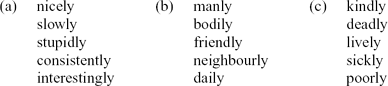
Although superficially similar and historically closely related (see, for example, Pounder Reference Pounder2001), the different processes involving -ly show some striking differences in behaviour. While any adjective-forming -ly can occur before other derivational suffixes (manliness, neighbourliness; deadliness, livelihood), adverb-forming -ly cannot occur in such contexts: *niceliness, *slowliness. In contrast, adverbs not formed with -ly do occasionally undergo morphological derivation: soonish, seldomness, etc. It seems to be the adverb-forming suffix, not the adverb status as such, of forms such as nicely, slowly that bars further derivation.
Moreover, while any adjectival -ly can be followed by inflectional suffixes (manlier, deadliest, etc.), adverbial -ly again cannot occur in such contexts: *nicelier, *slowliest. Such forms are amenable to periphrastic gradation only: more nicely, most slowly. Again it seems to be the suffix, not the lexeme's adverb status, which prevents inflectional gradation: some adverbs without -ly are capable of inflectional gradation, regardless of whether they have adjectival homonyms (earlier, faster) or not (sooner, soonest).
I will in this article subscribe to the claim that in English ‘adverb’ is not a lexical category but merely a specific modifier function performed by members of the category Adjective, associated with contexts other than those traditionally associated with adjectives. This ‘single-category claim’ might be taken to imply that the de-adjectival versions of adjective-forming and adverb-forming -ly, exemplified in (1c) and (1a) respectively, constitute the same derivational suffix. Deadly and nicely would then have identical morphological structures, and would differ merely in terms of their syntactic distributions. But such an analysis, however attractive at first glance, would be unable to account for the unusual behaviour of adverbial -ly which I noted above: adjectival -ly fails to share this behaviour. At any rate, contrary to what Baker (Reference Baker2003: 231) suggests, the single-category claim could not possibly be based on, or substantiated by, the observation that adjective-forming and adverb-forming -ly are of identical form. Such an observation is of diachronic interest only: similarity of form does not indicate synchronic relatedness any more than historical relatedness does.
Compare, for example, the two suffixes of the form -al found in English. Noun-forming -al (arrival, referral, withdrawal) attaches to end-stressed verbal bases only, but is itself stress-neutral, while adjective-forming -al, attaching to Latinate roots of which many also function as nouns, does not have such a restriction on its input selection but is itself ‘stress-shifting’: matern- – maternal, pivot – pivotal, accident – accidental (Marchand Reference Marchand1969: 236ff.; Giegerich Reference Giegerich1999: 54ff., 113f.). English simply has two derivational suffixes which share the form -al; they are associated with different derivational processes and give rise to different lexical category membership.
However, merely asserting that similarly the two -ly suffixes are associated with different derivational processes would fare no better than the single-category claim alone does in explaining the unusual behaviour of adverb-forming -ly. I will therefore argue, in addition to subscribing to the single-category claim, that adjectival and adverbial -ly are in terms of the morphological system of English radically different suffixes: the former is a derivational suffix while the latter is inflectional. In deadly, the suffix is derivational but non-category-changing (like, for example, -ish in greenish); but nicely is an inflected form of the adjective nice. I will demonstrate how such an analysis finds it easy to explain the various aspects of strange behaviour on the part of adverbial -ly, while under the traditional, derivational analysis of adverbial -ly, which as we saw may or may not treat adjectives and adverbs as categorially distinct, such behaviour defies explanation. The ‘inflected-adjective claim’ then entails the single-category claim (but not vice versa): if adverbial -ly is inflectional then adverbs cannot be categorially distinct from adjectives.
It follows from the two related claims made here that lexemes performing the ‘adverb’ function which do not end in the suffix -ly (for example, soon, seldom, early, fast, etc.) must be regarded as uninflected adjectives, which differ from traditional adjectives merely in terms of their distribution. I will demonstrate that, again, this analysis is advantageous in that, unlike its more traditional alternative, it explains the morphological behaviour of such lexemes.
1.2 The research background
The single-category claim for adverbial -ly is not altogether new; it has been made on syntactic grounds for example by Lyons (Reference Lyons1966), Emonds (Reference Emonds1976), Bybee (Reference Bybee1985), Radford (Reference Radford1988) and Baker (Reference Baker2003), all of whom base their argumentation on the complementary distribution of adjectives and adverbs: adjective phrases function as predicates or as modifiers in the noun phrase; adverb phrases can be modifiers elsewhere. I return to this issue in section 5 below, where I discuss the counterarguments to that position put forward by Payne et al. (Reference Payne, Huddleston and Geoffrey2010).
The inflected-adjective claim derives some support from the syntactic single-category claim (without following from it, as we saw above) in that the complementary distribution of adjectives and adverbs enables not only the distribution of adverbs, but thereby also that of adverbial -ly, to be treated as conditioned by the syntax. In morphological theories which make a systematic distinction between derivation and inflection, this is one criterion of several for inflectional status. Where inflection is further divided into ‘inherent inflection’ and ‘contextual inflection’ (Booij Reference Booij1996), adverbial -ly would belong with the latter.
Of course, further criteria have to be invoked to determine whether a given suffix is inflectional or derivational. Thus Hockett (Reference Hockett1958: 210) observed that adverbial -ly and suffixal gradation are mutually exclusive (*quicklier, *quickerly). Given that suffixal gradation is held to be inflectional (for discussion see Stephany Reference Stephany1982; Zwicky Reference Zwicky1989, Reference Zwicky1995), -ly belongs to the same paradigm, and is therefore itself inflectional.
Sugioka & Lehr (Reference Sugioka, Lehr, Richardson and Chukerman1983) make the inflected-adjective claim mainly on the grounds that adverbial -ly does not attach to adverbs where those are the first elements of compounds (widespread, fresh frozen), a feature shared by all regular inflection. (For discussion see Zwicky Reference Zwicky1995.) I deal with this point in more detail in section 3.1 below.
Sugioka & Lehr (Reference Sugioka, Lehr, Richardson and Chukerman1983) also argue that the dialect-specific absence of -ly, for example in John ate quick, supports the inflected-adjective claim – for discussion see again Zwicky (Reference Zwicky1995). I deal with this point in section 3.2 below. Plag (Reference Plag2003), finally, regards the transparency and productivity of adverbial -ly as indicative of its inflectional status – another criterion that will deserve further discussion, provided below in section 3.3.
On the balance of the arguments known to them, both Zwicky (Reference Zwicky1995) and Payne et al. (Reference Payne, Huddleston and Geoffrey2010) come down on the side of the traditional position which affords adverbs categorial distinctness from adjectives and treats all -ly as derivational. I will argue in the following sections that the morphological system of English itself, as well as among other things the morphological behaviour of underived adverbs, provides important, but hitherto overlooked, additional arguments for the inflectional analysis of -ly, so that – again, on balance – that analysis is to be preferred.Footnote 2
2 ‘Adverbs’ and the organisation of the morphology
I argue in this section that an inflectional treatment of adverbial -ly is consistent with the morphological system's general architecture while a derivational treatment is not. Under an analysis which recognises Adverb as a lexical category, the behaviour of -ly would mask central aspects of that architecture and thereby inhibit generalisations about it; and neither the adjective-like morphological behaviour of underived adverbs nor the inflection-like behaviour of adverbial -ly would have synchronic explanations.
2.1 Nouns, verbs and adjectives, but not adverbs, freely derive from each other
In the derivational morphology of English, the three lexical categories Noun, Verb and Adjective freely interact with each other. Nouns can be derived from both verbs and adjectives; verbs can be derived from adjectives and nouns; and adjectives in turn can be derived from nouns and verbs. Some examples are given in (2); the exhaustive descriptive account given by Marchand (Reference Marchand1969) gives many more.
(2)

Not all the derivational processes behind the complex lexemes listed in (2) are fully productive in Present-day English; but the productivity of derivational processes is not at issue here. The point is that between any two of the three categories Adjective, Noun and Verb there exist synchronically analysable two-way derivational relationships, to which a number of conversion processes may be added for completeness.
In contrast, when adverbs are derived from members of other lexical categories then the suffix involved is always -ly, and the other lexical category involved is always that of Adjective ((1a) above). No adverbs derive from verbs or nouns.
Moreover, recall from section 1 that adjectival -ly can be followed by other derivational suffixes but adverbial -ly cannot: manliness vs *slowliness, *niceliness. Given also that morphologically complex adverbs such as unpleasantly can be uncontroversially analysed as [[unpleasant]ly] rather than [un[pleasantly]], we can make the general observation that -ly adverbs cannot be affixation bases in the derivational morphology: nothing can be derived from them.
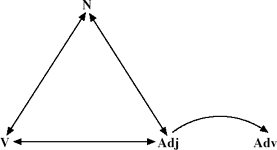
There are some other suffixes in the derivational morphology of English which, without major consequences for the morphological system, behave in this somewhat exceptional way: for example, -ism and -ity (Fabb Reference Fabb1988; Hay & Plag Reference Hay and Plag2004). But the specific fact that adverbial -ly is a derivational dead-end does have consequences for the morphological system as a whole: given the exclusive role of -ly in the formation of adverbs, it effectively isolates the putative category Adverb in the system. The derivational paths available in the morphology of English can then be schematically represented as in (3), where adverbial -ly is treated as derivational and Adverb as a lexical category.
(3) The place of adverbs in the derivational morphologyFootnote 3
I noted in section 1 the occasional occurrence of derivatives from morphologically simple adverbs: soonish, seldomness, soonness, unseldom, and probably more, are attested. Payne et al. (Reference Payne, Huddleston and Geoffrey2010: 63) cite the existence of such de-adverbial derivatives as support for the categorial integrity of adverbs, not noting, however, that the derivational affixes involved – -ish, -ness, un- – are all primarily and productively associated with de-adjectival processes. Greenish, kindness, unkind would serve as more typical examples of the processes involved than occasional adverb derivatives like soonish.
It might be argued that derivational suffixes such as those involved here are already known to sporadically attach to members of other categories (eightish, oneness, unease), and that therefore Adverb is just another category that such suffixes stray onto. But this would amount to giving soonish etc. an equally sporadic status, which in turn would miss a larger picture: the connection of all such ‘de-adverbal’ derivatives specifically with the de-adjectival morphology. Underived adverbs simply do not take suffixes that are not predominantly de-adjectival. The derivational behaviour of underived adverbs supports the claim, then, that ‘adverbs’ are members of the category Adjective. English has no derivational processes which could be specifically called ‘de-adverbial’, just as it has no morphological processes specifically associated with minor categories such as Determiner, Preposition, etc.
These observations strongly support the single-category claim. There is in English a triangle of lexical categories – Noun, Verb and Adjective – within which the derivational morphology is conducted. If there is a category Adverb then the derivational morphology of that category is at best that of an appendix to the category Adjective. All derived adverbs have adjectival bases; underived adverbs behave morphologically like adjectives.
2.2 Nouns, verbs and adjectives, but not adverbs, have distinct inflectional morphologies
The set of three lexical categories – Noun, Verb and Adjective – is not only significant to the derivational morphology; it figures similarly in the inflectional system. If we assume with most of the literature that morphological gradation (kinder, kindest) is inflectional (Stephany Reference Stephany1982; Zwicky Reference Zwicky1989), for example because certain syntactic contexts require comparative forms – X is _____ than Y – then the three lexical categories Noun, Verb and Adjective, and only these, have regular inflectional morphology.
We saw in section 1 that -ly adverbs reject inflectional suffixes – recall *nicelier, *slowliest, which are ill-formed while their adjectival counterparts (manlier, deadliest) are grammatical. They reject plural (*nicelies) and the inflectional morphology associated with verbs as well, of course. Underived adverbs may inflect for grade, just like adjectives, regardless of whether they have adjectival homonyms or not: sooner, soonest, faster, earliest. It may be observed here that gradation is not otherwise strictly confined to adjectives, but may occur, for example, with prepositions which have adjectival homonyms (close, near, far – Pullum & Huddleston Reference Pullum, Huddleston, Huddleston and Pullum2002b: 609), but that does not invalidate the main point connected with the gradability of underived adverbs. The main point is that the traditional category Adverb again stands apart from the other three lexical categories. It has no inflectional morphology of its own, just as it has no derivational morphology of its own. When adverbs do inflect they behave as though they were adjectives.
This aspect of adjective-like behaviour is particularly compelling in the case of well. Where this is an adjective as in a well man, regular gradation is available as expected: the wellest man in the world. In contrast, well as the underived adverb corresponding to adjectival good does not grade as *weller, *wellest, as one might expect after the model of other underived adverbs such as soon (sooner, soonest). It goes instead with the irregular gradation of the corresponding adjective, such that better, best are the irregular graded forms of both good and adverbial well. This observation strongly suggests that there is a paradigmatic relationship between good and adverbial well (from which adjectival well is excluded): if these two were paradigmatically as unrelated as they are in formal morphological terms then adverbial well would be expected to grade weller, wellest, like adjectival well. More generally, this observation supports the claim that graded adverbs such as faster, earlier, etc. are not just homonymous with graded adjectives where such homonyms are available, but that they in fact are graded adjectives: again, without such a claim, the fact that well shares the paradigm of good, although that paradigm is itself highly irregular and therefore not of default status, has to be regarded as a strange synchronic coincidence.
The complete picture of morphological pathways is given in (4), now including inflection. Recalling Hockett (Reference Hockett1958) from section 1.2, notice how the ‘Adv’ pathway of (3) above (occupied by adverbial -ly) can be conflated with that of -er/-est. These observations again support the single-category claim, as well as at least lending plausibility to the inflected-adjective claim for -ly adverbs.
(4) The architecture of the morphological system:
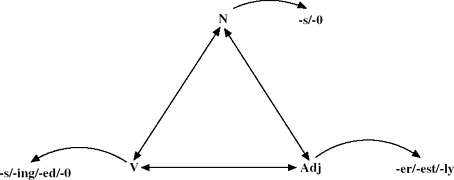
In summary, the traditional analysis, defended by Zwicky (Reference Zwicky1995) and Payne et al. (Reference Payne, Huddleston and Geoffrey2010), which accords adverbs lexical category status on a par with the other three, masks important generalisations about the morphological system of English and about the behaviour of its members. Only members of lexical categories are part of the morphological system; and adverbs are clearly not integrated in that system. They have neither a derivational nor an inflectional morphology of their own. Moreover, when adverbs in any way appear to undergo morphological processes – derivational or inflectional – then these processes are always of the kind primarily associated with adjectives, even where those are themselves irregular (better, best). An adjectival analysis accounts for the adjectival morphological behaviour of underived adverbs: these behave like adjectives simply because they are adjectives. It equally accounts for the odd behaviour of -ly-derived ‘adverbs’ within the morphological system. These are not derived but inflected; and given their adjectival bases, they must be inflected adjectives.
The lexical categories of English are, then, Noun, Verb and Adjective. The category Adjective makes an inflectional distinction between the traditional ‘adjectival’ and ‘adverbial’ functions, which is, however, suspended in the comparative and superlative grades, similarly to the way in which, for example, the verbal inflection does not express person distinctions in the past tense.
I will, in the remainder of this article, discuss further aspects of the behaviour of ‘adverb-forming’ -ly, and show that those either support, or are consistent with, an inflectional analysis of this suffix. This will, perhaps unexpectedly, involve not only morphological and syntactic behaviour but also phonological behaviour. A brief discussion of the syntactic behaviour of adverbs and why that behaviour again supports, or is consistent with, an inflectional analysis of adverbial -ly will conclude the article.
3 Further morphological aspects of the inflection-like behaviour of adverbial -ly
3.1 Confinement to the margins of lexemes
Adverbs formed with -ly cannot undergo morphological derivation, while underived adverbs as well as adjectives formed with -ly can: recall *niceliness vs soonness and manliness. Adverb-forming -ly also cannot be followed by inflectional suffixes: recall *nicelier, *slowliest (and again contrast non-ly adverbs and non-adverbial -ly: sooner and manlier). If adverbial -ly were a derivational suffix then it would be the only such suffix in English to be confined to the absolutely lexeme-final position: all other derivational suffixes can be followed by inflectional and/or other derivational suffixes.
But if adverbial -ly is treated as inflectional then this fact forms part of the much larger, though not uncontroversial, generalisation whereby regular inflection cannot occur inside lexemes but is confined to their margins (Kiparsky Reference Kiparsky1982; Rainer Reference Rainer1996; Cetnarowska Reference Cetnarowska2001). Thus, *eventsful, *peersless,*watches-maker, *rats-infested are ill-formed despite the fact that the embedded plural forms may be semantically warranted, while lexemes containing irregular inflection, such as headlice-repellent, mice-infested, are well-formed. Similarly, and supporting the separate claim that adjectival gradation is inflectional, irregularly graded adjectives are occasionally found inside derivatives while regularly graded adjectives again cannot occur there: to better, to further, to lessen, to worsen; betterment, furtherance, etc. vs *to nicer, *tallerment, *richerance, etc.
Sugioka & Lehr (Reference Sugioka, Lehr, Richardson and Chukerman1983), among the first to defend the inflected-adjective claim on morphological grounds, rely heavily on this positional constraint on regular inflection. They adduce two construction types in support of their claim, both of which they regard as compounds and neither of which can contain -ly adverbs as first elements. I will argue here that one of these is not actually of compound status, and hence is irrelevant, but that the other is relevant and that there is also a third one.
The first construction adduced by Sugioka & Lehr (Reference Sugioka, Lehr, Richardson and Chukerman1983) is exemplified in (5):
(5) beautiful dancer
quick thinker
fast mover
heavy smoker
Each of these is ambiguous, such that a beautiful dancer can be a beautiful person who is a dancer or someone who dances beautifully (but may be of unattractive appearance). The latter version Sugioka & Lehr regard as a compound lexeme, presumably because it has a superficial similarity to synthetic compounds such as watch-maker: in both cases, the first element appears to be a dependent of a verb embedded in the second. The dependents in (5) should therefore under the latter reading be regarded as adverbs, which in that compound-medial position cannot carry their normal inflectional suffix. But this analysis is wrong on two counts.
Firstly, as also noted by Zwicky (Reference Zwicky1995), forms such as those in (5) are not in fact compound lexemes under either reading: their elements are freely available to syntactic operations such as pro-one and individual modification without losing the reading which Sugioka & Lehr associate with the ‘compound’ version:
(6) a very beautiful but sometimes over-confident dancer
a rather slow thinker and an amazingly quick one
an at times very heavy but surprisingly intermittent smoker
Secondly, in more recent discussion such forms have been viewed as instances of an ambiguity between intersective and subsective modification, such that beautiful may modify all or merely a subset of the head's semantic elements (‘qualia’ in the sense of Pustejovsky Reference Pustejovsky1995; see also Jackendoff Reference Jackendoff1997, Bouchard Reference Bouchard2002). Since the same ambiguity is also found with heads which are not de-verbal (good chef, efficient nurse), subsective modification is clearly a semantic issue only. It therefore cannot provide a syntactic context in which one might argue that adjectives function as adverbs (while lacking the inflection expected in that context). They are simply adjectives pre-modifying nouns in either reading.
Sugioka & Lehr's (Reference Sugioka, Lehr, Richardson and Chukerman1983) second set of examples are of this form:
(7) widespread
fresh-frozen
quick-dissolving
slow-burning
free-moving
Such forms may be paralleled by adjective phrases such as quickly dissolving, slowly burning, etc. It is possible to buy slow-burning coal (not ablaze at the time of purchase), but slowly burning coal can only be found in a fire. It is therefore reasonable to say that forms such as those in (7) are lexical, perhaps lexicalised over time, and hence compound adjectives rather than adjective phrases. This is exactly the same lexicalisation pattern as that which gives rise to the parallelism of noun phrases and compound nouns: white house vs White-House, etc. (Giegerich Reference Giegerich, Lieber and Štekauer2008). There is no independent reason to distinguish between an adverb in slowly burning and an adjective in its compound counterpart slow-burning; and there is also no explanation why an adverb should lose its derivational suffix when it is embedded in a compound. Under an inflectional analysis, on the other hand, -ly is absent here simply due to the known ban on regular inflection inside complex lexemes. Note again that uninflected ‘adverbs’ can occur inside compounds just as irregular plurals can: well-formed, well-spoken. Footnote 4
The third set of relevant cases was noted by Payne et al. (Reference Payne, Huddleston and Geoffrey2010: 53f.), who, however, regarded them as examples of the parallel distribution of pre-modifying adjectives and adverbs within adjective phrases, and therefore as counterevidence to the single-category claim. The examples in (8) and their subdivision are Payne et al.’s:
(8)

In the examples in (8a) the modifiers have specialised meanings, usually denoting ‘high degree’ and contrasting, for example, with semantically transparent blindly drunk, coldly sober, etc. The non-compositional semantics of these examples again suggests lexicalised, that is, compound adjective status rather than the phrasal status which Payne et al. assume them to have. This in turn provides a ready explanation for the absence of -ly: these cases are on a par with those in (7) above.
The same may be said about some members of Payne et al.'s second subgroup, (8b) above. Mad keen should probably be in the former subgroup. Anal retentive can only be figurative and must therefore be lexical. (The transparent, medical-technical reading is only available to its phrasal counterpart anally retentive.) The other examples in (8b) may similarly be analysed as in some way lexicalised as recurrent collocations: their phrasal equivalents may be silkily smooth, repetitively boring, etc., or, alternatively, silky and smooth, repetitive and boring, in which case their lexicalised equivalents in (8b) would be adjectival dvandvas (Bauer Reference Bauer2008). Either way, they are compounds and the absence of -ly is explained under an inflectional account of that suffix. Note that under the alternative, derivational analysis of -ly defended by Payne et al. (Reference Payne, Huddleston and Geoffrey2010), cases such as those in (8) should still be regarded as compounds: the lexical nature of these forms is unrelated to the categorical status of their first elements. Cold and coldly in cold sober vs coldly sober, etc. are then not in fact in parallel distribution – the former is a compound and the latter a phrase – and therefore do not support Payne et al.'s position. I return to this point in section 5.
3.2 Restrictions on post-verbal -ly and pre-verbal non-ly adverbs
Several researchers (Sugioka & Lehr Reference Sugioka, Lehr, Richardson and Chukerman1983; Zwicky Reference Zwicky1995; Payne et al. Reference Payne, Huddleston and Geoffrey2010) have observed that in some dialects, adverbs functioning as post-modifiers in verb phrases may not have -ly: You gotta eat it up quick or they'll grab it off you. In such dialects the -ly is retained in other contexts: You gotta quickly/*quick eat it up. A derivational analysis of -ly adverbs finds it surprisingly difficult to account for this simple phenomenon: that analysis has to posit a presumably open class of dialect-specific zero-derived adverbs, whose distribution is restricted to that particular position, so that there would be the two distributionally distinct adverbs quickly and quick corresponding to the adjective quick. Under an inflectional analysis of adverbial -ly, this is simply another example of the loss of inflection which has been going on in the language for about a thousand years.
A grammar which distinguishes categorially between adjectives and adverbs cannot, of course, simply call such forms adjectives: uninflected adverbs such as soon, today, etc. also occur in that position. But adjectives is exactly what they are: in you're talking good, what occurs is the uninflected adjective, rather than the irregularly inflected adjective well expected in other varieties of the language (except perhaps in one which has no well at all). This is not just a matter of -ly loss, then: a plausible account of the dialect-specific form of adverbs in this context has serious problems maintaining a category distinction between adjectives and adverbs when quick, soon and good are interchangeable.
Sugioka & Lehr (Reference Sugioka, Lehr, Richardson and Chukerman1983) and Zwicky (Reference Zwicky1995) note, moreover, that there is ‘a surface constraint for all dialects which prohibits any “ly-less” adverb, including those which never take -ly such as fast, in the preverbal position: *he fast ate’ (Sugioka & Lehr Reference Sugioka, Lehr, Richardson and Chukerman1983: 285). This constraint is not dialect-specific, and in fact it is not an exceptionless prohibition: he soon ate, he seldom ate. But apart from that it seems to be the mirror-image of the constraint just discussed: the pre-verb position usually requires -ly, while in some dialects the post-verb position rejects it. Under a derivational analysis of adverbial -ly we would have to say, in conflict with the Lexical Integrity Principle (Di Sciullo & Williams 1987), that derived adverbs can occur pre-verbally but some of the underived adverbs cannot. The inflectional analysis is again rather more straightforward. It simply requires more finely grained syntactic and lexical conditioning in the distribution of inflectional -ly and of certain uninflected ‘adverbs’, such that fast, well, yesterday, etc. have slightly different distributions from, for example, soon, seldom, often, quickly.
3.3 Adjectives and ‘adverbs’: semantic and formal relationships
I deal in this section with a number of minor observations regarding the behaviour of derived and underived ‘adverbs’ in relation to corresponding adjectives (where those exist). These observations will be at least consistent with, and in some cases supportive of, an inflectional analysis of adverbial -ly.
Listing some of the arguments in favour of an inflectional analysis of adverbial -ly, Plag (Reference Plag2003: 196) notes that this suffix is highly productive and always semantically transparent. I comment that such behaviour is indeed consistent with regular inflectional status, but of course not confined to such status: some derivational processes – for example, the formation of abstract nouns with -ness – are also highly productive and almost always fully transparent. Plag's transparency claim for -ly is in fact not quite correct: Pullum & Huddleston (Reference Pullum, Huddleston, Huddleston and Pullum2002a: 565) note that some adverbs, such as barely, hardly, scarcely, lately, presently, shortly, are not synonymous, in the way for example quickly is, with their unsuffixed adjectival counterparts. But the occasional lexicalisation of inflected forms is not uncommon: this is what has happened, for example, in pluralia tantum such as scissors, trousers, Arts, etc. Exceedingly similarly lacks transparency, with the added problem of (unlike interestingly, for example) being based not on an adjective but on the present participle of a transitive verb. Again, such irregularity has parallels elsewhere in the system: news, etc.
Another, related point made by Plag is that adverbial -ly encodes no lexical meaning. It has this in common with other inflectional suffixes; but again I comment that this is a property also found occasionally among derivational suffixes: Levi (Reference Levi1978), Warren (Reference Warren1984), Leitzke (Reference Leitzke1989) and others have argued, for example, that suffixes which derive associative (‘relational’) adjectives such as autumnal, neighbourly from nouns are semantically empty. Notice the synonymy of autumnal equinox and autumn equinox. The semantics and productivity of adverbial -ly is, then, fully consistent with an inflectional analysis but not strongly supportive of such an analysis.
Consider now the possible formal relationships between adverbs and, where those exist, cognate adjectives. The question is again whether those are consistent with an analysis which regards such relationships as inflectional, or whether they confront us with counterarguments to the inflectional analysis.
Firstly, we have already seen that regular adverbial -ly (nicely, suddenly) is fully consistent in morphological terms with an analysis which treats such forms as regularly inflected adjectives. This includes the sporadic occurrence of semantically non-compositional items: barely, hardly, scarcely, lately, presently, shortly. Such behaviour is not unprecedented in the formally regular inflectional morphology.
Secondly, some adverbs are homonymous with adjectives: early, fast and others. Recall that we established the adjectival character of this set of ‘adverbs’ on the preceding pages. Under an inflectional analysis of -ly and the concomitant claim that ‘adverbs’ are not categorially distinct from adjectives, such forms are irregular, zero-inflected adjectives. They are on a par, for example, with nouns zero-inflected for plural such as sheep, deer, etc., as well as paradigmatically with the syncretism found, for example, among the past tense and past participle forms of many English verbs.
Thirdly, it is possible for adverbs to have adjectival counterparts without being morphologically related to those: good – well, and perhaps others. Recall that I observed the presence of a paradigmatic relationship between good and well in section 2.2. These two forms do not merely comprise an adjective from which unaccountably no adverb derives, plus an adverb not derived from an adjective. In the inflectional morphology such highly irregular cases are called suppletion: went is the classroom example. If the derivational morphology were to formally acknowledge such relationships in synchronic terms then it would have to regard, for example, cat – feline and heart – cardiac as instances of suppletion (Koshiishi Reference Koshiishi2011).
And fourthly, some adverbs lack both -ly and an adjectival counterpart, for example soon, seldom, tonight (Payne et al. Reference Payne, Huddleston and Geoffrey2010: 38). Their adjectival character, too, has already been established. Inflectionally such forms are comparable to nouns such as cattle: uninflected plurals which have no singular equivalent. In the present analysis, where an ‘adverb’ is an adjective with a specific modifier function (and distribution), such forms are simply adjectives with an irregular (defective) distribution.
Payne et al. (Reference Payne, Huddleston and Geoffrey2010: 69ff.) note that most of the most frequent adverbs are not formed with -ly; really is the only de-adjectival adverb among the twenty most frequent adverbs. This observation figures in their defence of the integrity of the category Adverb. But again the high frequency of uninflected forms acting as adverbs is unsurprising: frequency patterns in the distribution of irregularity elsewhere in the inflectional system are the same. In the present analysis, the subclass of -ly adverbs is regular and productive, while uninflected adverbs constitute a closed set of highly frequent but formally irregular items. Bybee (Reference Bybee1985) has shown that, for example, in the verbal inflectional system, members of the irregular (‘strong’) subclass are overwhelmingly frequent compared to the regular verbs, which is exactly why such verbs continue to block the regular inflection (sang vs *singed) and thereby to survive as irregular verbs.Footnote 5
4 Phonological aspects of the inflection-like behaviour of adverbial -ly
I deal in this section with two further aspects of the behaviour of adverbial -ly, both of which are morphophonological, and both of which I tentatively, and informally, link with the inflectional nature of adverbial -ly established on the preceding pages.
4.1 Degemination
Unlike for example -less or -like or indeed any consonant-initial derivational English suffix, adverb-forming -ly is in many cases subject to degemination when it attaches to bases ending in /l/; see (9a) below. Where that /l/ is itself part of a suffix, permanent fusion of the suffix sequence will result, as with -al and -able/-ible in (9b). Some examples of retained geminates are given in (9c).
(9)
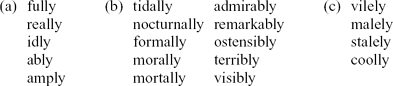
Clearly it cannot be said that -ly always triggers degemination; but when it does, the degeminated form is lexicalised to the point of possibly being reflected in the spelling. Diachronically this phenomenon may be driven by frequency – in (9b) perhaps by the frequency of the suffix sequence rather than by that of the whole lexeme – but it is nevertheless notable that no other consonant-initial suffix seems to either degeminate or to lexicalise degemination as readily as adverbial -ly does:
(10)
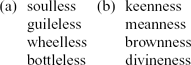
In an attempt to account for this behaviour in formal terms, one might invoke the phonological word (‘pword’), in the sense set out by Wiese (Reference Wiese1996: 65ff.), Hall (Reference Hall, Hall and Kleinhenz1999) and others. For reasons to do, for example, with syllabification, English prefixes and consonant-initial syllabic suffixes, but not vowel-initial suffixes, are regarded as pwords separate from their bases. Pwords are held to be the domains of phonotactic and other generalisations (Booij Reference Booij, Hall and Kleinhenz1999). If we accept such a role of the pword in the phonology, then geminates can only occur across pword boundaries, as in (9c) and (10), as well as in prefixed forms such as unnatural, etc. English does not have geminate consonants in other contexts. Fully and woolly rhyme, despite the latter containing the derivational suffix -y, not -ly. Degemination as in fully therefore effectively reduces -ly phonologically to /ɪ/ so that the suffix does not have pword status in the examples in (9a, b), having lost that status diachronically in these forms.
Why should -ly tend to lose its pword status when other consonant-initial suffixes so stubbornly retain it? One might suggest that this is again driven by the nature of the inflectional system. Adverbial -ly is the only inflectional suffix of English to qualify for pword status: no others comprise consonant-initial syllables (and, of course, English has no inflectional prefixes). The tendency of -ly to lose its pword status through degemination is, then, at least consistent with its inflectional status. It would be inconsistent with derivational status. We would not therefore expect degemination to occur systematically with specific affixes in the derivational morphology.
4.2 Haplology avoidance
Adverbial -ly does not attach to bases ending in -ly. This is so both after adjective-forming -ly (*manlily, *neighbourlily, *dailily, *nightlily) as well as in cases where the base-final -ly is not suffixal: *oilily, *sillily, *chillily, *wigglily are ill-formed, or at least dubious. Again, such behaviour is not found elsewhere in the derivational morphology: there does not seem to be any such constraint preventing, for example, agent-forming -er from attaching to verbal bases such as stammer, stutter, titter, shudder, etc. Similarly, heinousness is well-formed. One phenomenon of slight resemblance in the derivational morphology is the -al/-ar allomorphy, where the latter attaches to bases ending in /l/ and the former elsewhere: stellar, velar, avuncular vs autumnal, accidental, floral. But that resemblance is not strong.
It may be argued that adverbial -ly can be dropped while -er and -ness cannot be because, unlike those, -ly is semantically empty, as we saw above, so that uninflected daily can serve as both adjective and adverb. But if that were the case then heinousness should simply be ill-formed: we cannot expect in such a case unsuffixed heinous to be an abstract noun as well as an adjective. Given that heinousness is not ill-formed, the semantic emptiness of -ly is not what facilitates its avoidance of haplology.
There is again an interesting parallel to the haplology avoidance of adverbial -ly elsewhere in the inflectional morphology. Consider the following possessive forms:Footnote 6
(11)

Haplology avoidance is evident in (11b), where the possessive -s is optional after /s/, as well as throughout (11d), where either plural or possessive -s, but not both, can follow a base-final /s/: no optionality here. In (11c), *Cooks's shows that plural and possessive -s cannot occur in sequence, and the same is true for *Joneses's in (11d). Note that the pattern in (11) is not in its entirety a matter of ‘repeated morphs’ (Menn & MacWhinney Reference Menn and MacWhinney1984): non-suffixal final /s/ plays at least an optional part in haplology avoidance, just as we observed in the case of stem-final (non-suffixal) -ly. This is, then, another aspect of the behaviour of -ly which is also found elsewhere in the inflectional morphology but not in the derivational morphology – too weak perhaps to count as supporting evidence for the inflectional analysis of -ly, and certainly not formally linked to the inflectional system, but of interest (and, like the degemination facts presented in section 4.1 above, awaiting further investigation) nonetheless.
5 Conclusion: remarks on the syntax of ‘adverbs’
I noted initially that much of the argumentation in favour of an analysis whereby in English, adverbs and adjectives form a single lexical category has been conducted on syntactic grounds rather than – as I have done in this article – on morphological grounds based on the central claim that adverbial -ly is inflectional. I will first address a possible syntactic counterargument to that analysis before turning to the two syntactic arguments which have encouraged the single-category analysis.
It might be argued that the absorption of adverbs into the category Adjective might result in the loss of syntactic generalisations about the behaviour of that category. For example, it might be said that generalisations about the distribution of adjectives may be lost when we adopt a number of adverbs into the Adjective category whose forms or distributions are in some way irregular: fast is homonymous with a traditional adjective; soon is adverb only, etc. This means that a number of adjectives or adjective forms in the new, single-category sense have non-default distributions, the default distribution being roughly that adjectives occur as predicates, as pre-modifiers of nouns, and (inflected with -ly) as modifiers elsewhere. But the heterogeneity found above in the behaviour of adverbs is paralleled closely by heterogeneity already present within the traditional category Adjective: some members of this category cannot be predicates – e.g. drunken, sheer and some other isolated lexemes, and more generally associative adjectives such as vernal, phocine, medical, neighbourly (see Leitzke Reference Leitzke1989; Ferris Reference Ferris1993; Giegerich Reference Giegerich2005). Others cannot be pre-modifiers – ablaze, asleep, etc. – while others still may be post-modifiers to nouns, semantically distinct from their pre-modifying counterparts: the concerned students vs the students concerned. Collapsing the two traditional categories into one clearly does not create distributional heterogeneity where previously there was none. Indeed, the opposite may be argued to be true, as we shall see.
The first syntactic argument in favour of the single-category claim is that adjectives and adverbs take the same modifiers, namely degree as well as non-degree ‘adverbs’ (the former, like for example associative adjectives, largely resistant to modification): very nice – very nicely – more nicely, surprisingly good – surprisingly well, surprisingly soon, etc. (Emonds Reference Emonds1976; Baker Reference Baker2003) – an attractive distributional generalisation missed entirely in the traditional analysis, which would have to regard this pattern as coincidental.
The second syntactic argument in favour of the single-category claim is the (near) complementary distribution of adjectives and adverbs (Lyons Reference Lyons1966; Radford Reference Radford1988 and others). Basically, adjectives can modify nouns (and be predicates) while adverbs can modify everything else. Both the facts of the complementary-distribution claim and its relevance regarding the single-category claim have been challenged by Payne et al. (Reference Payne, Huddleston and Geoffrey2010).
Payne et al. argue that adjectives and adverbs can occur in parallel distribution in two contexts. The first such context is that of pre-modifier of adjectives in cases such as mad keen vs madly keen, as in (8) above. I argued in section 3.1 that such pairs of forms are not in fact minimal pairs. Mad keen is a compound adjective while madly keen is an adjective phrase. This is therefore not parallel distribution.
The second context is that of post-modifier in the noun phrase, where Payne et al. (Reference Payne, Huddleston and Geoffrey2010) cite a number of compelling and previously unnoticed examples of the occurrence of adverbs. Among them is the following minimal pair, which indeed falsifies the claim whereby English adjectives and adverbs are in absolutely complementary distribution (Payne et al. Reference Payne, Huddleston and Geoffrey2010: 52):
(12) shortages both nationally and internationally of these metals
shortages both national and international of these metals
But then they proceed to argue that the distribution of adjectives and adverbs, complementary or not, has no bearing on the single-category claim at any rate (Payne et al. Reference Payne, Huddleston and Geoffrey2010: 60f.), because all major categories are by and large in complementary distribution. This, too, is of course correct.
Let us, however, consider in more general terms what complementary distribution actually tells us about the putative categorial sameness of entities so distributed. Does complementary distribution, for example, prove the allophonic status and thereby the phonemic sameness of two phones? It does not. In English, [h] and [ŋ] are in essentially the same complementary distribution as, for example, ‘clear’ [l] and ‘dark’ [ɫ]. Unlike those, however, [h] and [ŋ] fail to meet the condition whereby the allophones of a given phoneme must be phonetically similar. Therefore they represent separate phonemes while [l] and [ɫ] are allophones of the same phoneme. So, clearly, two entities in complementary distribution may be of the same category only if they are sufficiently similar in nature to warrant the hypothesis of sameness in the first place.
In the case of adjectives and adverbs, the similarity criterion is amply met. They share across their near-complementary distribution their function as modifiers; they are in turn modified by members of the same category; and most importantly, as I have shown on the preceding pages, adjectives and adverbs are morphologically the same. There is merely the problem of (12) above.
Does parallel distribution prove categorial distinctness? Again, it does not. In English, utterance-final stops may or may not be released; and given that no contrastive function is associated with this parallel distribution, a pair of stops phonetically distinct in terms of their release only is not categorially, i.e. phonemically, distinct. The parallel distribution exemplified in (12) above is of the same nature. This is simply a slight overlap in the distribution of adjectives and adverbs, an instance of parallel distribution which has no contrastive function in the language: it is free variation. So, albeit in a way they did not foresee, Payne et al. (Reference Payne, Huddleston and Geoffrey2010) were correct in saying that this distribution has no bearing on the single-category claim, which I believe I have sufficiently substantiated in this article.


