Introduction
From roughly the middle of 1717 until August of 1718, a German preacher from the Prussian University town of Halle built an elaborate wooden model of Solomon's Temple that became an overnight sensation. The model was roughly three and a half meters long, tall, and wide, and contained a Temple building with a prominent tower surrounded by an interconnected complex of buildings, inner and outer courtyards, and a thick wall (fig. 1).Footnote 1
Copperplate engraving of Halle's model of Solomon's Temple as a scene painting (skenographia). Christoph Semler, der Tempel Salomonis (Halle 1718). All images used with permission of the Niedersächsische Staats-und Universitätsbibliothek, Göttingen.

This image of the model was included in a handbook containing detailed descriptions of each of its 367 pieces and several copperplate engravings. The preacher, Christoph Semler, reported that although the engravings were without color and omitted several details, they served to remind the observer of what she had seen; with the help of the handbook, he argued, anyone would be able “to place all of the [model's] pieces and their arrangement before their eyes as often as they desire” (Semler Reference Semler1718a, 9).Footnote 2 The handbook helped those who had not seen the “small building” better understand descriptions of the Temple contained in sacred writings (ibid.).Footnote 3
For centuries, learned Europeans produced ample, and very often competing, representations of Solomon's Temple, which was long imagined as a sacred, utopian, and universal space.Footnote 4 Some, famously the Bohemian pedagogue Jan Comenius, went so far as to describe Solomon's Temple as a material encyclopedia situated at the center of God's school of wisdom. It had once operated, he wrote, as the single most important instantiation of all knowledge and a way of light (via lucis). It was a place where “the human understanding could see visible and invisible things all at the same time, where profane, eternal and preternatural things were opened up” (quoted in Miletto Reference Miletto2004, 157; see Comenius [1642] Reference Comenius and Campagnac1938). From the perspective of one inside the Temple, perhaps looking out from the top of its tower, one saw “all at once” and thus acquired unencumbered views of the world (Jones Reference Jones2006, esp. 229–265; Daston Reference Daston2008, 110).
Attempting to represent all knowledge in libraries, gardens, or cabinets of curiosity was, of course, a characteristic feature of Renaissance encyclopedism. All encyclopedias were expressions of what was a common aim of the early modern period: to make the order and unity of the categories of nature accessible – ideally at a glance.Footnote 5 Restoring human society to its original, pre-Lapsarian state was also a goal of many sixteenth- and seventeenth-century attempts to create increasingly perfect collections of natural and artificial kinds. Those who created these places tended to believe that the arrangement of the collection was every bit as important as the properties of the objects displayed there. Solomon's Temple offered an idealized infrastructure. As a “house of knowledge,” it lent itself to attempts to develop a symbolic rubric for the organization of scientific academies, not to mention society, by the turn of the seventeenth century.Footnote 6
In Comenius’ system of Christian philosophy, or Mosaic physics, the Temple was much more than a symbol or metaphor.Footnote 7 It operated, without question, as a kind of emblem, but one in which each individual object and activity associated with it had to be personally experienced. Inside the space of his Temple, in a collective, Solomon offered a systematic presentation of the essential convergence between symbols and real things. In order to understand this convergence, one came to know the Temple gradually, moving from its external walls through its inner courtyards, experiencing the substances used to build it (wood, stones, gold), the animals contained inside of it, and the ritual function of its instruments and priests. One experienced the arrangement of the building as something one could apply, like an instrument, in order to know and to improve the world. Studying and reconstructing the Temple, in other words, was much more than a spiritual and antiquarian exercise for Comenius; it was also a fundamentally pedagogical and epistemological endeavor.Footnote 8 In Comenius’ “school of wisdom,” the Temple was a piece of information technology through which one learned to see and to assimilate the pieces of the world. It was necessary, therefore, to intensively study, even memorize, the arrangement of the space.
The main sources of information about the Temple were ancient texts, including those considered sacred by Jewish and Christian communities. But there was not enough information inside these texts to guarantee that everyone who read them would agree on what the space actually looked like or what was inside. Making the Temple observable through images and descriptions was a way of compensating for this lack of information.Footnote 9 Those European savants who studied the Temple made two-dimensional representations of the space to accompany their written commentaries. At least a few built small-scale wax or wooden models. But it was only in the seventeenth- and early eighteenth-centuries that three prominent large-scale wooden Temple models emerged: one in Amsterdam, one in Hamburg, and one in Halle.
All three of these wooden Temple models were polemical gestures, presenting observers with arguments about the sacred origins and order of the universe.Footnote 10 My interest in this article is in the Halle model's argument. Unlike the others, this Temple model never moved. The Amsterdam and Hamburg Temple models crossed territorial boundaries; they were both carried to London and the Hamburg model, at the request of the King of Saxony, was carried to Dresden.Footnote 11 Residents of Halle, on the other hand, deployed this model to stabilize the motions of objects and individuals; thus it was important for it to stay in place. Semler, the architect and builder, believed his model was uniquely capable of generating clearer and more distinct ideas about the original Temple than other media. He custom built it to be displayed inside the headquarters of the Danish-Halle mission: one of many long-distance networks operating as part of the early modern information order. As Simon Schaffer has shown, there were important links between this order and “the empiricist knowledge regime forged in the final decades of the seventeenth century, between a certain kind of epistemology, of providentialism and a form of domination” (Schaffer Reference Schaffer2008, 17; Harris Reference Harris1996, esp. 289, 317). This piece helps elucidate these links by exposing relations between this mission, an irenical turn as public policy in early eighteenth-century Brandenburg-Prussia, Christian philosophy (or Mosaic Physics), ethnographical collecting, and the Temple as an information technology.
An Effigy and Memory Theater
While standing in front of the wooden Halle Temple model, an enormous dollhouse really, one most likely observed it while listening to someone read aloud descriptions of its 367 individually numbered pieces (Müller Reference Müller2006). Perhaps one had purchased or borrowed a copy of the model handbook that was on display and for sale in the bookstore of the school complex. If confronting the model alone, with the help of the handbook, one engaged in acts of triangulation, moving between word, image, and thing to combine reading (possibly out loud) and observing in a single, coordinated motion (Daston Reference Daston2004, 444; Camille Reference Camille1985; Johns Reference Johns1998, 380–443).Footnote 12 If one observed the model with others, one likely did so in accordance with what Semler described as the “autoptical method” (methodus autopticus), a method of learning that involved intense periods of looking and listening.Footnote 13
When he presented the Temple model, Semler said he walked observers around all four sides of the buildings in order to help them acquire “an idea of the entire work” (Semler Reference Semler1718a, 9).Footnote 14 He then introduced them to the Temple's interior components while they looked inside the space. Observers were not encouraged to experience the model haphazardly, moving their eyes to whatever portion of the wooden structure they were curious about and then finding out more for themselves. Instead, the experience of listening or reading from the handbook ordered their experience; they were encouraged to keep looking at the model again and again, while moving forward along a “virtual pilgrimage” (Wood Reference Wood2008, esp. 338–340).
The order in which the model's components were presented, including the manner in which they appeared in the accompanying handbook, fit with Comenius’ general suggestions for how to use the components of the Temple to teach the stages of pansophy, or universal wisdom, to new audiences. In the Opera didactica omnia, Comenius divided the Temple into seven sections, each corresponding to a stage of pansophic induction (Comenius [1657] Reference Comenius1957).Footnote 15 In the first stage, which corresponded to the Temple's composite structure and proportions, one endeavored to grasp the overarching goals of his Christian philosophical program: perfection through the “harmonic reduction of all things that are and are made to sense, reason and Scripture” (quoted in Blair Reference Blair2000, 39–40). Second, one walked through the Temple's eastern gate, acquiring an introduction to the program's basic vocabulary. Third, one learned about everything that is accessible to sense in the first courtyard, which is reached by climbing seven steps and going through three doors. Fourth, in the middle or external courtyard, one encountered images that strengthened the soul's ability to acquire knowledge. Fifth, one moved into the inner courtyard, acquiring internal knowledge of the self and one's relationship to God. Sixth, one moved into the main Temple building and observed the divine, acquiring wisdom: the highest form of knowledge possible. Finally, one grasped the meaning of the holy water that had been directed upwards through pipes to the Temple (from sea level) and its significance for establishing an evangelical mission in the world.
With the help of the model and its handbook one learned to experience the space of the Temple virtually and in accordance with the stages outlined above. Just like the builder of this model made a point of first giving observers a “general idea of the entire work” when he demonstrated it, in the handbook one was also given an introduction to the structure, its size, and the landscape in which it was situated – stage one. Observers were told about the physical features surrounding it, such as piece “1) the mountain Moriah, 500 Ellen long and wide, upon which the Temple was built,” or piece “2) the external wall, which surrounded it (the Temple complex) entirely so that nobody who went there could fall into danger since the valley on the eastern and northern sides was 400 Ellen deep” (Semler Reference Semler1718a, 16–17).Footnote 16 To provide sufficient context for his Temple model, Semler also built models of the Tabernacle, the city of Jerusalem and Palestine, which he placed directly next to the Temple complex.Footnote 17
After listening to, or reading, descriptions of its surroundings, observers were told to move their eyes inside the model through the Temple's eastern gate and into the first courtyard – stage two. Reaching this gate in the Temple's external wall involved walking across a bridge and then through a space approximately 6 Ellen wide (piece 4) that stretched between the walls and the first courtyard or atrium. This first and largest courtyard was known as the “courtyard of the heathens” (piece 5) because “up to here heathens were allowed to come” (ibid., 17).Footnote 18 Observers learned the three-fold meaning of the term heathen: those who were complete foreigners and still prayed to their own gods, those who accepted Jewish customs and laws (but not the Jewish faith), and those who had converted to Judaism (ibid.).Footnote 19 The aim here was a complete introduction to key terms.
Stage three involved learning about everything that was accessible to sense in the first courtyard. One acquired detailed information about specific architectural features (doors, walls, steps, altars) such as piece 6) the halls that surround the courtyard of heathens on all four sides, 7) the hall of Solomon, “8) the pillars of marble that stand in three rows, of which only the third row is built into the wall,” 9) the “roof of the hall, which was not pointed like our roofs but flat and even, like the roofs of buildings in the holy land, upon which one can stand and walk around.” This was the site where the ancient Israelites held their services, the handbook explained, noting that “whatever happened on top of the roofs, always happened publicly and before the eyes of people” (ibid., 18).Footnote 20 One also saw the chambers where members of the high council came together (piece 15), the altar “where the sacrifices that had been declared unclean in the inner courtyard were sent to be burned” (piece 29), an assortment of steps heading off in various directions and, finally, the partition wall (piece 33), “up to which heathens were allowed to come but no further” (ibid., 20–24).Footnote 21
From the first courtyard, the model handbook guided the observer through “the room between the partition and the spatium intermurale” (piece 39) to the external courtyard – stage four. Here one observed the precise location(s) of sacred, ritual activities, including teaching, singing, learning, and lawgiving. For example, a description of the Temple model's synagogue included the following discussion:
41) The teaching house or Synagogue in the Temple, where the laws of the Sabbath and the high feasts are explained. The same thing was done in the Zwinger or intermurale on the south side in the atrium of the heathens near by the inner courtyard. After the offering-service on the Sabbath and feast days ended, one went to the synagogue. The priests and Levites were the ones that directed the office of teaching. Everyone had the freedom to ask what he wanted and the synod was also there because on the Sabbath and Festival days it did not meet. The teachers were to be found on a higher place and the listeners on a lower one. . . . Jesus was found sitting amidst all the teachers in this synagogue or teaching house in the Temple when he was twelve years old. This was very unusual because youth and all those learning and listening had to stand at their teacher's feet. (ibid., 26)Footnote 22
This description offered some discussion of those who taught and directed this office, where they did this and why. It concluded, like many handbook descriptions, with a moral lesson or parable that linked a specific component of the Temple to the ritual function of an activity for the ancient Israelites and to its function once Christ arrived on the scene.
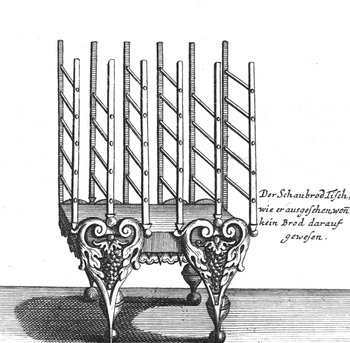
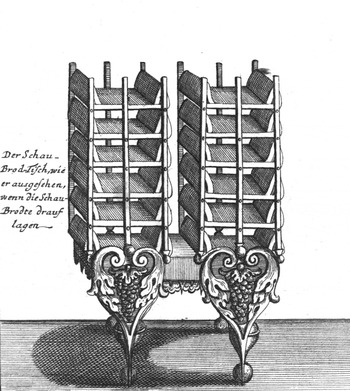
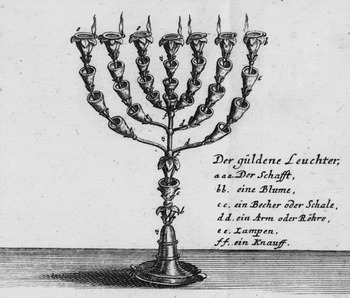
These parables helped to clarify the model's case for a sacred order at work in nature and society. In the external courtyard, one encountered key natural and artificial objects and saw how they were arranged. For example, one observed piece 51) a small forest of trees, 73) a room full of lambs, “in which there were always at least eight lambs available, out of which two were sacrificed daily,” 76) a gate full of more sacrificial animals, namely cows, sheep and goats, 84) a room full of salt, 99) a courtyard full of wood that was to be used to power the sacrificial altars (ibid., 38–42). The most important instruments were altars, those that played music, displayed the “showbread” (figs. 2 and 3), and illuminated various chambers. Each external courtyard had four large golden lights; they were so bright, observers learned, that they could be seen in the streets of Jerusalem (ibid., 44) (fig. 4).Footnote 23
Table for displaying the showbread (Schaubrot) as a sacred instrument. Christoph Semler, der Tempel Salomonis (Halle 1718).

The showbread (Schaubrot) with table. Christoph Semler, der Tempel Salomonis (Halle 1718).

The golden lights as sacred instruments. Christoph Semler, der Tempel Salomonis (Halle 1718).

From the external courtyard's various rooms and instruments, the handbook guided the observer into the inner courtyard – stage five. Designated as piece 110 in the model, this courtyard was further divided into the “courtyard of the Israelites,” the “courtyard of the priests,” the “place of sacrifice,” the “room between the Temple and the altar,” and the place around the Temple building. Twenty-four holy men, depicted in piece 112, stood in the courtyard of the Israelites every day and held services. Here one also saw piece 113) the throne of King Solomon, which was “three Ellen high, five Ellen wide, and stood upon a marble pillar” and piece 117) the clothes chamber containing ninety-four cases of white clothes worn by holy priests (ibid., 48–50).
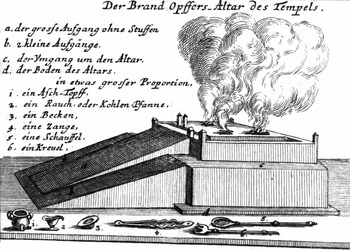
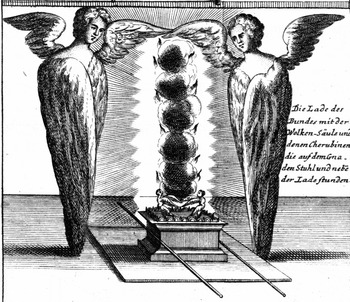
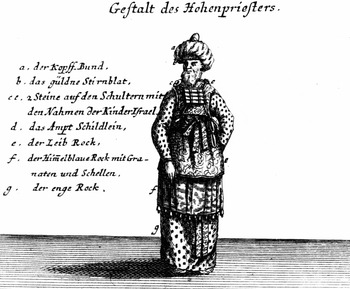
Finally, one arrived at the Temple – stage six. Before going inside, the model handbook directed observers to look at piece 193) the Temple's golden door, 194) its tower, which was 120 Ellen high and 195) its golden roof (ibid., 71–72). Once through the door, one saw more golden lights (pieces 202 and 213), sacred containers, tables and windows (pieces 204, 206 and 210) and 214), a golden smoking altar (ibid., 73) (see fig. 5). One saw piece 230) the Ark of the Covenant, 235) two small cherubim, 238) the pillar of clouds and fire “where God lives” (fig. 6). Then “248) the Tabernacle of Moses, with all of its components, which had been brought into the Temple and placed in the upper room” (ibid., 80–85). The main building was also comprised of piece 304) a chamber of medicines or an apothecary, “where the wonderful remedies were prepared,” piece 307) a chamber full of freshly harvested wheat, figs, granat apples, olives, grapes, and dates, 310) the improvement room, “in which things for improving the Temple were presented and stored,” 312) the high priest (fig. 7), and 367) the twelve precious stones, which were divided up into groups of three and presented in four rows (ibid., 88–89, 95).Footnote 24
A sacrificial altar. Christoph Semler, der Tempel Salomonis (Halle 1718).

The Ark of the Covenant, two small cherubim, and the pillar of clouds and fire where God lives. Christoph Semler, der Tempel Salomonis (Halle 1718).

A high priest. Christoph Semler, der Tempel Salomonis (Halle 1718).

To round out this description of the sacred stones housed inside the Temple building, the handbook concluded by stressing the emblematic function of the ancient Israelites’ religious services. The future was presented in hieroglyphs or emblems, observers learned; in effect, the building itself, including its ritual ceremonies and objects, mediated between past and future events (ibid., 96).Footnote 25 The ancient building had been a three-dimensional emblem, comprised of natural and artificial objects, just like the Temple model through which visitors had traveled virtually, with open eyes and ears.
As Francis Yates explained in her study of ancient mnemotechnics, the faculties of intense visual memorization that were extremely important in the pre-modern world, are canonically described in a text for teaching rhetoric, long thought to be written by Cicero, called the Ad Herennium (Yates [1966] Reference Yates2001, 4; Parshall Reference Parshall1999). The key to learning how to remember involved strategically deploying specific loci – places “easily grasped by the memory, such as a house, an intercolumnar space, a corner, an arch or the like” – and images (Yates [1966] Reference Yates2001, 4). Images are described in the Ad Herennium as forms, marks, or simulacra and were best remembered only when they were inscribed upon these loci. The key to mnemotechnics was having access to a large assortment of places, especially buildings, organized to form a series. If the memory loci “have been arranged in order,” the memory section of the Ad Herennium reported, “the result will be that, reminded by the images, we can repeat orally what we have committed to the loci, proceeding in either direction from any locus we please” (ibid., 7)
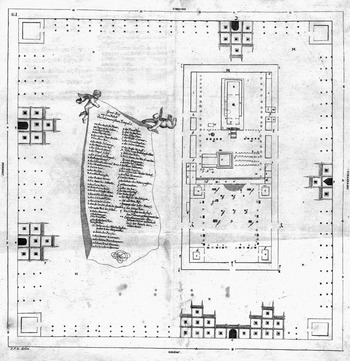
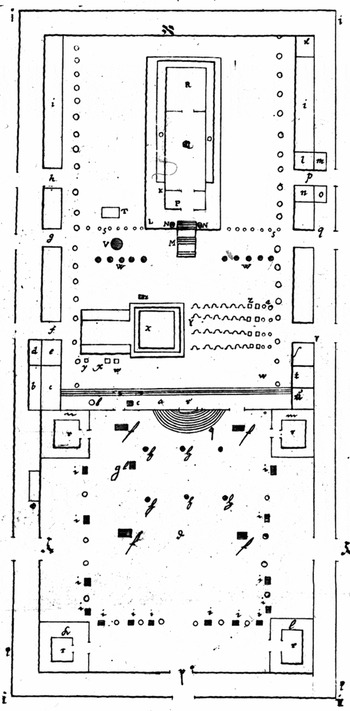
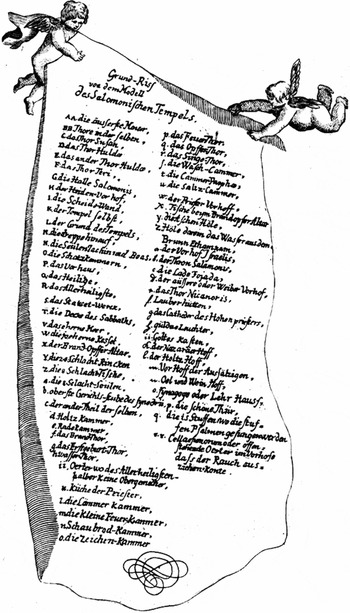
Semler's Temple model was a miniature yet elaborate locus, containing 367 individual loci that had been painstakingly organized according to a specific rubric. Semler explained in the handbook that the series and arrangement of the object made a special order observable “that was of great use for the spectator” (Semler Reference Semler1718a, 9).Footnote 26 To help him make this order visible and accessible to others, he created a precise, ichnographical footprint – a ground plan – thereby adapting the techniques of artists, architects, and engineers to his endeavor (see figs. 8, 9, and 10). He actually affixed his ground plan to the square wooden board (five Ellen long and wide) that served as his model's foundation. In this way, Semler anchored the loci, the pieces of his model, making them immovable so as to be more easily inscribed with the meanings conveyed to observers (Yates [1966] Reference Yates2001, 12).Footnote 27
Halle Temple model ground plan, Christoph Semler, der Tempel Salomonis (Halle 1718).

Close-up of the Halle Temple model ground plan. Christoph Semler, der Tempel Salomonis (Halle 1718).

Ground plan register of loci names. Christoph Semler, der Tempel Salomonis (Halle 1718).

When his wooden Temple model made its debut in 1718, Semler was already well known in Halle as a model and instrument maker, teacher, and preacher. He spent most of his life in Halle, leaving only briefly to study at the University of Jena with a charismatic professor of mathematics and physics, Erhard Weigel, who had also deeply impacted Leibniz's life. Following the (by then) very popular advice of Comenius, Weigel had advocated founding special kinds of schools for instilling virtue in children by showing them plant and animal specimens, models, machines, and measuring instruments (Schlelicke et al. Reference Schlelicke, Klaus-Dieter and Kratochwil1999; Weigel Reference Weigel and Schüling1970; Schlagenhauf Reference Schlagenhauf, Bluma, Pichol and Weber2004, esp. 202–204; Comenius [1654] Reference Comenius and Bötticher1907). Semler later founded a school in his home that aimed to teach children how to acquire a refined understanding of these things. He called it a “school of the real.” It was full of models.Footnote 28
While relying on a long and lingering tradition of occult memory systems derived from the much older tradition of mnemotecnics, Semler's innovation was to stress the peculiar potential of models to help systematically extend or improve this art. Ancient memory arts involved constantly maneuvering and reinscribing relationships between loci and images that existed in the mind and sometimes on a page or a screen (Yates [1966] Reference Yates2001, 10).Footnote 29 By the end of the sixteenth century, as art historian Peter Parshall has observed, individuals in Venice, Nuremberg, and beyond were calling certain kinds of images “effigies” or “imitatio” “in the sense of a more forceful presence than an image” (Parshall Reference Parshall1996, esp. 561). In other words, an effigy implied “a substitute for the thing itself as much as, or instead of, a portrayal or representation of it” (ibid.; see also Summers Reference Summers2003, 291).Footnote 30 Effigies were valued as replicas that allowed one closer access to the real thing than mere images. They were intermediaries, whose special status Semler decided to take advantage of in this case. He described his Temple model as an effigy: an imitation or substitute for the original Temple (Semler Reference Semler1723b, 9).Footnote 31 He used the Temple model to minimize and to standardize the amount of negotiation between images and loci that observers engaged in as they committed it to memory. While it was not as fixed as the original locus, for Semler it was more reliable, evocative, and better able to help people not only remember but also understand the original Temple than other images.
Since at least the sixteenth century, Protestant (and Catholic) reformers had been discussing the dangers of images, which many argued were often “false” and, therefore, disrupted the ability of individuals to experience the divine. By then, devotional images, especially effigies, were standard features of Catholic worship services. As Bob Scribner writes: “they were laden with sacred power,” they were believed to “exemplify an indwelling personality,” and they could “enter into an affective personal relationship with a viewer” (Scribner Reference Scribner, Eichberger and Zika1990, 102–103). The relationships individuals formed with devotional images were inherently unstable and, therefore, unpredictable. Although Martin Luther admitted that he, like most people, could not help but to create images in his mind (phantasias) that helped him to grasp “theological truths,” he was concerned with their proliferation in the Church and with the widespread conviction that they stood in for divine messages contained in the Bible (ibid.). In response, he championed a sustained and direct engagement with the authors of the Old and New Testament. He told his followers “to put your eyes in your ears”: to listen carefully to trusted spiritual leaders’ accounts of the word. A century later we find a Lutheran minister in Halle arguing rather directly against this (by then) well-established Protestant emphasis upon listening first, then looking. Semler's handbook urged observers to use their eyes and their ears simultaneously and to experience every single piece for themselves.
Semler argued that in general models offered precisely the kind of solution to the problems of the imagination that many sought. There were many ways to communicate information through media, but only models generated forms of understanding that were almost as high as that generated by seeing a real place or a model of it firsthand. He explained that there were “different gradations of understanding to be acquired of visible things. For example, I can acquire understanding of the fruit of an Indian tree from
1. a description with words in a book. But this understanding is like death; it is like when one sees something at night. Now if the fruit
2. is described through word of mouth by someone who has seen it himself, then my understanding will become much more vivid because I can ask this person more questions about that which I do not quite understand enough; this cannot happen with a book. Now if fruit of the foreign tree is presented
3. in a copperplate engraving, or
4. in a painting with vivid colors, or
5. in a model made of wax or wood, then the understanding is still much brighter and more distinct, or
6. in its natural state and laid out before the eyes. Then this of all the aforementioned ones is without question the highest degree of understanding and it presents the character with the best ideas.
Now when to this kind of ocular demonstration is added a vivid verbal lesson, then the understanding of the thing will sink itself more deeply into one's character (Semler Reference Semler1708, 9–10).Footnote 32
Because of their stability and autonomy as substitutes, their perceived closeness to the original, models generated superior forms of understanding. More of them needed to be used in schools. All children, Semler wrote, needed to be introduced to “ideas rerum materialium through models” at very young age and then to “ideas rerum immaterialium through short definitions and clear descriptions” (Semler Reference Semler1739, 84–85; emphasis in original).Footnote 33
To explain what “higher forms of understanding” meant to him, Semler made use of the Roman rhetorician Quintillian's characterization of evidence (truly, clearly, distinctly), noting that models created deeper sense impressions than images or paintings. They facilitated a form of understanding that was clearer, brighter, and more distinct (Gaukroger Reference Gaukroger1992; Jones Reference Jones2006, 64–65). He used the same criteria when discussing the special value of his Temple model relative to the myriad descriptions and images of the space found in illustrated Bibles, for example:
The descriptions and copperplate engravings one finds in the authors (of the holy scriptures), if they are truthful, are helpful for acquiring a clear idea of holy places and regions; but none of these produce the same kind of distinct or vivid idea as when one sees the entire Temple standing before the eyes in a material presentation and model. Here not only many sayings about the Temple that one only has a vague idea about become clear and distinct but the historical events, which took place in the Temple, are carried inside the character of a person, where they make a deep impression. (Semler Reference Semler1718a, 1)Footnote 34
As an especially striking effigy, the Temple model affected the inner senses and took root inside individuals. Semler claimed that a single hour of intense observation of this model would allow the individual to form a “much more unforgettable idea,” thereby “profiting more” than if that same person spent hours reading accounts by the best authors (ibid., 3).Footnote 35
Semler clearly understood his Temple model as a virtual locus, a kind of miniature memory theater into which one could walk with the help of the imagination. While the model helped observers to virtually experience this sacred, ancient space – to literally project themselves into another time and place – the effigy generated clearer, more distinct and vivid forms of understanding of the composite structure and its pieces. In so doing, the Temple model fulfilled the Cartesian admonition to consistently offer the intelligence “concrete practice in experiencing order, clarity, and distinctness in order to sharpen its ability to discern the truth” (Jones Reference Jones2006, 31).Footnote 36 All models, Semler explained near the end of his life, operated as sensualia, which individuals could regularly receive both “through listening and through the ocular presentation all kinds of ideas 1) truly, 2) clearly, 3) distinctly, and 4) completely, so that they grasp the thing clearly and if it should be talked about, they will understand this talk and become understanding and reasonable people. With this autoptical method,” he continued, “I am constantly engaging myself” (Semler Reference Semler1739, 84–85).Footnote 37
A long philosophical tradition insists that the criteria of clarity and distinctiveness are not epistemic, but rather aesthetic, because of their intrinsic unreliability. Semler's descriptions of his model's powers indicate that, for him, there was no difference, or contradiction, between the two. While Semler was still active in Halle, a young man who had attended school in the educational complex displaying this model, Alexander Gottlieb Baumgarten, issued his influential call for the founding of “aesthetics” as a philosophical discipline. Following Terry Eagleton's assessment, the aesthetic became “the name given to that hybrid form of cognition which can clarify the raw stuff of perception and historical practice, disclosing the inner structure of the concrete. . . . Because the aesthetic exists, the dense particulars of perception can be made luminous to thought, and determinate concretions assembled into historical narrative” (Eagleton Reference Eagleton1990, 17; for Baumgarten and Halle, see esp. Grote Reference Grote2008). Careful consideration of Semler's Temple model suggests that the study of the “hybrid form of cognition,” which discloses “the inner structure of the concrete,” were rooted in real observational practices and media. This model seemed uniquely capable of generating a kind of intuitive awareness of interconnections between manifold pieces and their relationships to one another as an embodied or internalized infrastructure (Jones Reference Jones2006, 31).Footnote 38 Poets and prophets had acquired special faculties of insight that allowed them to see and to understand the relationships between parts and wholes, to understand “completely” in ways that others could not. Much like a poem or a song, perhaps a well- constructed Temple model could do the same.
A Christian Philosophical Network
Even though Semler believed in the unique powers of his Temple model, his convictions alone did not guarantee it would operate the way he said it would. The model's ability to make sense impressions deeper than images and descriptions had to be collectively tested and verified. In the introduction to the Temple model handbook, Semler noted that several local experts in ancient history and architecture, some from the University, had observed the model and given it their seal of approval (Semler Reference Semler1718a, 3).Footnote 39 Semler also custom built this model to be deployed inside a collective – and was paid for his trouble. After approximately a year, the model was transported from his home to a nearby complex of schools known as the Glauchesche Anstalten or the Halle Orphanage, where it was integrated into its program of learning.Footnote 40
This communal organization maintained a steadily growing collection of curiosities that had been sent as gifts by anonymous donors, former students, professors, teachers, missionaries, and patrons. The objects found their way inside the commune through the work of those interested in demonstrating their support by sending it things. Several objects, including a unicorn's horn, the horn of a rhinoceros, and three whale teeth, were taken directly out of the royal curiosity cabinet in Berlin and sent to Halle (Müller-Bahlke Reference Müller-Bahlke1998, 15; for Leibniz and unicorns, see Ariew Reference Ariew1998). The author of the collection's first printed catalog remarked, tellingly, that “one observes no certain order to these objects because they have still not been divided into classes; this really ought to happen if the collection is to grow in the future” (Müller-Bahlke Reference Müller-Bahlke1998, 15; see also Dolezel Reference Dolezel and Frank2007; AFST/W XI/-/14). Despite this remark, there were attempts underway from roughly 1715 to 1730 to develop an argument about what kind of order should be imposed upon these things. The Temple model was implicated in these discussions; as a kind of template, it helped to stabilize the processes of displacement that had given way to an extensive and predominantly ethnographical collection.Footnote 41
In 1732, long after the Temple model arrived in the complex, the collection came to be housed in a single room. Comprised of approximately 4,500 objects by this point, they were organized into cabinets placed along the walls. These cabinets contained animal and plant specimens, minerals and precious stones, rare writings – including a Chinese patent and a letter from Martin Luther to the King of Denmark – clothes and other artifacts (knives, spoons, jars) from foreign lands (mainly Greenland, Russia, China, and Turkey), sacred relics from a variety of religions, and things sent specifically from missionaries in Malabar, the name Europeans used to describe much of southern India. In the middle of the room was an elaborate ensemble of models, all of which Semler had built, including 1) “the Holy Land, whose borders, divisions according to tribes, cities, mountains and rivers, along with other unusual things are presented using special pictures”; 2) “the City of Jerusalem, as it looked during the time of Christ”; 3) “two large heavenly spheres: the system of Copernicus, in which the orbits of the planets and their satellites around the sun are presented using wheels and weights . . . and the system of Tycho Brahe, which has been built with a screw that never ends and shows how the planets and the sun move around the Earth, placed in the center”; 4) the Tabernacle; and finally 5) Solomon's Temple (Dreyhaupt Reference Dreyhaupt1755, 225).Footnote 42
Before I begin to parse the meanings of the very dense and significant arrangement of this space, I want to deliberately situate this evidence alongside one account of how a copy of Semler's Temple model was used in the complex's most elite school, the Pädagogium, prior to 1732 (Semler Reference Semler1718a, 10).Footnote 43 As I have shown elsewhere, a signature of the Halle Orphanage schools was its administrators’ interest in “eclectic” teaching methods and their capacity to introduce pupils from a variety of social backgrounds to the mathematical sciences (Whitmer Reference Whitmer2009a; see also Mühler-Bahlke Reference Müller-Bahlke1997). In what were generally referred to as “recreation” or “motion” periods, male adolescents were directed to participate in a highly organized series of inductive exercises.
In 1721, these activities were reorganized according to a “new method” and applied in the Pädagogium. The following is a schematic summary of these activities:
1. Preparation for Physics and the Bible
a. Visiting Artists and Artisans
b. Lessons about Animals, Plant and Trees
c. Lessons about Metals, Stones and Minerals
d. Lessons about the Earth, Water, Air, Fire and Meteors
e. Lessons about Economics (Oeconomie)
f. Lessons about Medicines
g. Explanation of the Temple of Jerusalem
2. The Mechanical Disciplines
a. Turning
b. Making Instruments and Figures out of Cardboard
c. Polishing Glass
3. The Disciplines of Physics
a. Botany
b. Anatomy
c. Experimental Physics
4. The Disciplines of Mathematics
a. Astronomy
b. Music
c. Drawing
d. Calligraphy
(Freyer [1721] Reference Freyer and Kramer1966, 347–350)
While there is certainly a great deal that could be said about any one of these categories, and the activities included within it, I will focus exclusively here on the first activity, Preparation for Physics and the Bible. Pupils engaged in these activities on Mondays for several hours beginning at 11 a.m. Their teachers, mostly university students, were told to use Comenius’ Orbis Pictus and Johann Daniel Herrnschmidt's introduction to a text called Short Questions to be Asked of Natural Things. Herrnschmidt, then a professor of theology in Halle, recommended that young people be taught to critically examine and test phenomena that they had experienced, first hand, in nature (ibid., 348–349).Footnote 44 Teachers also used Christoph Weigel's Portrait of the Common and Useful Orders (Abbildung der Gemein-Nützlichen Haupt-Stände) to help them “develop questions about and better explain the objects, and also to teach pupils the Latin words for the things they saw” in the workshops of local artists and artisans (ibid., 348; Weigel [1698] Reference Weigel1987; Comenius [1659] Reference Comenius1970).Footnote 45
In addition to field trips, during the “Preparation for Physics and the Bible” exercises, pupils observed, autoptically, the “forms, names and components” of animals, plants, and trees. Their teachers were advised to use Part Two (chaps. 1 and 2) of Johann Franz Buddeus’ Elementa philosophiae theoreticae in order to provide a foundation for these classroom-based lessons (Freyer [1721] Reference Freyer and Kramer1966, 348–349).Footnote 46 Pupils were then introduced to metals, stones, minerals, and to the basic properties of air, water, earth, and fire using Chapter Three of the Buddeus text. They learned about the art of the household and its various components (farming and viniculture, cattle breeding, brewing beer, forestry, hunting, and fishing) and received an introduction to the materials used to make basic medicines. Finally, as the culmination of these activities, pupils stood in front of the Semler Temple model and took a virtual pilgrimage (ibid., 347–350).
The order of these activities begs a comparison with the ordering of the Temple model's 367 pieces in the handbook and the stages of pansophic induction described in the first part of this article. One began to learn outside the Temple and then slowly walked across a bridge, through its eastern gate and into the complex. In the same way, pupils at the beginning of their learning journeys were taken outside their school, into workshops and small-scale factories, where they received a series of general sense impressions. They then moved back inside the space of the school-Temple, observing specimens of animals, plants, and trees along the way. Inside they acquired further introductions to natural kinds, to the four elements, to the art of collective household management and to the materials for maintaining bodily health. Then they observed the Temple model, which offered them a physical space in which to organize these preliminary experiences. Embedded in a collective that was just as involved in running an evangelical mission as it was in the business of running schools, the Temple model lent itself to the articulation of an eclectic, Christian philosophical worldview.
Buddeus’ Elementa philosophiae theoreticae, in particular, was strongly affiliated with a Christian philosophical program: that is, it was a notable contribution to ongoing attempts to create a pious natural philosophy since the late Renaissance (Blair Reference Blair2000, esp. 35, 41–42, 51–58; Ahrbeck Reference Ahrbeck1958, 1047–1050; Collier Reference Collier1934, esp. 44–50; Comenius [1630–1640] Reference Comenius and Scherbaum2008). Buddeus’ aim was to create a new narrative about a perennial, Christian philosophy that would effectively extend the project outlined by Comenius in his Naturall Philosophy Reformed by Divine Light. He also sought to expose and to “Christianize” the Jewish Kabbalah – like Athanasius Kircher and others – as the earliest and most important expression of the Physica Mosaica. A signature feature of Comenius’, and later Buddeus’, Christian philosophical project was a new literalism, which meant moving away from the allegorical approaches to Scripture preferred by Paracelsians or hermetic philosophers (Blair Reference Blair2000).Footnote 47 Needless to say, this feature of the project alone meant it was often looked upon with a great deal of suspicion. Francis Bacon, for one, expressed his displeasure with Christian philosophy; he famously complained about the audacity of those who had “with extreme levity indulged so far as to attempt to found a system of natural philosophy on the first chapter of Genesis, on the book of Job, and other parts of the sacred writings” (quoted in ibid., 42). For Comenius’ Christian philosophers, the Bible was not only a potential source of information about the causes of natural phenomena, but actually the starting point for all natural philosophy.
Buddeus saw a return to a Mosaic physics and the theo-philosophy of the ancient Hebrews as a way to generate confessional and philosophical union: by returning to the moment before differences and disputes had emerged. This return to origins also appealed to some as a viable strategy for the reform of absolutism, of education, and of religion. The key was ensuring that it was a real philosophy: something that was actually possible for people to practice. Following Wilhelm Schmidt-Biggemann's analysis of his project, Buddeus discredited the “symbolic theosophy” of the Kabbalah and tried to reinterpret its significance in terms of something practical, physical (constantly emanating), and Biblical.Footnote 48 In turn, he developed an elaborate narrative about the political implications of this alternative philosophical program (Schmidt-Biggemann Reference Schmidt-Biggemann and Most2001, 123; Comenius [1633] Reference Comenius1651).
Advocates of Mosaic physics, including Buddeus, became key players in heated discussions about how to radically reform the state, which were underway in Brandenburg-Prussia at precisely the moment the Halle Temple model debuted. These discussions occurred amidst the backdrop of lingering concerns about the value of state-enforced tolerance policies in the German Empire more generally. After the disaster of the Thirty Years War, many public intellectuals had begun to argue that formal policies of religious tolerance simply did not work. They questioned the utility of the famous cuius regio, eius religio principle of the Peace of Augsburg (1555), for example, which had been upheld in the Peace of Westphalia (Wallmann Reference Wallmann, Duchhardt and May2000, 27). By allowing territorial leaders to sanction a single official religion, the principle perpetuated dangerous confessional hierarchies. One of its most vocal opponents, the theologian Georg Calixt, insisted that the cuius regio, eius religio principle should no longer be upheld and that vigorous inter-faith discussions needed to take place that were oriented around devising a consensus antiquitatis based entirely upon the practices of the first Christians – practices foreshadowed in the rites of the ancient Israelites. His opponents saw him as someone who wanted to eliminate diversity and make everyone think the same way.Footnote 49
By 1701, Frederick I of Brandenburg-Prussia had begun to support a Calixtean point of view. As a Calvinist ruling over Lutherans mainly, he wanted to enact state policies of confessional union and was prepared to dispense with traditional confessional vocabularies. As one royal correspondent reported:
His Royal Majesty is quite agreed that we should work for union and not for so-called tolerance – a union by which the unholy Schism might be terminated and by which one party and the other might be able and willing to use with clear conscience the worship and Communion of the whole. His Royal Majesty therefore thinks that it is necessary to abolish the party names, Lutheran and Reformed, and henceforth to call both churches by the single term Evangelical. (Jordan Reference Jordan1927, 200)
Frederick I sponsored a series of formal conferences concerning how best to dissolve confessional differences in his realm. These were precisely the kinds of “interfaith discussions” that Calixt had called for. Some of those involved in these conferences advocated assimilation and a new form of “theocratic absolutism” of the kind advocated both by Buddeus and by the Danish court chaplain Hector Gotfred Masius: an absolute state whose civil governing structures were rooted in a non-confessional version of divine law.Footnote 50 The emerging goal was to make a perennial Christian philosophy serve as the foundation for all civil and universal rights.
In some ways, this turn towards irenicism in confessional politics can be read as a reaction against Samuel von Pufendorf's system of universal rights. Gottfried Wilhelm Leibniz and many other Christian philosophers believed Pufendorf's system was fundamentally flawed. As Ian Hunter has explained, Leibniz's metaphysical conception of justice (justia est caritas sapientis) went fundamentally against Pufendorf's antimetaphysical or civil conception; both men had forged programs of universal justice out of two very different natural law traditions. Pufendorf's version of Grotian natural law drew from Bodinian sovereignty doctrine, “a native German ‘statist’ political science, a secular cultural and political history and German Staatsrecht – the political jurisprudence derived from the imperial legal system in particular” (Hunter Reference Hunter and Hochstrasser2003, 170–171). Leibniz's “Christian-rationalist” version of natural law was grounded in scholastic metaphysics and Roman law and drew readily from Protestant metaphysical jurists and political theologians’ syntheses of these sources (ibid.; see also Haakonssen Reference Haakonssen1996, esp. 46–49; Schnedier Reference Schnedier1967; Döring Reference Döring1993, 156–174).
In short, a network of individuals interested in moving beyond state-mandated tolerance dominated public policy-making in Brandenburg-Prussia during the first two decades of the eighteenth century. Frederick I informally supported efforts that seemed in line with the current irenical trend by giving privileges to those directing certain kinds of projects. The Halle Orphanage received a royal privilege, royal subsidies, and became a key vehicle for Prussian educational reforms (see Melton Reference Melton1988, esp. 23–59). The organization's director, a theologian, was among the first members of the Berlin-Brandenburg Society of Sciences. The founders of this body, Leibniz and the Hohenzollerns’ court preacher, Daniel Ernst Jablonski, hoped it would operate as a kind of evangelical mission initially. In a letter to Leibniz that was preserved for many years in the Halle Orphanage archive, Jablonski wrote:
From what I can tell, an Academy of Sciences will be built that includes only an observatory. . . . But we also need to develop a correspondence, like with England and France but over Moscow with China. . . . If we had enough funds, we could send people on ecclesiastical and civil missions to China, India, Ethiopia and other places, where they could do something important. And since most of the Academy members undertaking these missions would be physicians and experimentalists, there would also be plenty of opportunity to conduct philosophical experiments. (Delius Reference Delius, Arnim and Delius1970, 101)Footnote 51
While the Berlin-based scientific society never actually sent missionaries to China, India, or Ethiopia, the Halle Orphanage did start to do this. In 1706, Bartholomäus Ziegenbalg and Heinrich Plütschau settled in the Danish colony of Tranquebar, in “Malabar,” where they founded schools modeled after the complex in Halle and a “Church of the New Jerusalem” (see Ziegenbalg Reference Ziegenbalg1710 and Reference Ziegenbalg and Johann1715 and the Hallesche Berichten Reference Hallesche1710–1772; for the most recent scholarship on the mission, see Gross Reference Gross2006, esp. vol. 1).
Missionaries affiliated with the community distinguished their network from others by citing their connection to Halle, its patronage networks, and its foundations. Many of the young men who traveled to India had experience teaching in the foundations’ schools and wrote hundreds of letters back to friends (usually fellow teachers), detailing all that they were seeing, hearing, and learning. Pupils of the educational complex were asked to relay specific questions to the missionaries in letters and very often the responses to these questions were assembled and published.Footnote 52 Christian Friedrich Pressier, for example, was a university student who taught in the foundations for two years (from 1722 to 1724) and then traveled to India as a missionary. In one of his letters to pupils back in Halle, he responded to questions like “What about the Malabar's Astronomy and other physical sciences?” Another missionary, Christoph Theodosius Walter, was asked to describe his journey to India on a British ship. To the foundations’ pupils he wrote, “An English ship goes no more than four times to east India: after that it is either set out to sea or broken up. The quadrant they use, with which one can observe latitude in the afternoons, is different than the one Herr Wolff describes in his Astron. Tab. 1 Fig. 6, with which one can only observe stars when one is up high” (AFST/M 1 B 2 21 [June 19, 1725]; Bericht von Christoph Theodosius Walter, an Ernst Heinrich Aleman).Footnote 53 Walter then drew a picture of the new quadrant and described how the British sailors used it.
These Halle-based missionaries were concerned with gathering information about the rest of the world. They sent objects back to Halle to fill in the gaps of the world's universal infrastructure, which they had seen and even visited, through virtual pilgrimage, many times. For the proponents of this peculiar Christian philosophical organization, and mission, Solomon's Temple took on a special significance. Its status as a place of origins held out hope for those seeking a reliable way to organize new knowledge irenically. Of course it was common at the time to trace a linear path for the development of human knowledge from Adam to Solomon to ancient Rome. Buddeus developed a story that started, predictably, with Adam, who had possessed the ability to see the real “nature of things” by observing their unique signatures. From Adam through an elaborate genealogy, he arrived at Moses, whom he said had possessed unrivalled understanding of especially medicine, chemistry, and philosophiam symbolicam – or hieroglyphs (Schmidt-Biggemann 110–111). And from Moses, he came to Solomon, the primary agent of “exoteric” and “esoteric” knowledge in the world (Holzhey and Zimmerli Reference Holzhey and Walter1977).
Yet not everyone was willing to accept the Temple's status as the first, formalized expression of Adamic wisdom. On the contrary, antiquarian evidence seemed to suggest that the Temple's construction, arrangement, and rituals were derived entirely from a variety of pagan traditions (Zedler Reference Zedler1744, 377–382). Also, for many Protestants, the historical Temple had been full of gaudy and unnecessary decorations, gilded walls and other useless items that inhibited worship. To argue for the beauty, function, and necessity of golden candlesticks and cherubims was to reopen post-Reformation debates about the dangers of images and idols (Koerner Reference Koerner2004, 127–143; Clark Reference Clark2007, 161–203; Wandel Reference Wandel1995; Eire Reference Eire and Robert1990). Amidst a revitalized politics of confessional union and theo-philosophical cooperation in Brandenburg-Prussia, many in Halle had returned to embrace the power of effigies, and what they believed to be the unique potential of collective empirical exercises.
The overall effectiveness of these exercises was linked overtly to the quality of the observable media, which could be easily harnessed to the “new literalism” of Christian philosophy. The Halle Temple model made a sustained case for the literal significance of each and every piece of the Temple and did not take imaginary accounts of it, such as Ezekiel's, seriously as sources. While Ezekiel is an actual book of the Old Testament, it contains a prophetic – not an historical – account of a coming Temple. Thanks mainly to the efforts of a Spanish Jesuit named Juan Bautista Villalpando, Ezekiel's prophetic account was often “mixed up” with accounts of the historic Temple contained in the books of Kings and Chronicles. Near the end of the sixteenth century, Villalpando went so far as to combine Vitruvius’ accounts of Temples in ancient Rome with both the historical and the prophetic accounts to produce a series of evocative Temple images (Sheehan Reference Sheehan, Smith and Schmidt2007, esp. 250–254; Lara Reference Lara and O'Malley1999; Vitruvius Reference Granger1998). His illustrations impacted most subsequent attempts to learn more about the Temple's arrangement; even Comenius considered Ezekiel a reliable source (see Miletto Reference Miletto2004, 158).
A real Christian philosophical regime, one concerned with elucidating how the historical Temple had operated as the original and literal gathering point of perennial wisdom, had to dispense with Ezekiel and use only reliable first- and second-hand accounts found in the Old and New Testament and the Talmud. Accessing these accounts meant learning to read them in their original languages. The Halle Orphanage hosted an assortment of university collegia, where students received intensive instruction in reading sacred texts in their original languages. In 1728, a frequent visitor of these collegia, Johann Heinrich Callenberg, founded an institute for the advanced study of Jewish and Muslim culture that was affiliated with the complex (Bochinger Reference Bochinger and Wallmann1998; Rymatzki Reference Rymatzki2004; Dowdy Reference Dowdey2006). Without question, the aims of Callenberg's institute are best understood in conjunction with efforts to convert Jews to Christianity in the period more generally. For those involved in it, conversion was supposed to happen through collaborative acts of inspiration: through encountering media that were better suited to convincing individuals of the perennial truth.
As part of his rhetorical positioning of this Temple model in the handbook, Semler claimed that the model had the effect of actually drawing prominent members of the local Jewish community to it, not the reverse. He claimed Jews from near and far came to the school complex and wanted to talk with him about the model; some even came more than once (Semler Reference Semler1718a, 4).Footnote 54 He also stressed that his aim was not to discard but rather to understand the intricacies of the Jewish religion. He noted that he had been particularly impressed to learn of the large wooden Temple model that had been built in Amsterdam by the Dutch-Portuguese rabbi, Jacob Jehuda Leon, several decades earlier (ibid., 6).Footnote 55 In the introduction to his handbook, Semler also relayed the story of how he had personally been inspired by a rabbi from Prague who had traveled to Halle with a small wax Temple model. He said the experience had convinced him of all models’ uniquely evocative powers but also of the need to ensure that they were built as correctly as possible. As much as he respected this rabbi, he insisted the model itself was full of flaws and that this fundamentally limited the effect it could have on those who viewed it. He claimed to have developed, simply, a better model – with the rabbi's help of course.
Conclusion
With this discussion of Christian philosophical politics in place, we can now go back to the future of the Halle Temple model: where it stood in 1732. We find it in the center of a large room in the middle of an elaborate collection of objects. On either side of it are models of the Tabernacle, the city of Jerusalem and Palestine; on both sides of these are Copernican and Tychonean models of the heavens. Surrounding this ensemble are cabinets full of botanical and animal specimens, medicines, examples of clothing, writing implements, and other tools. Missionaries, teachers, and former students sent these objects from far away places to be placed in repositories so as to form a coherent narrative. The models in the middle became the virtual infrastructure of the entire collection and, by extension, the entire Christian philosophical project of which they were an integral part. If the Temple had once operated as the original gathering place of perennial wisdom, then every natural and artificial object in the world contained real pieces of that wisdom and had to be situated somewhere inside it. This was the project and, hence, the underlying reason for the collection's ethnographical quality.
Inside the Halle collective, the Temple model was invested with a kind of agency that required it to remain motionless. Objects and individuals moved around it, not the other way around. It anchored the Halle project through no effort of its own, really, but through the work – exegesis and model making – of its builder and those who gathered around to read its argument. As an effigy, the model helped to legitimize the efforts of Halle's Christian-philosophers to move inside the civil state and to make the invisible church the equivalent of that state. It shaped much more than the “scientific imagination” of those who encountered it in periods of motion; rather it helped stabilize, as an information technology, their practices of observing, experimenting, gathering, and sorting.
Models in general, following Semler, were uniquely suited to generating clearer and more distinct forms of understanding. As substitutes for real things, they were literally suspended between real, original places and the realm of the imaginary. But some models were better than others. In Semler's estimation, models that stood for real things and were rooted in eye witness accounts of these things, were better than models built from the imagination. He did not advocate making models in order to freely or creatively articulate images of things that had never previously existed. Instead, models had a stabilizing effect as substitutes, helping people understand and order things with a past. Observing the model allowed one to move inside a moral infrastructure that would have otherwise remained inaccessible and helped individuals learn to hold these details in their memories as they went out into the world.
Acknowledgments
The author extends special thanks to Fabian Krämer and Mirjam Brusius for their help with the German translations, to Steffi Klamm, Gordon McCouat, Jeff Schwegmann, and Alexandre Métraux for editorial suggestions, to Lorraine Daston and the participants of the Max Planck Institute for the History of Science Department II Colloquium for discussion of the model at an early stage in the project, and to Simon Schaffer.