It is surprising how little is known about when formal bank supervision came into existence. For example, existing research on their early evolution in the United States simply summarizes the supervisory environment for particular years (as in Weldon Reference Weldon1910) or presents a limited number of case studies (as in Gruchy Reference Gruchy1937). Several recent studies have examined the effects of bank supervision in historical periods and during recent decades (Agarwal et al. Reference Agarwal, Lucca, Seru and Trebbi2011; Mitchener Reference Mitchener2005, Reference Mitchener2007; White Reference White2011), but this research has not attempted to provide a long-term quantitative assessment of the evolution of bank supervisory institutions.Footnote 1 We aim to fill this lacuna by analyzing the factors that led to the creation of formal bank supervisory institutions in the United States. We focus on government agencies established by states specifically for the purpose of supervising banks. We examine their origin in light of theory, such as the role they might play in reducing asymmetric information, as well as in terms of modern policy objectives, such as reducing systemic risk and improving the monitoring of individual bank's balance sheets and management behavior.
We assess when and why American states established banking departments charged with chartering and supervising banks. Because states had the authority to create banks, the need for supervision at this jurisdictional level may have arisen very early in the history of the nation. We therefore examine the creation of state banking departments from the early years of the republic through the beginning of the twentieth century. To do so, we assemble a new, long-term historical data set spanning 1820–1910 that provides information on the date of adoption of formal institutions as well as on state-specific factors influencing that decision. Since implementation dates and supervisory characteristics varied considerably across states, we are able to exploit both the cross-state and time differences to identify factors that drove the adoption of state banking departments and, more generally, formal supervisory institutions. Using these data and additional information on supervisory characteristics, we also examine whether states made progressive improvements to the quality of their supervisory institutions, which we consider by examining a state's resource commitment to improving its monitoring technology.
The empirical findings show that it took more than a century for all states to develop formal supervisory institutions as well as what policymakers today would consider as modern supervisory priorities.Footnote 2 Consistent with Raghuram Rajan's (Reference Rajan2009) view that financial regulation has been procyclical, we find that formal supervisory institutions (defined here as state banking departments) rose from the ashes of banking crises. Six states created government banking agencies immediately after the Panic of 1837, two states established them after the Panic of 1857, six states put them in place after the Baring Crisis of 1890 and Banking Panic of 1893, and 17 made changes after the Panic of 1907. No other interval had as many new departments established. The pattern indicates that formal bank supervision was a response to bank failures: the high sunk costs of establishing formal bank supervisory institutions likely delayed states from preemptively installing them.
The introduction of the National Banking Act and the taxation of state bank notes in the 1860s also appear to have shaped the development of modern supervisory institutions and priorities. Commercial banks shifted the composition of their liabilities from notes to deposits, simultaneously drawing more individuals (and potential voters) into the banking sector and increasing the potential for systemic bank runs.Footnote 3 The shift also increased bank loan portfolios relative to bond purchases, in turn more closely tying economic activity to bank health (Calomiris and Mason Reference Calomiris and Mason2008). Our econometric results suggest that state legislatures refocused their attention on the safety of depositors and installed relatively more costly state banking departments. As deposit taking grew in importance relative to note issuance, supervision shifted more purposefully toward maintaining the safety and soundness of banking systems.
States also reacted to the threat of national banking itself. Rather than allowing banks to charter under the Office of the Comptroller of the Currency, states offered an alternative regulatory and supervisory environment by establishing formal institutions. The entry rate of national banks is positively correlated with the adoption of state banking departments and of publishing regular banking reports. Therefore, unlike other studies that find the competition between banking systems led to regulatory laxity, competition might also have been beneficial.
By the beginning of the twentieth century and prior to the founding of the Federal Reserve System, most states had established separate regulatory agencies charged with bank supervision and required banks to regularly submit balance sheet information. Our empirical findings further indicate that states that moved earlier to create separate banking agencies devoted more resources toward supervision. Early adopters were more likely to publish highly detailed and regular bank reports, spend more on supervision, and carry out more examinations per bank. Some of these states had also given their examiners the power to shut down banks that were deemed unsafe. Because enforcement problems, compliance, and competition with federal regulatory agencies persisted long after the founding of the Federal Reserve System, these quality differentials may have had lasting implications for systemic stability.
INSTITUTIONAL DEVELOPMENT OF BANK SUPERVISION IN THE UNITED STATES
In its broadest form, supervision involves monitoring the operations and financial performance of banks in order to ensure that they are operating prudently. It often works in conjunction with legislated rules and requirements. For example, supervisory authorities might deny charters to banks that do not have sufficient paid-in capital, monitor banks to ensure compliance with capital or reserve requirements or disclosure rules, or ensure speedy resolution of failed institutions. While much has been written about branching restrictions, double liability laws, and deposit insurance in the United States, considerably less is known about how formal supervisory institutions evolved.
Although theory can provide some guidance as to why states may have created bank supervisory institutions, state legislatures' perceptions about the public need for supervision appear to have been shaped by the changing economic environment, including the growth of the nation, innovations in the banking industry, and the incidence of costly and unevenly distributed financial panics. Indeed, as we document here and in the empirical exercises that follow, it would be difficult for a single theory to account for the decision to adopt formal supervisory institutions: rather, the objective of policymakers seem to have shifted over time. Hence, in this section, we document the evolution of state banking departments over three eras, highlighting key factors that may have influenced policymakers' decision-making to create permanent state banking departments. The first period covers the nation's early history, when banks received special charters from state legislatures to operate. The second period corresponds to the Free Banking Era—from the 1830s through the Panic of 1857 and the large number of bank closures during the early years of the Civil War. The last period covers the National Banking Era, 1863–1913, which includes the rise of dual banking, the shift to deposit-taking commercial banks, and the Panic of 1907.Footnote 4
Special Bank Charters and the Young Republic
Commercial banking emerged slowly during the first decades of the nineteenth century. In part, the growth in banking was hindered by a chartering process that required individuals wishing to create a bank to seek legislative approval at the state level. American legislators, however, viewed their authority to bring banks into existence with some trepidation, fearing that charters effectively granted monopolies to a “moneyed elite.” Because states were banned from issuing their own currency, some politicians also worried about concentrating banks' unique power to create money through note issuance in the hands of a few individuals.Footnote 5 Special acts of incorporation were thus viewed as a means for balancing the need for banking services with the ability to limit the power of bankers.Footnote 6 Special bank charters were also susceptible to influence peddling, and many histories of this period describe a process whereby charters were handed out to those that were politically connected (Hammond Reference Hammond1957). As a result of the special chartering process, a concentrated banking system with few banks and considerable monopoly power emerged: since banks needed legislative approval to operate, the number of new banks grew slowly and mostly in urban areas.
Bank supervision sprouted its first roots out of the concern that legislatively-chartered banks could issue notes.Footnote 7 A few legislatures attempted to require officials to obtain simple reports of condition on banks they had chartered or put into individual banks' charters the right to inspect them by forming special committees. Narrative accounts from the era, however, suggest these requirements were not widespread, had little bite, and, when in place, were easily circumvented. When reports were requested, it was easy to hide the true state of a bank's condition.Footnote 8
Incremental changes began to occur in the first three decades of the nineteenth century. Massachusetts passed a law in 1803 requiring periodic statements by all banks in the state; the law specified which items were to be included and authorized the assessment of fines when reports were not submitted. In 1813, the governor set up a system of three bank commissioners to enforce charter regulations, including minimum paid-in capital, but their examinations could not be described as comprehensive by any means (Gruchy Reference Gruchy1937).
New York also moved relatively early to improve bank supervision. New York set up its Safety Fund in 1829, a mutual insurance system that guaranteed the liabilities of failed banks.Footnote 9 The fund authorized three bank commissioners to examine member banks on a quarterly basis and determine if they were solvent. This public-private partnership also authorized any three banks to call for the examination of any other bank within the system.Footnote 10 Despite giving the bank commissioners the power to supervise member banks, they had no legal basis to shut down banks unless they were in violation of a particular section of state banking law. The fund eventually had to be bailed out through state borrowing after the Panic of 1839.Footnote 11
A group of banks in Indiana also set up a self-insurance system to limit risk taking in 1834. Under this system, state banks in Indiana were independent but were mutually responsible for each other's liabilities. A board of directors, composed primarily of the individual bank presidents, was created to oversee the integrity of all the banks in the system. This structure encouraged banks to monitor each other's portfolios in order to prevent default while allowing each bank a large degree of autonomy (Weber Reference Weber2011). As a result, no member bank in Indiana failed during the Panics of 1837 and 1839. Eventually groups of banks in Ohio (1845) and Iowa (1858) set up similar mutual guarantee systems.
Despite nearly 313 banks operating across the other 23 states, only Massachusetts and New York established formal bank supervisory institutions before 1830. Legislative records at both the state and national level also suggest little impetus for more formalized bank supervision. If anything, the 1830s ushered in the Jacksonian Era of Free Banking and a move toward less government involvement in banking at both the national and state level.
The Free Banking Era: Unleashing the Genie from the Bottle
Beginning in the 1830s, 18 states passed general bank incorporation acts permitting groups of individuals to form banks without legislative approval.Footnote 12 Free banking laws were particularly prevalent in the Midwest, but many states in the Northeast also passed them. The laws established a uniform set of capital, reserve, and note-issuance requirements that applied to any free bank created in these states.
Free banking reduced entry costs and hence led to tremendous growth in the number of state commercial banks.Footnote 13 Despite the financial panics of 1837, 1839, and 1857, the number of commercial banks in the United States increased from just over 765 in 1836 to more than 1,600 in 1860. Consistent with the laissez faire nature of the laws, free banking states generally did not create costly stand-alone agencies to monitor the behavior of all the newly created banks. Instead, the laws contained simple rules, requiring notes to be fully backed with collateral that was deposited with state officials in the hope that these requirements would prevent losses.Footnote 14 While noteholders could run on banks, repayment concerns only arose when there were dramatic movements in the bond market or economic shocks that would have affected all banks in a given state. Idiosyncratic bank risk was not the primary concern of policymakers during this period. Legislatures were more likely to increase backing requirements than watch over bank activities, and at most, free banks were required to publish unaudited balance sheets a few times a year.Footnote 15 Hence, with little government attention directed toward supervision, depositors, noteholders, and creditors relied on private monitoring and the limited published data of banks to obtain information about bank behavior.
As it turned out, commercial banks proved to be susceptible to bond market fluctuations during the Free Banking Era. By 1863, nearly two-thirds of all free banks and about one-third of all legislatively chartered charter banks had closed their doors.Footnote 16 Scholars point to insufficient portfolio diversification and lack of proper supervision as reasons for these failures (Jaremski Reference Jaremski2010).Footnote 17 In response, 15 states established separate banking authorities (generally called state bank commissioners) between 1830 and 1863. Similar to the New York Safety Fund, however, most authorities had little power to take action against banks that were in danger of becoming insolvent; they primarily focused on determining if de novo banks were in compliance with capital and note requirements. Moreover, very few states had developed banking departments that devoted resources to regular and periodic examinations of balance sheets and the monitoring of risk taking.
Banking panics, in particular, seem to have played a central role in the creation of these banking departments. Of the 15 states that installed supervision between 1830 and 1863, six states created formal supervisory institutions in the three years following the Banking Panic of 1837, and two of the hardest hit states of the Panic of 1857, Iowa and Missouri, set them up within two years of experiencing bank failures. The number of large and publicized bank closures stirred up fears of instability. Politicians seized upon these failures, using banking reform as a platform for gaining electoral support.Footnote 18
New York and Massachusetts, states that had created supervisory institutions before others, upgraded their existing state banking departments in response to the instability of the era. After the suspension or failure of 32 banks, Massachusetts strengthened its board of bank commissioners in 1838, requiring it to conduct annual examinations of all banks in addition to any special examinations requested by the legislature. The state supreme court also empowered the commissioners to force any bank to cease unsound practices. This provision was the first example of a state enabling a supervisory authority to take action before a bank became insolvent; this provision eventually became a universal feature of state bank regulation. In 1851, the state passed a free banking law and, in contrast to some other states, simultaneously enabled stockholders or creditors to request an examination of any bank in the state.
In response to the 1837 and 1839 Panics, New York required all bank notes to be backed by its state bonds or federal bonds; in 1843, it also did away with its banking commissioners after the failure of the Safety Fund. In 1851, New York then transferred authority from the State Comptroller to a newly-formed, government agency charged with monitoring banks. The superintendent of this department was authorized to hire as many examiners as “necessary,” and had the authority to require quarterly reporting of balance sheets from all banks. In 1853, it also gained the power to solicit weekly statements of condition from all banks.Footnote 19
The Era of the Dual Banking: Bottling the Genie
The Panic of 1857, the Civil War, and a series of banking failures in the early 1860s ushered in dramatic changes to the American banking system. The National Banking Acts of 1863 and 1864 established national banks—a new type of commercial bank that was federally chartered by the Office of the Comptroller of the Currency (OCC) and competed with state chartered banks. The Act adopted free banking's process of incorporation, but made securing a charter conditional on higher capital, note, and reserve requirements than many state laws.Footnote 20 Borrowing extensively from the supervisory systems of New York, Massachusetts, and Louisiana, the OCC also extended government's role in supervising banks. It required national banks to file reports of condition five times a year, and implemented a system of regular bank examinations. The OCC examiners were charged with looking at the balance sheets as well as the quality of management and loans of national banks. While the OCC had the ability to prohibit payments of dividends and compel write-downs of capital, it still did not have the authority to force banks that were nearing insolvency to alter their behavior (Bolles Reference Bolles1888; Robertson Reference Robertson1968). It only had the authority to force a suspension if the bank had defaulted and failed to redeem its bank notes.Footnote 21
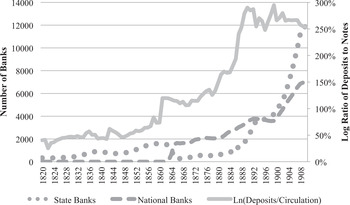
Competition from national banks as well as a tax placed on state bank notes fundamentally altered the balance sheets of state banks. Liabilities shifted from notes to deposits. Figure 1 shows that deposits in the antebellum period were a smaller and relatively constant portion of liabilities than bank notes through the late 1850s, but deposits then quickly increased relative to circulation after the start of the Civil War. By the end of 1900, bank notes made up less than 10 percent of all liabilities. The shift in the country's banking system to the widespread use of demand deposits exposed banks to greater liquidity risk and to depositor runs, as witnessed by the liquidity-driven banking Panics of 1873, 1893, and 1907 (Sprague Reference Sprague1910).
NUMBER OF BANKS AND RATIO OF DEPOSITS TO CIRCULATION, 1820–1910

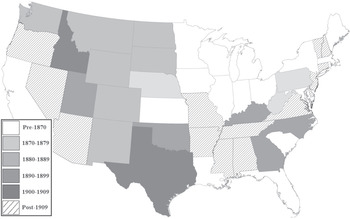
In response to the rise of demandable deposits, state policymakers seem to have begun to shift their focus toward ensuring bank safety and making improvements in supervisory standards in order to protect depositors and improve solvency. However, this shift began slowly, with significantly cheaper alternatives like double liability laws being installed first. Double liability maintained that directors, chief executive officers, chief financial officers, and stockholders of banks would have to pay up to twice the par value of their shares in the event of bank failure. With more at stake, bank owner-managers may have taken less risk. States appear to have adopted this earlier than formal supervision (with 32 states installing double liability prior to creating a separate banking department) as an early attempt to mitigate bank risk taking.Footnote 22 Figure 2 shows that most states in the Midwest and Northeast had passed a double liability law before 1870, and potentially in response to the National Banking Acts' requirements, many more passed one during the 1870s and 1880s. By 1890, 27 states had enacted double liability.
YEAR WHEN DOUBLE LIABILITY FIRST INSTALLED

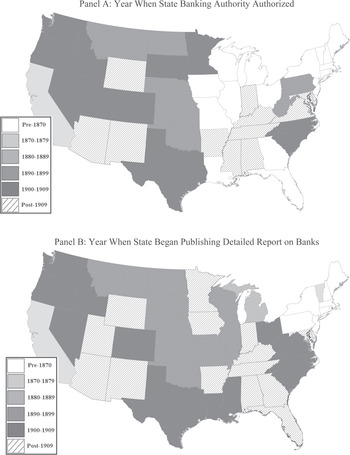
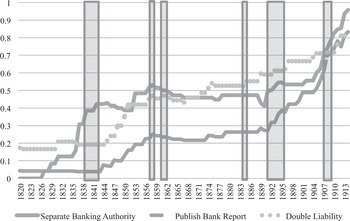
In contrast to double liability laws, few states created state banking departments between 1863 and 1890. Only California established an agency with bank commissioners during this 27-year period, bringing the number of states that had a separate department to 18 in 1890 (Figure 3). The next two decades, however, saw a flurry of activity, such that by 1915, only Delaware, Indiana, and Wyoming were without a separate governmental agency whose primary purpose was to monitor banks. Once again, banking crises seem to have been an agent for change, bringing the shortcomings of the states' supervisory systems to the forefront. Six states installed formal supervisory institutions within four years of the Baring Crisis of 1890 and the (banking) Panic of 1893; 17 more states established formal supervisory institutions between 1907 and 1914.
THE EVOLUTION OF STATE BANK SUPERVISION

Even in states that had state banking departments, policymakers responded to the Panics by further refining their supervisory institutions. For instance, in 1908, New York's state banking department was given the right to restrict chartering by requiring that banks receive charters only if “public convenience and advantage” necessitated a new financial institution. Several other states passed similar legislation or more strongly began to enforce restrictions on the chartering of new banks.
Some legislatures also augmented their existing supervisory institutions with reserve requirements and deposit insurance after panics. Thirty-five states installed reserve requirements on deposits between 1889 and 1914, and deposits insurance was not tried again until after 1907. That said, only nine states installed reserve requirements on deposits before establishing permanent state banking departments, and only Indiana established deposit insurance prior to installing permanent bank supervisory institutions. Thus, unlike double liability, deposit insurance and reserve requirements lagged bank supervision.
THE DETERMINENTS OF STATE BANK SUPERVISION
We now turn to assessing the factors that drove the adoption of formal bank supervisory institutions, using the historical evidence presented in the previous section as well as economic theory to guide the selection of determinants. Drawing on a wide variety of historical records, including state constitutions, state banking reports, and survey data from state banking departments described in the data appendix, we obtained the year in which each state first established a government agency whose primary task was to monitor banks (e.g., the Office of the Bank Examiner, Bank Commissioner, or state banking department) which we use as our measure of formal supervisory institutions.Footnote 23 The formation of these kinds of institutions represents a clear point when state policymakers began to treat banks distinctly from other types of corporations. Before their establishment, banks typically reported to a state authority whether that was the Governor, the State Auditor, or the State Comptroller. As these authorities often managed many other types of corporations, they did not devote special attention to banks. On the other hand, separate banking departments were tasked solely with supervising the banking sector and devoted significant time to standardizing balance sheets, examining banks to make sure regulations were met, keeping track of mergers and failures, as well as making recommendations for subsequent regulation.
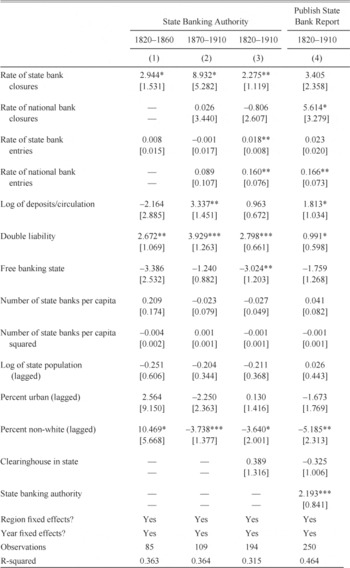
To explain the timing of adoption, we estimate Cox proportional hazard models where observations are by state and by decade.Footnote 24 The panel is updated each decade, such that states without banks or areas that were still territories are excluded from the sample until those conditions are met. The dependent variable is coded as either a zero in a decade where the state had not established a state banking authority for any of the years of that decade or a one if the department came into existence during the decade.Footnote 25 The coefficients in the hazard model provide the relative effect on the probability of adopting supervision, but unlike probit or logit models, the estimation procedure allows us to account for differential state entry dates and the unbalanced nature of our panel by controlling for the date at which statehood was obtained. In Table 1, we report the coefficients from Cox proportional hazard models; positive coefficients in the table imply that a particular covariate increases the probability of creating a state banking department. (Hazard ratios are reported in the online data appendix).Footnote 26
EXPLAINING THE TIMING OF THE FORMATION OF A STATE BANKING AUTHORITY AND THE PUBLICATION OF STATE BANK REPORTS, 1820–1910

∗ = Significant at the 5 percent level.
∗∗ = Significant at the 1 percent level.
∗∗∗ = Significant at the .05 percent level.
Notes:
Estimates are based on Cox proportional hazard models, where the dependent variable is either a dummy denoting whether the state had created a state banking department in that decade or a dummy denoting whether the state began publishing separate banking report. Observations are defined at the state-decade level. We drop observations for states that did not yet have commercial banks. The region dummies are defined in Footnote 39. Robust standard errors appear in brackets beneath the coefficients.
Source:
See Appendix for data construction.
We include a large set of conditioning variables that may have influenced the legislative decision on when to create formal state bank supervisory institutions.Footnote 27 Our first independent variable is the rate of bank entry in a given decade relative to the number of banks at the beginning of the decade. Public choice theory suggests that government intervention principally serves to redistribute economic resources from those interest groups with less political power to those with more; it can also help account for the durability of laws that are not necessarily welfare maximizing if interest groups derive power or economic benefits through existing laws or institutions.Footnote 28 In our context, this could translate to existing banks lobbying state legislators to impede the development of banking systems to protect their rents.Footnote 29 Therefore, a negatively-signed coefficient would be consistent with existing banks lobbying policymakers to promote their own interests, perhaps to protect themselves from competition or to forestall the creation of institutions requiring greater disclosure of profits, management activity, or supervisory activities perceived as costly. On the other hand, a positively-signed coefficient would suggest that legislators acted in the interest of the public by setting up supervisory institutions to promote product and price competition and to enforce legal restrictions on bank activity.
We include two additional independent variables that follow theories suggesting that regulation is done in the “public interest” in order to overcome market failures stemming from the presence of market power, externalities, and asymmetric information between bankers and depositors. The public interest view is often invoked to justify the presence of deposit insurance, reserve requirements, and capital requirements in the banking industry, especially in cases where individual bank failures spill over to other banks and impose negative externalities on customers of otherwise solvent banks.Footnote 30 The first public interest measure we include is the rate of state bank closures (defined here as either voluntary liquidations or failures) that occurred during the previous decade.Footnote 31 Banks may take on more risk than what is optimal from a depositors' perspective (in other words, moral hazard) as they may not be able to perfectly observe the quality and distribution of loan portfolios. Unable to discern if bank managers were taking on too much risk or committing fraud and worried that they might only receive a fraction of their funds if a bank failed, depositors would be reluctant to put money in the bank, thus making banking institutions less viable. In aggregate, this inefficiency could result in lower investment and output. Hence, asymmetric information could be lessened through supervision by providing independent assessment of accounting information and by checking for management fraud.
The second public interest measure is the logarithm of the ratio total deposits to total circulation for both national and state banks in each state.Footnote 32 In the context of American banking, the issue of depositor welfare became more pronounced in the latter half of the nineteenth century—when state banks changed their liability structure. Due to the taxation of state bank notes by the federal government, state-chartered commercial banks shifted away from note issuance and toward deposit taking. Depositors typically held funds in just a few banks at most, whereas noteholders often held a variety of notes from banks across the nation. A positive coefficient on the deposit-circulation ratio would indicate that state legislatures responded to the growth in fractional-reserve, deposit banking, and the risk of runs on individual banks by creating formal supervisory institutions.
Consistent with public interest theory, formal supervisory institutions could also be created to reduce the incidence of failures and “contagious runs,” and limit macroeconomic externalities. When large numbers of banks fail, they often impose external costs on the economy, reducing lending and aggregate investment. Moreover, as banks fail and disintermediation occurs, the costs of credit can rise for firms due to the loss in information about the quality of investment projects (Bernanke Reference Bernanke1983). Since commercial banks are conduits through which the money supply changes, a large number of failures can also impact the macroeconomy by altering the money supply (Friedman and Schwartz Reference Friedman and Schwartz1963). The possibility of “contagious” and costly bank runs provides a theoretical justification for governments to commit resources to develop technologies that monitor risk taking, such as prudential supervision. Hence, a positive coefficient on state banking distress would be consistent with the view that formal supervisory institutions arose in response to regulation in the public interest.Footnote 33
The description of the evolution of banking in the nineteenth and early-twentieth centuries in the previous section suggests additional factors that may have influenced the decision to adopt formal bank supervisory institutions. We assess whether there were any positive or negative externalities associated with the introduction of national banks in the 1860s by including the rate of national bank entry and closure. On the one hand, even though the OCC had no regulatory or supervisory authority over state banks, the mere presence of national banks could have created a positive demonstration effect. The Comptroller's Office developed a set of best practices with respect to bank examination, including understanding how accounting procedures and asset portfolios affected risk and failure likelihood. National banking may also have influenced state banking through a legislative requirement passed in 1873, which mandated that the OCC file an annual report describing the banking condition of the entire country. To fulfill this duty, the OCC had to gather information on state banks even though they were outside its formal jurisdiction and implored some states to change their practices.Footnote 34 On the other hand, the presence of national banks could have delayed the establishment of state banking departments, either by creating an incentive to free ride on the OCC or by introducing competition in laxity—that is, an incentive not to impose costs on state-chartered banks that national banks faced.
State legislatures may have delayed the creation of formal supervisory institutions since lower cost substitutes such as double liability laws existed. Alternatively, the passage of free banking laws, which accelerated the growth in state-chartered banks, could have increased the public demand for supervision. As waves of bank failures occurred, state policymakers may have updated their evaluation of the relative costs and benefits of their current banking systems versus putting in place additional rules and regulations. To capture this possibility, our baseline specifications therefore include dummy variables indicating whether a state had passed a double liability law or had passed and used a free banking law.Footnote 35 While it is possible that the adoption of double liability was endogenous to supervision, very few states installed it after supervision. Double liability may therefore have been an early and relatively inexpensive attempt to prevent bank risk taking. We consider other specifications in the online data appendix, including dropping double liability laws from the analysis.Footnote 36
We do not, however, include dummy variables for reserve requirements or deposit insurance systems because, as discussed previously, they were largely installed after formal supervisory institutions.Footnote 37 Although some states appear to have considered state banking departments a necessary condition for enacting regulation, the timing of the adoption of state deposit insurance systems does not work in favor of a hypothesis that these somehow served as an impetus for the creation of bank supervisory agencies.
In lieu of regulation in the public interest, it is possible that banks could act jointly and come up with collective mechanisms that would prevent spillovers to each other or to the economy.Footnote 38 The establishment of clearinghouses could have been one such private-sector response. Clearinghouses were established to facilitate the clearing of checks and notes, but they also collected financial statements and had the power to examine member banks. We therefore include a dummy variable denoting whether a clearinghouse was operating in the state at the end of the decade. To the extent that a clearinghouse mediated the need for the adoption of government solutions, the predicted sign of clearinghouses on the creation of state banking departments would be negative. We can include clearinghouses only when looking across the entire period because (1) only Maryland installed a clearinghouse before supervision in the antebellum period and (2) the clearinghouse dummy becomes nearly collinear with the region dummies once banks that installed supervision are dropped from the postbellum sample.
We include a variety of controls to capture other state and region-specific factors that may have also influenced the decision to create state banking departments. We examine the extent to which a state's level of development might have influenced the establishment of permanent supervisory institutions by including the number of state banks per capita at the end of a decade (as well as its square), the log of a state's population, the urbanization rate (defined as those places with more than 2,500 people), and the percent of the population that is non-white.Footnote 39 Since the timing of adoption may have been influenced by geographical differences such as banking market structure, regional indicator variables are also included as controls.Footnote 40 For example, the general lack of state supervision in the South prior to the Civil War was likely a result of the use of state-sponsored banks in that region. These banks served the state, holding their deposits, were permitted to branch throughout a state, and were protected by large capital stocks. The resulting small number of other commercial banks may thus have limited the incentives for legislatures to develop costly supervision.Footnote 41
EXPLAINING THE ADOPTION OF STATE BANK SUPERVISION
Estimating a hazard model over the entire sample period of 1820–1910 has the virtue of statistical power; however, it is less useful for taking into account evolving legislative priorities given structural changes in the American banking system. For example, in the antebellum period, state legislatures liberalized entry requirements with free banking laws. Because deposit accounts were fairly limited and note issuance was fully collateralized, banking largely grew unabated and there were few advances in supervision. However, by the postbellum period, the National Banking Acts gave rise to competition between state banks and national banks and to the rapid growth of banks funding their investments via deposits rather than notes. Because legislative priorities may have shifted in response to these structural changes, the estimation and interpretation of some of our coefficients using the entire sample period is sometimes problematic. For example, before 1870, the hazard model will assign values of zero to national bank entries and closures instead of a null value even though no national banks existed. We therefore also present estimates for the sub-sample periods of 1820–1860 and 1870–1910. We discuss the sub-sample estimates when we want to highlight how the perceptions of state legislatures may have been altered by structural breaks in American banking.
Table 1 shows that periods of state banking distress help to predict when formal supervisory institutions were put in place. The rate of state bank closures accelerated the establishment of formal supervisory institutions across both the antebellum and the postbellum periods. Based on the underlying hazard ratios, a 10 percent higher closure rate in state banks would nearly double the probability of installing formal supervision each decade across the entire period.Footnote 42 On the other hand, national bank closure rates are not significantly correlated with the adoption of state banking departments in the postbellum period.
Consistent with public interest theory, state policymakers thus may have found it advantageous to change supervisory practices in response to distress for banks they had chartered (labeled state banks) in comparison to those that may have created negative spillovers but for which they had no chartering authority (labeled national banks). As with other bureaucracies, state-banking departments persisted once they were established. A state had to be willing to commit to operational costs indefinitely. In normal periods, when losses were relatively low, states might not have seen the benefit in obligating themselves to future taxpayer liabilities. It appears that it was not until financial panics and widespread state bank depositor losses united constituencies that politicians were sufficiently motivated to act in the public interest. For instance, in its first report in 1893, Pennsylvania's superintendent of banking states that before the creation of the department:
It does not appear that any one of our Auditors General has ever been afforded proper assistance for the discharge of his duties relating to banks and saving funds. In fact, beyond receiving and publishing the quarterly reports of those institutions which were made to the Auditor General, and occasional appointments of special examiners, further supervision does not seem to have been expected of them … Time and again [state auditors] have called particular attention to the necessity of a closer state supervision of banks. Had some of their recommendations been adopted … the unfortunate and disreputable failures that have recently occurred, would have been halted at a time to prevent so serious a damage as has happened, and so disgraceful a stain placed upon our banking-annals both state and national. (Krumbhaar Reference Krumbhaar1893, pp. 1–2)
State legislatures also might have responded to the high bank resolution costs that emerged from banking panics. Kentucky's banking commissioner's first report confirms that this as an additional reason for installing formal institutions:
Prior to 1912, there were few safeguards thrown around banking institutions in this state. The frequency with which bank failures occurred led the Legislature, in 1912, to pass a comprehensive act looking toward the regulation, examination and proper conduct of all state banks, and providing for the closing and winding up of the affairs of all such as were found to be in an insolvent condition. This legislation has, as its ultimate aim the protection of the depositing public. (Smith Reference Smith1913, p. VI)
Without a staff of examiners, court officials of the state would have been saddled with the time-consuming process of obtaining records of bank assets, negotiating with loan customers, and tracking down stockholders; court-ordered liquidations were slowed and the redeployment of productive assets back into the economy was delayed (Mason, Anari, and Kolari Reference Mason, Anari and Kolari2000).Footnote 43 Hence, in the wake of failures and economic disruptions associated with them, legislatures may have decided to set up permanent supervisory institutions to reduce resolution costs and time.
Table 1 also indicates that faster bank growth rates accelerated the creation of formal supervisory institutions across the whole period. For state bank entry, the effect is relatively small. A 10-percentage-point increase in the rate of entry of state banks raised the probability of installing formal state bank supervisory institutions by about 0.2 percent per decade over the period 1820–1910. The positive sign indicates that policymakers were not delaying supervision to protect local monopolies. Policymakers, however, appear more concerned about the growth of the national banking system. A 10-percentage-point increase in the rate of national bank entry raised the probability by 1.7 percent per decade over the whole sample period.Footnote 44 If legislatures wanted their state banking systems to flourish in the face of competition from national banks, then the positively-signed coefficient is consistent with regulation in the public interest.Footnote 45 Eugene White (Reference White1983, Reference White2011) has shown that this competition often resulted in lower state capital and reserve requirements, but states may have also attempted to draw banks away from the federal system by offering an alternative to the OCC. The reported coefficient in Table 1 suggests a potential positive spillover from the competition between state and national banks.
Consistent with regulation in the public interest, the switch from circulation to deposits also raised the likelihood of state legislatures establishing state banking departments. As expected, the coefficient is statistically insignificant in the antebellum period when deposits were consistently low and held mostly by firms. However, it is statistically significant and positively signed in the postbellum period. A state that had double the number of deposits relative to circulation was about 160 percent more likely to install supervision during the entire period than a state that had a ratio of one.Footnote 46 Because depositors were generally more susceptible than noteholders to losses associated with idiosyncratic bank risk, we interpret this as an indication that elected legislators (who were accountable to depositors) began to pay more attention to the operations of individual banks. Because the rise of deposits pushed banks to expand their loan portfolios relative to bond purchases, the shift would have more closely connected to economic and financial health as well (Calomiris and Mason Reference Calomiris and Mason2008). Therefore, as deposits became more widely held, policymakers sunk the cost of creating state banking departments in the public interest.
Double liability also sped up the introduction of bank supervision. Over the period 1820–1910, a state with a double liability law in place was almost 16 times more likely to install a separate banking department than a state without a law.Footnote 47 Two-thirds of states passed double liability laws prior to establishing formal bank supervision, and more than 20 sates installed it a decade prior (Figure 4). Therefore, double liability was the first widely pursued bank regulation at the state level, and states only appear to have established costly supervisory institutions after double liability had been found lacking. As states experienced significant numbers of bank failures, legislators and depositors likely learned, through first-hand experience, how hard it was to track down and obtain payments from stockholders without the help of formal institutions charged with this responsibility. It thus appears that double liability was initially considered a cheap substitute for supervision, but as the political and economic costs of crises mounted, regulators changed their views on the relative merits of establishing permanent supervisory institutions. As noted earlier, however, the existence of regulations, like double liability laws, can potentially work in conjunction with supervision. Hence, once states set up bank supervisory departments that could aid in monitoring the risk taking of banks ex ante, double liability laws may have become more effective (Carlson Reference Carlson2015). On the other hand, policymakers that had already established state banking departments may have viewed double liability laws as ineffective or superfluous as only eight states chose to install double liability after supervision.
ADOPTION RATES FOR STATE BANK SUPERVISION AND REGULATION, 1820–1914
(Rate of Existing States)

Free banking laws were installed during the antebellum period, but they did not have a statistically significant effect during that period. Instead, they slowed down the adoption of supervision across the entire period. A state that passed a free banking law was about one-half as likely to install a separate bank authority as other states.
While a few states installed state banking departments during the antebellum period, their adoption was slow and primarily driven by financial panics. The latter one-half of the nineteenth century marks an important shift toward a system of state bank supervision that began to deal with the negative externalities associated with fractional reserve banking and deposit-taking financial institutions. However, states initially pursued cheaper options for reigning in bank behavior, such as double liability for bank stockholders, and again, only devoted significant resources to formal supervision after periods of banking distress. The competition between state and national banks also played a role in speeding up the adoption of formal supervision.
CHANGES IN THE MONITORING OF STATE BANKS
As shown in Figures 3 and 4, adoption of formal supervisory institutions by states was nearly completed by the first decades of the twentieth century. That said, differences in resources varied considerably across state banking departments, which in turn may have created differences in their ability to monitor banks—the function for which these institutions were created. In particular, the size of examination staffs, expenditure to support examination activities, and the volume and type of data collected by examiners significantly varied. If one assumes the agencies acted in the public interest, then ultimately one may be concerned with measuring how their creation influenced systemic stability—no doubt an important outcome to consider, but one that is beyond the scope of this article. We remain agnostic as to whether the institutions serve public or private interests, and instead focus our empirical analysis on a different set of outcome variables—those that help us characterize a state's ability to monitor commercial banks. We therefore define the quality of supervision in terms of a state's monitoring technology, and assess what factors drove states to enhance their monitoring “technologies.” To learn more about the determinants of differences in state's ability to monitor banks, we first examine when they began to publish separate banking reports. We then analyze how reported measures of expenditures and staffing of examination departments differed in 1911—after most states had created formal bank supervisory institutions.
Some state banking departments began to publish detailed and standardized bank balance sheet data beginning in the antebellum era, but most states failed to collect detailed balance sheet information even on an annual basis. As this type of information was important for the public to reliably monitor banks, it is a key measure of the quality of bank supervisory institutions. As shown in Panel B of Figure 3, the practice of collecting standardized information on banks began in the Northeast and slowly diffused westward. Many states in the Northeast published banking reports prior to the 1870s, with other regions lagging. The Great Plains began in the 1890s, the Pacific Northwest in the 1900s, and the Southwest in the 1910s.
The final column of Table 1 estimates a hazard model predicting when states began publishing regular and periodic balance sheets over the period 1820–1910.Footnote 48 States that created permanent bank supervisory institutions were significantly more likely to publish annual reports on the balance sheets of banks in the postbellum era. A state that established a separate bank authority was about 10 times more likely to publish a detailed bank report than a state without one, indicating that creating permanent supervisory institutions led to more rigorous and routinized monitoring of banks. We also find that the rates of national bank entry and closure encouraged the publication of separate bank reports. The former finding is likely driven by the state's concern over spillovers, whereas the latter finding is likely driven by the mandate of the OCC to collect state bank data. Consistent with our earlier discussion, the move to deposit-taking banks as well as laws mandating the payment of double the owner's equity in the event of a bank's failure encouraged publication of annual balance sheets.
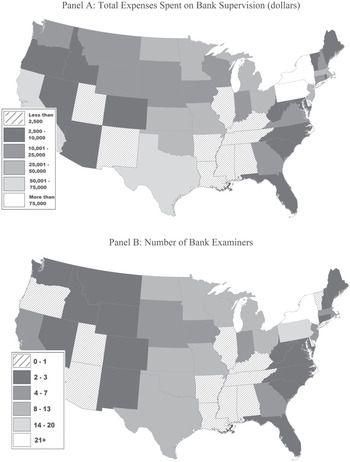
In 1911, the OCC published results from a survey that provided information for each state's expenditure on bank supervision, the number of examiners on staff, and the number of examinations conducted during the previous year.Footnote 49 Figure 5 shows state-level differences in expenditures by banking departments and the number of examiners hired. Because the Comptroller only surveyed state banking departments for a single year, we explore the cross-state differences in supervisory quality using an ordinary least square (OLS) model and a rich set of predictive variables.
QUALITY OF STATE BANK SUPERVISION IN 1911

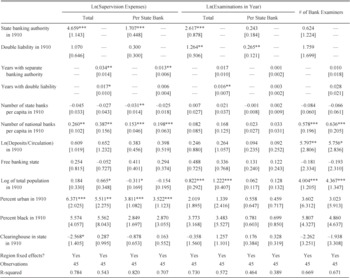
Using the same basic hazard model framework as before, Table 2 shows that the establishment of a state banking department is associated with increased expenditure on bank supervision and more bank examinations. States with bank supervisory departments spent nearly five times more in total and 1.7 times more per state bank in comparison to the nine states that had not created them by 1911. States that had created their supervisory departments earlier also spent more on supervision and examined banks more frequently than other states, perhaps indicating that these states used the additional funds to increase the quality of their supervision. The presence of double liability laws increased the number of examinations in a year, whereas free banking appears to have had no residual impact on the quality of bank supervision (at least after controlling for the number of banks in a state). Based on the regressions, a state that installed double liability made about 126 percent more examinations in total and about 25 percent more examinations per bank than states that had maintained single liability.
EXPLAINING THE EXTENT OF BANK SUPERVISION IN 1911

∗ = Significant at the 5 percent level.
∗∗ = Significant at the 1 percent level.
∗∗∗ = Significant at the .05 percent level.
Notes:
Estimates are based on OLS regressions, where the dependent variables are listed in the column heading. Observations are defined at the state level. The region dummies are defined in Footnote 39. Robust standard errors appear in brackets beneath the coefficients. Alabama, Illinois, and Louisiana are not included in the sample because the Comptroller did not report data on their supervisory practices.
Source:
See Appendix for data construction.
The number of national banks is associated with increased spending on supervision as well as the number of bank examiners, perhaps an unintended benefit of competition between federal and state regulators. Based on the model, a one-standard-deviation increase in the number of national banks per capita (5.3 banks) increased the total amount spent on supervision by at least 130 percent and the number of examiners 3.0. Consistent with the fact that some states published data on national banks, the regressions indicate that states devoted resources to watch over national banks. Alternatively, the number of state banks is only statistically significant in Column 3. The relative insignificance of state banks is likely due to the fact that banking departments would have to spend more as the number of banks increased, but would be able to spend less per bank. In summary, we find that the establishment of state banking departments is associated with an enhanced ability to monitor the management and portfolios of state commercial banks.
CONCLUSION
From the outset, American government officials were skeptical of giving banks too much power and autonomy. The first attempts at state bank supervision focused on assessing whether banks had sufficient paid-in capital to open for business and whether they had sufficient assets to back up the notes they issued. Policymakers in the early nineteenth century appear to have paid little attention to systemic risk. A century later, state bank supervision, though far from perfect, had made considerable strides toward modern standards and objectives. The vast majority of American states had established separate state banking departments by the time the Federal Reserve System was founded.
Using a new data set on the establishment of formal supervisory institutions, we show that state banking departments, which employed dedicated, supervisory staff to conduct regular and periodic examinations, were slow to emerge. The large initial fixed costs of establishing such institutions appear to have been one factor that influenced state legislatures' choice to use far cheaper regulatory systems based around double liability requirements for stockholders during earlier periods. Repeated and costly banking crises, thereafter, then moved states to look beyond the cheaper options, and forge permanent agencies devoted to bank examination. Twenty-nine states installed supervision immediately after one of the period's major panic periods: 1837–1839, 1857, 1890–1893, and 1907.
As we show, there are several reasons why states likely chose to install supervision after panics. First, public outcry after large or widespread banking failures increased the demand for financial stability. As banks changed from issuing collateralized notes to uncollateralized deposits, more individuals became exposed to the negative effects of fraudulent behavior and financial crises. Elected officials in the postbellum were increasingly accountable to taxpayers holding bank deposits and supervising in the public interest. Second, state officials likely learned that banking distress could involve sizable resolution costs. Liquidating banks meant taking accurate account of all failed banks' assets, wrapping up loans, and tracking down any stockholders who were liable for losses. Politicians might have been able to more easily justify the expenses associated with permanent state banking departments if they could reduce resolution costs by using qualified supervisory staff to liquidate banks. Finally, if legislators could make the claim that state-banking departments prevented future failures, then supervision in the public interest may have become more palatable to taxpayers. Ex post, there appears to be some evidence to support this conjecture. During the next severe banking crisis to hit the American economy, states with higher quality bank supervisory departments experienced fewer failures during the Great Depression (Mitchener Reference Mitchener2005, Reference Mitchener2007).
Our findings from an analysis of the timing of the publication of state banking reports and the 1911 Comptroller's survey of state banking departments speak somewhat further to this point, suggesting that institutional learning may help account for differences in supervisory quality that were apparent in the 1930s. Looking at when states regularly began publishing reports, we find that very few states published detailed data before a state banking authority had been established. The states that created permanent state banking departments the earliest also tended to have the most detailed summary of bank portfolios. When we analyze the 1911 Comptroller's survey of state banking departments, we find that those states establishing state banking authorities earlier had state banking departments that, on average, spent more on supervision and carried out more examinations. To the extent that better information and more examinations improve the ability of supervisors to monitor a bank's activities, the timing of establishment of state banking departments may be related to later differences in systemic stability.
Finally, while previous research has drawn attention to how the dual banking system may have promoted laxity in regulation, our analysis suggests somewhat different results for supervision.Footnote 50 For example, we find that states accelerated the adoption of permanent bank supervisory institutions in the face of greater competition from national banks. Of course, this may have been an unintended consequence of a chartering race whereby states offered an alternative regulatory and supervisory environment to draw banks away from the national banking system. That said, the national banking system also appears to have enhanced the quality of state supervisory institutions. During the 1870s, the OCC compelled states to collect and release bank data with regular frequency. We also find that national bank activity is positively associated with state banking systems carrying out more examinations and having more examiners to do so.
Appendix
Banking Data
We obtain the number of banks, bank entry, and bank closure data from two types of sources. We start with Weber's antebellum bank census (2005), which contains the location and dates of operation for every bank before 1861. We then extend his banking census through 1910 using the Merchants and Bankers' Directory (1860–1889), Rand McNally Bankers' Directory (1890–1900), and Polk's Bankers Encyclopedia (1901–1910). These bank directories are reported to provide, “a complete list of banks, bankers, savings banks, and principle trust companies.”Footnote 51 The directories include the name, location, and capital of each bank, as well as whether they were chartered by a state legislature or the OCC. Therefore, by comparing the directories in successive years, we can determine when a bank was chartered and when it exited. A drawback of using these directories is that they do not permit us to determine if banks exited due to merger, voluntary liquidation, or failure (involuntary liquidation). Even so, the data provide the most comprehensive census of banking activity for the nineteenth century. As a check on the completeness of the directory data, we confirmed that the totals matched those reported in published state banking reports (when the latter became available).
The circulation and deposit data come from Weber (2005) for the antebellum era, and the various issues of the Annual Report of the OCC for the postbellum era.
Date of Establishment of State Bank Authority
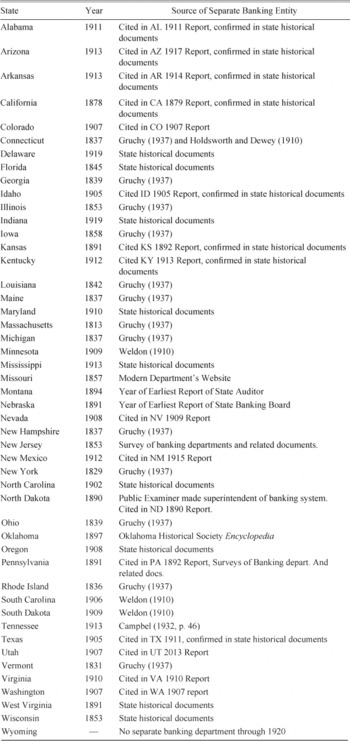
We define this as the year when a state created an agency whose primary task was to monitor commercial banks chartered by the state. These agencies went by various names, the most common of which were the Office of the Bank Examiner, Bank Commissioner, or State Banking Department. While individual states' departments differed, they all shared the common feature of focusing on banking, rather than insurance businesses or general business incorporation. In our analysis, we make no distinction between states that referred to the head of the agency as a bank commissioner, a bank comptroller, or a banking superintendent. We obtained dates using a variety of sources. Two published sources listed the dates of bank commissioners (Gruchy 1937) and banking departments (Weldon Reference Weldon1910), but these are incomplete and contain some errors based on our other data collection. We therefore conducted two surveys of 48 state banking departments (in 2002–2003 and a follow up in 2012), soliciting official documentation on the origin of their departments (denoted “state historical documents” in Appendix Table 1). Through these surveys, we obtained histories of state banking departments in the form of printed information or web-based official histories; however, a significant number of states did not respond. Hence, we utilized published state banking department reports from the first years of their existence, which we were able to locate for almost all states in our sample; these contained useful information on the enactment of state banking laws and the founding of the state banking departments. Whenever there were conflicts in the information we obtained, we used those dates from latter two sources rather than from the secondary sources. The founding dates and sources used to obtain these for each state are provided in Appendix Table 1.
Double Liability on Bank Stockholders
This dummy value takes on positive values once a state passed a law legislating double, triple, or unlimited liability for bank stockholders. Those states that did not have a liability law or had an ambiguous law are not considered to have double liability. We obtained these dates as well as the date of removal from a variety of sources. First, we sorted through the NBER State Constitutions Database (http://www.stateconstitutions.umd.edu/index.aspx) for keywords such as bank, shareholders, stockholders, liable, liability, and double. We augmented these data using George Barnett (1911, pp. 76–77) and the compiled statutes of each state. Second, we used Ralph Marquis and Frank Smith (Reference Marquis and Smith1937) to obtain the dates of some states that adopted double liability in the antebellum period and Richard Grossman (Reference Grossman2001, Reference Grossman2007) and Kris Mitchener and Gary Richardson (Reference Mitchener and Richardson2013) for dates of some states in the postbellum. We obtained the remaining dates from the following sources: Paton's Digest of Legal Opinions, Broom's First Hundred Years of North Carolina Banking, The Pacific Reporter, and The Atlantic Reporter.
Reserve Requirements on Deposits
The dates for when a state first required all banks to holder reserves on deposits are from R.G. Rodkey (Reference Rodkey1934).
Deposit Insurance
The dates of deposit insurance for the antebellum period are from Weber (Reference Weber2011) and for the postbellum period are from Rajeev Dehejia and Adriana Lleras-Muney (2007, Table 1).
Publication Date of Separate Banking Reports
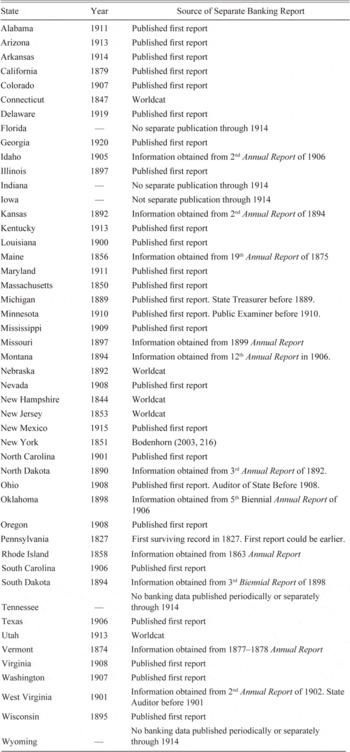
This is defined as the first year that a state published a separate report on banking. The distinction is necessary because some states reported a small amount of banking information in an omnibus report that also contained information on population, education, farming, and finances, which we do not code as constituting a banking report. We gathered the dates directly from the reports themselves (for example the dates of first published volumes), denoted in Appendix Table 2 as “published first report.” Many state reports are digitized and available on the Internet; others were tracked down through the Library of Congress and state libraries. For the few states that we were not able to obtain the first report, we obtained the year of the first volume through its library entry or through its numbering scheme (for example if the 8th annual report was published in 1908, the first was likely 1900), denoted as “Worldcat” in Appendix Table 2. The list of dates and sources are provided in Appendix Table 2.
DATES OF STATE BANKING AUTHORITY AND THEIR SOURCE

Population Data
Figures on each state's total population as well as the fractions living in an urban area and that were non-white are from census data assembled by Michael Haines (Reference Haines2004).
Clearinghouse Data
The dates of clearinghouse establishment were obtained from Jaremski (Reference Jaremski2015). Because they are listed by city, we selected the earliest year that a clearinghouse operated in a particular state to generate the dummy variable used in the paper.
DATES OF THE PUBLICATION OF STATE BANK REPORTS AND THEIR SOURCE