I. INTRODUCTION
Recently, niobium and tantalum compounds that are structurally related to tetragonal tungsten bronze (TTB) family have been attracting much attention owing to the combination of the unique properties, such as second harmonic generation (SHG) (Chi et al., Reference Chi, Gandini, Ok, Zhang and Halasyamani2004), piezo- (Yao et al., Reference Yao, Mak and Ploss2012), pyro- (Ramam and Chandramouli, Reference Ramam and Chandramouli2012), and ferroelectricity (Stennett et al., Reference Stennett, Miles, Sharman, Reaney and West2005). Such diversity of applications is caused by the deviation from the chemical stoichiometry. The general formula for TTB compounds can be described as [(A 1)2(A 2)4(C)4][(B 1)2(B 2)8]O30, where cations those are in positions A 1, A 2, B 1, B 2, and C located in 12-, 15-, 6-, 6-, and 9-fold oxygen environment. Basically, TTB structure is similar to the perovskite one. Both structure types can be derived one from another by putative rotation of the M 4O20 units (M – metal species) for the angle ~π/4 (Hyde and O'Keeffe, Reference Hyde and O'Keeffe1973). This restructuring provokes an opportunity for a TTB structure formation with “triangular”, “square”, and “pentagonal” tunnels. A ratio of “pentagonal” (position A 2), “square”:(position A 1), and “triangular”:(position C) tunnels is equal to 2:1:2. Maximal occupancy factor is usually observed for pentagonal and square tunnels. These positions are occupied by large cations with the effective ionic radius (Shannon, Reference Shannon1976) >1 Å, whereas triangular tunnels are free or occupied by small cations (r i < 1 Å), for example, Li (Elaatmani et al., Reference Elaatmani, Zegzouti, Capitelli, Moliterni, Migliori and Calestani2003) or transition metal ions (Awadalla and Gatehouse, Reference Awadalla and Gatehouse1978; Kumada and Kinomura, Reference Kumada and Kinomura1997) in a majority of cases. Variable degree of site occupancy affects significantly the physical and chemical properties of these compounds significantly. For instance, Ba6Ti2Nb8O30 (Chi et al., Reference Chi, Gandini, Ok, Zhang and Halasyamani2004) and Ba4MgTa10O30 (Wang et al., Reference Wang, Sakka, Rusakov, Mozharivskyj and Kolodiazhnyi2011), which represents the stoichometric TTB oxides, exhibit ferroelectric properties and high SHG efficiency because of the distortion of octahedral framework, whereas non-stoichometric TTB compounds (for Ba6−3x Sm8+2x Ti18O54 see, Ohsato, Reference Ohsato2001) with cationic deficiencies within the tunnels have increased permittivity among the class of materials. It has been reported that pentagonal tunnels could accommodate not only the large cations, but also a group of ions that are assembled together into distinct chains (Sleight, Reference Sleight1966). For Ba0.22TaO2.7 (Kuang et al., Reference Kuang, Pan, Cao, Liang, Suchomel, Porcher and Allix2013), such type of tunnels is randomly occupied by the combination of (TaO)3+ units and Ba2+ cations. A correlation of (TaO)3+ and Ba2+ content is a gradient function is acting along the pentagonal tunnels with a maximum for (TaO)3+ at 1/3. Generally the number of (MO)3+ groups are impregnated into the TTB structure varies within from ~33% for oxides with the composition M 34O94 (M = Nb, Ta, or W) (Krumeich, Reference Krumeich1998) to ~50% for orthorhombic A 4 B 2 M 10 X 30-type tungsten bronze NaNb6O15F (Andersson, Reference Andersson1965). The remaining part of tunnels is empty (Kirkland and Saxton, Reference Kirkland and Saxton2002) or can be partially occupied by comparatively larger cations (Krumeich, Reference Krumeich1998). The insertion of alternating M–O chain fragments could lead to relaxation of the octahedral framework and play an important role for a stabilization of the non-stoichiometric TTB structure.
II. EXPERIMENTAL
A. Synthesis
The polycrystalline sample of Ba2.64Ta11.25O30.81 was synthesized using a conventional solid-state reaction technique. Tantalum (V) oxide powder (assay 99.9%) and barium nitrate (barionite, synthetic, 99.9%) were wet-milled using isopropanol as a liquid active medium for half an hour in an agate mortar. Initial blend was pressed (P = 105 N m−2) into the pallet (Ø = 20 mm, d = 2 mm) and heated at 600 °С for 6 h in ceramic crucible until the complete deliberation of nitrogen oxides to the constant mass of the sample. Then the powder mixture was re-ground, pressed, and calcined at an optimized temperature (1150 °C) for 36 h in platinum crucible. The described protocol is essentially the same as it was proposed for structural investigations and the elucidation of electrical properties (Kuang et al., Reference Kuang, Pan, Cao, Liang, Suchomel, Porcher and Allix2013).
B. Data collection
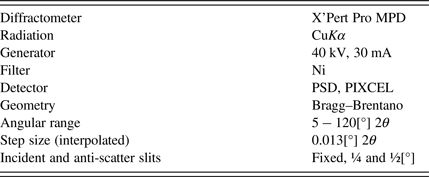
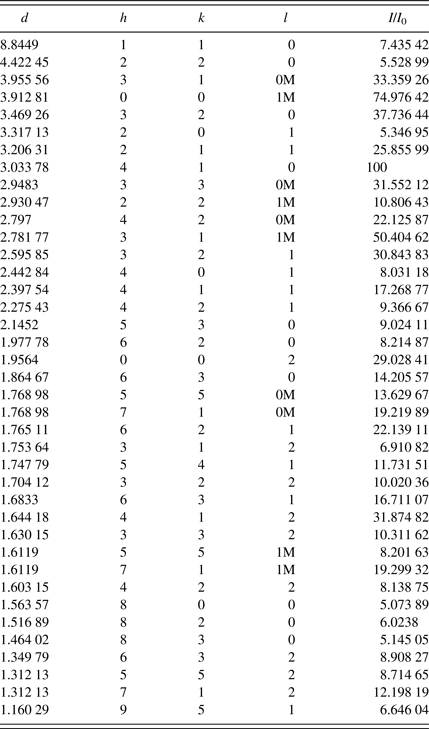
X-ray diffraction pattern of mortar-and-pestle-ground, front-loaded, pressed specimen was taken at room temperature using an X'Pert Pro MPD diffractometer (see details in Table I). Experiment was carried out by the Bragg–Brentano diffraction scheme. Reference pattern (Figure 1) was produced with a Rietveld pattern decomposition technique as it was shown earlier (for example, see, Wong-Ng et al., Reference Wong-Ng, Liu, Yan and Kaduk2013), it allowed maximally unbias experimental data toward systematic errors both in d-spacing and intensity (Table III). Field emission gun (FEG)–scanning electron microscopy (SEM) snapshots of the sample under investigation were taken with Hitachi S4100 microscope that was equipped with Röntec EDS system at 25 keV of accelerating voltage and 100 s of exposure per zone. The sample was deposited on the carbon-coated setup and sputtered with carbon in high vacuum. Quantative analysis was performed with Röntec EDWin WinTools (v. 3.1) based on intensity of O K−series, Ba L−series, and Ta Lα the set of analytical lines.
Rietveld plot for Ba2.64Ta11.25O30.81.

Parameters of X-ray powder diffraction measurements.

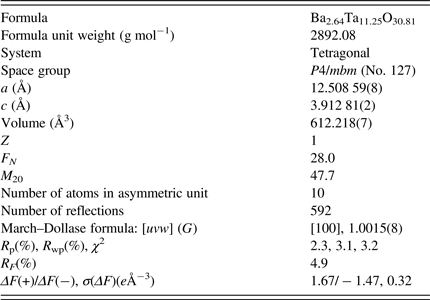
Crystal data and structure refinement details for (1).

X-ray powder pattern for Ba2.64Ta11.25O30.81. The symbols “M” refer to peaks containing contributions from two and more than two reflections, respectively.

III. RESULTS AND DISCUSSION
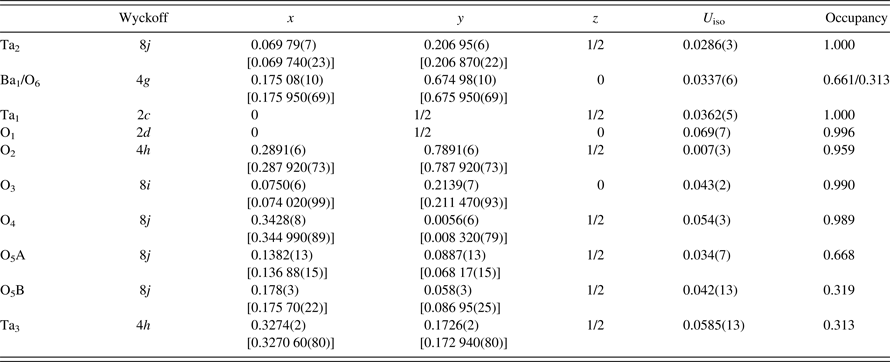
Crystal structure refinement was carried out using the FullProf (Rodriguez-Carvajal, Reference Rodriguez-Carvajal1990) program (see Table II for details). The pseudo-Voigt function is convoluted with asymmetry because of axial divergence (Thompson et al., Reference Thompson, Cox and Hastings1987) that was used to generate the line shape of the diffraction peaks. The latter was accurately estimated from NIST SRM 660b (LaB6) in prior to the study. The set of 55 parameters was refined, including scale factor, background (orthogonal Chebyshev polynomials of 20-th order), zero point, unit-cell parameters, and fractional coordinates of atoms were refined. The necessity of the latter procedure is caused by fit of experimental electron density to the reference model has been obtained by neutron diffraction. Isotropic thermal displacement parameters were refined for all atoms separately. A fit of the peak shapes was freed from default values paying attention to the size and strain broadening effect involving refinement of the isotropic Gaussian term of size and a series of S 400, S 004, S 220, S 202 parameters as introduced in the phenomenological model of microstrain (Stephens, Reference Stephens1999). Apparent calculated size of the coherent scattering block was found equal to 91.79(2) nm that is comparable with isolated crystallites those are the distinguished by SEM (Figure 2). Experimental composition is estimated by the energy-dispersive analysis on three independent zones of the sample and agrees well in an averaged form: anal. calcd. O, 68.93; Ba, 5.91; Ta, 25.17; found O, 69.61; Ba, 5.47; Ta, 24.92, but noticing local composition imhomogeneities. Final refined fractional coordinates and corresponding isotropic displacement parameters are assembled in Table IV.
FEG–SEM image of Ba2.64Ta11.25O30.81 at high (3 × 10⁴×) and low magnification (5 × 10³×).

Fractional atomic coordinates and isotropic displacement parameters (Å2) for Ba2.64Ta11.25O30.81 from current analysis (the first line) and as-reported by Kuang et al. (given in brackets, see Kuang et al., Reference Kuang, Pan, Cao, Liang, Suchomel, Porcher and Allix2013).

ACKNOWLEDGEMENT
Authors are gratefully acknowledging Marta Ferro at the University of Aveiro and Centre for Research in Ceramics and Composite Materials (CICECO, Aveiro, Portugal) for FEG–SEM and EDX measurements.