INTRODUCTION
In the general public, many people equate pedophilia with child molestation. However, from a clinical and empirical perspective, the equation of both phenomena is invalid and the differentiation between pedophilia and pedophilic disorder as it has recently been implemented in the fifth edition of the Diagnostic and Statistical Manual of Mental Disorders (DSM-5; 302.2; American Psychiatric Association, 2013) may help to clarify this misconception. While within the DSM-5 pedophilia is defined by persistent and intense sexual fantasies and urges toward prepubescent children, a diagnosis of pedophilic disorder additionally requires that the former aspects lead either to marked distress, interpersonal difficulties or, most importantly, that the individual has acted upon his/her deviant urges and thereby causing harm to another person. In line with new diagnostic systems, current research in the field (Kärgel et al., Reference Kärgel, Massau, Weiß, Walter, Kruger and Schiffer2015, Reference Kärgel, Massau, Weiß, Walter, Borchardt, Kruger and Schiffer2017) underlines the importance of distinguishing between pedophiles who acted or not acted upon their deviant urges.
Furthermore, sexual abuse is a severe social problem: The U.S. Department of Health & Human Services reports that 8.3% of the victimized children in 2014 (with a total number of 702,000 of reported cases of child maltreatment) were sexually assaulted (U.S. Department of Health & Human Services, 2016). These data are in contrast to the poor scientific and clinical knowledge regarding sexual offenses against children. Despite several research efforts focusing on the neural mechanisms underlying sexual offending against children and on the etiology of pedophilia, these mechanisms remain poorly understood.
In their literature review of previous studies examining the neural basis of pedophilia, Mohnke and colleagues concluded that the heterogeneity of existing data do not allow for any firm conclusion (Mohnke et al., Reference Mohnke, Muller, Amelung, Kruger, Ponseti, Schiffer and Walter2014). One reason seems to be that prior studies did not differentiate between offending and non-offending pedophiles.
Moreover, pedophilia (P) and child sexual offending (CSO) may have multiple causes, including genetic influences (Babchishin et al., Reference Babchishin, Seto, Sariaslan, Lichtenstein, Fazel and Langstrom2016; Langstrom, Babchishin, Fazel, Lichtenstein, & Frisell, Reference Langstrom, Babchishin, Fazel, Lichtenstein and Frisell2015), neurodevelopmental perturbations that are hypothesized to indicate neuroanatomical deficits (Blanchard et al., Reference Blanchard, Christensen, Strong, Cantor, Kuban, Klassen and Blak2002, Reference Blanchard, Kuban, Klassen, Dickey, Christensen, Cantor and Blak2003, Reference Blanchard, Kolla, Cantor, Klasses, Dickey, Kuban and Blak2007), critical life events, social learning (Jespersen, Lalumière, & Seto, Reference Jespersen, Lalumière and Seto2009), and structural as well as functional brain alterations (Cantor et al., Reference Cantor, Kabani, Christensen, Zipursky, Barbaree, Dickey and Blanchard2008; Mohnke et al., Reference Mohnke, Muller, Amelung, Kruger, Ponseti, Schiffer and Walter2014; Ponseti et al., Reference Ponseti, Granert, Jansen, Wolff, Beier, Neutze and Bosinski2012; Schiffer et al., Reference Schiffer, Peschel, Paul, Gizewski, Forsting, Leygraf and Kruger2007; Schiffer, Kruger, et al., Reference Schiffer, Kruger, Paul, de Greiff, Forsting, Leygraf and Gizewski2008; Schiffer, Paul, et al., Reference Schiffer, Paul, Gizewski, Forsting, Leygraf, Schedlowski and Kruger2008; Schiltz et al., Reference Schiltz, Witzel, Northoff, Zierhut, Gubka, Fellmann and Bogerts2007; Walter et al., Reference Walter, Witzel, Wiebking, Gubka, Rotte, Schiltz and Northoff2007). However, it still remains unclear which of those causes may facilitate the development of deviant sexual preferences or sexual offending or both.
While our understanding of neurophysiological and psychological perturbations associated with pedophilia and/or CSO is still limited, there is a growing number of neuropsychological studies pointing to the fact that executive dysfunctioning is associated with CSO rather than pedophilia (Eastvold, Suchy, & Strassberg, Reference Eastvold, Suchy and Strassberg2011; Joyal, Black, & Dassylva, Reference Joyal, Black and Dassylva2007; Kruger & Schiffer, Reference Kruger and Schiffer2011; Schiffer et al., Reference Schiffer, Mueller, Scherbaum, Hodgins, Forsting, Wiltfang and Leygraf2011; Suchy, Whittaker, Strassberg, & Eastvold, Reference Suchy, Whittaker, Strassberg and Eastvold2009). Joyal and colleagues presented pilot data supporting the notion that CSO is associated with executive dysfunctions (such as differences to normative data) as to impaired (verbal) processing speed and response inhibition ability, but not with respect to cognitive flexibility or conflict monitoring. The latter might be in contrast to findings by Kruger & Schiffer (Reference Kruger and Schiffer2011), demonstrating reduced cognitive flexibility by using the same task, the Wisconsin Card Sorting Test (WCST) (Kongs, Thompson, Iverson, & Heaton, Reference Kongs, Thompson, Iverson and Heaton2000). However, in contrast to Joyal et al. (Reference Joyal, Black and Dassylva2007), Kruger & Schiffer (Reference Kruger and Schiffer2011) examined pedophilic CSOs who were exclusively attracted to male or female children.
In a study differentiating CSO-P from P+CSO, Suchy and colleagues (2009) showed that both offender groups performed worse on executive functions in general. The workgroup by Eastvold et al. (Reference Eastvold, Suchy and Strassberg2011) also compared P+CSO and CSO-P and discovered that both of them showed better performance on measures of abstract reasoning compared to nonsexual offenders but, again, poorer performance for response inhibition. Surprisingly, the P+CSO outperformed CSO-P on measures of planning and overall performance accuracy. Moreover, recent studies have demonstrated that pedophilic men are not simply performing worse on measures of behavioral inhibition, but rather have distinct profiles of erroneous responses and longer reaction times, maybe supporting a specific planning-oriented response style (Eastvold et al., Reference Eastvold, Suchy and Strassberg2011; Habermeyer et al., Reference Habermeyer, Esposito, Handel, Lemoine, Kuhl, Klarhofer and Graf2013). Similarly, Schiffer and Vonlaufen (Reference Schiffer and Vonlaufen2011) found indications that pedophilic CSOs show worsened response inhibition ability as compared to healthy controls and nonsexual offenders. However, there was also evidence that the CSO-P revealed more severe dysfunction, especially on tasks associated with cognitive flexibility.
A recent fMRI study using a Go-Nogo paradigm also found evidence for decreased inhibition performance in P+CSO compared to P-CSO, while both groups did not differ from HC. Accordingly, the authors interpreted their findings as increased self-control in P-CSO (Kärgel et al., Reference Kärgel, Massau, Weiß, Walter, Borchardt, Kruger and Schiffer2017).
Consequently, a recent meta-analysis (Joyal, Beaulieu-Plante, & de Chanterac, Reference Joyal, Beaulieu-Plante and de Chanterac2014) confirmed that the sexual offenders against children tended to show impaired cognitive flexibility and deduction performance as compared to sexual offenders against adults, but performed better regarding the control of internal interference. In summary, they concluded that the neuropsychological data on sex offenders are still too scarce to confirm these trends or to test for more specifically hypotheses, for example, regarding subgroup differences. Nonetheless, Suchy and colleagues tested precisely the way P+CSO and CSO-P as well as non-sexual offenders and healthy controls (Suchy, Eastvold, Strassberg, & Franchow, Reference Suchy, Eastvold, Strassberg and Franchow2014) differ with respect to processing speed. By assessing three different types of this neurocognitive domain, they concluded from their data that deficits in P+CSO appear more as a fundamental neurocognitive weakness rather than a deliberate response style.
Also, the influence of age on executive (dys-)functions in sex offenders has been of interest in previous research. There is evidence that the executive profiles of adolescent sex offenders differ from those of adolescent non-offenders. However, the executive impairments do not seem to be specific for this entity because no differences could be detected between the first group and the non-sexual adolescent offenders (Gillis, Reference Gillis2005). Furthermore, Morais, Joyal, Alexander, Fix, and Burkhart (Reference Morais, Joyal, Alexander, Fix and Burkhart2016) assumed that adolescent child sexual offenders seem to be less impaired regarding executive functions compared to adult child sexual offenders. Moreover, in a study that examined the relationship between age and type of sexual crime committed, Dickey, Nussbaum, Chevolleau, and Davidson (Reference Dickey, Nussbaum, Chevolleau and Davidson2002) found that up to 44% of pedophiles were in the older adult age range (age between 40 and 70 years). When compared with rapists and sexual sadists, pedophiles comprise 60% of all older sexual offenders, indicating that pedophilic offenses may still present a risk even when the affected person gets older.
As already noted in the literature (Morais et al., Reference Morais, Joyal, Alexander, Fix and Burkhart2016; Seto, Reference Seto2008), there may be different reasons for child sexual offending in pedophiles, like temporary disinhibition and more general antisocial tendencies. Therefore, it seems not surprising that neuropsychological profiles of convicted and incarcerated pedophiles, resemble those of general criminals.
To separate executive dysfunctions associated with pedophilia from those associated with CSO, as suggested before (Schiffer & Vonlaufen, Reference Schiffer and Vonlaufen2011), a two (pedophilia: pedophilic vs. non-pedophilic) by two (child sexual offending/CSO: committed vs. not committed) group design was applied. We, therefore, recruited four groups of men: (1) pedophilic men who engaged in hands-on child sexual offending (P+CSO), (2) pedophilic men who did not (P-CSO), (3) child sexual offenders without pedophilic preference (CSO-P), and (4) men who were neither pedophilic nor showed a history of (sexual or criminal) offenses [healthy controls (HC)].
We hypothesized that CSO (especially CSO-P) rather than pedophilia is accompanied by executive dysfunction particularly with respect to tests sensitive for impulsivity, working memory, and cognitive flexibility. Given evidence suggesting that, in contrast to other groups of sex offenders, the likelihood of pedophilic men to engage in CSO is not negatively associated with age (Dickey et al., Reference Dickey, Nussbaum, Chevolleau and Davidson2002), we also tested for differential age-performance-associations between pedophilic and non-pedophilic groups.
MATERIAL AND METHODS
Participants
A total of 90 male participants who reported recurrent, intense fantasies or urges regarding sexual behavior involving prepubescent children were recruited for both pedophilic groups (45 P+CSO and 45 P-CSO). Moreover, 68 non-pedophilic men comprising 19 CSO-P as well as 49 HC were assessed. Controls were of similar socioeconomic strata compared to all three experimental groups without a history of criminal behavior. The pedophilic participants were separated into those who have and those who have not committed any sexual offenses against children (P+CSO/P-CSO), whereas CSO was defined as at least one reported extra-familial hands-on offense against a child under the age of 14, because exclusively incest offenders may represent a distinct child sexual offender group compared to extra-familial pedophilic offenders (Seto, Reference Seto2008). The P-CSO group was composed of community dwelling pedophiles recruited via relevant Internet platforms or the German Prevention Project “Dunkelfeld” (Beier et al., Reference Beier, Ahlers, Goecker, Neutze, Mundt, Hupp and Schaefer2009). Participants were matched regarding age, intelligence, handedness, and sexual gender orientation.
All participants in the offender groups had a history of at least one hands-on offense against a prepubescent child. In the P+CSO group, seven participants were on probation and seven participants were incarcerated and were recruited in co-operation with the correctional facilities of North Rhine-Westphalia and Lower Saxony, Germany. The other participants in the offender groups had either already served their sentences or had not been formally charged for their offense(s). The HC group was recruited from the community through advertisements in municipal institutions.
Key inclusion criteria for all participants were: age between 20 and 55 years, no acute Axis I psychiatric disorder (remission was defined as not meeting the criteria for any diagnosis during the past 6 months) according to DSM-IV-TR (American Psychiatric Association, 2000), besides paraphilia, no neurological disorders, no intellectual disability, as well as no psychopharmacological treatment or other medication that affects sexual functioning.
All participants provided written informed consent before participating. The five local ethics committees of the NeMUP research collaboration approved the study.
Measures
The Structured Clinical Interview (SCID) for DSM-IV-TR (Wittchen, Zaudig, & Fydrich, Reference Wittchen, Zaudig and Fydrich1997) was administered by trained psychologists to assess for Axis I and II comorbid disorders. Moreover, to assess actual depressive symptoms within the week before the study participation, the Hamilton Depression Scale (HAM-D) (Hamilton, Reference Hamilton1960) was conducted.
General cognitive functioning was measured from the means of four subtests derived from the German version of the Wechsler Adult Intelligence Scale, 4th Edition (von Aster, Neubauer, & Horn, Reference von Aster, Neubauer and Horn2006) (WAIS), comprising the subtests (1) Similarities and Vocabulary from the verbal comprehension scale as well as (2) Block Design and Matrix Reasoning from the perceptual reasoning scale. Individual raw scores were scaled, subsequently summed and divided per group (n) to compute group means (see Table 1).
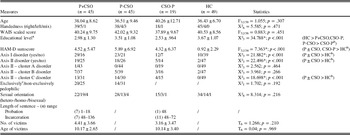
Demographic and forensic characteristics (mean±standard deviation) of study participants (N=158)

Note. P+CSO=pedophiles including a history of child sexual offenses; P-CSO=pedophiles exclusive a history of child sexual offenses; HC=healthy control group; HAM-D, Hamilton Depression Scale; WAIS, Wechsler Adult Intelligence Scale, 4th Edition.
*Statistically significant.
a Education level was assessed via a semi-structured interview and classified as follows: 1=no school-leaving qualification and leaving certificate of a school for mentally handicapped; 2=leaving certificate of secondary education (4 years secondary); 3=leaving certificate of secondary education (5 years secondary); 4=leaving certificate of secondary education (8 years secondary); 5=university degree.
b Pair-wise t-tests between groups, p=.05.
c Exclusive: sexual preference solely pedophilic.
Sexual interests as well as general offense history were assessed by a semi-structured clinical interview conducted by trained psychologists. Sexual age and gender preference was then confirmed by means of the Kinsey scale for developmental stages (Kirk, Bailey, Dunne, & Martin, Reference Kirk, Bailey, Dunne and Martin2000).
Neuropsychological Assessment
Five subtests of the Cambridge Neuropsychological Test Automated Battery (CANTAB), a computerized neuropsychological test system, measuring executive functioning across different domains were applied to all participants. The executive functioning battery used in this study was divided into the following broad categories: impulsivity, planning skills, and set shifting, as well as working memory (Cambridge Cognition Ltd, 2011). The associated CANTAB tests for impulsivity include the Stop Signal Task (SST) and the Information Sampling Task (IST). The SST is a version of a classic approach to measure response inhibition (Logan, Cowan, & Davis, Reference Logan, Cowan and Davis1984), whereas the IST test measures reflection impulsivity and decision-making skills. Rule acquisition and reversal learning that feature visual discrimination, attentional set formation maintenance, and cognitive flexibility are assessed with the Intra/Extradimensional Set Shift Task (IED). Finally, the Stockings of Cambridge Task (SOC) tests spatial planning ability and motor control and is similar to the Tower of London (Owen et al., Reference Owen, Sahakian, Hodges, Summers, Polkey and Robbins1995). The Spatial Working Memory Task (SWM) tests retention skills and the capacity to manipulate remembered items in the working memory.
At all study sites, the five subtests were administered on the same IBM tablet computer model, fitted with a touch sensitive monitor and a press pad used for the SST. Participants were asked to sit approximately 0.5 m away from the computer and to respond to instructions by touching the tablet PC screen with the index finger of their dominant hand. Tests were presented in a fixed order to all participants (order: SST, IED, IST, SWM, SOC). Before the measurements themselves, we conducted the Motor Screening Test (MOT) to introduce the participants to the touchscreen of the computer.
Stop-Signal-Task (SST): In the SST, the participant had to respond to an arrow stimulus by touching the left or right press pad with the corresponding index finger to the direction in which the arrow points. At the beginning, there were 16 practice trials, afterward an audio tone was presented in 20% of the trials, upon which the participant was required to inhibit a response. The Stop Signal Delay between the visual stimulus and the stop signal changes throughout the test depending on the participant’s past performance. The main outcome variable of interest in our study was the Stop Signal Reaction Time (SSRT), an estimate of the participant’s ability to withhold his prepotent response to the go signal in those trials in which a stop signal occurred before.
Information Sampling Task (IST): During the IST, an array of 5×5 gray boxes was presented on the screen and two colored panels were shown below. The participants were instructed to play a game for points that they can win by making a correct decision regarding which color was represented most frequently beneath the grey boxes. Boxes were opened one at a time by touching the appropriate box on the touch screen and each box revealed one of the two colors shown at the bottom of the screen. The participant then selected the corresponding color box at the bottom of the screen to make his decision (Clark, Robbins, Ersche, & Sahakian, Reference Clark, Robbins, Ersche and Sahakian2006; Clark, Roiser, Robbins, & Sahakian, Reference Clark, Roiser, Robbins and Sahakian2009).
This task comprised two conditions each with 11 trials: In the “win condition fixed” the participant was awarded with 100 points for his correct response regardless of the number of boxes opened to make the decision, whereas in the “win condition decreasing” the possible maximum gain was 250 points which decreases by 10 points with every box opened. The measurements of the IST applied here included the mean probability of correct decisions made per condition, which refers to both the participants chance of giving a correct answer at the time of the decision, and the number of total correct answers per condition. These two measures were used to assess the participant’s reflection impulsivity, defined as the amount of information that was required to make a decision under different conditions.
Intra-Extra-Dimensional Set Shift (IED): The IED is a computerized version of the Wisconsin Card Sorting Test (Downes et al., Reference Downes, Roberts, Sahakian, Evenden, Morris and Robbins1989; Ornstein et al., Reference Ornstein, Iddon, Baldacchino, Sahakian, London, Everitt and Robbins2000). In the IED, two artificial dimensions were displayed: (1) color-filled shapes and (2) white lines. In addition, there were two types of stimuli: “simple stimuli” containing only one of the aforementioned dimensions and “compound stimuli” consisting of both dimensions. At the beginning, the participant was presented with two simple color-filled shapes and was instructed to find out by trial and error which one was correct. Feedback allowed the participant to learn about the underlying rule. After six correct trials in a row, the computer changed the rule. These rule shifts were initially intra-dimensional (i.e., from one color-filled shape to another color-filled shape), later extra-dimensional (i.e., from a color-filled shape to a white line). There were two performance measures of interest: the number of total errors, as well as the number of stages completed (up to a maximum of nine stages).
Stockings of Cambridge (SOC): In the SOC, two screens containing three colored balls were shown. The participants were required to use the balls in the lower display to copy the pattern shown in the upper one. The number of minimum moves needed to accomplish each level was gradually increased from two to five (Owen et al., Reference Owen, Sahakian, Hodges, Summers, Polkey and Robbins1995). The number of problems (e.g., trials) solved with the minimum number of moves was used as an indicator for the overall planning accuracy.
Spatial Working Memory (SWM): In the SWM task, several colored squares (boxes) were presented on the screen. By touching the boxes, the participants were required to find the hidden blue token in each of several boxes. The frequency of boxes was gradually increased up to eight tokens per trial. We analyzed the number of between errors (return to a box where a token was already found earlier in the same trial) and strategy use (skill in following a predetermined search sequence rather than using unsystematic new searches). The smaller the strategy score, the more efficient the task performance (Owen, Downes, Sahakian, Polkey, & Robbins, Reference Owen, Downes, Sahakian, Polkey and Robbins1990; Owen, Evans, & Petrides, Reference Owen, Evans and Petrides1996).
Statistics
To characterize the sample, we conducted a series of one-way analyses of variance and Student’s t-tests to examine between-group differences regarding demographic and forensic characteristics (see Table 1). Subsequently, we conducted a series of analyses of covariance (ANCOVAs) regarding executive functioning measurements. We included age and WAIS scaled sum score as covariates of no interest and established a two by two between-participants design using the two factors (1) main sexual preference (pedophilic vs. teleiophilic) and (2) offender status (non-offenders vs. offenders). To account for multiple comparisons, we applied Bonferroni correction (p<.005). Furthermore, we conducted partial correlations between CANTAB test performance and age separately for pedophilic and teleiophilic participants accounting for a history of CSO (yes vs. no) as well as sexual orientation (hetero- vs. homosexual). All analyses were conducted using the Statistical Package for the Social Sciences (SPSS), 22nd edition (IBM Corp., Released 2013).
RESULTS
Characteristics of the Study Group
As depicted in Table 1, there were no significant group differences regarding age, intelligence, handedness, and sexual gender orientation.
Groups differed significantly regarding educational levels with significantly higher rates for the HC compared to both offender groups as well as higher rates for the P-CSO compared to the CSO-P. Regarding lifetime Axis I as well as Axis II cluster C personality disorders, the groups differed significantly with both pedophilic groups showing higher prevalence rates than control participants. Groups also differed regarding current depressive symptoms as assessed by the HAM-D, with higher sum scores in all three experimental groups compared to healthy controls. Pedophilic men (P+CSO vs. P-CSO) did not differ regarding their sexual preferences (divided into the subtypes exclusively pedophilic and non-exclusively pedophilic). Statistical analysis revealed no differences regarding the number and age of child victims between offenders (P+CSO vs. CSO-P).
Neuropsychological Performance
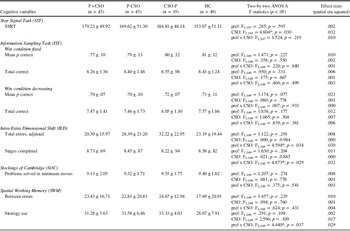
As shown in Table 2, the two (pedophilic vs. teleiophilic) by two (history of CSO vs. no history of CSO) ANCOVA revealed only a few significant effects. First, there was a significant main effect of CSO with respect to SSRT, thus being significantly higher in offenders than in non-offenders. Moreover, there were three significant sexual preferences by CSO interaction effects regarding the IED total errors adjusted and stages completed as well as for the SWM strategy use score.
Neuropsychological performance (mean±standard deviation) of study participants (N=158) including the covariates age and intelligence

Note. P+CSO=pedophiles including a history of child sexual offenses; P-CSO=pedophiles exclusive a history of child sexual offenses; HC=healthy control group; pref=sexual preference (pedophilic vs. teleiophilic); SSRT=Stop Signal Reaction Time.
*Statistically significant.
With respect to the two IED measurements, a post hoc test revealed that the P+CSO performed better than the P-CSO and the HC.
Regarding spatial working memory, post hoc analysis revealed significant differences between the CSO-P and the HC, with the CSO-P group showing the least and the HC group showing the most efficient strategy use.
However, none of these findings survived Bonferroni correction (p<.005) for multiple comparisons.
Performance Pattern in Relation to Age
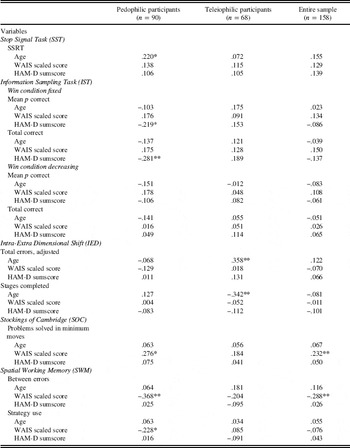
Subsequent partial correlation analysis showed significant results depending on sexual age preference: pedophilic participants showed impaired response inhibition skills, e.g., higher SSRT values, with increasing age, whereas no correlation between SSRT and age was found for teleiophilic participants. The teleiophilic group exhibited greater total error rates and a smaller number of stages completed in the IED subtest with increasing age. For pedophilic participants, no correlation effect between IED variables and age was found. We then tested for significant differences between these correlational coefficients. The SSRT correlations did not differ significantly between groups (p=.17), whereas both IED correlation coefficients differentiated significantly between groups (total errors, adjusted: p=.00; stages completed: p=.02). Please see Table 3 for correlation coefficients.
Partial correlation coefficients (controlling for sexual orientation and CSO history) between neuropsychological performance and age, intelligence, as well as HAM-D sumscore as calculated for pedophilic and teleiophilic participants separately as well as for the entire sample

Note. SSRT=Stop Signal Reaction Time; CSO=child sexual offender; WAIS, Wechsler Adult Intelligence Scale, 4th Edition; HAM-D, Hamilton Depression Scale.
*p<.05, **p<.01.
DISCUSSION
This is the first study to separate the influence of pedophilic preference and sexual offending against children regarding executive (dys-)function. We applied five subtests of the Cambridge Automated Neuropsychological Test Battery to four groups of men: (1) pedophilic men who engaged in child sexual offending, (2) pedophilic men who did not, (3) child sexual offenders without pedophilia, and (4) men who were neither pedophilic nor showed a history of (sexual or criminal) offenses. Using a two (pedophilic vs. teleiophilic) by two (offender vs. non-offender) ANCOVA, we confirmed our hypothesis that CSO rather than pedophilia is associated with executive dysfunction. As expected, we found that participants who engaged in CSO had greater problems withholding prepotent action impulses than had participants who did not engage in sexual offending. Contrary to our hypothesis, P+CSO performed best regarding cognitive flexibility. Moreover, and in line with our hypotheses, non-pedophilic offenders relative to healthy controls showed less ability for strategic working memory usage.
The finding of CSO related dysfunctions in Stop Signal Task performance may point to problems to withhold prepotent action impulses in both offending groups. This result cannot be explained by differences in age, IQ, or affective state. While this is largely in line with previous studies (Eastvold et al., Reference Eastvold, Suchy and Strassberg2011; Joyal et al., Reference Joyal, Black and Dassylva2007; Schiffer & Vonlaufen, Reference Schiffer and Vonlaufen2011) that also found poor inhibitory control abilities to be associated with offending behavior, here we are able to show that pedophilia per se is not necessarily associated with deficient response inhibition.
The profile of executive functioning in the non-pedophilic offender group was also characterized by worsened strategy usage in the Spatial Working Memory task as compared to healthy controls with both pedophilic groups performing in between. This group-specific finding also corroborates previous studies showing non-pedophilic child sexual offenders having impaired strategy use abilities (Joyal et al., Reference Joyal, Beaulieu-Plante and de Chanterac2014).
Contrary to previous findings (Kruger & Schiffer, Reference Kruger and Schiffer2011; Schiffer & Vonlaufen, Reference Schiffer and Vonlaufen2011), the P+CSO performed better than the P-CSO and the HC with regard to set-shifting abilities. However, since the above studies used different measures (a version of the Wisconsin Card Sorting Test vs. difference scores of both A&B versions of the Trail-Making-Test) to determine set-shifting abilities, heterogeneous test batteries might be likely to account for the inconsistent findings. Our results now indicate that set-shifting abilities may be associated with both factors (offense status and sexual preference).
Partial correlations between test scores and age were carried out separately for pedophilic and teleiophilic participants. Only in pedophiles, increasing age was associated with reduced response inhibition abilities (i.e., increased latency of the SSRT). By contrast, teleiophiles revealed only a very small correlation between age and SSRT, which, however, did not differ significantly from pedophiles. Accordingly, it cannot be concluded that pedophiles get more impulsive as their age increases compared to HC.
To date, there are only a few clinical studies examining age effects in pedophilic participants. In a longitudinal study examining the typology of dissexual behavior, Beier (Reference Beier1998) reported that among people with sexual offenses who relapsed, pedophilic men are well represented and are part of the older age categories at the time of their index offense (30–39 and 40–49 years old). Also Dickey and colleagues (2002) found pedophilia commonly represented in the group of over 40-year-old sex offenders, compared to other groups of sex offenders. Furthermore, a recent phenomenological study from our own pedophilia multi-site research network underpins these findings by detecting highly significant differences in age between pedophilic non-offenders and pedophilic hands-on offenders with the offenders being older than the non-offending pedophiles (Gerwinn et al., Reference Gerwinn, Weiß, Kärgel, Tenbergen, Wittfoth, Jung and Kruger2016).
Taken together, the results of our present correlation analysis regarding age and inhibition performance—even though not significantly differentiating between pedophiles and P-CSO—may therefore still point into the direction of previous investigations (Cantor et al., Reference Cantor, Blanchard, Christensen, Dickey, Klassen, Beckstead and Kuban2004; Kruger & Schiffer, Reference Kruger and Schiffer2011; Schiffer & Vonlaufen, Reference Schiffer and Vonlaufen2011) suggesting that pedophilia-specific neurocognitive perturbations increase with age. The finding that only teleiophilic participants displayed reduced set-shifting abilities with increasing age remains to be studied further. Diminished set-shifting abilities, comprising rule acquisition and reversal learning, in healthy aging participants are well documented in numerous studies (Ridderinkhof, Span, & van der Molen, Reference Ridderinkhof, Span and van der Molen2002). There is a need for further investigation and analysis as to why these processes obviously do not take place in the same way in pedophilic men and whether there is an association with the risk for CSO. Therefore, the examination of ageing in pedophilic men should be directly addressed in future research.
Strength and Limitations
Our study had several strengths. First, we were able to recruit and test a sample of, in total, 90 pedophilic participants, making our sample the largest yet published in the domain of research of executive functioning in this population. Second, we recruited both, judicially known pedophiles (pedophilic subjects with a history of child sexual offenses) and pedophiles from the “dark field” (comprising pedophiles not actually prosecuted for their offending behavior and those who did not yet commit any hands-on offenses) thus allowing us to examine the greatest possible range of pedophilic preference disorders. Moreover, the assessment of this groups enabled us to differentiate adequately between hands-on pedophilic offenders and pedophilic non-offenders using a comprehensive executive test battery targeting a broad range of executive functions.
However, this latter strength might also be a limitation. Relative to previous studies (Schiffer & Vonlaufen, Reference Schiffer and Vonlaufen2011; Suchy et al., Reference Suchy, Whittaker, Strassberg and Eastvold2009, Reference Suchy, Eastvold, Strassberg and Franchow2014), executive deficits particularly among the pedophilic offenders were rather small in the current study. The most reasonable explanation for this might be that cognitive functioning in judicially unknown and non-incarcerated pedophilic offenders (which is true for more than 50% of the pedophilic offenders in this study) is more preserved than in convicted and incarcerated samples that were examined in the past.
While acute Axis I diagnoses constitute an exclusion criterion, another limitation points to the possibly of confounding effects of psychiatric comorbidities and educational achievements in our sample. Accordingly, the pedophilic subjects showed greater rates of lifetime DSM-IV-TR Axis I and Axis II cluster C disorders than did non-offending teleiophilic subjects and moreover, the offenders had lower educational achievements than the non-offenders. Yet, as presented in Table 3, we only found a few clinical characteristics significantly correlated with neuropsychological performance, which were not detected in those domains where significant group-by-condition effects revealed.
Another shortcoming is related to the lack of using other instruments for preference diagnostics like penile plethysmography to validate self-reported information regarding sexual preference. However, in Germany, we are able to provide guaranteed confidentiality of all study information and the possibility of total anonymous participation. Therefore, it is rather unlikely that, on the one hand pedophilic participants may have denied their sexual interest in children, and that on the other hand participants untruthfully denied sexual offenses against children.
Also, our cross-sectional design does not allow us to clarify the impact regarding the association between age and executive performance, with respect to the onset of a person’s offending behavior.
Finally, although matching variables did not differ significantly, the CSO-P is the oldest group and shows the lowest IQ measures. However, since age and IQ were included as covariates of no interest, we do not assume both variables fully explain the findings at hand.
In conclusion, our data confirm that men who engaged in sexual offenses against children have problems withholding prepotent action impulses, non-pedophilic offenders had problems regarding spatial working memory capacities, and pedophilic offenders performed better regarding set-shifting. However, it is not clear how these findings relate to complex decision-making processes in real life situations. Hence, this association has to be addressed in further investigations. If proved true, adaptive cognitive training programs for the specific target group improving disabled executive domains might be a promising addition to existing cognitive-behavioral treatment approaches aimed at reducing the (re-)offending risk particularly in (pedophilic) child sex offenders.
ACKNOWLEDGMENTS
This research is part of a multi-side research project on the neural mechanisms underlying pedophilia and sexual offending against children (called NeMUP) funded by the Federal Ministry of Education and Research (BMBF): 01KR1205 to B.S., M.W., K.M.B., H.W., J.P., & T.H.C.K. It was also funded by the German Research Foundation (DFG): Schi 1034/3-1 to BS & THCK; For further details on this entire research initiative see www.nemup.de. The authors declare that they have no conflicts of interest.