Introduction
Reflector antennas are widely used in microwave communication. The surface of a reflector antenna is usually assembled in a metallic structure comprised by pieces of aluminum plates. Due to weather, temperature, and gravity, deformation will occur on the surface of these plates and greatly affect the gain, efficiency, main lobe width, and side lobe structure of the antenna [Reference Rahmat-Samii1]. An actuator system can be mounted on these plates to compensate for the deformation [Reference Prestage, Constantikes, Hunter, King, Lockman and Norrod2]. However, the premise to use the actuator system is to accurately measure the deformation on the surface.
It has been recognized that radio holography method is a powerful tool to measure the deformation of the reflector surface [Reference Yaccarino and Rahmat-Samii3, Reference Greve and Morris4]. The traditional theoretical basis of the radio holography methods including phase coherent and phase retrieval holography is the Fourier transform relation between the far-field pattern and the aperture field distribution [Reference Rahmat-Samii5]. The phase coherent method needs to measure the intensity and phase distribution of the far-field simultaneously. Therefore it needs to set another antenna and a dual channel reference receiver to provide the reference phase. Although the measurement accuracy of this method can reach 25 microns when expressed as axially resolved surface errors, it must pause at each measuring point to complete the relevant calculation, which will inevitably lead to a more complex process [Reference Morris and Barrs6]. It is not applicable in all frequencies and elevation angles of antenna due to the limitation of strong signal source with high frequency. Phase retrieval holography like Misell method does not need the phase distribution of the far-field, and therefore no more equipment is required [Reference Morris7]. But it needs to measure the intensity of the far-field patterns for several times with different de-focus values or different phase shifts, resulting in a longer measuring time. Out of focus holography requires a smaller dynamic range, which can make use of astronomical sources and receivers [Reference Nikolic, Prestage and Balser8]. However, its poor signal-to-noise ratio and resolution lead to a low accuracy of measurement. Moreover, atmospheric disturbance caused by bad weather and the drastic change of visibility will make the two methods mentioned above unusable.
The researches mentioned above mainly focus on solving the deformation by the phase distribution of the aperture field radiated by the antenna, which will be called phase method in the rest of this article. The high measurement accuracy of all these methods has obvious dependence on the high frequency of the transmitter, however, due to the lack of the EHF transmitter such as in Q-band (30–50 GHz) or even W-band (75–110 GHz), these methods are hard to provide a measure technology of high precision in all weathers and all attitudes. Besides, these methods have a disadvantage that if the phase error caused by the surface deformation exceeds $2\pi$ , then the solved deformation will have multiple results and an algorithm will be required to determine which solution is in line with the realistic situation [Reference Jin, Huang, Ye and Meng9].
Recently, Huang has proposed a novel method to solve the antenna's surface deformation by the near-field amplitude [Reference Huang, Huiliang, Ye and Meng10]. This method will be called amplitude method in the rest of this paper. In amplitude method, a so-called deformation-amplitude equation (DAE) is firstly derived to reveal the relation between the near-field amplitude and the surface deformation. Then an iterative algorithm is adopted to solve DAE and retrieve the deformation. The amplitude method can avoid the disadvantage in phase method and it only needs to measure a single near-field amplitude pattern which means little measurement time so that it can be adopted as a real time method to retrieve surface deformation.
However, simulation results show that the amplitude method has a system error and needs to be improved. The error is caused by regarding the feed of the antenna as a point source in the derivation of the amplitude method. Most of the antenna feeds of the actual radio telescope are Gaussian feeds, which are better models in both simulation and practical application [Reference McEwan and Goldsmith11].
Complex ray theory is an effective method to analyze wave field propagation and diffraction, firstly proposed by Keller and Felsen in the early 1970s [Reference Keller and Streifer12, Reference Felsen13]. This method extends the geometric optics (GO) and geometric theory of diffraction from the traditional real space analysis to the complex space, and tracks the ray trajectory in the complex space to obtain the amplitude and phase of the objective field. The integral of the initial field or current distribution on the surface of the wave source is avoided, and only a limited number of complex ray field components need to be tracked and superimposed, which makes this method simpler. The complex ray field could be regarded as local non-uniform plane waves in real space and it has a Gaussian field distribution in its paraxial region. Therefore, this method can be directly used to describe the propagation of bunching waves, such as the propagation and scattering of Gaussian beam in layered medium, inhomogeneous medium or lossy medium [Reference Ra, Bertoni and Felsen14–Reference Červený and Pšenčík16], the calculation of near-field and far-field patterns of microwave antenna [Reference Ghione, Montrosset and Felsen17, Reference Hasselmann and Felsen18], the analysis of radome [Reference Zong, Zeng, Cao and Geng19].
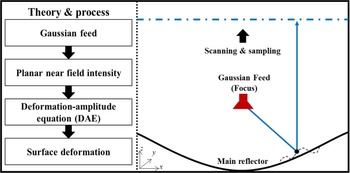
This paper will make up the amplitude method by considering the influence of the Gaussian feed. A Gaussian feed can be treated as a complex point source (CPS) [Reference Min, Feng, Xuewu and Rui20] and this paper finds that the imaginary part of the complex phase of the CPS can influence the accuracy of the amplitude method. The principle of the modified amplitude method is shown in Fig. 1. We regard the Gaussian feed located at the focus of the main reflector of the antenna as a CPS. By scanning the intensity of the planar near field, the modified DAE and supporting algorithm are used to solve the antenna surface deformation. Our main work is to derive the DAE expression with Gaussian feed, and use the search algorithm to track the ray trajectory in complex space based on geometric optics, to find the position of reflection point and the reflection angle. Finally, based on the fixed point theory, we solve the deformation distribution by iteration. Simulation results show that the deformation retrieved by the improved amplitude method is more accurate.
The principle of the modified amplitude method.

The application of the improved algorithm proposed in this paper to the large radio telescope surface measurement requires the antenna to be in the transmitting state with a stable Gaussian feed. An unmanned aerial vehicle carrying a source scans the antenna under test (AUT) by flying on a near-field plane, as shown as the dotted line in Fig. 1, to obtain the amplitude data point by point. Meanwhile, the AUT remains stationary. The processed amplitude data will be the input of the improved algorithm and the surface deformation could be solved with a better accuracy than the original algorithm proposed by Huang [Reference Huang, Huiliang, Ye and Meng10].
This paper is organized as follows: section “Original amplitude method” will briefly introduce the original amplitude method proposed by Huang [Reference Huang, Huiliang, Ye and Meng10] and point out where the error occurs. Section “Improved amplitude method” will make up the error by treating the feed as a Gaussian feed. Section “Simulation” shows some simulation results of comparison between deformation solved by original method and improved ones. Section “Conclusion” is conclusion.
Original amplitude method
In this section, a summary of amplitude method is presented and only several important results are given. The readers should refer to [Reference Huang, Huiliang, Ye and Meng10] for more detailed derivations.
Original DAE
The core part of amplitude method is DAE which reveals the relation between the surface deformation and near-field amplitude. The geometry of a reflector antenna is shown in Fig. 2.
The coordinate system of the antenna reflector.

The smooth parabola in Fig. 2 represents the ideal state of the antenna when there is no surface deformation. The antenna at this state is called ideal antenna. The wavy curve represents the surface deformation of the antenna. The antenna at that state is called realistic antenna. A Cartesian coordinate system is established at the bottom of the ideal antenna. Point $O$ is the feed, which is located at the focal point of the antenna where the coordinate is $( 0,\; \, 0,\; \, F)$
 and $F$
 is the focal length. The dash line in the figure denotes a planar near field and $P$
 denotes a random point in this near field. The near field is $h$
 meters from the origin of the coordinate. The corresponding reflection points of $P$
 on the ideal antenna surface and realistic antenna surface are $M$
 and $M^{\ast }$
 respectively. The $z$
 -direction projection of $M$
 on the realistic antenna is $M^{\ast \ast }$
 . The angles between the line segments $OM$
 and $OM^\ast$
 and the vertical direction are $\theta$
 and $\theta \ast$
 .
In this coordinate system, the surface of ideal antenna is a rotating paraboloid as shown as the thick black parabola in Fig. 2, which could be expressed as:

The $z$ -direction offset of the surface deformation is denoted as $\delta$
 as shown as the red part in Fig. 2, then the surface of realistic antenna where $M^\ast$
 and $M^{\ast \ast }$
 in Fig. 2 are located is expressed as:

The electric fields of the electromagnetic wave radiated by the feed which are reflected by ideal antenna and realistic antenna are denoted as $E$ and $E^\ast$
 , respectively. To get DAE, $E$
 and $E^\ast$
 need to be calculated. Take point $P$
 as an example, $E( P)$
 can be expressed as [Reference Ruan and Felsen21]:

Where $D( M)$ is the divergency coefficient of the ray-tube which connects point $P$
 and $M$
 and can be calculated by the law of conservation of energy, based on geometrical optics. The $j$
 in the above formula denotes imaginary unit. The $k$
 denotes wave number. The $d_{OM}$
 denotes the Euclidean distance between point $O$
 and $M$
 . The $d_{MP}$
 has a similar meaning. According to the geometric properties of the paraboloid, all the rays emitted from focal point become parallel after being reflected by ideal antenna. Therefore, $D( M)$
 equals 1 in the above formula.
In the similar way, $E^\ast ( P)$ can be expressed as:

Where $D( M^\ast )$ can be approximately expressed as [Reference Huang, Huiliang, Ye and Meng10]:

$\nabla ^2$ denotes Laplacian operator. The subscript $x$
 and $y$
 means taking the derivative of $x$
 and $y$
 . The $G$
 , $U$
 , and $V$
 in the above equation are expressed as:

Now that $E( P)$ and $E^\ast ( P)$
 are calculated, then we can get:

Since the surface deformation is very small, then $( {\left \vert E( M) \right \vert \over \left \vert E^\ast ( M) \right \vert }) ^2\approx 1$ . Therefore:

The above equation is the so-called DAE.
Original algorithm to solve DAE
An iterative algorithm was proposed to solve equation (8). The algorithm first omits $[ ( U + G_x) \delta _x + ( V + G_y) \delta _y] + ( U_x + V_y) \delta$ because it is much smaller than $1 + G\nabla ^2\delta$
 , then the DAE becomes:

We denote $( {\left \vert E( P) \right \vert \over \left \vert E^\ast ( P) \right \vert }) ^2-1$ as $FA$
 . Then equation (9) becomes:

DAE is simplified to a Poisson equation and FA is always given in discrete form. Therefore, the above equation also needs to be solved in discrete form where $\nabla ^2\delta$ can be expressed as:

A third-order discrete Laplacian is introduced based on Taylor expansions and the calculation of $\nabla ^2\delta$ could be expressed as the convolution of deformation $\delta$
 by the discrete Laplacian [Reference Huang, Huiliang, Ye and Meng10]:

In the above equation, $dx$ and $dy$
 denote distance between discrete points in $x$
 and $y$
 direction respectively. Using convolution theorem, equation (10) can be solved by fast Fourier transform (FFT) [10]:

Where $L_N$ in the above equation is a $N$
 by $N$
 matrix obtained from $L$
 by zero-padding in the bottom right direction. Equation (13) gives only an approximate solution of the DAE. Huang [10] found the exact solution can be gradually achieved by iteration from the approximate solution. After a rough deformation result $\widetilde {\delta }$
 is calculated from the above equation, the first order partial derivative term and deformation term in equation (8), namely, $[ ( U + G_x) \delta _x + ( V + G_y) \delta _y] + ( U_x + V_y) \delta$
 , could be calculated approximately as shown below:

Then equation (8) becomes:

Although $J$ is not precise, a fixed-point iteration method is proposed to make the results converged continuously [10]. FA can be updated as:

The updated FA can be put into equation (13) again to get a better deformation result. The iterative step can be done several times until the deformation result meets certain requirements. The whole algorithm scheme is shown in Fig. 3.
The original algorithm to solve the original DAE.

The error of the original amplitude method
In the original amplitude method, the feed is treated as a point source and that is why the rays emitted from source are straight lines. However, the feed used in practical is more in line with the Gaussian feed model than point source model. The Gaussian feed can be treated as a CPS [22]. The CPS is point source in complex space, which means the location of feed in Fig. 2 is now transferred from $( 0,\; \, 0,\; \, F)$ to $( 0,\; \, 0,\; \, F + jb)$
 where $b$
 is the Rayleigh distance of the Gaussian feed.
The expression of the electric field of the CPS is very similar to that of point source but now some variables are in complex space. In Fig. 4, a CPS is put at $\bar {O}$ and the electric field at point A is:

The variables with a horizontal bar mean that they are complex variables. The ${\bar {d}}_{\bar {O}A}$ is complex extension of Euclidean distance:

Now in Fig. 2, if the feed is a CPS with Rayleigh distance $b$ , then the $E( P)$
 and $E^\ast ( P)$
 are now changed into:

And

The electric field of a CPS.

The $\bar {M}$ and $\bar {M^\ast }$
 are the reflection points of $P$
 on the ideal and realistic antenna in complex space when the feed is a CPS. The location of $\bar {M}$
 is denoted as $( {\bar {x}}_{\bar {M}},\; \, \ {\bar {y}}_{\bar {M}},\; \, {\bar {z}}_{\bar {M}})$
 and the location of $\bar {M^\ast }$
 has similar notation. The location of $\bar {O}$
 is $( 0,\; \, \ 0,\; \, F + jb)$
 . Notice that the above ${\bar {d}}_{\bar {OM}}$
 is complex and therefore it has imaginary part. With equations (19) and (20), the DAE can be restated as:

The $Im$ notation in the above equation means taking the imaginary part of the variables. In real life, the frequency of an antenna can reach several GHz and therefore the wave number will be very large and then the exp part will play an important role in the above equation. It is the reason why the error occurs in the original DAE and the original solving algorithm.
Improved amplitude method
Improved DAE
Section “The error of the original amplitude method” shows that the error in the original DAE comes from the exp part in equation (21). To calculate this part, the accurate locations of $\bar {M}$ and $\bar {M^\ast }$
 are needed to be calculated. Take $\bar {M}$
 as example. This can be done by using Fermat theorem in complex space which indicates that the location of $\bar {M}$
 should make the derivative of complex optical path equal to zero [Reference Hasselmann and Felsen18]:

To calculate the complex optical path, the surfaces of ideal and realistic antenna need to be extended to complex space. For the surfaces of ideal antenna, the expression in complex space is:

Since $\bar {x}$ , $\bar {y}$
 , and $\bar {z}$
 are all complex numbers, the antenna surface now becomes four dimensional. This will make the computation of the location very complicated. For the surfaces of realistic antenna, since the deformation $\delta$
 is to be determined, the complex space extension will become even more complicated. Due to these difficulties, researchers made some simplifications when they calculate reflection points. Ruan proposed a method called Real Approximation [Reference Ruan and Felsen21]. In this method, the reflection point in real space, $M$
 and $M^\ast$
 in section “Original DAE”, is firstly computed. Then $\bar {M}$
 and $\bar {M^\ast }$
 can be calculated as $M$
 and $M^\ast$
 adding a displacement. The displacement $M\bar {M}$
 can be expressed as:

Where $f( b)$ has the property that:

The edge irradiate (EI) of an antenna needs to reach about $-11$ dB [Reference Stutzman and Thiele22]. Therefore, the Rayleigh distance $b$
 will be very small so that the feed can allocate enough energy to illuminate the boundary. Therefore, by equation (25), $\left \vert f( b) \right \vert \approx 0$
 and we can make the assumption that:

By the above approximation, only ${\bar {d}}_{\bar {OM}}$ and ${\bar {d}}_{\bar {OM^\ast }}$
 in the exponent part in equation (21) has imaginary part. The ${\bar {d}}_{\bar {OM}}$
 can be calculated as:

The first approximation in the above equation is by equation (26). The second approximation is because of the smallness of $b$ and the last approximation is by taking the first two parts of the Taylor expansion. The $\theta$
 is defined in Fig. 2 as the angle between $OM$
 and $z$
 axis. By the expression of the surface of ideal antenna in equation (1), $\theta$
 can be calculated as:

${\bar {d}}_{\bar {OM^\ast }}$ can be calculated in a similar way:

The $\theta ^\ast$ is defined in Fig. 2 as the angle between $OM^\ast$
 and $z$
 axis. $\theta ^\ast$
 has a very complex expression involving $\delta$
 and the first derivative of $\delta$
 . The calculation of $\theta ^\ast$
 will be handled in an iterative method in the next part where the solving algorithm is improved.
By equations (27), (28), and (29), the exponent part in equation (21) is:

We should make the assumptions below because $b$ and $\delta$
 are both small.

Therefore, the improved DAE is:

Where OIR is the original intensity ratio, namely the right side of equation (8) or (31). The $x_M$ and $y_M$
 in the above equation are $x_P$
 and $y_P$
 respectively because the rays reflected by ideal antenna are straight lines parallel to each other.
Improved solving algorithm
The original solving algorithm needs to be modified to solve equation (32). A similar approach is adopted like what the original algorithm does. First, $[ ( U + G_x) \delta _x + ( V + G_y) \delta _y] + ( U_x + V_y) \delta$ in OIR and $exp[ 2kb( {4F^2-( x_M^2 + y_M^2) \over 4F^2 + x_M^2 + y_M^2}-cos\theta ^\ast ) ]$
 are omitted. Then a rough deformation result can be calculated from equation (13). To facilitate discussion, the notation $EC$
 is defined as follows:

After getting a rough deformation, the result can be used to calculate $J$ and $EC$
 . Then $FA$
 can be updated as:

$J$ can be easily calculated by the rough deformation. To calculate $EC$
 , the accurate location of $M^\ast$
 needs to be known. Here, a numerical method is proposed to reach this goal. Due to the smallness of the deformation, the location of $M^\ast$
 will be close to $M^{\ast \ast }$
 . Therefore, we can take $M^{\ast \ast }$
 as a start point to search $M^\ast$
 . The neighborhood of $M^{\ast \ast }$
 can be well approximated by paraboloid [Reference Min, Feng, Xuewu and Rui20] as Fig. 5 shows.
The paraboloid approximation of the neighborhood of $M^{\ast \ast }$ .

The discrete point in Fig. 5 denotes deformation. The approximation paraboloid is denoted as $S$ . By the definition of $M^{\ast \ast }$
 , its $x$
 and $y$
 coordinate values are identical to $x_M$
 and $y_M$
 . A coordinate system is established at $( x_M,\; \, y_M,\; \, 0)$
 . To avoid confusion of symbols, the $x$
 and $y$
 axis of the coordinate system are denoted as $u$
 and $v$
 respectively. The expression of $S$
 under this coordinate system can be obtained by Taylor expansion:

The $z^\ast$ is ideal antenna adding the rough deformation. On $S$
 , by Fermat theorem, the location of $M^\ast$
 should minimize the optical length $LD$
 :

The steepest descent method is used to solve the above optimization problem. Since $M^{\ast \ast }$ is start point, the descending direction at that point is needed to be known. The $( u,\; \, v)$
 coordinate at $M^{\ast \ast }$
 is $( 0,\; \, 0)$
 , the partial derivative of $LD$
 with respect to $u$
 at this point is:

${LD}_v( 0,\; \, 0)$ can be calculated in a similar manner:

The descending direction ${\bf d}$ is:

The one-dimension search can be done on that direction. First, the searching interval needs to be determined. This can be done by the following steps:
(a) Initialize $i = 0$
 .
(b) $\alpha _i = i,\; \, \beta _i = i + 1$
.(c) If $LD( \alpha _i{\bf d}) < LD( \beta _i{\bf d})$
, then turn to step e, else turn to step d.(d) $i + +$
, turn to step b.(e) The searching interval is $[ 0,\; \, \beta _i] {\bf d}$
.


After determining the searching interval, golden section method [23] is adopted to find the optimal step size. The solution steps are as follows:
(a) Initialize $n = 0,\; \, c_n = 0,\; \, d_n = \beta _i,\; \, \lambda _n = 0.382\beta _i,\; \, \mu _n = 0.618 \beta _i$
, and provide a threshold value $\varepsilon$.(b) If $\left \vert d_n-c_n\right \vert < \varepsilon$
, stop iteration and output the result as ${\lambda _n + \mu _n\over 2}$, else if $LD( \lambda _n) > LD( \mu _n)$, turn to step c, else if $LD( \lambda _n) \le LD( \mu _n)$, turn to step d.(c) Set $c_{n + 1} = \lambda _n,\; d_{n + 1} = d_n,\; \lambda _{n + 1} = \mu _n,\; \mu _{n + 1} = c_{n + 1} + 0.618$
$ ( d_{n + 1}-c_{n + 1})$, turn to step e.(d) Set $c_{n + 1} = c_n,\; d_{n + 1} = \mu _n,\; \mu _{n + 1} = \lambda _n,\; \lambda _{n + 1} = c_{n + 1} + 0.382$
$( d_{n + 1}-c_{n + 1})$, turn to step e.(e) $k + +$
, turn to step b.


After getting the optimal step size, the optimal solution is:

The coordinate of $M^\ast is ( x_M + u^\ast ,\; \, \ \ y_M + v^\ast ,\; \, \ \ S( u^\ast ,\; \, \ \ v^\ast ) )$ . After getting the coordinate of $M^\ast ,\; \, cos\theta ^\ast$
 in $EC$
 is:

Therefore, EC can be calculated when giving the rough deformation. The improved solving algorithm is shown in Fig. 6.
The flow chart of the improved algorithm to solve the improved DAE.

Simulation
Effectiveness of the improved algorithm
In this section, several numerical simulations are performed to verify the effectiveness of the improved amplitude method. The parameter setting of the simulation is shown in Table 1.
The conditions of simulation

The discrete point number $N$ means the number of discrete points on the $x$
 axis and $y$
 axis on the planar near field. The total number of discrete points on the near field is $N\times N$
 . The near-field height $h$
 denotes the distance between scanning plane and the vertex of the reflector as shown in Fig. 2. The taper angle $\varphi$
 denotes the angle between the light radiated by the feed to the edge of the reflector and the $z$
 -axis. Rayleigh distance $b$
 is determined by the Gaussian feed as shown in Fig. 4. The taper $EI$
 is the edge irradiate, determined by $b$
 and $\varphi$
 , as shown below.

Where $k = 2\pi /\lambda$ is the wave number.
The computer used in the simulations is equipped with a 2.6 GHz i7-6700HQ processor.
In the first simulation, the deformation shown below was added to the antenna.

The root mean square (RMS) is used to evaluate the accuracy of the solving algorithm. Its calculation formula is shown below:

The $\delta _r$ in the above expression denotes the deformation solved by algorithm.
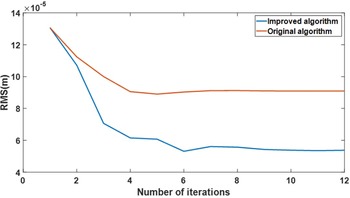
The curves of RMS of solving algorithm with respect to iteration number is shown in Fig. 7. The blue line in Fig. 7 is RMS data of improved solving algorithm and the red line is that of the original algorithm. It can be seen from the figure that the RMS of both algorithms converges after $12$ iterations, so we set the convergence condition in both algorithms as iterating $12$
 times. The final RMS value and computation time of the two algorithms are shown in Table 2.
The RMS trends of the original algorithm and the improved algorithm when solving deformation 1, namely equation (43), respectively.

Calculation result of the two algorithms

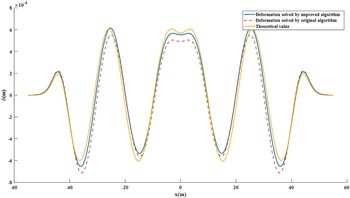
The $y = 0$ plane cut of the solved deformation is shown in Fig. 8. The red dot line is the deformation solved by original algorithm, the blue line is that of improved algorithm and the yellow line is the theoretical deformation value. From this figure, it is shown that a better result can be retrieved by improved algorithm.
$y = 0$ plane cut of the solved deformation.

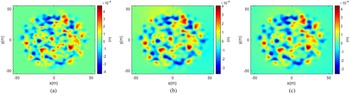
To verify the versatility of the improvement, a second simulation is performed by adding a random deformation to the antenna with a $113.01\, \mu$ m RMS error from the ideal reflector surface, which is more complex and harder to measure than the normal antenna deformation distribution. The added deformation and solved deformation by the two algorithms are shown in Fig 9.
A comparison of deformation solved by the improved and original algorithm. Figure (a) shows the theoretical deformation. The deformations solved by the original algorithm and the improved algorithm are shown by (b) and (c), respectively.

The RMS data of the two algorithm are shown in Fig. 10. It can be seen from the figure that the RMS of both algorithms converges after $12$ iterations, so we set the convergence condition as iterating $12$
 times and the result shown in Fig 9 is the result after iterating $12$
 times. The final RMS value and computation time are shown in Table 3.
The RMS trends of the original algorithm and the improved algorithm, respectively.

Calculation result of the two algorithms

From Table 3, it is shown that a better result can be retrieved from improved algorithm, but the computation time of the improved algorithm is much longer than the original one because solving the optimization problem in the improved algorithm is time consuming.
Effectiveness at different f and N
We have simulated the variations of the results with the frequency. The number of iterations is adjusted to $15$ and we keep the discrete point number $N$
 $257$
 unchanged. The deformation of the reflector surface is also supposed to be equation (43), whose RMS error from the ideal surface is $RMS( \delta ) = 327.54\, \mu$
 m. The simulation is performed at frequencies of $0.1$
 , $0.6$
 , $1$
 , and $3$
 GHz. The final RMS errors between the supposed deformation and the solutions of the method proposed in this paper and the corresponding solving times are shown in Table 4 below. It is shown that the improved algorithm can basically solve the deformation accurately at all frequencies. Although the RMS errors are slightly higher at $0.1$
 and $2$
 GHz, it is still more accurate than the original algorithm. The time of execution is the same at each frequency due to the same resolution $257\times 257$
 .
The final RMS errors and the corresponding solving times at different frequencies

Supposing the same deformation on the reflector surface, we have compared the results of the improved algorithm proposed in this paper at different frequencies with the semi-spherical scanning method [Reference Qian24] and the original algorithm of the planar scanning method [Reference Huang, Huiliang, Ye and Meng10], as shown as Fig. 11. The solving region covers the entire reflector surface. It is shown that the improved algorithm performs best at all frequencies.
Comparison of the simulated solution accuracy among the semi-spherical scanning method, original algorithm, and improved algorithm of the planar scanning method.

The effectiveness of the improved algorithm under different resolutions has also been verified. The number of iterations is also $15$ and we keep the frequency $0.3$
 GHz unchanged. We perform the simulations when the sampling resolutions of the near-field amplitude are $33\times 33$
 , $65\times 65$
 , $129\times 129$
 , $257\times 257$
 , $513\times 513$
 , respectively. The setting of $2^n + 1\ ($
 n=5$,\; \, 6,\; \, 7,\; \, 8,\; \, 9)$
 discrete points is convenient to get the central section for comparison. The RMS results and the corresponding solving times are shown in Table 5. It is shown that the RMS error is slightly lager when the resolution decreases and the execution time is proportional to $N^2$
 . However, even if the resolution is only $33\times 33$
 , the improved algorithm could also get an accurate solution.
The final RMS errors and the corresponding solving times at different resolutions

Conclusion
The original amplitude method proposed by Huang [10] has many advantages, such as the measurement accuracy does not depend on the working frequency, and the measurement can be realized when the antenna is in any elevation angle. Besides, the scanning plane could be chosen in both the reactive near field and the Fresnel zone, resulting in a better signal-to-noise ratio than the near-field holography method.
The main error of the original amplitude method comes from ignoring the influence of Gaussian feed. The Gaussian feed could be treated as a CPS. Taking this factor into consideration, an improved DAE is derived using the complex phase of the electric field of the CPS based on GO method. A search algorithm for ray tracing is proposed to find the reflection point and reflection angle, which is necessary to be calculated to solve the improved DAE. Finally, an iteration method is employed to solve the DAE. Although many approximations are applied in the derivation, simulation results show that the solution solved by the improved algorithm is better than that of the original algorithm.
The main contribution of this paper is shown below:
1. To calculate the reflection angle so that the improved DAE could be solved, an iteration method including a golden section search algorithm is designed to make the solutions gradually converge.
2. This paper presents a method to improve the accuracy of a surface deformation measurement algorithm for reflector antennas, using the complex phase of the electric field of the CPS. The RMS surface error has been reduced to $26.87\, \mu$
m from the $60.94\, \mu$m of the original algorithm while the RMS error of the supposed random deformation is $113.01\, \mu$m, which is meaningful for the millimeter wave observation efficiency of radio telescope. As a comparison, the RMS errors of antenna surface with a similar diameter of 110 m can be reduced to about $50-70\, \mu$m by the phase recovery method and the phase coherent holography method, when the RMS of the deformation is around $100\, \mu$m before adjustment.


Acknowledgements
This work is supported by the National Key Research and Development Program of China: Research on Key Technologies of real-time shape control and ultra wideband pulsar signal processing for large aperture radio telescope, $2021YFC2203501$ , and project $U1931137$
 supported by the National Natural Science Foundation of China.
Conflict of interest
None.
 Boyang Wang received a degree in physics from the Southeast University in 2014 and received his master's degree in 2019 from Shanghai Jiao Tong University. He is now studying for a Ph.D. degree at Shanghai Jiao Tong University. His main research interests are reflector surface measurement, geometrical optics, microwave holography, and deep learning algorithms.
 Qian Ye received his Ph.D. in 2002 from the Harbin Institute of Technology. He became an associate researcher at Shanghai Jiao Tong University in 2009. His main research interests are microwave holography, phase retrieval algorithm, reflector surface measurement, and large-scale electromechanical system control.
 Li Fu is now a senior engineer of Shanghai Observatory, Chinese Academy of Sciences, with a Ph.D. Her research interests are structural mechanics analysis and accuracy evaluation of large radio telescope antenna.
 Guoxiang Meng received her Ph.D. in 1990 from Xi'an Jiaotong University. She became a full-time professor at Shanghai Jiao Tong University in 2004. Her main research interests are reflector surface measurement, fluid transmission, and control.
 Qinghui Liu received his Ph.D. in 2003 from Kagoshima University. He is now the chief engineer of Shanghai Tian ma telescope (TMT). His main research interests are radio telescope, deep space exploration, and VLBI measurement.
 Zhiqiang Shen received his Ph.D. in 1996 from Shanghai Astronomical Observatory. He is now the director of Shanghai Observatory, Chinese Academy of Sciences. His main research interest is radio astrophysics.