INTRODUCTION
Species of the genus Anolis (anoles hereafter) are a diverse group (c. 361 species) of Neotropical lizards, which is distributed from northern California, USA, to the northern half of South America and the Caribbean islands (Losos Reference LOSOS and Berkeley2009). The great variation in body condition, body size, habitat use, clutch size and number of clutches reported in this group are ecological traits affected by predation, inter- and intraspecific competition and food resource availability (Schoener et al. Reference SCHOENER, SPILLER and LOSOS2002). Body condition and growth rate are negatively affected by high predation rate, intense inter- and intraspecific competition and low food availability because of exclusion from, or limitation of, optimal resources (Harmon et al. Reference HARMON, HARMON and JONES2007, Schoener et al. Reference SCHOENER, SPILLER and LOSOS2002). Nevertheless, intraspecific competition can also promote an increase in growth rate and body condition due to the competitive advantages of larger body size (Le Galliard et al. Reference LE GALLIARD, FERRIÈRE and CLOBERT2003, Pafilis et al. Reference PAFILIS, FOUFOPOULOS, POULAKAKIS, LYMBERAKIS and VALAKOS2009).
However, the interaction of these factors may differ between insular and continental environments (Palkovacs Reference PALKOVACS2003). It has been suggested that interspecific competition and predation tend to be less intense on islands than on the continent, since the reduced area of islands translates into fewer species that are potential competitors or predators of anole lizards (Thomas et al. Reference THOMAS, MEIRI and PHILLIMORE2009). The release from predation and interspecific competition tends to increase the intensity of intraspecific competition in insular lizard populations (Schoener et al. Reference SCHOENER, SPILLER and LOSOS2002). The impact of intraspecific competition on insular anoles is unclear, since this could force anole lizards to increase growth rates so as to acquire larger body sizes and be more competitive (Le Galliard et al. Reference LE GALLIARD, FERRIÈRE and CLOBERT2003, Pafilis et al. Reference PAFILIS, FOUFOPOULOS, POULAKAKIS, LYMBERAKIS and VALAKOS2009), or alternatively this could lead to decreased body condition and consequently lower growth rates.
In this paper we compare an insular and a continental population of Anolis nebulosus (Wiegmann 1834) with contrasting densities (113 and 15 individuals ha−1 respectively, unpubl. data). We aimed to compare growth rate, body condition, perch use and food availability for the two populations experiencing different levels of competition and predation. We hypothesized that lower species richness on the island (Arizmendi et al. Reference ARIZMENDI, BERLANGA, MÁRQUEZ, NAVARIJO and ORNELAS1991, Ceballos & Miranda Reference CEBALLOS and MIRANDA2000, CONANP 2008, García & Ceballos Reference GARCÍA and CEBALLOS1994) leading to decreased predation and interspecific competition, and increased intraspecific competition, would result in better body condition, faster growth rate and differences in height and diameter of perch use for insular compared with continental anoles.
METHODS
Study site
The insular population was studied at San Agustín Island (19°32′04.63″N, 105°05′18.08″W), which is located at 0.47 km from Pueblo Chamela on the south-western coast of Jalisco, Mexico. This is a tiny island with a total area of approximately 3.3 ha and maximum 280 m length and 230 m width, which probably was disconnected from the mainland between 7000 to 3600 y BP, when sea level increased slowly from −10 m to −2 m with respect to the current sea level (Ramírez-Herrera et al. Reference RAMÍREZ-HERRERA, KOSTOGLODOV and URRUTIA-FUCUGAUCHI2004). The continental study population was located at the Chamela Biological Station (19°29′48.61″N, 105°02′25.89″W), of the Instituto de Biología, Universidad Nacional Autonoma de Mexico, located 5.5 km from San Agustín Island.
Both study sites occur in protected areas. San Agustín Island is included within the Santuario de las Islas de Chamela, which protects nine species of bird and five reptiles including A. nebulosus (CONANP 2008). The Chamela Biological Station is part of the Chamela-Cuixmala Biosphere Reserve comprising an area of 13142 ha with 70 species of mammal, 270 birds, 19 amphibians and 68 reptiles including A. nebulosus (Arizmendi et al. Reference ARIZMENDI, BERLANGA, MÁRQUEZ, NAVARIJO and ORNELAS1991, Ceballos & Miranda Reference CEBALLOS and MIRANDA2000, García & Ceballos Reference GARCÍA and CEBALLOS1994). Both sites are characterized by a strong seasonality in precipitation in which rainfall is concentrated from July to October, with an extended dry season that can last up to 8 mo. Average annual rainfall is 749 mm with mean 24.9°C temperature (Bullock Reference BULLOCK1986). At both sites, seasonal tropical dry forest is the dominant vegetation, and is characterized by the deciduous nature of trees which drop their leaves in the dry season. However, trees are smaller on the insular site than in the continental forest. Despite the existence of eight islands and four islets in Chamela Bay, anole lizards have not been recorded on any of the other islands (A. Garcia pers. obs.), which also occur further from the mainland, meaning it was not possible to replicate the study on other islands within the bay.
Study species
Anolis nebulosus is a small, insectivorous, arboreal lizard, endemic to Mexico, which is distributed from Eastern Sonora along the Pacific slope to Southern Guerrero and the Balsas basin. Average snout-vent length is 42 mm in males and 36 mm in females, while body weight is 1.7 g and 1.6 g respectively (García & Ceballos Reference GARCÍA and CEBALLOS1994).
Data collection
At each site we estimated food availability (arthropods) for anoles using nine traps made with squares (25 × 25 cm) of plastic covered with Tanglefoot® to capture arthropods. These traps were set for 48 h, every 2 mo for a year. Arthropods were collected in 70% ethanol for subsequent taxonomic identification to Order level.
At each study site we surveyed three 25 × 25 m (625 m2) quadrats for lizards over three consecutive days, every 2 mo from October 2010 to September 2012, giving a total of 30 visits or 135 survey h for each quadrat over 2 y. Each quadrat was surveyed at different time periods on each of the 3 d: (1) 09h00–10h30; (2) 10h30–12h00; and (3) 12h00–13h30. Each individual encountered during the surveys was hand-captured and weighed with a 5g pesola® (precision ± 0.3%), and length measurements were taken using a Vernier caliper (precision 0.01 mm). The sex of the individual was determined by presence (male) or absence (female) of dewlap. Perch diameter and height were recorded for each captured individual. Each specimen was marked by toe clipping (only once), and was immediately released at the capture site. To date no adverse effects on reptiles have been reported when using this marking technique (Beausoleil et al. Reference BEAUSOLEIL, MELLOR and STAFFORD2004, Losos Reference LOSOS and Berkeley2009). However, to minimize any potential impact, clipping was done at the tip of the toe free of lamellae.
Body condition (condition or corpulence index) is an estimate of an individual animal's fitness, or coefficient of the relative size of energy stores compared with structural body components (Green Reference GREEN1999). We calculated body condition by the scaled mass-index method (Peig & Green Reference PEIG and GREEN2009), since this considers the relationship with various body component measures that vary between species and populations. We used the natural logarithm of the weight and body size of each individual in the formula Ḿi = Mi(L0/Li)bSMA (Peig & Green Reference PEIG and GREEN2009), where Mi is the body mass of individual i, Li is the linear body measurement (logSVL) of individual i, L0 is a representative value of L in the sample (e.g. the arithmetic mean value), bSMA is the scaling exponent estimated by the SMA (standardized major axis) regression of M on L (logMASS/logSVL) and Ḿi is the predicted body mass for individual i when the linear body measure is standardized to L0. Data were categorized by site (island, mainland) and sexual maturity (adult male, adult female and juvenile). Additionally, given that there is seasonal fluctuation of arthropod resources in dry forest (Lister & García Reference LISTER and GARCÍA1992), data were separated into rainy (September, October and December) and dry (February, April and June) seasons.
Mark–recapture data were used to calculate growth rate defined as the increase in body size of an individual divided by the number of days between two consecutive capture events (Schlaepfer Reference SCHLAEPFER2006). Juveniles were excluded from this analysis due to the limited number of juveniles captured.
Statistical analyses
Average arthropod density was determined at the Order level for each site, every 2 mo. The density of arthropods was standardized as DAi = (AMi−AAY)/SD (Longford Reference LONGFORD2009), modification of: D = (μ1−μ2)/σ), where DAi is the standard density of arthropods for the month i, AMi is the number of captured arthropods in the month i, AAY is the average of arthropods throughout the year, and SD is the standard deviation. A repeated-measures ANOVA with Bonferroni test was used to compare arthropod density among sites and capture months.
Body condition data had a normal distribution for 8 of 11 groups (Shapiro–Wilk test, P > 0.05). No juveniles were recorded on the island during the dry season; therefore we first conducted statistical analysis with only adults applying three-way ANOVA to compare body condition by site, season and sexual maturity. Second, we used two-way ANOVA for mainland individuals to compare body condition between season and sexual maturity. For the insular population we applied one-way ANOVA to compare body condition between adult males, adult females and juveniles. As no juveniles were recorded on the island in the dry season, the contrast between seasons was conducted only for adults applying two-way ANOVA to compare between seasons and sexes. Finally, we used two-sample t-tests to contrast body condition of juveniles between insular and continental sites during the rainy season.
We tested three equations for growth rate to determine the best fit to the data: linear Gr = A × r × (1−(AL/A)), logistic by length Gr = AL × r × (1−(AL/A)), and logistic by weight Gr = (r × AL/3)((1−AL3)/A3); where Gr is the growth rate, A is the asymptotic body length, r is the characteristic parameter for growth and AL is the average length (Dunham Reference DUNHAM1978). Data were better adjusted to the logistic equation by weight model (R2 = 0.228), than linear (R2 = 0.105) and logistic by length models (R2 = 0.217). Data were not normally distributed (k-s, P < 0.05), therefore we applied Kruskal–Wallis ANOVA to compare between sites and sexes.
Data on perch use were not normally distributed, and this was not improved by natural-logarithm transformation. Therefore, we used a three-way MANOVA, including the height and diameter of the perch to compare between sexes, sites and seasons; as this analysis is robust enough to work with non-normal data (Olson Reference OLSON1974, Stenbacka et al. Reference STENBACKA, HJÄLTÉN, HILSZCZANSKI and DYNESIUS2010). To detect relationships between biological variables (weight and size) and habitat-use variables (height and diameter), we first conducted a principal components analysis for each group of variables to reduce their dimensionality. Thus, we obtained new scores of PC1 and PC2 for each individual, with eigenvalue > 1. Finally we conducted an ANCOVA analysis using PC1 as the dependent variable, PC2 as a covariate, and site and sex as factors. All statistical analyses were run in STATISTICA 7® and SPSS 17®.
RESULTS
Food availability
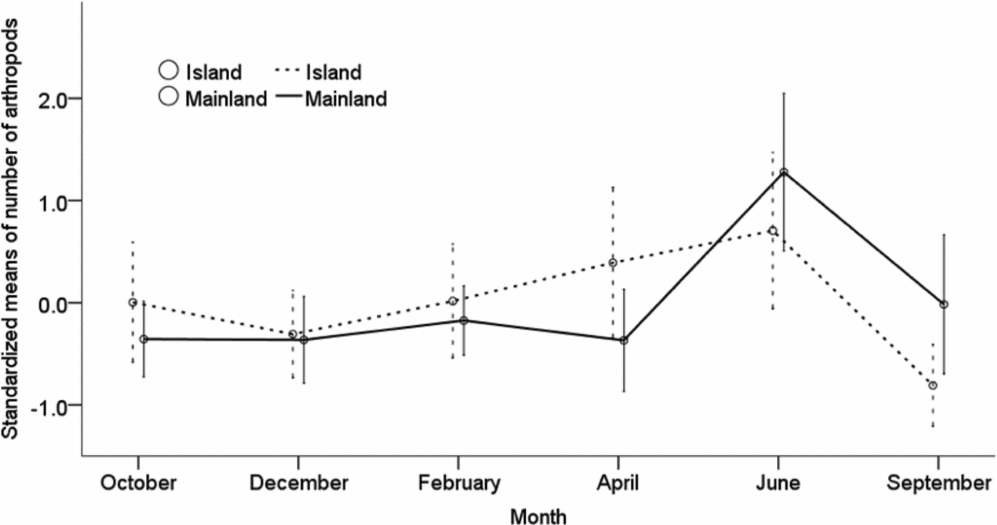
The composition of food items available for both populations of A. nebulosus included the following Orders: Diptera, Orthoptera, Araneae, Hymenoptera, Coleoptera, Hemiptera, Heteroptera and Lepidoptera. Food (arthropods) availability did not differ statistically between sites (F = 2, df = 1, P = 0.17), but varied significantly among survey periods of the year (F = 7.17, df = 5, P < 0.001), with a significant interaction of survey period with site (F = 2.34, df = 5, P = 0.049). At both sites, the highest density of arthropods was recorded in June (Bonferroni test, P < 0.05). However, on the island, arthropod abundance increased gradually over the dry-season months of December to June, with lowest density in the rainy-season month of September. By comparison, on the mainland arthropod abundance varied little over the dry season from October to April, with a peak in abundance in June and declining again in September (Figure 1).
Standardized means with 95% confidence intervals of number of arthropods (food supply to Anolis nebulosus) trapped at the Chamela Biological Station on the mainland, and on San Agustín Island, from October 2010 to September 2011.

Body condition
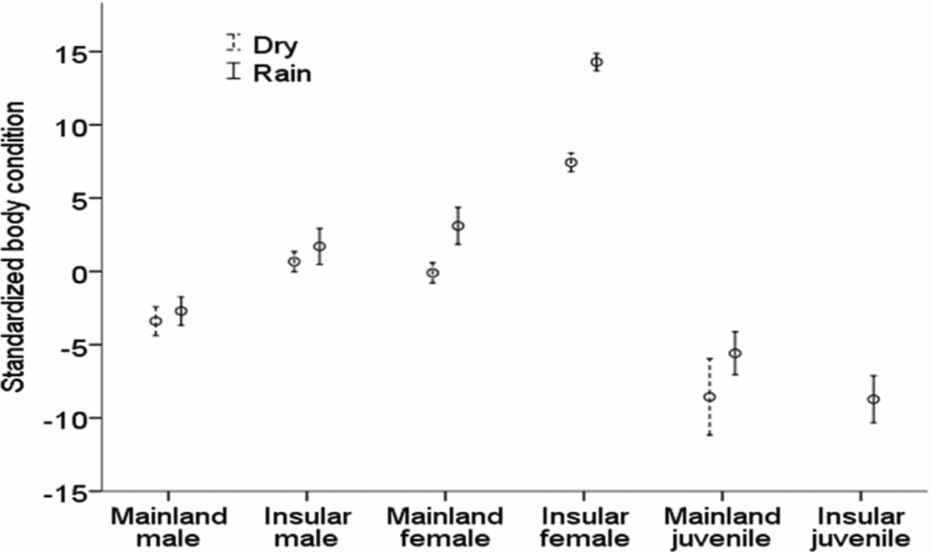
Body condition of adults differed between sites (F = 141, df = 1, P < 0.0001), seasons (F = 26.4, df = 1, P < 0.0001) and sexes (F = 154, df = 1, P < 0.0001). Anole lizards had better body condition on the island than on the mainland for both males and females and in both seasons (Figure 2). Furthermore, body condition was better in the rainy season relative to the dry season for each sex at each site (Figure 2), and at each site females had better body condition than males (Figure 2). On the continent, body condition differed significantly by sexual maturity (F = 62, df = 2, P < 0.0001) and between seasons (F = 14.6, df = 1, P = 0.0002), being better during the rainy season, and better for adult females than adult males and juveniles. For the island population, adult female lizards also had significantly better body condition than adult males and juveniles (F = 258, df = 2, P < 0.0001), body condition of adults was significantly better in the rainy season (F = 9.3, df = 1, P = 0.002) and was significantly better in females (F = 29, df = 1, P < 0.001). In contrast to adults, juveniles had better body condition on the mainland than for the island population (t = 2.5, df = 43, P = 0.016; Figure 3).
Standardized body condition (mean with 95% confidence intervals) of males, females and juveniles of Anolis nebulosus on San Agustín Island and the Chamela Biological Station on the mainland, in the dry and rainy seasons.
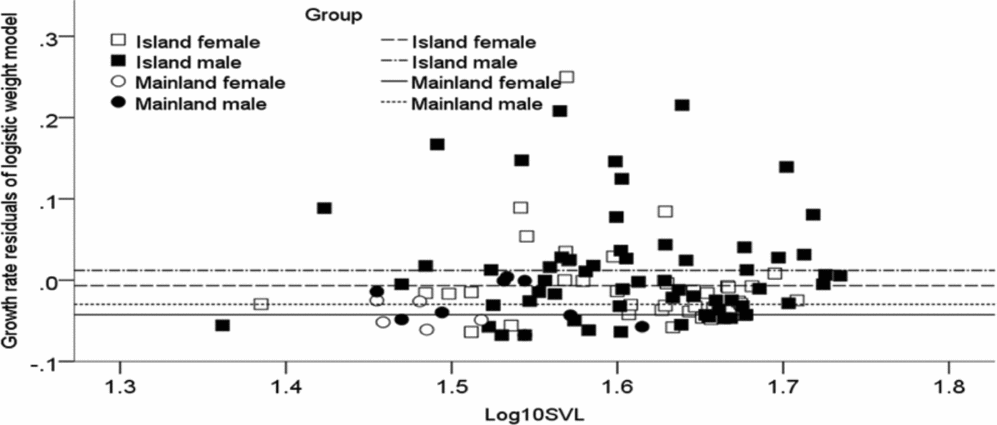
Residual growth rate (logistic weight model scatter plot) of male and female Anolis nebulosus on San Agustín Island and the Chamela Biological Station on the mainland. Lines are growth rate means for the Y axis. Log10SVL is the logarithm with base 10 of snout-vent length.
Growth rates
Growth rates differed between sites (F = 4.74, df = 1, P = 0.031), being higher for insular males (ẋ = 0.012) and females (ẋ = −0.029) compared with their continental counterparts (males: ẋ = −0.006; and females: ẋ = −0.042, Figure 3). There was no significant difference between sexes within each site (F = 0.78, df = 1, P = 0.37).
Perch use
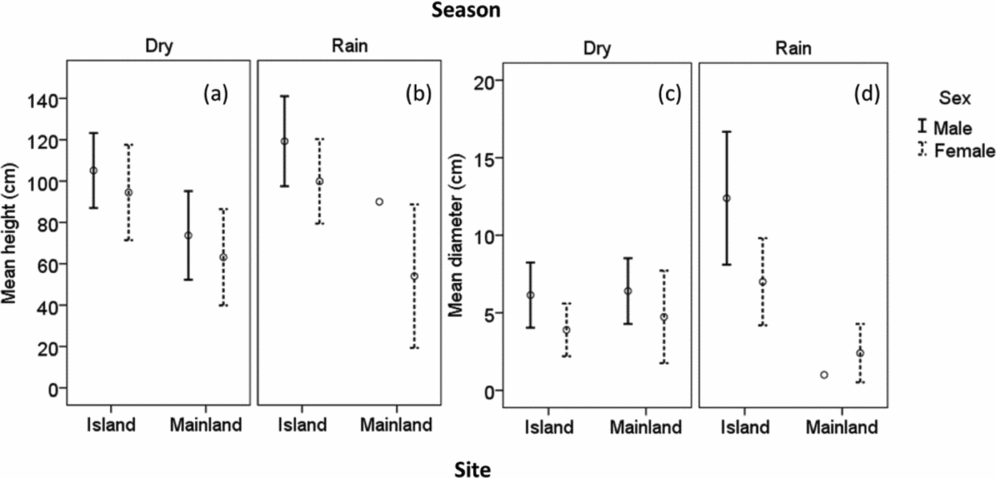
Island and mainland anoles tended to use perches of similar height and diameter (F = 2.57, df = 2, P = 0.077), particularly in the dry season (Figure 4). However, the MANOVA analysis of perch use determined a significant effect of the site–season interaction (F = 4.28, df = 2, P = 0.014), where perch use differed between sites in the rainy season (Figure 4). Mean perch diameter used by island and mainland anoles was similar during the dry season; however, in the rainy season, island anoles used perches of greater diameter, whereas mainland anoles used perches of smaller diameter (Figure 4). A similar pattern was found for perch height (Figure 4), though the only significant difference was for perch height of insular males in the rainy season compared with mainland males in the dry season (Tukey q = 4.53, P = 0.004). Males also tended to use similar perches to females (Figure 4).
Mean per cent observations with 95% confidence intervals of perch height in dry (a) and rainy (b) seasons, and perch diameter in dry (c) and rainy (d) seasons, for San Agustín island and Chamela mainland populations of Anolis nebulosus.
The ANCOVA analysis also found no relation between biological variables of anole weight and size (PC1) with habitat use (PC2) of perch height and diameter (F = 0.116, df = 1, P = 0.733).
DISCUSSION
Food availability
Our study found no difference in food resources for anoles between island and mainland sites, with similar density and orders of arthropods at both sites. This does not support the argument that food supply, in terms of density and species richness of arthropods, is a limited resource for insular anoles (Andrews Reference ANDREWS1976, Van Damme Reference VAN DAMME1999). It has been accepted that species richness and density of arthropods tend to be lower on islands when compared with the mainland (Connor et al. Reference CONNOR, COURTNEY and YODER2000, Wheelwright et al. Reference WHEELWRIGHT, DUKESHIRE, FONTAINE, GUTOW, MOELLER, SCHUETZ, SMITH, RODGERS and ZINK2006). Species richness and density of arthropods may be related to area, i.e. density of Orthoptera, Chilopoda and Tenebrionidae have been positively related with island size (Fattorini Reference FATTORINI2011), or vegetation cover (Morrison Reference MORRISON1998). Therefore, small islands should have lower arthropod richness than larger islands, or the mainland. However, distance from the mainland is also a determinant for species richness and density on islands (Fattorini Reference FATTORINI2011), since many arthropod species are terrestrial and have limited dispersion abilities (Fattorini Reference FATTORINI2011). Hence, the closeness of San Agustín Island to the continental coastline (0.47 km), and the outlet of the Chamela stream which is directly in front of the island, could facilitate migration of several arthropod species from the mainland.
Our results also do not support the idea that greater food availability on islands promotes gigantism in insular anoles (Pafilis et al. Reference PAFILIS, FOUFOPOULOS, POULAKAKIS, LYMBERAKIS and VALAKOS2009). Insular anoles can exploit food resources that are usually used by other species on the mainland (Thomas et al. Reference THOMAS, MEIRI and PHILLIMORE2009). The similarity in Order richness and arthropod density between insular and mainland sites in our study suggests that food availability per se may not be critical for the differences found in body condition, growth rates and perch use between insular and mainland anoles. Nevertheless, a similar level of food resources on the island may allow a higher anole population density due to reduced interspecific competition, which in turn could modify many aspects of the ecology and biology of insular anoles (Buckley & Roughgarden Reference BUCKLEY and ROUGHGARDEN2005). The absence of interspecific competitors, which usually occurs in insular lizard populations (Buckley & Jetz Reference BUCKLEY and JETZ2007) may lead to greater access to food resources for insular anoles.
Availability of arthropod food resources for the clouded anole and other insectivorous species fluctuates seasonally (Lister & García Reference LISTER and GARCÍA1992). The density of arthropods at the insular and mainland sites obtained in the present study corroborates the seasonal fluctuation of food resources for the clouded anole (Lister & García Reference LISTER and GARCÍA1992). Thus, variables such as body condition, growth rate and habitat use by anoles may also vary seasonally.
Body condition
The better body condition of insular anoles found in our study differs from previous studies that report better body condition in continental anoles (Stamps Reference STAMPS1977, Stamps & Tanaka Reference STAMPS and TANAKA1981a). The better body condition of anoles at San Agustín Island may be a result of greater access to food resources in the absence of interspecific competitors that exist on the mainland. Species richness at San Agustín Island is lower than at the mainland site of Chamela (CONANP 2008) where higher interspecific competition and predation rates (Siliceo-Cantero & García, pers. obs.) may be responsible for lower body condition in the continental population, as has been reported in other studies (Monasterio et al. Reference MONASTERIO, SALVADOR and DÍAZ2010, Schoener et al. Reference SCHOENER, SPILLER and LOSOS2002).
Females in our study had better body condition than males. Lizard body condition does not always differ between sexes (Jenssen et al. Reference JENSSEN, CONGDON, FISCHER, ESTES, KLING and EDMANDS1995), and is affected by the energy expenditure of individuals at the time of capture. For example, males may experience a decrease in body condition during the reproductive season due to the energy expended while defending territories or in obtaining mates (Ancona et al. Reference ANCONA, DRUMMOND and ZALDÍVAR-RAE2010, Schlaepfer Reference SCHLAEPFER2006). In females, body condition might decrease after egg-laying because of the energy invested in reproduction (Cox & Calsbeek Reference COX and CALSBEEK2010). Our results agree with findings in A. polylepis, where females recorded better body condition than males, possibly due to increased food consumption to allocate energy for egg production (Schlaepfer Reference SCHLAEPFER2006).
We found relatively lower body condition for juveniles in both populations. In the mainland population, this may be due to the high rates of predation and interspecific competition affecting the opportunities of juveniles to thermoregulate and forage, reducing their activity and consequently their body condition (Herczeg et al. Reference HERCZEG, GONDA, SAARIKIVI and MERILÄ2006). For the insular population, the high density of anoles (Siliceo-Cantero & García, pers. obs) means that juveniles may have to compete with adults under challenging conditions, as has been reported for Lacerta vivipara (Cote & Clobert Reference COTE and CLOBERT2010, Le Galliard et al. Reference LE GALLIARD, FERRIÈRE and CLOBERT2003). Furthermore, there may be a possibility of adult–juvenile cannibalism because of the high population density, since cannibalism has been reported for several anole species (Gerber & Echternacht Reference GERBER and ECHTERNACHT2000). Insular females have better body condition and probably allocate more resources to produce a higher number of offspring of lower body condition, as has been reported for insular females of Calotes versicolor (Shanbhag et al. Reference SHANBHAG, RADDER and SAIDAPUR2000) and Sceloporus undulatus (Angilletta et al. Reference ANGILLETTA, SEARS and WINTERS2001). Our results suggest that intraspecific interactions present on the island have a greater impact on the body condition of insular juveniles than interspecific interactions on continental juveniles. In our study, body condition in both populations was better in the rainy season and it may be that the increased foliage cover in these months enables lizards to be less conspicuous to predators, increasing the access to food resources.
Growth rates
Despite the fact that several lizard studies, including some Anolis species, suggest a positive relation of growth rate with food availability (Griffiths & Christian Reference GRIFFITHS and CHRISTIAN1996, Stamps Reference STAMPS1977), we found higher growth rate of insular individuals whereas there was no difference in food resource availability between the study sites. Other studies have reported a stronger and indirect influence of water availability on growth rate (Stamps & Tanaka Reference STAMPS and TANAKA1981b), because food availability is related positively with the amount of rain or proximity to water bodies (Sabo & Power Reference SABO and POWER2002). Hence, the higher growth rate of insular individuals in our study may be due to a large amount of wind-driven water reaching the island (Ashmole & Ashmole Reference ASHMOLE and ASHMOLE1997). A positive relationship between water resources and growth rate has also been observed in the congeneric lizard A. aeneus (Stamps & Tanaka Reference STAMPS and TANAKA1981b), where the authors suggest that arthropod density is a function of water levels. Another possible explanation for the difference in growth rates may be a result of the differential intensity of ecological interactions such as intra- and interspecific competition, and rates of predation occurring within each population.
The greater species richness found at the continental site makes the continental anole population more susceptible to a higher risk of predation and interspecific competition. Greater predation pressure for mainland individuals puts them in constant stress, forcing them to shorten their activity period (Sorci et al. Reference SORCI, CLOBERT and BELICHON1996), reducing the time allocated to activities such foraging and thermoregulation with negative effects on their growth rates (Downes Reference DOWNES2001, Lewis Reference LEWIS1986). Higher pressure from interspecific competition can negatively affect growth rates of a less competitive species, since resources are monopolized by other more competitive species (Pacala & Roughgarden Reference PACALA and ROUGHGARDEN1982), which are not necessarily at their optimal growth rate (Melville Reference MELVILLE2002). Lower lizard species richness and lower predation rates on San Agustín Island could lead to increased population density of A. nebulosus and greater intensity of intraspecific competition that may impact their growth rates since resources are density-dependent (Massot et al. Reference MASSOT, CLOBERT, PILORGE, LECOMTE and BARBAULT1992). However, under conditions of high resource availability, higher growth rates can help females to acquire larger sizes, enabling them to be more successful competitors and to increase their clutch sizes (Angilletta et al. Reference ANGILLETTA, SEARS and WINTERS2001, Trivers Reference TRIVERS1976).
Higher growth rates of insular anoles could be driven by intense intraspecific competition since males of greater size would be better competitors for territories, increasing their access to females and copulation frequency, thereby providing reproductive advantages (Thomas et al. Reference THOMAS, MEIRI and PHILLIMORE2009, Trivers Reference TRIVERS1976). In the case of females, a larger size enables greater access to resources and production of larger clutches (Downes Reference DOWNES2001, Lewis Reference LEWIS1986). The higher growth rates and increased body condition in insular anoles may allow them to acquire greater sizes than mainland anoles, a phenomenon observed in several lizard species (Meiri Reference MEIRI2007).
In both populations, average growth rates are higher in males than females, supporting the results found in Anolis garmani (Trivers Reference TRIVERS1976), as well as in other lizard species (Lewis Reference LEWIS1986, Schlaepfer Reference SCHLAEPFER2006). This phenomenon is widely attributed to the territoriality and the social role of males, whereas the lower growth rate in females could be attributed to their higher expenditure of energy in egg production (Lewis Reference LEWIS1986, Trivers Reference TRIVERS1976). Data in this study were not sufficient to determine seasonal changes in growth rate, however, the seasonal fluctuations found in arthropod density within both insular and mainland habitats could result in seasonal changes in growth rates of anoles, being lower during the dry season (Griffiths & Christian Reference GRIFFITHS and CHRISTIAN1996, Lemos-Espinal et al. Reference LEMOS-ESPINAL, SMITH and BALLINGER2003).
Perch use
The perch use found in insular and mainland anoles in our study may be due to factors such as feeding rates, inter- and intraspecific competition and predation (Kolbe et al. Reference KOLBE, COLBERT and SMITH2008, Schoener et al. Reference SCHOENER, SPILLER and LOSOS2002). On the continent, lizards such as Urosaurus bicarinatus and Sceloporus melanorhinus that use higher perches might compete with and force anoles to use lower perches (García et al. Reference GARCÍA, VALTIERRA-AZOTLA and LISTER2010). Other predators such as larger lizards (e.g. Aspidoscelis lineattissima; Siliceo-Cantero & Garcia Reference SILICEO-CANTERO and GARCIA2013), snake species (Oxybelis aeneus, Salvadora mexicana; García & Ceballos Reference GARCÍA and CEBALLOS1994) and birds (e.g. Trogon spp.; Losos Reference LOSOS and Berkeley2009) might limit the range of perch use by the anoles. On San Agustín Island, the lack of potential interspecific competitors and predators (e.g. S. melanorhinus lizards, all snake species and several bird species), and the potential increase in intraspecific competition, could lead to increased perch height and range of perch use by male anoles when guarding their territory from intraspecific competitors, while for females this may provide advantages in scanning the territory in search of prey (Kattan Reference KATTAN2007). That perch use was similar between island and mainland anoles could be due to environmental conditions.
Drivers in insular populations
Our results demonstrate another possible scenario for the ecology of anole populations in the wild, i.e. not all insular anole populations have limited food availability (Wright et al. Reference WRIGHT, KIMSEY and CAMPBELL1984), and anole populations on islands may present higher growth rates than on the mainland (Andrews Reference ANDREWS1976). This scenario of release from predation and interspecific competition, with increased intraspecific competition, and an adequate food supply, resulting in increased body condition and growth rate of A. nebulosus, could be observed in other lizard species on small islands near to the mainland that have low species richness. The relative influence of drivers such as food availability, predation and competition would depend on the specific conditions found on each island.
A limitation of the present study is the lack of true replication of insular population given that anole lizards are recorded only on one of the eight islands in the Chamela Bay. However, in accordance with Diamond (Reference DIAMOND, Diamond and Case1986), natural experiments take advantage of naturally occurring differences or perturbations (i.e. natural ‘treatments’) of two or more ecological systems in order to make comparisons to test several hypotheses; tests in natural experiments are not as definitive as laboratory or field experiments, since differences between the treatments are usually (1) beyond the scale that can be manipulated by an experimenter (e.g. forest fires, volcanic eruptions, hurricanes, long-term island residence, etc.) and (2) are not replicable since there are always many uncontrolled and unmeasured variables. In the present study, none of the other seven islands in Chamela Bay are inhabited by anole lizards. Furthermore, while there are about 136 islands along the Mexican coastal distribution of A. nebulosus, some which could potentially be occupied by this species, these islands have a wider range of sizes from 3.3 to 144000 ha, with differing environmental and ecological conditions, and varying distances to the continent. Hence, even though our findings come from only one island, this is an important example of ecological differences between island and mainland populations because there are so few such comparisons. Needless to say, many more comparisons will be needed before patterns and generalities emerge that will provide greater insight into the ecology and evolution of tropical anoles and the forces that drive ecological differences.
ACKNOWLEDGEMENTS
To the graduate programme on biological sciences at the Instituto de Biologia (IB) from Universidad Nacional Autónoma de México (UNAM) and the Estación de Biología Chamela from IB-UNAM. Katherine Renton and Bradford C. Lister made comments and suggestions that improve the manuscript both in its content and the English.