Introduction and background
The maple leafcutter moth (Paraclemensia acerifoliella (Fitch) (Lepidoptera: Incurvariidae); hereafter referred to as MLC) is a member of the Lepidoptera family Incurvariidae, a small group of primitive moths commonly known as leafcutter moths. Like other incurvariids, MLC larvae cut small discs from the leaves of their host, and then live beneath these discs and skeletonise the surrounding live leaf tissue around them. The small holes combined with skeletonised arcs on the leaf are unmistakable signs of their feeding damage.
The MLC is a common species in eastern North America, where the larvae feed on sugar maple (Acer saccharum Marshall; Sapindaceae) and black maple (Acer nigrum Michaux; Sapindaceae), and occasionally reach outbreak populations. Larvae have occasionally been found on red maple (Acer rubrum Linnaeus), Betula Linnaeus (Betulaceae), Ostrya Scopoli (Betulaceae), Pyrus Linnaeus (Rosaceae), Sorbus Linnaeus (Rosaceae), Fagus Linnaeus (Fagaceae), Quercus Linnaeus (Fagaceae), Vaccinium Linnaeus (Ericaceae), and Ulmus Linnaeus (Ulmaceae) (Ross Reference Ross1962; Prentice Reference Prentice1965; Nielsen Reference Nielsen1982), but these are considered to be accidental overflow during population outbreaks (Ross Reference Ross1962). There have also been historical reports of damage on Fagus, Ulmus, and Ostrya, but Ross (Reference Ross1962) noted that no eggs were ever found on these species, and the only feeding observed on them was slight damage by later instars, during extremely dense population outbreaks on Acer Linnaeus.
The MLC has been reported previously from Manitoba, Ontario, Québec, Nova Scotia, and Newfoundland, Canada (Ross Reference Ross1962; Prentice Reference Prentice1965; Nielsen Reference Nielsen1982). It was also reported from British Columbia, Canada over 100 years ago, by Busck (Reference Busck1904a), but Ross (Reference Ross1962) considered that record to be erroneous or a recent introduction, and the species has generally been considered to be restricted to eastern North America (Nielsen Reference Nielsen1982). In the United States of America, it is known as far south and west as Mississippi, eastern Texas, and southern Illinois (Moth Photographers Group 2014).
Here we report the discovery of MLC in northeastern Alberta, Canada, where a large population was found feeding on saskatoon (also known as serviceberry) (Amelanchier alnifolia (Nuttall) Nuttall ex Roemer (Rosaceae)). We provide details of the discovery in Alberta, report details of its natural history on saskatoon, and contrast that to populations feeding on Acer. As well we confirm presence of the species in British Columbia, review its geographical and host range and the hypothesised evolutionary and biogeographical history of the genus Paraclemensia, and speculate on the origins of maple feeding in the group.
Discovery of maple leafcutter moth in Alberta
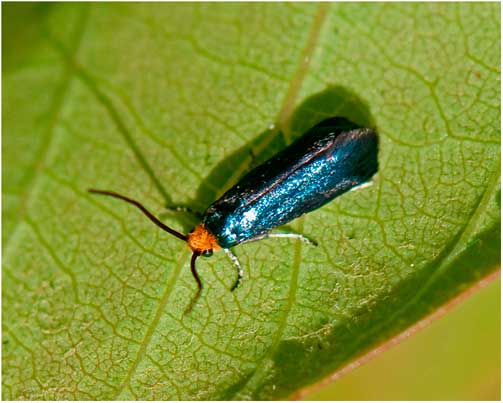
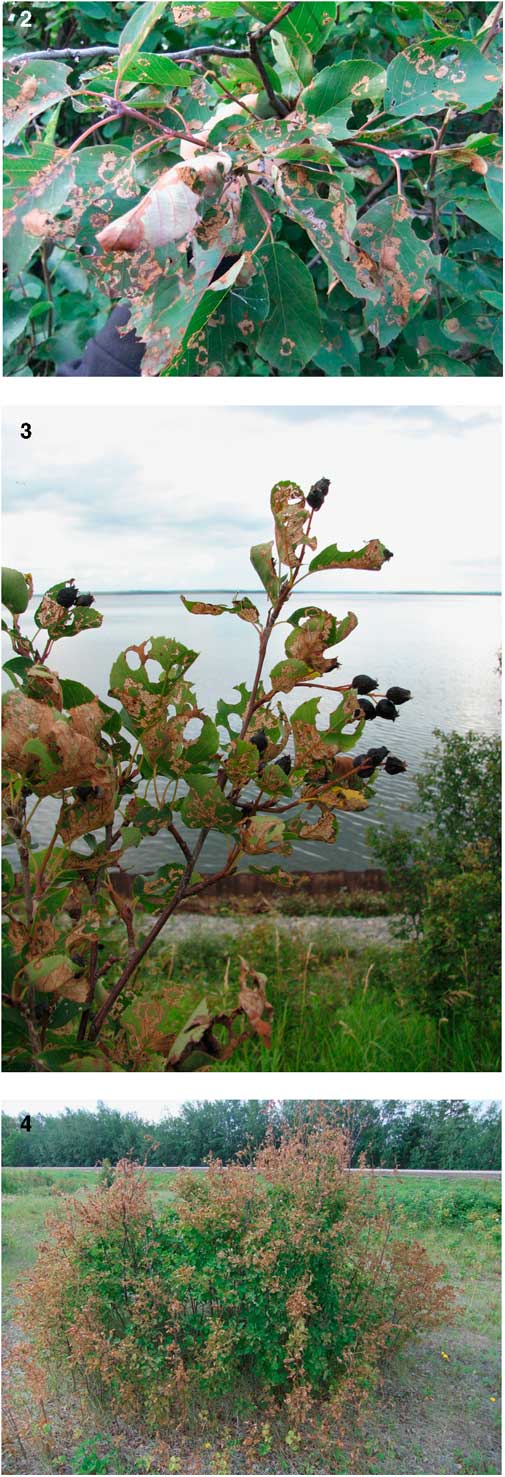
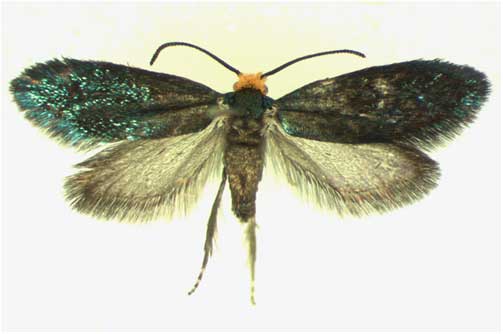
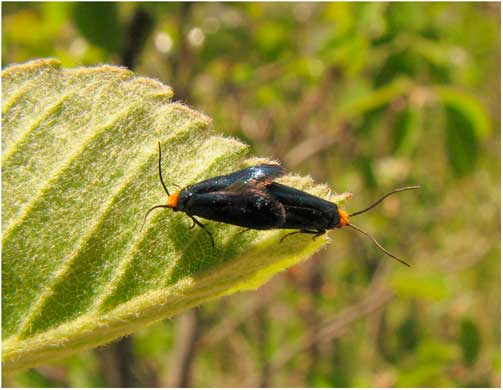
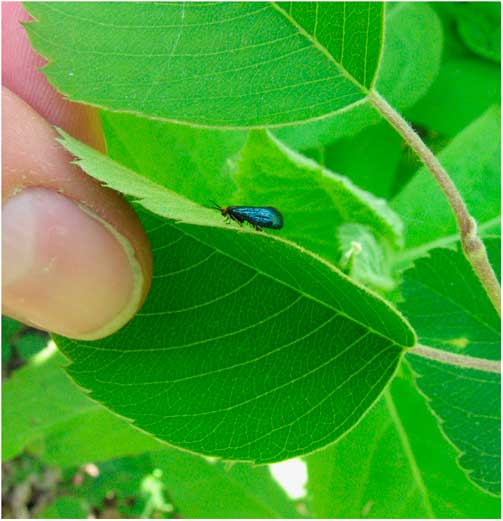
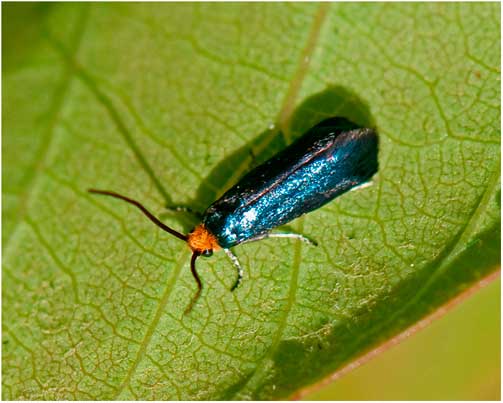
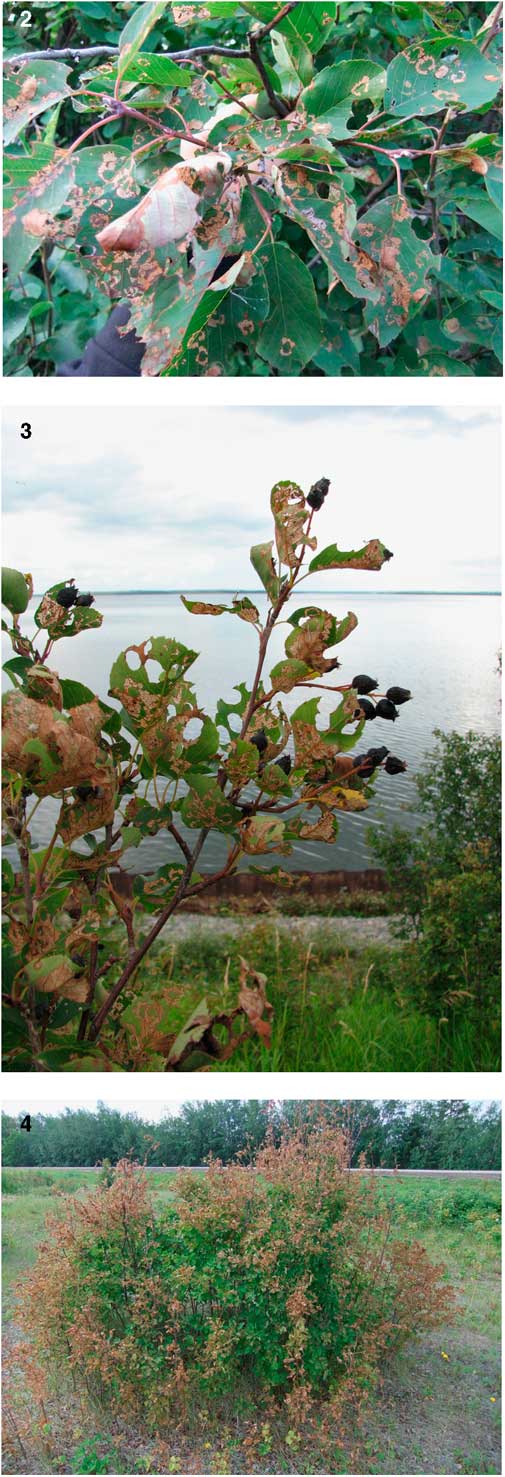
The MLC was initially discovered in Alberta via photographs of adult moths taken by S.G. (Fig. 1). The photographs were taken on 27 May 2010, in Winston Churchill Provincial Park, which is located on an island in Lac La Biche (54.8303°N, 111.9930°W). By the time the moths in the images were tentatively identified, the adult flight period had ended, so no adult specimens could be obtained that summer to confirm the identification. However, on 2 August 2010 saskatoon trees were found by C.J. and D.R. at Lac La Biche with telltale signs of incurvariid feeding (Figs. 2–4). No other species of incurvariids are known to occur in the area, so it was deemed likely that these represented the same species as the adult photographed by S.G. The adult certainly resembled MLC, but diagnosis of Paraclemensia species requires dissection of the genitalia. The larvae fit the description of MLC by Ross (Reference Ross1958), but no other larvae have been described in the genus, so that description could apply to other Paraclemensia species as well. No species of incurvariid anywhere in the world was known to feed on Amelanchier (Robinson Reference Robinson1999), so the hostplant provided no diagnostic information. Most curiously, the larvae at Lac La Biche did not infest feral Manitoba maple (Acer negundo Linnaeus) trees within 5 m of the infested saskatoons, suggesting this might be another Paraclemensia species other than MLC. The sudden appearance of a large population, on a tree species often grown commercially for berries, suggested that this might be an exotic introduction, either of MLC or of some related species. Being in a provincial park near a campsite, there was a possibility that a camper had inadvertently brought in some overwintering pupae with transported firewood.
Adult maple leafcutter moth.
Typical maple leafcutter moth (MLC) leaf damage.
Live larvae were brought back to the Natural Resources Canada lab in Edmonton, Alberta, Canada for study. Several larvae were preserved and a series was sent to V.N. and C.S., who prepared them for DNA barcoding via the International Barcode of Life Project (2014). The remaining larvae were reared on saskatoon plants. After the larvae dropped off the plants to pupate, they were placed in a screen cage and left outside in ambient conditions in the Edmonton area.
In August and September 2010, G.R.P. carried out a subsequent survey of saskatoon trees in east-central Alberta, and made enquiries with other biologists, agriculturalists, and members of the commercial berry growing community. As a result of these queries, we were informed of several other potential populations that we investigated.
The following spring, on 30 May to 2 June 2011, adults were again observed by the authors at Lac La Biche, and adults were brought to the laboratory for study of reproductive and oviposition behaviour. Vouchers were deposited at the Northern Forestry Centre Research Collection of Natural Resources Canada in Edmonton, Alberta, and at the University of Alberta Strickland Museum, Edmonton, Alberta. Further informal surveys of potential habitat were carried out at various locations in Alberta from 2011 to 2014. We also obtained data from the Biodiversity Institute of Ontario, from Malaise traps they deployed at national parks across Canada in 2012, which included MLC records from several sites (vouchers were deposited at the Biodiversity Institute of Ontario, Guelph, Ontario; data available at dx.doi.org/10.5883/DS-PARACLEM).
Results of genetic and morphological analyses
After the snow melted in spring 2011, a single female moth successfully emerged from the overwintering cage, on 2 June. That individual, as well as several male and female vouchers collected in 2011 and 2012 had all the morphological characteristics of P. acerifoliella as figured by Ross (Reference Ross1958) and Nielsen (Reference Nielsen1982).
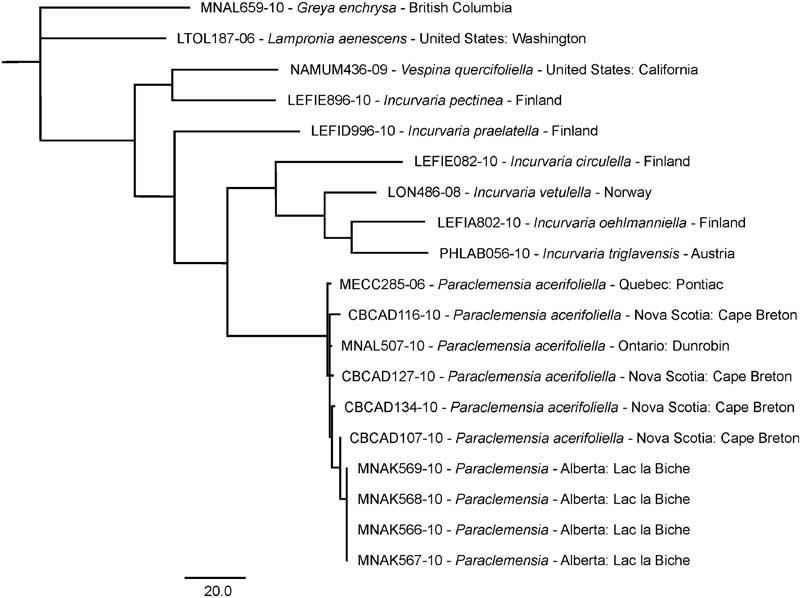
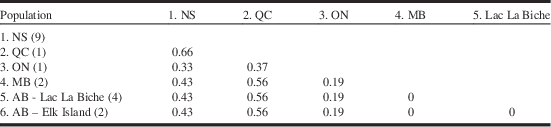
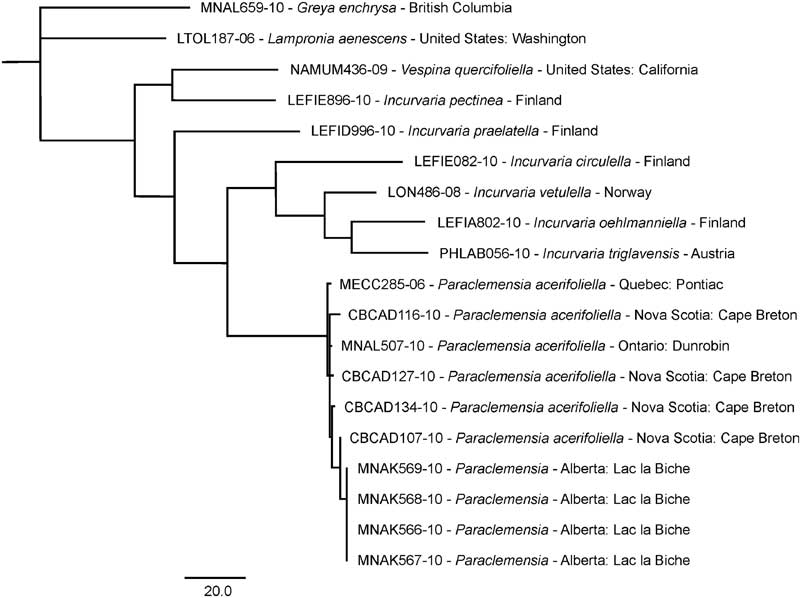
Four larvae collected in 2010 were successfully barcoded. As well, two adult specimens of MLC were identified from a Malaise trap catch from 21 May to 1 June 2012, at Elk Island National Park in central Alberta. These Alberta specimens were compared with one another, and to specimens in the BOLD database from Manitoba, Ontario, Québec, and Nova Scotia. The Lac La Biche, Elk Island, and Manitoba populations exhibited exactly the same DNA barcodes (Table 1). They were found to be over 99% similar to eastern Canadian populations, well within the typical range of variation for a species (Fig. 5). Based on the morphological and genetic characters, we conclude that the larvae and adults represent the same species, and that it is conspecific with MLC from eastern Canada.
DNA barcode phenogram of maple leafcutter moth (MLC) and related species.
Estimates of evolutionary divergence over sequence pairs between groups.

Notes: Values are per cent differences based on the number of amino acid differences per site from averaging over all sequence pairs between groups. The analysis involved 19 amino acid sequences. All positions with <95% site coverage were eliminated. That is, fewer than 5% alignment gaps, missing data, and ambiguous bases were allowed at any position. There were a total of 538 positions in the final data set. Evolutionary analyses were conducted in MEGA5 (Tamura et al. Reference Tamura, Peterson, Peterson, Stecher, Nei and Kumar2011). Alberta (AB), Manitoba (MB), Ontario (ON), Québec (QC), and Nova Scotia (NS).
Reproductive biology and development on saskatoon
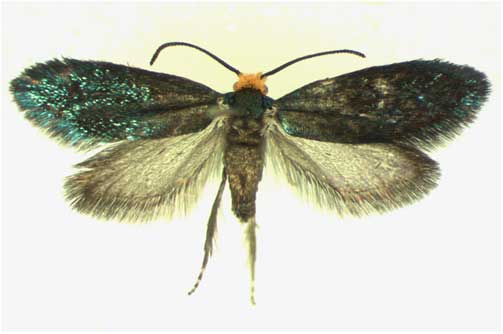
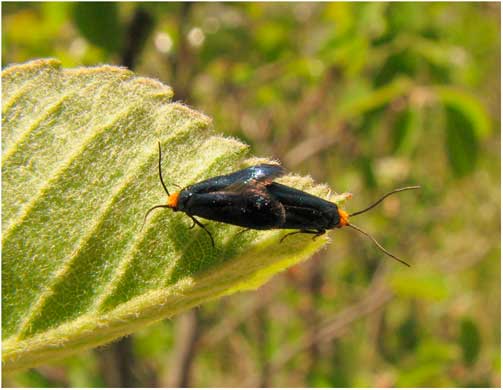
Based on our observations in 2010 and 2011, adults (Fig. 6) fly from late May into early June. This varies somewhat depending on the year, but the flight coincides with peak flowering of saskatoon (27 May in 2010; 30 May to 2 June in 2011; 21 May in 2012; 3 June in 2014). Males may emerge slightly earlier than females, as they appeared to be more abundant at the beginning of the flight period. Adults swarm about the host plants during warm, calm, sunny weather. Males and females would occasionally alight and actively wander about on saskatoon leaves. Mating was observed both in the field and in the laboratory. When a male was within about 5 cm of a female, it would rapidly buzz its wings in short bursts, and approach the female with its abdomen curled underneath its body, with the tip pointing towards the female. If the female was receptive, they would copulate (Fig. 7). Copulation lasted about five minutes.
Pinned adult maple leafcutter moth (MLC).
Copulating maple leafcutter moths (MLC) at Lac La Biche.
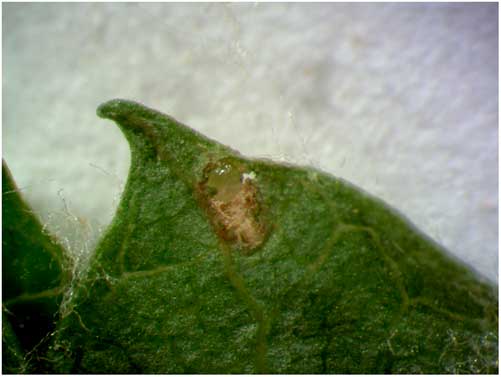
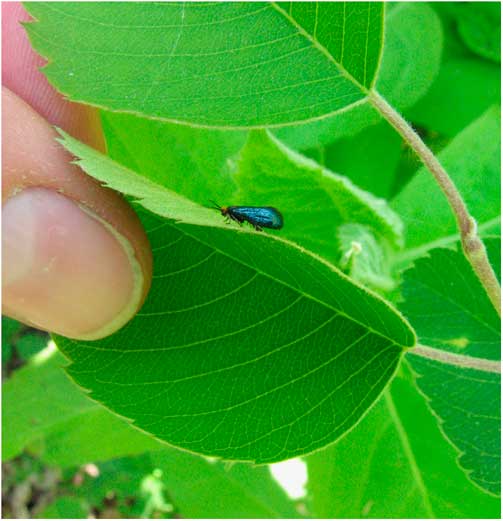
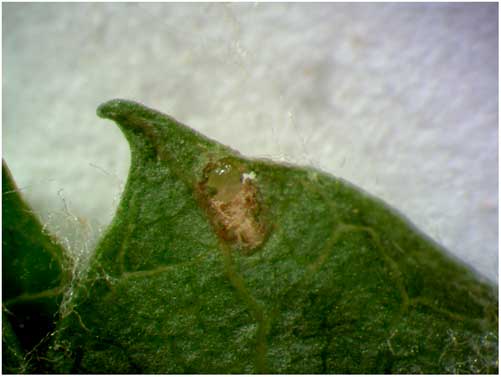
Females were seen ovipositing on saskatoon leaves in the field and in the laboratory. To do so, a female would curl its abdomen so the tip was perpendicular to the leaf surface, and then pierce the leaf with its sclerotised ovipositor (Fig. 8). The moth then remained outwardly motionless for about a minute, before removing its ovipositor to continue wandering on the leaf. Multiple holes were typically punched into each leaf. When the leaves were examined later, eggs were found in some oviposition holes (Fig. 9), but not all holes contained eggs. Up to 17 eggs were found in a single leaf. Though adult females explored both the upper and lower surfaces of the leaves, oviposition was invariably on the underside, usually near the leaf margin.
Adult female maple leafcutter moth (MLC) ovipositing on a saskatoon leaf.
Maple leafcutter moth (MLC) egg in an oviposition hole on a saskatoon leaf.
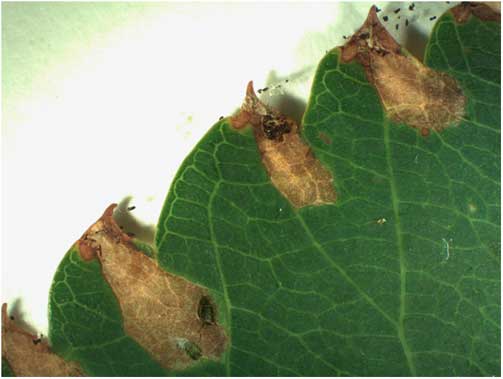
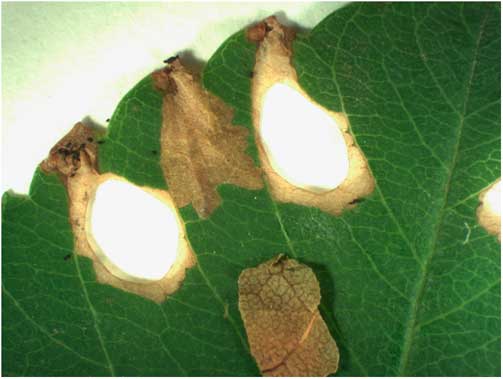
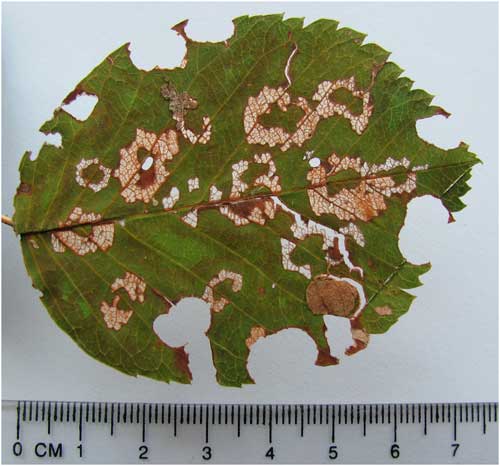
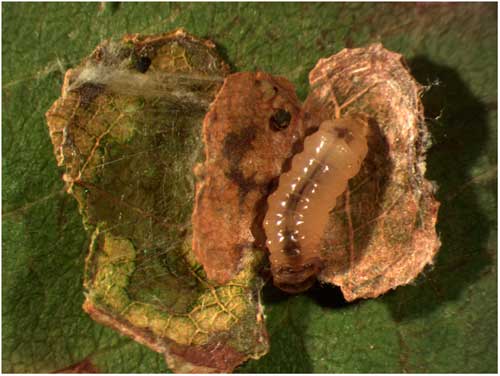
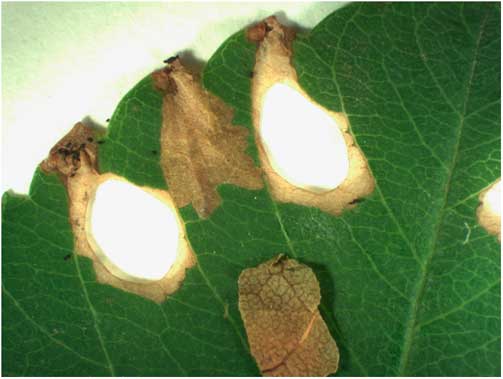
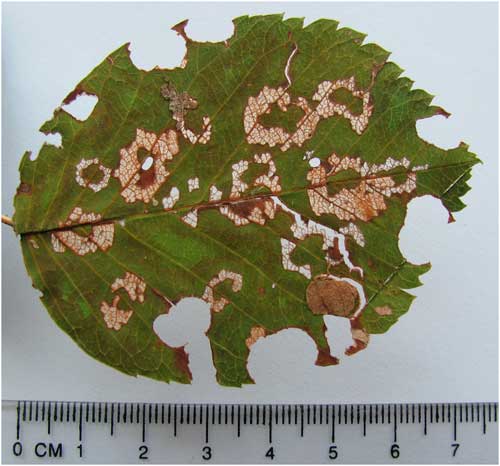
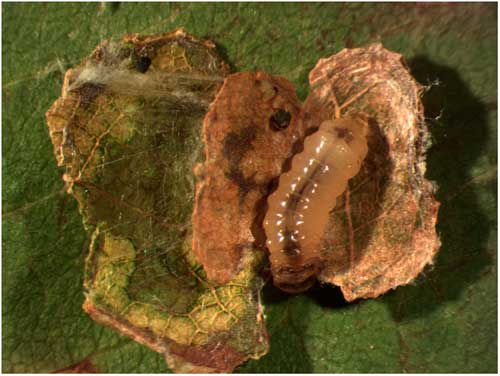
Eggs hatched after about 14 days, and first instars formed small ovoid mines in the leaves at the oviposition sites (Fig. 10). Approximately 14 days later, the larvae cut two small ovals (shields) from the leaf epidermis of the mined area (Fig. 11), and constructed a case from them with silk. They then exited the mines to live within these cases. From this time onwards they fed by skeletonising the leaf, forming curved bands of damage around their cases (Fig. 12). They continued to feed in this manner for ~30 days, each larva cutting and adding an additional shield to its case with each moult. The process of cutting and removing a piece of leaf was described in detail by Herrick (Reference Herrick1923). When the cases of mature larvae were opened up later (Fig. 13), only three to four layers of shields were present, so apparently the larvae eat or discard the smaller shields at some point. At this time the mature larvae dropped to the ground within their cases. By 35 days after hatching (early August in 2011), about 90% of the larvae had dropped to the ground. Of the few cases that remained on the leaves at this time, most contained parasitised and/or dead larvae.
Leaf mines of first-instar maple leafcutter moths (MLC) on saskatoon.
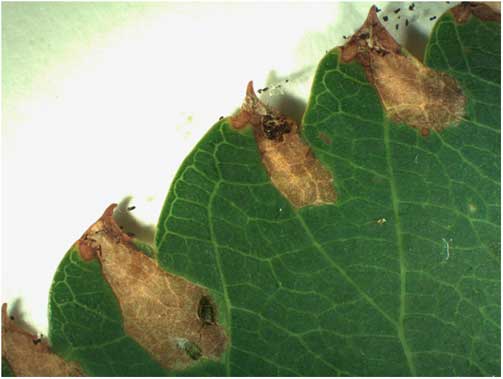
Holes cut in leaf epidermis to construct the first larval case.
Feeding damage by maple leafcutter moth (MLC) larvae in their cases.
Mature maple leafcutter moth (MLC) larva in an opened case.
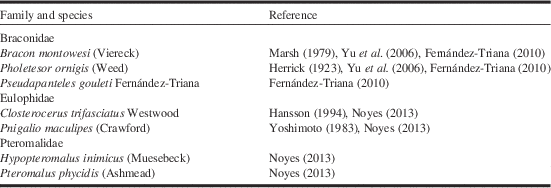
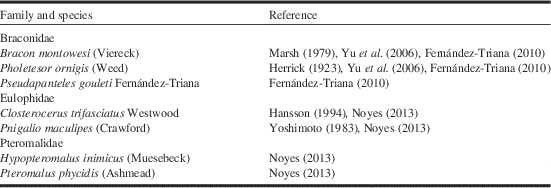
Two species of Hymenoptera parasites were reared from MLC larvae, a Bracon Fabricius species (Hymenoptera: Braconidae) and a species of Ichneumonidae that have not as yet been further identified. Several Hymenoptera parasitoids have been reported previously from MLC (Table 2).
Hymenoptera parasitoids reported from Paraclemensia acerifoliella.
The general habits of MLC on saskatoon – of leafmining in the first instar, followed by case construction and skeletonising in later instars – is similar to MLC behaviour on maple as described by Herrick (Reference Herrick1923) and Ross (Reference Ross1962). However, the duration of the larval stage is much shorter. On saskatoon, almost all larvae had reached maturity and dropped to the ground by early August, whereas on maple, Ross (Reference Ross1962) reported larvae maturing and dropping to the ground between 25 August and 29 September. Herrick (Reference Herrick1923) reported larvae reaching the ground from late August to mid-September. He observed many larvae on the tree trunks at that time, and suggested that many larvae may walk down the tree trunks rather than dropping to the ground.
Extent and origin of maple leafcutter moth populations in the west
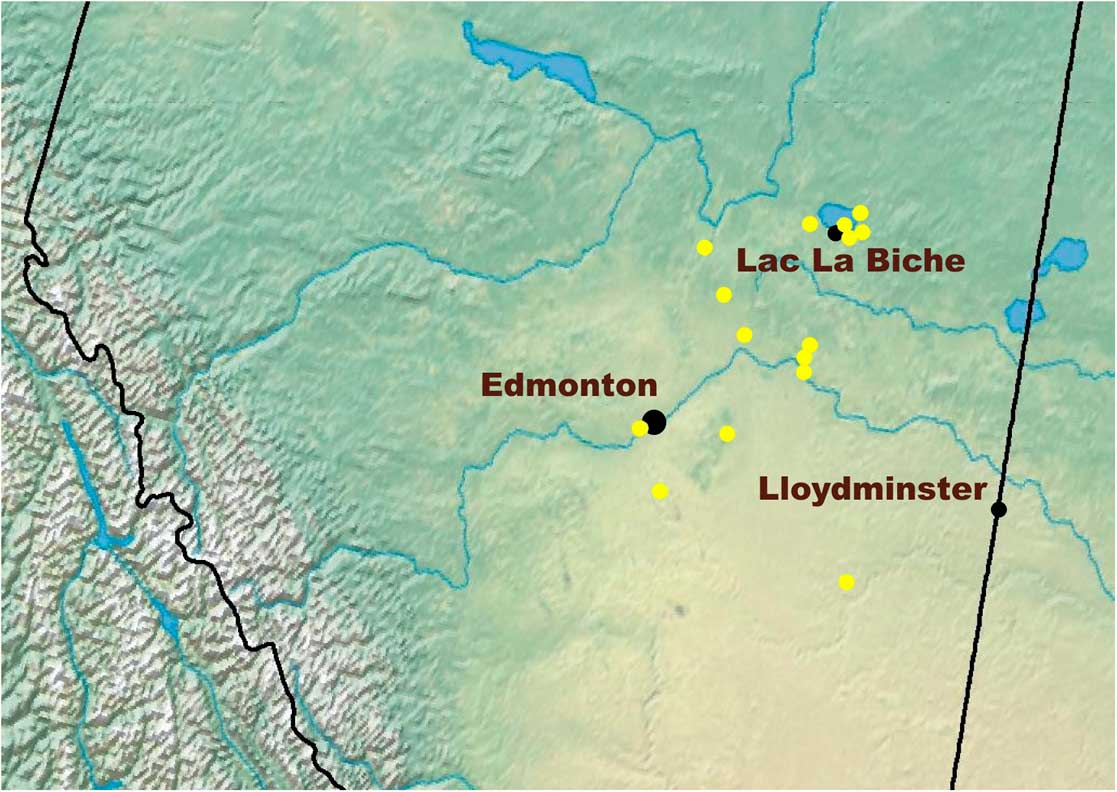
Surveys in August and September 2010 revealed evidence of a large population of MLC around the eastern and southern shores of Lac La Biche, as well as signs of smaller populations at several sites between Lac La Biche and Edmonton (Fig. 14). Populations were also found at four sites where saskatoons were being grown as berry crops. Additional survey work in subsequent years revealed evidence of populations near Athabasca, Elk Island National Park, Tofield, Edmonton, Wetaskiwin, and Hardisty, establishing that the range of this species extends through much of the southern boreal forest and parkland of central Alberta.
Sites where evidence of maple leafcutter moth (MLC) has been found in Alberta.
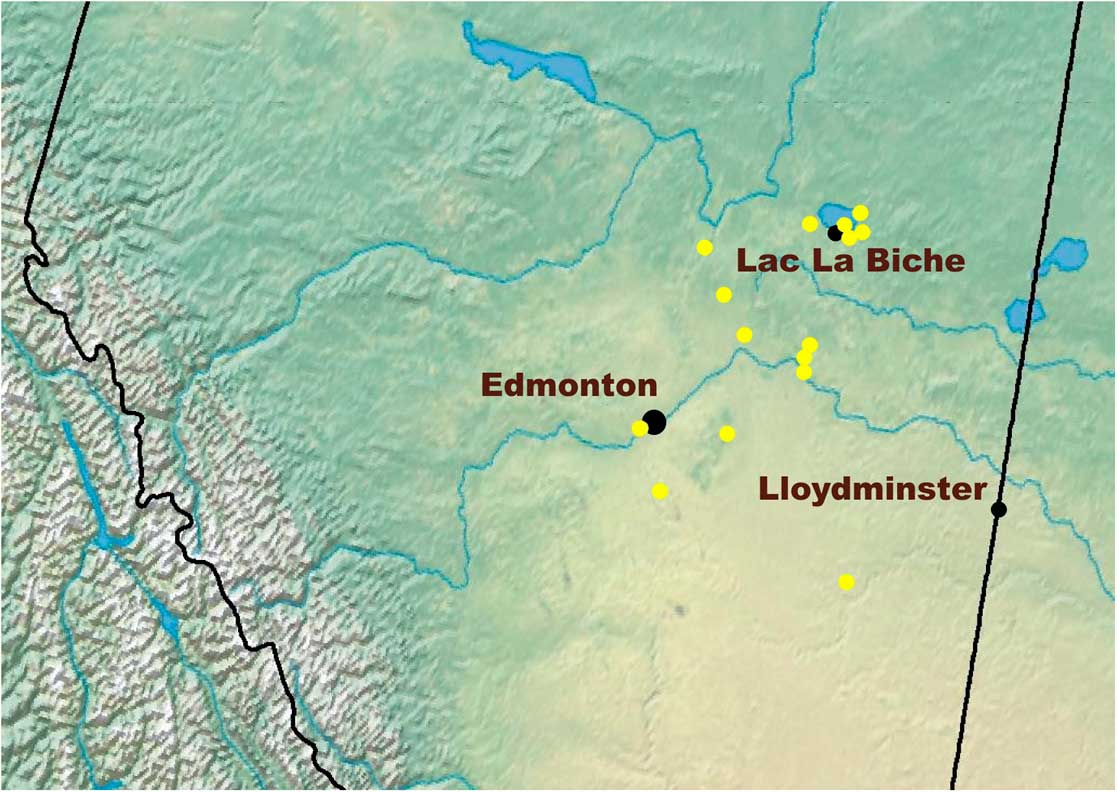
All known MLC sites in Alberta are in open or shrubby areas where saskatoon trees are exposed to direct sun. Most were found in small clumps of saskatoon in open parkland habitat, even though most of the sites lie within the Boreal Forest as defined by Brandt (Reference Brandt2009). Many forested sites between Edmonton and Lac La Biche were searched, and no evidence of MLC was found on any saskatoon trees beneath the forest canopy. Typical habitats where they do occur are open sites along lakeshores, south-facing river valleys, and fence-lines of agricultural fields. Although adult moths were seen alighting on other plant species, no larval feeding was observed on any plant species other than saskatoon. At Lac La Biche, several feral Manitoba maple trees were found growing in the area of large MLC populations, within 5 m of infested saskatoon, but there was no sign of any larval feeding on them. Therefore, Manitoba maple is clearly not a preferred host for MLC.
Besides leading to the above records in Alberta, our enquiries with agricultural agencies and berry producers resulted in a recollection from a retired fruit crops specialist with Saskatchewan Agriculture, who clearly remembered seeing incurvariid-type damage in Saskatchewan twice in the early 1970s, which he had diagnosed as MLC. However, no voucher specimens or host plant records are known to exist from those finds.
The records from Manitoba also warrant further discussion. The basis of those records are DNA barcoded material from Malaise traps deployed in 2012, and historical specimens in the Canadian National Collection of Insects, Arachnids, and Nematodes (CNC). The recent collection is from a single trap sample near Clear Lake in Riding Mountain National Park, from 4–12 June 2012. The area there is comprised of aspen parkland, similar to MLC sites in Alberta. The historical specimens are as follows: four specimens collected at Riding Mountain National Park on 15 June 1938 by W.J. Brown and J.H. McDunnough; and five specimens collected at Aweme (near Wawanesa) by Norman Criddle on 13 June 1921, 10 June 1924 (two specimens), 4 June 1926, and 14 June 1926. The exact locality of the historical Riding Mountain specimens is not known. The Aweme homestead of the Criddle/Vane families lies in the aspen parkland, with mixed patches of forest containing white spruce (Picea glauca (Moench) Voss; Pinaceae), bur oak (Quercus macrocarpa Michaux; Fagaceae), Manitoba maple, and trembling aspen (Populus tremuloides Michaux; Salicaceae) (Bird Reference Bird1927). Both these Manitoba sites are over 300 km from any native sugar maple, red maple, or black maple; the former two species occur naturally only in the extreme southeastern corner of Manitoba, and the latter species does not occur naturally in the province (Farrar Reference Farrar1995).
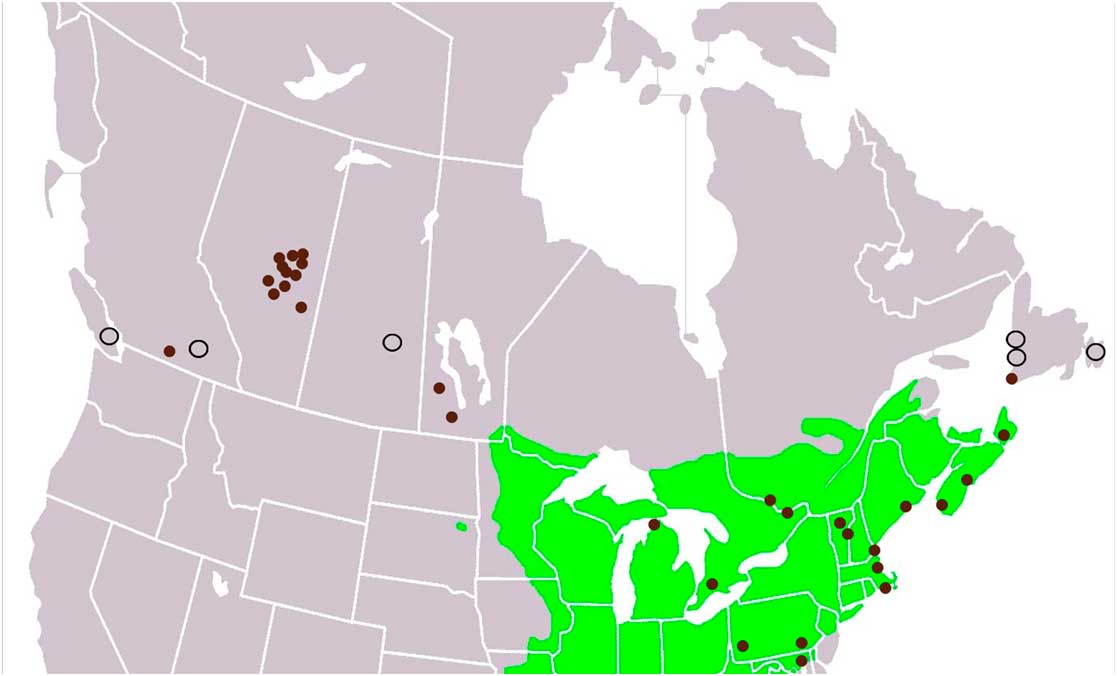
During this research, we also investigated the historical reports of MLC from British Columbia. The species was first reported from British Columbia by Busck (Reference Busck1904a), on the basis of “several specimens from Kaslo, British Columbia, July (Dyar and Cockle)”. That record was repeated by Dyar (Reference Dyar1904) and Forbes (Reference Forbes1923). The Entomological Society of British Columbia (ESBC) (1906) listed records from Kaslo as well as Wellington (now part of Nanaimo) on Vancouver Island, indicating that at least two populations were thought to exist over 100 years ago, both outside the range of known maple hosts. The Dyar/Cockle specimens cannot be located, despite searches of the CNC; the Royal BC Museum (Victoria, British Columbia); the University of British Columbia Beaty Biodiversity Collection (Vancouver, British Columbia); the Pacific Forestry Centre of the Canadian Forest Service (Victoria, British Columbia); the United States National Museum (Washington, District of Columbia, United States of America); and the Lyman Entomological Museum of McGill University (Sainte-Anne-de-Bellevue, Québec), all known depositories of Dyar and/or Cockle material. Those early British Columbia records were considered by Ross (Reference Ross1962) to be a recent introduction, and were omitted by Nielsen (Reference Nielsen1982), who only listed confirmed localities. Although the July flight time is late compared with other MLC specimens collected in Canada, there are no other small blue primitive moths known in North America, so it is difficult to imagine what they could have been confused with if they were not MLC. In fact Busck (Reference Busck1904b) described the genus Paraclemensia, so he would not likely have made a mistake in identifying specimens. Although our query with the Lyman Entomological Museum did not yield any Dyar/Cockle material, a more recent series of British Columbia specimens was found there, collected at Penticton in the southern interior by J.A. Garland between 29 April and 9 May 1977. So, although the old reports from British Columbia remain unconfirmed, the species has been verified to occur in the province, at a previously undocumented locality. No host information is known for any of the British Columbia MLC records. Amelanchier occurs throughout British Columbia, as do other potential host plants. They may have been feeding on introduced ornamental maples, or on one of the three native maples that occur in British Columbia. A revised range map for MLC (Fig. 15) illustrates the species occurrence across Canada.
Revised range map of maple leafcutter moth (MLC) in Canada and the northern United States of America. The green area is the Acer saccharum range from Farrar (Reference Farrar1995); solid circles are specimens examined by the authors; open circles are unverified literature records.
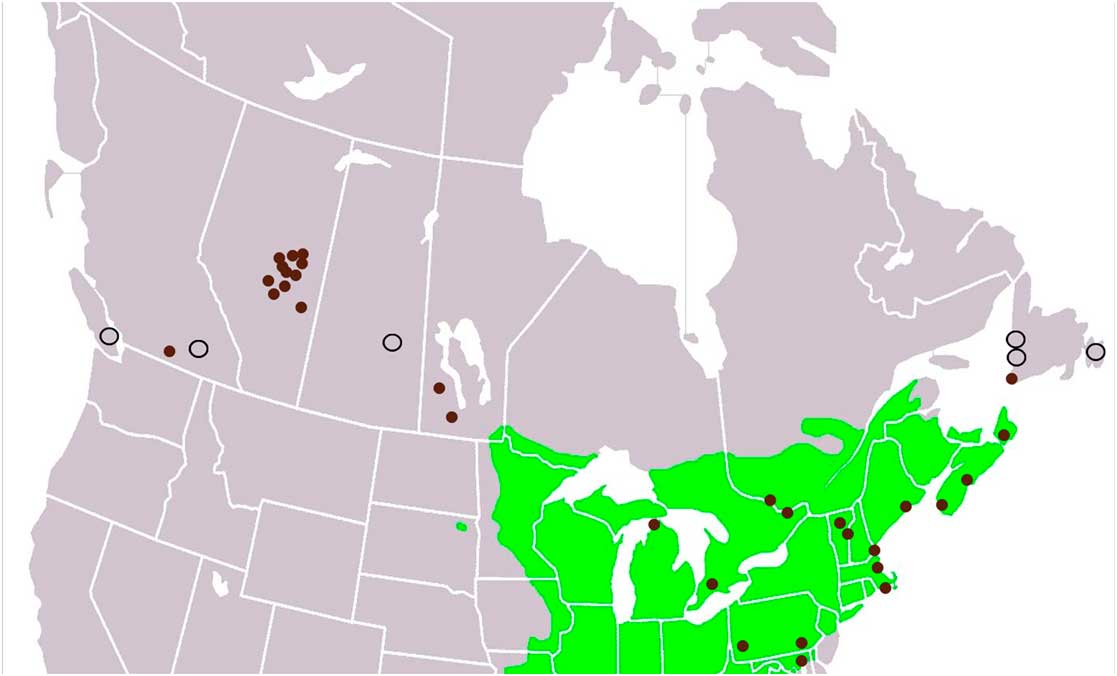
We conclude that in the Prairie Provinces of Canada, MLC is a species of the aspen parkland, where it thrives on open-growing saskatoon trees. The age and origin of the parkland populations is open to question. The earliest confirmed record in western Canada is from Aweme, Manitoba in 1921. It is possible that MLC moved westwards from Manitoba to Saskatchewan and Alberta within the past 100 years, to appear in Saskatchewan by the 1970s and Alberta by 2010. The sudden appearance of a large population at Lac La Biche, and the lack of historical reports on commercial berry crops, suggests that it is a recent arrival in western Canada. However, the widespread locations in central Alberta suggest otherwise: that it has probably been present in the province for some time. Although slight, the genetic difference from eastern populations also suggest that it is not a recent introduction from eastern North America.
If the presence of MLC in the Prairie Provinces is not a recent development, it is curious that no outbreaks have been reported previously there on saskatoon. The larval feeding damage is so conspicuous, that it probably would have been noticed by fruit growers and brought to the attention of entomologists if it had occurred previously at those levels. Historically there have been large research plantations of saskatoon at Indian Head, Saskatchewan and at Beaverlodge, Alberta; MLC has never been reported at either location, despite the presence of entomologists there for many years studying tree pests. It may be that such outbreaks are either unprecedented or very rare. The history of MLC outbreaks on maple in eastern North America suggest the latter; Herrick (Reference Herrick1923) and Ross (Reference Ross1962) report that it is occasionally very abundant but localised, and that it all but disappears for many years in between such outbreaks.
If MLC did arrive within the past century in the Prairie Provinces, it would be following a pattern of immigration that has been seen in several other Lepidoptera species. Some of these, such as Noctua pronuba (Linnaeus) (Noctuidae) and Hedya nubiferana (Haworth) (Tortricidae), are invasive polyphagous species that have been introduced to North America by humans, and have subsequently spread across the continent from the east (Passoa and Hollingsworth Reference Passoa and Hollingsworth1996; Hooper Reference Hooper2001; Pohl et al. Reference Pohl, Anweiler, Schmidt and Kondla2010). Another class of colonisers are native species that have followed the anthropogenic spread of their host plants. This group includes Caloptilia fraxinella (Ely) (Gracillariidae), which moved westward following plantings of ash trees (Fraxinus species) on the prairies by homesteaders (Pohl et al. Reference Pohl, Saunders, Barr, Wartenbe and Fownes2004); and Hyalophora cecropia (Linnaeus) (Saturniidae) and Acronicta americana (Harris) (Noctuidae), which moved westward following Manitoba maple plantings (Pohl et al. Reference Pohl, Anweiler, Schmidt and Kondla2010). A third class of colonisers are native species that appear to have naturally expanded their ranges westward. This group includes Ctenucha virginica (Esper) (Erebidae), which first appeared in Alberta at Fort McMurray in the 1950s, and then moved south and west into the parkland and prairies (Pohl et al. Reference Pohl, Anweiler, Schmidt and Kondla2010). Actias luna (Linnaeus) (Saturniidae) also moved west into Alberta from Saskatchewan, appearing in Fort McMurray in 2012 (Pohl et al. Reference Pohl, Anweiler, Bird, Landry, Macaulay and Maton2013). Two butterfly species, Lethe anthedon (Clarke) (Nymphalidae) and Poanes hobomok (Harris) (Hesperiidae) have also spread into the parkland of Alberta from Saskatchewan (Bird et al. Reference Bird, Hilchie, Kondla, Pike and Sperling1995; Pohl et al. Reference Pohl, Anweiler, Schmidt and Kondla2010). The MLC may have moved into the parkland recently, similar to this third coloniser group. The spread of this group may be due to an expansion of the Parkland region, caused by the release of trees from grazing pressure by huge bison herds and the end of rampant wildfires on the prairies (Campbell et al. Reference Campbell, Campbell, Blyth and McAndrews1994). In addition, the warming trend of the past 60 years (Zhang et al. Reference Zhang, Vincent, Hogg and Niitsoo2000) may be expanding the potential habitat for these species in the west.
Maple leafcutter moth populations outside of host maple range in eastern North America
Other MLC populations at the periphery of the range of maple hosts in northeastern North America may also be adapted to other host plants. In Newfoundland, MLC has been collected from at least four locations. No sugar maple or black maple occur naturally in Newfoundland, although red maple and other maple species occur in these general areas. The only known reared material from Newfoundland was reared from white birch (Betula papyrifera Marshall; Betulaceae). In Nova Scotia, where sugar maple does occur, MLC has been reared only from yellow birch (Betula alleghaniensis Britton). In the southern United States of America, MLC has been collected south of the natural distribution of sugar maple and black maple, in Texas and Mississippi. Clearly MLC is feeding on other species in those areas, perhaps on Amelanchier, which does occur there.
Origin of maple leafcutter moth feeding on Amelanchier
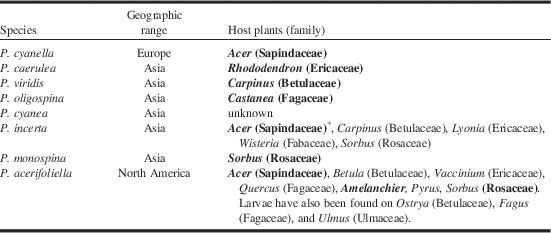
Paraclemensia is a Holarctic genus with eight described species (Nielsen Reference Nielsen1982). The species P. cyanella (Zeller) lives in Europe, MLC is the only species in North America, and the rest are from eastern Asia, with the centre of diversity in Japan.
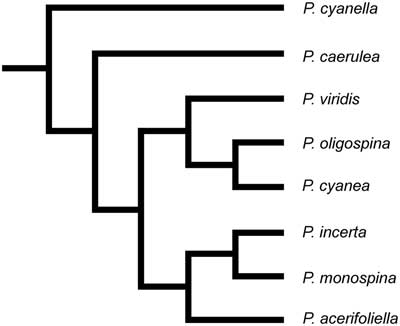
Based on a cladistic analysis by Nielsen (Reference Nielsen1982), MLC forms a monophyletic group with two of the Japanese species (here referred to as the P. acerifoliella group), Paraclemensia incerta (Christoph), and Paraclemensia monospina Nielsen (Fig. 16). The classification is based on a phylogenetic analysis of characters of the male and female genitalia, as detailed in Nielsen (Reference Nielsen1982), but it is somewhat equivocal. It requires the parallel evolution of the blue forewing colour in P. cyanella and MLC, and of pointed uncus lobes in MLC and P. incerta, as well as the parallel evolution (or reversal) of head colour. Despite these incongruencies in the cladogram, it remains the best working hypothesis for the evolution of the group, with most branches supported by genitalic character apomorphies.
Hypothesised phylogeny of Paraclemensia, after Nielsen (Reference Nielsen1982).
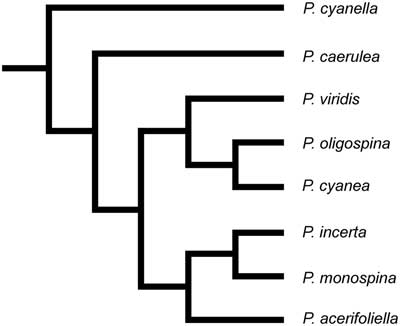
Davis (Reference Davis1974) discussed the biogeography of the genus, before the discovery of the Asian species, when it was known only from the North American MLC and the European P. cyanella (the latter treated therein as Paraclemensia europae Davis, now a synonym of P. cyanella). He noted that the European species was more generalised than the North American MLC. Based on the morphological differences and the current range of MLC in North America, he suggested that MLC may have been a recent speciation event resulting from the introduction of P. cyanella into North America, possibly aided by humans as recently as the 17th century. Alternatively he suggested that the two species may be older in origin, remnants of a Holarctic genus that was once more widely distributed. The discovery and description of several Asian species by Nielsen (Reference Nielsen1982) affirms the latter hypothesis. Nielsen (Reference Nielsen1982) hypothesised that the ancestor of Paraclemensia was likely from central or eastern Eurasia, and that MLC had arisen from a Palaearctic ancestor that colonised North America via Beringia. He did not speculate on the time frames of any dispersal or diversification events.
There is some fossil evidence of early incurvariid feeding damage from North America (Schaarschmidt Reference Schaarschmidt1992; Labandiera Reference Labandiera2002; Sunderlin et al. Reference Sunderlin, Loope, Parker and Williams2011), all from the early to mid Eocene (45–58 million years ago). It is not known if this time frame corresponds to the time of evolution and radiation of Paraclemensia, since the latter is unknown. None of these fossil species are on Rosaceae or Sapindaceae.
Host plants are known for all Paraclemensia species except P. cyanea Nielsen (known only from the female holotype from Japan). All known host plants are trees or shrubs in the families Ericaceae, Fabaceae, Sapindaceae, Rosaceae, Fagaceae, and Betulaceae (Table 3). All species with known life histories have feeding habits similar to the generalised incurvariid habits described above.
Distribution and known host plant genera of Paraclemensia species.
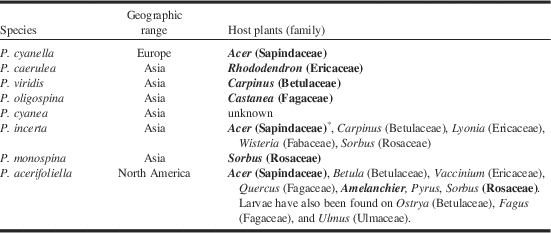
Notes: Bold=preferred hosts.
* Status of Acer as the primary host plant of P. incerta is uncertain.
Clearly, Paraclemensia is adaptable, on an evolutionary scale, to various host plants spanning a broad cross-section of higher angiosperms. Maple feeding is known to occur in three species, including the most basally derived species P. cyanella, and two species of the P. acerifoliella group. Rosaceae feeding occurs in all three species of the P. acerifoliella group. We hypothesise here that maple feeding may represent an ancestral capability for Paraclemensia, and that the ancestor of the P. acerifoliella group had made the evolutionary move to Rosaceae feeding. This would explain the ability of all three extant members of the P. acerifoliella group to feed on Rosaceae, with two species retaining the ability to feed on the ancestral Acer host. Under this scenario, P. acerifoliella would have had the ability to feed on Rosaceae species as well as on Acer, as it colonised North America via Beringia. Both Amelanchier and Acer are Holarctic genera, and both were present in the Paleogene, Neogene, and early Quaternary environments of Beringia and North America (Graham Reference Graham1964; Wen Reference Wen1999; DeVore and Pigg Reference DeVore and Pigg2007).
Not enough is known about the distribution of MLC on its different hosts, to determine if these may represent different host races. The phenological and behavioural differences suggest that this may be the case. More information on MLC populations on different hosts in eastern North America, would be very informative.
Acknowledgements
The authors thank Terry Thormin for circulating the initial MLC photograph. Tim Gosche assisted in the initial discovery of MLC adults by Stan Gosche in 2010. Normand Durocher and Norbert Raffael (Alberta Tourism, Parks and Recreation, Parks Division) granted us a permit for survey work in Sir Winston Churchill Provincial Park. Martha Allen, ecologist at Elk Island National Park, allowed us access to restricted areas. Barb Deneka, Colin Deneka, and Christianne MacDonald assisted with field surveys. Sabrina Rochefort, Stephanie Boucher, and Terry Wheeler (McGill University, Lyman Entomological Museum) located British Columbia specimens of MLC for us in the Lyman collection, and provided label data and photographs. Ian DeMerchant and Jon Sweeney (Natural Resources Canada, Atlantic Forestry Centre) provided specimen data. Daryl Williams (Natural Resources Canada, Edmonton) identified the parasitoids. Travis Burwash, Lorne Moen, Hank Stachnik, Odessa Telstead, and Murry Zazula provided information about potential MLC sites in central Alberta. They also thank the following people for providing information and assistance: Rob Cannings (Royal British Columbia Museum, Curator Emeritus), Don Davis (Smithsonian Institution), Jason Dombroskie (Cornell University), Paul Hebert and Megan Milton (Biodiversity Institute of Ontario), Dave Holden (Canadian Food Inspection Agency), Jean-François Landry (Agriculture and Agri-Food Canada), Clarence Peters (Saskatchewan Agriculture, retired), Forrest Scharf (Saskatchewan Agriculture), and Rob Spencer (Alberta Agriculture and Rural Development). Amelia Deneka took the photograph used in Fig. 6.Daryl Williams and James Hammond of Natural Resources Canada provided helpful comments on a draft version of the manuscript.