The 2000s witnessed the rise of social cash transfers (SCT) on global agendas and in countries of the global South – a ‘quiet revolution’ (Hanlon et al., Reference Hanlon, Barrientos and Hulme2010).Footnote 1 Around 2000, governments, international organizations and social movements had converged around a global anti-poverty consensus (Noël, Reference Noël2006), and SCT soon came to be seen as a new instrument of fighting poverty. Yet, at the beginning of the 2000s, it was not clear whether SCT would make it to global agendas at all, and there was no clear picture what models of SCT ought to be considered. By the end of the 2000s, a repertoire of models of SCT had been codified by international organizations that has been serving as standard reference for global social politics since. This paper investigates who developed this repertoire during the 2000s, how the models were constructed, and what forces propelled the process.Footnote 2
This article is about cognitive and normative models of SCT devised by international organizations rather than actual social cash transfer programmes set up in countries of the global South (for summary monographs on the latter see Leisering et al., Reference Leisering, Buhr and Traiser-Diop2006; Barrientos, Reference Barrientos2013). But the ideas and concepts of international organizations regarding SCT have not been analysed in depth, in contrast to ideas in more established fields of global social policy such as health and pensions (e.g. Kaasch, Reference Kaasch2013). In particular, ideas on SCT have not been compared across all main types of SCT and across all major international organizations; and the changes in ideas have not been traced over the entire time span of the emergence of the concept of SCT (since the 1990s). Moreover, while some writers do mention global ideas on SCT, this article is based on an in-depth analysis of all major documents of international organizations. In the empirical part, we therefore only refer to publications written by or for international organizations. We take the ideas in these documents as data, without discussing their validity or political desirability.
During the 1990s, international organizationsFootnote 3 increasingly turned into social policy actors, influencing domestic social policies through ideas and policy advice – described by Deacon et al. (Reference Deacon, Hulse and Stubbs1997: 3) as ‘socialization of global politics’ (and ‘globalization of (national) social policy’). These international organizations operate as knowledge actors, besides or in conjunction with other functions, such as lending, standard setting and technical assistance. While international organizations lack electoral legitimacy, their recognition as knowledge actors rests on their claim to represent universal world cultural values and ideas rather than vested interests – they pose as ‘objective disinterested others’ (Meyer, Reference Meyer2009: 186). Meyer assumes a basic normative consensus among international organizations, while the global social policy literature often emphasizes contestations between ‘neoliberal’ and ‘social reformist’ (Deacon et al., Reference Deacon, Hulse and Stubbs1997: 213) camps. Kaasch (Reference Kaasch2013) argues that the degree of contestation differs by policy area. The new field of SCT has not been analysed in this respect (but see Leisering, Reference Leisering2009: 265).
Orenstein (Reference Orenstein2008: 57), in his study of the World Bank's campaign for pension privatisation in the 1990s and 2000s, conceives of international organizations as proposal actors, defined as ‘actors that develop fully elaborated reform proposals and advocate them in the course of domestic policy debate’. They are not ‘veto players’ (actors ‘that exercise a formal veto over the policy process’), but ‘they have the power to formulate legitimate and well-elaborated policy proposals’ (Orenstein, Reference Orenstein2008: 56f.). Orenstein conceptualizes the activity of international organizations and other global policy actors as encompassing three phases: policy development, policy diffusion and policy implementation. We focus on the less researched first phase, on policy development. ‘Policy development is a distinct activity that some transnational actors may be active in and some may not. It requires resources, expertise, and moral authority to pursue successfully.’ (Orenstein, Reference Orenstein2008: 65) The construction of policy proposals mainly falls into the first phase, which is normally only briefly sketched in diffusion studies.Footnote 4
The paper starts with sections on concepts and methods, and goes on to the empirical analysis of ideational change in global arenas during the 2000s. A conclusion on ambivalences of the ‘socialization of global politics’ follows.
Modelling ideational change in global arenas: sequences and layers
We start from Hall's (Reference Hall1993) seminal concept of ‘paradigm shift’ but modify and extend it (for an extensive discussion of ideational approaches to policy analysis see von Gliszczynski, Reference Von Gliszczynski2015: 8–13). Hall conceives of changes of problem definitions and basic categories of policies as ‘paradigm shift’ or ‘third order’ change, to be distinguished from less profound changes that only affect the choice of instruments (second order change) or the settings of instruments (first order change). Third order changes tend to entail second order changes.
Hall's original analysis dealt with changes in economic policy, in which case third, second and first order changes occurred simultaneously (Hall, Reference Hall1993: 284), and the new instruments were regulatory measures. But in policy areas with high organizational complexity such as social security, new ‘instruments’ may involve complex institution building, relying on normative and cognitive assumptions specific to the institution, like a micro paradigm. We therefore propose to conceive of second order change in terms of micro paradigms – called ‘models’ –, rather than using the technical term ‘instruments’. Moreover, related to the complexity of models, second order change in social security may follow third order change with some delay. As we argue, when social security emerged as new paradigm of development policy during the 1990s, an ideational window of opportunity for building new models of social security opened up, but the models of SCT only emerged during the 2000s. For our study, therefore, Hall's theory needs a conceptual modification (from instruments to models) and an extension (modelling sequential structures of policy change).
The concept of models is less frequently discussed in the literature but deserves further elaboration, since the role of international organizations as proposal actors includes propositions of concrete models. Weyland (Reference Weyland2004) uses the concept of model to identify processes of policy diffusion between Latin-American countries in old-age pensions. He explicitly assumes a hierarchical and sequential structure of ideational change: ‘Whereas a paradigm constitutes a comprehensive framework for analyzing and interpreting a broad swath of reality, a model crystallizes the normative implications of such an innovative set of ideas for a specific issue area. . . . Thus, models embody general worldviews and derive from them specific proposals for addressing concrete problems. Models therefore tend to arise in the wake of general shifts in policy paradigms and resemble such a paradigm shift in a specific issue area.’ (Weyland, Reference Weyland2004: 8).
By global model we mean a model which is accepted or even supported by most international organizations. By umbrella model or meta model we mean a general model that accommodates sub models, like social insurance and its branches. In the empirical section of this article we show that SCT emerged as a new global meta model in social security, incorporating four sub-models.
Some authors emphasize that policies are embedded in even broader kinds of knowledge than policy paradigms. Nullmeier (2006), for example, suggests that policy-making is shaped by socially shared knowledge at distinct, but interrelated, levels of abstraction, starting with concrete policy models or blueprints and going up to discourses that shape entire fields of policy. The broadest imaginable context of ideas is world culture, as conceived by John W. Meyer (Reference Meyer2009) in his neo-institutionalist theory of the world society. According to Meyer, world culture permeates world society at all levels, including international organizations and nation states. World culture largely reflects Western values and norms. The most general values include universalism, rationalism, individualism and social progress, all of which are relevant to social security.
The discussion of the literature leads us to propose a multi-layered model of global knowledge, with four layers (for a detailed elaboration of a similar model see von Gliszczynski, Reference Von Gliszczynski2015: 20–24). The layers represent different degrees of abstraction or generality of ideas, ranging from the most abstract level of world culture (which includes, for example, the idea of social progress) to discourses as more specific forms of knowledge (for example discourses on social human rights) to even more specific policy paradigms (for example social protection) to models (for example SCT).
The layered model suggests a multi-layered model of ideational change: changes in more abstract layers may prepare the ground for changes in more concrete layers. ’Anchoring’ specific models in more general ideas may broaden the political support for the models. Relationships between the layers are contingent, for instance, the idea of social progress does not necessarily imply social security as a policy paradigm, and social security as a policy paradigm does not necessarily imply SCT as a model. Anchoring models in higher layer ideas from fields of knowledge other than social policy may give social security policies even more clout. For example, framing models of poverty reduction by human rights of the poor entrenches social security policy in the general human rights discourse. Similarly, acknowledging that social security is not just a moral issue, but part of strategies of economic growth, links the extension of social security to economic and developmental concerns.
Within the multi-layered structure of global knowledge, knowledge actors use mechanisms or strategies to change ideas and agendas. From the point of view of sociological constructivism, which we adopt, global knowledge diffusion is driven by international organizations that construct policy models in view of social acceptability rather than by rational design (bounded rationality). Combining the multi-layered concept of global knowledge with elements from constructivist diffusion theory (Dobbin et al., Reference Dobbin, Simmons and Garrett2007: 450–454) and from discourse analysis (Keller, Reference Keller2011), we propose five factors that make for the successful spread of models to global agendas. These factors could explain why some models make it to global agendas and others do not. Models are likely to spread if several or all of five conditions are met:
• Organizational mandate: an international organization defines the model as part of its mandate.
• National examples: the construction of the model takes up earlier models, either models proposed by other international organizations or models already adopted in some states, rather than designing a new model from scratch.
• Expert knowledge: the model is underpinned by reference to theories and/or empirical evidence provided by experts from selected expert communities and other organizations considered as peers.
• Contextualization: the model is framed by more general ideas from higher layers of knowledge (from policy paradigms, discourses and/or world culture); and the model is linked to strong ideas from policy fields other than social policy.
• Presentation: the model is given a name that appeals to a global public (political semantics), and discursive practices are used to underpin the model, such as narratives and quantitative evidence.
Methods
Methodologically, we draw on the sociology of knowledge approach to discourse (SKAD; Keller, Reference Keller2011), a current approach that emphasizes ‘schemes of interpretation’ (Deutungsmuster) and configurations of such patterns. This variety of discourse analysis aims at a medium level of abstraction between ideologies and routine knowledge, closer to policy processes, and highlights the changeability of discourses. The empirical sections of the article flow from a wider study on the evolution of ideas relevant to SCT (von Gliszczynski, Reference Von Gliszczynski2015), relying on document analysis, supplemented by expert interviews. We concentrate on those documents and international organizations that had a major impact on the global trajectory of SCT. The data base was constructed in a cumulative way, by following up cross-references between documents, documents pointed out by interviewees, or papers presented at relevant international conferences in which the first author participated during the larger study. The final database comprises 234 documents published between the 1970s and 2014.
The data was analysed in depth by way of a methodology inspired by grounded theory in order to trace changes in schemes of interpretation, ideas, discourses, discursive fields and discursive practices. Using Atlas.ti, all documents were coded, involving open coding, selective coding, theoretical coding and research memos (Strauss and Corbin, Reference Strauss and Corbin1998). This process resulted in 40 codes which categorise global ideas, policy models and discourses on SCT and social protection. This article only presents some of the results on the level of models (for the other levels see von Gliszczynski, Reference Von Gliszczynski2015: 67–103, 104–182), though with references to the impact of the higher orders of knowledge.
The ideational background of the rise of SCT – the 1990s
The rise of SCT to global agendas during the 2000s could build on wider changes in social policy thinking in development policy during the preceding decade. Ideational changes since 1990 can be reconstructed in terms of the multi-layered model proposed above, with models, paradigms, discourses, world culture as layers. The 1990s were a time of growing social concerns in global politics, of a heightened awareness of social issues (Hulme, Reference Hulme2015: 34–45; Leisering et al., Reference Leisering, Davy and Davy2015: 581–589), as encapsulated in Deacon's expression ‘socialization of global politics’. New priorities and new understandings of social problems like poverty and inequality emerged. Even though global actors had occasionally referred to SCT during the 1990s, around 2000 there was no clear idea what instruments would be most appropriate to advance social protection for the poor. A global consensus on the appropriateness of SCT was remote – the Millennium Development Goals did not mention SCT. Fifteen years later, the Sustainable Development Goals of 2015 did, through reference to the Social Protection Floors of the International Labour Organization (ILO).
For social insurance the ILO had codified a repertoire of (sub-) models a long time ago, namely protection in case of sickness, unemployment, old age, employment injuries, loss of the primary wage earner in the family, and maternity (ILO, 1952: 23). But for non-contributory monetary transfers to the poor no models were available. Around 2000, global organizations started publishing serious research papers on SCT (e.g. Barrientos and DeJong, Reference Barrientos and DeJong2004; Barrientos and Lloyd-Sherlock, Reference Barrientos and Lloyd-Sherlock2002; Devereux, Reference Devereux2001). A new policy debate ensued that culminated in the publication of a ‘practice paper’ by the Department for International Development (DFID, UK) (DFID 2005) which first codified types of transfers under the common label of ‘SCT’ and gave arguments for their usefulness. By 2005 all relevant organizations seemed to agree on SCT as a feasible avenue of social protection.
In the 1990s, an ideational window of opportunity for the idea of SCT had opened up, through the rise of social protection as a new paradigm of development policy and through more general global discourses – on poverty, development, risk and human rights. This included the ‘discovery’ of the poor as agents of economic development rather than passive recipients of aid. The idea of SCT built on that, not rejecting the reference to economic growth but rather redefining it, through the new paradigm ‘growth through redistribution’: investing in the poor to boost economic growth (von Gliszczynski, Reference Von Gliszczynski2015: 84–85). SCT were to promote the human capital of the poor and to reduce the vulnerability of the poor in view of future crises and shocks, enabling the poor to undertake risky economic behaviour (DFID, 2011; ILO, 2004: 62; ILO, 2009: 124–125; World Bank, 2008: 14–16, 431). This was a consensus across political camps. Some international organizations, especially the ILO and HelpAge International, additionally emphasized the human rights base of individual entitlements to cash and the moral obligation involved (e.g. DFID, 2005: 6–7; HAI, 2004:10; ILO, 2011: 10–15, 22).
Constructing four global models of social cash transfers – the 2000s
During the 2000s, international organizations eventually constructed a repertoire of models of SCT which has come to define the field of SCT till the present day. In this section, we reconstruct this process, tracing four variants of SCT that came to be recognized as consensual policy models in global discourses: social pensions, family allowances, conditional cash transfers and general household assistance.Footnote 5 The overarching concept and meta model ‘SCT’ only emerged through and parallel to the construction of the four sub models. The terms ‘social transfer’ and ‘cash transfer’ were first used as an umbrella term by DFID (2005: 9–13), and the composite term ‘social cash transfer’ was first used in reference to the pilot project in Kalomo (see below). The four sub models came to define the policy field ‘SCT’.
We refer to the five conditions of ideational change depicted above to explain why these four variants of SCT became global models. The fourth variant, general household assistance, is a borderline case, testifying to our model ex negativo: general household assistance did not (or only weakly) meet any of the five conditions, and has remained marginal on global agendas. Still, we classify it as a model because it has served as a background model (see below).
Social pensions: creating a global model through NGO advocacy
Social Pensions are defined as regular benefits paid to the persons above an age threshold (often around 60), designed to alleviate their vulnerability to poverty (DFID, 2005: 16–17; UNICEF and ODI, 2009: 18; World Bank, 2008: 361). But by sharing pension benefits within the households and families of the pensioners, others supposedly profit as well, e.g. grandchildren.
Social pensions are the earliest variant of SCT to be advocated by international organizations. The World Bank in 1994 included ‘non-contributory pensions’ in its multi-pillar pension model, but only to complement contributory pensions (World Bank, 1994: 238–242). The term ‘social pensions’ was first used in global policy documents around 2001: ‘Social pensions in Namibia and South Africa’ (Devereux, Reference Devereux2001: 41–49) described the history of social pensions in both countries in detail, and offered a statistical assessment of their impact. Advocacy of social pensions increased significantly in 2003, when HelpAge International (HAI) adopted the cause and started a coordinated campaign for the model, in frequent cooperation with the World Bank and the ILO. During the campaign, HAI produced several widely quoted publications.
Several empirical studies aimed to prove the beneficial effects of social pensions, e.g. ‘Non-contributory pensions and poverty prevention. A comparative study of Brazil and South Africa’ (HAI and IDPM, 2003). The document mostly adhered to the older World Bank terminology ‘non-contributory pensions’, confining the term ‘social pension’ to South Africa. Comparing the two countries, quantitative evidence was provided to prove the beneficial effects of social pensions. The study ‘Making Cash Count ’ (HAI et al., 2005) mainly revolved around the welfare of children, but went on to recommend social pensions as an option for their support, based on the argument of sharing within the family (ibid: 47). Furthermore, the study used ‘social pensions’ as a generic term for pensions in African countries other than South Africa. Other advocacy documents such as ‘Age and Security’ (HAI, 2004) combined empirical results with a strong moral case, based on human rights.
The focused campaign initiated by HelpAge was successful: Since the mid 2000s, social pensions have been treated as self-evidently useful by all major global organizations. Later publications often cited the early studies and declarations by HelpAge, resorting to the same arguments (e.g. DFID, 2005: 13, 39; World Bank, 2008: 361).
The career of social pensions demonstrates the impact of the five factors from our explanatory model. First (organizational mandate), social pensions were constructed as a model mainly due to one specialised organization, HelpAge International, which adopted the issue as part of its mandate and led an advocacy campaign. Second (country examples), South Africa's ‘social pension’ has been consistently used as a positive example of newly ‘discovered’ effects. Third (expert knowledge), the process was initialised by the provision of statistical data and country comparisons, especially regarding the sharing of pensions in the family. Fourth (contexualization), the model was linked to broader discourses on age and ageing, and, most importantly, anchored in the development discourse by emphasizing the agency of older persons, as supporters of their grandchildren. Fifth (presentation), ‘social pensions’ has been established as name of the model, carrying a more positive and less technical connotation than the earlier term ‘non-contributory pensions’.
Family allowances: globalizing an old Northern model
Family allowances are regular benefits to poor families with children, legitimised by the vulnerability of children. Besides poverty reduction, family allowances are supposed to support the human capital development of children by facilitating school enrolment, better nutrition and healthcare (ILO, 2010: 20; UNICEF, and ODI, 2009: 13, 27–28).
Global organizations have known a model of family allowances since a ‘family benefit’ was mentioned in the ILO's Social Security (Minimum Standards) Convention No.102 (ILO, 1952; Articles 39–45, 71). However, the Convention pertains to social security in general, and family allowances are only mentioned briefly as one component. When social issues moved to the forefront of global debates during the 1990s, family allowances were also discussed under the umbrella term ‘safety nets’. At this point, most international organizations referred to schemes in the Global North (e.g. Roddis and Tzannatos, Reference Roddis and Tzannatos1999) – in so far, the model has a Northern origin.
However, the construction of family allowances as a global model did not begin before 2005 when UNICEF started advocating this type of benefits for developing countries. UNICEF funded research that constructed family allowances as the model which best served the needs of children. ‘Making Cash Count’, a study on social protection in Africa (HAI et al., 2005), argued that even SCT not directly targeted to children may support children because the money is often shared in the household. ‘Child Poverty: A Role for Cash Transfers?’, a UNICEF study on SCT in Africa (UNICEF and ODI, 2009), defined family allowances similar to ILO Convention No. 102, but made a case for extending family allowances to developing countries, based on statistical simulations for several African countries which suggested that SCT can be expected to reduce poverty (ibid: 27–36).
After these studies, UNICEF convinced a coalition of global organizations to support family allowances in a joint publication on ‘child-sensitive social protection’, co-signed by the ILO, the World Bank and DFID (UNICEF et al., 2009). Finally, UNICEF developed its own social protection strategy (UNICEF, 2012) that portrayed family allowances as a useful tool in the fight against poverty. All in all, family allowances had gained unquestioned legitimacy with most policy actors by the year 2009 (DFID, 2005: 10; ILO, 2010: 20, 39–42, 46; HAI et al., 2005; UNICEF and ODI, 2009; World Bank, 2008: 257, 263).
The explanatory factors apply to family allowances as well. First, the acceptance of a policy model by the global development community relies on an international organization defining this model as part of its mandate. Before UNICEF started advocacy in 2005, family allowances had not been widely recognized as a policy model. Second, to construct the model, studies on family allowances drew on the experience of Northern welfare states. Third, perceptions of the global applicability of family allowances changed when statistical data on their effects in developing countries was presented. Fourth, the idea of family allowances was anchored in moral concerns about the particular vulnerability of children and in human rights discourses, but also referred to human capital development. Fifth, ‘family allowance’ and ‘child benefit’ have remained the established names of the model, referring to successful models from the Global North and to positive narratives on social protection for children.
Conditional cash transfers: drawing on innovative national models from the Global South
Conditional cash transfers (CCT) rest on the assumption that poor families do not invest optimally into the human capital of their children. CCT are cash benefits to poor families which are paid only if the family sends their children to school or to preventive healthcare. These conditions are to promote long-term investment into the human capital of children. The World Bank in particular emphasizes the utility of such transfers for long-term economic growth (World Bank, 2009: 22, 47, 169–173).
Two national SCT programmes were the starting point for CCT: Mexico's PROGRESA (from 1997), and Brazil's Bolsa Familia (from 2003, with regional predecessors). Both examples attracted the attention of global organizations around 2000, particularly of the World Bank, due to positive programme evaluations (Sugiyama, Reference Sugiyama2011: 253–255). However, neither programme was initially presented as a ‘conditional cash transfer’, indicating that a specific model did not yet exist. A positive evaluation of Bolsa Escola (a precursor of Bolsa Familia) by the Bank's regional office first used the term ‘conditional cash transfers’ (World Bank/LACRO, 2001). Still, the ideas behind CCT remained too vague to establish a clear model. Nevertheless, the number of World Bank publications on CCT steadily increased between 2004 and 2006, and a consistent idea of CCT began to take shape (e.g. Rawlings, Reference Rawlings2004). By 2006, the World Bank seemed to have gained discursive dominance: When it came to CCT, most other organizations referred to Bank publications (e.g. ILO, 2010: 39–42; Künnemann and Leonhard, Reference Künnemann and Leonhard2008).
This culminated in two major World Bank publications: First, ‘For Protection and Promotion’ updated the World Bank's safety net approach to include CCT, with a greater emphasis on human capital development (World Bank, 2008). Second, the sizeable study ‘Conditional Cash Transfers – Reducing Present and Future Poverty’ systematically collected all evidence on CCT, providing an elaborate rationale for their implementation (World Bank, 2009). This indicates that between 2004 and 2009, the World Bank established a clear idea of what CCT should encompass, and advocating CCT became an unquestioned part of World Bank policy. The second Social Protection Sector Strategy of 2012 indicated that promotion of economic activity via CCT was seen as a pillar of social protection (World Bank, 2012: 1–3; 25–27).
While the Bank thus had developed into the strongest advocate of CCT, other participants of the debate continued to question conditionality. Critics claimed that human rights make for entitlements to benefits without behavioural conditions, and that the beneficiaries would invest in human capital anyway (e.g. Künnemann and Leonhard, Reference Künnemann and Leonhard2008). Still, many organizations see CCT as one of several options, with pros and cons, and have neither endorsed nor condemned them entirely (e.g. ILO, 2010: 39–42). In so far, CCT are less recognized than family allowances.
Again, the explanatory factors mentioned above seem to have had a significant influence on the career of CCT as a policy model. First, the World Bank adopted CCT as part of its mandate and was the main advocate of CCT: the rise of the model to global agendas accelerated significantly when the Bank intensified research on CCT in the early 2000s. Second, the process of construction began when PROGRESA (Mexico) and Bolsa Familia (Brazil) were ‘discovered’ by a global public and taken up by the World Bank. Third, both PROGRESA and Bolsa Familia attracted the attention of the World Bank because of positive programme evaluations. World Bank publications on CCT rely on statistical evidence, which also includes comparisons between different types of programmes (see especially World Bank, 2009). Fourth, CCT as model is strongly anchored in the new economic development discourse of the 1990s according to which the poor are rational agents and potential contributors to economic growth, and children are the economic agents of the future. Conditionality is justified by the assumption of bounded rationality which is part of a variant of the economic agency discourse. Fifth, the name ‘CCT’ has been established almost as a brand by the World Bank, with global conferences and networks of experts designed to spread the concept of CCT.
General household assistance: from archetype to weak policy model
We use ‘general household assistance’ to designate the model of regular non-categorical cash benefits, that is, money is paid to any poor household, irrespective of membership to a certain age group or other categorical group. Need is the sole criterion of entitlement. Poor persons of working age would also be covered. But most global organizations are sceptical about SCT that target the working-age poor (DFID, 2005: 16–17; ILO, 2010: 20; UNICEF and ODI, 2009: 13, 18; UNICEF et al., 2005).
In the global debate, general household assistance is the least distinctive policy model. There is no commonly agreed name. While the terms ‘family allowances’, ‘social pensions’ and ‘conditional cash transfers’ originated with policy actors, ‘general household assistance’ is an analytical term chosen by the authors. Moreover, this model is rarely defined in precise terms by global policy actors, and is only treated briefly in most policy documents (e.g. DFID, 2005: 5; ILO, 2010: 20).
But why did general household assistance not emerge as a strong policy model comparable to other variants of SCT? Interestingly, general household assistance was the first model discussed in global arenas. As early as the 1980s, Bernd Schubert (Reference Schubert1985, Reference Schubert1987), a German development consultant, had asserted that the ‘poorest of the poor’ could not benefit from the conventional instruments of development aid, and he made a case for introducing direct transfer payments. This idea met with scepticism (e.g. Reutlinger, Reference Reutlinger1988). Nevertheless, German Technical Cooperation (Deutsche Gesellschaft für technische Zusammenarbeit, GTZ), the semi-public development agency of the German government, became interested in the concept (Interview 1; GTZ, 1989; Schubert and Balzer, Reference Schubert and Balzer1990) and motivated the government of Mozambique to implement a pilot project, which, however, was phased out in 1992 for lack of political support and poor performance (see Schubert, Reference Schubert1990; Schubert and Antezana, Reference Schubert and Antezana1991).
In spite of the failure of this first global debate on SCT, general household assistance resurfaced in global politics in 2003, through a GTZ pilot project in Kalomo, Zambia (GTZ 2005). In contrast to the pilot project in Mozambique, the Kalomo project received considerable attention by global development organizations: It was a centrepiece of the 2006 ‘Livingstone Conference’ in Zambia which resulted in a declaration to introduce cash transfers in Africa (HAI, 2006: 4, 30–31). The conference included a trip to Kalomo, to demonstrate that the scheme worked. But remarkably, attention to general household assistance only served to establish the general idea of SCT. Various policy documents from 2004 onwards referred to statistical evaluations of the Kalomo pilot when arguing for SCT in general, rather than for general household assistance as a specific model (e.g. DFID, 2005: 16; HAI, 2004: 28, 32; ILO, 2006: 33; UNICEF and ODI, 2009: 20; World Bank, 2008: 18, 141, 264). General household assistance is an archetype which reflects the (non-categorical) ideal type of Northern social assistance with entitlements for all needy persons. Although promoting the overall legitimacy of SCT, the model was soon eclipsed by categorical models. The model still figures occasionally in statements of many organizations, suggesting that the model's utility is recognized, yet reservations about benefits for persons of working age linger.
The factors that made for the rise of the other models apply to general household assistance, but to a lesser extent. This explains the weakness of the model and confirms the validity of our explanatory model. First, no global organization adopted the household assistance model as part of its mandate. No organization specifically represented the interests of the working age poor, unlike UNICEF as advocate of children and HAI of older persons. Second, Kalomo played a significant role as a national example, but it was merely a regional pilot project, in contrast to nation-wide statutory schemes like PROGRESA in Mexico. But Kalomo was taken as example of the idea of SCT in general. Third, even though some statistical data on general household assistance was available, there were fewer comparative studies than for the other SCT models, and they were not discussed by global development organizations. Fourth and decisively, the model could not be anchored in the dominating development discourse which focuses on long-term economic growth and support to those who need it most. Since the working-age poor are deemed sufficiently capable of supporting themselves, benefits to this target group are generally tied to an expected contribution to growth, making public employment programmes a preferred option. The human rights discourse and even the world cultural principle of universalism were not strong enough to counter the claims of the development discourse. Fifth, the model lacks a commonly agreed name.
Conclusion: ‘socializing’ global politics – openings and constraints
We have shown that in the 2000s international organizations established a new field of global social policy, SCT, defined by way of four models – social pensions, family allowances, conditional cash transfers and general household assistance. The rise of SCT on global agendas marks a major expansion of global social policy: International organizations (World Bank, ILO, DFID, UNICEF, HAI) have extended their domains in view of social issues, indicating an ongoing ‘socialization of global politics’. The engagement of HAI in the field was particularly remarkable since non-governmental organizations (and UNICEF) had tended to advocate empowerment rather than welfare provisions. At the same time, developmental thinking (with ‘economic growth through social security’ as new paradigm) and changing broader global discourses (on poverty, development, risks and human rights) have opened up, enabling new forms of the global ‘social’ to rise, namely individualized regular non-contributory monetary transfers to the poor. Well into the 1990s, the idea of SCT had been rejected by economic liberals and social democrats alike, for fear of ‘dependence’ and stigmatization of the poor.
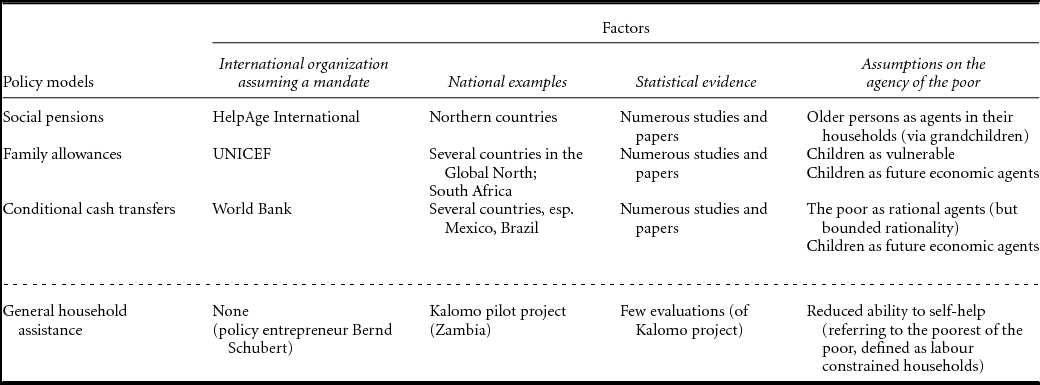
The factors that made for the consensual rise of the new global models are summarized in the Table, testifying to our model of ideational change. The model ‘general household assistance’ is demarcated by a dotted line because it is a borderline case between successful and failed model.
The mechanism ‘drawing on country examples’ (as well as ‘reliance on scientific evidence’) seems to be characteristic of global social policy at large. International organizations promote policy development, but often they are ‘only riding a wave‘.Footnote 6 But the vacancy of SCT as policy field around 2000 SCT was peculiar to SCT. A ‘vacant’ field is a field with few established objectives, instruments and vested interests (Hvinden, Reference Hvinden2003: 610f.). Vacancy enabled old and new international organizations to step into the field. Regarding policies, the emergence of SCT implied a paradigm shift in global income security, redefining problem definitions, goals, instruments and addressees: from policy for workers in the formal sector to policy for the poor; from income maintenance to poverty reduction; and from social insurance to SCT as mainstay of social security – potentially a new social model of income security for countries in the global South.
Models of social cash transfers and factors contributing to their construction

The rise of SCT as global model was ambivalent. While changes in broader discourses, especially in developmental thinking, enabled the rise, they also left their imprint on the new model of social security. Global discourses, in conjunction with organizational domains, also constrained the idea of social cash transfers, reducing it to four models that specify the idea in a narrow way. The ensemble of the four models falls short of universalism and responsiveness to need, reflecting instead a categorically fragmented and incomplete universalism. This reduction has enabled a remarkable consensus on SCT by international organizations, even if the organizations still have different preferences regarding favourite models.
Universalism is the most basic principle of global social policy and world culture, called upon in human rights documents, in standard lead semantics like inclusiveness, and in programme-specific campaigns such as the Global Campaign on Social Security and Coverage for All (ILO, from 2003), ‘Health for All‘ or ‘Education for all‘. The rise of SCT, irrespective of means-testing, indicates a move towards universalism, by extending welfare entitlements to the poor beyond the formal sector of the economy (Leisering, Reference Leisering2009: 265). As we found, the move towards universalism is not the outcome of a coherent agenda, but emanated from the converging efforts of different organizations, each of which advocated the interests of their constituency, such as UNICEF (children, family allowances) and HelpAge International (older persons, social pensions). This has resulted in categorically fragmented universalism.
Moreover, a key group is missing in most discourses on SCT and in all models (with the exception of the model with the lowest political support, general household assistance), namely persons of working age. That is, universalism is not only categorically fragmented but also incomplete. The ILO Recommendation 202 on Social Protection Floors is phrased in universalistic terms, also covering persons of working age, but the document does not talk about individual entitlements to benefits and global institutional models, but about ‘social security guarantees’, to be designed locally (ILO, 2012: section II, 4., 5.; Deacon, Reference Deacon2013: 158). Social assistance in most Northern countries covers persons of working age, the unemployed are even a key target group. This means that while social insurance ‘travelled’ from the North to the South a long time ago, social assistance has not travelled South.
All in all, international organizations, when developing SCT policies, have established a fragmented and incomplete universalism that creates new social divisions by selective and unequal entitlements to welfare benefits. The exclusion of persons of working age reflects the primacy of the economic, which continues to characterize global social policy, even if economic growth and social security have been made compatible in discourses. Categorical fragmentation is also common in European welfare states (Bahle et al., Reference Bahle, Hubl and Pfeifer2011: 193–214), traced to notions of deservingness and historical paths of separate institutionalization for different groups in society. In global arenas, categorical differentiation also reflects organizational domains.
Moreover, SCT models mix conventional social policy categories stemming from the global North with categories from discourses on development and other global discourses, especially on risk and climate change. For example, as we found, the models of SCT are geared to reducing poverty in the long-term, via the promotion of human capital and investment in children, and these are traditional developmental ideas. This is remarkable since SCT are widely perceived or even presented as instruments to address present needs of the poor. Similarly, the emphasis on ‘vulnerability’ in view of future risks rather than (current) ‘poverty’ reflects the new global discourse on risk and climate change.Footnote 7 The ‘socialization of global politics’ has left a ‘social’ imprint on development policy, but vice versa, developmental thinking has imbued the ‘social’ in global arenas.
Thus, the ‘socialization of global politics’ is not a simple ‘uploading’ of ‘social’ ideas from European traditions, but an active process of social construction by global actors. In this process, ideas from the global South play a vital role, since international organizations tend to pick up models from innovative Southern countries, as we have shown.