



1 Introduction
A blender is a hyperbolic set such that its projection to a certain ‘central’ subspace has a non-empty interior, and this property persists for any
$C^1$
 -close system. An immediate consequence is that non-transverse intersections with the stable or unstable set can become unremovable by
$C^1$
 -small perturbations. This opens the way for constructing various
$C^1$
 -robust dynamical phenomena, including those that appear fragile at first glance. As the first such example, a large class of diffeomorphisms exhibiting robust non-hyperbolic transitivity was constructed by Bonatti and Díaz in their discovery paper [Reference Bonatti and Díaz11] of blenders. Subsequently, various non-trivial results involving blenders have been obtained: persistence of heterodimensional cycles [Reference Bonatti and Díaz12, Reference Bonatti, Díaz and Kiriki14, Reference Li and Turaev26], abundance of
$C^1$
 -robust homoclinic tangencies [Reference Barrientos, Díaz and Pérez5, Reference Bonatti and Díaz13, Reference Li, Li, Shinohara and Turaev24], typicality of the Newhouse phenomenon in the space of families of diffeomorphisms [Reference Berger7], robustly fast growth of the number of periodic orbits [Reference Asaoka, Shinohara and Turaev1, Reference Asaoka, Shinohara and Turaev2, Reference Berger8], robust existence of non-hyperbolic ergodic measures [Reference Bochi, Bonatti and Díaz10],
$C^1$
 density of stable ergodicity [Reference Avila, Crovisier and Wilkinson3, Reference Rodriguez-Hertz, Rodriguez-Hertz, Tahzibi and Ures34], robust transitivity in Hamiltonian dynamics [Reference Nassiri and Pujals31], persistence of homoclinics to saddle-center periodic points [Reference Li and Turaev29], and robust bifurcations in complex dynamics [Reference Biebler9, Reference Dujardin18, Reference Taflin37], among others.
Essentially, there are two strategies for obtaining a blender. One can either explicitly construct blenders from (relatively) specific systems (see, e.g., [Reference Berger7, Reference Berger8, Reference Nassiri and Pujals31]) or identify conditions under which blenders emerge near particular dynamical objects. In the latter case, blenders are mostly found near heterodimensional cycles, except that in [Reference Avila, Crovisier and Wilkinson3, Reference Moreira and Silva30], blenders arise from horseshoes with sufficiently large fractal dimension, while in [Reference Li and Turaev29], blenders are built near one-dimensional whiskered tori with homoclinics. In this paper, we investigate the creation of blenders near heterodimensional cycles. The first major contribution in this direction was made by Díaz in [Reference Díaz17] where he implicitly constructed a blender. Later, Bonatti and Díaz developed [Reference Bonatti and Díaz12] a general theory in the
$C^1$
 topology, establishing that blenders can appear after a
$C^1$
 -small perturbation which unfolds a heterodimensional cycle of coindex 1. A conservative version of this result was also obtained in [Reference Rodriguez-Hertz, Rodriguez-Hertz, Tahzibi and Ures33]. More recently, together with Turaev, the author showed in [Reference Li and Turaev26] that for every
$C^r$
 diffeomorphism
$(r=2,\ldots ,\infty ,\omega )$
 having a coindex-1 heterodimensional cycle, there exist
$C^r$
 -small perturbations that give rise to blenders. The method employed there is different from [Reference Bonatti and Díaz12] and, in particular, we identified certain classes of heterodimensional cycles that give rise to blenders without being destroyed.
The present paper serves as a continuation of the blender-related investigation initiated in [Reference Li and Turaev26], completing the analysis of the case where at least one of the saddles in a heterodimensional cycle has a nonreal central multiplier. The main goal is to provide a comprehensive description (Theorem A) of the relation between the natural (that is, non-perturbative) existence of blenders and arithmetic properties of moduli of topological conjugacy for
$C^r$
 diffeomorphisms having heterodimensional cycles of coindex 1. The result characterizes the blender-producing mechanisms for coindex-1 heterodimensional dynamics in full generality. As a consequential result, we establish a dichotomy (Corollary 1 and Theorem B) for the local dynamics near non-degenerate heterodimensional cycles, depending on the existence/non-existence of rational dependencies between the moduli: one has either rich dynamics, that is, the cycle is a limit of infinitely many blenders, which in most cases form robust heterodimensional dynamics, or simple hyperbolic dynamics, that is, there are only finitely many locally maximal and compact hyperbolic sets in any sufficiently small neighborhood of the cycle and no heterodimensional connections (except for the cycle itself). Moreover, such a dichotomy can extend to nearby systems (Corollary 2). We also obtain several perturbative results (Theorem C) that can be used as a standard tool for creating blender-involved robust heterodimensional dynamics in the
$C^r$
 topology, giving possibilities for improving the regularity of many
$C^1$
 results based on the Bonatti–Díaz construction in [Reference Bonatti and Díaz12]. (The results in this paper can be translated without effort to the setting of flows on manifolds of dimension four or higher, see Remark 3.4.)
1.1 Blenders and moduli of topological conjugacy
There are many definitions of blenders, see, e.g., [Reference Barrientos, Ki and Raibekas6, Reference Bochi, Bonatti and Díaz10, Reference Bonatti and Díaz11, Reference Bonatti and Díaz13, Reference Bonatti, Díaz and Viana15, Reference Nassiri and Pujals31]. The blenders found in this paper are the same as in [Reference Li and Turaev26], which we call standard. They carry more dynamical meaning than the original geometrically defined blenders [Reference Bonatti and Díaz11, Reference Bonatti and Díaz12, Reference Bonatti, Díaz and Viana15]. Roughly speaking, a standard blender is a zero-dimensional partially hyperbolic set obtained from a Markov partition with a finite (but arbitrarily large) number of elements, such that the iterated function system that arises from the partition satisfies the so-called covering property (see Proposition 4.2). It is a generalization of the blender-horseshoe defined in [Reference Bonatti and Díaz13], whose corresponding Markov partition had exactly two elements. We refer interested readers to [Reference Li23, Reference Li and Turaev26], where a detailed construction of standard blenders is given. Here, for stating our results, it suffices to use a version of the geometric definition [Reference Bonatti, Díaz and Viana15, Definition 6.11].
In the rest of the paper, let
$\mathcal {M}$
 be a manifold of dimension at least three and let
$\mathrm {Diff} ^r(\mathcal {M})$
 be the space of
$C^r$
 diffeomorphisms of
$\mathcal {M}$
 .
Definition 1.1. (Blenders)
A basic (that is, compact, transitive, locally maximal) hyperbolic set
$\Lambda $
 of a diffeomorphism
$f\in \mathrm {Diff} ^1(\mathcal {M})$
 is called a center-stable (cs) blender if there exists a
$C^1$
 -open set
$\mathcal {D}$
 of
$d^{ss}$
 -dimensional discs (embedded copies of
$\mathbb {R}^{d^{ss}}$
 ) with
$d^{ss}=\dim (W^s(\Lambda ))-1$
 , such that for every system g that is
$C^1$
 -close to f, for the hyperbolic continuation
$\Lambda _g$
 of the basic set
$\Lambda $
 , the set
$W^u(\Lambda _g)$
 intersects every element from
$\mathcal {D}$
 ; a center-unstable (cu) blender is a cs-blender of
$f^{-1}$
 .
Recall that the index of a transitive hyperbolic set is the rank of its unstable bundle. We denote it by
$\operatorname {ind}(\cdot )$
 . Following [Reference Li and Turaev26], we use the following definitions.
Definition 1.2. (Heterodimensional dynamics)
We say that a diffeomorphism
$f\in \mathrm {Diff} ^1(\mathcal {M})$
 has heterodimensional dynamics if there are two basic hyperbolic sets
$\Lambda _1$
 and
$\Lambda _2$
 such that they have different indices and their invariant manifolds intersect cyclically, that is,
$W^u(\Lambda _1)\cap W^s(\Lambda _2)\neq \emptyset $
 and
$W^u(\Lambda _2)\cap W^s(\Lambda _1)\neq \emptyset $
 . The quantity
$|\operatorname {ind}(\Lambda _1)- \operatorname {ind}(\Lambda _2)|$
 is called the coindex of the heterodimensional dynamics.
In the literature, the above heterodimensional dynamics is called a ‘heterodimensional cycle’. However, we reserve the word ‘cycle’ for the simplest version of such dynamics, which is the precise object studied in the paper.
Definition 1.3. (Heterodimensional cycles)
A heterodimensional cycle of f is a closed invariant set consisting of four orbits: two hyperbolic periodic orbits
$L_1$
 and
$L_2$
 with
$\operatorname {ind}(L_1)\neq \operatorname {ind}(L_2)$
 , and two heteroclinic orbits, one from
$W^u(L_1)\cap W^s(L_2)$
 and the other from
$W^u(L_2)\cap W^s(L_1)$
 .
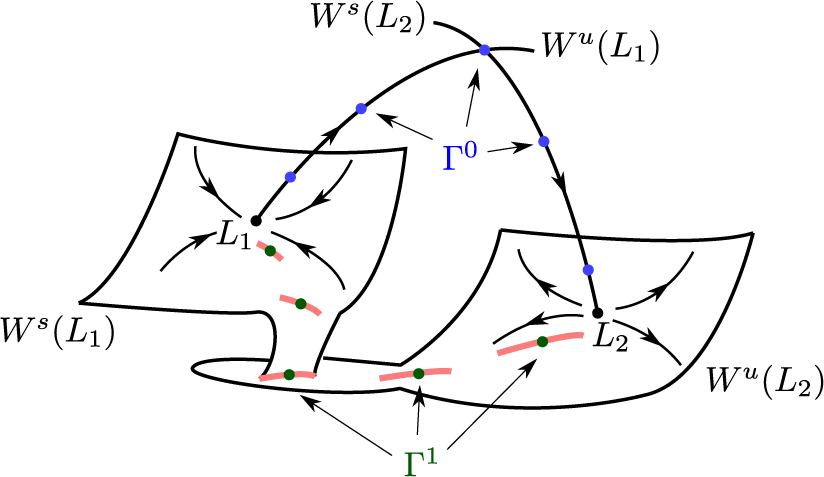
See Figure 1 for an illustration. We only study coindex-1 heterodimensional cycles, that is, those with
$|\operatorname {ind}(L_1)-\operatorname {ind}(L_2)|=1$
 , so for brevity, we omit the word ‘coindex-1’ henceforth. Note that we lose no generality by considering only cycles associated with periodic orbits. Indeed, since hyperbolic periodic orbits are dense in a hyperbolic basic set and their stable/unstable invariant manifolds approximate the stable/unstable leaves of the hyperbolic set (see, e.g., [Reference Katok and Hasselblatt21, Theorem 6.4.15]), one can always obtain heterodimensional cycles from heterodimensional dynamics by an arbitrarily
$C^r$
 -small perturbation.
[Reference Li and Turaev26, Figure 1]. A heterodimensional cycle for a three-dimensional diffeomorphism. It consists of two fixed points
$L_1$
 and
$L_2$
 , a fragile heteroclinic orbit
$\Gamma ^0$
 (blue dots) in the non-transverse intersection
$W^u(L_1)\cap W^s(L_2)$
 , and a robust heteroclinic orbit
$\Gamma ^1$
 (green dots) in the transverse intersection
$W^s(L_1)\cap W^u(L_2)$
 (red curves) (color online).

We further consider heterodimensional cycles that fulfill certain non-degeneracy conditions introduced in [Reference Li and Turaev26] (which are also presented in Appendix A for completeness). All these conditions can be achieved by an arbitrarily
$C^r$
 -small perturbation and are
$C^r$
 -open in the set of diffeomorphisms having a heterodimensional cycle.
The dynamics near a non-degenerate heterodimensional cycle is largely determined by the central multipliers of the two involved periodic orbits
$L_1$
 and
$L_2$
 . (The multipliers of a periodic orbit L are the eigenvalues of the derivative of the period map
$f^{per(L)}$
 evaluated at any point of L.) Let us assume
$\operatorname {ind}(L_1)+1=\operatorname {ind}(L_2)$
 , and denote
$d_1:=\operatorname {ind}(L_1)$
 and
$d_2:=\operatorname {ind}(L_2)$
 . When the multipliers of
$L_1$
 are in general position, there is either one real multiplier, say
$\unicode{x3bb} $
 , or a pair of conjugate complex multipliers, say
$\unicode{x3bb} $
 and
$\unicode{x3bb} ^*$
 , closest to the unit circle from inside, which we call center-stable. Similarly, for
$L_2$
 , there is either one real multiplier, say
$\gamma $
 , or a pair of conjugate complex multipliers, say
$\gamma $
 and
$\gamma ^*$
 , closest to the unit circle from outside, which we call center-unstable. See §2 for a detailed discussion. It is well known [Reference Newhouse, Palis and Takens32, Reference van Strien39] that the ratio

and the arguments

are moduli, that is, invariants of topological conjugacy, for diffeomorphisms having non-degenerate heterodimensional cycles. Note that the arguments are also defined for real
$\unicode{x3bb} $
 and
$\gamma $
 , in which case, one has
$\omega _1\in \{0,\pi \}$
 and
$\omega _2\in \{0,\pi \}$
 , respectively. We prove the following theorem.
Theorem A. Let
$f\in \mathrm {Diff} ^r(\mathcal {M})$
 , with
$r=2,\ldots ,\infty ,\omega $
 , have a non-degenerate heterodimensional cycle, and let U be any small neighborhood of the cycle.
-
• If $\omega _1/2\pi $
 and
$\omega _2/2\pi $
are both irrational, then there exist both a cs-blender and a cu-blender in U. The blenders have different indices, and their stable and unstable sets intersect cyclically and
$C^1$
-robustly.
-
• If exactly one of $\omega _1/2\pi $
and
$\omega _2/2\pi $
is irrational, then there exists at least one blender (this blender, and also the one in the third item, can be center-stable or center-unstable. This depends on f, and is made precise in Propositions 4.3 and 5.1) in U. -
• If $\theta $
is irrational with at least one of
$\unicode{x3bb} $
and
$ \gamma $
being non-real, and
$\omega _1/2\pi $
and
$\omega _2/2\pi $
do not belong to the set $$ \begin{align*} \bigg\{\dfrac{p}{q}\mid p,q\in\mathbb{N} \;\text{are coprime with } 3\leqslant q \leqslant 8\bigg\}, \end{align*} $$then there exists at least one blender in U.


In each of the above cases, the blender is center-stable if and only if it has index
$d_1$
 , and center-unstable if and only if it has index
$d_2$
 .
Remark 1.4. This theorem significantly strengthens the previous results [Reference Li and Turaev26, Propositions 6.2 and 6.7] in terms of the required conditions, where only the following three subcases were considered: (1)
$\theta ,\omega _1/2\pi ,1$
 are rationally independent; (2)
$\theta ,\omega _2/2\pi ,1$
 are rationally independent; and (3)
$\theta ,\omega _1/2\pi ,\omega /2\pi ,1$
 are rationally independent.
By definition, if
$\omega _1/2\pi $
 is irrational, the multiplier
$\unicode{x3bb} $
 must be non-real and, if it is rational,
$\unicode{x3bb} $
 can be either real or non-real; similarly for
$\omega _2/2\pi $
 and
$\gamma $
 . Hence, the result concerns all possibilities of the modulus values when at least one of
$\unicode{x3bb} $
 and
$\gamma $
 is non-real, except for the possibility that all
$\omega _{1}/2\pi ,\omega _{2}/2\pi $
 and
$\theta $
 are rational, considered in Theorem B. Theorem A is our main result and it reflects the essential relation between values of the moduli and the existence of blenders. However, it is too general for practical use in the sense that not much information about the blenders is provided. In fact, this theorem follows from several much finer results collected in Theorems 1 and 2 in §2, where the homoclinic relations between the found blenders and periodic orbits involved in the cycle are established. We stress that Theorem A has a non-perturbative nature. This is the main difference from the Bonatti–Díaz construction in [Reference Bonatti and Díaz12], where the cycle is destroyed to create blenders.
The case where both
$\unicode{x3bb} $
 and
$\gamma $
 are real was fully studied in [Reference Li and Turaev26], where such cycles are further classified into types I and II, according to whether an orientation-like property is satisfied by the central dynamics along the non-transverse heteroclinic orbit, see [Reference Li and Turaev26, §2.5].
Theorem. [Reference Li and Turaev26, Theorem 1]
For any non-degenerate type-I cycle and any neighborhood U of it, if
$\theta $
 is irrational, then there exists a blender in U.
Note that a cycle being type II in particular means that both central multipliers
$\unicode{x3bb} $
 and
$\gamma $
 are real. In summary, we obtain the following corollary.
Corollary 1. For any non-degenerate heterodimensional cycle which is not type II, it is accumulated by infinitely many blenders if either:
-
• ${\omega _i}/{2\pi }$
is irrational for some
$i\in \{1,2\}$
; or -
• $\theta $
is irrational and
${\omega _i}/{2\pi }={p_i}/{q_i}$
for
$i=1,2$
, where
$p_i,q_i\in \mathbb {Z}$
are coprime with
$q_i> 8$
.


We remark that the infinitely many blenders in Corollary 1 form a ‘nearly-affine blender system’, as defined in [Reference Li23]. The union of a properly chosen finite collection of those blenders carries dynamical properties that normally do not hold for a single blender, which are discussed in detail in [Reference Li23]. In a forthcoming paper [Reference Li and Turaev27], we also show that these blenders can be embedded into a family to form a parablender in the sense of [Reference Berger7], giving rise to robust coexistence of infinitely many sinks for generic families of diffeomorphisms.
1.2 Simple hyperbolic dynamics
In the last remaining case where
$\theta $
 ,
$\omega _1/2\pi $
 and
$\omega _2/2\pi $
 are all rational (including the possibilities of
$\unicode{x3bb} $
 and/or
$\gamma $
 being real), there are generally no blenders near the heterodimensional cycle. To state the results precisely, let us introduce some necessary notions.
Denote the heterodimensional cycle of f by
$\Gamma $
 , and the two heteroclinic orbits involved by
$\Gamma ^0\subset W^u(L_1)\cap W^s(L_2)$
 and
$ \Gamma ^1\subset W^u(L_2)\cap W^s(L_1)$
 , where we assumed that
$\operatorname {ind}(L_1)+1=\operatorname {ind}(L_2)$
 . Recall that the hyperbolic periodic orbits admit unique continuations for all diffeomorphisms
$C^1$
 -close to f. Thus, for any small neighborhood U of
$\Gamma $
 , we can find a codimension-1 subspace
$\mathcal {H}_f \subset \mathrm {Diff} ^r(\mathcal {M})$
 such that each
$g\in \mathcal {H}_f$
 has a cycle
$\Gamma _g\subset U$
 involving the continuations of
$L_1$
 and
$L_2$
 , and heteroclinic orbits close to
$\Gamma ^{0}$
 and
$\Gamma ^1$
 . Since
$\theta $
 depends continuously on diffeomorphisms, inside
$\mathcal {H}_f$
 , there is a codimension-2 subspace
$\mathcal {H}_{f,\theta }=\mathcal {H}_f\cap \{\theta =const\}$
 , where all diffeomorphisms have the same
$\theta $
 values as f. Similarly, one can define two codimension-3 subspaces
$\mathcal {H}_{f,\theta ,\omega _1}$
 and
$\mathcal {H}_{f,\theta ,\omega _2}$
 , and one codimension-4 subspace
$\mathcal {H}_{f,\theta ,\omega _1,\omega _2}$
 by intersecting
$\mathcal {H}_{f,\theta }$
 with
$\{\omega _1=const\}$
 ,
$\{\omega _2=const\}$
 , and both of them, respectively.
We define the splitting parameter
$\mu $
 for the heterodimensional cycle as a continuous functional of a neighborhood
$\mathcal {U}\subset \mathrm {Diff} ^r(\mathcal {M})$
 of f that measures the distance between
$W^u(L_1)$
 and
$W^s(L_2)$
 in a certain neighborhood (see Remark 3.1). Then,
$\mu (g)=0$
 for
$g\in \mathcal {U}$
 corresponds to the codimension-1 subspace
$\mathcal {H}_f$
 . For a one-parameter family
$\{f_\varepsilon \}$
 of
$C^r$
 diffeomorphisms with
$f_0=f$
 , we call it a generic unfolding family (when there is one parameter) or a rank-1 unfolding family (when there is more than one parameter) if

Let
$\mathcal {N}$
 be the set of orbits that lie entirely in U.
Definition 1.5. (Simple hyperbolic dynamics)
A generic one-parameter unfolding family
$\{f_\varepsilon \}$
 is said to have simple hyperbolic dynamics if the following hold.
-
• At $\varepsilon =0$
,
$\mathcal {N}$
is the union of
$L_1$
,
$L_2$
,
$\Gamma ^0$
, and the orbits of transverse intersection of
$W^u(L_2)$
with
$W^s(L_1)$
near
$\Gamma ^1$
. -
• At all sufficiently small $\varepsilon \neq 0$
,
$\mathcal {N}$
is composed either of:-
– $L_2$
, an index-
$d_1$
uniformly hyperbolic compact set
$\Lambda _1$
containing
$L_1$
and transverse heteroclinic orbits in
$W^u(L_2)\cap W^s(\Lambda _1)$
; or -
– $L_1$
, an index-
$d_2$
uniformly-hyperbolic compact set
$\Lambda _2$
containing
$L_2$
and transverse heteroclinic orbits in
$W^u(\Lambda _2)\cap W^s(L_1)$
.
-


In particular, there are no blenders at
$\varepsilon =0$
 and no heterodimensional dynamics at
$\varepsilon \neq 0$
 .
Theorem B. Let
$f\in \mathrm {Diff} ^r(\mathcal {M})$
 , with
$r=2,\ldots ,\infty ,\omega $
 , have a heterodimensional cycle with all
$\theta $
 ,
$\omega _1/2\pi $
 , and
$\omega _2/2\pi $
 being rational. There exists a set
$\mathcal {H}^{\prime }_f\subset \mathcal {H}_{f}$
 such that any generic one-parameter unfolding family
$\{g_\varepsilon \}$
 with
$g_0\in \mathcal {H}^{\prime }_{f}$
 has only the simple hyperbolic dynamics defined above. Moreover, the set
$\mathcal {H}^{\prime }_f$
 has the following properties:
-
• if $\unicode{x3bb} $
and
$\gamma $
are both real, then
$\mathcal {H}^{\prime }_f$
is open and dense in
$ \mathcal {H}_{f,\theta }$
; -
• if $\unicode{x3bb} $
is non-real and
$\gamma $
is real, then
$\mathcal {H}^{\prime }_f$
is open and dense in
$ \mathcal {H}_{f,\theta ,\omega _1}$
; -
• if $\unicode{x3bb} $
is real and
$\gamma $
is non-real, then
$\mathcal {H}^{\prime }_f$
is open and dense in
$\mathcal {H}_{f,\theta ,\omega _2}$
; and -
• if $\unicode{x3bb} $
and
$\gamma $
are both non-real, then
$\mathcal {H}^{\prime }_f$
is open and dense in
$\mathcal {H}_{f,\theta ,\omega _1,\omega _2}$
.


The first item in Theorem B was established in [Reference Li and Turaev26, Theorem 6] and the proof of the remaining cases is given in §7. The result implies that the blenders that exist for the moduli values in Corollary 1 depart from the heterodimensional cycle immediately once we change the moduli to rational values within
$\mathcal {H}_f$
 .
1.3 Robust heterodimensional dynamics arising from perturbations
A direct consequence of the existence of blenders near a heterodimensional cycle is the emergence of robust heterodimensional dynamics, defined as follows.
Definition 1.6. (Robust heterodimensional dynamics)
We say that a diffeomorphism f exhibits
$C^1$
 -robust heterodimensional dynamics if it has heterodimensional dynamics involving two hyperbolic basic sets
$\Lambda _1$
 and
$\Lambda _2$
 , where at least one of them is non-trivial, and there exists a
$C^1$
 -neighborhood
$\mathcal {U}$
 of f such that every
$g\in \mathcal {U}$
 has heterodimensional dynamics involving the continuations of
$\Lambda _1$
 and
$\Lambda _2$
 .
It is proven that robust heterodimensional dynamics can always be obtained by an arbitrarily small perturbation of a heterodimensional cycle, see [Reference Bonatti and Díaz12, Reference Bonatti, Díaz and Kiriki14] for the
$C^1$
 topology and [Reference Li and Turaev26] for the
$C^r$
 topology. In the following, we present a strengthened version of the latter result in terms of the class of families allowed. Specifically, we consider the case where at least one of
$\unicode{x3bb} $
 and
$\gamma $
 is non-real.
Let f have a heterodimensional cycle involving
$L_1$
 and
$L_2$
 with
$\operatorname {ind}(L_1)+1=\operatorname {ind}(L_2)$
 . We further classify the unfolding families with more than one parameter. We already defined rank-1 unfolding families by (2). When there are at least two parameters, a family
$\{f_\varepsilon \}$
 is called a rank-2 unfolding family if one of the following conditions is satisfied:
-
• $\operatorname {rank}\,{d(\mu (\varepsilon ),\omega _1(\varepsilon ))}/{d\varepsilon }|_{\varepsilon =0}\,=\,2, \quad {\omega _1(0)}/{2\pi }\notin \{0,{1}/{2}\},\quad {\omega _{2}(\varepsilon )}/{2\pi }\not \equiv {p}/{q} \quad \text {for } 3\leqslant q \leqslant 8;$
-
• $\operatorname {rank}\,{d(\mu (\varepsilon ),\omega _2(\varepsilon ))}/{d\varepsilon }|_{\varepsilon =0}\,=\,2, \quad {\omega _2(0)}/{2\pi }\notin \{0,{1}/{2}\}, \quad {\omega _{1}(\varepsilon )}/{2\pi }\not \equiv {p}/{q} \quad \text {for } 3\leqslant q \leqslant 8;$
-
• $\operatorname {rank}{d(\mu (\varepsilon ),\theta (\varepsilon ))}/{d\varepsilon }|_{\varepsilon =0}=2,\quad ({\omega _1(0)}/{2\pi },{\omega _2(0)}/{2\pi })\notin \{0,{1}/{2}\}^2,\quad {\omega _{1,2}(\varepsilon )}/{2\pi } \not \equiv {p}/{q} \quad \text {for} \; 3\leqslant q \leqslant 8.$


Here
$p,q$
 are coprime integers and ‘
$\not \equiv $
 ’ means not equal in a small neighborhood of
$\varepsilon =0$
 . Recall that we take
$\omega _{1,2}\in [0,\pi ]$
 (see (1)). Hence, the multipliers
$\unicode{x3bb} $
 and
$\gamma $
 are real if and only if
$\omega _1/2\pi \in \{0,1/2\}$
 and
$\omega _2/2\pi \in \{0,1/2\}$
 , respectively.
If the family has at least three parameters, we call it a rank-3 unfolding family if one of the following conditions is satisfied:
-
• $\operatorname {rank}{d(\mu (\varepsilon ),\omega _1(\varepsilon ),\theta (\varepsilon ))}/{d\varepsilon }|_{\varepsilon =0}=3,\quad {\omega _1(0)}/{2\pi }\notin \{0,{1}/{2}\}, \quad {\omega _{2}(\varepsilon )}/{2\pi }\not \equiv \, {p}/{q} \text { for}\; 3\leqslant |q| \leqslant 8,$
-
• $\operatorname {rank}{d(\mu (\varepsilon ),\omega _2(\varepsilon ),\theta (\varepsilon ))}/{d\varepsilon }|_{\varepsilon =0}=3,\quad {\omega _2(0)}/{2\pi }\notin \{0,{1}/{2}\}, \quad {\omega _{1}(\varepsilon )}/{2\pi }\not \equiv \, {p}/{q} \text { for}\; 3\leqslant |q| \leqslant 8;$
-
• $\operatorname {rank}{d(\mu (\varepsilon ),\omega _1(\varepsilon ),\omega _2(\varepsilon ))}/{d\varepsilon }|_{\varepsilon =0}=3,\quad ({\omega _1(0)}/{2\pi },{\omega _2(0)}/{2\pi })\notin \{0,{1}/{2}\}^2.$


Note that the rank-2 and rank-3 unfolding families are generic in the space of families with at least two parameters and at least three parameters, respectively.
Recall that two hyperbolic periodic points P and Q are homoclinically related if they have the same index and their invariant manifolds intersect cyclically and transversely:
$W^s(P)\pitchfork W^u(Q)\neq \emptyset $
 and
$W^u(P)\pitchfork W^s(Q) \neq \emptyset $
 . Two hyperbolic basic sets are homoclinically related if they have two periodic orbits that are homoclinically related.
Theorem C. Let
$f\in \mathrm {Diff} ^r(\mathcal {M})$
 , with
$r=3,\ldots ,\infty ,\omega $
 , have a non-degenerate heterodimensional cycle such that at least one of
$\unicode{x3bb} $
 and
$\gamma $
 is non-real. Let
$\{f_\varepsilon \}$
 be either a rank-i (
$i=2,3$
 ) unfolding family or a rank-1 unfolding family with f satisfying the condition in Corollary 1. Given any neighborhood U of the cycle, there exist open regions in the
$\varepsilon $
 -space accumulating on
$\varepsilon =0$
 such that each corresponding diffeomorphism
$f_\varepsilon $
 has robust heterodimensional dynamics in U, which involves two non-trivial hyperbolic basic sets
$\Lambda _1$
 of index
$d_1$
 and
$\Lambda _2$
 of index
$d_2$
 . The sets
$\Lambda _1$
 and
$\Lambda _2$
 are homoclinically related to the continuations of
$L_1$
 and
$L_2$
 , respectively. Moreover, we have that:
-
• if the family is rank 1 or 2, then at least one of the following holds: $\Lambda _1$
is a cs-blender,
$\Lambda _2$
is a cu-blender, or both; -
• if the family is rank 3, then $\Lambda _1$
is a cs-blender and
$\Lambda _2$
is a cu-blender.


Remark 1.7. Here, we require one more regularity for f, because this guarantees a smooth dependence on the parameters of the coordinates used in the proof. For
$r=2$
 , the result is still true with a minor adjustment to the arguments, see [Reference Li and Turaev26, discussion above Corollary 2] for details.
Remark 1.8. This result reduces the number of parameters necessary to obtain blenders by 1 or 2 depending on the situation, in comparison with that required in [Reference Li and Turaev26, Theorem 7]. This makes the task of finding blenders in specific examples easier. In particular, Theorem C is used in [Reference Turaev38] to obtain certain pseudohyperbolic attractors containing robust heterodimensional dynamics within a 2-parameter family. With [Reference Li22, Reference Li and Turaev25, Reference Li and Turaev28], it can also be applied to obtain blenders in the attractors in Lorenz-like systems.
We stress that the conditions for the families can be verified explicitly and can be satisfied in restricted settings such as perturbations keeping a symmetry. The theorem follows from Theorem 4 in §2, which concerns one-parameter unfoldings of heterodimensional cycles with different arithmetic properties of the moduli. It should be noted that the cycle does not need to be unfolded in all cases. For example, in the second case of rank-3 unfolding families, the result is achieved by keeping
$\mu =0$
 and adjusting
$\omega _i$
 so that
$\omega _i/2\pi $
 are both irrational. If we do not require the homoclinic relations between
$\Lambda _i$
 and the continuations of
$L_i$
 , then the cycle can also be preserved in the first case of rank-3 unfolding families. This fact can be inferred from Theorem 2.
1.4 A dichotomy for local dynamics near heterodimensional cycles
In closing the introduction, we present a result on the complexity of the dynamics near a heterodimensional cycle. To that aim, we need the bifurcation results for cycles with real
$\unicode{x3bb} $
 and
$\gamma $
 obtained in [Reference Li and Turaev26], which can be summarized as the following theorem.
Theorem 1.9. [Reference Li and Turaev26, Theorem 2 and Corollary 2]
Let f have a non-degenerate heterodimensional cycle with both real central multipliers. Suppose that:
-
• when the cycle is type-I, $\{f_\varepsilon \}$
is rank-2 or rank-1 with irrational
$\theta (0)$
; and -
• when the cycle is type-II, $\{f_\varepsilon \}$
is rank-2 .


Given any neighborhood U of the cycle, there exist open regions in the
$\varepsilon $
 -space accumulating on
$\varepsilon =0$
 such that each corresponding diffeomorphism
$f_\varepsilon $
 has robust heterodimensional dynamics in U, which involves two non-trivial hyperbolic basic sets
$\Lambda _1$
 of index
$d_1$
 and
$\Lambda _2$
 of index
$d_2$
 .
Note from Theorem B that by taking the union of
$\mathcal {H}^{\prime }_f\subset \mathcal {H}_f$
 over different rational values of the moduli, we obtain a dense subset
$\mathcal {S}_f\subset \mathcal {H}_f$
 where each diffeomorphism g has simple hyperbolic dynamics defined in §1.1. Since non-degenerate cycles are open and dense in
$\mathcal {H}_f$
 (see Appendix A), the above observation, along with Corollary 1, Theorem C, and Theorem 1.9, leads to the following corollary.
Corollary 2. Let
$f\in \mathrm {Diff} ^r(\mathcal {M})$
 , with
$r=3,\ldots ,\infty ,\omega $
 , have a heterodimensional cycle
$\Gamma $
 . There exists a dense subset
$\mathcal {S}\subset \mathcal {H}_f$
 and, when the cycle is not type-I, there also exists a dense subset
$\mathcal {C}\subset \mathcal {H}_f\setminus \mathcal {S}$
 such that:
-
• any nearby arc transverse to $\mathcal {H}_f$
at
$g\in \mathcal {S}$
has simple hyperbolic dynamics near the cycle
$\Gamma _g$
; and -
• for $g\in \mathcal {C}$
, the cycle
$\Gamma _g$
is a limit of blenders and any close arc transverse to
$\mathcal {H}_f$
at g intersects a sequence of open sets accumulating on g, which correspond to diffeomorphisms having robust heterodimensional dynamics involving blenders.


1.5 Plan of the proofs
In §2, to facilitate the discussion of the problem, we first define two types of heterodimensional cycles, saddle-focus and double-focus, depending on whether only one or both central multipliers are non-real. Then, according to the types and finer arithmetic properties of
$\theta ,\omega _1/2\pi ,\omega _2/2\pi $
 (e.g., rational independence), we split Theorem A into slightly more technical parts, Theorems 1–3. After that, based on these theorems, we state a bifurcation result, Theorem 4, which implies Theorem C.
In §3, we introduce the first return maps associated with heterodimensional cycles and present the cross-form formulas for these maps that are obtained in [Reference Li and Turaev26] in a more unified way. The proofs of our results are mostly done by analyzing these maps.
The main results, Theorems 1–3, are proved in §§4 and 5 for saddle-focus and double-focus cycles, respectively. A key step is the use of a criterion for the existence of blenders, which is adapted to the cross-form formulas, so that the problem of finding blenders is reduced to finding sequences
$\{(k_n,m_n)\}\subset \mathbb {N}^2$
 such that the set

has suitable accumulation points. The criterion is introduced in §4.1.
We deal with Theorem 4 and Theorem B in §§6 and 7, respectively. The proofs there follow closely the corresponding proofs in [Reference Li and Turaev26], using the newly obtained non-perturbative results, namely Theorems 1–3.
2 Results for different types of heterodimensional cycles
In this section, we state several detailed results covering more subcases of the arithmetic properties of the moduli. These results imply Theorems A and C. We distinguish three main types of heterodimensional cycles, defined as follows. Let
$f\in \mathrm {Diff}^r(\mathcal {M})\, (r=2,\ldots ,\infty ,\omega )$
 have a heterodimensional cycle involving two hyperbolic periodic orbits
$L_1$
 and
$L_2$
 satisfying
$\operatorname {ind}(L_1)+1=\operatorname {ind}(L_2).$
 Denoting
$d=\dim (\mathcal {M})$
 and
$d_i=\operatorname {ind}(L_i)\, (i=1,2)$
 , we can order the multipliers of
$L_i$
 as

Up to an arbitrarily
$C^r$
 -small perturbation, we can assume that the multipliers are in general position. So, the center-stable multiplier(s) either is
$\unicode{x3bb} _{1,1}$
 being simple and real, or are
$\unicode{x3bb} _{1,1}$
 and
$\unicode{x3bb} _{1,2}=\unicode{x3bb} ^*_{1,1}$
 being a pair of simple complex conjugate numbers; and the center-unstable multiplier(s) either is
$\gamma _{2,1}$
 being simple and real or are
$\gamma _{2,1}$
 and
$\gamma _{2,2}=\gamma ^*_{2,1}$
 being a pair of simple complex conjugate numbers. We say that the heterodimensional cycle is of:
-
• saddle type if $\unicode{x3bb} _{1,1}=:\unicode{x3bb} $
and
$\gamma _{2,1}=:\gamma $
are real and satisfy
$|\unicode{x3bb} _{1,2}|<|\unicode{x3bb} _{1,1}|$
and
$|\gamma _{2,1}|<|\gamma _{2,2} |$
; -
• saddle-focus type if either
$$ \begin{align*}\unicode{x3bb}_{1,1}=\unicode{x3bb}_{1,2}^*=\unicode{x3bb} e^{i\omega}, \;\omega\in(0,\pi), \quad\text{and}\quad \gamma_{2,1}=:\gamma \text{ is real},\end{align*} $$where $\unicode{x3bb}>|\unicode{x3bb} _{1,3}|$
and
$|\gamma _{2,1}|<|\gamma _{2,2} |$
, or $$ \begin{align*}\gamma_{2,1}=\gamma_{2,2}^*=\gamma e^{i\omega},\;\omega\in(0,\pi), \quad\text{and}\quad \unicode{x3bb}_{1,1}=:\unicode{x3bb} \text{ is real},\end{align*} $$where $\gamma <|\gamma _{2,3}|$
and
$|\unicode{x3bb} _{1,2}|<|\unicode{x3bb} _{1,1}|$
;
-
• double-focus type if
$$ \begin{align*}\unicode{x3bb}_{1,1}=\unicode{x3bb}_{1,2}^*=\unicode{x3bb} e^{i\omega_1},\;\omega_1\in(0,\pi),\quad\text{and}\quad \gamma_{2,1}=\gamma_{2,2}^*=\gamma e^{ i\omega_2},\;\omega_2\in(0,\pi),\end{align*} $$where $\unicode{x3bb}>|\unicode{x3bb} _{1,3}|$
and
$0<\gamma <|\gamma _{2,3}|$
.


Since the second case for saddle-focus type can be reduced to the first one by considering
$f^{-1}$
 , we always assume that for saddle-focus cycles,
$\unicode{x3bb} _{1,1}$
 is non-real and
$\gamma _{2,1}$
 is real.
As mentioned, in this paper, we focus on saddle-focus and double-focus heterodimensional cycles (while the saddle ones have been comprehensively studied in [Reference Li and Turaev26]). To formulate our results in a compact way, we use a version of the notion of activation introduced in [Reference Bonatti and Díaz12].
Definition 2.1. (Activation)
A cs-blender
$\Lambda $
 of index i is said to be activated by a hyperbolic set H if
$\operatorname {ind}(H)=i+1$
 ,
$W^u(H)$
 intersects
$ W^s(\Lambda )$
 transversely, and
$W^s(H)$
 contains a disc in the open set
$\mathcal {D}$
 in Definition 1.1 (with
$d^{ss}={d-i-1}$
 ) so that the non-transverse intersection
$W^s(H)\cap W^u(\Lambda )$
 is
$C^1$
 -robustly non-empty.
Similarly, a cu-blender
$\Lambda $
 of index i is activated by a hyperbolic set H if
$\operatorname {ind}(H)=i-1$
 ,
$W^s(H)\pitchfork W^u(\Lambda )\neq \emptyset $
 , and
$W^u(H)$
 contains a disc in an open set
$\mathcal {D}$
 of embeddings of
$(i-1)$
 -dimensional discs, each of which intersects
$C^1$
 -robustly the set
$W^s(\Lambda )$
 .
Let us start with saddle-focus heterodimensional cycles. As mentioned, we always assume that the center-stable multipliers are a pair of complex conjugate numbers and the center-unstable multiplier is real. Throughout the remaining paper, we use the notation
$p/q$
 to refer to rational numbers with
$p,q$
 being coprime integers, and, in all cases, a cs-blender always has index
$d_1$
 and a cu-blender always has index
$d_2$
 .
Theorem 1. Let
$f\in \mathrm {Diff}^r(\mathcal {M})$
 have a non-degenerate saddle-focus heterodimensional cycle and let U be any small neighborhood of the cycle.
-
(1) If $\omega /2\pi $
is irrational, then there exists a cu-blender in U, homoclinically related to
$L_2$
. -
(2) If $\omega /2\pi $
is irrational and
$\theta ,\omega /2\pi ,1$
are rationally independent (so
$\theta $
is also irrational), then there exists a cs-blender in U, in addition to the cu-blender of case (1), which is homoclinically related to
$L_2$
. The two blenders activate each other and, in particular,
$L_2$
activates the cs-blender. -
(3) If $\omega /2\pi =p/q$
with
$q\geqslant 9$
and
$\theta $
is irrational, then there exists a blender in U.


Remark 2.2. The type of the blender in case (3) depends on certain coefficients of the first return map, see case (1) of Proposition 4.3.
The theorem is proved in §4. Case (2) here, as well as case (2) in Theorem 2 below, follows from [Reference Li and Turaev26, Theorem 7], but we reprove them with a more general approach. Let us explain briefly how the lower bound for q appears in case (3). The existence of blenders is determined by the central dynamics of the first return maps
$T_{k,m}$
 along a heterodimensional cycle, where k and m represent the number of iterations spent near the two periodic orbits
$L_1$
 and
$L_2$
 , respectively. When the center-stable multiplier of
$L_1$
 is non-real, the rotation produced by it leads to the emergence of trigonometric terms like
$\sin (k\omega +\eta )$
 in the formula for the one-dimensional central part of the first return map. To prove the existence of blenders, we need certain inequalities involving these trigonometric terms to be satisfied (see (20)) and, in most cases, we only need
$\sin (k\omega +\eta )$
 to take sufficiently many different values for different k. This is ensured by a lower bound on q. See §3.2 for details.
For double-focus heterodimensional cycles, we have the following theorem.
Theorem 2. Let
$f\in \mathrm {Diff}^r(\mathcal {M})$
 have a non-degenerate double-focus heterodimensional cycle and let U be any small neighborhood of the cycle.
-
(1) Suppose that at least one of $\omega _i/2\pi \ (i=1,2)$
is irrational.-
(i) If $\omega _{1}/2\pi $
is irrational and
$\omega _{2}/2\pi =p/q$
with
$q\geqslant 8$
, then there exists a cu-blender in U, homoclinically related to
$L_{2}$
. -
(ii) If $\omega _{2}/2\pi $
is irrational and
$\omega _{1}/2\pi =p/q$
with
$q\geqslant 8$
, then there exists a cs-blender in U, homoclinically related to
$L_1$
. -
(iii) If both $\omega _1/2\pi $
and
$\omega _2/2\pi $
are irrational, then in U, there exist simultaneously a cs-blender, homoclinically related to
$L_1$
, and a cu-blender, homoclinically related to
$L_2$
; the two blenders activate each other and, in particular,
$L_1$
activates the cu-blender and
$L_2$
activates the cs-blender.
-
-
(2) Suppose that $\theta $
and exactly one of
$\omega _i/2\pi $
are irrational.-
(i) If $\theta ,\omega _1/2\pi ,1$
are rationally independent and
$\omega _2/2\pi =p/q$
with
$q\geqslant 8$
, then there exists in U a cs-blender, in addition to the cu-blender of (1.i) which is homoclinically related to
$L_2$
. -
(ii) If $\theta ^{-1},\omega _2/2\pi ,1$
are rationally independent and
$\omega _1/2\pi =p/q$
with
$q\geqslant 8$
, then there exists a cu-blender in U, in addition to the cs-blender of condition (1.ii) which is homoclinically related to
$L_1$
.
In each of the two cases, the two blenders activate each other, and in particular $L_2$
activates the cs-blender in case (2.i) and
$L_1$
activates the cu-blender in case (2.ii). -
-
(3) If $\theta $
is irrational, and
$\omega _1/2\pi =p_1/q_1$
and
$\omega _2/2\pi =p_2/q_2$
such that either
$q_1\geqslant 9$
and
$q_2\geqslant 8$
or
$q_2\geqslant 9$
and
$q_1\geqslant 8$
, then there always exists a blender in U.


In all cases, a cs-blender has index
$d_1$
 and a cu-blender always has index
$d_2$
 .
Remark 2.3. The type of the blender in case (3) depends on certain coefficients of the first return map, see case (1) of Proposition 5.1.
This theorem is proved in §5, and, together with Theorem 1, it implies Theorem A. The reason for the lower bounds on q is the same as for the saddle-focus cycles, where the related inequalities are given in (30).
The next result concerns the possibilities for the simultaneous appearance of a cs-blender and a cu-blender in cases (3) of Theorems 1 and 2. In fact, such coexistence is ensured when q is larger than a number which depends on the diffeomorphism and is locally constant. Recall that, for a diffeomorphism g having a non-degenerate cycle
$\Gamma $
 , we denote by
$\mathcal {H}_{g}$
 the codimension-1 subspace in
$\mathrm {Diff}^r(\mathcal {M})$
 , where every
$f\in \mathcal {H}_{g}$
 has a heterodimensional cycle
$\Gamma _f$
 near
$\Gamma $
 . Also note that being non-degenerate is
$C^r$
 -open in
$\mathcal {H}_{g}$
 , see Appendix A.
Theorem 3. Let g have a non-degenerate heterodimensional cycle of saddle-focus or double-focus type
$\Gamma $
 . For any sufficiently small neighborhood
$\mathcal {U}$
 of g in
$\mathcal {H}_{g}$
 , there exists a number
$N(\mathcal {U})$
 such that a diffeomorphism
$f\in \mathcal {U}$
 has a pair of mutually activating cs-blender and cu-blender in any neighborhood of
$\Gamma _f$
 if:
-
• in the saddle-focus case, $\theta (f)$
is irrational and
$\omega (f)/2\pi =p/q$
with
$q \geqslant N(\mathcal {U})$
; or -
• in the double-focus case, $\theta (f)$
is irrational and
$\omega _i(f)/2\pi =p_i/q_i$
with either
$q_1 \geqslant N(\mathcal {U})$
and
$q_2 \geqslant 8$
or
$q_2 \geqslant N(\mathcal {U})$
and
$q_1 \geqslant 8$
.


We prove this theorem in §§4.4 and 5.3. In light of this result, by taking
$q\to \infty $
 , it is natural to expect coexisting blenders near saddle-focus cycles when both
$\theta $
 and
$\omega /2\pi $
 are irrational. This is true if
$\theta $
 ,
$\omega /2\pi $
 , and 1 are rationally independent, as in case (1) of Theorem 1. However, in the absence of such rational independence, we cannot prove coexisting blenders, see case (2) of Proposition 4.3. Similar comments apply to double-focus cycles, see case (2.2) of Proposition 5.1.
Let us now present some perturbative results based on the above theorems. The results show that, by splitting the heterodimensional cycle, one builds homoclinic relations between the involved periodic orbits and the blenders found above, and hence obtains robust heterodimensional dynamics. Recall that a one-parameter family
$\{f_\varepsilon \}$
 is of rank-1 if
$d\mu /d\varepsilon \neq 0$
 at
$\varepsilon =0$
 , see (2). Let us denote the cs-blender and cu-blender in Theorems 1–3 by
$\Lambda ^{cs}$
 and
$\Lambda ^{cu}$
 , respectively. We use the same notation
$L_{1,2},\Lambda ^{cs},\Lambda ^{cu}$
 for their continuations at
$\varepsilon \neq 0$
 .
Theorem 4. Consider any rank-1 unfolding family
$\{f_\varepsilon \}$
 of
$C^r$
 (
$r=3,\ldots ,\infty ,\omega $
 ) diffeomorphisms with
$f_0=f$
 satisfying the hypotheses of one of Theorems 1–3. Let U be any neighborhood of the cycle of f. There exists a sequence
$\{\varepsilon _j\}$
 accumulating on
$\varepsilon =0$
 such that for each
$f_{\varepsilon _j}$
 :
-
• in Theorem 1(1) and Theorem 2(1.i), $\Lambda ^{cu}$
is homoclinically related to
$L_2$
, and is activated by a non-trivial hyperbolic basic set in U which is homoclinically related to
$L_1$
; -
• in Theorem 2(1.ii), $\Lambda ^{cs}$
is homoclinically related to
$L_1$
and is activated by a non-trivial hyperbolic basic set in U which is homoclinically related to
$L_2$
; -
• in Theorem 1(2), Theorem 2(2), and Theorem 3, $\Lambda ^{cs}$
and
$\Lambda ^{cu}$
activate each other, and are homoclinically related to
$L_1$
and
$L_2$
, respectively; -
• in Theorem 1(3) and Theorem 2(3), if the blender is center-stable, it is homoclinically related to $L_1$
and is activated by a non-trivial hyperbolic basic set in U which is homoclinically related to
$L_2$
; if the blender is center-unstable, then it is homoclinically related to
$L_2$
and is activated by a non-trivial hyperbolic basic set in U which is homoclinically related to
$L_1$
.


Moreover, in all cases, the periodic orbits, blenders, and hyperbolic sets involved in the robust heterodimensional dynamics, as well as the heteroclinic orbits constituting the intersections involved in the activations and homoclinic relations, all lie in U.
This theorem is proved in §6. Theorem C follows immediately from the above results, by using the additional parameters to change
$\theta ,\omega ,\omega _{1,2}$
 to fulfill the hypotheses required in the corresponding cases. The last part of Theorem 4 shows that all the objects related to the obtained robust heterodimensional dynamics are localized arbitrarily close to the original cycle. This fact is important for the (local) stabilization theory of heterodimensional cycles [Reference Barrientos, Díaz and Li4, Reference Bonatti, Díaz and Kiriki14, Reference Li and Turaev26].
3 First return maps
In this section, we present the formulas obtained in [Reference Li and Turaev26] for the first return maps of non-degenerate saddle-focus and double-focus heterodimensional cycles. The proofs of our main results are based on the analysis of these formulas.
3.1 Local map and transition map
Recall that
$f\in \mathrm {Diff}^r(\mathcal {M})$
 with
$r=2,\ldots ,\infty ,\omega $
 has a heterodimensional cycle involving two hyperbolic periodic orbits
$L_1$
 and
$L_2$
 , where their indices
$d_1$
 and
$d_2$
 satisfy
$d_1+1=d_2$
 . Let
$\Gamma ^0$
 be a heteroclinic orbit in
$W^u(L_1)\cap W^s(L_2)$
 and
$\Gamma ^1$
 be a heteroclinic orbit in
$W^s(L_1)\cap W^u(L_2)$
 . We further denote the heterodimensional cycle as the closed invariant set
$ \Gamma =L_1\cup L_2\cup \Gamma ^0\cup \Gamma ^1. $

Take two points
$O_1$
 and
$O_2$
 from the two periodic orbits
$L_1$
 and
$L_2$
 . For
$i=1,2$
 , let
$U_{0i}$
 be some sufficiently small neighborhoods of
$O_i$
 . We define the local maps
$F_i:=f^{per(O_i)}|_{U_{0i}}$
 , where
$per(O_i)$
 are the periods of
$O_i$
 . Next, using the heteroclinic orbits
$\Gamma ^0$
 and
$\Gamma ^1$
 , we define transition maps connecting neighborhoods of
$O_1$
 and
$O_2$
 . Take in
$\Gamma ^0$
 a pair of points
$M^-_1\in W^u_{\mathrm {loc}}(O_1)$
 and
$M^+_2\in W^s_{\mathrm {loc}}(O_2)$
 so that
$f^{n_{1}}(M^-_1)=M^+_2$
 for some integer
$n_1>0$
 , and in
$\Gamma ^1$
 , a pair of points
$M^-_2\in W^u_{\mathrm {loc}}(O_2)$
 and
$M^+_1\in W^s_{\mathrm {loc}}(O_1)$
 so that
$f^{n_{2}}(M^-_2)=M^+_1$
 for some integer
$n_2>0$
 . The transition maps are then defined as
$F_{12}:=f^{n_1}$
 , taking a small neighborhood of
$M^-_1$
 to a small neighborhood of
$M^+_2$
 ; and
$F_{21}:=f^{n_2}$
 , taking a small neighborhood of
$M^-_2$
 to a small neighborhood of
$M^+_1$
 . The first return maps are defined as compositions of the local map and transition map.
Remark 3.1. The splitting parameter introduced in §1.1 can be defined to measure the signed distance between
$F_{12}(W^u_{\mathrm { loc}}(O_1))$
 and
$W^s_{\mathrm {loc}}(O_2)$
 in a small neighborhood of
$M^+_2$
 .
As mentioned, we assume that the cycle of f is non-degenerate in the sense of [Reference Li and Turaev26], which can always be achieved by an arbitrarily
$C^r$
 -small perturbation. There are four non-degeneracy conditions, whose precise definitions are given in Appendix A. Roughly speaking, the first three require that:
-
• $T_1(W^u_{\mathrm {loc}}(O_1))$
intersects transversely the local extended stable manifold
$W^{sE}(O_2)$
at
$M^+_2$
and
$T^{-1}_1(W^s_{\mathrm {loc}}(O_2))$
intersects transversely the local extended unstable manifold
$W^{uE}(O_1)$
at
$M^-_1$
; -
• $T_2^{-1}(W^s_{\mathrm {loc}}(O_1))$
is not tangent to the strong-unstable leaf
$\ell ^{uu}\subset W^u(O_2)$
at
$M^-_2$
and
$T_2(W^u_{\mathrm {loc}}(O_2))$
is not tangent to the strong-stable leaf
$\ell ^{ss}\subset W^s(O_1)$
at
$M^+_1$
; and -
• $M^+_1$
does not belong to the strong-stable manifold
$W^{ss}_{\mathrm {loc}}(O_1)$
and
$M^-_2$
does not belong to the strong-unstable manifold
$W^{uu}_{\mathrm {loc}}(O_2)$
.


Here,
$\ell ^{uu},\ell ^{ss},W^{ss}_{\mathrm {loc}}(O_1), W^{uu}_{\mathrm {loc}}(O_2)$
 are defined in the usual way;
$W^{sE}_{\mathrm {loc}}(O_2)$
 is the invariant manifold corresponding to the stable and weak-unstable directions at
$O_2$
 , and similarly for
$W^{uE}_{\mathrm {loc}}(O_1)$
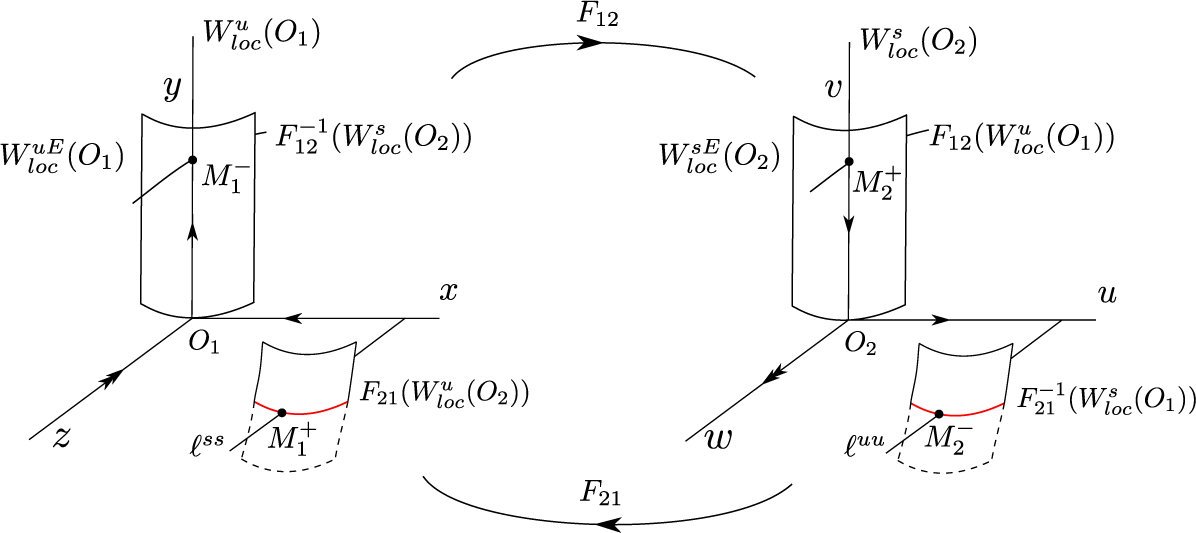
 . Figure 2 provides an illustration. The last non-degeneracy condition is more delicate, requiring that the projections of the transverse intersection points
$M^+_1$
 and
$M^-_2$
 to the central directions do not lie in certain lines. See Appendix A for details.
Here,
$W^u_{\mathrm {loc}}(O_1)$
 is the y-axis,
$W^s_{\mathrm {loc}}(O_1)$
 is the
$(x,z)$
 -plane,
$W^s_{\mathrm {loc}}(O_2)$
 is the v-axis, and
$W^u_{\mathrm {loc}}(O_2)$
 is the
$(u,w)$
 -plane. The two red curves are
$\ell _1=W^s_{\mathrm {loc}}(O_1)\cap F_{21}(W^u_{\mathrm { loc}}(O_2))$
 and
$\ell _2=F^{-1}_{21}(\ell _1)$
 (color online).

Figure 2 Long description
The diagram consists of two three-dimensional coordinate systems connected by curved arrows.
On the left, the first system is centered at origin O sub 1. The vertical axis is y, the horizontal axis is x, and the depth axis is z. A vertical curved surface is labeled F sub 1 2 super negative 1 open parenthesis W sub l o c super s open parenthesis O sub 2 close parenthesis close parenthesis. A point M sub 1 super minus lies on this surface along the y-axis. To the right of the origin, a smaller curved surface contains a red curve labeled ell sub 1 and a point M sub 1 super plus.
On the right, the second system is centered at origin O sub 2. The vertical axis is v, the horizontal axis is u, and the depth axis is w. A vertical curved surface is labeled F sub 1 2 open parenthesis W sub l o c super u open parenthesis O sub 1 close parenthesis close parenthesis. A point M sub 2 super plus lies on this surface along the v-axis. Below the u-axis, a smaller curved surface contains a red curve labeled ell sub 2 and a point M sub 2 super minus.
Two large curved arrows connect the systems. The top arrow points from left to right and is labeled F sub 1 2. The bottom arrow points from right to left and is labeled F sub 2 1. Labels for stable and unstable manifolds, such as W sub l o c super u open parenthesis O sub 1 close parenthesis and W sub l o c super s open parenthesis O sub 2 close parenthesis, are positioned near the vertical axes.
3.2 Saddle-focus case
The first return map of a saddle-focus heterodimensional cycle is defined as the composition
$T_{k,m}:=F_{21}\circ F^m_2\circ F_{12}\circ F^k_1$
 , which, for suitable choices of
$(k,m)$
 , takes points in a small neighborhood of
$M^+_1$
 back to the neighborhood. It is shown in [Reference Li and Turaev26, §§6.1.1–6.1.3] that there exist coordinates
$(X,Y,Z)\in \mathbb {R}\times \mathbb {R}^{d_1}\times \mathbb {R}^{d-d_1-1}$
 near
$M^+_1$
 such that the first return map can be expressed in a cross-form, which manifests the partial hyperbolicity, for a collection of pairs
$(k,m)$
 . In what follows, we introduce this formula.
Recall that we denote the pair of complex conjugate center-stable multipliers by
$\unicode{x3bb} e^{\pm i\omega }\, (0<\omega <\pi )$
 and the real center-unstable multiplier by
$\gamma $
 . For
$\delta>0$
 , define

where
$d_1=\operatorname {ind}(O_1)$
 .
It is proven that there exist coefficients
$A,B,b,\eta _{1,2}\in \mathbb {R}$
 (which are expressed in terms of the derivatives
$\mathrm {D} F_{12}|_{M^-_1}$
 and
$\mathrm {D} F_{21}|_{M^+_2}$
 ),
$u^-\in \mathbb {R}$
 (which is given by the position of
$M^-_2$
 , see (A.1)) and a positive number
$C(\delta )$
 depending on
$\delta $
 such that, for all sufficiently small
$\delta $
 and sufficiently large k and m satisfying

one has that
$(\bar X,\bar Y,\bar Z):=T_{k,m}(X,Y,Z)\in \Pi $
 for a point
$(X,Y,Z)\in \Pi $
 if and only if

where the functions
$\phi $
 satisfy

and

(Equation (6) is obtained from [Reference Li and Turaev26, (6.18)] by dropping the subscript of
$X_1$
 and grouping the coordinates
$(X_2,Z)=:Z$
 .)
The non-degeneracy conditions ensure (see [Reference Li and Turaev26, §6.1.3]) that
$A> 0,B> 0,b\neq 0, u^-\neq 0$
 and

The partial hyperbolicity of
$T_{k,m}$
 follows immediately from a computation of the invariant cone fields using (6). Denote by
$(\Delta X,\Delta Y,\Delta Z)$
 the vectors in the tangent spaces.
Lemma 3.2. [Reference Li and Turaev26, Lemma 6.1]
Given any
$K>0$
 , one can choose
$\delta $
 sufficiently small such that, for all sufficiently large
$k,m$
 for which
$\sin (k\omega +\eta _1)$
 and
$\sin (k\omega +\eta _2)$
 are bounded away from zero, the cone fields

which are defined on
$\Pi $
 , are forward-invariant in the sense that if a point
$M\in \Pi $
 has its image
$\bar M=T_{k,m}(M)$
 in
$\Pi $
 , then the cone at M is mapped strictly into the cone at
$\bar M$
 by
$\mathrm {D} T_{k,m}$
 ; the cone fields

which are defined on
$\Pi $
 , are backward-invariant in the sense that if a point
$\bar {M}\in \Pi $
 has its preimage
$M=T^{-1}_{k,m}(\bar M)$
 in
$\Pi $
 , then the cone at
$\bar {M}$
 is mapped strictly into the cone at M by
$\mathrm {D} T^{-1}_{k,m}$
 . Moreover, vectors in
$\mathcal {C}^{uu}$
 and, if
$|A_{k,m}|>1$
 , also vectors in
$\mathcal {C}^{cu}$
 are expanded by
$\mathrm {D} T_{k,m}$
 ; vectors in
$\mathcal {C}^{ss}$
 and, if
$|A_{k,m}|<1$
 , also vectors in
$\mathcal {C}^{cs}$
 are contracted by
$\mathrm {D} T_{k,m}$
 .
3.3 Double-focus case
In this case, we consider the first return map
$T_{k,m}:=F^m_2\circ F_{12}\circ F^k_1\circ F_{21}$
 near
$M^-_2$
 . A cross-form formula for
$T_{k,m}$
 is obtained in [Reference Li and Turaev26, §§6.4.1–6.4.3] with coordinates
$(U,V,W)\in \mathbb {R}\times \mathbb {R}^{d-d_2}\times \mathbb {R}^{d_2-1}$
 in a small neighborhood
$M^-_2$
 , which we describe below. For simplicity, many coefficients here carry the same notation as those in the saddle-focus case, but they are different coefficients. This does not cause ambiguity as we never discuss the two cases at the same time in the proofs.
Recall that for a double-focus heterodimensional cycle, we denote the center-stable multipliers by
$\unicode{x3bb} e^{\pm i\omega _1}\, (0<\omega _1<\pi )$
 and the center-unstable multipliers by
$\gamma e^{\pm i\omega _2}\, (0<\omega _2<\pi )$
 . For
$\delta>0$
 , define

where
$d_2=\operatorname {ind}(O_2)$
 .
It is proven that there exist coefficients
$A^*,B^*,b,\eta _{1,2,3}$
 (which are expressed in terms of derivatives
$\mathrm {D} F_{12}|_{M^-_1}$
 and
$\mathrm {D} F_{21}|_{M^+_2}$
 ),
$u^-_{1,2}$
 (which is given by the position of
$M^-_2$
 , see (A.1)) and a positive number
$c(\delta )=o(1)_{\delta \to 0}$
 depending on
$\delta $
 such that, for all sufficiently small
$\delta $
 , and sufficiently large k and m satisfying

one has that
$(\bar U,\bar V,\bar W):=T_{k,m}(U,V,W)\in \Pi $
 for a point
$(U,V,W)\in \Pi $
 if and only if

where the functions
$\phi $
 satisfy

and

with

(Equation (13) is obtained from [Reference Li and Turaev26, (6.44)] by dropping the subscript of
$U_1$
 , grouping the coordinates
$(U_2,W)=:W$
 , and dividing
$(1+b_{41}\tan (m\omega +\eta _3))$
 to both sides of (6.44).)
The non-degeneracy conditions ensure that
$A^*> 0,B^*> 0,b\neq 0,u^-\neq 0$
 and
$\tan \eta _1\neq \tan \eta _2$
 , see [Reference Li and Turaev26, §6.4.3].
One sees that (13) assumes the same form as (6), with replacing
$U,V,W$
 by
$X,Z,Y$
 , respectively. By a completely parallel computation, one finds the following counterpart to Lemma 3.2, which characterizes the partial hyperbolicity of
$T_{k,m}$
 .
Lemma 3.3. Given any
$K>0$
 , one can choose
$\delta $
 sufficiently small such that for all sufficiently large
$k,m$
 satisfying (12) and (30), the cone fields

which are defined on
$\Pi $
 , are forward-invariant in the sense that if a point
$M\in \Pi $
 has its image
$\bar M=T_{k,m}(M)$
 in
$\Pi $
 , then the cone at M is mapped into the cone at
$\bar M$
 by
$\mathrm {D} T_{k,m}$
 ; the cone fields

which are defined on
$\Pi $
 , are backward-invariant in the sense that if a point
$\bar {M}\in \Pi $
 has its preimage
$M=T^{-1}_{k,m}(\bar M)$
 in
$\Pi $
 , then the cone at
$\bar {M}$
 is mapped into the cone at M by
$\mathrm {D} T^{-1}_{k,m}$
 . Moreover, vectors in
$\mathcal {C}^{uu}$
 and, if
$|A_{k,m}|>1$
 , also vectors in
$\mathcal {C}^{cu}$
 are expanded by
$\mathrm {D} T_{k,m}$
 ; vectors in
$\mathcal {C}^{ss}$
 and, if
$|A_{k,m}|<1$
 , also vectors in
$\mathcal {C}^{cs}$
 are contracted by
$\mathrm {D} T_{k,m}$
 .
Remark 3.4. The results in this paper are solely based on the analysis of the first return maps, so they can be transferred easily to the continuous-time case, that is, when f is a flow on any manifold of dimension at least four. Indeed, one just needs to define
$F_i$
 for each
$i=1,2$
 as the Poincaré map of a local transverse cross-section at some point
$O_i$
 of the periodic orbit and define
$F_{12}$
 by the trajectories of the flow from a neighborhood of
$M^-_1$
 to a neighborhood of
$M^+_2$
 , and similarly for
$F_{21}$
 .
4 Blenders near saddle-focus heterodimensional cycles
In this section, we prove Theorem 1 and the first case in Theorem 3. Both theorems can be divided into two parts, where one concerns the existence of blenders and the other concerns the homoclinic relations. We obtain results for these two parts separately and then prove the theorems. For the blender part, we use a criterion obtained in [Reference Li and Turaev26].
4.1 A criterion for the existence of blenders
Let us first introduce the notion of activating pair to further characterize the embedding set
$\mathcal {D}$
 in Definition 1.1. Take a cube

where
$I_i$
 are closed intervals in
$\mathbb {R}$
 . A k-dimensional disc S is said to cross Q if the intersection
$S\cap Q$
 is given by
$(x_{i_{k+1}},\ldots ,x_{i_d})=s(x_{i_1},\ldots ,x_{i_k})$
 , where
$(i_1,\ldots ,i_d)$
 is some permutation of
$(1,\ldots ,d)$
 and s is a smooth function defined on
$I_{i_1}\times \cdots \times I_{i_k}$
 . It crosses Q properly with respect to a cone field
$\mathcal {C}$
 defined on Q if the tangent spaces of
$S\cap Q$
 lie in
$\mathcal {C}$
 , that is, the tangent spaces of S lie in
$\mathcal {C}$
 .
For an invariant cone field
$\mathcal {C}$
 , we use
$\dim (\mathcal {C})$
 to denote the largest dimension of linear subspaces of the tangent spaces contained in
$\mathcal {C}$
 .
Definition 4.1. (Activating pair)
A pair
$(Q ,\mathcal {C})$
 consisting of a cube and a cone field is called an activating pair for a cs-blender
$\Lambda $
 if
$\dim (\mathcal {C})=\dim W^s(\Lambda )-1$
 and if any surface S crossing Q properly with respect to
$\mathcal {C}$
 intersects
$W^u(\Lambda )$
 . The pair
$(Q ,\mathcal {C})$
 is an activating pair for a cu-blender
$\Lambda $
 if
$\dim (\mathcal {C})=\dim W^u(\Lambda )-1$
 and any surface S crossing Q properly with respect to
$\mathcal {C}$
 intersects
$W^s(\Lambda)$
 . The cube Q is called an activating domain.
For example, if
$(\Pi ,\mathcal {C}^{ss})$
 , with
$\Pi $
 in (4) and
$\mathcal {C}^{ss}$
 in (10), is an activating pair of some cs-blender, then all curves crossing
$\Pi $
 properly with respect to
$\mathcal {C}^{ss}$
 belong to the embedding set
$\mathcal {D}$
 in Definition 1.1. Each such curve is the graph of some smooth function
$(X,Y)=s(Z)$
 , which is defined on
$[-\delta ,\delta ]^{d-d_1-1}$
 and whose tangent spaces lie in
$\mathcal {C}^{ss}$
 .
Let
$\delta>0$
 and take a cube

with
$1+d_Y+d_Z=d$
 . Let
$\{T_{n}\}_{n\in \mathbb N}$
 be a sequence of maps defined on pairwise disjoint subsets
$\{\sigma _n\}$
 of Q such that
$T_i(\sigma _i)\cap T_j(\sigma _j)\cap Q =\emptyset $
 for
$i\neq j$
 . Define
$T:\bigcup _n \sigma _n \to \mathbb {R}^d$
 by
$T(X,Y,Z)=T_n(X,Y,Z)$
 if
$(X,Y,Z)\in \sigma _n$
 . Suppose for every
$n\in \mathbb N$
 and
$(X,Y,Z)\in Q$
 , one has that
$(\bar X,\bar Y,\bar Z)=T_n (X,Y,Z)$
 if and only if

where the constants
$A_n$
 and
$B_n$
 , and the
$C^1$
 functions
$\phi $
 defined on Q are allowed to depend on
$\delta $
 , and we have the estimates

Proposition 4.2. [Reference Li and Turaev26, Proposition 4.12]
Suppose there exists
$\delta _0>0$
 such that the constants
$A_n$
 and
$B_n$
 satisfy the following.
-
(1) For each $\delta \in (0,\delta _0)$
, the set
$\{B_n\}$
is dense in an interval I that contains zero and is independent of
$\delta $
. -
(2) For all $\delta \in (0,\delta _0)$
and all
$n\in \mathbb N$
either:-
(2.1) $0<C_1<|A_n|<C_2<1$
with
$C_{1,2}$
independent of n; or -
(2.2) $1<C_3<|A_n|<C_4<\infty $
with
$C_{3,4}$
independent of n.
-


Then, there exist
$c\in (0,1)$
 and

such that for every
$\delta \in (0,\delta _0)$
 , one can find a finite set
$\mathcal {N}\subset \mathbb {N}$
 with arbitrarily large elements such that the restriction
$T_{\mathcal {N}}$
 of T to
$\bigcup _{n\in \mathcal {N}} \sigma _n\cap Q$
 has a blender, which consists of points whose orbits never leave Q under
$T_{\mathcal {N}}$
 , and has an activating pair
$(Q',\mathcal {C})$
 with the cone field
$\mathcal {C}$
 independent of
$\delta $
 and n. Moreover:
-
• if condition (2.1) holds, $\Lambda $
is a cs-blender of index
$d_Y$
and cones in
$\mathcal {C}$
are around Z-coordinates; -
• if condition (2.2) holds, $\Lambda $
is a cu-blender of index
$(d_Y+1)$
and cones in
$\mathcal {C}$
are around Y-coordinates.


In our case, the maps
$T_n$
 are the return maps
$T_{k_n,m_n}$
 for some sequence of pairs satisfying conditions (1) and (2). For completeness, we sketch the proof of this proposition in Appendix B.1.
4.2 Existence of blenders when at least one of
$\theta $
and
$\omega /2\pi $
is irrational


Recall that for a saddle-focus heterodimensional cycle, we denote the complex center-stable multipliers by
$\unicode{x3bb} e^{\pm i\omega }$
 , where
$\unicode{x3bb}>0$
 and
$0<\omega <\pi $
 , and the real center-unstable multiplier by
$\gamma $
 . Let
$A>0,B>0,b,u^-,\eta_{1,2}$
 be the coefficients in (7). We introduce a condition on the modulus
$\omega $
 .
-
A1: There exist infinitely many $k>0$
such that (20) $$ \begin{align} bu^-\sin(k\omega +\eta_2)>0,\quad \sin(k\omega +\eta_1)\neq 0,\quad \alpha_k:=\dfrac{bu^-A\sin(k\omega+\eta_1)}{\sin(k\omega+\eta_2)}\neq\pm 1. \end{align} $$


Observe that condition A1 is automatically satisfied if
$\omega /2\pi $
 is irrational or if
$\omega /2\pi = p/q$
 with
$q\geqslant 9$
 . To see the latter, note first that the last inequality in (20) can be rewritten as

or

It follows that to achieve simultaneously this inequality and the second one in (20), it is enough to have at least four different values of
$k\omega \bmod 2\pi $
 in
$[0,1/2)$
 or in
$[1/2,1)$
 . It is easy to check that when
$\omega /2\pi =p/q$
 , there are at least
$ \left \lfloor {(q-1)/2} \right \rfloor $
 different values of
$k\omega \bmod 2\pi $
 both in
$[0,1/2)$
 and in
$[1/2,0)$
 , where
$ \left \lfloor {a} \right \rfloor $
 means the largest integer that is smaller than or equal to a. Choosing the values from the suitable interval also gives
$bu^-\sin (k\omega +\eta _2)>0$
 . Thus, when
$ \left \lfloor {(q-1)/2} \right \rfloor \geqslant 4$
 or
$q\geqslant 9$
 , there exists some
$r\in \{0,\ldots ,q-1\}$
 such that all
$k=r+iq$
 with
$i=0,1,2,\ldots $
 satisfy the inequalities in (20).
Proposition 4.3. Let
$\delta $
 be the size of
$\Pi $
 defined in (4), and
$\mathcal {C}^{ss}$
 and
$\mathcal {C}^{uu}$
 be given by Lemma 3.2 with a sufficiently small K. Let a non-degenerate saddle-focus heterodimensional cycle satisfy condition A1 and U be any neighborhood of the cycle.
-
(1) If $\theta =\ln \unicode{x3bb} /\ln |\gamma |$
is irrational and
$\omega /2\pi =p/q$
, then, for every sufficiently large k satisfying condition A1, there exists a cs-blender in U when
$|\alpha _k|<1$
(defined in (20)) or a cu-blender in U when
$|\alpha _k|>1$
. -
(2) If $\omega /2\pi $
is irrational, and
$\theta ,\omega /2\pi $
and 1 are not rationally independent, then there exists a cu-blender in U. -
(3) If $\theta ,\omega /2\pi $
and 1 are rationally independent, then there exist simultaneously a cs-blender and a cu-blender in U.


In each of the above cases, the cs-blender has index
$d_1$
 and an activating pair
$(\Pi ',\mathcal {C}^{ss})$
 , while the cu-blender has index
$(d_2=d_1+1)$
 and an activating pair
$(\Pi ',\mathcal {C}^{uu})$
 , where the cube
$\Pi '$
 is defined as

for some
$c\in (0,1)$
 .
Proof. We prove the proposition by finding, in each case, a sequence of pairs
$\{(k_n,m_n)\}$
 such that the sequence of return maps
$\{T_{k_n,m_n}\}$
 satisfies the conditions of Proposition 4.2. Let
$A>0,B>0,b,u^-,\eta_{1,2}$
 be the coefficients in (6).
Case (1):
${\theta }$
 is irrational and
$ {\omega /2\pi }$
 is rational. Take
$\omega /2\pi =p/q$
 . Since condition A1 is satisfied, there exists
$k=r\in \{0,\ldots ,q-1\}$
 satisfying (20). We particularly have

Since
$\theta $
 is irrational, the set

is dense in
$\mathbb R$
 and, hence,
$\{\gamma ^{m-(kq+r)\theta }\}_{k\in \mathbb {N},m\in 2\mathbb N}$
 is dense in
$[0,\infty ]$
 . This along with (22) implies that one can find a sequence
$\{(k^{\prime }_nq+r,m^{\prime }_n)\}$
 such that
$\{\gamma ^{m^{\prime }_n-(k^{\prime }_nq+r)\theta }\}$
 is dense in a small neighborhood of
$bu^-/BR$
 . Thus, the sequence

is dense in a small neighborhood
$\Delta $
 of zero.
Recall
$\theta =-\ln \unicode{x3bb} /\ln |\gamma |$
 (note that
$\unicode{x3bb}>0$
 ). When the integer m is even, we can write

Now, denote
$k_n=k^{\prime }_nq+r$
 and
$m_n=m^{\prime }_n$
 . The preceding paragraph shows that
$\sin (k_n\omega +\eta _2)$
 is bounded away from zero. In addition, since
$\unicode{x3bb}>0$
 and
$m_n$
 are even, (24) implies that
$\unicode{x3bb} ^{k_n}\gamma ^{m_n}=\gamma ^{m_n-k_n\theta }$
 . It follows that by taking
$\Delta $
 sufficiently small, condition (5) is satisfied with
$(k,m)=(k_n,m_n)$
 . Hence, the first return maps
$T_n:=T_{k_n,m_n}$
 take the form (6). By comparing (7) with (23), we find that the sequence (23) is exactly the constant term
$B_{k_n,m_n}$
 in (6). Thus, setting
$X=X_1$
 and
$Z^{new}=(X_2,Z)$
 , we find that the sequence
$\{T_n\}$
 satisfies condition (1) of Proposition 4.2.
Next, let us check condition (2) of Proposition 4.2. To find the values of
$|A_{k_n,m_n}|$
 , we use (7) to write

On the one hand, by taking
$\Delta $
 sufficiently small, the contribution of
$B_{k_n,m_n}$
 to
$A_{k_n,m_n}$
 can be ignored. On the other hand, by the choice of
$k_n$
 , one has
$\sin (k_n\omega +\eta _1)=\sin (r\omega +\eta _1)$
 and
$\sin (k_n\omega +\eta _2)=\sin (r\omega +\eta _2)$
 . Thus, we have

Since assumption (20) ensures
$|\alpha _r|\neq 1$
 , this gives condition (2.1) of Proposition 4.2 if
$|\alpha _r|<1$
 or condition (2.2) if
$|\alpha _r|>1$
 . Therefore, using Proposition 4.2, we obtain, in the former case, a cs-blender with an activating pair
$(\Pi ',\mathcal {C}_1)$
 for some cone field
$\mathcal {C}_1$
 and, in the latter case, a cu-blender with an activating pair
$(\Pi ',\mathcal {C}_2)$
 for some cone field
$\mathcal {C}_2$
 .
Since these two cone fields are independent of
$\delta $
 and n, one can take
$\delta $
 small and n large so that
$\mathcal {C}^{ss}$
 and
$\mathcal {C}^{uu}$
 in Lemma 3.2 are contained in
$\mathcal {C}_1$
 and
$\mathcal {C}_2$
 , respectively. As a result,
$(\Pi ',\mathcal {C}^{ss})$
 and
$(\Pi ',\mathcal {C}^{uu})$
 are also activating pairs.
Case (2):
$ {\omega /2\pi }$
 is irrational, and
$ {\theta ,\omega /2\pi }$
 and 1 are rationally dependent. We can write

Consider the function

which is defined on
$\mathbb {R}$
 . Let
$s=s_0$
 be a zero of h, that is,
$h(s_0)=0$
 . It is obvious that
$s_0$
 can be taken with arbitrarily large absolute value. Since the set

is dense in
$\mathbb R$
 , one can find a sequence
$\{qq'k^{\prime }_n\omega /2\pi -qq'l_n\}$
 dense in a small neighborhood of
$s_0$
 such that, by continuity of
$h(s)$
 , the sequence

is dense in a small neighborhood
$\Delta $
 of zero.
By (24) and (A1), for even m, we have

Taking
$k_n=qq'k^{\prime }_n$
 and
$m_n=p'qk^{\prime }_n+pq'l_n$
 , one readily finds that
$B_{k_n,m_n}$
 in (6) equals (27). Arguing as in case (1), we obtain condition (1) of Proposition 4.2 with
$\{T_n:=T_{k_n,m_n}\}$
 .
It is immediate from (27) that
$\sin (k_n\omega +\eta _2)$
 can be arbitrarily close to zero by taking
$|s_0|$
 sufficiently large. Since
$B_{k_n,m_n}$
 is negligible by taking
$\Delta $
 small, it follows from (8) and (25) that
$|A_{k_n,m_n}|>1$
 for all n, and, particularly, they are bounded away from
$1$
 and infinity. So, applying Proposition 4.2 with condition (2.2) gives a cu-blender. The activating pair is obtained as in case (1).
Case (3):
$ {\theta ,\omega /2\pi }$
 and 1 are rationally independent. The result is an easy consequence of the denseness of the set

in
$\mathbb R^2$
 . Indeed, one just needs to choose a sequence
$\{(k_n,m_n)\}$
 satisfying that
$\sin (k_n\omega +\eta _2)$
 is dense in a small interval
$\Delta '$
 and
$\unicode{x3bb} ^{k_n}\gamma ^{m_n}=|\gamma |^{m_n-k_n\theta } \to t$
 for some constant t such that

is dense in a small neighborhood
$\Delta $
 of zero. The latter fact gives condition (1) of Proposition 4.2. The former one implies that, with sufficiently small
$\Delta $
 , the values
$|A_{k_n,m_n}|$
 in (25) can lie between zero and 1 by taking
$\Delta '$
 close to zero, which leads to a cs-blender, or lie between 1 and infinity by taking
$\Delta '$
 such that
$\sin (k_n\omega +\eta _2)$
 is close to zero, which leads to a cu-blender. The activating pair is obtained as in case (1).
4.3 Homoclinic relations in the saddle-focus case
We first make some observations on the blenders obtained in §4.2. The cs-blender in Proposition 4.3, denoted by
$\Lambda _1$
 , is given by Proposition 4.2 and, hence, corresponds to a finite set
$\mathcal {P}_1$
 of pairs
$(k,m)$
 such that
$0<C_1<|A_{k,m}|<C_2<1$
 for
$(k,m)\in \mathcal {P}_1$
 , where
$A_{k,m}$
 is as in (6) and
$C_{1,2}$
 are some constants. Similarly, a cu-blender in Proposition 4.3, denoted by
$\Lambda _2$
 , corresponds to a finite set
$\mathcal {P}_2$
 of pairs
$(k,m)$
 such that
$1<C_3<|A_{k,m}|<C_4<\infty $
 for
$(k,m)\in \mathcal {P}_2$
 , where
$C_{3,4}$
 are some constants. The sets
$\Lambda _i\, (i=1,2)$
 consist of points whose orbits under
$T_{k,m}$
 with
$(k,m)\in \mathcal {P}_i$
 never leave the cube
$\Pi $
 defined in (4) and, hence, are hyperbolic basic sets equipped with the cone fields in Lemma 3.2.
For each
$i=1,2$
 and a point
$M_i\in \Lambda _i\cap \Pi '$
 , define its local invariant manifolds
$W^s_{\mathrm {loc}}(M_i)$
 and
$W^u_{\mathrm { loc}}(M_i)$
 as the connected components through
$M_i$
 of
$W^s_{\mathrm {loc}}(\Lambda _i)\cap \Pi $
 and of
$W^u_{\mathrm {loc}}(\Lambda _i)\cap \Pi $
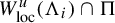 , respectively. One readily finds from Lemma 3.2 that those manifolds are given by smooth functions of the following forms:
-
• $W^s_{\mathrm {loc}}(M_1):Y=\psi ^s_{M_1}(X,Z)$
defined on
$[-\delta ,\delta ]\times [-\delta ,\delta ]^{d-d_1-1}$
; -
• $W^u_{\mathrm {loc}}(M_1):(X,Z)=\psi ^u_{M_1}(Y)$
defined on
$[-\delta ,\delta ]^{d_1}$
and, in particular,
$W^u_{\mathrm {loc}}(M_1)$
crosses
$\Pi '$
properly with respect to
$\mathcal {C}^{uu}$
defined in (9); -
• $W^s_{\mathrm {loc}}(M_2):(X,Y)=\psi ^s_{M_2}(Z)$
defined on
$[-\delta ,\delta ]^{d-d_1-1}$
and, in particular,
$W^s_{\mathrm {loc}}(M_2)$
crosses
$\Pi '$
properly with respect to
$\mathcal {C}^{ss}$
defined in (10); -
• $W^u_{\mathrm {loc}}(M_2):Z=\psi ^u_{M_2}(X,Y)$
defined on
$[-\delta ,\delta ]\times [-\delta ,\delta ]^{d_1}$
.


An immediate observation is that when a cs-blender and a cu-blender found in Proposition 4.3 coexist (that is, case (3)), they activate each other in the sense of Definition 2.1.
For the other cases in Proposition 4.3, we need the fact (see (3.23) of [Reference Li and Turaev26]) that

and the following lemma.
Lemma 4.4. [Reference Li and Turaev26, Lemma 6.5]
If
$\omega /2\pi $
 is irrational, then there exist infinitely many k such that
$F^{-k}_1\circ F^{-1}_{12}(W^s_{\mathrm {loc}}(O_2))$
 is a disc of the form

which crosses
$\Pi '$
 defined by (21) properly with respect to
$\mathcal {C}^{ss}$
 defined by (10).
Comparing the equations in (28) with those for
$W^u_{\mathrm {loc}}(M_1)$
 and
$W^s_{\mathrm {loc}}(M_2)$
 , we obtain

Here, the second intersection is used later in the proof of the perturbative results. By the first intersection, the formulas for
$W^s_{\mathrm {loc}}(M_2)$
 and
$W^u_{\mathrm {loc}}(M_2)$
 , and Lemma 4.4, one finds that
$O_2$
 is homoclinically related to the cu-blender found in Proposition 4.3 when
$\omega /2\pi $
 is irrational (that is, cases (1) and (2)). In this case, it follows from the lambda-lemma that
$O_2$
 also activates the cs-blender if the cu-blender does. In summary, we obtain the following lemma.
Lemma 4.5. The periodic point
$O_{2}$
 and the blenders found in Proposition 4.3 have the following homoclinic relations:
-
• in case (2), the cu-blender is homoclinically related to $O_2$
; and -
• in case (3), the cu-blender is homoclinically related to $O_2$
; the two blenders activate each other and, in particular,
$O_2$
activates the cs-blender.


4.4 Proofs of Theorem 1 and the first case in Theorem 3
Theorem 1 follows immediately from Proposition 4.3 and Lemma 4.5.
Proof of the first case in Theorem 3
Since being non-degenerate is an open and dense property in
$\mathcal {H}_f$
 , we take the neighborhood
$\mathcal {U}$
 of g sufficiently small such that
$\Gamma _f$
 is non-degenerate for all
$f\in \mathcal {U}$
 . Take any
$f\in \mathcal {U}$
 with irrational
$\theta (f)$
 and rational
$\omega (f)/2\pi =p/q$
 . According to the proof of Proposition 4.2, to obtain both a cs-blender and a cu-blender for f, it suffices to find
$r_1,r_2\in \{0,\ldots ,q-1\}$
 such that
$0<|\alpha _{r_1}|<1$
 and
$1<|\alpha _{r_2}|<\infty $
 (see (26)). Obviously, there exists
$N_f$
 depending on
$A,b,u^-,\eta _{1,2}$
 such that if
$q\geq N_f$
 , then one can always find such
$r_1$
 and
$r_2$
 . Since the cycle is non-degenerate for all
$f\in \mathcal{U}$
 , the involved coefficients are well defined and depend continuously on f. Thus, coexisting blenders appear whenever
$q\geq N(\mathcal {U})=\sup_{f\in\, \mathcal{U}} N_f$
 . The homoclinic relation follows from the formulas for the invariant manifolds of points of the blenders listed in §4.3.
5 Blenders near double-focus heterodimensional cycles
In this section, we prove Theorem 2 and the second case in Theorem 3, in the same fashion as for saddle-focus cycles. We first state the blender results and homoclinic relation results separately, and then prove the theorems.
5.1 Existence of blenders when at least one of
$\theta ,{\omega _1}/2\pi ,{\omega _2}/2\pi $
is irrational

Recall that for a double-focus heterodimensional cycle, we denote the center-stable multipliers by
$\unicode{x3bb} e^{\pm i\omega _1}$
 and the center-unstable multipliers by
$\gamma e^{\pm i\omega _2}$
 , where
$\unicode{x3bb}>0,\gamma >0$
 and
$0<\omega _{1,2}< \pi $
 . Let
$A^*>0,B^*>0,b,u^-,\eta_{1,2,3}$
 be the coefficients in (14) and (15). We first introduce a condition on the moduli
$\omega _1$
 and
$\omega _2$
 .
-
A2: There exist infinitely many pairs $(k,m)$
satisfying (12) and the inequalities (30) $$ \begin{align} &(\cos(m\omega_2+\eta_3)u^-_1+\sin(m\omega_2+\eta_3)u^-_2)\sin(k\omega_1+\eta_2)>0, \hspace{9pt} \sin(k\omega_1 +\eta_1)\neq 0, \nonumber\\[5pt] &\alpha_{k,m}:=\dfrac{A^*(\cos(m\omega_2+\eta_3)u^-_1+\sin(m\omega_2+\eta_3)u^-_2)}{(\cos(m\omega_2+\eta_3) + b\sin(m\omega_2+\eta_3))^2} \cdot \dfrac{\sin(k\omega_1+\eta_1)}{\sin(k\omega_1+\eta_2)}\neq\pm 1. \end{align} $$


Obviously, condition A2 is satisfied when both
$\omega _1/2\pi $
 and
$\omega _2/2\pi $
 are irrational. This condition also holds if
$\omega _1/2\pi $
 is irrational and
$\omega _2/2\pi =p/q$
 with
$q\geqslant 8$
 , and if
$\omega _1/2\pi =p_1/q_1$
 with
$q_1\geqslant 9$
 , and if
$\omega _2/2\pi =p_2/q_2$
 with
$q_2\geqslant 8$
 . Indeed, when
$q_2\geqslant 8$
 , there are at least six different values of
$m\omega _2\bmod 2\pi $
 in
$[0,2\pi )$
 , so at least one value will satisfy (12) and
$\cos (m\omega _2+\eta _3)u^-_1+\sin (m\omega _2+\eta _3)u^-_2\neq 0$
 . Taking this value fixes the factors involving m in (30). Then, arguing as in the saddle-focus case for condition A1, we find that, when
$\omega _1$
 is irrational or
$q_1\geqslant 9$
 , there is at least one value of
$k\omega _1 \bmod 2\pi $
 validating all inequalities in (30).
For the sake of clarity in proving our results, we classify the various possibilities of the arithmetic relations among
$\theta ,\omega _1/2\pi ,\omega _2/2\pi $
 into seven cases.
Proposition 5.1. Let
$\delta $
 be the size of
$\Pi $
 defined in (11), and
$\mathcal {C}^{ss}$
 and
$\mathcal {C}^{uu}$
 be given by Lemma 3.3 with a sufficiently small K. Let a non-degenerate double-focus heterodimensional cycle satisfy condition A2 and U be any neighborhood of the cycle.
-
(1) If $\theta $
is irrational and
$\omega _1/2\pi ,\omega _2/2\pi $
are rational, then, for every sufficiently large pair
$(k,m)$
satisfying condition A2, there exists a cs-blender in U if
$|\alpha _{k,m}|<1$
(defined in (30)), or a cu-blender in U if
$|\alpha _{k,m}|>1$
. -
(2.1) If $\omega _1/2\pi $
is irrational,
$\omega _2/2\pi $
is rational, and
$\theta ,\omega _1/2\pi ,1$
are rationally independent, then there exist simultaneously a cs-blender and a cu-blender in U. -
(2.2) If $\omega _1/2\pi $
is irrational,
$\omega _2/2\pi $
is rational, and
$\theta ,\omega _1/2\pi ,1$
are rationally dependent, then there exists a cu-blender in U. -
(3.1) If $\omega _1/2\pi ,\omega _2/2\pi $
are irrational, and
$\theta ,\omega _1/2\pi ,\theta \omega _2/2\pi ,1$
are rationally independent, then there exist simultaneously a cs-blender and a cu-blender in U. -
(3.2) If $\omega _1/2\pi ,\omega _2/2\pi $
are irrational,
$\theta ,\omega _1/2\pi ,\theta \omega _2/2\pi ,1$
are rationally dependent, but
$\theta ,\omega _1/2\pi ,1$
are rationally independent, then there exist simultaneously a cs-blender and a cu-blender in U. -
(3.3.1) If $\omega _1/2\pi ,\omega _2/2\pi $
are irrational,
$\theta ,\omega _1/2\pi ,1$
are rationally dependent, and
$\omega _1/2\pi ,\theta \omega _2/2\pi ,1$
are rationally dependent, then there exists a cu-blender in U. -
(3.3.2) If $\omega _1/2\pi ,\omega _2/2\pi $
are irrational,
$\theta ,\omega _1/2\pi ,1$
are rationally dependent, and
$\omega _1/2\pi ,\theta \omega _2/2\pi ,1$
are rationally independent, then there exists a cu-blender in U.


In each of the above cases, the cs-blender has index
$d_1$
 and an activating pair
$(\Pi ',\mathcal {C}^{ss})$
 , while the cu-blender has index
$(d_2=d_1+1)$
 and an activating pair
$(\Pi ',\mathcal {C}^{uu})$
 , where the cube
$\Pi '$
 is defined as

for some
$c\in (0,1)$
 .
We postpone the proof of this proposition to §5.3, after we prove the theorems.
5.2 Homoclinic relations in the double-focus case
Let us find out the homoclinic relations among the found blenders in Proposition 5.1, and the periodic points
$O_1$
 and
$O_2$
 . Denote by
$\Lambda _1$
 and
$\Lambda _2$
 the cs- and cu-blenders. Since the proof of Proposition 5.1 (see §5.4) is also based on the use of Proposition 4.2, the structures of
$\Lambda _i\, (i=1,2)$
 are completely the same as those in the saddle-focus case, that is, they consist of points whose orbits under the corresponding sets of first return maps never leave the cube
$\Pi $
 defined in (11), and their activating domain is
$\Pi '$
 defined in (31). (See the discussion at the beginning of §4.3). One concludes from Lemma 3.3 that for any points
$M_1\in \Lambda _1\cap \Pi '$
 and
$M_2\in \Lambda _2\cap \Pi '$
 , their local invariant manifolds are given by smooth functions of the following forms:
-
• $W^s_{\mathrm {loc}}(M_1):W=\psi ^s_{M_1}(U,V)$
defined on
$[-\delta ,\delta ]\times [-\delta ,\delta ]^{d-d_2}$
with c in (31); -
• $W^u_{\mathrm {loc}}(M_1):(U,V)=\psi ^u_{M_1}(W)$
defined on
$[-\delta ,\delta ]^{d_2-1}$
and, in particular,
$W^u_{\mathrm {loc}}(M_1)$
crosses
$\Pi $
properly with respect to
$\mathcal {C}^{uu}$
defined in (16); -
• $W^s_{\mathrm {loc}}(M_2):(U,W)=\psi ^s_{M_2}(V)$
defined on
$[-\delta ,\delta ]^{d-d_2}$
and, in particular,
$W^s_{\mathrm {loc}}(M_2)$
crosses
$\Pi $
properly with respect to
$\mathcal {C}^{ss}$
defined in (17); -
• $W^u_{\mathrm {loc}}(M_2):V=\psi ^u_{M_2}(U,W)$
defined on
$[-\delta ,\delta ]\times [-\delta ,\delta ]^{d_2-1}$
.



Obviously, whenever two blenders in Proposition 5.1 coexist (that is, cases (2.1), (3.1) and (3.2)), they activate each other in the sense of Definition 2.1.
For other cases in Proposition 5.1, we need the fact, given at the end of [Reference Li and Turaev26, §6.4], that

where
$\psi =O(U^2+\delta V^2)$
 is some smooth function defined on
$[-c\delta ,c\delta ]\times [-\delta ,\delta ]^{d-d_2}$
 . Comparing these equations with those for
$W^s_{\mathrm {loc}}(M_2)$
 and
$W^u_{\mathrm {loc}}(M_1)$
 , we obtain that

For other heteroclinic intersections, we use the following lemma.
Lemma 5.2. [Reference Li and Turaev26, Lemma 6.8]
If
$\omega _2/2\pi $
 is irrational, then there exist infinitely many m such that
$F^{m}_2\circ F_{12}(W^u_{\mathrm {loc}}(O_1))\cap \Pi '$
 is a disc of the form
$(U,V)=s(W),$
 crossing
$\Pi '$
 properly with respect to
$\mathcal {C}^{uu}$
 defined by (16).
Lemma 5.3. [Reference Li and Turaev26, Lemma 6.9]
If
$\omega _1/2\pi $
 is irrational, then there exist infinitely many k such that
$F^{-1}_{21}\circ F^{-k}_1\circ F^{-1}_{12}(W^s_{\mathrm { loc}}(O_2))$
 is a disc of the form
$(U,W)=s_2(V),$
 crossing
$\Pi '$
 defined by (31) properly with respect to
$\mathcal {C}^{ss}$
 defined by (17).
Thus, if
$\omega _2/2\pi $
 is irrational, then
$W^u(O_1)\pitchfork W^s(\Lambda _1)\neq \emptyset $
 , which, along with (32), implies that
$O_1$
 is homoclinically related to the cs-blender
$\Lambda _1$
 ; if
$\omega _1/2\pi $
 is irrational, then
$W^s(O_2)\pitchfork W^u(\Lambda _2)\neq \emptyset $
 , which, along with (32), implies that hence
$O_2$
 is homoclinically related to the cu-blender
$\Lambda _2$
 . In summary, we obtain the following lemma.
Lemma 5.4. The periodic points
$O_{1,2}$
 and the blenders found in Proposition 5.1 have the following homoclinic relations:
-
• in case (2.1), the cu-blender is homoclinically related to $O_2$
; the two blenders activate each other and, in particular,
$O_2$
activates the cs-blender; -
• in case (2.2), the cu-blender is homoclinically related to $O_2$
; -
• in cases (3.1) and (3.2), the cs-blender is homoclinically related to $O_1$
and the cu-blender is homoclinically related to
$O_2$
; the two blenders activate each other, and, in particular,
$O_1$
activates the cu-blender and
$O_2$
activates the cs-blender; and -
• in cases (3.3.1) and (3.3.2), the cu-blender is homoclinically related to $O_2$
and activated by
$O_1$
.


5.3 Proofs of Theorem 2 and the second case in Theorem 3
Proof of Theorem 2
Cases (2.1) and (2.2) in Proposition 5.1 together with Lemma 5.4 cover case (1.i) and, by considering
$f^{-1}$
 , also case (1.ii). Since the rational independence of
$\theta ,\omega _1/2\pi ,1$
 implies the irrationality of
$\theta $
 , case (2.i) follows from case (2.1) in Proposition 5.1 and Lemma 5.4. Using
$f^{-1}$
 , we also obtain case (2.ii). Case (3) follows immediately from case (1) in Proposition 5.1.
What remains is case (1.iii), whose hypothesis is covered by those of cases (3.1), (3.2), (3.3.1), and (3.3.2) in Proposition 5.1. We are done if either of the hypotheses in cases (3.1) and (3.2) holds. Now, suppose we are under the hypothesis of case (3.3.1). With Lemma 5.4, this gives us a cu-blender homoclinically related to
$O_2$
 and activated by
$O_1$
 . Considering
$f^{-1}$
 leads to one of cases (3.1), (3.2), (3.3.1) and (3.3.2). Since the roles of
$O_1$
 and
$O_2$
 interchange for
$f^{-1}$
 , it follows from Proposition 5.1 and Lemma 5.4 that we always have a cu-blender of
$f^{-1}$
 , homoclinically related to
$O_1$
 and activated by
$O_2$
 . This blender is a cs-blender of f. Using the lambda-lemma, we see that this cs-blender and the previous cu-blender activate each other, giving the desired result for case (1.iii). The proof with the hypothesis of case (3.3.1) is the same.
Proof of the second case in Theorem 3
The proof is essentially the same as in the saddle-focus case. The only difference is that the quantity
$\alpha _k$
 there is replaced by
$\alpha _{k,m}$
 defined in (30), which depends on the coefficients
$A^*,b,u^-_1,u^-_2,\eta _{1,2,3}$
 in (14). Take the neighborhood
$\mathcal {U}$
 of g sufficiently small such that
$\Gamma _f$
 is non-degenerate for all
$f\in \mathcal {U}$
 . Take any
$f\in \mathcal {U}$
 with rational
$\omega _1(f)/2\pi $
 and
$\omega_2(f)/2\pi $
 , and denote their denominators by
$q_1$
 and
$q_2$
 , respectively. Since the coefficients depend on f continuously, there exists a lower bound
$N_1(\mathcal {U})$
 such that if
$q_1\geqslant N_1(\mathcal {U})$
 and
$q_2\geqslant 8$
 , then one can find
$r_1,r_1'\in \{0,\ldots ,q_1-1\}$
 and
$r_2\in \{0,\ldots ,q_2-1\}$
 satisfying that
$|\alpha _{r_1,r_2}|<1$
 and
$|\alpha _{r^{\prime }_1,r_2}|>1$
 . Note that here, taking
$q_2\geqslant 8$
 is only for the validation of condition A2 and, after fixing
$r_2$
 , one only needs to change
$r_1$
 to adjust the values of
$|\alpha _{r_1,r_2}|$
 . Applying the same arguments to
$f^{-1}$
 gives a lower bound
$N_2(\mathcal {U})$
 for
$q_2$
 . Setting
$N(\mathcal {U})=\max \{N_1(\mathcal {U}),N_2(\mathcal {U})\}$
 proves the theorem.
5.4 Proof of Proposition 5.1
We first prove an auxiliary result (Lemma 5.5). Define two functions


where
$S^1=[0,1]$
 with the endpoints identified, and
$A,B,\xi $
 are given in (15). We consider two classes of lines and one class of planes in
$\mathbb {R}^3$
 :

where
$s^*$
 and
$w^*$
 are constants satisfying


where
$a_1^2+b^2\neq 0,a_2\neq 0$
 , and
$w^*$
 satisfies
$A(2\pi w^*)B(2\pi w^*)\xi (2\pi w^*)\not \in \{0,\infty \}$
 ;

where
$a^2+b^2\neq 0$
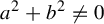 and
$w^*$
 satisfies
$A(2\pi w^*)B(2\pi w^*)\xi (2\pi w^*)\not \in \{0,\infty \}$
 .
Lemma 5.5. For a sequence
$E=\{(t_n,s_n,w_n)\}$
 of points in
$\mathbb {R}^3$
 :
-
(1) if the closure $cl(E)$
contains a proper horizontal line, then there exists a subsequence for which
$\{h(t_n,s_n,w_n)\}$
is dense near zero and
$\{|g(t_n,s_n,w_n)|\}$
belongs to some closed interval either in
$(0,1)$
or in
$(1,\infty )$
, depending on
$s^*$
and
$w^*$
in (35), and coefficients in g and h; -
(2) if the closure $cl(E)$
contains a proper tilted line, then there exists a subsequence for which
$\{h(t_n,s_n,w_n)\}$
is dense near zero and
$\{|g(t_n,s_n,w_n)|\}$
belongs to some closed interval in
$(1,\infty )$
; -
(3) if the closure $cl(E)$
contains a proper plane, then there exist two subsequences such that
$\{h(t_n,s_n,w_n)\}$
is dense near zero for both of them, and
$\{|g(t_n,s_n,w_n)|\}$
belongs to some closed interval in
$(0,1)$
for one of them and in
$(1,\infty )$
for the other.


Proof. To simplify the proof, we consider g and h as functions
$\mathbb {R}^3\to \mathbb {R}$
 , which makes no difference by the formulas of g and h. Also note that if a sequence approximates a proper line or a proper plane in
$\mathbb {R}\times S^1\times S^1$
 , then its lift in
$\mathbb {R}^3$
 also approximates the lift of the proper line or proper plane.
Case (1). Let the proper horizontal line be given by (35). Its image by h is parameterized as

It follows from the first inequality in (36) that this image covers a neighborhood of zero. Since
$cl(E)$
 contains the proper horizontal line, by continuity of
$h_1$
 , we obtain a subsequence for which
$\{h(t_n,s_n,w_n)\}$
 is dense near zero. Let us denote the subsequence by the same notation. By (33) and (34), we have

This gives the desired result on
$|g(t_n,s_n,w_n)|$
 due to the second inequality in (36).
Case (2). Let the proper tilted line be given by (37). By (15), one can find a small interval
$\Delta _i$
 arbitrarily close to
$s=(-\eta _2/2\pi )+i$
 with
$i\in \mathbb {Z}$
 such that

for all
$s\in \Delta _i$
 with
$w=a_2s$
 or
$w=w^*$
 . Since
$\xi (2\pi w)$
 is bounded, taking n sufficiently large and
$\Delta _i$
 sufficiently close to
$s=(-\eta _2/2\pi )+i$
 ensures that the images of the functions

obtained with
$w=a_2 s$
 in (37), and

obtained with
$w=w^*$
 in (37) both cover a small neighborhood of zero. Now, take a subsequence of E approximating the line segment obtained by intersecting the tilted line with
$\{(t,w,w)\mid s\in \Delta _i\}$
 . Obviously, for this subsequence,
$\{h(t_n,s_n,w_n)\}$
 is dense near zero. Moreover, when
$\Delta _i$
 is taken sufficiently close, the value of
$\sin (2\pi s+\eta _2)$
 is arbitrarily close to zero, which together with (39) implies that
$\{|g(t_n,s_n,w_n)|\}$
 lie in some closed interval in
$(1,\infty )$
 .
Case (3). We now take a small interval
$\Delta _i$
 arbitrarily close to
$s=(-\eta _2/2\pi ) +i$
 and a small interval
$\Delta ^{\prime }_i$
 arbitrarily close to
$s=-\eta _1/2\pi +i$
 . Define two functions

in the first case of (38), and

in the second case of (38). Obviously, one can find
$t^*$
 such that, for all
$s\in \Delta _i$
 , and either
$w=at^*+bs$
 or
$w=w^*$
 , the inequalities in (40) are satisfied and
$h_{31}(\Delta _i)$
 or
$h_{32}(\Delta _i)$
 , depending on whether
$w=at^*+bs$
 or
$w=w^*$
 , covers a small neighborhood of zero. Then, consider the subsequence approximating the intersection of the proper plane with
$\{t=t^*, s\in \Delta _i\}$
 . Proceeding as in case (2) shows that
$\{h(t_n,s_n,w_n)\}$
 is dense near zero and
$\{|g(t_n,s_n,w_n)|\}$
 lie in some closed interval in
$(1,\infty )$
 . Considering a similar number
$t^*$
 for
$s\in \Delta _i'$
 gives another required subsequence.
Proof of Proposition 5.1
Denote

Recall that in the double-focus case, we have
$\unicode{x3bb}>0,\gamma >0$
 , so
$\unicode{x3bb} ^k\gamma ^m=\gamma ^{m-k\theta }.$
 Comparing
$A_{k,m}$
 and
$B_{k,m}$
 in (14) with functions g and h given by (33) and (34), yields

It follows that, for any sequence
$\{(t_n,s_n,w_n)\}$
 falling in one of the cases of Lemma 5.5, Proposition 4.2 is applicable to the system
$\{T_n:=T_{k_n,m_n}\}$
 (passing to the subsequence in the lemma) given by (13), with the correspondence
$U\to X, W\to Y, V\to Z.$
 More specifically, we have that:
-
• if $\{(t_n,s_n,w_n)\}$
approximates a proper horizontal line, then there exists a blender whose type depends on the coefficients in (13); -
• if $\{(t_n,s_n,w_n)\}$
approximates a proper tilted line, then there exists a cu-blender; and -
• if $\{(t_n,s_n,w_n)\}$
approximates a proper plane, then there exist simultaneously a cs-blender and a cu-blender.


Moreover, since the cone field in Proposition 4.2 does not depend on
$\delta $
 and k, one concludes (as in the proof of Proposition 4.3) that the obtained blender has an activating pair
$(\Pi ',\mathcal {C}^{ss})$
 if it is center-stable or
$(\Pi ',\mathcal {C}^{uu})$
 if it is center-unstable, where
$\Pi $
 is defined in (31), and
$\mathcal {C}^{ss}$
 and
$\mathcal {C}^{uu}$
 are given by Lemma 3.3.
We thus prove Proposition 5.1 by showing that, for each of the cases in the statement of the proposition, one can find a sequence
$\{(k_n,m_n)\}$
 such that
$\{(t_n,s_n,w_n)\}$
 given by (41) approximates a proper line or a proper plane. Recall that
$\omega _{1,2}\in (0,\pi )$
 and by
$p/q$
 , we always mean that p and q are positive coprime integers.
Case (1):
${\theta }$
 is irrational,
${\omega _1/2\pi ,\omega _2/2\pi }$
 are rational. Denote

Since condition A2 is satisfied, there exist integers
$r_1\in \{0,\ldots ,q_1-1\}$
 and
$r_2\in \{0,\ldots ,q_2-1\}$
 such that inequalities in (36) are satisfied with
$s^*=r_1{\omega _1}/{2\pi }$
 and
$w^*=r_2\omega _2/2\pi $
 . Then,

is a proper horizontal line of the form (35). The irrationality of
$\theta $
 implies that we can take a sequence
$\{(k^{\prime }_n,m^{\prime }_n)\}$
 of pairs of positive integers such that the set

is dense in
$\mathbb {R}$
 . Setting
$k_n=q_1k^{\prime }_n+r_1$
 and
$ m_n=q_2m^{\prime }_n+r_2$
 in (41) gives a sequence whose closure contains the above proper horizontal line. So, we get a cs-blender if
$|\alpha _{r_1,r_2}|<1$
 or a cu-blender if
$|\alpha _{r_1,r_2}|>1$
 .
Case (2.1):
$ {\omega _1/2\pi }$
 is irrational,
$ {\omega _2/2\pi }$
 is rational, and
$ {\theta ,\omega _1/2\pi ,1}$
 are rationally independent. Let
$p_2,q_2,r_2$
 be as in the preceding case. By the rational independence among
$\theta ,\omega _1/2\pi ,1$
 , one can find a sequence
$\{(k^{\prime }_n,m^{\prime }_n,i^{\prime }_n)\in \mathbb {N}^3\}$
 such that the set

is dense in
$\mathbb R^2$
 . Setting
$k_n=k^{\prime }_n$
 and
$m_n=q_2m^{\prime }_n+r_2$
 in (41) gives a sequence whose closure contains the proper plane
$\{w=r_2\omega _2/2\pi \}.$
 So, we get simultaneously a cs-blender and a cu-blender.
Before proceeding to other cases, we make the following claim.
Claim. To prove that there exists
$\{(t_n,s_n,w_n)\}$
 given by (41) approximating a proper line or a proper plane, it suffices to show that each point of this proper line or proper plane is accumulated by points of the set

for some sequence
$\{(k_n,m_n)\}$
 .
Indeed, the assumption particularly implies that, for each rational point in the proper line or proper plane, we have such a sequence
$\{(k_n,m_n)\}$
 and, hence, the union of these countably many sequences gives a new sequence which defines the desired
$\{(t_n,s_n,w_n)\}$
 by (41).
Case (2.2):
$ {\omega _1/2\pi }$
 is irrational,
$ {\omega _2/2\pi }$
 is rational, and
$ {\theta ,\omega _1/2\pi ,1}$
 are rationally dependent. Denote

With
$r_2$
 as in case (1), the set
$\{t=-sp_1/q_1+r_2,w=r_2p_3/q_3\bmod 1\}$
 is a proper tilted line. Let us show that each point of this line can be approximated by the set (42).
By the irrationality of
$\omega _1/2\pi $
 , the set

is dense in
$\mathbb {R}$
 . So, for any
$s\in [0,1]$
 , one can find a sequence
$\{(k_n',i_n')\}$
 such that

Denote
$k_n=q_2q_3k^{\prime }_n $
 and
$ m_n=r_2+p_2q_3k^{\prime }_n+p_1q_3i^{\prime }_n.$
 The relation (43) then implies

which gives the desired approximation. By the claim, we have a cu-blender.
Case (3.1):
$ {\omega _1/2\pi ,\omega _2/2\pi }$
 are irrational and
${\theta ,\omega _1/2\pi ,\theta \omega _2/2\pi ,1}$
 are rationally independent. The rational independence implies that, for any point
$(t,s,w)$
 , there exists
$\{(k_n,m_n,i_n,\ell _n)\}$
 such that

Combining the first and third relations yields

which implies

Therefore, any point of any proper plane can be approximated by a sequence of the form (42). By the claim, we get simultaneously a cs-blender and a cu-blender.
Case (3.2):
${\omega _1/2\pi ,\omega _2/2\pi }$
 are irrational,
${\theta ,\omega _1/2\pi ,\theta \omega _2/2\pi ,1}$
 are rationally dependent, but
${\theta ,\omega _1/2\pi ,1}$
 are rationally independent. Denote

Since
$\theta ,\omega _1/2\pi ,1$
 are rationally independent, the set

is dense in
$\mathbb {R}^2$
 . Hence, for any point
$(t,s)$
 , there exists a sequence
$(k^{\prime }_n,m^{\prime }_n,i^{\prime }_n)$
 such that

Denote
$k_n=q_3k^{\prime }_n $
 and
$ m_n=q_1m^{\prime }_n.$
 The relation (46) shows that

Thus, any point of the proper plane
$\{w=at+bs\bmod 1\}$
 can be approximated by a sequence of the form (42). By the claim, we get simultaneously a cs-blender and a cu-blender.
Case (3.3.1):
$ {\omega _1/2\pi ,\omega _2/2\pi }$
 are irrational,
$ {\theta ,\omega _1/2\pi ,1}$
 are rationally dependent, and
$ {\omega _1/2\pi ,\theta \omega _2/2\pi ,1}$
 are rationally dependent. Denote

The irrationality of
$\omega _1/2\pi $
 implies that the set

is dense in
$\mathbb {R}$
 . For any
$s\in [0,1]$
 and any sequence
$(k^{\prime }_n,i^{\prime }_n)$
 such that

denote
$k_n=q_2q_4k^{\prime }_n $
 and
$ m_n=p_2q_4k^{\prime }_n+p_1q_3i^{\prime }_n.$
 The relations in (47) show that

Observing the relation between (44) and (45), one finds

Thus, any point of the proper tilted line
$\{t=-p_1s/q_1,w=as\}$
 can be approximated by a sequence of the form (42). The claim then gives a cu-blender.
Case (3.3.2):
$ {\omega _1/2\pi ,\omega _2/2\pi }$
 are irrational,
$ {\theta ,\omega _1/2\pi ,1}$
 are rationally dependent, and
$ {\omega _1/2\pi ,\theta \omega _2/2\pi ,1}$
 are rationally independent. We still denote
$\theta $
 as in (47). For any
$s\in [0,1]$
 and any sequence
$(k^{\prime }_n,i^{\prime }_n)$
 such that

denote
$k_n=q_2k_n' $
 and
$ m_n=p_2k^{\prime }_n+p_1i^{\prime }_n.$
 The first relation in (47) gives

It then follows from the rational independence among
$\omega _1/2\pi ,\theta \omega _2/2\pi ,1$
 , and the correspondence relation between (44) and (45) that any point of any proper tilted line in the plane
$\{t=-p_1s/q_1\}$
 can be approximated by a sequence of the form (42). The claim then gives a cu-blender.
6 Robust heterodimensional dynamics in generic one-parameter unfolding families: proof of Theorem 4
Finding robust heterodimensional dynamics is essentially equivalent to connecting the invariant manifolds of the blenders and periodic orbits
$O_{i}$
 (
$i=1,2$
 ). As shown in §§4.3 and 5.2, the structure of the blenders obtained in this paper is quite clear in the small neighborhood
$\Pi $
 of
$M^+_1$
 (for saddle-focus cycles) and of
$M^-_2$
 (for double-focus cycles), with explicit formulas for their local invariant manifolds. The homoclinic relations or activations between blenders and the points
$O_{i}$
 depend on how the local invariant manifolds of
$O_i$
 behave along the dynamics of the cycle. By construction, the intersections of
$W^s(O_1)$
 with the unstable manifolds of the blenders and the intersections of
$W^u(O_2)$
 with the stable manifolds of the blenders are automatic (see (29) and (32)). The other intersections depend on the positions of the iterates

for saddle-focus cycles, and

for double-focus cycles. Basically, one gets the intersection of
$W^u(O_1)$
 with the stable manifolds of the blenders if the first iterate in each case crosses
$\Pi '$
 , and gets the intersection of
$W^s(O_2)$
 with the unstable manifolds of the blenders if the second iterate in each case crosses
$\Pi '$
 . According to Lemma 4.4, the second iterate in the saddle-focus case always hits
$\Pi '$
 if
$\omega /2\pi $
 is irrational. Similarly, in the double-focus case, Lemmas 5.2 and 5.3 show that the two iterates cross
$\Pi '$
 if
$\omega _2/2\pi $
 and
$\omega _1/2\pi $
 , respectively, is irrational. Thus, the proof of Theorem 3 is essentially about verifying the intersections of these iterates with
$\Pi '$
 when
$\omega /2\pi $
 and
$\omega _i/2\pi $
 are rational and the cycle is unfolded.
Recall that
$\mu $
 is the splitting parameter of a non-degenerate heterodimensional cycle, see Remark 3.1. A one-parameter unfolding family
$\{f_\varepsilon \}$
 with
$f_0=f$
 having a non-degenerate cycle satisfies
$d\mu (0)/d\varepsilon \neq 0$
 (see (2)). Since it suffices to prove the results for one-parameter families, we simply use
$\mu $
 as a new parameter, replacing
$\varepsilon $
 .
6.1 Unfolding saddle-focus heterodimensional cycles
Let us first deal with saddle-focus cycles, where the center-stable multipliers are non-real and the center-unstable one is real, denoted by
$\unicode{x3bb} e^{i\omega }$
 and
$\gamma $
 , respectively. For brevity, we denote below the continuations of hyperbolic objects (e.g.,
$O_{1,2}$
 and the blenders) by the same letters and drop the term ‘continuation’.
Let the coefficient
$A,B,u^-,b,\eta _{1,2}$
 be as in (7), let the cube
$\Pi '$
 be given by (21), and let the cone fields
$\mathcal {C}^{ss}$
 and
$\mathcal {C}^{uu}$
 be given by Lemma 3.2.
Lemma 6.1. [Reference Li and Turaev26, Lemma 6.4]
Fix any sufficiently small
$\delta $
 . For every sufficiently large m, if

then
$F_{21}\circ F_2 \circ F_{12}(W^u_{\mathrm {loc}}(O_1))$
 is a disc of the form
$(X,Z)=s(Y)$
 for some smooth function s, which crosses
$\Pi '$
 properly with respect to
$\mathcal {C}^{uu}$
 .
As mentioned, the coordinates in [Reference Li and Turaev26] are
$(X_1,X_2,Y,Z)$
 , and in this paper, we dropped the subscript of
$X_1$
 and grouped
$X_2,Z$
 as a new Z coordinate. Moreover, the coefficient
$b_{11}$
 there is denoted by b in this paper.
Lemma 6.2. Suppose
$\omega /2\pi =p/q$
 . Fix a sufficiently small
$\delta $
 and any
$r\in \{0,\ldots ,q-1\}$
 . For every
$k=r+iq$
 with sufficiently large i, if

then
$F^{-k}_1\circ F^{-1}_{12}(W^s_{\mathrm {loc}}(O_2))$
 is a disc of the form
$(X,Y)=s(Z)$
 for some smooth function s, which crosses
$\Pi '$
 properly with respect to
$\mathcal {C}^{ss}$
 .
The proof of Lemma 6.2 is given in Appendix B.2 as a minor modification of the proof of [Reference Li and Turaev26, Lemma 6.5].
Proof of Theorem 4 for the saddle-focus case
The results in Theorem 4 for the saddle-focus case are those concerning Theorems 1 and 3. By (2), we only need to consider the family
$\{f_\mu \}$
 with
$f_0=f$
 . Since blenders persist under
$C^1$
 -small perturbations, the homoclinic relations and activations obtained in Theorems 1 and 3 are preserved for all small
$\mu $
 .
Case (1) of Theorem 1. It suffices to show that
$O_1$
 activates the cu-blender
$\Lambda ^{cu}$
 and is homoclinically related to some non-trivial hyperbolic basic set. Then, by the lambda-lemma, this set also activates
$\Lambda ^{cu}$
 . Since
$W^s_{\mathrm {loc}}(O_1)=\{Y=0\}$
 by (28), Lemma 6.1 implies that there exists a sequence
$\mu _j\to 0$
 such that
$F_{21}\circ F_2 \circ F_{12}(W^u_{\mathrm {loc}}(O_1))\cap W^s_{\mathrm {loc}}(O_1)\neq \emptyset $
 , which gives a hyperbolic basic set homoclinically related to
$O_1$
 . To see that
$O_1$
 activates
$\Lambda ^{cu}$
 , we note first that
$W^s(O_1)\cap W^u(\Lambda ^{cu})\neq \emptyset $
 by (28) and the formula for
$W^u_{\mathrm {loc}}(M_2)$
 in §4.3. Then, since
$\Lambda ^{cu}$
 is obtained from Proposition 4.3 and hence has an activating pair
$(\Pi ',\mathcal {C}^{uu})$
 , the proper crossing part of Lemma 6.1 shows that
$O_1$
 indeed activates
$\Lambda ^{cu}$
 .
Case (2) of Theorem 1. One only needs to create a homoclinic relation between the cs-blender
$\Lambda ^{cs}$
 and
$O_1$
 by changing
$\mu $
 . The intersection
$W^s(O_1)\cap W^u(\Lambda ^{cs})\neq \emptyset $
 is automatic at
$\mu =0$
 by (28) and the formula for
$W^u_{\mathrm {loc}}(M_1)$
 in §4.3. With the formula for
$W^s_{\mathrm {loc}}(M_1)$
 in the same section, one obtains by Lemma 6.1 a sequence
$\mu _j\to 0$
 for which
$W^u(O_1)\cap W^s(\Lambda ^{cs})\neq \emptyset .$

Case (3) of Theorem 1 and Theorem 3. Before proceeding to the rational
$\omega $
 cases, let us make an observation. By similar arguments to the above cases, we obtain that, when Lemma 6.2 holds,
$O_2$
 is homoclinically related to the cu-blender in Proposition 4.3, if it exists; it activates the cs-blender, if it exists; and, it is always homoclinically related to a non-trivial hyperbolic basic set. We have thus proved that
for every sufficiently small
$\mu $
 satisfying both conditions (48) and (49), each of
$O_1$
 and
$O_2$
 is homoclinically related to a non-trivial hyperbolic basic set; and moreover, whenever there is a cs-blender from Proposition 4.3, it is homoclinically related to
$O_1$
 and activated by
$O_2$
 , and whenever there is a cu-blender from Proposition 4.3, it is homoclinically related to
$O_2$
 and activated by
$O_1$
 .
Then, the results concerning Theorem 3 and case (3) of Theorem 1 follow immediately from the following claim.
Claim 6.3. There exists a sequence
$\mu _j\to 0$
 with each
$\mu _j$
 satisfying both conditions (48) and (49).
This completes the proof of Theorem 4 for saddle-focus cycles. Let us prove the above claim. Note that (48) and (49) give two intervals
$I^u_m$
 and
$I^s_k$
 , respectively, of
$\mu $
 values such that the inequality is satisfied if
$\mu $
 lies in the corresponding interval. It then suffices to find a sequence
$\{k_n,m_n\}$
 with
$k_n,m_n\to \infty $
 such that
$I^u_{m_n}\cap I^s_{k_n}\neq \emptyset $
 . The centers of these two intervals are given by

and the radius of
$I^u_m$
 is
$|\gamma ^{-m}b^{-1}|q\delta /2$
 . Now, set
$k_n=k^{\prime }_nq+r$
 and
$m_n=m^{\prime }_n$
 as in (23). It follows from (24) that

which shows that
$I^u_{m_n}\cap I^s_{k_n}\neq \emptyset $
 for all sufficiently large n.
6.2 Unfolding double-focus heterodimensional cycles
Here, we have the following counterpart to Lemmas 6.1 and 6.2, and Claim 6.3.
Lemma 6.4. Let the cube
$\Pi '$
 be given by (31), and the cone fields
$\mathcal {C}^{uu}$
 and
$\mathcal {C}^{ss}$
 be given by Lemma 3.3.
-
• If $\omega _2/\pi $
is rational, then there exists a sequence of intervals
$I^u_m$
such that, for all sufficiently large m, if
$\mu \in I^u_m$
, then
$F^{m}_2\circ F_{12}(W^u_{\mathrm {loc}}(O_1))\cap \Pi '$
is a disc of the form
$(U,V)=s(W),$
crossing
$\Pi '$
properly with respect to
$\mathcal {C}^{uu}$
. -
• If $\omega _1/\pi $
is rational, then there exists a sequence of intervals
$I^s_k$
such that, for all sufficiently large k, if
$\mu \in I^s_k$
, then
$F^{-1}_{21}\circ F^{-{k}}_1\circ F^{-1}_{12}(W^s_{\mathrm {loc}}(O_2))\cap \Pi '$
is a disc of the form
$(U,W)=s_2(V),$
crossing
$\Pi '$
properly with respect to
$\mathcal {C}^{ss}$
. -
• If both $\omega _1/\pi $
and
$\omega _2/\pi $
are rational, then there exists
$\{k_n,m_n\}$
such that
$I^u_{m_n}\cap I^s_{k_n}\neq \emptyset $
for all large n.


The first two items are perturbative versions of Lemma 5.2 and Lemma 5.3, respectively. They can be obtained by modifying the proofs in [Reference Li and Turaev26, §6.4.5] in the same way as we did to obtain Lemma 6.2, the perturbative version of Lemma 4.4. The third item can also be proved in the same way as Claim 6.3. We hence omit their proofs. Theorem 4 for double-focus cycles then follows from the routine checks as in §6.1, with using the above results and the lemmas in §5.2.
7 Purely rational moduli: proof of Theorem B
Since the set of non-degenerate cycles is open and dense in
$\mathcal {H}_f$
 (see Appendix A), we can always assume that the cycle in Theorem B is non-degenerate. The first item of Theorem B concerns the saddle case, that is, when both the center-stable multiplier
$\unicode{x3bb} $
 and center-unstable multiplier
$\gamma $
 are real, which follows immediately from [Reference Li and Turaev26, Theorem 6].
We now consider the saddle-focus and double-focus cases. We need to investigate the set of orbits that lies entirely in a small neighborhood U of a heterodimensional cycle. Recall that a cycle is the union
$\Gamma =L_1\cup L_2\cup \Gamma ^0\cup \Gamma ^1$
 , where
$L_{1,2}$
 are the orbits of the periodic points
$O_{1,2}$
 , and
$\Gamma ^0$
 and
$\Gamma ^1$
 are the two heteroclinic orbits in
$W^u(L_1)\cap W^s(L_2)$
 and
$W^u(L_2)\cap W^s(L_1)$
 , respectively. An orbit which lies entirely in U, except for those in the invariant manifolds of
$L_{1,2}$
 , must intersect the neighborhood
$\Pi $
 of
$M^+$
 infinitely many times for both forward and backward iterations. In particular, an intersection of
$\Pi $
 with any orbit gives a pair of two points M and
$\bar M$
 in this orbit satisfying
$\bar M=T_{k,m}(M)$
 . In what follows, we show that (Lemma 7.1) for any sequence of pairs
$\{(k_i,m_i)\}$
 corresponding to intersection points of
$\Pi $
 with any set of orbits, the assumption of rational moduli imposes a strong relation on the pairs, which thus leads to simple hyperbolic dynamics.
7.1 Simple hyperbolic dynamics in the saddle-focus case
Let us first deal with the saddle-focus cycles, where the center-stable and center-unstable multipliers are
$\unicode{x3bb} e^{\pm i\omega }$
 and
$\gamma $
 , and we assume that
$\theta $
 and
$\omega /2\pi $
 are rational.
Consider a generic unfolding family
$\{f_\mu \}$
 . To study the dynamics, we use the following perturbative version of formula (6), which is easily derived from [Reference Li and Turaev26] in Appendix B.3: any two points
$(X,Y,Z),(\bar X,\bar Y,\bar Z)\in \Pi $
 (the domain defined in (4)) satisfy
$(\bar X,\bar Y,\bar Z)=T_{k,m}(X,Y,Z)$
 for some pair
$(k,m)$
 if and only if

where the coefficients and the functions are the same as in (6), with smooth dependence on
$\mu $
 , and
$\phi _1$
 satisfies the finer estimate

Let
$\omega /2\pi =p/q$
 . There exist two finite sets
$E_{\eta _i}\subset \mathbb R$
 (
$i=1,2$
 ) such that if
$\eta _{i}\not \in E_{\eta _i}$
 , then for any
$r \in \{0,\dots, q-1\}$
 one has

For these
$\eta _i\not \in E_{\eta _i}$
 , we use (7) to rewrite the above formula as

where

Lemma 7.1. Let
$\theta =p'/q'$
 and
$\omega /2\pi =p/q$
 . Assume that for all
$r_1,r_2\in \{0,\ldots ,q-1\}$
 , we have

Consider any (finite or infinite) sequence of different pairs
$\{(k_i,m_i)\}$
 such that there exist some sequence of points
$\{M_i\in \Pi \}$
 and some small
$\mu $
 for which
$T_{k_i,m_i}(M_i)\in \Pi $
 with
$\Pi $
 defined in (4). Then, for all sufficiently small
$\delta $
 , either all
$m_i$
 are equal to each other,
$m_i=m$
 , and
$\unicode{x3bb} ^{k_i} = O(\delta ) \gamma ^{-m} $
 for all i; or all
$k_i$
 are equal to each other,
$k_i=k$
 , and
$\gamma ^{-m_i} = O(\delta ) \unicode{x3bb} ^{k}$
 for all i.
Proof. Let us first consider the special case where the sequence
$\{(k_i,m_i)\}$
 has two pairs. By assumption, the system

has at least one solution
$(k_1,m_1,M_1,\bar M_1,k_2,m_2,M_2,\bar M_2)$
 with
$k_i,m_i\in \mathbb {N}$
 and
$M_i, \bar M_i\in \Pi $
 . This system imposes two equations involving the X-equation in (53), which are

for some
$r_1,r_2\in \{0,\ldots ,q-1\}$
 . Since
$X_i,\bar X_i \in [-\delta ,\delta ] $
 by assumption, the new system has solutions if and only if there exist
$X_i=K_i\delta $
 and
$\bar X_i=C_i\delta $
 for some
$K_i,C_i\in [-1,1]$
 (where
$\delta $
 is the size of
$\Pi $
 defined in (4)) such that

Subtracting the second equation from the first one yields

From this point, the proof is the same as that of [Reference Li and Turaev26, Lemma 5.7]. Indeed, comparing (57) with [Reference Li and Turaev26, (5.36)], we see that the only difference is that
$a_{r_1}=a_{r_2}=a$
 and
$x^+_{r_1}=x^+_{r_2}=x^+$
 in [Reference Li and Turaev26]. Modifying the proof there in the obvious way, one finds that (57) has no solutions satisfying
$(k_1,m_1)\neq (k_2,m_2)$
 unless

Proceeding as in [Reference Li and Turaev26] with considering all possible pairs
$(r_1,r_2)$
 , we obtain the desired conclusion on
$k_i$
 and
$m_i$
 for an arbitrary two-element sequence
$\{(k_1,m_1),(k_2,m_2)\}$
 .
To finish the proof of the lemma, let us consider a sequence
$\{(k_i,m_i)\}$
 with more than two elements. Applying the above result to the first two elements, we have
$m_1=m_2=m$
 or
$k_1=k_2=k$
 . We assume the former case and the proof in the latter case is the same. Then, we have

We claim that
$m_i=m$
 for all i. If this were not true, then there would be some i such that
$m_i\neq m=m_1$
 . Applying the two-element result to
$\{(k_1,m_1),(k_i,m_i)\}$
 , yields
$k_1=k_i$
 and
$\gamma ^{-m_1}=O(\delta )\unicode{x3bb} ^{k_1}$
 , which contradicts the above inequality. Thus, all
$m_i$
 are the same and the relation
$\unicode{x3bb} ^{k_i}=O(\delta )\gamma ^{-m}$
 is obtained by applying the two-element result to
$\{(k_i,m),(k_j,m)\}$
 for every
$(i,j)$
 pair.
Recall that
$E_{\eta _{i}}$
 (
$i=1,2$
 ) are the set of
$\eta _i$
 values for which (52) is satisfied, and
$E_{r_1,r_2}$
 are the sets in (55).
Theorem 7.2. Let f have a non-degenerate saddle-focus heterodimensional cycle with both
$\theta =p'/q'$
 and
$\omega /2\pi =p/q$
 being rational. If

with
$i\in \{1,2\}$
 and
$r_1,r_2,r\in \{0,\ldots ,q-1\}$
 , then any generic one-parameter unfolding family
$\{f_\varepsilon \}$
 with
$f_0=f$
 has simple hyperbolic dynamics as in Definition 1.5.
Since each of the sets
$E_{\eta _i}$
 ,
$E_{r_1,r_2}$
 , and
$E^{\prime }_r$
 is nowhere dense in
$\mathbb {R}$
 , this theorem covers the second and third items of Theorem B. The proof is essentially a word-by-word repetition of the proof of [Reference Li and Turaev26, Theorem 6], with (53) in place of [Reference Li and Turaev26, (3.20)] and Lemma 7.1 in place of [Reference Li and Turaev26, Lemma 5.7]. For completeness, we give the proof in Appendix B.4.
7.2 Simple hyperbolic dynamics in the double-focus case
The arguments for double-focus cycles are completely parallel. In this case, the central multipliers are
$\unicode{x3bb} e^{\pm i\omega _1}$
 and
$\gamma e^{\pm i\omega _2}$
 , and

are rational. First, note that there is a set
$E_{\eta _3}$
 such that if
$\eta _3\in E_{\eta _3}$
 , then the condition (12) is satisfied. For these
$\eta _3$
 values, one can obtain a perturbative version of (13) by performing the calculation in [Reference Li and Turaev26, proof of Lemma 6.6] with adding the parameter
$\mu $
 to the right-hand side of the first equation in (6.22) there. We obtain that, for point
$(U,V,W)\in \Pi $
 (defined in (11)), one has

where
$A_{k,m},B_{k,m}$
 , and the functions
$\phi $
 are as in (13) with smooth dependence on
$\mu $
 , and

with
$\ell $
 being a certain coefficient (the coefficient ‘
$a_{14}$
 ’ in [Reference Li and Turaev26, (6.22)]) in
$\mathrm {D} F_{12}$
 . Denoting

with
$r_i\in \{0,\ldots ,q_i - 1\}$
 (
$i=1,2$
 ), one rewrites (58) as

Arguing as in the saddle-focus case, one easily obtains a counterpart to Lemma 7.1 and, hence, obtains the following result covering the last item of Theorem B.
Theorem 7.3. Let f have a non-degenerate double-focus heterodimensional cycle with
$\theta =p'/q',\omega _1/2\pi =p_1/q_1,\omega _2/2\pi =p_2/q_2$
 being rational. There exist nowhere dense subsets of
$\mathbb {R}$
 :
$E_{\eta _i},E_{r_1,r_2,r^{\prime }_1,r^{\prime }_2},E^{\prime }_{r_1,r_2}$
 with
$i\in \{1,2,3\}$
 ,
$r_1,r^{\prime }_1\in \{0,\ldots ,q_1-1\}$
 and
$r_2,r^{\prime }_2\in \{0,\ldots ,q_2-1\}$
 such that if

then any generic one-parameter unfolding family
$\{f_\varepsilon \}$
 with
$f_0=f$
 has simple hyperbolic dynamics as in Definition 1.5.
A Appendix. Non-degeneracy conditions
We use the notation in §3.1. Let us first collect some preliminary facts on the local dynamics of hyperbolic periodic points (see, e.g., [Reference Shilnikov, Shilnikov, Turaev and Chua36]). In
$U_{01}$
 , the local map
$F_1$
 has a
$(d-d_1)$
 -dimensional local stable invariant manifold
$W^s_{\mathrm {loc}}(O_1)$
 and a
$d_1$
 -dimensional local unstable manifold
$W^u_{\mathrm {loc}}(O_1)$
 . On
$W^s_{\mathrm { loc}}(O_1)$
 , there exists a strong-stable
$C^r$
 -smooth foliation
$\mathcal {F}^{ss}$
 , which particularly includes the
$(d-d_1-2)$
 -dimensional strong-stable invariant manifold
$W^{ss}_{\mathrm {loc}}(O_1)$
 . There also exists a
$(d_1+2)$
 -dimensional extended-unstable invariant manifold
$W^{uE}_{\mathrm {loc}}(O_1)$
 tangent at
$O_1$
 to the eigenspace corresponding to the two conjugate non-real center-stable multipliers and the unstable multipliers
$\gamma _{1,1},\ldots ,\gamma _{1,d_1}$
 (recall that the multipliers are introduced in (3) and, in the saddle-focus case, we always assume that
$L_1$
 has non-real center-stable multipliers). The manifold
$W^{uE}_{\mathrm {loc}}(O_1)$
 is not uniquely defined; however, any two such manifolds contain
$W^u_{\mathrm {loc}}(O_1)$
 and are tangent to each other at points of
$W^u_{\mathrm {loc}}(O_1)$
 .
Similarly, there exists a strong-unstable
$C^r$
 -smooth foliation
$\mathcal {F}^{uu}$
 on the
$d_2$
 -dimensional local unstable invariant manifold
$W^u_{\mathrm {loc}}(O_2)$
 . Denote by
$d^{cu}$
 the number of center-unstable multipliers of
$O_2$
 , so
$d^{cu}=1$
 if the cycle is of saddle-focus type or
$d^{cu}=2$
 if it is of double-focus type. The manifold
$W^u_{\mathrm {loc}}(O_2)$
 includes the
$(d_2-d^{cu})$
 -dimensional strong-unstable invariant manifold
$W^{uu}_{\mathrm {loc}}(O_2)$
 . Here, we also have a
$(d-d_2+d^{cu})$
 -dimensional extended-stable invariant manifold
$W^{sE}_{\mathrm {loc}}(O_2)$
 , corresponding to the center-unstable multiplier(s) and the stable multipliers
$\unicode{x3bb} _{2,1},\ldots ,\unicode{x3bb} _{2,d-d_2}$
 . Any two such manifolds contain
$W^s_{\mathrm { loc}}(O_2)$
 and are tangent to each other at the points of
$W^s_{\mathrm {loc}}(O_2)$
 .
We introduce the following non-degeneracy conditions:
-
C1: $F^{-1}_{12}(W_{\mathrm {loc}}^{sE}(O_2))\pitchfork W^{u}_{\mathrm {loc}}(O_1)\neq \emptyset $
at the point
$M^-_1$
and
$F_{12}(W_{\mathrm {loc}}^{uE}(O_1))\pitchfork W^{s}_{\mathrm {loc}} (O_2)\neq \emptyset $
at
$M^+_2$
; -
C2: The leaf of $\mathcal {F}^{uu}$
at the point
$M^-_2$
is not tangent to
$F_{21}^{-1}(W^s_{\mathrm {loc}}(O_1))$
and the leaf of
$\mathcal {F}^{ss}$
at the point
$M^+_1$
is not tangent to
$F_{21}(W^u_{\mathrm {loc}}(O_2))$
; and -
C3: $\Gamma ^1\cap (W^{ss}(O_1)\cup W^{uu}(O_2))=\emptyset $
, that is, the points
$M^+_1$
and
$M^-_2$
lie outside of
$W^{ss}(O_1)$
and
$W^{uu}(O_2)$
, respectively.


Figure 2 provides an illustration of the fulfillment of these three conditions. The first two conditions are about the non-degeneracy of the non-transverse and transverse intersections. Condition C2 is
$C^r$
 -open and condition C1 is
$C^r$
 -open in the
$\mathcal {H}_f$
 , the class of diffeomorphisms with the heterodimensional cycle defined above Theorem B. One can always make f fulfill conditions C1 and C2 by an arbitrarily small
$C^r$
 -perturbation; more specifically, in the smooth case, one adds a local perturbation to f and in the analytic case, one follows the scheme used in [Reference Broer and Tangerman16, Reference Gonchenko, Turaev and Shilnikov20]. Condition C3 is also
$C^r$
 -open and, if it is not satisfied, then without perturbing f, we can always find another transverse heteroclinic orbit which satisfies condition C3 and is arbitrarily close to
$\Gamma ^1$
 . To see this, note that condition C2 shows that the curve
$\ell _1=W^s_{\mathrm {loc}}(O_1)\cap F_{21}(W^u_{\mathrm {loc}}(O_2))$
 is not tangent to
$W^{ss}_{\mathrm {loc}}(O_1)\cup F_{21}(W^{uu}_{\mathrm { loc}}(O_2))$
 . Hence, there is always another point in
$\ell _1$
 curve lying outside of that
$W^{ss}(O_1)$
 and
$W^{uu}(O_2)$
 . We then take this orbit of this point as the new transverse heteroclinic orbit in our cycle.
There is one more non-degeneracy condition. To state it precisely, let us introduce
$C^r$
 -coordinates
$(x,y,z)\in \mathbb {R}^{2}\times \mathbb {R}^{d_1}\times \mathbb {R}^{d-d_1-2}$
 in
$U_{01}$
 such that the local invariant manifolds as well as the leaves of the foliation
$\mathcal {F}^{ss}$
 are straightened (see Figure 2). Thus, we have

These coordinates can be chosen such that the extended-unstable manifold
$W^{uE}_{\mathrm {loc}}(O_1)$
 is tangent to
$\{z=0\}$
 when
$x=0$
 and
$z=0$
 .
Similarly, we introduce
$C^r$
 -coordinates
$(u,v,w)\in \mathbb {R}^{d^{cu}}\times \mathbb {R}^{d-d_2}\times \mathbb {R}^{d_2-d^{cu}}$
 in
$U_{02}$
 such that the local invariant manifolds as well as the leaves of the foliation
$\mathcal {F}^{uu}$
 are straightened, so we have

These coordinates can be chosen such that the extended-stable manifold
$W^{sE}_{\mathrm {loc}}(O_2)$
 is tangent to
$\{w=0\}$
 when
$u=0$
 and
$v=0$
 .
With [Reference Gonchenko, Shilnikov and Turaev19, Lemmas 5 and 6], the coordinates can be chosen to further satisfy that the restrictions

are linear in the center-stable and center-unstable coordinates, respectively:

Recall that for saddle-focus cycles, we omit the case where the center-stable multiplier is real, but the center-unstable multipliers are non-real, since it can be reduced to the above case by considering
$f^{-1}$
 . In these coordinates, we have
$M^+_1=(x^+,0,z^+)$
 and
$M^-_2=(u^-,0,w^-)$
 , and hence, condition C3 reads
$x^+\neq 0$
 and
$u^-\neq 0$
 .
Recall that the transition map
$F_{21}$
 takes a small neighborhood of
$M^-_2$
 to a small neighborhood of
$M^+_1$
 . By counting dimension, the two intersections
$\ell _1=W^s_{\mathrm {loc}}(O_1)\cap F_{21}(W^u_{\mathrm {loc}}(O_2))$
 and
$\ell _2=F^{-1}_{21}\ell _1$
 are two one-dimensional curves. Denote by
$(dx,dz)_{M^+_1}$
 the tangent vectors to
$\ell _1$
 at the point
$M^+_1$
 and by
$(du,dw)_{M^-_2}$
 , the tangent vectors to
$\ell _2$
 at the point
$M^-_2$
 .
-
C4: When the center-stable multipliers are a pair of complex conjugate numbers (so $x\in \mathbb {R}^2$
), the vector
$dx_{M^+_1}$
is not parallel to the vector
$x^+$
. When the center-unstable multipliers are a pair of complex conjugate numbers (so
$u\in \mathbb {R}^2$
), the vector
$du_{M^-_2}$
is not parallel to the vector
$u^-$
.


This condition is independent of the choice of the coordinates which straighten the local invariant manifolds and foliations, and linearize the central dynamics as in (A.1). To see this, one notices that any transformation between two sets of such coordinates leaves the x- and u-plane invariant and restricts to a linear map on them. Condition C4 is also independent of the choice of the points
$M^+_1$
 and
$M^-_2$
 from
$\Gamma ^1$
 , since replacing them by their iterates contribute the same factor to
$dx_{M^+_1}$
 and
$x^+$
 , and to
$du_{M^-_2}$
 and
$u^-$
 , respectively.
A saddle-focus or double-focus heterodimensional cycle is called non-degenerate if it satisfies conditions C1–C4, and any such cycle can be made non-degenerate by an arbitrarily
$C^r$
 -small perturbation.
Remark A.1. For heterodimensional cycles of saddle type, that is, both center-stable and center-unstable multipliers are real, the first three non-degeneracy conditions are the same. The fourth condition is different. In this case, the central dynamics on
$W^s_{\mathrm {loc}}(O_1)$
 and
$W^u_{\mathrm {loc}}(O_2)$
 are given by
$\bar {x} = \unicode{x3bb} x,\,\bar {u}=\gamma u$
 with
$x\in \mathbb {R}$
 and
$u\in \mathbb {R}$
 . By condition C2, the restriction
$F_{21}|_{\ell _2}:\ell _2\to \ell _1,(u,v,w)\mapsto (x,v,z)$
 has the following non-zero derivative:

The fourth condition is
$|{b^*u^-}/{x^+}|\neq 1$
 (which is condition C4.1 in [Reference Li and Turaev26, §2.3]).
B Appendix. Simple results analogous to those in [Reference Li and Turaev26]
B.1 Sketch of the proof of Proposition 4.2
Let us first prove the proposition when condition (2.1) is satisfied. The map
$T_n^\times : (X,\bar Y,Z)\mapsto (\bar X,Y,\bar Z)$
 given by (18) is a contraction. Take a finite set
$\mathcal {N}\subset \mathbb N$
 such that
$T_n^\times $
 takes Q into itself for all
$n\in \mathcal {N}$
 . Then, by a fixed point lemma for a direct product of metric spaces (see, e.g., [Reference Shilnikov35, Theorem 6.2]), there is a one-to-one correspondence between the set
$\Sigma :=\{0,\ldots ,\operatorname {Card}\mathcal {N}-1\}^{\mathbb {Z}}$
 of two-sided sequences of
$\operatorname {Card}\mathcal {N}$
 symbols and the set
$\hat \Lambda $
 of points whose orbits under the iterated function system
$\{T_n\}_{n\in \mathcal {N}}$
 never leave Q. This shows that
$\hat \Lambda $
 is a compact, transitive, locally maximal invariant set of T. Evidently, from (18),
$\hat \Lambda $
 is also hyperbolic.
Let
$(\Delta X,\Delta Y, \Delta Z)$
 denote vectors in tangent spaces. Given any constant
$K>0$
 , it is easy to check that, by taking
$\delta $
 sufficiently small and n sufficiently large, the cone field defined by

is backward invariant in the sense that for any
$(X,Y,Z)\in \Pi $
 , if
$T_n(X,Y,Z)=(\bar X,\bar Y,\bar Z)\in \Pi $
 for some
$n\in \mathcal {N}$
 , then the cone at
$(\bar X,\bar Y,\bar Z)$
 is mapped inside the one at
$( X, Y, Z)$
 by
$\mathrm {D} T^{-1}_n$
 .
By assumption (1), there exists
$c\in (0,1)$
 such that
$B_n$
 is dense in
$[-c\delta ,c\delta ]$
 . Let
$Q'$
 be defined as in (19). Consider the open set
$\mathcal {S}$
 of discs S of the form
$(X,Y)=s(Z)$
 for some smooth function s, which crosses
$Q'$
 properly with respect to
$\mathcal {C}^{ss}$
 . We prove that the set
$\Lambda =\hat \Lambda \cap Q'$
 is a cs-blender, which amounts to showing that
$S\cap W^u(\Lambda )\neq \emptyset $
 for every
$S\in \mathcal {S}$
 . By construction, the local unstable manifold of
$\Lambda $
 is the set of points in Q whose backward orbits under
$\{T_n\}_{n\in \mathcal {N}}$
 stay in
$Q'$
 . Thus, it suffices to prove the so-called covering property that for any
$S\in \mathcal {S}$
 , there exists
$n\in \mathcal {N}$
 such that the intersection
$T^{-1}_n(S)\cap Q'$
 contains a piece in
$\mathcal {S}$
 . Indeed, this gives a sequence of positive integers
$\{n_i\in \mathcal {N}\}$
 and a sequence of nested compact sets
$\{\hat S_i\subset S\}$
 such that each preimage
$T_{n_i}(\hat S_i)$
 is a disc in
$\mathcal {S}$
 , which particularly implies that
$\bigcap \hat S_i$
 contains a point whose backward orbit under
$\{T_n\}_{n\in \mathcal {N}}$
 lies in Q.
Let us prove the covering property. Due to the backward invariance of
$\mathcal {C}^{ss}$
 , one only needs to check that
$T^{-1}_n(S)\cap Q$
 has a connected component crossing Q. Also observe that by the strong contraction in Z and strong expansion in Y, it suffices to show that, for any
$S\in \mathcal {S}$
 , there exists
$n\in \mathcal {N}$
 such that the X-coordinates of points of
$T^{-1}_n(S)$
 lie in
$I:=[-c\delta ,c\delta ]$
 . This is equivalent to proving that:
-
• for $n\in \mathcal {N}$
, the union of the images of the interior of I under the affine maps
$g_n:\bar X = A_{n} X + B_{n}$
covers a neighborhood of I; and -
• the overlaps between $g_n(I)$
are large enough so that there exists some
$n^*\in \mathcal {N}$
such that the X-coordinates of points of S lie completely in
$g_{n^*}(I)$
.


To find a set
$\mathcal {N}$
 satisfying the above conditions, we note that the center of
$g_n(I)$
 is
$B_n$
 and the length of it is greater than some constant
$L_1>0$
 . Since
$\{B_n\}$
 is dense in I, it follows that there exist finitely many n such that the union of the
$L_1/2$
 -neighborhoods of
$B_n$
 covers a neighborhood of I. The overlap requirement can be satisfied by taking K in (B.1) sufficiently small so that the total variation of X-coordinates of S is sufficiently small. The covering property is proven.
Finally, one sees that the blender found above can be arbitrarily close to the origin by taking the integers in
$\mathcal {N}$
 sufficiently large. This completes the proof when condition (2.1) holds.
When condition (3.1) holds, define
$\hat T_n:= T^{-1}_n|_{T_n(\sigma _n)\cap Q}$
 . The maps
$\hat T_n$
 assume the same form as (18) but with new
$A_n$
 whose absolute values are uniformly bounded away from 0 and 1. Then, apply the above arguments to
$\{\hat T_n\}$
 .
B.2 Proof of Lemma 6.2
In the coordinates (A.1), we have
$M^-_1=(0,y^-,0)$
 and
$M^+_2=(0,v^+,0)$
 for some constants
$y^-\neq 0$
 and
$v^+\neq 0$
 . The parameter
$\mu $
 enters the Taylor expansion of the transition map
$F_{12}$
 as

where all coefficients
$y^-,v^+,a_{ij}$
 depend on
$\mu $
 .
Remark B.1. This is [Reference Li and Turaev26, (6.3)], where the parameter is denoted by
$\hat {\mu }$
 . When
$r\geqslant 3$
 (which is our case), it is the same as our
$\mu $
 , see [Reference Li and Turaev26, §6.1.2].
We need a formula for
$F^{-k}_1\circ F^{-1}_{12}(W^s_{\mathrm {loc}}(O_2))$
 . Such a formula at
$\mu =0$
 is given by [Reference Li and Turaev26, (6.30)], and a parametric version with non-zero
$\mu $
 can be obtained by setting
$\hat \mu $
 (which is the
$\mu $
 here by Remark B.1) non-zero in [Reference Li and Turaev26, (6.8)] and then applying the coordinate transformation [Reference Li and Turaev26, (6.11)]. In the end, one finds that
$F^{-k}_1\circ F^{-1}_{12}(W^s_{\mathrm {loc}}(O_2))$
 is given by

where
$\hat {\gamma }>|\gamma |$
 is some constant and the right-hand sides are functions of Z defined on
$[-\delta ,\delta ]^{d-d_1-1}$
 . It immediately follows that, for all sufficiently small
$\delta $
 and sufficiently large k, if
$\mu $
 satisfies (49), then

where the first two inequalities mean that
$F^{-k}_1\circ F^{-1}_{12}(W^s_{\mathrm {loc}}(O_2))$
 crosses
$\Pi '$
 and the last one implies that the crossing is proper with respect to
$\mathcal {C}^{ss}$
 .
B.3 Remarks on formula (50)
This formula can be obtained by first applying the coordinate transformation [Reference Li and Turaev26, (6.11)] to (6.10) there with keeping the
$\hat \mu $
 term, then making the notation change
$b_{11}\to b,X_1\to X, (X_2,Z)\to Z$
 , and finally using the implicit function theorem in an obvious way to express the nonlinearities as functions of
$(X,\bar Y,Z)$
 . The estimate (51) is given by [Reference Li and Turaev26].
We note that here we do not have condition (5). Indeed, this condition is equivalent to [Reference Li and Turaev26, (6.17)], which is to ensure that the image
$T_{k,m}(M)$
 of a point
$M\in \Pi $
 lies also in
$\Pi $
 , and this fact then allows one to use the implicit function theorem to deduce (6.18) (that is, formula (6) in the present paper) from (6.12). Since we now directly assume
$\bar M=(\bar X,\bar Y,\bar Z)\in \Pi $
 , (5) is no longer needed.
B.4 Theorem 7.2
First, note that Lemma 7.1 holds when
$k_i$
 or
$m_i$
 is infinite, with taking
$\unicode{x3bb} ^\infty =0$
 and
$\gamma ^{-\infty }=0$
 . The case
$k_i=\infty $
 corresponds to
$M_i\in W^s_{\mathrm {loc}}(O_1)$
 and
$\bar M_i \in F_{21}\circ F_2^{m_i} \circ F_{12} (W^u_{\mathrm {loc}}(O_1))$
 . The case
$m_i=\infty $
 corresponds to
$M_i \in F_1^{-k_i}\circ F_{12}^{-1} (W^s_{\mathrm {loc}}(O_2))$
 and
$\bar M_i \in F_{21}(W^u_{\mathrm { loc}}(O_2))$
 .
The case
$k_1=m_1=\infty $
 corresponds to the existence of the heteroclinic intersection of
$F_{12}(W^u_{\mathrm {loc}}(O_1))$
 with
$W^s_{\mathrm {loc}}(O_2)$
 , where one can take
$M_1\in W^s_{\mathrm {loc}}(O_1)$
 and
$\bar M_1\in T_{21}(W^u_{\mathrm {loc}}(O_2))$
 . This happens at
$\mu =0$
 . Suppose there is another pair
$(k_2,m_2)$
 such that
$\bar M_2=T_{k_2,m_2}(M_2)$
 . Then, one can easily check that applying Lemma 7.1 to the sequence
$\{(k_1,m_1),(k_2,m_2)\}$
 forces
$k_2=m_2=\infty $
 , which implies the dynamics described as in Definition 1.5 for
$\mu =0$
 .
For
$\mu \neq 0$
 , consider the set
$\mathcal {L}$
 of orbits which lie entirely in U, and different from
$L_{1,2}$
 and from the heteroclinic orbits in the intersection of
$F_{21}(W^u_{\mathrm {loc}}(O_2))$
 with
$W^s_{\mathrm {loc}}(O_1)$
 . Any orbit
$L\in \mathcal {L}$
 gives a sequence
$\{M_i\}$
 of intersection points with
$\Pi $
 , satisfying
$M_{i+1}=T_{k_i,m_i}(M_i)$
 for some
$(k_i,m_i)$
 . Note that the case
$k_i=m_i=\infty $
 is excluded since
$F_{12}(W^u_{\mathrm {loc}}(O_1))\cap W^s_{\mathrm {loc}}(O_2)=\emptyset $
 at
$\mu \neq 0$
 . Depending on
$\{M_i\}$
 , the sequence
$\{(k_i,m_i)\}$
 can be infinite or finite. We modify the sequence
$\{(k_i,m_i)\}$
 as follows such that it is always infinite.
-
• If $\{M_i\}$
is infinite, then the sequence
$\{(k_i,m_i)\}$
is infinite with finite
$k_i,m_i$
, and we keep it. -
• If $\{M_i\}$
is finite from the left, then the leftmost point
$M_{i_l}$
lies either in
$F_{21}(W^u_{\mathrm {loc}}(O_2))$
or in
$F_{21}\circ F_2^{m} \circ F_{12} (W^u_{\mathrm {loc}}(O_1))$
for some m. However, the former is impossible since
$L\in \mathcal {L}$
. In this case, we extend
$\{(k_i,m_i)\}$
to an infinite sequence by adding
$(k_{i_l-j},m_{i_l-j})=(\infty ,m)$
for all
$j\geqslant 1$
. -
• If $\{M_i\}$
is finite from the right, then the rightmost point
$M_{i_r}$
lies either in
$W^s_{\mathrm {loc}}(O_1)$
or in
$F_1^{-k}\circ F_{12}^{-1} (W^s_{\mathrm {loc}}(O_2))$
for some k. However, the former is impossible since
$L\in \mathcal {L}$
. In this case, we extend
$\{(k_i,m_i)\}$
by adding
$(k_{i_l+j},m_{i_l+j})=(k,\infty )$
for all
$j\geqslant 0$
.


Lemma 7.1 then implies three possibilities.
-
(1) There exist positive integers k and m such that $k_i=k$
and
$m_i=m$
for all i and for all
$L\in \mathcal {L}$
. In this case, one achieves the desired result by using the fact that the map (53) is hyperbolic when
$|a_rb\unicode{x3bb} ^k\gamma ^m|$
is bounded away from 0 and 1, which is equivalent to requiring
$|a_rb|\not \in \{|\gamma |^{{s}/{q'}}\}$
, and hence, the maps
$T_{k,m}$
are hyperbolic with contraction in
$(X,Z)$
and expansion in Y when
$0<|a_rb\unicode{x3bb} ^k\gamma ^m|<1$
, and with contraction in Z and expansion in
$(X,Y)$
when
$1<|a_rb\unicode{x3bb} ^k\gamma ^m|$
. -
(2) There exists positive integer m such that $m_i=m$
for all i and for all
$L\in \mathcal {L}$
, while some
$k_i$
are different. The desired result follows from the fact that
$|a_rb\unicode{x3bb} ^k\gamma ^m|<1$
by the relation
$\unicode{x3bb} ^{k_i}=O(\delta )\gamma ^{-m}$
given by Lemma 7.1, and hence, the maps
$T_{k_i,m}$
are hyperbolic with contraction in
$(X,Z)$
and expansion in Y. -
(3) There exists a positive integer k such that $k_i=k$
for all i and for all
$L\in \mathcal {L}$
, while some
$m_i$
are different. The desired result follows from the fact that
$|a_rb\unicode{x3bb} ^k\gamma ^m|>1$
by the relation
$\gamma ^{-m_i}=O(\delta )\unicode{x3bb} ^{k}$
, and hence, the maps
$T_{k_i,m}$
are hyperbolic with contraction in Z and expansion in
$(X,Y)$
.


Acknowledgements
I am grateful to Professor Dmitry Turaev for his invaluable guidance during my career and for bringing me the interesting topics on heterodimensional cycles. I thank Xiaolong Li for useful discussions that improved the presentation of the main theorems. I also thank the anonymous referee for helpful comments and suggestions. This work was supported by the Science Fund Program for Excellent Young Scientists (Overseas), the New Cornerstone Science Foundation, and the Leverhulme Trust grant RPG 2021-072.