Introduction
Navua sedge is a perennial C4 sedge common in tropical environments which forms dense stands with a creeping rhizome (Vogler et al. Reference Vogler, Carlos, Setter, Roden and Setter2015). This species prefers growing in places without a distinct dry season, and that receive more than 2,500 mm of annual rainfall (Vogler et al. Reference Vogler, Carlos, Setter, Roden and Setter2015). However, in areas of lower rainfall, it grows in low-lying, wetter areas or drains (Parsons and Cuthbertson Reference Parsons and Cuthbertson1992). The plant reproduces both by seed and vegetatively, making it a very successful colonizer (Black Reference Black1984; Vitelli et al. Reference Vitelli, Madigan and van Haaren2010). Vegetatively, it spreads through the extension of the rhizome system and when viable rhizome fragments are dispersed during cultivation (Karan Reference Karan1975). A prolific seed producer, it produces in excess of 450 million seeds per hectare (Black Reference Black1984). The seeds are light in weight and are readily dispersed across short distances when released in strong winds. However, the main vectors of seed dispersal are cattle, birds, humans, flood waters, and harvesting machinery (Biosecurity Queensland 2016; Black Reference Black1984). Both reproductive modes are equally important, as large seed reproduction enhances dispersal from the parent plant and encourages initiation of new infestations, whereas vegetative propagation allows the parent to spread locally, maintaining population persistence (Barrett Reference Barrett2015; Levine and Murrell Reference Levine and Murrell2003; Pfeiffer et al. Reference Pfeiffer, Günzel and Frey2008). Navua sedge is an extremely aggressive and persistent weed that competes with pastures and crops for light, water, nutrients, and space and has the ability to quickly smother pastures (Vitelli et al. Reference Vitelli, Madigan and van Haaren2010). Across tropical north Queensland, the dairy and livestock, sugarcane, and banana industries have raised concerns about productivity losses caused by Navua sedge (Shi et al. Reference Shi, Osunkoya, Chadha, Florentine and Dhileepan2021).
Mechanical control options for managing Navua sedge, such as crushing, slashing, and rotary hoeing are time consuming, impractical, and usually unsuccessful for large infestations (Vitelli et al. Reference Vitelli, Madigan and van Haaren2010). This species provides low nutritional value and is not very palatable to grazing animals, and heavy grazing of the area encourages growth of the weed due to reduction in competing species and facilitates new colonization (Black Reference Black1984). Previous research has found six herbicides that are effective for Navua sedge control: halosulfuron-methyl (an inhibitor of acetolactate synthase [ALS], classified as a Group 2 herbicide by the Weed Science Society of America [WSSA]); glyphosate (WSSA Group 9; an inhibitor of enolpyruvyl shikimate-3-phosphate synthase); hexazinone (WSSA Group 5; a photosystem II inhibitor); imazapic (WSSA Group 2; an ALS inhibitor); imazapyr (WSSA Group 2; also an ALS inhibitor); and MSMA (WSSA Group 17; a nondescript mode of action; see Vitelli et al. Reference Vitelli, Madigan and van Haaren2010). Although these herbicides provided 90% to 99% control at very high application rates, other problems such as persistence in soil, off-site movement, and lack of selectivity are of significant concern (Vitelli et al. Reference Vitelli, Madigan and van Haaren2010). The nonselective herbicides may also damage other pasture plants, thereby reducing coincident pasture cover, which in turn, creates opportunities for Navua sedge to re-establish and spread (Vitelli et al. Reference Vitelli, Madigan and van Haaren2010). As glyphosate- and ALS-inhibiting herbicides are translocated to actively growing tissues, these herbicides can provide better control of the rhizomes (Nelson and Renner Reference Nelson and Renner2002). However, glyphosate at 3,240 g ae ha−1 was required to achieve greater than 90% reduction in Navua sedge stem density, and this high rate could cause loss of other desirable species and hence, cannot be used in pastures or crops (Vitelli et al. Reference Vitelli, Madigan and van Haaren2010).
Currently, only halosulfuron-methyl is registered for Navua sedge control in Australia. Although halosulfuron-methyl was found to be most effective in selectively controlling Navua sedge, the quantity of live reproductive tillers increased from 2% at 10 wk to 107% at 16 wk after treatment (Vogler et al. Reference Vogler, Carlos, Setter, Roden and Setter2015). This shows that a sedge population can quickly increase due to 1) regrowth from the rhizomes, 2) the growth of newly germinated seeds, or 3) the maturity of seedlings that survived the initial treatment.
The duration of rhizomatous weed infestation affects the efficacy of herbicides because longer infestation time will result in higher number of plants with established rhizomes (Hakansson Reference Hakansson, Holzner and Numata2013). The plant growth stage at time of treatment is another key factor affecting the degree of shoot control and regrowth suppression achieved (Chandrasena Reference Chandrasena1990; Hossain et al. Reference Hossain, Ishimine, Taniguchi, Konnai, Akamine, Kuramochi and Murayama1998; Johnson and Norsworthy Reference Johnson and Norsworthy2014; Steckel and Defelice Reference Steckel and Defelice1995). Parallel studies conducted on other rhizomatous weed species have demonstrated herbicide treatments to be more effective against plants without established rhizomes rather than plants with established rhizomes (Damalas and Eleftherohorinos Reference Damalas and Eleftherohorinos2001). It has been suggested that plants of a rhizomatous species growing from seed that have not yet assumed perennial characteristics can be controlled more easily than after it produces perennating structures (Zimdahl Reference Zimdahl2018), but this hypothesis has not yet been tested for Navua sedge.
Because Navua sedge can spread both via seeds and its underground rhizome system, the management of this species must target both the aboveground and underground structures. Notwithstanding this dual reproductive ability, the control of Navua sedge depends largely on reducing the rhizome biomass and ultimately rhizome viability, which are the perennial propagules of this weed. The precise effect of halosulfuron-methyl on the rhizomes, whether it kills the rhizome or reduces their ability to resprout, is not well understood. Such knowledge is crucial in situations where the residual rhizome bank has the potential for restocking. Recent efforts to manage similar species has demonstrated that simultaneously targeting both seed production and rhizomes can provide long-term control and also deplete the soil-stored seedbank (Webster and Grey Reference Webster and Grey2014). Hence, the objectives of this study are to 1) evaluate the efficacy of halosulfuron-methyl on Navua sedge plants with well-established rhizomes; 2) quantify the effects of halosulfuron-methyl on rhizome viability and levels of regrowth after herbicide treatment; and 3) evaluate the efficacy of halosulfuron-methyl on various stages of Navua sedge plants grown from seeds, without established rhizomes.
Materials and Methods
Rhizome and Seed Collection
Navua sedge rhizomes were collected from two locations in Queensland in December 2019 (17.79°S, 145.95°E and 17.39°S, 145.63°E). The aboveground parts were removed, rhizomes were washed to remove the soil, and wrapped in paper towel to keep them moist until they were placed in pots in the glasshouse 3 d later. Mature seeds of Navua sedge were collected in July 2019 from South Johnstone, Queensland (17.71°S, 146.04°E) from a roadside area that had a monoculture of Navua sedge plants. Seeds were stored in dark glass bottles at 19 C in the seed ecology laboratory of Federation University Australia, Mount Helen, Victoria, prior to the start of the experiment.
Experimental Setup
Trials using rhizomes (Experiment 1, plants with established rhizome) were conducted between December 2019 and May 2020, and trials using seeds (Experiment 2, plants without established rhizome) were conducted between April 2021 and October 2021. Both trials were repeated twice with a gap of 2 wk between trials. Both experiments were carried out in the glasshouse at the Ballarat campus of Federation University, Australia. The glasshouse was maintained at day temperatures between 32 C and 27 C and a night temperature between 23 C and 18 C. The relative humidity was always maintained above 80% and the photoperiod ranged from 9 to 13 h. The plants were watered once daily for 10 min using the automatic watering system in the glasshouse to eliminate water stress.
Experiment 1: Plants with Established Rhizomes
Plastic pots measuring 19 cm in diameter and 18 cm in height were filled with commercially purchased potting mix (Van Schaik’s Bio Gro Pty Ltd, Mount Gambier, South Australia) composed of 59% composted bark, 32% nursery blend, and 9% Coco peat. Four rhizomes, consisting of one small rhizome (2 to 3 cm length), two medium rhizomes (3 to 5 cm length), and one large rhizome (5 to 8 cm length) were planted into each pot to maintain similar rhizome sizes in each pot.
The experimental design was a two-factor factorial in a completely randomized design with five replications. The first factor was the application timing, based on three growth stages, mowed (the plants were cut at pot rim level to simulate mowing; mean of 32 ± 1.4 tillers pot−1 prior to cutting), pre-flowering stage (mean of 36 ± 3.0 tillers pot−1) and flowering stage (mean of 39 ± 3.2 tillers pot−1). The second factor used four rates of halosulfuron-methyl application, 0× (control), 0.5× (38 g ai ha−1), 1× (75 g ai ha−1), and 2× (150 g ai ha−1). Each combination of application timing and herbicide rate was replicated five times.
Experiment 2: Plants without Established Rhizomes
The experimental design was similar to that in Experiment 1. Ten seeds of Navua sedge were sown at a depth of 0.5 cm and were thinned to four plants per pot after the seedlings were established. The three application times were at seedling (4 wk after sowing; mean of 22 ± 0.5 leaves pot−1, no tillers were developed), pre-flowering stage (8 wk after sowing; mean of 14 ± 2.6 tillers pot−1), and flowering growth stages (12 wk after sowing; mean of 26 ± 3.5 tillers pot−1). For each of the application times, plants were sprayed with four fractional herbicide applications of the recommended field label rates for halosulfuron-methyl: 0× (control), 0.5× (38 g ai ha−1), 1× (75 g ai ha−1), and 2× (150 g ai ha−1).
Herbicide Spraying and Data Collection
The adjuvant, paraffinic oil (450 g L−1), was added to all halosulfuron-methyl spray treatments at a 1% vol/vol concentration of the spray volume as recommended on the halosulfuron-methyl label. A trolley sprayer was used to deliver 150 L ha−1 spray solution at a spray pressure of 200 kPa. Minidrift air-inclusion nozzles with a spray angle of 110° and 50 cm distance between the nozzles were used in the boom. The application was maintained at a height of 50 cm above the foliage. Controls were maintained by repeating the application while omitting the herbicide.
In Experiment 1 (plants with established rhizomes), the number of green reproductive tillers were counted at 10 wk after treatment (WAT), after which the aboveground leaves and tillers were removed and the rhizomes in the pots were allowed to resprout and grow. The number of tillers in each plant was again counted at 16 WAT to quantify the regrowth from rhizomes. The survival of plants/rhizomes was determined 16 WAT and measured as the percentage survival with the survival criterion being at least one new green leaf or green tiller emerging after the herbicide application.
In Experiment 2 (plants without established rhizomes), the number of green reproductive tillers were counted, and survival of plants was determined at 10 WAT with the survival criterion being similar to that of Experiment 1. Each plant was given a visual score for herbicide damage between 0 and 100, with 0 representing no visible herbicide damage and 100 indicating no plants survived.
Statistical Analyses
Data from both the trials were combined for all variables tested because no significant difference was found (P-values ranged from 0.243 to 0.665 for all the analyses). Logistic regression was used to examine the effects of rhizome size, application timing, and herbicide rate on the survival of rhizomes. Linear mixed models were conducted to investigate the main effects of application timing, herbicide rate and their interaction, with pot as a random effect for Experiment 1. Separate models were used for the number of tillers per plant at 10 WAT and 16 WAT. Similar linear mixed models were used to investigate the survival, number of tillers per plant at 10 WAT, and visual score for Experiment 2. The significance of the main effects was analyzed using Tukey’s post hoc analysis, and significant interactions from the mixed models were analyzed by investigating the simple main effects with Bonferroni adjustments. All assumptions were checked by investigating the normality and spread of the residuals. All the analyses were conducted using SPSS software (IBM SPSS Statistics version 26, New York, NY).
Results and Discussion
Experiment 1: Plants with Established Rhizomes
The logistic regression identified that the survival of rhizomes was reduced for small rhizomes compared to medium rhizomes (odds ratio [OR] = 0.06; 95% confidence interval [CI] 0.02, 0.18; Table 1]. All of the large rhizomes survived. Of the rhizomes that died, 74% mortality was observed among small rhizomes (2 to 3 cm in length) and 27% mortality in medium rhizomes (3 to 5 cm in length). All the rhizomes in the control treatment survived. Application of herbicide at 75 g ai ha−1 (OR = 0.20, 95% CI [0.05, 0.78]) and 150 g ai ha−1 (OR = 0.13, 95% CI [0.03, 0.50]) reduced rhizome survival compared to 38 g ai ha−1 (Table 1). Application at the mowed stage also reduced rhizome survival compared to the flowering (OR = 0.02, 95% CI [0.01, 0.11]) and pre-flowering stages (OR = 0.05, 95% CI [0.01, 0.17]; Table 1). Across tested variables, mowed plants had the highest mortality (17.5%) followed by plants sprayed at pre-flowering (2.5%) and flowering (1.25%) stages.
Summary of results from the logistic regression of survival of rhizomes for Experiment 1 (plants with established rhizomes). a

a All of the plants with large rhizomes and controls survived. These were removed from the regression analysis due to lack of variation present that is required to perform a logistic regression.
b The odds ratio in the table represents the odds that a rhizome survived for the second named level of a category compared to the first named.
c Abbreviation: CI, confidence interval.
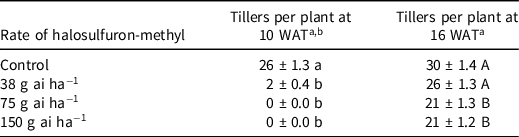
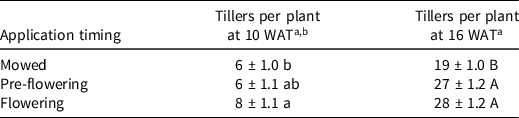
Table 2 summarizes the results obtained from the mixed models for the number of tillers per plant at 10 and 16 WAT. There was no interaction between application timing and the rate of herbicide for the number of tillers at 10 WAT and 16 WAT; however, both application timing and rate of herbicide had a significant effect. The number of tillers at 10 WAT had significant differences in the application timing (P = 0.021) and herbicide rate (P < 0.001). The number of tillers at 16 WAT also had significant differences in the application timing (P < 0.001) and herbicide rate (P < 0.001). Hence the number of tillers was averaged across all the application times for each of the herbicide rate (Table 3) and across all the herbicide rates for each of the application time (Table 4).
Summary of ANOVA for all main effects and their interaction from the mixed models for the number of tillers per plant at 10 and 16 WAT for Experiment 1 (plants with established rhizomes). a

a Abbreviation: df, degrees of freedom; WAT, weeks after treatment.
Mean number of tillers per plant ± standard error at 10 and 16 WAT across different rates of halosulfuron-methyl used on Navua sedge plants for Experiment 1 (plants with established rhizomes).

a Treatment means within a column followed by the same letter do not statistically differ according to Tukey’s honestly significant difference test at α = 0.05.
b Abbreviation: WAT, weeks after treatment.
Mean number of tillers per plant ± standard error at 10 and 16 WAT across different application timings at which Navua sedge plants were treated with halosulfuron-methyl for Experiment 1 (plants with established rhizomes).

a Treatment means within a column followed by the same letter do not statistically differ according to Tukey’s honestly significant difference test at α = 0.05.
b Abbreviation: WAT, weeks after treatment.
The number of tillers at 10 WAT was significantly higher in the control plants compared to all the rates of herbicides tested (Table 3). At 10 WAT, there were no live tillers in the plants treated with 75 and 150 g ai ha−1 across all the application times. However, at 16 WAT, the number of tillers increased from 0 to 21 tillers plant-1 in plants sprayed with 75 g ai ha−1 and 150 g ai ha−1 (Table 3). At 10 WAT, there was no significant difference in the number of tillers per plant in all the three rates used (38, 75 and 150 g ai ha−1) but the results differed slightly at 16 WAT as the number of tillers per plant in plants treated with 38 g ai ha−1 of herbicide was significantly higher than that of plants treated with 75 and 150 g ai ha−1 (Table 3).
Plants sprayed at the flowering stage (8 tillers plant-1) had significantly higher number of tillers at 10 WAT compared to the mowed stage (6 tillers plant−1; Table 4). The significant effect of application time was also found in the number of tillers per plant at 16 WAT, wherein the number of tillers was significantly reduced in the mowed stage (19 tillers plant−1) compared to the pre-flowering and flowering stage (27 and 28 tillers plant−1, respectively; Table 4). A remarkable increase was observed in the numbers of tillers per plant between 10 and 16 WAT in the mowed, pre-flowering, and flowering stages, as evidenced by the means in Table 4.
Experiment 2: Plants without Established Rhizomes
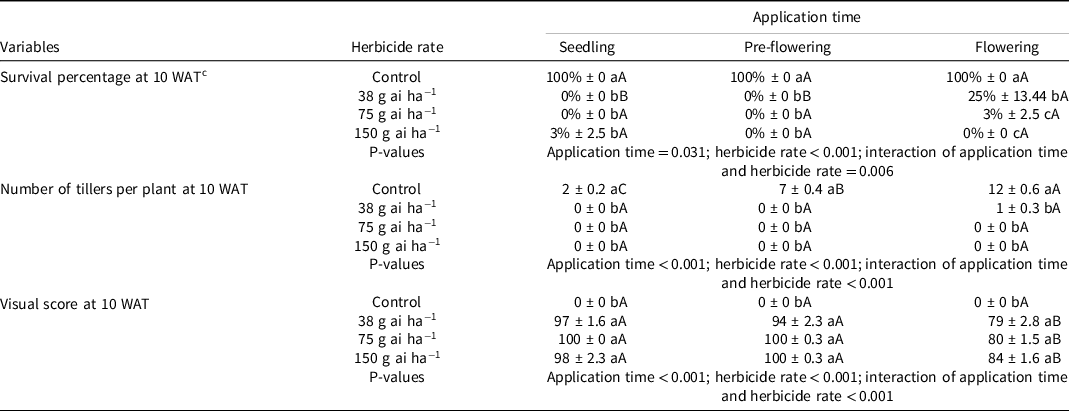
A significant interaction (P < 0.05) between the application time of herbicide and the rate of herbicide used in the treatment was observed in the three variables recorded: survival, number of tillers per plant measured at 10 WAT, and visual score (Table 5). All the plants treated with 38 and 75 g ai ha−1 of halosulfuron-methyl at the seedling and pre-flowering stages died. However, when treated at the flowering stage, there was 25% and 2.5% survival with 38 and 75 g ai ha−1, respectively (Table 5). There was no significant difference in the survival of plants among the three application times when treated with 75 and 150 g ai ha−1. However, when treated with 38 g ai ha−1, flowering plants had significantly greater survival compared with seedling and pre-flowering plants, which had zero survival (Table 5). Within seedling and pre-flowering application time, survival of plants was similar for all the herbicide rates that were significantly lower than the control. However, at the flowering stage, survival of plants treated with 75 and 150 g ai ha−1 was significantly lower than plants treated with 38 g ai ha−1 (Table 5).
Impact of herbicide treatment and application timing on survival percentage, number of tillers per plant, and visual score of Navua sedge plants when treated with halosulfuron-methyl. a,b

a Significant interactions from the mixed models were analyzed by investigating the simple main effects with Bonferroni adjustments.
b Treatment means within columns, followed by the same lowercase letter do not statistically differ at α = 0.05. Treatment means within rows, followed by the same uppercase letter do not statistically differ at α = 0.05.
c Abbreviation: WAT, weeks after treatment.
A significant interaction was observed for the number of tillers at 10 WAT between the application times and the rates of herbicide used (Table 5). The control had tillers that increased over the application times, but all three herbicide rates had significantly fewer tillers regardless of the application time. At each of the herbicide rates used, 38, 75, and 150 g ai ha−1, there was no significant difference in the numbers of tillers per plant between the different application times (Table 5). Within each application time, the number of tillers per plant was similar for all the herbicide rates used (38, 75 and 150 g ai ha−1) and were significantly lower than the control (Table 5).
An interaction was also observed in the visual score between the application timing and the rate of herbicide used (Table 5). For all the three rates of herbicide used, plants treated at the flowering stage had significantly lower visual score than plants treated at the seedling and pre-flowering stages (Table 5). In each application time, there was no significant difference in the visual score of plants treated with any rate of the herbicide tested. However, the visual score of the plants treated with herbicide was significantly higher than that of the control for each of the application time (Table 5).
Our results show that Navua sedge plants without established rhizomes can be better controlled by a single application of halosulfuron-methyl compared to plants with established rhizomes as creeping perennials gain a major competitive advantage from their underground storage and proliferation organs (Ringselle et al. Reference Ringselle, Oliver, Berge, Sundheim Fløistad, Berge and Brandsæter2021). A mortality rate of 9.4% was observed in Navua sedge plants with established rhizomes, whereas plants without established rhizomes had 96.7% mortality combined across all three rates of halosulfuron-methyl and application times. Such observations have also been reported in other weed species with rhizomes such as johnsongrass [Sorghum halepense (L.) Pers.] and quackgrass [Elytrigia repens (L.) Nevski] in which herbicide treatments were found to be more effective against plants without established rhizomes rather than with rhizomes (Damalas and Eleftherohorinos Reference Damalas and Eleftherohorinos2001; Harker and Born Reference Harker and Born1997). This could be attributed to a greater amount of herbicide being absorbed by the seedlings (per unit weight) due to their lower biomass compared to that of plants with established rhizomes (Damalas and Eleftherohorinos Reference Damalas and Eleftherohorinos2001). Greater sensitivity of younger plants may also be due to the ease of wetting of the leaves, which have less wax and cuticle, and are therefore more permeable to herbicides (Crafts and Foy Reference Crafts, Foy and Gunther1962; Sargent Reference Sargent1965).
It is generally not enough to only control the aboveground biomass of perennial weeds because dormant buds in the rhizomes can sprout and grow using the carbohydrate reserves of the rhizome (Van Evert et al. Reference van Evert, Cockburn, Beniers and Latsch2020). An effective long-term control strategy for Navua sedge should focus on suppressing the nonstructural carbohydrate of the rhizome to reduce regrowth and diminish infestation levels (Johnson et al. Reference Johnson, Li and Wait2003). In this study, among all the rhizomes that died, mortality was highest (74%) in the 2- to 3-cm-long rhizomes of Navua sedge, and no mortality was observed in rhizomes larger than 5 cm in length. Similarly, plant age was a key in control by herbicides in other rhizomatous weeds such as torpedograss (Panicum repens L.) and johnsongrass (Hossain et al. Reference Hossain, Ishimine, Taniguchi, Konnai, Akamine, Kuramochi and Murayama1998; Richard and Griffin Reference Richard and Griffin1993). The mortality of rhizomes could be related to the nonstructural carbohydrate content of the rhizomes, but the effect of herbicides on the carbohydrate content in the rhizomes of Navua sedge is not yet known and should be a focus of future research.
Reduced translocation of halosulfuron-methyl to untreated buds or dormant buds could allow regrowth from the rhizome. Reduction in rhizome viability is strongly related to translocation of herbicides to the rhizomes where the meristematic tissues are most active (Gannon et al. Reference Gannon, Yelverton and Tredway2012; Shaner and Singh Reference Shaner, Singh, Roe, Burton and Kuhr1997). Hence, translocation of foliar applied herbicides is a limiting factor in the successful control of rhizomatous weeds like Navua sedge (Chandrasena Reference Chandrasena1990; Troxler et al. Reference Troxler, Burke, Wilcut, Smith and Burton2003). Because dormant tissue incorporates very little assimilate from the body of the plant, the herbicide in the assimilate stream may fail to reach dormant buds in lethal quantities (Dekker and Chandler Reference Dekker and Chandler1985; Robertson et al. Reference Robertson, Taylor, Harker, Robert and Yeung1989). An approach to overcome this issue could be to activate the dormant buds and promote their growth prior to herbicide treatment or sequential spraying of herbicides (Elmore et al. Reference Elmore, Patton, Tuck, Murphy and Carleo2019; Harker and Born Reference Harker and Born1997; McIntyre and Hsiao Reference McIntyre and Hsiao1982). These plants when treated with herbicide will have reduced plant biomass per rhizome segment and increased leaf area for herbicide uptake (Duc et al. Reference Duc, Pakeman and Marrs2003; Froese et al. Reference Froese, Van Acker and Friesen2005).
In the rhizomatous plants, our study has shown that the number of tillers per plant at both 10 and 16 WAT were least in the plants that were mowed and then treated with halosulfuron-methyl. Higher mortality of rhizomes was also observed in the plants that were mowed and then treated with herbicide. This could be due to relatively short distance for herbicide translocation compared to pre-flowering and flowering plants (Gannon et al. Reference Gannon, Yelverton and Tredway2012). It has also been reported in other species that plants with smaller rhizome systems had greater mortality compared to larger rhizome systems as observed in torpedograss and quackgrass (Chandrasena Reference Chandrasena1990; Claus and Behrens Reference Claus and Behrens1976).
Our results indicate regrowth occurred from the rhizomes at 16 WAT, which is similar to the findings reported by Vogler et al. (Reference Vogler, Carlos, Setter, Roden and Setter2015) in field studies. This indicates that long-term control will require follow-up treatments, especially before the regrowth produces seeds. Under optimal growing conditions, Navua sedge takes 7 to 8 wk to flower and an additional 30 d to ripen on the flower head, which makes regular monitoring and sequential spraying an integral part of managing the infestations (Vitelli et al. Reference Vitelli, Madigan and van Haaren2010). Although halosulfuron-methyl is a good selective option for control of Cyperus weeds, a single treatment does not provide good control of the underground reproductive propagules (Blum et al. Reference Blum, Isgrigg and Yelverton2000; Brecke et al. Reference Brecke, Stephenson and Unruh2005; Elmore et al. Reference Elmore, Patton, Tuck, Murphy and Carleo2019).
In conclusion, this research demonstrates that halosulfuron-methyl is highly effective at controlling Navua sedge plants at the seedling stage, when rhizomes have not yet developed reproductive abilities. A new infestation of Navua sedge rising from seeds may produce a high plant density, but the population will lack a large reservoir of rhizomes with stored nutrients, making it easier to control them with halosulfuron-methyl. A single application of halosulfuron-methyl is not effective at controlling rhizomatous Navua sedge plants that have established rhizomes. Future research on control of Navua sedge should focus on sequential spraying of herbicides to target the new growth from rhizomes and new plants emerging from seeds. Prominence should be given to understanding the effect of herbicides on the nonstructural carbohydrate content of the rhizomes, since increased understanding of rhizome dynamics will improve confidence in recommendations for long-term control of Navua sedge. Outcomes of this study suggest that long-term control of Navua sedge should focus on reducing seed input into the soil seed bank and reducing rhizome development and viability in the soil. Finally, we note that although halosulfuron-methyl seems to be a good option for controlling Navua sedge, it needs to be used strategically to minimize the possibility of herbicide resistance and toxic soil residues that present a global significant risk.
Acknowledgments
The PhD scholarship for Aakansha Chadha was funded by Federation University, Australia, and the funding for the project was provided by Department of Agriculture and Fisheries, Biosecurity Queensland, Australia. We thank Dr. Boyang Shi, Melissa Setter, and Stephen Setter from Department of Agriculture and Fisheries, Biosecurity Queensland, for providing the rhizomes for this study.
No conflicts of interest have been declared.