INTRODUCTION
For women at high risk for breast cancer, screening is the mainstay of risk management. Optimal risk management is likely to be in the context of a multidisciplinary setting (Field & Phillips, Reference Field and Phillips2007). The advantages of multidisciplinary high-risk care has resulted in recommendations for and development of such clinics (Kuschel et al., Reference Kuschel, Lux and Goecke2000). High-risk clinics provide continual surveillance, screening, and management for high-risk women in a centralized context. Despite the benefits of multidisciplinary high-risk cancer surveillance programs, many women with a family history of breast cancer do not attend or reattend for continued screening and risk management (Hailey et al., Reference Hailey, Carter and Burnett2000).
While extant research has identified a number of barriers and facilitators of screening adherence among women at high risk for breast cancer, few studies have examined factors related to reattendance. Previous studies have primarily focused on prior screening experiences and a limited set of demographic variables and have shown an association between a decreased likelihood of reattendance and reluctance at initial attendance, negative past screening experiences, prior mammography screening, a foreign-language background, and greater rurality (Cockburn et al., Reference Cockburn, Schofield and White1997; Bulliard et al., Reference Bulliard, de Landtsheer and Levi2003; Tatla et al., Reference Tatla, Paszat and Bondy2003; Katapodi et al., Reference Katapodi, Lee and Facione2004; Price et al., Reference Price, Butow and Charles2010). Research on reattendance is particularly important considering that attendance rates tend to decline with successive screening (Fink et al., Reference Fink, Shapiro and Roester1972; Taylor et al., Reference Taylor, Taplin and Urban1995). Therefore, research examining additional factors related to reattendance is essential for increasing rates of reattendance (Cockburn et al., Reference Cockburn, Schofield and White1997).
Among high-risk women, some evidence suggests that elevated levels of distress and depressive symptoms relate to decreased screening adherence (Wellisch & Lindberg, Reference Wellisch and Lindberg2001; Kash et al., Reference Kash, Holland and Halper1992; Price et al., Reference Price, Butow and Charles2010). Although anxiety has been found to be related with both screening avoidance and adherence (Lerman et al., Reference Lerman, Daly and Sands1993; Meiser et al., Reference Meiser, Butow and Barratt2000; Hailey, Reference Hailey1991; Kash et al., Reference Kash, Holland and Halper1992; Lerman et al., Reference Lerman, Kash and Stefanek1994; Consedine et al., Reference Consedine, Magai and Krivoshekova2004; Lindberg & Wellisch, Reference Lindberg and Wellisch2001), there is some evidence that the anxiety–adherence relationship may be nonlinear, with a likelihood of adherence declining both with increasing or decreasing levels of anxiety (Meiser et al., Reference Meiser, Butow and Barratt2000; Zhang et al., Reference Zhang, Chiarelli and Glendon2012). Literature evaluating the effect of lifetime psychiatric history on reattendance behavior is more limited. However, consistent with the kindling hypothesis (Kendler et al., Reference Kendler, Karkowski and Prescott1999), it might be expected that high-risk women with a history of depression or anxiety may be sensitized to stressful life events—like maternal illness and death—and experience subsequent maladaptation. Indeed, previous research has demonstrated an association between past psychiatric illness and current affective difficulties among women at high risk for breast cancer (Hopwood et al., Reference Hopwood, Keeling and Long1998).
Studies have also examined perceived risk as a correlate of breast-cancer screening among high-risk women, though findings have been inconsistent. Perceived risk has shown a positive association with breast-cancer screening (Lerman et al., Reference Lerman, Daly and Sands1993; Consedine et al., Reference Consedine, Magai and Krivoshekova2004; McCaul et al., Reference McCaul, Branstetter and O'Donnell1998; Reference McCaul, Schroeder and Reid1996; Zhang et al., Reference Zhang, Chiarelli and Glendon2011), and has also been shown to be unassociated with screening (Sheinfeld-Gorin & Albert, Reference Sheinfeld-Gorin and Albert2003; Martin & Degner, Reference Martin and Degner2006; Isaacs et al., Reference Isaacs, Peshkin and Schwartz2002; Diefenbach et al., Reference Diefenbach, Miller and Daly1999). However, a recent comprehensive review about perceived risk and adherence to breast-cancer screening among women with familial breast-cancer risk reported a weak to moderate positive relationship between perceived breast-cancer risk and mammography adherence (Walker et al., Reference Walker, Chiarelli and Knight2013).
Demographic characteristics also likely affect screening reattendance. Research indicates that older age and being married/partnered predicts screening uptake (Price et al., Reference Price, Butow and Charles2010; Rahman et al., Reference Rahman, Dignan and Shelton2005), as well as reattendance for breast-cancer screening (Pakenham et al., Reference Pakenham, Pruss and Clutton2000). Reattendance may also be related to aspects of women's experiences of breast cancer within their families. Research has also shown that women with a breast-cancer death in the family were more likely to have had a recent mammogram compared with women with only a breast-cancer survivor in the family (Tracy et al., Reference Tracy, Quillin and Wilson2008). However, the association between mothers' survival from breast cancer and daughters' reattendance rates to high-risk clinics has not yet been examined.
The main aim of this study was to profile women who are likely to return versus those unlikely to return for follow-up care in a high-risk breast-cancer clinic, with a specific focus on daughters of breast-cancer patients. A set of hypotheses emerged from the literature that this study could bear upon. It was expected that demographic characteristics would be associated with an increased likelihood of reattendance, including older age and being married/partnered. Next, it was hypothesized that depressive symptomatology, lifetime psychiatric diagnoses, perceived breast-cancer risk, and survival status of the mother would be associated with likelihood of reattendance. Specifically, an increased likelihood of reattendance was expected to be associated with higher levels of perceived risk and maternal loss to breast cancer, while a decreased likelihood of reattendance was expected to be associated with clinically significant depressive symptoms and having a previous diagnosis of a psychiatric disorder. It was also hypothesized that the survival status of the mother would moderate the effects of the aforementioned hypothesized predictors on likelihood of reattendance. Finally, it was hypothesized that the relationship between state anxiety and reattendance would be curvilinear in nature such that reattendance would be more strongly associated with moderate levels of anxiety than milder or more severe anxiety.
METHODS
Participants and Procedure
The data for the present study were obtained during participants' initial appointments at the UCLA Revlon Breast Center High Risk Clinic. The High Risk Clinic is a multidisciplinary center that serves patients at familial risk for breast cancer. During their first visit to the clinic, patients are individually seen and counseled by an oncologist, a genetics counselor, a nurse practitioner, a nutritionist, and a psychologist. Most patients also receive a mammogram.
The research carried out in the current study was in compliance with the Helsinki Declaration and approved by the institutional review board at UCLA. Women were eligible for participation if their biological mother had been diagnosed with breast cancer, were at least 18 years old, spoke English, and had never themselves been diagnosed with breast cancer. Data for 131 patients from the High Risk Clinic were available for the analyses conducted. A psychologist conducted a semistructured clinical interview with participants during their first appointment, during which psychosocial background information was obtained. Participants also completed questionnaires assessing depression and anxiety symptoms during their initial appointment.
Measures
The primary outcome variable was reattendance to the high-risk clinic, defined as a dichotomous measure of whether patients returned for a follow-up appointment (reattendance coded as 1, did not follow up as 0).
To ascertain their mothers' breast-cancer survival, participants were asked whether their mothers were still alive, and the cause of death if deceased (died from breast cancer coded as 1, alive or non-breast-cancer death as 0). Perceived risk was assessed by having participants rate from 0 (not at all likely) to 100 (extremely likely) the likelihood that they would ever develop breast cancer. Participants were also asked about their lifetime history of any diagnosed psychiatric condition (previous psychiatric diagnosis coded as 1, no psychiatric history as 0).
The State–Trait Anxiety Inventory (STAI) (Spielberger et al., Reference Spielberger, Gorsuch and Lushene1970) was utilized to evaluate current level of anxiety (“state anxiety”). The State scale contains 20 items, and responses are measured on a 4-point Likert-type scale, with higher scores signifying the presence of higher levels of anxiety. The STAI manual reports high internal consistency for the State scale (α = 0.92), which was replicated in our study (α = 0.90).
The Center for Epidemiologic Studies Depression Scale (CES–D) (Radloff, Reference Radloff1977) was employed to assess current depressive symptomatology. The CES–D consists of 20 items, and scores may range from of 0 to 60, with higher scores signifying the presence of more symptomatology. The test has good reliability (α = 0.85 for the general population; α = 0.90 for a clinical population); the reliability of the scale was strong in the current study (α = 0.95). Although not constituting a clinical diagnosis of depression, scores at or above 16 on the CES–D are considered indicative of clinically significant symptoms of depression.
Additionally, a number of variables were considered as potential covariates, including age in years at interview, ethnicity (Caucasian or non-Caucasian), marital status (married/partnered or unmarried/not partnered), educational attainment (high school, some college, college graduate, or graduate school), employment status (currently employed or unemployed), participant age at the time of mother's breast-cancer diagnosis, mother's age at the time of diagnosis, number of relatives with a past or present breast-cancer diagnosis, and computed breast-cancer risk using the Gail model (Gail et al., Reference Gail, Brinton and Byar1989).
Statistical Analyses
Analyses were conducted using SPSS 19.0. Associations between reattendance and potential control variables were examined using χ2 and t tests for categorical and continuous variables, respectively. Variables that had a significant association with reattendance were included as covariates in the multivariate models to ascertain unbiased point estimates. Three multivariate logistic regression models were used to predict reattendance as a dependent variable, with results expressed in adjusted odds ratios (AORs) with 95% confidence intervals (95% CIs). The first model assessed likelihood of reattendance based on the focal main effects, after controlling for relevant covariates. Perceived breast-cancer risk, depressive symptomatology, state-anxiety percentile score, personal history of a psychiatric diagnosis, and survival status of participants' mothers were included in the model as main effects.
Next, to test the moderating effects of mother's survival status, the two-way interactions of survival status with perceived risk and the other focal predictors were considered. Continuous predictors were mean-centered prior to creating interaction terms (Aiken & West, Reference Aiken and West1991). Preliminary analyses revealed three nonsignificant interaction terms (survival × state anxiety, survival × depression, and survival × past psychopathology, Fs < 1). Thus, these terms were trimmed, and the significance of the survival status × perceived risk interaction effect was tested in the multivariate model. In the third model, the quadratic effect of state anxiety was added to the main-effects model to discern whether the association between likelihood of reattendance and state anxiety might be nonlinear. Quadratic state-anxiety scores were computed by squaring the centered state-anxiety percentile scores. Likelihood ratio tests were employed to determine whether the increment in the proportion of variance accounted for by addition of the higher-order terms was statistically significant.
RESULTS
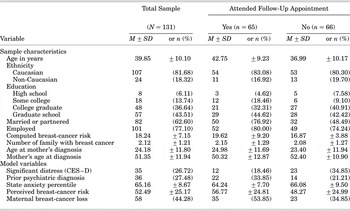
A total of 131 (65 reattended, 66 did not return) participants were included in the study. Table 1 shows the background characteristics of the sample. With respect to age, the overall sample was relatively young (M = 39.85, SD = 10.10) and exhibited absolute breast-cancer risks moderately higher than that in the general population (18.24% calculated lifetime risk). Additionally, the majority of participants were Caucasian (81.68%, n = 107), married (62.60%, n = 82), and had a college or advanced degree (80.15%, n = 105). The background characteristics of the two groups were generally similar. However, compared to participants who returned for a follow-up appointment, participants who did not reattend were younger (t(129) = –3.40, p = 0.001), less likely to be married (χ2(1) = 11.31, p = 0.001), and had a lower computed breast-cancer risk (t(129) = –2.22, p = 0.029). Given these findings, age, marital status, and computed breast-cancer risk were used as control variables.
Summary of sample characteristics and model variables for participants who returned for a follow-up appointment compared to those who did not

CES–D = Center for Epidemiologic Studies Depression Scale.
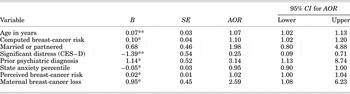
The main-effects model was significant—χ2(8) = 45.89, p < 0.001, Nagelkerke R 2 = 0.39—and correctly classified 70.77% of patients who reattended and 75.76% of patients who did not return for follow-up; overall, the correct classification rate was 73.28%. Seven of the eight variables had significant independent associations with clinic reattendance (see Table 2). When holding other variables constant, this model suggests that likelihood of reattendance increased by 7% for each 1-year increase in age, and each standardized unit increment in computed breast-cancer risk was associated with a 10% rise in likelihood of reattendance. For each standardized unit increment in perceived breast-cancer risk, likelihood of reattendance increased by 2%. Participants with clinically significant distress were only about 25% as likely to reattend as those who did not demonstrate marked depressive symptomatology. For each percentile increase in state anxiety, likelihood of reattendance decreased by 5%. Finally, the likelihood of reattendance among participants who reported a past psychiatric diagnosis was over three times as large as those without a psychiatric history, and the likelihood of reattendance among participants whose mothers died from breast cancer was over 2½ times that of participants whose mothers survived breast cancer.
Logistic regression predicting the likelihood of reattendance

AOR = adjusted odds ratio; 95% CI = 95% confidence interval; CES–D = Center for Epidemiologic Studies Depression Scale.
*p < 0.05, **p < 0.01.
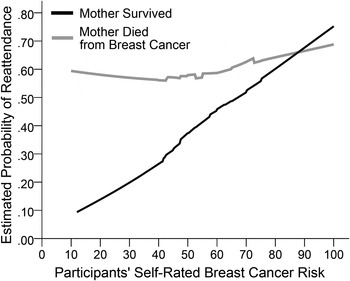
In addition to main effects, the interaction of survival status and perceived risk was also assessed. While the significance of all other previously present predictors remained virtually unchanged, entry of this interaction term into the multivariate model significantly improved the fit over the main effects–only model: χ2 inc(1) = 5.53, p = 0.019, Nagelkerke R 2 = 0.43. This suggests that the association between perceived risk and likelihood of reattendance was moderated by mother's survival status. To facilitate interpretation of this significant interaction effect, the association between perceived risk and likelihood of reattendance was examined separately among daughters whose mothers died from breast cancer and daughters whose mothers survived (see Figure 1). Analyses revealed that higher perceived risk was associated with a greater likelihood of reattendance among participants whose mothers survived breast cancer (p = 0.002, AOR = 1.04, 95% CI = 1.01–1.07). In contrast, no association was shown between perceived risk and reattendance among participants whose mothers died (p = 0.685, AOR = 0.99, 95% CI = 0.97–1.02). This interaction effect is illustrated in Figure 1, which shows predicted probabilities of reattendance based on perceived breast-cancer risk, stratified by mother's survival status.
Predicted probability of reattendance as a function of perceived breast-cancer risk for daughters whose mothers survived breast cancer and those whose mothers died from breast cancer (plotted using Lowess smoothing with a bandwidth of 0.8).

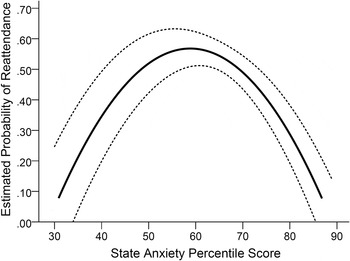
To assess nonlinearity in the association between state anxiety and likelihood of reattendance, a quadratic effect for the state-anxiety term was introduced to the multivariate logistic regression model. As previously discussed, the linear state-anxiety term was significantly associated with reattendance in the main-effects model (see Table 2). When the quadratic term was entered into the model, all previously significant main effects remained as such, including the linear state-anxiety term (p = 0.049, AOR = 0.95, 95% CI = 0.90–0.99). The quadratic state-anxiety term was also shown to be significant (p = 0.037, AOR = 0.99, 95% CI = 0.99–1.00), and the addition of this term resulted in significant improvement of the model (χ2 inc(1) = 6.26, p = 0.012, Nagelkerke R 2 = 0.44), demonstrating that a nonlinear relationship better described the data. We plotted predicted probability of reattendance as a function of state anxiety to examine the association between state anxiety and likelihood of reattendance. As depicted in Figure 2, the peak probability of reattendance implied by the model occurs at a state-anxiety percentile approaching 60, with reattendance declining both with increasing and decreasing levels of state anxiety.
Predicted probability of reattendance as a function of state-anxiety percentile scores (dashed lines represent 95% confidence intervals).

DISCUSSION
This study sought to profile daughters of breast-cancer patients who were likely to return versus those unlikely to return for follow-up care in a high-risk breast-cancer clinic. As predicted, demographic characteristics were found to be related to clinic attendance. Though not significant in multivariate analyses, the finding that greater reattendance was observed among participants who were married/partnered supports the results of previous studies (Pakenham et al., Reference Pakenham, Pruss and Clutton2000). Some suggest that a stable relationship provides the social support that is often related to higher levels of adherence to health recommendations (Lerman et al., Reference Lerman, Rimer and Trock1990). Age was significant in the multivariate model, and, holding all other variables constant, it was found that each year of increased age was associated with a 7% greater likelihood of reattendance; in fact, likelihood of reattendance doubled with each decade of age. This agrees with the thrust of the literature that older age is predictive of greater reattendance as well as adherence to such breast-cancer screening practices as mammography ((Pakenham et al., Reference Pakenham, Pruss and Clutton2000; Price et al., Reference Price, Butow and Charles2010; Rahman et al., Reference Rahman, Dignan and Shelton2005). We view this as logical because older patients would have more stability and security in their lives, personified by long-term relationships, having children, and more established career patterns. These life circumstances help support such older patients in facing the anxiety of high-risk status and clinic attendance, and offer more reason to live, thus reinforcing the possibility of clinic reattendance.
Clinically significant depressive symptoms turned out to be among the most significant predictors of non-reattendance. Our hypothesis was supported in that those patients with clinically significant depressive symptomatology (CES–D score of 16 or higher) were only 25% as likely to return for follow-up. This begins to make a case for measuring depression at baseline in clinics such as this, and for patients found to have CES–D scores above 16 to be given additional attention. This might mean offering them more emotional support, some time with a clinic mental health professional during the first visit, and more diligent callbacks to ensure that they scheduled and attended follow-up appointments.
With regard to our hypothesis about a previous diagnosis of a psychiatric condition, we were mistaken in our prediction. Unexpectedly, a history of a psychiatric diagnosis proved to be predictive of substantially greater likelihood of clinic reattendance. This is in sharp contrast to the finding that current clinically significant symptoms of depression eventuated in significantly less likelihood of reattendance. However, it is important to note that having a previous psychiatric diagnosis does not necessarily equate to having a current psychiatric diagnosis. Moreover, the presence of anxiety and significant depressive symptomatology were statistically controlled for in consideration of the effects of this variable. It is possible that having had a previous diagnosis sensitizes one to the value and need for clinical care, and that such patients are likely to be more motivated and accepting of care in a situation such as the high-risk clinic. These findings suggest that such history should not be considered as a rule-out factor that would preclude continuity of care, but perhaps as an asset and motivating factor in continuity of care.
The hypothesis that maternal loss to breast cancer would predict higher likelihood of compliance with clinic attendance was borne out by the data analysis. This finding is consistent with the research showing that loss of a close family member to breast cancer may motivate reattendance and adherence to cancer-screening recommendations (Tracy et al., Reference Tracy, Quillin and Wilson2008). By itself, it is a powerful predictor, with results indicating that participants who lost their mothers to breast cancer were over 2½ times more likely to follow up. However, and as hypothesized, the data in our study reflect the fact that this variable cannot be considered in isolation but should be considered in an interactional context with other relevant predictors.
We considered this variable in relation to perceived risk and in doing so discovered that perceived risk differentially impacts reattendance according to maternal loss. Our results demonstrated that mother's survival status moderated the relationship between reattendance and perceived risk such that a higher level of perceived risk was associated with a greater likelihood of reattendance only for participants whose mothers survived breast cancer. This finding has sensitized us to be more attentive to patients whose mothers survived who perceive themselves at lower risk. For the women whose mothers died from breast cancer, perceived risk became somewhat of a moot point in predicting clinic return. Perhaps the fact their mothers died from breast cancer is decisive in their patterns of reattendance.
With regard to the hypothesis that the association between anxiety and reattendance would be curvilinear, this was robustly supported by the data. Previous literature has shown anxiety to negatively affect breast-cancer surveillance (Kash et al., Reference Kash, Holland and Halper1992). It is evident, in our data, that a certain level of anxiety is motivating and facilitative of clinic attendance and reattendance. There is literature which shows that the effects of anxiety on adherence to recommended screening practices is best considered as an inverted “U” (Zhang et al., Reference Zhang, Chiarelli and Glendon2012). Similar to the findings discussed earlier regarding depressive symptomatology, these data on state anxiety suggest a need to carefully identify and consider immediate intervention with the patient showing significant anxiety symptoms on a screening measure such as the State–Trait Anxiety Inventory.
Too little anxiety and too much anxiety appear to place patients at increased risk for non-reattendance. Therefore, in addition to identifying patients who are overwhelmed with anxiety, we have learned to be equally concerned with identification of patients with seemingly too little anxiety appropriate to the clinical context. It may be that patients endorsing minimal levels of anxiety are utilizing the defense mechanisms of denial, suppression, or repression in ways that do not facilitate optimal adherence with clinical care. With regard to the patients with clearly identifiable severe anxiety, we see the necessity for extra and intensive interventions starting from the point of the initial visit. Anxiety may be related to posttraumatic stress disorder, which has been previously identified in women at high risk who have witnessed fatal breast cancer in their mother or other close family relatives (Lindberg & Wellisch, Reference Lindberg and Wellisch2001). It is essential that such patients be offered anxiety-management interventions starting from the baseline clinic visit. This may be particularly necessary in helping such patients deal with such issues as breast self-examination, mammography, and integration of risk information (Kash et al., Reference Kash, Holland and Halper1992).
It is important to take some limitations into consideration when interpreting the findings from our present study. The demographics of the study sample were weighted toward Caucasian, highly educated, married women, thus limiting generalizability to other populations. Additionally, it cannot be assumed that the subset of patients who did not return to the high-risk clinic did not get other types of surveillance in another clinical setting. In future studies, the assessment of depression, anxiety, and past psychiatric history should be strengthened through use of a structured clinical interview for the Diagnostic and Statistical Manual modules for major depressive disorder, generalized anxiety disorder, and posttraumatic stress disorder, at a minimum, as well as a more detailed questionnaire regarding past psychiatric history. Further research of reattendance to high-risk breast-cancer clinics is needed to corroborate these findings and identify additional modifiable psychosocial factors that may be targeted from the first visit to increase the likelihood of follow-up care.