Introduction
The sovereign state is the basic unit of analysis in international relations and for some time now the Correlates of War Project (COW) has maintained a valuable list of the members of the state system since 1816.Footnote 1 Yet that list possesses a Eurocentric bias that awards sovereign status in the pre-1920 era to those polities that possessed sufficient diplomatic relations with both Britain and France. As a result, some 96 states during the nineteenth century are excluded from most analyses because of an insufficient relationship with the European core.Footnote 2 Many of these units were located in Africa and along the Indian Ocean rim in the dense state systems of South Asia and Southeast Asia. Were these ‘excluded’ states different from the basic units listed in COW? Was the character of the systems they constituted different from the core system we know and study? And were they any more or less violent than the European system?
In this article we examine the structure of political order in nineteenth-century West Africa, Southeast Asia, and South Asia. We also explore potential links between system structure and violent conflict. To identify states in these systems we use the International System(s) Dataset (ISD) that records 21 states in West Africa, 18 states in Southeast Asia, and 28 states in South Asia from 1816–1905.Footnote 3 We develop a framework to capture variation in political order between sovereign units (anarchy) and within sovereign units (hierarchy). We then use states identified in the ISD to construct a state-year dataset for West Africa, Southeast Asia, and South Asia and assess the frequency of violent conflict using Peter Brecke’s conflict catalogue.Footnote 4 This is the first comparative study of non-Western international systems based on a systematically derived register of the states that constitute those systems, to the best of our knowledge. We are also the first to comparatively assess the frequency of violent conflict in nineteenth-century states, factoring in the number of states in a system and the duration of their existence across these previously unexplored regions.
Our findings suggest that relations were essentially anarchic between territorially-based states in these systems and there is little evidence of states dividing sovereign functions among other sovereigns or recognising cross-cutting sovereignty, as may have been the case in Medieval Europe. Hierarchy appears to be more variable, with West Africa and Southeast Asia composed of highly decentralised states. Some states in South Asia were also decentralised, but these existed alongside polities that were more successful in centralising sovereign functions. West Africa was the most war-prone region in our analysis, followed by Southeast Asia and South Asia. Generally, this article indicates that state leaders had similar goals of expanding state power by capturing resources and populations while retaining control of decision-making power, but the costs of extending state infrastructures vary across time and space. State leaders in environments where projecting power is costly must often give greater concessions to substate units in the form of decision-making autonomy. These concessions may have downstream effects on violent conflict by compounding information asymmetries and generating commitment problems. We emphasise, however, that the results of this study are inductively-derived and advanced with caution. There are likely to be alternative explanations that we have not considered, and some of the alternative explanations we explicitly acknowledge may turn out to be powerful explanations for the variation in conflict propensity we observe. But we see this as reflective of the early stage of research into non-Western international systems, and welcome the controversy.
The remainder of this article will proceed as follows. First, we discuss recent developments in identifying sovereign states and, consequently the constituent units of international systems, with a focus on the COW state system membership list and the ISD. We also situate our research within the existing studies of non-Western international systems. Second, we propose a theoretical framework for examining state systems. Third, we apply that framework to three regions during the nineteenth century that were previously neglected in much of the international relations scholarship: West Africa, Southeast Asia, and South Asia. We conclude with a discussion on the relationship between political order, interaction capacity, and conflict.
State system datasets and Eurocentricism
State system data is necessary for a range of studies in International Relations and accurately identifying the set of sovereign states in the modern era is therefore an essential task. To that end COW has maintained an important list of states and connected that list with other useful datasets regarding trade, conflict and diplomacy.Footnote 5 To identify the set of sovereign states since the Napoleonic Wars, COW has used the following criteria:
-
1. Prior to 1920, the state must have a population of 500,000 or more and the establishment of diplomatic missions at or above the rank of charge’d’affaires by Britain and France.
-
2. After 1920, the state must have membership in the League of Nations or United Nations or a population of 500,000 or more and establishment of diplomatic missions from any two major powers.
These criteria aim to ensure that states possess both a minimum size and a sufficient level of international recognition.
The COW dataset, however, it is not without criticism.Footnote 6 A core critique is that the pre-1920 recognition criteria are too Eurocentric. Polities were required to possess a minimum level of diplomatic relations with both Britain and France to qualify as a member of the international system. Since historical records for Britain and France are available and reliable and these two ‘legitimisers’ arguably constituted the core of the expanding European-based state system, diplomatic linkages were a consistent method to identify mutual recognition.Footnote 7 The problem, however, is that large areas of the Earth are excluded from system membership during the nineteenth century because the lead states had not yet interacted at the level of charge’d’affaires with the local political units. The result is an incomplete list, one that omits a set of states that were sufficiently large and sufficiently recognised.
The authors of this article in 2013 attempted to correct for these issues with the International Systems Dataset (ISD) by defining a state as a recognisable political entity that possesses:Footnote 8
-
1. A population of at least 100,000.
-
2. Autonomy over a specific territory.
-
3. Sovereignty that is either uncontested or acknowledged by the relevant international actors.
Aside from lowering the population threshold and applying it consistently over time the ISD aimed to identify sovereign states without referencing a fixed legitimising state (or set of states). Rather, the disconnectedness and changing nature of the international system(s) makes an emphasis on any particular actor problematic. France and Britain were simply not the relevant actors in all regions at all times. Portugal, Belgium, Kazembe, and Luba were the relevant actors for the Lunda Empire in nineteenth-century Central Africa. The Netherlands was more relevant for the Karangasem kingdom of Bali and Lombok than Britain or France.Footnote 9
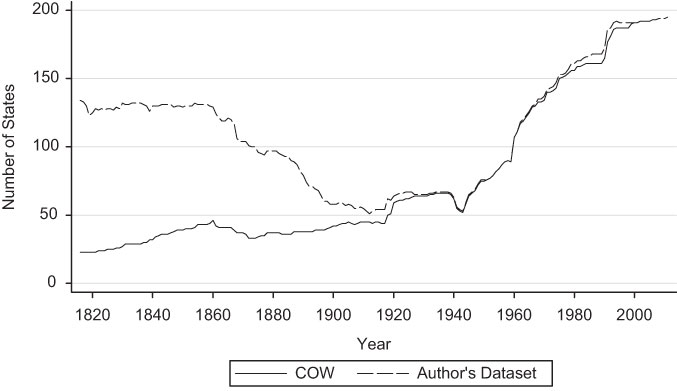
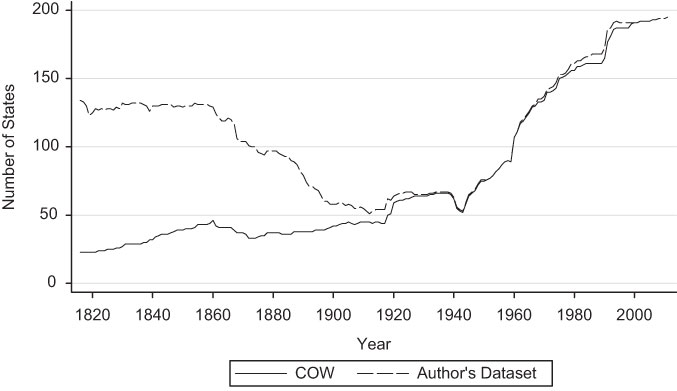
The ISD includes most of the geographic regions that COW excludes in the nineteenth century. Whereas COW records 23 states in 1816, the ISD identifies 134. Most of these ‘excluded’ states are in West Africa, South Asia, and Southeast Asia. Figure 1 shows how the two datasets differ across the 1816–2014 period. In this article we examine whether these systems that were (partially) disconnected from the European diplomatic system were structurally different to the core European system and whether these structural differences can account for variations in observed rates of violent conflict.
Annual number of states, 1816–2011 (COW and ISD)
This article is a contribution to not just the literature on sovereign state datasets,Footnote 10 but also the ongoing research on alternative international systems and orders.Footnote 11 In our view this exciting research area lacks uniformity in terms of how states and state systems are defined. Providing a framework for analysis is a chief aim in our article. Some critics may argue that such an endeavour is foolhardy, perhaps impossible, given that sovereignty is a variable concept,Footnote 12 and that other related concepts like the state and anarchy are ultimately culturally centred.Footnote 13 We contend that our rather arid definition of the state and related framework for analysing system structure can be applied across different cultural zones, but we welcome disagreement on this point.
A framework for analysing international systems
In this section we describe our framework for comparing the structure of international systems. This task presents a number of challenges, and, we only outline two here. The first is deciding what counts as a ‘unit’ and, consequently, the basis upon which system-wide generalisations can be made. The second is deciding what features to measure across international systems such that the most important variation is captured in a parsimonious way. We build upon the work of several scholars, particularly Barry Buzan and Richard Little (2000), to propose a framework that: (1) assigns sovereignty to those units that are free to conduct their own foreign policies; and (2) measures the structure of a given international system by observing the extent to which states (units) give over sovereign functions either to other states or to substate entities. This framework is useful for studying the connection between political order and interaction capacity, another core element of an international system.Footnote 14 In the analysis to come we explore the relationship between political order, interaction capacity, and the frequency of conflict.
The first controversy is defining what counts as a unit, in this case, what counts as a ‘state’. We conceptualise a state as an entity possessing territory, a viable population, and the freedom to manage their own foreign affairs, in line with the ISD.Footnote 15 These are the units that are freely able to participate in the politics of the system, especially in decisions of war and peace. Thus, the state needs to have both internal hierarchy and external sovereignty, and this excludes those federacies, protectorates, and various other types of vassalage that cannot enter into relations with other states as an equal. Foreign policy making is a theoretically sensible requirement for sovereignty as the right to make foreign policy is an authority claim to act in the realm of formal international relations. When other units recognise this claim, they are sovereign equals and units in the system. When polities recognise the claim of a state to represent them in the realm of international relations, these are non-sovereign polities and subordinate to another. We think of these units as ‘sovereign peaks’, and this conception is consistent with the spirit of the Montevideo Declaration on the Rights and Duties of States, as well as the COW State Member List.Footnote 16 It differs, however, from conceptions of the state that admit polities that are sovereign internally but not externally. One example is the Kristian Gleditsch and Michael Ward dataset that includes units like Oman from 1891–1971 when its foreign policy was formally managed by the British.Footnote 17
The next challenge is measuring variation in state systems. Here we follow Buzan and Little, who argue that one needs to examine both functional differentiation and structural differentiation, that is, the nature of order between and within states.Footnote 18 Thus, our framework is more inclusive than structural realism, which has been criticised for ignoring the internal dimension of states but less inclusive than other schemas that incorporate the identities or self-understandings of states.Footnote 19
We define functional and structural differentiation based upon the extent to which states hand over sovereign functions such as taxation, policing, and justice to other political entities and the types of political entities they hand them over to. We define functional differentiation as a measure of political order above the state, apprehending the degree to which states hand over these sovereign functions to other states (that is, to other foreign-policy controlling entities). Structural differentiation measures political order below the state, assessing the extent to which sovereigns delegate these key prerogatives to substate actors and polities such as ethnic groups, and/or powerful families. Functional differentiation and structural differentiation are concepts measured at the unit level that can then be aggregated to summarise features of an international system.Footnote 20 A system with high levels of functional differentiation exists where a large number of states handed over sovereign functions to other sovereign entities. Examples might include medieval Europe or the present day European Union. A system with high levels of structural differentiation exists where a large proportion of the states are decentralised, a situation we describe in West Africa below.
Measuring structural and functional differentiation depends on how we define the ‘state’, because to whom the state hands over sovereign functions is critical. Permissive definitions that include vassals and protectorates will record higher levels of functional differentiation because protectorates hand over decision-making power to other sovereign entities, by definition. A stable measure of variation in political order above and below the state requires a clear and operational definition of the state, one that ultimately divides anarchy from hierarchy. If one draws the line above indirectly-ruled units and treats them as non-sovereign, then there will be less functional differentiation and units in the anarchic realm will appear relatively homogenous. But if one lowers that line to include highly independent but formally unequal units, anarchy becomes more variegated just as the level of structural differentiation is reduced. The composition of both anarchy and hierarchy depends on how you define the state.
Our framework offers advantages in the study of international systems. First, it captures many of the differences between ideal types discussed in the literature, especially the difference between empires that exhibit high levels of structural differentiation and modern states, which do not. Second, we avoid overstating the differences between units such as city-states, empires, and modern states and thereby inflating our estimate of functional differentiation in a system. Empires may be successful city-states and city-states may just be small modern states. In this sense differences in unit-type are conflated with differences in unit success. In our view, the key dimension is the extent to which states give over sovereign functions to other substate polities. We suspect that research on periods of heteronymous political forms may benefit from our framework, an issue we return to in the conclusion.
In the forthcoming analysis we use this framework to analyse the structure of three international systems based on states identified in the ISD: West Africa, Southeast Asia, and South Asia. We consulted secondary sources on each of the states in the ISD to obtain a sense of the extent to which they devolved sovereign functions to other subsovereign polities, as evidence of structural differentiation. We also consulted these secondary sources for evidence of supranational institutions that controlled some sovereign prerogatives, as evidence of functional differentiation. The historical record is patchy for some of these nineteenth-century states and good information is generally only available where detailed anthropological or historical studies exist. What is presented below is our best estimate of these international systems, based on the framework above, and the available source material. Naturally, we have also relied upon existing historical generalisations of the states in these regions.Footnote 21
We evaluate the role of interaction capacity as a causal factor explaining variation across these systems. In theory, systems are supposed to shape the behaviour and composition of the constituent units, depending on the level of interaction capacity, which Buzan and Little define as ‘the amount of transportation, communication, and organizational capability’ within the system.Footnote 22 ‘When interaction is high (e.g. regular trade amongst the units) structural effects should be strong; when it is low (e.g. sporadic and small-scale trade) structural effects should be weak.’Footnote 23 There are numerous claims in the literature regarding potential system effects.Footnote 24 For example, one argument holds that increased interaction capacity, or dynamic density, caused the historical transition from indirect to direct rule.Footnote 25 Our framework enables us to test these sorts of claims in three previously excluded systems.
We also investigate how variation in structural and functional differentiation can explain patterns in war and peace. We see theoretical reasons derived from bargaining theory for why high structural differentiation may be causally related to patterns of inter- and intra-state war.Footnote 26 In the latter part of this article, we use a dataset of all state-years in these systems from 1816–1905 to assess whether these regions were more or less war prone than Western Europe during the same period.
Analysis
West Africa
West Africa spans the Senegalese coast through modern day Mali and Niger to Lake Chad and south to the Atlantic Coast.Footnote 27 Nineteenth-century West Africa was a period of upheaval. Four Islamic empires conquered large parts of the region by the mid-nineteenth century (Sokoto, Tukolor, Wassulu, and Massina). The Oyo Empire (in modern day Nigeria) collapsed and the Asante Empire in Ghana expanded from the hinterland to the coast. The slave trade, which had sustained some states, was slowed, although not eradicated. We find that West Africa was a largely anarchic system in the sense there was little functional differentiation. States in West Africa also converged around a model of religious monarchy or oligarchy where the centre controlled ritual power or authority but powerful substate kingdoms or families retained autonomy over trade, taxation, the administration of justice, and the ability to mobilise for war (without having the authority to declare war). Thus we find high and fairly uniform levels of structural differentiation.
Of the three cases we examined, interaction capacity was probably lowest in West Africa. Most states interacted with states that were contiguous, although Smith argues that norms of diplomatic intercourse were accepted across West Africa, especially immunity, mutual recognition, and the expectation of a formal declaration of war, such that it could be considered a single system.Footnote 28 The rise of Islamic Empires may have reflected a tightening cultural integration of West Africa with the wider Islamic world. The Sokoto Empire in modern day Nigeria, for example, sent ambassadors to Egypt, Tripoli, and Mecca and the spread of Islamic education and literacy had the effect of creating an elite educated class that provided a level of cultural exchange across West Africa.Footnote 29 Economically, many inland states traded with the coast in slaves or primary commodities, especially gold and kola nut, and most treaties that were concluded involved trade relations.Footnote 30 Indeed coastal trade boomed from 1810–50 and stimulated the rise of European and indigenous banking and credit facilitates.Footnote 31 However, economic transactions were denser between coastal West African states and European markets than between indigenous states in the interior, or between interior states and the coast, where banking and credit facilities did not develop to the same degree. As Jeffrey Herbst point out, African states also had to contend with large areas of thinly populated or uninhabited land.Footnote 32
We find little evidence of functional differentiation. While an Islamic consensus on issues of justice and state administration may have emerged by the late nineteenth century, it had not spawned the kind of supranational institutions such as the papacy and the Holy Roman Empire witnessed in Europe. Relations were essentially anarchic. States formed alliances against other states and invaded one another to annex territories and increase in size, intervened in each other’s civil wars, and extracted tribute from other kingdoms. There is even evidence of arms racing in muskets in the early nineteenth century.Footnote 33 The Mossi states in modern day Burkina Faso may present an exception. A kinship metaphor moderated inter-state relations where states represented different members of a family with different functions and obligations.Footnote 34
While West Africa’s inter-state system appears anarchic the units maintained high levels of structural differentiation. The dominant state model included a ritual centre and had the authority to make decisions of war and peace, but its power was heavily circumscribed by families or kingdoms that retained wide functional autonomy. Most African states did not maintain a standing army and relied upon the mobilisation of loyal chiefs to make war. Taxation was often levied through regional kingdoms or fiefs that were also responsible for the administration of justice. Few states attempted to restructure conquered territories and integrate them into the core. Perhaps the best example is the Fante federation established in the eighteenth century on the Ghanaian coast, and then again in 1868 following a period of British protection. The Fante federation was composed of, at its peak, 24 chiefdoms that centralised foreign policy and defense, but ceded little other power.Footnote 35 In addition, we also find a number of religious oligarchies where autonomous and powerful families or kingdoms elected or rotated rulers. The ruler of Futa Toro on the Senegal River, for example, was elected from a small number of aristocratic families.Footnote 36 Rulers of nearby Fouta Djallon were alternated every two years between nominees from the Alfaya and Soriya families.Footnote 37
Local autonomy increased with distance from the centre, where states on the periphery might have aspects of their foreign relations circumscribed, but retained autonomy in most other respects.Footnote 38 One example is Dahomey (modern day Benin) before it became independent from the Oyo Empire in 1820. While Dahomey acknowledged the supremacy of the Oyo Empire, it was free to raid and establish tributary relations upon other smaller kingdoms so long as the requisite proportion of tribute was transferred to Oyo, and Dahomey refrained from building an army that threatened Oyo itself or attacking kingdoms over which Oyo had established tributary relations.Footnote 39 Tokolor, Massina, and Wassulu were arguably more successful in supplanting local concentrations of power and may have heralded the rise of a more centralised state, but the establishment of European control in the 1880s and 1890s cut short this development.Footnote 40 While nineteenth-century West African states were decentralised, we find little evidence of radical deviations from this model of high structural differentiation. Certainly there existed some strange political forms in West Africa such as Asuncion Island (legally categorised by the British as a stone frigate), slave trading stations, and autonomous polities ruled by rouge Europeans (such as Banana Island and Bumpe in Sierra Leone), but these were either too small to count as states (population less than 100,000) or else lacked control over foreign policy.
In summary, we find that West Africa was a system with low interaction capacity, high structural differentiation, and low levels of functional differentiation with a convergence around the highly decentralised state model.
Southeast Asia
Southeast Asia has possessed the features of a state system for many centuries.Footnote 41 In general, historians have uncovered a high level of interaction between state-like units along the arc stretching from Southeast Asia and down the Malay Peninsula and the major islands surrounding the Java Sea as far east as the Spice Islands. Although the Sultan of Ambon and various Rajas of Bali may not have had direct diplomatic contact with Siam or Annam, they were nonetheless connected by a set of political units that were situated between them geographically. Like West Africa and South Asia, this region provides a glimpse of a non-Western system just before the final enclosure of the world system.
Our research suggests that Southeast Asian states demonstrated high levels of economic, cultural, and political interaction. Economically, Southeast Asia was a crossroads for trade given that all of the maritime routes from East Asia had to cross through the straits of Malacca or Sunda. Moreover, the highly coveted spices of Maluku extended the trade routes into the Eastern portion of the Island chain. Most of the major states were maritime powers oriented toward trade (thalassocracies). This trading network combined with the natural waterways of the region to produce a fairly dynamic and dense cultural zone. Chinese and Indian influences had resonated in the area of millennia. Many of the states on the mainland and in the islands came to practice Hindu and write in Sanskrit. And by the twelfth century, Islam and Arabic were becoming court religions and languages. Literary traditions blossomed in Malay, Javanese, Balinese, among others, and spread to the outlying regions. Like the cultures of South Asia or the Mediterranean, the various island groups could point to empires of antiquity like Majapahit as a cultural touchstone connecting different places. Southeast Asia had its diaspora groups – the Chinese, the Bugis, the Makassarese – and it had foreign invaders – the Portuguese, the Spanish, the Dutch. This was a cultural zone with shared experience.
Despite the moderate to high connectivity across the region, the system was anarchic and there was low functional differentiation. The various monarchs claimed hierarchy over their territories, engaged in shifting alliances, fought proxy wars and wars of conquest, and engaged in the realpolitik of the classic European states system. Overall there were no organisations above the state and there were no foreign actors that claimed partial authority over local politics.Footnote 42 The system appears to have had structural effects on the behaviour of the units to roughly the same degree that the European system did during these years. The foreign policies of states were often reacting to international relations, and their internal affairs were heavily influenced by external economic and cultural factors. One of the main differences between this system and the modern system was the availability of uninhabited territory in the interior of the big islands and in the mainland of Southeast Asia. Although states set boundaries and recognised each other’s domains, the large massif of the mainland, Zomia, and the interior of the big islands provided frontiers over which authority ebbed and into which frustrated populations could disappear.Footnote 43 And since many of the regions were largely inpenetratable they constituted a kind of terra nullius. But unlike many parts of Africa where the large open frontier was a core reality of political life, Southeast Asian states were mostly littoral polities connected by the sea.
We also find that levels of structural differentiation in Southeast Asia were generally high. Political order inside the state was also fairly uniform, with little appreciable variance across units, with the possible exception of the Dutch United East India Company (Vereenigde Oost-Indische Compagnie, or VOC). The dominant unit type was the monarchy. Power was formally centralised and a King (or Queen), Sultan, or Rajah typically stood at the apex above the elites and lower classes. Political leaders often practiced limited kingship and systems of vassalage and suzerainty depending on geography and the distance between centre and periphery. Like West Africa, though perhaps to a lesser degree, Southeast Asian states could be characterised as mandalas in which the authority of the ruler dissipated as a function of the distance from the centre.Footnote 44 This was especially so on the mainland where the vast interior hill country created obstacles to power projection. As in West Africa’s ‘vast pointillist landscape’, vassals on the edge of these dissipating orbits of power were often subject to a tug-of-war between two sovereign peaks.Footnote 45 Indeed, petty lords could exploit this distance from the two centres by paying tribute to both, thus creating a de facto, though informal, dual sovereignty. ‘Thus, Chiang Khaeng … was tributary to Chiang Mai and Nan (in turn, tributary to Siam) and to Chiang Tung / Keng Tung (in turn, tributary to Burma).’Footnote 46 Apparently, these ‘two-headed birds’ could exist on an informal basis in systems with relatively low interaction capacity.
Even the more powerful states in Southeast Asia afforded substantial autonomy to substate families and polities. As the power of independent Aceh grew in the 1820s and the sultanate expanded southwards into the 1840s, for example, Sultan Tuanku Ibrahim consolidated his rule by playing off the pepper rajas that had grown wealthy trading with the British, Dutch, and Americans. While these small ports remained under the authority of the Sultan of Aceh, they retained considerable power vis-a-vis the central state.Footnote 47 Thus, we find little variance in structural differentiation in the sense that most polities were constituted in institutionally similar ways – as monarchies that handed over substantial autonomy to powerful substate groups.
The major alternative political form to the states of Southeast Asia was the European holding company. The British East India Company and, in particular, the VOC are both alike and unlike sovereign states. Like states, these entities possessed territory, armies and navies, and they conducted diplomatic relations with other states on a rather equal footing. In practice, these units were primarily extensions of their metropoles, albeit in a highly capitalist form, and we do not consider them to be alternative institutional variations on the sovereign state.Footnote 48 Indeed, by 1800, the VOC was bankrupt and by 1826 was formally absorbed into the Dutch state.Footnote 49
In summary, we find that Southeast Asia exhibited a higher level of interaction capacity in the early nineteenth century than West Africa but this did not stimulate the rise of international institutions that could be said to heavily constrain the actions of states. Like in West Africa, we find that many states ceded high levels of autonomy to constituent polities though vassalage relations, and that the degree of this autonomy varied generally as a function of distance from the centre. While there is a case that holding companies may have been an alternative form of administration, this is debatable, and for the most part, Southeast Asia was a system with numerous territorially based states competing in anarchic conditions.
South Asia
There is a strong case for treating the Indian subcontinent as a single international system as most of the relevant political units had been integrated into the Mughal Empire during the seventeenth and eighteenth centuries. We find some evidence of functional differentiation in South Asia during the mid eighteenth and early nineteenth centuries, although this is mainly restricted to the ceremonial role played by the Mughal court. Otherwise, there were a large number of states that controlled foreign policy and substantial military capabilities.Footnote 50 Most states exhibited high levels of structural differentiation, but we also see the emergence of more centralised states in Mysore and Travancore before they were incorporated into British rule. It is difficult to understand the South Asian system in the late eighteenth and early nineteenth centuries without also appreciating that this was a period of rapid change in the wake of a declining Mughal Empire and the expansion of the British East India Company from Bengal into central and eastern India. The former facilitated the rise of large, powerful, and sometimes quite centralised, regional states, perhaps presaging a more anarchic international system than had prevailed in the Mughal period. The latter marked the return of hierarchy through a combination of indirect and direct rule by the British.
Unlike West Africa and Southeast Asia, we find some functional differentiation on account of the disintegrating Mughal Empire in Dehli and the Maratha Confederacy in Poona (Pune), but this is primarily restricted to the symbolic or normative realm. Indian polities, despite the decline of the Mughals, continued to claim subordinate status to the Mughal Empire. When the Shinde family conquered the Mughal capital, Delhi in 1785, they installed Shah Alam as the Emperor of the Mughal Empire and took the title of Vakil-ul-Mutlak (vice regent of the Empire), thus acceding to the sovereignty of Delhi.Footnote 51 In addition to the Maratha states, the Mughal successor states of Hyderabad and Oudh continued to claim the title of Deputy or Nawab of the Mughal Empire during their period of independence. Rajput leaders sought to compensate for their internal weakness by seeking and appropriating symbols of external sovereignty. Jai Singh, for example, obtained Mughal recognition of Jaipur as the capital of his state in 1733 and constructed Mughal palaces and gardens.Footnote 52 As the British came to dominate the continent, the ruler of the Rajput states also sought the external legitimation and symbols of their sovereign rule from this source. The Mughals, however, did not control the foreign policy of Indian states and played a largely ceremonial role from Delhi of bestowing offices and titles upon other sovereigns that were then used to legitimise their rule to domestic constituents. At best, therefore, the remnants of the Mughal Empire generated only a thin level of functional differentiation.
The Maratha polity was more complicated. Theoretically it was an oligarchy of powerful families (Shinde, Holkar, Bhonsle, and Gaekwad) that acknowledged the supremacy of the Peshwa or prime minister based in Poona.Footnote 53 The families of Shinde and Holkar were largely independent of Poona by the nineteenth century, however, and the Peshwa in Poona had established an administration that was independent of these constituent states. Shinde and Holkar constructed infantry-based militaries with European artillery after 1760 and embarked upon independent foreign policies, including arms racing that bankrupted both states.Footnote 54 The Maratha polities attacked each other and invaded Hyderabad and Travancore independently of the wishes of the Peshwa. On the fringes of the Maratha polity, especially in Rajasthan, tribute was demanded by the Marathas, but was often only paid following punitive raids and not in a way that substantially impinged on the foreign-policy decision-making of these states.Footnote 55 Rajput and Maratha states signed treaties with the British independently. Rajput states often fought wars against one another to influence the outcome of succession disputes (despite inter-state connections of shared aristocratic identity and a network of marriage alliances). Jodhpur and Bikaner, for example, are supposed to have fought eight wars by 1788, while Jaipur and Jodphur struggled violently for the right to marry the daughter of the king of Udaipur in the early nineteenth century.Footnote 56
Below the sovereign, however, we find that most states exhibited high levels of structural differentiation, but we also see more variance. According to Ramusack, the decline of the Mughals and the diffusion of British military technology and expertise (often in the form of individual consultants or mercenaries) stimulated a period of creative state formation that produced novel forms of administration.Footnote 57 Although they varied enormously in size, most states were hereditary monarchies where substate units were afforded substantial autonomy. The central administration held certain prerogatives, especially rights to demand the use of the troops of local elites and a certain proportion of the territory’s income in tax, while the local level was still functionally autonomous in matters of policing, revenue collection, and justice.Footnote 58 Rajasthani kings, for example, ruled as first among equals of kinship and military elites that vied for control of the centre.Footnote 59 The Maratha polities depended on and farmed out sovereign rights to the local, armed, elite families or deshmukh who retained autonomy in matters of revenue collection, information gathering, military mobilisation, and policing.Footnote 60
Alongside this decentralised model of state administration, however, were the conqueror states of Mysore, Travancore, Ranjit Singh’s Sikh state, and Bahawalpur. Mysore and Travancore were conquered by the British when the ISD begins in 1816, but we include them in the analysis here to indicate the types of states that might have existed before colonisation. These states tended to command large, professional militaries armed with modern European weapons. Consistent with Tilly’s description of European state-making, these governments penetrated more deeply into society to extract the revenue required to maintain these armies, in the case of Mysore by replacing intermediaries with revenue collecting agencies of the state and in the case of Travancore by stimulating widespread cash-cropping.Footnote 61 The East India Company had defeated Mysore and Tranvacore by 1800, establishing them as protected states. Singh’s Sikh Empire persisted into the mid-nineteenth century and Bahawalpur into the early nineteenth century.
The presence of higher variance in the extent of structural differentiation and a thin layer of functional differentiation suggests that South Asia had the capacity to support a form of continent-wide hierarchy and a heteronomy of political forms. Perhaps this can be explained by a higher level of interaction capacity than in West Africa or Southeast Asia in the form of economic, political, and religious networks and a high population density. States in Rajasthan, for example, had existed for hundreds of years by the nineteenth century and had developed a shared sense of Rajput or aristocratic identity. Rajput states also developed sophisticated administrative structures that balanced local autonomy with state power. More generally, Indian elites had been linked by a literate Hindu caste and Islamic religious network that formed something akin to an administrative class. These religious networks provided a kind of normative structure whereby rulers could draw upon an existing stock of symbols and rituals to legitimate their sovereignty that was comprehensible to the subordinate population (some of these were later provided by the Mughal Empire).Footnote 62
Furthermore, India’s states were linked by a continental network of trade in agricultural products and manufactures and, by the late eighteenth century, a partially monetised economy with city-based credit facilities.Footnote 63 The backing of powerful banking families, for example, was crucial to prevailing in the succession disputes of the Maratha polities. In addition, India’s population density and agricultural productivity were, in all likelihood, higher than in West Africa or Southeast Asia and may have made Indian polities profitable enough to justify the costs for empire-builders of extending their administrative network or engaging in revenue-raising raids far-afield.Footnote 64 Finally, empire-builders could draw upon pre-existing revenue-collection structures to cheaply link disparate polities into a single administration, albeit a relatively thin one that tolerated a large degree of decentralisation when compared to modern states.
In summary, we find that South Asia had greater variance in the types of states established on the continent. Some were more centralised while others devolved most sovereign functions. South Asia also exhibited some functional differentiation in the vestiges of two collapsed empires – the Mughals and Marathas – but this was largely restricted to the symbolic realm.Footnote 65
System structure and war
How does variation in anarchy and hierarchy interact with patterns of inter-state and intra-state war? In this section, we outline some theoretical links between systems composed of highly decentralised states and the frequency of armed conflict. We then assess the empirical record across West Africa, Southeast Asia, and South Asia, in comparison to Western Europe, from 1816–1905. Table 1 summarises our findings in regard to functional differentiation, structural differentiation, and interaction capacity across these three regions.
Main findings, system structure

We use the bargaining theory of war as a starting point for understanding how conflict frequency might vary across differently structured international systems. Bargaining theory emphasises that states and substate groups have incentives to avoid costly wars and come to negotiated settlements that reflect the projected outcome of a conflict.Footnote 66 Wars occur when groups cannot agree on the likely outcome or costs of war, a situation often exacerbated by private information and impediments to credible communication (information asymmetries), and where the two sides cannot trust one another to uphold the terms of an agreement (commitment problems). The decentralised arrangements observed in West Africa and Southeast Asia, and, to a lesser extent, South Asia, reflect negotiated agreements about the distribution of sovereign power made in the shadow of possible war. Information asymmetries and commitment problems between and within states may be especially acute where states devolve decision-maker power to substate entities, especially the power to mobilise (or not) in a time of war.
First, with regards to information asymmetries, Barbara Walter points out that weak governments facing multiple potential challengers have incentives to go to war in attempt to convince other potential challengers that they are strong.Footnote 67 The more substate groups that the centre devolves power to, the stronger these incentives might be. Furthermore, when the government does not maintain a standing army and mobilises from subsovereign entities, it may know very little about its own military capabilities, let alone that of their internal or external challengers and their potential allies. Decentralisation creates uncertainty over the true military strength of states as both do not know how successful the other will be in mobilising powerful families, tribes, or ethnic groups to participate in war. This difficulty appraising the true military capabilities of states and internal challengers increases the potential for miscalculation and war. In addition, low interaction capacity (such as inter-state trade and cultural exchange) reduces the types of costly signals short of war available to states, and, potentially, decreases the ability of states to credibly communicate strength and resolve.Footnote 68
Second, regarding commitment problems, the institutional capacity of the sovereign is weak in decentralised states. Where the power of one region is growing differentially, it may not be able to credibly promise that it will not attack the centre in the future.Footnote 69 The capital may decide that it is better to attack and weaken a recalcitrant but rising region today than commit to a deal that it believes the region will renege upon when it becomes powerful enough. These arguments lead us to postulate that systems with low interaction capacity and composed of highly decentralised states will be especially prone to inter-state and intra-state war.
We constructed some basic tests of these ideas. If interaction capacity and decentralisation were related to war proneness then we would expect a higher incidence of violent conflict in West Africa and Southeast Asia when compared to South Asia. We would also expect the incidence of conflict to be higher than in Western Europe, where states such as France, the United Kingdom, and Germany/Prussia are thought to have been fairly centralised with high levels of interaction.Footnote 70
A state-year dataset was assembled with all of the relevant states in West Africa, Southeast Asia, South Asia, and Western Europe for the period 1816–1905. We have used the Peter Brecke Conflict Catalogue (2012), to identify wars that states in the ISD were involved in. Brecke’s work identifies violent conflicts within and between states from 1400 AD. We have chosen Brecke’s work because of the lower death threshold and subsequent likelihood that it picks up smaller conflicts than the COW data, and its explicit focus on states and regions not included in the COW State List. Brecke’s work been utilised in studies examining historical patterns of warfare in non-Western regions.Footnote 71 The main dependent variable is war ‘incidence’ – marked as ‘1’ when there was an ongoing war during the state year, and ‘0’ otherwise.Footnote 72 We have also disaggregated this variable into inter- and intra- state conflicts, and also recorded information on the number of war onsets, war duration, and intensity (where data are available).
Other studies have compared war propensity across these regions, but the main innovation of this study is the ability to compare rates of onset and incidence taking into account how many states there were in the system and for how long they were alive. Not taking this into account could lead to false inferences. For example, it might initially appear that Western Europe has the highest rate of war incidence (as it has the most wars), but, if it were also the case that there were a large number of states alive at this time, the actual per-state year rates of war onset might not differ, or even be lower than other regions.
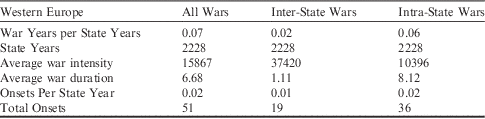
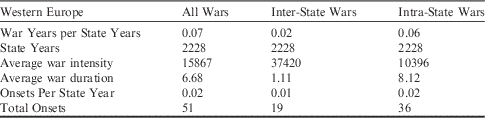
The quantitative analysis of state systems that fall outside of the Correlates of War definition is at an early stage. It has taken decades of work to produce additional data on aspects of inter-state relations for states in the COW register, from alliance portfolios to trade figures and the nature of political institutions. While we hope that these data might be collected for states that have hitherto fallen outside of this effort, this information is not presently available for (most) states in West Africa, Southeast Asia, and South Asia. As such, we have no available control variables for these states or these regions and rely upon comparisons of average values across state systems. One-way analysis of variance (ANOVA) tests were used to assess the confidence with which we can reject the hypothesis that rates of war incidence were not different in West Africa, Southeast Asia, South Asia, and Europe. Of course, we cannot claim any causal relationships from this analysis, but, if we do observe significant differences in line with our expectations above, then we think the theory has some plausibility. Table 2 reports these summary statistics for Western Europe. Table 3 then compares these with the results for West Africa, Southeast Asia, and South Asia.
Descriptive statistics, violent conflict in Western Europe, 1816–1905
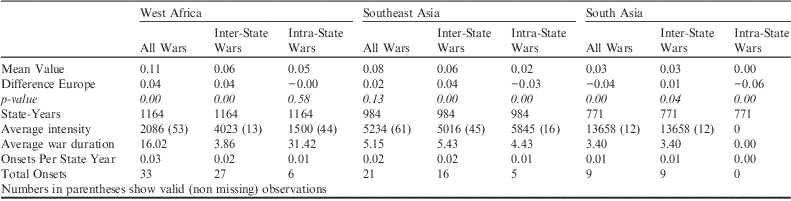
Violent conflict in West Africa, Southeast Asia, and South Asia, 1816–1905
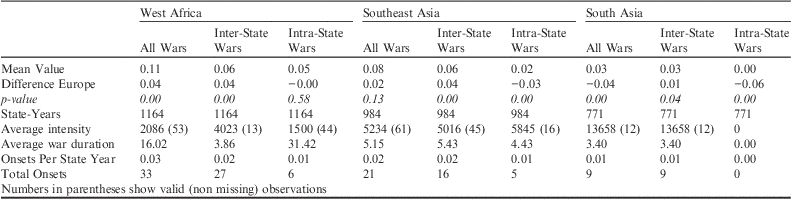
Table 2 shows that Western Europe experienced roughly 0.07 war years per state year, or, one war year for every 14.5 state years. The rate of intra-state war onset was higher than for inter-state wars. Intra-state wars lasted roughly seven years longer that inter-state wars. While inter-state wars were shorter, however, they were more intense with 37,420 fatalities per war year, on average.
How does this compare with the alternative international systems examined here? Table 3 replicates Table 2 but for West Africa, Southeast Asia, and South Asia. It also shows the difference between the war incidence rates in these regions and Europe and a test of the statistical significance of this difference.
Table 3 shows some initial differences between West Africa and Europe. First, the rate of war incidence is higher, at 0.11 war years per state year, or roughly nine state years per war year. This difference is statistically significant. West Africa also exhibits a higher rate of inter-state war incidence than Europe, and a comparable rate of intra-state war incidence. This does not appear to be driven by a small number of very long wars as the rate of inter-state war onset is nearly three times higher in West Africa than in Europe. Inter-state wars in West Africa, were also, on average, longer than wars in Europe, but not as intense. We must keep in mind, however, that there is a very large amount of missing data with regards to war intensity in Africa.
We see a similar pattern in Southeast Asia. The overall rate of war incidence is higher than in Europe, but does not initially satisfy conventional levels of statistical significance. When inter-state wars and intra-state wars are disaggregated, however, we see that Southeast Asia had a significantly higher rate of inter-state war incidence and a lower rate of intra-state war incidence. Again, this does not appear to be driven by long wars, as the rate of inter-state war onset is roughly double that in Europe, although inter-state wars were fought for, on average, 4 years longer in Southeast Asia than in Europe. There were only a handful of conflicts in South Asia, and no examples of intra-state war before all of the precolonial states were absorbed into the British Empire. The overall rate of war incidence was lower than in Europe, but slightly higher when we only look at inter-state wars. These conflicts were substantially more deadly than in Southeast Asia and West Africa.
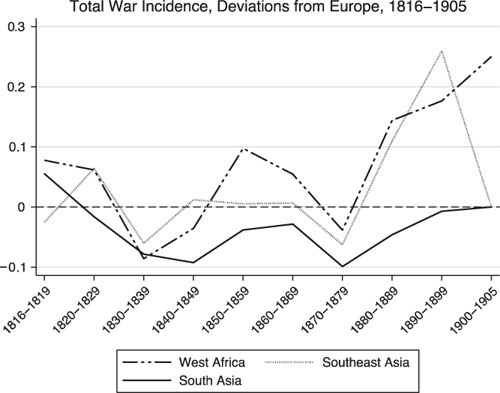
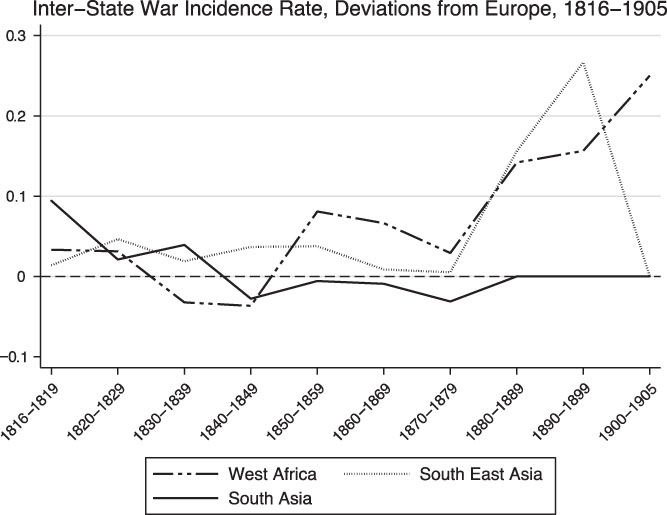
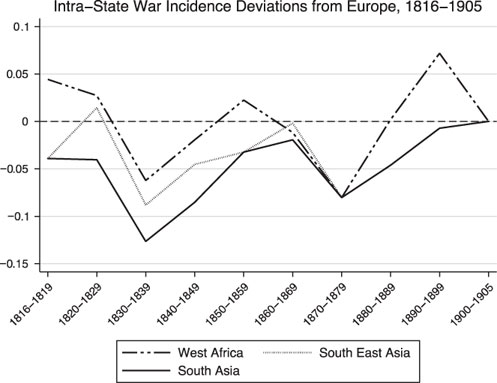
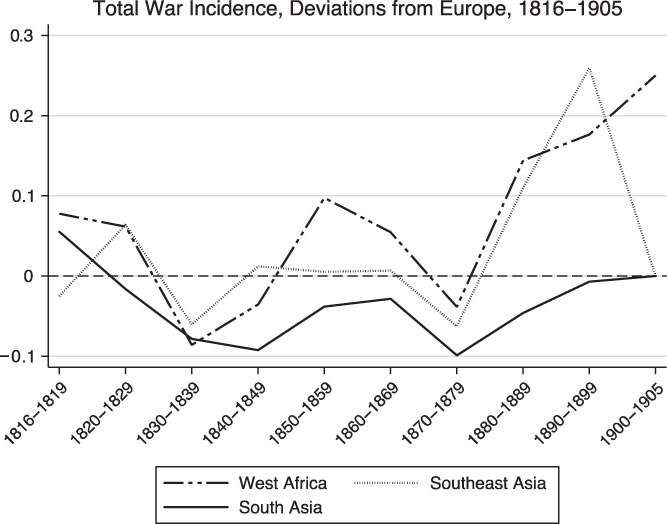
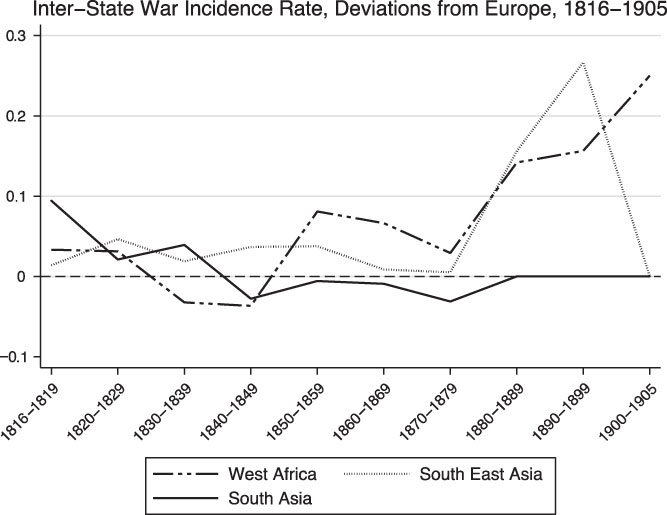
Tables 2 and 3 summarise the average rates of war incidence across the entire 1816–1905 period. Greater temporal disaggregation can provide a sense of the periods in which this difference was greatest, and when rates of war incidence were comparable. Figures 2–4 show the extent to which war incidence rates for West Africa, Southeast Asia, and South Asia deviated from Western Europe for each decade from 1816–1905. The dashed reference line indicates the point where the war incidence rates were equal for that period. When the line rises above the dash, the war incidence rate was higher than in Europe. When it falls below, the incidence rate is lower.
Total War Incidence, Deviations from Europe, 1816–1905
Inter-State War Incidence, Deviations from Europe, 1816–1905
Intra-State War Incidence, Deviations from Europe, 1816–1905
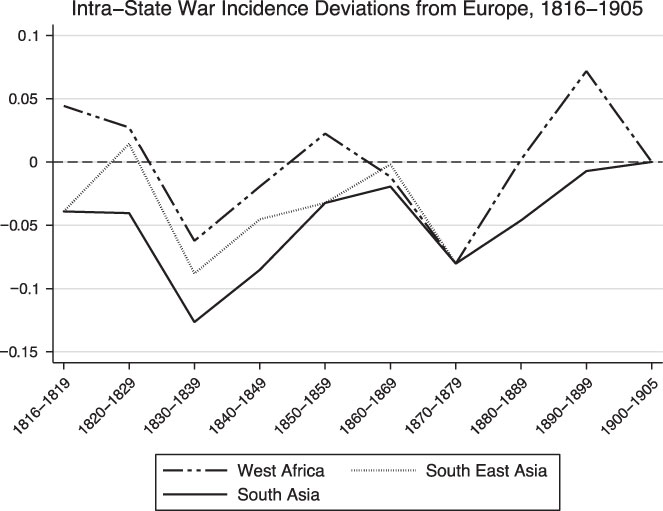
Figures 2–4 provide additional context. In terms of total war incidence, Southeast Asia was roughly comparable to Europe until about 1870 when there is a sharp divergence. This is a product a growing number of wars in Asia and the decline of war in Europe. There are three distinct periods where war incidence is higher in West Africa than in Europe: from 1816–30, 1850–60, and from 1880 onwards. With the exception of 1816–20, South Asia exhibited a consistently lower rate of war incidence than Europe, but this is mostly to do with the consolidation of the British Empire. When inter-state wars and intra-state wars are shown separately, we see the divergence in experiences reported in Table 3. Both Southeast Asia and West Africa exhibit consistently high levels of inter-state war incidence (with the exception of roughly 1830–50 in Africa) when compared to Western Europe. South Asia’s rates are higher until about 1830–9, when they fall in line with Europe’s (very low) levels. In general, all three non-European regions had lower rates of intra-state war incidence than Europe, but the differences were also smaller.
What do these results tell us about the relationship between system structure and war propensity? We advance these interpretations with some caution, as there are likely to be many confounding variables not examined here. However, the results suggest that all three alternative international systems had higher rates of inter-state war incidence and onset that Western Europe during the same period. This difference was largest for West Africa, followed by Southeast Asia and smallest (but still significant) for South Asia. We think that the results regarding inter-state wars are fairly reliable. Wars in non-European regions are likely to be underreported, especially wars between indigenous states. If anything, these differences could be larger. We also think that inter-state wars are more likely to be recorded than intra-state conflicts in general, increasing our confidence in these findings. We are quite sceptical about the lower rates of intra-state war incidence outside of Europe, as it is likely that there are many missing conflicts. For example, the separation of Dahomey from the Oyo Empire (in West Africa) and the more widespread collapse of the Oyo Empire would appear to qualify as a series of civil wars, none of which are included in the datasets used here.Footnote 73
Our analysis of system structure suggested that West Africa had the highest levels of structural differentiation, followed by Southeast Asia. South Asia had some decentralised states but also some more centralised ones. Europe may be considered the region with the most centralised states over the period under examination. One interpretation of these data is that structural differentiation is related to the incidence of inter-state war. Systems with many states that do not centralise sovereign functions, experience more frequent, and potentially, longer inter-state conflicts. State centralisation may allow states to more accurately appraise the military capabilities of their opponents, and themselves, as there is not the added uncertainty of whether a particular family or region (or many families and regions) will support the regime in a crisis or not. This may mean that states in systems with high levels of structural differentiation miscalculate more often, and fight more wars. Systems with high levels of structural differentiation may also fight longer inter-state wars, as, potentially, leaders calculate that they can turn the tide by attracting the support of an uncommitted region, or by inducing parts of the enemy’s policy to defect to their side.
The flip side of centralisation is that miscalculations become very costly as the capability of the state for organised violence increases. Similarly, centralisation may make it easier to appraise which side will prevail once conflict has started, reducing the utility of war faster and shortening these conflicts. We see this pattern in our data. West Africa and Southeast Asia appeared to fight more frequent and longer wars, but they were less intense. Inter-state wars in South Asia (where there were more centralised states) were less frequent than in West Africa or Southeast Asia, but were more intense. Wars were least frequent but most intense (and short) in Europe, where the system was dominated by comparatively centralised states.
There are, of course, many confounding variables. Most of the inter-state wars in Southeast Asia and South Asia involved a European power and colonialism no doubt has a substantial role to play. Colonialism, per se, however, cannot explain the regional differences in the violence associated with the extension of Empire as the same European states were extending their Empires across these regions over the period in question (mostly Britain and France, but also the Dutch in Southeast Asia and the Portuguese in West Africa). Differences in the size of the colonial presence, or in the interests of the colonisers that varied by region, may explain these regional differences. Alternatively, the responses of local states to colonial incursions may also have varied. Our theory would accommodate the possibility that local states in West Africa chose conflict with Europeans more often because of the greater uncertainty surrounding their own military capabilities. Uncertainty over the extent to which Europeans were committed, or resolved, to violently conquer indigenous states may also have played into this equation. In South Asia, it would appear that there were higher levels of accommodation, with many local states opting to sign treaties of protection with the British without large-scale violent. We have not tested these ideas, however, and see them as important areas for future research. In addition to this, there may be factors specific to West Africa during the nineteenth century that explain the higher rate of war-incidence. The influx of guns in the eighteenth and nineteenth century, and the close relationship between slaving and state expansion on some parts of the Atlantic coast is one prominent contender, as are explanations that may link climate, terrain, and state formation.Footnote 74
Conclusion
In this article we developed a framework for analysing variation in international systems that captures the extent to which sovereign functions are distributed above and below the state. We then applied this framework to three international systems contemporaneous to Europe that have not been analysed comparatively: West Africa, Southeast Asia, and South Asia. We found little evidence of states sharing sovereign functions or farming out sovereignty to international institutions. Relations were essentially anarchic. Sharing sovereignty was more common below the state. In West Africa and Southeast Asia the centre often held the ideological power and authority to make decisions of foreign policy and taxation or tribute, but the implementation of these decisions was left in the hands of powerful substate groups. The more geographically distant a group was from the centre, the more sovereign prerogatives it was likely to retain. Some states in South Asia were decentralised in a similar fashion, but there were also large and powerful states that successfully centralised some sovereign functions by maintaining standing armies and directly extracting resources.
These variations in system structure may be driven by variations in interaction capacity – the speed, value, and density of transactions between social groups. Extending state infrastructure is expensive where interaction capacity is low and the centre must afford substate groups decision-making autonomy that reflect these higher costs. Where interaction capacity is high, states can more easily offset the costs of extending state infrastructure with increased taxation. In the cases of West Africa and Southeast Asia, the political units typically possessed an apex of power, and political order generally radiated outward in concentric circles. On the outer orbits of these sovereign peaks, or mandalas, were shatter zones in which local groups were subject to shifting sovereign control and caught in a mode of conflict that blurred the lines between civil and inter-state war.Footnote 75 In some cases informal patterns of dual sovereignty – two-headed birds – were the result. We conjecture that there were similar dynamics during the European medieval period, which is commonly characterised as a heteronymous system characterised by cross-cutting forms of political authority.Footnote 76 We suspect that much of the functional differentiation described in that period was, by our standards, structural differentiation made possible by an environment with low interaction capacity. If so, then it is the nature of hierarchy that has changed over time, not anarchy.
Our analysis of violent conflict incidence suggests that variations in the structure of international systems influence the incidence of war. The data suggest that West Africa and Southeast Asia were systems with high levels of inter-state war, although Europeans drove much of this. This may reflect the notion that systems composed of highly decentralised states are especially vulnerable to inter-state conflicts as decentralisation intensifies uncertainty and creates commitment problems. These results must be taken with the caveats that there are alternative explanations for the patterns, perhaps centred on divergent colonial states, interests and strategies across these regions. Intra-state wars in the non-Western regions examined here also appear to be poorly recorded. Focused data collection on intra-state conflicts in regions not covered by COW might lead to further insights.
Our findings make a contribution to the literature on non-Western international systems, to the comparative analysis of international systems, and to the literature on violent conflict that has been largely focused the European-based system. Our analysis acts as a corrective to the notion that non-Western systems were radically different from Europe. In our analysis, they were not. This article also provides a framework for analysing other international systems, perhaps those not covered by this article in the nineteenth century (the Middle East, Central Asia, or East Asia) or systems further back in time. Our analysis also points to the idea that multipolar systems where states are highly decentralised may be especially war-prone. Drawing on bargaining theory, this adds an important analytical dimension to the standard realist picture that emphasises the balance of power between states, independent of their internal composition. While much contemporary research highlights domestic institutions, especially the role of democracy and liberalism in forming ‘security communities’ with low rates of inter-state war, our analysis highlights the centralisation and control of sovereign functions as an additional explanatory factor for system-level frequencies of war and peace.