Why is the Chinese Communist Youth League (Zhongguo gongchanzhuyi qingnian tuan 中国共产主义青年团, CYL hereafter), an organization portrayed as weak, also presented as the cradle for one of the main factions within the Chinese Communist Party (CCP)? The CYL acts as the Party's “assistant” (zhushou 助手) in managing youth affairs.Footnote 1 It is similar in size to the CCP,Footnote 2 with 87.5 million members at the end of 2015.Footnote 3 There are CYL committees at every level of the party-state hierarchy as well as in organizations with numerous young people, such as schools and universities.
Yet despite its size, the CYL is an organization “without power and funds” (wuquan wuqian 无权无钱).Footnote 4 It is the Party that controls the recruitment of CYL leaders. Although the League's Central Committee formally elects the central-level CYL secretaries, it is the CCP Politburo Standing Committee that actually selects them. This arrangement is reproduced at lower levels.Footnote 5 Beyond lacking autonomy, the CYL also lacks funding: the 2015 budget for the central CYL (5,838 million yuan) was just over a quarter of the 2015 budget for another mass CCP organization, the All-China Federation of Trade Unions (2 billion yuan).Footnote 6 In addition to its organizational weakness, studies have stressed that the CYL holds limited appeal for young people and its political indoctrination role has been in decline since the 1980s.Footnote 7
As the Party's “reserve force” (houbeijun 后备军), the CYL performs an essential role in the recruitment and political training of future CCP members and officials. The CYL recruits young people aged between 14 and 28 years of age. After being screened and trained, some of its members eventually become CCP members. Yet the broad base of membership, which covers 25 per cent of the 14–28 age group, means that CYL membership alone does not provide its members with any clear advantage for a political career.Footnote 8 Second, the CYL recruits young cadres to lead the organization. They are managed like civil servants and are generally both CYL and CCP members. Many of them later pursue careers within the party-state. Between 1922 and 2012, 34.59 per cent of CCP Central Committee members had previously worked as CYL officials.Footnote 9
The CYL's role as a stepping stone for future leaders has grown over time. Studies have shown that CYL officials in particular have benefited from the cadre system reforms initiated by the party-state in the 1980s.Footnote 10 However, no study systematically analyses this evolution or the mechanisms driving it. Contrary to scholars who contend that the reforms gave rise to a cohesive “Youth League Faction” or tuanpai 团派,Footnote 11 I argue that the promotion of numerous CYL affiliates to party-state leadership positions is the by-product of the CYL's organizational weakness set against the context of the Party's rejuvenation policy.
CYL leaders enjoy a high ranking as the heads of a primary mass organization and, being in charge of a youth organization, they are comparatively young. In the age-based promotion system that emerged in the 1980s, this unique situation has had a significant effect on their future careers. Moreover, the CCP leaders who control this avenue for promotion use it as a springboard to accelerate the careers of their protégés. Distinct from being a stronghold of a specific faction, party-state leaders at different times and in different localities can use this promotion channel to their advantage. As a result, the CYL provides the party-state with a stable means to identify, screen and promote young talent.
The CYL's lack of autonomy, however, does make it very sensitive to policy changes. Indeed, the configuration which allows this weak organization to play key political functions remains fragile. Since his rise to power, Xi Jinping 习近平 has in fact been working towards weakening this route to leadership so that it cannot be used by potential rivals.
Here, I provide a unique account of the role played by the CYL in the promotion of top leaders since the 1980s. My analysis is based on 14 months of field-research conducted in Beijing, Nanjing and Guiyang between 2011 and 2015. Following a snowball sampling method, I conducted 121 interviews with actors affiliated to the CYL at different levels of the polity. Relying on these interviews and biographical data, I have reconstructed the career trajectories of CYL cadres as well as their working environments.
In this article, I first highlight the CYL's lack of autonomy and why it is not a separate nexus of power within the Chinese party-state. I then document the rise of the CYL as a key stepping stone for promotion in post-Mao China and demonstrate that its resilience results from its organizational weakness and dependence on the CCP. Finally, I describe the changes happening under Xi Jinping and how they might challenge the CYL's role as a “reserve force.”
No Power and No Funds
The Chinese Communist Youth League organized its first national congress in 1922.Footnote 12 That same year, the Party issued a “Resolution on the question of the youth movement” to limit the CYL's political autonomy.Footnote 13 The organization's fate has been firmly linked to the CCP ever since. Initially, the CYL was a vital tool in the CCP's struggle for power, but after 1949, it was transformed into a governing instrument to manage young people's activities. Its relations with the Party became problematic during the Cultural Revolution when it was accused of bourgeois revisionism.Footnote 14 Just as rebel organizations bypassed the Party organization to take control, the CYL, deemed guilty “by association,” was replaced by the Red Guards.Footnote 15 All CYL activities ceased in 1966 until 1973 when provincial CYL committees were re-established, followed by the national organization in 1978.Footnote 16
In the 1980s, party-state reformers thought that it was necessary for the Party to relax its control over the CYL if it were to remain relevant to young people.Footnote 17 They argued that the decreasing ideological hegemony of the CCP along with the emergence of new channels of social mobility in the 1980s had meant that the CYL had lost its appeal among Chinese youth.Footnote 18 A reform project was put forward in 1988 to make the CYL more autonomous.Footnote 19 However, a year later, the Tiananmen movement embodied the CYL's failure to control China's young people. The League was criticized for being too indulgent towards the students and too loosely organized in the 1980s.Footnote 20 As early as 1980, the League admitted that 30 per cent of its 2.2 million local units countrywide were poorly organized or even paralyzed.Footnote 21 Moreover, studies showed how CYL cells on campus facilitated student mobilization.Footnote 22 The Party called a halt to the CYL reform proposals following the Tiananmen movement.Footnote 23
Ever since 1989, officials have been regularly calling for the strengthening of the CCP's supervision over the CYL.Footnote 24 Along these lines, the CYL first secretary, He Junke 贺军科, declared at the 2018 National Congress of the CYL: “CYL work often does not live up to the standards of the new era … The CYL still has weak foundations at the grassroots.”Footnote 25 His speech followed on from recent criticism of the League. In 2015, the Central Commission for Discipline Inspection accused the CYL of being increasingly “bureaucratic, administrative, aristocratic and entertainment-oriented.”Footnote 26 And, in a 2017 book compiling his comments on youth issues, Xi Jinping warned the CYL against “empty slogans” (konghan kouhao 空喊口号) and becoming an “empty shell” (kongke 空壳).Footnote 27 He has also argued for more Party control.
Xi's proposition amounts to a consolidation of the current structure. Party committees already manage CYL committees at every level of the polity. From the local to the central level, the CCP is in charge of appointing CYL leaders. In the “one-level downward” cadre management system,Footnote 28 and similar to the way it treats its own departments, the CCP committee at the corresponding level oversees the selection of local CYL leaders, who are one full rank below that of the Party committee leaders.Footnote 29 The CCP also has control over the League's budget.Footnote 30
At every level, the CYL is dependent on the Party, and the upper-level CYL unit only has a supervision function, with very little power. The main channel through which the upper-level CYL committee can influence the units below is by transmitting a negative evaluation of CYL cadres to the relevant CCP committee.Footnote 31 As explained by a Central CYL School staff member:
A significant problem for the CYL is that it cannot have an integrated work plan. The central CYL policies are only partially implemented at the local levels as the upper echelons have no power over officials’ promotions … If a local CYL committee must choose between conflicting orders given by the upper-level CYL committee and by the local CCP committee, it will follow the Party.Footnote 32
Chinese experts on the CYL widely share this diagnosis. Zheng Changzhong 郑长中, a former CYL official now based at Fudan University, warns that the CYL is “marginalized” (bianyuanhua 边缘化) at the local level as it lacks resources and because its officials do not adequately follow central CYL instructions.Footnote 33
Overall, the CYL is in a position of organizational “juniority.”Footnote 34 It is unfavourably embedded in party-state hierarchies, which leads to its subordination and disempowerment. It lacks two critical features of an institution: autonomy and coherence.Footnote 35 How, then, can it be the Party's “reserve force?”
Not a Separate Nexus of Power
Despite the League's organizational weakness, a branch of literature highlights how many former CYL officials have been promoted to top positions within the Party. These authors argue that a Youth League Faction (tuanpai) has developed, first under Hu Yaobang 胡耀邦 in the 1980s and then under Hu Jintao 胡锦涛 in the 2000s.Footnote 36
This tuanpai literature implicitly develops a cyclical narrative of the rise of CYL members to CCP leadership positions during the post-Mao era. During the first phase, many CYL affiliates were promoted within the Party thanks to the support of Hu Yaobang, a former central CYL secretary (1952–1966) and general secretary of the CCP between 1980 and 1987. He turned to the CYL to promote officials he could trust as part of the Party's rehabilitation process and rejuvenation policy. This phase ended with Hu Yaobang's political downfall, an event which also harmed the careers of several officials he had promoted from within the CYL.Footnote 37 Two years later, his death triggered the Tiananmen movement. The CYL leadership was criticized for having too much sympathy for the student movement,Footnote 38 and by the late 1980s, the promotion of CYL officials to top Party positions seemed to have lost political momentum. A second phase in the rise of the tuanpai came when Hu Jintao, also a former central CYL secretary (1982–1985), became the CCP general secretary in 2002. According to Cheng Li, the tuanpai became a cohesive group of former CYL leaders, with Hu Jintao at its centre.Footnote 39
The emergence of the CYL as a promotion route to leadership positions in the post-Mao era becomes clear when one looks at the evolution of the CCP Central Committee and Politburo members’ backgrounds. Figure 1 illustrates this trend by displaying the percentage of CCP Central Committee and Politburo members that are former central CYL officials, from the eighth CCP Congress of 1956 until the 19th Congress of 2017.Footnote 40 These bodies, which have around 300 and 20 members respectively, represent the Party elite.
Former Central-level CYL Cadres in the CCP Central Committee and Politburo
Sources:
Database compiled by Victor Shih and Jonghyuk Lee at http://www.jonghyuklee.com/database. Accessed 7 May 2018; Chinavitae.com.

Looking at Figure 1, the numbers of former central-level CYL officials who later joined the CCP Central Committee and Politburo increased sharply in the 1980s. However, the data do not support a purely factional explanation for this increase. First, when looking at the number of CYL affiliates who were promoted to the CCP Central Committee, the primary difference is between the Mao and post-Mao eras, i.e. 1976 onwards. By contrast, the variations that are attributed to factional struggles within the post-Mao era are secondary. This is even clearer when looking at the percentage of Politburo members who were formerly central-level CYL officials. While there were none during the Mao era, such appointments became common afterward. Second, the main increase in former CYL officials gaining seats on these organizations in the 1980s took place at the 13th Congress of 1987, ten months after Hu Yaobang's downfall. Third, although former CYL officials were less represented on the Central Committee and Politburo after the 13th Congress, this did not fundamentally change with the 16th Congress of 2002 and the nomination of Hu Jintao as Party leader. Fourth, the share of former CYL cadres was unusually high under Hu Jintao at the 17th Congress, but almost as many were appointed at the 18th Congress of 2012, even though Hu Jintao was no longer in office. However, the number of CYL affiliates appointed to the Party leadership dropped at the 19th Party Congress. As discussed below, Xi Jinping has been undermining the role the CYL plays in promoting potential top leaders.
The factional narrative is also based on an alleged rivalry between two coalitions within the Party. Cheng Li describes the tuanpai as a group of like-minded officials who are interested in social policies.Footnote 41 He contends that this faction is competing against the “elitist” princelings, the offspring of Party and military leaders from the Mao era. This dichotomy is far from obvious. Although some princelings may have been vying with CYL affiliates for leadership positions, the idea that these groups are fundamentally opposed does not stand up to empirical scrutiny. Several key members of the supposed tuanpai faction also have a princeling background – for example, Chen Haosu 陈昊苏 and He Guangwei 何光伟 in the 1980s, and then later, Liu Yandong 刘延东.Footnote 42 Although there is no statistical record of CYL officials’ family backgrounds, several of the cadres I interviewed noted that since the 2000s, an increasing number of high-ranked officials’ children started to work for the CYL, especially at the central level.Footnote 43 This overlap as well as the similarities in these two groups’ political agendas renders as questionable the suggested dichotomy between a “populist” tuanpai and a group of “elitist” children of officials.Footnote 44
Although factional allegiances have played a role in the rise of some CYL cadres, they cannot explain the phenomenon as a whole. The assertion that all CYL leaders since the 1980s form a single political bloc with a shared foe remains unproven. With these limitations in mind, Kou Chien-wen has argued that both factional and organizational effects are at play in the rise of CYL affiliates. He suggests that the CYL produces a pool of talent from which the tuanpai can recruit followers.Footnote 45 Kou applies Andrew Nathan's analogy of factions developing on organizations “like vines on a trellis” to the CYL. For Nathan, external factional networks, based on clientelist ties, can attach themselves to, or emerge from, organizations. This facilitates the development of the faction, as it can use the organization's communication flows and can recruit from among its members.Footnote 46 The way in which Chiang Ching-kuo used the Kuomintang's various youth organizations, which he headed in the mainland in the 1930s and Taiwan in the 1950s and 1960s, to develop his own personal network illustrates this phenomenon.Footnote 47
The trellis model requires the organization to have some autonomy from other political structures. Yet, CYL leaders are selected by the Party leadership and not the League itself. They often come from outside the League – generally from a local CCP leadership position – and get transferred to another party-state unit after a few years in office. This was the case for the last three central CYL first secretaries: Hu Chunhua 胡春华, who was appointed in 2006, Lu Hao 陆昊, appointed in 2008, and Qin Yizhi 秦宜智, who was appointed in 2013. Thus, the CYL is not an autonomous promotion channel and does not fit the trellis configuration. In contrast to Chiang Ching-kuo's personal faction, which survived the KMT's successive youth organizations, the CYL's route to leadership has survived the political side-lining of Hu Yaobang and Hu Jintao and has continuously brought new blood to the CCP: factional networks cannot explain the resilience of this promotion channel. It is the CYL's lack of autonomy and coherence that prevent it from becoming a separate nexus of power.
A Path to Power
Rather than a factional stronghold, I argue that the League has become a regularized path to leadership positions in the post-Mao era and has been used across the board. The CYL became increasingly important as a promotion channel in the context of the CCP's rejuvenation policy. In 1980, Deng Xiaoping 邓小平 called for the promotion of “revolutionary, younger, more educated, and more technically specialized” officials.Footnote 48 Accordingly, the party-state implemented new promotion rules. In contrast to the rules of the Mao era, class origin was no longer emphasized but education became vital.Footnote 49 New entry and exit mechanisms were developed to accelerate cadre turnover and rejuvenate the Party. The establishment of a retirement systemFootnote 50 was followed by the development of new rules concerning the age of leading cadres,Footnote 51 which are still in place today. As highlighted by Kou Chien-wen and Tsai Wen-Hsuan, age limits became a unique and complicated system affecting promotions at all levels of the polity.Footnote 52 These age-related rules were implemented alongside the development of regulated cadre tenures: officials must serve a minimum term in all of their posts to prevent accelerated promotions based on favouritism. Also, cadres cannot skip levels and must be promoted from one level up to the next. Although not always fully implemented, these regulations are applied throughout the cadre system.Footnote 53
The Party's rejuvenation policy resurrected the CYL's role as the Party's “reserve force.” This official function of the organization, which had been removed from the CYL charter in 1957,Footnote 54 was brought back in 1982.Footnote 55 More significantly, the CYL mirrored the Party and established age limits for its leading cadres in 1982 on the grounds that leaders could not be much older than League members.Footnote 56 This change had a significant impact on the career trajectories of CYL leaders. As the heads of a key mass organization, CYL leaders are highly ranked; they also have an age advantage when transferring to party-state positions. For instance, when the CYL Central Committee first secretary, who cannot be older than 45 when appointed, is transferred to a similarly ranked position within the party-state, he or she generally becomes a provincial leader – but at a much younger age than other officials. In a system with strict age restrictions, CYL officials have a head start in the race to the top.Footnote 57
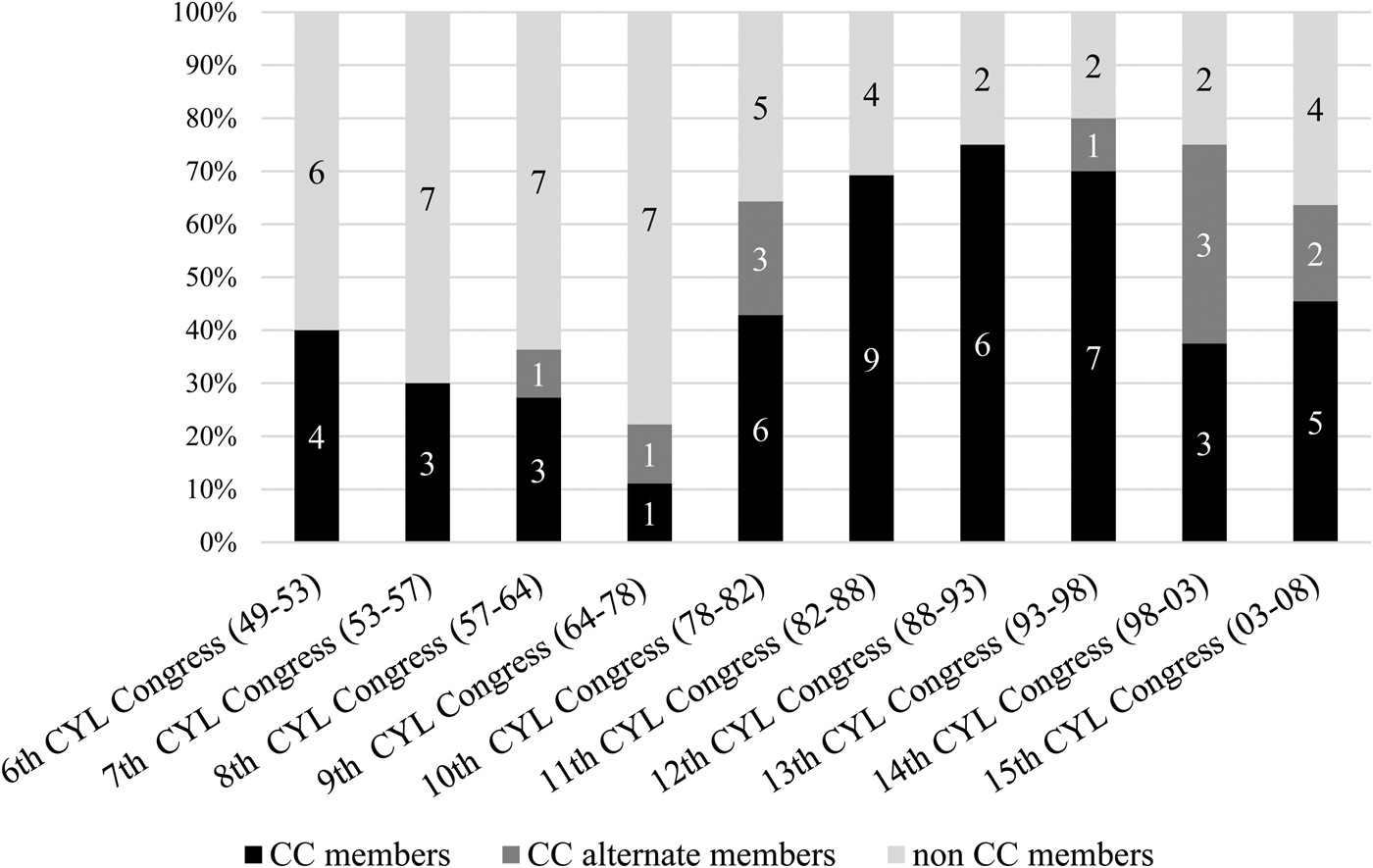
When following the careers of former central CYL secretaries, it is evident that these changes have led to the continuous promotion of CYL leaders to party-state leadership positions in the post-Mao era. A new secretariat of around ten members is selected at the CYL national congress every five years. Although the first secretary is generally an alternate member of the CCP's Central Committee, most secretaries are too junior and would not usually be considered for party-state leadership posts for another 15 years or so. Still, as shown in Figure 2, it is striking that the vast majority of them eventually become CCP Central Committee members.
Former Central-level CYL Secretaries in the CCP Central Committee
Source:
Central Government Portal 2016. Resumés are taken from Xinhuanet.com or Baidu.baike (only if the data were sourced from media or official reports).

From 1949 to 1978, only a few former CYL leaders made it on to the Central Committee. Then, starting with the tenth Congress of the CYL in 1978 and particularly after the 11th Congress in 1982, the majority of central CYL secretaries did at some point join the CCP Central Committee. Of the eight CYL secretaries nominated at the 11th Congress of the CYL, only two did not go on to join the CCP Central Committee and one of these, Feng Jun 冯军, died before he was eligible. The same pattern holds for the following congresses. It must be noted that top officials from the 14th and 15th CYL Congresses are still relatively young and might yet be appointed to the Central Committee. The 16th (2008) and 17th CYL Congresses (2013) are not included in the current analysis as most of those CYL leaders are still too junior to be appointed to the CCP Central Committee.
The situation with the CYL is very different to that of other mass organizations. For example, from 1978 to 2013 only 24.7 per cent of the former leaders, chairmen and vice-chairmen of the All-China Federation of Trade Unions (ACFTU) were appointed to the CCP Central Committee.Footnote 58 Youth League leaders have a brighter future despite being pegged at a lower rank than ACFTU leaders. The CYL Central Committee first secretary is a ministerial-level official with only an alternate membership in the CCP Central Committee, whereas the ACFTU chairman is generally a Politburo member with the rank of a deputy state leader.
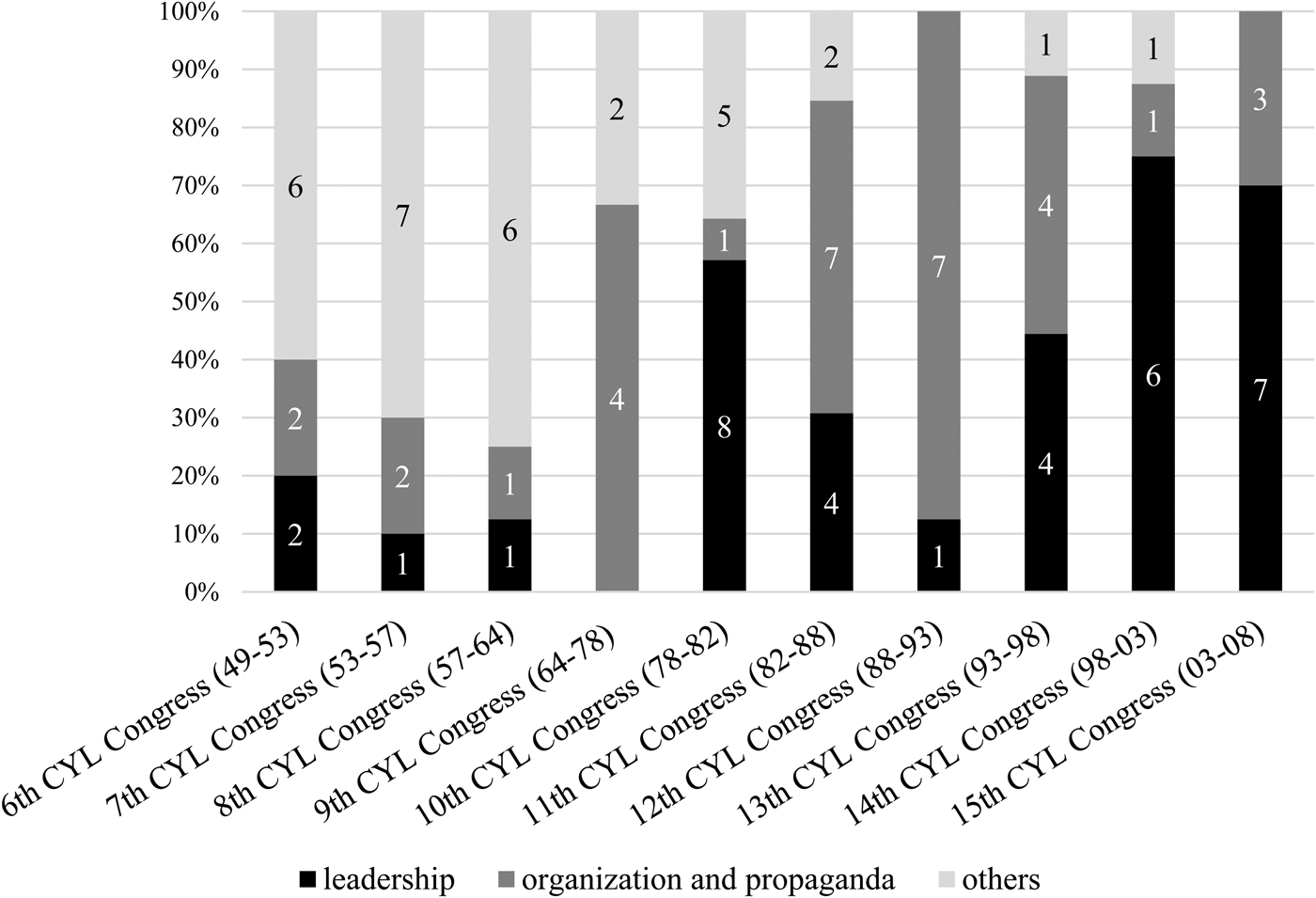
Furthermore, former CYL officials have increasingly been promoted directly towards leadership positions within the party-state. Figure 3 illustrates this trend. During the Mao era, transfer options for central CYL leaders were diverse and included, among others, propaganda, technical or military positions. Only a few secured leadership positions, generally as local Party secretaries. After 1978, the ratio of former CYL leaders transferred to such positions increased considerably. Some are still appointed to the propaganda or organization departments, but most of them are promoted as local leaders and generally join provincial leadership teams.
Types of Positions Obtained by Former Central-level CYL Secretaries after Leaving the CYL
Source:
See source for Figure 2.

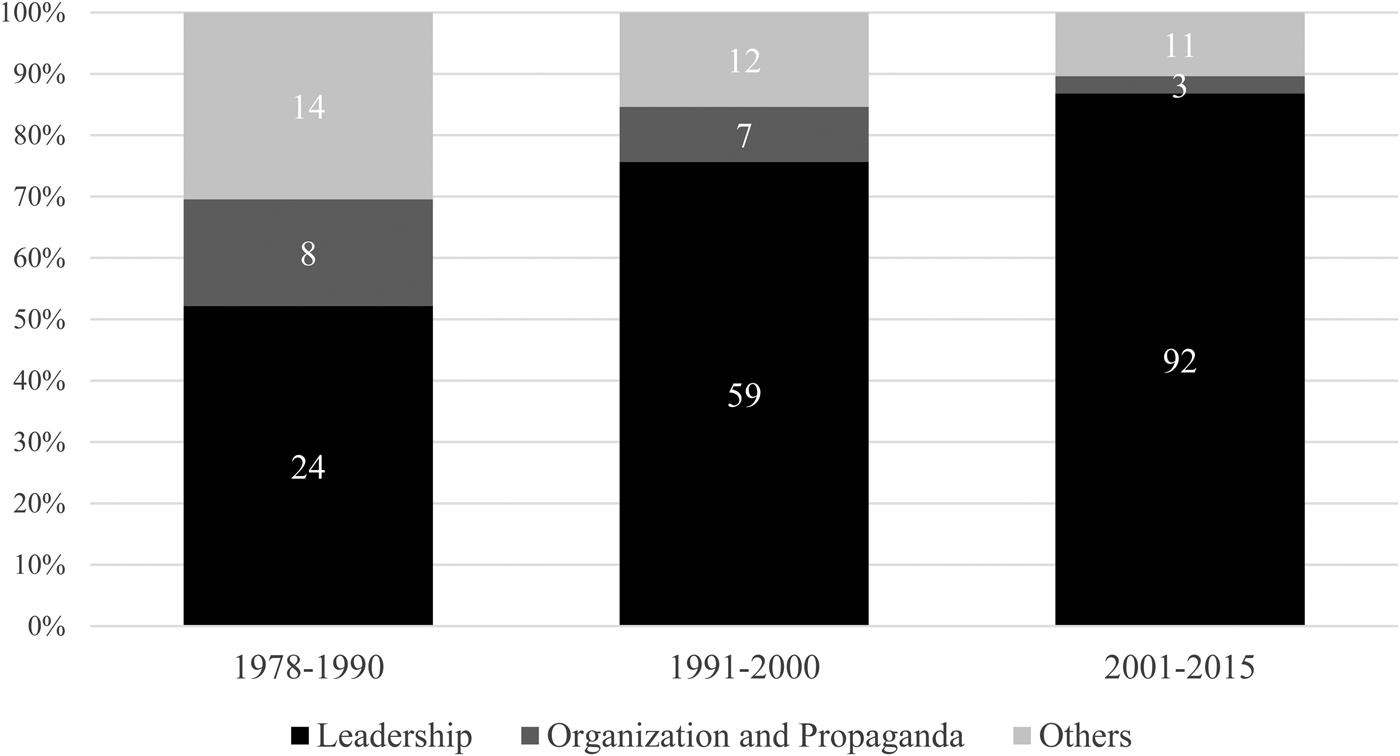
At the local level, CYL affiliates are also increasingly promoted to leadership positions. Figure 4 shows that in the 1980s, provincial-level CYL leaders (secretaries and deputy secretaries of CYL committees in provinces, autonomous regions and municipalities) were transferred to positions ranging from agriculture to culture. This all changed in the 1990s: almost 80 per cent of the provincial CYL leaders appointed between 1991 and 2000 directly became local party-state leaders. This trend became more prominent in the 2000s. Indeed, provincial CYL secretaries are in a perfect position to become future local leaders as they already hold a bureau-director ranking and are generally below 40 years old.Footnote 59 Most former provincial CYL secretaries went on to become city-level CCP deputy secretaries.Footnote 60 In addition, many former CYL cadres joined local leadership structures: of the provincial Party secretaries and governors in office in March 2015, 45 per cent had previous work experience as CYL officials.Footnote 61
Types of Positions Obtained by Former Provincial-level CYL Leaders after Leaving the CYL
Source:
Name lists of former provincial CYL secretaries are available online (see, e.g., https://freewechat.com/a/MzIxNzU3MjM2NA==/2247488044/1. Accessed on 29 July 2019). I crosschecked these with local CYL officials. I analysed career data using the same sources as Figure 2.

A position within the CYL is only one step in an official's career and obviously cannot explain a whole trajectory. Still, these results confirm that starting from the 1980s, the CYL became a regularized promotion route to top party-state positions. This phenomenon is, however, tied to a specific and fragile configuration founded on age-based rules, which raises the question of its resilience over time.
All Leaders Have Their Own tuanpai
I argue that the unique promotion opportunities open to League officials are a by-product of the CYL's weakness. The CYL's organizational dependence on the Party leads to close relationships between CYL leaders and CCP leaders at the same echelon. CYL leaders can attend CCP standing committee meetings as observers and they report to the Party leadership regularly.Footnote 62 A local CYL cadre I interviewed summarized this relationship:
As a CYL secretary, you can meet local CCP leaders daily. You can talk to the CCP secretary, regularly exchange with him. He therefore knows you, your skills and qualities. This is the most unique feature of being a CYL leader.Footnote 63
The relationship with CCP leaders is particularly important as they appoint CYL leaders, evaluate their work and eventually promote them to party-state positions within their jurisdiction.Footnote 64 For example, a provincial-level Party secretary can decide to appoint the CYL secretary of the province to the post of deputy mayor of a middle-sized city within the province.
This is not the case for all League officials. Although leading CYL officials are managed by the CCP at the same level, lower-ranked CYL officials are managed by the League and cannot rely on the CCP leadership to promote them. Most promotion opportunities for lower-level officials lie within the CYL itself, and when they reach the age limits for CYL positions, they have to transfer to another organization. The League rarely has the means to help them search for another post, thus they must rely on themselves. The CYL promotion channel therefore only functions for leading cadres. The CYL's two-track system echoes the elite dualism literature which describes how only some party-state officials are “pulled” to the top.Footnote 65
For the chosen few, their relationship with CCP officials is all the more critical as evaluations of CYL officials are highly subjective. According to one of my interviewees:
CYL leaders have objectives and they submit annual reports to CCP leaders on how they attained them. However, the Party leaders barely read them. The evaluation is very subjective; what is essential is to know how to manage the boss and his feelings towards you. You have to make yourself useful to him.Footnote 66
Since the 1980s, the party-state cadre management system has progressively been systematized to integrate precise methods and criteria for the evaluation of officials’ work.Footnote 67 Yet, this evolution has not really applied to CYL officials. The CCP leadership evaluates the CYL secretary and deputy secretaries at the corresponding level, but beyond organizing the activities themselves, there is no clear standard on the impact these activities should have. The evaluations are not based on any quantifiable targets. Moreover, as mentioned above, the policies and projects initiated by the central CYL do not always have to be implemented by local CYL committees. Owing to the CYL's overall lack of coherence, the Leagues follow the priorities set by local CCP committees instead.
In the absence of clear performance targets, CYL officials have to please their superiors. My interviewees stressed the subjective nature of evaluations and the importance of efficiently showcasing one's own work. They emphasized the importance of rhetorical and writing skills, as well as “charisma” (meili 魅力).Footnote 68 As one official put it: “the most important thing is to speak and write well, to learn to defend your work. When you have no power and no funds you have to be a sweet talker.”Footnote 69 CYL officials like to highlight their abilities to organize numerous activities with little means in order to assert their legitimacy and compensate for their lack of specific expertise.Footnote 70
CYL officials must get noticed by their superiors in order to be promoted. Consequently, they organize massive events to attract their attention. The Youth Volunteers Operation (qingnian zhiyuanzhe xingdong 青年志愿者行动), which was launched in 1993 and is still running, exemplifies this phenomenon. Set up by Li Keqiang 李克强, then first secretary of the CYL and now the PRC's premier, the Youth Volunteers Operation is aimed at recruiting young volunteers and channelling them towards various educational, social or environmental projects. In addition to day-to-day activities, it also recruits volunteers for major events including, for example, the 1.7 million volunteers who took part in the 2008 Olympic Games in Beijing. Between 2001 and 2013, the CYL recruited 40 million volunteers at different levels.Footnote 71 CYL officials present this operation as one of Li Keqiang's key successes.Footnote 72
Projects can lead to competition. During my fieldwork, the Nanjing CYL took an active part in the organization of the Nanjing 2015 Youth Olympic Games. The CYL recruited and managed around 20,000 volunteers for the event.Footnote 73 To demonstrate its commitment, the Nanjing CYL committee set up a special office, employing around 400 temporary staff members. However, the Jiangsu CYL committee tried to win control of the event and gain a share of the spotlight.Footnote 74
To attract the attention of their superiors, local CYL leaders publicize their work widely. Here is the response of one CYL official when I asked him why he published so many articles in the local media and internal Party publications:
Rather than the content [of the articles], it is most important to show that you are active, as you have to put yourself forward to be promoted. You have to use the media, or any channel through which the local and central leaders can hear about you. It also gives you things to say to your boss in meetings, and you can show that you understand correctly the directives coming from the top.Footnote 75
In contrast to the literature that highlights the meritocratic features of the Chinese party-state,Footnote 76 some studies have stressed the importance of pleasing one's superior in order to get promoted.Footnote 77 For CYL officials, the lack of clear evaluation criteria further increases their dependence on their superiors’ subjectivities.
As a result of the close connection between CYL and CCP leaders, CCP secretaries at all levels use the CYL to promote their associates. They may appoint someone with whom they already have a personal tie to a CYL leadership post in order to further cultivate this tie, or appoint someone with whom they wish to build a relationship. These strong ties contrast with the weak ones between the different levels of the League itself.Footnote 78 The appointment to a CYL leadership post gives cadres a distinct career advantage over their colleagues. Furthermore, it allows CCP heads to further develop their networks within the party-state as these protégés might rise to top posts in the future. Thus, all Party leaders are able to build their own “youth league faction.” Contrary to the tuanpai literature, which emphasizes the ties created within the League, I argue that it is the strong ties forged between CCP and CYL officials that allow this weak organization to be a sure path to power.
The League's lack of autonomy also enhances its resilience as a promotion channel. Since Party leaders are able to use this route to fast-track the careers of young officials they trust and like, they have little reason to question the specific status the CYL enjoys within the Chinese political system. When they gain power, they can purge the organization of those loyal to their predecessor or rivals and, once again, use the organization to promote their followers. After Hu Yaobang's fall, several of his loyal associates were indeed purged from the League.Footnote 79 A central leader attempting to concentrate power in his hands might, however, go one step further and reduce the dominance of this stepping stone to power, as it can be used by potential rivals at the local level.
Young Officials in the Xi Jinping Era
Being dependent on the Party leadership, the CYL's status as a path to power is precarious. In recent years, Xi Jinping has taken several steps towards limiting the role played by the League. In August 2016, the CCP Politburo Standing Committee approved the “Proposal for reform of the Central Youth League,” which underscores the Party's control over the League and calls for a restructure of its leadership organs.Footnote 80 The main features of the reform can be summarized by the expression “shrinkage at the top and replenishment below” (jianshang buxia 减上补下). It implies a drastic reduction in the number of CYL full-time personnel at the central and provincial levels, who will be partially replaced by part-time and temporary transferred cadres, and a parallel increase in personnel at the county level. This reform limits the CYL's resources and strengthens the CCP's control over it.
The 2016 restructuring is a response to Xi Jinping's criticisms of the CYL, outlined above.Footnote 81 It follows on from a series of measures aimed at weakening the dominance of the organization. First, the central CYL's budget was cut by almost half between 2015 and 2016. The central CYL lost control of some of its main volunteering activities and the associated funding.Footnote 82 Second, the central CYL has lost several of its associated structures including its shares in the China Travel Group and Cachet Pharmaceutical,Footnote 83 and the core of the China Youth University of Political Studies, which was co-managed by the CYL and the Ministry of Education and has now been absorbed into the newly established University of Chinese Academy of Social Sciences.Footnote 84
These changes will probably diminish the CYL's role as a promotion channel in the long run, especially at the central and provincial levels. The recent appointment of former CYL first secretary Qin Yizhi as deputy director of the General Administration of Quality Supervision, Inspection and Quarantine, reflects this change. This position is of lesser importance than the provincial party-state leadership positions to which CYL heads are usually transferred.Footnote 85
This evolution must be understood within the context of Xi Jinping's attempts to reform the party-state's elite renewal system. The age-based rules explained above are progressively being relaxed and are being implemented less and less at the local level.Footnote 86 A 2014 document on the promotion of leading cadres, as well as the 2019 revised version, endorsed this change: it noted that age limits should not be used too strictly for personnel transfers.Footnote 87
Xi Jinping is also blocking other avenues that facilitate the rapid promotion of young officials. In addition to the curbs on the CYL, steps have been taken that impede the “open selection” (gongtui gongxuan 公推公选) process which allowed the rapid promotion of young officials. This mechanism requires the recruiting unit to publicly announce vacant positions, set up open application procedures for all qualified candidates, and then make appointments based on the results of written exams and interviews.Footnote 88 It was introduced in the 2000s to make the recruitment process more transparent as well as to bring new blood to leadership positions. In fact, “open selection” made it easier for young officials not to follow tenure regulations, and it became a well-known fast track for young officials to get ahead in the Party.Footnote 89 The scope of “open selection” was restricted in 2014 with the publication of a revised version of the “Working regulations for the promotion and appointment of leading Party and government cadres.” According to this document, “open selection” can only be used when the local unit cannot find suitable candidates internally. It is also no longer possible to transfer candidates across provinces for positions at the division director level (chuji 处级) and below, which includes most leading officials aged 40 or below.Footnote 90 The 2019 revised version of that same document goes one step further and states that this mechanism should be used for appointments to deputy positions rather than for full-ranked leading officials.Footnote 91
Officially, these changes are aimed at limiting the rapid promotion of inexperienced and unfit cadres who rely on personal ties to accelerate their careers. In practice, they make the promotion process extremely difficult and “strict” (yan 严), to paraphrase the China Youth Daily.Footnote 92 As one of my interviewees explained:
It is now very difficult to be promoted as a young official. Many people think about transferring to the private sector. Even me. I have been a CCP member since high school and a loyal CYL official, and I am now leaving.Footnote 93
Xi Jinping is weakening the promotion channels that could be used by other officials to develop their networks as he consolidates his power base.Footnote 94 He is constraining the promotion chances of young officials and limiting potential competition. Yet, by decreasing the importance of age-based rules and the level of cadre turnover, Xi Jinping risks creating an increasingly aged party-state elite. This is not to say that young officials are not promoted to high-level positions anymore, but the absence of formalized promotion channels could make such promotions rarer and increasingly based on patronage.Footnote 95 To illustrate this change, the Central Committee selected at the 19th Party Congress is the oldest in decades, with an average age of 57 compared to 56.1 in 2012 and 53.5 in 2007.Footnote 96
Conclusion
The party-state's rejuvenation policy of the 1980s led to the development of a cadre management system largely based on age. In this context, CYL officials, and especially CYL leaders, are placed in a favourable position as they are both young and highly ranked. CYL officials have a structural career advantage compared to other cadres, which facilitates their promotion to high-level positions.
The CYL's role in promoting top leaders has been widely accepted and maintained over time, not because the League emerged as a unified faction but as a result of its lack of autonomy from the Party. At different points in their careers, young officials can use the CYL as a springboard to advance within the party-state hierarchy. Meanwhile, Party leaders control the appointment and evaluation of CYL leaders and can promote their trusted associates. Both recruits and recruiters can therefore use the CYL strategically and thus have little incentive to curb this promotion channel.
This fast-track path is essential to attract talented young people in a context where the party-state no longer has the monopoly on social mobility and other career choices are available. This echoes Milan Svolik's work on how authoritarian political parties manage to secure their members’ loyalty by forcing them to invest in the organization for long periods before they can reap the benefits tied to leadership positions.Footnote 97
To sum up, this unique configuration allows a weak CYL to conduct essential functions but leaves it vulnerable. As Xi Jinping continues to concentrate more power in his hands, he has put forward several reforms that constrain the CYL's role in promoting top leaders. By doing so, he is marginalizing a political springboard that could be used by potential rivals. This may limit competition but it also limits elite renewal.
Acknowledgements
I am grateful to Kyle Jaros, Françoise Mengin, Andrew Nathan, Patricia Thornton, Konstantinos Tsimonis and Sebastian Veg for their comments on earlier versions of this article. I also thank Victor Shih and Jonghyuk Lee for sharing their data on Central Committee members. Finally, I would like to thank the three anonymous reviewers for their insightful comments. All remaining errors are my own.
Conflicts of interest
None.
Biographical note
Jérôme DOYON is a departmental lecturer in contemporary Chinese studies at the School for Global and Area Studies, University of Oxford. He works on Chinese domestic politics including elite politics, the Party system and the management of religious minorities.