INTRODUCTION
Alzheimer’s disease (AD) is associated with early medial temporal lobe damage, particularly in the hippocampal formation, subsequent damage to cortical association areas, and relative sparing of most subcortical structures (Braak & Braak, Reference Braak and Braak1991; Hyman, Van Hoesen, Damasio, & Barnes, Reference Hyman, Van Hoesen, Damasio and Barnes1984). Huntington’s disease (HD), in contrast, is associated with early damage to basal ganglia structures (Vonsattel, Reference Vonsattel2000; Vonsattel et al., Reference Vonsattel, Myers, Stevens, Ferrante, Bird and Richardson1985) that have extensive projections to the frontal lobes (Alexander, Crutcher, & DeLong, Reference Alexander, Crutcher and DeLong1990; Crosson et al., Reference Crosson, Benefield, Cato, Sadek, Moore, Wierenga and Briggs2003; Cummings, Reference Cummings1993), followed by more diffuse involvement of other cortical and subcortical regions and networks.
Research has shown that the different patterns of neurodegeneration associated with AD and HD yield distinct profiles of memory loss (Delis et al., Reference Delis, Massman, Butters, Salmon, Cermak and Kramer1991; Hodges, Salmon, & Butters, Reference Hodges, Salmon and Butters1990; Moss, Albert, Butters, & Payne, Reference Moss, Albert, Butters and Payne1986; Salmon & Bondi, Reference Salmon and Bondi2009; Salmon & Filoteo, Reference Salmon and Filoteo2007; Troster et al., Reference Troster, Butters, Salmon, Cullum, Jacobs, Brandt and White1993). Individuals with AD usually have pervasive memory deficits characterized by poor learning, rapid forgetting, and poor recognition (Budson & Kowall, Reference Budson and Kowall2013), a profile of memory loss thought to reflect an encoding/storage deficit. Patients with early stage HD often have significant deficits in recall with less compromised recognition (Butters, Wolfe, Granholm, & Martone, Reference Butters, Wolfe, Granholm and Martone1986; Butters, Wolfe, Martone, Granholm, & Cermak, Reference Butters, Wolfe, Martone, Granholm and Cermak1985; Lundervold, Reinvang, & Lundervold, Reference Lundervold, Reinvang and Lundervold1994; Martone, Butters, Payne, Becker, & Sax, Reference Martone, Butters, Payne, Becker and Sax1984; Massman, Delis, Butters, Levin, & Salmon, Reference Massman, Delis, Butters, Levin and Salmon1990), a profile of memory loss thought to reflect primarily a retrieval deficit.
Although recognition is less impaired than recall in early HD, recognition is still often significantly impaired, particularly in the later stages of disease, raising the possibility that encoding processes are also compromised to at least some degree (see Montoya et al., Reference Montoya, Pelletier, Menear, Duplessis, Richer and Lepage2006 for review). Given that the prefrontal cortex has been shown to be implicated in encoding processes (e.g., Blumenfeld & Ranganath, Reference Blumenfeld and Ranganath2007; Tulving et al., Reference Tulving, Kapur, Craik, Moscovitch and Houle1994) and that HD is associated with frontal system pathology and dysfunction, the extent to which encoding is affected in HD may at least partly depend on the degree to which prefrontal networks become compromised throughout the disease process. Nonetheless, it is unlikely that encoding deficits in HD would ever reach a level of severity comparable to what is observed in AD, given the disproportionately greater impact of AD on medial temporal regions that play a more integral role in encoding processes. Rather, the pattern of memory dysfunction in HD is likely best characterized as primarily a retrieval deficit, even when accompanied by mild encoding difficulties.
In efforts to characterize profiles of memory loss, the degree to which recognition memory is affected provides insight into whether impaired recall reflects (a) failure to encode/store information at the outset (i.e., an encoding/storage deficit, as in AD), or (b) compromised retrieval processes that warrant prompting or cuing to facilitate recognition of previously encoded information (i.e., a retrieval deficit, as in early HD). Although the extant literature suggests that a major distinction between the memory profiles associated with AD and with HD largely involves the extent to which recognition memory is impaired, the nature and degree to which it is affected in HD in particular is less clear and warrants further exploration.
CVLT Studies of Yes/No Recognition Memory in AD and HD
The California Verbal Learning Test (CVLT) is a list-learning measure that assesses a multitude of verbal learning and memory indices, including immediate recall, free and cued recall over short and long delays, and Yes/No Recognition. Studies using the original CVLT (Delis, Kramer, Kaplan, & Ober, Reference Delis, Kramer, Kaplan and Ober1987) consistently demonstrated that among individuals in mild stages of dementia, deficits on the Yes/No Recognition trial are less severe in those with HD than in those with AD (Delis et al., Reference Delis, Massman, Butters, Salmon, Cermak and Kramer1991; Kramer et al., Reference Kramer, Delis, Blusewicz, Brandt, Ober and Strauss1988; Kramer, Levin, Brandt, & Delis, Reference Kramer, Levin, Brandt and Delis1989). This difference was shown with the original CVLT recognition discriminability (RD) index that measures the ability to distinguish List A targets from all distractors on the Yes/No Recognition trial (Delis et al., Reference Delis, Massman, Butters, Salmon, Cermak and Kramer1991; Kramer et al., Reference Kramer, Delis, Blusewicz, Brandt, Ober and Strauss1988).
In contrast, studies that compared individuals with AD or HD on the Yes/No Recognition trial of the second edition of the CVLT (CVLT-II; Delis, Kramer, Kaplan, & Ober, Reference Delis, Kramer, Kaplan and Ober2000) have produced inconsistent results. While one study found that individuals with HD obtained higher standardized scores than those with AD on the CVLT-II Total RD index (Fine et al., Reference Fine, Delis, Wetter, Jacobson, Hamilton, Peavy and Salmon2008), another study with a larger sample found that AD and HD groups performed comparably on this measure (Graves et al., Reference Graves, Holden, Woods, Delano-Wood, Bondi, Salmon and Gilbert2017). One implication of this pattern of results is that patients with HD may have worse Yes/No Recognition performance on the CVLT-II than on the original CVLT. This possibility is consistent with the clinical observation that Total RD scores of patients with HD are generally lower on the CVLT-II than on the original CVLT (Dean C. Delis, personal communication, October 26, 2017).
Reasons for differences in the performance of individuals with HD on the recognition components of the two versions of the CVLT may lie in differences in how RD is determined. The Yes/No Recognition trial of the original CVLT included only half (i.e., 8) of the 16 List B items as distractors (Delis et al., Reference Delis, Kramer, Kaplan and Ober1987). Due to a ceiling effect in cognitively normal individuals, the trial’s difficulty was increased in the CVLT-II by including all 16 List B items as distractors (Dean C. Delis, personal communication, September 26, 2017). Although this had the intended effect of making the Yes/No Recognition trial more difficult, it potentially made the test more sensitive to deficits in source memory. Individuals with frontal-system dysfunction (e.g., HD) may have particular difficulty in identifying the source of each previously presented item (List A or List B) during the Yes/No Recognition trial when asked whether or not an item had been on List A (Fine et al., Reference Fine, Delis, Wetter, Jacobson, Hamilton, Peavy and Salmon2008). Increasing the number of List B distractors on the CVLT-II Yes/No Recognition trial may have amplified this difficulty.
The CVLT-II Yes/No Recognition trial also had an increased proportion of distractors that are semantically related to List A target items (8 of 28 distractors for CVLT vs. 16 of 32 distractors for CVLT-II; Delis et al., Reference Delis, Kramer, Kaplan and Ober2000). Research has shown that patients with frontal-system dysfunction are prone to making semantic intrusion or semantic confusion errors due to impaired inhibition of activation within semantic networks (e.g., Baldo, Delis, Kramer, & Shimamura, Reference Baldo, Delis, Kramer and Shimamura2002). A deficit in inhibition of the semantic network during the CVLT may lead individuals with HD to have greater difficulty in rejecting distractors that share obvious semantic associations with targets than in rejecting distractors that do not (the same deficit could lead to semantically related intrusion errors during free recall trials). This would have a greater adverse effect on the CVLT-II than the CVLT for individuals with HD due to the increased proportion of semantically related distractors.
Increasing the proportion of semantically related distractors may not have the same effect on individuals with AD since their severe recognition memory deficits reflect a profound encoding/storage deficit that can be attributed to more extensive neuropathology targeting the medial temporal lobes and cortical association areas. Thus, individuals with AD are likely to exhibit relatively comparable levels of difficulty in rejecting novel distractors whether or not they share obvious semantic associations with targets.
A Purer Sub-measure of Novel RD on the CVLT-3
While the CVLT-II included eight novel unrelated distractor items on the Yes/No Recognition trial, it did not provide a separate index that assessed the ability of individuals to endorse List A targets while rejecting those novel unrelated distractors. The second and third editions of the CVLT (CVLT-II and CVLT-3, respectively) contain the same target words on the recall trials and the same targets and distractors on the Yes/No Recognition trial (in fact, the only word-item changes that were made to the CVLT-3 are on the Forced Choice Recognition trial). However, the CVLT-3 (Delis, Kramer, Kaplan, & Ober, Reference Delis, Kramer, Kaplan and Ober2017) includes a purer RD index, List A versus Novel/Unrelated RD, that isolates the ability to distinguish List A targets from distractors that were not previously presented during test administration and do not share obvious semantic associations with targets. Thus, the new List A versus Novel/Unrelated RD index minimizes any potential influences of source and semantic interference, and is, therefore, thought to provide a more refined assessment of yes/no recognition memory.
The present study sought to elucidate the nature of AD and HD differences in yes/no recognition memory by comparing the performance of individuals with AD and HD in mild and moderate stages of dementia on CVLT-3 indices of Total RD and List A versus Novel/Unrelated RD. It was hypothesized that although both AD and HD would be associated with deficits on Yes/No Recognition testing, individuals with HD would perform better than those with AD, particularly on the new List A versus Novel/Unrelated RD index. In other words, the List A versus Novel/Unrelated RD index, in minimizing any potential influences of source and semantic interference, was expected to exhibit greater utility than the Total RD index in distinguishing the memory profiles of individuals with AD versus HD.
METHODS
Participants
Study participants were 52 individuals with AD, 55 individuals with HD, 53 healthy older adults (OA), and 31 healthy middle-age adults (MA); the healthy OA and MA groups were included to serve as AD and HD comparison groups, respectively. The Dementia Rating Scale (DRS) or the Dementia Rating Scale-2 (DRS-2; Jurica, Leitten, & Mattis, Reference Jurica, Leitten and Mattis2001) was administered to individuals in the AD and HD subgroups to provide an assessment of global cognitive functioning. Individuals with AD and HD were characterized as mild or moderate in dementia severity based on DRS/DRS-2 scores: 120+=mild, 100–119=moderate (mod). Accordingly, the study sample consisted of six total groups, with 25 Alzheimer’s disease-mild (AD-mild), 27 Alzheimer’s disease-moderate (AD-mod), 39 Huntington’s disease-mild (HD-mild), 16 Huntington’s disease-moderate (HD-mod), 53 OA, and 31 MA participants.
Individuals with AD were recruited from the Shiley-Marcos Alzheimer’s Disease Research Center (ADRC) affiliated with the University of California, San Diego (UCSD). Diagnoses of individuals with probable AD were made by a senior staff neurologist at the ADRC and were consistent with the criteria established by the National Institute of Neurological and Communicative Disorders and Stroke–Alzheimer’s Disease and Related Disorders Association (ADRDA) workgroups (McKhann et al., Reference McKhann, Drachman, Folstein, Katzman, Price and Stadlan1984, Reference McKhann, Knopman, Chertkow, Hyman, Jack, Kawas and Phelps2011).
Individuals with HD were recruited from the Huntington’s Disease Clinical Research Center (HDCRC) at UCSD and were administered the Unified Huntington’s Disease Rating Scale (UHDRS; Huntington Study Group, 1996) by a senior staff neurologist. Individuals with HD were diagnosed with definite HD on the basis of unequivocal motor signs on the UHDRS and a positive family history of HD. Participants in the HD-mild group had an average Total Motor Score (TMS) of 34.89 (SD=14.24), and participants in the HD-mod group had an average TMS of 50.00 (SD=16.94), with higher scores indicating greater severity of motor symptoms.
In addition, all HD participants had a CAG repeat length greater than 39, indicating that all carried the fully penetrant genetic mutation for HD. Participants in the HD-mild group had an average of 44.57 (SD=3.48) CAG repeats, and participants in the HD-mod group had an average of 45.88 (SD=4.30) CAG repeats. Portions of the AD and HD groups in the present study overlap with the samples used in previous studies (Delis et al., Reference Delis, Wetter, Jacobson, Peavy, Hamilton, Gongvatana and Salmon2005; Fine et al., Reference Fine, Delis, Wetter, Jacobson, Hamilton, Peavy and Salmon2008; Graves et al., Reference Graves, Holden, Woods, Delano-Wood, Bondi, Salmon and Gilbert2017).
Exclusionary criteria for AD and HD participants included the following: a diagnosis of any neurological disorder aside from AD or HD, respectively; a diagnosis of any major medical condition (e.g., cancer); a diagnosis of any major psychiatric disorder (with the exception of a mood or anxiety disorder for which any current symptoms must have been well managed); a history of traumatic brain injury; and a history of a substance use disorder. Whether participants with AD or HD met exclusionary criteria was determined based on information gathered via a combination of self-report, informant-report, and medical records.
Healthy OA participants were recruited from the San Diego community by the Center for Healthy Aging and Neurodegenerative Disease Research (CHANDR) at San Diego State University (SDSU) directed by P.E.G. and the Normal Aging Laboratory at UCSD directed by M.W.B. Healthy MA participants were recruited from the San Diego community by the CHANDR directed by P.E.G. and the HDCRC directed by J.C.B. Exclusionary criteria for all healthy adult participants included the following: a diagnosis of any neurological disorder, a diagnosis of any major medical condition (e.g., cancer), a diagnosis of any major psychiatric disorder (with the exception of a mood or anxiety disorder, for which any current symptoms must have been well managed), a history of traumatic brain injury, and a history of a substance use disorder. Whether OA and MA participants met exclusionary criteria was determined based on information gathered primarily via self-report.
CVLT-II data were extracted from archival databases that included data from a larger battery of neuropsychological tests administered by trained research assistants or psychometrists at the ADRC, HDCRC, CHANDR, and Normal Aging Laboratory. All participants provided informed written consent and the study was approved by the Institutional Review Board of SDSU and/or UCSD.
CVLT-II and Yes/No Recognition Indices
The CVLT-II is a list-learning test that provides a multitude of verbal learning and memory indices, including immediate recall, free and cued recall over short and long delays, and Yes/No Recognition. The CVLT-II was administered using standard procedures outlined by Delis and colleagues (2000). Short- and long-delay tests of recall were separated by an interval of approximately 20 min, during which other nonverbal neuropsychological measures were administered.
Given that the CVLT-II and CVLT-3 contain identical target words on the recall trials and identical targets and distractors on the Yes/No Recognition trial, CVLT-3 algorithms were applied to CVLT-II data to generate scores on variables of interest in the present study: Total RD and List A versus Novel/Unrelated RD. Raw d’ scores on Total RD and List A versus Novel/Unrelated RD indices were calculated using methods used on all three versions of the CVLT (Delis et al., Reference Delis, Kramer, Kaplan and Ober1987, Reference Delis, Kramer, Kaplan and Ober2000, Reference Delis, Kramer, Kaplan and Ober2017) that are based on signal detection theory (see Macmillan & Creelman, Reference Macmillan and Creelman1991). In general, d’=z(hit rate) – z(FP rate), and raw d’ scores on the Total RD and List A versus Novel/Unrelated RD indices are, therefore, generated using the following formulas:
 $$\eqalignno{ & {\rm Total}\,{\rm RD}{\equals}z\left( {{\rm Total}\,{\rm Hit}\,{\rm rate}} \right)-z\left( {{\rm Total}\,{\rm FP}\,{\rm rate}} \right) \cr & {\rm List}\,{\rm A}\,versus\,{\rm Novel}\,/\,{\rm Unrelated}\,{\rm RD}{\equals}z\left( {{\rm Total}\,{\rm Hit}\,{\rm rate}} \right) \cr & \quad -z\left( {{\rm Novel}\,/\,{\rm Unrelated}\,{\rm FP}\,{\rm rate}} \right) $$
The hit rate refers to the proportion of targets endorsed and the FP rate refers to the proportion of distractors endorsed. A z-transform is applied to each hit rate and FP rate, and subtracting the latter from the former yields d’. Thus, as the CVLT-3 manual (Delis et al., Reference Delis, Kramer, Kaplan and Ober2017) states, the raw d’ score reflects the difference in standard deviation (SD) units between the examinee’s hit rate (signal) and FP rate (noise). For instance, if the hit rate is 84% of the possible targets (approximately 1 SD above the expected mean) and the FP rate is 16% of the possible distractors (approximately 1 SD below the expected mean), the raw d’ score is approximately +2.0. In contrast, if the hit rate is 16% and the FP rate is 84%, the raw d’ score is approximately -2.0. If the hit rate and FP rate are both at 50% accuracy, then d’ is 0. While the range of raw d’ scores will vary depending on the number of FP errors, Total RD on the CVLT-3 can range from a high of +4.0 (16 hits, 0 FP errors) to a low of -4.0 (0 hits, 32 FP errors). Scaled scores on Total RD and List A versus Novel/Unrelated RD indices were derived using the CVLT-3 standardization sample norms that adjust for age and gender.
Statistical Analyses
Analyses were conducted in the Statistical Package for the Social Sciences (SPSS) Version 25.
Demographic and preliminary analyses
Before conducting primary analyses, one-way analysis of variance (ANOVA) tests (with Tukey’s post hoc pairwise comparisons) and chi-square analyses were conducted to examine group differences on demographic variables, including age, gender, and education, as well as DRS/DRS-2 scores. Additionally, preliminary ANOVA and analysis of covariance (ANCOVA) tests were conducted to determine whether any demographic variables were significant predictors of raw scores on Yes/No Recognition variables of interest.
Primary analyses
ANCOVA tests were conducted to examine the effect of group (AD-mod, AD-mild, HD-mod, HD-mild, OA, MA) on raw scores on Total RD and List A versus Novel/Unrelated RD indices, while controlling for demographic factors when appropriate. Additionally, ANOVA tests were conducted to examine the effect of group on scaled scores on Total RD and List A versus Novel/Unrelated RD indices. Post hoc pairwise comparisons were conducted to examine group differences on raw and scaled scores on Total RD and List A versus Novel/Unrelated RD indices in the context of significant group effects.
The following comparisons were of primary interest and are emphasized in the discussion of results and their implications: (1) AD-mod versus HD-mod, (2) AD-mild versus HD-mild, (3) AD-mod versus AD-mild, (4) HD-mod versus HD-mild, (5) AD-mod versus HD-mild, and (6) AD-mild versus HD-mod. The Bonferroni adjustment applied to this set of comparisons was: α=.05/6=.008. Cohen’s d effect size values associated with significant AD and HD group differences were calculated and reported. In addition, the following comparisons were conducted to provide information regarding the level of performance that may be expected among cognitively healthy groups relative to demographically similar but clinically impaired AD and HD groups on the new CVLT-3 List A versus Novel/Unrelated index: (1) AD-mod versus OA, (2) AD-mild versus OA, (3) HD-mod versus MA, and (4) HD-mild versus MA. The Bonferroni adjustment applied to this set of comparisons was: α=.05/4=.013.
Exploratory analyses
Regression analyses were conducted to explore whether TMS scores and number of CAG repeats were significant predictors of raw scores on Total RD and List A versus Novel/Unrelated RD indices in participants with HD. Exploratory analyses involving participants with AD could not be conducted, as clinical data were not available on these individuals.
RESULTS
Demographic Analyses
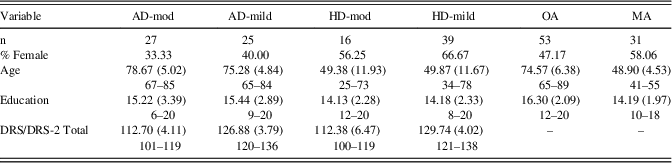
Demographic information on study participants is provided in Table 1. One-way ANOVA tests revealed a significant effect of group on age, F(5,185)=109.05, p<.001, education, F(5, 185)=5.04, p<.001, and DRS/DRS-2 scores, F(3,103)=114.35, p<.001. Tukey’s post hoc pairwise comparisons revealed that, as expected, the AD-mild, AD-mod, and OA groups were significantly older than the HD-mild, HD-mod, and MA groups (ps<.001). However, there were no differences in age among the AD-mod, AD-mild, and OA groups (ps>.05), or among the HD-mod, HD-mild, and MA groups (ps>.05).
Demographic information on participants in the Alzheimer’s disease-moderate (AD-mod), Alzheimer’s disease-mild (AD-mild), Huntington’s disease-moderate (HD-mod), Huntington’s disease-mild (HD-mild), healthy older adult (OA), and healthy middle-aged adult (MA) groups

Note. For age, education, and DRS/DRS-2 Total variables, first row includes mean (standard deviation) values and second row includes range.
In addition, Tukey’s post hoc pairwise comparisons revealed that the OA group completed significantly more years of education than the HD-mild, HD-mod, and MA groups (ps<.05). However, there were no differences in education among the AD-mild, AD-mod, HD-mild, and HD-mod groups (ps>.05); among the AD-mild, AD-mod, and OA groups (ps>.05); or among the HD-mild, HD-mod, and MA groups (ps>.05). Furthermore, Tukey’s post hoc pairwise comparisons revealed that, as expected, the AD-mod and HD-mod groups had significantly lower DRS/DRS-2 scores than the AD-mild and HD-mild groups (ps<.001). However, there were no differences in DRS/DRS-2 scores between the AD-mod and HD-mod groups (p>.05), or between the AD-mild and HD-mild groups (p>.05). The chi-square analysis revealed no differences in gender distributions across groups, χ 2 (5, N=191)=9.52, p=.09.
Preliminary Analyses
Age was shown to be a significant predictor of raw scores on the Total RD index, F(1,189)=3.74, p<.05, but not the List A versus Novel/Unrelated RD index, F(1,189)=2.59, p=.11. Given the evidence for significant group differences on age, and for a significant effect of age on aspects of Yes/No Recognition performance, age was included as a covariate in all primary analyses involving raw scores. As scaled scores correct for age, age was not included as a covariate in any primary analyses involving scaled scores.
Gender was shown to be a significant predictor of raw scores on the Total RD index, F(1,189)=3.87, p<.05, but not the List A versus Novel/Unrelated RD index, F(1,189)=1.29, p=.26. Although gender distributions did not vary significantly across groups, gender was controlled for in all primary analyses involving raw scores given the evidence for a significant effect of gender on aspects of Yes/No Recognition performance. As scaled scores correct for gender, gender was not controlled for in any primary analyses involving scaled scores.
DRS/DRS-2 scores were shown to be a significant predictor of raw scores on the Total RD index, F(1,105)=25.85, p<.001, and the List A versus Novel/Unrelated RD index, F(1,105)=18.41, p<.001. However, given that DRS/DRS-2 scores were systematically varied by group (i.e., individuals with AD and HD were characterized as mild or moderate in dementia severity), DRS/DRS-2 scores were not controlled for in primary analyses involving raw or scaled scores. Education was not shown to be a significant predictor of raw scores on Yes/No Recognition variables of interest (ps>.05).
Primary Analyses: AD and HD Performances on Total RD and List A versus Novel/Unrelated RD Indices
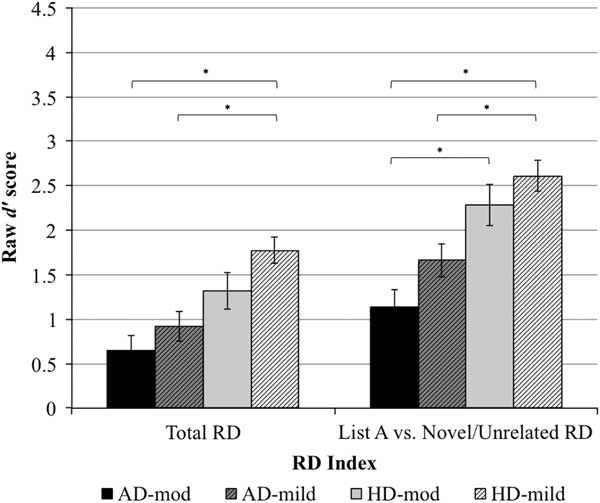
ANCOVA tests revealed a significant effect of group on raw scores on the Total RD index, F(5,183)=71.88, p<.001, and the List A versus Novel/Unrelated RD index, F(5,183)=39.86, p<.001, controlling for age and gender. Post hoc tests with Bonferroni adjustments for multiple comparisons revealed that, on both indices, the AD-mild and AD-mod groups exhibited significantly lower raw scores than the OA group (ps<.001), and the HD-mild and HD-mod groups exhibited significantly lower raw scores than the MA group (ps<.001).
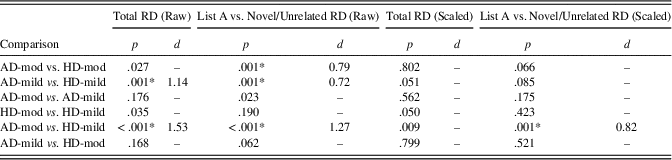
Additionally, the HD-mild group exhibited significantly higher raw scores than the AD-mild and AD-mod groups on both indices (ps<.01). Furthermore, the HD-mod group exhibited significantly higher raw scores than the AD-mod group on the List A versus Novel/Unrelated RD index (p=.001), although this difference was not observed on the Total RD index (after a Bonferroni adjustment). No other significant group differences on raw scores on the Total RD and List A versus Novel/Unrelated RD indices were observed.
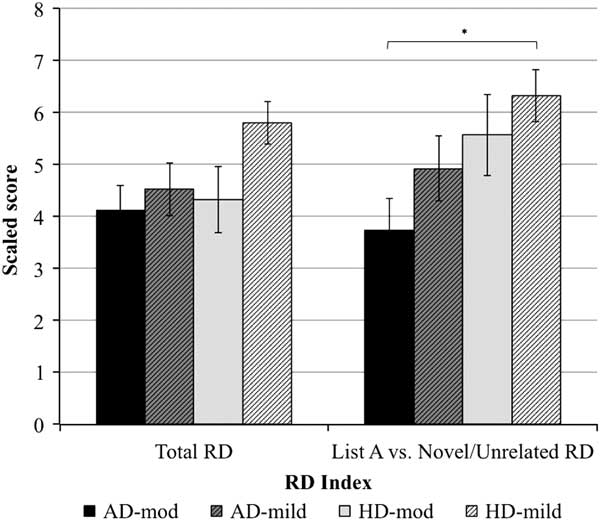
ANOVA tests also revealed a significant effect of group on scaled scores on the Total RD index, F(5,185)=66.68, p<.001, and the List A versus Novel/Unrelated RD index, F(5,185)=41.16, p<.001. Post hoc tests with Bonferroni adjustments for multiple comparisons revealed that, on both indices, the AD-mild and AD-mod groups exhibited significantly lower scaled scores than the OA group (ps<.001), and the HD-mild and HD-mod groups exhibited significantly lower scaled scores than the MA group (ps<.001). Additionally, the HD-mild group exhibited significantly higher scaled scores than the AD-mod group on the List A versus Novel/Unrelated RD index (p=.001), although this difference was not observed on the Total RD index (after a Bonferroni adjustment). No other significant group differences on scaled scores on the Total RD and List A versus Novel/Unrelated RD indices were observed.
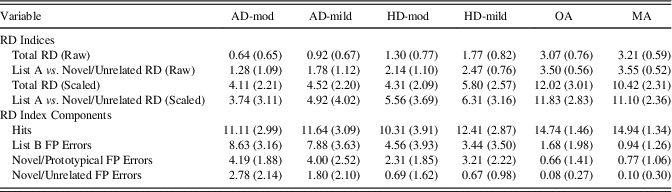
Descriptive and inferential statistics associated with analyses involving raw and scaled scores on the Total RD and List A versus Novel/Unrelated RD indices are provided in Tables 2 and 3. Relevant group differences on raw and scaled scores on the two indices are illustrated in Figures 1 and 2.
Mean (standard error) raw scores on the Total RD and List A versus Novel/Unrelated RD indices in the Alzheimer’s disease-moderate (AD-mod), Alzheimer’s disease-mild (AD-mild), Huntington’s disease-moderate (HD-mod), and Huntington’s disease-mild (HD-mild) groups.

Mean (standard error) scaled scores on the Total RD and List A versus Novel/Unrelated RD indices in the Alzheimer’s disease-moderate (AD-mod), Alzheimer’s disease-mild (AD-mild), Huntington’s disease-moderate (HD-mod), and Huntington’s disease-mild (HD-mild) groups.

Mean (standard deviation) values for the Alzheimer’s disease-moderate (AD-mod), Alzheimer’s disease-mild (AD-mild), Huntington’s disease-moderate (HD-mod), Huntington’s disease-mild (HD-mild), healthy older adult (OA), and healthy middle-aged adult (MA) groups on raw and scaled scores on Total RD and List A vs. Novel/Unrelated RD indices, as well as RD index components

p values associated with relevant pairwise comparisons on raw scores (controlling for age) and scaled scores on Total RD and List A vs. Novel/Unrelated RD indices. Cohen’s d values associated with significant AD and HD group differences are reported

*p value retains significance following Bonferroni adjustment for multiple comparisons.
Exploratory analyses
Regression analyses indicated neither TMS scores nor number of CAG repeats were significant predictors of raw scores on Total RD or List A versus Novel/Unrelated RD indices in participants with HD (ps>.05).
DISCUSSION
The present study compared the performance of individuals with AD and HD in mild and moderate stages of dementia on indices of Total RD and List A versus Novel/Unrelated RD that were developed for the CVLT-3. Group differences on RD indices involving the AD-mod, AD-mild, HD-mod, and HD-mild groups were of primary interest; however, OA and MA groups were included as cognitively healthy comparison groups for AD and HD, respectively. Because the CVLT-3 List A versus Novel/Unrelated index is a new measure, the OA and MA groups were included in analyses of scaled scores, in addition to raw scores, to provide information regarding the level of scaled score performance that might be expected from cognitively healthy individuals demographically similar to clinically impaired patients with AD or HD. Results showed that all AD and HD subgroups performed significantly worse than their respective healthy comparison groups on all Yes/No Recognition RD raw scores and scaled scores.
Analysis of raw scores on Yes/No Recognition indices showed that the HD-mild group performed significantly better than the AD-mod and AD-mild groups on both the Total RD and List A versus Novel/Unrelated RD indices. Additionally, the HD-mod group performed significantly better than the AD-mod group on the List A versus Novel/Unrelated RD index; notably, this difference was not observed on the Total RD index. These findings demonstrate that, in the context of raw scores, both the Total RD and List A versus Novel/Unrelated RD indices are able to reveal less severe yes/no recognition memory deficits in mild HD than in mild AD.
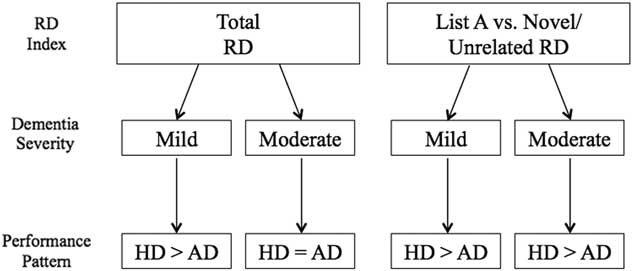
Importantly, however, as predicted, the List A versus Novel/Unrelated RD index, but not the Total RD index, yielded less severe yes/no recognition memory deficits in moderate HD than in moderate AD. The flowchart below outlines the pattern of HD and AD performance that may be expected with raw scores on the CVLT-3 Total RD and List A versus Novel/Unrelated RD indices, and may serve as a helpful reference for clinicians and researchers when using the CVLT-3 to assess Yes/No Recognition performance in individuals with HD or AD (Figure 3).
Flowchart outlining the pattern of performance that may be expected with raw scores on the CVLT-3 Total RD and List A versus Novel/Unrelated RD indices in Huntington’s disease and Alzheimer’s disease.

Analysis of scaled scores on Yes/No Recognition indices showed no group differences among the AD and HD subgroups on the Total RD index. This is consistent with previous findings of comparable performance by individuals with AD or HD on the CVLT-II Total RD index (Graves et al., Reference Graves, Holden, Woods, Delano-Wood, Bondi, Salmon and Gilbert2017), and extends earlier findings by showing comparable performance on the Total RD index in AD and HD across mild and moderate stages of dementia severity. Importantly, the HD-mild group performed significantly better than the AD-mod group on the scaled score for the List A versus Novel/Unrelated RD index. Thus, even in the context of scaled scores (albeit to a lesser extent than in the context of raw scores), AD and HD differences on yes/no recognition memory are detectable, but only using a purer index of RD that minimizes potential influences of source and semantic interference (i.e., List A vs. Novel/Unrelated RD).
The discrepancy between findings from analyses involving raw scores and those involving scaled scores warrants discussion. First, we acknowledge that the difference may have been partly due to limited statistical power, given the relatively small number of participants in the HD-mod group in particular. However, we believe the discrepancy more likely reflects an issue in converting raw scores into scaled scores on indices with potential ceiling effects. Given that most cognitively normal individuals are expected to perform well on these RD indices (particularly on List A vs. Novel/Unrelated RD), lower raw scores in cognitively impaired individuals (e.g., the participants with AD or HD in our study) are likely to correspond with significantly reduced scaled scores.
In addition, while we treated age as a continuous variable in our analyses of raw scores, the CVLT-3 normative sample was stratified into age groups, and age-corrected scaled scores are derived from these categorical groupings. Moreover, given that individuals with HD are younger, on average, than individuals with AD, raw scores in those with HD may be submitted to a more stringent age correction, which could further result in smaller HD and AD differences in the context of scaled scores relative to raw scores. On that premise, it is worth noting that, when analyzing raw scores, including age as a covariate when age is confounded with group or diagnosis is not the most ideal method for parceling out the effects of age on performance, and this is an inherent issue in many studies comparing AD and HD performance using raw scores. Moreover, we did not possess the statistical power that would be required to account for age using more sophisticated statistical methods (e.g., stratification). We encourage readers to take these issues into consideration in the evaluation of the present findings. Nonetheless, due to the aforementioned reasons, we believe that examining performance using raw scores (controlling for age as a continuous variable albeit its limitations) may yield greater sensitivity and better reflect the utility of the CVLT-3 RD indices in elucidating the degree to which yes/no recognition memory is impaired in HD versus AD.
Taken together, the present results with both raw and scaled scores indicate that the new CVLT-3 List A versus Novel/Unrelated RD index has a more robust capacity than the Total RD index to detect differences in the recognition memory deficits associated with AD and HD. In particular, the present findings suggest that recognition memory deficits are less severe in HD than in AD and support the notion that the memory profile of HD reflects primarily a retrieval deficit, whereas the memory profile of AD reflects a more profound encoding/storage deficit.
The Total RD index incorporates FP errors from all distractor types (including those from List B and those that are novel but share obvious semantic associations with targets), whereas the List A versus Novel/Unrelated RD index incorporates only FP errors associated with distractors that are novel and do not share obvious semantic associations with targets. Thus, the present findings provide evidence that individuals with HD may be particularly vulnerable to (1) endorsing List B distractors that are likely confounded by source interference, and (2) endorsing novel distractors that share obvious semantic associations with targets and are, therefore, likely confounded by semantic interference. Accordingly, those with HD may perform more similarly to individuals with AD on the Total RD index due to source memory deficits and semantic interference sensitivity associated with their frontal-system dysfunction. The present findings also support the hypothesis of Graves et al. (Reference Graves, Holden, Woods, Delano-Wood, Bondi, Salmon and Gilbert2017) that the higher proportion of List B and semantically related distractors relative to targets on the CVLT-II than on the original CVLT may have increased the difficulty of the CVLT-II Yes/No Recognition trial specifically for individuals with HD, thereby making their performance on the CVLT-II Total RD index similar to that of individuals with AD.
In conclusion, the present findings provide evidence that the endorsement of distractors on Yes/No Recognition testing may be influenced by both (1) their novelty (i.e., whether or not they were previously presented during test administration), and (2) their degree of semantic association with targets. While it is probably not feasible to develop an RD index that is completely free of any influences of source and/or semantic interference, the present findings indicate that the new CVLT-3 List A versus Novel/Unrelated RD index minimizes these effects compared to the Total RD index. Thus, while the Total RD index provides a global, more sensitive measure of yes/no recognition memory in general, the new List A versus Novel/Unrelated RD index likely provides a purer measure of yes/no recognition memory independent of source and semantic interference, and may, therefore, exhibit greater utility in differentiating levels of yes/no recognition memory impairment in HD versus AD.
ACKNOWLEDGMENTS
Dean C. Delis, PhD, is an author of the CVLT and receives royalties for the test. There are no other conflicts of interest to be declared by any authors. This work was supported, in part, by National Institutes of Health (NIH) grants R01 AG034202 to P.E.G., K24 AG026431 to M.W.B., and P50 AG005131 to the Shiley-Marcos ADRC, and a Huntington’s Disease Society of America Center of Excellence grant to J.C.B.