Introduction
The global demand for advanced energy storage technology is rapidly increasing. Large-scale power storage systems for the grid are necessary to utilize electrical energy with high efficiency and for peak shift operation.Reference Dunn, Kamath and Tarascon1 Such energy storage devices could also be utilized to store electricity generated from solar cells and wind turbines serving as green energy resources.
The rechargeable lithium battery (often called a Li-ion battery, as named by Sony Corp.) was originally developed and utilized as a high-energy power source for portable electronic devices and is now beginning to be utilized as a large-scale power source for transportation applications instead of fossil fuel and combustion engines. Although lithium batteries with manganese- and iron-based materials such as LiMn2O4 and LiFePO4, respectively, potentially provide a solution to achieve sustainable energy development, we must reconsider the feasibility of lithium based on its availability.Reference Tarascon2 Lithium is not regarded as an abundant element even though it is widely distributed in the Earth’s crust and sea. The mean mass fraction of lithium in the Earth’s crust is estimated to be only 20 ppm.Reference Carmichael3 Indeed, the cost of lithium resources has been increasing since the commercialization of lithium batteries.Reference Slater, Kim, Lee and Johnson4
In contrast, sodium availability is nearly unlimited, such as the sea, and sodium is one of the most abundant elements on earth. Additionally, since sodium is the second-lightest and -smallest alkali metal next to lithium, the sacrifice in energy density is expected to be minimized if the same electrochemical insertion is utilized for the charge and discharge reactions. On the basis of material abundance and its similarity as an alkali metal ion, rechargeable sodium batteries (i.e., Na-ion batteries) are believed to be the ideal alternative to Li-ion batteries. In this article, we review advances in layered sodium transition metal oxides as positive electrode materials for batteries. Layered sodium transition metal oxides, NaxMeO2 (Me = transition metals), are promising candidates for positive electrode materials and are similar to the layered LiMeO2 materials utilized in Li-ion batteries. Their electrochemical and structural behavior is discussed by comparing the chemistry between Na- and Li-ion battery systems.
Na-ion battery
Na-ion batteries are operable at ambient temperature without unsafe metallic sodium, different from commercial high-temperature sodium-based battery technology (e.g., Na/SReference Oshima, Kajita and Okuno5 and Na/NiCl2Reference Bones, Teagle, Brooker and Cullen6 batteries). Figure 1a shows a schematic illustration of a Na-ion battery. It consists of two different sodium insertion materials as positive and negative electrodes with an aprotic electrolyte solution such as organic carbonate ester solvents with electrolyte salts. They are, therefore, free from metallic sodium unless unfavorable reactions (e.g., overcharge) cause failures in the battery. The cell design, components, systems, and reaction mechanisms of a Na-ion battery are essentially the same as those of a Li-ion battery, except that Li+ ions are replaced with Na+ ions.
(a) Schematic illustration of a Na-ion battery consisting of layered NaxMeO2 (Me = transition metals) and non-graphitizable carbon as positive and negative electrodes, respectively. During the charging process, sodium ions move from the positive electrode to the negative electrode through the electrolyte solution with simultaneous movement of electrons through the external circuit. In contrast, the discharging process proceeds in the opposite direction. (b) Comparison of charge/discharge curves for Li//LiCoO2 and Na//NaCoO2 cells.Reference Mizushima, Jones, Wiseman and Goodenough10,Reference Delmas, Braconnier, Fouassier and Hagenmuller11 The operating voltage of the Na//NaCoO2 cell is lower than that of the Li//LiCoO2 cell even though both oxides have similar layered structures consisting of CoO2 slabs. A schematic illustration of the crystal structure of LiCoO2 and NaCoO2 is also shown. Schematic illustrations of the crystal structures used in this article were drawn using the program VESTA.Reference Momma and Izumi70

Studies on electrochemical energy storage utilizing Li+ and Na+ ions as charge carriers at ambient temperature were published in 1976Reference Whittingham7,Reference Whittingham8 and 1980,Reference Newman and Klemann9 respectively. Electrode performance of layered lithium cobalt oxide, LiCoO2, which is still widely used as the positive electrode material in high-energy Li-ion batteries, was first reported in 1980.Reference Mizushima, Jones, Wiseman and Goodenough10 Similarly, electrochemical properties of its sodium counterpart, NaxCoO2, were also reported.Reference Delmas, Braconnier, Fouassier and Hagenmuller11 The early history of sodium insertion materials was reviewed in the literature published in 1982.Reference Abraham12,Reference Delmas, Braconnier, Maazaz and Hagenmuller13 Nevertheless, in the past three decades, research interests in Li-ion batteries had rapidly increased, and significant research efforts were devoted to Li-ion batteries, while studies on sodium insertion materials for energy storage were conducted on a small scale. The quality of utilizable battery materials and apparatuses such as electrolyte solution, binders, separators, and glove box was insufficient for sodium batteries at that time, which resulted in difficulty in observing potential electrode performance in aprotic Na metal cells. Furthermore, both practical and theoretical energy densities of batteries are much lower for the Na system when compared with those for the Li system.
Figure 1b compares typical charge/discharge curves of Li//LiCoO2 and Na//NaCoO2 cells.Reference Mizushima, Jones, Wiseman and Goodenough10,Reference Delmas, Braconnier, Fouassier and Hagenmuller11 Although both oxides have the same crystal lattice built up by CoO2 slabs of edge-sharing CoO6 octahedra, the operating voltage of LiCoO2 for the region at the end of discharge (start of charge) is >1.0 V higher than that for NaCoO2. As a result, the available energy density is much lower for the Na system than for the Li system. The sodium battery system would not be sufficient to meet the demands for rechargeable batteries with high-energy densities in the late 1980s, especially as power sources for portable devices. In 1991, the first successful commercial Li-ion cells, using carbon//LiCoO2, resulted in technological innovations and accelerated the development of Li-based batteries for portable devices in the 1990s and automobiles in the 2000s.
With growing energy issues in the 21st century, research interest in sodium insertion materials has now been completely renewed. Since 2010, materials researchers have extensively explored new sodium insertion materials for battery applications because some of the known sodium containing layered materials have been revisited and showed unique electrochemical properties, as described later. Our group contributed to one of the first successful demonstrations of long-life performance of rechargeable Na-ion batteries consisting of layered NaNi1/2Mn1/2O2 (having an O3-type structure according to the Delmas’ notation as shown in the next section) and non-graphitizable carbon (hard carbon) as positive and negative electrodes, respectively, and a propylene carbonate electrolyte solution.Reference Komaba, Murata, Ishikawa, Yabuuchi, Ozeki, Nakayama, Ogata, Gotoh and Fujiwara14 The hard carbon electrode exhibits a low operation voltage close in value to Na metal and a high reversible capacity of approximately 250 mAh g–1.Reference Stevens and Dahn15,Reference Alcantara, Lavela, Ortiz and Tirado16 Improvement of the positive electrode performance, thus, is necessary to further enhance the performance of Na-ion batteries, as the Li-ion battery field also had faced similar circumstances. Our research group has been exploring layered sodium transition metal oxides as promising candidates for positive electrode materials in Na-ion batteries.
Classification of layered structures
The most common layered structures are built up by stacking sheets of edge-sharing MeO6 octahedra. Polymorphisms appear when the sheets of edge-sharing MeO6 octahedra are stacked with different orientations along the c-axis direction. Sodium-based layered materials can be categorized into two main groups using the classification proposed by Delmas et al.:17 O3-type or P2-type structures, in which the sodium ions are accommodated at octahedral or prismatic sites, respectively, as shown in Figure 2.Reference Delmas, Fouassier and Hagenmuller17 O3-type NaMeO2 consists of a cubic close-packed oxygen array accommodating sodium and transition metal ions at distinct octahedral sites because the ionic radius of sodium ions (1.02 Å) is much larger than those of transition-metal ions with the trivalent state (< 0.7 Å).Reference Shannon18 O3-type layered phases are classified as one of the cation-ordered rock-salt superstructure oxides.Reference Mather, Dussarrat, Etourneau and West19 Edge-shared NaO6 and MeO6 octahedra stack into alternate layers along the [111] direction, forming NaO2 and MeO2 layers, and their stacking manner is crystallographically isostructural with CdCl2. NaMeO2 is composed of “three” MeO2 layers in the hexagonal unit cell, as shown in Figure 2, and sodium ions are accommodated at the “octahedral” (O) interstitial sites sandwiched with MeO2 layers. The structure, therefore, is named an O3-type layered structure. The structure is also classified as a 3R phase with a space group of R  $\bar 3$m.
Schematic illustrations of crystal structures for O3, P3, P2, and O2 type NaxMeO2 (Me = transition metals).Reference Delmas, Fouassier and Hagenmuller17 The layered NaxMeO2 with the various stacking types consist of MeO2 slabs with edge-sharing MeO6 octahedra. The letters O and P suggest the octahedral and prismatic alkali ion sites, respectively, and the numbers indicate the number of MeO2 slabs in a hexagonal cell. Arrays of O3-P3 and P2-O2 suggest possible phase transitions during electrochemical cycling in the Na cells.
The unit cell of P2-type NaxMeO2 consists of “two” MeO2 layers and intercalated sodium, and the sodium environment is different from the O3 type. The larger sodium ions can be located at trigonal “prismatic” (P) sites where the smaller lithium ions are not stabilized. When a sodium deficient condition (typically 0.6 < x < 0.7 in NaxMeO2) is adopted for materials synthesis, the P2-type phase is empirically known to be structurally stabilized. The P2-type layered structure is also often classified as a 2H phase with a space group of P63/mmc. Additionally, a prime symbol is utilized when the crystal lattice has distortion, but the number of MeO2 layers is counted in pseudo-hexagonal unit cells, such as O′3-type NaMnO2 with a monoclinic lattice (space group [S.G.], C2/m)Reference Mendiboure, Delmas and Hagenmuller20 and P′2-type NaxMnO2 with an orthorhombic lattice (S.G., Cmcm).Reference Stoyanova, Carlier, Sendova-Vassileva, Yoncheva, Zhecheva, Nihtianova and Delmas21
Sodium extraction from O3- and P2-type phases generally induces phase transitions. Sodium ions in the O3-type phase are originally stabilized at edge-shared octahedral sites with MeO6 octahedra. Prismatic sites for Na ions often become an energetically stable phase and comprise the P3-type phase when sodium ions are partly extracted from the O3-type phase, associated with the formation of vacancies. The sodium coordination in the P3 phase is similar to that in the P2-type phase, as shown in Figure 2. It is also possible to directly synthesize this P3-type phase by solid-state reaction without electrochemical sodium extraction in Na cells. For instance, P3- and P2-type Na2/3[Co0.7Mn0.3]O2 are known as low- and high-temperature phases, respectively.Reference Paulsen and Dahn22 The phase transition from P3/O3- to P2-type phase is, however, impossible in Na cells because phase transition is only achieved by breaking/re-forming Me–O bonds and therefore requires higher temperature environments. On the other hand, the P2 phase changes into an O2-type phase during the charge cycle in Na cells (Figure 3). Since large prismatic sites in the P2-type phase are energetically stabilized by large Na+ ions, MeO2 slabs move (glide) to form octahedral sites after the extraction of Na ionsReference Lu and Dahn23,Reference Lu and Dahn24 (and also by Na+/Li+ ion-exchangeReference Delmas, Braconnier and Hagenmuller25). This phase consists of two MeO2 layers in a hexagonal unit cell. Vacancies left in between the MeO2 layers are octahedral sites, that is, the O2-type phase.
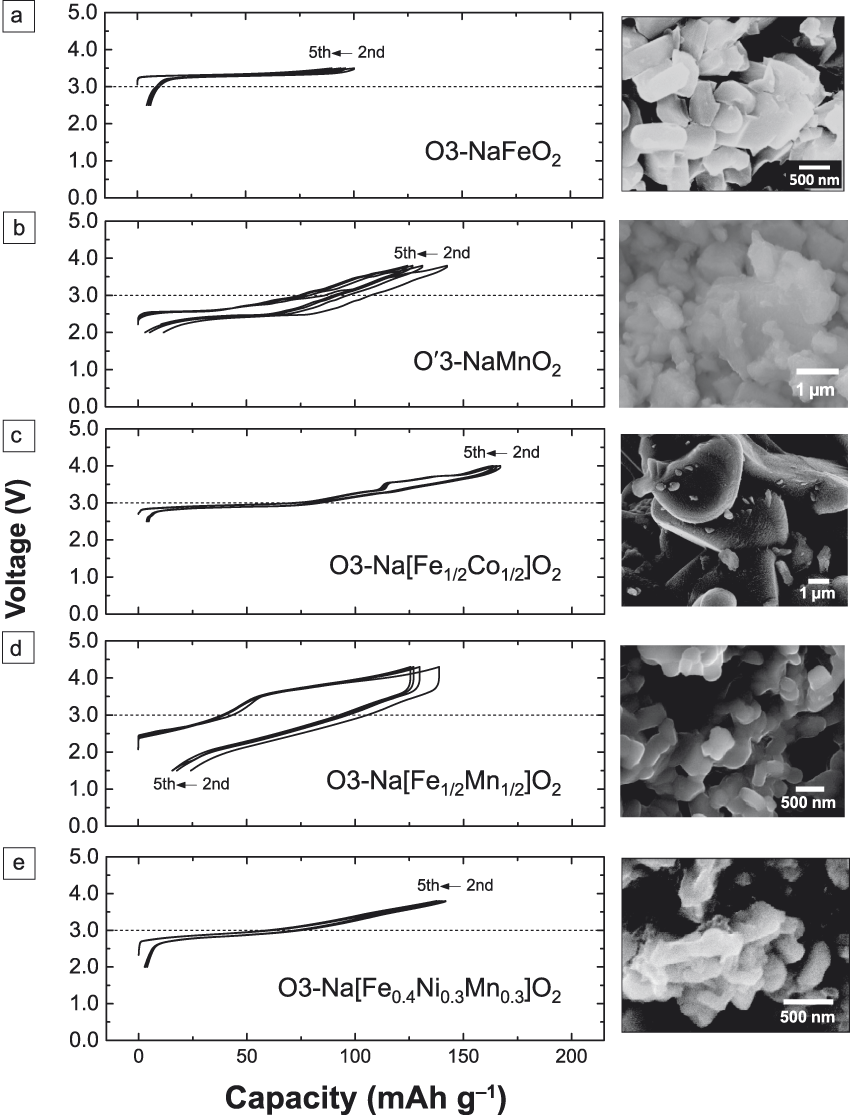
Galvanostatic charge/discharge curves of (a) O3-NaFeO2,Reference Yabuuchi, Yoshida and Komaba37 (b) O’3-NaMnO2,Reference Ma, Chen and Ceder34 (c) O3-Na[Fe1/2Co1/2]O2,Reference Yoshida, Yabuuchi and Komaba44 (d) O3-Na[Fe1/2Mn1/2]O2,Reference Yabuuchi, Kajiyama, Iwatate, Nishikawa, Hitomi, Okuyama, Usui, Yamada and Komaba43 and (e) O3-Na[Fe0.4Ni0.3Mn0.3]O2Reference Yabuuchi, Yano, Yoshida, Kuze and Komaba47 in aprotic Na cells from the 2nd to 5th cycles tested at room temperature. The morphology of the particles for each sample is also compared (right). The O3-type sodium transition metal oxides demonstrate reversible Na intercalation in Na cells similar to O3-type lithium transition metal oxides. Surprisingly, some NaMeO2 (Me = transition metals), such as NaFeO2, show different electrochemical activities in Na cells compared to LiMeO2 in Li cells. Note: the letter “O” suggests the octahedral alkali ion site, and the numbers indicate the number of MeO2 slabs in a hexagonal cell. O′3 shows the distorted structure of O3 type.
O3-type sodium transition metal oxides
O3-type alkali transition metal oxides, AMeO2 (A = alkali metal), are often found as layered phases when the atomic ratio of A/Me equals 1. The O3-type lithium transition metal oxides, LiMeO2, have been intensively studied as positive electrode materials for lithium batteries, and O3-LiCoO2,Reference Mizushima, Jones, Wiseman and Goodenough10 Li[Ni0.8Co0.15Al0.05]O2,Reference Delmas and Saadoune26,Reference Ohzuku, Ueda and Kouguchi27 and Li[Ni1/3Mn1/3Co1/3]O2Reference Ohzuku and Makimura28,Reference Yabuuchi and Ohzuku29 are often utilized for practical Li-ion batteries. For several 3d transition metals, O3-type LiMeO2 (Me = Ti, Fe, and Mn) is not obtained by a conventional solid-state reaction. On the other hand, O3-type (including O′3-type) sodium compounds, NaMeO2 (Me = 3d transition metal such as Ti,Reference Maazaz, Delmas and Hagenmuller30 V,Reference Didier, Guignard, Denage, Szajwaj, Ito, Saadoune, Darriet and Delmas31 Cr,Reference Braconnier, Delmas and Hagenmuller32,Reference Komaba, Takei, Nakayama, Ogata and Yabuuchi33 Mn,Reference Mendiboure, Delmas and Hagenmuller20,Reference Ma, Chen and Ceder34 Fe,Reference Takeda, Nakahara, Nishijima, Imanishi, Yamamoto, Takano and Kanno35–Reference Yabuuchi, Yoshida and Komaba37 Co,Reference Delmas, Braconnier, Fouassier and Hagenmuller11 and NiReference Braconnier, Delmas and Hagenmuller32,Reference Vassilaras, Ma, Li and Ceder38 ), and their sodium de-intercalation/intercalation behavior have been reported. Furthermore, multiple transition metal oxides, such as Na[Ti1/2Ni1/2]O2,Reference Yu, Guo, Zhu, Ishida and Zhou39,Reference Okada and Yamaki40 Na[Ni1/2Mn1/2]O2,Reference Komaba, Yabuuchi, Nakayama, Ogata, Ishikawa and Nakai41 Nax[Ni0.6Co0.4]O2,Reference Saadoune, Maazaz, Menetrier and Delmas42 Na[Fe1/2Mn1/2]O2,Reference Yabuuchi, Kajiyama, Iwatate, Nishikawa, Hitomi, Okuyama, Usui, Yamada and Komaba43 Na[Fe1/2Ni1/2]O2,Reference Okada and Yamaki40 Na[Fe1/2Co1/2]O2,Reference Yoshida, Yabuuchi and Komaba44 Na[Ni1/3Co1/3Fe1/3]O2,Reference Vassilaras, Toumar and Ceder45 Na[Fex(Ni1/2Mn1/2)1–x]O2,Reference Kim, Lee, Slater, Lu, Rood and Johnson46,Reference Yabuuchi, Yano, Yoshida, Kuze and Komaba47 Na[Ni1/3Mn1/3Co1/3]O2,Reference Sathiya, Hemalatha, Ramesha, Tarascon and Prakash48 and sodium-excess O3-type phase with a high sodium content of more than one Na1+zRu1–zO2 (or described as Na[NazRu1–z]O2)Reference Tamaru, Wang, Okubo and Yamada49 also have been studied as positive electrode materials for sodium batteries.
The electrochemical reversibility of sodium extraction/insertion processes for selected O3-type layered materials is shown in Figure 3. Among these materials, alpha-NaFeO2 (Figure 3a) is a typical example of the O3-type phase and is easily prepared using a conventional solid-state reaction.Reference Zhao, Zhao, Dimov, Okada and Nishida36 In contrast, synthesis of O3-type LiFeO2 is difficult. Since the ionic radii of Li+ and Fe3+ are similar, a cation disordered rock-salt phase is easily obtained by solid-state reaction at higher temperatures. Furthermore, O3-type NaFeO2 is electrochemically active in a Na cell,Reference Jorgensen, Avdeev, Hinks, Burley and Short50 whereas O3-type LiFeO2 is known to be electrochemically inactive in a lithium cell.Reference Ado, Tabuchi, Kobayashi, Kageyama, Nakamura, Inaba, Kanno, Takagi and Takeda51 O3-type NaFeO2 can deliver approximately 80 mAh g–1 of reversible capacity with a flat operating voltage profile at 3.4 V in the Na cell, as shown in Figure 3a. This flat profile is characteristic of NaFeO2 and indicates a relatively low operating voltage. Similar differences are also observed in the electrochemical activity for O3-NaCrO2 and O3-LiCrO2.Reference Komaba, Takei, Nakayama, Ogata and Yabuuchi33 O3-NaCrO2 is highly active, but O3-LiCrO2 is not. The reversible capacity of O3-NaFeO2, however, is limited to only 80 mAh g–1, corresponding approximately to 0.3 mole of Na insertion/extraction. The theoretical capacity of NaFeO2 reaches 241.8 mAh g–1, assuming the Fe3+/Fe4+ redox reaction is accompanied by one mole Na extraction for the formula unit. This narrow reversible capacity range originates from an irreversible structural change, presumably associated with iron migration into the adjacent tetrahedral sites in Na layers.Reference Yabuuchi, Yoshida and Komaba37 O′3-NaMnO2 (Figure 3b) also shows a different electrochemistry in a sodium battery from that of O′3-LiMnO2 in a lithium battery.Reference Ma, Chen and Ceder34 In O′3-LiMnO2, synthesized by ion-exchange from O′3-NaMnO2, the reversible capacity rapidly decays due to an irreversible phase transition into a spinel-like phase during cycles, while O′3-NaMnO2 does not suffer from the irreversible phase transition, resulting in high reversible capacity and good cycle stability, as shown in Figure 3b.
O3-type NaMeO2 often transforms to the P3-type phase (including P′3 type phase) during charging. For instance, O3-NaCoO2 (Figure 1b) transforms to O′3-type and then to P′3-type NaxCoO2 during the charge cycle.Reference Delmas, Braconnier, Fouassier and Hagenmuller11 Sodium diffusion in the O3-type phase is thought to be slower than in the P3-type phase, which could originate from a difference in the sodium ion diffusion process.Reference Saadoune, Maazaz, Menetrier and Delmas42 In the O3-type phase, sodium ions migrate through face-shared tetrahedral sites (similar to O3-type LixCoO2) (i.e., via two triangular faces as a bottle neck in the NaO2 layers). In contrast to the O3-type layered system, since the P3-type layered framework should provide open paths for sodium diffusion, a lower diffusion barrier than that for the O3-type phase is expected. Na+ ions migrate between equivalent and face-sharing prismatic sites through a large rectangular face (and thus smaller repulsive interaction from oxide ions is expected). The formation of a P3-type phase, therefore, could be beneficial for good rate-capability as a positive electrode in Na cells. Interestingly, the O3-P3 phase transition was not observed for NaFeO2, NaVO2, and NaTiO2, and only O3- or O′3-type phases are found during charging cycles.
A computational investigation of the energy difference between O3- and P3-type phases predicted stabilization of P3-type phases for Na0.5MeO2 (Me = Ni, Mn, and Co) and destabilization for Na0.5TiO2 and Na0.5VO2.Reference Kim, Ma, Ong and Ceder52 Among layered 3d-transition metal oxides, the P3-type phase is significantly stabilized for NaxCoO2,Reference Kim, Ma, Ong and Ceder52 and excellent electrode performance has been reported for O3-type Na[Fe1/2Co1/2]O2 (Figure 3c) and Na[Ni1/3Co1/3Fe1/3]O2.Reference Yoshida, Yabuuchi and Komaba44,Reference Vassilaras, Toumar and Ceder45 These experimental and theoretical studies could be in agreement. Furthermore, a large difference in electrode performance for O3-type Na[Fe1/2Mn1/2]O2 and Na[Fe0.4Ni0.3Mn0.3]O2 is found in Figure 3d–e, respectively. O3-type Na[Fe1/2Mn1/2]O2 electrodes show large hysteresis and poor cycle stability. In contrast to O3-type Na[Fe1/2Mn1/2]O2,Reference Yabuuchi, Kajiyama, Iwatate, Nishikawa, Hitomi, Okuyama, Usui, Yamada and Komaba43 O3-type Na[Fe0.4Ni0.3Mn0.3]O2Reference Yabuuchi, Yano, Yoshida, Kuze and Komaba47 exhibits excellent cycle stability and very small polarization, which indicates the importance of the nickel substitution. The combination of transition metals is the important strategy to stabilize the P3-type phase and further improve the electrode performance of O3-type layered materials.
P2-type sodium transition metal oxides
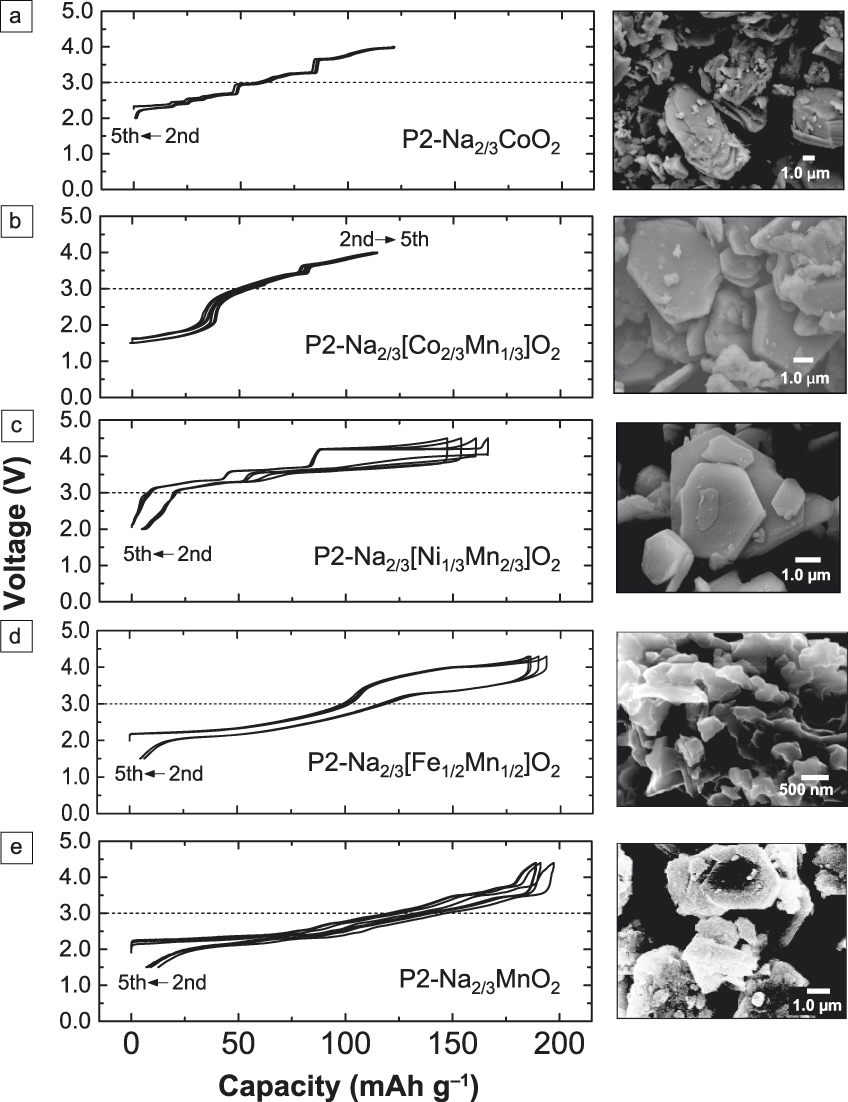
Studies on the electrochemical properties of the P2-type phase in Na cells were also started in the 1980s. Electrochemical reversibility of Na extraction/insertion from/into P2-NaxCoO2 and P2-NaxMnO2 in Na cells were first reported in 1980 and 1985, respectively.Reference Delmas, Braconnier, Fouassier and Hagenmuller11,Reference Mendiboure, Delmas and Hagenmuller20,Reference Braconnier, Delmas, Fouassier and Hagenmuller53 The charge/discharge curves for P2-NaxCoO2, P2-NaxMnO2, and the related compound electrodes are shown in Figure 4. Although the electrode performance of the P2-type phases as positive electrode materials for Na batteries was examined in the 1980s, P2-NaxMeO2 materials also have been extensively studied as precursors for the synthesis of metastable O2-LixMeO2 by Na+/Li+ ion-exchange as positive electrode materials in lithium batteries in some early studies.Reference Paulsen and Dahn22,Reference Delmas, Braconnier and Hagenmuller25,Reference Paulsen, Thomas and Dahn54–Reference Komaba, Croguennec, Tournadre, Willmann and Delmas57 Note that no P2-type phases have been found in layered lithium intercalation materials because trigonal prismatic sites in the Na layer are too large for lithium and transition metal ions. In the past three years, P2-NaxMeO2 has become an extensively studied positive electrode material for sodium batteries.Reference Slater, Kim, Lee and Johnson4,Reference Yabuuchi, Kajiyama, Iwatate, Nishikawa, Hitomi, Okuyama, Usui, Yamada and Komaba43,Reference Berthelot, Carlier and Delmas58–Reference Kim, Kang, Slater, Rood, Vaughey, Karan, Balasubramanian and Johnson63 All of the P2-NaxMeO2 materials examined as positive electrode materials for sodium batteries so far contain cobalt, manganese, or titanium ions,Reference Delmas, Braconnier, Fouassier and Hagenmuller11,Reference Mendiboure, Delmas and Hagenmuller20,Reference Yoshida, Yabuuchi, Kubota, Ikeuchi, Garsuch, Schulz-Dobrick and Komaba64 except for P2-NaxVO2.Reference Guignard, Didier, Darriet, Bordet, Elkaim and Delmas65 It is thought that this originates from the difficulty in obtaining P2-type phases where tetravalent transition metal ions such as Fe4+ and Ni4+ are partially accommodated at octahedral sites under ordinary synthesis conditions. Since the initial P2-type phase has about 1/3 sodium deficiency in the general composition, P2-Na2/3MeO2 (can be described as P2-Na2/3[Me3+2/3Me4+1/3]O2), Men+ ions with a higher oxidation state exist in the initial P2-type phase as compared to the O3-type phase.Reference Carlier, Cheng, Berthelot, Guignard, Yoncheva, Stoyanova, Hwang and Delmas59 However, P2-Na2/3[Co2/3Mn1/3]O2 containing both cobalt and manganese elements stabilizing the P2-type structure shows a relatively small reversible capacity and a low operating voltage, as shown in Figure 4b.Reference Carlier, Cheng, Berthelot, Guignard, Yoncheva, Stoyanova, Hwang and Delmas59 Optimizing the selection of transition metals is also a very important strategy to obtain the P2 type phases and improve the electrode performance in Na cells. For example, some of the P2-type phases deliver high reversible capacity as positive electrodes in Na cells, as shown in Figure 4. In the case of P2-NaxMnO2 (Figure 4e), its reversible domain for Na extraction/insertion is wider than that of O’3-NaMnO2 (Figure 3b). Over 150 mAh g–1 of reversible capacity in the Na cell was reported in an early study.Reference Caballero, Hernan, Morales, Sanchez, Pena and Aranda66 When a battery-grade (high-purity with <20 ppm of water) electrolyte solution is used, approximately 190 mAh g–1 of reversible capacity with good capacity retention is obtained, as shown in Figure 4e. Furthermore, since sodium ions occupy trigonal prismatic sites in the P2-type phase, similar to the P3-type phase, ionic conductivity in the P2-type phase would be higher than that for the O3-type phase with similar chemical compositions because the P2-type layered framework has open paths for sodium diffusion with a low Na diffusion barrier, as is similarly described for the P3-type phase.Reference Delmas, Maazaz, Fouassier, Reau and Hagenmuller67
Galvanostatic charge/discharge curves of (a) P2-Na2/3CoO2,Reference Delmas, Braconnier, Fouassier and Hagenmuller11 (b) P2-Na2/3[Co2/3Mn1/3]O2,Reference Carlier, Cheng, Berthelot, Guignard, Yoncheva, Stoyanova, Hwang and Delmas59 (c) P2-Na2/3[Ni1/3Mn2/3]O2,Reference Lu and Dahn24 (d) P2-Na2/3[Fe1/2Mn1/2]O2,Reference Yabuuchi, Kajiyama, Iwatate, Nishikawa, Hitomi, Okuyama, Usui, Yamada and Komaba43 and (e) P2-Na2/3MnO2Reference Caballero, Hernan, Morales, Sanchez, Pena and Aranda66 in aprotic Na cells from the 2nd to 5th cycles tested at room temperature. Morphology of particles for each sample is also shown for comparison (right). Although P2-type phases have not been found in layered lithium intercalation materials, P2-type NaxMeO2 (Me = transition metal) with large particle sizes also exhibits reversible Na intercalation in Na cells. Note: the letter “P” suggests the prismatic alkali ion site, and the numbers indicate the number of MeO2 slabs in a hexagonal cell.
The P2-type phase ideally transforms into the O2-type phase during charging, where sodium ions are partially accommodated at octahedral sites, and the P2-O2 phase transition could alter the mechanism of in-plane sodium ion diffusion. For instance, P2-Nax[Ni1/3Mn2/3]O2 (Figure 4c) delivers approximately 160 mAh g–1 of initial charge capacity, corresponding to the extraction of almost all of the Na and P2-O2 phase transitions observed during charging.Reference Lu and Dahn24 The P2-O2 phase transition involves large volume shrinkage, by ca. 23%, and the capacity rapidly decays during the cycles in Nax[Ni1/3Mn2/3]O2.Reference Lee, Xu and Meng68 Partial substitution of a transition metal for manganese and cobalt also effectively influences electrode performance of the P2-type phase. Among these, P2-Na2/3[Fe1/2Mn1/2]O2 (Figure 4d) exhibits good cycle stability and a large reversible capacity of 190 mAh g–1 with an average voltage of 2.75 V versus sodium. The energy density is estimated to be 520 mWh g–1 versus Na, which is comparable to that for LiFePO4 (about 530 mWh g–1 versus Li) and greater than that for LiMn2O4 (about 450 mWh g–1).Reference Yabuuchi, Kajiyama, Iwatate, Nishikawa, Hitomi, Okuyama, Usui, Yamada and Komaba43
In addition, the many voltage plateaus observed for P2-NaxCoO2, Nax[Co2/3Mn1/3]O2, Nax[Ni1/3Mn2/3]O2, and NaxMnO2 (Figure 4a–c, and e, respectively) are not observed for P2-Nax[Fe1/2Mn1/2]O2 (Figure 4d). The appearance of voltage plateaus is closely correlated with in-plane sodium/vacancy ordering (presumably coupled with charge ordering in MeO2 layers).Reference Berthelot, Carlier and Delmas58 Stabilization of the Na/vacancy ordering also results in bi-phasic reactions (two phases with generally different unit cell volumes coexist in the single particle) in the region of voltage plateaus. Rate-capability for these electrode materials is expected to be restricted because of the phase boundary movement of two-phase regions.Reference Yoshida, Yabuuchi and Komaba44 The 50% substitution of Fe for Mn in the P2-type phase effectively reduces the tendency of in-plane sodium/vacancy ordering. These characteristics are expected to be beneficial for increasing the cycle life and power density of the electrode materials in sodium batteries.
Although the O3- and P2-type layered oxide materials are promising candidates as high-capacity positive electrode materials for Na-ion batteries, several issues still remain and are necessary to overcome, for example, (1) hygroscopic character, which restricts sample handling in moist air (as-prepared P2-Na2/3[Fe1/2Mn1/2]O2 is partly oxidized by water or O2, forming P2-Na1/2[Fe1/2Mn1/2]O2 and NaOH or sodium oxide), and (2) sodium deficiency, especially in P2 samples, resulting in unmatchable initial charge and discharge capacities between positive/negative electrodes of the Na-ion cells. For the latter problem, one idea to compensate for the sodium ions is the addition of sacrificial salts such as NaN3, which electrochemically and irreversibly decompose into Na+ ions and N2 gas. Mixing of the P2-type phase with NaN3, therefore, increases the initial charge capacity and thus effectively compensates the sodium deficiency for the initial state P2-type phase.Reference Singh, Acebedo, Cabanas, Shanmukaraj, Armand and Rojo69 Further optimization is necessary to overcome these drawbacks and to realize large-scale and high-energy Na-ion batteries in the future.
Conclusions
Redox reactions of Li- and Na-ion batteries are basically the same except for the ionic carriers of Li+ and Na+ ions, respectively. Generally, the nature and characteristics of lithium and sodium ions are very similar to alkali metals. However, differences in the chemistry between lithium and sodium layered oxides are distinctly found in the crystal structure, operation voltage, electrochemical reactivity, phase transition mechanism, and kinetics. Battery technology and its understanding developed in the Li-ion battery field are strongly influencing and accelerating the development of Na-ion batteries. It is anticipated that the demonstration of Na-ion batteries on an industrial level will start in the near future, even though there are still many tough challenges. Competing with high-energy Li-ion batteries (graphite//LiCoO2 system) does not seem to be easy, especially considering the volumetric energy density. Innovations in materials are still needed, especially for the negative electrode, which was not discussed in this article. Na-ion batteries can be potentially used as battery systems for hybrid electric vehicles and electrical energy storage, which require high-power and cost-effective batteries, respectively, if the battery cycle life and safety are competitive with the lithium system. Na-ion batteries will be used for new, future battery systems and will complement high-energy lithium systems, especially for stationary type large-scale applications because of the abundance of sodium.
Acknowledgments
The authors would like to acknowledge the students, collaborators, and industrial partners who have contributed to this series of research over the past several years. This study was granted by JSPS through KAKENHI (21750194), the “Funding for NEXT Program,” the MEXT program “Elements Strategy Initiative to Form Core Research Center” (since 2012), and the NSG Foundation for Materials Science and Engineering.