Introduction
Foraging strategies are central to an animal’s life history. However, ‘foraging strategy’ is a term loosely applied in the literature. It could refer to genetically-linked species-bound behaviour shaped by natural selection and evolution (e.g. Stephens & Krebs Reference Stephens and Krebs1986), or it could refer to short-term tactics followed by individuals in response to local conditions (e.g. Bonadonna et al. Reference Bonadonna, Lea, Dehorter and Guinet2001, Lea et al. Reference Lea, Guinet, Cherel, Duhamel, Dubroca, Pruvost and Hindell2006). In terms of evolutionary-fashioned strategies, otariid seals (fur seals and sea lions) are known as central-place foragers (Orians & Pearson Reference Orians and Pearson1979). Their strategy is characterized by a separation between foraging at sea (i.e. foraging trip) and nursing a pup on land (attendance period), collectively described as an attendance cycle. This also makes them income breeders, where the success of the pup depends on the ability of the female to locate prey and gain sufficient energy on consecutive foraging trips to transfer to its offspring.
The plasticity and variation of attendance cycles in fur seals has received considerable attention over the last three decades (e.g. Gentry & Kooyman Reference Gentry and Kooyman1986, Bester & Bartlett Reference Bester and Bartlett1990, Goldsworthy Reference Goldsworthy1999, Reference Goldsworthy2006, Kirkman et al. Reference Kirkman, Bester, Hofmeyr, Pistorius and Makhado2002). They attract interest because of the variety of strategies that are species-bound (inter-species comparisons) and flexibility between populations within a species (intra-species comparisons). Species-bound variation in lactation period is linked, amongst others, to latitude (Bester Reference Bester1981, Gentry & Kooyman Reference Gentry and Kooyman1986). Lactation in otariid seals generally lasts 10–12 months, with exceptions at both ends of the spectrum. For example, the two high latitude species, the Antarctic fur seal (Arctocephalus gazelle Peters) and the northern fur seal (Callorhinus ursinus L.), utilize the short polar summer and predictable prey distribution to wean their pups in four months before the onset of the polar winter (Gentry & Kooyman Reference Gentry and Kooyman1986). Conversely, the longer lactation periods of temperate species are thought to have evolved in response to low variability but less predictable resource distribution of the mid-latitudes. For example, the subantarctic fur seal (SAFS; A. tropicalis Gray) typically have a lactation period of 10 months (Bester Reference Bester1981, Gentry & Kooyman Reference Gentry and Kooyman1986). Several studies indicated that despite phylogenetically-bound foraging tactics, otariid seals of the same species from distant colonies are able to adapt and change their foraging tactics in response to changing local conditions. Differences in foraging behaviour within-species vary between populations (e.g. Goldsworthy Reference Goldsworthy1999, de Bruyn et al. Reference de Bruyn, Tosh, Oosthuizen, Bester and Arnould2009 and references therein) and even between colonies within populations (e.g. Lea et al. Reference Lea, Guinet, Cherel, Hindell, Dubroca and Thalmann2008, Staniland et al. Reference Staniland, Gales, Warren, Robinson, Goldsworthy and Casper2010).
How females apportion their time at sea and on land appears to be mediated in two contrasting but mutually non-exclusive ways: i) females forage until they have gained the maximum amount of energy they can in that period of time, or ii) females forage until they have reached a net energy gain of some threshold (Boyd et al. Reference Boyd, Lunn and Barton1991). Females have a minimum energy gain threshold that needs to be achieved before returning to a pup. However, females are also limited by the fasting abilities of their pups, their own storage capacity and several external environmental pressures (Boyd et al. Reference Boyd, Lunn and Barton1991, Goldsworthy Reference Goldsworthy1999, Verrier et al. Reference Verrier, Groscolas, Guinet and Arnould2009). Environmental pressures could be predictable cyclic variation, such as seasonal change, or stochastic perturbations such as El Niño or annual fluctuations in prey availability (e.g. Boyd et al. Reference Boyd, Lunn and Barton1991, Boyd Reference Boyd1999, Guinet et al. Reference Guinet, Jouventin and Georges1994).
Costa (Reference Costa2008) illustrated how females could increase their foraging intensity and first change their prey intake before increasing their foraging trip durations during periods of limited food availability. The amount of energy a female can deliver to the pup per shore visit is relatively constant (Costa Reference Costa1991). This is related to the maximum amount of energy a female can gain per foraging trip and the metabolic costs to both the female and pup (Arnould et al. Reference Arnould, Boyd and Speakman1996a). Moreover, even if a female stays at sea for longer, she might not necessarily be successful at finding more prey. Therefore, an increase in foraging trip duration simply means that females take longer to acquire and subsequently deliver the same amount of energy. This brings about an overall decrease in energy delivered per foraging trip. Increasing foraging trip duration should be a last resort in times of reduced prey availability caused by environmental fluctuations, such as climatic shifts or anomalies.
To quantify how females respond to a changing environment there is a need to accurately calculate how they divide their time between foraging at sea and nursing a pup on land. Measuring attendance cycles of lactating central-place foragers is usually done in two contrasting ways: i) through observer-based studies of flipper-tagged mother-pup pairs (e.g. Kirkman et al. Reference Kirkman, Bester, Hofmeyr, Pistorius and Makhado2002), or ii) using instruments to remotely collect attendance data, including automated systems whereby a radio-transmitter deployed on the female is detected by a receiver station placed near the landing area of the beach (e.g. Boyd et al. Reference Boyd, Lunn and Barton1991) or records gathered via satellite trackers, GPS devices or time-depth recorders (e.g. Harcourt et al. Reference Harcourt, Bradshaw, Dickson and Davis2002). Although telemetry is the ideal platform to study attendance cycles of central-place foragers, it is frequently hindered by small sample sizes because of: i) cost, ii) loss of instrumented animals, and iii) device loss, destruction or failure. This limits the confidence in conclusions drawn from telemetry data related to seasonal, annual or long-term climatic changes, as most variation within a year or season can not be disentangled from individual disparity (see Bonadonna et al. Reference Bonadonna, Lea, Dehorter and Guinet2001). Observer-based studies allow larger sample sizes at comparatively low cost and are often more easily accomplished thereby offering a useful alternative. However, observer-based attendance pattern studies are considered not ideal because females can be missed when present and short over-night foraging trips will not be accounted for (Goldsworthy Reference Goldsworthy1999, Reference Goldsworthy2006, Kirkman et al. Reference Kirkman, Bester, Hofmeyr, Pistorius and Makhado2002), which ultimately leads to erroneous conclusions.
Here observational onshore presence-absence data collected from flipper-tagged, individually identifiable, lactating SAFS was used over a 6-year period to test a novel method: by accounting for detection failures using an innovative multi-state capture-mark-recapture (CMR) approach to correct attendance data. This corrected attendance data was compared with uncorrected data and traditional methods that contrast with our approach. Influences of season, pup sex and presence of satellite tracking device on both corrected and uncorrected female attendance cycle data are also explored.
Methods
Study site
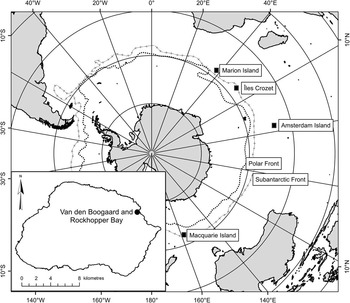
Marion Island (46°54'S, 37°45'E) is located in the Indian sector of the Southern Ocean. It lies directly in the path of the Antarctic Circumpolar Current and is bounded to the north by the Sub-Antarctic Front and by the Antarctic Polar Front to the south (Ansorge & Lutjeharms Reference Ansorge and Lutjeharms2002). This study was conducted at Van den Boogaard (VdB) and adjacent Rockhopper Bay (RhB) beaches (Fig. 1), a low-density SAFS colony on the north-eastern side of the island (Hofmeyr et al. Reference Hofmeyr, Bester, Makhado and Pistorius2006). On average 148±40 (range: 101–189) pups were born here annually during the 6-year study (Mammal Research Institute, unpublished data). Both VdB and RhB are characterized by large boulders, typical of the preferred SAFS breeding haul-out sites (Bester Reference Bester1982), bounded by 2–7 m high cliff faces and backed by a vegetated area.
The position of Marion Island in the Southern Ocean in relation to Ile de la Possession (Iles Crozet), Amsterdam Island and Macquarie Island, as well as the Antarctic Polar Front, Subtropical Front and the Sub-Antarctic Front. The location of Van den Boogaard and Rockhopper Bay beaches on Marion Island are indicated (inset).

Field methods
Starting in the winter of 2006, females with dependent pups were captured using a hoopnet and their pups caught by hand. Mother-pup pairs were weighed (females to the nearest 0.5 kg and pups to the nearest 0.1 kg, using calibrated Salter scales, Tonbridge) and marked with uniquely numbered and colour-coded tags (Dalton Jumbo® Rototags, Henley-on-Thames) in the trailing edge of each fore flipper. The sex of the pup was noted. A minimum of 30 mother-pup pairs were tagged during each year. Several females did not return from foraging bouts or for every breeding season of the study period (2006–11). Some pups died early in the summer season. Consequently, several untagged mother-pup pairs were caught and tagged at the start of each winter season to maintain and/or increase the sample size. Most females returned and pupped in>1 year and an effort was made to capture and tag the pups of previously tagged females. However, it was not always possible to catch and sex the pups of these females. As a result the sexes of 62 pups in this study are unknown. Trained field personnel conducted attendance observations twice daily (1–2 hour sessions at approximately 09hr00 and 16hr00) by careful inspection of beach and vegetated areas at both study sites. Beach observations were often made from vantage points above the colony using binoculars to avoid disturbing the seals. The presence of all marked females (including their pups when sighted) was recorded together with their behaviour and subsequent indications of possible disturbance caused by the observers. Summer observations extended over two months (15 January to 14 March), while winter observations were conducted over 3 months (15 May to 14 August). ‘Season’ refers to either a winter or summer within a year (e.g. summer 2008). ‘Year’ refers to the summer and winter seasons collectively within a given year (e.g. note that ‘year 2008’ includes summer and winter data of pups born over a period of six weeks centred on mid-December 2007; Hofmeyr et al. Reference Hofmeyr, Bester, Pistorius, Mulaudzi, de Bruyn, Ramunasi, Tshithabane, McIntyre and Radzilani2007). This study includes data from 2006–11 (n=10 seasons; excluding summer 2006 and winter 2011).
Data handling and analyses
Females were often seen on day one, absent on day two, and present again on day three. Given that SAFS from Marion Island have not been recorded to take short over-night foraging trips (de Bruyn et al. Reference de Bruyn, Tosh, Oosthuizen, Bester and Arnould2009), such females were regarded as present on day two. However, when females were absent for 2–3 days before being located again, it became subjective to choose a cut-off point for their attendance onshore. To eliminate bias, detection probability was modelled by means of multi-state CMR models and attendance bout durations were corrected accordingly.
Calculation of foraging cycle parameters
Not all study individuals were present at the start or end of the season; consequently, there are several incomplete foraging trips or attendance periods in each season. Traditionally, only complete foraging cycles would be used in analyses. This would limit sample sizes and result in several days of observations being discarded (e.g. Kirkman et al. Reference Kirkman, Bester, Hofmeyr, Pistorius and Makhado2002). Longer foraging trips towards the end of each season would also be discarded and consequently foraging trip length is underestimated. Furthermore, attendance observations were only conducted for sections of the lactation phase (summer attendance: 15 January to 14 March, and winter attendance: 15 May to 14 August). Therefore, individual mean foraging trip duration (f) was calculated in days using the equation,
 $$f=\left( {{\rm A}\,{\rm x}\,{\rm S}} \right)/\left( {{\rm 1}{\hbox{-}}{\rm S}} \right),$$
where A=mean attendance period (days) and S=proportion of time spent at sea over the entire observation period (Goldsworthy Reference Goldsworthy2006). This approach enabled inclusion of all available data collected in each season. The equation underestimates mean foraging trip duration but is a more accurate estimate than using the duration of a foraging trip of females for which only complete foraging trips were recorded (Goldsworthy Reference Goldsworthy2006). A total of 308 females were observed over the 6-year period with several females observed in more than one season and/or year. Taking this into account there is presence/absence data for 124 unique individuals.
Multi-state capture-mark-recapture models
Demographic parameters were estimated based on daily resight histories of individually marked, lactating SAFS at RhB/VdB beaches from winter 2006 to summer 2011. This involved 217 individuals over 151 time steps (summer=59 days; winter=91 days). Capture (P), apparent survival (Φ) and transition (ψ) probabilities were estimated under a Conditional Arnason-Schwarz multi-state CMR framework (Lebreton & Pradel Reference Lebreton and Pradel2002) to estimate detection probabilities. These parameters were modelled according to the following variables: state, season, year and pup sex, using the M-Surge software (Choquet et al. Reference Choquet, Reboulet, Pradel, Gimenez and Lebreton2004). Two states were identified: i) when a female was present and seen by the observer (i.e. ‘on land’), and ii) when the female was absent (i.e. ‘at sea’). Since no age data is available for the females, age was not considered in the models. Small sample corrected Akaike Information Criterion (AICc) was used to select the most parsimonious model, with models considered to be different when their AICc values differed by more than two (Burnham & Anderson Reference Burnham and Anderson2002). The model with the lowest AICc that could accurately estimate all the parameters was chosen.
Survival probability
A demographically closed population within a season was assumed, i.e. no death or recruitment of females during that interval; therefore, Φ could be set to a constant of one. If a pup died or the female did not return in a season she was excluded from the analyses. Between seasons, within a year, the population was assumed to be open. If there was adequate attendance data for a female within one season (e.g. summer 2008) but not the next or previous season (e.g. winter 2008) within the same year (e.g. 2008 collectively) she was included in the model.
Transition probability
Previous studies indicate that females’ foraging trip durations increase as pups age (Georges & Guinet Reference Georges and Guinet2000, Kirkman et al. Reference Kirkman, Bester, Hofmeyr, Pistorius and Makhado2002). Pup sex of some fur seal species also influence the mother’s foraging cycles (Goldsworthy Reference Goldsworthy2006). Yearly fluctuations in food availability caused by environmental fluctuations could potentially cause females to stay at sea for longer or return to the colony sooner (e.g. Boyd et al. Reference Boyd, Lunn and Barton1991). The probability for a female to transit from land to sea or from sea to land was modelled as a function of season, year, pup sex and their interaction. Unknown sex pups (n=62 for entire study period) could not be included in the interaction term. As such, females with an unknown sex pup were included as an additive effect.
Capture probability
By definition the probability of detecting a female while in state two (i.e. ‘at sea’) was set to a constant of zero. The influence of pup sex, season and year on capture probability while on land was explored. All possible combinations of these variables were tested to find the best models.
Correction of attendance data
To correct for days a female was present on land but not observed, the total number of days a female was seen within a season was divided by the detection probability for that given season. For example, in the winter of 2008 the detection probability was 90.95% (see results). Female LB573 was seen a total of nine days, divided by 0.9095, which results in a corrected number of attendance days of 9.89. The corrected number of attendance days for each female was used in subsequent analyses of foraging trip parameters.
Mixed-effects models
Linear mixed-effects models were used to test the influences of several covariates on foraging trip duration and attendance period (in days) as well as proportion of time spent at sea for both corrected and uncorrected data. Mixed-effects models were fitted using the ‘nlme’ library in R (Pinheiro et al. Reference Pinheiro, Bates, Debroy and Sarkar2011, R Development Core Team 2012).
Proportion of time spent at sea was square-root arcsine transformed prior to modelling. Proportion of time spent on land is dependent upon time spent at sea. Therefore, any effects on it were not explored. All females with pups of unknown sex were excluded from the analyses because of an uneven distribution throughout the seasons. The starting covariates used in all models were: season, year, pup gender, whether or not a female carried a telemetry device (irrespective of the type of device because of the small number of females that carried devices, n=17), an interaction term between year and season, and the interaction between season and device presence/absence individual identity (i.e. tag number) was the random effect. A backward stepwise selection method was employed by sequentially excluding non-significant covariates; however, each possible combination of the covariates were tested. A maximum likelihood method was used to fit all models. Autocorrelation plots did not reveal any significant autocorrelation issues. Small sample AICc was used for model selection (Burnham & Anderson Reference Burnham and Anderson2002) together with several plot types to assess model fits. A marginal hypothesis test (F-test) was carried out on the final model to distinguish the significance of the various mixed effects. The percentage of the variance explained by the random effect (i.e. tag number) was calculated by means of a variance component analysis (Crawley Reference Crawley2007).
Results
Multi-state capture-mark-recapture models
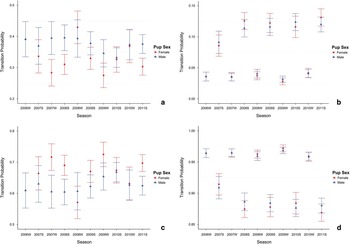
Female survival for all years between seasons was estimated from tagged individuals to be 0.72±0.04 (confidence limits=0.637 and 0.792). The likelihood for a female to be at sea (state two, i.e. transition from land to sea, or from sea to sea) was always higher than for her to be on land. Transition probabilities and variation in them according to pup sex are illustrated in Fig. 2.
The transition probability (± standard error) across the different seasons that females will a. move from sea to land, b. move from land to sea, c. remain on land, and d. remain at sea. Differences associated with pup sex are also indicated.

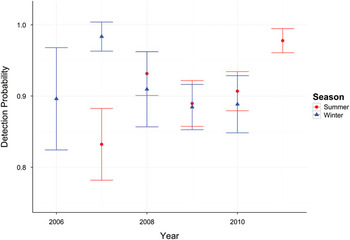
Capture probability is best predicted by the interaction between season and year (Fig. 3). The AICc values decreased substantially when pup sex was included in the model. Model estimates indicated that capture probability was only reduced for females with unknown pup sex with no notable differences between having male or female pups. Small numbers of females with pups of unknown sex, noted through the years and seasons resulted in exclusion of the ‘pup sex’ variable from the final CMR model.
Probability (± standard error) of a female being detected and marked as present when she is on land; across different years, with differences between summer and winter shown.

Corrected versus uncorrected data
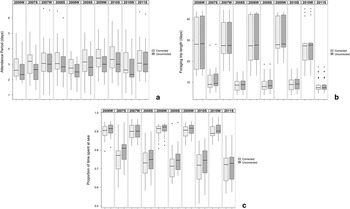
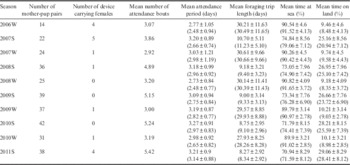
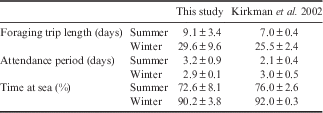
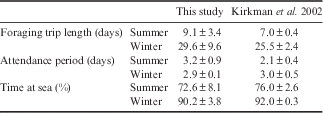
Corrected foraging trips were always longer in the winter, with average foraging trip duration of 29.6±9.6 days vs 9.1±3.4 days in the summer through all years. The average attendance period in winter (3.08±0.97 days) was only slightly shorter than in summer (3.28±0.94 days) across all years. This means that during winter females spent 90.2±3.8% of their time at sea, while in the summer only 72.6±8.1% was spent at sea. There were no differences between the seasons in any of the foraging cycle parameters (Table I). Prior to modelling, simple box-and-whisker plots revealed no obvious differences in foraging trip length, attendance period or proportion of time spent at sea between corrected and uncorrected data (Fig. 4) and a comparison to that of previous published attendance patterns data for SAFS from Marion Island also show no clear separation (Table II).
Box-and-whisker plots indicating the difference between the corrected and uncorrected average for a. foraging trip length (days), b. attendance period (days), and c. proportion of time spent at sea within each season of lactating subantarctic fur seals.

Summary of foraging cycle parameters within each year and season. Numbers presented in brackets are the uncorrected values prior to applying the season specific detection probability (mean±standard deviation).

Comparison of attendance cycle parameters for summer and winter between this study and Kirkman et al. Reference Kirkman, Bester, Hofmeyr, Pistorius and Makhado2002 (mean±standard deviation).
Linear mixed-effects models: foraging trip duration
An F-test indicated that only season had a significant influence on the duration of a foraging trip (χ2=636.04, df=1, P<0.0001). Model estimates indicate that foraging trip durations increased by 19.8±0.8 days from summer to winter (t-value=25.22, df=124, P<0.0001). Individual (random) effects explained 27.3% of the variation in the most parsimonious model.
Season was the only significant variable when modelling uncorrected foraging trip duration (F-test: χ2=484.81, df=1, P<0.0001). Foraging trip duration increases by 20.0±0.9 days from summer to winter (t-value=22.01, df=124, P<0.0001). Individual (random) effects explained 28.2% of the variation in the best model.
Linear mixed-effects models: attendance period
An F-test indicated only season (χ2=4.62, df=1, P<0.05) and pup sex (χ2=6.53, df=1, P<0.05) were significant indicators of attendance period. Females performed shorter attendance periods by 0.3±0.12 days (t-value=-2.6, df=123, P<0.05) when they had a male pup. During the summer, females stayed on land significantly longer (0.24±0.1 days; t-value=-2.15, df=123, P=0.01). Individual (random) effects explained 24.14% of the variation in the best model.
Uncorrected attendance period data were also only influenced by the sex of the pup (χ2=7.30, df=1, P<0.01) and the season (χ2=5.05, df=1, P<0.05). Estimates for these models varied little between models (Fig. 2). Females attended their male pups by 0.3±0.12 fewer days (t-value=-2.68, df=123, P<0.05) than for female pups. During the summer females stayed on land significantly longer (0.23±0.1 days; t-value=-2.23, df=123, P<0.01). Individual (random) effects explained 23.37% of the variation in the best model.
Linear mixed-effects models: proportion of time spent at sea
When using the arcsine transformed percentage time at sea as explanatory variable only season and pup sex were significant covariates (F-test: χ2=629.0, df=1, P<0.0001 and χ2=6.6, df=1, P<0.05, respectively). Females with male pups spent 2.6±1.1% more time at sea (t-value=2.8, df=123, P<0.05) than females with female pups. In the winter, females spent 23.4±0.9% (t-value=25.7, df=123, P<0.0001) more of their time at sea compared to summer. The interaction term between season and pup sex was non-significant. Individual variation explained 31.3% of the model.
The uncorrected arcsine transformed percentage of time spent at sea was also only significantly influenced by season (χ2=636.0, df=123, P<0.0001) and pup sex (χ2=4.8, df=123, P<0.05); although estimates showed more variance. A weight function, with season as the identity structure, had to be implemented to stabilize heteroscedasticity. Year and device presence/absence were marginally non-significant (P=0.063 and P=0.060, respectively). Individual variation explained 15.9% of the model.
Discussion
Using a novel robust CMR framework, we show that observer-based attendance pattern data could be useful in augmenting expensive telemetry studies and could be easily applied where lactating central-place foragers do not take short over-night foraging trips.
Previous studies on flipper-tagged lactating SAFS and their pups suggest that females from Marion Island perform extended foraging trips (Bester & Bartlett Reference Bester and Bartlett1990, Kirkman et al. Reference Kirkman, Bester, Hofmeyr, Pistorius and Makhado2002). However, in both of these studies daily observations were only performed once a day, around midday. Females that leave at night and return early the next morning would subsequently be marked as present and over-night foraging trips would not be detected. Females also often move into the shallows, especially during midday for thermoregulatory reasons (Bester Reference Bester1982) and as a result would be missed. These studies are considered inappropriate to detect over-night foraging trips. However, no over-night foraging trips were recorded for satellite tracked females (n=34; de Bruyn et al. Reference de Bruyn, Tosh, Oosthuizen, Bester and Arnould2009, Wege Reference Wege2013), as with females from Amsterdam Island (Georges & Guinet Reference Georges and Guinet2000).
Observational methods underestimated foraging trip duration and overestimated attendance period for Antarctic fur seals at Bird Island, South Georgia, as well as SAFS and Antarctic fur seals at Macquarie Island (Boyd et al. Reference Boyd, Lunn and Barton1991, Goldsworthy Reference Goldsworthy1999). Our results, using twice daily observations and accounting for under-detection, did not show any measurable departures in foraging trip duration from that measured by observation only on an east coast beach of Marion Island by Kirkman et al. (Reference Kirkman, Bester, Hofmeyr, Pistorius and Makhado2002) (Table II). Nor did the results of the linear mixed-effects models with uncorrected data greatly differ from that of the corrected data. This does not imply that accounting for detection failure is a superfluous exercise. In the current study, detection probability was high across all seasons (range: 83–98%) and females were rarely missed. The study beaches (VdB and RhB) are low-density beaches (Hofmeyr et al. Reference Hofmeyr, Bester, Makhado and Pistorius2006). Therefore, it is easier to read tag numbers and see most females as there are simply fewer animals to observe within a unit of area as compared to a high-density site. This correction technique may allow for significant improvement of observation results in, for example, high-density rookery scenarios.
The equation provided by Goldsworthy (Reference Goldsworthy2006) for calculation of average attendance period and foraging trip duration per unit time, relies heavily on the number of bouts a female performed. If females are often not seen while being ashore, the observed attendance period and the number of bouts will decrease. Therefore, a reduction in detection will decrease the observed number of shore bouts, which acts as a numerator to calculate A (the average attendance period). Furthermore, from uncorrected data the foraging trip length was always longer and attendance period shorter; thus observed proportions of time spent on land and at sea will be most affected. The linear mixed-effects model with percentage of time spent at sea as the response variable hinted at this, given that values for the best model of uncorrected data differed the most from corrected data. Although not significant, device presence-absence carried more weight in the best model, indicating that the attendance cycle data of device-carrying animals (measured 100% correctly through telemetry) differed slightly from uncorrected observer-based attendance patterns data.
In most otariid species, including SAFS (Georges & Guinet Reference Georges and Guinet2000, Kirkman et al. Reference Kirkman, Bester, Hofmeyr, Pistorius and Makhado2002), Antarctic fur seals (Boyd et al. Reference Boyd, Lunn and Barton1991), New Zealand fur seals (Harcourt et al. Reference Harcourt, Bradshaw, Dickson and Davis2002) and Australian fur seals (Arnould & Hindell Reference Arnould and Hindell2001), foraging trip duration increases from summer to winter. This is attributed to: i) seasonal change in prey availability and abundance, ii) increase in pup demands (Georges & Guinet Reference Georges and Guinet2000), and iii) females are pregnant in the winter (Bester Reference Bester1995) and thus require additional energy gain for the growing unborn pup. In summer, the fasting capabilities of young pups are considerably lower than when they are older during winter (Verrier et al. Reference Verrier, Groscolas, Guinet and Arnould2009) and pup size physically limits the amount of milk they are able to ingest. Consequently, during summer attendance patterns are dependent on pup demands (Georges & Guinet Reference Georges and Guinet2000). In winter, when pups are bigger and able to fast for longer, female attendance patterns are controlled by female traits, such as body size and experience (Georges & Guinet Reference Georges and Guinet2000), explained by the 23–31% in the linear mixed-effects models described by random effect (individual variation). Given that information on female experience and age is unavailable, it was not possible to explore the influence on maternal attendance patterns. Unlike other studies where attendance period remains similar from summer to winter (e.g. Goldsworthy Reference Goldsworthy1999, Georges & Guinet Reference Georges and Guinet2000, Kirkman et al. Reference Kirkman, Bester, Hofmeyr, Pistorius and Makhado2002), attendance durations decreased in this study. Like their counterparts on Amsterdam Island, lactating females undertake one of the longest (distance and duration) foraging trips known for otariids (Georges & Guinet Reference Georges and Guinet2000, Kirkman et al. Reference Kirkman, Bester, Hofmeyr, Pistorius and Makhado2002, de Bruyn et al. Reference de Bruyn, Tosh, Oosthuizen, Bester and Arnould2009). However, unlike females from Amsterdam Island that dive to mean depths ranging between 19 and 29 m, Marion Island females often exceed diving depths of 40 m (Wege Reference Wege2013). Thus they work harder not only in terms of swimming distance but also foraging effort. However, there is an upper limit where it is no longer advantageous for females to increase their foraging trips given the added metabolic overhead (Arnould et al. Reference Arnould, Boyd and Speakman1996a). For a female to maximize her time at sea to gain resources, it would be better to decrease the days spent on land instead of increasing days spent at sea. Consequently, the proportional time spent at sea is higher without incurring the extra metabolic costs. Furthermore, pups are larger in the winter which means their sucking capabilities are greater and females’ milk-stores will be depleted sooner (Georges & Guinet Reference Georges and Guinet2000).
New Zealand fur seal females take longer foraging trips and consequently spend a higher proportion of their time at sea when they have male pups (Goldsworthy Reference Goldsworthy2006). Similarly, during the summer, SAFS females at Marion Island spent 69.6% of their time at sea if they have female pups but 73.9% if they had male pups. During the winter this difference decreased and females with female pups spent 89.4% of their time at sea compared to 90.1% for mothers of male pups. However, unlike New Zealand fur seals where females increase their foraging trip duration, SAFS reduced the time spent on land. Milk-ingestion capabilities and suckling rates of larger male pups were suggested as possible explanations (Goldsworthy Reference Goldsworthy1995). As a species, SAFS are highly sexually dimorphic, and Marion Island SAFS pups show significant differences in body mass between males and females from as early as 30 days of age up to weaning (Kirkman et al. Reference Kirkman, Bester, Hofmeyr, Pistorius and Makhado2002). Males grow faster than females (Kerley Reference Kerley1985) because male pups invest more in lean muscle development whereas female pups have higher adipose reserves (Arnould et al. Reference Arnould, Boyd and Socha1996b). However, on Amsterdam Island, foraging trip duration and attendance periods were not related to pup sex, but rather to the pup’s weight (Georges & Guinet Reference Georges and Guinet2000). Arnould et al. (Reference Arnould, Boyd and Socha1996b) similarly found that when the amount of milk ingested did not differ between sexes but was rather influenced by the mass of the pup. This is despite obvious differences in metabolic rate between the sexes. They concluded that pup mass is, therefore, not a good measure of maternal investment between pup sexes. The difference in attendance patterns of mothers with male versus female pups on Marion Island is, therefore, most probably a consequence of differences in body growth requirements related to sex. Notably, the degree to which female attendance cycles differ between male and female pups from summer to winter decreases (4.3% vs 0.7% for summer and winter, respectively). This is indicative of females reaching their upper limit in foraging trip duration during the winter when resources are limited. Although the requirements of male pups are higher, it would not be beneficial for females to increase their foraging trip duration due to increased metabolic costs, as discussed by Costa (Reference Costa2008). Despite the shortcomings of pup mass, attendance cycle data can still act as an indicator of differential investment by females relating to the sex of her pup.
Differences in capture probability
Despite the thorough training of field personnel, annual and seasonal variations in capture probabilities indicate that, both effort (annual variation) and in situ experience of observers (seasonal variation), play a role in resighting females. The annual relief voyage for Marion Island arrives mid-April and experienced field personnel have a month to train new field personnel. The ship departs mid-May leaving the new team behind, and therefore a Marion Island “team year” does not overlap with a SAFS breeding year, which starts mid-December (median pupping date for females) and ends October the next year (weaning of pups) (Kerley Reference Kerley1985, Hofmeyr et al. Reference Hofmeyr, Bester, Pistorius, Mulaudzi, de Bruyn, Ramunasi, Tshithabane, McIntyre and Radzilani2007). Therefore, summer attendance pattern observations would be performed by experienced field personnel that worked on the island since April the previous year. Winter observations, however, are generally performed by less experienced field personnel that arrived at the island only a month prior to the start of the winter attendance pattern study. This might explain why capture probability was lower in the winter than in summer for most years, although the effect of comparatively more severe weather conditions (e.g. more snow cover) cannot be discounted. Little can be done to improve capture probability from summer to winter. External weather-related factors cannot be controlled. Spending more time to train field personnel is also not necessarily helpful because experience can only be gained with time. Therefore, using capture probability estimates obtained from CMR is essential to correct attendance data.
Conclusion
Here a novel approach was used to analyse observer-based attendance cycle data. Negligible changes in foraging cycle parameters shown in this study illustrate that at Marion Island observer-based data could be used to augment costly telemetry studies. Specifically, the high detection probability across all seasons and the strongly supported assumption that females do not undertake short over-night foraging trips facilitate this conclusion. Therefore, taking detection probability into account is a measurable improvement on previous methods of arbitrary assumptions of female presence-absence. Furthermore, not only season but also pup sex influence the percentage of time females apportion to foraging at sea and suckling their pups on land. This may be because mothers provide nourishment at a faster rate to male pups due to their larger growth demands. Information on maternal age and/or experience is unavailable in this study and these factors may also influence attendance patterns. However, the mixed-effects model approach allowed us to account for the amount of individual variation indicated by the percentage variation explained in the models by the random effect.
Attendance cycle data provides valuable insight into differential investment by females to male and female pups. However, concomitant information on pup growth, female body condition and population changes are required to further test for environmental influences on female foraging behaviour.
Acknowledgements
C. Tosh, C. Oosthuizen, M. Phalanndwa, R. Reisinger, T. Mufanadzo, M. Postma, D. van der Merwe, J. Purdon, H. Purdon and T. Scott are gratefully acknowledged for their hard work with field data collection. We also thank the anonymous reviewers, who improved the paper considerably through their constructive and detailed comments. The Department of Environmental Affairs supplied logistical support within the South African National Antarctic Programme. Financial support was provided by the Department of Science and Technology, through the National Research Foundation (NRF), in support of the Marion Island Marine Mammal Programme (MIMMP) of the MRI.
Author contribution
M. Wege conceptualized the research questions. M. Nevoux provided analytical insight and support. M. Wege performed all analyses and wrote the paper. M.N. Bester and P.J.N. de Bruyn designed field methods. All authors contributed to final drafts.