



1. Introduction
Features: Perspectives on a Key Notion in Linguistics is an ambitious volume, which takes a fresh look at central concepts in the discipline, such as definiteness, person, number, gender, and case. Though they have often been taken for granted or even overlooked as ancillary in theory-building, features are indispensable in pretty much any linguistic framework or any attempt at theorising about language, ranging from ancient grammatical treatises to cutting-edge computational applications. This book seeks to place them centre stage and to offer a wide range of perspectives from various angles, including typology, computational linguistics and different strands of contemporary formal linguistics. It is therefore a remarkably faithful mirror of the richness and variety of present-day scholarship. The chapters are written by internationally recognised leading experts in the respective fields. Attention is given to phonological features (see B. Elan Dresher’s contribution), morphological and syntactic features (Greville G. Corbett’s and Anna Kibort’s chapters), and semantic features (Keith Plaster & Maria Polinsky). For the interface between syntax, morphology and semantics, see especially Anna Kibort’s, Gabi Danon’s, Gergana Popova’s and David Adger’s chapters. The formal aspects of features are explored by Ann Copestake & Dan Flickinger, Ivan A. Sag, and Geoffrey K. Pullum & Hans-Jörg Tiede.
The rest of this paper is organised as follows. Section 2 provides a summary and evaluation of the book, whose ten main chapters are grouped into three parts: ‘Key notions’ (Part I), ‘Perspectives from syntactic description and theory’ (Part II), and ‘Formal perspectives’ (Part III). Section 3.1 discusses the language-internal and cross-linguistic dimensions, which are prominent in the volume. I focus on some verbal features in Bulgarian and attempt to achieve a greater degree of descriptive consistency within the language-internal system itself, as well as in comparison with other languages, such as English. Section 3.2 focuses on the boundaries between syntax, semantics and morphology, and is based on two case studies. The first one briefly considers the status of animacy in Bulgarian, demonstrating that it sometimes proves rather difficult to operate with clear boundaries between the traditional components of grammar. The second case study analyses English backshift as agreement in tense; this provides sufficient grounds for regarding tense as a (partially) morphosyntactic feature rather than strictly morphosemantic.
2. Summary of the book
2.1 Key notions
The first chapter, ‘Introduction’, by the editors of the volume (Kibort & Corbett)Footnote [2] provides a comprehensive overview of what is to follow and acknowledges a long tradition of language research and description which has appealed to features. Mention is made in the volume of the work of Saussure (Dresher: 37), the Prague School (where features were particularly prominent in describing the phoneme), followed by lexical semantics, Chomsky’s revolution in syntax, as well as morphological theory, down to formal models such as Generalised Phrase Structure Grammar (GPSG) and later Head-driven Phrase Structure Grammar (HPSG), which notably offer a coherent theory of features (see also Corbett Reference Corbett2012: 11–12, with references). Features are justified in that they enable linguists to capture generalisations by placing items in natural classes that share certain information or important similarities – English plural nouns, for instance, are characterised by the fact that they are compatible with the determiner these (Corbett: 17; Corbett Reference Corbett2012: xiii, 1ff.; Kibort: 64; Kibort & Corbett: 1). Making generalisations without features would be an extremely burdensome task, if not outright impossible (though see Kapatsinski Reference Kapatsinski2011 for an alternative). Despite potentially having different exponents, features are claimed to show ‘consistency across items, and to some extent across languages’ (Kibort & Corbett: 1). English plurals can be marked by - $s$, -en, vowel mutation, or zero, but they all behave in the same way with respect to plurality, regardless of their morphology. Moreover, English plurals are generally thought to be comparable to functional equivalents in other languages (Corbett Reference Corbett2012: xiii, 1–2). I will return to this non-trivial issue in the discussion below, where I will also present some dissenting views, most notably Haspelmath (Reference Haspelmath2010a, Reference Haspelmathb, Reference Haspelmath, Graf, Paperno, Szabolcsi and Tellings2012).
The book brings together scholars of various persuasions, which highlights the fact that, although features tend to be a currency that virtually all linguists share, they are often invested with different content or put to different uses, depending on who is using them (Kibort & Corbett: 2; see also Corbett Reference Corbett2012: 1).Footnote [3] This brings to the fore the importance of building a more or less generally accepted feature infrastructure. In his contribution, Corbett (34–36) outlines the first practical steps for this, noting some theoretical implications. Kibort is also especially concerned with this issue.Footnote [4]
Several threads run through the book, reflecting the situation in linguistics more broadly – the problem of identification (How do we establish the features and the values that make them up?), the meaning and function of features, their status, their structure and interactions, and the domains where they operate (Kibort & Corbett: 2–3). An important contrast is drawn between inherent and contextual features – a plural noun denotes a plurality of referents, and its number is therefore an inherent property, but a plural verb that agrees with its subject does not necessarily denote a plurality of events (see Corbett: 25; Corbett Reference Corbett2012: 66–68, with references, as well as the discussion of Kibort’s chapter below; see also Sag: 258). That is reminiscent of the distinction between interpretable and uninterpretable features in Minimalism (Chomsky Reference Chomsky1995; Adger: 187ff.; Corbett: 26; Kibort & Corbett: 3). It was noted above that researchers might invest the same term with different meanings, which is an unfortunate fact about our field. We now see another problem of a similar kind – linguists tend to come up with different terms for what is essentially the same concept (see esp. Kibort: 66–67). An apt illustration can be found in Table 4.1 in Kibort (66), where the synonymous terms ‘feature’, ‘Kategoriengefüge’ [complex of categories], and ‘(inflectional) category’, are listed. There are even more alternatives for the concept of ‘value’ (see Adger: 197, on similar issues within Minimalism). Corbett’s and Kibort’s contributions highlight both those setbacks in a laudable effort to introduce more uniformity across the field. An attempt is made in the volume to combine formal approaches to features with their diverse potential typological manifestations across various languages.
Corbett’s chapter, ‘Features: Essential notions’, looks at how features are integrated in grammatical description. He advocates an approach with sharp distinctions between semantics, morphology, and syntax; in his view, those should be strictly separate modules supplied with appropriate interfaces (see Corbett Reference Corbett2012: Chapter 3). Syntax is assumed to be phonology- and morphology-free, so syntactic rules cannot refer to purely phonological or morphological rules (see Corbett: 18; Corbett Reference Corbett2012: 42ff., with references, and the discussion of Popova’s chapter and Section 3.2 below; see also Sag: 259–260). In other words, purely morphological, phonological, semantic or morphosemantic information should not be visible to syntax. However, it is unclear how exactly morphosyntactic features will fit in – it is acknowledged that such features ‘have an effect across component boundaries’ (Corbett: 18; see also Corbett Reference Corbett2012: 48ff.). As Kibort (67) notes,

As regards the division between semantics and morphosyntax, Corbett (also Corbett Reference Corbett2012: 48) notes that the morphosyntactic genders in many languages correspond in part to semantic distinctions, though the correspondences are only partial. It remains to be worked out how to integrate and appropriately interface semantic features such as animacy, which can be proven to be different from morphosyntactic animacy, and yet influence morphosyntactic patterns. I return to this in Section 3.2.1 below.
One of the major achievements of Corbett’s chapter is the work the author has done on the internal structure of features (see Corbett Reference Corbett2012: Chapter 2). Corbett (20–23) convincingly demonstrates that features can indeed have a hierarchical internal structure similar to the structure we find in many other components of language; however, this need not be the case and a linguist should argue for, rather than assume, the analysis he or she adopts (see Danon – an illustration of how this can be implemented). A three-person system can just be made up of a list of values (first, second, and third), or it can be decomposed into [±participant] and [±speaker], thus producing a binary-branching hierarchy (Corbett: 19). Crucially, unstructured (flat) lists of values are acceptable in the model proposed by Corbett, which sets it apart from the views advocated in much previous work. Thus, neither layering nor binarity of feature values should be seen as universal (see Adger: 192ff.; Pullum & Tiede: 273ff.). It is additionally shown how syncretism can be accounted for by appealing to a flat list of values in combination with default settings. Languages could also operate with facultative values, i.e. values which need not be selected. For example, there are languages with dual number which allow the use of the plural instead of the dual with reference to two items (see Corbett: 20; also Kapatsinski Reference Kapatsinski2011). The latter situation would justify positing internal structure. Either type of analysis is fine for Corbett, as long as it is motivated.
Although his focus is primarily typological, Corbett (27–31; Corbett Reference Corbett2012: 39–40) outlines the problems agreement phenomena could pose for various syntactic theories. Such problems may come from hybrid controllers like English committee or from conjoined phrases. Both these types of constituent admit variable agreement which is not always easy to capture formally and which seems to be constrained by Corbett’s Agreement Hierarchy (Corbett Reference Corbett1979 and elsewhere).Footnote [5]
Attempts to deal with variable agreement in a constraint-based setting can be found in Dalrymple & Hristov (Reference Dalrymple, Hristov, Butt and Holloway King2010) and Hristov (Reference Hristov2012, Reference Hristov, Butt and Holloway King2013b, with references). Kibort (Section 4.3.3.1) takes up the dichotomy between syntactic and semantic agreement too – e.g. the committee has/havedecided. At first glance, she seems to conveniently gloss over an important problem: Where exactly do the properties of these hybrids belong and how are they best classified and described? Will agreement involving a semantically justified feature value make that feature syntactico-semantic, semantico-syntactic or morpho-syntactico-semantic? In the end, Kibort does offer a reasonable solution. An inherent value, for example the number or gender of a noun, can be assigned on the basis of semantic or formal criteria, or both, in the case of so-called hybrid nouns like committee. In turn, the feature values thus assigned may be visible to agreement targets and will therefore qualify as contextual values on agreeing verbs or adjectives. Therefore, this will still count as a morphosyntactic agreement phenomenon, albeit less canonical if it appeals to the more semantically justified value (Kibort: 79). This, I believe, moves the field forward quite perceptibly.
The lucid style and cogent explanations are hallmarks of Corbett’s exposition throughout. Even the discussion of some of the relatively complex cases is quite accessible and impeccably argued, making the chapter a pleasure to read. Corbett often revisits material from his earlier work, though now it is sometimes presented in a slightly different light. Probably due to limitations of space, some issues are only skated over in passing and the reader is left to chase up the references provided in the body of the text. The project under discussion is the culmination of Corbett’s long involvement with gender (Corbett Reference Corbett1991), number (Corbett Reference Corbett2000), and agreement (Corbett Reference Corbett2006), which originally started with typological outlines of Slavonic (Corbett Reference Corbett1979, Reference Corbett1983). Along with Blake (Reference Blake1994), those are highly respected field-defining texts. This volume also paves the way for Corbett’s (Reference Corbett2012) book entirely dedicated to features. The importance and the merits of this immense body of work can hardly be overstated.
Dresher’s chapter, entitled ‘Feature hierarchies and contrast in phonology’, draws a distinction between contrastive and redundant phonological features (see Pullum & Tiede for the philosophical underpinnings of feature redundancy). Dresher argues that the traditional minimal pair in phonology, which involves a pair of fully specified segments, should be abandoned as inadequate and replaced by a contrastive hierarchy dividing the set of phonemes in a reductive manner by appealing to a hierarchically ordered set of features. Dresher acknowledges the work in the same spirit of his predecessors, most notably Trubetzkoy (Reference Trubetzkoy1939) and Jakobson & Halle (Reference Jakobson and Halle1956), as well as more recent work in descriptive linguistics and Optimality Theory (see Dresher: 48–49). His ideas have parallels in morphosyntax (see Corbett: Section 2.3.1; Kibort & Corbett: 5). The obvious similarities are between distinctive phonemes, which differentiate words, and inflectional contrasts, which signal different semantics and/or syntactic functions. The locus of the phonological contrast has now been shifted from the phonetic properties of segments to their functions. There is some rather intriguing discussion of the interaction between phonetics and phonology (see esp. Dresher: 53–55, 60–62), which has important theoretical implications. As with phonemes, it is proposed elsewhere in the volume that grammatical feature values should be distinguished on the basis of function rather than form (see Kibort; Kibort & Corbett: 5). What phonological and morphological segments do will then be deemed more important than what they actually look like. One of the undisputable merits of the volume is that, diverse as it is, it gets us a step closer to a unified approach to phonology and morphosyntax. Like Corbett’s, Dresher’s chapter makes explicit what lies behind central assumptions which are normally taken for granted but rarely justified. This is healthy for the field in general.
However, as with most analyses with a relatively high degree of abstraction, this one also raises some questions which are not at all easy to answer in a theory-neutral fashion. Dresher (51–52) has to assume that the vowel [u] in his example (16b) is derived from an underlying /ʊ/, which has phonetically merged with underlying /u/. This assumption is needed to maintain vowel harmony in Classical Manchu. It would be nice, however, to see more independent non-circular evidence supporting this analysis, rather than simply conceding that the examples in (16b) do not contain vowel harmony. Without additional background information, the justification currently seems to be little more than a prop for an elegant model. It is suggested at the end of the chapter that this is further explored in Dresher (Reference Dresher2009), where interested readers can find out more about the topics touched upon here.Footnote [6]Footnote [7]
Kibort’s contribution, ‘Towards a typology of grammatical features’, works out a typology informed by the descriptions of a representative sample of languages. In the introductory sections, she considers data which are mostly well known in the literature, such as the problematic gender systems of Polish and Romanian, and adjectival declension in German. Along with the other contributors, the author upholds excellent standards of terminological precision (see esp. Kibort: Section 4.2). Kibort is very careful about her use of terminology and frequently makes explicit the assumptions behind the terms she does or does not adopt, as well as the reasons for (not) adopting them. As mentioned above, an important distinction is recognised between contextual features required by syntactic rules, e.g. number on verbs agreeing with their subjects, and inherent ones, which are independent of the syntactic context, though they might have consequences for syntax, e.g. noun number or verb tense (see Kibort: Section 4.3.1). For Kibort, the ultimate criterion for establishing the existence of a feature is the presence of morphological exponence. Here form is given priority over function. This is in stark contrast to the insistence on function we found with Dresher.
Corbett and Kibort concur that a feature’s relevance to syntax is determined by its participation in agreement and/or government. Such a feature will qualify as morphosyntactic. This is contrasted with a morphosemantic feature, which will have no relevance for syntax; morphosemantic feature values can only be inherent and are not involved in agreement or government. Verbal tense is often taken to illustrate this category (though see below). In turn, a purely morphological feature will be irrelevant to both syntax and semantics – such values can only be inherent, cannot participate in agreement or government, and cannot be selected to indicate function or meaning contrast. A typical example is declension or conjugation class. The conclusion following a complex case study is that number, gender, person, respect, case, and definiteness do participate in syntactic agreement and/or government in the languages of the world, and hence qualify as morphosyntactic features, though tense, aspect, mood, and polarity (among others) appear to be restricted to the interface of morphology and semantics due to lacking the above defining properties.Footnote [8] These issues will be revisited in Section 3 below, where I argue that there can be agreement in tense. Likewise, at first glance, the subjunctive mood in many languages appears to be governed, selected or at least licensed by certain verbs but not others, where the verbs governing the subjunctive do not possess the subjunctive value themselves (this is briefly touched upon in Sag: 241, with references). Therefore, I think more work is needed to ascertain if this is merely a morphosemantic phenomenon which is due to meaning alone.
Kibort (77) asserts that English singularia tantum nouns such as happiness and poverty are assigned their inherent number on the basis of semantics, unlike pluralia tantum ones such as scissors and dregs, whose fixed inherent number value is based on form. It is often noted in the literature, however, that pluralia tantum nouns like scissors and trousers have at least some semantic justification because they are made up of two parts (see Corbett Reference Corbett2000; Reference Corbett2012: 26; Payne & Huddleston Reference Payne and Huddleston2002: 340–342; see also Copestake & Flickinger: Section 9.4, 233, for a sophisticated discussion of the interpretation of number, including so-called pair or binary nouns). Finally, Kibort (82–83) points out that her definitions are concerned with canonical morphosyntactic, morphosemantic, and morphological features. Various deviations from canonicity are expected in this canonical approach. We return to it in Section 3.1 below.
2.2 Perspectives from syntactic description and theory
Part II of the volume explores how features fit in syntactic description and syntactic theory. Plaster & Polinsky’s chapter, ‘Features in categorization, or a new look at an old problem’, looks into how languages determine the values of the gender feature. The validity of relying on cross-linguistically comparable formal and semantic cues is confirmed, which the authors put down to limitations on language acquisition and the perceptual salience of central concepts such as male, female, animate or edible. In order to illustrate their point, they reassess the system of gender in Dyirbal, which was famously said to conceptually group together women, fire and dangerous things (Dixon Reference Dixon1972, Lakoff Reference Lakoff1987, and the references cited in the chapter). The authors’ reassessment, which invokes diachronic reanalysis that was sometimes based on formal analogy, removes the need for a synchronic conceptual association between disparate items which now happen to belong in the same gender class. As a result, Dyirbal no longer seems as exotic as it was previously made out to be – it turns out that Dyirbal too relies on a combination of relatively straightforward formal and semantic factors.
Like earlier chapters, this one also moves the debate forward by reappraising assumptions that have held sway for decades. We once again see terminological precision (Plaster & Polinsky: 109 fn. 2, 123), as well as an attempt to draw parallels between different components, such as phonological and gender systems (Plaster & Polinsky: 109). Like other chapters, this one too is concerned with cross-linguistic generalisations, more specifically regarding ‘the content of gender features possible in human language’ (Plaster & Polinsky: 109; see Corbett Reference Corbett2012: 111–119, with references). Though I am by no means an expert on Dyirbal, I cannot help but praise the fact that the diachronic dimension has been brought in. In spite of the mixed feelings many eminent 20th-century linguists had about language history and its place in linguistic explanation, the picture without the diachronic dimension in it cannot be truly complete (see Haspelmath Reference Haspelmath, Carnie, Sato and Siddiqi2014 on diachronic explanations in typology). This chapter beautifully demonstrates that it is often impossible to make sense of synchrony without appealing to diachrony, truistic as this may sound (see Plaster & Polinsky: 125). In line with prevalent assumptions about the origin of a great deal of language change (and hence structure), the centrality of young learners acquiring their native language is also duly acknowledged (see Ringe & Eska Reference Ringe and Eska2013, among others, as well as Chomsky’s generative tradition).
However, a diachronic account without much corroborating historical evidence is of necessity highly speculative (see Plaster & Polinsky: Sections 5.5.4, 5.5.5). It is always a danger to invoke analogy as a last resort, the way the Neogrammarians did when the results of regular pre-historic sound changes they proposed didn’t turn out as expected. When formal parallels are invoked, it is naturally imperative to find sources for any putative analogy, and the authors do try to identify exactly such instances of formal similarity (see esp. Plaster & Polinsky: 118–121, 128ff.). They mostly look quite plausible, though analogy, notoriously irregular by nature, is sometimes a matter of rather subjective interpretation and point of view (see Plaster & Polinsky: 121 fn. 9, on alligators, as well as Plaster & Polinsky: 129ff., 134, for other problematic cases and exceptions, including frequency effects on analogical change).Footnote [9] Nor is synchrony neglected at the expense of diachrony (see Plaster & Polinsky: Section 5.5), and it is nice to see the plausibility of the proposed system confirmed by evidence from loanword adaptation (Plaster & Polinsky: 124). The situation reminds one of the celebrated debunking of the myth surrounding Eskimo snow terminology (Pullum Reference Pullum1989).
Danon’s chapter, ‘The definiteness feature at the syntax-semantics interface’, uses material from Hebrew. It looks into complex genitive constructions where the definiteness value is said to be shared or spread. Danon (143) argues for analysing this spreading as a syntactic phenomenon in Hebrew, which works by sharing a morphosyntactic feature of definiteness, whereas in other languages it is just a byproduct of the semantic interpretation of noun phrases, without any reference to a grammatical definiteness feature. Danon demonstrates (Section 6.2) that definiteness does participate in agreement (or government) in Hebrew, in which case its occurrence can be semantically vacuous on the target (see Danon: 144–145; Corbett Reference Corbett2012: 134–137, with references; see also the discussion of English backshift in Section 3.2.2 below). Since the phenomenon of spreading depends on syntactic structure, Danon claims that definiteness should be treated as a morphosyntactic feature, highlighting mismatches between morphosyntactic marking and semantically definite interpretations. For instance, noun phrases which are semantically definite do not have to be marked for the morphosyntactic definiteness feature (see Danon: 146–147, for examples and discussion). Conversely, constructions whose embedded nominal is marked as morphosyntactically definite are not necessarily interpreted as semantically definite (see Danon: 151–152, 152ff., for all the possible permutations). This nicely fits in with the criteria and the methodology developed by Corbett and Kibort in earlier chapters, since an important distinction is drawn between morphosyntactic definiteness and its semantic counterpart.
However, Danon (149) disagrees with Kibort on the morphosyntactic status of tense and aspect. He notes that, in many languages, features such as number, person and gender are all involved in overt agreement. He then says:

Without assuming any abstract agreement whatsoever, I will demonstrate in Section 3.2.2 below that English does exhibit overt agreement in tense.
A few passing thoughts are perhaps in order regarding the discussion in Danon on pages 157–158. Although [[a man’s]Det:NP dog]NP does not allow definite determiners, it should be pointed out that it will not allow any determiner at all, since there is one already – the genitive noun phrase. Contra Siloni (Reference Siloni and Lecarme2003), Alexiadou (Reference Alexiadou2005) and Danon, and siding somewhat with Woisetschlaeger (Reference Woisetschlaeger1983), I would like to stress that a man’s dog is at least paraphrasable with the definite article, i.e. ‘the dog of a man’, in addition to having an indefinite interpretation: ‘a dog of a man’. Similarly, a king’s sons can conceivably stand for ‘the sons of a king’ and probably even ‘(some) sons of a king’, where the latter is not definite and does not have to refer to the entire set of male siblings (see Quirk et al. Reference Quirk, Greenbaum, Leech and Svartvik1985: 265ff.; Danon: 157–158). Barring these minor objections, Danon’s arguments seem sound and the whole analysis looks plausible.
Popova’s chapter, entitled ‘Features in periphrastic constructions’, follows up claims in the literature that the morphosyntactic features of periphrastic constructions cannot be easily derived from the properties of their component parts. The English perfect, for example, comes about as a combination of the auxiliary have and a past participle, but neither of those components can express the perfect on its own (Spencer Reference Spencer, Junghanns and Szucsich2003; Kibort & Corbett: 8). Popova’s contribution explores the interaction of features in such periphrastic environments. The focus is on meaning mismatches in the clausal domain, in particular the values associated with ‘analytic tense forms’. Popova sets out to demonstrate that the interactions of features in periphrastic constructions are more complex than has hitherto been assumed. She makes a case for a top–down approach, whereby a periphrastic construction is associated with morphosyntactic features directly as a multi-part unit (Popova: 167). Given the alternative, bottom–up view (which is ultimately rejected), the features associated with the construction as a whole should come from some or all of the elements making up the bigger unit (see Popova: 172–173). This chapter aims to shed light on how language creates meaning by relying on a division of labour between syntax and morphology, again taking up and developing a thread that runs through the book.
Popova treats periphrases as forms of a lexeme, a view which has a long history in traditional grammatical description and which will be challenged in Section 3.1.1 below. In order to capture this formally, Popova adopts a realisational approach to morphology; in this approach, lexemes are associated with the features appropriate for them independently of the manner in which their word forms are constructed (Popova: 169, with references). Crucially, the realisational framework adopted by the author allows word forms to be made up of synthetic or analytic constructions.
Finally, the chapter contains some controversial assertions (though they are largely orthogonal to the main line of the argument). Bulgarian verbs are said to inflect for aspect, and nouns for gender (Popova: 167–168). It is a moot point whether morphologically marked aspectual pairs are instances of inflection or derivation (see Nicolova Reference Nicolova2008: 247ff.; Corbett Reference Corbett2012: 71). Nouns, on the other hand, normally have a lexically specified, inherent gender value and they certainly do not inflect for gender in the same way that adjectives do, or in the same way that nouns themselves inflect for number (see Corbett Reference Corbett2012: 67 fn. 23, and the discussion of inherent and contextual features above). In other words, an adjective can be masculine, feminine or neuter depending on the syntactic environment, but a noun is exclusively and fairly immutably assigned to one gender class only. Bulgarian masa ‘table(f)’ can hardly be masculine or feminine in the same way that it can be singular or plural.Footnote [10]
Adger’s chapter sketches out ‘A Minimalist theory of feature structure’. The author (185) is interested in the architecture of features and the syntax of how features combine to build lexical items and larger structures. In a typically Minimalist fashion, all of structure embedding is said to stem from a single operation – that of Merge (though Adger: 199, 201, 204 does talk about variants of Merge). This is a sweeping generalisation which entails that structure embedding in human language can only be syntactic. As a JL referee suspects, the idea is that there can only be an X inside an X in the syntax, and hence there may be no features inside the values of other features in the lexicon (HPSG-style). I am not at all certain whether this will stand up to close scrutiny – it would therefore be good to see some more empirical argumentation offered in its favour in order to convince the agnostic reader.
This chapter is a textbook illustration of the differences between transformational and lexicalist approaches to syntax (the latter are also represented elsewhere in the volume).Footnote [11] In the former, espoused by Adger, the syntactic component is all-powerful and this is where most of the relevant information resides, including complexity of feature structures. By contrast, lexicalist approaches like Lexical Functional Grammar (LFG) and HPSG will have a much richer lexicon with rich featural structures for lexemes. In the spirit of Minimalism, Adger sees the grammar as a lexicon of items, combined with a set of operations on lexical items (and on outputs of operations); the operations are themselves constrained by principles of admissibility and triggered by the need to check or provide a value for valueless features. The structures built by the syntax are subsequently interpreted by the modules that map such structures to sounds and meanings.
A problem for feature checking or valuing operations comes from phenomena like pro-drop, where there is no controller against which to check (or value) the features of the target (see Adger: 189, 192, 207; Corbett Reference Corbett2012: 37; Hristov Reference Hristov2012: 24–25, with references).Footnote [12] Subsuming agreement and (case-)government under the same Agree operation obscures important differences between them, outlined earlier by Kibort. Crucially, English verbal governors, for instance, never have overt case, the way agreeing subjects and verbs both show number and person (see Adger: 210–211; see also Sag: 258, for a constraint-based take on this). In general, Adger’s (198ff.) notation can at first be a little intimidating for anyone without a solid formal background, which might make it difficult for such a reader to effortlessly follow the points the author is making (see Kapatsinski Reference Kapatsinski2011).Footnote [13] The elaborate hierarchical structures intended to cope with the order of the many men/*many the men (Adger: 199–200) would have to be adjusted or enriched in order to account for many a man, for instance, though the latter could potentially be discarded as an exceptional idiom. There are also strings like as much a man, as good a man, how good a man, so good a man, although a minimalist would presumably see these as a product of movement (Bob Borsley, p.c.). In either case, observations following a thorough examination of natural language material should be the decisive factor in determining the theoretical model of choice (see Adger: Section 8.4 for some intriguing, albeit empirically questionable, discussion of data contrasting Minimalism to lexicalist approaches).Footnote [14] It would therefore be nice to see how Adger’s sophisticated system fares with a wider range of data, though there is obviously limited space in a chapter.
2.3 Formal perspectives
Following Adger’s Minimalist chapter, the rest of the volume is dedicated to formal perspectives on features. Copestake & Flickinger’s contribution deals with ‘Features and computational semantics’. This chapter elaborates on how the findings of linguistics can be implemented in other spheres of human activity – semantic representations are used in computer applications and text processing, including information retrieval and extraction, and machine translation and summarisation, for instance. Copestake & Flickinger address the issues faced by the developers of such programs when it comes to encoding semantic information. These issues include the representation of features that come from the morphology and the syntax without much access to extensive underlying background knowledge or large enough lexicons containing detailed lexical information. Additional matters include the need to make provisions for anaphora and discourse structure, the need to be able to disambiguate and underspecify, and the need to achieve expressive adequacy and compatibility with grammatical information, among others.
This model is implemented with HPSG-style feature structures. Unlike what we saw in the preceding chapter, the HPSG approach relies heavily on the lexicon, demonstrating the diversity of theoretical affiliations showcased in the volume, while still keeping the focus on the interplay between syntax, morphology and semantics. The authors also employ Minimal Recursion Semantics (Copestake et al. Reference Copestake, Flickinger, Sag and Pollard2005), coupled with an augmented version of standard predicate logic.
Although, as noted above, HPSG relies heavily on the lexicon, in a sense, this is arguably even more true of Minimalism. Bob Borsley (p.c.) points out that ‘in HPSG lexical elements interact with complex hierarchies of phrase types to determine the grammatical expressions of the language’. In Minimalism, by contrast, we get only a handful of very general mechanisms with which lexical items interact (Merge, Agree, Move/Copy); so whatever is possible arises mostly as a consequence of the properties of lexical items. (I am grateful to Bob Borsley for bringing this up.)
Sag’s chapter, ‘Feature geometry and predictions of locality’, explicitly tackles issues of locality of selection which have to do with idiomatic expressions, control of pronominals, and filler–gap dependencies. Locality of selection is defined as ‘the problem of delimiting what syntactic and semantic information lexical items select’ (Sag: 236). Another fundamental question concerns the locality of construction, i.e. how one can determine what syntactic and semantic information is accessible to grammar rules. Given that constructions are limited to mother–daughter relationships, non-local phenomena are amenable to an explanation which uses local encoding and the inheritance of grammatical information. It is the geometry of features that constrains the grammatical information available for lexical selection or syntactic structure building.
Sag’s proposal is developed in the framework of Sign-Based Construction Grammar, an offshoot of HPSG cross-pollinated with Construction Grammar (see Sag: Section 10.4). The awareness of these issues ultimately goes back to the Chomskyan tradition, as outlined in Sag (Section 10.2). Sag’s model is brought to bear on phenomena as diverse as non-local case assignment in English and in case-stacking languages, as well as various filler–gap dependencies and idiomatic expressions.Footnote [15] The coindexation of dummy subjects in English is of particular interest. Though this may seem obvious, it might still be worth mentioning that no coindexation will be needed for subjects like those in Itlooks like there’s going to be a storm/Kim’s going to win, which sets them apart from Therelooks like there’s going to be a storm/*Kim’s going to win (see example (39) in Sag: 266, and the constraint in (42) in Sag: 268). This raises the more fundamental issue of the possible abuse or misapplication of Sag’sxarg feature percolation mechanism, including questions of when and how it is motivated. Essentially, the xarg feature allows an argument of a head to be visible outside the maximal projection of that head (Bob Borsley, p.c.). The relevance of this to English grammar is most clearly seen in tag questions or in idioms like Helost his/*hertemper.
The final chapter of the volume, ‘Inessential features and expressive power of descriptive metalanguages’, by Pullum & Tiede, is based on model-theoretic syntax. It seeks to establish criteria for distinguishing genuine from spurious linguistic features. Another important matter brought up in the chapter is the amount of strength a metalanguage should have in order to be suitable for syntactic description. This is the most formal in a series of increasingly formal chapters, so it should come with a health warning for those not versed in formal logic. Model-theoretic syntax is a basic view of the nature of syntax assumed in a number of frameworks, e.g. LFG and HPSG, but not in Minimalism (Bob Borsley, p.c.). Structures in natural language are related to model-theoretic structures. This sort of grammar is then ‘a finite set of statements, formulated in a logical metalanguage adapted to the statement of descriptions of natural language structural properties’ (Pullum & Tiede: 276). Essentially, this approach recognises a structure as grammatical if and only if the structure satisfies (or is a model of) the statements in the grammatical metalanguage (see Kibort & Corbett: 11). The authors apply logics of varying strength to syntactic trees, and relate their model-theoretic approach to the generative paradigm via the notion of definability.
Pullum & Tiede point out that a feature can be deemed unnecessary if it can be eliminated without causing any loss of descriptive power. In purely structural terms, a feature is inessential ‘if its distribution is fixed by the other features’ (Pullum & Tiede: 289; quoting Kracht Reference Kracht and Retoré1997). Unsurprisingly, GPSG or X-bar features such as slash and bar turn out to be superfluous in this sense, but so does the familiar morphosyntactic feature of case, which comes as a bit of a shock (on GPSG slash and bar, see Adger: 195–196; Sag: 242–244; Corbett Reference Corbett2012: 45–47, with references).
Pullum & Tiede conclude that, at least for now, telling apart features as technical artefacts and features as genuinely motivated distinguishing properties of linguistic expressions cannot be reduced to any formal criterion (see Kibort & Corbett: 12). This has wider implications, meaning that it is worthwhile to capture, albeit informally, the distinctions intuitively relevant to natural language descriptions – a comforting conclusion, showing that typologists’ and descriptive linguists’ efforts are not in vain (see Kibort & Corbett: 12).
Such optimism, coupled with a cautionary note, is an appropriate way to close this volume, rich in enlightening theoretical perspectives and insightful analyses from several points of view. In many ways, it reads like a Modernist novel with multiple narrators retelling the same story in different styles and focusing on different aspects of it – as promised in the subtitle. In the discussion below, I return to some of the central recurrent themes.
3. Discussion
3.1 The language-internal and cross-linguistic dimensions
As indicated above, problems of the language-internal and cross-linguistic validity and correspondence of features and their values are given due attention in the volume. Apart from Corbett’s programmatic chapter, the correspondence problem is also addressed by Dresher (60–62), regarding the cross-linguistic viability of hierarchies of phonological features, by Kibort, regarding grammatical features, by Plaster & Polinsky, regarding gender assignment, by Danon, regarding the morphosyntactic status of definiteness cross-linguistically, by Copestake & Flickinger (227–230), regarding the cross-linguistic adequacy and harmonisation of computational grammars, and by Pullum & Tiede (272–275) – more philosophically.
Corbett’s (31) aim is to develop a list of features and values, which would make for a simple typology, unless and until such an enterprise turns out to be unfeasible (see also Corbett Reference Corbett2012: 73). However, the author is acutely aware that this is not as simple and easily attainable as one would wish. He sounds the following cautionary note:

Since finding a solution to these issues is of vital importance for typological work, the way out might involve continued attempts to prove the cross-linguistic validity of features by being careful about definitions, possibly within a canonical approach (Corbett: 33; see also Corbett Reference Corbett, Corbett and Noonan2008; Reference Corbett2012: Chapter 5, esp. 108–109, Chapter 6; Brown, Chumakina & Corbett Reference Brown, Chumakina and Corbett2013, as well as the Canonical Typology Bibliography compiled by the Surrey Morphology Group: http://www.surrey.ac.uk/englishandlanguages/research/smg/canonicaltypology/bibliography/). There is an additional complication, namely that, even within a single language, feature values cannot always be said to straightforwardly correspond across the items that have them (Corbett: 33; also Corbett Reference Corbett2012: Chapter 4, 108–111).
When it comes to the cross-linguistic comparability of features, Haspelmath (Reference Haspelmath2010a, Reference Haspelmathb, Reference Haspelmath, Graf, Paperno, Szabolcsi and Tellings2012) is a notable dissenting voice. He believes that it is not possible to directly equate formal categories or features across languages, because the assignment criteria are different in each language, which is an old insight that we owe to the Structuralist school of linguistics (see preceding paragraph). In order to overcome this, Haspelmath (Reference Haspelmath2010a) draws a distinction between more universal comparative concepts and language-specific descriptive categories, though he is reluctant to treat the latter as mere instantiations of the former (see Corbett Reference Corbett2012: 108–109 fn. 5).
Pullum & Tiede (275) are also skeptical. They note that it is not justified to formally equate the feminine gender in French and German, for instance. The former has a binary gender system, whereas the latter employs a three-way contrast. The word for ‘table’ is feminine in French but masculine in German. However, Pullum & Tiede (275) do offer some measured optimism, stating that:
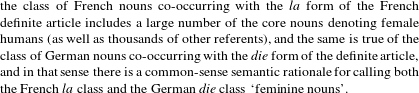
In the same vein, Pullum & Huddleston (Reference Pullum and Huddleston2002: 31–33) insist on formal definitions for language-particular categories, while they appeal to semantic notions for the purposes of defining more abstract and general concepts of more universal applicability, in a way anticipating Haspelmath’s (Reference Haspelmath2010a) approach (see Corbett Reference Corbett2012: 107, 109, and the references there).
To my mind, the volume successfully demonstrates that we can be confident about the cross-linguistic validity of (roughly) comparable (meta-)features, as seen in the case studies based on a variety of unrelated or distantly related languages. The best we can currently do is to use semantics as a common denominator and a common core, and to rely on the canonical approach. On the role of careful definitions, canonicity, prototypes and semantic concepts in cross-linguistic comparison, see Haspelmath (Reference Haspelmath2010a, Reference Haspelmathb, Reference Haspelmath, Graf, Paperno, Szabolcsi and Tellings2012, with references). The difference between canonical and prototypical is elucidated in Corbett (Reference Corbett2012: 155 fn. 2), while Haspelmath (Reference Haspelmath, Carnie, Sato and Siddiqi2014) provides an excellent overview of issues of comparison from different theoretical angles. In the next section, we look into ways of achieving greater cross-linguistic and language-internal consistency in typological work and individual language description.
3.1.1 Cross-linguistic and language-internal consistency: Some verbal features in Bulgarian
The material in Popova’s chapter comes from Bulgarian, which boasts a rather elaborate verbal system. However, I was at first a little puzzled by statements to the effect that Bulgarian has ‘a particularly rich synthetic and analytic verbal morphology’ (Kibort & Corbett: 8), as well as ‘a very rich system of periphrastic verbal tense forms’ (Popova: 167). Since an analytic or periphrastic construction by definition gives expression to a grammatical category by means of a syntactic combination, it strikes me as questionable to talk about analytic verbal morphology. For English too, traditional sources assume that is writing, is being written, has written, has been writing, etc. are morphological forms of WRITE and the auxiliaries are dependents of the following main verb; however, it has repeatedly been argued that such expressions are actually better seen as catenative syntactic combinations, where the auxiliary takes the verb that follows it as a non-finite complement (see Huddleston Reference Huddleston2002b: 1209–1220).Footnote [16] Below I demonstrate that a similar reassessment is also warranted for Bulgarian, where the prevailing tradition nevertheless still operates with so-called analytic forms of a verbal lexeme.
Popova (169) points out that grammatical features can be associated with ‘a whole sequence of word-like elements’. The Bulgarian feature of tense, for example, is traditionally said to comprise nine values: present, aorist, imperfect, future, past future, perfect, pluperfect, future perfect, past future perfect (see Kucarov Reference Kucarov and Bojadžiev1999: 382ff.; Nicolova Reference Nicolova2008: 269).Footnote [17] However, only three of the purported nine ‘tenses’ in Bulgarian are synthetic (the present, the aorist, and the imperfect), while the rest are periphrastic (Popova: 169). Those periphrastic forms can be thought of in either of two ways: as syntactic combinations whose features are assigned by means of composition in the syntax or as ‘forms of lexemes whose features are given a priori and whose elements can be seen as “realizations” of these features’ (Popova: 170–171). In the approach adopted by Popova (179), periphrastic constructions are not treated as outputs of productive syntactic operations, but as morphological realisations of lexemes. The so-called perfect tense mislila sâm ‘I have thought’ is therefore assumed to be a form of the lexeme MISLJA ‘think’ no less than the synthetic aorist mislix ‘I thought’.
Analysing periphrastic constructions as forms of lexemes entails that they belong to the paradigm of a lexeme (Popova: 179). In the framework of Paradigm Function Morphology (Stump Reference Stump2001), which Popova endorses, periphrastic constructions come about as a result of an association between the root of a lexeme (or potentially the lexeme itself) and a full set of morphosyntactic properties appropriate for that lexeme (Popova: 179). The author admits (179) that periphrastic constructions are obviously not inflected forms made up of affixes, so the paradigm function (or the realisation rules) of her model has to ensure that the realisation in such cases comes out as a syntactic structure.
In what follows, I offer an alternative syntactic analysis, demonstrating that the Bulgarian future and perfect are syntactic combinations, not forms of a lexeme. Moreover, I take the view that they are not tense values. Rather, they belong to their own separate categories. Futurity is only one of the meanings expressed by what has traditionally been considered the future tense, whereas the perfect is an entirely separate category which cross-cuts tense and also has a number of uses (see Janakiev Reference Janakiev1976; Nicolova Reference Nicolova2008: 268). Ivan Kucarov is a pioneer in this respect (Kucarov Reference Kucarov and Bojadžiev1999: 382–398). Although he works with analytic word forms, he recognises only three tenses for Bulgarian – essentially, the present, the aorist and the future, assigning the rest of the traditional nine ‘tense’ values to separate systems after meticulous justification. Below, I will argue for removing the future from the morphological tense system of Bulgarian, which leaves us with a two-member opposition (see Corbett Reference Corbett2012: Chapter 8, for general theoretical considerations concerning feature–value mismatches and misalignments).
3.1.1.1. The Bulgarian future
The so-called Bulgarian ‘future tense’ is built from the conjugated present tense of the (main) verb, such as that in (1a) below, with the indeclinable particle šte, as in (1b) (see Kucarov Reference Kucarov and Bojadžiev1999: 388; Nicolova Reference Nicolova2008: 304, 306; Popova: 172). Historically, šte is a present tense form of the verb šta ‘want’ (Old Bulgarian/Old Church Slavonic xotĕti; see Janakiev Reference Janakiev1976: 238–239 fn. 14), which has been grammaticalised to talk about futurity.

The so-called ‘past future’ (equivalent to English I would/was going to think) is built with a conjugated past form of šte followed by a complementiser and the present tense of the (main) verb (see Kucarov Reference Kucarov and Bojadžiev1999: 397; Nicolova Reference Nicolova2008: 311):

Although Popova (180) considers šte an invariant tenseless particle, she correctly treats the past 1sgštjax (appearing as 2sgšteše in (2) above) as an imperfect, and even glosses it as ‘want’, the original meaning of the verb before it was grammaticalised as a future marker (see the diagram in Popova: 181). It would indeed be rather problematic to have the synthetic form štjax as morphologically future and imperfect at the same time (I return to this below). This problem does not arise if we describe šte synchronically as a fossilised present-tense word which has been grammaticalised to talk about future time and which, like other morphological presents, can be inflected for the imperfect. Even bâda, which is said to be ‘historically a future tense form of “be”’ (Popova: 176), is actually better regarded as present in terms of form; it was conjugated as a present-tense verb in Old Bulgarian/Old Church Slavonic too, since Old Bulgarian/Old Church Slavonic had no dedicated future tense forms, having lost the Indo-European future inflections (see Janakiev Reference Janakiev1976: 244ff.; Duridanov et al. Reference Duridanov, Dogramadžieva and Minčeva1991: 301ff.; Mirčev Reference Mirčev2000: 117–118; Nicolova Reference Nicolova2008: 305).Footnote [18]
The ‘negative future sub-paradigm’ is built with njama – a fossilised negative contraction of a verb expressing possession (compare English I have to go). Like the ‘past future’ illustrated in (2), negative forms with njama, in (3) below, also have a complementiser/subordinating conjunction da (see Spencer Reference Spencer, Junghanns and Szucsich2003; Nicolova Reference Nicolova2008: 306; Bonami Reference Bonami2015: 79, with references). It normally introduces finite subordinate clauses and its presence is hard to explain if the strings in (2) and (3) are believed to be straightforwardly morphological.Footnote [19]

Although she treats šte as an invariant particle, Popova (173) admits that the negative form njama ‘not have’, used instead of šte in negative structures, is itself in the present tense; so the future meaning cannot be contributed by it. It is quite plausible that the interpretations should be associated with the construction as a whole, as suggested by Popova. Alternatively, I do not see why the future meaning should not come either from šte or from njama – formally and historically speaking, both of them are equally 3sg presents recruited to express future meaning (see Kapatsinski Reference Kapatsinski2011; Brown et al. Reference Brown, Chumakina, Corbett, Popova and Spencer2012: 253). However, I am not at all convinced that the construction should be treated as the expression of the morphosyntactic features of a single lexeme, which moreover appears in a visibly present-tense morphological guise. I would be more inclined to say that the morphological tense is present, though the semantic interpretation associated with this particular syntactic construction (or constructions) is future.
In other words, the Bulgarian construction may be future in meaning, but this is not a genuine morphological future tense comparable to the one found in Latin or many of its descendants, e.g. Latin amā-b-i-t love-fut-v-3sg.indic.active ‘(s)he will love’. Saying that Bulgarian has a future tense formed with šte/njama would amount to saying that, in Modern English, to a mouse is the dative case of mouse. Just like the English modal verb will, which incidentally is also derived from an Old English verb for ‘want’, OE willan, the Bulgarian šte-construction has modal meanings too, quite apart from indicating futurity (see Quirk et al. Reference Quirk, Greenbaum, Leech and Svartvik1985: 176, 213ff.; Huddleston Reference Huddleston2002a: 208ff., who are among the scholars denying the existence of a future tense in English). Šte is used in inferences about the present, comparable to English That will be the postman uttered upon hearing the doorbell ring (see Janakiev Reference Janakiev1976: 240; Nicolova Reference Nicolova2008: 280–281; Popova: Section 7.4; also Quirk et al. Reference Quirk, Greenbaum, Leech and Svartvik1985: 228). Šte can express habitual activities and is compatible with past and present time orientation (Janakiev Reference Janakiev1976: 238). The original volitional meaning survives as well, though šta (1sg) is then conjugated in the present, unlike the ‘future particle’ (such splits are not unusual in grammaticalisation). Considering this evidence, Janakiev (Reference Janakiev1976: 239ff.) correctly classifies the Bulgarian ‘future’ as a type of modality, not a type of tense. Njama is also still used to indicate possession with 3sg subjects, as well as in existential clauses.
As already hinted, the ‘future’ (or imperfect) values in the examples above are in conflict with the present-tense morphology of the (main) verb, which is why Popova attaches the relevant superordinate values to the construction as a whole. The ‘future perfect tense’, and even more so the ‘past future perfect’, likewise seem to be contradictory because they combine values of two or three independent ‘tense’ forms, i.e. the future, the past and the perfect (see Popova: 180–181). This looks like combining in the same cell of a paradigm a singular and a plural, and maybe a dual on top. The possibility of using both the future tense (sic) and the perfect tense (sic) in the same construction is evidence that they cannot be markers of the same type, as it is normally impossible to have two bona fide tenses (such as past and present), or two numbers, in the same word form (see Kucarov Reference Kucarov and Bojadžiev1999: 385, 390; Brown et al. Reference Brown, Chumakina, Corbett, Popova and Spencer2012: 246, 253, with references). This lends support to treating the future and the perfect as syntactic constructions which have idiosyncratic meanings and uses and do not belong to the same category.
Conversely, futurity is basically marked twice in the real-life example in (4), once with šte and once with ima, the positive counterpart of negative njama ‘not have’ (though ima also has deontic and existential overtones because of its other uses, similarly to English have to; see Nicolova Reference Nicolova2008: 269–270, 304):

Šte or ima could each have appeared on its own in (4), expressing more or less the same future meaning. If we believe that periphrastic future markers build forms of lexemes on a par with bona fide tenses like the aorist, for instance, we cannot explain why a single lexeme is marked for the same category more than once. This works for futurity but not for the aorist. The problems of ‘conflicting values’ and ‘double-marking’ vanish if we treat these periphrastic constructions as syntactic combinations of different lexemes, of course some more grammaticalised than others (see Brown et al. Reference Brown, Chumakina, Corbett, Popova and Spencer2012: 249, 258–261, with references).
Finally, as (5) illustrates, Bulgarian does not allow inherently perfective verbs, which denote an action in its totality, to stand on their own in the present tense.

Such sentences become acceptable when another verb is added, as in (6).

The forms šte and njama have a similar effect, as seen in (7).

Šte and njama thus clearly pattern with other two-verb syntactic constructions, where both verbs are in the present, especially modal 3sg present forms like trjabva ‘must’ (see Janakiev Reference Janakiev1976: 241–242; Spencer Reference Spencer, Junghanns and Szucsich2003: 278, with references).
3.1.1.2. The Bulgarian perfect
The traditional analysis of the Bulgarian perfect tense (sic), consisting of ‘be’ and a past active participle, is virtually the same as the traditional analysis of the future. Rather mysteriously, however, what is claimed to be a periphrastic form can actually host different number values – see Corbett (30–31; Corbett Reference Corbett2012: 40) and the proscribed, though common, Bulgarian translation of Corbett’s example in (8) below. This sentence can be politely addressed to a woman.

One might say, perhaps, that different number values could somehow coexist in the same lexeme, like English committee for instance (see Corbett Reference Corbett2012: 99ff., 110). Although the two values can indeed appear on different agreement targets controlled by committee (e.g. The committee hasto learn to adjust themselvesto that (British National Corpus)), the values cannot both have exponence on the controller at the same time (see above). In other words, we cannot get simultaneously singular and plural marking on committee itself. Likewise, it would be impossible for a single adjectival target or a synthetic verbal one to simultaneously indicate divergent agreements. Therefore the equivalent of have been in Bulgarian must be a syntactic combination, not a form of a lexeme (see Popova: 169, Sections 7.7 and 7.8). Corbett (30; see also Corbett Reference Corbett2012: 40) acknowledges this problem as follows:

Popova (181) provides an example analogous to (8) above, repeated with some typographic modifications in (9):

Faced with this piece of data, Popova (182) sees a need to associate the construction as a whole with the tense value of pluperfect (though she uses the English present perfect in her translation).Footnote [20] At the same time, she points out that the elements of the construction behave like independent syntactic units with respect to the features of agreement (Popova: 182). In order to cope with this conundrum, Popova (183) stipulates that the set of features in a periphrastic construction may be different from the set associated with synthetic forms. In the Bulgarian data above, the pluperfect set does not contain agreement values (Popova: 183). That is to say, ‘the construction which fills the pluperfect cell in the paradigm of Bulgarian verbal lexemes is not associated with agreement features’ (Popova: 183). The agreement information is said to be supplied individually for each separate constituent of the larger construction (Popova: 183). This pluperfect periphrastic ‘word form’ is a rather anomalous inflectional cell then, and the whole explanation seems nothing more than a confession that the (plu)perfect is actually not a real form of a single lexeme (but also see Brown et al. Reference Brown, Chumakina, Corbett, Popova and Spencer2012: 254).
Popova’s stipulative removal of the agreement features from the pluperfect construction as a whole entails that the syntax can directly access not just the features associated with the construction as a morphological unit, but also the features of the component parts (Popova: 183). This in a way contradicts Corbett’s earlier claim that syntax should be blind to such ‘morphology-internal’ information and once again suggests that these ‘periphrases’ are not inflectional forms of a lexeme.Footnote [21]
This takes us back to the problem of the cross-linguistic and language-internal validity and correspondence of features. At this stage, we should recall Corbett’s insistence on taking care with definitions (Section 3.1 above). Upon careful examination, Bulgarian has turned out to be cross-linguistically reasonably similar to English in that its tense feature has two (present and past) or at most three values (present, aorist and imperfect), all of them synthetic and mutually exclusive.Footnote [22] The future, the perfect, and other analogous constructions belong to separate systems. It was demonstrated above that such an analysis enjoys greater language-internal and cross-linguistic consistency in that it involves no glaring contradictions and unnecessary mismatches. Although this will probably sound irredeemably heretical to most contemporary Bulgarian grammarians, Bulgarian simply has no morphological future tense, though like English, it has syntactic structures to express future meaning. Nor is the perfect part of the language’s tense system or a form of the main verb lexeme.
A constructionist model of the type advocated in Sag’s chapter will work much better for Popova’s data. In Sag’s proposal (Section 10.4, 255), both words and phrases are unified as types of construct. Such an approach might eliminate the problems inherent in Popova’s current claims about the morphological status of ‘periphrastic tense constructions’ while still enabling us to maintain her generalisations about the non-compositional nature of their meaning.
From a different angle, Brown et al. (Reference Brown, Chumakina, Corbett, Popova and Spencer2012, with references) adopt a canonical approach and argue that periphrasis can instantiate both syntax and morphology. This emphasis on the dual nature of analytic constructions seems to be the state of the art – see Bonami & Webelhuth (Reference Bonami, Webelhuth, Chumakina and Corbett2013) and Bonami (Reference Bonami2015). Even if, after more diligent consideration, it transpires that Bulgarian does have periphrastic forms of lexemes after all (contrary to the conclusions of this section), their syntactic properties, neglected for far too long, should no longer be so lightly dismissed. Our discussion is now threatening to spill over into the subject matter of the next section – on the boundaries between morphology, syntax and semantics.
3.2 Boundaries between syntax, semantics and morphology
The interactions between syntax, semantics and morphology are another preoccupation of the volume of which we have seen quite a lot in the preceding text. It was noted above that Corbett distinguishes the three quite sharply. Crucially, syntax is assumed to be blind to phonology and morphology (Corbett: 18; Corbett Reference Corbett2012: 42ff., 61–65, with references; see also Anderson Reference Anderson1992: 84). Neither the phonological make-up of verbs nor their conjugation affiliations are expected to affect their syntactic behaviour (recall the Bulgarian examples in (1)–(7) above). As Sag (260) reminds us, it is equally unlikely that there could be a language similar to English which however had a verb fask – just like English ask, apart from requiring its second argument to be a wh-question with an animate wh-phrase.
Guided by the same intuitions, Danon (153) states that narrow syntax should not have access to lexical semantic distinctions between classes of nouns. On the other hand, Corbett (cited in Danon: 153 fn. 8) warns that this reasoning might mean that agreement belongs outside narrow syntax, since agreement is known to sometimes distinguish between group nouns and other nouns for instance. Danon counters that this is true for semantic agreement, but not for agreement in general. These differences between two of the contributors are symptomatic of a concern that recurs in the book on which I would like to comment below, in an attempt to tease apart the interplay of morphology, syntax and semantics. Section 3.2.1 looks at how animacy can transcend module boundaries and defy neat classification. In Section 3.2.2, I will then argue, contra Kibort (this volume) and Kibort (Reference Kibort, Galani, Hicks and Tsoulas2011), that tense can be both a morphosemantic and a morphosyntactic feature.
3.2.1 Bulgarian animacy at the intersection of semantics and morphosyntax
Apart from having animacy as a purely semantic feature, Bulgarian also operates with morphosyntactic animacy (see Hristov Reference Hristov2012: 139ff., with references). There are dedicated numerals and relative pronouns inflected to agree with masculine nouns that denote humans, as (10) illustrates.

Thus, animacy, or rather male humanness, serves as a masculine personal sub-gender (see Corbett Reference Corbett2012: 84, 160–162, 171 fn. 23).Footnote [23] In addition, animacy also has an impact on agreement patterns (Hristov Reference Hristov2012: Chapter 3). Two conjoined singular nouns referring to humans or higher animals are statistically more likely to trigger resolved plural agreement, as in (11), rather than agreement with the closest noun, as in (12) (see Hristov Reference Hristov2012: Chapter 3).

This latter instantiation of animacy is not restricted to its morphosyntactic role as a masculine personal sub-gender, and yet it does not completely overlap with semantic animacy either, as it probably excludes lower animals. In sum, animacy in Bulgarian is simultaneously a morphosyntactic feature value, a semantic feature relevant to syntax (more specifically, to agreement with conjoined nouns), and a purely semantic feature (Hristov Reference Hristov2012: 144–145; see also Corbett Reference Corbett2012: 44 fn. 3, 91–93, 102, 160–162, and references there).
Cases like this, I believe, make it extremely hard to invariably draw clear lines between semantics, morphology and syntax with a view to classifying features and their values. Corbett (Reference Corbett2012: 48, 102) is a good source to consult for similar interface problems; semantic conditions on the use of morphosyntactic features are covered in Corbett (Reference Corbett2012: 193–196), including animacy,Footnote [24] as well as the influence of typically morphosemantic features such as tense, aspect and mood on the distribution of morphosyntactic case values. The situation on the ground suggests that the boundaries are sometimes rather permeable, though the principles from the previous section remain useful as rules of thumb. We now turn to the status of tense, which presents another grey area.
3.2.2 Backshift in English: Tense as a morphosemantic and a morphosyntactic feature
Figure 4.8 in Kibort’s (83) contribution makes explicit her claim that verbal tense is not attested as participating in agreement or government and is therefore excluded from the catalogue of morphosyntactic features (see the summary of her chapter in Section 2 above and Kibort Reference Kibort, Galani, Hicks and Tsoulas2011). Kibort (64–65, 85) confirms that in many languages the tense inflection expresses semantic distinctions, but it is irrelevant to the syntactic mechanisms of agreement or government. Consequently, if the syntax of a language is not sensitive to the tense value of the verb, the syntactic rules for that language do not need to mention tense at all (ibid.).
However, in a language as widely investigated as English, the rules of syntax do appear to make reference to the feature of tense, sometimes in blatant disregard for the semantics normally associated with its values. The phenomenon in question is known as backshift or sequence of tenses (see Comrie Reference Comrie1985: Chapter 5; Reference Comrie1986, for material from English and other languages; as well as Quirk et al. Reference Quirk, Greenbaum, Leech and Svartvik1985: 1026ff.; Huddleston Reference Huddleston1989, Reference Huddleston2002a: 151–158). Similar, though less robust, examples might potentially be supplied by the subjunctive (see brief discussion in Section 2 above), or by so-called negative concord (discussed by Kibort: 98, Section 4.2.4). Unlike the subjunctive and negative concord, however, a more solid case can be made for backshift being imposed by a syntactic rule, as opposed to merely representing a semantic option. The following are typical instances of backshift in English:


The preterite in English can stand for past time or for modal remoteness. While knew in (13) encodes modal remoteness with present time reference, had expresses neither past time nor modal remoteness (Huddleston Reference Huddleston2002a: 152; see also Huddleston Reference Huddleston1989: 335–336). On the most salient interpretation of (13), the referent of she clearly has too many commitments at the present time. Likewise, the addressee in (15) is still at the door and Barney still (assumes he) has his money stashed away, but it would hardly be possible to get non-backshifted is or have in (15) and (16) (see Huddleston Reference Huddleston1989: 337; Reference Huddleston2002a: 157–158). What is more, the subjunctive/irrealis will not be acceptable in the examples above where it is distinct in form (were), as shown in (14) and (15), so we are definitely not dealing with hypothetical situations (Huddleston Reference Huddleston2002a: 152). A language like Russian or Bulgarian, by contrast, will happily use the present tense in place of the English backshifted preterite above (see Comrie Reference Comrie1985: 107ff.; Nicolova Reference Nicolova2008: 279). All the evidence therefore seems to point in the direction of a language-specific syntactic rule sensitive to the tense value (see Comrie Reference Comrie1985: Chapter 5; Reference Comrie1986; Huddleston Reference Huddleston1989, with references).
The preterite in the matrix clause requires that a preterite should appear in the subordinate clause(s) as well. Thus, both the matrix-clause tensed verb and the one from the subordinate clause host the relevant value. However, the two verbs are not equal in status. In other words, the elements involved are symmetric with regard to possessing the feature of tense and not so when it comes to their status. This phenomenon should therefore fall within the remit of agreement (see Table 4.1 in Kibort: 71). This is also the conclusion arrived at by Huddleston (Reference Huddleston2002a: 154):

Apart from agreement and government, Kibort (69–70) envisages another situation: the simultaneous marking of the same information on more than one element in a construction could result from a semantic or pragmatic choice which is made separately for each individual element for the same semantic or pragmatic reason. And yet, we have already seen that matching the semantics of the individual verbs bearing the value is often ruled out when it comes to backshift in English. A backshifted preterite frequently indicates neither past time nor counterfactuality.Footnote [25]
Alternatively, Kibort (69) proposes that a feature value may be selected for an entire constituent on semantic grounds, and the inflectional morphology of the language in question may then require that the feature value be realised on several members of the said constituent or unit. Then, a number of elements will carry an identical value of a morphosemantic feature at the same time (Kibort: 69). Examples of such semantically enforced attributes which may simultaneously appear on multiple elements include number, definiteness, or semantic case imposed on a noun phrase, or a verbal feature imposed on (the members of) a verbal complex (Kibort: 69). As Kibort (85) reaffirms:

It is essential to highlight the semantic motivation of this phenomenon. Such distributive multirepresentation will thus be equally inappropriate as an explanation of the English data above, since the data involve an obvious semantic clash, which, to my mind, is incompatible with any semantically-based distributivity of a morphosemantic feature. If you can distribute a morphosemantic feature at will, even in the face of semantic inconsistencies, there will be nothing to distinguish such multirepresentation from syntactic agreement or government.
In the light of her proposed classification of feature multirepresentation scenarios, Kibort (Sections 4.6.5 and 4.6.6; Kibort Reference Kibort, Galani, Hicks and Tsoulas2011) discusses potential agreement in Tense, Aspect, Modality and Polarity (TAMP) (see Evans Reference Evans2003).Footnote [26] Ultimately, Kibort (100; Kibort Reference Kibort, Galani, Hicks and Tsoulas2011) discards the agreement analysis due to an alleged lack of directionality in the Kayardild data she presents. However, what can be called preterite agreement in English does appear to be directional – the matrix verb gets its inherent tense value which is semantically justified (compare the number of a noun), but then the subordinate backshifted verb does not always have semantic justification for its own value; the preterite appears contextually due to the constraints of a syntactic rule (similarly to the number feature on a verb agreeing with its subject); the relevant value is imposed by the matrix/superordinate controller in what is a directional, asymmetric relationship. In the case study discussed by Kibort (100), the apparent controller, i.e. the matrix verb, is sometimes omitted, which suggests to Kibort that an agreement account is inappropriate. This, however, is little different from subject–verb agreement in pro-drop languages, in which the controller may be missing as well.
Following Evans (Reference Evans2003), Kibort claims that tense and the other verbal features in Kayardild are imposed on the clause as a whole. In other words, they are clausal, not lexical, features, and a particular value for tense, aspect, mood, and polarity is selected for the entire clause as a result of a semantic choice (Kibort: 100). By contrast, the preterite value is not always prescribed for the whole clause in English (see below); even when it is, it does not necessarily make semantic sense for both the matrix and the subordinate verbs. The ‘sentence-wide imposition’ of the English preterite is consequently not the result of a semantic or pragmatic choice. Rather, it is a syntactic rule.
In addition to exploring the clausal domain, Kibort (Section 4.6.6) also examines multiple TAMP inflection on the elements of a Kayardild verbal group or complex. Verbs in Kayardild serial constructions have to be marked for the same TAMP values. Crucially, these constructions may exhibit semantic idiosyncrasies, whereby past tense might not correspond straightforwardly to past time. Following Corbett (Reference Corbett2006: 140), Kibort (102) treats these constructions as a single semantic and syntactic unit, and a single predicate which is assigned the TAMP features as a unit. Kibort (102) therefore concludes that

She reasserts that the TAMP inflection is a clausal category, not a lexical one, and continues to view TAMP values as selected for the entire clause on the basis of a semantic choice (see Kibort Reference Kibort, Galani, Hicks and Tsoulas2011).Footnote [27]
This is open to debate. Evans, for one, notes that, with Kayardild serial verb constructions, it is not always possible to derive the choice of TAMP inflection on some non-head verbs directly from the semantics of the clause (Evans Reference Evans2003: 223; cited in Kibort: 102). Evans therefore attributes this choice in Kayardild to direct agreement with the head verb, though he still admits that the multirepresentation of TAMP in this case exhibits informational equivalence and lack of directionality (Evans Reference Evans2003: 217, fn. 15, 218; cited in Kibort: 102). As demonstrated above, backshift in English does have directionality, and the choice is not dictated by informational equivalence (if by that we mean semantics). All things considered, Kibort (103, and quotations above) does not seem to be concerned by the fact that there could be semantic conflicts regarding some of the constituent parts when a feature is selected for an entire construction on semantic grounds. I fail to see how a value could be selected for a unit on semantic grounds, unless it is also semantically appropriate for all the components of that unit. Otherwise, there is nothing to distinguish this from agreement proper.
Finally, we ought to accept that the rules of backshift in English can sometimes be relaxed due to semantic or pragmatic factors (see Comrie Reference Comrie1985: 114–116; Reference Comrie1986: 284ff., fn. 11, fn. 12; Quirk et al. Reference Quirk, Greenbaum, Leech and Svartvik1985: 1027; Huddleston Reference Huddleston1989: 337; Reference Huddleston2002a: 155–158). For example, backshift is not obligatory when the statement expressed in a subordinate reported clause is still relevant or continues to apply, e.g. Jill said she had/hasa weak heart (Huddleston Reference Huddleston2002a: 156–157). This is reminiscent of semantically justified vs. syntactically justified agreement, or of the semantic conditions on morphosyntactic rules we encountered above. Nor can it be denied that backshift often mirrors semantics and is even admissible without a preterite matrix trigger, as in I remember thinking it wasimpossible (Huddleston Reference Huddleston1989: 336–339; Reference Huddleston2002a: 153).Footnote [28] In a nutshell, tense in English is mostly a morphosemantic feature which acts as a not so canonical morphosyntactic feature only in certain restricted conditions. The important thing is that it does (see esp. Huddleston Reference Huddleston1989, who persuasively argues for a combined semantic and syntactic account of English backshift).
4. Conclusion
In this brief survey of some of the central issues raised by the volume, we kept coming up against fuzzy boundaries which undermine neat classification. Nowhere is this pervasive reality of human language seen more clearly than in examining the features that constitute its complex grid of atoms. And yet, the discussion of this truly diverse publication has shown equally clearly how linguists try to bring order out of chaos in a valiant attempt to improve our understanding of this challenging inherent complexity.



