

Introduction
When analysts of the vote in Italy revealed that traditional cleavages (mainly social class, religion, and territory; Rokkan, Reference Rokkan1970) were less and less useful in accounting for a significant proportion of variance of political choices (Corbetta Reference Corbetta2006; Bellucci, Reference Bellucci2007; Garzia, Reference Garzia2013), some of them embraced the ‘individualization thesis’ advocated by different theoretical perspectives (Clark et al., Reference Clark, Lipset and Rempel1993; Inglehart, Reference Inglehart1997; Beck and Beck-Gernsheim, Reference Beck2002).
In general, this argument is based on the idea that, due to the increase in social and geographical mobility, traditional group memberships (family, social class, gender, employment, religion, and territory) weakened their ability to root social identities, and, as a consequence, to affect individual behavior. In fact, empirical evidence seemed to show that the impact of these traditional social identities declined in various democratic societies and in various social domains (e.g. Andersen et al., Reference Andersen, Yang and Heath2006; Heath et al., Reference Heath, Martin and Elgenius2007). The core of the individualization thesis postulates that, as a consequence, the individual becomes freer to evaluate and decide (e.g. Rose and McAllister, Reference Rose and McAllister1986), and an attitudinal approach (instead of the traditional identity approach) was considered as better suited to study partisanship (Bartle and Bellucci, Reference Bartle and Bellucci2014).
If this thesis has garnered considerable fame, it has also attracted a great deal of criticism and has provoked a lively debate (e.g. Zuckerman, Reference Zuckerman2005; Atkinson, Reference Atkinson2007). For example, some studies, especially about political choice, showed that the effects of social class have not disappeared, leading to the conclusion that the process of individualization may be overstated (e.g. Brooks and Manza, Reference Brooks and Manza1997; Andersen and Heath, Reference Andersen and Heath2002; Andersen et al., Reference Andersen, Yang and Heath2006; Achterberg et al., Reference Achterberg, Houtman and van der Waal2008; Ballarino et al., Reference Ballarino, Schadee and Vezzoni2009; Haddon, Reference Haddon2015).
From a social psychological perspective, conceiving the individual as either socially determined or free to decide means viewing his/her social nature as detrimental rather than as a resource. In fact, we believe that, even if the impact of the social class and of other traditional social cleavages on political choices declines, the rise of a pre-social voter is not the only inescapable alternative. Indeed, between the socially determined individual and his/her disembedded counterpart, there are many meaningful possible social identities that may help individuals build their worldview and orientations.
Even some supporters of the individualization thesis suggested that the overcoming of the traditional cleavages as heuristic categories, far from leaving individuals deprived of any meaningful social identities, raises the need to explore new sources of identification (Beck, Reference Beck and Beck–Gernsheim1987; Bennet, Reference Bennett1998). In Beck’s words ‘New sources for the formation of social bonds and for the development of conflicts arise. They lie in the domain of private social relations and private ways of living and working. New social formations and identities beyond class society begin to emerge’ (Reference Beck and Beck–Gernsheim1987: 349).
Social values acquired a central role in the individualized perspectives, but relevant differences in their conceptualization emerged. According to the ‘value pluralism thesis’, values are individual citizens’ preferences arranged in unpredictable ways (Brooks and Manza, Reference Brooks and Manza1994). Instead, according to the post-materialistic frame proposed by Inglehart (Reference Inglehart1997), ‘new’ non-economic values gradually (with generational following) replace the ‘old’ materialistic ones. Thus, the support for, and the conflict between, these two configurations of priorities become the new critical cleavage defining the polarization of the political parties’ social bases. Moreover, new political issues concerning the quality of life are raised to people’s attention. In this latter case, the individualization thesis takes a less radical form, as the sharing of materialistic/post-materialistic values might designate meaningful social boundaries (Achterberg, Reference Achterberg2006). In this light, using the ‘individualization’ label may be somewhat misleading, because it leads us to believe that, with the weakening of traditional social identities, any meaningful social membership plays a role in individual political orientation and voting.
In fact, it is possible that the decline of traditional group identifications may translate into non-traditional, but still meaningful, group membership. If this is the case, a critical task for social scientists would be to uncover the boundaries and the foci of the identifications into which a still significant level of political sharing could be detected.
The present research sought to explore whether social categories exist in which people still express politically pertinent identities. New meaningful identifications, compared with those designed by the traditional cleavages, are more difficult for social scientists to detect, because of their fuzzier boundaries. However, despite the general growth of political indifference, people continue to be involved politically with ‘lifestyle issues’, such as the environment, health and child care, job security, civil rights, and so on (Bennet, Reference Bennett1998). This idea led us to the concept of lifestyle as a possible construct capturing new meaningful boundaries within which people also share political views. The research we present aims at exploring whether lifestyles could be a basis for social identity, and whether they also assume a political meaning above and beyond the traditional social cleavages. In other words, we hypothesize that a possible stratification principle would rely on consumption models, and that being part of ‘consumption communities’ sharing the same lifestyle may be the generating principle of social identity (Pakulski and Waters, Reference Pakulski and Waters1996).
Is lifestyle something different from social class?
The lifestyle concept in relation to that of social class is not new in social sciences. In particular, according to Bourdieu (Reference Bourdieu1979), the social class concept must be redefined considering that, in modern society, social cleavages are rooted in access to social relationship opportunities. The objective class positioning facilitates the individual’s ability to take advantage of the material and cultural production, which in turn shapes the subjective representation of their positioning and strategies of self-presentation (i.e. lifestyle). Therefore, in Bourdieu’s view, tastes and lifestyle are deeply rooted in class position, which determines the individual’s access to economic, cultural, and social capital. Lifestyle makes social capital differences evident through the logic of membership and exclusion. However, the coincidence of social classes and lifestyles would be a feature of the industrial society hinged on the cleavage between manual and non-manual workers (Inglehart and Rabier, Reference Inglehart and Rabier1986). In the advanced industrial societies, the social class distinction became more nuanced, with the enlargement of the middle class and the enhancement of manual workers’ conditions, and lifestyles run across classes, weakening their direct link with the individual socio-economic position.
More interesting for our goals, for Weber (Reference Weber1922) – who distinguishes between class and status, the latter being a symbolic aspect of individual positioning not reducible to the economic dimension – lifestyles are the expression through which people of different status groups seek to define their boundaries and to converge on markers of inclusion and exclusion. Thus, following Weber’s approach, Chan and Goldthorpe claimed that lifestyles are overt manifestations of status, rather than class, able to designate loose social networks as ‘networks of relations, often extensive in space, among individuals who come together as equals in more intimate forms of sociability, and who tend to value and seek to pursue broadly similar lifestyles’ (Reference Chan and Goldthorpe2007: 517).
However, the question regarding the coincidence or the overlapping degree between lifestyle and social class is far from uncontroversial – both from the theoretical and the empirical point of view (Lash and Urry, Reference Lash and Urry1994). Recently, Petev (Reference Petev2013) carried out an interesting empirical analysis on the historical evolution of the association between social class and lifestyle across four decades in the United States. Considering social contacts as proxies for lifestyles, he found that class distinction in sociability patterns holds on overtime, even though class differences were not radical and class categories were not associated with an exclusive sociability pattern. In conclusion, Petev (Reference Petev2013) acknowledged that further research should consider lifestyles measured through cultural preferences and practices in domains such as literature, music, art, and consumer brands.
In fact, a critical aspect of the lifestyle study is that, despite its popularity, a consensual definition of the construct is hard to find. However, following Lazer (Reference Lazer1963), lifestyle can be defined as the patterns in which people live and spend their time and money. This definition points out the centrality of material and cultural consumption as well as leisure-time choices. Many sociologists, from Simmel (Reference Simmel1957) and beyond, recognize that this kind of consumption assumes a fundamental expressive meaning. Consumption behaviors are social practices that produce and maintain self-definitions, in terms of similarity or difference with respect to other people. Thus, products in a broad sense provide a ‘social stock of knowledge that people use in typifying those they meet’ (Shavitt and Nelson, Reference Shavitt and Nelson2000: 40). In consumption-centered societies, the style orientating and maintaining coherence among these choices may cross-cut, at least in part, social classes (e.g. Crane, Reference Crane2013), and lifestyles may be considered the reflection of such a culture in every human behavior, including the political one.
The notion of lifestyle has been widely used for commercial goals. Marketing scholars and advertising planners applied lifestyle patterns to market segmentation through clustering methods (Plummer, Reference Plummer1974). They argued and showed that lifestyle characteristics, more than socio-demographic variables, provide relevant information useful to understanding consumers and to planning effective marketing programs (e.g. Hornick, Reference Hornik1989). The individualization thesis was called into question in this domain too (e.g. Lipovetsky, Reference Lipovetsky1983; Slater, Reference Slater1997). However, it was also recognized that consumption has a fundamental aggregating meaning, as ‘the consumption of widely available cultural goods serves as one of the primary ways in which individuals become connected and integrated into the social structure. Individuals who are not involved in culture consumption are therefore more likely to be disconnected from others and forgo all of the benefits that come from network relations’ (Lizardo, Reference Lizardo2006: 800). In other words, through products and cultural goods, individuals manage their connection and integration into the social structure. The ‘linking value’ of products and services may even overcome their use value, generating a phenomenon of ‘new tribalism’ (Cova, Reference Cova1997).
Outside the marketing science domain, the sociological interest in lifestyles has developed in order to deal with the phenomenon of American cultural fragmentation (e.g. Fischer and Hout, Reference Fischer and Hout2006), but the debate concerning the heuristic potential of this concept in designing social grouping with a peculiar political connotation is still open (Fischer and Mattson, Reference Fischer and Mattson2009).
Lifestyle and politics
Some evidence of the connection between lifestyle and politics can be found in the ‘political consumerism’ literature. These studies start from the idea that as citizens are more and more concerned about uncertainty and risks and less and less trusting in the capacity of the political system to deal with them they choose to engage themselves in new forms of participation, including ‘political shopping’ (Inglehart, Reference Inglehart1997; Beck, Reference Beck1999). ‘Political’ or ‘critical’ consumerism consists of selecting products and producers by applying social, political, or ethical criteria (Micheletti, Reference Micheletti2003; Shah et al., Reference Shah, McLeod and Kim2007). Individuals following this lifestyle strongly base their consumption behaviors on the desire to express political and ethical choices. Examples of such behaviors are choosing products with recyclable or recycled packaging, boycotting companies that are seen as harmful to the environment or the society, or favoring companies and brands that support the buyer’s values. Political or critical consumers are people who believe that buying is a political behavior. Therefore, political consumerism may be conceived as an unconventional way through which people engage with public issues outside of conventional political behaviors such as voting (Stolle et al., Reference Stolle, Hooghe and Micheletti2005). In this light, political consumerism is the central issue for a number of social movements, and also for the daily practices of ordinary citizens, and should be considered as the broad tendency to see political meaning in recreational experiences, entertainment choices, fashion decisions, and other personal happenings. In sum, political consumerism represents a practical manifestation of the emphasis people place on post-materialistic values.
In Italy – that is, the context in which we performed this study – Forno and Ceccarini (Reference Forno and Ceccarini2006) have carried out a detailed study on political consumerism, showing that critical consumerism comes both from left-wing movements and the Catholic tradition of chasteness, and involves economic investments, eco-friendly tourism, and point-of-purchase selection as well. They showed that political consumerism may take several forms and cohabit with conventional political participation rather than being an alternative form of participation. Interestingly, they claimed that consumption becomes an opportunity for the building of political identities in certain segments of the civil society. A clear example of critical consumerism as political and associative strategy is the Slow Food movement – that is, the association for the global promotion of local ‘fair good and clean’ foods and culture. This association was founded in Italy at the end of the 1980s by a left-wing sympathizer, and it contributed to inserting food within the frame of politicization of consumer practices (Sassatelli and Davolio, Reference Sassatelli and Davolio2010). In sum, although the study of political consumerism was framed as an expression of the individualized behavior in the political domain, Stolle et al. (Reference Stolle, Hooghe and Micheletti2005) found that political consumers were also active in other forms of collective participation and group involvement.
In this case, the connection between a consumption model and the individual (left-wing) political orientation is evident. In contrast with the post-materialistic conception that claims the obsolescence of the material consumption-centered lifestyle as an expression of values, we contend that other consumption-based lifestyles could be associated with less-evident political connotations. However, extending the inquiry about the political meaning of lifestyles immediately poses the problem of the causality direction. Indeed, if scholars agree that ascribed socio-structural positioning exerted its influence on individual political choice through socialization – thus identification is assumed to precede the formation of political orientation – when it comes to lifestyles and political choice, a circular process of influence and reinforcement might be a better representation of the relations at play. In fact, in the case of critical consumerism, political choice comes first, as leaning toward a certain political ideology entails a coherent type of lifestyle. However, for other lifestyles, the reverse direction could also be plausible: the everyday interaction with people sharing the same consumption-based lifestyle could contribute to the co-construction of a worldview shaping political choices. For example, Vincke (Reference Vyncke2002) showed that a typology of seven lifestyle clusters based on values, life-vision, and esthetic preferences performed better than the social class in accounting for political party preferences.
This is why we believe that, at present, we should explore the political meaning of lifestyles as mere connections between the consumption model and political choices, without the ambition to postulate a causality direction between them.
To the best of our knowledge, when the idea of electorate segmentation has been imported into the political domain, it has been done for propagandistic goals, much like what happened in the commercial domain (e.g. Butler and Collins, Reference Butler and Collins1999; Smith and Hirst, Reference Smith and Hirst2001; Baines et al., Reference Baines, Worcester, Jarrett and Mortimore2003, Reference Baines, Worcester, Jarrett and Mortimore2005). For this reason, the clustering of people was based on specific political features (e.g. policy opinions or attitude toward the leaders), rather than a consumption-based lifestyle. The question as to whether consumption-based lifestyle segmentation may give rise to politically homogeneous social aggregates is still open.
The present study
We contend that, despite the lowering of traditional political identifications, people continue to refer to internally homogeneous social groups and communities with respect to many relevant aspects of their lives. This happens both because people tend to select friends based on criteria of affinities and because interaction within groups contributes to the formulation and the social sharing of attitudes and opinions.
Based on the literature above, we advance the hypothesis that today a central role should be played by lifestyle choices as selection criteria. Thus, if the grouping principle is the consumption model, individuals have the opportunity to discuss, compare, and also share political attitudes and opinions within a social network designed by lifestyle. This is not to say that explicit political discussion is needed to reach a certain level of internal political homogeneity: the social sharing of a worldview that characterizes group life implicitly includes the social representation of political issues and objects (parties and actors) based on which individuals orientate themselves in the political domain.
In this light, we believe that in studying the political color of consumption-based lifestyles, a complete coincidence between lifestyle and social class should not be taken for granted: it could be that lifestyle types cut across, almost in part, traditional social classes and define the (fuzzy) boundaries within which political attitudes and a shared world representation develop.
As a first step to test this assumption, the purpose of the present study was to investigate whether it is possible to detect distinctive and relatively homogeneous lifestyle groups in the Italian population and to establish the degree to which they overlap or cross-cut the traditional social categories (age, sex, social class, education, and territory of residence). Obviously, the detection of distinctive lifestyle clusters per se would not indicate a meaningful social point of reference until we can show that this distinction is diagnostic of a significant level of internal homogeneity in very different domains, such as that of politics. Thus, our second goal was to explore whether the eventually found consumption-based lifestyle typology also reflects an intra-type political homogeneity. It is worth noting that this is different from analyzing the impact of single consumption variables on voting behavior: we did not want merely to show that consumption acts can have a broad political significance. We wanted, instead, to test the idea that the sharing of complex and coherent patterns of (cultural and material) consumption corresponds to relatively homogeneous political orientation and behavior as well. This would indicate that people belonging to loose social networks delimited by lifestyle boundaries also share broad political views, beyond the well-known political consumerism, and might regard these social networks as a source of identities.
In operational terms, we performed a two-step study. In the first, we tried to identify a typology of Italian consumption-based lifestyles (what people consume and do), and then studied its relation to socio-demographic features (who they are) and its ability to discriminate participants’ political attitudes and orientations (what they think). In the second step, we tested whether the belonging to each lifestyle category is significantly associated with voting behavior, net of the variance accounted for by the traditional cleavages (especially social class).
Measures
We used the data from a national probability sample of 1508 Italians who participated in the 2013 post-election ItanesFootnote 1 survey (for a complete description, see Vezzoni, Reference Vezzoni2014). Participants responded to a questionnaire administered via the computer-assisted personal interviewing system by trained interviewers immediately after the general election of February 2013.
Our first problem was that of operationalizing the lifestyle notion, as the situation mirrors the definition confusion sketched above. In order to avoid confusion with psychographics (based on attitudes and personality traits), we chose to operationalize lifestyle only in terms of self-reported frequencies of behavior (Anderson and Golden, Reference Anderson and Golden1984). In addition, we wanted to operationalize the lifestyle concept in terms of three main dimensions: material, cultural, and leisure-time consumptions. The recent Itanes questionnaire allowed us to select items for each of these dimensions. Indeed, in 2013, for the first time, the Itanes survey included, beyond the traditional questions about politics, some items about material consumption as well as leisure time and cultural activities (see Appendix). In particular, we had (a) one question about leisure time (frequency of restaurant attendance, answer range 1–5); (b) six questions about cultural activities [taken from the Lizardo (Reference Lizardo2006) scale] that we summarized in a single scale, and two questions about television exposure and newspaper reading; and (c) 12 questions about material consumption behavior (answer range 1–4). On these last 12 variables, an explorative factor analysis with varimax rotation was run and a three-factor solution emerged explaining a 48.29% variance (all the factor scores >0.47). The first factor (eigenvalue=2.07) included four items referring to consumption as an entertainment activity (e.g. ‘To go shopping is one of my preferred activities’), the second (eigenvalue=1.92) included four items referring to critical consumerism (e.g. ‘Before buying food products, I carefully read the ingredients’), and the third (eigenvalue=1.81) included four items referring to the trust toward brands (e.g. ‘I always buy products of well-known brands’). Average scores were computed for each of the three factors identified (Cronbach’s α from 0.55 to 0.67).Footnote 2
Finally, due to different answer scales, we normalized all the variables to be used for segmenting the population through the following formula: (observed−minimum)/(maximum−minimum), in order to obtain scores ranging from 0 to 1. Then participants were segmented into homogeneous lifestyle groups using cluster analysis, and cluster membership became the key factor in the analyses of association with socio-demographic variables, political orientation, and political choice.
Socio-demographic profiles of the clusters were sketched analyzing age, sex, education, public/private sector of employment and social class distribution. These variables have been used as ‘control variables’ to elicit the net effect of lifestyle on electoral choice. Regarding social class, following Goldthorpe’s (Reference Goldthorpe1980) theory applied to the Italian case by Cobalti and Schizzerotto (Reference Cobalti and Schizzerotto1994), it was coded into four categories according to the participants’ profession, or the previous work of those retired, or the bread-winner work of students or housewives: upper class (entrepreneurs, professionals, managers), non-manual workers (semi-professionals, technicians, routine employees in administration and commerce), petty bourgeoisie (small proprietors, artisans, shopkeepers, and farmers, with or without employees), manual workers (skilled, semi-skilled, and unskilled manual workers in all sectors of activity). However, it can be argued that this schema largely reflects the occupational system prevailing up to the mid-1970s, and that educational upgrading, welfare state expansion, and the increasing in female occupational levels have altered that occupational structure. Indeed, some scholars (Oesch, Reference Oesch2006; Güveli et al., Reference Güveli, Need and De Graaf2007) have proposed a revision of the Goldthorpe schema, with two sub-classes at the upper end of the occupational hierarchy (an ‘old’ class of technocrats and a ‘new’ service class of social-cultural specialists) and two sub-classes at the lower end, with a distinction between the ‘old’ class of unskilled industrial workers and the ‘new’ class of low-skilled sales and service activities. Their studies relied on the recoding of large data sets with detailed information about employment in different European countries in order to operationalize their proposal. Unfortunately, we do not have such a detailed description of the respondents’ occupations. However, we can consider the fact that, according to the above-mentioned studies, three variables are closely related to the ‘new’ classes: at the higher level, most of the social and cultural specialists work in the public sector and they have a high level of education; and at the lower level, mostly female workers are engaged in low-skilled sales and services activities. This is why – in addition to the Goldthorpe classes – education, gender, and private/public employment sector should also allow us to control for the social class in its new expressions.
The relationship between the clusters and the political attitudes have been examined through four indexes: political involvement (as a mean of two items: self-rating of political interest and frequency of political conversation, r=0.58), knowledge (as the sum of the answers to four right/wrong questions, e.g., who is the foreign minister?), participation (as the sum of nine yes/no questions about political activities in the last 2 years, yes=1; no=0), and left-right self-placement (score from 1=‘left’ to 10=‘right’ recoded into six categories: left, center-left, center, center-right, right, and refuse to answer).
Political choice was coded into four categories according to the participant’s vote for a coalition in the 2013 national election: center-left, center, center-right, and five-star movement.Footnote 3
Data analyses
To examine the relationship between lifestyle and political choice, we followed a three-step strategy. First, k-means cluster analysis was carried out in order to detect a typology of internal homogeneous lifestyles based on material, cultural, and leisure-time consumptions. The aim of the cluster analysis was to identify a reduced number of non-overlapping profiles from a larger group (Wind, Reference Wind1978; Everitt et al., Reference Everitt, Landau and Leese2001). Cluster analysis is suitable for our purposes because it minimizes variances within clusters, thus maximizing the internal cohesion of a cluster, such that sub-groups of participants who are similar to one another, but different from other sub-groups of participants, are identified.
Second, once the typology built through the cluster analysis was in place, each cluster was cross-tabulated with external variables: we explored the groups’ socio-demographic profiles and tested whether the clusters were actually diagnostic of political orientation. χ 2 tests were performed to test the statistical differences among clusters regarding the categorical variables, whereas the analysis of variance was used to test cluster differences on continuous variables.
Finally, we tested the strength of the association between the lifestyle typology and the individuals’ political choice, while controlling for the traditional structural variables (social class included), through a multinomial logistic regression.
Results
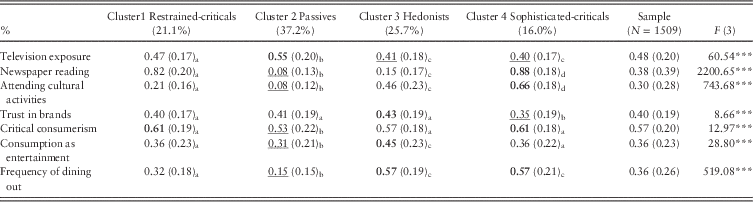
The lifestyle typology: As we do not have theoretical reasons to infer the number of lifestyles enacted by the Italian population, in order to determine the number of clusters, we proceeded on an empirical basis. In contrast to other clustering methods (e.g. hierarchical clustering), with the k-means method there is no standard way to find the optimal number of clusters. The researcher must examine a range of solutions and decide which solution provides the best balance between substantive depth and parsimony. Multiple runs were made with a different number of clusters in each solution, with the goal of finding distinct and easily interpretable clusters. Even though this is a rather subjective decision, the determination of which solution to retain can also be based on the amount of additional variance accounted for with the next highest cluster size, much like the factor solution determination ‘scree test’ in factor analysis. In particular, we took into account the mean of η 2, showing that the variance explained increased in the passage from two to three and four clusters and after it began to flatten (number of cluster in parenthesis): 0.16 (2); 0.27 (3); 0.31 (4): 0.32 (5); 0.39 (6); 0.42 (7). We further checked the robustness of the model, with the ‘split sample method, randomly dividing the data into two subsets and performing an analysis on each subset separately’ (Everitt et al. Reference Everitt, Landau and Leese2001: 184). This analysis produced two sets of four groups perfectly similar in terms of differences in their means for all clustering variables. Thus, a final four-cluster solution based on all 1508 cases was retained. The four segments provided an indeed parsimonious solution by showing indicative and significant differences of means for all the clustering variables (Table 1).
Lifestyle typology (k-means cluster analysis)

Means of the clustering variables, standard deviations in parentheses. Variables range: 0–1. Highest values are in bold, lowest are underlined.
Means with different subscripts in the same line differ from each other in the post hoc test by at least P<0.05.
***P<0.001.
Cluster names were chosen based on the highest and the lowest values of clustering variables. Cluster 1 consisted of people characterized by the highest mean of critical consumption and a rather high frequency of newspaper reading; however, they scored rather low on cultural activities and restaurant attendance. Owing to this tendency to go out rarely, we called them Restrained-criticals. Cluster 2 represented the largest group. Participants in this cluster reported being heavily exposed to television shows, and also reported lower means for almost all the other factors. This is why we decided to call them Passives. Cluster 3 included the respondents reporting consumption choices based on high trust toward brands, high pleasure attached to consumption, and high frequency of dining out. We called these people Hedonists. Finally, cluster 4 consisted of Italians who reported frequently reading newspapers, were critical consumers, and frequently went to restaurants and cultural activities in their leisure time. We called them Sophisticated-criticals.
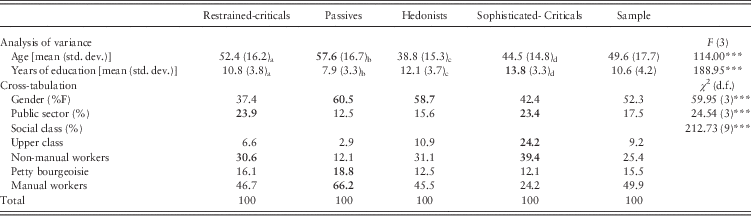
In order to test whether systematic variations in lifestyle are rooted in socio-structural categories, we sketched a socio-demographic profile of clusters. Table 2 shows that the Restrained-criticals are older than the sample mean and men are over-represented among them; women and relatively elderly people were over-represented among the Passives; young people, women, and the rather well educated were over-represented among the Hedonists; and the Sophisticated-criticals were, above all, well educated. Of particular interest for our purposes is that a significant relationship emerged between lifestyle and social class: with respect to the sample distribution, non-manual workers were over-represented among the Restrained-criticals; the petty bourgeoisie and manual workers were over-represented among the Passives; the Hedonists were not associated with any particular social class, whereas the upper class and non-manual workers were largely over-represented among the Sophisticated-criticals.
Socio-demographic profiles of the clusters

Highest values are in bold.
Means with different subscripts in the same line differ from each other in the post hoc test by at least P<0.05.
***P<0.001.
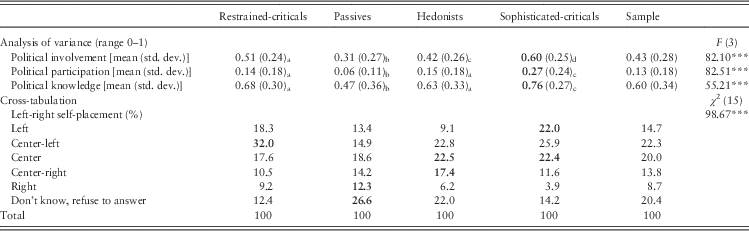
Having established meaningful types of lifestyle, we examined whether and how the individuals classified in the four groups differed in their interaction with the political field. Significant differences emerged in this regard among all clusters (Table 3). The Restrained-criticals manifested higher political involvement (but not higher participation or better political knowledge) compared with the whole sample, and were over-represented by participants placing themselves in the center-left zone of the left-right axis. The Passives were the least involved, knowledgeable, and participatory in political activities of the sample, and when it came to self-placement on the left-right axis, they chose the right side, or preferred not to answer, more than the rest of the sample. Hedonists scored as the whole sample on the political measures and tended to place themselves at the center and center-right more than the other people in the sample. Coherently, the Sophisticated-criticals were revealed to be the most involved, knowledgeable, and participatory in political activities of the sample. They tended to place themselves at the left and on the center of the left-right axis more than the rest of the sample.
Political orientation profiles of the clusters

Highest values are in bold.
Means with different subscripts in the same line differ from each other in the post hoc test by at least P<0.05.
***P<0.001.
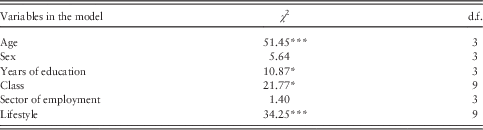
Relationship between lifestyle and the vote: Globally, lifestyle was significantly associated with the coalition vote, χ 2(9)=41.78; P<0.001. However, as the four clusters were significantly characterized by socio-structural features (especially social class), in order to uncover the net association between lifestyle and political choice, we need to test the strength of this relationship while controlling for socio-demographic variables. To this end, we performed a multinomial logistic regression having the coalition vote as a dependent variable. We first tested a model including only the socio-demographic predictors (sex, age, years of education, social class, public/private sector of employment), and in a second step we entered the lifestyle variable.
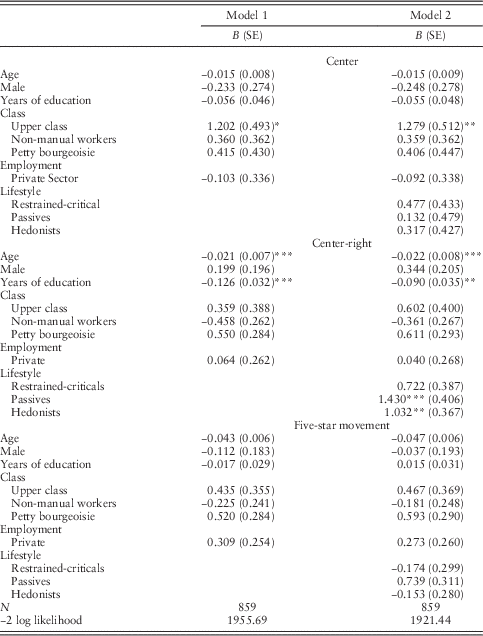
The results of this analysis are reported in Tables 4 and 5. Crucial results are shown in the last line of Table 4, with the model fit values for the two steps. The test of significance for logistic models is the likelihood ratio test, based on the difference between the likelihood ratio (−2LL) for the model under examination and the −2LL for the compared model (e.g. Bohrnstedt and Knoke, Reference Bohrnstedt and Knoke1994). This difference follows a χ 2 distribution, with degrees of freedom equal to the difference in the number of parameters between the two models (increasing the ‘number of parameter’ variable in the model, −2LL diminishes up to the theoretical point of 0).
Predictors of the coalition vote

Logistic multinomial regression. Dependent variable: vote for the coalition (center-left, center, center-right, five-star movement). Baseline outcome: center-left. Reference categories: female (gender), manual workers (class), public sector (employment), Sophisticated-criticals (lifestyle). Robust standard errors in parenthesis. χ 2=−2LL Model 1 – (−2LL Model 2)=34.25***.
*P<0.01, **P<0.005, ***P<0.001.
Likelihood ratio test for predictors of the vote

Logistic multinomial regression. χ 2=(−2LL model without the indicated variable) – (−2LL model with all the variables).
*P<0.01, ***P<0.001.
Our results showed that the addition of the lifestyle variable significantly increased the fitting of the model (with a significant reduction of the −2LL: χ 2=34.25 P<0.001), indicating, in line with our hypothesis, that the lifestyle-based clustering of Italians is indeed significantly and autonomously associated with their voting behavior. In more detail, Table 5 illustrates the significance of each variable in the model, through the difference of likelihood ratios (−2LL) between the model with all the variables and the model without that specific variable. All the predictors, apart from the sex and the sector of employment, were statistically significant in explaining the vote. In line with our hypotheses, lifestyle showed a stronger effect than that of social class, even though the social class effect remained significant after controlling for lifestyle.
More detailed results are also reported in Table 4, with the regression coefficients of the multinomial regression for each variable along with standard errors and significance levels. The most important coefficients for the test of our hypotheses were those related to the variables ‘class’ and ‘lifestyle’ on the propensity to vote for a center-right vs. center-left coalition. Two out of three coefficients for the lifestyle categories remained statistically significant, even after controlling for traditional social class and other socio-structural variables, whereas the analogous class coefficients became non-significant.
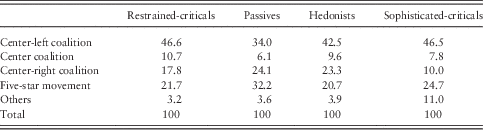
Finally, we calculated the estimated partial effect of lifestyle on vote – that is, the percentage distribution of vote choice in each lifestyle cluster, net of the effect of the socio-demographic variables (Table 6). The results are presented in the form of a bivariate relationship, although the analysis is, in fact, multivariate. Indeed, the percentages – also known as ‘predictive margins’ or ‘margins’ (Graubard and Korn, Reference Graubard and Korn1999) – are the ‘estimated’ frequencies generated by a multivariate model. This distribution showed that voters for the center-left coalition were over-represented among the Restrained-criticals, and likewise among the Sophisticated-criticals. The Passives were especially characterized for over-representation of the five-star movement and center-right coalition voters. The Hedonists were the least characterized for their voting behavior, even though the center-right voters tended to be over-represented among them.
Estimated percentage of coalition vote in each lifestyle group when controlling for socio-demographic variables

Discussion
In the so-called ‘post-modern’ societies, observation of the weakening of socio-structural influence on individual political choices gave rise to a lively debate between scholars interpreting the phenomenon as an individualization process and those blaming social scientists for their inadequacy to understand the role of other social factors. From a social psychological point of view, the struggle between the socially determined individual and the free-pre-social one is often solved in favor of a socially situated actor, able to individuate and build his/her meaningful social memberships. However, theoretical and empirical contributions from both sides of the debate seemed to suggest that today lifestyle could become a useful criterion in designing socially meaningful bonds. Our research, aiming at directly investigating the relationship between lifestyle and political choice, confirmed our hypotheses.
First, in a representative sample of Italians, and through cluster analysis, we found four relatively homogeneous consumption-based lifestyles to which, based on the characteristics described above, we attributed the labels of Restrained-criticals, Passives, Hedonistes, and Sophisticated-criticals. This typology resounds, but further distinguishes, the previously proposed dichotomy between materialistic and post-materialistic ways of life. Indeed, two types (the Restrained-criticals and the Sophisticated-criticals) clearly bring to mind the well-known critical consumption phenomenon. Nevertheless, they differ from each other in the orientation toward outside activities, thus revealing that the critical attitude toward consumption may be accompanied with an inner retreat or, on the contrary, with the outside opening and search for external connections and enjoyment. This could suggest that the Sophisticated-criticals are a better example than the Restrained-criticals of people supporting post-materialistic values. The cluster of Hedonists includes people who, probably free from economic and material constraints, seem inclined to enjoy the socially dominant acritical consumerism, as well as of the opportunities outside entertainment. On the other side, we found a large segment – those we called Passives – who, probably due to material and cultural capital scarcity, manifest the lowest critical orientation toward consumption and a strong centrality of television exposure. These features suggest that they are less likely to value quality of life enhancing goals typical of the post-materialistic-value endorsers. However, the analysis of the relationship between value orientation and lifestyle goes beyond the aims of the present study. The question should be addressed in dedicated future research.
Second, lifestyle clusters were significantly associated with the vote, even when socio-structural factors (age, sex, education, public/private sector of employment, and traditional social class) were controlled for. In addition, our analyses showed that the four-lifestyle typology performs better than socio-structural variables in accounting for the 2013 coalition vote variance.
Previous attempts to understand the connection between consumption and political choices limited themselves to the study of the so-called critical consumption as an expression of non-economic values and a form of unconventional political participation. In particular, in the post-materialistic account of the relationship between lifestyle and the vote, critical consumption has been studied primarily in order to detect the impact of environmentalist concerns on left-wing political choices. Our analyses showed that, beyond critical consumption, considering the whole repertoire of attitudes toward consumption and related practices allows us to capture its effect on political choices of all kinds. Indeed, we found our lifestyle typology to be diagnostic of external political characterization above and beyond the social class. In other words, even though the socio-structural positioning of the individuals influenced their lifestyle adoption, all the four consumption-based lifestyle groups we found, and not only those characterized by ‘critical’ consumerism, expressed relatively homogeneous political orientations and choices.
Thus, in contrast with Bourdieu’s view, lifestyle is only in part an expression of the social class. For the rest, it is rather a means by which people adjust their place within a symbolic map of social groups. In a changing and complex political context, Italians’ vote in 2013 was more similar to that of other people with similar patterns of consumption than those sharing their structural position. Furthermore, in contrast with Garzia’s (Reference Garzia2013) claim of a shift from an identity-based to an attitudinal-based partisanship, we believe that our results may be interpreted anew in line with an identity-based approach. The sharing of (political) attitudes and stances among the respondents was not accidental. Rather, individuals still appear as social actors engaged in constructing and sharing a worldview within recognizable social groups (in the same line, see also Hayes, Reference Hayes2009; Bonneau and Cann, Reference Bonneau and Cann2013).
It is worth noting that the investigation into the connection between lifestyle and the vote assumes a very different perspective in comparison with the study of the structural influence. The traditional idea of social stratification entails a vertical and hierarchical perspective (e.g. ‘upper class’) with a clear causal direction to the output, whereas the shift to the lifestyle concept implies a more horizontal and relational perspective characterized by an associative approach (rather than causal) to the output. In all probability, people engage in lifestyle choices and political orientation development through the same process of negotiation of a shared reality within their social networks.
We acknowledge that this is just one step toward answering the following question: ‘do we recognize other people consuming like we do as an identification source?’. Although we find clear support for an affirmative answer in the present study, questions remain that should be addressed by future studies. The first concerns the strength of lifestyle identification – that is, the degree to which individuals psychologically invest in their lifestyle category. This is an important issue because only when individuals invest in a particular category do they see themselves as group members and the cognitive, affective, and behavioral corollaries of group membership occur (Hopkins and Reicher, Reference Hopkins and Reicher2011). In this regard, for example, Lizardo (Reference Lizardo2006) pointed out that little groups (e.g. environmentalists), and elite lifestyle groups in particular, are more inclined to share political culture than large or subordinate groups. Therefore, we could expect our Sophisticated-criticals to identify more with their group than the Passives, and then to share a greater deal of political views with their like. An empirical paradigm allowing comparison between the strength of identification stemming from lifestyle and social class should be developed.
A second problem concerns the stability of lifestyle groups overtime and their political connotations: lifestyles are fuzzy and low entitative categories. However, in order to function as a social identity source, an entity must be relatively stable (Tajfel and Turner, Reference Tajfel and Turner1979). Therefore, this is another worthwhile future direction of in-depth longitudinal or, at least, trend analyses.
Acknowledgments
We express our gratitude to Pasquale Colloca, Maurizio Pisati, and Michele Roccato.
Financial Support
The research has been funded by the Italian Ministry of Education, University and Research (Prin-Miur 2010-11) Grant No. 2010943×4L.
Appendix Question wording concerning lifestyle
Material consumption
I am going to read some statements that people before you made about their consumption habits. Please tell me to what extent you recognize yourself in each of them.
-
1. I like buying products that make me stand out among other people.a
-
2. If you buy products of well-known brands you do not need to read the ingredients.c
-
3. When I buy a product I pay attention that it has a minimal package, to avoid to pollute.b
-
4. When I find a flawed product I always protest.b
-
5. To avoid bad surprises, I always buy products of well-known brands.c
-
6. I have my habits, I try to always buy the same brands.c
-
7. I always read with close attention the ingredients of the products that I buy.b
-
8. Products’ labels should contain more information that could be useful for the customers.b
-
9. I often enjoy window shopping, even without buying anything.a
-
10. Going shopping is one of the things that I like most.a
-
11. I enjoy watching commercials.a
-
12. Industrial products are healthier and safer than handcrafted ones.c
Response scale
Definitely true
Fairly true
Fairly untrue
Definitely untrue
Note: The superscripts refer to the factor in which the item was included based on the principal component analysis: a. Consumption as an entertaining activity; b. Critical consumerism; c. Trust toward the brands.
Cultural and leisure-time consumption
Did you engage in the following activities during the past year?
-
1. Seen a movie at the cinema.
-
2. Gone to a live performance of popular music like rock/pop music concert.
-
3. Attended a live performance of a nonmusical stage play.
-
4. Heard a classical music or opera performance.
-
5. Visited an art museum or gallery.
-
6. Read a novel, poem, or play.
Response scale: No=0, Yes=1
How frequently do you dine out (excluding business lunches/dinners)?
[1] Many times a week
[2] Once a week
[3] One or more times a month
[4] A few times a year
[5] Never