

Australian Employee Perspectives on Disability Management
Background
Disability management is a relatively new field of research and practice, both within Australia and internationally (Buys, Matthews, & Randall, Reference Buys, Matthews and Randall2010; Geisen & Harder, Reference Geisen and Harder2011). It has evolved in response to ongoing concerns regarding the social and economic costs of injury and illness and is contextualised within the sociopolitical milieu of Australian society. Australia is classified as a liberal welfare state, as reflected by modest universal transfer and social insurance payments, as well as minimal decommodification effects (Esping-Andersen, Reference Esping-Anderson1990). It has resulted from a neo-liberal political ideology over the past two decade that includes a focus on notions of mutual obligation and reciprocity. This shift in ideology has resulted in reduced social expenditure and a shifting of social responsibility away from government and toward private and not-for-profit service providers (Fenna & Tapper, Reference Fenna and Tapper2012; Mendes, Reference Mendes2009).
In Australia, the management of illness and injury is covered by diverse insurance schemes intended to provide different benefits depending on type and location of where the disability or injury occurred. Specifically, benefits may be provided through workers compensation, if the injury occurred as a result of work; motor accident insurance, if the injury occurred as a result of a motor vehicle incident; or the National Disability Strategy or new National Disability Insurance Scheme if the disability was acquired or congenital. Unfortunately, Australia now has more than 15 separate insurance schemes, each with their own legislative guidelines and administrative processes. As a result, the Australian system struggles with fragmentation and jurisdictional confusion regarding degree of a respective systems responsibility.
Australian statistics from 2012 to 2013 report that 117,815 serious workers compensation claims occurred, primarily in the transport and storage, agriculture, forestry and fishing, construction and manufacturing industries (Safe Work Australia, 2014). However, given that many workers opt to use employer provided sickness benefits rather than workers compensation, it is likely that this number significantly underestimates the actual human and financial costs of workplace injury and illness. Estimating the total cost of illness and injury for both workers compensation and nonworkers compensation, the total projected value for 2012 to 2013 has been estimated as high as A$61.8 billion, or 4.1% of the Australian Gross Domestic Product (Safe Work Australia, 2015).
Disability Management
Disability management has only become part of the Australian lexicon over the past one or two decades, evolving out of legislation introduced in the 1980s that mandated rehabilitation of injured workers as a means of attempting to reduce the spiraling costs of workers compensation. Buys and Randall (Reference Buys, Randall, Marshall, Kendall, Banks and Gover2009) suggest that the move to include rehabilitation as an aspect of workplace insurance was philosophically rooted in the principle of mutual obligation; that is, injured workers were required to participate in return to work programs in return for receiving workers compensation benefits. In addition, increased responsibility was placed on the employer to both reduce workplace injuries and provide services to assist injured employees to stay at work and return to work. This increased employer responsibility led to the genesis of the disability management approach, whereby employers were required by workers compensation systems to play a much larger role in injury prevention and rehabilitation. Over time employers have seen the value of disability management, broadening their focus to include both work-related and nonwork-related illness/injury as they realise the economic value of retaining and returning injured employees to the workplace (Tompa, de Oliveira, Dolinschi, & Irvin, Reference Tompa, de Oliveira, Dolinschi and Irvin2008) given estimates that suggest employee turnover costs employers approximately one to two times the employee's salary in lost productivity (LifebyDesign, 2007). Employers’ interest in disability management is expected to further increase given the increasing incidence of chronic disease in an aging workforce.
Previous Literature
There have been a number of Australian studies on disability management that indicate the importance of such programs for employers and injured workers. For example, it has been found that a partnership approach to disability management involving all key stakeholders is necessary to achieve optimal rehabilitation outcomes (Roberts-Yates, Reference Roberts-Yates2006). In this context, Bohatko-Naismith, James, Guest, and Rivett (Reference Bohatko-Naismith, James, Guest and Rivett2015) found that communication, coordinator characteristics, and management of the return to work process were the domains most important for effective disability management. There are examples of excellent disability management programs in Australia that follow this approach, (Westmorland, Buys, & Clements, Reference Westmorland, Buys and Clements2002) although there appears to be a lack of integration of prevention and rehabilitation services at a company level (Westmorland & Buys, Reference Westmorland and Buys2004). Further, management of stress-related conditions continues to be challenging for employers with one study (Buys, Matthews, & Randall, Reference Buys, Matthews and Randall2010) finding that, from the perspective of employees, employers dealt with stress prevention and rehabilitation poorly, particularly in smaller workplaces. It is therefore increasingly recognised that employers need to develop positive workplace cultures, particularly in the management of occupational stress (Randall, Buys, & Kendall, Reference Randall, Buys and Kendall2006). These findings are consistent with research on workplace stress conducted in other countries (Cartwright & Cooper, Reference Cartwright and Cooper2011).
These Australian findings indicate that the effectiveness of disability management programs is influenced by organisational context. Where disability management programs are supported and embedded in a positive organisational culture that is characterised by high levels of communication and cooperation between key stakeholders, prevention and rehabilitation outcomes are optimised. This is consistent with research that has found that organisational culture is manifest in phenomena such as job satisfaction, workplace morale, and employee health and wellbeing, which in turn impact performance and productivity (Ritchie, Reference Ritchie2000; Uddin, Luva, & Hossian, Reference Uddin, Luva and Hossian2013). Indeed, Amick et al. (Reference Amick, Habeck, Hunt, Fossel, Chapin, Keller and Katz2000) concluded that a people-oriented culture facilitates disability management programs, resulting in productive return to work outcomes. However, there has been little research on employee perspectives on disability management in relation to manifestations of workplace culture, including job satisfaction, physical and mental health, workplace morale and sickness absence. The current study therefore had two aims:
Examine the relationship between components of a disability management program (disability prevention [DP], stay at work [SAW], and return to work [RTW] programs) and employees’ perceptions of their impact on job satisfaction, physical and mental health, workplace morale and sickness absence in a sample of large Australian companies.
Compare employee perceptions of disability management according to union versus nonunion, public versus private status and gender.
Methods
The Australian sample was completed as a country-specific data collection within a large international data collection that included Australia, Canada, China and Switzerland. Information regarding perceptions of disability management as it related to job satisfaction, physical and mental health, workplace morale and sickness absence was collected by local research teams within each country.
Measures
Data was collected using a survey instrument specifically developed by the research team to meet the aims of this study. While there are existing instruments that measure workplace morale, job satisfaction and health, no currently available tool exists that measures these variables in relation to disability management, hence the need to create a new instrument. The survey was created via team consultation with special attention to contextual factors in order to ensure that both national and international analyses would be possible. The initial instrument was created in English and then was translated and reverse translated into German, French, Simple Chinese and Traditional Chinese. Example items included ‘The workplace disability management program contributes positively to my satisfaction’ and ‘The workplace disability management program contributes positively to the satisfaction of employees’. Each item included a 5-point Likert scale that allowed the respondents to indicate a response from 1 (strongly agree) to 5 (strongly disagree). Survey questions focused on three components of a disability management program — DP, (SAW and RTW — in relation to the dependent variables of job satisfaction, physical and mental health, workplace morale and sickness absence. Demographic data collected included gender, age, marital status, level of education, occupation, income, physical health, mental health and disability status.
Participants
Survey information was collected from employees in 10 large Australian companies (i.e., greater than 1500 employees) using primarily online data collection procedures. Companies were selected as a convenience sample through contacts of one of the research team and employees were randomly selected from a list provided by each employer. Industry sectors represented included health care (2), facilities management (2), recruitment (1), transport (1), telecommunications (1), insurance (1), regional council services (1) and rehabilitation services (1). A total of 365 participants responded to the survey. However, the number of responses varied across items. The majority of participants reported being female (65.2%, N = 238), 33.7% (N = 123) male and the average age was 41.10 years (SD = 11.137). A large majority of participants reported being married (72.6%) and 44.9% reported having children. Participants also reported high levels of education, with 18.7% (N = 68) reporting secondary level education and 81.4% (N = 297) reporting some form of postsecondary education. Adjusting for purchasing power parity, the average reported income was US$95,731.05 (SD = US$44,881.65). Reflecting this high average income, most participants reported being managers (31.8%), followed by technicians/associate professionals (25.2%), clerical support workers (16.7%), service and sales workers (13.4%), and professionals (11.0%). Most were also working full-time (78.4%, N = 286) or part-time (15.1%, N = 55).
Participants reported good physical health (M = 2.14, SD = 0.900; 1 [very good] to 5 [poor] and mental health (M = 1.90, SD = 0.876). Reflecting this overall good health, only 3.0% (N = 11) of participants considered themselves as having a disability, and the average time missed from work due to disability or illness in the previous year was minimal (M = 1.83, SD = 0.841; 1 [none] to 6 [six months or more]). Participants also reported high job satisfaction (M = 1.81, SD = 0.759; 1 [very satisfied] to 5 [very dissatisfied]) and workplace morale (M = 1.93, SD = 0.826; 1 [strongly agree] to 5 [strongly disagree]).
In addition to the survey data presented here, each company participated in qualitative interviews. Qualitative interviews were completed with two employees who received support, a disability management practitioner and a human resource practitioner at each location, and are reported on elsewhere. Ethical clearance for the Australian component of the study was obtained from the Griffith University Ethics Committee.
Results
Participants agreed with the statements that their company takes measures to prevent disability in the workplace (M = 1.70, SD = 0.727; 1 [strongly agree] to 5 [strongly disagree]), has a program designed to help disabled workers stay at work (SAW: M = 1.69, SD = 0.918), and has a program designed to help disabled workers return to work (RTW: M = 1.61, SD = 0.705). Participants also agreed that their company supported them to stay at work (M = 1.89, SD = 0.918) or return to work after illness or disability (M = 1.87, SD = 0.964); and that their company supported a coworker to either stay or return to work (M = 1.63, SD = 0.753). Furthermore, participants reported a good quality of support for both themselves and coworkers (Self SAW: M = 1.80, SD = 1.006; Self RTW: M = 1.73, SD = 0.950; Coworker SAW or RTW: M = 1.68, SD = 0.803; 1 [very good] to 5 [very poor]).
Participants strongly agreed that their company should continue their disability management programs (M=1.37, SD=0.588; 1 [strongly agree] to 5 [strongly disagree]). Participants perceived moderate benefits of their company's disability management program on their job satisfaction (M=2.15, SD=0.796), physical health (M=2.33, SD=0.821), mental health (M=2.33, SD=0.877), and morale (M=2.29, SD=0.785). Similarly, participants also reported moderate benefits for their coworkers across the same variables (M=2.06, SD=0.759; M=2.14, SD=0.796; M=2.22, SD=0.829; M=2.20, SD=0.785; respectively). Participants were more neutral in their response when asked if the company's disability management program reduced their sick time taken off work (M=2.76, SD=0.937), and their coworkers sick time (M=2.65; SD=0.956).
Regression Analyses
Multivariate linear regression was employed to predict disability management's influence on job satisfaction, physical health, mental health, morale and time missed, from respondents’ perceptions of whether their company provided disability prevention, stay at work, and return to work initiatives within their organisation (from 1 [strongly agree] to 5 [strongly disagree]). It is important to note that in every case, a disability management program existed in participant companies for a period of at least two years. Therefore, the questions reflected participants’ perceptions of the disability management program that existed within their workplace.
Disability management program's influence on job satisfaction
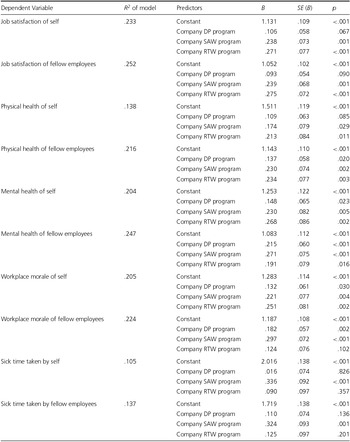
Each of the SAW and RTW programs predicted perceptions of the disability management program's influence on individual and coworker job satisfaction. In contrast, the DP program did not predict perceptions of the disability management program's influence on job satisfaction for either the individual or for coworkers. That is, Australian employees reported the SAW and RTW programs as linked to the disability management program's influence on their own, as well as their coworkers’ job satisfaction; alternately, the DP program was not significantly linked to the disability management program's influence on either individual or coworker job satisfaction (see Table 1).
Standard Regression of Company Disability Management Program Variables in Prediction of Employee Workplace Perceptions

Disability management program's influence on physical health
The DP program predicted perceptions of the disability management program's influence on coworker physical health. In contrast, the SAW and RTW programs predicted perceptions of the the disability management program's influence on physical health for both the individual and their coworkers. That is, Australian employees reported the SAW and RTW programs as linked to the disability management program's influence on their own as well as their coworkers’ physical health, but saw the DP program efforts as beneficial only for their coworkers.
Disability management program's influence on mental health
Each of the DP, SAW and RTW programs predicted the disability management program's influence on mental health for both the individual and coworkers. That is, Australian employees reported all forms of disability management intervention as beneficial for the disability management program's influence on both individual and coworker mental health.
Disability management program's influence on morale
The DP and SAW programs were predictive of perceptions regarding the disability management program's influence on individual and coworker workplace morale. In contrast, the RTW program was only predictive of the disability management program's influence on individual workplace morale. In other words, for Australian employees all forms of disability management intervention were important for the disability management program's influence on workplace morale, but the RTW interventions were reported as not significantly important for coworker workplace morale.
Disability management program's influence on sick time
Interestingly, for Australian employees, there were no significant relationships between the DP program and the RTW program for the disability management program's perceived influence on individual or coworker sick time. However, SAW programs significantly predicted the disability management program's influence on both individual and coworker reduced sickness absence.
Group Difference Analyses
Public versus private companies
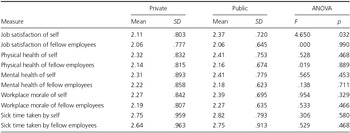
Using one-way ANOVA, comparisons were made between the Australian sample's respondents from public versus private companies on disability management's influence for job satisfaction, physical health, mental health, morale and time missed (for both the respondent and the respondent's perception for coworkers). Using p ≤ .05 as the criteria, differences were revealed for individual responses on job satisfaction (Public N = 51, M=2.37; Private N=314, M=2.11). Respondents from private companies ranked the disability management program's influence on individual job satisfaction as greater than did respondents from public companies (see Table 2).
Means, Standard Deviations (SD), and Results of One-Way ANOVAs Comparing Employee Workplace Perceptions by Private vs Public Companies

Union versus nonunion
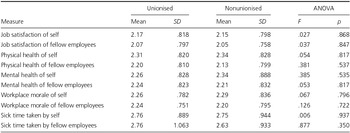
Using one-way ANOVA, comparisons were made between the Australian sample's respondents from union versus nonunion work environments on the disability management program's influence for job satisfaction, physical health, mental health, morale, and reduced sickness absence (for both the respondent and the respondent's perception for coworkers). No significant differences were revealed on any variable (see Table 3).
Mean, Standard Deviation (SD), and Results of One-Way ANOVAs Comparing Employee Workplace Perceptions by Unionised vs Nonunionised Employees

Gender
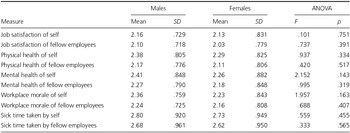
Using one-way ANOVA, comparisons were made between self-reported males and females in the Australian sample on the disability management program's influence for job satisfaction, physical health, mental health, morale and time missed (for both the respondent and the respondent's perception for coworkers). No significant differences were revealed on any variable (see Table 4).
Means, Standard Deviations (SD), and Results of One-Way ANOVAs Comparing Employee Workplace Perceptions by Gender

Discussion
Our sample was primarily middle-adult females who were married, well educated and healthy. Most respondents were working full-time and this was reflected in the relatively high income levels. Few of the respondents consider themselves as an individual with a disability and most reported missing little work and experiencing high job satisfaction and workplace morale.
The first aim of our study was to examine the relationship between components of a disability management program (DP, SAW, and RTW programs) and employees perceptions of their impact on job satisfaction, physical and mental health, workplace morale and sickness absence. Participants felt strongly that their workplaces provided support to prevent disability in the workplace and also reported good quality assistance for staying at work and returning to work, both for themselves and their colleagues. Participants felt strongly that disability management efforts should be continued and that the perceived impact of disability management on psychosocial and health-related variables (job satisfaction, physical health, mental health, workplace morale, absenteeism) was moderate.
Our regression results further reinforced these findings. Overall, Australian employees reported positive perceptions regarding disability management programs as contributors to individual psychosocial and health-related workplace factors. Specifically, respondents reported that the SAW and RTW programs were perceived as positive contributors to both job satisfaction and workplace morale, for both themselves and their coworkers. Similarly, these same intervention types were seen as positively contributing to both physical health and morale of the individual (not coworkers). DP programs were related to greater mental health and workplace morale for respondents and their coworkers, as well as physical health of coworkers. SAW programs were perceived as positive contributors to individual and coworker reduced sickness absence and workplace morale of coworkers. Interestingly, DP and RTW programs were not perceived as contributors to reduced sickness absence. While this appears to be counterintuitive, it may be related to perceptions that DP and RTW programs are more focused on preventing and managing injury, rather than those illnesses commonly viewed as major contributors to sickness absence such as influenza and gastroenteritis.
Clearly employees viewed disability management as an important part of their organisational culture based on its contribution to job satisfaction, health and morale. This is an important finding given previous research that has linked a positive workplace culture to higher levels of productivity (Ritchie, Reference Ritchie2000; Uddin, Luva, & Hossian, Reference Uddin, Luva and Hossian2013). The potential impact of disability management on workplace culture indicates it may provide a direct contribution to the economic value of a company rather than just through savings associated with preventing and managing injury related costs. It is notable that SAW programs led to greatest employee-perceived benefit in reducing absenteeism. Given that the economic impact of absenteeism on employers, whereby the cost is an estimated A$27.5 billion per year in Australia (Direct Health Solutions, 2016), £32 billion in the United Kingdom (PwC, 2016) and US$227 billion in the United States (The Fiscal Times, 2013), it is not surprising employees saw the benefit of proactive management of absence through SAW programs. Overall, SAW programs were positively perceived as contributing to the range of psychosocial and health-related variables examined, indicating the importance of this component of disability management to organisations. Interestingly, while disability prevention was linked to most of the variables, it was perceived not to influence job satisfaction. It is not clear whether this finding was due to employees having little direct experience of employer-based prevention services or them holding the view that their job satisfaction was related to other workplace factors.
The second aim of our study was to compare employee perceptions of disability management according to unionised versus nonunionised workplace, public versus private industry status and gender. It was found that disability management was perceived as more beneficial in private companies compared to public organisations in relation to job satisfaction, but there were no differences found based on unionisation or the gender of the respondent. It is not clear why employees in private companies would rate disability management as more beneficial in relation to job satisfaction. It may be related to sense of job security, in that private sector employees feel less secure in their jobs compared to public sector employees and therefore view disability management as a form of job protection in that it assist them to return to work should they incur an injury or illness that leads to absence. Further research on this issue is warranted.
Limitations
The present study has several limitations. First, there is the possibility of respondent bias in that individuals with stronger feelings toward disability management may have more readily agreed to participate in our study. Second, interpretation of our results is also limited by the survey and cross-sectional nature of the data, wherein no conclusions can be drawn regarding the directionality of the data. For example, it is possible that people with greater job satisfaction are more like to value disability management, as opposed to the other direction as we have proposed. Third, our findings cannot be generalised to all companies as our sample consisted of employers with an existing disability management program in place for at least two years. They also cannot be generalised to how employees with disabilities and ill-health perceive disability management programs, as only 3% of the sample reported having a disability. Fourth, our sample tended to be female, married, of higher income and in good health; consequently, it is not possible to generalise our findings to companies with other demographic profiles. Finally, our survey tool was a team-created tool specifically designed for use in the present study. Consequently, it is yet to be determined whether tool-related influences may have impacted the results in some manner.
Conclusions
Disability management programs are positively perceived by Australian employees with respect to important variables associated with organisational culture, including job satisfaction, physical and mental health, workplace morale, and reduced sickness absence. The perceived benefit is broadly applicable across all program types, as well as both for the employee and their coworkers. An important implication of these findings is that disability management research needs to broaden its focus, which has tended to be on case management practice, to more general organisational variables such as workplace culture, in order to address workplace health issues. It is evident that there may be an impact of disability management on organisational productivity that is mediated by variables associated with workplace culture, as well as a direct economic benefit arising from preventing and managing injury. More research is required to examine these areas.
Acknowledgements
This work was supported by the Swiss Network for International Studies. We would like to thank all of the employees who agreed to participate in our survey, in particular those who completed more than one research component.