INTRODUCTION
Sponges belonging to the family Clionaidae D'Orbigny, 1851, constitute a diverse and important group of marine sponges, with the ability to excavate calcium carbonate substrates creating galleries connected by tunnels within the substrate in which they live (Rützler, Reference Rützler1975; Calcinai et al., Reference Calcinai, Bavestrello and Cerrano2004).
Originally, all boring species were assigned to the family Clionaidae, on the basis of their common excavating ability (Laubenfels, Reference de Laubenfels1936), but subsequently it was shown that this ability is not restricted to this family, and species were relocated in four different families, Clionaidae and Alectonidae (Hadromerida), Phloeodictyidae (Haplosclerida) and Acarnidae (Poecilosclerida) (Rützler, Reference Rützler, Hooper and Van Soest2002). Currently, the family Clionaidae is defined by their spicular complement composed of tylostyles, and microscleres that include a large variability of spirasters, amphiasters, microxeas, microrabds and raphides (Rützler, Reference Rützler, Hooper and Van Soest2002).
In the last decades, boring sponges have acquired a growing interest due to the impact that they cause on the destruction of calcareous structures such as corals (Risk et al., Reference Risk, Sammarco and Edinger1995; Weil, Reference Weil2002; Carballo et al., Reference Carballo, Bautista-Guerrero and Leyte-Morales2008a, Reference Carballo, Cruz-Barraza, Nava and Bautista-Guerrerob), constituting the principal endolithic bioeroders of coral framework (Hein & Risk, Reference Hein and Risk1975; Risk et al., Reference Risk, Sammarco and Edinger1995).
In order to be able to monitor bioerosion processes, the identification of species becomes more important. In most cases, boring sponges are easy to identify by the microsclere morphology (Carballo et al., Reference Carballo, Cruz-Barraza and Gómez2004), but there are species devoid of them, and cases where the spicule complement is quite similar between species, which cause confusion in taxonomic determination (Schönberg, Reference Schönberg2002; Zea & Weil, Reference Zea and Weil2003).
In an attempt to facilitate the identification of these problematic species, details of skeletal structures and morphological characteristics have been also included (Rosell & Uriz, Reference Rosell and Uriz1991; Schönberg, Reference Schönberg2002; Zea & Weil, Reference Zea and Weil2003), as well as ecological and genetic information (Bavestrello et al., Reference Bavestrello, Calcinai, Cerrano, Pansini and Sarà1996; Zea & Weil, Reference Zea and Weil2003; Barucca et al., Reference Barucca, Azzini, Bavestrello, Biscotti, Calcinai, Canapa, Cerrano and Olmo2007).
Coral reef boring sponges have received special attention in several taxonomic and ecological studies, principally in the Caribbean (Pang, Reference Pang1973; Rützler, Reference Rützler1974, Reference Rützler1975; Hofman & Kielman, Reference Hofman and Kielman1992; Zea & Weil, Reference Zea and Weil2003) and the Indo-Pacific (Annandale, Reference Annandale1915; Thomas, Reference Thomas, Mukundan and Gopindama-Pillai1972, Reference Thomas1975, Reference Thomas and James1985; Vacelet et al., Reference Vacelet, Vasseur and Lévi1976; Calcinai et al., Reference Calcinai, Cerrano, Sarà and Bavestrello2000; Schönberg, Reference Schönberg2000). In recent years, studies of boring sponges from the Mexican Pacific have provided a general vision of their diversity, distribution and ecology (Carballo et al., Reference Carballo, Cruz-Barraza and Gómez2004, Reference Carballo, Hepburn, Nava, Cruz-Barraza and Bautista-Guerrero2007, Reference Carballo, Bautista-Guerrero and Leyte-Morales2008a, b; Bautista-Guerrero et al., Reference Bautista-Guerrero, Carballo, Cruz-Barraza and Nava2006; Nava & Carballo, Reference Nava and Carballo2008), but there still are a few undescribed species which undoubtedly play an important role in the bioerosion of East Pacific coral reefs (see Carballo et al., Reference Carballo, Bautista-Guerrero and Leyte-Morales2008a; Nava & Carballo, Reference Nava and Carballo2008).
In this paper, we describe four new species of the family Clionaidae which were found invading corals of the genus Pocillopora, which is the most common hermatypic coral of the East Pacific Ocean. Cliona tropicalis sp. nov. is one of the most important bioeroding sponges from Mexican Pacific coral reefs (identified as Cliona sp. in Carballo et al., Reference Carballo, Bautista-Guerrero and Leyte-Morales2008a; Nava & Carballo, Reference Nava and Carballo2008). We also include the first records of boring sponges from the Revillagigedo archipelago, an important tropical area for corals, and completely unknown for its sponge fauna.
MATERIALS AND METHODS
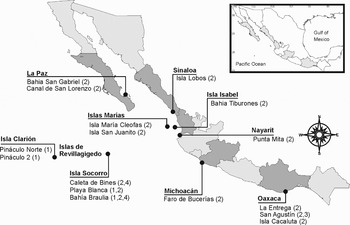
The specimens were collected by SCUBA diving and snorkelling at sixteen localities of coral ecosystems from the Mexican Pacific Ocean (including Marías and Revillagigedo Islands) (Figure 1). The specimens were fixed in 4% formaldehyde for 24 hours and later transferred to 70% ethanol for storage. External morphology and skeletal elements were recorded for each species. The preparation of dissociated spicules, both for light microscopy (LM) and scanning electron microscopy (SEM), were prepared following the techniques described by Rützler (Reference Rützler1974). Spicule measurements were obtained from a minimum of 25 spicules chosen randomly from each specimen. Tylostyle measurements are given in length × shaft width; head width. The number in parentheses is the average.
Reef location and distribution of the species. Numbers refer to the different species. (1) Cliona medinae sp. nov.; (2) C. tropicalis sp. nov.; (3) Cliothosa tylostrongylata sp. nov.; and (4) Thoosa purpurea sp. nov.

Material has been deposited in the Colección de Esponjas del Pacífico Mexicano (LEB-ICML-UNAM), of the Instituto de Ciencias del Mar y Limnología, UNAM, in Mazatlán (México). The type material has been deposited in the Museo Nacional de Ciencias Naturales in Madrid (Spain) (MNCN), and in the British Museum of Natural History (BMNH) (London). Specific terms are used according to Boury-Esnault & Rützler (Reference Boury-Esnault and Rützler1997).
RESULTS
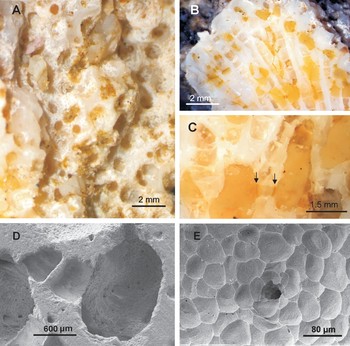
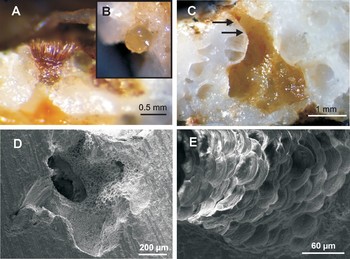
Cliona medinae sp. nov. (A) Superficial view of the papillae; (B) cross-section view of a network of chambers; (C) detail of the joining of excavating chambers. Arrows show diaphragms; (D) scanning electron microscopy images of erosion pattern scars on the oval chamber wall; (E) detail of scars where chips were removed by the sponge tissue.

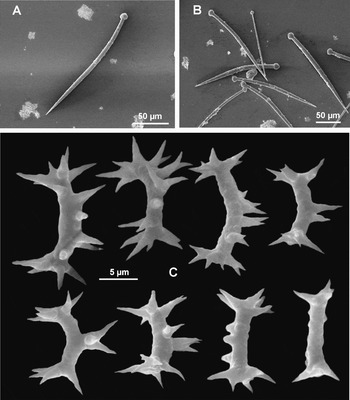
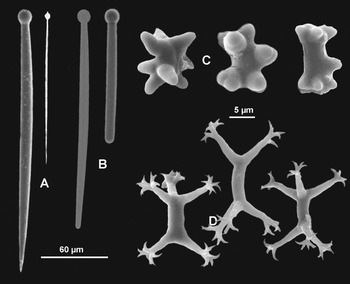
(A) Scanning electron microscopy images of spicules of Cliona medinae sp. nov.; (B) tylostyles; (C) spirasters.

TYPE MATERIAL
Holotype: MNCN 1.01/633, Isla Clarión, Roca Norte (Revillagigedo), 18°47′14″N 110°55′42″W, 4 m depth, 12 March 2005.
Paratypes: BMNH 2010.11.01.4, Isla Clarión, Roca Norte (Revillagigedo), 18°47′14″N 110°55′42″W, 4 m depth, 12 March 2005. LEB-ICML-UNAM-1238, Isla Clarión, Roca Norte (Revillagigedo), 18°47′14″N 110°55′42″W, 4 m depth, 12 March 2005. LEB-ICML-UNAM-1252, Pináculo Norte (Revillagigedo), 18°51′4″N 110°59′53″W, 4 m depth, 12 March 2005. LEB-ICML-UNAM-1260, Isla Clarión, Pináculo 2 (Revillagigedo), 18°48′17″N 110°56′21″W, 4 m depth, 13 March 2005. LEB-ICML-UNAM-1661, Playa Blanca, Isla Socorro (Revillagigedo), 18°48′56″N 111°02′42″W, 3 m depth, 5 May 2008. LEB-ICML-UNAM-1668, Bahía Braulia, Isla Socorro (Revillagigedo), 18°43′44″N 110°56′08″W, 8 m depth, 7 May 2008.
DESCRIPTION
Papillate species found excavating live coral branches of the genus Pocillopora. The papillae extend by an area up to 12 cm long. These are very small, circular or oval-shaped, from 0.3 to 0.8 mm in diameter (Figure 2A). They are relatively abundant and regularly distributed over the coral surface, usually spaced 0.5 to 1.7 mm from each other. The papillae are at surface level in preserved specimens. Oscules have not been observed and no distinction between ostial and oscular papillae was made because of the difficulty of recognizing each type after fixation. The papillae have firm consistency; the choanosome is soft and fleshy, and abundant inside the coral structure. Both papillae and choanosome are yellow-orange in living specimens; after fixation the colour turns to light brown. The diaphragms are easy to distinguish from the choanosomal tissue by having a dark yellow colour and oval shape (0.3–0.7 mm in diameter) (Figure 2B, C).
Erosion patterns: the species produces a regular network or reticulate galleries with spherical–ovoid (from 1.2 to 1.5 mm) to rectangular chambers with rounded borders (from 1.7 to 2.5 mm), which are densely distributed along the coral structure (Figure 2B–D). The sponge occupies the natural pores of the coral, boring only the walls that separate coral septae, producing large chambers as the result of fusion between two or more chambers. They measure from 2 to 8 mm in length and are 0.5 to 1 mm thick. The chambers are separated from each other by substrate walls from 0.2 to 0.6 mm thick, and the are connected by ducts from 180 to 330 µm. The walls of the chambers and tunnels present a pitted surface where chips have been removed (Figure 2D). They are polygonal from 20 to 50 µm in diameter (Figure 2E).
Skeletal structure: in the ectosomal papillae, the tylostyles are arranged in a palisade pattern, with tips toward the exterior. In the choanosome the tylostyles are irregularly scattered, single or in vague tracts. The spirasters are common in the choanosome tissue.
Spicules: tylostyles are mostly thin and lightly curved toward the upper third; the shafts are gradually tapering to the end, finishing in a hastate point. They have well-formed globular heads, sometimes with a small terminal knob (Figure 3A, B). Tylostyle measurements: 152–(176)–195 × 2.5–(6)–7.5 µm. Head diameter: 7–(10)–13 µm. The spirasters (Figure 3C) are small and short, with a robust shaft, lightly curved toward the centre in a ‘C’ form, with the spines toward the convex side of the shaft. Spines are large and robust sometimes bi- or trifurcated, with sharp points. There are a few straight, amphiaster-like forms with rounded knobs along the shaft. Spiraster length: 10–(13)–15 µm.
ETYMOLOGY
The species is named after Mr Pedro Medina, who found the species for the first time in the Isla Clarión (Revillagigedo archipelago).
DISTRIBUTION
The species was found boring corals in different places from Clarión and Socorro Islands (Revillagigedo archipelago, Mexican Pacific Ocean) (Figure 1), between 3 m and 8 m depth.
REMARKS
There are only a few clionaid species with spirasters like Cliona medinae sp. nov. The closest species appear to be C. dichotoma Calcinai et al., Reference Calcinai, Cerrano, Sarà and Bavestrello2000 and C. favus Calcinai et al., Reference Calcinai, Bavestrello and Cerrano2005, both from the Indo Pacific Ocean. Cliona dichotoma has spirasters similar in size to that of C. medinae sp. nov. However, in C. dichotoma they are exclusively amphiasters, with straight shaft and spines in the ends which are large and usually branched near the extremes. In C. medinae sp. nov., the spirasters are slightly curved toward the centre with spines toward the convex side of the shaft. Spines are large and robust sometimes bi- or trifurcated near the base of the shaft. Cliona favus also differs from Cliona medinae sp. nov. by having spirasters quite variable in shape, in spine number, and in their arrangement along the shaft, whereas C. medinae sp. nov. has spirasters with spines arranged toward the convex side of the shaft. In addition, the presence of robust ensiform tylostyles and the very different geographical distribution clearly separates these two species from C. dichotoma. Tylostyles in C. dichotoma are also larger and thicker (from 200–350 × 15–37 µm) than those in Cliona medinae sp. nov.
The species C. euryphylle Topsent, 1887 and C. dioryssa (Laubenfels, 1950) also have short almost straight spirasters. However, they have a thick shaft and they are densely spined by large and strong spines. The spirasters in C. dioryssa (from 11 to 41 µm) and in C. euryphylle (from 4 to 30 µm) are longer than those in C. medinae sp. nov. (from 10 to 15 µm). Additionally, C. euryphylle and C. dioryssa possess a variety of spiraster forms, including large and slender spirasters, which are absent in C. medinae sp. nov.
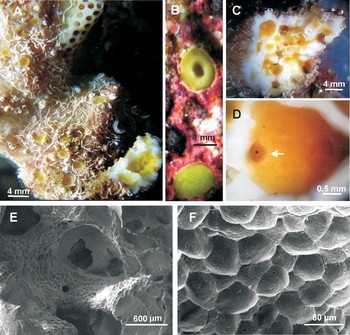
Cliona tropicalis sp. nov. (A) Fragment of coral infested by the sponge; (B) detail of ostial and oscular papillae; (C) excavating chambers inside of coral; (D) detail of a chamber; arrow shows a diaphragm; (E) scanning electron microscopy (SEM) images of erosion pattern scars on the chamber wall; (F) SEM image detail of scars wall.

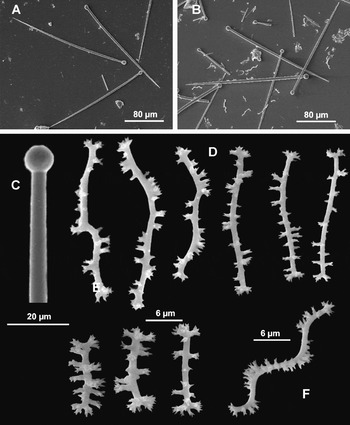
Scanning electron microscopy images of spicules of Cliona tropicalis sp. nov. (A, B) Tylostyles; (C) detail of head of a tylostyle; (D) common large spirasters; (E) short almost straight spirasters with large and branched spines; (F) sinuous spiral-shaped spirasters.

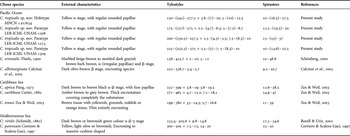
Comparative data for the external characteristics and dimension of spicules (μm) of Cliona viridis-complex, from Pacific, Caribbean and Mediterranean area. Dimensions of spicules are given as length by width of the shaft. Values in parentheses are means.

TYPE MATERIAL
Holotype: MNCN 1.01/634 Bahía Tiburones (Isla Isabel, Nayarit), 21°52′30″N 105°54′54″W, 2 m depth, 21 July 2005.
Paratypes: BMNH 2010.11.01.5, Bahía Tiburones (Isla Isabel, Nayarit), 21°52′30″N 105°54′54″W, 2 m depth, 21 July 2005. LEB-ICML-UNAM-1165, Isla Lobos (Sinaloa), 23°13′49″N 106°27′43″W, 1 m depth, 19 August 2005. LEB-ICML-UNAM-1208, La Entrega (Oaxaca), 15°44′34″N 96°07′35″W, 6 m depth, 5 April 2005. LEB-ICML-UNAM-1273, Faro de Bucerías (Michoacán), 18°20′49″N 103°30′33″W, 8 m depth, 24 July 2005. LEB-ICML-UNAM-1309, San Agustín (Oaxaca), 15°41′09″N 96°13′46″W, 6 m depth, 9 April 2005. LEB-ICML-UNAM-1326, Bahía Tiburones (Isla Isabel, Nayarit), 21°52′30″N 105°54′54″W, 2 m depth, 21 July 2005. LEB-ICML-UNAM-1327, Punta Mita (Nayarit), 20°47′13″N 105°71′13″W, 2 m depth, 9 June 2005. LEB-ICML-UNAM-1337, Isla Cacaluta (Oaxaca), 15°43′08″N 96°09′43″W, 5 m depth, 5 June 2005. LEB-ICML-UNAM-1455, Bahía San Gabriel, Isla Espíritu Santo (Baja California Sur), 24°25′48″N 110°21′53″W, 5 m depth, 12 March 2007. LEB-ICML-UNAM-1463, Canal de San Lorenzo (Baja California Sur), 24°23′43″N 110°19′21″W, 5 m depth, 12 March 2007. LEB-ICML-UNAM-1639, Caleta de Bines, Isla Socorro (Revillagigedo), 18°44′10″N 110°57′37″W, 6 m depth, 6 May 2008. LEB-ICML-UNAM-1667, Playa Blanca, Isla Socorro (Revillagigedo), 18°48′56″N 111°02′42″W, 3 m depth, 5 May 2008. LEB-ICML-UNAM-1690, Bahía Braulia, Isla Socorro (Revillagigedo), 18°43′44″N 110°56′08″W, 6 m depth, 7 May 2008. LEB-ICML-UNAM-1767, Isla San Juanito, (Islas Marías), 21°43′39″N 106°40′25″W, 3 m depth, 22 June 2008. LEB-ICML-UNAM-1769, Isla María Cleofas (Islas Marías), 21°17′59″N 106°16′24″W, 3 m depth, 21 June 2008.
DESCRIPTION
Boring sponge with papillae and choanosome of a bright yellow colour (Figure 4A, B); after fixation colour turns to pale yellow or brown (Figure 4C, D). The papillae are very small, circular or oval-shaped, from 0.5 to 2 mm in diameter. They are numerous (4–8 papillae per cm2), and regularly scattered on the surface (from 0.5 to 1.2 mm apart) protruding 0.2–1.8 mm above the surface when the sponge is alive. After preservation they were contracting to the surface. The ostial papillae bear many sieve-like ostia, whereas oscular papillae have an oscule about 0.6 mm in diameter (Figure 4B). The papillae consistency is firm, while the choanosome is soft and fleshy, lightly compressible. The diaphragms are dark yellow and oval-shaped, from 0.3 to 0.7 mm in diameter.
Excavation patterns: the species produced circular–elliptic chambers although some of them may be slightly irregular to polygonal-shaped (3.8 mm × 2.4 mm in average). They are joined by ducts from 0.2 to 0.7 mm in diameter that have diaphragms at the ends (0.35 mm in diameter on average). The main axis of the chambers is often parallel and near the coral surface (from 0.2 to 2 mm depth). The chambers are separated from each other by substrate walls from 0.1 to 1.7 mm thick. Sometimes the chambers may be fused and form larger galleries that occupy much of the coral skeleton inside. Erosion scars on chamber walls are smooth and polygonal-shaped from 60 to 95 µm in diameter (Figure 4E, F).
Skeletal structure: in the ectosome, the tylostyles form a densely packed palisade with pointed ends sticking out, typical of the genus Cliona. The choanosome has loose, single or bundles of tylostyles and scattered spirasters throughout the tissue.
Spicules: the species has tylostyles and spirasters (Table 1). The tylostyles are slender and straight or lightly curved. The heads are typically well-formed, with a spherical or oval shape, although some of them are malformed with rounded borders (Figure 5A–C). Tylostyle measurements: 175–(193)–280 µm × 2.5–(5)–10 µm. The head measures from 2.5 to 12.5 µm in diameter (8.6 µm average). The spirasters vary in morphology; the most common have a large, almost straight and thin shaft, sometimes with elaborate ends. The spines are relatively short bi–trifurcated and sparsely located around the shaft (Figure 5D). There are also short and straight or lightly curved spirasters, with relatively large branched spines, irregularly arranged along the shaft and well-elaborated spine bouquets at the ends (Figure 5E). Sinuous spiral-shaped spirasters (from 2–5 turns) with a profusely spined shaft are also common. They present spines relatively short and branching two, three or even more times, although rarely conical (Figure 5F). The spirasters measure 10–(25)–43 µm in length.
ETYMOLOGY
Tropicalis is derived from Latin and refers to the wide distribution of the species in tropical waters from the East Pacific Ocean.
DISTRIBUTION AND ECOLOGY
This species is common along the coast of the Mexican Pacific Ocean (Baja California Sur, Sinaloa, Nayarit, Michoacán and Oaxaca States). It is also found in distant islands of the archipelagos Marías and Revillagigedo (Figure 1). It is very common in coral reefs, from 2 to 8 m depth excavating live and dead corals of the genus Pocillopora. The new species Cliona tropicalis sp. nov. (identified as Cliona sp. in Carballo et al., Reference Carballo, Bautista-Guerrero and Leyte-Morales2008a; Nava & Carballo Reference Nava and Carballo2008) is together with C. vermifera Hancock, 1867, one of the most important bioeroding sponges from coral reef ecosystems.
REMARKS
Based on the spicular morphology, Cliona tropicalis sp. nov. belongs to the C. viridis-complex group, which harbour the species C. orientalis Thiele, 1900 and C. albimarginata Calcinai et al., Reference Calcinai, Bavestrello and Cerrano2005 from the Indo-Pacific Ocean; C. caribbaea Carter, 1882, C. aprica Pang, Reference Pang1973 and C. tenuis Zea & Weil, Reference Zea and Weil2003 from the Caribbean; and C. viridis (Schmidt, 1862) and C. parenzani Corriero & Scalera-Liaci, Reference Corriero and Scalera-Liaci1997 from the Mediterranean.
All species of the Cliona viridis-complex present a similar external morphology; they are usually encrusting-shaped sponges with a typical brown to dark olive-brown or olive green colour caused by symbiotic zooxantellae (Carballo et al., Reference Carballo, Sánchez-Moyano and García-Gómez1994; Schönberg, Reference Schönberg2000; Zea & Weil Reference Zea and Weil2003; Calcinai et al., Reference Calcinai, Bavestrello and Cerrano2005). This general pattern has never been observed in C. tropicalis sp. nov., which was always found in alpha stage with well-rounded yellow papillae. In the C. viridis-complex specimens in alpha stage have also been found, but these characteristically have irregular-shaped papillae and coloration similar to the beta and gamma forms (see Carballo et al., Reference Carballo, Sánchez-Moyano and García-Gómez1994; Schönberg, Reference Schönberg2000).
The spicular complement is also similar in all species of the viridis-complex, but light differences in size and morphology have been found between the species of the complex and Cliona tropicalis sp. nov. Tylostyles are from 320 to 500 µm in the complex (maximum length), while in C. tropicalis sp. nov. tylostyles are smaller than 280 µm long (see Table 1).
The geographically closest Pacific species to Cliona tropicalis sp. nov. is C. orientalis, which has spirasters with spines usually arranged at the convex side of the spicule parts (Thomas, Reference Thomas1979a; Calcinai et al., Reference Calcinai, Cerrano, Sarà and Bavestrello2000), forming little bouquets along the shaft (Schönberg, Reference Schönberg2000) similar to our specimens. But, additionally, C. tropicalis sp. nov. has large and short almost straight spirasters, with spines arranged around the shaft.
The Caribbean species Cliona aprica differs from C. tropicalis sp. nov. by having spirasters with wide spires and profusely branched spines which form bouquets (Zea & Weil, Reference Zea and Weil2003). The species C. caribbaea has long spirasters, narrowly turning (from 5 to 10 turns), sparsely to profusely spined, with short and branched spines in bouquets (Zea & Weil, Reference Zea and Weil2003) and C. tropicalis sp. nov. has spirasters with fewer turns (2–5). Other spirasters are almost straight and large with short spines, or can be short with large branched spines. Cliona tenuis has a variety of spiraster shapes, widely turning spires (1–4 up to 7 turns), almost straight or u-shaped, profusely spined, with spines relatively short and branched in bouquets (Zea & Weil, Reference Zea and Weil2003), which are very different from the typical spirasters of C. tropicalis sp. nov.
In the Mexican Pacific, two more species, Cliona raromicrosclera (Dickinson, 1945), and C. vallartense Carballo et al., Reference Carballo, Cruz-Barraza and Gómez2004 show similar characteristics to C. viridis-complex species (Carballo et al., Reference Carballo, Cruz-Barraza and Gómez2004). Cliona vallartense, differs from C. tropicalis sp. nov. by having thick and slightly bent spirasters with small conical or bifurcate spines, narrowly spaced along the shaft, while C. tropicalis sp. nov. has almost straight or strongly undulated spirasters and commonly branched spines. Cliona vallartense has tylostyles with a typical malformed head, while in C. tropicalis sp. nov., they have a commonly well-formed head. Cliona raromicrosclera has sinuous or straight spirasters, but also possesses typical small anthosigmas with spines arranged along the convex side, absent in our species. In addition, C. raromicrosclera has tylostrongyles, also absent in our species.
The record of Cliona viridis from the north-eastern Pacific area (Sim & Bakus, Reference Sim and Bakus1986) was considered invalid due to the lack of a morphological description (Carballo et al., Reference Carballo, Cruz-Barraza and Gómez2004).
Cliothosa tylostrongylata sp. nov. (A, B) Transversal (A) and superficial (B) view of papillae; (C) cross-section of coral branches showing the chambers; (D) erosion pattern scars on the chamber wall; (F) detail of scars wall.

Scanning electron microscopy images of spicules of Cliothosa tylostrongylata sp. nov. (A) Tylostyles; (B) tylostrongyles (light microscope image); (C) smooth and nodulose amphiaster; (D) long branched amphiaster.

TYPE MATERIAL
Holotype: MNCN 1.01/636. San Agustín (Oaxaca), 15°41′09″N 96°13′46″W, 6 m depth, 7 May 2010.
Paratypes: BMNH 2010.11.01.3 San Agustín (Oaxaca), 15°41′09″N 96°13′46″W, 6 m depth, 7 January 2010. LEB-ICML-UNAM-1193, San Agustín (Oaxaca), 15°41′09″N 96°13′46″W, 4 m depth, 18 July 2005. LEB-ICML-UNAM-1333, San Agustín (Oaxaca), 15°41′09″N 96°13′46″W, 6 m depth, 18 July 2005. LEB-ICML-UNAM-1881, San Agustín (Oaxaca), 15°41′09″N 96°13′46″W, 6 m depth, 7 January 2010. LEB-ICML-UNAM-2020, San Agustín (Oaxaca), 15°41′09″N 96°13′46″W, 6 m depth, 7 May 2010.
DESCRIPTION
Sponge with papillae very difficult to observe in situ, and distributed irregularly over the substratum surface. These are quite small, circular or slightly oval-shaped, from 0.4 to 1.5 mm in diameter, light red in life, and dark brown after preservation (Figure 6A, B). The choanosome is also light brown after preservation (Figure 6C). No distinction between inhalant and exhalant papillae was made. The papillae are firm in consistency but the choanosome is fragile.
Erosion patterns: chambers are elongated, slightly ovoid and often with the longer axis (from 3 mm × 1 mm in diameter) parallel to the substrate surface. The chambers are connected to the papillae through narrow conical-shaped channels from 0.9 to 1.3 mm long (Figure E). The chambers and channel walls present a pitted polygonal shaped surface (10 to 60 µm in length) caused by bioerosion (Figure 6F).
Skeletal structure: in the periphery of the papillae there is a dense palisade of tylostyles, with their heads anchored in the tissue and pointed ends piercing the surface. In the choanosome, both megascleres and microscleres are irregularly dispersed.
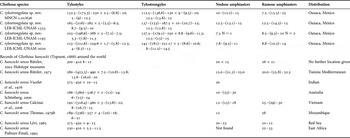
Spicules: the megascleres are tylostyles and tylostrongyles (Table 2). The tylostyles are mostly straight, with the shaft wider in the middle part than at the ends. Their heads are well differentiated with a globular or oval form (Figure 7A). Tylostyles measure 103–(202)–286 × 1.7–(6.3)–12.5 µm; head 3.3–(7)–13 µm diameter. Tylostrongyles are less frequent than tylostyles. They are usually straight with a well-formed globular head (Figure 7B). Measurements: 112–(162)–251 µm × 5–(9.6)–15 µm, and head diameter is 7.3–(2.7)–15 µm. Microscleres are amphiasters in two categories (Table 2): (1) smooth and nodulose amphiasters, with short and thick shaft and rounded actins (Figure 7C); they measure 7.3–(11)–15 µm in length; and (2) long branched amphiasters with robust shaft and elongated actines (8 actines) which branch at the end in two or more spines (Figure 7D); they measure 7.5–(12)–25 µm in length.
Comparative data for dimension of spicules (μm), of Clothosa tylostrongylata sp. nov., from Mexican Pacific, and different records of C. hancocki (Topsent, Reference Topsent1888). Dimensions of spicules are given as length by width of the shaft. Values in parentheses are means.

DISTRIBUTION AND ECOLOGY
The species has been found excavating the coral Pocillopora damicornis at San Agustín (Oaxaca) (Figure 1), between 4 and 6 m depth. Despite extensive surveys undertaken in different coral reefs, the species was found only in this locality. This is one of the less common clionaid species from the Mexican Pacific coast.
ETYMOLOGY
The name ‘tylostrongylata’ alludes to presence of tylostrongyles as a distinctive characteristic of this species.
REMARKS
Cliothosa tylostrongylata sp. nov. is characterized mainly by having tylostrongyles, which are present in all specimens examined. This character has never been reported for any Cliothosa species.
The closest species to Cliothosa tylostrongylata sp. nov. is C. hancocki Topsent, Reference Topsent1888, with which it shares similar spicular complement and spicules morphology. The main difference between the two species is the presence of tylostrongyles in the new species. In addition, size of tylostyles is also different. In C. tylostrongylata sp. nov. tylostyles measure from 103 to 286 µm. Instead, the different records of C. hancocki show longer tylostyles: from 280 to 490 µm in the Mediterranean Sea (Rützler, Reference Rützler1973), from 275 to 450 µm in the Indian Ocean (Vacelet et al., Reference Vacelet, Vasseur and Lévi1976), from 166 to 443 µm in Australia (Schönberg, Reference Schönberg2000) and from 192 to 490 µm in Vietnam (Calcinai et al., Reference Calcinai, Azzini, Bavestrello, Cerrano, Pansini and Thung2006) (see Table 2). Cliona quadrata (Hancock, 1849) is another species of this genus, but its validity has been questioned due to its similarity with C. hancocki (Calcinai et al., Reference Calcinai, Bavestrello and Cerrano2005). Nevertheless, C. quadrata does not have tylostrongyles or nodular amphiasters.
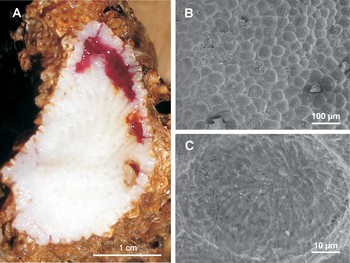
Thoosa purpurea sp. nov. (A) Cross-section of coral branches showing the chambers formed by sponge tissue; (B) scanning electron microscopy images of erosion on the walls of excavated chambers; (C) detail of ornamented pit.

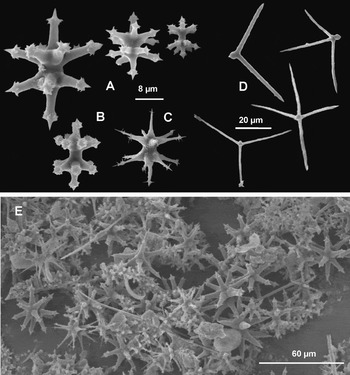
Scanning electron microscopy images of spicules of Thoosa purpurea sp. nov. (A) Amphiasters category with a few strong hook-like curved spines at the end; (B) amphiasters with abundantly microspined ends; (C) amphiasters both shaft and rays slender, ending in sharp point with large conical spines at side; (D) oxyasters bi- tri- tetra-radiate; (E) diverse spicular complement shaped of amphiasters, arrow show a centrotylote oxea.

TYPE MATERIAL
Holotype: MNCN 1.01/635, Caleta de Bines, Isla Socorro (Revillagigedo), 18°44′10″N 110°57′37″W, 5 m depth, 6 May 2008.
Paratypes: BMNH 2010.11.01.6 Bahía Braulia, Isla Socorro (Revillagigedo), 18°43′44″N 110°56′08″W, 8 depth, 5 November 2009. LEB-ICML-UNAM-1674, Caleta de Bines, Isla Socorro (Revillagigedo), 18°44′10″N 110°57′37″W, 5 m depth, 6 May 2008. LEB-ICML-UNAM-1879, Caleta de Bines, Isla Socorro (Revillagigedo), 18°44′10″N 110°57′37″W, 6 m depth, 5 November 2009. LEB-ICML-UNAM-1880, Bahía Braulia, Isla Socorro (Revillagigedo), 18°43′44″N 110°56′08″W, 8 m depth, 5 November 2009.
DESCRIPTION
Sponge has very small and scarce papillae (Figure 8A). If the coral is fragmented, the purple tissue of the sponge is visible to the naked eye. Papillae are circular-shaped, from 0.7 to 1.2 mm in diameter. No distinction between inhalant and exhalant papillae was made. The choanosomal tissue is jelly-like and has a fleshy consistency. The colour in life, of both papillae and choanosome is bright purple; after fixation they turn dark brown or ochre.
Erosion patterns: the species produces spherical–ovoid (from 3 to 5 mm) to elongated chambers (1.1 × 0.3 cm on average) generally with longer axis parallel to the substratum surface. The chambers are separated from each other by substrate walls (from 1.2 to 3.5 mm), and usually lie near of the surface (between 1 to 2 mm). They are connected to papillae by slender channels from 0.4 to 0.8 mm in diameter. Erosion marks (Figure 8B) circular to oval shaped from 31 to 62 µm in diameter are evident in chambers (Figure 8C).
Spicules: the species has tylostyles, two amphiaster categories and oxyasters bi- tri- and tetra-radiate (Figure 9). Tylostyles not found in all specimens. Measurements: 105–(186)–222 × 2.5–(3)–3.8 µm; and 3.8–(4.8)–6.3 µm of head diameter. Common amphiaster category (1) has 6 smooth rays at each side of the shaft, with extremes spinated and ending in a sharp point. Two types of amphiasters can be separated: (i) amphiasters have a stout or thin shaft and relatively large rays, with a few strong hook-like spines at the end (Figure 9A). They are very variable in size, 10–(30)–46 µm × 5–(22)–38 µm; and (ii) amphiasters quite similar to type 1, but rays are relatively shorter and have abundantly microspined ends (Figure 9B). Measurements: 18–(21)–25 µm × 12–(14)–19 µm. Less common amphiaster categories (2) have 7 rays on each side of the shaft, both shaft and rays are slender, ending in a sharp point with large conical spines (Figure 9C). Measurements: 18–(20)–39 µm × 12–(16.5)–27 µm. Smooth oxyasters with an elongated or irregular centre at the junction, which can be biradiate, triradiate, or tetraradiate (Figure 9D). Measurements: 22–62 µm. Centrotylote smooth or microspined oxeas are also present (see Figure 9E). Measurements: 105–(186)–222 × 2.5–(3)–3.7 µm; 3.75–(4.8)–6.2 µm in the centre.
ETYMOLOGY
The specific name purpurea alludes to the typical colour of the sponge.
DISTRIBUTION
The species was found excavating pocilloporid dead branches from Isla Socorro (Revillagigedo archipelago) (Figure 1), between 5 to 8 m deep.
REMARKS
Thoosa purpurea sp. nov. constitutes the third species of the genus Thoosa from the Eastern Pacific Ocean.
The only known species from the same area are Thoosa mismalolli Carballo et al., Reference Carballo, Cruz-Barraza and Gómez2004 and T. calpulli Carballo et al., Reference Carballo, Cruz-Barraza and Gómez2004, which are clearly different from T. purpurea sp. nov., in tissue colour and spicular complement. Thoosa mismalolli is a light brown sponge with bulbose amphiasters with reduced actines and very short spines. Thoosa calpulli is of a pale beige colour, with symmetrical oxyasters with six rays, biradiate oxyasters like bird wings, and smooth or spined centrotylote oxeas, which are missing in T. purpurea sp. nov.
A similar species to Thoosa purpurea sp. nov is T. armata Topsent, Reference Topsent1888 from Gabon (Atlantic Coast of Africa). The species has amphiasters with strong hook-like curved spines similar to those of T. purpurea sp. nov., but in addition, Topsent (Reference Topsent1888) showed a spicular complement formed by pseudosterrasters and biradiate oxyasters resembling bird wings, which are absent in Thoosa purpurea sp. nov. In subsequent descriptions by the author from Seychelles (Topsent, Reference Topsent1904), and Azores (Topsent, Reference Topsent1918), he also mentioned the presence of pseudosterrasters.
Thoosa armata has been also recorded from the Red Sea and Indian Ocean (Lévi, Reference Lévi1965; Thomas, Reference Thomas1973). The specimens of Lévi (Reference Lévi1965) have amorphous amphiasters and do not have tylostyles, and the specimens of Thomas (Reference Thomas1973), possess globose nodular microspined amphiasters similar to T. mismalolli amphiasters.
DISCUSSION
The taxonomy of the sponges has been traditionally based on the skeletal elements and their arrangement in the body (see Hooper & Van Soest, Reference Hooper and Van Soest2002). In particular, species of the family Clionaidae are relatively easy to identify based on skeletal characteristics, shape and size of tylostyles and spirasters (Schönberg, Reference Schönberg2000; Carballo et al., Reference Carballo, Cruz-Barraza and Gómez2004). However, some groups of species display an almost identical spicular complement (e.g. Cliona viridis-complex) that made their identification very difficult. In these cases, other characteristics like burrowing patterns, papillae shape, size and colour, and ecological characteristics, prove useful to discriminate between species (see Hartman, Reference Hartman1957; Rosell & Uriz, Reference Rosell and Uriz1991, Reference Rosell and Uriz1997, Reference Rosell and Uriz2002).
The species of the Cliona viridis-complex are characterized by having a typical brown to dark brown, olive-brown, or olive-green colour, usually caused by symbiotic zooxanthellae (Calcinai et al., Reference Calcinai, Bavestrello and Cerrano2005; Vacelet et al., Reference Vacelet, Bitar, Dailianis-Zibrowius and Perez2008). These species are highly destructive, both excavating and encrusting the substrate, and can cover surfaces from a few centimetres to 1 m in diameter (Schönberg, Reference Schönberg2000; Rützler, Reference Rützler, Hooper and Van Soest2002; Zea & Weil, Reference Zea and Weil2003; Vacelet et al., Reference Vacelet, Bitar, Dailianis-Zibrowius and Perez2008). Most of the specimens reported in the alpha stage have irregular-shaped papillae and a typical dark colour (see Carballo et al., Reference Carballo, Sánchez-Moyano and García-Gómez1994; Schönberg, Reference Schönberg2000). Cliona tropicalis sp. nov. was always found growing with papillae, never encrusting the substrata, but the typical external characteristics of the viridis complex have never been seen in our specimens. In the last years molecular tools have provided alternative approaches to morphological taxonomy, principally in discrimination of species-complex (Sole-Cava & Boury-Esnault, Reference Solé-Cava and Boury-Esnault1999; Nichols & Barnes, Reference Nichols and Barnes2005; Blanquer & Uriz, Reference Blanquer and Uriz2007). However, they are poorly implemented in boring sponges (Barucca et al., Reference Barucca, Azzini, Bavestrello, Biscotti, Calcinai, Canapa, Cerrano and Olmo2007).
The new species Cliothosa tylostrongylata sp. nov. and Thoosa purpurea sp. nov. are also part of a species-complex represented by the species C. hancocki (Topsent, Reference Topsent1888) described from the Mediterranean Sea and T. armata Topsent, Reference Topsent1888, from Gabon (Atlantic Coast of Africa), respectively, which have a widespread distribution. At present, we could differentiate the new species based on the characteristics of spicular complements; T. purpurea sp. nov. lacks pseudosterrasters and biradiate oxyasters (like bird wings), which are present in T. armata; while C. tylostrongylata sp. nov. differs from C. hancocki, by having tylostrongyles as complementary megascleres, and smaller tylostyles than those recorded for C. hancocki. The subtle but consistent morpho-spicular differences, in addition to geographical distance, are sufficient argument to consider our specimens as separate species.
Our knowledge of the sponge fauna on Mexican Pacific coral reefs has increased in the last few years. Undoubtedly, boring sponges with 22 known species so far, constitute the group that has been more thoroughly studied, with the Mexican Pacific Ocean as one of the best known areas for boring sponges of the world (Carballo et al., Reference Carballo, Cruz-Barraza and Gómez2004, Reference Carballo, Hepburn, Nava, Cruz-Barraza and Bautista-Guerrero2007, Reference Carballo, Cruz-Barraza, Nava and Bautista-Guerrero2008b; Bautista-Guerrero et al., Reference Bautista-Guerrero, Carballo, Cruz-Barraza and Nava2006). However, this is the first contribution to the sponge fauna of the Revillagigedo archipelago. These islands are recognized by their high degree of endemism, because in the area organisms from the Indo-Pacific, Gulf of California and the Mexican Pacific converge. Although the archipelago has been the subject of numerous investigations on terrestrial and marine fauna and flora (Strong & Hanna, Reference Strong and Hanna1930; Durham & Barnard, Reference Durham and Barnard1952; Squires, Reference Squires1959; Herrera, Reference Herrera1960; Rioja, Reference Rioja1960; Villalobos, Reference Villalobos, Adem, Cobo, Blásquez, Miranda, Villalobos Herrera and Vásquez1960; Caso Reference Caso1962; Chan, Reference Chan1974; Holguin, Reference Holguin, Ortega and Castellanos Vera1994; Ketchum & Reyes-Bonilla, Reference Ketchum and Reyes-Bonilla1997, Reference Ketchum and Reyes-Bonilla2001; Ochoa et al., Reference Ochoa, Reyes Bonilla and Ketchum1998), there are no studies on Porifera.
ACKNOWLEDGEMENTS
The authors thank Clara Ramírez for help with the literature and Arturo Núñez and Cristina Vega for their assistance in the sampling (ICML—Mazatlán). We also appreciate the help of the Ing. Israel Gradilla (Centro de Nanociencias y Nanoestructuras, UNAM) for the SEM images and Carlos Suarez and Germán Ramirez for their computational assistance. Thanks to SAGARPA for the permission DGOPA.00978.120209.0457 conferred for the collection of the samples. This research has been partially supported by the project SEP-CONACYT-102239.