

Introduction
Several insects exhibit phenotypic plastic responses to varying environmental conditions (West-Eberhard, Reference West-Eberhard2003). On both a spatial and temporal scale, mosquitoes encounter variable environmental conditions that can induce changes in individual traits, including development, growth, fecundity, gonotrophic cycles and lifespan, along with effects on population performance. Since individual to population level changes of mosquitoes can impact disease transmission (Dye, Reference Dye1986), the effects of the environment on these insects are important, both ecologically and medically. Photoperiod (day length) is an abiotic factor that provides valuable information on seasonal changes and often acts as a cue to induce phenotypic plastic changes in organisms. In several insects, fluctuations in photoperiod can induce changes in behaviour, development and growth, or induce diapause as unfavourable conditions approach (Tauber et al., Reference Tauber, Tauber and Masaki1985; Nylin and Gotthard, Reference Nylin and Gotthard1998). Specifically, in mosquitoes, photoperiod can alter life history traits and induce diapause in some species (Anderson, Reference Anderson1968; Jordan and Bradshaw, Reference Jordan and Bradshaw1978; Hawley et al., Reference Hawley, Reiter, Copeland, Pumpuni and Craig1987; Lanciani and Anderson, Reference Lanciani and Anderson1993; Leisnham et al., Reference Leisnham, Towler and Juliano2011; Yee et al., Reference Yee, Juliano and Vamosi2012; Costanzo et al., Reference Costanzo, Schelble Jerz and Keenan2015).
The Asian tiger mosquito, Aedes (Stegomyia) albopictus (Skuse) and the yellow fever mosquito Aedes (Stegomyia) aegypti (Linnaeus) (Diptera: Culicidae) are well-studied species due to their medical importance, as they vector several human pathogens. Aedes aegypti is the primary vector for dengue fever, chikungunya, yellow fever and the emergent Zika virus in several regions of the world (Tabachnick, Reference Tabachnick1991; Hayes, Reference Hayes2009; Paupy et al., Reference Paupy, Ollomo, Kamgang, Moutailler, Rousset, Demanou, Hervé, Leroy and Simard2010; Richards et al., Reference Richards, Anderson and Alto2012; Vega-Rúa et al., Reference Vega-Rúa, Zouache, Girod, Failloux and Lourenço-de-Oliveira2014). Aedes albopictus also serves as a vector for dengue and chikungunya, and has been implicated as a potential vector for Zika, Ross River, West Nile, La Crosse and Eastern equine encephalitis viruses (Gratz, Reference Gratz2004; Paupy et al., Reference Paupy, Ollomo, Kamgang, Moutailler, Rousset, Demanou, Hervé, Leroy and Simard2010; Rezza, Reference Rezza2012; Richards et al., Reference Richards, Anderson and Alto2012; Grard et al., Reference Grard, Caron, Mombo, Nkoghe, Mboui Ondo, Jiolle, Fontenille, Paupy and Leroy2014; Vega-Rúa et al., Reference Vega-Rúa, Zouache, Girod, Failloux and Lourenço-de-Oliveira2014). The impact of numerous environmental factors, including temperature, rainfall, larval competition and nutrition on the life history and population dynamics of Ae. albopictus and Ae. aegypti have been extensively studied (Alto and Juliano, Reference Alto and Juliano2001; Costanzo et al., Reference Costanzo, Kesavaraju and Juliano2005; Alto et al., Reference Alto, Lounibos, Mores and Reiskind2008a; Bevins, Reference Bevins2008; Delatte et al., Reference Delatte, Gimonneau, Triboire and Fontenille2009; Joy et al., Reference Joy, Arik, Corby-Harris, Johnson and Reihle2010; Roiz et al., Reference Roiz, Rosà, Arnoldi and Rizzoli2010; Mohammed and Chadee, Reference Mohammed and Chadee2011; Brady et al., Reference Brady, Johansson, Guerra, Bhatt, Golding, Pigott, Delatte, Grech, Leisnham, Maciel-de-Freitas, Styer, Smith, Scott, Gething and Hay2013, Carrington et al., Reference Carrington, Armijos, Lambrechts, Barker and Scott2013a, b; Waldock et al., Reference Waldock, Chandra, Lelieveld, Proestos, Michael, Christophides and Parham2013). Despite the importance of photoperiod as a seasonal cue, relatively few studies have investigated the effect of photoperiod regimes on the ecology and life history of these two species (Lounibos et al., Reference Lounibos, Escher and Lourenço-de-Oliveira2003; Leisnham et al., Reference Leisnham, Towler and Juliano2011; Yee et al., Reference Yee, Juliano and Vamosi2012; Costanzo et al., Reference Costanzo, Schelble Jerz and Keenan2015).
Aedes albopictus is native to Asia and India (Hawley, Reference Hawley1988), but has been successfully introduced to nearly every continent throughout the world, including North America (Lounibos, Reference Lounibos2002). In the United States, Ae. albopictus ranges across 36 states, most in the southeast, but populations have been detected as far north as New Jersey, New York and Pennsylvania (Enserink, Reference Enserink2008). Originating from Africa, Ae. aegypti is established in many tropical and sub-tropical regions throughout the Americas, the African continent, India and Southeast Asia. In the US, Ae. aegypti occupies 23 states (also mainly in the southeast), and is found as far north as Indiana and Kentucky (Darsie and Ward, Reference Darsie and Ward2005; Reiter, Reference Reiter2010; Eisen and Moore, Reference Eisen and Moore2013). For both species, many populations around the world encounter seasonal fluctuations in photoperiod and can remain active during periods with shorter day lengths, particularly Ae. aegypti (Reiskind and Lounibos, Reference Reiskind and Lounibos2013; Tsunoda et al., Reference Tsunoda, Cuong, Dong, Yen, Le, Phong and Minakawa2014). Aedes albopictus and Ae. aegypti both have evolved receptivity to photoperiodic fluctuations, and females have been found to exhibit species–specific responses in life history. For instance, Ae. albopictus females emerge at different body sizes across different photoperiod treatments, and under shorter day lengths, produce diapausing eggs. Aedes aegypti females cannot produce diapausing eggs and are unable to exhibit plasticity in body size across different photoperiods, but increase blood-feeding activity and live longer as adults under shorter day conditions (Lounibos et al., Reference Lounibos, Escher and Lourenço-de-Oliveira2003; Leisnham et al, Reference Leisnham, Towler and Juliano2011; Yee et al., Reference Yee, Juliano and Vamosi2012; Costanzo et al., Reference Costanzo, Schelble Jerz and Keenan2015).
To date, little is known of how photoperiod may affect population performance (e.g. survival and population growth) in Ae. albopictus and Ae. aegypti. In addition, most studies have focused on female responses of these two species to photoperiod (Lounibos et al., Reference Lounibos, Escher and Lourenço-de-Oliveira2003; Leisnham et al., Reference Leisnham, Towler and Juliano2011; Costanzo et al., Reference Costanzo, Schelble Jerz and Keenan2015), since females are the sex that transmits diseases important to human health. However, male responses to environmental factors are also of interest, not only to reach more accurate predictions of the population performance, but to also provide information on if males and females respond differently to environmental variation (sexually dimorphic responses), which is illustrated in several insects (Teder and Tammaru, Reference Teder and Tammaru2005).
Mosquitoes exhibit sex-based differences in life history traits because males and females achieve maximum fitness through different developmental strategies (Steinwascher, Reference Steinwascher1982; Kleckner et al., Reference Kleckner, Hawley, Bradshaw, Holzapfel and Fisher1995). Females maximize fitness by emerging at a larger size, which increases their fecundity, but they attain this larger size at the expense of a slower developmental rate (Steinwascher, Reference Steinwascher1982; Briegel, Reference Briegel1990; Lounibos et al., Reference Lounibos, Suárez, Menéndez, Nishimura, Escher, O'Connell and Rey2002). In contrast, males maximize their fitness by increasing their rate of development with associated costs of a smaller body size. This earlier emergence (protandry) provides more mating opportunities and a greater probability of access to virgin females (Steinwascher, Reference Steinwascher1982).
Because of these different selective pressures on development and growth between the two sexes, different plastic responses to variable environments may have been selected for in males and females. In Ae. albopictus and Ae. aegypti, differences in male and female phenotypic responses have been illustrated across varying environmental conditions such as resource levels, temperatures, predator regimes and competitive environments (Juliano, Reference Juliano1998; Bedhomme et al., Reference Bedhomme, Agnew, Sidobre and Michalakis2003; Costanzo et al., Reference Costanzo, Muturi and Alto2011a; Padmanabha et al., Reference Padmanabha, Bolker, Lord, Rubio and Lounibos2011; Wormington and Juliano, Reference Wormington and Juliano2014). With respect to photoperiod, Yee et al. (Reference Yee, Juliano and Vamosi2012) found that Ae. albopictus females illustrated a stronger response in life history traits to photoperiod and found a greater degree of sexual dimorphism between male and female size and development time when reared in longer day photoperiod treatments. However, the trends in Ae. albopictus life history traits across photoperiod studies are inconsistent (Yee et al., Reference Yee, Juliano and Vamosi2012; Costanzo et al., Reference Costanzo, Schelble Jerz and Keenan2015), due to varying experimental protocols (e.g. temperature, resources); thus, it is of interest to measure these responses under different environmental conditions. In Ae. aegypti, sexual dimorphic responses to photoperiod have yet to be investigated. Since photoperiod is an important seasonal cue that induces phenotypic change in insects, and males and females experience different selective pressures to maximize fitness, it is of interest to determine if males and females respond differently to photoperiod regimes.
In this study, we investigate the effect of photoperiod on population performance (survival and population growth) of both Ae. albopictus and Ae. aegypti. In addition, we aim to detect if there are any differences in male and female phenotypic responses (developmental rate, body size) to photoperiod in both species. We also compare the performance of both these species across three photoperiod treatments in laboratory experiments.
Materials and methods
Experiment I: Ae. albopictus
This experiment tested the effects of varying photoperiod regimes on male and female development time and body size, along with population growth and survival to adulthood in Ae. albopictus. The experiment was conducted using an F10 progeny of field-collected Ae. albopictus from Miami, FL. On the first day of the experiment, 400 ml Tri-Pour® beakers were filled with 340 ml of deionized (DI) water and 45 first-instar (~24 hr) larvae added to each beaker. We added to each unit 0.03 ± 0.0005 g of 1:1 lactalbumin: yeast (by volume) as a resource. The beakers were placed in one of three environmental chambers, all with a temperature of 25 °C. Each chamber represented one of the following photoperiod treatments: (1) short day (10:14 Light: Dark), (2) control (12:12 L:D) and (3) long day (14:10 L:D). There were 10 replicates (beakers) for each photoperiod treatment, resulting in 30 experimental total units. The photoperiod times applied in the treatments are within 30 min of the maximum and minimum day lengths in summer and winter at 25−26° latitudes (http://aa.usno.navy.mil/data/docs/RS_OneYearphp) and are close to or identical treatments that have been used in other studies with Ae. albopictus and Ae. aegypti (Lounibos et al., Reference Lounibos, Escher and Lourenço-de-Oliveira2003; Yee et al., Reference Yee, Juliano and Vamosi2012; Costanzo et al., Reference Costanzo, Schelble Jerz and Keenan2015). In nature, fluctuations in photoperiod are often coupled with changes in temperature; however, we aimed to isolate the effects of photoperiod as an independent cue. We selected a temperature of 25 °C because it represents an intermediate of the range of temperatures experienced in Miami, FL from the onset of autumn to late spring (20−28.3 °C), (http://www.weather.com/weather/wxclimatology/monthly/USFL0316).
To prevent resource depletion, 0.015 g of lactalbumin yeast was added to each cohort (beaker) on days 5 and 10 of the experiment. Each day of the experiment, any pupae from each cohort were transferred to individual vials with DI water until eclosion. Following eclosion, adult mosquitoes were sacrificed by freezing, and stored in a drying oven (60 °C) for at least 24 h. Adult mosquito wings were dissected and mounted on microscope slides, and wing length measured as a proxy for adult size (Leica application suite ver. 1.7.0).
Experiment II: Ae. aegypti
This experiment tested the effects of varying photoperiod regimes on Ae. aegypti male and female development time and body size, as well as population growth and survival to adulthood. The experiment was conducted using F4 progeny of field-collected Ae. aegypti from Miami, FL. Identical photoperiod treatments, temperature, water volume, resource levels and resource additions were applied as the first experiment with Ae. albopictus. The only difference between experiments was that in experiment II, 40 first instar larvae were added on the first day of the experiment and six replicates represented each photoperiod treatment. All other protocols implemented (including daily data collection and mosquito processing) were identical to those used in the first experiment with Ae. albopictus.
Data and analyses
In both experiments, we measured mean development time (days from hatching to adult ecdysis) and adult size (wing length in mm) for males and females. For both species, we calculated survivorship to adulthood (number of adults/initial number of larvae), and the finite rate of increase (λ′) of each replicate. This composite index of mosquito performance is based on r′, which estimates the realized per capita rate of population changes for each replicate [λ′ = exp (r′)], (Livdahl and Sugihara, Reference Livdahl and Sugihara1984). We calculated λ′ for each cohort as follows:
 $$\begin{equation*}
\lambda '\ = \ {\rm{exp}}\left[ {\frac{{\ln \left[ {\left( {1/{N_0}} \right)\sum {{A_x}f\left( {{w_x}} \right)} } \right]}}{{D + \left[ {\sum\limits_x {x{A_x}f\left( {{w_x}} \right)/} \sum\limits_x {{A_x}f\left( {{w_x}} \right)} } \right]}}} \right],
\end{equation*}$$
where N 0 is the initial number of females in a cohort (assumed to be 50% of the initial cohort), Ax is the number of females eclosing on day x, wx is a measure of mean female size on day x per replicate, f(wx ) is a function relating fecundity to female size, and D is the time (in days) for a newly eclosed female to mate, obtain a blood meal and oviposit. For Ae. albopictus, D is 14 days (Livdahl and Willey, Reference Livdahl and Willey1991), whilst for Ae. aegypti, D is 12 days (Grill and Juliano, Reference Grill and Juliano1996). The size−fecundity relationship for Ae. albopictus applied is f(wx ) = 78.02(wx ) – 121.24, (r 2 = 0.713, N = 91, P < 0.001), (wx = wing length in mm), (Lounibos et al., Reference Lounibos, Suárez, Menéndez, Nishimura, Escher, O'Connell and Rey2002). In experiment II, emerged Ae. aegypti females were small in size, so we used the cube of the wing length for all calculations (wx 3 = (wing length in mm)3). The size−fecundity relationship for Ae. aegypti applied is f(wx 3 ) = 2.5(wx 3 ) − 8.616 (r 2 = 0.875, N = 206, P < 0.001) (Briegel, Reference Briegel1990).
We ran identical analyses for both experiments unless otherwise specified. All of the analyses described below were done for both Ae. albopictus and Ae. aegypti separately. For Ae. albopictus, the λ′ data did not meet the assumption of normality (which transformations did not eliminate), so we performed a Kruskal–Wallis test (PROC NPAR1WAY, SAS 9.1) to detect any differences in Ae. albopictus λ′ across photoperiod treatments. For Ae. aegypti, the λ′ data met all assumptions, and we ran an analysis of variance (ANOVA), (PROC GLM, SAS 9.1) with photoperiod treatment as a fixed effect. A general linear mixed-model (PROC GLIMMIX, SAS 9.1) was used to detect differences amongst proportion survival to adulthood for cohorts across photoperiod treatments with the replicate as a random effect.
A multivariate analysis of variance (MANOVA) (PROC GLM, SAS 9.1) was run on the life history traits (development time and adult size) with photoperiod, sex and the interaction of photoperiod by sex as independent variables to detect any effect of photoperiod treatment, sex, and if the response to photoperiod treatments varied by sex. Standardized canonical coefficients were used to assess the relative contribution of each dependent variable to the effect (Scheiner, Reference Scheiner, Scheiner and Gurevitch2001). The sexual dimorphism of size and development time within a treatment were calculated by subtracting the male mean wing length and development time from that of the female (e.g. female wing length–male wing length), (Yee et al., Reference Yee, Juliano and Vamosi2012). The difference in sexual dimorphism across treatments was analysed by a MANOVA with photoperiod as a fixed effect. Follow-up Tukey tests (α = 0.05) were performed to detect any pairwise differences between the dependent variables across treatments and sex, depending on the analysis.
Results
Experiment I: Ae. albopictus
For Ae. albopictus, there was no significant effect of photoperiod treatment on the proportion of the population that survived to adulthood (Mixed model GLM: F = 1.73; df = 2,18; P = 0.21), (mean % survival ± 1 standard error, short day: 52.52% ± 0.07, control: 52.88% ± 0.03, long day: 54.67% ± 0.05). There was also no effect of photoperiod on the population growth index λ′ (χ2 = 2.63; df = 2; P = 0.27), with λ′ estimates above 1 in all treatments, indicating a positive population growth (median ± interquartile ranges: short day: 1.112 ± 0.091, control: 1.123 ± 0.023, long day: 1.111 ± 0.026).
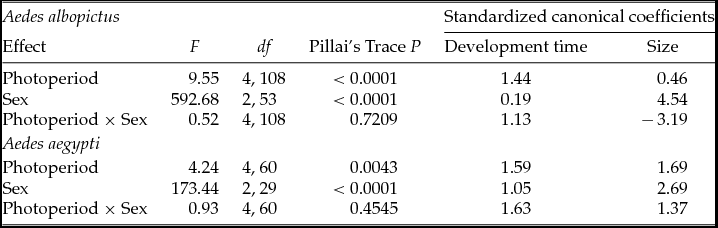
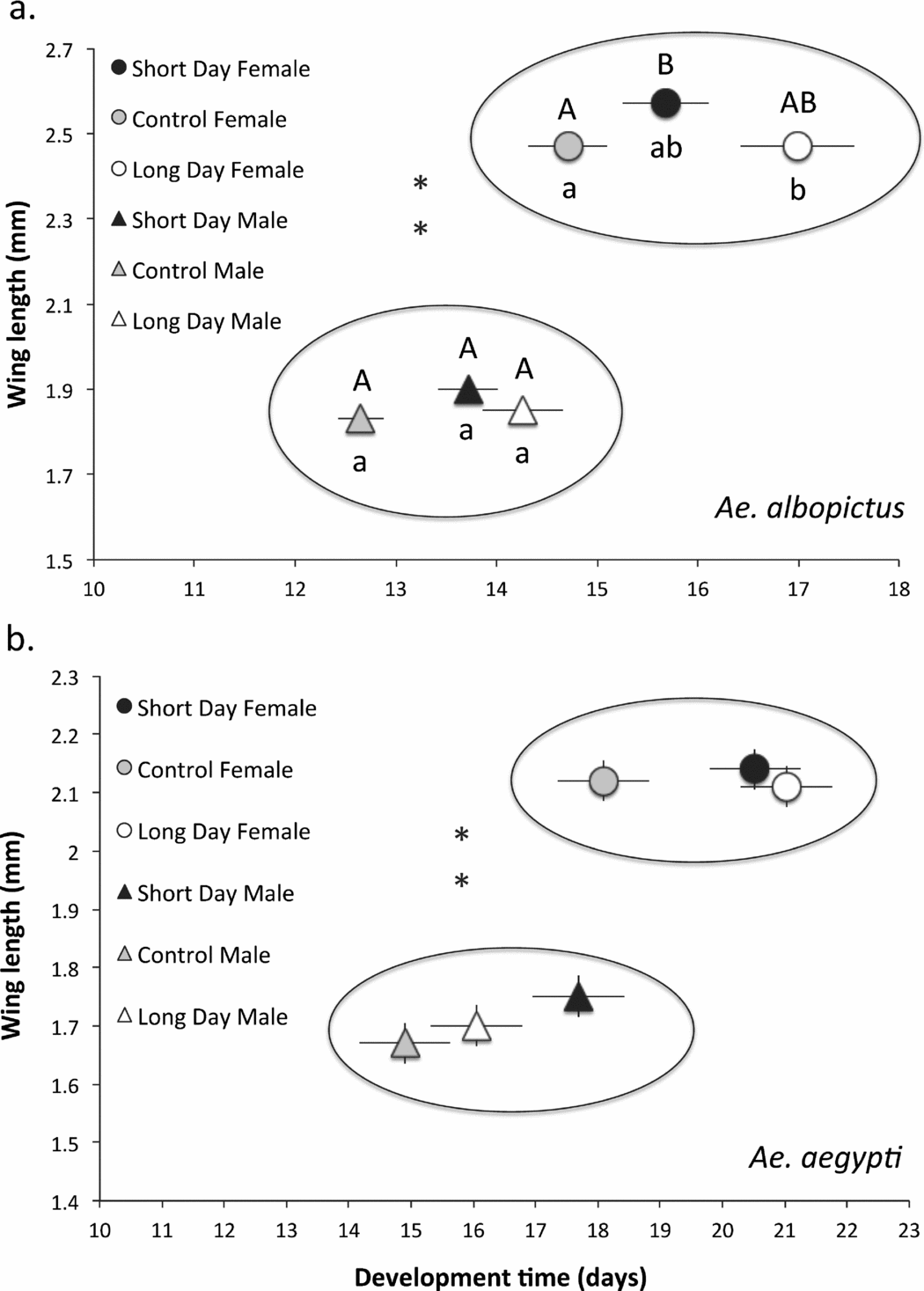
Both photoperiod and sex had a significant effect on Ae. albopictus life history dependent variables, whilst the interaction of treatment by sex was not significant (Table 1). Standardized canonical coefficients show that variation in development time was more affected by photoperiod treatment, whilst the sex effect could explain more of the variation in size (Table 1). In the short-day treatments, adult females were significantly larger in size compared to the controls, whereas there was no difference in male adult size across treatments (Fig. 1a). Females took longer to develop in the long-day treatments compared to controls, whilst no difference in male development times was detected across treatments (Fig. 1a).
MANOVA results on life history traits in Aedes albopictus and Ae. aegypti, respectively, across photoperiod treatment, sex and their interaction

Wing length and development time of males and females for Aedes albopictus (a) and Ae. aegypti (b), across photoperiod treatments. For both species, significant differences between the two sexes for both traits are indicated with an asterisk. For Ae. albopictus, significant pairwise differences in wing length across treatments are indicated with different upper case letters, whilst significant pairwise differences in development time across treatments are indicated with different lowercase letters. For Ae. aegypti, there were no significant pairwise differences detected in development times or sizes across treatments.

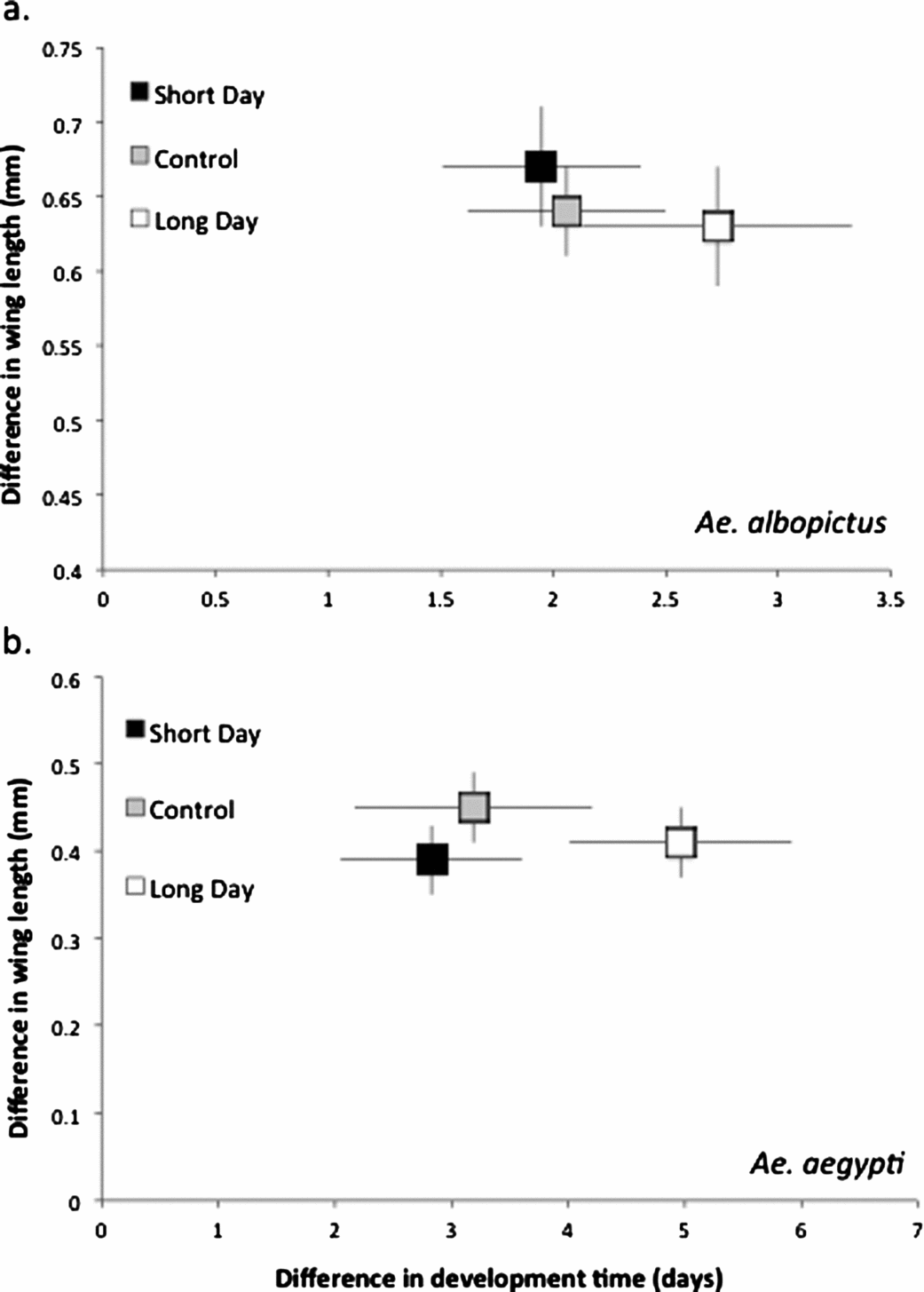
The overall trends in sexual dimorphism across all treatments were as expected, with females taking significantly longer to develop and were larger in size as adults than males (Table 1), (mean development time ± 1 standard error: males: 13.54 ± 0.23, females: 15.79 ± 0.23; mean wing length ± 1 standard error: males: 1.86 ± 0.01, females: 2.50 ± 0.01). Across photoperiod treatments, the magnitude of sexual dimorphism did not vary (e.g. female size–male size) (F = 0.6; df = 4, 54; Pillai's Trace P = 0.67) (Fig. 2a).
Sexual dimorphism in development time (female development time–male development time) and size (female wing length–male wing length) for Aedes albopictus (a) and Aedes aegypti (b) across photoperiod treatments.

Experiment II: Aedes aegypti
For Ae. aegypti, there was no significant effect of photoperiod treatment on survival (Mixed model GLM: F = 0.02; df = 2,10; P = 0.98), (mean % survival ± 1 standard error, short day: 65.41% ± 0.03, control: 66.25% ± 0.07, long day: 65.83% ± 0.02). There was no effect of photoperiod on the population growth index λ′ (F = 0.42; df = 2,15; P = 0.66), and all cohorts illustrated positive population growth with λ′ estimates above 1 (mean ± 1 standard error: short day: 1.075 ± 0.007, control: 1.071 ± 0.007, long day: 1.066 ± 0.007).
The MANOVA indicated that photoperiod and sex had a significant effect on Ae. aegypti life history traits, with no effect of the interaction. Adult size contributed to slightly or substantially more of the variation detected in the treatment and sex effect, respectively (Table 1). However, the post-hoc tests indicated no significant differences in Ae. aegypti size or development times across treatments for both males and females (Fig. 1b). Between the two sexes, females took significantly longer to develop and were significantly larger as emerging adults, compared to males (mean development time ± 1 standard error: males: 16.21 ± 0.42, females: 19.88 ± 0.43; mean wing length ± 1 standard error: males: 1.7 ± 0.02, females: 2.12 ± 0.02). There was no difference found in the degree of sexual dimorphism detected across photoperiod treatments (F = 1.07; df = 4, 30; Pillai's Trace P = 0.39), (Fig. 2b).
Discussion
Although photoperiod may induce changes in life history traits and behaviour of Ae. albopictus and Ae. aegypti (Yee et al., Reference Yee, Juliano and Vamosi2012; Costanzo et al., Reference Costanzo, Schelble Jerz and Keenan2015), we found no evidence for effects of photoperiod on the population performance of both species. In our study, photoperiod affected neither the population growth index λ′ nor survivorship to adulthood. The latter suggests that any life history changes detected were not a result of density dependent effects. This study did, however, find evidence for differences in the male and female responses to photoperiod treatments (sexually dimorphic responses) in Ae. albopictus, but not Ae. aegypti.
Overall, for Ae. albopictus, we found the females were more sensitive to different photoperiod treatments, consistent with Yee et al. (Reference Yee, Juliano and Vamosi2012). Females took longer to develop in long-day treatments, with no differences in male development times detected across treatments. Since generally, shorter development times in males maximizes their fitness (Steinwascher, Reference Steinwascher1982), stronger selection towards a canalized response would be expected in males but not in females, and is consistent with our findings. In other mosquitoes, greater constraints on the development time of males have been observed in their response to environmental conditions (Bedhomme et al., Reference Bedhomme, Agnew, Sidobre and Michalakis2003).
Considering the greater fitness consequences of body size in females compared to males, one may expect the body size of males to be more sensitive to environmental fluctuations than females. However, in our study, we found that female size varied across photoperiod treatments, whilst males exhibited no differences in size. Short-day treatments produced larger Ae. albopictus adult females, consistent with Costanzo et al. (Reference Costanzo, Schelble Jerz and Keenan2015), who used identical photoperiod treatments and experimental protocols. The sexual dimorphism in the responses of adult size to photoperiod can be explained by the functional roles of the sexes in reproduction. Aedes albopictus females can produce overwintering diapausing eggs, which is reflected by their distribution extending through temperate regions around the world (Hawley et al., Reference Hawley, Reiter, Copeland, Pumpuni and Craig1987; Mitchell, Reference Mitchell1995; Leisnham et al., Reference Leisnham, Towler and Juliano2011). In Ae. albopictus, diapause is induced primarily by photoperiod (Mori et al., Reference Mori, Oda and Wada1981; Pumpuni et al., Reference Pumpuni, Knepler and Craig1992) and functions to sustain a population through unfavourable conditions, such as extreme cold temperatures or desiccation (Urbanski et al., Reference Urbanski, Benoit, Michaud, Denlinger and Armbruster2010; Thomas et al., Reference Thomas, Obermayr, Fischer, Kreyling and Beierkuhnlein2012). Diapausing eggs have higher energetic demands than non-diapausing eggs, requiring greater energy inputs from mosquitoes (Hahn and Denlinger, Reference Hahn and Denlinger2007). Thus, the shift towards a larger body size in female Ae. albopictus in shorter day lengths may be a mechanism adopted to accumulate the energy reserves to invest in diapausing eggs as unfavourable conditions approach. The lack of differences found in Ae. albopictus male adult size across treatments in our study further supports this postulate.
Despite these differences in male and female responses across treatments, we found no evidence for differences in the magnitude or direction of sexual dimorphism across treatments. Although not significant, males also trended towards a longer development time in long-day treatments and a larger size in short day treatments in long- and short-day treatments, which contributed to the lack of difference detected statistically. In another photoperiod study, a greater difference between Ae. albopictus male and female mass and development time (greater sexual dimorphism) was found in long-day conditions (Yee et al., Reference Yee, Juliano and Vamosi2012). Interestingly, the trends in body size of this study with largest females emerging from long-day conditions were the opposite of our study. These differences across studies illustrate how the interaction of photoperiod with different variables (such as temperature and resources) may alter the phenotypic consequences. Additionally, our study failed to illustrate the common trade-off associated between development time and size found in mosquitoes, with faster developmental rates associated with smaller sized adults (Kleckner et al., Reference Kleckner, Hawley, Bradshaw, Holzapfel and Fisher1995; Yee et al., Reference Yee, Juliano and Vamosi2012; Wormington and Juliano, Reference Wormington and Juliano2014). It is possible that other physiological and developmental costs not measured in this study may be associated with shorter development times.
In contrast to Ae. albopictus, female Ae. aegypti life history traits were less sensitive to photoperiod than males. For Ae. aegypti, although photoperiod affected life history traits in general (Table 1), we failed to detect any pairwise differences in the development time and size in both males and females across photoperiod treatments (Fig. 1b). Since photoperiod did not result in any significant changes across both sexes in Ae. aegypti, we also found no difference in the magnitude or direction of sexual dimorphism across photoperiod treatments (Fig. 2b). Unlike Ae. albopictus, Ae. aegypti cannot produce diapausing eggs, which is perhaps why there are consistently no effects of photoperiod found on female body size in Ae. aegypti as there are in Ae. albopictus (Costanzo et al., Reference Costanzo, Schelble Jerz and Keenan2015). Rather than diapause, Ae. aegypti has developed other mechanisms that may sustain their populations through harsh conditions, such as the production of non-diapusing eggs with an increased tolerance to desiccation (Juliano et al., Reference Juliano, O'Meara, Morrill and Cutwa2002; Costanzo et al., Reference Costanzo, Kesavaraju and Juliano2005), and a greater adult tolerance to desiccation and colder temperatures compared to Ae. albopictus (Mogi et al., Reference Mogi, Miyagi, Abadi and Syafruddin1996; Brady et al., Reference Brady, Johansson, Guerra, Bhatt, Golding, Pigott, Delatte, Grech, Leisnham, Maciel-de-Freitas, Styer, Smith, Scott, Gething and Hay2013). Furthermore, Costanzo et al., (Reference Costanzo, Schelble Jerz and Keenan2015) found in a photoperiod laboratory study that in shorter day environments, Ae. aegypti females are more likely to blood feed and live longer as adults. These may be additional strategies adopted by Ae. aegypti to increase energy reserves that can carry the population as adults through periods with reduced temperature and precipitation across their range (Costanzo et al., Reference Costanzo, Schelble Jerz and Keenan2015).
In competitive larval environments, Ae. aegypti has been shown to exhibit sexually dimorphic responses in traits least associated with fitness cost (size for males, development time for females) (Bedhomme et al., Reference Bedhomme, Agnew, Sidobre and Michalakis2003). When reared under adverse conditions (such as limiting resources and overcrowding), this sexual dimorphic response is likely due to optimization of trade-offs in a stressful environment. In our study, the environmental gradient (day length) acts as a cue signalling environmental change rather than posing a stress on the mosquitoes with associated costs. The lack of difference in the two life history traits measured in this study in Ae. aegpyti across photoperiod treatments may not encompass the changes the two sexes go through in preparation for winter months. It would be of interest to determine if Ae. aegypti males also have an increased life span in shorter day lengths as females have (Costanzo et al., Reference Costanzo, Schelble Jerz and Keenan2015), as male longevity has been shown to be more sensitive to environmental stress than that of females in Ae. aegypti (Bedhomme et al., Reference Bedhomme, Agnew, Sidobre and Michalakis2003).
Although we did not find any effects of photoperiod on population dynamics of both species, the interspecific differences in photoperiod effects on life history may have both ecological and medical implications on a seasonal, temporal scale. In the US, larval Ae. albopictus is illustrated as the superior resource competitor to several native and resident species, particularly Ae. aegypti (Juliano and Lounibos, Reference Juliano and Lounibos2005). However, environmental conditions (including resource type, resource ratios, precipitation, predation and pesticides) can alleviate the effects of competition from Ae. albopictus on other species, or even reverse the competitive advantage (Griswold and Lounibos, Reference Griswold and Lounibos2005; Costanzo et al., Reference Costanzo, Kesavaraju and Juliano2005, Reference Costanzo, Muturi, Lampman and Alto2011b; Yee et al., Reference Yee, Kaufman and Juliano2007; Murrell and Juliano Reference Murrell and Juliano2008; Alto et al., Reference Alto, Lampman, Kesavaraju and Muturi2013). It would be of interest to evaluate the effects of photoperiod on interspecific interactions of the invasive Ae. albopictus with resident species. Additionally, life history traits such as body size can have an impact on other parameters of vectorial capacity, including blood feeding behaviour and vector competence (Alto et al., Reference Alto, Reiskind and Lounibos2008b; Westbrook et al., Reference Westbrook, Reiskind, Pesko, Greene and Lounibos2010; Farjana and Tuno, Reference Farjana and Tuno2013). The effects of photoperiod on lifespan and fecundity have already been investigated (Costanzo et al., Reference Costanzo, Schelble Jerz and Keenan2015), but the impact of photoperiod on other parameters of vectorial capacity and vector competence should be evaluated as environmental factors can alter these traits (Alto et al., Reference Alto, Lounibos, Mores and Reiskind2008a; Muturi et al., Reference Muturi, Blackshear and Montgomery2012; Alto and Lounibos, Reference Alto, Lounibos, Takken and Koenraadt2013; Brady et al., Reference Brady, Johansson, Guerra, Bhatt, Golding, Pigott, Delatte, Grech, Leisnham, Maciel-de-Freitas, Styer, Smith, Scott, Gething and Hay2013).
Conclusion
We found no evidence of photoperiod affecting the population performance of Ae. albopictus and Ae. aegypti. In Ae. albopictus, photoperiod treatments produced a response in female size and development time, with no response detected in males across treatments. This sexually dimorphic response to various photoperiods can be explained both by different fitness consequences to changes in these traits between the two sexes, and by females transitioning into diapause. For Ae. aegypti, neither male nor female development time or size varied across treatments. We found no evidence for sexual dimorphic responses across photoperiod treatments in Ae. Aegypti that they exhibit under stressful conditions. The differences across species reflect different strategies adopted to sustain the population through unfavourable conditions, and could have potential ecological and medical consequences associated with the spread of these species.
Acknowledgements
We thank K. Little, M. Keenan, M. Ndhlovu, S. Schelble and S. Whittington for assistance with daily data collection and maintenance during the experiments, wing dissections and measurements. We also thank O. Akhiwu, Z. Kozlowski, A. Nottingham, M. Verdi and B. Zylinski for assistance with wing dissections and measurements. We thank B. W. Alto and J. E. Muturi for providing Ae. albopictus and Ae. aegypti eggs used to start laboratory colonies. This study was partially funded by Canisius Earning Excellence funds.