Migrant workers are profitable and beneficial to the host society only so long as they are unorganized, insecure, bereft of political rights, in a word, “exploited.”
Gary Freeman, Immigrant Labor and Racial Conflict in Industrial SocietiesFootnote 1A central tenet of international relations is that the postwar international economic order was “embedded”—governments intervened in free markets to compensate for the losses from global trade and international market volatility.Footnote 2 Ruggie describes the accommodation of market efficiency and social stability as a “compromise,” preserving liberal multilateralism with and through interventionist policies.Footnote 3 In his analysis, international economic orders reflected underlying social and political orders, and Ruggie draws attention to the “legitimate social purpose” that economic orders serve.Footnote 4 Finnemore and Sikkink characterize the postwar liberal economic order as the “coupling of power” with “a war for hearts and minds.”Footnote 5
But although analyses of embedded liberalism have emphasized shared social values of stability, order, and mutual gain, decades of scholarship have failed to critically consider the domestic prerequisites of national governments identifying and acting on shared values. The “social” in social purpose is not inherent. Its meaning is shaped by internationalFootnote 6 and domestic norms,Footnote 7 as well as democratic imperatives to include some and exclude other.
We argue in this article that migration created a fundamental tension in the postwar liberal international order (LIO), and that tracing how states grappled with migration reveals central dynamics in both the rise and decline of embedded liberalism. Postwar economic growth in many advanced industrial democracies was driven by migration, but compensatory policies under embedded liberalism excluded migrants. Advocates of a return to embedded liberalism or something like itFootnote 8 have identified the importance of compensation to make globalization work, but have not grappled with the fundamental tensions between domestic liberalism and the international liberal order in a world of migration. States are the decisive actors in establishing social purpose in the international economy but they are also bound by territory and citizenship.
Analyses of embedded liberalism have focused overwhelmingly on flows of goods and capital, implicitly assuming that labor represented just another factor of production. But just as active welfare regimes and capital controls were essential components of the embedded liberal order, as Lake, Martin, and Risse observe, so too were restrictions on the democratic and social rights of migrants.Footnote 9 This combination of economic openness and political closure has been characterized as a “liberal paradox.”Footnote 10
Embedded liberalism came under strain in the 1970s, buffeted by the rise of finance and the decline of Anglo-American leadership. Here we draw attention to parallel processes putting strain on the order's common social purpose. Just as the LIO expanded to include new countries and industries via international trade integration, advanced democracies were met with new obligations to integrate migrants socially and politically, not merely economically. As advanced industrial democracies made citizenship and social policies more inclusive, they put strain on the common “social purpose” that had been implicit in embedded liberalism's domestic political foundations.
To describe how labor-receiving states managed the tensions created by migration under embedded liberalism, we introduce the concept of exclusionary openness: policy regimes that combine openness to labor migration with strict limits on the social rights available to migrants. These policy regimes place bounds on the citizenship (legal status, implying full legal and political rights) and membership (belonging and social inclusion, delineating in-group members who fully enjoy the benefits of compensation, protection, and rights) of migrants.Footnote 11 Boundedness is central to democratic theory, defining the demos who may participate in democratic lifeFootnote 12 and determining whom the state registers, regulates, and taxes. This generates a tension: the territorial boundaries established by the Westphalian state system are only coterminous with the population within that territory in a world without migration. In a world of migration, states must either restrict the citizenship and membership rights of migrants, or expand their definition of “the people” to include them. The latter choice, we argue, undermined embedded liberalism from below because “social purpose” had been maintained through selective, purposeful social closure.
Taking a historical institutionalist approach, we trace how policies enacted to support migration in the postwar international order have had unanticipated consequences for politics today. Focusing on the paradigmatic cases of Germany and the United Kingdom, and drawing additional comparative insights from Japan, we examine the tensions of migration and embedded liberalism and the ways that advanced industrial economies have attempted to manage them.
In bringing together two literatures that have developed largely in isolation from one another—citizenship and international political economy—we show that the widely heralded “globalization trilemma”Footnote 13 provides an incomplete picture of the stakes of “democracy” or “autonomy” because it disregards how flows of labor affect the composition of national political communities. International economic liberalism in a world of nation-states exists in tension with domestic democratic liberalism, which values social and political equality. Our argument likewise joins the international politics of embedded liberalism with the established literature on social exclusion and the welfare state.Footnote 14 We see these processes as fundamentally intertwined, as do many others, but we identify how these domestic processes have shaped—and have been shaped by—the LIO over the past seventy-five years. In addition to attending to how the changing structure of the international economy has undermined embedded liberalism,Footnote 15 international relationship scholarship must also grapple with the role of inclusionary citizenship and immigration policies in eroding the domestic constituency for embedded liberalism from below.
We are aware that our argument has disquieting implications. Many believe that the embedded liberal era provided a better foundation for democratic capitalism in a global economy than its neoliberal successor, and one might conclude that the key to restoring embedded liberalism is to reconstruct its exclusionary foundations. Although we do not endorse this view, we do hold that only by understanding how embedded liberalism actually functioned can we understand how it might be rescued, and the value in doing so. We address this in our conclusion.
Embedded Liberalism and the Challenge of Migration
Following Abdelal and Ruggie, “the core principle of embedded liberalism is the need to legitimize international markets by reconciling them to social values and shared institutional practices.”Footnote 16 This perspective sees the legitimacy of economic liberalism at the international level as being achieved through compensatory policies at the domestic level that respond to the volatility and economic transformation that accompany international economic integration. These may include capital controls, active labor market policies, robust welfare state policies, and Keynesian demand management.Footnote 17
Reconciling the market and state constitutes what Ruggie describes as a “compromise” of embedded liberalism: the state stepped in to manage the domestic economic dislocation associated with international economic liberalism. This distinguished embedded liberalism from the classical liberal order that existed prior to World War I, which saw steady increases in international trade and investment as well as domestic economic transformation toward a market-based economic system, but without any concomitant effort to manage the dislocations that accompanied rapid economic change. This “disembedded” the economic order and—in the analysis of Karl PolanyiFootnote 18 and the generation of policymakers who followed him—was ultimately self-undermining because the social and political dislocations of economic transformation were too much for societies to bear. The new liberal order that emerged following World War II would need to ensure that states would be able to ease the costs to their citizens. Those citizens, in turn, would come to support that liberal order, institutionalizing economic openness within a self-sustaining system of national democratic politics.
In practice, embedded liberalism introduced liberal multilateralism alongside active economic management. Institutionalized in the areas of international monetary and financial governance, multilateralism was sufficiently flexible to balance international market pressures with the requirements of domestic stability, including social obligations. Yet structural exemptions in the LIO left significant discretion for the advanced industrial economies to navigate “legitimate social purpose” and domestic disruption for themselves. For example, the General Agreement on Trade and Tariffs (GATT) secured a new trade regime but included many exemptions, such as for exhaustible natural resources, minimum labor standards, environmental concerns, and national security.
Exemptions also facilitated flexibility. The Bretton Woods financial system committed countries to a fixed exchange rate regime, coupled with capital and credit controls to ensure that the states maintained macroeconomic policy autonomy.Footnote 19 In principle, the constraints were not fixed. Therefore, the practice of embedded liberalism reveals not only a series of compromises but also innovations and flexibility.Footnote 20 As Haggard and Simmons note, the common social purpose was “elastic enough to subsume a fairly wide range of ‘norm-governed changes,’” including the protectionism of the 1970s.Footnote 21 Among these compromises were participation exemptions in international trade agreements that allowed for domestic safeguards for balance-of-payment reasons, which evolved alongside the international trade regime itself.
There were also sectoral exemptions. Ruggie mentions textiles and agricultural exemptions specifically as being excluded from trade agreements because of their central importance to national economies and democratic constituents. These exemptions were not a core design feature of the LIO, but rather they were more an evolving practice. And quantitative restrictions in these areas have been “relatively modest,” their purpose being to “slow down structural change and to minimize the social costs of domestic adjustment.”Footnote 22 Finally, Ruggie notes that the embedded liberal order did not fully include developing countries,Footnote 23 whose inclusion would be disruptive to mutual prosperity (although he also believed that this represented a missed opportunity).
Despite its focus on national labor under economic globalization, the literature on embedded liberalism is strangely silent on a key area where they directly intersect: migration. For example, the very logic of embedded liberalism envisions national governments encouraging “an international division of labor which, while multilateral in form and reflecting some notion of comparative advantage (and therefore gains from trade), also promised to minimize socially disruptive domestic adjustment costs as well as any national economic and political vulnerabilities that might accrue from international functional differentiation.”Footnote 24 But in countries devastated by World War II, labor shortages were a pressing issue. The concerns of the classic embedded liberalism literature were the division of labor and gains from trade, overlooking the initial availability of labor to achieve those ends.
We start from the position that migration lies at the heart of the international liberal order,Footnote 25 with labor functioning as another factor of production that—like goods, services, and capital—flowed across national borders. In fact, migration is a central feature of economic liberalism more generally. For example, as mercantilism transitioned to “disembedded” liberalism of the midnineteenth century, states saw unprecedented population movement both within Europe and to new settler states.Footnote 26 Omitting migration from analyses of embedded liberalism not only misses a larger economic story of how certain states were able to economically revive and thrive so robustly after World War II, it also misses the politics of how social purpose is designated, and for whom.Footnote 27 Polanyi's understanding of embeddedness explicitly rejects an apolitical understanding of a market system as distinct from the social foundations that support it.Footnote 28 It is precisely because migration affects social structures as well as economic outcomes that embedded liberalism must attend to its effects on the LIO.
We consider how states regulate social boundaries between insiders and outsiders, using immigration and citizenship policies. In this balancing act—constructing a distinction between migrants as labor and citizens as social rights-bearers—we explain how legitimate social purpose was defined, obtained, and eventually abandoned.
Citizenship, Migration, and the Politics of Social Purpose
Every subfield of political science recognizes the importance of boundaries. The field of international relations primarily conceives of boundedness as territorial: as the physical demarcation of space. This is derived directly from Max Weber's definition of the state, as a “community that successfully claims the monopoly of the legitimate use of physical force within a given territory.”Footnote 29 But demarcation is not just territorial, it is also social. States designate who is and is not a member of the national political community, and therefore a recipient of status, rights, protections, and obligations. The ability to designate is a reflection and extension of a state's administrative capacity, and depends on its relationship with its community members.Footnote 30 For the modern state, citizenship denotes the relationship between the state and the community on whose behalf it acts.
Citizenship is the formal institutional expression of national belonging,Footnote 31 and the infrastructure for extracting and distributing resources between individuals and the state. Weber's definition of the state makes no mention of the population within it, but some residents claim rights and status as citizens, whereas others—residents, foreigners, and other nonstatus outsiders—merely live there. These distinctions shape the demographic, military, and social characteristics of nation-states. As Torpey illustrates, one could define the state not by territory but by its “monopolization of the legitimate means of movement.”Footnote 32 Citizenship, as Brubaker defines it, operates as both an “instrument and object of social closure,”Footnote 33 prohibiting individuals from accessing territory or the national in-group. According to Brubaker, the modern state is not a territorial organization but rather a membership organization that confers or withholds access based on national interest.
We are not the first to have noticed that migration might challenge the embedded liberal order. Nearly three decades ago, Hollifield noted that an increase in international migration could jeopardize the liberal economic order by challenging what he termed the “the national perquisites [sic] of sovereignty and citizenship.”Footnote 34 Nor are we the first to observe the surprising consequences of political inclusion. Dancygier, in her theory of immigrant conflict, describes how—in the context of economic scarcity—native–immigrant conflict emerges where migrants have electoral power.Footnote 35 But, uniquely, we join these observations and locate them in the early days of embedded liberalism, in state arrangements to deliver on “legitimate social purpose” by demarcating domestic recipients of social compensation and rights from labor.
To capture the role of citizenship and immigration policymaking in the politics of embedded liberalism, we generate a typological space in which citizenship and immigration policy interact. This approach preserves their unique but often complementary characters while allowing for different configurations of policy. In this schema, citizenship is a status and a set of rights. In Thomas H. Marshall's definition, full citizenship was receiving social rights, from “a modicum of welfare and security to the right to share to the full in the social heritage and live the life of a civilized being according to the standards prevailing in society.”Footnote 36 In fact, this understanding of citizenship rights is located institutionally not in border control, or ministries of justice, but in the welfare state, which grew alongside the rise of embedded liberalism. Immigration, by contrast, regulates the movement of individuals into state territory. Another way to conceptualize this difference is as one between “external” and “internal” closure:Footnote 37 the former restricts the movement of people, the latter restricts the rights and privileges available to those who have migrated. They are distinct, but logically related; Michael Walzer describes membership as the “primary good,” where distributional decisions concern “present and future populations.”Footnote 38
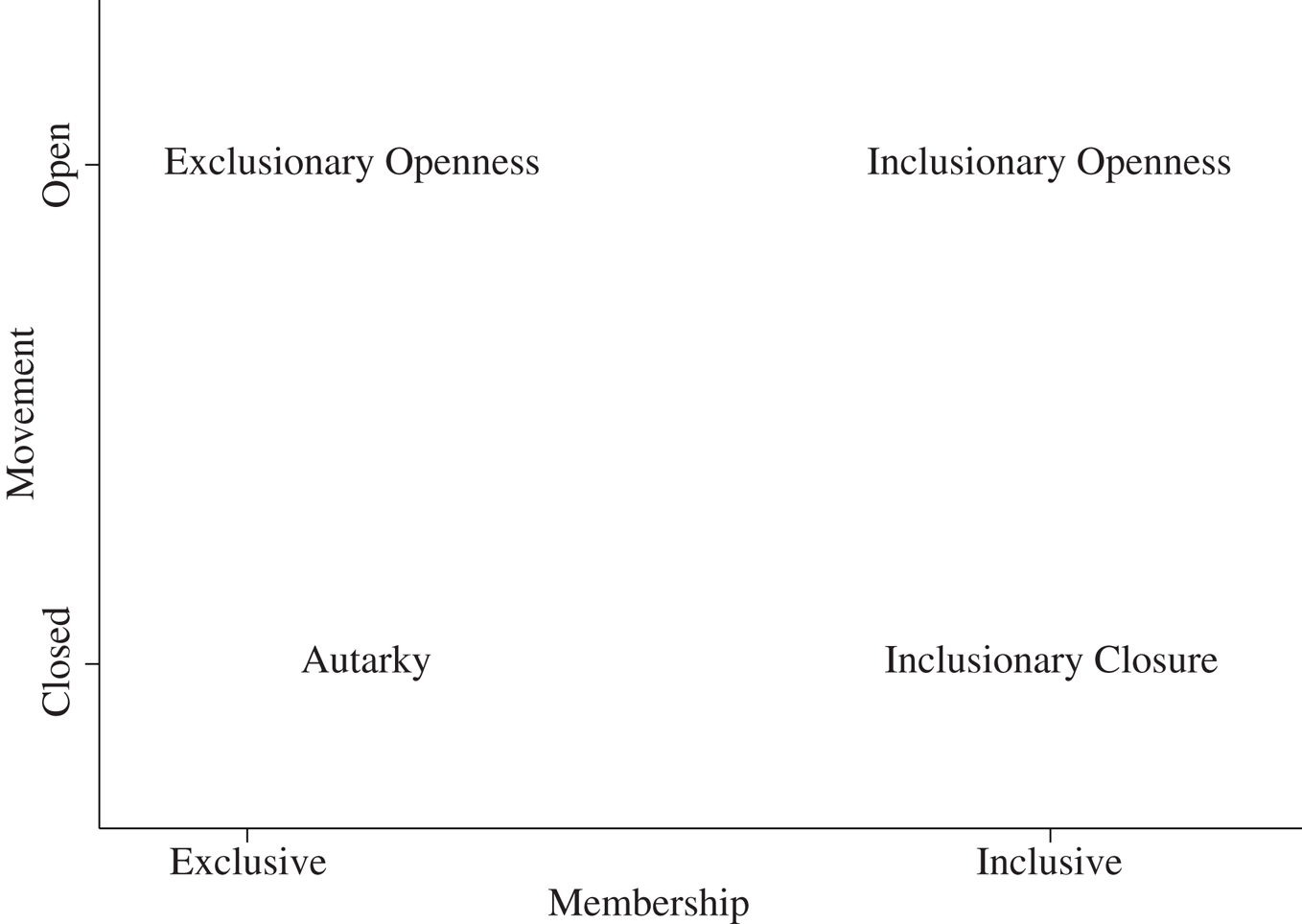
With this distinction, we present four general constellations of migrant management policy in Figure 1. Under autarky, social and physical borders are closed, thereby establishing firm boundaries around the political community that correspond to the country's residents. Inversely, when migration is and membership policies are inclusive, boundaries on the political community are comparatively low (represented in “inclusionary openness”). The lower-right quadrant constitutes what we call “inclusionary closure,” describing a regime that restricts movement of people but adopts few or no restriction on citizens once admitted.Footnote 39 Last, the upper-left quadrant—what we term “exclusionary openness”—allows for cross-border population movement but restricts access to the rights associated with citizenship and national membership. These constellations are ideal types; in reality, there are intermediary positions between openness and closure, between restriction and inclusion, and movement in between.
Migration and membership policy

Our particular interest is this last type: exclusionary openness, in which states accept immigrants but restrict membership, limiting access to political status and social-civil rights. As we show, restrictions on citizenship and social were—like capital controls and trade exclusions—part of the domestic bargain that compensated for economic openness. Three features characterize exclusionary openness in practice: (1) openness to migration; that is, to the cross-border movement of people to support the new LIO; (2) commodification of migrants as labor; and (3) restrictions on citizenship and membership rights to migrants and their descendants. Although the specific details of exclusionary openness vary across national contexts, such regimes establish balance necessary for embedded liberalism, allowing labor to flow across national borders while compensating citizens for the dislocation that this may create.
Our contribution is not simply to identify the configuration of exclusionary openness, but rather to show how it reflects an essential tension between democratic politics at home and imperatives of the economic international liberal order. Material prosperity from economic integration—of goods, capital, and labor—provided the economic basis for shared prosperity. The embedded liberal order was politically sustainable just as long as democratic governments produced benefits and protections for their citizens.
Embedded Liberalism: Migration Openness and Social Closure (1945 Through the 1970s)
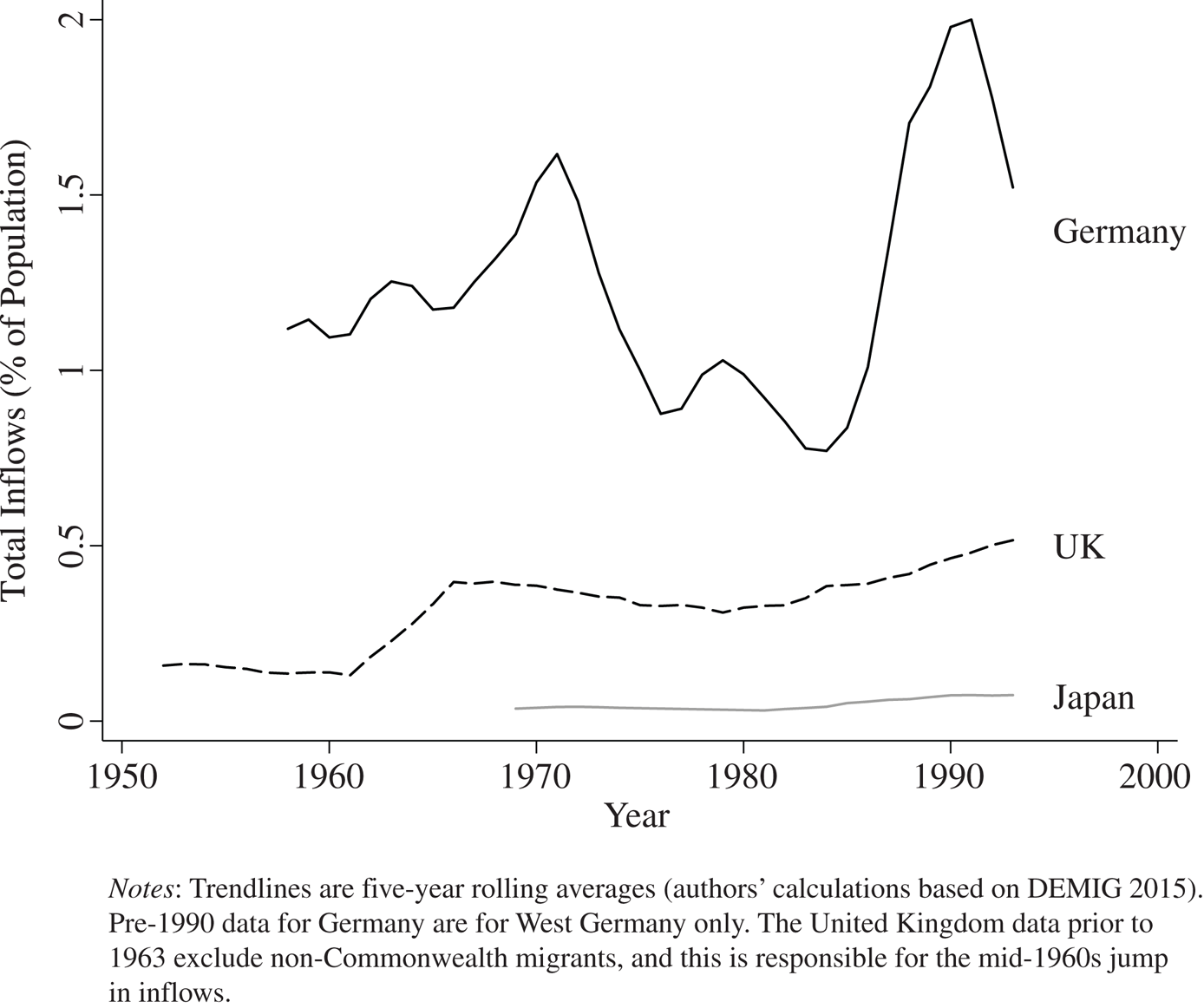
To illustrate the exclusionary social foundations of embedded liberalism, we follow the embedded liberal compromise through two epochs: its origins and growth (1945 through the early 1970s), and its crisis and decline (from the late 1970s onward) in Germany and the United Kingdom. Each confronted a severe domestic labor shortage immediately following World War II, and their responses illustrate the different ways that the advanced economies have resolved the tensions between migration and citizenship. Trends in immigration inflows as a percentage of national population appear in Figure 2, alongside comparison with Japan, which grew rapidly without labor migration, choosing autarky instead. Germany achieved robust economic growth under embedded liberalism through a classical presentation of exclusionary openness; that is, guest workers were welcomed but with social and political exclusion that lasted generations. In the United Kingdom, we see an initial approach of inclusionary openness that they quickly abandoned, adopting instead a series of postcolonial citizen stratification reforms. In particular, this case highlights the politically unsustainable domestic costs of its initial policy of openness.
Migrant inflows, 1950 through 1995

The postwar liberal order supported cross-border economic flows, and migrants were a key part of these robust cross-border exchanges. However, migration was largely unregulated at the international level, and no liberal regime for migration emerged.Footnote 40 What the LIO did provide was a compensation norm; in exchange for economic openness and high global growth, states would reconcile market liberalization with societal demands for stability through capital controls and compensatory policies that reduced unemployment and welfare inequalities. As economic openness necessitated domestic regulations on market competition in key sectors, so too, analogously, did labor mobility necessitate domestic social controls to reduce the potential dislocation from labor migration. Decisions about what these controls would be—although largely unguided by international factors (effectively relegated to the states in pursuit of “legitimate social purpose”)—were strongly constrained by domestic forces, from the interests of stakeholders and firms to the electoral interests of governing elite. We discuss subsequently the three conditions that produced exclusionary openness.
Openness to Migration
First, the pursuit of economic growth through embracing labor migration—although an opportunity created under the postwar LIO—was not one pursued by all industrialized states. Migration to labor-receiving countries such as Germany and the United Kingdom was instrumental in supporting their postwar recovery. Kindleberger showed that the influx of foreign labor into Germany was responsible for the country's rapid economic expansion.Footnote 41 He also attributes the United Kingdom's relatively anemic early growth rates to constraints on labor supply, noting that immigration from both Ireland and the United Kingdom's former colonies was an essential source of labor for British manufacturing but also produced a political backlash as a result.Footnote 42 By contrast, Japan's rapid economic recovery proceeded without large inflows of foreign labor, a fact that Kondo and others attribute to large amounts of internal (rural to urban) migration, rapid mechanization of unskilled labor, and far longer working hours relative to Europe.Footnote 43
Commodification of Migrants as Labor
For immigrant-receiving countries in Western Europe and North America, migration in the immediate postwar era—following massive flows of refugees and returnees after the war itself—was almost singularly economic. To fuel the industrial production that spurred the postwar economic recovery in which native workers were increasingly moving to middle-class work. Western European countries in particular began to seek labor from abroad. This choice, however, had consequences: opening up national economies to migration and trade exposed domestic economies to international markets in goods and labor. In the absence of robust international governance in the realm of migration,Footnote 44 the responsibility of managing the potential domestic implications of labor migration fell to national governments.
The distributional effects of immigration within countries are a subject of considerable debate.Footnote 45 Migrants whose labor substitutes for native labor, or who enter inflexible labor markets, may undermine wage rates and increase native unemployment. If, on the other hand, migrant labor is a complement to native labor and labor markets are relatively flexible, then migration may improve labor market efficiency without undermining native labor's wages or employment.Footnote 46
Balancing these costs and benefits—much like pursuing economic openness alongside social purpose—is the responsibility of national governments. Just as they regulate other aspects of globalization in the interests of their citizens, these governments regulate immigration in ways that reflect domestic priorities. And Germany and the United Kingdom reveal instructive differences in how governments sustained the embedded liberal compromise. Both, along with other northern European countries, began intensive labor recruitment drives to rebuild postwar economies, both through intentional bilateral labor agreements and as the incidental consequences of decolonization. But where Germany rebuilt by sustaining a domestically popular model of guest worker recruitment alongside rights exclusion, the United Kingdom illustrates the domestic costs of inclusion. It “accidentally” admitted thousands of Commonwealth citizens with access to jobs and social rights, and subsequently “course-corrected” to pacify elite opposition and retain a governing majority. In the subsequent case studies, we illustrate how the domestic politics of embedded liberalism necessitated social exclusion of migrants, satisfying the third condition of exclusionary openness: restrictions on the social and economic rights available to migrants.
Germany and Classic Exclusionary Openness
Despite a long-running doctrine that Germany was kein Einwanderungsland (“not a country of immigration”), and in fact passed its first comprehensive immigration bill only in 2004, German postwar economic recovery was intimately connected to migration. By accepting migration but limiting social and membership rights, Germany exemplifies exclusionary openness. After initial assistance from the Marshall Plan, and an influx of returnees and refugees, West Germany sought to maintain its “economic miracle” through a deliberate strategy for labor migration recruitment. This guest worker (Gastarbeiter) programFootnote 47 established bilateral agreements first with Italy (1955), then with Spain and Greece (1960), and later with Turkey (1961), Morocco (1963), and Yugoslavia (1968). Immigrants were recruited for manual labor and low-skilled positions in agriculture and industry, under contracts designed to be temporary and rotational, and by the time the oil crisis ended recruitment, “some 3 million non-nationals remained in the country … and were soon joined by spouses and dependents.”Footnote 48
Immigration made possible both economic growth and a generous welfare state. By the early 1960s, native-born unemployment was almost zero. By filling industrial and agricultural jobs, guest workers were not competing with West Germans but were specifically credited for moving native workers into the middle class, moving into managerial and clerical positions.Footnote 49 The programs were economically and politically popular, supported by “a robust political consensus” and, as James Hampshire observes, “it is remarkable how guestworker recruitment was viewed as an essentially technocratic administrative issue.”Footnote 50 The consensus extended to include employers’ associations and especially unions, which, along with the federal government, “were united by the underlying common goal of economic growth” through recruitment policies.Footnote 51
But while native Germans were experiencing social mobility and rising welfare, immigrant lives were far more precarious. First and fundamentally, they lacked a right to citizenship, and therefore to participation and representation. But, most immediately to their needs, foreigners did not have a right to residence, and were permitted to stay only as long as they met “the needs of the Federal Republic,” according to the 1965 Ausländergesetz (Foreigner's Act). This residential insecurity had practical consequences; for example, in response to rising unemployment in 1966, many guest worker contracts were not renewed in order to protect the employment of native workers. Rotation worked initially but failed in subsequent attempts.
In the labor market itself, immigrants also experienced significant exclusion, from good wages and mobilityFootnote 52 and from sector-based representation. This labor commodification of migrants was deliberate, as Green observes: “to minimise costs for society (which would arise in the form of schools, housing and health care provision for permanent immigrants and their dependents), the Federal Labour Office usually favoured young, single men.”Footnote 53 There were also exclusions in recruitment: German employer associations successfully lobbied to downgrade Italy's recruitment priority status, even though Italians workers were included in European Common Market regulations.Footnote 54 Finally, although activities such as joining trade unions were encouraged, they yielded mixed integration results.Footnote 55 Foreign workers had to actively lobby and organize strikes against major unions to get them to press for stronger protections, rights, and representation.Footnote 56 Likewise, recruiting employers were responsible for providing accommodation, but this obligation ended if a worker changed jobs, thus constraining worker mobility.
All of these limitations reflected an attempt, as Straubhaar describes, to maximize the “allocational benefits” of migration while reducing its “distributional costs” on Germans, specifically referencing citizenship as an example of the latter.Footnote 57 The “robust political consensus” among the federal government, firms, and employer associations supported exclusionary openness, which maximized the profitability of migration while reducing its social costs on Germans.
From Inclusionary to Exclusionary Openness: The United Kingdom
The United Kingdom exhibits a different trajectory in which instead of offsetting economic openness with social exclusion immediately after the war, British policymakers “accidentally” experimented with inclusionary openness. Starting from a position of maximal openness toward immigration by default, Gary Freeman notes, one can “interpret much of post-war immigration policy in Britain as an attempt to remove rights of citizenship too generously extended during the colonial period.”Footnote 58 Exclusion was not achieved by making citizenship restrictive, but by redefining eligibility for entry based on technicalities of Commonwealth status. As Christian Joppke remarked, “the peculiarity of British immigration policy is that it is directed not against aliens, but against formal co-nationals.”Footnote 59
Beginning with the British Nationality Act (BNA) of 1948, the United Kingdom conferred citizenship—and with it, access to the British labor market—to all Commonwealth subjects.Footnote 60 Given acute labor shortages in the aftermath of World War II that remained unfilled by refugee and Irish labor, the British government “at best passively tolerated”Footnote 61 migration from the Commonwealth, as opposed to implementing active recruitment policies such as those in Germany.Footnote 62 In time, the so-called Windrush Generation (named after the ship that brought 500 Jamaican migrants to the United Kingdom in 1948) brought hundreds of thousands of migrants from across the Commonwealth, which, along with other postcolonial migration, transformed Britain into a multicultural society.
Although immigrants filled a variety of vital labor demands, migration almost immediately became associated with race and social concerns. Even while entry numbers were initially small, government ministers expressed “considerable public concern” that migration—particularly non-White migration—would pose a social problem, specifically to Britain's cultural homogeneity.Footnote 63
Given not only political pressures to keep the multiethnic Commonwealth together, but also the expansiveness of Commonwealth subject rights, Conservative governments of the 1950s were restricted in how much they could limit migration. In this classic example of a two-level game,Footnote 64 the British government balanced domestic interests against maintaining ties with the (New) Commonwealth countries. In the end, unlike the consensus exhibited in German policymaking, Britain's migration was regulated by markets and labor demands, not politics. Yet government was not entirely toothless; instead of legislating social closure, they instructed administrative practices in the country of origin to limit “Colonial” qua “colored” migration to Britain. For example, immigration from Pakistan was curbed by issuing passports only if applicants could speak English (among other conditions), as immigrants from Asia were deemed “not as readily employable as West Indians” and “cannot be absorbed.”Footnote 65 In Jamaica, a British citizen had to show a clean criminal record. By contrast, no such practices were adopted to curb immigration from Ireland, Canada, Australia, or New Zealand.
If British subjects were able to settle in the United Kingdom, they faced immediate disadvantages and race-based discrimination.Footnote 66 Although formally enrolled for provisions such as the National Insurance system, migrants faced deep discrimination, from labor market practices—often through collusion in discriminatory practices between unions and managementFootnote 67—to housing, where blacks “were simply not considered in the massive housing reform program of the post-war Labour Government.”Footnote 68
By the late 1950s, nonwhite migration from the New Commonwealth (that is, the West Indies, India, Pakistan) outpaced Old Commonwealth migration (that is, from Canada or Australia). Rising unemployment (particularly in areas such as Yorkshire that experienced industry-specific recession and high concentration of migrant settlement) and race riots fed Conservative party beliefs that migration needed to be controlled through legislation. Therefore, the 1962 Commonwealth Immigrants Act delinked the right of entry from citizenship, meaning that immigrants from New Commonwealth countries became subject to migration controls. Entry became tied to a limited number of government-issued employment vouchers. This work voucher system was thinly veiled prejudice, reserving immigration for skilled workers with an employment offer in hand (who were disproportionately white, Old Commonwealth migrants). The remainder would be subject to entry permits that were strategically allocated based on “labour needs of the United Kingdom economy.” Hence, from 1962 onward, the state regulated immigration to fulfill labor market needs. The intention was clear: economic openness could not coincide with social openness at the domestic level. Even the Labour Party, which opposed the racialized grounds of the 1962 act, preserved it when they entered government in 1964 and extended it in the 1968 act. And, when the Tories re-entered government in 1970, these limits were expanded.
A comparison of Germany and the United Kingdom reveals how both countries reconciled the need for migrant labor with its implications for native populations. Germany adopted a planned approach, undergirded by a robust political consensus that migrants were guests. Immigration policy in the United Kingdom “corrected” for its initial inclusionary openness, limiting rights associated with British status and, eventually, limiting access to migration directly. In both cases, the result was restrictions on rights and benefits to migrants in favor of expansive welfare protections for native populations.
Challenging Exclusionary Openness: Inclusion and Its Consequences
The oil crisis of 1973 is a critical juncture between the heyday of embedded liberalism and its subsequent unraveling, between balancing economic openness with social closure on the one hand, and gradual granting of social and citizenship rights to migrants on the other. Economic restructuring reduced the industrial economies’ need for migrant labor, so guest worker and open recruitment schemes came to a grinding halt. This transformed the policy debate by revealing the “myth of the guest worker;”Footnote 69 not only did guest workers not return to their home countries—they also had brought family members with them when they migrated. Moreover, once economic opportunities for migration were closed, advanced economies began to see upticks in humanitarian-based claims.
In Germany, after the oil crisis shut down temporary migration, permanent settlement became a fact of life: three million migrants stayed in Germany, “becoming permanent ethnic minorities.”Footnote 70 As dependents came to join these family members, Joppke notes there was no serious attempt to remove or deport the guest worker population: “next to legal constraints, moral constraints kept the political elite from doing this.”Footnote 71 In fact, the “political elite developed a sense of special obligation toward the guestworker population,” with deep contestation evolving over what these obligations would look like. The “notion of prevailing elite consensus” on matters of immigration and citizenship in Germany became “difficult to sustain,” as political parties began to disagree over matters of immigrant integration and citizenship acquisition.Footnote 72 This period in postwar German history exemplifies the inherent instability of embedded liberalism's exclusionary foundations, as liberal pressures for increased mobility and moral obligations for inclusion collided with the exclusionary policy regime that had benefited native labor.
Already on the path to restriction, the United Kingdom's Conservative government rolled out its strongest immigration control yet with 1971's Immigration Act, building on the 1968 restrictions of Harold Wilson's Labour government. Replacing employment vouchers with work permits, immigration control was extended to all nationalities, exempting only those with direct personal or ancestral association to Britain (“patriality”). This act, according to Hansen, “confirmed in critics’ eyes the essentially racist character of British migration law.”Footnote 73 Restrictions increased further in 1981, limiting right of abode for non-British citizens and adding other citizenship conditions. As Figure 2 depicts, Great Britain had robust admission, particularly from the Indian subcontinent and the Caribbean, but intake plateaued for more than a decade. The Conservative government, led by Margaret Thatcher, aimed to reduce migration further in the 1980s, famously observing that “people are rather afraid that this country might be rather swamped by people with a different culture.”Footnote 74
International and Domestic Pressures for Inclusion
In the decades following the oil crisis, we see several processes at the domestic and international levels that exposed and challenged the tension of exclusionary openness—and with it, the domestic constituency for embedded liberalism. Beginning with global factors, the emergence of an international human rights regimeFootnote 75—observed in international norms, declarations, international organizations, and the widening practices of international courts—created “international legitimation” for inclusionary norms at the domestic level.Footnote 76 As Hollifield observes, “as the world has become more open, more democratic, and more liberal, people are freer to move than ever before in history. This has placed great strains on liberal states, especially on the institution of citizenship.”Footnote 77 And, in the British case, although work-based migration was severely limited following the oil crisis, the new flow of refugees from around the world—notably Tamil refugees from Sri Lanka (a Dominion of the British Empire until 1972)—presented new challenges to Britain's regime of exclusionary openness.
A second international factor pressuring toward openness was globalization itself, specifically trade integration. As Ronald Rogowski shows, trade significantly affects domestic political alignments, which can make it difficult to maintain political support for international economic policies.Footnote 78 An analogous argument applied to labor migration. Social compensation became more difficult to maintain when it was so thoroughly outpaced by international trade and its many distributional effects.Footnote 79 Domestic labor began to lose its alliances with business and agriculture. Gourevitch wrote of this period that where “business collaborated with labor in the postwar reconstruction to promote stabilization mechanisms and an open international economy,” labor costs, as well as high taxes and regulation, became viewed as barriers to both profitability and modernizing national economies.Footnote 80 Thus, trade integration not only internationalized production but also loosened the link between domestic labor and firms. We would also emphasize here the role of transnational social networks in pressuring for opening, as migrants themselves pushed for liberalization.
In Europe, these international changes were reinforced by organizations such as the European Union, bringing states together in a single market by the late 1980s, and into a political and economic union with the 1992 Maastricht Treaty. This not only brought international norms shifts to the domestic level but also created binding institutions that codified some of these norms, such as labor mobility and free movement within the Schengen zone.Footnote 81 Labor market mobility for EU citizens became so contentious that by the late 2000s, new EU citizens from Bulgaria and Romania had delayed access to the European Union's labor market, initially required instead to obtain work permits in most member states. And although formal participation in the European Union did not harmonize immigration policies for entry from outside the European Union (third country nationals) nor did it harmonize citizenship practices, it did establish minimum standards of social rights and bolstered emerging norms toward liberalizing citizenship policy.Footnote 82
Exclusionary openness was also difficult to sustain for domestic reasons. First and foremost were the long-term effects of migration itself. As the Swiss author Max Frisch wrote, “we asked for workers and we got people instead.” This revelation—that migrants were not merely human capital stock but people, with family, needs, and interests—was a belated one to policymakers and employers alike. Freeman notes that many misperceptions on migration stem from a “systematic tendency toward ‘temporal illusion’” in that “the effects of migration tend to be lagged; short-term benefits oversold and the long-term costs denied or hidden to show up clearly only in the outyears.”Footnote 83 That “economic problems” turned out to be “social” ones is a byproduct of the process of settlement and integration, inevitably positioning migration as a subject of “trade-offs” between markets and rights.Footnote 84 This required new policies in areas typically separate from immigration, such as social policy and welfare, the very areas in which embedded liberalism's “legitimate social purpose” was achieved.
These concerns interweave with a broader spectrum of philosophical and programmatic imperatives of liberal democracy, namely tolerance and equality, which by the 1980s were preserved in and asserted through strong multicultural policies. Institutional accommodation of group-based differences and group recognition became features not only of British and Dutch immigrant policy, for example, but also of states that avowedly rejected multicultural ideals but maintained multicultural practices, such as Germany.Footnote 85 This trend both reflected and moved in parallel to the waning days of the Cold War, a victory not just for economic liberalism but also for political liberalism.Footnote 86 In this environment, the political appetite for the continued domestic restriction of migrant rights declined. As Hollifield argues, “the confluence of unregulated markets for foreign labor and the rise of rights-based politics … explains the failure of restrictionist policies.”Footnote 87 Migrants and their families experienced greater access to social programsFootnote 88 and opportunities for long-term residence and eventually for citizenship itself.Footnote 89 In the United Kingdom, citizenship was among the most liberal for naturalizing immigrants, where access for postcolonial migrants became more restricted as a function of status. But liberalization never did eliminate the tensions that had produced exclusionary openness in the early days of embedded liberalism—they simply resolved them in a different way. The United States is an exemplary case.
This inclusionary norm also developed to counterbalance the xenophobia of growing far-right populist parties, first in France and Belgium. Given the documented transformation of immigration politics over the second half of the twentieth century from a market-driven movement to a sociopolitical liability, it remains unsurprising that nativist, anti-immigrant positions form the substance of the illiberal, populist backlash of the 2010s. Initially, states had been generally able to maintain liberal migration policies because these policies were set by firms who stood to gain substantially from inflows of labor, and not by the public, whose costs were more diffuse.Footnote 90 But as unemployment rose in the 1970s, so did xenophobia and racism. One immediate implication has been the rise of welfare chauvinismFootnote 91 as well as greater public opposition to immigration. We can interpret the emergence of anti-immigrant welfare chauvinism—and with it, the broader challenge to the postwar international order as a whole—as far-right populist forces responding to liberals’ efforts to challenge postwar exclusionary openness.Footnote 92
Domestic Inclusion and the Erosion of Social Purpose
The product of these many factors, as Brian BurgoonFootnote 93 and others have argued, is an erosion of domestic consensus about the “legitimate social purpose” of the embedded liberal order. As migrants and their descendants began to enjoy both the material and symbolic benefits previously reserved for only “native” citizens, they came into conflict with the group that had previously formed the key domestic constituency that had endorsed the embedded liberal bargain. Even if parties on the left were willing to accept liberalization of trade and investment, they could not do the same for migration. In sum, the push toward greater inclusiveness had the unintended effect of undermining the domestic political constituency in favor of embedded liberalism. Domestic inclusion removed boundaries surrounding social compensation, with the result that by the 1980s, economic openness without effective compensation had begun to render the “bargain” of embedded domestically untenable.
These tensions were already evident by the early 1990s, with parties such as the Austrian Freedom Party advancing the anti-immigrant “Austria First” petition while also embracing the core elements of the Austrian welfare state. In the United States, new peaks in immigration were offset by new domestic restrictions, such as California's Proposition 187 that excluded undocumented immigrants from most nonessential public services. We see the long-term consequences of this inclusion explicitly in the xenophobic backlash of contemporary politics. Today, Germany is more inclusive than ever when it comes to social rights and citizenship,Footnote 94 but migration is also a strongly divisive political issue. After Chancellor Angela Merkel opened Germany's border to more than one million asylum seekers in 2015, there was a quick sea change from the “We can do it!” (Wir schaffen das) spirit of accommodation to a backlash in coalition support, which was evident in the weak government victory and strong support for the Alternative für Deutschland (AfD) in the 2017 federal elections. Alongside rising instances of xenophobia and anti-immigrant violence,Footnote 95 the continued support for the AfD (particularly in areas marked by economic deprivation) suggests rising support for a more managed form of capitalism that could reconstruct the protections that “native” Germans had enjoyed.
Similarly, immigration restrictions and xenophobia continue to feature prominently in British national politics. By the 2010s, successive Conservative governments annually repeated a commitment to reduce immigration to the “tens of thousands,” a plainly impossible goal in an era of EU free movement and postcolonial migration networks. That migration was a central motivator for Leavers in voting for Britain to leave the European Union (“Brexit”) is not surprising given this context.Footnote 96 The prolonged process of “delivering Brexit” has included immigration restriction affecting intra-EU migration to the United Kingdom, EU-citizen settlement status in the United Kingdom, prospective migration from outside the European Union, and, potentially, immigration of students and high-skilled workers. Part of “taking back control” has also included stripping immigration status, and the deportation of immigrants who arrived as long ago as the Windrush Generation.
Developments since the 1980s show that embedded liberalism is unsustainable when combining open immigration with open membership, and a variety of domestic and international factors have pushed toward both. As immigration policies began to reflect the rise of rights-based politics—culminating with the end of the Cold War and the consolidation of the European Union as a political union—a new legal culture emerged with features that ranged from legislative acts to an increased role for ethnic-based interest groups, and which included more inclusive definitions of citizenship.Footnote 97 We can also look to specific cases to see this internal tension in balancing openness. In the United States, immigration slowly trended upward in the postwar period, reaching a peak by the 1980s. Both Thatcher and Ronald Reagan, while opening up the borders to new peaks in migration levels, also championed neoliberalism, with an emphasis on deregulation, lower taxes, and destruction of the welfare state and the social consensus on which it was built. Germany, meanwhile, incrementally liberalized citizenship access in 1999 under a Social Democratic Party of Germany (SPD)–Green coalition, only to be entrenched in counterbalancing closure moves by successive Christian Democratic Union (CDU)-led coalitions in the decade that followed.
Our analysis of how international and domestic factors challenges exclusionary openness offers a new perspective on how embedded liberalism functions and on the politics of its decline since the 1970s. The advanced industrial democracies managed the domestic costs of international economic integration by devising compensatory policies that protected the interests of their citizens. But in the absence of an international regime that governed migration, immigrant-receiving states adopted exclusionary policies that built prosperity while distinguishing sharply between the rights and privileges of workers and those of citizens: two groups that in an age of migration are not the same. As international and domestic challenges to exclusionary openness unwound those policies, so too did it unwind a common agreement on the “legitimate social purpose” of embedded liberalism.
The Autarkic Alternative?
Could the advanced industrial democracies have avoided the tensions between exclusionary and inclusionary visions of national citizenship in a world of migration? In our analysis, the only way to do so is to restrict migration altogether, thus aligning the national community with the labor force. This is the path that Japan chose.
Japan, however, is no longer as closed to migration as it was in the heyday of embedded liberalism. Reforms to Japan's immigration law in 1990 allowed for high-skill foreign workers.Footnote 98 They also allowed second- and third-generation descendants of Japanese overseas to immigrate to Japan with no skills conditions or work restrictions.Footnote 99 These policy changes in combination with growing labor market demandFootnote 100 produced conditions favorable to labor migration, and by the 2000s, the stock of foreign residents exceeded 1.5 percent of Japan's total population,Footnote 101 far below other large Organisation for Economic Cooperation and Development (OECD) economies, but higher than Japan's historical average. In large cities especially, foreign workers are now a prominent part of the labor force.
But restrictions on welfare benefits and political participation mean that Japan's citizenship policy regime has come to resemble the exclusionary openness seen in the 1960s in Europe. Erin Chung notes that “there is no legislation that explicitly protects the civil rights of foreign residents, which makes foreign residents’ rights contingent on the political climate, public debate, and administrative interpretation.”Footnote 102 Permanent foreign residents do have access to social welfare rights but can neither vote nor work in the public sector. Rights are even more limited for temporary workers, and naturalization rates remain low.Footnote 103
Japan's experience shows that by restricting immigration altogether, it was possible to avoid the tensions between labor migration and inclusive citizenship that we have identified in Western Europe. But the rising stock of migrants and their descendants means that Japan today faces a choice between liberalizing its citizenship regime and protecting what has traditionally been understood to be the Japanese national community.
Conclusion
We have argued that embedded liberalism rested on exclusionary foundations. The “social purpose” of embedded liberalism was to mitigate the effects of international economic integration specifically for members of the national community. Labor migration brought new workers, but societies erected barriers to membership through policy regimes that we have identified as “exclusionary openness.” The decline of embedded liberalism coincided with greater inclusion domestically. We are still dealing with the repercussions of this decline: the rise of exclusionary populismFootnote 104 in the advanced economies is, in our analysis, a consequence of a shift toward inclusionary openness. That is, we diagnose the origins of exclusionary populism as lying not simply in rising income inequality and runaway globalization but also in how they interacted with an ever-expanding conception of the nation, which has given populists a wedge through which to attack liberalism itself. We agree with Lake, Martin, and Risse's observation that many critics of “hyper globalization … understand it to be a dangerous betrayal of the intentions of those who constructed the LIO in the mid-twentieth century,”Footnote 105 but that those intentions rested on a politics of exclusion that promoted the interests of an imagined national community rather than some abstract notion of the common good.
Our focus on exclusionary openness highlights the “liberal paradox” of immigration. States secured international liberalism through domestic illiberalism, revealing conflict between their economic and political goals. Exclusionary openness was a stable political arrangement just as long as voters could accept the contradiction between liberal markets and illiberal social policy. But we reiterate that the shift to inclusionary citizenship does not “escape” or “resolve” the liberal paradox, any more than abandoning the nation-state would “resolve” Rodrik's globalization trilemma.Footnote 106 Liberalizing domestic politics has created a framework through which illiberal voices could use liberal spaces to press for exclusionary polices once again. This is a long-standing issue confronting democratic theoryFootnote 107 but one that reappears with new urgency today.
We see this argument as a first step toward a broader research agenda on the international dimensions of exclusionary populism, complementing a focus on the changing structure of the global economyFootnote 108 as well as toward work that introduces insights from comparative politics and economic geography into international relations.Footnote 109 Today, exclusionary populists thrive by activating welfare chauvinism and xenophobia, blaming immigrants for causing economic hardship and fostering political discord, and competing with left parties by promising to protect “native” rights and privileges. In broad strokes, populists argue that elites have sacrificed the interests of the “real” people for the interests of “outsiders.” Our account raises a number of questions that will require analytical frameworks that cross subfield boundaries. What are the mechanisms through which native populations came to understand liberalizing citizenship regimes as a threat to their identities? How do establishment parties and populist outsiders differ in their framing of the relationship between globalization and active welfare regimes? How do exclusionary populist movements in advanced democracies balance welfare chauvinism with needs for pension and labor market reforms?
Other questions target the mechanics of how international forces shaped domestic politics. To what extent did migrants themselves drive policy change through social mobilization or moral suasion? How did this vary between guest-worker-based systems and Anglo-American systems? How did international norms transform domestic policy environments, and how did elite actors reckon with the (perhaps unanticipated) backlash to liberalizing citizenship regimes? There is a rich body of research in comparative politics—stretching back to the 1980s—on outsider populist challenges to mainstream party systems upon which international relations scholarship can draw. But as the field of international relations comes to grapple with questions of race and racial orders,Footnote 110 it can also contribute to this literature with greater attention to these international sources of domestic policy change, in turn politicizing globalization and international cooperation.Footnote 111
In the spirit of Ruggie's landmark contributions to international relations,Footnote 112 our argument also raises normative questions about how best to construct an international order that balances national sovereignty and the boundedness that it requires with the globalization of goods, finance, and labor. In point of fact, national political communities have expanded in every immigrant-receiving society in the postwar era. These communities cannot achieve shared social purpose by preserving exclusive national communities defined in postwar terms. This is especially the case in a dense policy regime such as that of the European Union, where strong courts and commitments to universal rights make rights won difficult to unwind, but it is also true in immigrant societies such as the United States and Australia.
How can these tensions be resolved to preserve a LIO? One interpretation of our argument is that migration and inclusive citizenship have “gone too far,” and that therefore boundaries must be resurrected and reinforced. This is, to a first approximation, a position held by some of the tamer members of far-right and exclusionary populist parties, and some admirers of Japan's “monoethnic” society and the social solidarity that it allegedly nurtures. It is also the position implied by liberals such as David Frum, who wrote in a much-debated essay in The Atlantic, “Without immigration restrictions, there are no national borders. Without national borders, there are no nation-states. Without nation-states, there are no electorates. Without electorates, there is no democracy. If liberals insist that only fascists will enforce borders, then voters will hire fascists to do the job liberals refuse to do.”Footnote 113
We acknowledge that this might be one response to the crisis of liberalism in an era of globalization and resurgent populism, but it is not one that we endorse. Exclusionary openness allowed embedded liberalism to work, but resurrecting old boundaries to exclude existing migrant communities would almost certainly foster greater social dislocation and political conflict, undermining the shared social purpose inherent in a renewed embedded liberal model.
The alternative is to work seriously at multiculturalism and inclusion. The advanced economies must come to understand that they are, in point of fact, plural societies. Modern economies were built in significant part by migrant labor. Building common social purpose in plural societies will strengthen liberalism within these countries. Our critical perspective on embedded liberalism shows that these are not topics that can be consigned to country specialists, citizenship scholars, or democratic theorists. The normative, policy-focused research agenda that follows for international relations is whether an international migration regime could re-establish legitimate social purpose among a community of multicultural states, to construct the embedded liberal order once again.
Acknowledgments
We thank Aditi Sahasrabuddhe for outstanding research assistance, and Jeff Frieden, Henry Farrell, Jim Hollifield, Franca van Hooren, Dan McDowell, Thomas Risse, Ron Rogowski, Nita Rudra, Abbey Steele, Marcos Tourinho, Stef Walter, and workshop participants at the Free University of Berlin, Stanford, Syracuse, the University of Amsterdam, the University of Denver, and the University of Wisconsin for comments on various ideas and drafts.