“The international monetary system established at Bretton Woods … represented an attempt to impose a fictitious equality on national currencies.”
—Johnson, “Political Economy Aspects of International Monetary Reform”
I. INTRODUCTION
Recently there has been a slight increase in doctrinal histories devoted to the subject of international monetary reform, and much of the literature has been focused on the Bretton Woods era (Bordo and James Reference Bordo and James2001; Endres Reference Endres2005; Williamson Reference Williamson2006; Connell Reference Connell2013). Footnote 1 In this paper our objective is to consider a specific aspect of this subject mentioned by Harry Johnson in the epigraph to this paper. We intend to consider the debate among leading economists during the Bretton Woods era and in the decade post-Bretton Woods, on the subject of the cross-border uses of national currencies, with a view to offering a historical perspective to the contemporary discussion on this subject. Footnote 2 Lately, discussion of international monetary reform has returned to the issue of currency internationalization (e.g., United Nations Commission 2009; Eichengreen Reference Eichengreen2010; Fiorentini and Montani Reference Fiorentini and Montani2010; Farhi et al. Reference Farhi, Gourinchas and Rey2011; Fratianni Reference Fratianni2012; Prasad Reference Prasad2014). We intend to demonstrate that much of this discussion has taken place without heeding salient lessons learned in the earlier debates and without acknowledging the importance of the idea of international currency competition.
When Charles Kindleberger (Reference Kindleberger, Greenfield, Levenson, Hamovitch and Rotwein1979) posed the question in his article “Is Symmetry Possible in International Money?” he considered an issue that had been debated since the Bretton Woods (BW) meetings in 1944. Marina Whitman (1974) also inquired in her article “The Current and Future Role of the Dollar: How Much Symmetry?” and her conclusion was that the internationalization of the dollar was a matter of degree, and not all national currencies could enjoy ‘symmetry,’ which meant achieving equality with the dollar in that respect. In these contributions, “symmetry” meant either broad equality among national currencies in terms of sharing various international functions, or the creation of a single, purely international currency. As we shall see, a key lesson of the post-Bretton Woods debate was that in the absence of a single international currency, currency symmetry and currency internationalization are not equivalent concepts except in an ideal world of “equality” (to use Johnson’s term) in the use of national monies across borders. By contrast, Robert Triffin (Reference Triffin1972), essentially following John Maynard Keynes (Reference Keynes and Horsefield1943), held out the prospect that a single international synthetic money could be designed by an overarching international agreement; otherwise, glaring asymmetries in the cross-border uses of particular national monies could lead to international monetary instability. Moreover, the underlying presumption was that greater symmetry in cross-border currency use improved the prospects of international financial stability because it entailed a “measure of financial disarmament” (Keynes Reference Keynes and Horsefield1943, p. 36).
In this paper our first objective is to consider the divergent positions that developed among economists in the second half of the twentieth century on the international (cross-border) uses of national currencies. We ask the following questions: In the BW era, what specific intellectual contexts marked out different positions on the deliberate design (or otherwise) of international currency, and what specific doctrines became prominent? Our second objective is to examine how the currency internationalization debate was continued and extended to incorporate the various emerging functions of international money in the decade following the collapse of the BW system, when private capital markets and international capital flows began to increase. To foreshadow some of our conclusions, the most recent revival of the currency internationalization discussion has ignored major factors determining the extent of sharing international currency functions among national currencies. In rehabilitating the idea of creating only one synthetic international money to resolve the ‘sharing’ problem in one fell swoop, some prominent modern literature has failed to appreciate the quite different cross-border functions performed by existing national currencies. Since the 1970s those functions have become more important and have been distributed via ongoing currency competition in a world of flexible exchange rates and liberalized international financial markets—and the causes of the competitive outcomes over the relative performance of those functions among national currencies were clearly foreseen in literature during the 1960s and 1970s.
The paper is structured as follows. First, in section II we outline some standard principles and functions of international currency. Section III surveys prominent contributions to the mid-twentieth-century debate on the construction and ongoing operation of the BW international financial system that offered analysis in favor of (and against) internationalization of national currencies across a range of functions, as then understood. Section IV examines the first uses of the terms international currency “symmetry” and “asymmetry” in the late 1960s, as well as new insights turning on competition among currencies for international functions that emerged both before and after the collapse of the BW system in the 1970s. Section V considers further strengthening of the idea of international currency competition in the decades following the collapse of BW currency arrangements, and it provides, for the first time, an intellectual history perspective on the modern revival of the debate on this question in the light of the doctrinal trends and lessons learned from our survey of ideas expounded in the earlier post-Bretton Woods era. Section VI draws together our major findings that confirm the resilience, since at least the 1960s, of ideas favoring a process of currency internationalization that ultimately relies on competition among national currencies over a range of international functions.
II. “INTERNATIONAL” CURRENCY: SOME BRIEF FIRST PRINCIPLES
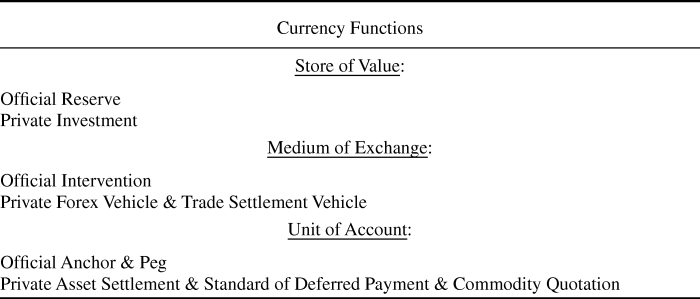
At a high level of generality, international money has three distinguishable functions in keeping with money in general: medium of exchange, unit of account (including standard of deferred payment), and store of value. The scope and range of these functions are geographically dispersed outside the country of currency origin by comparison with pure national money (Cohen Reference Cohen1971, Reference Cohen1998; Kenen Reference Kenen2011). An international currency may perform some, if not all, of several well-defined functions to a greater or lesser extent but rarely to an equal extent with others. International currency, for our purposes, is national money used for a range of cross-border functions for transactions between residents and between non-residents. Moreover, the cross-border uses of currency embody the three standard functions above, with each function further divided into private and official dimensions, as depicted in Table 1 below.
Standard International Currency Functions

Economic thought on the subject of international currency may be divided as follows:
-
1. A descriptive, empirical assessment at any one time in order to gauge the extent to which a currency is either internationalized across all major functions or internationalized in respect of singular functions (e.g., private cross-border medium of exchange or official unit of account to anchor a national currency, etc.).
-
2. A descriptive, economic history covering a period of time in order to gauge the dynamic changes in cross-border uses of a currency and assess their economic consequences.
-
3. A prescriptive account recommending changes in the functions of particular currencies in the international realm or perhaps the creation of a full-fledged international currency in its own right. Arguments turning on the narrowly national costs and benefits of currency internationalization are only one set of considerations. It is usually the case that prescriptions are also based on prognoses and assertions turning on the consequences for international financial stability if a currency retains a degree of internationalization across a range of functions, or if its role expands or contracts in respect of one or more functions. This broader consideration was dominant in debate over international currency during the BW era and in the immediate decade following the collapse of BW.
-
4. A functional account of currency internationalization in which causal assertions are made about how a currency may function in cross-border uses in a manner that contributes to greater order/disorder, integration/disintegration, stability/instability in the international financial system taken as a whole.
Appropriate to our doctrinal investigation, in the following sections of this paper we intend to concentrate on the prescriptive and functional accounts above (points 3 and 4).
III. INTERNATIONAL CURRENCY DEBATE PRIOR TO THE BREAKDOWN OF BRETTON WOODS: DIVERGENT POSITIONS ON DOLLAR DOMINANCE
One of the rationales for the BW international monetary agreement was the stabilization of all currencies, given widespread distaste for the currency exchange-rate fluctuations and competitive currency depreciations experienced in the interwar years (Nurkse Reference Nurkse1944). In the lead-up to BW we find several attempts to prescribe the roles of national currencies in the international realm. In each case the proponents thought they were making cases for an integrated, harmonious international currency order—a concordance of parts that made for coherent rather than piecemeal currency internationalization. Friedrich Hayek (Reference Hayek1937) summarized the gold standard proponents’ case for the spontaneous evolution of gold-convertible national currencies in a world of fixed currency exchange rates. Keynes (Reference Keynes and Horsefield1943) proposed a single world currency; his “bancor”’ plan and clearing union proposal is well known, though it fell by the wayside for reasons that have been widely canvassed in the historical literature. Footnote 3 Keynes’s proposal was essentially to create a strongly symmetric (and synthetic) currency in the sense that the bancor would possess all major international monetary functions—pre-eminently as an official reserve currency, but also potentially as a private vehicle currency, store of value, and international unit of account that would displace any national currency and gold in those roles (Joshi and Skidelsky Reference Joshi, Skidelsky and Claessens2010, pp. 174–175).
By contrast, and dissenting from what was eventually to become the BW consensus, John Williams ([1943] 1949, [1944] 1949) promoted a “key currency’’ approach to the cross-border use of national money. The precursor for this idea was the Tripartite Agreement of 1937, which aimed to establish stability in exchange rates among the dollar, sterling, and the French franc. In a world of many chronic debtor and creditor countries, Williams was skeptical of plans that provided either for a synthetic international currency unit or for immediate, universal currency stabilization (Dormael Reference Dormael1978, pp. 257–258; Endres Reference Endres2005, pp. 56–78; Asso and Fiorito Reference Asso, Fiorito and Leeson2009, pp. 200–209). He proposed a currency agreement between the US and Great Britain such that if the dollar and sterling were “stabilized’’ following certain uniform rules and policies in both countries, other currency units could be linked in due course to one or other key currency (following adoption of certain congruent monetary policies) and thence import that currency’s stability. Here, the normative objective was to make two currencies function equally in the international realm—supported by the fact that the rate of exchange between the two currencies would rarely fluctuate in terms of their purchasing power. This outcome was achievable only in the longer term (after large US loans to, and postwar recovery in, Britain) by strict coordination of monetary policies between the two countries (Hawtrey Reference Hawtrey1946, p. 113). In the event, the key currencies might come to share additional international functions such as reserve, intervention, unit-of-account, and vehicle roles; there would be at least weak symmetries between the dollar and sterling (and asymmetries in relation to most other currencies) in terms of sharing these international functions.
The critics of Williams’s plan were quick to condemn its hegemonic aspects. From the perspective of politics, not economics, the proposed key currency regime implied a major asymmetry in power relations based on a doctrine of “hegemonic stability.” That doctrine implied the necessary imposition of specific bilateral currency arrangements on the rest of the world by nations whose economic size was expected to dominate all others in postwar years (Kindleberger Reference Kindleberger1973, p. 28; Eichengreen Reference Eichengreen and Cooper1989). In this view, not all national monies were equal in the sense that they had the same potential to become fully internationalized. For Williams, such a world in which all currencies could be considered equal irrespective of the economic size of the issuing country, or rendered equal in terms of some legal arrangement governed by a supranational authority, did not exist and could not feasibly be created. Indeed, BW architects created what was called “legal symmetry” among currencies in terms of one particular currency property: clear multilateral rules governing the setting and changing of exchange rates (Cooper Reference Cooper1972, p. 327; Whitman 1974, p. 541). At BW rules for setting exchange rates were implicitly regarded as a necessary condition for eventually facilitating the diffusion of various international currency functions among national currencies over the long run (Johnson Reference Johnson1972). The BW fixed-adjustable par value rule for national currencies was not organized deliberately to create a single international currency that would forever become the main reserve currency, to create a single key currency, or to forever enshrine the subsequently emergent US dollar standard as the dominant international currency. It is common for modern commentators on BW not to elaborate on this crucial point when they state that the original BW Agreement “aimed to achieve symmetry positions among currencies within the international financial regime” (Hall and Tavlas Reference Hall and Tavlas2013, p. 342). The nature, extent, and realization of such “symmetry positions” were controversial, especially in respect of international currency functions.
The early discussion and reformulation of the concept of currency “convertibility” in the BW system also contained allusions to the problem of currency internationalization or its absence in respect of a principal precondition for currency internationalization: the ease and flexibility of currency conversion on the current account and capital account of a nation’s balance of international payments. The BW Agreement emphasized easing currency convertibility on the current account on member nations’ balances of payments and restricting convertibility on the capital account. At BW it became clear that strong currency ‘internationalization’ in the following four general senses of convertibility was not preferred in respect of all national currencies: (i) universal official gold convertibility for all currencies at all times (gold standard); (ii) universal currency-to-currency convertibility at officially fixed rates honored by monetary authorities (with possible exchange controls) at all times; (iii) universal currency-to-currency convertibility at market-determined rates (paper standard without exchange controls) honored by foreign exchange market participants at all times; (iv) pure national currency inconvertibility everywhere and at all times (state money with absolute exchange controls, autarky).
For Robert Triffin ([1947] 1966), the first economist explicitly to pose the issue of what he called “international versus domestic money,” all these arrangements were unacceptable. He did not dwell on the fact that under (iii) above, the concept of convertibility was redundant—it was “an empty box” (Mundell Reference Mundell, Kenen, Papadia and Saccomanni1994, p. 79). In the 1950s very few economists preferred arrangement (iii) as a way of eliminating convertibility problems. Frank Graham (Reference Graham1949) and Milton Friedman (Reference Friedman and Friedman1953) made strong cases for floating exchange rates and removal of exchange controls, while Gottfried Haberler (Reference Haberler1954) and James Meade (Reference Meade1955) made somewhat more guarded cases for market-referenced, variable exchange rates. Footnote 4 Arrangements (i) and (iv) were not widely promoted.
Economic institutions and preferred policies had not only altered the content of the idea of currency convertibility at BW; they altered the prevailing positions on currency internationalization with regard to a specific service: the mode, ease, and flexibility of cross-border currency conversion. The BW Agreement (Article VIII, section 4) embodied the obligation of monetary authorities to repurchase their national currencies used on current account transactions when presented by a foreign monetary authority. At the same time the Agreement did not insist on an obligation to present currency for immediate settlement—there was no corresponding requirement for all foreign currencies held by central banks to be converted at once. The new consensus turned on incorporating in the notion of convertibility “feasible goals of international economic policy, susceptible of concrete implementation in a concrete historical environment” (ibid.). Thus, reserve assets (preferred, useful foreign currency and foreign currency-denominated financial assets), could be accumulated by monetary authorities in any national currency of their choice. As well, exchange controls would have a legitimate place in the original BW structure in limiting international capital movements and in ruling out some transactions on current account, as required by various national economic objectives. Taking all these influences together, convertibility came to be defined in “relative not absolute terms” (Triffin [1954] 1966, p. 24; Gold Reference Gold1971, p. 58).
The implications were profound for the process of currency internationalization: a country could not always use earnings with some of its trading partners to settle deficits with others unless it transacted in a widely held international currency such as the dollar. As a vehicle currency, the dollar emerged as the prime facilitator of multilateral clearing for international transactions when not all currencies were directly convertible into another currency. The complete multilateral clearing of debit and credit balances in international payments using any currency whatsoever was not provided for in the BW Agreement. Thus, the post-1945 conventional wisdom on cross-border currency convertibility was loose enough to allow, in principle, any national currency or currencies to emerge as pre-eminently convertible. In the BW sense, “pre-eminent” meant always and everywhere officially convertible directly into a national currency or gold at a fixed rate. And the US dollar assumed this role, becoming not only a major vehicle currency; foreign par values were often set in US dollars and the dollar far and away emerged as the dominant reserve currency for international payments and official exchange-rate management. Crucially, the BW architects, and specifically the White Plan at BW, “failed to anticipate” (emphasis added) the latter outcome (Kenen 2008, p. 4). Footnote 5 Such poor anticipation was also “embodied in the original structure of the International Monetary Fund until it was modified to recognize the special status of the dollar” (Johnson Reference Johnson1972, p. 406). From the perspective of the United States, this outcome crimped the ability of the US to alter the US dollar exchange rate in a pegged rate system (barring the declaration of a new parity with gold) without supportive exchange market intervention from other countries.
In the event, the demise of the widespread convertibility condition was necessary (but not sufficient) for the dispersal of international currency functions among many currencies. The emergence of the dollar in a pre-eminently convertible role against gold and all other currencies created controversies among economists about the consequences. The US dollar standard persisted from 1950 to 1971 (McKinnon Reference McKinnon1996a, pp. 44–45). Of interest here are some of the main doctrinal reactions. The dollar standard was periodically indicted for threatening international financial stability. Specifically, the now well-known “Triffin dilemma” turned on the accumulated US dollar debts held by foreign monetary authorities and the implications of any attempts to encourage reductions of those debts (Triffin Reference Triffin1960). The other landmark achievement in economic thought during this period was in part the result of careful historical work undertaken in response to Triffin’s proposition. Here, tribute should be paid to Charles Kindleberger (Reference Kindleberger1965) for originally pointing out that the store-of-value function of the US dollar extended well beyond its dominant role in official reserves. Increasingly by the 1960s, the dollar provided a private investment and liquidity service to foreign asset holders. In short, the internationalization of the US dollar was reinforced as global financial markets gathered more depth and breadth, and private asset holders and enterprises demanded more cross-border liquidity.
It was not intended at BW that the US would be able to issue currency with impunity to finance its balance of payments in amounts potentially exceeding the US dollar demands on other nations. The fixed rate dollar standard was also indicted on a related count: it pressured all other countries (other than the US) to make balance-of-payments adjustments when currency reserves were depleted; surplus countries were not so pressured (Polak Reference Polak, Kenen, Papadia and Saccomanni1994, p. 29). Economists supporting the indictments were emboldened by the collapse of the BW system to search for what they explicitly called more “symmetrical’’ international monetary arrangements (e.g., Triffin Reference Triffin1972, p. 327). We shall now consider the surge of new literature on currency questions associated with the international monetary reform debate in the late 1960s and during the 1970s.
IV. NEW PERSPECTIVES FOLLOWING THE BW EXPERIENCE: SINGLE RESERVE CURRENCY VS INTERNATIONAL CURRENCY
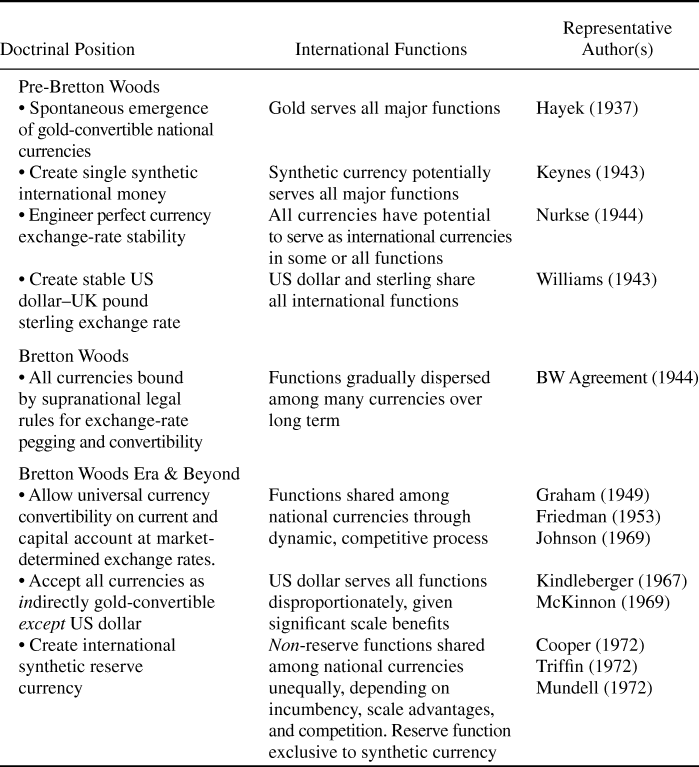
Table 2 below compares, in summary form, expressions of currency internationalization in the pre-BW and BW eras that we have just discussed, with new expressions that emerged in the post-BW era.
Alternative Approaches to Currency Internationalization 1930s–1970s

Writing before the suspension of US dollar–gold convertibility, Ronald McKinnon (1969, p. 3) was the first to employ the term “asymmetry” in a descriptive manner in his account of the US dollar’s functioning as international money. The dollar was dependent for its international status on elusive conventions and not the “supranational legal framework” created at BW. The need for international monies to perform three main functions—a unit of account in international commodity pricing and in pricing many internationally traded goods, an acceptable monetary vehicle in international trade-settlement, and a store of value in international finance—was established in principle in the legal Articles of Agreement of the International Monetary Fund (IMF). In all these respects, asymmetries emerged or, as Charles Kindleberger (1967, p. 4) had previously expressed it, there was a definite “hierarchy”: currencies “stand in relationship to one another not as full equals but in a hierarchical arrangement of descending utility as international money.” And the position of a currency in the hierarchy was not a matter of “moral worth,” but related to the economic size and general monetary credibility of the issuing country (p. 11). As well, Kindleberger likened the currency internationalization process to the widespread adoption of a “world language” that enjoyed ongoing scale economies and positive network externalities.
In the interests of currency stability, IMF member countries were obliged to peg their currencies to gold or to a currency of a member that was pegged to gold. During the BW era, only the US opted to peg the dollar directly to gold. Other countries pegged their currencies to the dollar. The functions of the dollar as international money expanded thereafter. Footnote 6 In addition to the foregoing functions of international money, the dollar also had a fourth distinguishing role: it became a convenient reserve and intervention medium for national monetary authorities seeking to avoid liquidity problems and transact dollars in foreign exchange markets to maintain the value of their currencies in a fixed exchange-rate world. The dollar became a benchmark for other currency valuations. Altogether, other currencies did not provide all international functions to any extent approaching that of the dollar. All these features of the evolving dollar exchange standard reinforced the deep “asymmetrical relationship” (McKinnon Reference McKinnon1969, pp. 3, 21) between the internationalization of the dollar and other currencies. And they ignited a controversy among economists that betrayed deep doctrinal divisions.
There were several doctrinal implications of the asymmetry identified by McKinnon. First, all issuers of currencies other than the US dollar possessed equal power to change the value of their national currencies against the dollar, but they did not enjoy equal international roles. Within the arrangements among the non-US currencies, there occurred a wide variety of currency convertibility regimes (McKinnon Reference McKinnon1969, p. 33). Some non-US currencies were more widely and freely convertible than others (e.g., the Canadian dollar) because of the extent of exchange controls, but that did not, on its own, render them acceptable as major international currencies. Second, the McKinnon asymmetry was practically convenient since it established a key currency for all to use, as the case demanded—an outcome considered desirable by some economists because it “gave the world a monetary unity, in effect the framework of a single international money” (Mundell Reference Mundell, Mundell and Polak1977, p. 239). Indeed, it resolved what Robert Mundell (1968, pp. 195–203) had earlier dubbed the currency “redundancy problem” that now claims a place in all standard textbooks on international money. Footnote 7 Third, for some commentators, the asymmetry was undesirable because it purportedly produced the Triffin dilemma; to avoid it, there was an urgent need to restore the convertibility of foreign official dollar reserves into some synthetic international reserve asset. Fourth, for other commentators, including Kindleberger (Reference Kindleberger1965, Reference Kindleberger1967, Reference Kindleberger1972), McKinnon (Reference McKinnon1969, Reference McKinnon1974), and Paul Samuelson (Reference Samuelson1972), under certain circumstances the asymmetry was benign and therefore should be accepted on pragmatic grounds. The third and fourth implications were elaborated in the debate following the suspension of US dollar–gold convertibility in 1971.
Some prominent international monetary economists made different cases for “radical changes” that would alter the process of currency internationalization (Cooper Reference Cooper1972, p. 327). These cases paralleled a mostly political debate in the late BW era over what had been called the “exorbitant privilege” accruing to countries issuing international reserve and vehicle currencies. Footnote 8 Richard Cooper (Reference Cooper1972) argued that asymmetries of the kind identified above by McKinnon were a fact of the economic size of the United States coupled with the development of scale and sophistication in that country’s financial markets. Samuelson (1972, p. 441) pragmatically accepted the asymmetries because they were ultimately the result of relative economic size of the US economy. Kindleberger concluded that the dollar has been chosen as the international currency in the “day-to-day life of markets” (1967, p. 10); and the “market not governments” determines how the function of international money is shared, if at all, among national monies (Kindleberger Reference Kindleberger1972, p. 426). William Fellner (1972, p. 754) offered general support for the idea of “benign neglect” of the various consequences of currency internationalization (such as had produced the idea of the Triffin dilemma)—an attitude that should also be attributed to Gottfried Haberler (Reference Haberler, Fred Bergsten and Tyler1973). By contrast, Cooper, Triffin, and others were concerned to blunt the force of some of the purportedly unacceptable asymmetries in order to initiate what they thought would be greater international economic stability. For these economists, the effects of the international currency asymmetries mattered—in particular, the persistent international monetary imbalances they supposedly caused and their subsequent burdens on national macroeconomic policies.
Triffin (Reference Triffin1972) and Cooper (1972, p. 332) proposed an international financial architecture that, at the very least, removed the official reserve-intervention currency asymmetries by deliberate design of a synthetic, “non-national” currency that would function exclusively as an official reserve. That currency would be used by national monetary authorities to consolidate their official foreign reserves and as intervention currency to keep exchange rates fixed; it would function in the first phase of its life as the ultimate international reserve asset. Consistent with all his work during the BW era, Triffin (Reference Triffin1972) submitted a case for the creation of new synthetic international currency, administered by the IMF broadly along the lines of Keynes’s (1943) proposals for an international payments-and-receipts clearing union, to replace dollar holdings in the reserves held by national monetary authorities. We will not delve into the details of his normative scheme here, but his arguments for official reserve consolidation in no way denied the fact that private participants in markets choose some of the functions of international money they require. Mundell (1972, pp. 100–101) also formulated proposals for a “world currency” that was “freely exchangeable into dollars” without replacing all of the international monetary functions of the dollar chosen by the market. Mundell’s plan underscored the more even distribution of seigniorage through IMF management of the world currency as well as the official reserve consolidation objective. His scheme was refined and propounded before the collapse of the BW system and further developed thereafter (e.g., Mundell Reference Mundell, Kenen, Papadia and Saccomanni1994, Reference Mundell2012). Whatever the scheme devised for synthetic international money, they all had in common dependence on a binding international agreement for its acceptability and issue. Footnote 9
For Triffin, as for Cooper and Mundell, in their desired world of managed exchange rates, only monetary authorities demand and choose foreign currency reserve holdings; if they should cooperate and agree to hold a new international unit, it could serve to replace the functions of key currencies held at central banks. That is, the reserve and intervention currency asymmetries (the strong domination of the US dollar in these functions) could be eliminated simultaneously. In time, private use of key currencies for international vehicle and unit-of-account properties might also change and be denominated in the new international unit, so long as the new synthetic instrument could develop credibility and be privately traded in deep markets. We would then be on the road back to currency symmetry across most of the key properties of international money, as originally intended by the BW architects (see Table 2, second column). The creation of the Special Drawing Right (SDR) in the 1960s was a small, though ineffectual, step in the direction recommended by Triffin and Cooper—a synthetic credit line from the IMF, which could be converted into national currencies for current account transactions, as the rules of conversion and case demanded (Endres Reference Endres2005, pp. 181–184). The SDR carried with it some potential to become a widely marketable and thus internationalized ‘currency’ backed by a credible supranational organization (the IMF). However, the SDR failed to develop the depth, wide use, and resilience of a truly internationalized currency across a range of international functions (e.g., both the store-of-value and unit-of-account functions of the SDR were minimal, and its medium-of-exchange use non-existent), not least because it was not permitted to be privately tradeable across the various private international functions (i.e., the private functions listed in our Table 1 above). Footnote 10
In the 1970s Cooper, Mundell, and Triffin were still under the sway of the BW par value system; they continued to favor fixed, adjustable currency exchange rates—a system of common rules for all but the numéraire currency produced by an ‘anchor’ country. Yet, Cooper (1972, p. 336) also recognized that “a move to freely floating exchange rates … would establish symmetry in official currencies’’ in the sense that it would prima facie eliminate the need for large holdings of official foreign reserves for exchange market-intervention purposes and thereby reduce the risk of destabilizing shifts in the composition of reserve assets. Johnson (Reference Johnson and Harold1969, Reference Johnson1972) used this argument to fortify his (and Milton Friedman’s 1953) case for market-determined exchange rates as a precondition for widespread currency internationalization through national currency competition. Footnote 11 Moreover, in the Johnson–Friedman view, balance-of-payments financing in the appropriate currencies would not be circumscribed by having to find official liquidity in those currencies. The corresponding elimination of exchange controls would increase convertibility. Indeed, official reserve assets held for financing international trade would not need to be mediated by national monetary authorities or the IMF. Thus, we are ultimately drawn back to currency internationalization in yet another guise, but one in which decentralization was the catalyst and cause of the wider, voluntary international use of various national monies for a range of international functions, rather than centralized international monetary management. In the post-BW era, as we shall see in the next section, this decentralized process became known as “international currency competition.”
While not popular at the time, the process of achieving the Johnson–Friedman approach to currency internationalization would be open ended—a long-term process rather than imposed in an instant top-down. The general scenario outlined in this doctrine ran as follows. Major industrial nations would adopt credible commitments to appropriate monetary policies that stabilize the value of national money issued within their jurisdictions. Several countries would provide a nominal anchor without gold as the official commodity anchor. Then, at the very least, the store-of-value function of a currency that might be used for international purposes (in cross-border private investment and as an official reserve) would be enhanced. Demonstration effects would follow and be led by a reliance on market processes in exchange-rate determination among the currencies of major economies. As inflation rates became low and less dispersed in the major economies, changes in their market-determined currency exchange rates would not be so volatile. Other nations then would follow suit (in terms of monetary policies and exchange-rate regimes) as their circumstances allowed, anchor their currencies, and possibly even float their currencies against those of a major economy, depending on their predominant trading partners, investment flows, and liquidity requirements. The international use of a wider range of national monies would then be gradually achieved. Footnote 12
Once again, there was a clash of ideas on what constituted genuine currency internationalization. Later, McKinnon (1996a, p. 79) viewed the foregoing market process approach as an acceptance of currency and monetary “asymmetry,” but that would be to see the arrangement from a very short-term perspective. In the 1970s Cooper (1975, p. 65) was quick to condemn the Johnson–Friedman line as a “free-for-all”:
A free-for-all regime does not commend itself. It would allow large nations to exploit their power at the expense of smaller nations. It would give rise to attempts by individual nations to pursue objectives that were not consistent with one another (e.g. inconsistent aims with regard to a single exchange rate between two currencies), with resulting disorganization of markets. Even if things finally settled down, the pattern would very likely be far from optimal from the viewpoint of all the participants.
John Williamson expressed the free-for-all approach to international money as follows: “If only each country would look after its own fundamentals the system would look after itself” (Williamson Reference Williamson1985, p. 78; also Williamson Reference Williamson and Bernstein1976). Observed from another standpoint, Samuelson perceived a fundamental disjunction between prices and wages as a foil to any normative scheme based on sharing international currency functions among national currencies. Currencies were, in fact, mere tokens, and whatever currency or currencies became internationalized across the various international functions, the impact was not all that economically significant. In his view, there were deeper forces at work making for currency asymmetries that could not be fixed by cross-border legal agreements or synthetic international monies. In respect of the BW consensus on currency, there was something “essentially wrong at its core.” Indeed, “we had to re-learn from Dr. Friedman, a lone voice braying for so long in the wilderness that you can’t peg exchange rates in a changing world where prices and wages are not two-ways flexible and in which people will not subject themselves to the discipline of the exchanges” (Samuelson Reference Samuelson1972, p. 451). It was this absence of “two-ways” flexibility that created problems for both the creation of all-round currency convertibility in a fixed exchange-rate world and the maintenance of par values, and ultimately blunted the potential for sharing international currency functions among different national monies.
Other contributions to the discussion in the early 1970s with a more Keynesian flavor attended to the official intervention functions of not only the US dollar but of other key currencies issued by major trading nations. Marcus Fleming (1972, pp. 360–363) outlined a scheme for “symmetrical currency intervention,’’ which would function to keep those currencies within a certain range of their desired par values. It was the kind of scheme that drew strong support from contemporary British Keynesians (e.g., Kahn Reference Kahn1973). Contemporary critics of such a system would see it as a fair-weather, time-inconsistent arrangement. For example, Johnson (1972, pp. 406–407, 410) was critical of any formal institutional arrangement that would attempt to make the dollar “symmetrical with that of other currencies” in respect of any specific currency function. According to Johnson, the international role of currencies is dependent in the long term on currency-related inflation risk, while national economic size and associated foreign exchange market depth also mattered. The lower the inflation risk, the more stable a currency’s expected intertemporal stability in real terms, and this is a necessary condition for it to be able to enter (and remain in) the international currency competition game (for the store-of-value function at least) (pp. 418–419). Other necessary conditions include low transaction costs and network effects in the cross-border use of currency—ideas that, as we noted above, were already contained in Kindleberger’s work during the 1960s. Footnote 13 It turns out, in Johnson’s perspective, that the McKinnon-type asymmetry of the US dollar relative to other currencies in providing international functions was not just benign; it was not necessarily permanent and unique to the dollar after all.
V. THE POST-BRETTON WOODS ERA: EMERGENCE OF NEW IDEAS ON THE EFFICACY OF INTERNATIONAL CURRENCY COMPETITION
Bretton Woods-type fixed-adjustable currency and convertibility obligations were progressively abandoned after 1971, with such labels as “non system” (Williamson Reference Williamson and Bernstein1976) and international “monetary anarchy” (Tobin Reference Tobin, Triffin and Cooper1982, pp. 115–116) being applied to the outcome. In many respects these disapproving labels were an expression of dislike for the continued dominance of the US dollar in most international currency functions. Not only were countries able to set currency policy and monetary policies independently, but the market was increasingly able to choose which currencies should act in various international functions. Here, the ‘market’ included national monetary authorities making choices on the currency composition of reserves, intervention currencies, and the relevant pegging currency.
The process of international currency competition, as it became known in the post-BW era, was enhanced by corresponding, gradual relaxation of restrictions on both current account and capital account convertibility, such that various national currencies were coming to be used in a range of cross-border functions by non-residents. The theory of international currency competition and currency substitution was first elaborated in this period (Hartmann Reference Hartmann1998; Endres Reference Endres2009). In defense of the evolving process of currency internationalization at the time, Friedrich Hayek ([1978a] 1999, [1978b] 1999, [1979] 1999) offered an important normative view. Hayek’s “Choice in Currency” ([1978a] 1999) was originally entitled “International Money.” Not only was more cross-border competition in currency desirable because it increased the range of choice available to users, but it also imposed greater discipline on macroeconomic policymakers and monetary authorities in particular. Indeed, monetary policy credibility (“reputation of financial righteousness”) was tested by currency internationalization (Hayek [1978a] 1999, p. 123). With the gradual abandonment of exchange controls from the 1970s, government fiat monies could compete in offering the range of functions normally associated with international money. Footnote 14 Hayek understood the scale and transaction cost advantages accruing to the use of major currencies in the international realm. However, he predicted that technological advances in currency trading could eventually reduce these advantages and lead to more widespread currency substitution (Hayek [1978a] 1999, p. 123; [1978b] 1999, p. 223).
Hayek inveighed against the BW currency arrangements because they supported incumbent international currencies such as the dollar, and he was skeptical of attempts to design a single, synthetic reserve currency à la Keynes (or Triffin) because, in the hands of politically dependent officials in international financial institutions such as the IMF, such currencies had inflation-generating potential. In this view an international currency should not be deliberately designed. Instead, rivalry among national money producers over cross-border functions could be enhanced by removing restrictions on capital account convertibility, the development of confidence and trust in a fiat money producer by dint of speedy international communication concerning the conduct of national monetary and fiscal policy, and market-determined exchange rates and the ever-present potential for competition among national money producers (Hayek [1978b] 1999, pp. 214–215). This doctrine was an extension of arguments made by Milton Friedman and Johnson in the 1950s and 1960s. It was clearly given impetus by the wider adoption of flexible exchange rates and the freeing up of currency convertibility in the 1970s. Footnote 15
The original BW consensus doctrine on currency internationalization referred to in section III above did not envisage that a process of intense Hayekian rivalry or open currency competition among national money producers would be an optimal means of achieving greater symmetry or sharing of international currency functions. The competitive process prevailing by the late 1970s would have disturbed the BW architects; their preference would have been for a careful, internationally coordinated plan driven by sharing the official reserve function in particular. This is because they focused exclusively on the adequate provision of world liquidity at all times in order to facilitate trade and avoid international financial instability. And it is again the principal reason why criticism of currency asymmetries in the present international financial architecture seems to focus exclusively on the dominant official reserve role of the US dollar and on the dollar’s dominance in the unit-of-account role in the composition of SDRs, therefore echoing similar complaints in the 1960s (e.g., United Nations Commission 2009; Ocampo Reference Ocampo, Griffith-Jones, Ocampo and Stiglitz2010; Stiglitz and Greenwald Reference Stiglitz and Greenwald2010). To be sure, the reserve function of the US dollar is assisted by the fact that dollar-denominated bonds—in which by definition the dollar functions as an international standard of deferred payment—are widely traded outside the US, and the market for US dollar bonds has breadth, depth, and liquidity. Some economists propose to improve and stabilize the market for international currency initially by creating official reserve symmetry (among others, e.g., Mundell Reference Mundell2012 offers broadly the same plan that he was suggesting in previous decades). Many different doctrines have been expounded (Bordo and James Reference Bordo and James2012 review the most popular). The most prevalent proposals are reminiscent of key elements of the Keynes and Triffin plans; they turn on resurrecting and repositioning SDRs as international, synthetic money eventually replacing national monies in official reserves (Williamson 2010; and see Obstfeld Reference Obstfeld2011 for a more skeptical account).
The case is also being made relatedly for China’s RMB to play a unit-of-account role in the SDR, as if that would be necessary for wider RMB internationalization (Prasad Reference Prasad2014, pp. 249–255). If the infertility of such doctrines in previous eras is any guide, the execution and implementation (including political) difficulties in obtaining international agreements on currency internationalization for just a single function (e.g., official reserve) seem to be underestimated. More importantly, they also neglect Kindleberger’s fundamental warning originally derived from a doctrine formulated in the 1960s: in the realm of international money, if officials decree a synthetic instrument as the single currency, “the market will create additional money or monies to suit its needs,” because international currency performs many different functions (Kindleberger Reference Kindleberger1989, pp. 55–56). The lesson from doctrinal debates we have surveyed is clear: instituting proposals based on international currency cooperation and deliberate reserve-currency design would not necessarily alter other (private) international functions performed by various national currencies in open competition with each other.
Modern proposals put forward by economists for international monetary reform often forget the history of international monetary doctrines. As before, some modern economists believe international currency competition is benign and efficacious. In this view competition is stability enhancing and working gradually to erode the US dollar share of some international currency functions (e.g., Thimann Reference Thimann2008; Eichengreen Reference Eichengreen2009, p. 68). Nonetheless, some economists see currency competition as a potentially destructive ‘free-for-all,’ just as their counterparts had done in the 1970s. Accordingly, they have continued to give attention to the management of the official reserve currency role as a means of offering an anchor to the world currency system (e.g., Dailami and Masson Reference Dailami and Masson2011, p. 52). They disapprove of the ongoing, prominent status of the US dollar in this connection. Often their doctrines give rise to the assertion that the US has “disproportionate influence on the policies and activities of international financial institutions, such as the IMF,” even though it “is not clear … that other dimensions of currency internationalisation have enhanced the political or economic influence of the United States” (Kenen Reference Kenen2011, p. 14). Yet, there is no escaping the fact that, just as in the 1950s and 1960s, some proposals for international currency reform are motivated by deep doctrinal commitments relating to the causal connections between currency internationalization (including perceived inadequacies in that process) and international financial stability. In modern literature we therefore find similar arguments to those advanced at BW and during the BW era: international stability is promoted by creating more “equal” structures in the international system for the cross-border uses of national currencies, “regardless of the size of economies in which [national currencies] are issued” (D’Arista Reference D’Arista2004, p. 569). This nostalgic view is indeed promoted in the spirit of the original BW consensus and associated sentiments relating to “international financial disarmament” resonant throughout the Keynes Plan (Rossi Reference Rossi, Marcuzzo and Giacomin2007; Costabile Reference Costabile2009). However, the proponents do not seem to recognize that there may be means other than internationally coordinated plans, blueprints, and agreements to effect wider (though not absolutely equal) sharing among various national monies of a wider range of international currency functions. Again, these alternative means were laid bare in the doctrinal debates in the 1960s and 1970s.
VI. CONCLUSION: CURRENCY COMPETITION TRIUMPHS OVER BLUEPRINTS FOR INTERNATIONAL CURRENCY
We have traversed the contours of a large literature on the question of currency internationalization in the third quarter of the twentieth century. In the light of evolving arrangements in the BW system, asymmetries in the use of currencies for cross-border purposes were widely debated in the BW era and in the aftermath of BW in the 1970s. In taking a long-run historical perspective, our exposition of the currency internationalization issue draws three basic conclusions. First, there has been considerable doctrinal variation on what constitutes acceptable sharing (“symmetry”) of international currency functions among national currencies, and the means of achieving such sharing. Second, the term “symmetry” in respect of international currency functions was often used prescriptively. Third, the twentieth-century debate among economists on the subject of convertibility established that minimal government restrictions on the freedom of domestic or foreign entities to buy and sell a national currency on foreign exchange markets was necessary but not sufficient for internationalization.
As Kindleberger, McKinnon, Samuelson, and others insisted, economic size and corresponding depth in domestic financial markets mattered as much as ease of convertibility. More generally, some protagonists who advocated flexible exchange rates and relatively free cross-border capital movements thought that these policies would support the internationalization of a national currency via a process of competition. In this connection, we observed the growing influence of the Friedman–Johnson–Hayek trajectory of thought on the subject—a thought trajectory that emphasized currency competition among national money producers so that the degree of currency internationalization depended crucially on national macroeconomic policy credibility and consistency.
Divergent positions reflected different perspectives on the practical economic importance of various international currency functions. Many economists and policymakers wished to proscribe the dominance of a national currency in a particular international role because it risked producing disorder and instability in the cross-border (especially official reserve) currency use. However, during and soon after the BW era, plans of the kind formulated by Triffin to create synthetic international money were not widely accepted, perhaps because they pertained exclusively to one currency function (the official reserve function) or ignored the variety of international currency functions. Indeed, the Triffin position lost ground in the debate in a world of much greater financial openness than the BW architects, including Keynes, had in mind or would have desired in 1944.
Just as in the BW era, one recent (normative) view seems to be that no single national currency should assume a dominant official reserve role, and, if it does, it will also tend to dominate all other international currency functions. The BW consensus vision turned on what Harry Johnson called a “ fictitious equality” of national currencies; it was an optimistic view holding the prospect that many other (non-reserve) international currency functions may legitimately be served and shared by a number of freely convertible national currencies. In accordance with this vision, the recent “multipolar’’ approach asserts that gains from diversification in the international use of a wider range of currencies promise to outweigh the transaction-cost advantages of scale, favoring previously dominant currencies such as the US dollar. Altogether, some recent normative approaches to the subject of international currency competition are moving unwittingly in the direction of the multi-currency vision promoted at BW in 1944 and embodied in the BW consensus view. These recent approaches maintain that more currencies than ever before should be and, in fact, are acquiring international currency functions in a dynamic process of currency competition (rather than via a BW-type international blueprint).
What are we to make of familiar doctrinal themes on various aspects of currency internationalization that have re-emerged in recent literature? As before, some economists approve of the present dynamics of international currency competition because it is leading to greater sharing of international functions among more national currencies. Some see those dynamics as destroying any semblance of equality in the sharing of currency functions, while others wish to resort to deliberate design in order to create greater sharing of currency functions and thence, in their view, assure greater international financial stability. This latter concern revives the original BW-era focus on international consequences and stability. Be all that as it may, if international currency symmetry and thus international financial stability in a world of greater financial openness requires Johnson-like “equality” or sharing in the performance of just one international currency function (let alone all functions), then Kindleberger (Reference Kindleberger, Greenfield, Levenson, Hamovitch and Rotwein1979) was right—symmetry in this sense is likely impossible in practice (and indeed “fictitious,” to use Johnson’s adjective in the epigraph to this paper).
With regard to assessing the historical development of the currency internationalization debate, there is one central message in terms of the influence of ideas. The gradual encroachment of the idea of competition among existing national currencies for international currency functions has been inexorable since the 1970s, and assumed a dominant position over the less fertile idea of creating a single international currency, an idea that has its doctrinal origins in Keynes (Reference Keynes and Horsefield1943). Originally, for all its faults and perhaps idealism, the BW Agreement favored the long-run diffusion of international currency functions among national currencies in the interests of supporting, though by no means guaranteeing, international financial stability. In the twenty-first century, whether or not that diffusion and asserted outcome are now becoming evident via a process of currency competition is an empirical matter.